I’ve found the Paris of my dreams

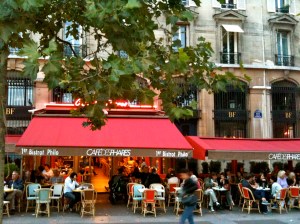
Café_des_Phares,_Place_de_la_Bastille,_Paris
The Cafe des Phares on Place de la Bastille, the home of the first Café philo. Picture attribution: “Café des Phares, Place de la Bastille, Paris” by Booklover206 – Own work. Licensed under CC BY-SA 3.0 via Commons (link at bottom of page)

I’ve finally found the Paris of my dreams!  When Americans come to Paris, we dream of going to parties with people who have strong opinions about Sartre versus Bernard-Henri Lévy and are very familiar with the history of the cinema.  We also dream of sitting around cafes discussing weighty stuff with people.  I haven’t figured out how to get invited to any of those parties, but I found out how to do the cafe thing.

There’s this thing called a “café philo,” or Philosophical Cafe.  These are public meetings to talk about philosophical matters, typically (as you might guess, although not always) in a cafe.  The format can vary–sometimes there’s a pre-selected topic, and sometimes people suggest and vote on topics at the beginning of the meeting.  The Cafés philo are actually a movement that started in Paris in the 1990s at the inspiration of the philosopher Marc Sautet.  (The English Wikipedia page on Sautet relates that he briefly offered consulting services on philosophy to businessmen, at rates about equal to those of a psychoanalyst–the most French business idea that I’ve ever heard of.)  The Cafés philo aim at a democratization of the practice of philosophy, and have spread all over France and elsewhere, notably South America.

Anyone can, and does, come to these things.  Attendance at one that I went to this weekend included:

  • An old guy in a tweed jacket and severe glasses
  • A pale-faced, blonde Polish cardiologist (charming accent) wearing a stunning knee-length caracol winter coat
  • A pompous guy in a black turtleneck
  • A smoking-hot college student
  • A young African guy
  • A clearly crazy guy with a long gray beard wearing a peacoat like a cape, pants rolled up to his knees, and white knee-length stockings (he talked to himself through the whole thing)

Topics are wide-ranging.  Here are some of the topics that were voted on at the beginning of one that I went to this weekend:

  • Are existing and living the same thing?
  • Why are you afraid to die?
  • The end of carefreeness?
  • Language is the house of my master (might have been language and the house of my master–no matter which it was, I couldn’t make any sense out of it)

We finally ended up with “is a life lived only for oneself worth living?”  Opinions varied; the only thing I can recall hearing broad agreement about at one of these things is that utilitarianism is sucky–and “Anglo-Saxon.”

How I discovered the Cafés philo, and how you can find them for yourself: Meetup.com.  This turns out to be a great way to deal with the isolation of being a foreigner in France, as you can connect with groups of people doing all sorts of things.  Scroll through the list of things happening in Paris and you’re likely to find something of interest.  Language-sharing groups abound, as do things for expats.  I found a number of computer-science-related things, and…the Cafés philo, of which there are several in Paris, meeting at different times and places.

The most surprising thing to me has been how fun these things are.  My previous exposure to philosophy has mostly been pretty dry and pedantic–fussy, even.  In contrast, the Cafés philo are animated affairs, with perhaps a young college student in the back waving his arms to be called on to share his thoughts on why obstacles are necessary to happiness, or a really pithy insight being followed by applause.  I had a great time!  As one of the speakers pointed out, the point is to live life–philosophy is just a way of learning how to do that.  A variety of beverages were consumed, people laughed (at one point I think I heard the joke about the Jew stranded alone on a desert island with two synagogues, one of which he goes to on the Sabbath, and the other which he wouldn’t set foot in–many of the Jews I know love telling this joke–although I have trouble understanding the guy who was telling it because he’s missing some teeth, and I assume it was the joke mostly on the basis of keywords), and afterwards those who feel like it go out for lunch or dinner together.

People at these things tend to be thrilled to show off their English when they find out that you’re American, but these things basically take place entirely in French, unless you go to one that is specifically advertised as being in English (there’s at least one in Paris, but they’re in the minority, and I’ve never been to one, so I can’t tell you what the attendance is like).  So, this experience is going to be most enjoyable for someone with a pretty good command of the language.  (I understand maybe 80% of what’s going on, and unfortunately, the 20% that I miss always seems to be the most important part.)  As you can imagine, Zipf’s Law strikes constantly in one of these things–I would have had trouble following a technical philosophy discussion even in my native language, and it’s far worse in a second language.  Here are some words that I had to look up (translations from the Collins French-English dictionary, Kindle edition):

  • le bonheur: happiness.  “Happiness” was the main topic of conversation at the café philo that I went to Saturday night, with definitions ranging from the metaphorical to the purely ontological.
  • la morosité: (sadness) morosity, gloominess; (of a person) sullenness; (of an economy or market) sluggishness.  The person running one of the cafés philo that I went to this weekend commented on how odd it felt to be talking about happiness in the light of the morosité of recent weeks, since the attacks of 13/11.  (First definition from WordReference.com.)
  • l’insouciance (f.): (absence de soucis) carefreeness, carefree attitude; (irresponsabilité) carelessness.
  • l’excitation (f.): excitement.
  • l’enthousiasme (m.): enthusiasm.
  • la méfiance: distrust.
  • la désespoir: despair; hopelessness.
  • demander la parole: to ask to speak (WordReference.com)
  • prendre la parole: to take the floor, to speak (WordReference.com)
Picture source: https://commons.wikimedia.org/wiki/File:Caf%C3%A9_des_Phares,_Place_de_la_Bastille,_Paris.JPG#/media/File:Caf%C3%A9_des_Phares,_Place_de_la_Bastille,_Paris.JPG

What are you talking about??

How a computer knows what you’re asking about when you ask it a question.

nuage-wordle
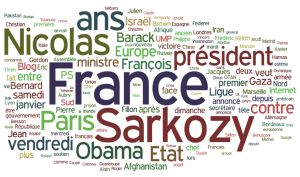
A “word cloud” showing named entities. Picture source: http://www.tal.univ-paris3.fr/plurital/travaux-2009-2010/bao-2009-2010/MarjorieSeizou-AxelCourt/webservices.html.

Recently we’ve been talking about questions—in particular, some of their weird social dynamics (see this, too) and how you can get computers to answer them. In one post, we talked about the fact that you can get computers to answer factoid questions, but the computer has to be able to figure out what you’re asking about. In that post, we talked about how the computer can help itself to do this by figuring le focus and le thème of the question—for example, that When was Mozart born? is looking for some expression of time.

Another thing that computers can do is to recognize what we call named entities in the question. A named entity is a mention of some specific semantic class of things. For example, Mozart is a named entity, specifically a person; National Institutes of Health is a named entity, specifically an organization; Paris is a named entity, specifically a place. If a computer knows that something in a question is a named entity, then it knows that it is likely to find the answer to a question in a sentence that contains that named entity. Here’s the intuition behind the approach: given a question like When was Mozart born?, we don’t care that much about sentences that contain the words when or was, but sentences that contain Mozart might be useful to us. The way that the computer can tell that it should care about Mozart more than it cares about when or was is by recognizing that Mozart is a named entity.

In a previous post, we ran across the term repérage d’entités nommées, meaning “named entity recognition” (more literally, spotting or finding). Here’s another way of saying the same thing, from the French Wikipeda page on named entity recognition:

La reconnaissance d’entités nommées: named entity recognition.

La reconnaissance d’entités nommées est une sous-tâche de l’activité d’extraction d’information dans des corpus documentaires. Elle consiste à rechercher des objets textuels (c’est-à-dire un mot, ou un groupe de mots) catégorisables dans des classes telles que noms de personnes, noms d’organisations ou d’entreprises, noms de lieux, quantités, distances, valeurs, dates, etc.

“Named entity recognition is a sub-task of the extraction of information in document corpora. It consists of searching for textual obects (that is to say, a word, or a group of words) categorizable into classes such as names of persons, names of organizations or enterprises, names of places, quantities, distances, values, dates, etc.”

He’s an adult

In the birthplace of Existentialism, you really are responsible for yourself.

2015-12-02 11.14.28
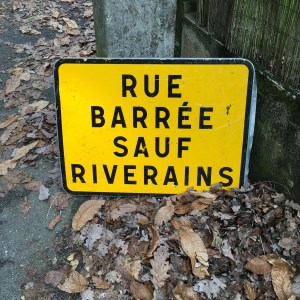
“Road closed except for residents.”  This was the sign at the construction site (read the post).  Picture source: me.

One of the things that I appreciate about France is that the French treat their citizens as if they have common sense and can think for themselves.  Some examples:

  • Recently, the news in the US was full of the fact that so many “love locks” had been attached to the Pont des arts bridge in Paris that the railing along the side had fallen down.  While waiting for it to be repaired, the French authorities put a rope in front of the fallen section of railing.  I’m pretty sure that in America, the entire bridge would have been closed down.  From a French perspective: what kind of idiot would walk off the side of a bridge?  You’re not stupid enough to do that, and even if you are, should I block off the entire bridge for everyone?
  • I was recently sitting up late at night (well, late for me, which means it was probably about 9 PM) with a bunch of people in Japan, having a drink.  There was an Italian, an Norwegian, a Korean, a Japanese guy, and a French woman–of course, we were speaking English, that being the only language that everyone had in common.  One of the guys got up to go take a soak in the onsen, one of the famous Japanese baths.  One of the other guys said, “oh, no–you shouldn’t do that when you’ve been drinking!”  The French woman’s response was very characteristic: “he’s an adult.”  That, my friend, is the essence of France.
  • The one road that leads from the train station to my campus is torn up right now due to a construction project.  I walked up to the foreman the other day and asked if I could pass through the road.  Sure–no  problem.  In America, the entire road would have been blocked off–here, the foreman just assumed that I would have the sense to walk around the power shovel, rather than under it.

Nothing in life happens without Zipf’s Law coming into play.  Here’s the word that I learnt that morning.  Definitions from WordReference.com.

  • le riverain: inhabitant, local.
  • riverain (adj.): bordering, stretching along; riverside, waterside; riparian.

Political maneuvering to keep the extreme right out of power in the French regionals

The far right did well in the first round of regional elections, but the rest of France hasn’t given up the fight.

Screenshot 2015-12-09 07.27.24
“If the left and the right don’t manage to get along in order to obstruct the extreme right, there will be reason to lose hope in our politicians.” Picture source: Twitter screenshot.

The Word Of The Day in France is faire barrage.  WordReference.com translates it as “to stand in the way, to obstruct.”  Sunday was the first tour–the first round of votes–in the 2015 regional elections.  The second tour will be this weekend.  In the first tour, there were an enormous number of parties participating.  In the second tour, only the three highest-scoring parties in any région can participate.  The far-right National Front party had a huge showing in the first tour.  The left and the center right share a concern with stopping it in the second tour, and there are many strategies to faire barrage à the National Front–to block it (from taking power).  For example, in a number of areas of France, the Socialist party is urging its members to vote for the center-right Les Républicains–normally their sworn enemies, but if it will keep the far right out of office, the Socialist prime minister will support it. Consequently, the expression faire barrage is all over the news this week.  The center right is saying that it won’t join with the left, but it’s the one that’s benefitting, so presumably this is going to happen.  I hope…

  • le barrage: dam, floodwall; barrier, roadblock.  (There’s also a sports-related meaning that I don’t even understand in English.)
  • faire barrage (à): to stand in the way (of), to obstruct.

America doesn’t suck, but Donald Trump does

Discriminating against people because of their religion is evil. Donald Trump discriminates against Moslems. Donald Trump is evil.

Donald Trump is an American real estate developer, a very rich man, a reality TV star, and a candidate for the Republican Party nomination for the 2016 presidential election.  In fact, for some months, he has been the frontrunner for the Republican Party nomination.  He is a horrible person.

The specific evidence that Trump is a horrible person: he is currently using the stump to shop the idea that Muslims should be banned from entering the country.  Here’s one of the things that make America great: it’s illegal to discriminate against people because of their religion.  (For example, here’s a lengthy description of the prohibition against discrimination in hiring because of religion.)  Why is it illegal?  Because discriminating against people because of their religion is bad.  It is evil. 

Trump’s statement has triggered outrage in the United States.  You’ll hear people point out that it’s stupid because we have Muslims fighting and dying for America in the US military (15,000 currently serving, according to Wikipedia).  You’ll hear people point out that it’s stupid because only the tiniest, tiniest minority of Muslims support terrorism.  All of these people are right–but, they’re missing the point.  The point is that discriminating against people because of their religion is bad.  It is evil.  Yes, I’m repeating myself–this bears repeating.  I generally keep my politics out of this blog, but I can’t imagine keeping silent about this.  It’s wrong to discriminate against Catholics because of their religion.  It’s wrong to discriminate against Jews because of their religion.  It’s wrong to discriminate against Muslims because of their religion.  It’s wrong to discriminate against Mormons because of their religion.  It’s wrong, and it’s not American.  It never has been, and I hope that it never is.

Zipf’s Law comes up in a discussion of Donald Trump like it does anywhere else.  Here are some words from the French Wikipedia article on fascism:

Le fascisme est un système politique autoritaire qui associe populisme, nationalisme7 et totalitarisme8 au nom d’un idéal collectif suprême. À la fois révolutionnaire et conservateur, il s’oppose frontalement à la démocratie parlementaire et à l’État libéral garant des droits individuels9,10.

“Fascism is an authoritarian political system that brings together populism, nationalism, and totalitarianism in the name of an ideal supreme group.  Revolutionary and conservative at the same time, it is head-on opposed to parliamentary democracy and to the liberal State that guarantees individual rights.”

  • associer: to associate, to combine.
  • s’opposer à: to be opposed to, to be against; to oppose, to confront; to be contradictory with each other.


The morning after

reste-tranquille-et-nique-les-juif-frère
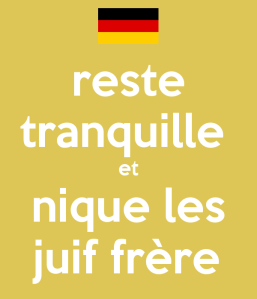
“Keep calm and fuck the Jews, brother.” Picture source: https://www.keepcalm-o-matic.co.uk/p/reste-tranquille-et-nique-les-juif-fr%C3%A8re/. You can order t-shirts, coffee mugs, and even a keyring.

I totally screwed up my commute to work today. I haven’t done that in a year and a half! I looked out of the window of the metro wagon (subway car), and didn’t recognize any of the station names. The buildings were not ones that I had seen before. My immediate suspicion—and I don’t even want to think about what this says about the functioning of my mind—was that the metro had smoothly slipped into an alternate universe. Hm, what to do… A check of the sign above the door verified that I was on the right line. A glance out the window verified that I was going in the right direction. Finally, I asked the teenager sitting next to me if they had recently changed the names of the stations—nope. OK: time to go over the various options again. I took a closer look at the sign above the door. It lists the stops, in order, and I soon found the strange station names that I’d been seeing—and realized that I had missed my stop.

I’d missed my stop because I was deep in thought about yesterday’s elections. In the first tour (the first round of voting), the far right National Front party had placed first in six out of thirteen regions. Not surprisingly, I had been greeted in the metro station this morning, the day after elections that saw the far right take a region that had been held by the Socialists, by the following new piece of graffiti: Vive la France—sans juifs. That’s “long live France—without Jews.”

It’s not a great time to be Jewish in France right now. The right wing has always been anti-Semitic; at the moment, it’s à la mode (fashionable) to be anti-Semitic on the left, too; and, according to The New Yorker’s George Packer’s recent article on the poor suburbs of Paris, the tendency among North African voters is to figure that the far right hates Jews even more than they hate North Africans, so: vote for the far right.

I grew up visibly Jewish—peyos (sidecurls), a yarmulke, all that—so, I am not a stranger to visible expressions of anti-Semitism by any means. I grew up around way too many people with numbers tattooed inside their arms not to know that it can be deadly dangerous. I also have seen it so relentlessly in my own life since then—as an adult with my mother’s French and German Christian looks and tattoos all over my…well, a lot of tattoos, I’m not visibly Jewish, and people often don’t bother to hide racism around me—that I know that most of the time, it’s just assholes. I know that if you don’t go to anti-Semitic places, you will never go anywhere. You most likely won’t be able to stay at home, either.

Everything in the history of Jews in Europe tells you that you have to keep an eye on anti-Semitism–Germany was one of the most civilized, cultured countries in the world–probably the best one for Jews in Europe–right up until it killed 6,000,000 people just like me, just like my grandmother, just like my kid. Everything in the history of everyone in the world also tells you that it’s not adaptive to get freaked out by anything—even malignant assholes. So, no more getting so deep in thought that I screw up my commute–fragility gets you nowhere with this shit. But, I’ll be watching the second tour (second round of elections, with the just the top three placers from the first tour running) pretty closely. I’m totally into the vive la France (long live France) part of that graffiti. But, regarding the sans juifs (without Jews) part: je les emmerde—screw them.

  • le scrutin: poll, polls, ballot, vote, voting, election.

Definition: WordReference.com.

On the transnational adorableness of little kids

Kids everywhere are equally totes adorbs–well, maybe some a tiny bit more than others.

French children dont throw food
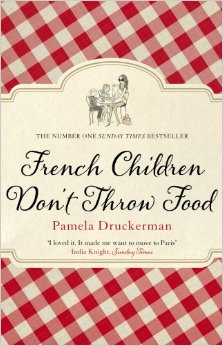
“French children don’t throw food,” by Pamela Druckerman.

I’ve traveled much of the world–I had to count how many countries I’d been in over the past five years to fill out a form a while ago, and at the time, it was 15.  I’ve come to the following conclusion from my travels: adults are definitely not equally attractive everywhere you go, but kids are uniformly, absolutely adorable, absolutely everywhere.

I have to say, though: French kids kick it up a notch.  I’ve always heard about how much better the French are supposed to be at raising well-behaved kids than us Americans are, but I hadn’t actually spent any time with a French child since the mid-2000s.  That all changed this evening.

Hoping to keep myself from spending the entire weekend holed up in my apartment, I bought tickets to three random concerts this weekend–Friday night, Saturday night, and Sunday evening.  I didn’t realize until I showed up at the Philharmonic today that the Sunday evening thing was a “family, participatory” event.  So, there I was: 799 parents with kids, plus me, listening to Le Bourgeois Gentilhomme, both Strauss and Lully versions.

In the US, this whole experience would have been hell, I think.  In Paris, it was a totally different situation.  For two hours, those kids sat and listened politely.  When it was time for everyone to get up and either dance or bang on a drum, selon their assignment, everyone got up and either danced or banged on a drum, with great enthusiasm.  Through the whole thing, there was no talking, no whispering, no video games, and no whining–I think I heard what was probably a two-year-old wail at one point, and that was it.  Perhaps I am unfair to my compatriots, but I am pretty sure that in the US that audience would have been a sea of pouting, whining, talking, Candy Crush, and parents surreptitiously checking their emails.  Please don’t think I’m claiming that French children are a bunch of little angels–Adam Gopnik describes the French playground as Lord Of The Flies.  But, their behavior around adults can be impeccable, which is a hell of a lot more than I can say about my own kid.

So, yeah–all kids everywhere are equally adorable, but some have that little bit of charm–and good behavior–that makes them…just a teeeny bit more.

Of course, Zipf’s Law visits us at the Philharmonie de Paris, just as it does anywhere else:

  • la sonorité: (of an instrument) sound, tone.


PDA

doisneau_kiss
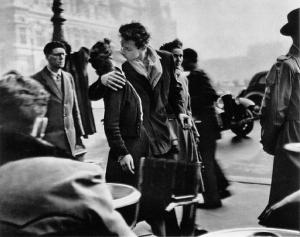
Robert Doisneau’s famous photograph “The kiss by the Hôtel de Ville.” It was staged–as Doisneau said, “I would have never dared to photograph people like that. Lovers kissing in the street, those couples are rarely legitimate.” Picture and quote source: https://iconicphotos.wordpress.com/2009/05/08/le-baiser-de-lhotel-de-ville/.

While doing my shopping today, I saw a couple kissing on the street. Despite Paris’s reputation as the most romantic city in the world, this is unusual—kissing in public isn’t really a thing here. Debra Olivier explains in her book What French women know: About love, sex, and other matters of the heart and mind that there’s actually only a limited window of time in a relationship in which it’s really OK to kiss in public in France. Before you start sleeping together you don’t know each other well enough, and after you start sleeping together it’s thought of as an ostentatious show of the fact that you’re in a relationship, so you only get that small period of time in between to lock lips in public. The couple looked to be in their 40s, so it’s likely that either they were in that little window, or they were American.

As I said, I ran into the young lovers while doing my shopping, and I never do my shopping without running into Zipf’s Law. Here are the words that I learnt in the process of picking up groceries today. (Translations from WordReference.com.)

  • le céleri: Pronunciation: [sɛlʀi], despite the accent aigu. I checked it in two places.
    • le pied de célerie: bunch of celery. (Literally, it’s “a foot of celery.”)
    • la branche de céleri: celery stick.
  • la betterave: beet.

If you’re French and you don’t get the title: “PDA” is “public display of affection.” It has its very own abbreviation because it’s forbidden in certain contexts—students in some high schools, members of the military in uniform, stuff like that.

No theorbo–wake up the dawn!

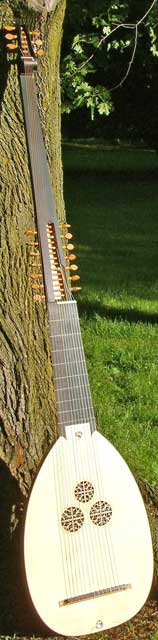
Theorbo-ref
A theorbo. Picture source: “Given by Cezar MAteus (the author of the instrument) expressly for Wiki”

I learnt a great expression from the Coffee Break French podcast once upon a time. Rester cloîtré means something like “to stay holed up”—you might recognize the English cognate cloister, a place where nuns or monks stay in isolation. As I’ve said, it is mostly dark in Paris in the wintertime, and without some incentive to leave the house, I can spend an entire weekend en restant cloîtré dans mon appartement—holed up in my apartment–reading, hanging up laundry to dry, and napping (minus the obligatory weekly shopping trip on Saturday morning).

I’m hoping to avoid that this winter–starting with this weekend–so, I blew about $50 US on tickets to the Paris Philharmonic for Friday night, Saturday night, and Sunday. I didn’t even look to see what was being played—I just knew that I needed to “get out of the house,” as we say in my native language. It mostly turned out OK. Saturday night is Louis XIV et ses musiques—Louis the Fourteenth and his musics. I like motets, so that should be cool. Sunday night is Le bourgeois gentilhomme. I’m not that into Strauss, but they’ll also do the Lully version, and that should be cool. Friday night, though—tonight was another story. Tonight was…an educational experience.

I rushed in the door late, having no idea what I had bought tickets to. Showing up late for a concert in France turns out to be a more linguistically intensive experience than one would think, as I was handed off to a succession of ushers hissing, in rapid French, things like this way, please, sir! No, don’t follow me—follow him! You have to wait a minute before I can seat you. There’s a seat open at that end that I can get you to easily, or do you want to stay here? (I think that’s what they were saying, anyway—it could have been who the fuck do you think you are, showing up late?  My French isn’t actually that great.)

I’ve spent much of my adult listening life assiduously avoiding modern classical music. My tastes run more to a theorbo/harpsichord duet, perhaps with a nice soloist singing in Italian that I don’t understand. I never really got atonality, arhythmicity, discordance. Wasn’t I surprised to discover that I had just taken the metro all the way across town on a Friday night to listen to a full evening of the stuff.

I loved it! I learnt something: you have to hear that kind of music live. I never understood before that there is a rhythm to that stuff—you just have to be able to watch the conductor’s body move in order to be able to understand it. Those seemly random bangs, clashes, and screeches? They’re an incredibly carefully orchestrated (sorry) sequence of tightly timed interactions between musicians who have none of the structural or melodic cues that you get in a normal musical piece for a group (orchestral music, sorry—I couldn’t bring myself to use the word again) that let you anticipate where you’ll come in and drop out.  There’s a feeling in the air when a group of musicians finish playing something fun.  I felt it in the concert hall tonight.

One of the pieces (Calmo, by Luciano Berio) involved a mezzo-soprano singing. The lyrics were a pastiche of different poetic pieces. For some of the Zipfian obscure vocabulary items that I had to look up today, I’ll give you the first verse, because it’s actually a nice tie-in to the darkness of the Parisian winter and the joy that I feel when I see the sun rise in the morning here:

Mon cœur est affermi My heart is strengthened
Mon âme chante My soul sings
Réveillez vous, mon luth et ma harpe! Wake up, my lute and my harp!
Je veux éveiller l’aurore I want to awaken the dawn
Cantique des cantiques, par Salomon Song of Songs, by Solomon

The translation is by me, so take this with a bit of salt, but: my recollection is that the Hebrew words are “I will see the morning.” I think I like this version better–the idea of waking up the sun is very powerful.

  • affermir: to consolidate, to strengthen; to firm up
  • éveiller: to arouse, to awaken

Definitions from the Collins French-English dictionary, Kindle edition.

Defy and define the darkness

What it looks like outside my office window right now. Picture source: http://www.ledr.com/colours/black.htm

Look at how a single candle can both defy and define the darkness.

–Anne Frank, from goodreads.com

Adam Gopnik, the best expositor of the American experience in France for my money, says in his book Paris To The Moon that the main difference between New York and Paris is that Paris is at a much more northern latitude, and therefore the days of darkness are much longer in wintertime in Paris than in New York. This has its disadvantages: I find that the darkness sucks the life and energy out of me. In the Paris summertime, I am out and about constantly. In contrast, in the wintertime, it’s pretty much what Parisians call métro, boulot, dodo for me–go to work, come home, eat, read for a bit, and then to sleep.  Not the most exciting life.

There’s a plus side to the short days, though: in wintertime in Paris, I never miss a sunrise. Every morning, riding the train to the southern suburb where I work, I watch the sun break over the horizon and get a shot of beauty in my morning. Quite lovely, really.

We talked about words for sunrise, sunset, etc. in a previous post, so let’s focus on words for darkness, instead.  (Definitions from WordReference.com.)

  • l’obscurité (f.): darkness, e.g. after sunset.
  • les ténèbres: darkness, but literary or figurative.

To check the difference between these, I just pointed out the window–it’s 5:42 PM here, and literally as black as night–and asked my office mate what to call it.  Obscurité, he said.  [Crap–this means that I’ve been using the wrong word for “darkness” for the past year and a half.]  He came up with the word tenebrous as an English cognate (I didn’t know how to pronounce it, either–turns out the stress goes on the first syllable), and remarked that French has not just the noun, but also an adjective, ténébreux.  He explained that the adjective is an interesting word because in addition to meaning things like “gloomy,” which you would expect, it can actually be positive when applied to a human–it connotes a certain power and mystery.

To the symphony tonight–must defy the #%^*! darkness. 

Ukrainian Humanitarian Resistance

Resisting the russist occupation while keeping our humanity

Languages. Motivation. Education. Travelling

"Je suis féru(e) de langues" is about language learning, study tips and travelling. Join my community!

Curative Power of Medical Data

JCDL 2020 Workshop on Biomedical Natural Language Processing

Crimescribe

Criminal Curiosities

BioNLP

Biomedical natural language processing

Mostly Mammoths

but other things that fascinate me, too

Zygoma

Adventures in natural history collections

Our French Oasis

FAMILY LIFE IN A FRENCH COUNTRY VILLAGE

ACL 2017

PC Chairs Blog

Abby Mullen

A site about history and life

EFL Notes

Random commentary on teaching English as a foreign language

Natural Language Processing

Université Paris-Centrale, Spring 2017

Speak Out in Spanish!

living and loving language

- MIKE STEEDEN -

THE DRIVELLINGS OF TWATTERSLEY FROMAGE