Maslow’s hierarchy of Americans on airplanes

We all learnt about Maslow’s hierarchy of needs in college. Your most basic needs are physiological; next, safety; and so on, up to self-actualization. What is less commonly known is that there is a hierarchy of Americans on planes to and from France. Going there for work is way cooler than going there as a tourist, for instance. Amongst people going there for work, my gig at the National Center for Scientific Research ranks highly, but not as highly as that of the guy who I sat next to coming home from Paris this weekend, who was there to work on nuclear weapon security issues with Interpol. That’s really cool. Of course, I knew all of this only because like me, he was an American, and might actually exchange life facts with the person sitting next to him on an airplane—unlike a Frenchman, who wouldn’t dream of having a personal conversation with a stranger in that environment. Here are some random words that I ran across while working my way through a book about serial killers on the plane. (P.s.: in the hierarchy of Americans on planes, reading something in French bumps you way up, although wearing a beret would bump you way, way down.)

  • en tant que: As (a).  We actually ran into this one a few posts ago, but it bears repeating.  En tant que médecin, il était bien placé pour commettre plus de deux cent cinquante meurtres sans éveiller de soupçons.  “As a doctor, he was well placed to commit over 250 murders without arousing suspicion.”  (Note: this is taken from the bilingual book Meurtres à l’anglaise, by Ross Charnock.)
  • éveiller de: to kindle, stimulate, arouse.  (See above.)
  • le porte-parole: spokesperson, representative.  Selon le porte-parole de la police de Manchester…  “According to the spokesman for the Manchester police…”
Ces bottes sont faites pour marcher: buying flowers in Paris

"These boots are made for walking," from the recording by Michèle O.
“These boots are made for walking,” from the recording by Michèle O.

One of the little pleasures of being in Paris is being able to buy nice flowers quite inexpensively.  On Saturday mornings, I go to the fleuriste across the street from the apartment, where a wide selection of flowers is available for 2 euros (currently $2, usually about $3) a bouquet.  The sign advertising the flowers always confused me: it says that the flowers are 2 euros per botte, and as far as I ever knew, that means “boot,” as in Ces bottes sont faites pour marcher“These boots are made for walking.”  It turns out that it has other meanings when talking about plant-related materials:

See this music video by singer Michèle O for a great rendition of Ces bottes sont faites pour marcher (“These boots are made for walking”) in French.

Plus de français, mais plus de fautes: More French, but no more errors

As is the case in English, French spelling only gives you a clue as to the pronunciation.  Recently I ran across two words that are spelt the same, but pronounced differently.  In a real linguistic tour de force, these words are each other’s opposites!  They are plus, with the s pronounced, and plus, with a silent s.  Plus-with-an-s means “more,” while plus-without-an-s means “no more.”  Of course, being French, there are complications that ensue when the following word begins with a vowel, which typically leads to the pronunciation of the final consonant of a preceding word.

Before proceeding, I should point out that (1) I first heard about this phenomenon in William Alexander’s book Flirting with French: How a Language Charmed Me, Seduced Me, and Nearly Broke My Heart, and that (2) this blog post is almost entirely taken from one of the excellent “Learn French with Pascal” series of YouTube videos.  Here’s the link: https://youtu.be/wf6LculPOOg.  I should also mention Pascal’s web site, which can be found at http://www.frenchspanishonline.com/.  I’m going to add some occasional phonetic transcriptions (which you can recognize by their being in square brackets []).  (Note that in the International Phonetic Alphabet, the high tense front rounded vowel is transcribed with a [y], and that’s what I’ll be doing.  I would do more transcriptions, but I mostly don’t know how to type IPA on my Mac keyboard.) Let’s get to the details.

If the meaning is “no more:” the s is silent.  Thus:

  • J’en veux plus: I don’t want anymore.
  • T’as plus soif? You’re not thirsty anymore?
  • J’ai plus d’argent: I don’t have any more money.
  • Plus de vin!  No more wine!
  • But: if the next word starts with a vowel, then the s is pronounced, but as a z: Tu n’a plus [plyz] à t’inquiéter “you don’t have to worry anymore.”

Now, let’s consider the word with s pronounced.  It can mean “plus:”

  • Trois plus deux font cinq.  “Three plus two make five.”

…or “more:”

  • J’en veux plus “I want more”

What if there’s a following consonant, though?  Now we DON’T pronounce it, so “more quickly” is plus rapidement [ply rapidmã].  BUT, if there’s a potential for confusion, you can pronounce it.  So, we saw above that plus de vin [ply] means “no more wine,” and “more wine!” would be written the same–plus de vin, but  according to the generalization that even plus meaning “more” is pronounced [ply] (no s) when it precedes a consonant, we would expect them to be pronounced the same, too.  However, to avoid the confusion, you can pronounce the s.

Finally, let’s look at a couple of multi-word expressions.  There’s a distinction between plus que with an s pronounced, and plus que with a silent s.

  • plus que with the s pronounced means “more than.”  Plus que dix minutes with the pronounced is “more than 10 minutes.”
  • plus que with a silent s means “only.”  Plus que dix minutes with a silent s is “only 10 minutes.”  Il n’en reste plus que deux, with a silent s, means “there are only two left.”

So, now you know how to understand the title of this post (which, again, comes from Pascal’s excellent video): Plus de français, mais plus de fautes.  The first plus is [plys]–“more French.”  The second plus is [ply]–“no more errors.”  Bon courage, and don’t forget to visit Pascal’s web site at http://www.frenchspanishonline.com/.

Cell phones are a continual source of amusement

Cell phones are a constant source of linguistic delight and discovery for me in France.  An occasional source of hassle, too.  Happily, cell phone service in France is so good and so cheap that I can afford to maintain a French phone number with unlimited calling to the United States all the time–it’s so cheap that I don’t mind paying for it even when I’m at home in the States.  Getting a cell phone in the first place was an exercise in learning lots of new vocabulary and one of those interpersonal experiences that you just have to laugh about.

Once I had my phone in my greasy little hands, all was well for the next several months.  Then someone in China stole my credit card number, and I had to get a new one.  No problem, until I got to France today, turned on my phone, and found a single text message telling me that my account has not been paid, and my phone is henceforth locked.  No mystery there: the account was being paid with my old credit card number, so they need my new one.  So, I go to the web site and begin a long round of phone calls to my credit card company and my French phone company.  The amazing thing is, the calls to the French phone company were far less frustrating than the calls to my American credit card company, despite the fact that I don’t speak French!  In the mean time, I learned some new words on the French phone company’s web site.  They are interesting in that the words are similar, and have related, but different, sets of meanings.  They are the verbs régler and régulariser:

  • régulariser: this verb means to sort out or resolve (e.g. a situation), or to set up or adjust (e.g. a clock).
  • régler: this verb means to to adjust or regulate, and also to sort out, but it has an additional meaning of to pay, settle, or pay off, as in a debt, or a bill.

In the end, despite the super-helpful customer service guy at the phone company, I need to go to the phone company store tomorrow.  We’ll see if it’s as much of an adventure the second time as it was the first time!

Lee Kuan Yew

Sitting here on the plane to Paris, I’ve been able to surreptitiously read the French subtitles on the movie that the gentleman next me has been watching–no problem.  (Apparently I’m no gentleman.).  However, I can’t make it one sentence into the article about the death of Lee Kuan Yew that I’m trying to read on my cell phone without running into Zipf’s Law.  Twice in the same article, I’m running into the same expression: en tant que, which my dictionary tells me means “as.”  Here are the examples from the news story (courtesy of TV5 Monde’s “7 jours sur la planète” iPhone app):

  • Nous sommes vraiment fiers en tant que Singapouriens. “We are truly proud as Singaporeans.”
  • Pendant 50 ans en tant que Premier ministre “During 50 years as Prime Minister.”

Let’s see what other real-life examples we can find to shed light on the situation.  I’ll start with Twitter, as recommended by a colleague at Arizona State University, who will go unnamed, as I don’t have her permission to include her in my little blog:

  • @MelodieMR_ Theo James en tant que Christian Grey please  Seems straightforward enough: “Theo James as Christian Grey, please”
  • @PierreDEHAEN Ce match 7 de la finale sera mon dernier en en tant que juge de lignes international. Also seems pretty straightforward: “This match 7 of the finals will be my last on @LigueMagnus as international line judge.”
  • @itineraireB Anna Oualid rejoint OpinionWay en tant que directrice du Social Media Research Also pretty straightforward: “Anna Oualid rejoins OpinionWay as director of Social Media Research.”

I tried a Google phrase search, but it just gets a bunch of metalinguistic stuff–no actual examples of use.  (This was what motivated my ASU colleague’s advice to use Twitter in the first place.)

OK, so, this is a big digression from Lee Kuan Yew, but that’s the nature of language…

High tense rounded vowels

French has two vowels that we Americans typically can neither hear the difference between, nor produce the difference between.  One is called a high back tense rounded vowel–it’s the vowel in words like food.  The other one is called a high front tense rounded vowel.  We don’t have that one in English–except, some of us do.  Actually, in my dialect, the vowel in food is more of a high front tense rounded vowel.  The problem is, we Americans have either one or the other, but French has both; since we only have one or the other, we can’t hear the difference between them, and we can’t produce the difference between them.

Often when speaking French, in daily life an American can use context to have a good guess about which is being used.  You’re not that likely to confuse j’ai dû (“I had to,” with the front vowel) with j’ai doux (“I had sweet,” whatever that would mean, with the back vowel) in the course of conversation.  Similarly, I would suppose that French people can probably guess which vowel we’re trying to say, even if the failure to distinguish between them does give us a horrendous accent.  However, every once in a while, the difference is crucial, and there’s no way to use context to differentiate.  For example, I’m not the only person in the world to have complained about the difficulty of hearing the difference between au-dessus (with the front vowel), which means “above,” and au-dessous (with the back vowel), which means “below.”  Sigh!  (See the video above for how to pronounce and use these expressions.)

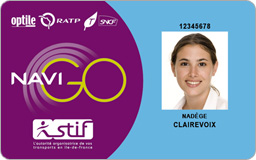
A Pass Navigo.  Yes, there's a picture of you on your Pass Navigo.  No, that's not my Pass Navigo.
A Pass Navigo. Yes, there’s a picture of you on your Passe Navigo. No, that’s not my Pass Navigo.

Awake at four in the morning today–jet lag–I ran into this vowel contrast within a single email.  I was reading a message from the excellent One Thing In A French Day web site about the ordeal of getting the kids up and out the door to school after the spring time change, and having to validate your Pass Navigo.  We’ll get to exactly what the Pass Navigo is in a second–for the moment, let it suffice to say that this email caught my eye, because my Pass Navigo is the major enabler of my freedom of movement in Paris.  The email contained the word pouce, “thumb,” with the back vowel, and puce, “flea,” with the front vowel.  (The words are otherwise pronounced identically.  As we’ll see below, there is a gender contrast, so there can be a contextual clue from that.  But, on with the examples.)

Regarding the travails of getting the kids out the door after the time change, the email tells us: Lisa qui était déjà allongée sur le canapé, avec le pouce dans la bouche, a soupiré.  “Lisa, who was already stretched out on the couch with her thumb in her mouth, sighed.”  Regarding the Passe Navigo, here’s the explanation given in the email: la carte munie d’une puce qui permet de voyager, avec un abonnement, en Ile-de-France.  “The card equipped with a chip that lets one travel, with a subscription, in Ile-de-France.”  (Il-de-France is the part of France in which Paris is located.)

The cafe in my father’s neighborhood isn’t open this early in the morning, so I haven’t even had a cup of coffee, and already I’ve had to grapple with these two challenging vowels!  Here are more subtleties, for those who are interested in the details of the French lexicon:

  • le pouce: thumb; big toe; inch.  As an exclamation: “truce!”
  • la puce:
    • flea
    • In computing: chip
    • In typography: a bullet point
    • (ma) puce: (my) sweetie, sweetheart, darling.

A pleasant conversation in the Colorado late-winter sun

I just had a pleasant conversation in the Colorado late-winter sun with a nice lady from one of our labs. Here are some words that came up:

  • le/la neurologue: neurologist.
  • la vessie: bladder.  Note that it’s pronounced [vesi].
  • la douane: usually this means customs, but my friend used it to mean “border,” as in la douane Américaine–her husband comes from a place near it in Canada.
  • à grande échelle: large-scale.
  • le dossier médical: health record.
  • le moine: monk.
  • avec eux: with them.  It’s really frustrating that for all of my vocabulary development, I still struggle with things like how to use object pronouns correctly.

Interpellations

The Bardo Museum in Tunis, site of yesterday's terrorist attack
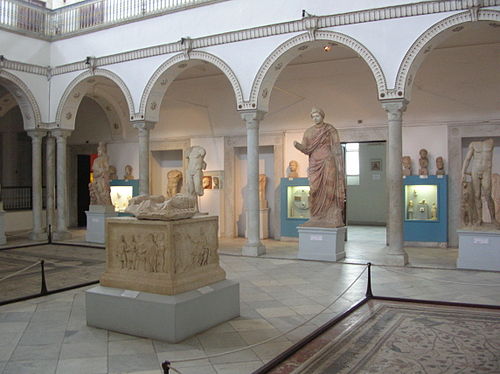
The Bardo Museum in Tunis, site of yesterday’s terrorist attack

It makes my heart ache that once again, I am writing about words that I learnt because of a terrorist attack.  I am reminded of something that Katherine Rich wrote about studying Hindi in India just after the 9/11 attacks (in her beautiful book Dreaming In Hindi):

“We know how to say ‘terrorists killed the man.’ We don’t know the word for ‘side table.'”

Yesterday was the terrorist attack on the museum in Tunisia.  Today I woke up to this headline on my phone:

Vague d’interpellations après l’attaque du musée du Bardo à Tunis

If you know that the Bardo is the museum in question, then you’re probably comfortable with all of this but the word interpellation. 

This word has a number of meanings in English, which you can find here.  (I think there’s an additional meaning in anatomy, where I believe it has to do with something being interleaved with something else, as in interpellated disc, but I actually haven’t been able to find any evidence that I’m not imagining that.)

In French, there are also a number of meanings, mostly related to hostile interchanges.  Let’s start with the verbs:

  • interpeller:
    • (of the police) to take in for questioning
    • (in politics) to interpellate (see English definitions above), to question
    • (= appeler) to call out to
    • (= apostropher) to shout at
  • s’interpeller (reciprocal reflexive): to shout at each other

Now, the noun:

  • (la) interpellation:
    • (by the police) questioning
    • (politics) interpellation, questioning

Sigh…

Charlie Hebdo

Sign distributed by email for printing out and carrying at the demonstration to protest the murders of the Charlie Hebdo journalists and policemen.

The fact that this is my second blog post about vocabulary related to terrorism is quite depressing. For me, the most personal connection to the Charlie Hebdo murders has been the emails that I get on the LIMSI mailing list. They announce plans for the moment of silence, notices about restrictions on access to the building, and, most recently, information for those who want to participate in the “Republican march” on Sunday. Here are some words that might help you read news stories, emails, and the like about the murders at Charlie Hebdo and the kosher supermarket:

  • un attentat: attack; bombing; assassination attempt; assault; offense; outrage. The Charlie Hebdo murders are described in the news as an attentat.
  • boucler: a number of meanings, but in this case, to close off or cordon off. The street where the attacks took place was bouclé afterwards.
  • cacher (also cachère, kasher): kosher. The second attack was at a cacher supermarket.
  • affluence (nf): crowd, crowds. Three routes were planned for the demonstration because of the expected affluence: …en raison de l’affluence attendue, trois parcours
    distincts seront organisés…
  • la banderole: banner, streamer. There will be a banderole for people associated with universities at the march.
  • en deuil: in mourning. See the picture—it’s a sign that was distributed via email for people associated with universities to print out and carry during the demonstration.

A typical Saturday morning in Paris

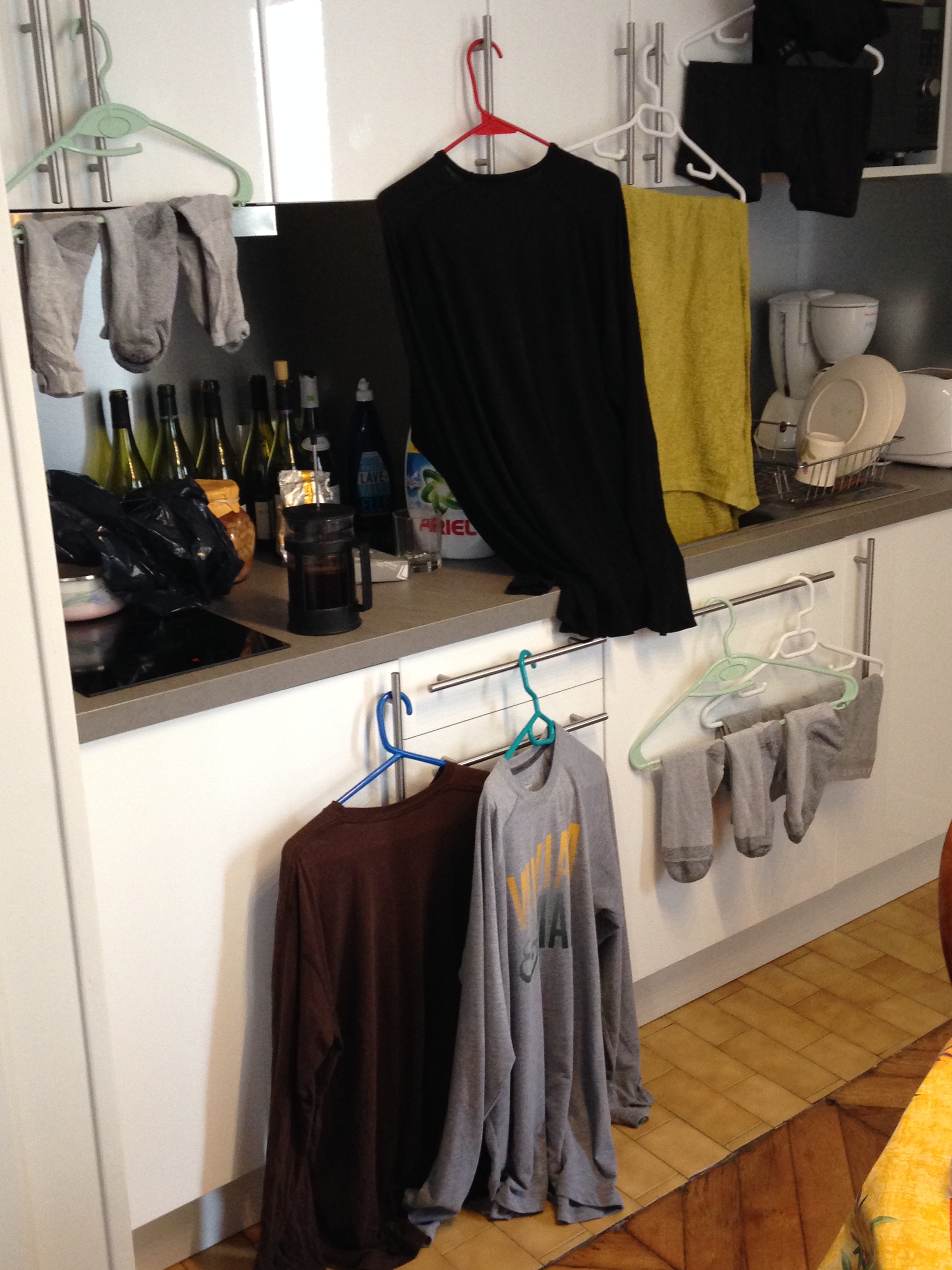
Most things in France can be described with respect to how they are "in theory" and "in practice."  In theory, the small apartment that I rent is super-cute.  In practice, it is usually draped with drying laundry.  Here is my kitchen--the sheets are draped all over the bathroom.
Most things in France can be described with respect to how they are “in theory” and “in practice.” In theory, the small apartment that I rent is super-cute. In practice, it is usually draped with drying laundry. Here is my kitchen–the sheets are draped all over the bathroom.

In general, private time is valued more than work time here, much differently from in the United States.  People are generally not willing to give up their personal time in exchange for a small amount of extra money, so the vast majority of Parisian businesses close quite early, by American standards–by 7 PM, or 8 PM at the latest.  This means that if you work at all past 6 PM and you have a significant commute home, you’re going to have trouble doing any normal shopping.  Additionally, most businesses are closed on Sunday.  So, Saturday is a day when many stores are crowded with people buying all of the stuff that they weren’t able to pick up during the week.

By noon today, I had done two loads of laundry and had been to the fromagerie (cheese shop), the fruit marchand (stall keeper, shop keeper, merchant), the boulangerie (bread bakery, as opposed to a patisserie, or pasty bakery), and the fleuriste (florist), with a final stop at the supermarché (supermarket–actually a very small one, rather than the Monoprix, which, as you may remember from previous posts, is a horrid experience) for the stuff that I couldn’t find anywhere else.  Along the way, I popped into a Middle Eastern restaurant for a quick lamb tongue sandwich–yum.  This leaves me time for a long Saturday afternoon of grading corpus linguistics papers–yay!

  • le/la fleuriste: florist.
Ukrainian Humanitarian Resistance

Resisting the russist occupation while keeping our humanity

Languages. Motivation. Education. Travelling

"Je suis féru(e) de langues" is about language learning, study tips and travelling. Join my community!

Curative Power of Medical Data

JCDL 2020 Workshop on Biomedical Natural Language Processing

Crimescribe

Criminal Curiosities

BioNLP

Biomedical natural language processing

Mostly Mammoths

but other things that fascinate me, too

Zygoma

Adventures in natural history collections

Our French Oasis

FAMILY LIFE IN A FRENCH COUNTRY VILLAGE

ACL 2017

PC Chairs Blog

Abby Mullen

A site about history and life

EFL Notes

Random commentary on teaching English as a foreign language

Natural Language Processing

Université Paris-Centrale, Spring 2017

Speak Out in Spanish!

living and loving language

- MIKE STEEDEN -

THE DRIVELLINGS OF TWATTERSLEY FROMAGE