Lee Kuan Yew

Sitting here on the plane to Paris, I’ve been able to surreptitiously read the French subtitles on the movie that the gentleman next me has been watching–no problem.  (Apparently I’m no gentleman.).  However, I can’t make it one sentence into the article about the death of Lee Kuan Yew that I’m trying to read on my cell phone without running into Zipf’s Law.  Twice in the same article, I’m running into the same expression: en tant que, which my dictionary tells me means “as.”  Here are the examples from the news story (courtesy of TV5 Monde’s “7 jours sur la planète” iPhone app):

  • Nous sommes vraiment fiers en tant que Singapouriens. “We are truly proud as Singaporeans.”
  • Pendant 50 ans en tant que Premier ministre “During 50 years as Prime Minister.”

Let’s see what other real-life examples we can find to shed light on the situation.  I’ll start with Twitter, as recommended by a colleague at Arizona State University, who will go unnamed, as I don’t have her permission to include her in my little blog:

  • @MelodieMR_ Theo James en tant que Christian Grey please  Seems straightforward enough: “Theo James as Christian Grey, please”
  • @PierreDEHAEN Ce match 7 de la finale sera mon dernier en en tant que juge de lignes international. Also seems pretty straightforward: “This match 7 of the finals will be my last on @LigueMagnus as international line judge.”
  • @itineraireB Anna Oualid rejoint OpinionWay en tant que directrice du Social Media Research Also pretty straightforward: “Anna Oualid rejoins OpinionWay as director of Social Media Research.”

I tried a Google phrase search, but it just gets a bunch of metalinguistic stuff–no actual examples of use.  (This was what motivated my ASU colleague’s advice to use Twitter in the first place.)

OK, so, this is a big digression from Lee Kuan Yew, but that’s the nature of language…

High tense rounded vowels

French has two vowels that we Americans typically can neither hear the difference between, nor produce the difference between.  One is called a high back tense rounded vowel–it’s the vowel in words like food.  The other one is called a high front tense rounded vowel.  We don’t have that one in English–except, some of us do.  Actually, in my dialect, the vowel in food is more of a high front tense rounded vowel.  The problem is, we Americans have either one or the other, but French has both; since we only have one or the other, we can’t hear the difference between them, and we can’t produce the difference between them.

Often when speaking French, in daily life an American can use context to have a good guess about which is being used.  You’re not that likely to confuse j’ai dû (“I had to,” with the front vowel) with j’ai doux (“I had sweet,” whatever that would mean, with the back vowel) in the course of conversation.  Similarly, I would suppose that French people can probably guess which vowel we’re trying to say, even if the failure to distinguish between them does give us a horrendous accent.  However, every once in a while, the difference is crucial, and there’s no way to use context to differentiate.  For example, I’m not the only person in the world to have complained about the difficulty of hearing the difference between au-dessus (with the front vowel), which means “above,” and au-dessous (with the back vowel), which means “below.”  Sigh!  (See the video above for how to pronounce and use these expressions.)

A Pass Navigo.  Yes, there's a picture of you on your Pass Navigo.  No, that's not my Pass Navigo.
A Pass Navigo. Yes, there’s a picture of you on your Passe Navigo. No, that’s not my Pass Navigo.

Awake at four in the morning today–jet lag–I ran into this vowel contrast within a single email.  I was reading a message from the excellent One Thing In A French Day web site about the ordeal of getting the kids up and out the door to school after the spring time change, and having to validate your Pass Navigo.  We’ll get to exactly what the Pass Navigo is in a second–for the moment, let it suffice to say that this email caught my eye, because my Pass Navigo is the major enabler of my freedom of movement in Paris.  The email contained the word pouce, “thumb,” with the back vowel, and puce, “flea,” with the front vowel.  (The words are otherwise pronounced identically.  As we’ll see below, there is a gender contrast, so there can be a contextual clue from that.  But, on with the examples.)

Regarding the travails of getting the kids out the door after the time change, the email tells us: Lisa qui était déjà allongée sur le canapé, avec le pouce dans la bouche, a soupiré.  “Lisa, who was already stretched out on the couch with her thumb in her mouth, sighed.”  Regarding the Passe Navigo, here’s the explanation given in the email: la carte munie d’une puce qui permet de voyager, avec un abonnement, en Ile-de-France.  “The card equipped with a chip that lets one travel, with a subscription, in Ile-de-France.”  (Il-de-France is the part of France in which Paris is located.)

The cafe in my father’s neighborhood isn’t open this early in the morning, so I haven’t even had a cup of coffee, and already I’ve had to grapple with these two challenging vowels!  Here are more subtleties, for those who are interested in the details of the French lexicon:

  • le pouce: thumb; big toe; inch.  As an exclamation: “truce!”
  • la puce:
    • flea
    • In computing: chip
    • In typography: a bullet point
    • (ma) puce: (my) sweetie, sweetheart, darling.

A pleasant conversation in the Colorado late-winter sun

I just had a pleasant conversation in the Colorado late-winter sun with a nice lady from one of our labs. Here are some words that came up:

  • le/la neurologue: neurologist.
  • la vessie: bladder.  Note that it’s pronounced [vesi].
  • la douane: usually this means customs, but my friend used it to mean “border,” as in la douane Américaine–her husband comes from a place near it in Canada.
  • à grande échelle: large-scale.
  • le dossier médical: health record.
  • le moine: monk.
  • avec eux: with them.  It’s really frustrating that for all of my vocabulary development, I still struggle with things like how to use object pronouns correctly.

Interpellations

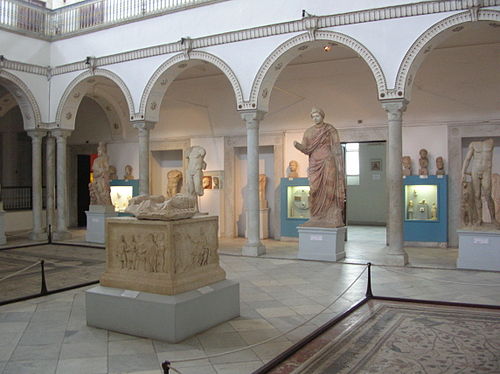
The Bardo Museum in Tunis, site of yesterday's terrorist attack
The Bardo Museum in Tunis, site of yesterday’s terrorist attack

It makes my heart ache that once again, I am writing about words that I learnt because of a terrorist attack.  I am reminded of something that Katherine Rich wrote about studying Hindi in India just after the 9/11 attacks (in her beautiful book Dreaming In Hindi):

“We know how to say ‘terrorists killed the man.’ We don’t know the word for ‘side table.'”

Yesterday was the terrorist attack on the museum in Tunisia.  Today I woke up to this headline on my phone:

Vague d’interpellations après l’attaque du musée du Bardo à Tunis

If you know that the Bardo is the museum in question, then you’re probably comfortable with all of this but the word interpellation. 

This word has a number of meanings in English, which you can find here.  (I think there’s an additional meaning in anatomy, where I believe it has to do with something being interleaved with something else, as in interpellated disc, but I actually haven’t been able to find any evidence that I’m not imagining that.)

In French, there are also a number of meanings, mostly related to hostile interchanges.  Let’s start with the verbs:

  • interpeller:
    • (of the police) to take in for questioning
    • (in politics) to interpellate (see English definitions above), to question
    • (= appeler) to call out to
    • (= apostropher) to shout at
  • s’interpeller (reciprocal reflexive): to shout at each other

Now, the noun:

  • (la) interpellation:
    • (by the police) questioning
    • (politics) interpellation, questioning

Sigh…

Advice for asking for a letter of recommendation for graduate school

As a member of the admissions committee in our graduate program, I read a lot of letters of recommendation.  As a faculty member in a department with a lot of master’s degree students, I also get asked to write a lot of letters of recommendation for graduate programs.  Here is some advice for asking people for letters of recommendation, and helping them write good letters for you.

  1. Remember that writing a good letter of recommendation takes a substantial amount of time.  Writing many good letters of recommendation can take an enormous amount of time.  Keep this in mind when asking for a letter of recommendation.
  2. Be prepared to be asked for a draft of the letter that you want someone to write for you.  This probably won’t happen with letters of recommendation for graduate school, but you will often be asked to write a draft of your own letter if it is for a job, a visa, or things like that.
  3. Think about who you ask for a letter.  When your letter is read by the program to which you are applying, the committee will weight letters differently, depending on the characteristics of the letter writer and the nature and length of your relationship with them.  People who have more experience with you will have their letters taken more seriously than people who have less experience with you.  If you have taken three classes with someone, they are in a better position to write you a letter than someone with whom you have taken only one class.  Think about what your grade was in that person’s class.  Someone from whom you got an A can write you a better letter than someone from whom you got an A-.
  4. Now that you’ve identified a potential letter writer…Don’t ask people if they would write you a letter of recommendation–ask them if they could write you a strong letter of recommendation.  You don’t want someone to say “yes” to a nonspecific request for a letter, and then write you a lukewarm letter.
  5. Now you want to help your recommender write you the best letter possible.  To do this, you want to send them the following three things: (i) the letter that you wrote to the school to which you’re applying, (ii) your transcripts from the program that you’re currently in, and (iii) an example of your research, such as a paper that you wrote for the recommender.  (If you sent the department a resume, then send a copy to the recommender, too.)  (i) is really important.  You customized your letter for every school that you applied to (right?), and it can help your recommender customize your letter.  In particular, you should have identified in your letter at least one specific faculty member who you could see yourself working with.  (If you can’t identify at least one specific faculty member at the school who you could see yourself working with, you probably shouldn’t be applying there!)  If your recommender can see in your letter who you would like to work with, then your recommender can specifically mention that person, which strengthens the letter overall.
  6. Along the same lines: as Chris Brew puts it, really strong recommendation letters follow the “show, not tell” rule.  That is, they mention specific things that the student has done, such as writing a really strong seminar paper or doing a really great analysis.  You can help your recommender do this by repeating back to them their comments to you, e.g. their comments on a paper that you wrote, etc.

    Some additional suggestions, from Laura Michaelis:

    1. Make sure that you waive your right to view the letter, whether through an online recommendation system (like most universities use) or in a hard copy form. The comments of a recommender who is writing a confidential letter will be taken more seriously than those of one who is not.
    2. If you are asking your recommender for multiple letters, make her a list of each and their due dates. Even if she will be getting an email request from each university to which you’ve applied (and most recommendation letters these days are uploaded by the recommender via online systems like ApplyYourself), the recommender wants to see that list.
    3. If there are areas of concern in your transcript or academic history—or even in the degree of fit between you and the program or job–make sure to mention those and counter them in some way in your personal statement, so that the recommender is better able to address those things in her letter. It’s better to speak about an obvious area of concern than to hope no one notices—and this holds both for you and your recommender.

If you need a little bit of comic relief related to this whole process, check out the novel Dear committee members, by Julie Schumacher.  It’s a pretty hilarious epistolary novel which takes the form of a series of letters of recommendation by a curmudgeonly liberal arts professor.  Highly recommended.

Thanks to Chris Brew, Larry Hunter, and Laura Michaelis for feedback on this post.  Some of the suggestions come from them.

How to figure out whether your data can be described by Zipf’s Law or not

vnsrIt’s way harder than it should be to get Google to point you towards instructions for figuring out whether or not your data fits Zipf’s Law.  Since this blog is all about the effects of Zipf’s Law, this seems like a good place to publicize how to do that.  It turns out to be pretty easy, once you’ve learned what it is that you need to do!

1) You’ll want to use R and import the igraph package.

2) Put your data into a vector.  I sorted mine, but I don’t know whether or not that’s required.

3) Pass your vector to the power.law.fit() method.

4) The output will include KS.stat, which is the value for the Kolmogorov-Smirnov test, and KS.p, which is the associated p-value.

5) If your data DOES fit the power law, then your p-value will be greater than .05.  If it’s less than .05, then your data does NOT fit the power law.

For more information on igraph’s power.law.fit() function: http://igraph.org/r/doc/power.law.fit.html

Charlie Hebdo

Sign distributed by email for printing out and carrying at the demonstration to protest the murders of the Charlie Hebdo journalists and policemen.

The fact that this is my second blog post about vocabulary related to terrorism is quite depressing. For me, the most personal connection to the Charlie Hebdo murders has been the emails that I get on the LIMSI mailing list. They announce plans for the moment of silence, notices about restrictions on access to the building, and, most recently, information for those who want to participate in the “Republican march” on Sunday. Here are some words that might help you read news stories, emails, and the like about the murders at Charlie Hebdo and the kosher supermarket:

  • un attentat: attack; bombing; assassination attempt; assault; offense; outrage. The Charlie Hebdo murders are described in the news as an attentat.
  • boucler: a number of meanings, but in this case, to close off or cordon off. The street where the attacks took place was bouclé afterwards.
  • cacher (also cachère, kasher): kosher. The second attack was at a cacher supermarket.
  • affluence (nf): crowd, crowds. Three routes were planned for the demonstration because of the expected affluence: …en raison de l’affluence attendue, trois parcours
    distincts seront organisés…
  • la banderole: banner, streamer. There will be a banderole for people associated with universities at the march.
  • en deuil: in mourning. See the picture—it’s a sign that was distributed via email for people associated with universities to print out and carry during the demonstration.

A typical Saturday morning in Paris

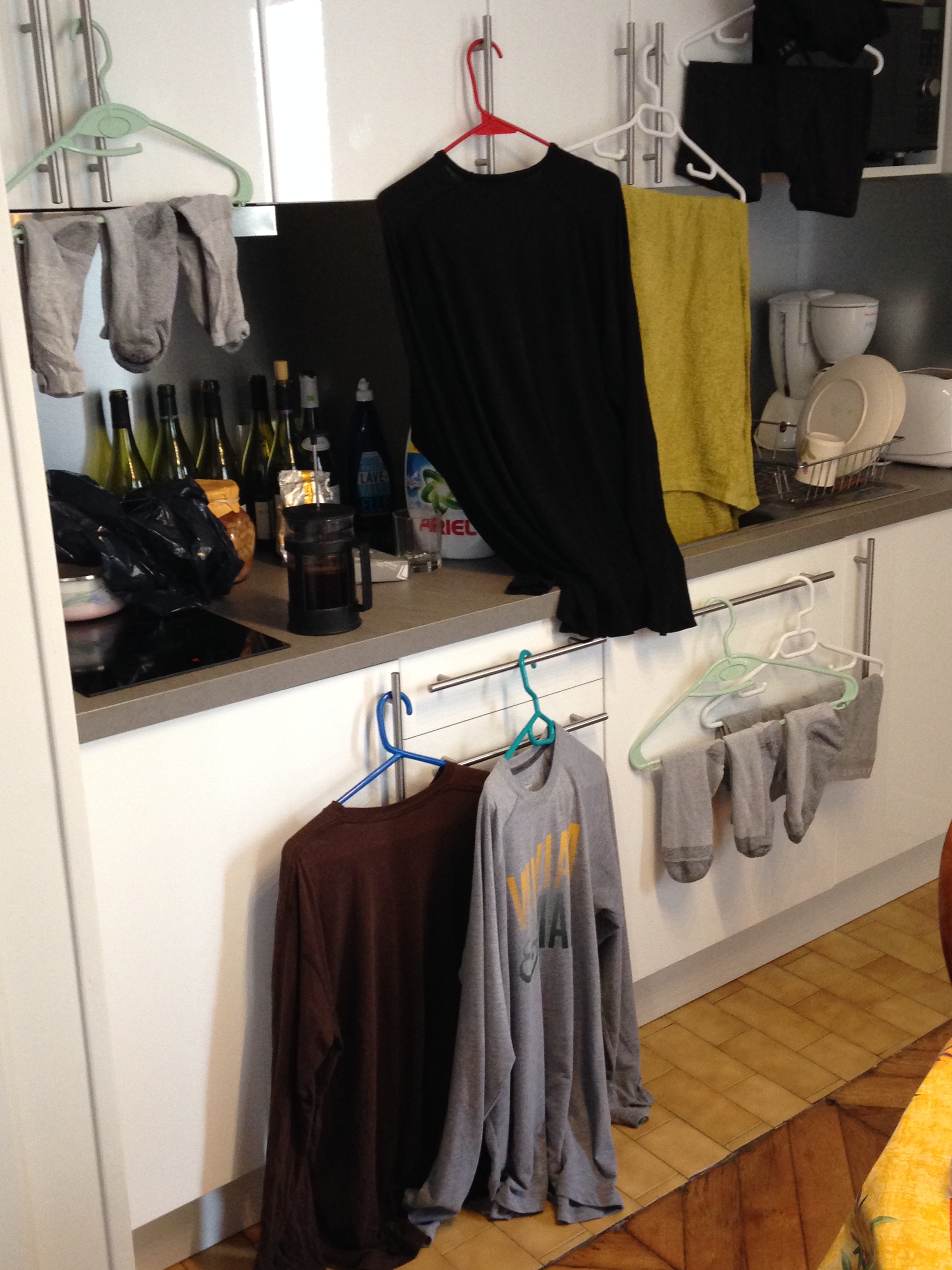
Most things in France can be described with respect to how they are "in theory" and "in practice."  In theory, the small apartment that I rent is super-cute.  In practice, it is usually draped with drying laundry.  Here is my kitchen--the sheets are draped all over the bathroom.
Most things in France can be described with respect to how they are “in theory” and “in practice.” In theory, the small apartment that I rent is super-cute. In practice, it is usually draped with drying laundry. Here is my kitchen–the sheets are draped all over the bathroom.

In general, private time is valued more than work time here, much differently from in the United States.  People are generally not willing to give up their personal time in exchange for a small amount of extra money, so the vast majority of Parisian businesses close quite early, by American standards–by 7 PM, or 8 PM at the latest.  This means that if you work at all past 6 PM and you have a significant commute home, you’re going to have trouble doing any normal shopping.  Additionally, most businesses are closed on Sunday.  So, Saturday is a day when many stores are crowded with people buying all of the stuff that they weren’t able to pick up during the week.

By noon today, I had done two loads of laundry and had been to the fromagerie (cheese shop), the fruit marchand (stall keeper, shop keeper, merchant), the boulangerie (bread bakery, as opposed to a patisserie, or pasty bakery), and the fleuriste (florist), with a final stop at the supermarché (supermarket–actually a very small one, rather than the Monoprix, which, as you may remember from previous posts, is a horrid experience) for the stuff that I couldn’t find anywhere else.  Along the way, I popped into a Middle Eastern restaurant for a quick lamb tongue sandwich–yum.  This leaves me time for a long Saturday afternoon of grading corpus linguistics papers–yay!

  • le/la fleuriste: florist.

Vignettes II

2014-11-30 17.16.59Americans constantly complain about how rude Parisians are.  That’s funny, because Parisians are generally actually quite polite–you just have to know what the rules of interaction are here so that you can recognize them, and so that you can reply appropriately.

One aspect of daily politeness here is that when you enter a shop, you say bon jour (good day) or bon soir (good evening), even if you don’t see anyone.  It’s a little awkward in a big place like a supermarket or a department store, so instead you say bon jour/bon soir to the cashier.  This morning I was in a supermarket line.  When I got up to the cashier, I greeted her with bon jour in my horrible American accent.  Apparently the matron in line behind me was astonished to witness good behavior by an American, because she said élégant!, and gave me a big smile, as well as an au revoir when I left–not typical.

**********

This morning I was waiting for the metro when a middle-aged woman walked up to me.  We were alone in the metro station, so this felt odd.  “Excuse me–you really shouldn’t keep your phone in your pants pocket when you ride the metro,” she said.  “Someone will steal it.  You should keep it in your buttoned jacket pocket.”  (I think that’s what she said–my French got weak at the end of the last sentence.)  I thanked her and put my phone in my jacket pocket.  “Really, not on the metro,” she said, and smiled and walked away.

**********

I stopped at the florist the other evening to buy some flowers.  Leaving, I fumbled with my change, and dropped a 1-Euro coin (about $1.35) on the ground.  It was dark, it was raining, it was cold, and I couldn’t seem to find it, so I shrugged and walked off.  “Excuse me, mister,” said a middle-aged man, and pointed at the ground–right at my coin.  How nice.  I think he might have been carrying a bag that said “judo,” but I was too shy to ask him about it–Parisians typically don’t like to interact with strangers–and have regretted it for days.

Vignettes

As you might recall from previous posts, I climb a serious hill on my way to work every morning.  The other day, I’m working my way up the hill when an elderly gentleman pokes his head out the window and says:

Elderly Gentleman: ça va?  (How are you?)

Me: ça va bien.  (I’m fine.)

EG: ça va bien?  (You’re fine?)

Me: oui, ça va bien.  (Yes, I’m fine.)

EG: bon courage!  (No exact translation–you say this to encourage someone who’s taking on a difficult task.)

Where do people come up with the idea that the French just aren’t friendly?

***************

The steepest part of the hill that I have to negotiate going to and from work is so steep that it’s even hard to get down.  The other day, I’m working my down it after work.  As I gingerly pick my way downhill, I hear a clop-clop-clop-clop coming down the hill behind me, and a woman passes me, running down the hill in heels.  Only in France.  Well, maybe also in Romania or Albania.  But, mostly just in France.

***************

Useful words:

  • chaussures à talons hauts: high-heeled shoes.
  • escarpins (m. n.): also high-heeled shoes.
  • Bon courage: said to encourage someone who’s taking on a difficult task.

Ukrainian Humanitarian Resistance

Resisting the russist occupation while keeping our humanity

Languages. Motivation. Education. Travelling

"Je suis féru(e) de langues" is about language learning, study tips and travelling. Join my community!

Curative Power of Medical Data

JCDL 2020 Workshop on Biomedical Natural Language Processing

Crimescribe

Criminal Curiosities

BioNLP

Biomedical natural language processing

Mostly Mammoths

but other things that fascinate me, too

Zygoma

Adventures in natural history collections

Our French Oasis

FAMILY LIFE IN A FRENCH COUNTRY VILLAGE

ACL 2017

PC Chairs Blog

EFL Notes

Random commentary on teaching English as a foreign language

Natural Language Processing

Université Paris-Centrale, Spring 2017

Speak Out in Spanish!

living and loving language

- MIKE STEEDEN -

THE DRIVELLINGS OF TWATTERSLEY FROMAGE