Mettre en examen: Zipf’s Law, the Poisson distribution, and the wiretapping of Sarkozy

Sarkozy's legal troubles.
Sarkozy’s legal troubles.

If you’ve been following this blog for a while (or read the About page), you know that Zipf’s Law has an effect on vocabularies: every language has a very large number of words that occur only rarely.  The Poisson distribution describes distributions of rare events, and predicts that even rare events will sometimes occur in clusters.  No movie stars die for a year, and then three of them die in a month–that kind of thing.  If you think about the interaction between Zipf’s Law and the Poisson distribution, you have the fact that every day, a second language learner will run across words that they’ve never seen before–a consequence of Zipf’s Law–and you have the likelihood that they will sometimes occur in unexplained clusters–a consequence of the Poisson distribution.

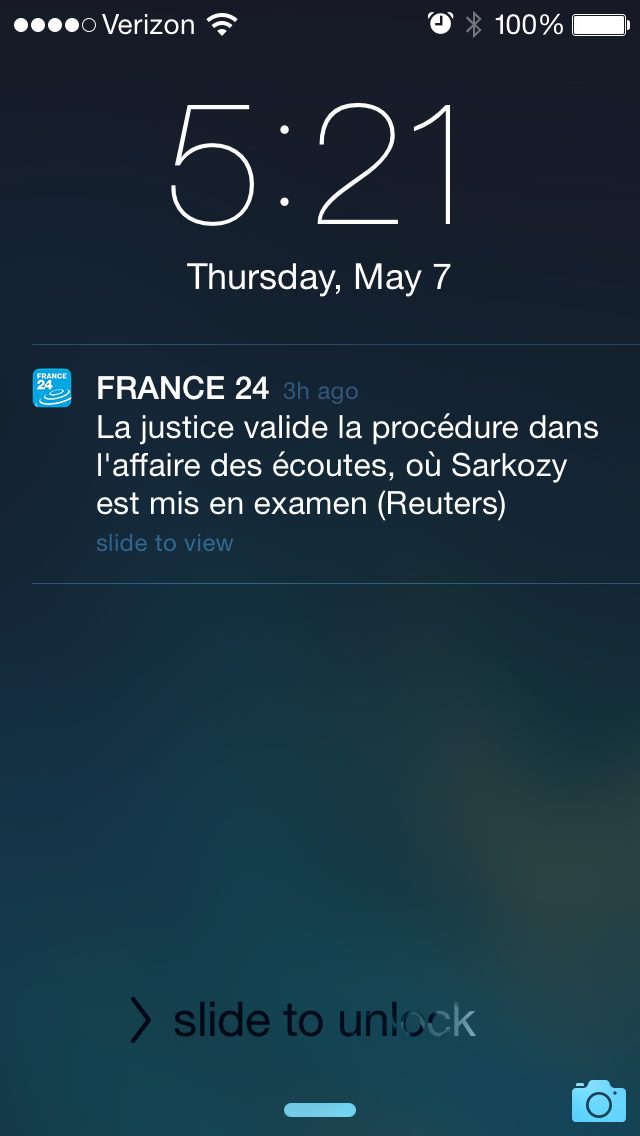
This interaction was illustrated for me today by the expression mettre en examen.  After not having come across it in 16 months of intensive French study, I came across it just a couple of days ago in a book about English serial killers, and then this morning, it showed up on my phone as an alert about a news story about Sarkozy’s legal troubles.  Zipf’s Law + the Poisson distribution: you live into your 50s without ever seeing a word, and then you see it twice in a couple of days, in totally unconnected circumstances.

  • mettre en examen: WordReference.com defines it as “to investigate” or “to place under formal investigation.”  In the book that I’m reading, it was translated as “to suspect.”  I guess I probably trust WordReference.com more, but that is such data as I have.

What about that affaire des écoutes that the news alert mentions?  As you might suspect, the noun écoute is related to the verb écouter, “to listen to.”  It turns out that this noun has a number of meanings, one of which is “wiretapping.”  Former French head of state Nicolas Sarkozy’s calls to his lawyer were tapped during an investigation of suspected influence-peddling, and this has become known as the affaire des écoutes.  Here are some other meanings, from WordReference.com:

  • “oreille attentive”: listening.  Il est à l’écoute de ses clients.  “He is attentive to his clients, he is in tune with his clients.”
  • wire-tapping, phone-tapping: Le journaliste est sur écoute.  “The journalist’s phone is tapped.”  Note the pronoun sur.
  • audience; (TV) viewing figures; (radio) listening figures.
  • There’s an additional meaning related to the nautical speed of a ship, I think, but I can’t quite figure it out.
Apparently I speak French like a Spanish cow

This is probably the best of the
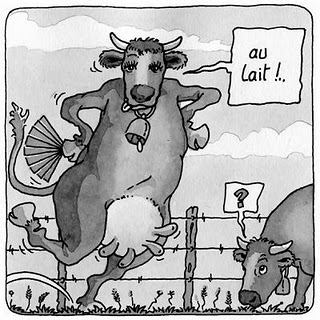
This is probably the best of the “Spanish cow” pictures. The cow is saying “au lait,” which means something like “with milk” in French, and, crucially, is pronounced the same as “olé!”

I’m not that comfortable in French, but I’m told that I speak it “well, for an American.”  It turns out that this means that I speak French about as well as a Spanish cow.  This is the expression for speaking French poorly: parler français comme une vache espagnole, or “to speak French like a Spanish cow.”  I can’t really think of a clever English-language equivalent.

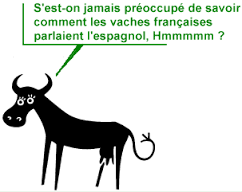
It turns out that if you do a search on vache espagnole (Spanish cow) on Google Images, you find quite a bit of stuff.  I’ve posted some of the better pictures here.

This cow is asking,
This cow is asking, “is no one wondering how well French cows speak Spanish?”
This cow is advertising a web site, which she says will teach you
This cow is advertising a web site, which she says will teach you “to speak Spanish better…than me.”

Visiting Denver for the North American Association for Computational Linguistics conference

The Demon Horse at the Denver airport.

The North American Association for Computational Linguistics annual meeting (NAACL 2015) will be held in Denver, Colorado this year.  Here are some things that I think might be useful or enjoyable for visiting computational linguists, natural language processing people, and the like.  I’m not going to talk about the mountains, Red Rocks, or any of that kind of stuff–you can find that in tourist guides, hotel propaganda, and pretty much anywhere else.  These are some of the things that make life in Denver bearable, and that I don’t think you’ll hear about elsewhere.

Airport:

The Denver International Airport looks quite distinctive.  Opinions differ as to whether it is meant to look like teepees, the Rocky Mountains, or what.  It features in a number of conspiracy theories, which mainly claim that it is built over an underground complex that will be the seat of the government of the New World Order.  On the way from the airport to Denver, be sure to look for the Demon Horse statue.  We call it the Demon Horse for two reasons: (1) it has glowing red eyes, and (2) during its construction, the head fell off and crushed the artist, killing him.

Bookstores:

Here’s a link to a web page listing ten good or great independent Denver bookstores.

Bars:

The classic Denver bar that no one else knows about is El Chapultepec.  Either arrive early, or be prepared to stand all evening.  You can reach it from the conference hotel with a ride down the 16th Street Mall free shuttle and a short walk through a lively neighborhood.  The LoDo area has many bars that are quite busy on weekend nights.  Use caution around the time that the bars close.  Again, you can reach LoDo quite easily from the conference hotel via the free 16th Street Mall shuttle.

Restaurants:

A rare hippie restaurant treat in Denver is the Mercury Cafe, known to us locally as “The Merc.”  It’s a step back into the 1960s, sorta.  Take a cab there, or the light rail–don’t try to walk from the conference hotel, as the neighborhood is not always safe.

Marijuana:

Marijuana is legal here under state law.  You can find it easily; the stores (usually known as “dispensaries”) are typically marked with a green cross or a green marijuana leaf.  However, it is NOT legal under federal law–if you are not an American citizen, don’t take a chance with this.  It’s a legal gray zone, and people do occasionally get burnt.  Also, like alcohol, it is not legal to consume it in public.  (And, no: I don’t indulge!)

Mexican food:

The Denver population is 30% Hispanic, and we have fantastic Mexican food here–also Salvadoran and some Peruvian, if you don’t mind leaving the area of the conference hotel to find it.  Mexican food is an integral part of American food in this part of the country.  A good place to get it is Real de Minas, on Colfax.   Avoid the cheese-smothered burrito platters and have something that’s actually Mexican, like tacos de carne asada, or ribs (costillas) in green chile sauce.  You can get there on the number 15 bus–more on that below.

Decadent snacks:

Voodoo Doughnuts is an import from Portland, Oregon–some of you may remember it from ACL 2011.  Truly amazing doughnuts–be prepared to stand in line.  You can get there on the number 15 bus from the conference hotel.

Local beers:

Denver has a lot of microbreweries, and many good local beers.  One of the main favorites is Fat Tire (which is now nationally distributed, so you may have had it before).

The Number 15 bus:

The number 15 bus goes up and down Colfax Avenue, allegedly the longest street in America, and probably one of the sleaziest.  (Colfax runs quite close to the conference hotel.) Everyone in Denver has a story about the number 15 bus, typically involving a drunk, a drug addict, or vomit.  It’s actually pretty safe, although you should be careful on Colfax at night, as you would in any big city anywhere in the world.  The last stop on the eastbound leg of the route (away from the mountains) is the Anschutz/Fitzsimons medical campus.  Stop by the Biomedical Text Mining Group in the Center for Computational Bioscience for one of the best views of downtown Denver and the mountains that you’ll find.

Safety:

In general, Denver is a pretty safe city.  Aurora is not quite as safe, particularly in the older parts of town.  In general, you should be aware of your surroundings in the evening, as you would be in any big city.

When carrying a backpack is like being kidnapped

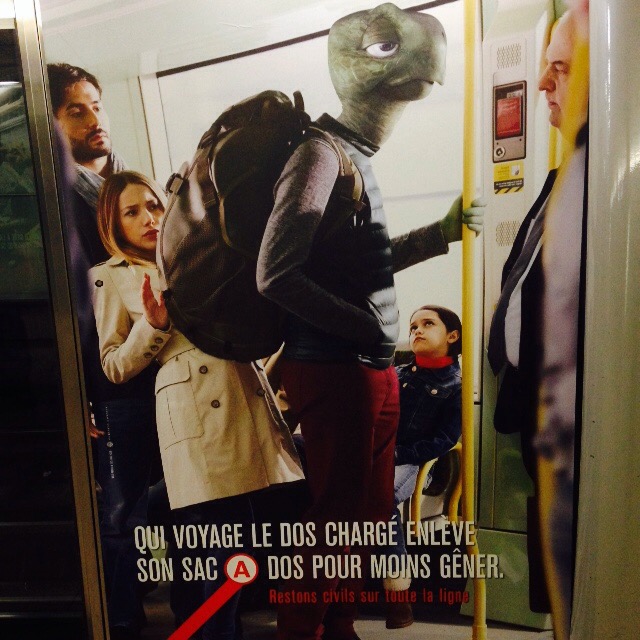
Just one word today: enlever. This word has two meanings. One meaning is to remove. You can use enlever to refer to washing a spot out of clothing, for instance. In the picture of the turtle–a cute sign that was all over the Métro tunnels the last time I was in Paris–it means to remove.  The caption, which rhymes in French, says “he who travels  with his back loaded removes his backpack in order to bother less.”  The other meaning that it can have is to kidnap or snatch. I ran into it this morning in a news story about a little village in Myanmar where women tattoo spider webs on their faces on order to make themselves ugly because a king from a neighboring kingdom once kidnapped one of them and forced her to become his wife. Zipf’s Law!

Les Shebab

I guess I’m almost not as upset about the fact that I’m writing another post about words that I learnt in connection with a terrorist attack as I am upset about the fact that at some point, I might not even notice anymore that I’m writing about terrorist attacks. These words came from a story about the recent Kenyan university attack by Al Shebab (les Shebab, in French).

  • être de/en faction: to stand guard, keep watch
  • le factionnaire: guard
  • les milices: militia
  • le/la milicien(ne): militiaman/woman
  • en tous/tout cas: in any case
  • surtout: above all; especially
  • surtout que: especially as
  • suffire: to be enough, to satisfaire
  • ça suffit!  That’s enough!
  • Cela lui suffit: He’s content with this, this is enough for him

Maslow’s hierarchy of Americans on airplanes

We all learnt about Maslow’s hierarchy of needs in college. Your most basic needs are physiological; next, safety; and so on, up to self-actualization. What is less commonly known is that there is a hierarchy of Americans on planes to and from France. Going there for work is way cooler than going there as a tourist, for instance. Amongst people going there for work, my gig at the National Center for Scientific Research ranks highly, but not as highly as that of the guy who I sat next to coming home from Paris this weekend, who was there to work on nuclear weapon security issues with Interpol. That’s really cool. Of course, I knew all of this only because like me, he was an American, and might actually exchange life facts with the person sitting next to him on an airplane—unlike a Frenchman, who wouldn’t dream of having a personal conversation with a stranger in that environment. Here are some random words that I ran across while working my way through a book about serial killers on the plane. (P.s.: in the hierarchy of Americans on planes, reading something in French bumps you way up, although wearing a beret would bump you way, way down.)

  • en tant que: As (a).  We actually ran into this one a few posts ago, but it bears repeating.  En tant que médecin, il était bien placé pour commettre plus de deux cent cinquante meurtres sans éveiller de soupçons.  “As a doctor, he was well placed to commit over 250 murders without arousing suspicion.”  (Note: this is taken from the bilingual book Meurtres à l’anglaise, by Ross Charnock.)
  • éveiller de: to kindle, stimulate, arouse.  (See above.)
  • le porte-parole: spokesperson, representative.  Selon le porte-parole de la police de Manchester…  “According to the spokesman for the Manchester police…”

Hunger Games versus Camus

etrangerI’ve grown weary of trying to work my way through a book about Saussure in French, and thought that maybe I should take my ambition down a notch.  I tried a French translation of some Stephen King stories.  Forget it–super-hard vocabulary.  I’m halfway through a bilingual French/English book about British serial killers, but it has both languages on facing pages, so I’m not sure that it counts.  I was in a train station bookstore today and saw a French translation of “Hunger Games,” picked it up, saw that I could mostly understand it, and resolved to pick up a copy at an independent bookstore later in the day, rather than the chain bookstore that I was in. This evening, I walked into a tiny bookstore that I like in my neighborhood.  I wasn’t actually sure how to say “Hunger Games” in French, so my conversation with the proprietress went something like this:

Me: “Ma’am, have you of the books for the youth, teenagers?”

Bookstore Proprietress (BP): “Of what age?”

Me: “True-y, it is for me.  I speak not well French, and I am looking for a book that I may understand.  Do you have “The Hunger Games”?

BP: “De…’unger…Gamez?  What is that?”

Me: “What you would suggest?”

BP: (rummages around in crowded shelves, pulls out Albert Camus’s “The Stranger”) “You will like this.”

Now, I know exactly what “The Stranger” is, having read it, in English, years ago.  It’s a classic of French existentialist literature.  No way am I going to try to read it in French.

Me: “I have already readed the book in English.  I CANNOT read it in French.”

BP: “Yes, you can.  I have recommended this book before for people who are trying to improve their French.”

I flip through it, pick out some random paragraphs, and I’ll be damned if she’s not right: I CAN read it!

Me: “You are right!  I can read it!”

BP: “Yes–I’ve owned this bookstore for 41 years.  Give it a week, and if you don’t like it, bring it back.”

I take the book up to the counter to pay for it, shaking my head in amazement.  I thank her, as politely as I am able.  “You are obéissant,” says Madame Bookstore Proprietress.  I think to myself, “I hope like hell that means ‘polite,'” smile, take my change, and leave. Back at home with my book and a couple of small cheeses, I check my dictionary.  Ooh, SNAP!

  • obéissant: obediant.

Ces bottes sont faites pour marcher: buying flowers in Paris

"These boots are made for walking," from the recording by Michèle O.
“These boots are made for walking,” from the recording by Michèle O.

One of the little pleasures of being in Paris is being able to buy nice flowers quite inexpensively.  On Saturday mornings, I go to the fleuriste across the street from the apartment, where a wide selection of flowers is available for 2 euros (currently $2, usually about $3) a bouquet.  The sign advertising the flowers always confused me: it says that the flowers are 2 euros per botte, and as far as I ever knew, that means “boot,” as in Ces bottes sont faites pour marcher“These boots are made for walking.”  It turns out that it has other meanings when talking about plant-related materials:

See this music video by singer Michèle O for a great rendition of Ces bottes sont faites pour marcher (“These boots are made for walking”) in French.

Plus de français, mais plus de fautes: More French, but no more errors

As is the case in English, French spelling only gives you a clue as to the pronunciation.  Recently I ran across two words that are spelt the same, but pronounced differently.  In a real linguistic tour de force, these words are each other’s opposites!  They are plus, with the s pronounced, and plus, with a silent s.  Plus-with-an-s means “more,” while plus-without-an-s means “no more.”  Of course, being French, there are complications that ensue when the following word begins with a vowel, which typically leads to the pronunciation of the final consonant of a preceding word.

Before proceeding, I should point out that (1) I first heard about this phenomenon in William Alexander’s book Flirting with French: How a Language Charmed Me, Seduced Me, and Nearly Broke My Heart, and that (2) this blog post is almost entirely taken from one of the excellent “Learn French with Pascal” series of YouTube videos.  Here’s the link: https://youtu.be/wf6LculPOOg.  I should also mention Pascal’s web site, which can be found at http://www.frenchspanishonline.com/.  I’m going to add some occasional phonetic transcriptions (which you can recognize by their being in square brackets []).  (Note that in the International Phonetic Alphabet, the high tense front rounded vowel is transcribed with a [y], and that’s what I’ll be doing.  I would do more transcriptions, but I mostly don’t know how to type IPA on my Mac keyboard.) Let’s get to the details.

If the meaning is “no more:” the s is silent.  Thus:

  • J’en veux plus: I don’t want anymore.
  • T’as plus soif? You’re not thirsty anymore?
  • J’ai plus d’argent: I don’t have any more money.
  • Plus de vin!  No more wine!
  • But: if the next word starts with a vowel, then the s is pronounced, but as a z: Tu n’a plus [plyz] à t’inquiéter “you don’t have to worry anymore.”

Now, let’s consider the word with s pronounced.  It can mean “plus:”

  • Trois plus deux font cinq.  “Three plus two make five.”

…or “more:”

  • J’en veux plus “I want more”

What if there’s a following consonant, though?  Now we DON’T pronounce it, so “more quickly” is plus rapidement [ply rapidmã].  BUT, if there’s a potential for confusion, you can pronounce it.  So, we saw above that plus de vin [ply] means “no more wine,” and “more wine!” would be written the same–plus de vin, but  according to the generalization that even plus meaning “more” is pronounced [ply] (no s) when it precedes a consonant, we would expect them to be pronounced the same, too.  However, to avoid the confusion, you can pronounce the s.

Finally, let’s look at a couple of multi-word expressions.  There’s a distinction between plus que with an s pronounced, and plus que with a silent s.

  • plus que with the s pronounced means “more than.”  Plus que dix minutes with the pronounced is “more than 10 minutes.”
  • plus que with a silent s means “only.”  Plus que dix minutes with a silent s is “only 10 minutes.”  Il n’en reste plus que deux, with a silent s, means “there are only two left.”

So, now you know how to understand the title of this post (which, again, comes from Pascal’s excellent video): Plus de français, mais plus de fautes.  The first plus is [plys]–“more French.”  The second plus is [ply]–“no more errors.”  Bon courage, and don’t forget to visit Pascal’s web site at http://www.frenchspanishonline.com/.

Cell phones are a continual source of amusement

Cell phones are a constant source of linguistic delight and discovery for me in France.  An occasional source of hassle, too.  Happily, cell phone service in France is so good and so cheap that I can afford to maintain a French phone number with unlimited calling to the United States all the time–it’s so cheap that I don’t mind paying for it even when I’m at home in the States.  Getting a cell phone in the first place was an exercise in learning lots of new vocabulary and one of those interpersonal experiences that you just have to laugh about.

Once I had my phone in my greasy little hands, all was well for the next several months.  Then someone in China stole my credit card number, and I had to get a new one.  No problem, until I got to France today, turned on my phone, and found a single text message telling me that my account has not been paid, and my phone is henceforth locked.  No mystery there: the account was being paid with my old credit card number, so they need my new one.  So, I go to the web site and begin a long round of phone calls to my credit card company and my French phone company.  The amazing thing is, the calls to the French phone company were far less frustrating than the calls to my American credit card company, despite the fact that I don’t speak French!  In the mean time, I learned some new words on the French phone company’s web site.  They are interesting in that the words are similar, and have related, but different, sets of meanings.  They are the verbs régler and régulariser:

  • régulariser: this verb means to sort out or resolve (e.g. a situation), or to set up or adjust (e.g. a clock).
  • régler: this verb means to to adjust or regulate, and also to sort out, but it has an additional meaning of to pay, settle, or pay off, as in a debt, or a bill.

In the end, despite the super-helpful customer service guy at the phone company, I need to go to the phone company store tomorrow.  We’ll see if it’s as much of an adventure the second time as it was the first time!

Ukrainian Humanitarian Resistance

Resisting the russist occupation while keeping our humanity

Languages. Motivation. Education. Travelling

"Je suis féru(e) de langues" is about language learning, study tips and travelling. Join my community!

Curative Power of Medical Data

JCDL 2020 Workshop on Biomedical Natural Language Processing

Crimescribe

Criminal Curiosities

BioNLP

Biomedical natural language processing

Mostly Mammoths

but other things that fascinate me, too

Zygoma

Adventures in natural history collections

Our French Oasis

FAMILY LIFE IN A FRENCH COUNTRY VILLAGE

ACL 2017

PC Chairs Blog

EFL Notes

Random commentary on teaching English as a foreign language

Natural Language Processing

Université Paris-Centrale, Spring 2017

Speak Out in Spanish!

living and loving language

- MIKE STEEDEN -

THE DRIVELLINGS OF TWATTERSLEY FROMAGE