I’m sitting at the breakfast table one beautiful spring morning when I start cursing in some incoherent mixture of French and English.
I’m sitting at the breakfast table one beautiful spring morning when I start cursing in some incoherent mixture of French and English: fuck! Mais c’est pas possible ! Bordel de cul ! No!!! What had happened: I was reading a comic book, and the ending touched me, deeply. A comic book. A COMIC BOOK. I read Céline, and he mostly makes me laugh; I read Jean Genet, and he makes me laugh even more; reading Les liaisons dangereuses, I often shut the book just to let the beauty of a sentence that I had just read sink in. But, what led me to break out in inarticulate multilingual shouts of rage and sadness was a comic book. A fucking COMIC BOOK.
I’m hanging out in a bookstore not far from my little deux-piece (a two-room apartment, very common in Paris). I’m browsing through a book, and all of a sudden I have to put it down and dash to a quiet, hidden corner of the store, where I burst into sobs. (For context: I am an American male in his 50s, and American men of my generation do not, not, not cry.) What caused this sudden storm of emotion: a comic book. A comic book. A fucking COMIC BOOK.
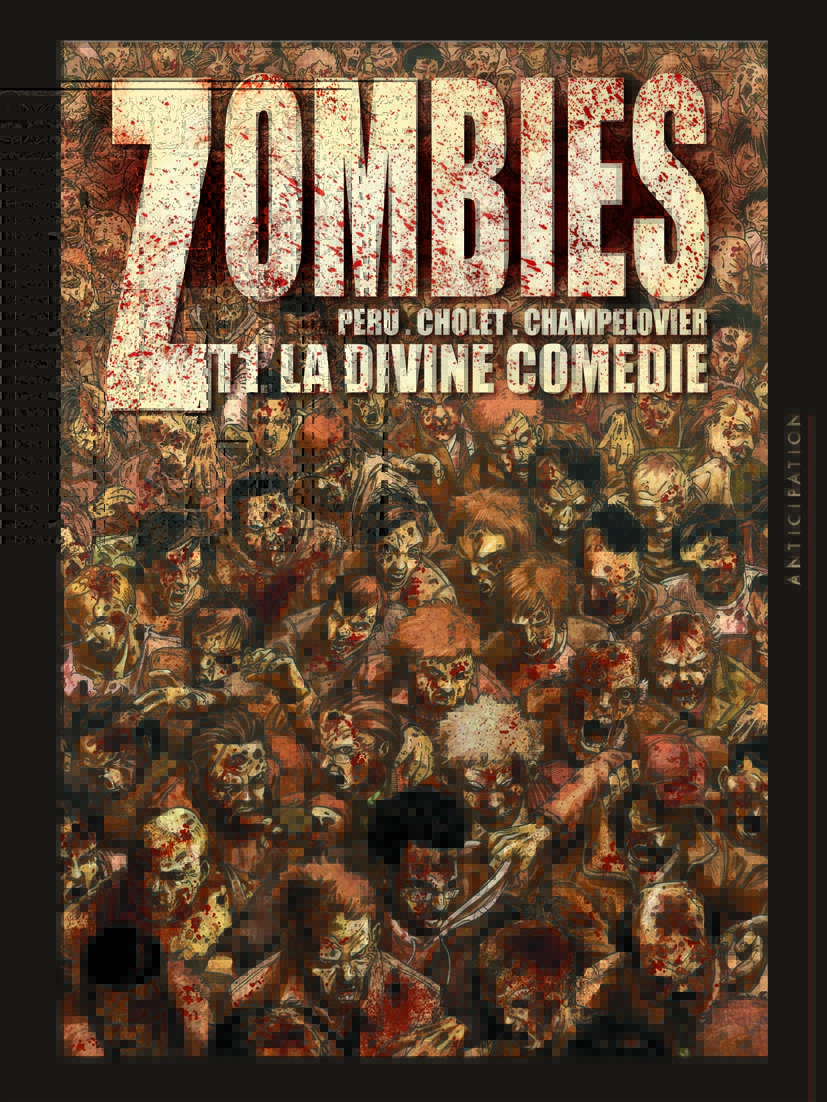
Comic books–les bandes dessinées–are considered literature in France, like any other high-brow written form. It’s not unusual to see men and women in business suits or stereotypically academic clothes (which is to say, blue jeans and a backpack full of journal articles on math or literature) reading one on the train on the way to work in the morning, and comic books can get literary prizes just like anything else. The series that had me screaming over my breakfast was this one by Peru and Cholet:
My Uncle John immigrated to the US from the UK as a young man and promptly joined the Army, which sent him to Korea. Before he died, some oral history project sent someone to interview him about the experience, and we learned things that he had never, ever talked about, like the time that he had to pile up a couple bodies of his dead pals so that he could shelter behind them while he shot at the North Koreans (or Chinese, or whoever it was that was actually behind the triggers on the other side). When I was a little tike, he made me solemnly swear to never read a comic book. I still feel a little guilty every time I pick one up–I feel exempt from fulfilling that particular oath, since I made it as a small child, but as an adult, I take promises super-seriously, and rarely make them. Hopefully, the quality–and power–of this particular one takes it out of the realm of the kinds of comic books that Uncle John was talking about. Yes: I was moved to rage and sadness by a comic book. A comic book. A fucking COMIC BOOK.
To my surprise, I notice that this is the 500th post on the Zipf’s Law blog. It’s super-amazing to me that this thing that started out as a way to publicize information about the judo clubs of Paris, and then evolved into a way to keep my family and friends up to date on Parisian adventures that were too long for Facebook posts, has become something else entirely, with as of today, more than 45,000 page views and just under 28,000 visits. I thank Ellen Epstein for suggesting the blog in the first place, and all of you who comment on the posts–you give me the positive feedback of knowing that someone out there listens to what I say, and the helpful guidance of pointing out my errors in French, explaining French history and culture to me, and the like. Even beyond the relief of getting the shit that grouille dans ma tête out of it and “on the page,” you folks who leave comments make this an enriching experience for me. Thank you again.
English notes:
tike/tyke: a small child. “When I was a little tike” is a common way of introducing something that you’re going to say about your early childhood.
The most important thing is to look before you leap: you have to expect the water to be full of debris, as well as your shipmates, and you don’t want to land on either of them.
May 19th, 2018
United States
Dear Zipf,
Chlöé says that she and her uncle both passed the highest ARC water-safety tests, but that her uncle, who got his cert a generation earlier, had to learn to jump into the water from destroyer-height, wearing a Mae West, without having the vest break his neck on hitting the water.
She wondered whether you’d learned how to do this, and if so, how to do it.
Reynaud
March 20, 2018
Zurich
Dear Reynaud,
Yep, sure did. The most important thing is to look before you leap: you have to expect the water to be full of debris, as well as your shipmates, and you don’t want to land on either of them. The vest thing makes perfect sense, but I don’t remember what to do about it–the old kapok vests have a high collar, which is meant to keep your face out of the water if you lose consciousness, and indeed, if forced straight upwards hard enough, it could probably take out your cervical spine. What I do remember how to do is that when you jump, you hold your balls. And, no: I’m not kidding about your balls. The idea is to avoid them getting racked up when you hit the water. Today there are women on board ship, but I don’t know what they’re told to do. You’re also taught to use a hat, your shirt, or your pants as flotation devices. That last one is effective, but fucking HARD to do–I got worn out the first time I tried, and had to do it again to pass the test.
The basic thing once you’re safely off of the vessel is to get as far from the ship as quickly as possible: you don’t want to get sucked down when it sinks, and depending on how deep it is when (if) the engines explode, you could get injured by the shock.
The thing that they didn’t have us practice is swimming with burning oil on the surface. They told us that at night, the burning oil lights up the water underneath it, so you look for a shaft of darkness, swim up to the surface through it, take a breath, and then submerge again to find your way away from the oil.
Zipf
Here’s a video showing how to use your pants as a flotation device. This is actually better than what they were teaching when I was a squid (slang for “sailor”), in that we were taught to tie each pants leg individually, which is a hell of a lot harder than what this guy does: tie them together. Note that this guy is using a floating technique, so he’s not expending very much energy while he prepares his pants–we just treaded water, which is exhausting when you can’t use your arms to help ’cause they’re occupied trying to get your pant legs tied and the @#$% things inflated.
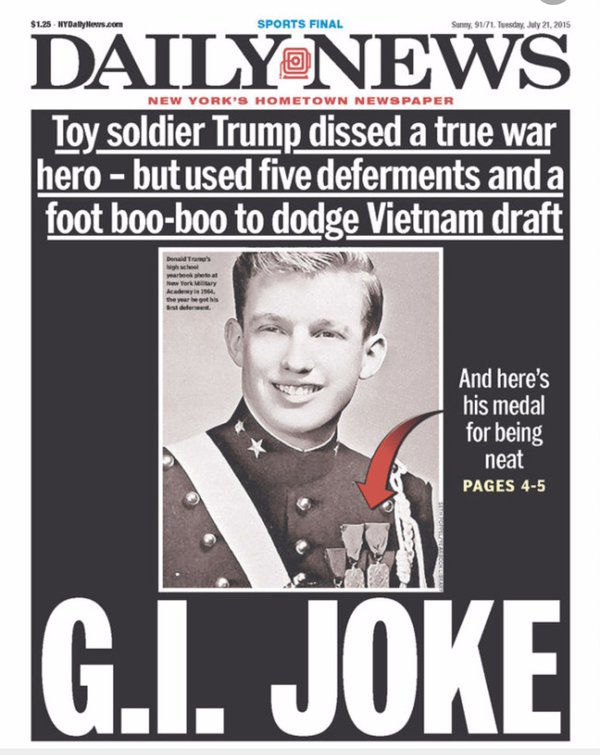
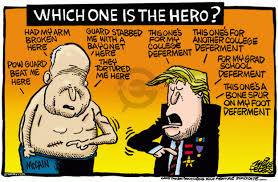
My ship, the USS Biddle. It’s a cruiser, formerly called a destroyer escort–bigger than a destroyer, but smaller than a lot of other things. Picture source: https://www.helis.com/database/unit/1068_USS_Biddle/ Hey, guess who didn’t serve? Donald Trump–multiple draft deferments for college, and then a claim of a bone spur in his foot. Snowflake.
English notes
Royal Air Force pilot wearing an inflated “Mae West” flotation device. Note how it comes behind the pilot’s neck–that is meant to keep his head out of the water if he’s unconscious. Picture source: http://www.alamy.com/stock-photo/mae-west.html
ARC: American Red Cross.
cert: certification.
destroyer: a small ship, mostly used to screen big ships from submarines and aircraft.
Mae West: a kind of life vest. It’s named after Mae West, a film star of the epoque known for playing super-sexy roles.
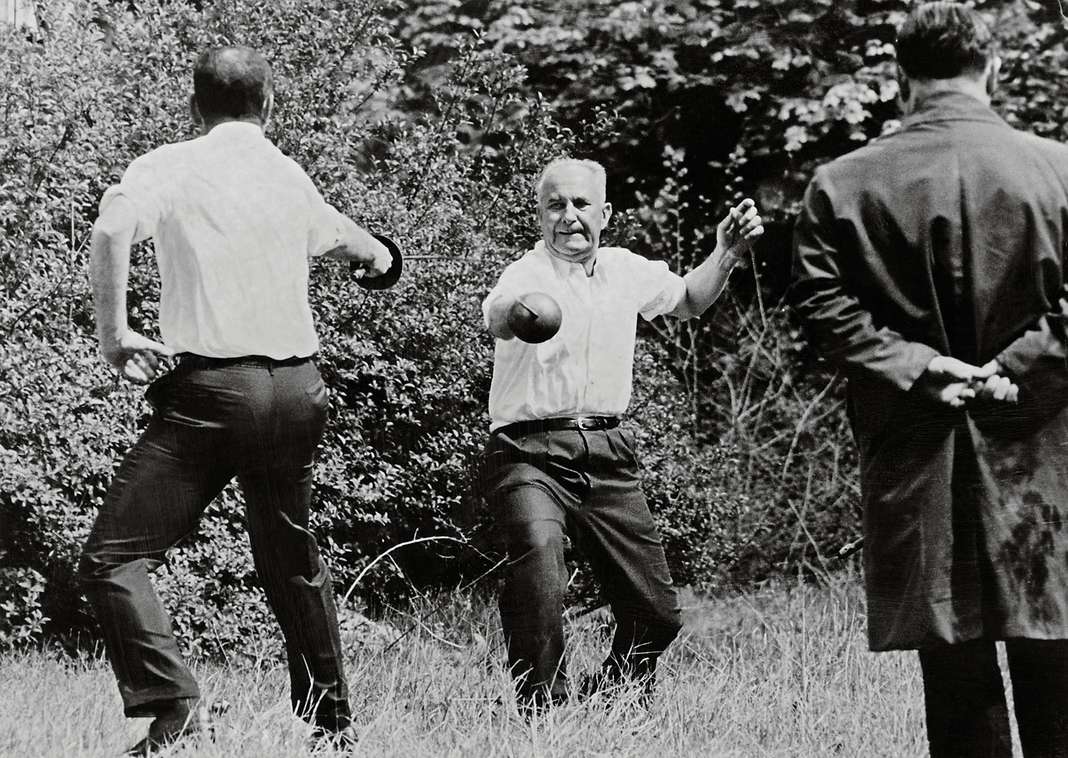
The last duel in France leads to a discussion of syntactic theory, ’cause that’s how I roll.
Wanna watch the last duel in France? Here you go. Scroll down past the video for an excerpt from an article on the topic from Le monde and the definitions of some of the French vocabulary therein.
The article in Le monde: click here. Some relevant vocabulary:
retrousser [+ sleeves or pant legs] : to roll up. Elle avait un de mes pyjamas dont elle avait retroussé les manches. (Camus, L’étranger)
l’hôtel particulier : like a château, but it’s in a city, versus being in the country, and it could just as well be owned by a bourgeois as an aristocrat–I think it’s actually more likely to have been owned by a bourgeois, at least in Paris. Don’t quote me on this.
Dans un jardin ombragé par des arbustes bienveillants,enveloppé d’une douceur printanière, chemise blanche, col ouvert, manches retroussées, deux hommes, épée à la main, se jugent, se jaugent, puis, sur un signe de l’arbitre, croisent le fer. Quatre minutes plus tard, le combat cesse un des deux duellistes ayant été touché par deux fois au bras. Cette scène n’est extraite d’aucun roman ou film de cape et d’épée. Elle eut lieu il y a exactement cinquante ans, le 21 avril 1967, dans le parc d’un hôtel particulier de Neuilly-sur-Seine.
English notes
wanna: the written form of the contraction of want + to. One of the interesting things about this contraction is that it is only possible in specific syntactic contexts, and is absolutely impossible in others. This lets you distinguish between the following. Suppose that the following situations exist:
There is going to be a contest. Whoever wins the contest will be awarded a horse. There are a number of horses available, and the winner of the contest will be able to choose the horse that they will receive.
There is going to be a horse race. One of the horses will win the race.
In situation number 1, if you want to ask someone which of the horses they would choose were they to win the contest, you could ask the question in either of two ways. The second one is more casual, but they are both completely acceptable from a linguistic point of view:
Which horse do you want to win?
Which horse do you wanna win?
In situation number 2, if you think that someone has a preference regarding the winner of the race, and you want to ask them which of the participating horses they hope will emerge the winner of the race, you only have one option:
Which horse do you want to win?
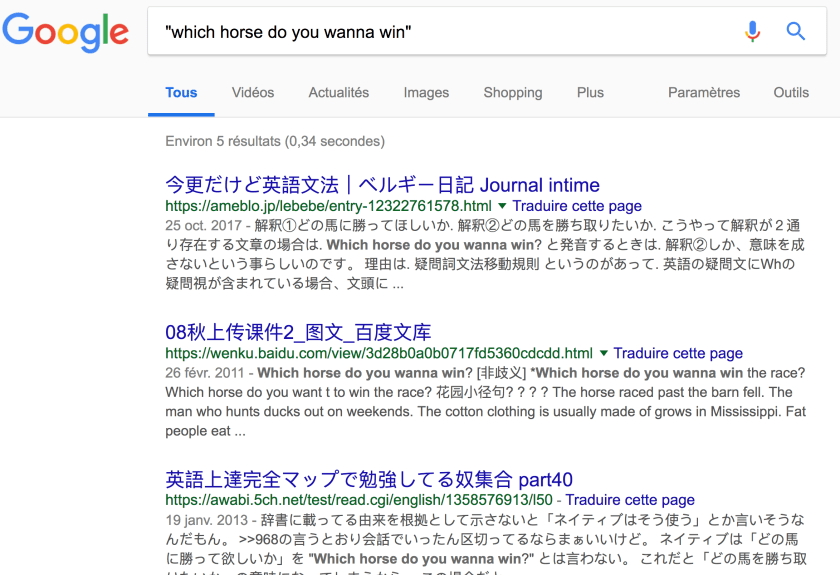
Google the quoted phrase “which horse do you wanna win” and you will get 5 results, all of them in Japanese. WTF, you’re wondering…
What you’re seeing in the Google results is sentences that illustrate interesting syntactic phenomena. Most of the literature on syntax is written about English syntax (blame Chomsky), mostly by (notoriously monolingual) anglophones, and the classic examples in the field are hence mostly in English. (Actually, the only classic non-English examples that I can think of are in Swiss German–more on that another time, perhaps.) The which horse do you want to/wanna win sentences are used in classic transformational-generative grammar to argue for the existence of something called a trace. This is held to be something that is present in the structure of the sentence, but that is not observable–the claim is that you can’t “see” it, but it’s there. What is that “it”? The idea is that underlying those two sentences are two “deeper” forms:
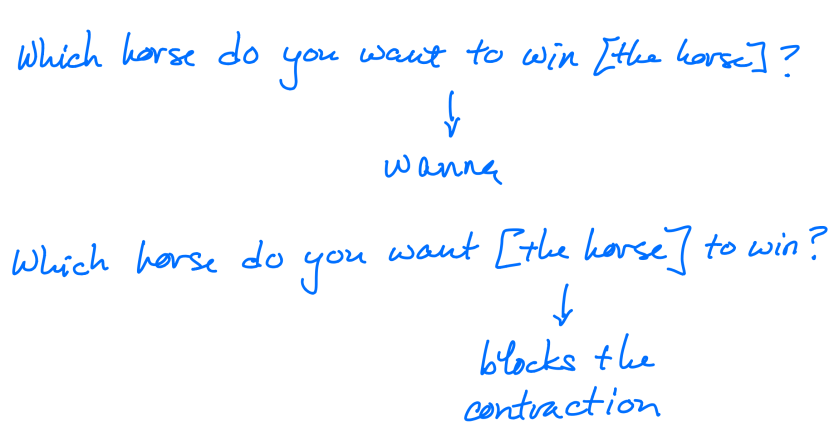
For situation 1 (there’s a contest, and the winner gets a horse): Which horse do you want to win [the horse]?
For situation 2 (there’s a horse race, and one of the horses will win): Which horse do you want [the horse] to win?
(Linguists in the audience: yes, I am simplifying this for didactic purposes–no hate mail, please.) In both cases, the bracketed [the horse] goes away; in the second case, the “trace” that is left behind blocks the contraction of want + to to wanna.
Now, I know what you’re thinking: It’s obsessing about things like this that keeps Zipf from ever getting a second date. …and you’re right, I imagine.
Zipf’s Law is why if someone is looking for a web page and types “dogs in marseilles” into the query box, your search engine should pay no attention to the word “in,” some attention to “dogs,” and quite a bit of attention to “marseilles.”
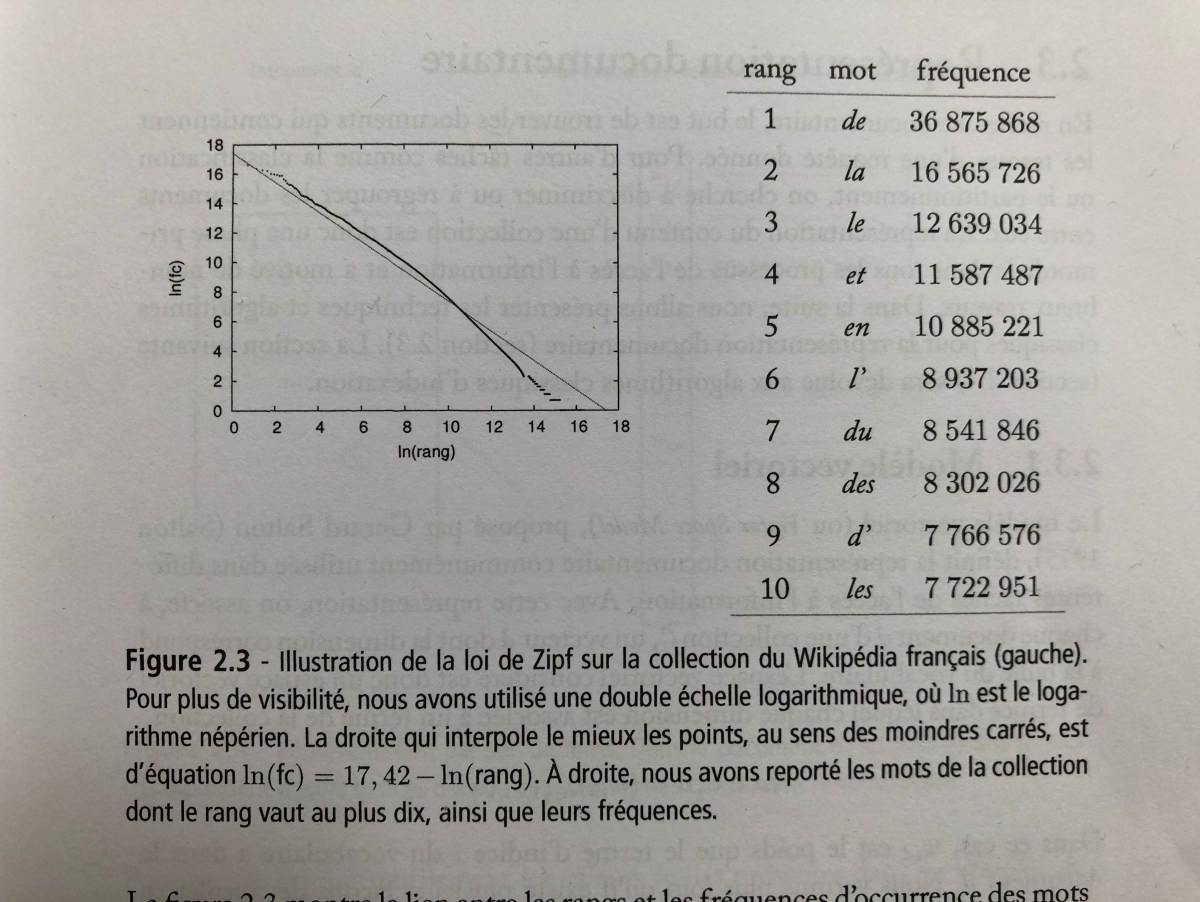
Zipf’s Law describes the frequencies of words: there is a very, very small number of words that occur very, very often, and a very, very large number of words that occur very, very rarely–but, they do occur. This blog is focused on one of the consequences of Zipf’s Law: it means that if you are seriously studying a second language, you are going to run into words that you don’t know every day for the rest of your life.
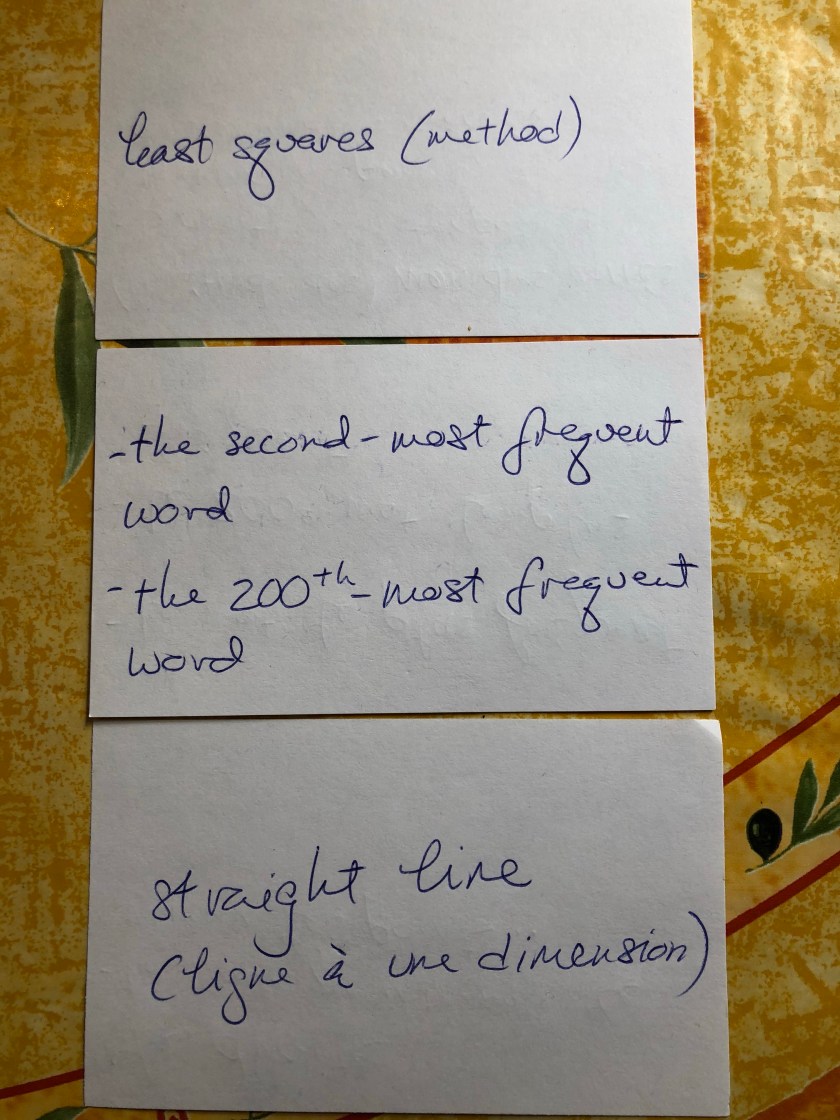
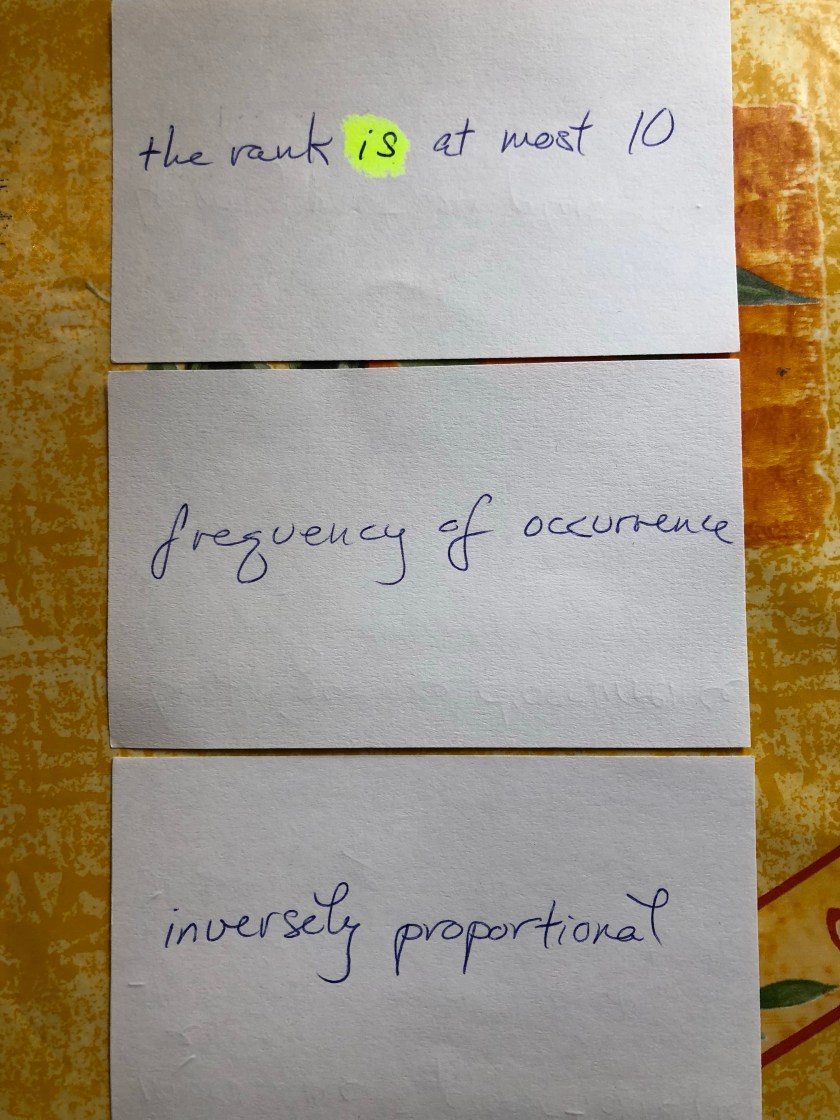
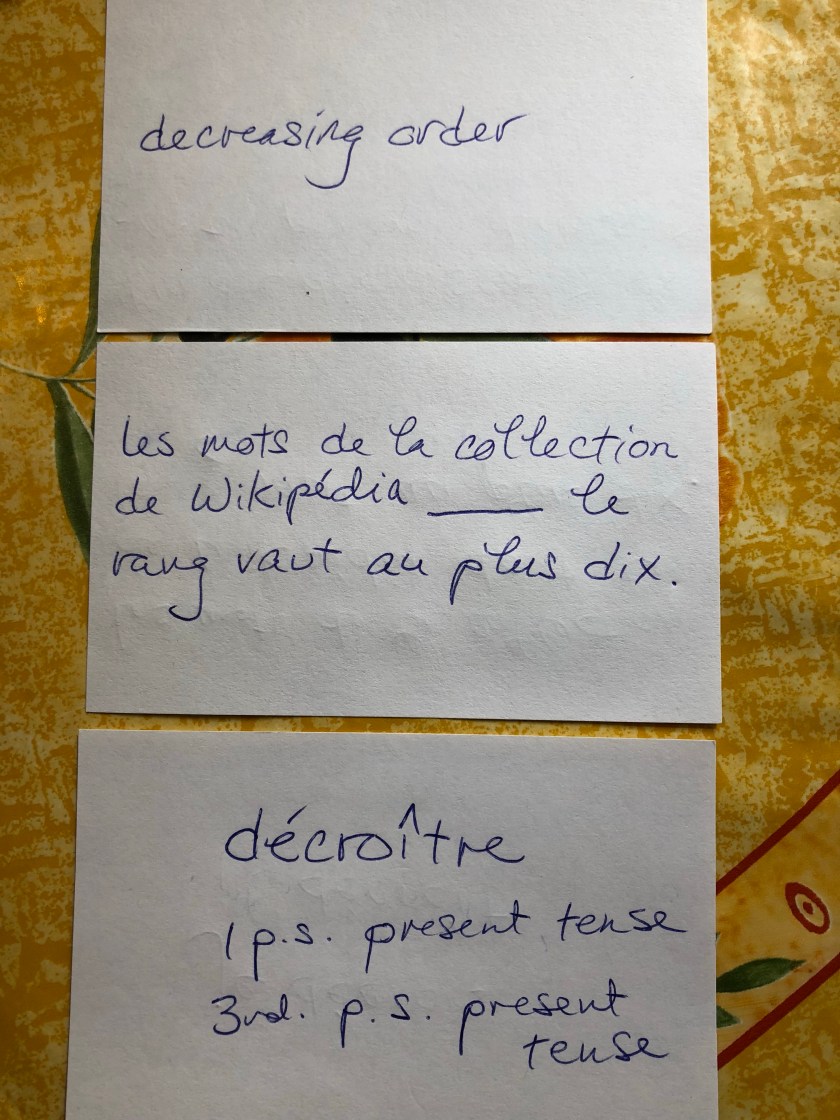
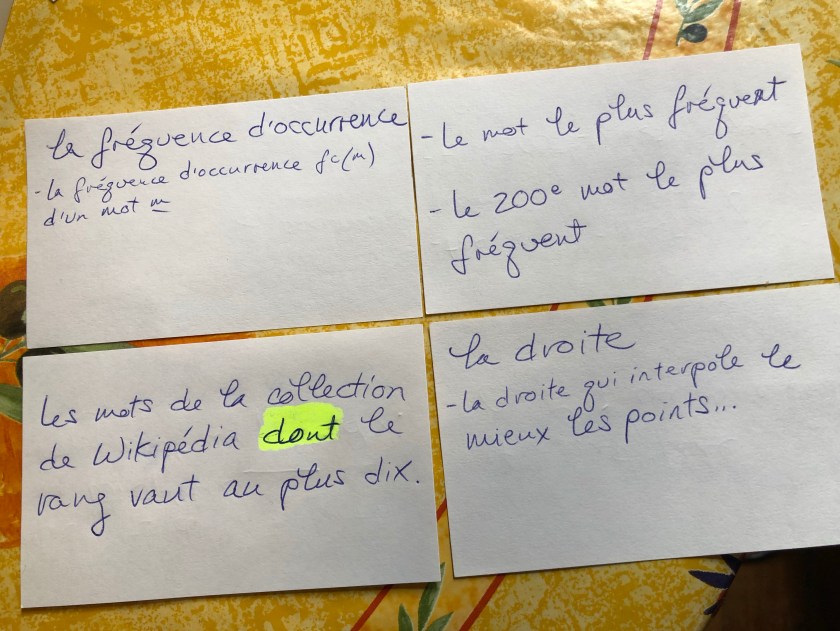
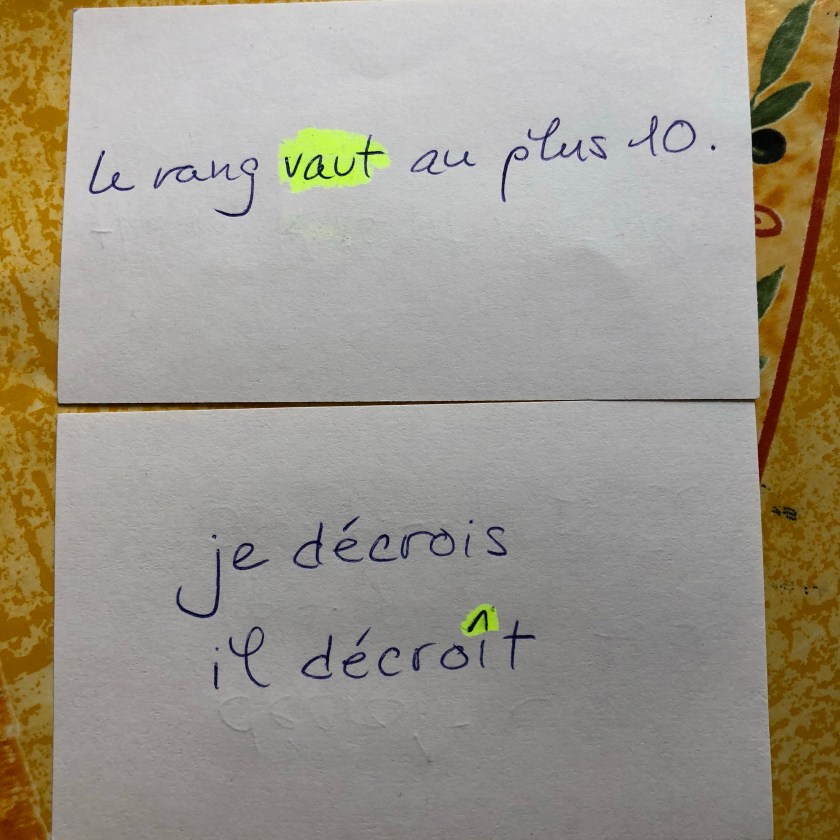
You know how the matching game works: we have words in English, words in French, and we match them. Today’s words (and a tiny bit of grammar) are taken from the discussion of Zipf’s Law in the book Recherche d’information: Applications, modèles et algorithmes, by Massih-Reza Amini and Éric Gaussier, second edition. Recherche d’information is information retrieval, the task of finding documents in response to an information need: what Google does for you every day. One of the great embarrassments of linguistics is the fact that information retrieval is mostly about language, in the sense that mostly what you’re looking for is web pages with stuff written for them and you use words to find them–and yet, most of the work of information retrieval is done without actually doing anything that looks very much like doing anything with language. At its heart, the technology of information retrieval is almost entirely done with counting and very simple arithmetic–nothing linguistic there. You could think of that very simple arithmetic as taking advantage of Zipf’s Law–the very simple arithmetic is used to figure out things like the fact that if someone is looking for a web page and types dogs in marseilles into the query box, your search engine should pay no attention to the word in, some attention to dogs, and quite a bit of attention to marseilles when it is making the decision about which web pages to put at the top of the search results. Scroll down to find today’s vocabulary items, and click on the pictures of the relevant pages from Amini and Gaussier’s book if you’d like to see those words in context. As for me: a second cup of coffee, go over these flashcards, and then off to the lab. Today’s goal: explain why researchers calculated the ratio of vocabulary size to length of conversation of a bunch of soldiers–after chasing them through the woods, catching them, depriving them of food and sleep, and then interrogating them.
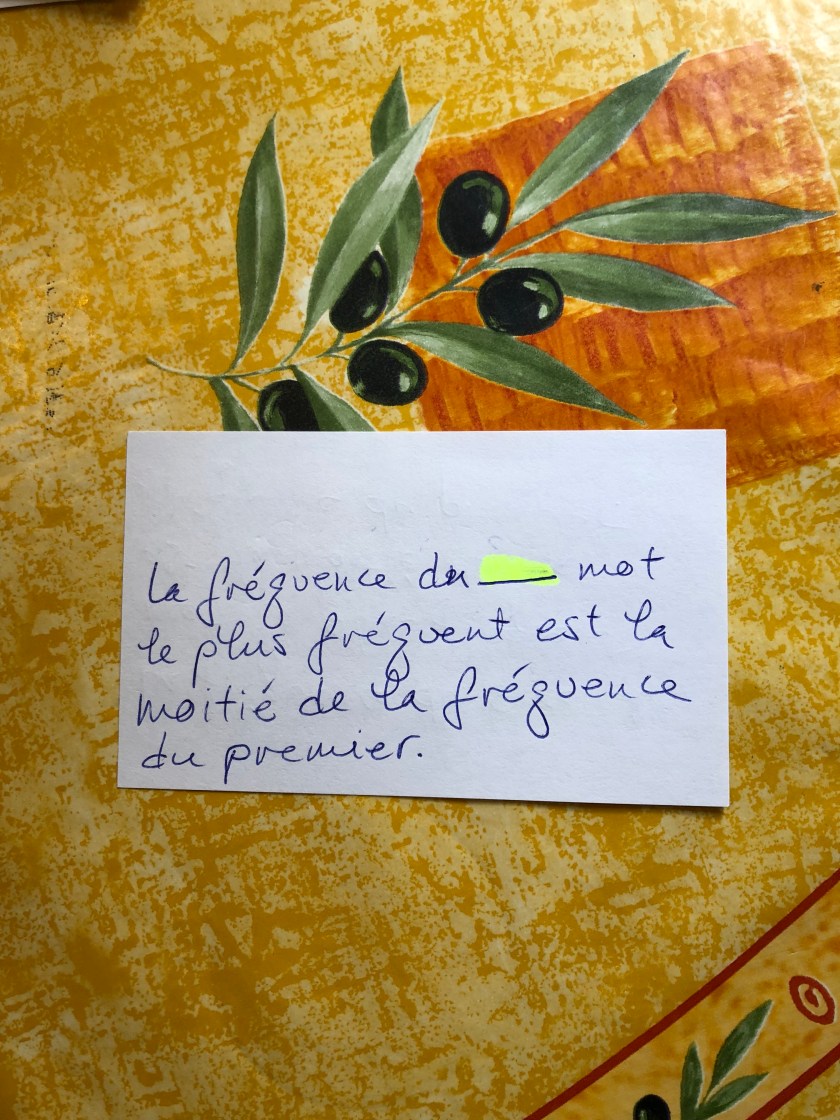
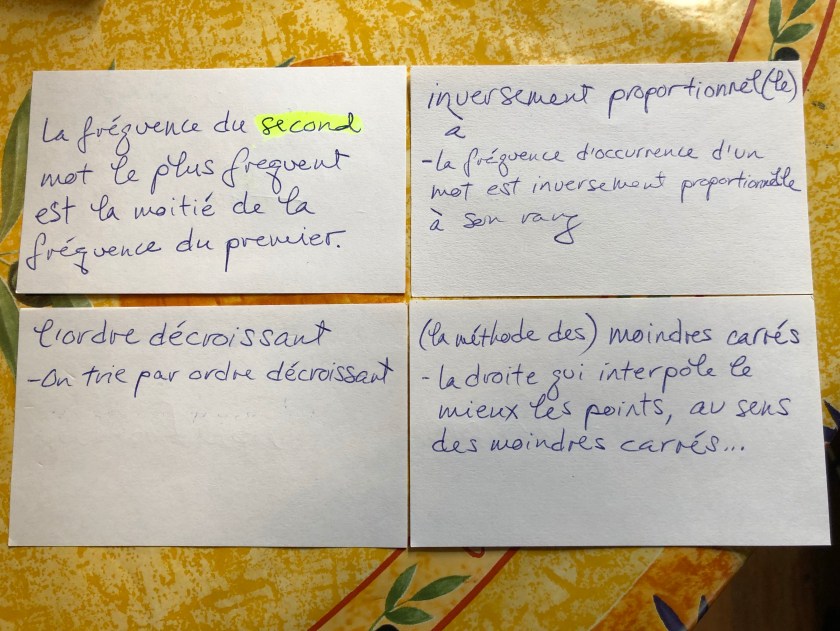
I included La fréquence du second mot because I’ve been trying to understand when to use second and when to use deuxième. If I understand the Académie’s Dire/Ne pas dire page correctly, the Academy would prefer that this be deuxième, but not even the Académie thinks that it’s mandatory to make the distinction:
On peut, par souci de précision et d’élégance, réserver l’emploi de second aux énoncés où l’on ne considère que deux éléments, et n’employer deuxième que lorsque l’énumération va au-delà de deux. Cette distinction n’est pas obligatoire.
On veillera toutefois à employer l’adjectif second, plus ancien que deuxième, dans un certain nombre de locutions et d’expressions où il doit être préféré : seconde main, seconde nature, etc., et dans des emplois substantivés : le second du navire.
As the CarriereOnline.com web site puts it: C’est pour cela qu’on parle de la Seconde Guerre mondiale parce qu’on espère qu’ il n’y en aura pas de troisième !
Linguistics is similar to organic chemistry in some respects: how things combine tells you something about what those things are.
Tag questions are those simple little things that you use to get someone to give you a yes-or-no answer:
Trump sure needs a lot of little golf mini-vacays, doesn’t he?
Trump screwed the pooch on health care, didn’t he?
Trump lies a lot, doesn’t he?
Actually, they’re not so simple, those little questions…. They have an odd quirk that will give you a little bit of insight into how linguists think through things.
I often explain linguistics to people as being similar to organic chemistry in some respects: on one level, it’s about figuring out what the parts of language are, and how they go together. As is the case in organic chemistry, how the parts go together–or don’t–tells you something about what those parts are. An example: the distinction between auxiliary verbs and other verbs.
The main library at the Strahov monastery in Prague. Enlarge the picture and look closely at the upper-left corner–that’s Les Encyclopédistes being cast into hell. Source: https://www.avantgarde-prague.fr/
In general, scientists tend to start with the assumption that everything is the same until proven otherwise. Proving it to be otherwise is not always as simple as you might think–consider the fuzzy separation between things as basic as matter and energy in the physical universe. For the Encyclopédistes, separating the realm of the Divine from the realm of everything else was a major nouveauté–and one that they were condemned for. (This summer I saw a monastery library in Prague that had a gorgeous painted ceiling; the fresco included a scene of the Encyclopédistesbeing cast into Hell. This is why.)
Back to tag questions… In English, the verbs in tag questions exhibit an odd behavior. There are some verbs that can be in the “sentence” to which the tag is added, as well as in the tag. For example:
Trump is an asshole, isn’t he?
Trump could get impeached, couldn’t he?
Trump did reveal intelligence to the Russian ambassador, didn’t he?
But, most verbs can’t show up in the tag. Instead, they are replaced by did. For example:
Trump screwed the people who elected him with that tax bill, didn’t he?
Trump went kinda apeshit over the whole inauguration crowd thing, didn’t he? Insecure loser…
Trump lied about Obama’s birth certificate, didn’t he?
To a linguist, the fact that English verbs cluster into two groups–ones that can appear in the tag of a tag question, and ones that can’t–suggests that there are two distinct kinds of verbs in the language. This is one piece of evidence that you could use if you wanted to argue (and linguists do love to argue about language) that there is such a thing as a distinction between auxiliary verbs and other kinds of verbs. It’s just like organic chemistry–knowing how the parts go together tells you something about what they are.
See these previous posts on forming tag questions:
We’ve been working on tag questions with the verb to be recently. We worked on the third person singular (Trump is an asshole, isn’t he?) and the third person plural (Trump and his cronies ARE the swamp, aren’t they?). We did that in the present tense–let’s try the past tense now, ’cause the verb in the tag has to agree with the verb in the base sentence with respect to tense. (Still think that tag questions are simple?)
We’ll follow our usual structure for drills–half a dozen on the same model, half a dozen on a similar model, and then mix ’em up. Remember: we’re not testing ourselves–we’re practicing. This is fun! (…and this is why I never get a second date.)
Model:
Trump was a draft dodger during the Vietnam war.
Trump was a draft dodger during the Vietnam war, wasn’t he?
Trump was a draft dodger during the Vietnam war.
Trump was remarkably silent about Roy Moore for quite a while.
Obama was fucking wonderful for the economy.
Trump was given a draft deferment for bone spurs in his feet. Now he says he’s the healthiest president ever. Fucking coward.
Trump was more pissed about being criticized for his defense of the bigots in Charlottesville than he was about the poor girl that was murdered by a white supremacist.
Scroll down past the picture for the answers.
Trump was a draft dodger during the Vietnam war, wasn’t he?
Trump was remarkably silent about Roy Moore for quite a while, wasn’t he?
Obama was fucking wonderful for the economy, wasn’t he?
Trump was given a draft deferment for bone spurs in his feet, wasn’t he? Now he says he’s the healthiest president ever. Fucking coward.
Trump was more pissed about being criticized for his defense of the bigots in Charlottesville than he was about the poor girl that was murdered by a white supremacist, wasn’t he?
…and now the opposite polarity:
Trump wasn’t actually a very successful businessman.
Trump wasn’t above refusing to pay small businessmen who had done work for him.
Trump wasn’t embarrassed to declare bankruptcy.
Trump wasn’t honest with the students in his real estate “school.”
Trump wasn’t eager for war when he was still young enough to be drafted.
…and scroll down past the picture for the answers once again!
Trump wasn’t actually a very successful businessman, was he?
Trump wasn’t above refusing to pay small businessmen who had done work for him, was he?
Trump wasn’t embarrassed to declare bankruptcy, was he?
Trump wasn’t honest with the students in his real estate “school,” was he?
Trump wasn’t eager for war when he was still young enough to be drafted, was he?
French notes
la fresque: fresco.
English notes
vacay: slang for “vacation.” How it was used in the post: Trump sure needs a lot of little golf mini-vacays, doesn’t he?
to screw the pooch: “Pooch” is a slang term for “dog.” I would call it archaic, personally–but, I think I might be wrong about that. To wit: if you compare its frequency to the frequency of the word dog, it’s clearly quite rare–here’s a graph of their frequencies in English-language books over the course of the 200 years from 1800 to 2000:
Now, to screw the pooch: Wiktionary defines it as to screw up; to fail in dramatic and ignominious fashion. That’s bad. Ooooooh, this is interesting–I just looked for screw the pooch (and its past tense and present participial forms) on Google Ngrams, and look what I found–its frequency jumps around the same time that we saw a jump in pooch:
Could the mid-1980s resurgence of pooch that we saw in the second graph be due to a growth in the use of screw the pooch? Possibly so. Wiktionary says that the expression to screw the pooch became popular due to its appearance in Tom Wolfe’s book The right stuff in 1979 and its film adaptation in 1983–these graphs certainly support that timing!
Is natural language processing a way of processing language–a natural way–or is it the processing of a kind of language–natural language? I love having an ambiguous profession.
Ambiguity is the condition of having more than one meaning:
Il y a ambiguïté lorsqu’à une forme unique correspondent plusieurs significations.
Notice that Fuchs uses the word forme: ambiguity is not limited to the meanings of words. A form could just as well be a phrase (something smaller than a sentence), or a sentence.
Two things to know about ambiguity:
It is a feature of every human language.
Almost everything that you say, hear, read, or write today will be ambiguous in some way.
Ambiguity is absolutely pervasive and ubiquitous in language. The thing is, humans are excellent at “recovering” the intended meaning–so good at it then we only recognize ambiguity a minuscule fraction of the times that we come across it. The other thing is: a computer program that does things with language cannot ignore it. In fact, you could think of my job as being getting computers to resolve ambiguity–to choose which of multiple possible interpretations is the intended one.
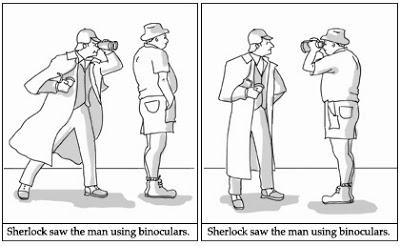
Humor often works by manipulating ambiguities. It does this by forcing you to find the interpretation–the meaning–that you wouldn’t have expected. I’ll give you an example:
Original source unknown
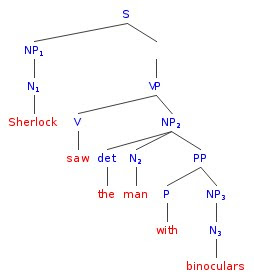
This is an example of a structural ambiguity. The two possible meanings correspond to two different syntactic structures. In the one where it’s Sherlock who’s using the binoculars, using binoculars is “attached to” the verb saw. In the one where it’s the man who’s using the binoculars, using binoculars is “attached to” the man. Here are the two syntactic structures, from the blog Walk in the Words:
When I teach natural language processing (see the ambiguity there? Is natural language processing a way of processing language–a natural way–or is it the processing of a kind of language–natural language? I love having an ambiguous profession), an exercise that I give students early in the semester is to go through a bunch of things–mostly comics in which ambiguity is the mechanism of the humor–and explain to me how the ambiguity works. Wanna try it yourself? Here you go.
Oh–about natural language processing? It’s processing of “natural language,” which means human languages, as opposed to computer languages. An essential difference between the two? All human languages are ambiguous, but no computer language is ambiguous.
French notes
French has lots of words that correspond to the English word when, and knowing when to use each one is essentially beyond me. (For perspective: I have a C1 level in French. That’s one higher than you need to attend–or to teach in–a French university.) The only expression that I sorta know how to use is for saying that something happens at the same time as some event. It’s lors de. Here are some examples of it in use:
Lors de ma présentation à Versailles « and so i’m very famous because I put sometimes on twitter the update of fromwhatdoweindignatetoday.xlsx ». Tha audience is applausing.
Notice what lors de modifies here: ma présentation à Versailles, “my presentation at Versailles”–an event.
Avant son départ pour New York, la tête de la Statue de la Liberté s’expose au champ de Mars lors de l’Exposition Universelle de 1878 pic.twitter.com/xyFuB0cEoX
Here lors de modifies l’Exposition Universelle de 1878–the Universal Expo of 1878. Again: an event.
Aujourd’hui on aura eu:
-Un fight entre chômeurs dans les Intermarché pour du Nutella
-Des chameaux botoxés dans un concours de beauté
-Une meuf qui se fait soulever dans le rer D comme à l’hôtel
-Et Jawad qui fait un sketch lors de son procès
Lors de son procès: during his trail. Again, an event. Oh, and yes—the botox scandal during the camel beauty contest really did happen. Is happening, actually–12 offending camels found as of yesterday. Here’s the story on Les matins de France Culture.
Adventures in anaphora resolution: the Alain Bashung version.
A l’arrière des berlines
on devine
des monarques et leurs figurines
juste une paire de demi-dieux
livrés à eux
ils font des petits
ils font des envieux
What the hell is being delivered, and who the hell is it being delivered to? Livrésis masculine plural. Berlinesis feminine plural, so it can’t be the berlines; monarques is masculine plural, so it could be that; figurines is feminine plural, so it can’t be that; une paire de demi-dieux, I don’t know what to say about. Demi-dieu is masculine (I think), butune paire is feminine and singular–WTF? I’ve got livrés narrowed down to monarques or demi-dieux, in any case… Then we get to eux in livrés à eux. My hypothesis: the figurines are being delivered to the monarchs. Counter-arguments?
à l’arrière des dauphines
je suis le roi des scélérats
à qui sourit la vie
marcher sur l’eau
éviter les péages
jamais souffrir
juste faire hennir
les chevaux du plaisir
osez, osez Joséphine
osez, osez Joséphine
plus rien ne s’oppose à la nuit
rien ne justifie
usez vos souliers
usez l’usurier
soyez ma muse
et que ne durent que les moments doux
durent que les moments doux
et que ne durent que les moments doux
osez, osez Joséphine
osez, osez Joséphine
plus rien ne s’oppose à la nuit
rien ne justifie
“Just stick as many Ys in there as you can,” said my mentor–and if the question is how do you spell “homonymy,” then that’s the right answer.
A cherished mentor had this word of advice for me on how to spell words like homonymy and metonymy:
Just stick as many Ys in there as you can.
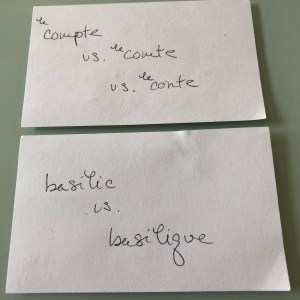
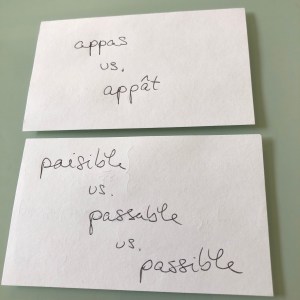
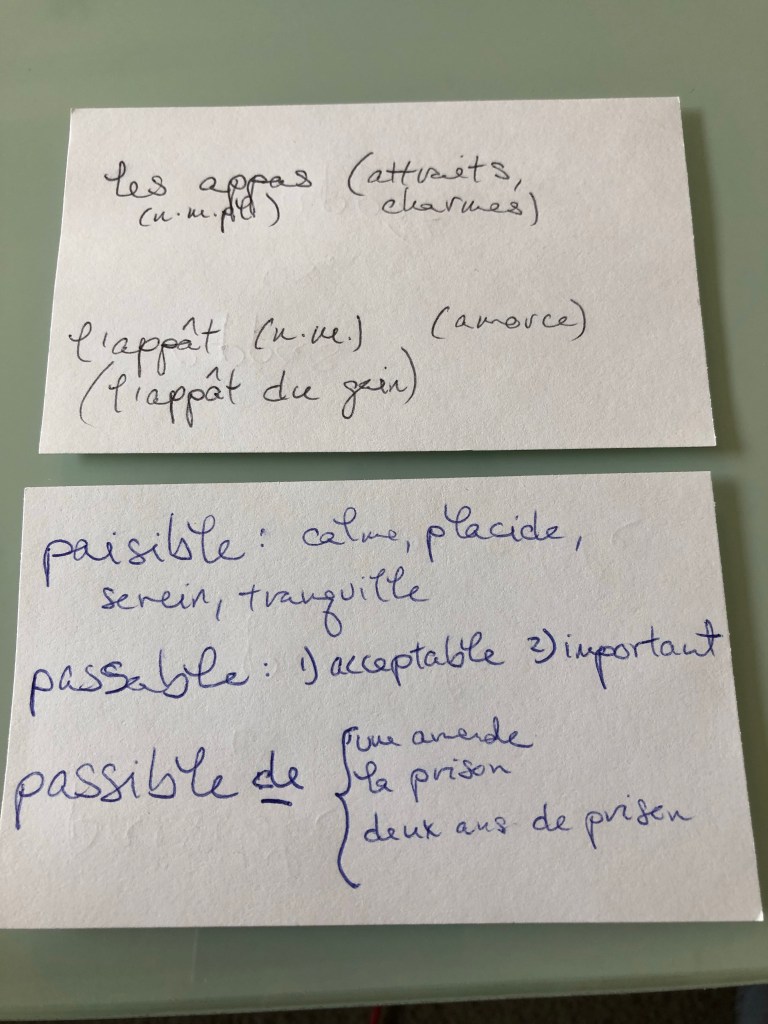
I thought about him today as I put together this post about words that I confuse (or that confuse me–I’m never clear on what the underlying semantics of confuse are). As you can see from my flash cards, I’m working on words that sound the same, but that are written differently. What do you call those? homo = the same, and graph = writing, so these are homographs.
Now, two (or more) words can be written the same, but sound different: lead the metal (pronounced like laide in French) and lead the verb (pronounced like lied in English), for instance. Homo = the same, phone = sound, so these are homophones.
Now, we’ve been making an assumption about homophones (words that sound the same) and homographs (words that are written the same): we’ve been making the assumption that they mean different things. How about words that sound the same and are written the same–so, they are homophones and homographs–but, they mean different things? These are homonyms. Some examples of homonyms in English:
duck (a kind of bird) and duck (to move one’s body downward without sitting or lying down)
sentence (a group of phrases) and sentence (a punishment) and sentence (to assign a punishment to someone)
lead (to direct) and lead (the primary role in a movie, play, or television series)
Where do the Ys come in? In spelling words like homonymy (the phenomenon of the existence of homonyms) and metonymy (referring to something by something that is associated with it, e.g. referring to the president’s administration as The White House). Just stick as many Ys in there as you can, said my mentor–and if the question is how do you spell… then that’s the right answer.
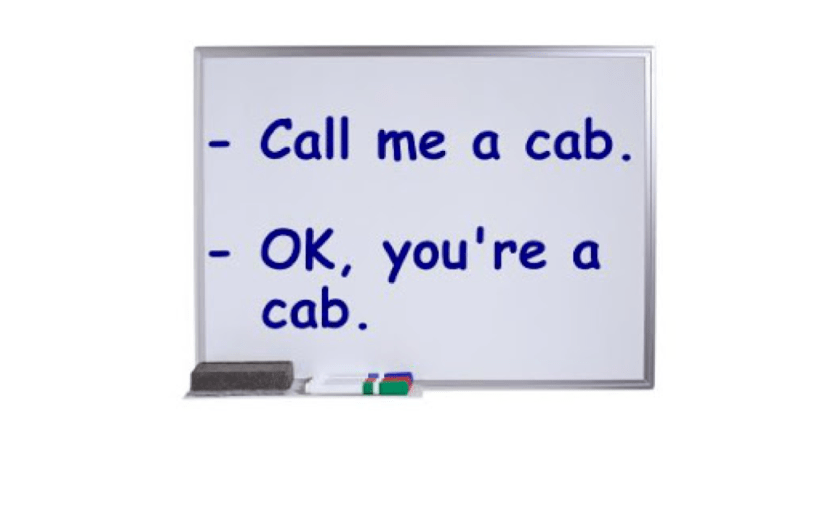
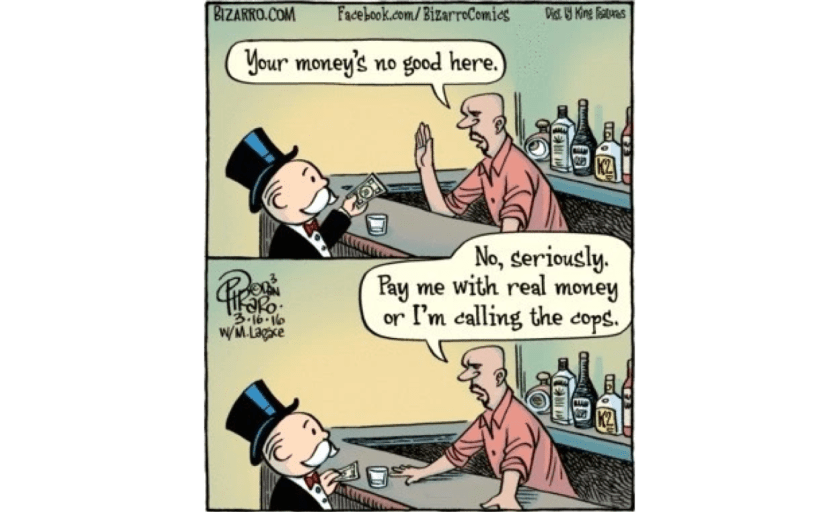
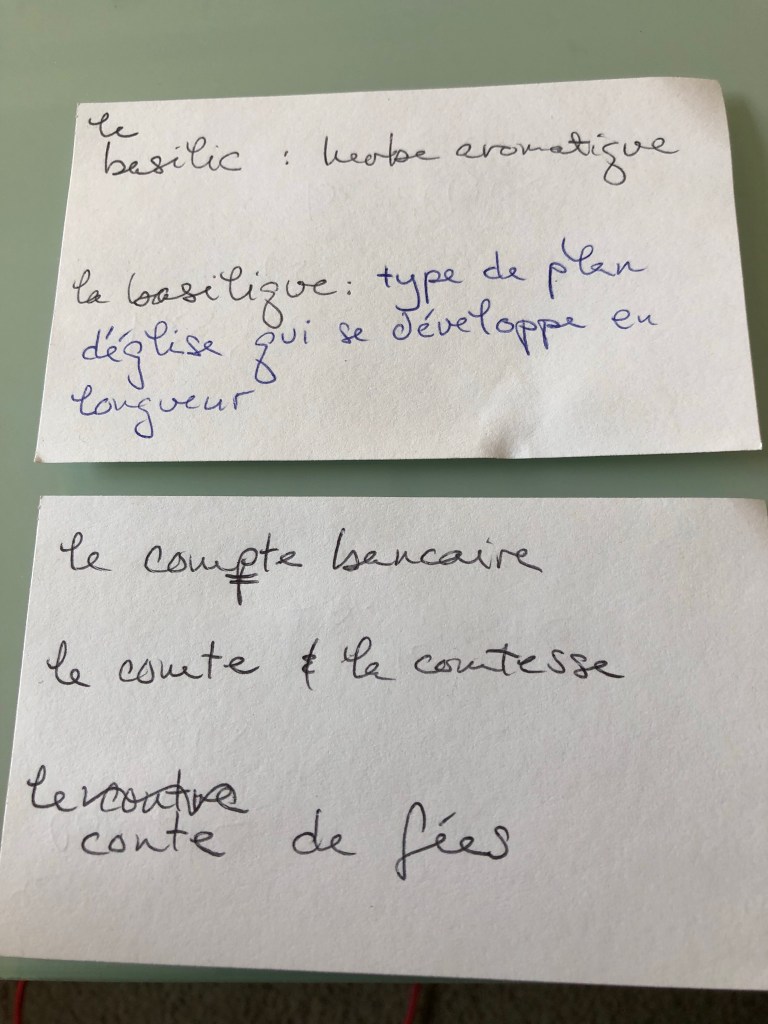
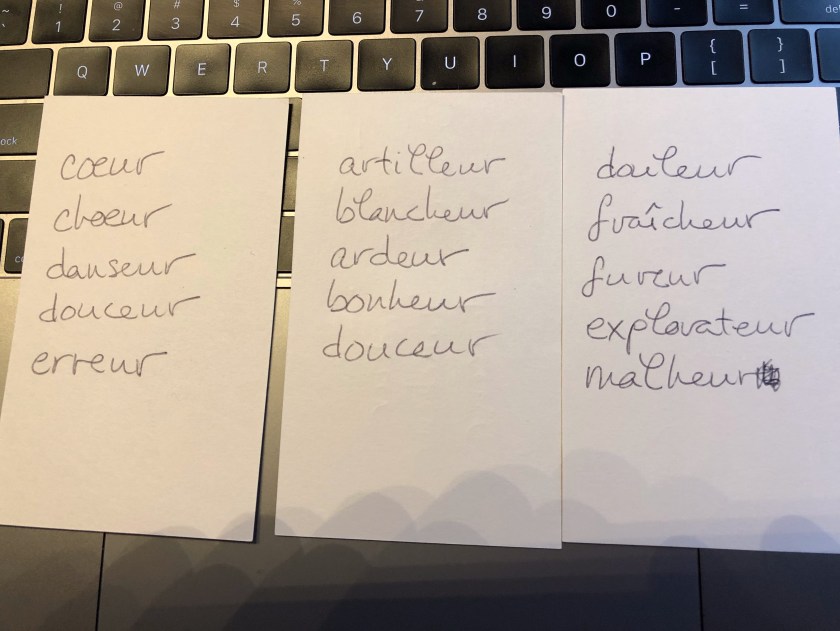
I learn about 10 new words a day, except during the month of December, when I review everything that I learned in the previous year. My French review chore of the day is to get straightened out on a few similar words. Zipf’s Law being a fact of life–most words almost never occur, and yet they do occur, I actually ran into all of these in 2017. They’re mostly words that sound the same, but are written differently–so, homographs, homophones, or homonyms? I threw in some that just sound and look similar–paisible, passable, and passible–but, all of the rest are homophones. Enjoy!
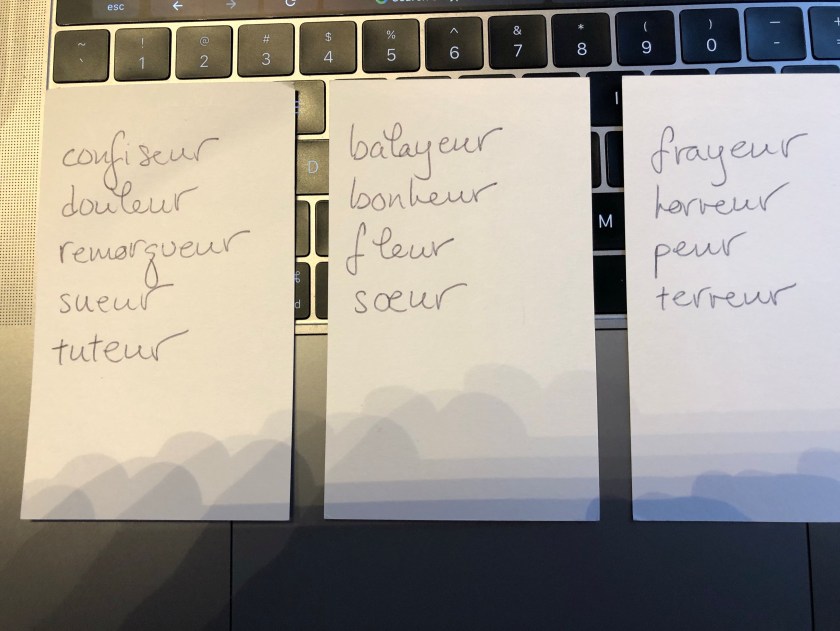
The phenomena are the same whether you’re talking about the two genders of French or the 20 genders of Shona: some things have to agree with nouns. Does it really matter what we call them? No, not really.
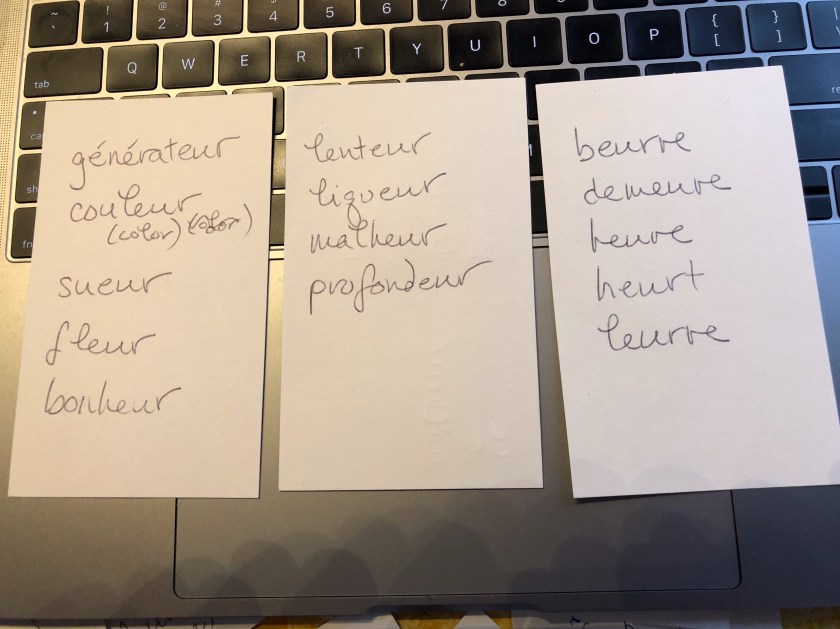
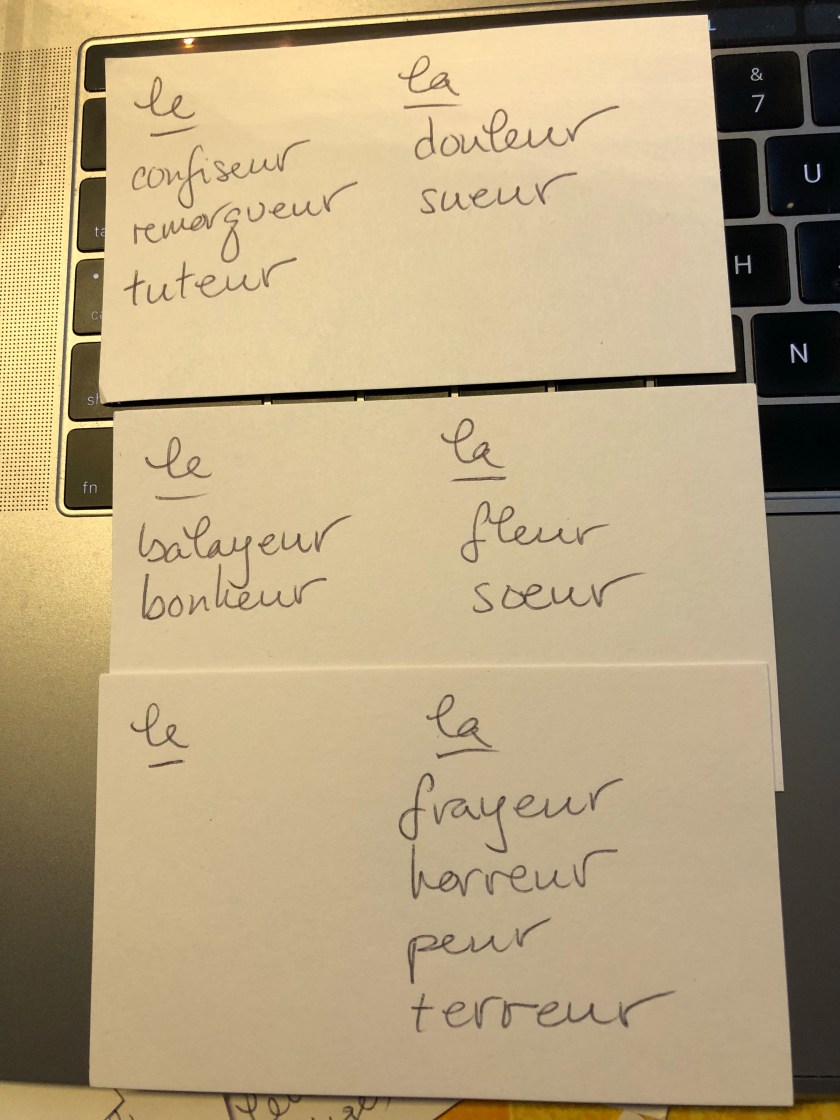
This is the kind of thing that linguists mean when they say that gender in languages with noun gender is arbitrary: malheur is masculine, peur is feminine; why? No reason–it’s just one of those things that you have to memorize. When a language has two genders, people will try endlessly to convince you that the specific noun genders in that language are as they should be (of course a tugboat (remorqueur) is masculine and booze (liqueur) is feminine, they might say); when a language has three genders (Bulgarian, German, Tamil) they don’t argue quite so loudly; get above 15 (Swahili: 18, Shona: 20), and you have trouble convincing those same people that they’re gender systems. And yet: the phenomena are the same whether you’re talking about the two genders of French or the 20 genders of Shona: some things have to agree with nouns. What classes do those nouns fall into? Does it really matter what we call them? No, not really.
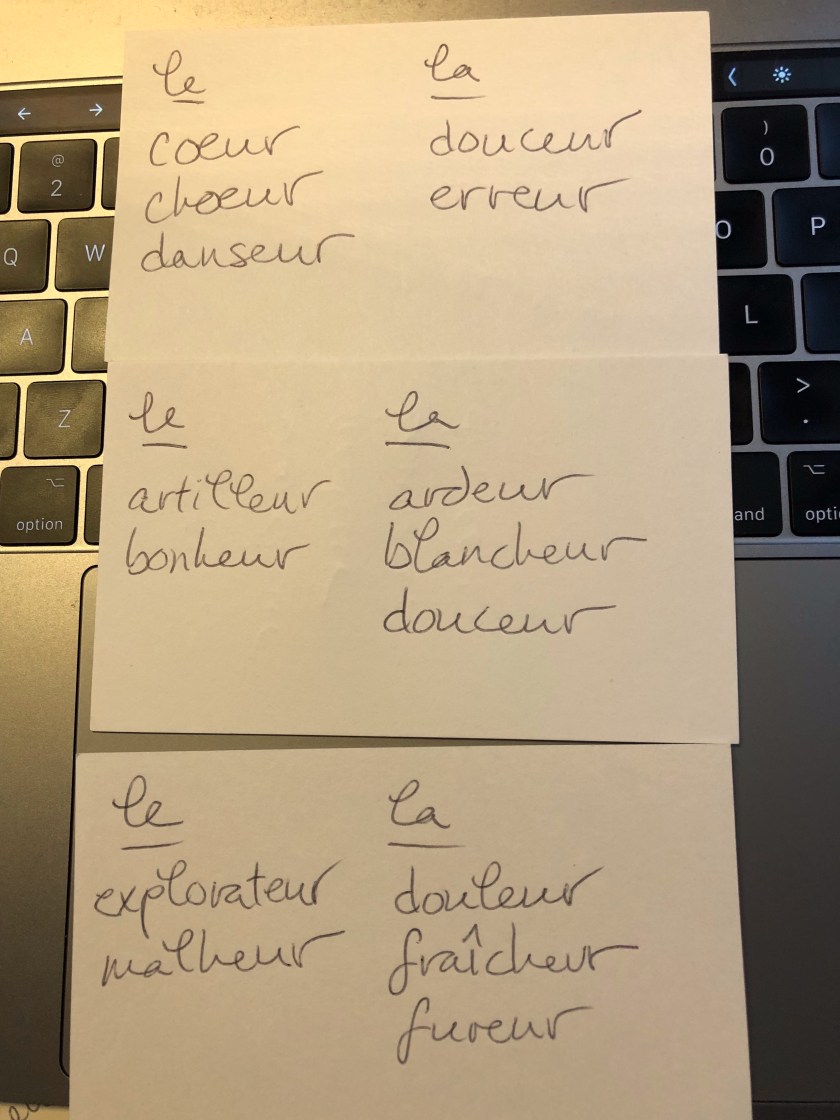
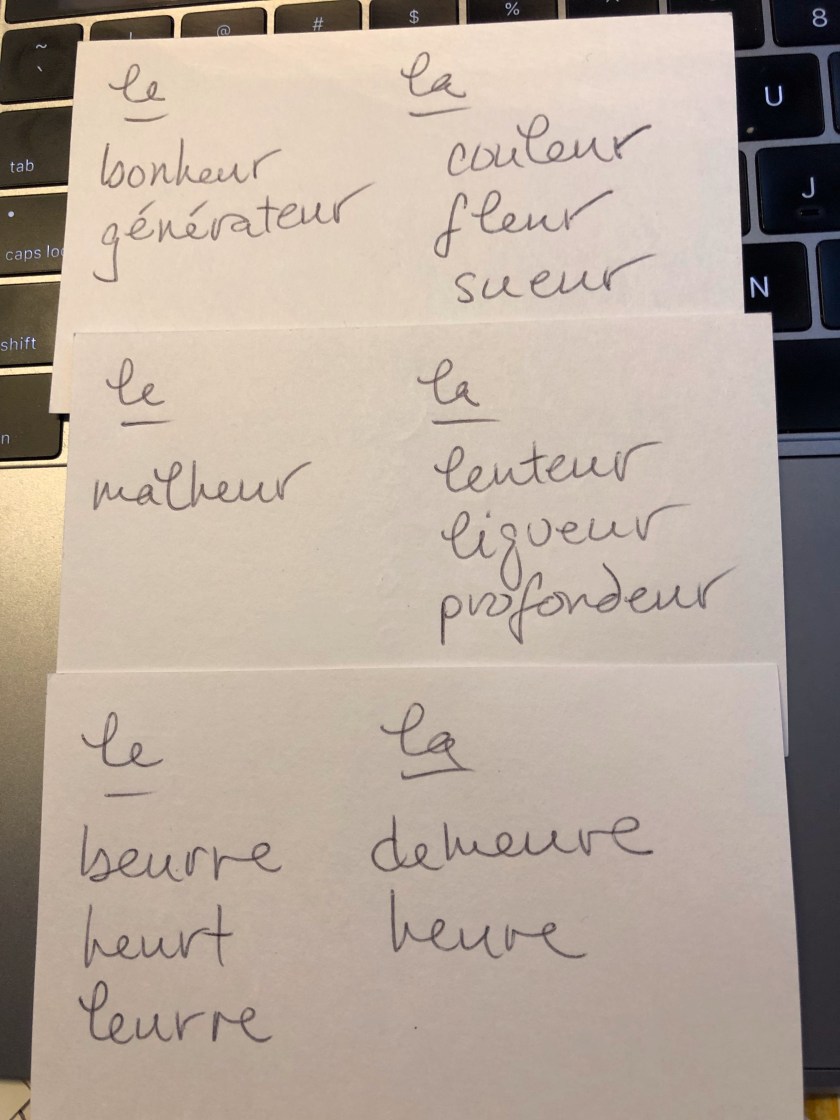
The task of the day: memorize the gender of nouns ending with -eur. Now, I know what the native speakers are going to tell me: It’s easy, Zipf. If it’s a person, it’s masculine, and there’s a corresponding feminine form, which might end in -euse (chanteuse) or might not (doctoresse). If it’s an abstract quality—peur, douleur, fureur-–then it’s feminine, except when it’s not, like bonheur and malheur. Oh, and remorqueur is a tugboat, not a person, but it’s still masculine, plus fleur and sueur are not abstract qualities, but they’re feminine. Yep: it’s arbitrary–you just have to memorize it.
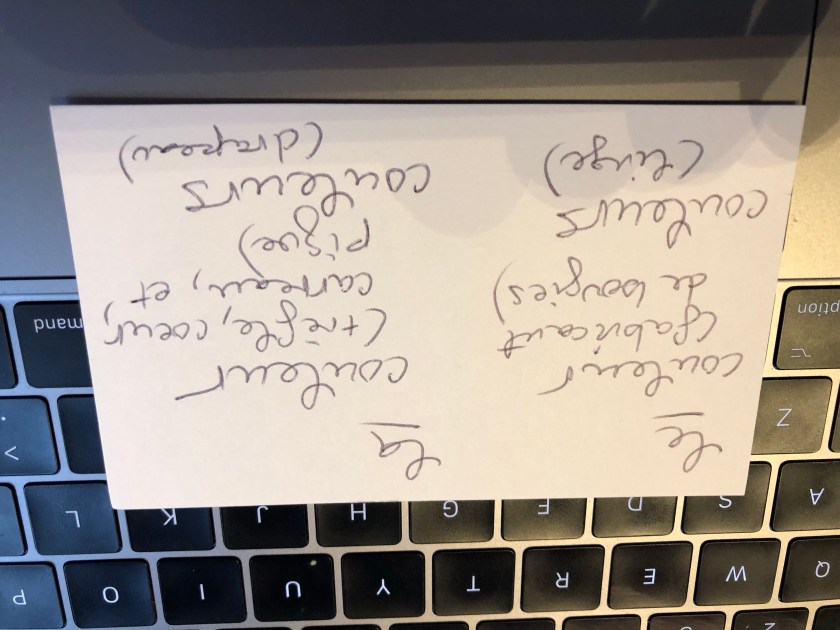
I think you can figure out how these drills work. Oh–native speakers might disagree about some of these, especially the two plurals couleurs, one for the flag and one for the darks in your laundry. Native speakers, please feel free to chime in in the Comments section…
On some interpretation of the word “scientist,” I am a scientist. In practical terms, that means that I publish a lot, and that when I publish, it’s in journals with names like Genome Biologyor Suicide and Life-threatening Behavior, or in conferences with names like American Medical Informatics Association Annual Symposium. That whole “publish a lot” thing is important, and in order to convince people to publish scientific work, you need to convince them that what you’re writing about is something new.
A common trope for convincing other scientists that what you’ve done is new is by saying some version of “no one has ever published anything about this before.” …or at least, not very much–not enough. But, how do you convince an editor that no one else has ever written about your topic? The best way that I know of is to tell the reader what has been written about the topic that’s close to, and relevant to, what you’re doing, but not quite what you’re doing.
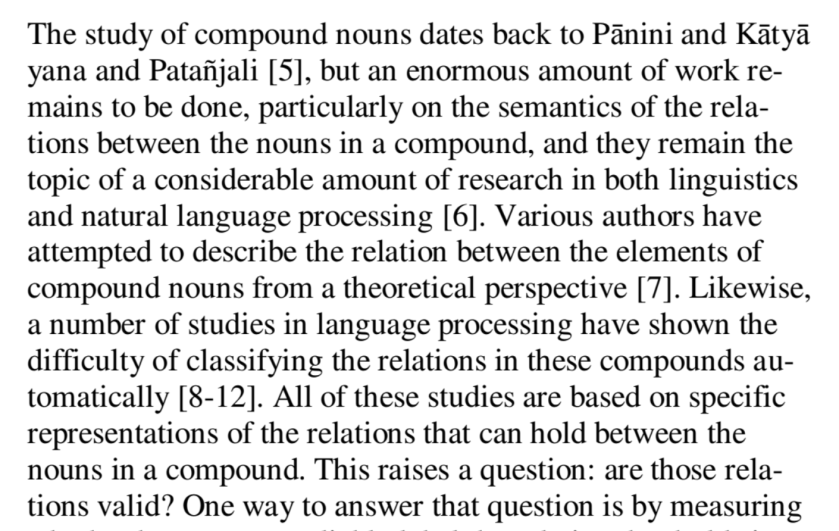
Here’s a version of the convince-the-reader-that-they-should-trust-that-you-know-what-is-and-isn’t-novel-because-you’ve-read-a-ton-about-the-topic strategy in action. Note that the author doesn’t assert that what they’re writing about has never been written about before–they tell you about a bunch of stuff that has been written about on closely related topics (citing eight specific other works on the subject), and then asserts that there’s still an open question (which, of course, they will answer in their paper):
Having been beaten about the head and shoulders with eight citations on the topic, the reader is pretty likely to accept that you know what has and hasn’t been done here.
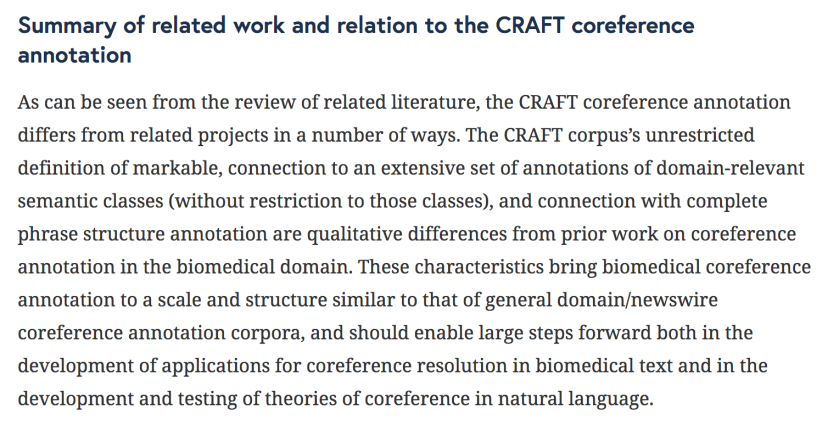
Here’s another take on the strategy. The following paragraph follows a fairly detailed discussion of 76 (that’s seventy-six, for those of you who, like me, are so old that you have trouble reading numerals on screens) related papers, books, etc.:
The author isn’t letting you decide for yourself what that pile of references means from the perspective of their work–they’re telling you what it means. That extra step of summarizing is actually the author taking the opportunity to place their work relative to everybody else’s, which lets them show you how their work is different from all of the stuff that ‘s been done before.
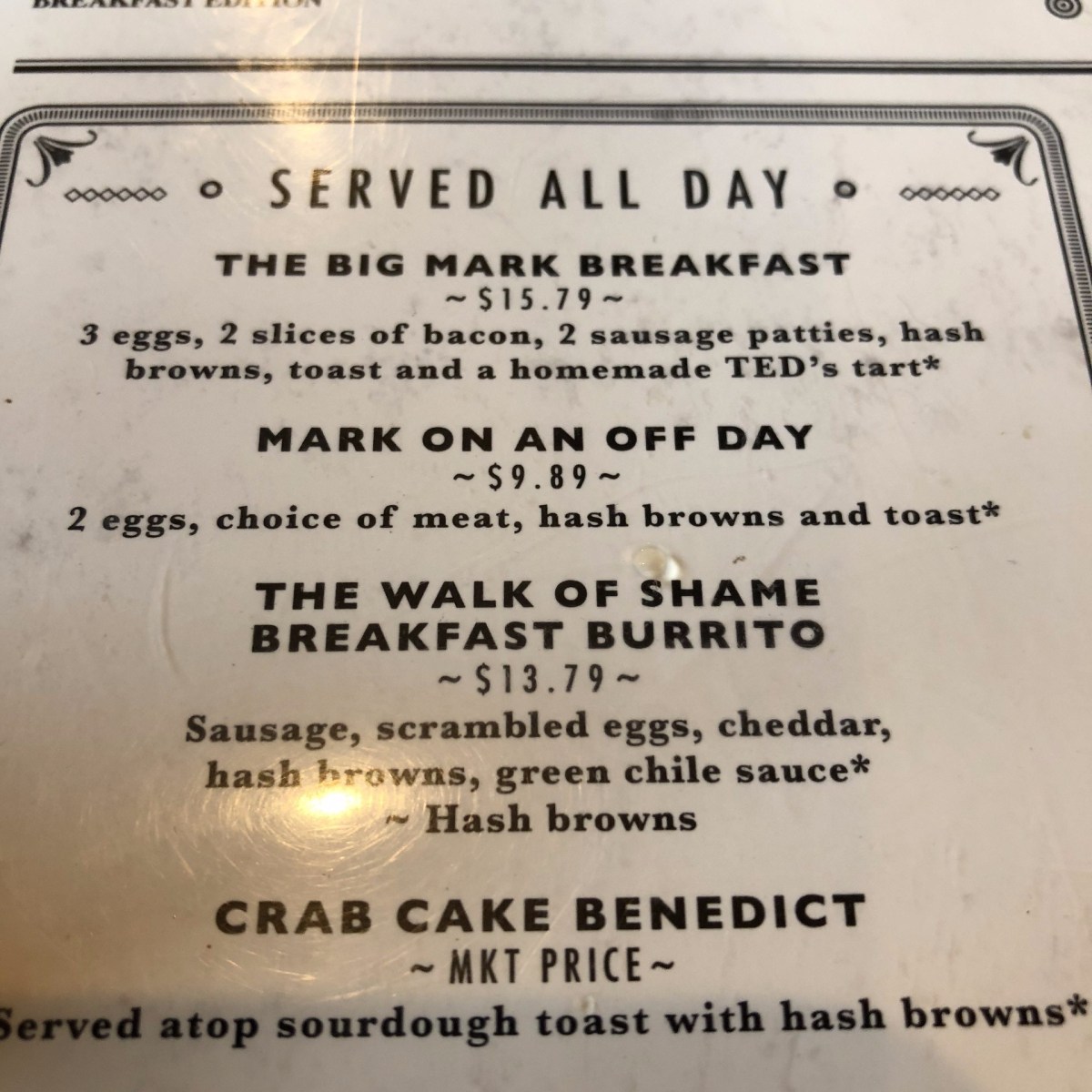
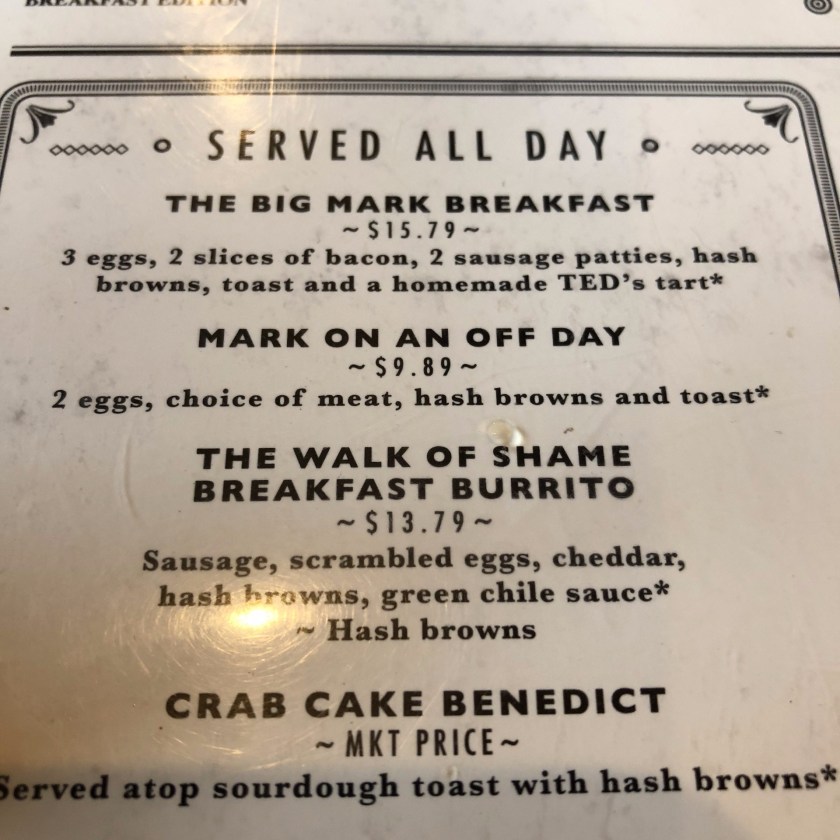
These laborieuses pensées (never miss a Montaigne allusion, say I) came to mind while ordering breakfast the other day in Ted’s Bulletin, a cool restaurant in Dupont Circle (or maybe Adams Morgan–I never know where to draw the line between them) with a damn fine breakfast menu. Perusing said breakfast menu, I noted the following:
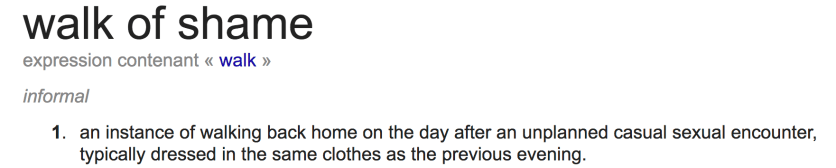
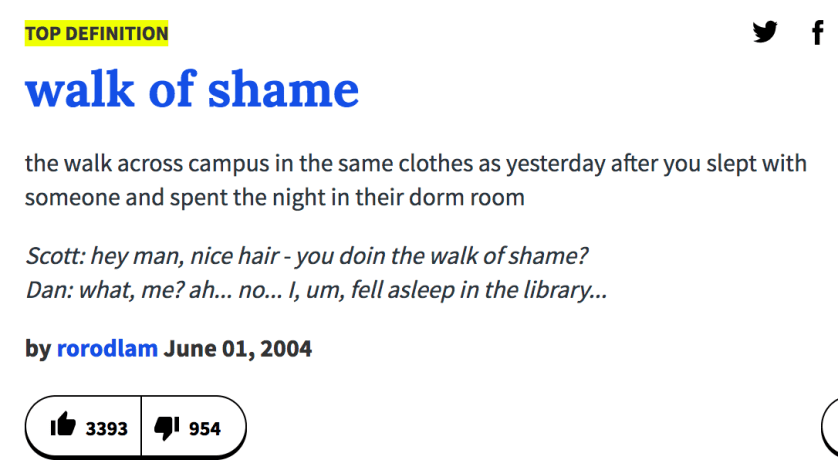
Now, I know what a burrito is. I also know what a “breakfast burrito” is–you would expect it to have eggs and other traditionally American breakfast stuff within. I also know what the Walk of Shame is. Here are some definitions, scraped from the wonder that is the Internet:
Source: screen shot of Google’s suggested definition.Screen shot from urbandictionary.com
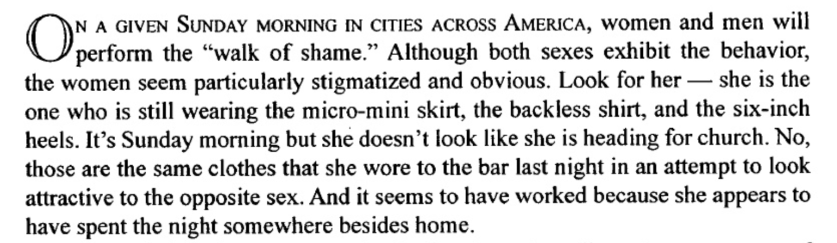
Casting about for reliable sources to cite in this blog post, I came across the following in Brett Lunceford’s paper The walk of shame: A normative description, in the journal ETC: A Review of General Semantics.
Source: Lunceford, Brett. “The walk of shame: A normative description.” ETC: A review of General Semantics 65.4 (2008): 319-329.
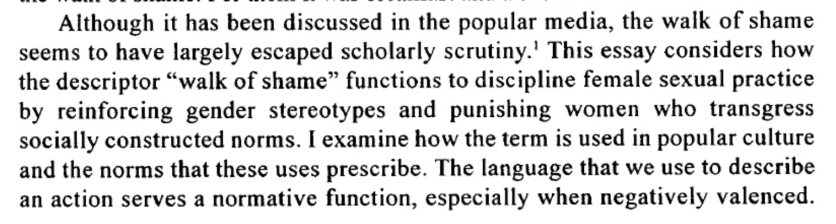
One notable thing about this paper is that in it, Lunceford takes a nice approach to the why-you-should-believe-me-when-I-say-that-no-one-has-done-this-before move. Here’s where he asserts that what he’s doing is novel (new):
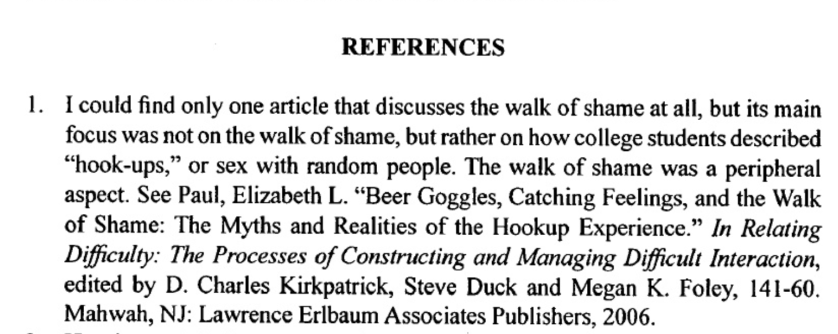
Did you catch that footnote (endnote, actually) at the end of the first sentence? Let’s track it down:
The “only” in I could find only one article implies “I looked hard.” The description of what the article does and doesn’t say on the subject implies “I actually did read the paper.” Personally, as an editor, or as a reviewer, or as a reader, I find that convincing. Sure, it’s possible that the writer of something like this just did a really shitty job of searching–but, that’s not the most obvious conclusion to draw, and most people are going to accept this support for the novelty of the work if they don’t actually, personally, know of relevant prior work that you’ve missed–and if they do, they’re doing you a favor by telling you about it, right? Brett (the author of the Walk of Shame paper) sees it this way himself. As he put it to me in a recent email:
I was wary of writing that I couldn’t find anything else on the topic, because there is always a risk that someone will then respond, “You idiot! How could you not know about XYZ’s article on this very topic?” But Penn State had an amazing library with a wide range of sources available to me, so I figured if I couldn’t find it there it was likely not available. But that risk is why most people seem to hedge their bets, as we saw in some of the earlier examples here.
(I didn’t tell Brett that the earlier examples were all from my papers. I also didn’t tell him that I didn’t realize that it sounded like I was hedging my bets–d’oh!)
As it turns out, Brett’s paper is also an interesting example of how you find a novel topic, as well as the role of your literature review in convincing not just the reviewers, but yourself that you are following a new line of thought. Brett himself again:
In the field of rhetoric, we are much less concerned with novelty in the subject than we are in a new and different reading of the topic. After all, there are many people still combing over speeches by MLK and Lincoln. So I was under less pressure to find novelty than someone in the sciences. For me, it was genuine surprise – how have we as a scholarly community managed to overlook this? I did not set out to discuss the walk of shame, though. Rather, the walk of shame came to me. When I was teaching a course in small group communication, one assignment was to present an infomercial of a product, real or imagined. One student group presented a “walk of shame” kit. I asked if this was a major issue on campus, and they replied that some people would get up early to taunt those returning to the dorms. This was what got me thinking about the notion of shame. When I looked to see what had been written on the topic, I was surprised at how difficult it was to find anything at all. I found stuff in Cosmo and other popular magazines, but nothing else. It’s rare to find a topic so common, but so overlooked, so I wrote the article.
Picture source: imgflip.com
(That’s my emphasis.) Now, just because you’ve established that something hasn’t been done before doesn’t mean that you’ve established that it would be worth doing it. Brett takes this up head-on in the conclusion of his article. He actually combines it nicely with a technique called introducing a nay-sayer—that is, explicitly pointing out a potential counter-argument to what you’re asserting (or in this case, to the idea that anybody should be bothering to read what you’ve written). The conclusion to his article is as good of an ending to this blog post as I could have written, so I’ll leave you with his words:
The walk of shame may seem an inconsequential matter but linguistic practices that work to police female sexual behavior in this way are links in the chain of female oppression. These chains can–and should–be broken through critical evaluation of sexual norms and a redefinition of female and male sexual behavior. But before we can act, we must first begin with how we think about these norms–in short, we must begin with the very words we use to define ourselves, our actions, others, and our relationships.
French notes
la référence or la référence bibliographique : a citation, as in an academic paper. Frome Wikipedia: Une référence bibliographique est un ensemble de données permettant d’identifier un document publié, ou une partie de ce document, et d’y faire référence.
Not to be confused with…
la citation : a quote. From Wikipedia: Une citation est la reproduction d’un court extrait d’un propos ou d’un écrit antérieur dans la rédaction d’un texte ou dans une forme d’expression orale.




 You know how the matching game works: we have words in English, words in French, and we match them. Today’s words (and a tiny bit of grammar) are taken from the discussion of Zipf’s Law in the book





 Zipf's Law