“It is a stain on America’s honor”

I served in the US military from 1979-1988.   I spent a little bit of that time working in the engine room of a guided missile cruiser, and a lot of that time delivering medical care, mostly to people with heart and lung disease.

I was, and am, proud of my service in the American military.  The reason that I was (and am) proud had nothing to do with my individual actions—the world was relatively quiet during that period, and the closest I came to combat was the Gulf of Sidra incident—and everything to do with the fact that the American military is one of the most moral armed forces in the world, and perhaps in the history of the world.  We do not commit rape in the territories that we take.  We do not kill unnecessarily.  We treat prisoners humanely.  We do not torture.

I was horrified to learn of the CIA’s torture of prisoners after 9/11, and even more horrified when the news came out that they had spied on a Senate subcommittee that was investigating their activities.  The CIA has a long history of valuable service to the United States, and I have no question that many CIA agents, analysts, and others have served honorably.  However: this is terrible.  Completely un-American.

The harshest critics of torture that I’m aware of are US servicemen: specifically, pilots.  They are perhaps the most at risk of being captured, and they know that hostility against them is likely to be the strongest of all hostilities towards enemy combatants: bombs kill indiscriminately, and sometimes pilots are responsible for bombs.

Senator John McCain, the Republican candidate for president in 2008 and a military veteran who was captured and tortured by the North Vietnamese, said this about CIA torture: “It is a stain on America’s honor.”  I couldn’t have said it better.
One French sentence, three new words: scheduling a talk

Part of academic life in every country that I’ve visited in an official capacity is going to people’s talks.  I found this to be a great way to practice my French listening skills, and I always learned new technical vocabulary.  I didn’t usually have to struggle through the talk announcement emails, but the consequences of Zipf’s Law are never far away, and this morning I ran into three words that I didn’t know just in the first sentence of an email announcing an upcoming series of talks by the LIMSI interns:

Les prochaines séances de séminaire du groupe ILES seront consacrées à des exposés des stagiaires, qui présenteront leur travail au sein groupe.

These are especially fun words, since all three of them have English cognates with totally different meanings:

  • la séance: session; in the context of the theater or movies: showing, performance.  I’m pretty sure I saw a wider range of uses in France, but don’t remember any off the top of my head.
  • consacré: dedicated to, devoted to, dealing with.
  • un exposé: report, account; in the context of a conference: talk, lecture; in the context of a class: presentation.


Today’s headlines in Guatemala

According to Wikipedia’s page about Guatemalan newspapers, the most widely read paper in Guatemala is Nuestro Diario.  Let’s see if I can make it any further in this paper than in a French newspaper… Nope, can’t even get past the headlines.  Let’s see what new words Zipf’s Law brings us today.  Nuestro Diario is a tabloid, so not surprisingly, the headlines are all about violence and Miss Teen Guatemalan Mayan.

  • baleado: shot down, shot dead.  Headline: Baleados en la terminal.
  • arrollado: mown down, swept along, dragged underneath.  Headline: Mueren dos hombres arrollados por camión en Guanagazapa.

The anatomy of the hand in Spanish

I can make it through the first sentence of the Spanish-language Wikipedia page on hand anatomy, but by the second sentence, Zipf’s Law strikes…  Here are the first two sentences:

Las manos forman parte de las extremidades del cuerpo humano, siendo el cuarto segmento del miembro superior o torácico, están localizadas en los extremos de los antebrazos, son prensiles y tienen cinco dedos cada una. Abarcan desde la muñeca hasta la yema de los dedos en los seres humanos.

  • abarcar: in this context, to span.
  • yema del dedo: fingertip.  Other meanings of yema: talking about eggs, it’s the yolk; talking about plants, it’s a bud or a shoot.


The risks of hand surgery

Informed consent is important anywhere that you practice.  Getting informed consent includes explaining the risks of the surgery to the patient.  Zipf’s Law applies to the vocabulary of surgical risk, of course (although I don’t know if it applies to the actual adverse effects themselves or not).  Here are some words that come up in the discussion of risks of hand surgery on this web page about hand surgery:

  • conllevar: most of the meanings are in the area of entailing or bringing (as in power bringing responsibility), conveying or carrying (as in a feeling), or implying or involving.  Another sense is to bear or put up with.  La mayoría de las cirugías conllevan los riesgos de la anestesia y de hemorragia.
  • la sensibilidad: feeling, sensitivity.  Pérdida de sensibilidad o movimiento de la mano o los dedos.
  • coágulo: clot, blood clot.  Pueden formarse coágulos de sangre.


Stuff that I didn’t know about Kent State

For me, part of preparing myself for any trip is a lot of listening to the radio.  Yesterday I heard a long story about the Kent State shootings.  I learned a lot that I didn’t know–in particular, that the shootings came in a period of rapidly increasing anti-left-wing hysteria in the region.  I guess I had always thought of them as happening out of nowhere.  What a sad story.

Zipf’s Law strikes in tragedies as much as any other time.  Here are some words that I learned from this story:

  • tropas: troops.
  • disparo: a shot.
  • prever: to anticipate, foresee, forecast, plan.

Sigh.

What is hand surgery, anyway?

Last year I spent a lot of time working with a wonderful hand surgeon, and want to make sure that my hand surgery vocabulary is up to snuff in case I end up with him again.  Last year Zipf’s Law pulled its usual crap on me—like, when you go to see a hand surgeon, the first question he asks is, “are you right-handed or left-handed?”, and I knew how to say “left-handed”–zurdo, which everyone learns in school because it’s easy to confuse with sordo, “mute”–but, I had no clue how to say “right-handed.”  (Turns out it’s diestro.)  For today, I’m starting with a web page that gives a general description of hand surgery.  Zipf’s Law raises its ugly head in the very first sentence, of course.

  • amplia: adjective with a range of meanings including wide, spacious, loose.
  • gama: range, spectrum.  Having looked up these two words, I can finally understand THE FIRST SENTENCE of the web page defining what plastic surgery is: Cirugía de la mano es un término general que incorpora una amplia gama de diferentes tipos de cirugía de la mano. 
  • colgajo: flap, as in colgajo de piel, “skin flap.”
  • suministro: supply, as in suministro de sangre, “blood supply.”
  • ubicación: location, whereabouts, position.

Zipf’s Law is embarrassing sometimes

I’m getting ready for a trip to Guatemala to spend a week interpreting for a wonderful bunch of surgeons.  Check out Surgicorps–it’s a great group, and you should totally donate.

The embarrassing thing about Zipf’s Law is that it often leads you to stumble on words that aren’t unusual at all.  For example: preparing for a trip means spending lots of time listening to the radio in the relevant language.  A few weeks ago, I was listening to a “health and beauty” show in Spanish.  The host used the word recetar, where I would have expected prescribir.  Both mean to prescribe.  I knew the word receta “prescription” (also “recipe”), but just had never heard the verbal form recetar before.  Had no clue it existed.  Unusual?  Only in the sense of rare, and then no more “unusual” than anything else.  Zipf’s Law.


The many ways to spell “Kevin” in French

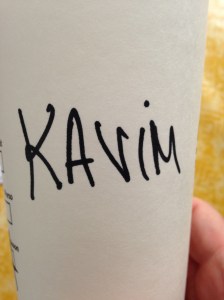
2014-06-08 11.05.24I’m told that the name “Kevin” was a popular baby name in the 1990s, due to Kevin Costner. However, the name “Kevin” doesn’t have any French equivalent that I know of (although there’s a close Breton equivalent, Breton being a Celtic language spoken in the Brittany region of France).  American and French spelling of vowel-nasal sequences don’t correspond very well, leading to some cute misspellings when people ask what my name is and then need to write it down. I’ve been collecting misspellings, just for fun.  Here’s what I have so far:

  •  Kavim: my favorite.  This is what they wrote on my coffee cup at Starbucks (yes, I went to Starbucks in Paris–it opens far earlier than normal cafes).
  • Calvin: what my barber calls me.  Even Americans in the US make this mistake sometimes.
  • Kévin: I saw this written the other day, as some other guy’s name.  The pronunciation would be pretty different from the way that I pronounce my name.

The best French words ever

So, I’m on my way back home to Denver, sad to leave Paris, but happy to have had this opportunity to spend an extended period of time in my mother’s ancestral homeland. Over the weeks, I stopped noticing the long hike up the hill to work. I don’t know if my judo improved, but I definitely got a deeper appreciation for how much strength doesn’t have to matter in judo if your technique is really good—a result of marathon ne waza sessions with the beautiful Françoise, leading to me being arm-barred, say, every 7 minutes or so. I sampled enough different cheeses to be able to follow the “eat what you like” advice with some confidence that I’ve tried enough cheeses to actually know what I do (and don’t) like, and have read enough about the subject that I can explain what I’m looking for to a cheesemonger (love that word). I wrote 600 lines of code or so, and learned a lot about the structure of French noun phrases.

I’m sure that Zipf’s Law will be taking its wrath out on me right up until the plane takes off from Charles de Gaulle. In the meantime, I’ll wrap up this portion of my life with some of my favorite words from among the hundreds that I’ve come across:

  • haussmanniser: to Haussmannize. From a magazine article about the Marais section of Paris. Haussmann-style architecture is what you’re thinking of when you think of the typical look of Paris. The question posed in the article was, where could immigrants live in an otherwise haussmannisé (Haussmannized) city?
  • soupçonner: to suspect. From a newspaper article about a guy’s arrest. Soupçon can have the same sense in French as it does in English, but I’ve only heard this wonderful verb; the associated noun is un soupçon, a suspicion.
  • hebdomadaire: this amazing adjective means “weekly.”
  • bouquiniste: I love words with an extremely specific meaning—this is a used bookseller on the banks of the Seine. I particularly like the fact that the word entered the dictionary in 1789—the country was being torn apart by one of the most amazing revolutions in European history, and the Académie Française was taking the time to put words about used books and the people who love them in the dictionary.

…and with that, I’m off to the airport. A bientôt!

Ukrainian Humanitarian Resistance

Resisting the russist occupation while keeping our humanity

Languages. Motivation. Education. Travelling

"Je suis féru(e) de langues" is about language learning, study tips and travelling. Join my community!

Curative Power of Medical Data

JCDL 2020 Workshop on Biomedical Natural Language Processing

Crimescribe

Criminal Curiosities

BioNLP

Biomedical natural language processing

Mostly Mammoths

but other things that fascinate me, too

Zygoma

Adventures in natural history collections

Our French Oasis

FAMILY LIFE IN A FRENCH COUNTRY VILLAGE

ACL 2017

PC Chairs Blog

Abby Mullen

A site about history and life

EFL Notes

Random commentary on teaching English as a foreign language

Natural Language Processing

Université Paris-Centrale, Spring 2017

Speak Out in Spanish!

living and loving language

- MIKE STEEDEN -

THE DRIVELLINGS OF TWATTERSLEY FROMAGE