Spoken American English can be very difficult to understand. Here’s a video to help you cope with one of the problems therewith.
Walking out of the exam on oral comprehension during the testing for the Diplôme approfondi de langue française a couple months ago, I found a very unhappy-looking young man waiting for the elevator. Are you OK? He shook his head glumly: I flunked again, I know it. I made sympathetic noises. Was this your first time taking the test? I responded in the affirmative. He gave me a look of pity–clearly the expectation was that I was going to find the experience as brutal as he had. Repeatedly, apparently.
Indeed, the oral comprehension exam got me my worst score out of the whole test. Spoken French and spoken English can both be brutally difficult to understand if they’re not your native language, and for many of the same reasons. One of those is their sets of vowels–both languages have vowel “inventories” (the technical term) that are shared by relatively few languages. Another is a process called reduction, which leads to things having a range of ways that they could be pronounced, some of which are less distinct than others. For example, in French, some unstressed vowels are optional in casual spoken language, so that cheveux is often pronounced chveux, matelot can be pronounced matlot, and so on. Furthermore, the sounds that are “left behind” can be changed as a result, so that, for example, the j in je becomes pronounced as ch when je suis is “reduced” to chuis. So, when I describe this as becoming “less distinct,” think about this. In French, there are these two words, and the difference between them is the sound of j versus the sound of ch:
le jar: secret language, argot
le char: chariot; in Canada, car.
When j becomes ch, as in chuis, the difference between the two sounds goes away, and in that sense, a “reduced” word is less distinct from other words than it might have been.
Reduction processes are rampant in spoken American English, and they can make the language pretty difficult to understand if you’re not a native speaker. I’m trying my hand at putting some videos together that aim to help people learn to understand these reductions. You can find the first one, on the topic of the reduction of let meto lemme, at the link below. If you’re as mystified by spoken American English as I am by spoken French, check it out–I’d love to have feedback on what does and doesn’t work, whether that be here on this blog, or in the Comments section on YouTube. Unfortunately, I haven’t figured out the whole subtitle thing, and I’d like to know to what extent that does or doesn’t interfere with the effectiveness (or lack thereof) of the video. Any input at all would be appreciated, though!
You can unscrew a lightbulb, you can unplug your monitor, and you can unbuckle your suspenders, so why can’t you unsee things? It has to do with the prefix un- when it’s attached to verbs. In order to be able to un- a verb:
The verb has to refer to changing the state of something. So, you can undress yourself (changing your state from being dressed to not), you can unclog a pipe (changing its state from being clogged to not), and you can unlock a door (changing its state from being locked to not).
The state has to be reversible. So, you can dress/undress yourself, you can clog/unclog a pipe, and you can lock/unlock a door. But: you can bake a cake, but can’t unbake it; you can dry a shirt, but as far as I know, you can’t undry it; you can breakan egg, but you can’t unbreak it.
So: you can see something, but you can’t unsee it, because when you see something, you’re not changing its state, and that’s the sine qua non of verbs that can take un-.
Ack–data! I almost forgot that I’m an empiricist! In fact, the verb to unsee occurs a lot. It occurs with a frequency of 0.02 words per million in the enTenTen13 corpus (19.7 billion words of English, available on the Sketch Engine web site). But, it’s cool: it doesn’t mean to undo the seeing of something. When we talk about unseeing things, we’re usually talking about the very fact of not being able to unsee them, and what that actually means is this: we can’t forget them, and/or we can’t move beyond whatever we learned from what we saw.
In fact, the interwebs are full of talk about things that can’t be “unseen.” Some examples:
Old guy at the YMCA was pooping with the door open. C’mon man I can’t unsee that.
Why does unsee work so well for this use, when it can’t have the meaning that you would think it would? I suspect that it’s precisely because (a) it’s basically an impossible verb, and (b) it’s used only to describe an impossible action. And, the fact that the meaning of unsee is not the meaning of see plus the meaning of un- is important here. We’ve talked often about the basic principle of compositionality–the idea that meaning in language comes from something like “adding together” the meanings of different things. Here is a case where the meaning is clearly not compositional–to unsee something, were it possible, would not be what it is if it were compositional. (Were it possible explained below in the English notes.) So: cool, if you think that it’s cool to violate the expectations of linguistics, computer science, and philosophy. (I do think it’s cool, but maybe that’s why I’m single.)
What I can’t unsee: pierres d’attente. I took a guided tour of Haussmannian Paris the other day. What that means: the enormous redesign of Paris in the 3rd quarter of the 19th century, when huge swaths of the city were torn down and rebuilt into the stereotype that you’re thinking of when you visualize Paris today. (See here for a post about the typical Haussmannian streets and how they relate to your ability to survive the zombie apocalypse in Paris, as well as here for a post about the typical Haussmannian apartment buildings and how they, too, relate to your ability to survive the zombie apocalypse in Paris.)
The new Haussmannian buildings went up in the order in which their lots were appropriated, the old buildings torn down, and the new buildings financed. That meant that it was often the case that buildings were put up that one day would have neighbors, but didn’t yet. In anticipation of the need to line up with adjacent buildings–lining up with things was very important in Haussmann’s Paris–the front-facing walls of the buildings had projections that were meant to facilitate alignment with future neighbors. So, pierre d’attente: “waiting stone,” I guess. (I think they can also be called pierres d’accord.)
Pierres d’attente. Picture source: me, on the rue La Fayette, on a rainy day in January 2017.
Pierres d’attente. Picture source: me.
Now, at some point, architects realized that if you have pierres d’attente sticking out of the side of your building, they catch rain, and then it can run into your walls, and that is most definitely not a good thing for your building. So, people started cutting them off, which is why you will see things like this:
Apartment building with pierres d’attente removed. Picture source: me, on the rue La Fayette.
But: not everyone was happy about this. Haussmannian apartment buildings are part of our patrimoine, and pierres d’attente are part of Haussmannian apartment buildings, so those pierres d’attente are part of our patrimoine, and no asshole should be cutting them off, right? Point taken, and cutting off your pierres d’attente is apparently no longer allowed. But, hey, this is France, and we’re logical–so, what you can do is, you can cut them so that there’s a pente, a slope, on the top edge. (I just had to throw the French word in there, on account of the fact that when I memorized it, I thought that I would never, ever get to use it–and there, my friends, is a very concrete example of Zipf’s Law in action.)
The guided tour was great. Seulement voilà (the thing is)…the tour guide explained pierres d’attente to us, and now I can’t stop seeing them. It’s OK–frankly, the more there is to occupy my fevered little brain, the better…
English notes
Anglophone students of French whine about the French subjunctive, and frankly, I’m not sure that Francophone professors are thrilled about teaching it to us, but: the fact is, English has a subjunctive voice, too. Or, more accurately: it can. This varies quite a bit by dialect, but English can have a subjunctive, in at least the following circumstance: talking about things that are not real at the moment. For example, here are some options, with and without the subjunctive:
If I were you, I wouldn’t tell him to fuck off–he’s a lot bigger than you are.
If I was you, I wouldn’t tell him to fuck off–he’s a lot bigger than you are.
You can recognize the subjunctive by the weird agreement of If I were you, rather than If I was you. Both are correct, and most Americans would say If I was you, but If I were you is more natural in my dialect. (I come from a relatively obscure area in the northwest of the country.)
Would you prefer that he give you a pat on the back, or a kick in the ass?
Would you prefer that he gives you a pat on the back, or a kick in the ass?
Again, you can recognize the subjunctive by the weird agreement of he give you versus he gives you.
How the subjunctive was used in the post: Here is a case where the meaning is clearly not compositional–to unsee something, were it possible, would not be what it is if it were compositional. I chose obscenity-laden examples to make clear that this isn’t a formality thing–the subjunctive is just more natural in my dialect. Again, most American speakers of English would say the form of these two sentences without the subjunctive, but both are fine. I have no idea how this works in the United Kingdom–can any of you Brits comment on this?
If you go to PubMed/MEDLINE, the US National Library of Medicine’s giant repository of (and search engine for) biomedical publications, and look around for papers on language and suicide, you won’t find that much on what you’re probably expecting: research on the language of suicidal people. What you will find is papers on how we talk about suicide.
The major issue has to do with the ways that we refer to the act of suicide. In English, your basic options are:
to commit suicide
to kill oneself
to take one’s own life
to do oneself in
to die by one’s own hand
The problem is that first one: to commit suicide. People who work in the field of suicide in any capacity–prevention, treatment, research, whatever–aren’t very fond of it. The reason: it stigmatizes the act. In English, things that you commit are bad.
Now, you’re thinking: commit isn’t always bad, right? You can commit to doing something, commit to someone, commit something to memory. No question! But, we’re seeing two very different linguistic phenomena here. The bad commit has a very specific kind of structure: it’s what we call a light verb.
Light verbs are a special kind of verb. They don’t have very much meaning by themselves. Rather, they occur with some other verb, and it’s that verb that gives the expression its meaning. For example: in English, the verb to take can be a light verb. (It isn’t always a light verb–but, there are many times when it is.) Here are some English-language expressions in which to take is a light verb:
to take a bath
to take a beating
to take a break
What does to take mean in to take a bath, to take a beating, and to take a break? I suggest to you that it doesn’t mean very much at all. Rather, it’s bath, beating, and break that contain the meanings of those expressions. (I’ve put a technical definition at the end of the page, if you are into that kinda thing.)
Light verb constructions are not a rare phenomenon. Here are a bunch more expressions in English that are what we call light verb constructions (that means the light verb plus whatever it is that it combines with–in English, typically a noun) in which the light verb is take:
to take a breather
to take a bus/taxi/shuttle/plane/train
to take a dump
to take a gander (at)
to take a minute
to take a pee
to take a piss
to take a shit
to take a vacation
to take a walk
to take pity (on)
…and, it’s not like take is the only light verb in English. In fact, we have several. Some examples:
to make a decision, to make an offer, to make haste, to make peepee
to give a shit, to give (someone) a hand, to give a damn, to give a fuck, to give birth (plus some obscene ones that I’m leaving out)
to get dressed, to get ready, to get angry/mad, to get nasty, to get drunk, to get high, to get sober
to do battle, to do business, to do your business (yes, those are different)
to have a ball, to have a blast, to have fun, to have a good time, to have a headache, to have mercy, to have sex, to take a piss
to take action, to take a seat, to take one’s time, to take note, to take notes (yes, those are different), to take a look (at)
With that data in hand, we can see the difference between the commit of to commit suicide and the non-bad senses of commit in to commit to memory, to commit to a person, to commit to a deadline… none of those have that verb + noun structure. They’re all commit + tosomething.
Some more (or less) useful light verb constructions in French: faire la vaisselle: to do the dishes faire la lessive: to do the laundry faire [+université]: to go to a university (J’ai fait William and Mary, I went to William and Mary) faire du [+musical instrument]: to play an instrument (as in to do so habitually) faire du diabète: to have diabetes
One of the interesting things about light verb constructions is that they don’t show a basic characteristic that we expect to see in language: compositionality. To paraphrase from a previous post:
Compositionality is the process of meaning being produced by something that you could think of as similar to addition (technically, it’s a more general “function,” but “addition” will work for our positions–linguists, no hate mail, please). Take a situation where my dog stole some butter. The semantics are: there’s a dog, it’s my dog, there’s some butter, and the butter was taken, by the dog, without permission. (You can’t believe how horrible the poo that I had to pick up over the course of the next 24 hours was.) My dog’s name is Khani, so I might say something like this: Khani stole some butter. The idea behind compositionality is that the meaning of Khani stole the butter is the adding together of the meanings of Khani, steal, butter, and the meaning of being in the subject position versus the object position of an active, transitive sentence.
So: we have this basic expectation that meaning in language will be compositional, and as linguists, as computer science people who work with human language, and as philosophers, we have a hell of a lot riding on that expectation.
In that context, the cool thing about light verb constructions is this: they’re not compositional. There is pretty much no way to get any systematic interpretation of the combinations of light verbs and their nouns. Pause and ponder:
To make peepee and to take a piss: they mean the same thing (the difference is that one is child language and the other is too impolite to say in front of your grandmother). Peepee and piss mean the same thing–again, one is child language, and the other one is too impolite to say in front of your grandmother. Your assignment: tell me what make and take contribute to the meaning of those expressions–that is, explain to me what their contribution is to the composition of the verb and the noun. My point: peepee and piss mean the same things, and to make peepee and to take a piss mean the same things–how do you explain that, if make and take each contribute something to the meaning of those expressions?
Consider to take a bath and to take a bus. One of those is what you might think of as event–an act of bathing. The other is a big, smelly thing that takes you to work. (See how I slipped another take in there? Different take–nobody said that linguistics was going to be easy.) In take a bath and take a bus, your relationship with the two things is pretty different. In the first case, you’re participating in an event, while in the second case, you’re making use of a mode of transportation. Your assignment: tell me how that difference comes from the verb to take.
The answers:
Trick question: as far as I know, make and take don’t contribute anything to the meanings of those expressions. The meanings of the expressions are not compositional.
Trick question: as far as I know, take doesn’t contribute anything to the meanings of those expressions. The meanings of the expressions are not compositional.
So, back to to commit suicide. As you might have noticed, the relationships between light verbs and their nouns are things that a child learning their native language just has to remember. There’s nothing that the kid learns about their language that would let them infer or guess that they’re making peepee now, but they’ll be taking a piss when they grow up: they have to remember it when they’re exposed to it. (I don’t mean to suggest here that children learn language by remembering stuff to which they’ve been exposed–we’ve talked about how very little of language-learning for children works that way.)
So, the verb + noun combinations in light verb constructions are pretty random. The thing about commit is this: it’s a light verb, too, in constructions like to commit suicide. Its noun is of a very specific kind, though: its verb is something bad. Compare that with the light verb to have. You can have a heart attack, you can have a migraine, or you can have a good time, or have sex. No particular semantic consistency there–could be bad (heart attack, migraine), or it could be good (a good time, sex). Here’s a list of the words that are statistically most closely associated with the verb to commit in the enTenTen corpus (a collection of 19.7 billion words of written English, available on the Search Engine web site; git is a computer science thing. See this post.)
Top objects and subjects of the verb “commit” in 19.7 billion words of English. From the enTenTen corpus on the Sketch Engine web site.
What kinds of things get commited? Crime, sin, murder, fraud, atrocity. Who commits things? Offender, defendant, criminal. Not good.
So, what are we to make of to commit suicide? Many people who work in the field (go do your own search on PubMed/MEDLINE if you’re interested, or just see here and here for examples) are of the opinion that use of the expression to commit suicide has the effect of stigmatizing the person who killed themself. Is that a bad thing? They think it is. I think it is, too. Now, does the person who killed themself care how you talk about them? Certainly not–they’re dead. But, that person’s mother, husband, son, daughter, cousin, aunt, uncle, best friend… They do, and they’re not dead. So, many people who work with suicide in some capacity would like to see that expression go away. Here’s a very eloquent expression of the idea, from Doris Sommer-Rotenberg:
The expression “to commit suicide” is morally imprecise. Its connotation of illegality and dishonour intensifies the stigma attached to the one who has died as well as to those who have been traumatized by this loss. It does nothing to convey the fact that suicide is the tragic outcome of severe depressive illness and thus, like any other affliction of the body or mind, has in itself no moral weight. —Doris Sommer-Rotenberg,Suicide and language
Who cares? Sommer-Rotenberg again:
The rejection of the term “commit suicide” will help to replace silence and shame with discussion, interaction, insight and, ultimately, successful preventive research.
Now, I know what you’re thinking: you’re thinking that the language that we use doesn’t affect the way that we think. You know what? I agree with you. However: even if how we talk about suicide doesn’t change the way that we think about it, I suggest to you–as a fellow student said to me in the basement of Oxley Hall one evening in our graduate student days: the fact that the language that we use doesn’t change our reality doesn’t change the fact that you can make someone feel bad with the language that you use, and you wouldn’t want to do that, right? Well, of course not. (I love my job, but my fellow ex-student’s job is definitely cooler–she’s the only speech therapist in New York City whose practice is exclusively concerned with transgendered people.)
There’s also controversy/discussion around the ways that we talk about what happens when people try to kill themselves, but don’t succeed–attempted suicide, unsuccessful attempt, failed attempt, failed suicide, and failed completion, versus completed suicide–the idea is that these expressions model suicide as a desirable act. (If you fail to have a good time, fail to get into medical school, fail to convince someone to marry you, that’s a bad thing.) See here for a fuller discussion.
So, yeah: there’s probably more stuff in the National Library of Medicine’s repository on how we talk about suicide than there is on how people who are suicidal talk. It would be great to change that, because if we knew more about how people who are suicidal use language, then we might be able to do a better job of preventing it. Now, that means that we need language data from people who are or have been suicidal, right? But, we also need data from people who aren’t suicidal–if you want to understand something, you usually need to compare it to something else, and in this case, that means comparing the language of suicidal people to the language of people who aren’t suicidal.
It happens that there’s an enormous amount of real, live language out there in the world on social media platforms. It would be great for suicide researchers to have it, but there are ethical issues involved–just because someone puts their life out there on the web doesn’t give you the right to just grab it and do stuff with it. However: you can donate your social media data to OurDataHelps.org, a group that collects language from all kinds of people for social media research. You can sign up with them here. As the character Père LeFève says in Anne Marsella’s wonderful short story The Mission San Martin:
Best wishes to all of you who are still alive. And if you’re yet alive, please give.
On the mechanics of how the meaning gets out of the noun and into the verb, so to speak:
Contrary to “prototypical” verbal constructions where the verb is the syntactic and semantic head of the sentence and its syntactic dependents are also its semantic arguments, in LVCs, one of the syntactic dependents of the verb, generally its direct object, functions as the semantic head, projecting its own argument structure, while the verb, which is semantically “light”, bears only inflection and projects no argument structure.
− Given the fact that the verb has no semantic contribution or rather its semantic contribution is quite weak, it cannot be selected lexically, that is on the basis of its semantic contribution. The combination of a particular predicative noun (PN) with a particular light verb (LV) is thus a matter of idiosyncrasy: The noun and the verb form a collocation that must be stored in the lexicon.
Pollet SAMVELIAN, Laurence DANLOS, and Benoît SAGOT, On the predictability of light verbs
Here in France, our major worries are that we’ll do the same idiotic thing in our next election that America just did in hers. Meanwhile, all the anglophone press can find to talk about is our little rat problem, while ignoring everything linguistically interesting about it.
The French 2017 presidential race is quickly coming down to a match between the far-ish right and the extreme right, it’s not clear how much longer Europe as we know it will continue to exist, and Marine Le Pen was just voted the most admired politician in France, but the main story about France in the anglophone press right now is… an explosion of the Parisian rat population.
That store window in Ratatouille: it’s for real. (There’s a cool bar nearby, Le baiser salé (“The Salty Kiss”), that I stop into once in a while. I’m sparing you a photograph of the real rat window because it really is quite disgusting, and I say that as someone who once posted a picture of a grilled guinea pig here.) Friends tell me that the story has it that there is one rat for every person in Paris, but current estimates are quite a bit higher.
How would you know the size of the rat population, one way or the other? There’s a specific sampling technique that’s used to estimate the size of a population that can’t be directly observed–think about fish in a pond, or arctic ground squirrels in their little burrows, or–rats. Charming video involving goldfish crackers to be seen here.
Zipf’s Law being what it is, this brings up a linguistic oddity that I find interesting. It has to do with what’s called derivational morphology: the things that we can add to words that change their meaning or their part of speech, like the un in unlock or the ic in anemic.
French has a prefix, dé, that you can add to verbs to make them mean something like a reversal of the normal action of the verb. Alain Bentolila, in his La langue française pour les nuls (don’t mock it–it may be the best book on the linguistics of any single language that I’ve ever read) defines it and its close relatives, dés- and dis-, as contributing a meaning something like séparé de, qui a cessé de, différent. Some examples:
visser
to screw
dévisser
to unscrew
voiler
to veil
dévoiler
to unveil
vérouiller
to bolt; to lock; to close (a brèche, in a military context)
déverrouiller
to unbolt; to unlock (a phone, a keyboard, the caps lock)
valoriser
to add value to, to increase the value of
dévaloriser
to devalue
vêtir
to dress (transitive)
dévêtir
to undress (transitive)
This is relevant to current events because there is a set of words that have to do with removing things–mostly pestilential things, except for the last one–that have an interesting pattern with respect to this derivational prefix. To wit, I give you these examples from Bernard Fradin’s Nouvelles approches en morphologie (definitions in French when necessary, because these don’t typically show up in bilingual dictionaries)
dératiser
to exterminate the rats in [something] (WordReference)
désinsectiser
to spray [something] with insecticide (WordReference)
(I will mention here that some of the definitions of désinsectiser that I’ve come across have specified that this means to get rid of insects by using gas. I can’t find any at the moment, though.)
décafardiser
(not in WordReference)
détruire les cafards dans un lieu, spécialement par fumigation. (Cordial)
dénicotiniser
to remove the nicotine from [something] (WordReference)
What’s interesting about this–a lot, actually. To wit:
There are no corresponding forms without dé. Unlike visser/dévisser vêtir/dévêtir, we have no form of dératiser/désinsectiser/décafardiser without dé.
These verbs seem to have both a prefix (dé) and a suffix–where does the -is- come from?
As we will see, this gets us to an interaction that is not supposed to happen in language: between pragmatics, and morphology.
Fradin explains the pattern like this (scroll down for the translation):
The second case to consider is that of the verbs like dératiser (décafardiser, désinsectiser, dénicotiniser, désodoriser, dévirginiser) which display at the same time a derivational prefix and a derivational suffix….[T]he only analysis worth considering for these verbs is to say that here dé is affixed to a verb that is not present in the language, but is possible. The solution appealing to an unattested verb is especially plausible since we can show that the verb is missing due to reasons of pragmatics.
Fradin goes on to make the case that what we have here is a set of verbs that describe the reversal of a state that you do not create. You don’t infest something with rats, or insects, or nicotine. (Note that Molière’s Sganarelle would disagree with the notion that nicotine is something that one is infested with.) His story is that we see this bizarre combination of patterns:
No corresponding version of the verb without dé
There’s an -is- that doesn’t seem to have anything obvious to do with the meaning of dé
…just in the case of these verbs, in which you didn’t create the initial state of infestation.
As one of my coworkers pointed out over lunch one day: that’s not to say that you couldn’t create the initial state of infestation. He’s right: you certainly could put rats in something, or insects, or a cockroach. (In fact, that’s a famous scam, right?) It’s a nice point, because it doesn’t change the essentially pragmatic nature of the explanation for this bizarre little grouping of verbs–in fact, it highlights the involvement of pragmatics, because it argues against the possibility of an ontological explanation for this. On an ontologically-based approach, you have to have a model of reality in which it simply isn’t possible to cause something to have rats, or cockroaches, or insects, and that clearly is not the case. Rather, this is more about what’s plausible than about what’s possible. It’s not about what “is” (i.e., ontology)–it’s about what people expect to be the case. (This is a big deal (to me) because you run into people who think that the answer to every question in the world is an ontology. That doesn’t seem to be the case here. It’s also a big deal (again, to me) because the dominant school of thought in 20th-century linguistics was heavily into denying the effects of pragmatics on language. However, pragmatics appears to have a role here, if we buy Fradin’s story.)
My coworker also raised a counterargument. It’s a kind of counterargument that we really like in my line of work: positing that there is a simpler explanation for the phenomenon in question. His suggestion was that the -is- thing comes from what we call denominalization, or turning nouns into something else–in this case, a verb. (You can find a discussion of nominalization–turning a verb into a noun–here.) I don’t buy the adequacy of this hypothesis, because we can find so many French verbs that are pretty clearly denominalized–that is, derived from a noun–but don’t have the -is-. Some examples:
dérater
Débarrasser une personne ou un animal de l’organe appelé Rate. Il se disait des Chiens à qui l’on faisait cette opération pour les rendre, croyait-on, plus agiles à la course. (L’appli Larousse Dict-français-français)
“To remove from a person or an animal the organ called Rate (spleen). It was said of Dogs to whom this operation was done in order to make them, it was thought, faster at racing.”
dévisser
to unscrew
..from visser, to screw, from la vis (screw, and you pronounce the s)
déclouer
Détacher, défaire ce qui est fixé par des clous. (L’appli Trouve-mot)
..from clouer, to nail, from le clou, nail
I especially like the contrast between dérater and dératiser. The semantics of both of them involves changing the state of something (linguists are heavily into the changing of states), and they both involve changing a state that you didn’t create. So, why no -is- in dérater? If we asked Fradin, he would be likely to point out that the verbs that he mentions–that is, the ones with dé and -is–all make reference to changing a state that is in some sense noxious. In contrast, having a spleen is not something that you would think of as noxious, and so dérater–the removal of the spleen–doesn’t get the -is- part. (The technical term is morpheme.)
Now, I’ve been sorta defending Fradin here, but: I hate this kind of argument in linguistics, where you’re basically arguing on the basis of examples and counterexamples. I’m aware of the venerable history of this form of rhetoric in theoretical linguistics, but I also am more and more aware–as is much of the field–that science in general, and linguistics in particular, is less often about always and never than it is about tendencies in populations. If you look at tendencies in the population of French verbs about changing states, you can notice a group of verbs that shares a particular “behavior” (mucking about with both dé and -is-) and a particular meaning (changing a noxious state that you didn’t create). But, there are other verbs that have the dé-is- pattern that involve a change of state, but don’t involve a noxious condition–Friden himself gave us the example of dévirginiser, which I passed on to you in the second table above–and as far as I know, there’s nothing noxious about virginity in the Francophone world. Furthermore, there are:
…verbs that have to do with changing a noxious state that you didn’t create, but have a different morphological structure that doesn’t involve dé or -is-: to delouse, which isépouiller, and likewise for to de-flea:épucer or, again,épouiller.
…verbs with pretty much the same semantics that do take dé, but don’t take -is-. In particular, dévirginiser has another form, dépuceller, which led to a very embarrassing moment for me over lunch one day, but that’s a story for another time…
…and beyond that: who says that there are no corresponding verbs without dé, which you will recall is crucial to his pragmatically-based analysis? There are hundreds of millions of easily searchable words of naturally-occurring French-language data on the web, and I would like to see a solid effort to find those words before I bought the idea that they don’t occur in the language.
So, from my point of view, I’d want to see quantitative data. Being a minor phenomenon in a language does not by any stretch of the imagination mean that you’re not an interesting phenomenon–but, from my point of view, part of understanding anything linguistic is understanding the distribution of the phenomenon.
The mayor’s office launched a deratization campaign last month, and the story seems to have fallen out of the news. My strolls across the city haven’t run into any of the closed-off parks that you might have read about. I still stick my bread in the microwave before I go to bed at night–but, I always have. I hate rats.
English notes
rats! is a very mild way of expressing unhappy surprise. When I say “very mild,” I mean that you could say this in front of your grandmother.
“Oh, rats!” I couldn’t find it. I had copies of other stories and poems that I’d written in the past, but couldn’t find this particular one. (Marcus Mebes, Rats! And other frustrations)
rat: an informer. This is slang.
That Richard’s been badmouthing me to the boss behind my back;he’s a rat. Ce Richard dit du mal de moi au patron derrière mon dos ; c’est une ordure. (WordReference.com)
We’ve used the term “rat” to refer to an informer since approximately 1910. (Mentalfloss.com)
to not give a rat’s ass: to not care (about some fact).
I don’t give rats ass, my niece and her boyfriend met in church but she a hoe. (Twitter, in response to a tweet asking Guys!! Can you marry a girl you met at a Club? Not standard English, obviously (I don’t give rats ass, she a hoe).)
French people are not rude, and syntax is not autonomous.
I’m walking up the hill to the lab the other day. It’s a long hill, and I’m old and fat, so I usually stop to catch my breath halfway up. I’m standing in my usual spot when down the hill comes a man who (I hope) looks even older than I do. (Down the hill comes an old man…explained in the English notes below.) Snow-white hair, snow-white beard, and a serious snow-white bear rug rising up out of his coat to merge with his beard. He and his well-behaved dog walk up to me. Good morning. Are you OK? I take my earphones out. Oh, yes, thank you–I’m just resting a bit. You know, there’s a nice path through the forest–the road that you’re going up isn’t really very interesting. He points out the entrance to the path, but I can’t quite make it out for the trees. He and his dog walk a bit back down the hill with me and take me right to the beginning of the path. Go straight for a while–then you can turn left and go down to the town, or turn right and go up to the campus. My dog likes to walk here–it’s really pretty. I thank him, I start down the path, and he and his dog head back up the hill.
I get up to “the plateau,” the top of the hill, where the campus is located. I have only the vaguest idea where I am. I wander down a little side street, thinking that it might lead to the lab, and pass a construction vehicle. I hear a voice calling me, and turn back. Good morning, mister, the construction worker says. Your earphones are hanging out of your back pocket. …and he’s right, they are! I thank him, ask the way to my building, brush the dirt off, and go back to listening to whatever I was listening to.
Google rude french and you will find countless web pages, YouTube videos, etc., on the subject of French rudeness. Um…seriously?? Not from where I’m standing. Have I ever had a run-in with a rude lady at the phone company? Sure–just like in the US. Have I had enormous numbers of entirely pleasant interactions with random French strangers? Sure–just like in the US. The countries are, in some ways, very, very different–but, the people aren’t any more or less nice in either. You just have to know how to recognize the very different forms of American and French politeness when you see them–and how to be polite, in both the American and the French ways, yourself.
Here’s a really good explanation of some of the ways that things can go wrong for typical Americans interacting with typical French people in a typical French context–because we mistake French politeness for rudeness. Note: no one is completely typical.
English notes
…down the hill comes an old man…: There’s a lot going on here. I’ll try to unpack it (I think that’s what the kids say these days)–let’s start with looking at the sentence and its context:
I’m walking up the hill to the lab the other day. It’s a long hill, and I’m old and fat, so I usually stop to catch my breath halfway up. I’m standing in my usual spot when down the hill comes a man who (I hope) looks even older than I do.
The first thing that you probably notice is the unusual word order–not an old man comes down the hill, but down the hill comes an old man. This phenomenon goes by a couple of names–a good one is subject-locative inversion. That is: you are inverting the positions of the subject of the sentence and of a phrase that conveys something that is more or less a location. (Down the hill is a direction, not a location, but let’s stick with the “simple” name for the moment.)
You probably already understand the sentence, but if you’re not a native speaker, may not be at all clear on when one could use it. I’m going to draw on this excellent discussion (which itself draws on the Cambridge Grammar of the English Language) and on Wikipedia in trying to explain it.
First of all: as far as I know, you would only use this construction in telling a story. Much like the passé simple in 20th-century French, this isn’t something that you would use in every-day spoken language. You can certainly say it out loud, and news reporters often use it to describe a scene when they’re reporting “on location.” But, you’re not going to stick your head into your wife’s office and say On the table is dinner.
The circumstances under which you can use this depend on aspects of what we call discourse structure, which you could think of as the way that things that are said form a coherent whole. We talked the other day about discourse connectives–words and expressions like because, even though, and as a result that establish how the ideas behind two sentences (or whatever) are related to each other. When talking about subject-locative inversion, there needs to be a particular relationship between the subject (the old man in my sentence) and the locative phrase (down the hill). The Cambridge Grammar of the English Language specifies that relationship like this:
i. The preposed phrase must not represent information that is less familiar in the discourse than that represented by the postposed NP.
(Preposed means moved to an earlier position. Postposed means moved to a later position. An NP is a noun phrase, a group of words that is focussed on a noun.)
Does Cambridge’s claim hold? Let’s look at the post again.
I’m walking up the hill to the lab the other day. It’s a long hill, and I’m old and fat, so I usually stop to catch my breath halfway up. I’m standing in my usual spot when down the hill comes a man who (I hope) looks even older than I do.
We’ve established that there’s a hill involved in whatever it is that I’m going to tell you about: I’m walking up the hill to the lab the other day. So, in down the hill comes a man, it is indeed the case that the preposed phrase (down the hill) does not represent information that is less “familiar in the discourse” than the postposed noun phrase (a man). The claim is not falsified by my data.
Back to the Cambridge Grammar of the English Language:
iii. The verb must not represent information that is new to the discourse.
…and back to the post again:
I’m walking up the hill to the lab the other day. It’s a long hill, and I’m old and fat, so I usually stop to catch my breath halfway up. I’m standing in my usual spot when down the hill comes a man who (I hope) looks even older than I do.
Is it, in fact, the case that the verb does not represent information that is new to “the discourse?” Actually, I don’t know how you would evaluate that, one way or the other. Certainly the whole “discourse” up to that point has been about my movement, so I guess you could say that the verb to come is not “new”–it’s in the same lexical field. However, if you accept that analysis, then unless you insist that the verb be identical to some preceding one, I don’t know how you could demonstrate that the verb did represent information that’s “new to the discourse.”
(You might have noticed that my quotes from the Cambridge Grammar of the English Language went straight from (i) to (iii). This is because I don’t know what the hell (ii) is talking about. See this page if you want to see it for yourself.)
This kind of phenomenon turns out to be important in one of the deep theoretical issues in linguistics. For various and sundry reasons, Chomsky and his ilk would like to posit what they call “the autonomy of syntax”–the idea that syntax is a part of human linguistic knowledge (the kind that we all have unconsciously, not the kind that people like me get in graduate school) is “autonomous”–that is, that it operates independently of the rest of language. When you have a situation like we see with subject-locative inversion, where the syntax is dependent on something else–in this case, on the structure of the discourse, or more specifically, whether something is “old information” or “new information”–it makes it tough to argue that syntax is autonomous.
Discourse connectives and why Sun-Ah barked something at me
I gave my first stand-up-in-front-of-complete-strangers-and-talk-about-your-research sort of talk in the early 1990s. My advisor wasn’t able to come to the Linguistics Society of America meeting with us that year, so she asked Sun-Ah Jun, one of her senior students, to ride herd over us youngsters. (Some years later, I would accidentally almost kill Sun-Ah, but that’s another story.)
Back in those days, there were no laptops and there was no PowerPoint. That meant that your talk had to be completely finished and printed out on acetate sheets before you ever got on the plane to go to the conference. I had practiced my talk over, and over, and over, and over, and over, and–you get the point–and I was about as ready as I could get. So, right before my talk, I did a typical sort of thing for an American to do: I sat down in the hotel cafe with a cup of coffee to relax myself for the presentation.
Next thing I knew, Sun-Ah was standing next to me. What are you doing? …she barked. (“To bark” and other English quotatives explained below in the English notes.) Relaxing before my talk? That was the wrong answer. You have 15 minutes! You could be practicing ONE MORE TIME!
She was, of course, right. I did practice one more time, and I was glad that I did, because a large crowd showed up–my talk had a sexy title, and I was almost embarrassed that a bunch of people walked into the room right before my talk started, and then walked right back out again after it was over. That can’t have felt good to the other speakers–yuck. (That’s beurk, in French, if you were wondering.)
Decades later, Sun-Ah’s advice still comes back to me every time I give a talk–or do anything else that requires preparation before doing something that requires a sort of performance. So, in the minutes leading up to my test of oral production for the DALF level C1 last week, I stood outside the Alliance Française building with my little pile of index cards in my hands, memorizing discourse connectives.
Discourse connectives are the words and expressions that you use to link things that you say together into a coherent whole. Consider this set of sentences, adapted from an article by Charlotte Roze, Laurence Danlos, and Philippe Muller about LEXCONN, their dictionary of French discourse connectives:
Pierre m’a aidé à repeindre la chambre…
‘Peter helped me repaint the bedroom…’
Il a beaucoup de boulot en ce moment.
‘He has a lot of work at the moment.’
C’est déjà terminé !
`It is already over!’
Contrast that with this version, taken directly from the paper:
Pierre m’a aidé à repeindre la chambre…
‘Peter helped me repaint the bedroom…’
…bien qu’il ait beaucoup de boulot en ce moment.
‘…even though he has a lot of work at the moment.’
Du coup, c’est déjà terminé !
‘Thus it is already over!’
You probably see the relationships between the three sentences in the second example a lot more clearly than you do in the first one, where it actually might not have been clear that there were any relationship between them at all. The difference: bien que ‘even though,’ and du coup ‘as a result.’ Those are discourse connectives. In this case, they establish very specific kins of relationships between the sentences–what Roze et al. call Concession in the case of bien que, and I think what they call Consequence in the case of du coup. (If you want to know more about their classification system, here’s a link to the article again.)
Once you reach the point of preparing for a C-level test in French, the prep books are not about the language anymore. Rather, they’re about how to structure an argument. So, the section on preparation for the production tests for the DALF C1 starts with a discussion of discourse connectives, including a list of same to help you have some variety in what you’re writing or saying. That turned out to be a good pick for what to spend those last 15 minutes reviewing. I snuck a look at the members of the jury every time I used a good one, and it was pretty clear that they noticed them. (Bien que is a favorite of mine, because it gives me an excuse to use the subjunctive, and finding excuses to use the subjunctive is an excellent strategy for taking French language proficiency exams.)
As it turns out, this ability to structure an argument is crucial at the C1/C2 level of the DALF exams. For example, 50% of the oral production test is pronunciation/grammar/vocabulary (did you catch that? for example is a discourse connective), but the other 50% is about your ability to put together and present an argument (did you catch that? but is a discourse connective).
Sun-Ah went on to get the best job in linguistics, filling the open position that was left at UCLA when Peter Ladefoged, the most famous phonetician of the 20th century, retired. Many years later, she is a full professor and has supervised an astounding number of doctoral dissertations on the subjects of intonation and prosody. I thought about her as I stood outside the Alliance Française preparing to take my test, going through my discourse connective flash cards as I snuck a cigarette.
I picked up my scores this week: réussite. One thing that I can say about preparing for the test: not a single minute of the time that I spent studying French over the course of the past three years was wasted. Not a single flash card. Not a single hour with my tutor. Not a single drive home from work, listening to a France culture podcast. Not a single form that I had to fill out at the lab–but not until after making sure that I understood every single word on it. Not a single email received or written, not a single lunch in the cafeteria with my co-workers, not a single evening at a café philo, or at a Meetup group for software developers, or at a lecture at the Philharmonie de Paris. I drew on every single one of those for every single one of the four parts of the DALF C1 test. In the last 15 minutes before the exam, I also drew on that morning in Boston decades ago when Sun-Ah caught me relaxing with a cup of coffee and chewed me out for wasting an entire quarter of an hour. My thanks to all of you who have corrected my grammar, taught me new vocabulary, and put up with my feeble attempts to learn the language of Molière–your patience and generosity are amazing, and I’m sure that my French relatives appreciate it even more than I do. The story of how I accidentally almost killed Sun-Ah: that’ll have to wait for another time.
French notes
le connecteur de discours: discourse connective. Examples from this article, by Laurence Danlos, Margot Colinet, and Jacques Steinlin:
Cet article présente le repérage des connecteurs de discours dans le corpus « French Treebank » (FTB) déjà annoté pour la morpho-syntaxe. This article presents the recognition of discourse connectives in the “French Treebank” (FTB) corpus, already annotated for morpho-syntax.
to ride herd over something/someone: to manage, to lead. This can also be to ride herd on something/someone. There’s some implication that the person/people/thing to be managed is sort of large and ungainly, sort of difficult to steer.
To ride herd on someone, to watch over them, comes from the idea of cowboys guarding or controlling a herd of cattle by riding round its edge. Julia Cresswell, Little Oxford dictionary of word origins.
At this writing, the Chinese government struggles for control over independent decisions by local authorities to allow development, and tries to ride herd over the growing strength of the private sector. Hester Eisenstein, How global elites use women’s labor and ideas to exploit the world.
How it was used in the post: My advisor wasn’t able to come to the Linguistics Society of America meeting with us that year, so she asked Sun-Ah, one of her senior students, to ride herd over us youngsters.
to bark:Merriam-Webster defines this sense of the verb as : to speak in a curt loud and usually angry tone. It’s an example of the class of verbs called quotatives, which are used to convey something that someone else said; it’s also an example of something called a mannerverb, which means that the meaning of the verb includes how the action was performed. (Contrast that with a result verb, whose meaning includes what the outcome of the action was, such as to break. If you want to know more about quotatives, see this blog post.) When you want to specify what was barked, you can use the preposition out, as in the last three examples below (the bilingual examples are from the Sketch Engine web site, where you can search for linguistic data in an amazing variety of languages):
At one time, under the old command and control type of leadership, the leader simply barked orders to subordinates. Il fut un temps où, dans l’ancien style de leadership, le leader se contentait d’aboyer des ordres à ses subordonnés.
At best, players will comply with orders for as long as they are barked at. Dans l’hypothèse la plus optimiste, les joueurs obéiront aux ordres tant que l’entraîneur aboiera après eux.
… traders in suit jackets barked their orders through a haze of tobacco smoke. …des négociants en veston criant leurs ordres dans un nuage de fumée de tabac.
I asked a young woman to help but, when she reached for the front of the chair, I barked at her. Je demande à une jeune femme de m’aider, mais lorsqu’elle essaie de prendre le devant du fauteuil, je lui lance un cri.
You don’ t recall one point barking out the name Diane Sawyer?Tu ne te rappelles pas avoir hurlé le nom de Diane Sawyer?
LRT I fucking BARKED OUT a high pitched laugh at the end, wtf XDD So great… (Twitter)
@anonymized you mean you barked out a question like the rest of the hoard and he ignored you. (Twitter)
Il naquit une fois au centre de la Chine une vachette. Elle aima sa maman, et sa maman l’aima. Elle passa son enfance en jouant avec ses amis, en vadrouillant dans la pâture, en découvrant le goût, si doux, du mélilot. Ce fut bon, le goût du mélilot.
Un jour elle eut mal aux mamelles. Le fermier constata ça. Il fut bienveillant, le fermier. Mal aux mamelles : non plus. Ce fut bon, être traite.
Un jour d’automne elle eut un genre de faim. Pour quoi, elle ne sut pas. Le fermier constata ça. Il fut bienveillant, le fermier. Le fermier la mena à la pâture. Il y eut l’odeur de pommes mûres dans l’air. Il y eut un taureau. Ce fut bon, être dans la pâture, un jour d’automne, l’odeur de pommes mûres dans l’air, avec un taureau.
Au fil des mois elle accoucha une vachette. Elle aima sa vachette. La vachette l’aima, sa maman. Ce fut bon, l’amour.
Un jour elle eut du mal à se mettre debout. Le fermier le constata. Il fut bienveillant, le fermier. Il lui apporta du mélilot. Elle mourut sans peur, sans peine, sans douleur. Ce fut bon, le goût du mélilot.
Une jeune fille à Shanghai qui était timide mangea sa langue, et le jour d’après elle parla. Un gars à Pékin, anémie, mangea son foie, et le prochain jour il courut avec ses amis. Moi, à Wuhan je mangeai son coeur sur un lit de nouilles frites, et je sentis à l’aise dans un pays où je ne pouvais ni parler, ni lire, ni courir. (Question de vieillesse, pas d’anémie.) Ce fut bon, être à l’aise dans un pays où je ne pouvais ni parler, ni lire, ni courir. Il y eut un léger goût du mélilot.
Le parfait latin était traxi, traxis, traxit… Le passé simple en ancien français alterne formes faibles et fortes, les formes faibles sont accentuées sur la désinence.
On voit l’inconvénient en comparant au présent de l’indicatif : trai, trais, trait, traions, traiez, traient. Les formes de presque toutes ces personnes sont des réfections analogiques sur les 2e et 3e personnes, ainsi que sur le radical de l’infinitif. Il y eut ensuite une homonymie surtout pour les personnes 1 et 3 des deux temps, après l’amuissement des finales. Une réfection aurait été possible à partir de la 2e personne sur le modèle sigmatique de cousis, mais la plupart des passés sigmatiques d’ancien français ont été refaits (ceinsis, joinsis, masis de mettre, morsis, plainsis, escressis, solsis de soudre) ou leurs verbes sont morts (arsis deardre, escosis de escoudre « secouer », semonsis de semondre). Le passé simple aurait eu alors un radical irrégulier et rare.
Voici quelques exemples médiévaux tirés de Littré, les phrases sont toutes au passé :
Lors s’armerent tuit par l’ost [tous dans l’armée] chevalier et serjant, et trait chascuns à sa bataille, Villehardouin.
Cil Alexis print l’empereour son frere ; si lui traist les iex [yeux] de la teste, idem.
Lors [je] trais une aiguille d’argent D’un aguiller mignot et gent, Si pris l’aguille à enfiler, Roman de la rose.
Le clerc tendi s’arbalestre, et trait, et en feri [frappe ] l’un parmi le cuer, Joinville.
The topic of conversation over lunch today: is there, or is there not, a feminine form of the word for “roommate?” Someone used the word colocatrice, someone objected that it’s invariant colocataire, and we were off to the races. (This and other American English expressions explained in the English notes.) It was a nice example of a stereotypical French behavior: engaging in heated discussions of the French language.
The first day of a Linguistics 101 class, you teach your students the difference between descriptive and prescriptive approaches to language. Prescriptive approaches to language, ethics, or whatever are approaches based on the goal of telling people what to do or how to do it. In English-language schools, all instruction concerning the English language is prescriptive: we’re taught that ending a sentence with a preposition is wrong, that you must say I don’t have rather than I don’t got, and that you’re supposed to say Mary and I, not Mary and me.
In contrast, descriptive approaches to language seek to describe language–what actually happens in it–and to understand the implications of what happens in a language for our understanding of language in general. (French has separate words for these–langue and langage, respectively–and the more that I (start to) understand them, the more that I wish that we had them in English.)
I’m a linguist by training, by profession, and by nature, and linguists are entirely descriptivists. (You could make an argument for an exception to this in the case of issues of language and gender, but for a linguist, prescriptive statements along the lines of encouraging gender neutrality in language are always preceded by data on the subject.) For me, as a linguist, the idea of something linguistic being right or wrong, correct or incorrect, has no more meaning than the notion of a particular variant in mosquito wing beat rates being right or wrong to an entomologist–for me, it’s all data, and I just want to know what the facts are, and then figure out what the facts mean for our understanding of language. It’s not that I don’t care whether or not you end sentences with a preposition–rather, I want to know how often you do or don’t end a sentence with a preposition, and how that frequency varies depending on who you’re speaking to when you do it, whether you’re speaking or just writing, what your power relationship is with the person to whom you’re speaking, whether or not you’re the same gender as that person, what gender you are to begin with, where you grew up, what your social aspirations are, how you identify yourself, how long the sentence is, how long the noun phrase that the preposition modifies is, whether or not the noun phrase was mentioned earlier in the conversation, etc., etc., etc. Ultimately, my expectation is that I’ll end up with a bunch of numbers, and then I’ll draw a graph, or build a regression model, or something. The notions of correct and incorrect don’t enter it. Just not relevant to anything that I care about as a linguist.
So, it should come as a surprise to you–and it certainly comes as a surprise to me–that right here and now, I am going to advocate that you use a particular verb. As you may be aware, some days ago the European ExoMars Schiaparelli lander went silent during its descent toward the Red Planet and was later photographed in pieces on the ground. This sad event followed a period of considerable excitement in the local geekosphere, but this being France, also occasioned some linguistic anxiety. The burning question: what verb do you use to refer to a landing on Mars?
French is quite well equipped with words that refer to the action of landing on or touching down on–on purpose or otherwise–something. In particular, you have the following:
atterrir: to land; to end up, to wind up; figuratively, to come back down to earth.
alunir: to land on the moon.
amerrir: to land on the sea; to splash down.
What might not be immediately evident is that all of these verbs incorporate the noun referring to the thing that is landed on. Here are the three nouns and the verbs that are derived from them:
What you’re landing on
Incorporated noun
Verb
Earth
la Terre (Earth)
atterrir
the moon
la lune (moon)
alunir
the ocean
la mer (sea)
amerrir
So, while in English you use the verb to land and then have the option of also specifying what exactly what landed on, in French you use a variety of different verbs. I’ve gotten examples by using the Sketch Engine web site, which lets me search for words in French and gives me the English translation of the French sentence:
En cas de problème moins de 30 mn après le décollage, faites demi-tour et amerrissez.If you should develop motor trouble within a half hour after leaving the Hornet, fly back to the ship and land in the water.
Si on amerrit maintenant, on aurait peut-être la chance d’être repêchés.If we land on the water now, we might have a rescue.
Hier, un engin spatial américain a amerri au large des côtes de Californie.Yesterday, a U. S. spacecraft splashed down off the Southern California coast.
Amerrissez là.Land here.
On amerrit.We’ re ditching.
Le 6 octobre de l’année dernière, c’est ici que j’ai amerri pour prendre Tim et Amie.On October 6 last year, this is the spot here at Kaflia Lake where I pulled in to pick up Tim and Amie.
For landing on the moon, there’s a different verb: alunir.
On n’a pas aluni.We didn’ t land on the moon.
Malheureusement, on n’alunit pas.Well, unfortunately, we’re not landing on the moon, are we?
Le LEM est conçu pour alunir, pas pour faire des corrections de trajectoire.We designed the LEM to land on the moon, not fire the engine out there for course corrections.
Apollo a-t-elle vraiment aluni?Did the Apollo really land on the moon?
Six équipes à deux hommes ont fait alunisage et ont rapporté divers prélèvements. Six two-man teamslandedon the moon and returned various samples.
There’s another sense of the English verb to land, in the sense of troops, an explorer, or something like that landing somewhere after an ocean voyage: débarquer. (We have an English cognate: to debark.)
Le site du bassin Brown est chargé d’histoire puisque c’est là que débarquèrent les soldats britanniques du général Wolfe en 1759. The Brown Basin site is laden with history, because this is where General Wolfe’s British soldiers landed in 1759.
…des poissons et produits de la pêche qu’ilsdéclarent les quantités débarquées, transbordées, mises en vente ou achetées. …fish and fishery products should be required to declare the quantities landed, transhipped, offered for sale or purchased.
À la fin du 15e siècle, quand les Européens débarquent officiellement en Amérique du Nord avec Christophe Colomb en tête… At the end of the 15th century, when Europeans first officially landed in North America, led by Christopher Columbus and then John
Comment mes troupes peuvent-elles debarquer sur Midway si les avions et les batteries de cote ennemis ne sont pas neutraIises?How am I expected to land my invasion forces on Midway, unless the enemy airfields and shore batteries have been neutralized?
Now, bombs and rockets can land, too, in English. French has a verb for this one: tomber. Remember that tomber uses être for the passé composé:
Une roquette taliban est tombée dans le fleuve lors de la première semaine de construction, mais autrement, le chantier… A Taliban rocket landed in the river nearby during the first week of construction, but the site has not been attacked.
Toutes les bombes sont tombées sur leurs cibles et toute la moitié ouest du village semblait s’élever dans les airs. All bombs landed where they were aimed for and the entire west half of the village seemed to rise into the air.
There’s something that I like about these three verbs, which is this: they are all regular IR-class verbs. Now, about 80% of French verbs fall into the regular ER-class, and it’s said that the ER-class is the only one that’s productive. What “productive” means: in this case, it means that it’s the only class that modern speakers are creating new verbs for. When a new verb is needed–tweeter, chunker, télécharger–it goes into the ER-class.
This takes us back to the European Mars lander. The question in French is: when all of your verbs for landing a vehicle lexicalize what you’re landing on–atterrir for the Earth, alunir for the moon, and amerrir for the sea–don’t you need a new verb for landing on Mars? Lots of people feel that you do, and that it would naturally follow the pattern for verbs that encode what you’re landing on. Those are IR-class verbs. So, if we get a new verb for landing on Mars, it will be amarsir, and then we’ll have something quite unusual: a new IR-class verb. And IR-class verbs are cool!
Why IR-class verbs are cool:
Unlike the more common ER-class verbs, they have a real subjunctive. J’atterris, but que j’atterrisse; on alunit, but qu’on alunisse.
The present participle requires -ss– : tout en atterrissant.
Same for the imperfect tense: nous amerrissions.
Now, “cool” is not a technical description. But, seriously: what’s not to love? Although to a linguist, inconsistency is boring, as a language learner, I find it charming. (This blog post, Linguists versus normal people, explains why irregularities in a language aren’t particularly interesting to linguists, in general. I love a good irregular verb–but as a civilian, so to speak, not as a linguist.)
So: although in my professional life–and in my thinking about language in general–I’m very much a descriptivist, I’m going to break with my norms and take a prescriptivist stance: we should all be saying amarsir to describe landing on Mars.
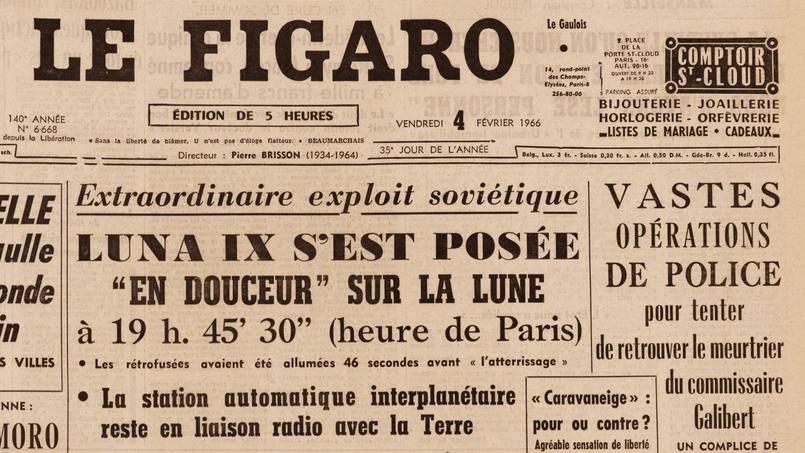
Now, that stalwart of prescriptivism, Le Figaro, disagrees with me here. It takes a typical prescriptivist approach to the question of how to refer to landing on Mars: in a recent essay on the subject, Alice Develey examines a number of dictionaries. Finding no dictionary that lists amarsir but an on-line one, and multiple traditional dictionaries that define atterrir as “to land” without any specification of what’s being landed on, she concludes that a Mars landing should be referred to with the verb atterrir, as well.
Si l’on se fie donc aux dictionnaires, les Terriens et les Martiens ont la même légitimité à atterrir sur le sol de la planète bleue que celui de la planète rouge!
“Thus, if one trusts in dictionaries, Earthlings and Martians have the same right to atterrir on the Blue Planet as on the Red Planet!” …and prescriptivists pretty much always “trust in dictionaries.” Certainly it’s true that if you look at naturally occurring data, you will see that atterrir is used for landing on all kinds of things, such as aircraft carriers. However, there’s been use of amarsir, as well–going back to 189t, according to Wiktionnarie. In this particular case, I can at least excuse my shameful prescriptiveness with a bit of empirical data. Sadly, the failed Mars landing keeps refusing to come up in conversation, and I haven’t been able to create facts on the ground by casually using it. I’m not dead yet, though…
to be off to the races: to have started something, to have reached a state of successfully performing an activity. The Free Dictionary gives this definition: an expressioncharacterizingtheactivity or excitementthat is justbeginning. Wiktionary gives this: In or into a process of energeticengagement in some activity; in or into a phase of conspicuouslyincreasingsatisfaction or success. Notice that in both of them, there’s a crucial element of change–of beginning something, or of having a notable increase in something. How it was used in the post: Someone used the word colocatrice, someone objected that it’s invariant colocataire, and we were off to the races. The meaning is that someone did something, someone else reacted, and that was the beginning of engagement in the activity of talking about language.
Statue of Michel de Montaigne on the rue des Ecoles. It makes me all warm and gooey inside to know that my grandfather probably visited this statue for the same reason that I did. Picture source: me.
I’m a big believer in tutelary gods. These are the local deities that rule over or protect a place. You could make a good case that part of the reason that Judiasm was able to survive its exile from its place of origin was that the original idea of its typically Fertile Crescent god–he lived on top of a particular hill, and in order to really worship him properly, you had to go there–changed to an idea of an immanent god who was everywhere, in all things. (Yes, he is transcendent in Judaism, too, as far as I know–it’s complicated.) And yet: the old tutelary gods live on. It’s worth paying attention to the kami when you’re in Japan, and Pele in Hawaii.
Montaigne’s right foot, polished by generations of students touching it for luck with their tests. Picture source: me.
As far as I can tell, the only relevant deity in the Paris region is Montaigne. Also known as Eyquem, Michel de Montaigne was a writer who is widely considered to be the father of the modern essay and the grandfather of all magazine writers. There’s a statue of him on the rue des Ecoles. I passed by it on my way home today expressly to engage in the rites of Montaigne-worship, which consist of rubbing the toe of his right foot for luck before a test. The reason: I had just finished the first of four days of language-testing that I’ll be doing this week and next week, and I was not feeling happy about the valuable insight that I’d gotten into my weak points.
A lot of what I struggled with on today’s exams didn’t bother me that much–a super-fast speaker, mostly. But, I was pretty down on myself when I still found myself struggling with the A2-level issue of tout/tous/toute/toutes. In theory, these four words all mean all of, but it gets a bit more complicated than that, and there is also a pronunciation issue: tous is pronounced as tou most of the time, but tousse on occasion. Throw in there the fact that I was never sure how to spell some of the stuff that I know how to say, like tout ce que je veux…, and you see how I might still be struggling with this–despite the fact that a class that I attended last winter spent an hour on it one day!
I’ll lay this out a bit differently than other explanations that I’ve seen: I’m going to put the idiomatic expressions first. These get used a lot, and if you can remember that they’re (almost) all the same form, tout, that might make it easier to digest the complexity that follows.
Here are some idiomatic expressions with tout. I took them from Eli Blume and Gail Stein’s French: Three years review text, just because that’s the one reference for English speakers that I happen to have lying around my apartment:
en tout cas: in any case, at any rate
pas du tout: not at all
tout à coup: all of a sudden, suddenly (see also tout d’un coup, below)
tout à fait: indeed
tout à l’heure: just now; in a little bit
tout demême: nevertheless
tout de suite: immediately
tout le monde: everybody, everyone
tout le temps: all the time
Some others that you’re likely to run into:
tout doucement: slowly
malgré tout: despite everything, in spite of everything
tout droit: straight ahead
tout d’un coup: all of a sudden, suddenly (see also tout à coup above)
…and now the only fixed expressions that I know of with a form other than tout:
toute la journée: all day
tous les jours: every day
toutes les nuits: every night
tous les quatre: all the time, often
tous les deux, toutes les deux: both
With that out of the way, let’s talk about what people usually talk about first: using tout to mean “all (of).” Something important to remember here that might be difficult to remember if you’re an English-speaker: you do not follow this tout with de. Don’t, don’t, don’t.
When used in this way, tout agrees in number and gender with the noun that it’s modifying, the forms being:
tout: masculine singular (tout le gateau all of the cake, the whole cake)
tous: masculine plural (tous ces amis all (of) his friends)
toute: feminine singular (toute la durée de vie all of the life cycle)
toutes: feminine plural (toutes les peintures all (of) the paintings
You probably noticed that all of those examples were followed by a definite article (i.e., some form of the word the). You can also use it before a noun without an article to mean every or any. In this case, it agrees with the gender of the noun, but the number is always singular:
Tout tatou est poète ! Every armadillo is a poet! (Tex’s French Grammar web site)
Je contredirai ceux et celles qui croient que toute femme prend la décision de mettre fin à sa grossesse le cœur léger… I would contradict those people who believe that any woman takes the decision to terminate a pregnancy lightly… (Linguee.fr web site)
You could think of the preceding examples as quantifiers–they specify how many or how much of something specified. All of his friends, all of the cake. Every armadillo, any woman. Tout can also function as a pronoun, not quantifying something, but replacing something. In this case, you’re either going to have tout to mean something like “everything,” or you’re going to have one of the two plural forms–tous, or toutes, depending on the gender of what’s being replaced. Here is the one case (that I know of) where you pronounce tous as tousse (I don’t know whether or not you have liaison to touze):
Tout s’est bien goupillé. Everything came together well (said by a friend of some slides that she put together for a PowerPoint presentation).
Ils partageront tout. They will share everything. (Blume and Stein)
Tout ce qu’il dit est la vérité. Everything he says is the truth. (Blume and Stein)
Mes amis sont venus et tous étaient contents. My friends came and they all were happy. (Kwiziq French web site) (Liaison? I don’t know. Native speakers?)
Les filles sont allées aux toilettes toutes ensemble. The girls all went to the bathroom together. (Transparent Language French blog)
Ils sont tous invités They’re all invited (my tutor)
Tous sont malades Everybody’s sick (my tutor)
Now: tout as an adverb. We’ll call it an adverb when it modifies an adjective. In this case, it means something like completely or entirely.
Il me parle tout bas He talks all Barry White to me (Edith Piaf, La vie en rose–technically it’s modifying another adverb here, but we’ll let that go)
Il est tout pâle He’s totally pale (my tutor)
Tout simplement simply put, simply, just (Linguee.fr–again we’re modifying another adverb)
Tout comme just like; il est grand, tout comme ses parents He’s big, just like his parents (WordReference.com)
C’est tout comme “same difference,” “it’s close enough” Il ne m’a pas insulté mais c’est tout comme ! He didn’t insult me, but he might as well have! (WordReference.com)
…and now it gets tough. You’ll notice that in all cases, we had tout in the same form. But, there’s an exception. If the adjective:
…is feminine, and…
…starts with a consonant or with h aspiré…
…then it becomes toute or toutes. For example:
Diane a mangé la pizza tout entière. Diane ate the whole pizza. (Transparent Language French web site) The adjective entière is feminine, since pizza is feminine–but, it starts with a vowel, so we have tout, not toute.
C’est une fille toute petite, mais elle peut tout faire! She’s a small girl, but she can do it all! (Transparent Language French web site) The adjective petite is feminine AND it starts with a consonant, so we have toute.
En outre, vu ses propriétés en matière de construction, elle est tout indiquée pour les hauts murs non porteurs… In addition, because of its constructional properties, it is particularly suitable for high, non-load-bearing walls… (Linguee.fr) The adjective indiqée is feminine, but it doesn’t start with a vowel or h aspiré, so we have tout.
Elles sont tout autant africaines qu’européennes. They are African just as much as they are European. (Linguee.fr) Africaines and européennes are feminine and plural, but they (or maybe the relevant thing here is autant) don’t start with a consonant or h aspiré, so we have tout.
(Sorry, I haven’t been able to find good examples of a consonant-initial feminine plural adjective to show you (and myself) the contrast. Native speakers??)
Tout ce que vous voulez: Everything you want. Picture source: me, on my way home this evening.
Feel like trying this out? You’re now ready for this quiz on the Français Facile web site. You can find a bunch more of them here. Want another take on all of this? See the Tex’s French Grammar site, which also has a nice little exercise at the end: https://www.laits.utexas.edu/tex/gr/det9.html. As the cartoons of my childhood would have put it: Th-th-th-th-that’s all, folks! Off to bed now, ’cause testing starts again first thing in the morning…
It’s two days until your French test and you just discovered that there’s an entire agreement phenomenon that you’ve never heard of before. Chrestomathies to the rescue! Trigger warning: grammar and colloquial English obscenities.
I’ve always wanted to write a chrestomathy. Chrestomathies are certainly useful, but mainly, I just want an excuse to use the word. Mind you, I wasn’t even sure that I knew how to pronounce it until I looked it up just now: stress on the second syllable.
A chrestomathy is a book of examples, typically used to assist with learning a language. I love the idea, but never expected that when the time came to write one, it’d be after midnight and I’d be panicking about an upcoming French proficiency exam. I just read that the French tense (actually, it’s an aspect, but I try to keep technical vocabulary out of here) called the plus-que-parfait (the past perfect) requires agreement of the past participle when it’s conjugated with the verb être. (If you’re thinking WTF?, see this post for an introduction to the plus-que-parfait, and then this post for an example of how to use it in all six persons/numbers. WTF? is explained below, in the English notes.) Some urgent searching found me a page on the Tex’s French Grammar web site with a review of the plus-que-parfait and some great exercises. That got me started, but I wanted lots, lots more practice. What to do? For starters, I wanted a chrestomathy, and I especially wanted examples of agreement of the past participle with the subject. (If you’re still thinking WTF: you really should either go read the posts that I pointed you to above, or stop torturing yourself. This post won’t be that interesting if you’re not into either lexicography, or French morphosyntax.)
Happily, today we can build our own chrestomathies. Web sites that offer multilingual example sentences can help us find them. The problem, of course, is that we need to know how to search for the sentences that we want. In this case, the process that I went through went something like this.
I started at the Linguee web site. This site allows you to search in one language, and then get results in that language, as well as an additional language of your choice. Where do they get them? I have no idea. The results do tell you what web site they came from, and I run across the proceedings of the European Parliament fairly often. But, the rest could come from pretty much anywhere, as far as I can tell. Are any of the translations manually checked for accuracy? I have no idea. Caveat emptor, but the site is generally pretty good.
I made use of two facts: (a) most search interfaces will let you surround multiple words with quotes to find those words in exactly that sequence, versus just happening to occur in the same document. (b) French verbs that use être in the plus-que-parfait belong to a pretty finite group, and some of them are quite common (“high-frequency,” in technical terms), so I should be able to find examples of the plus-que-parfait with être by searching for those specific verbs.
Now I started looking for specific verbs that I knew should show up with être. The plus-que-parfait usually corresponds to had somethinged (where something is an arbitrary verb) in English, so I did searches like “had arrived”, “had gone”, and such. Did this work perfectly? Certainly not–although the verbs for which I searched are often or usually translated into French with the equivalent verbs in that language–arriver “to arrive,” aller “to go,” etc.–that’s not always the case. For example, my search for “had gone” got me these results: The man had gone into a coma after drinking a bottle of vodka and he had been taken to hospital in an ambulance. L’homme a sombré dans un coma après la consommation d’une bouteille de vodka et a été transporté d’urgence en ambulance. But, more often than not, I did get a verb with être. I just had to read through a lot of examples to pick them out. Remember: the double quotes are essential to this search, as they’re what ensures that the words are next to each other.
After doing this for a while, I had plenty of examples of masculine singular and plural subjects and feminine singular subjects, but no examples with feminine plural subjects, and that’s important, since the agreement markers for feminine plural subjects are unique to them. So, I had to make my search a bit more specific. “the women had” only got me one verb with être, but one is ooooh so much more than zero…
You can practice the plus-que-parfait at this page on the Tex’s French grammar web site, where you’ll find twelve test sentences. Have at it! If you have examples to add or corrections to make, I’d love to hear about them. Scroll down past the examples if you just want the discussion of English points.
Masculine singular:
That was when I had left and now I saw that my vision had been the truth.
C’était lorsque j’étais parti et je voyais maintenant que ce que j’avais vu était vérité.
He said he had consulted many Canadians and had arrived at a balanced budget.
Il a dit qu’il avait consulté un grand nombre de Canadiens et qu’il en était arrivé à un budget équilibré.
He had gone to the clinic over and over again.
Il était allé au centre de soins maintes et maintes fois.
Masculine plural:
Many only realised just how bad things were once the fire brigade, the army
and the emergency services had left.
Beaucoup ne se sont effondrés que lorsque les pompiers, les soldats de l’armée fédérale et
les secours étaient déjà repartis.
The local chief said that since 1989 many people had left for Kadugli.
Le chef local a dit que depuis 1989, beaucoup étaient partis pour Kadubli.
Feminine singular:
I thought I had gone to school for nothing.
Je me disais alors que j’étais allée à l’école pour rien. (I tried to go to the original source’s web site to verify that the writer was female–broken link.)
She testified at arbitration that she had left on vacation because she felt
much better than she had a few weeks earlier.
Elle a témoigné à l’arbitrage qu’elle était partie en vacances parce qu’elle se sentait beaucoup mieux que quelques semaines auparavant.
Yes the myopic vision had gone and for once a unified horizon stretched out before them to the ends of the earth.
Oui, la vision myope était dépassée et, du coup, les chrétiens voyaient se déployer devant eux un horizon unifié, s’étendant jusqu’aux extrémités de la terre.
Only 8.9% of its population had arrived between 1996 and 2001.
Seulement 8,9 p. 100 de sa population était arrivée entre 1996 et 2001. NB: I don’t know why this one has feminine agreement. Pour cent is masculine, according to WordReference.com.
Feminine plural
At the first session, the women had grouped according to their cultures – the Indigenous women clustering on one side of the room.
Lors de la première séance, les femmes s’étaient groupées selon leur culture – les femmes autochtones s’étant regroupées d’un côté de la classe.
Want to try a little test of the plus-que-parfait? Check out this page on the Français Facile web site. English notes below.
WTF: an abbreviation for “what the fuck.” It’s usually used to express puzzlement or surprise. For far more hilarious/freaky/weird/creepy examples than I could ever possibly put in this post, go to Google Images and search for WTF. I’m going to leave you with just this one GIF, which illustrates nicely the evolution that this expression has gone through: in spoken English, it’s possible to just say the fuck?? …that is, you can leave out the word what. I don’t know why–sometimes in language, shit just happens. DO NOT use this expression in any sort of formal situation–not at school, not at work, not in writing, not when meeting your new in-laws for the first time, etc. How it appeared in the post: If you’re thinking WTF?, see this post for an introduction to the plus-que-parfait, and then this post for an example of how to use it in all six persons/numbers.




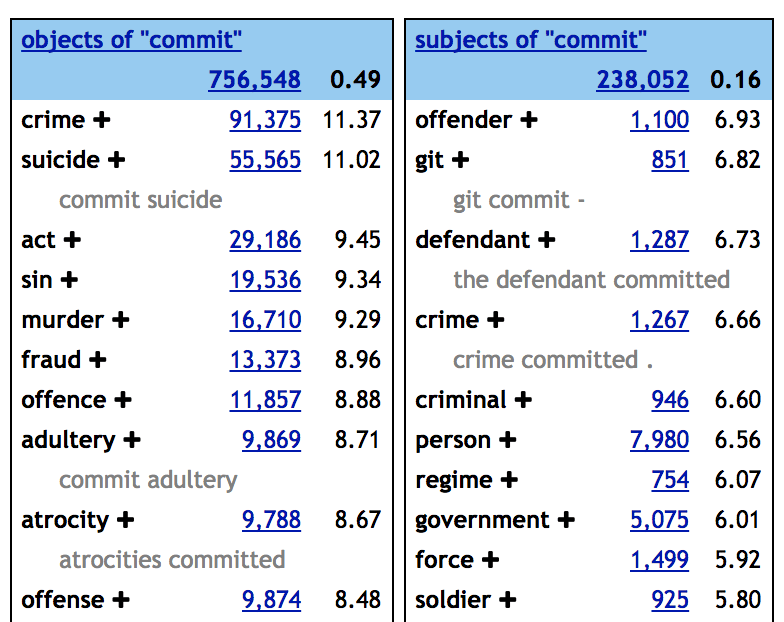
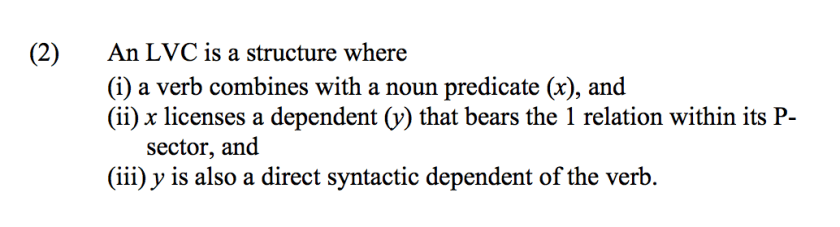

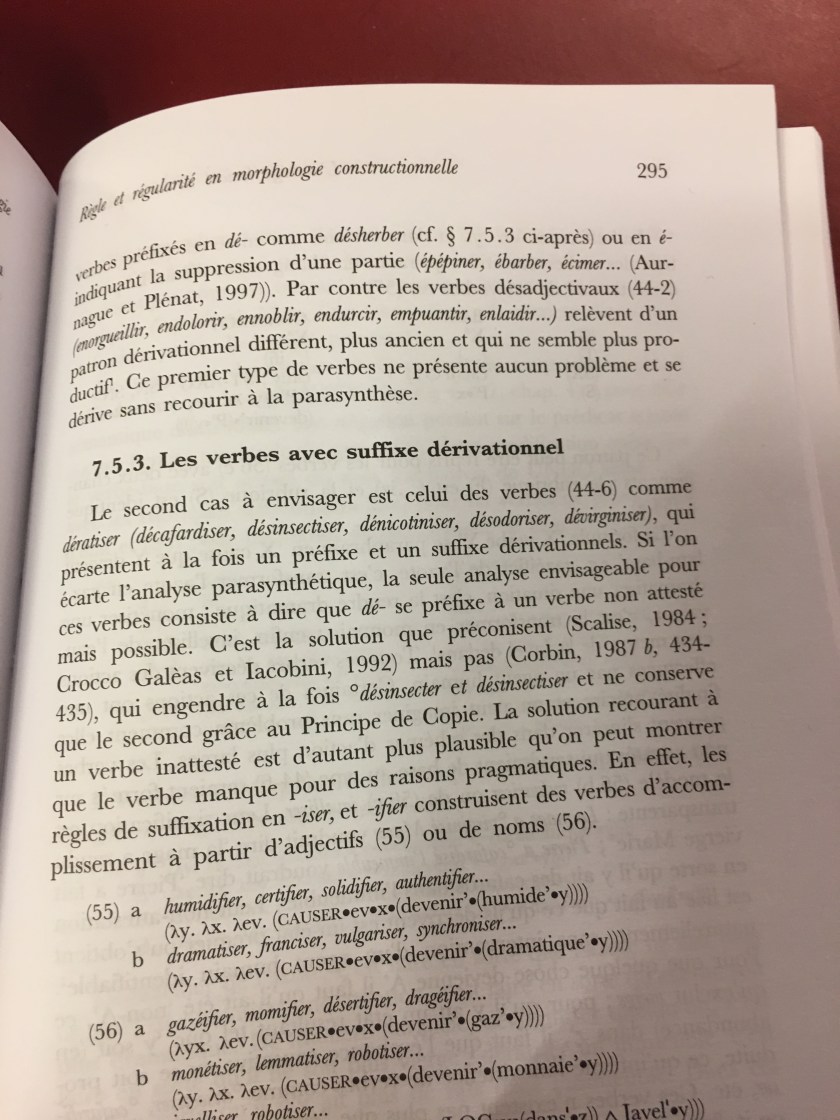


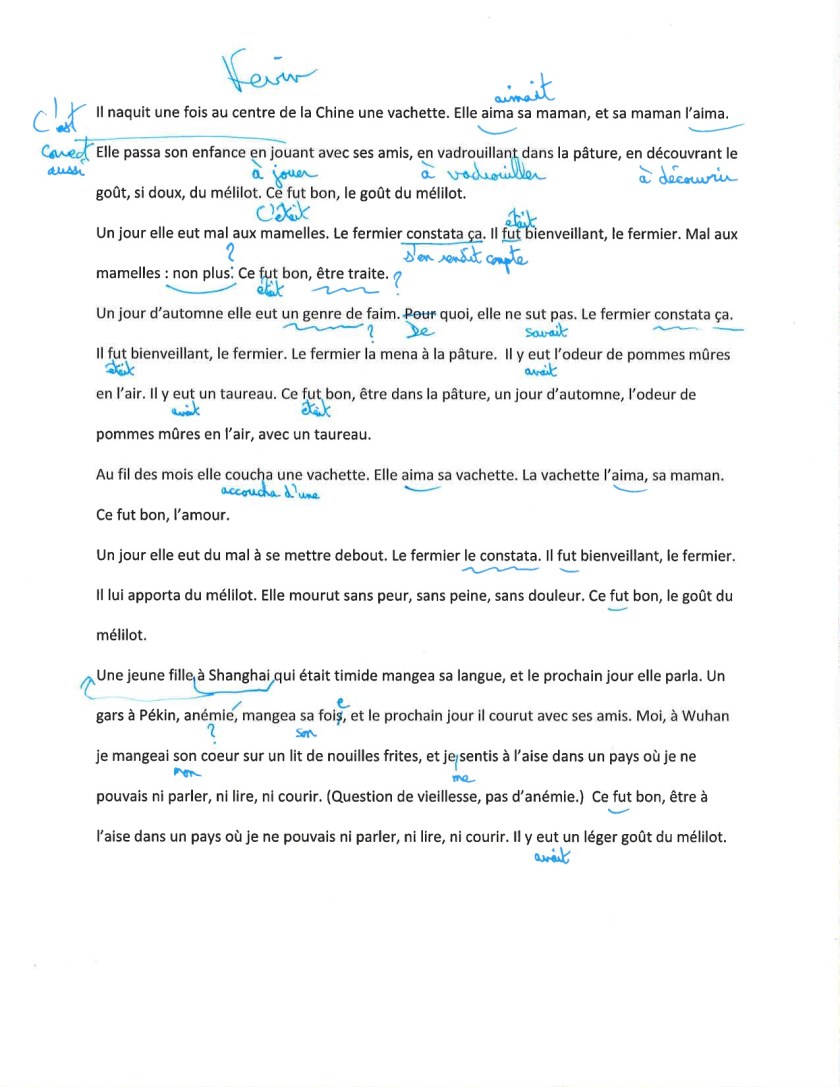
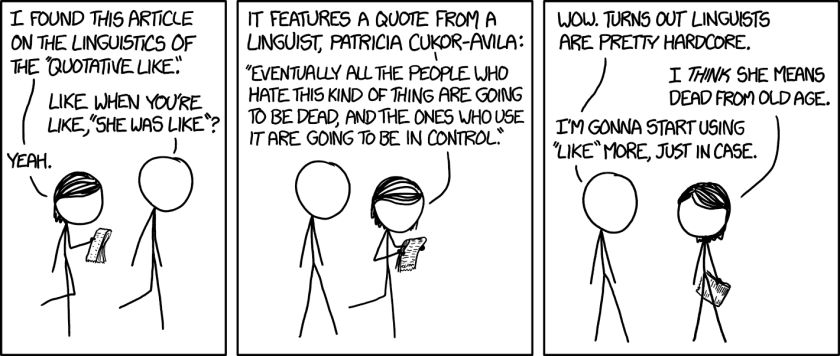





 Zipf's Law