Which TWD character is your classifier? Bias and variance in machine learning

You don’t expect the zombie apocalypse to be relevant to research in computational linguistics–and yet it is; it so, so is.
Spoiler alert: this post about the TV show The Walking Dead–which, I will note, is as popular in France as it is in the US–will tell you what happens to Carol around Season 3 or 4.

In general, it’s the stuff that surprises you that’s interesting, right?  No one ever expects the arctic ground squirrel to have anything to do with computational linguistics–and yet it does: it so, so does.  No one ever expects to be confronted with problems with the relationship between compositionality and the mapping problem over breakfast in a low-rent pancake house–and yet it happens; it so, so happens(Low-rent as an adjective explained in the English notes below.) You don’t expect the zombie apocalypse to be relevant to research in computational linguistics–and yet it is; it so, so is.


large-scale-deep-learning-with-tensorflow-8-638
You probably think that I just make this stuff up. I don’t! Picture source: https://www.slideshare.net/JenAman/large-scale-deep-learning-with-tensorflow

You’ve probably heard of machine learning.  It’s the science/art/tomfoolery of creating computer programs to learn things.  We’re not talking about The Terminator just yet–some of the things that are being done with machine learning, particularly developing self-driving cars, are pretty amazing, but mostly it’s about teaching computers to make choices.  You have a photograph, and you want to know whether or not it’s a picture of a cat–a simple yes/no choice.  You have a prepositional phrase, and you want to know whether it modifies a verb (I saw the man with a telescope–you have a telescope, and using it, you saw some guy) or a noun (I saw the man with a telescope–there is a guy who has a telescope, and you saw him).  Again, the computer program is making a simple two-way choice–the prepositional phrase is either modifying the verb (to see), or it’s modifying the noun (the man).  (The technical term for a two-way choice is a binary decision.)  Conceptually, it’s pretty straightforward.

cat-detector-cpus
Cats keep showing up in these illustrations because the latest-and-greatest thing in machine learning is alleged to have solved all extant problems and made the rest of computer science irrelevant, but the major reported accomplishment so far has been classifying pictures as to whether or not they are pictures of cats.  The “It uses a few CPUSs!” part is a reference to the fact that in order to do this, it requires outlandish amounts of computing resources (a CPU is a “central processing unit”).  Picture source: https://doubleclix.wordpress.com/2013/06/01/deep-learning-next-frontier-01/

When you are trying to create a computer program to do something like this, you need to be able to understand how it goes wrong.  (Generally, seeing how something goes right isn’t that interesting, and not necessarily that useful, either.  It’s the fuck-ups that you need to understand.)  There are two concepts that are useful in thinking your way through this kind of thing, neither of which I’ve really understood–until now.
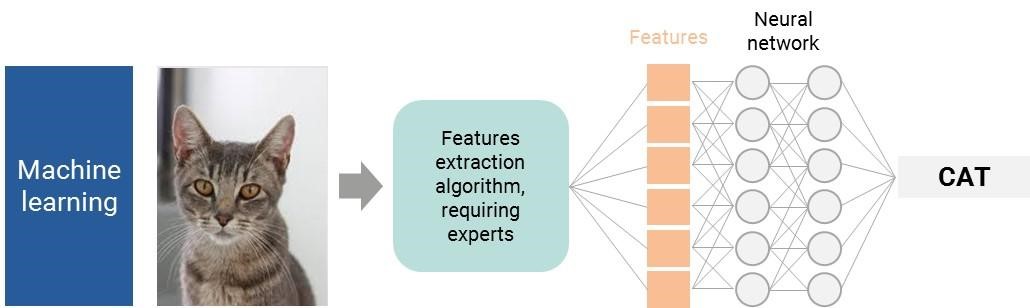
ml-cat
Picture source: http://daco.io/insights/2016/about-deep-learning/

I recently spent a week in Constanta, Romania, teaching at–and attending–the EUROLAN summer school on biomedical natural language processing.  “Natural” language means human language, as opposed to computer languages.  Language processing is getting computer programs to do things with language.  Biomedical language is a somewhat broad term that includes the language that appears in health records, the language of scientific journal articles, and more distant things like social media posts about health.  My colleagues Pierre Zweigenbaum and Eric Gaussier taught a great course on machine learning, and one of the best things that I got out of it was these two concepts: bias and variance.  

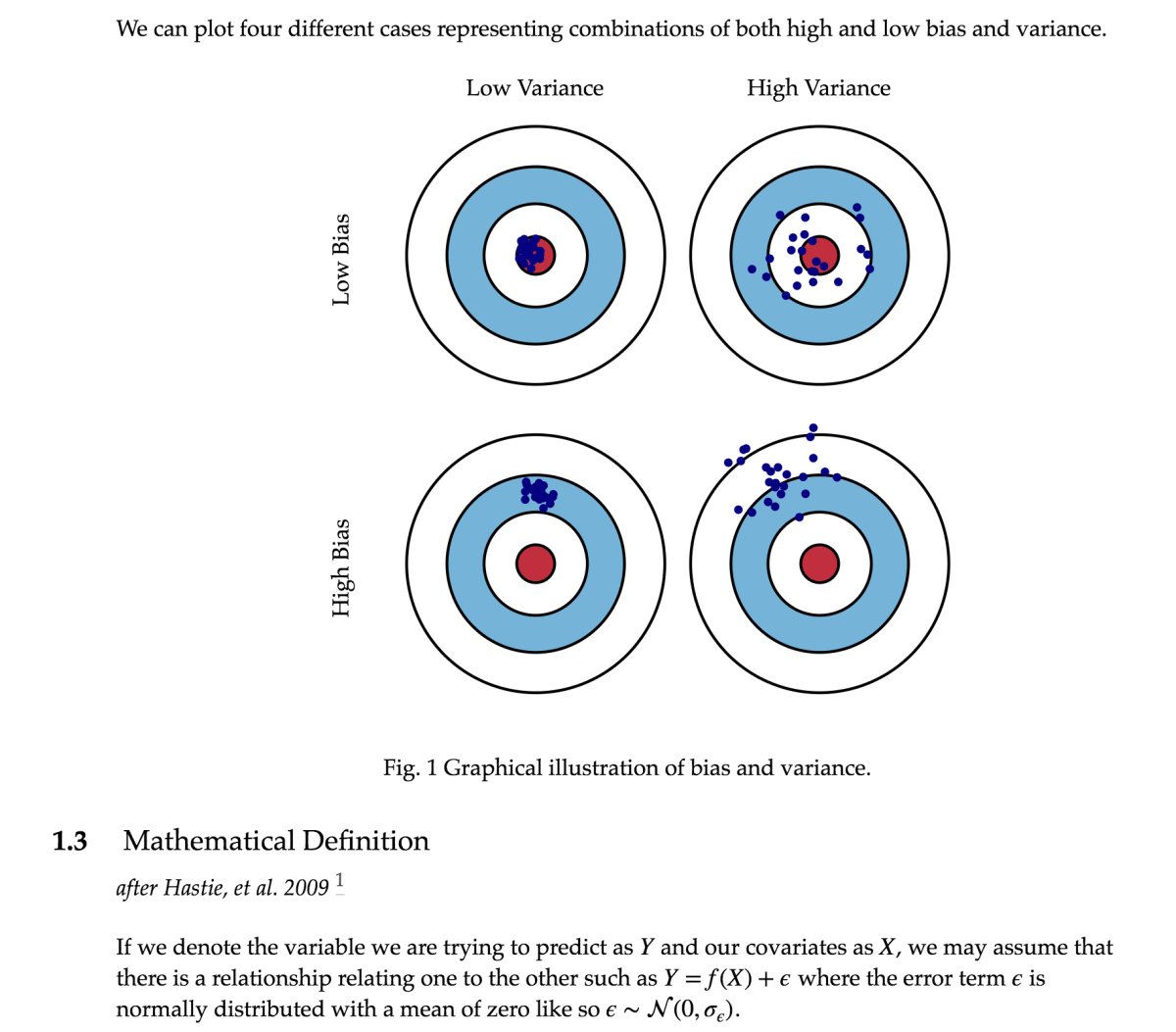
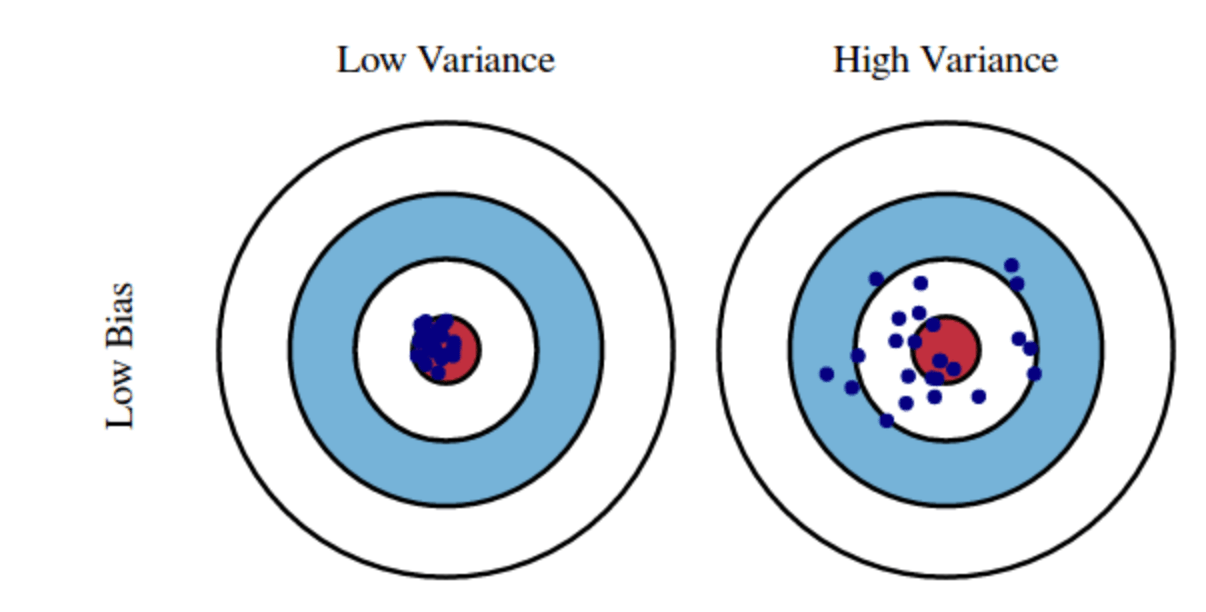
Bias means how far, on average, you are from being correct.  If you think about shooting at a target, low bias means that on average, you’re not very far from the center.  Think about these two shooters.  Their patterns are quite different, but in one way, they’re the same: on average, they’re not very far from the center of the target.  How can that be the case for the guy on the right?
Screen Shot 2017-11-09 at 10.26.24
Picture source: XX

Think about it this way: sometimes he’s a few inches off to the left of the center of the target, and sometimes he’s a few inches off to the right.  Those average out to being in the center.  Sometimes he’s a few inches above the target, and sometimes he’s a few inches below it: those average out to being in the center.  (This is how the Republicans can give exceptionally wealthy households a huge tax cut, and give middle-class households a tiny tax cut, and then claim that the average household gets a nice tax cut.  Cut one guy’s taxes by 1,000,000 dollars and nine guys’ taxes by zero (each), and the average guy gets a tax cut of 100,000 dollars.  One little problem: nobody’s “average.”)  So, he’s a shitty shooter, but on average, he looks good on paper.  These differences in where your shots land are are called variance.  Variance means how much your results differ from each other, on average.  The guy on the right is on average close to the target, but his high variance means that his “average” closeness to the target doesn’t tell you much about where any particular bullet will land.

Thinking about this from the perspective of the zombie apocalypse: variance means how much your results differ from each other, on average, right?  Low variance means that if you fire multiple times, on average there isn’t that much difference in where you hit.  High variance means that if you fire multiple times, there is, on average, a lot of difference between where you hit with those multiple shots.  The guy on the left below (scroll down a bit) has low bias and low variance–he tends to hit in roughly the same area of the target every time that he shoots (low variance), and that area is not very far from the center of the target (low bias).  The guy on the right has low bias, just like the guy on the left–on average, he’s not far off from the center of the target.  But, he has high variance–you never really know where that guy is going to hit.  Sometimes he gets lucky and hits right in the center, but equally often, he’s way the hell off–you just don’t know what to expect from that guy.

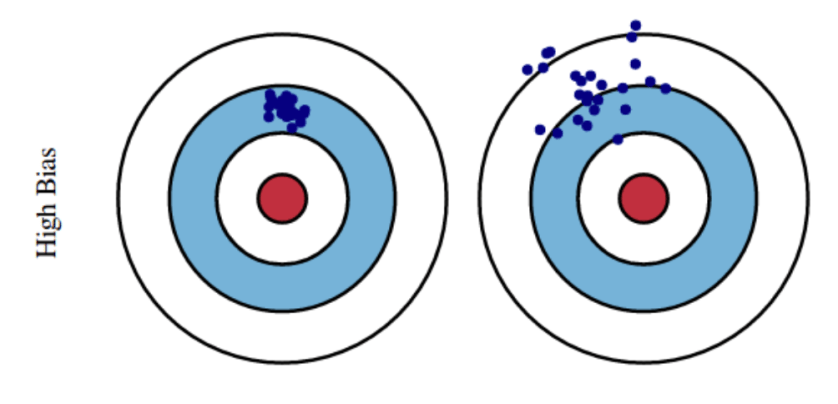
We’ve been talking about variance in the context of two shooters with low bias–two shooters who, on average, are not far off from the center of the target.  Let’s look at the situations of high and low variance in the context of high bias.  See the picture below: on average, both of these guys are relatively far from the center of the target, so we would describe them as having high bias.  But, their patterns are very different: the guy on the left tends to hit somewhere in a small area–he has low variance.  The guy on the right, on the other hand, tends to have quite a bit of variability between shots: he has high variance.  Neither of these guys is exactly “on target,” but there’s a big difference: if you can get the guy on the left to reduce his bias (i.e. get that small area of his close to the center of the target), you’ve got a guy who you would want to have in your post-zombie-apocalypse little band of survivors.  The guy on the right–well, he’s going to get eaten.
Screen Shot 2017-11-09 at 10.39.21
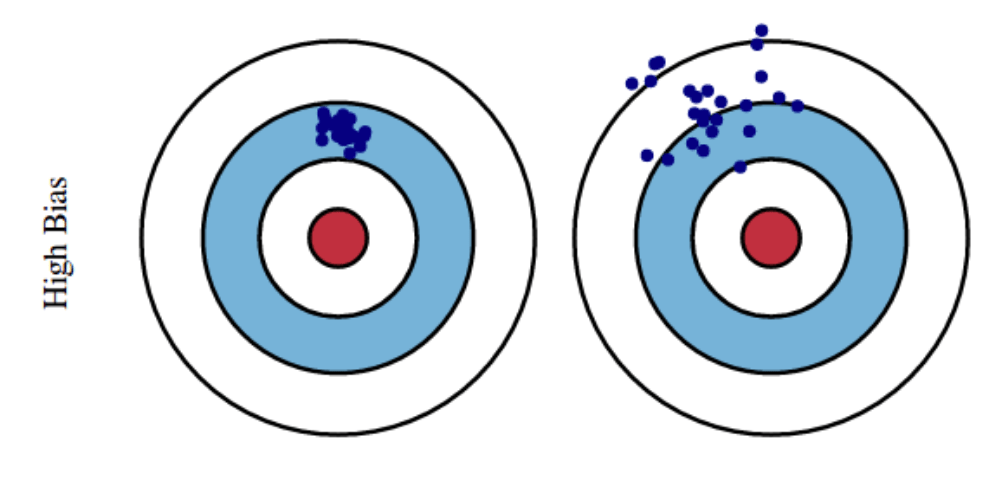
High bias: both of the shooters tend to hit fairly far from the center of the target. The guy on the left has low variance, while the guy on the right has high variance.

A quick detour back to machine learning: suppose that you test your classifier (the computer program that’s making binary choices) with 100 test cases.  You do that ten times.  If it’s got an average accuracy of 90, and its accuracy is always in the range of 88 to 92, you’re going to be very happy–you’ve got low bias (on average, you’re pretty close to 100), and you’ve got low variance–you’re pretty sure what your output is going to be like if you do the test an 11th time.

Abstract things like machine learning are all very well and good for cocktail-party chat (well, if the cocktail party is the reception for the annual meeting of the Association for Computational Linguistics–otherwise, if you start talking about machine learning at a cocktail party, you should not be surprised if that pretty girl/handsome guy that you’re talking to suddenly discovers that they need to freshen their drink/go to the bathroom/leave with somebody other than you.  Learn some social skills, bordel de merde !)  So, let’s refocus this conversation on something that’s actually important: when the zombie apocalypse comes, who will you want to have in your little band of survivors?  And: why? “Who” is easy–you want Rick, Carol, Darryl.  (Some other folks, too, of course–but, these are the obvious choices.)  Why them, though?  Think back to those targets.

promo329185466
Picture source: http://hubwav.com/moral-codes-walking-dead-characters-get-broken/

Low bias, low variance: this is the guy who is always going to hit that zombie right in the center of the forehead.  This is Rick Grimes.  Right in the center of the forehead: that’s low bias.  Always: that’s low variance.

Low bias, high variance: this is the guy who on average will not be far from the target, but any individual shot may hit quite far from the target.  This guy “looks good on paper” (explained in the English notes below) because the average of all shots is nicely on target, but in practice, he doesn’t do you much good.  This guy survives because of everyone else, but doesn’t necessarily contribute very much.  In machine learning research, this is the worst, as far as I’m concerned–people don’t usually report measures of dispersion (numbers that tell you how much their performance varies over the course of multiple attempts to do whatever they’re trying to do), so you can have a system that looks good because the average is on target, even though the actual attempts rarely are.   On The Walking Dead, this is Eugene–typically, he fucks up, but every once in a rare while, he does something brilliantly wonderful.

Screen Shot 2017-11-09 at 10.39.21
High bias: both of the shooters tend to hit fairly far from the center of the target. Picture source: XX
yhp9gl5wtzmv0lt0wnls_10924799_847035102035681_5419345367201271911_n
SPOILER AERT! The Walking Dead’s Carol. She starts out as a meek, mild, battered housewife who can barely summon up the courage to keep her daughter from being sexually abused. Later… Yes, she’s my favorite TWD character. Picture source: https://goo.gl/8D6323

High bias, low variance: this guy doesn’t do exactly what one might hope, but he’s reliable, consistent–although he might not do what you want him to do, you have a pretty good idea of what he’s going to do.  You can make plans that include this guy.  He’s fixable–since he’s already got low variance, if you can get him to shift the center of his pattern to the center of the target, he’s going to become a low bias, low variance guy–another Rick Grimes. This is Daryl, or maybe Carol.

8-1487895983804_1280w
The Walking Dead’s Eugene. Picture source: https://goo.gl/CWsfqm

High bias, high variance: this guy is all over the place–except where you want him.  He could get lucky once in a while, but you have no fucking idea when that will happen, if ever.  This is the preacher.

Which Walking Dead character am I?  Test results show that I am, in fact, Maggie.  I can live with that.


Here are some exercises on applying the ideas of bias and variance to parts of your life that don’t have anything to do (as far as I know) with machine learning.  Scroll down past each question for its answer, and if you think that I got wrong, please straighten me out in the Comments section.  Or, just skip straight to the French and English notes at the end of the post–your zombie apocalypse, your choice.

  1. Your train is supposed to show up at 6 AM.  It is always exactly 30 minutes late.  If we assume that 30 minutes is a lot of time, then the bias is high/low.  Since the train is always late by the same amount of time, the variance is high/low.
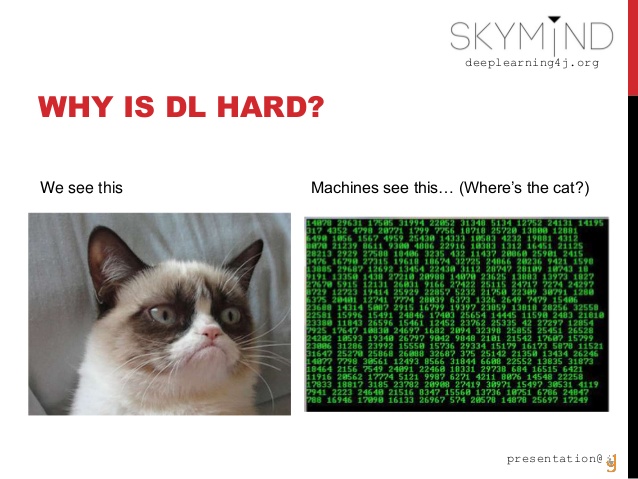
introduction-to-deep-learning-dmytro-fishman-technology-stream-16-638
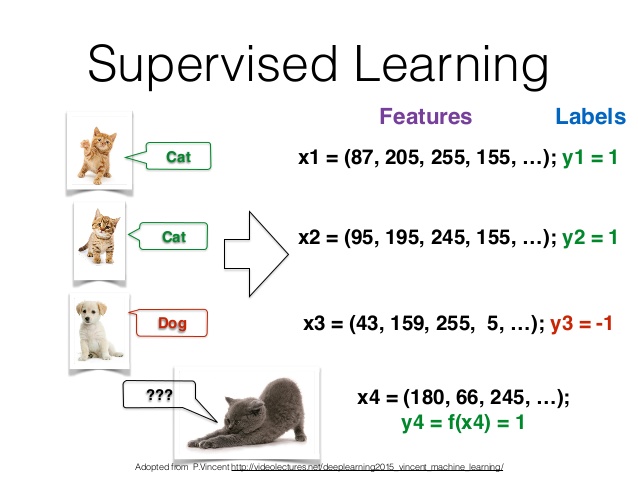
Cat pictures, cat pictures, cat pictures–do they talk of nothing but cat pictures?  ‘Fraid so… Picture source: https://www.slideshare.net/ITARENA/fishman-deep-learning
  1. The bias is high.  Bias is how far off you are, on average, from the target.  We decided that 30 minutes is a lot of time, so the train is always off by a lot, so the bias is high.  On the other hand, the variance is low.  Variance is how consistent the train is, and it is absolutely consistent, since it is always 30 minutes.  Thus: the variance is low.

Your train is supposed to show up at 6 AM.  It is always either exactly 30 minutes early, or 30 minutes late.  More specifically: half of the time it is 30 minutes early, and half of the time it is 30 minutes late.  Assume that 30 minutes is a lot of time: is the bias high or low?  Is the variance high or low?
deep-learning-on-hadoopspark-nextml-5-638
“DL” is “deep learning,” the most popular name for the latest-and-greatest approach to machine learning. I hear that it’s really good at recognizing pictures of cats.  Picture source: https://www.slideshare.net/agibsonccc/deep-learning-on-hadoopspark-galvanize

Since on average, the train is on time–being early half the time and late half the time averages out to always being on time–the bias is low. Zero, in fact.  This gives you some insight into why averages are not that useful if you’re trying to figure out whether or not something operates well. The give-away is the variance—even when something looks fine on average, high variance gives away how shitty it is.

Want to know which Walking Dead character you are?  You have two options:

  1. Take one of the many on-line quizzes available.
  2. Analyze yourself in terms of bias and variance.

English notes

low-rent: “having little prestige; inferior or shoddy” (Google) “low in character, cost, or prestige” (Merriam-Webster)

to look good on paper: “to seem fine in theory, but not perhaps in practice; to appear to be a good plan.” (McGraw-Hill Dictionary of American Idioms and Phrasal Verbs) Often followed by “but…”


French notes

From the French-language Wikipedia article on what’s called in English the bias-variance tradeoff:

En statistique et en apprentissage automatique, le dilemme (ou compromis) biais–variance est le problème de minimiser simultanément deux sources d’erreurs qui empêchent les algorithmes d’apprentissage supervisé de généraliser au-delà de leur échantillon d’apprentissage :

  • Le biais est l’erreur provenant d’hypothèses erronées dans l’algorithme d’apprentissage. Un biais élevé peut être lié à un algorithme qui manque de relations pertinentes entre les données en entrée et les sorties prévues (sous-apprentissage).
  • La variance est l’erreur due à la sensibilité aux petites fluctuations de l’échantillon d’apprentissage. Une variance élevée peut entraîner un surapprentissage, c’est-à-dire modéliser le bruit aléatoire des données d’apprentissage plutôt que les sorties prévues.


 

Fashion!

Why do computational linguistics?  Fashion! 

When I was in graduate school–in the US–I had a colleague whose child was allegedly growing up francophone.  I think the father was an American professor in the French department, or something.  We were all very impressed.

One semester we had a visiting academic from France in our lab.  He had super-hip glasses.  Over lunch one day, the kid asked him: “why do your glasses have such tiny lenses?  His response: c’est à la mode.  

The kid thought for a minute.  Then, another question: “why do you have ice cream on your glasses?”  I try not to be mean, but I thought to myself: this kid speaks French even worse than I do, and that’s an accomplishment…


Why do computational linguistics?  There are a lot of perfectly good reasons, but this guy has the best: Fashion!  Want to know more?  Check out the OpenMINTED project.  In the following material, “TDM” stands for text data mining.

In the French notes today (scroll down past the picture): my attempts to understand various words that could be used to translate the English word fashion.


TDM-story-sheet-Alan-Akbik-page-001
Source: openminted.eu

French notes

la mode : style, fashion, trend; the fashion industry itself.

la tendance : trend, fashion.

tendance (adj.) : trendy, fashionable, “in.”  Register: familier.

branché : trendy, cool, hip, “in.”  Register: familier.

le branché : cool person.

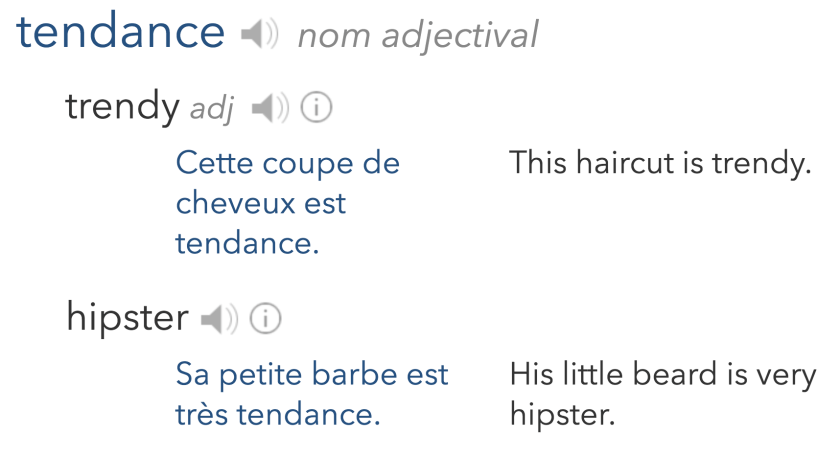
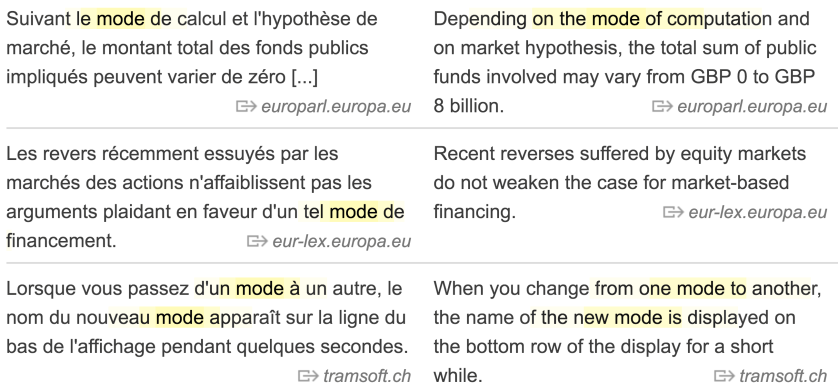
In trying to figure out the differences between la mode and la tendance via looking at examples on Linguee.fr, the trend (ha) seems to be that la tendance is not used to talk about things that are “in fashion” so much as tendencies/trends more generally.  The closest uses to “in fashion” are their adjectival examples:

Screen Shot 2018-05-10 at 20.33.39
Source: screen shot from Linguee.fr.

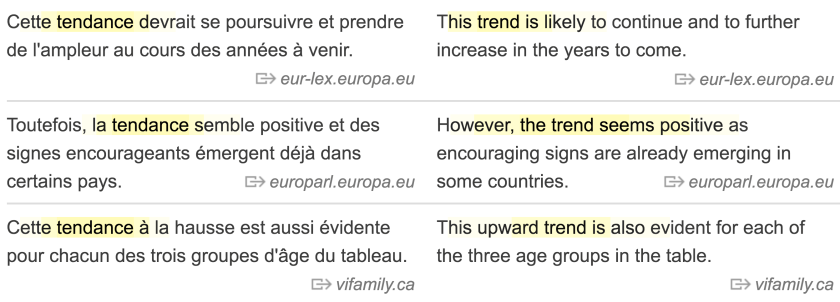
Compare some nominal (noun) examples–their translations are more about trends in general, versus trends in the sense of things being fashionable:

Screen Shot 2018-05-10 at 20.36.46
Source: screen shot from Linguee.fr.

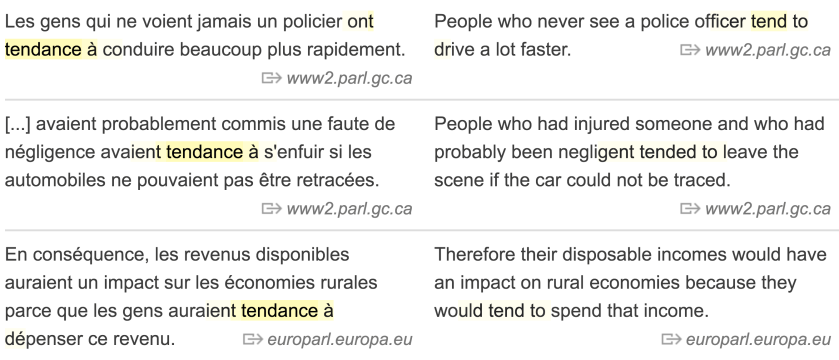
Linguee.fr gives a number of examples of avoir tendance à, translated as “to tend to:”

Screen Shot 2018-05-10 at 20.38.36
From Linguee.fr.

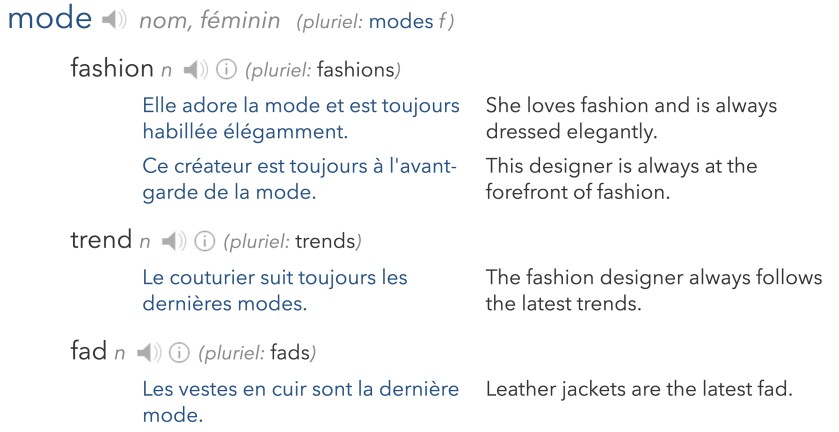
For fashion in the sense of haute couture and the like (yes, that’s the English term, too), la mode seems to be more common:

Screen Shot 2018-05-10 at 20.50.19
From Linguee.fr.

Change the gender to masculine — le mode — and you have senses along the lines of “mode” in English:

Screen Shot 2018-05-10 at 20.52.34
From Linguee.fr.

…and some fixed expressions (all examples from Linguee.fr):

  • le mode d’emploi : operating instructions, instruction manual, user guide
    • J’ai lu le mode d’emploi avant d’utiliser l’appareil.  I read the instruction manual before using the device.
    • Le mode d’emploi est fourni en cinq langues.  The operating instructions are provided in five languages.
    • Avant de nous contacter, veuillez vous assurer d’avoir respecte le dosage des produits et suivile mode d’emploi.  Before contacting us, please, make sure that
      you take the right dosage of the products and follow the instructions for use.
    • le mode de vie : lifestyle
    • le mode aperçu : preview mode

It seems so simple that it makes one wonder: why was I ever confused about this?  As it happens, I have a pretty good memory for the contexts in which I run into words, so I can tell you that the source of my confusion is an advertising poster that I saw in the metro one day.  I interpreted it (possibly incorrectly) as meaning something like “so you think you know what’s cool?”, and my recollection is that it said something like tu penses que tu connais la tendance?  Maybe it’s just that the aforementioned kid (ledit marmot) spoke French better than I thought, and I speak French even worse than I thought…


What computational linguists actually do all day: The debugging edition

We already knew that the patient had the primary, secondary, and tertiary stages of syphilis.

Tell someone you’re a computational linguist, and the next question is almost always this: so, how many languages do you speak?  This annoys the shit out of us, in the same way that it might annoy a public health worker if you asked them how many stages of syphilis they have.  (There are four.  When I was a squid (military slang for “sailor”), one of our cardiologists lost her cool and threw a scalpel.  It stuck in one of my mates’ hands.  We already knew that the patient had the primary, secondary, and tertiary stages of syphilis, so my buddy was one unhappy boy…)

Being asked “how many languages do you speak?” annoys us because it reflects a total absence of knowledge about what we devote our professional lives to.  (This is obviously a little arrogant–why should anyone else bother to find out about what we devote our professional lives to?  That’s our problem, right?  Nonetheless: the millionth time that you get asked, it’s annoying.)  It’s actually easier to explain what linguistics is in French than it is in English, because French has two separate words for things that are both covered by the word language in English:

  • une langue is a particular language, such as French, or English, or Low Dutch.
  • le langage is language as a system, as a concept.
interaction of tone with foot structure
No, I did not just make up “tone-bearing unit.”

Linguists study the second, not the first.  People who call themselves linguists might specialize in vowels, or in words like “the,” or in how people use language both to segregate themselves and to segregate others.  Whatever it is that you do, you’re basing it on data, and the data comes from actual languages, so you might work with any number of them–personally, I wrote a book on a language spoken by about 30,000 people in what is now South Sudan.  The point of that work, though, is to investigate broader questions about langage, more so than to speak another language–that’s a very different thing.  I can tell you a hell of a lot about the finite state automata that describe tone/tone-bearing-unit mappings in that language, but can’t do anything in it beyond exchange polite greetings (and one very impolite leave-taking used only amongst males of the same age group).

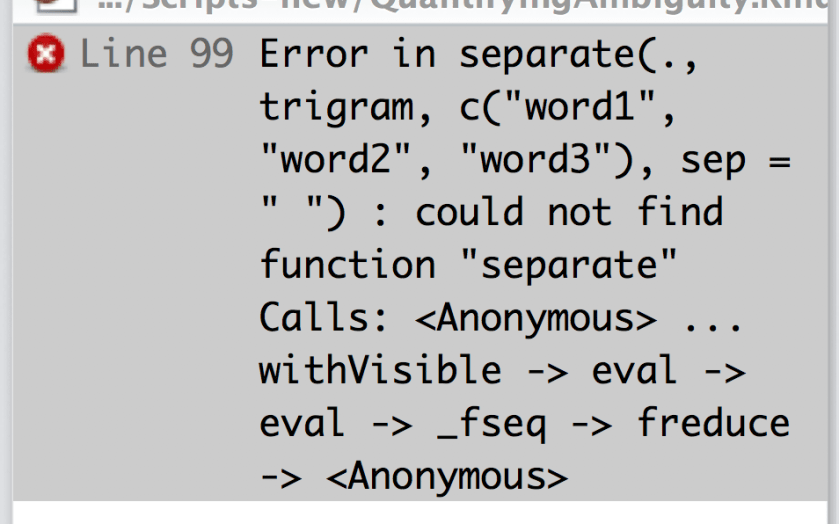
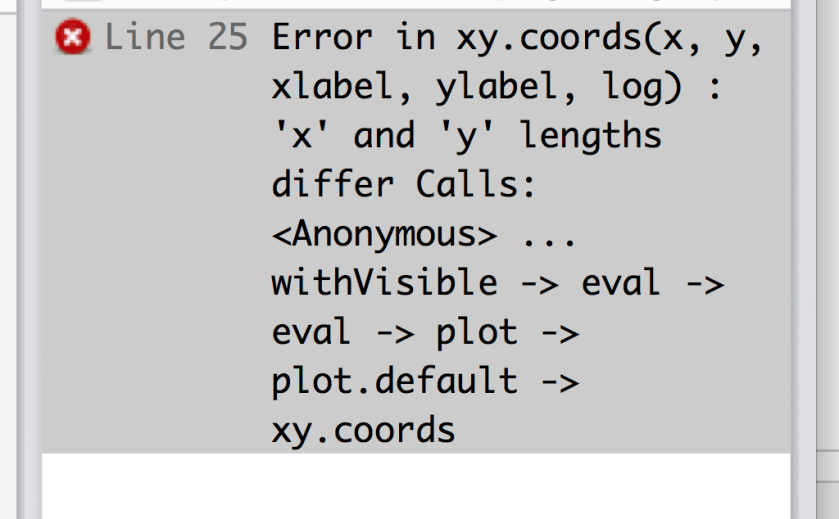
So, if you’re not spending your days sitting around memorizing vocabulary items in three different regional variants of Upper Sorbian, what does a linguist actually do all day?  Here’s a typical morning.  I was trying to do something with trigrams (3-word sequences–approximately the longest sequence of words that you can include in a statistical model of language before it stops doing what you want it to do), when I ran into this:

Screen Shot 2018-03-28 at 04.01.05

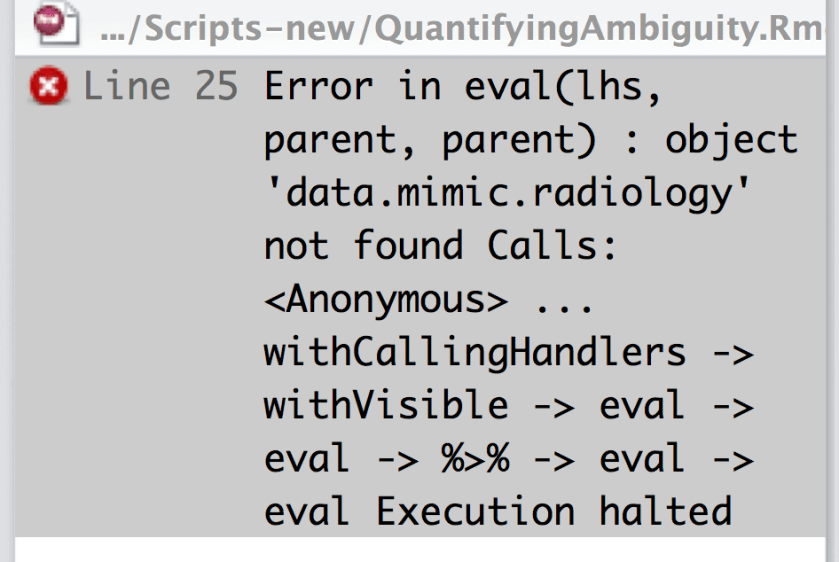
Fixed that one, and then there was a problem with my x-ray reports (my speciality is biomedical languages)…

Screen Shot 2018-03-28 at 03.30.00

Fixed that one, and then…

Screen Shot 2018-03-28 at 03.26.09

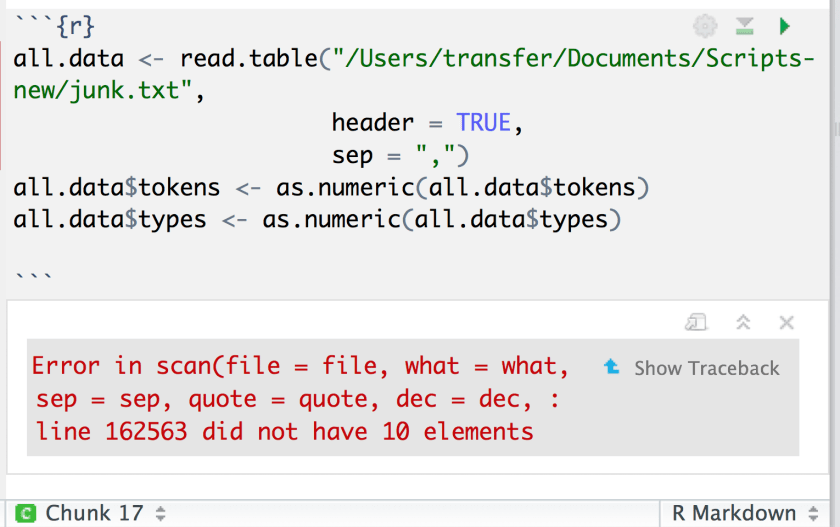
…and your guess may well be better than mine on that one.  God help you if you run into this kind of thing, though…

missingelements
Source: me.

…because that message about not having some number of elements (a) usually takes forever to figure out, and then (b) once you do figure it out, reflects some kind of problem with your data that is going to give you a lot of headaches before you get it fixed.

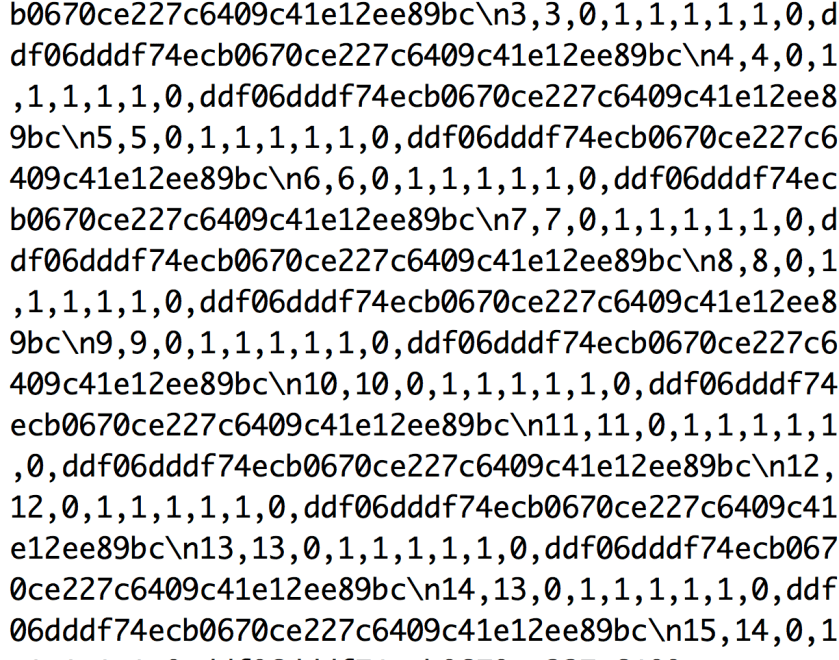
I spend a lot of my day looking at things like this:

screenfullofcrap
Source: me.

.,..which is a bunch of 0s and 1s describing the relationship between word frequency and word rank, plus what goes wrong when your data gets created on an MS-DOS machine, which I will have to fix before I can actually do anything with said data (see the English notes below for what said data means); or this…

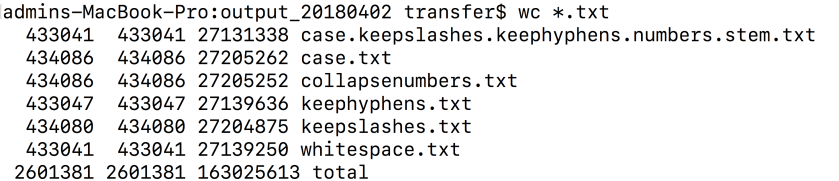
filesizes
Source: me.

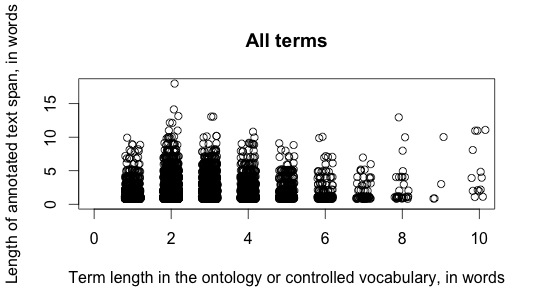
…which tells me some things about the effects of “minor” preprocessing differences on type/token ratios–they’re not actually so minor; or this…

All_terms_lengths
Source: Cohen, K. B., Verspoor, K., Fort, K., Funk, C., Bada, M., Palmer, M., & Hunter, L. E. (2017). The Colorado Richly Annotated Full Text (CRAFT) corpus: Multi-model annotation in the biomedical domain. In Handbook of Linguistic Annotation (pp. 1379-1394). Springer, Dordrecht.

…which tells me that either there are some errors in that data, or there is an enormous amount of variability between the official terminology of the field and the way that said terminology actually shows up in the scientific literature.  (See the leftmost blob–it indicates that there are plenty of cases of one-word terms that show up as more than 5 words in actual articles.  That is certainly possible–disease in which abnormal cells divide without control and can invade nearby tissues is 13 words that together correspond to the single-word term cancerbut, I was surprised to see just how frequent those large discrepancies in lengths were.  In my professional life, I love surprises, but they also suggest that you’d better consider the possibility that there are problems with the data.)

So, yeah: it’s not like I can’t get my hair cut in Japanese, or explain how to do post-surgical hand therapy in Spanish, or piss off a con artist in Turkish (a story for another time)–but, none of those have anything to do with my professional life as a computational linguist.  That’s all about computing, which means computers, and I hate computers.  Ironic, hein?  Life is fucking weird, and I like it that way.


English notes

queneau exercices de figure
I think this is Queneau, but couldn’t swear to it. Source: it’s all over the place.

said: a shorter way of saying “the aforementioned.”  Both of these are characteristic of written language, more so than of spoken language.  Even in writing, though, it’s pretty bizarre if you’re not a native speaker, which is why I picked it to talk about today.  A French equivalent would be ledit/ladite/lesdites (not sure about that last one–Phil dAnge?), which I have a soft spot for ’cause I learned it in Queneau’s Exercices de style.  

Trying to think of helpful ways to recognize this bizarre usage of said, I went looking for examples of said whose part of speech is adjectival.  Here are some of the things that I found:

  • As such, any dispute that you may have on goods purchased or services availed of should be raised directly with said merchant/s.
  • seemingly endless shopping list to conquer, a shrinking budget with which to do said shopping ~ and let’s face it: our businesses don’t run themselves while we’re visiting relatives.
  • This is a monumental pain in the ass — you don’t exactly trip over Notary Publics in today’s day and age — and I can only assume came from said company having a problem with identity once sometime in the last twelve years, and the president saying “fuck it.”

How it appears in the post:

  • …what goes wrong when your data gets created on an MS-DOS machine, which I will have to fix before I can actually do anything with said data;…
  • Either there are some errors in that data, or there is an enormous amount of variability between the official terminology of the field and the way that said terminology actually shows up in the scientific literature. 

debugging: A technical term in software programming that refers to finding problems in your program.  I used it in the title of today’s post because most of the illustrations that I gave of what I do all day are of irritating problems of one sort or another that I (really did) have to track down in the course of my day.  They don’t tell you in school that tracking down such things are literally about 80% of what any programmer spends their time doing.  Of course, any problem in a computer program is a problem that you created, so you can get irritated about them, but you most certainly cannot take your irritation out on anyone else…

Movement of bodies: the illustrated version

Fields, lexical and otherwise: Henry Reed’s sweetly funny WWII poem “Movement of bodies.”

As National Poetry Month draws to a close, here is more of the gentle humor of Henry Reed.  This version of Movement of bodies, published in 1950, comes from the Sole Arabian Tree web site, where you can find a recording of Henry Reed reading the poem.

If you remember this one from last year: I’ve added some more explanations of the vocabulary, as well as some of your comments!

LESSONS OF THE WAR

III. MOVEMENT OF BODIES
Those of you that have got through the rest, I am going to rapidly
Devote a little time to showing you, those that can master it,
A few ideas about tactics, which must not be confused
With what we call strategy. Tactics is merely
The mechanical movement of bodies, and that is what we mean by it.
Or perhaps I should say: by them.

Strategy, to be quite frank, you will have no hand in.
It is done by those up above, and it merely refers to,
The larger movements over which we have no control.
But tactics are also important, together or single.
You must never forget that, suddenly, in an engagement,
You may find yourself alone.

This brown clay model is a characteristic terrain
Of a simple and typical kind. Its general character
Should be taken in at a glance, and its general character
You can, see at a glance it is somewhat hilly by nature,
With a fair amount of typical vegetation
Disposed at certain parts.

Here at the top of the tray, which we might call the northwards,
Is a wooded headland, with a crown of bushy-topped trees on;
And proceeding downwards or south we take in at a glance
A variety of gorges and knolls and plateaus and basins and saddles,
Somewhat symmetrically put, for easy identification.
And here is our point of attack.

But remember of course it will not be a tray you will fight on,
Nor always by daylight. After a hot day, think of the night
Cooling the desert down, and you still moving over it:
Past a ruined tank or a gun, perhaps, or a dead friend,
In the midst of war, at peace. It might quite well be that.
It isn’t always a tray.

And even this tray is different to what I had thought.
These models are somehow never always the same: for a reason
I do not know how to explain quite. Just as I do not know
Why there is always someone at this particular lesson
Who always starts crying. Now will you kindly
Empty those blinking eyes?

I thank you. I have no wish to seem impatient.
I know it is all very hard, but you would not like,
To take a simple example, to take for example,
This place we have thought of here, you would not like
To find yourself face to face with it, and you not knowing
What there might be inside?

Very well then: suppose this is what you must capture.
It will not be easy, not being very exposed,
Secluded away like it is, and somewhat protected
By a typical formation of what appear to be bushes,
So that you cannot see, as to what is concealed inside,
As to whether it is friend or foe.

And so, a strong feint will be necessary in this, connection.
It will not be a tray, remember. It may be a desert stretch
With nothing in sight, to speak of. I have no wish to be inconsiderate,
But I see there are two of you now, commencing to snivel.
I do not know where such emotional privates can come from.
Try to behave like men.

I thank you. I was saying: a thoughtful deception
Is always somewhat essential in such a case. You can see
That if only the attacker can capture such an emplacement
The rest of the terrain is his: a key-position, and calling
For the most resourceful manoeuvres. But that is what tactics is.
Or I should say rather: are.

Let us begin then and appreciate the situation.
I am thinking especially of the point we have been considering,
Though in a sense everything in the whole of the terrain,
Must be appreciated. I do not know what I have said
To upset so many of you. I know it is a difficult lesson.
Yesterday a man was sick,

But I have never known as many as five in a single intake,
Unable to cope with this lesson. I think you had better
Fall out, all five, and sit at the back of the room,
Being careful not to talk. The rest will close up.
Perhaps it was me saying ‘a dead friend’, earlier on?
Well, some of us live.

And I never know why, whenever we get to tactics,
Men either laugh or cry, though neither is strictly called for.
But perhaps I have started too early with a difficult task?
We will start again, further north, with a simpler problem.
Are you ready? Is everyone paying attention?
Very well then. Here are two hills.


English notes

This poem is full of delightful plays on multiple meanings of words, most of which I’ll skip to focus on the lexical field of geographic terms.  Reed uses a bunch of terms that refer to elements of topography (Merriam-Webster: the art or practice of graphic delineation in detail usually on maps or charts of natural and man-made features of a place or region especially in a way to show their relative positions and elevations) as metaphors for a woman’s body.  Many of these are terms that a typical native speaker (including myself) wouldn’t necessarily be able to define specifically, although I would guess that most people would at least know that they refer to elements of a terrain, and might even be able to group them into two classes: ones that refer to elevations (high points), and ones that refer to depressions (Merriam-Webster: a place or part that is lower than the surrounding area :  a depressed place or part :  hollow ).  I’ll split them out in that way, then follow them with a few miscellaneous terms.  (All links to Merriam-Webster are to the definition for that word.)  For a reminder, here’s a paragraph from near the beginning of the poem:

Here at the top of the tray, which we might call the northwards,
Is a wooded headland, with a crown of bushy-topped trees on;
And proceeding downwards or south we take in at a glance
A variety of gorges and knolls and plateaus and basins and saddles,
Somewhat symmetrically put, for easy identification.
And here is our point of attack.

Elevations

bond1
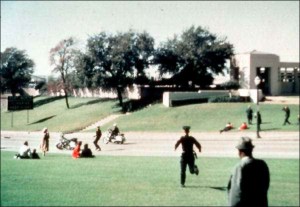
The famous “grassy knoll.” I got this off of a JFK assassination conspiracy theory website, but have no idea to whom it should actually be credited.

knoll: Merriam-Webstera small round hill :  mound.  The term grassy knolla small hill covered with grass, is closely associated with the assassination of President John F. Kennedy, particularly with conspiracy theories about it.

headland: Merriam-Webstera point of usually high land jutting out into a body of water :  promontory

plateau: Merriam-Webster: a usually extensive land area having a relatively level surface raised sharply above adjacent land on at least one side :  tableland

Depressions

palouse-river-gorge
The Palouse River Gorge. Picture source: https://goo.gl/zkU7CN

gorge: Merriam-Webstera narrow passage through land; especially :  a narrow steep-walled canyon or part of a canyon

basin: Merriam-Webstera large or small depression in the surface of the land or in the ocean floor.  As I speak a bit of French, it’s difficult not to make the association here with le bassin, the pelvis.

b5_1211
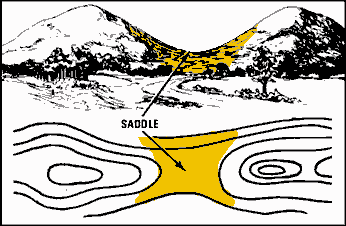
Picture source: armystudyguide.com, https://goo.gl/SNBe4g

saddle: Merriam-Webstera ridge connecting two higher elevations; a pass in a mountain range.  In English, this has the same connections with sex as it does in French: J’en ai-t-y connu des lanciers, // Des dragons et des cuirassiers // Qui me montraient à me tenir en selle // A Grenelle!

Phil d’Ange points out that…

A few notes on some English/French topographical terms : “plateau” and “gorge” are exactly the same and have the same meanings . “Basin” is just one of the common English misspellings, here for “bassin” . But “un bassin” is also used in topography, not only to mean the pelvis, and is applied to large depressions . In France you have “le bassin parisien” and “le bassin aquitain”, rather wide surfaces . On the other hand we have nothing like a saddle in topography . “Une selle” is never used in that way, and I’d add that it is not related to sex either, except in specific occasions like the old song you quote . There are other words associated to horse riding that are common about sexual activities : monter, chevaucher, etc…

Others

wooded: Merriam-Webstercovered with growing trees

engagement: In the context of the poem, the most obvious meaning is the military one of a hostile contact between enemy forces (Merriam-Webster).  Presumably Reed is also playing here on the more commonly-used meaning of a commitment to marriage (my best guess on all of the crying trainees).

You must never forget that, suddenly, in an engagement,
You may find yourself alone.

The French cognate has a much wider range of uses/meanings than the American English word.  As Phil d’Ange puts it:

A word about “engagement, a French word that has the same meanings : military and commitment to any activity with a moral virtue : social, political, humanitary causes and for some weird reason to marriage (I guess it can be a humanitary cause in some cases) . Seriously “un engagement” is also a promise, a commitment to any act, moral or not : “Il a pris l’engagement de réparer ma voiture avant lundi”, “… l’engagement de me prêter 1000 €” . And it also means hiring an employee . “Engager” a housemaid, an accountant, a bodyguard ( that’s my daily life ha ha ) .

The situation seems to be different in the United Kingdom, where the range of meanings/uses of engagement is closer to that of French.  Osyth put it this way:

We use engage in that way too …. I would ‘engage’ a butler or a garage to fix my car and I might be ‘engaged’ to do a piece of work for a magazine. When a couple is preparing for marriage they are ‘engaged’ which makes it alarming or appropriate depending on your feelings about the marital state (or more likely your own experience) that we also engage in combat!

tactics versus strategy: tactics are short-term–a tactical nuclear weapon is one that you would use on the battlefield.  (Not very fun to think about, is it?  When I tell people that some aspects of the peacetime military seem kinda silly and they ask me for examples, I always tell them about our “what to do in case of nearby nuclear weapon explosion” drills.)  In contrast, strategic nuclear weapons are meant for the bigger picture–the stuff that you would use to hammer the other guy’s country in such a way that he becomes unable to continue fighting at all.  My tactics in my professional life mostly consist of making schedules to ensure that I don’t miss deadlines, while my strategy is the set of papers that I plan to publish in the next few years.  From the poem:

Strategy, to be quite frank, you will have no hand in.
It is done by those up above, and it merely refers to,
The larger movements over which we have no control.
But tactics are also important, together or single.
You must never forget that, suddenly, in an engagement,
You may find yourself alone.

to be at peace:  “Calm and serene. My daughter was miserable all week, but she’s at peace now that her tests are over.”  (TheFreeDictionary.com)

How Reed uses it in the poem (quite brilliantly):

After a hot day, think of the night
Cooling the desert down, and you still moving over it:
Past a ruined tank or a gun, perhaps, or a dead friend,
In the midst of war, at peace.

to fall out: in a military context, the most common meaning of this is  to leave one’s place in the ranks (Merriam-Webster).   From the Military.com web site:

Fall out

The command is “Fall Out.” On the command, you may relax in a standing position or break ranks (move a few steps out of formation). You must remain in the immediate area, and return to the formation on the command “Fall In.” Moderate speech is permitted.

How it appears in the poem:

                                              I think you had better
Fall out, all five, and sit at the back of the room

Guillaume Apollinaire: Exercice

Guillaume Apollinaire is another one of those folks who shows that you can be both a poet, and a very serious ass-kicker. 

2014-07-04 19.10.09
Street sign in the Saint-Germain-des-Prés neighborhood.

Guillaume Apollinaire is another one of those folks who shows that you can be both a poet–and a very serious ass-kicker.  Apollinaire tried to join the French army in Paris at the beginning of the First World War, but was turned down–because he wasn’t a French citizen.  (Polish, actually.)  Undaunted, he travelled south, tried again, and this time got in.  He was initially assigned to the artillery, but that wasn’t hard-core enough for him, and he asked for–and received–a transfer to the infantry.  He suffered a head wound in 1916, never really recovered from it, and in his weakened condition, died in the influenza epidemic of 1918.  Here is one of his poems, Exercice.

Exercice

Vers un village d l’arrière
S’en allaient quatre bombardiers
Ils étaient couvert de poussière
Depuis la tête jusqu’aux pieds

Ils regardaient la vaste plaine
En parlant entre eux du passé
Et ne se retournaient qu’à peine
Quand un obus avait toussé

Tous quatre de la classe seize
Parlaient d’antan non d’avenir
Ainsi se prolongeait l’ascèse
Qui les exerçait à mourir


French notes

In the last two lines, note the inversion: not L’ascèse qui les exerçait à mourir se prolongeait ainsi, but Ainsi se prolongeait l’ascèse qui les exerçait à mourir.  If you’d like to read an analysis of the various and sundry kinds of inversion that ainsi can trigger, as well as some quantitative data on ainsi-triggered inversion in Le Monde, see Lena Karssenberg and Karen Lahousse’s paper on the topic.

•    la poussière: dust.
•    la plaine: plain.
•    se retourner: (tourner la tête) turn around, do a double take; (changer de sens, de position) turn over, toss and turn; (se mettre à l’envers) turn over, overturn
•    la peine: punishment, sorrow, trouble—but, that’s not what it means here—see the next entry.
•    à peine: scarcely, hardly
•    un obus: shell (artillery).
•    tousser: to cough
•    d’antan: of yesteryear, of long ago
•    se prolonger: continue; perpetuate itself; persist; linger; go on; be continued; be extended
•    ascèse: This word is a tough one.  It’s not in any of my French-English dictionaries.  In Anne Greet’s translation (see below), it’s rendered as “ascesis.”  I found it in a monolingual (French-French) dictionary; the definition seemed to be something like asceticism.
•    exercer: to train, exercise, practice

What should we make of the past imperfect tense that is used throughout the poem?
Greet’s notes suggest that it produces a detachment between the poet and the four men: “The poet…is not part of the graphic little scene he is painting.  The verbs, in third person and imperfect tense, indicate that he is an omniscient observer.  This role produces a…fine balance in the poem between compassion and detachment.”

Towards a village in the rear
Marched four bombardiers
And they were covered with dirt
From head to foot

They stared at the vast plain
As they talked about the past
And they barely looked around
When a shell made a coughing sound

All four of class sixteen
Spoke of the past not future time
Thus the ascesis dragged on
That practiced them in dying

Translated by Anne Hyde Greet

You like Apollinaire, but like me, have trouble with the French?  I like Anne Hyde Greet’s translation of Calligrammes quite a bit.

Rest In Peace, Jacques Higelin

One of my friends once said this to me: “When I walked out of the room after finishing my bac [the French high school exit exam–your score on it determines a lot of the future course of your life], I said to myself: if I’d spent as much of the last four years studying as I did memorizing Higelin, I’d be going to a much better university.” 

One of my friends once said this to me: “When I walked out of the room after finishing my bac [the French high school exit exam–your score on it determines a lot about the future course of your life], I said to myself: if I’d spent as much of the last four years studying as I did memorizing Higelin, I’d be going to a much better university.”  Jacques Higelin died yesterday.  Go to his anglophone Wikipedia page and you’ll find a few short paragraphs–go to his francophone page, and it goes on for screen, after screen, after screen.  Here’s the most appropriate song of his that I could think of during this National Poetry Month–scroll down past the video for the lyrics.

https://www.youtube.com/watch?v=Ydf5e4kpTxM

J’suis mort qui qui dit mieux
Ben mon pauv’vieux, voilà aut’chose
J’suis mort qui, qui dit mieux
Mort le venin, coupée la rose
J’ai perdu mon âme en chemin
Qui qui la r’trouve s’la mette aux choses
J’ai perdu mon âme en chemin

Qui qui la r’trouve la jette aux chiens

J’m’avais collé avec une fumelle
Ben alors ça c’est la plus belle
J’m’avais collé avec une fumelle
L’jour où j’ai brûlé mes sabots
J’lui avais flanqué un marmot
Maint’nant qu’son père est plus d’ce monde
L’a poussé ce p’tit crève la faim
Faut qu’ma veuve lui cherche un parrain.

Elle lui en avait d’jà trouvé un
Eh j’ai pas les yeux dans ma poche

Elle lui en avait d’jà trouvé un
Dame faut prévoir, en cas d’besoin
C’est lui qui flanquera des taloches
A mon p’tiot pour qu’il s’tienne bien droit
C’est du joli, moi j’trouve ça moche
De cogner sur un plus p’tit qu’soi.

Cela dit dans c’putain d’cimetière
J’ai perdu mon humeur morose
Jamais plus personne ne vient
M’emmerder quand je me repose
A faire l’amour avec la terre
J’ai enfanté des p’tits vers blancs
Qui me nettoient, qui me digèrent
Qui font leur nid au creux d’mes dents.

Arrétez-moi si je déconne
Arrétez-moi ou passez m’voir
Sans violettes, sans pleurs ni couronnes
Venez perdre un moment d’cafard
J’vous f’rais visiter des cousins
Morts à la guerre ou morts de rien
Esprit qui vous cligne de l’oeil
Les bras tendus hors du cercueil

Aujourd’hui je vous sens bien lasse
Ne soyez plus intimidée
A mes côtés reste une place
Ne tient qu’à vous de l’occuper
Qu’est c’que tu as ? oui, le temps passe
Et le p’tit va rentrer de l’école
Dis lui q’son père a pas eu d’bol
‘L a raté l’train, c’était l’dernier

Attend un peu, ma femme, ma mie
Y’a un message pour le garçon
J’ai plus ma tête, voilà qu’j’oublie
Où j’ai niché l’accordéon
P’t’être à la cave, p’t’être au grenier
Je n’aurais repos pour qu’il apprenne
mais il est tard, sauve toi je t’aime
Riez pas du pauv’macchabé

Ceux qui ont jamais croqué d’la veuve
Les bordés d’nouilles, les tir à blanc
Qu’ont pas gagné une mort toute neuve
A la tombola des mutants
Peuvent pas savoir ce qui gigote
dans les trous du défunt cerveau
Quand sa moitié dépose une botte de rose
Sur l’chardon du terreau
Quand sa moitié dépose une botte de rose
Sur l’chardon du terreau


French notes

Je suis mort, qui qui dit mieux : This is a complicated line, combining an expression fron childish language (qui qui) with qui dit mieux, which is how an auctioneer tries to raise an amount that’s been bid.  An explanation from a friend:

“Qui dit mieux” est l’expression du commissaire priseur, mais pas “qui qui dit mieux”.   
En français commencer une phrase par “qui qui (veut des pâtes ?, chante si fort ?…etc…), est une formulation enfantine ou illettrée pour dire “Qui est-ce qui ? “.  La complexité de la construction grammaticale de ce bout de phrase non visible mentalement dans sa version orale, fait que jeunes élèves et adultes fâchés avec la belle langue le réduisent à “C’est qui qui + verbe” ou “Qui, qui + verbe”.

https://www.youtube.com/watch?v=Ydf5e4kpTxM


À Grenelle

Suddenly Bruant’s poem made sense.

For the 3rd day of National Poetry Month, here’s a slice of life from Aristide Bruant.

IMG_3629
My little bookstore.

I live in the most boring arrondissement of Paris.  The 15th typically doesn’t even show up in tourist guide-books–it’s the biggest arrondissement in the city, but it’s just a residential neighborhood, plain and simple.  (Plain and simple is an adverb, not an adjective–see the English notes below.)  The pearl of my little corner of the 15th is a small used bookstore on the boulevard Grenelle.  The floor is almost completely covered with stacks of books, to the point that if the owner ever has a heart attack in there, they will have to empty the store to get the stretcher inside–it’s adorable, and if the owner sees something that he thinks I’ll like, he puts it aside for me.


bruant_aristide
Aristide Bruant. He’s usually pictured wearing a wide-brimmed hat, but you can find such depictions anywhere… Source: http://www.dutempsdescerisesauxfeuillesmortes.net, https://goo.gl/rcFw9e

And yet: this being Paris, there are centuries of history everywhere around me.  An afternoon’s walk often takes me through the side streets to the west of the École militaire, the military academy that was meant to increase the size of the French officer corps by making it possible for the sons of non-aristocrats to get into it.  (Napoleon learned his craft there.)  Amongst those streets was the red-light district of this very military neighborhood, and the poet Aristide Bruant immortalized it in À Grenelle.

Much of this poem puzzled the shit out of me (see the English notes below for what that means) until the day that I walked into my little bookstore and the owner showed me something that he was saving for me.  Called Les mots et la chose, the trame (premise?) of Jean-Claude Carrière’s epistolary novel is that a retired lexicographer gets a letter in the mail from a struggling actress who pays her bills by dubbing pornographic films into French.  She’s tired of the limited vocabulary that she’s asked to use, and she requests that the lexicographer suggest some alternatives.  (Note the subjunctive: that the lexicographer suggest, not suggests.)  The rest of the book is his responses, with separate chapters for penises, breasts, la chose itself, etc.

IMG_0495Suddenly Bruant’s poem made sense.  Faire sentinelle: to stand guard, but also to have an erection.  La chapelle: chapel, but also vagina.  Other plays on words are more obvious, at least to a veteran (which I am, but Trump isn’t, having been excused from Vietnam due to a sore foot, although apparently said foot did not deter him from being an enthusiastic athlete).  Montaient à l’assaut de mes mamelons: the word le mamelon is a nipple or a small hill, and lemme tell ya, assaulting a hill is a highly technical undertaking–higher ground gives the defender a major advantage, and assaulting hills is the kind of thing that you really have to practice.  I was also impressed by the technical accuracy of this verse: …des lanciers, // Des dragons et des cuirassiers // Qui me montraient à me tenir en selle… Specifically, the fact that these soldiers who are teaching her “to stay in the saddle” (do French men all share the universally-held American man’s wish to “die in the saddle”?) are all mounted (i.e. on horseback) troops of one sort or another: lanciers and cuirassiers were cavalry troops, and dragons were “mounted infantry,” meaning that they travelled on horseback, but dismounted to fight.

There’s cool stuff in the poem for grammarians, as well–most notably, this line: J’en ai-t-y connu des lanciers…  Us anglophones struggle with both and en, and finding both of the together and with an inversion…well, good luck finding anything that complicated ever again, and if you do, please tell us about it in the comments…

738_yvette_guilbert
Yvette Guilbert in 1885. I HATE the Toulouse-Lautrec paintings of her, but looking at this photo, you can see why he did what he did with her… Source: franceculture.fr, https://goo.gl/RknwY1

Bruant’s poem was eventually recorded by Yvette Guilbert, and more recently by Patachou.  I hum it in my head whenever my train passes by the Chaussée d’Antin metro station, for reasons that will become clear when you get to the last verse.


À Grenelle

Aristide Bruant

Quand je vois des filles de dix-sept ans,
Ça me fait penser qu’y a bien longtemps
Moi aussi, je l’ai été, pucelle,
A Grenelle!Mais c’est un quartier plein de soldats,
On en rencontre à tous les pas,
Jour et nuit, ‘font sentinelles,
A Grenelle!J’en ai-t-y connu des lanciers,
Des dragons et des cuirassiers
Qui me montraient à me tenir en selle
A Grenelle!Fantassins, officiers, colons,
Montaient à l’assaut de mes mamelons!
Ils me prenaient pour une citadelle!
A Grenelle!

Moi, je les prenais tous pour amants,
Je commandais tous les régiments,
On m’appelait “Mâme la Colonelle”,
A Grenelle!

Mais ça me rapportait que de l’honneur,
Car si l’amour, ça fait le bonheur,
On fait pas fortune avec elle,
A Grenelle!

Bientôt je m’aperçus que mes beaux yeux
Sonnaient l’extinction des feux,
On se mirait plus dans ma prunelle
A Grenelle!

Mes bras, mes jambes, mes appâts,
Tout ça foutait le camp à grands pas,
J’osais plus faire la petite chapelle
A Grenelle!

Aujourd’hui que j’ai plus de position,
Les régiments me font une pension:
On me laisse manger à la gamelle,
A Grenelle!

Ça prouve que quand on est putain,
Faut s’établir Chaussée d’Antin,
Au lieu de se faire une clientèle
A Grenelle!

Scroll down for the English notes.

IMG_5803
The Chaussée d’Antin stop on line 7. Picture source: me.

English notes

plain and simpleClearly; without any complexity (Wiktionary).  Plain and simple is what linguists call a sentential or sentence-level adverb.  It describes the speaker’s attitude towards the assertion being made by the rest of the sentence: in this case, that the assertion is indisputably true.  Plain and simple is unusual in that most sentential adverbs come at the beginning of the sentence (Luckily, we didn’t miss the train); in contrast, plain and simple usually comes at the end of the sentence.  Some examples from the enTenTen13 corpus at the Sketch Engine web site, purveyor of fine linguistic corpora and the tools for searching them:

  • It doesn’t work, plain and simple.
  • Those things are just evil, plain and simple.
  • A mood disorder is an illness, plain and simple.
  • Seriously addressing the long-term fiscal problem means restraining entitlement spending growth, plain and simple.
  • That is the reason for the obesity epidemic, plain and simple.

to verb the shit out ofa delightful English adverb (well, maybe American–I don’t actually know much about British English) that intensifies the action of the verb.

  • Found : At most gay bars, probably confusing the shit out of everyone.
  • When and if it does happen it won’t freak the shit out of you…
  • The group is preparing to shock the shit out of tourists.
  • If there is one thing ATLA is overflowing with, it’s ladies absolutely walloping the shit out of everyone.
  • There’s not a critic in the world who could say anything to me, because I kick the shit out of myself way worse than anybody ever could.
  • What happened here was the jury didn’t like the victim, and so the wrong-doer got a walk, and frankly that should scare the shit out of you.
  • If you want this to be a legitimate sport, start running it like one and stop embarassing the shit out of everyone who has supported your organization since the get go.

Note that the modified verb is usually one with a negative sense–to confuse, to beat, to shock, to wallop (to hit very hard), to scare, to embarrass.  (Yes, it’s spelled wrong in the example above.)  But, it doesn’t have to be a negative verb; using it with a positive one is odd, though, and that gives a certain flavor to such uses.

  • I plan to enjoy the shit out of it.
  • I’d buy the shit out of those tickets.
  • Then go find your Peter Brand and hire the shit out of him before someone else does.
  • Choir! – but you have, right? – they are everyday people who get together on Tuesdays or Wednesdays to sing the shit out of something, usually a popular song from the last 30 years or so.
  • I want to marry the shit out of you and then I want to put a baby inside you as soon as you’ll let me.
Ukrainian Humanitarian Resistance

Resisting the russist occupation while keeping our humanity

Languages. Motivation. Education. Travelling

"Je suis féru(e) de langues" is about language learning, study tips and travelling. Join my community!

Curative Power of Medical Data

JCDL 2020 Workshop on Biomedical Natural Language Processing

Crimescribe

Criminal Curiosities

BioNLP

Biomedical natural language processing

Mostly Mammoths

but other things that fascinate me, too

Zygoma

Adventures in natural history collections

Our French Oasis

FAMILY LIFE IN A FRENCH COUNTRY VILLAGE

ACL 2017

PC Chairs Blog

Abby Mullen

A site about history and life

EFL Notes

Random commentary on teaching English as a foreign language

Natural Language Processing

Université Paris-Centrale, Spring 2017

Speak Out in Spanish!

living and loving language

- MIKE STEEDEN -

THE DRIVELLINGS OF TWATTERSLEY FROMAGE