Sometimes having an accent is not a bad thing


Nagasaki, Japan.  Photo source: Wikipedia, ""Nagasaki City view from Hamahira01s3" by 663highland - Own work. Licensed under CC BY 2.5 via Commons - https://commons.wikimedia.org/wiki/File:Nagasaki_City_view_from_Hamahira01s3.jpg#/media/File:Nagasaki_City_view_from_Hamahira01s3.jpg"
Nagasaki, Japan. Photo source: Wikipedia, “”Nagasaki City view from Hamahira01s3″ by 663highland – Own work. Licensed under CC BY 2.5 via Commons – https://commons.wikimedia.org/wiki/File:Nagasaki_City_view_from_Hamahira01s3.jpg#/media/File:Nagasaki_City_view_from_Hamahira01s3.jpg”

Sometimes having an accent is not a bad thing. For example: Sunday night I arrived in Nagasaki after almost 20 hours of travel. My typical experience upon arriving in Japan is that after many hours in planes, trains, and buses, I get maybe five minutes from the hotel, and then can’t find it. When I got in at 10:30 PM everything was closed, but I found a taxi. I got in, and had the following conversation with the driver. If something is in italics, it happened in Japanese:

Me: Good evening.

Driver: ‘Evening.

I hand him the map to the hotel that I have printed out and point at the hotel.

Driver: Which hotel is it?

Now I realize that (a) the map is really just a schematic, so it doesn’t show exactly where the hotel is, and (b) I absent-mindedly printed it off of the English-language version of the web site, so the taxi driver probably wouldn’t recognize the name of the hotel anyway.  What to do?

English loanwords get used a lot in Japanese. I’ve found that I can sometimes make myself understood if I say an English word with a Japanese accent. The name of the place is the Luke Plaza Hotel, so I try this:

Me: Ruku Puraza Hoteru, please. (That is “Luke Plaza Hotel” pronounced with a Japanese accent.)

Driver: Ah, OK.

And we drive off! I was feeling pretty pleased with myself, because I hadn’t previously realized that I knew how to say “Which hotel is it?” in Japanese. Of course, what with me not actually speaking Japanese, it’s possible that he said “You REALLY smell like dog biscuits,” but we did get to the hotel, so I doubt it. Here is some vocabulary from the French Wikipedia page about Nagasaki, my home this week:

Avant que: `before.’ This expression is only simple deceptively, for two reasons: (1) it has to be followed by the subjunctive, and (2) it is involved with a construction that includes something called an expletive negative. Here is the example from the French Wikipedia article about Nagasaki: Sous la période Tokugawa, la persécution des chrétiens y fut particulièrement vive, avant que la ville ne soit ouverte après la restauration Meiji. “During the Tokugawa period, the persecution of Christians was particularly harsh, before the city was opened after the Meiji resoration.” We could do an entire blog post on this one sentence, but let’s just pick apart the avant que construction.

Syntactic expletives are words that are required by the syntax of the language, but don’t actually mean anything. An example of a syntactic expletive in English is the expletive or pleonastic pronoun in sentences like It’s raining or It’s important that you get there on time.  Normally the English word it refers to something that has previously been mentioned, but the pronoun it in It’s raining doesn’t mean anything—you just have to have it in that construction in English.

In French, there are a number of morphosyntactic (i.e., related to specific words and sentence structures) phenomena that involve syntactic expletives. One of these is called the French expletive negative, an added negative particle where you wouldn’t expect it from the meaning of the sentence. The avant que construction is an example of this. If you do a morpheme-by-morpheme analysis of the example that we saw above, you have this:

avant que la ville ne soit ouverte
Before that the town not be open

The thing is, this means “before the town was opened”—it has a positive, not a negative, meaning.  This is French negative expletion. It is simply a fun feature of the grammar of French.  Let’s look at some Twitter examples:

Screenshot 2015-09-17 10.38.48
“OH THE GOAL” he exclaims proudly, before the guy touches the ball. He didn’t score.
Screenshot 2015-09-17 10.34.28
I have time to go to Africa, do a world tour, go to the moon, and come back before the #ios9 update finishes.

Now: it’s important to be aware that the expletive negative with avant que is a feature of proper written French, but it is often omitted in casual French. So, you might see something like this tweet:

Screenshot 2015-09-17 10.34.04
I want Pokemon to tell me stories in French before I go to sleep.

…or this profile:

Screenshot 2015-09-17 10.32.47
My life was in black and wait before I met this boy of thousands of colors.

In fact, if you search for the avant que construction on Twitter, you will see far, far more tweets without the expletive negative than with it. However, you will notice that it is always followed by a verb in the subjunctive.  Got any cute expletive negatives of your own?  Why not post them in the comments?
Unusual bars of Paris

I tend to think of Paris as having a cafe culture, more so than a bar culture.  Apparently, I’ve been missing the mark.  Here is a list of unusual bars in Paris, from one of my favorite French web sites for expats, The Local, followed by some relevant vocabulary:

http://www.thelocal.fr/20150826/eight-of-the-wackiest-bars-in-paris

  • 1664: A popular beer in France.  I have a humiliating amount of trouble with French numerals, so I was always very proud of myself every time I ordered a seize soixante-quatre (“sixteen sixty four”)—right up until I noticed that everyone else just asks for a seize (“sixteen”)!  Don’t live my shame.
  • la bière brune: dark beer.
  • le demi: a medium-sized beer, roughly a half-pint.


Baffled by Brigitte’s “Bon retour:” verbs of returning

rentrer
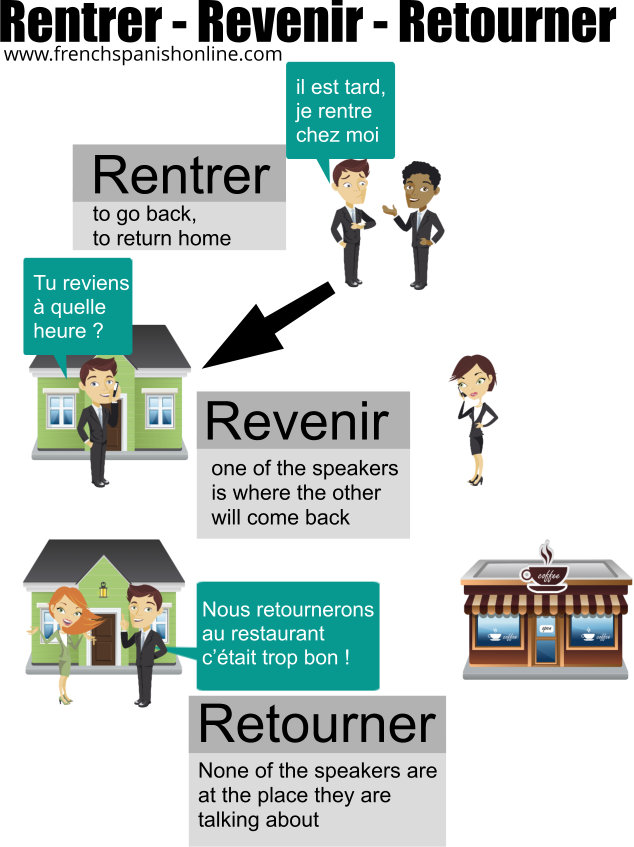
Explanation of when to use three different French verbs meaning “to return,” from the web site “Learn French Online with Pascal,” http://www.frenchspanishonline.com/magazine/rentrer-revenir-retourner/.

For me, the most absurd part of being in France is that I understand spoken French so much more poorly than I can read it.  I’ll sit at home at night reading in French about different theoretical perspectives on whether or not verbs can be considered to be concepts–no problem.  Then I go to work the next day and someone says “good morning” to me in a way that I haven’t heard before, and I stand there like I’ve just been hit upside the head with an ax handle, blinking like an idiot.

Case in point: my last day in the lab this summer, Brigitte and I chatted about whatever it was that we were chatting about–no problem.  As I headed out the door for the last time, Brigitte said: Bon retour!  I was totally flummoxed.  I knew that retourner is “to return,” but was she wishing me a nice return to France some day?  Was she wishing me a good trip home?  I had no clue.

Turns out this wasn’t such an odd question.  Today I came across a nice video from the web site French Spanish Online and its video series Learn French With Pascal on the subject of three different French verbs that all mean something like “to return,” but with subtle differences in their deictic properties.  Deixis has to do with how languages express relative location.  An example in English is the words this and that, which express the notion that something is either relatively closer to the speaker (this), or relatively further from the speaker (that).  Most languages have some reflection of deixis in their grammar.  For example, in the Kukú language, spoken in South Sudan, most verbs can be inflected (and some must be inflected) for whether the action of the verb is taking place towards or away from the position of the speaker.

As explained in Pascal’s video, the three French verbs rentrer, revenir, and retourner differ in this way:

  • rentrer is to return home.
  • revenir is to return to where the speaker is.
  • retourner is to return to someplace where neither the speaker nor the listener is.

So far so good.  However, we still need to know a couple of related nouns and/or expressions.

A very culture-specific one is la rentrée.  “The return” is that time at the end of the famous French summer vacation period when people return from their vacations to school or their job.  Ads bemoaning the rentrée appear in France almost as soon as vacation starts.  According to the French Wikipedia disambiguation page for rentrée, we can speak of the rentrée scolaire, when kids go back to school; the rentrée universitaire, when college students go back to school, which happens some weeks later; and the rentrée littéraire, the period between the end of August and the beginning of November when many new books are published in France, hoping for good sales timing in anticipation of the end-of-year holidays and good placement in the competition for literary prizes.

So, what did Brigitte mean when she wished me bon retour (“good return”)?  According to WordReference.com, bon retour translates as have a good journey home or have a safe journey home.  Why retourner, and not rentrer?  Is it because neither the speaker nor the hearer is where the hearer will eventually be going (home)?  I don’t know!  Pascal tells us that there are many exceptions, but I don’t know whether or not this is one of them, versus neither speaker being there trumping home being the destination.  Do you know the answer?  If so, why not leave it in the comments?

How to interact with a Parisian waiter

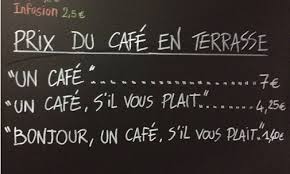
un cafe
“A coffee: 7 euros. A coffee, please: 4.25 euros. Good day–a coffee, please: 1.40 euros.”

Probably no one in France strikes more fear into the American heart than the French waiter.  We all know the stereotypes: they’re rude, they’re impatient, and their service sucks.  Actually, none of this is true, with the possible exception of the “impatient” part, and if you see that, it’s probably your fault.

Let’s start with “rude.”  This is actually a pretty typical conception that Americans have of the French.  In fact, if anything, the French are hyper-polite with strangers.  The issue that arises is that every culture has different conceptions of politeness, and unsurprisingly, French and American politeness is different.  The key is to learn to recognize French politeness when you see it, and to respond equally politely.

I would love to know enough about French politeness to explain all of its ins and outs, but I don’t.  I do, however, know enough to explain how to interact with a waiter.

On to the “impatient” thing: The first thing that you have to know about waiters in Paris is that they are covering far more tables than an American waiter would believe possible.  No exaggeration here: if you ever asked an American to cover as many tables as a Parisian waiter covers every single day, they would probably quit.

French waiters, like pretty much everyone else in France, have a métier, and they know how to do their job.  In turn, they expect you to know how to interact with them when they are doing their job.  One thing that this means is that you have to be aware that if everything goes as it should, you will not see that waiter very often, and he will not be making a lot of trips to your table.  So: be ready to order everything at once.  Have your drink order, your food order, and your dessert order ready.  If you are going to want water, ask for it along with everything else.  (If you want to make a French waiter crazy: order drinks.  When he comes back with your drinks, ask for water.  When he brings your water, tell him that you would like a menu.  When he brings your food, tell him that you would like an extra napkin.  Then, wait until he brings you your dessert to tell him that you’re going to share it, and would like another spoon.)

Finally, the service: Service is not supposed to be fast in France.  That is just not a goal.  Meals in France typically take a long time–my friends tell me stories of three-hour Sunday dinners with their families (during which children were expected to sit quietly and listen politely, but more on French kids some other time).  One book that I read about French and American differences in the business world said that in France, a three-hour lunch with your co-workers is like a two-week team-building ropes course camping trip in the US.  In fact, for your waiter to rush you would be rude.  Edmund White points out in his book Inside A Pearl that in France, the more expensive the restaurant, the slower the service.  When you go into a cafe and order yourself a cup of coffee or a glass of wine, you have just bought yourself a table for as long as you want it.  If the waiter is running to your table repeatedly, he is rushing you out the door–and he won’t.  (So, what do you do if you just want a fast cup of coffee?  Go into the cafe and stand at the bar.  Coffee at the bar typically costs about 1 euro less than coffee at the table, and it’s a very quick interaction–you order, you get your coffee, you drink it, you pay, and you leave as soon as you like.)

And, no, your waiter is not judging you: A fear about French waiters that we rarely admit to in America, but that I suspect we all share, is that they are judging our taste when we order.  Really, they don’t care.  If your waiter makes a weird face when you order something, it doesn’t mean that he thinks you have bad taste–it’s his polite way of telling you that the chef isn’t really hitting the target with that particular dish today.  You should thank him.

And finally, tipping: Tips are included in the bill.  However, you should leave something extra as a courtesy.  At a minimum, leave the small change to round up to the next euro.  If you liked the service, leave a euro or two extra.  Leave three euros, and you will be remembered the next time–guaranteed.  And, the more often you go there, the closer you will get to friendly treatment, if that’s important to you—strangers can make French people uncomfortable (which makes the waiter’s job extra-difficult), but they can be really warm if they recognize you.

From a linguistic point of view, the interesting thing about dealing with a waiter is understanding the various culture-specific things that they say to you.  Here are some useful expressions to know:

  • A boire? or A manger?: the waiter is asking you if you’re there just for drinks, or to eat.  This will determine whether you get directed to a table with silverware, or without it.  You can also use these to tell the waiter that you’re just there for drinks, or that you’re there to eat.
  • Vous désirez?: This is roughly “what would you like?”  It’s interesting in that it shows a common form of forming a question in the spoken language: normal word order, i.e. no inversions or question words, with rising intonation.  This wasn’t taught in the US, in my day.
  • Vous avez choisi?: This is roughly “have you decided?”  I.e., have you decided what to order?  Again, we see the normal word order, but with a rising intonation.
  • C’est bon: This is how you tell the waiter to “keep the change.”  (Hopefully you will have added a euro or two–see above.)

There are some things that I still haven’t figured out.  The big one: how do I tell the waiter that I prefer to sit outside?  Feel free to tell me the answer in the comments!

Regression models in French: Part II

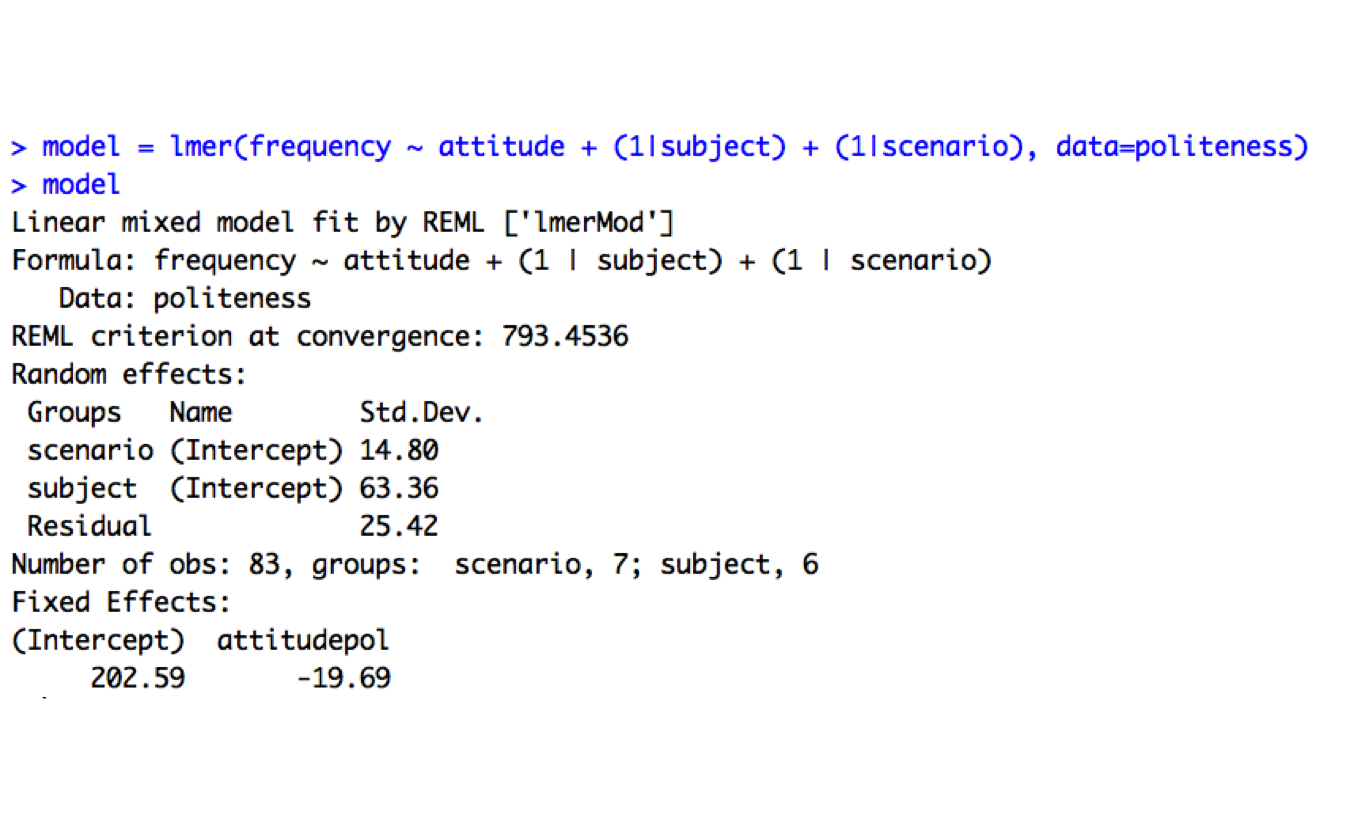
A linear mixed effects regression model of some data on intonation from Bodo Winter.

In a previous post, we talked about the vocabulary of a number of different kinds of regression models. Today, let’s move on to mixed effects models.  You can find an excellent discussion of mixed effects models here on Bodo Winter’s web site.  There is also some coverage of mixed effects models in Harald Baayen’s book Analyzing linguistic data: A practical introduction to statistics using RStefan Gries’s book Statistics for linguistics with R: A practical introduction has a good critique of current applications of mixed effects models in linguistics.

In statistics, an “effect” is anything that might affect the values in a sample. If we are building a statistical model of crop yields, an example of an effect might be the weather. If we are building a statistical model of voice onset times (the time gap between when a consonant is released from the mouth and when the vocal cords start vibrating for a following vowel), an example of an effect might be whether or not the associated syllable is stressed.

We can talk about two kinds of effects: fixed effects, and random effects.
As explained by Bodo Winter, fixed effects are things with a systematic and predictable influence on your results. They exhaust the possible levels, even if “only” defined operationally. As Stefan Gries puts it, fixed effects cover all possible levels (values that a variable could take) in the population. In contrast, random effects (as explained by Bodo Winter) are generally something that can be expected to have a non-systematic, idiosyncratic, unpredictable, or “random” influence on your data. In linguistic experiments, that is often “subject” and “item.” As Stefan Gries puts it, random effects sample the population, rather than exhausting it.  To see if you have this down, figure out if the following described fixed effects, or random effects:

  1. The Kukú language has voiced, voiceless, and implosive consonants. I have some of each in my experiment.
  2. The Kukú language has bilabial, alveolar, palatal, velar, labiovelar, and glottal stops. I have some of each in my experiment.
  3. For the purposes of my experiment, I am defining politeness as having two levels: casual, and formal. I have some of each in my experiment.
  4. There are almost 2,000 verbs in the CRAFT corpus. My student sampled 30 for a study of sentence plausibility.
  5. There are a number of labs in the Pharmacology department. My student recruited volunteers from one of them.
  6. There is an infinite number of sentences in Mousey Banana (a former co-worker’s favorite language name; more properly, it would be Musey Banana or Massa Banana; they are spoken in Chad and Cameroon), as there are in any language. Suppose that I took a sample of them for a study of intonation.

(Yes, these come straight from my statistics lecture notes.)  The first three of those are all fixed effects.  The last three are all random effects.

The beauty of mixed effects regression models is that they let you take random effects into account in building the model.  With a standard regression model, random effects introduce variability that your model will not be able to account for–going back to the voice onset example (the time lag between a consonant and vocal cord vibration for the vowel), the voice onset time will be affected systematically by things like whether or not the syllable is stressed and where in the mouth the consonant is formed, but it will also be affected randomly by things like which speakers I happen to have chosen–even with all other things being equal, my voice onset times will not be exactly the same as yours.  A mixed effects model lets you take these random effects into account.

With that background, we are ready for the French vocabulary that we need for talking about mixed effects models:

  • un effet: effect.
  • un effet aléatoire: random effect (the most common way of saying it).
  • un effet de/du hasard: another way of saying random effect (less common).
  • un effet fixe: fixed effect.
  • les effets mixtes: mixed effects.

Now comes the hard question: how do you link together modèle and effets mixtes?  Here’s the most common way of doing it:

  • le modèle à effets mixtes: mixed effects model.

Here are some examples from the linguee.fr website:

  • Nous proposons un modèle de régression spatial dans un cadre
    général de modèles à effets mixtes pour résoudre le problème de l’estimation pour petits domaines.  “A spatial regression model in a general mixed effects model framework has been proposed for the small area estimation problem.” (from statcan.gc.ca)
  • Ces analyses reposent sur des modèles physiologiques plus ou moins simplifiés et nécessitent des outils statistiques pluscomplexes comme la modélisation non-linéaire à effets mixtes.  “These analyses rely on more or less simple physiological models and require more complex statistical tools such as non-linear mixed effects modelling.” (from digiteo.fr)
  • Développement de méthodes d’estimation des paramètres des modèles non linéaires à effets mixtes par maximisation des vraisemblances approchées.  “Development of parameters estimation methods in the nonlinear mixed effects models with maximisation of approximated likelihood.” (from lemenuel.com))

Having beaten mixed effects models to death, I should point out that although they are very hot in American linguistics right now, they are not used as commonly in France at this time.  I brought up a question about mixed effects models after a talk in France once, and was embarrassed when the speaker asked me to switch to English.  It turned out afterwards that my French was OK–the speaker just wasn’t familiar with mixed effects models, and didn’t recognize the technical terms.

I haven’t tested this, but I suspect that chocolate is an effective tool of seduction everywhere

Old poster advertising a French brand of chocolate.  Photo from http://www.postercorner.com/Culinary-Chocolate-Palhasson-Vintage-Poster-Print-p/00720.htm.
Old poster advertising a French brand of chocolate. Photo from http://www.postercorner.com/Culinary-Chocolate-Palhasson-Vintage-Poster-Print-p/00720.htm.

You can find a list of the great restaurants of Paris anywhere.  However, a list of the great chocolatiers of Paris is harder to find.  Here’s a link to an article that talks about French chocolate and chocolate makers (chocolatiers), and gives the addresses of a number of Parisian chocolate shops.  What a nice theme for a day in Paris–a tour of the arrondissements by way of chocolate.

List of chocolatiers and chocolate shops of Paris from francetoday.com.

Here are some chocolate- and dessert-related terms that you might not have come across elsewhere:

  • la bûche de Noël: Christmas cake. (Picture below.)
  • la crème anglaise: custard.
  • la ganache: a cream-filled chocolate, a truffle.  Other meanings, too: the lower jaw, and an old fool.
  • la gaufre: waffle.  You probably knew this one already, but I include it here anyway, just because I like the word.  Another thing to note: le gaufre is a gopher (the North American mammal).  La gaufre: waffle.  Le gaufre: gopher.  Fun.
Bûche de Noël. Photo from http://blog.lamadeleine.com/2013/12/23/yule-love-it-the-history-of-buche-de-noel/.

The DALF: I find myself in the same position as a 3rd grade immigrant student

DALF C1 diploma. Picture from http://www.delfdalf.fr/dalf-c1.html.

I used to tutor a 3rd grade student.  He had recently arrived in the US from Mexico, and didn’t yet speak English.  I found that what he needed the most was to have the instructions on his homeworks explained to him in Spanish.  The language of those homework instructions was, frankly, sometimes ridiculous–convoluted sentence structures, odd uses of vocabulary, and the like.  It wouldn’t surprise me if some native-speaker parents had trouble with them, and there certainly was no way that his monolingual Spanish-speaking parents were going to be able to give him any help with them.

Fast-forward some years, and I now find myself preparing to take the DALF, or the test for the Diplôme approfondi de langue française.  This is the French implementation of the last two levels of the CEFR.  The Common European Framework of Reference for Languages (CEFR) is a European attempt to define levels of proficiency in a variety of languages.  It has six levels, from A1 (the lowest) to C2 (the highest).  A grande école (a member of the French system of elite schools that operates in parallel with the university system) would probably require a C1 or C2.

The last time I was in France, I picked up a couple of exam prep books for the DALF.  (I think a prep book is called an entrenez-vous, but can’t swear to it.)  Of course, I can’t even understand the instructions for preparing for the test!  This is frightening, as the requirements for C1 look difficult, and if I can’t even understand the instructions…  Here is one part of the description of what your level of ability has to be like for the oral comprehension part of the C1 test:

  • Je peux extraire des détails précis d’une annonce publique émise dans de mauvaises conditions et déformée par la sonorisation (par example, des annonces publiques dans une gare, un stade).  “I can extract precise details of a public announcement produced under poor conditions and distorted by the sound system, for example in a train station or sports venue.”

Can you imagine?  I’m lucky if I can understand that kind of speech in my native language! Let’s look at some of the vocabulary that you will need just to understand the description of the oral comprehension test in the book Réussir le DALF:

  • la colonne: column.  We are allowed to take notes in the right-hand colonne of the exam paper while listening to recordings during the oral comprehension part of the exam.
    • la colonne or la colonne vertébrale: spinal column.
  • le débat: discussion, debate.  At a later point in the exam, we have a débat with the examining committee.
  • repérer: to spot; (shelter, an enemy) to locate.  (You might remember this verb from this post on vocabulary from a French conference–apparently I didn’t.)
  • porter sur: lots of ways to translate this, but it basically means to be about. Here are some examples of its use from linguee.fr:
    • Cette information doit porter sur la mise en place d’une relation et sur un comportement responsable envers l’autre. “This information should be about forming relationships and about how to relate to each other in a responsible manner.”  (europarl.europa.eu)
    • Ces modalités peuvent notamment porter sur les procédures d’élaboration et d’adoption des projets de plans de déploiement commun.  “These rules may cover in particular the procedures for the preparation and adoption of draft joint deployment plans.”  (eur-lex.europa.eu)
  • le support: medium or format; also a support, and (for a book or tool) a stand.  We are encouraged to listen to recordings of lots of different supports in order to prepare for the test.
  • tirer parti de: to take advantage of, to make good use of (WordReference.com).  My test prep book instructs us to tirer parti des caractéristiques de l’oral–“take advantage of the characteristics of the oral,” like knowing the characteristics of different types of discourse–spontaneous speaking; written language read out loud…
  • faire preuve de: to show (e.g. courage).  We are told that vous devrez faire preuve d’un très bon niveau de compréhension en français sur des sujets abstraits ou complexes même hors de votre domaine de spécialité.  “You must show a very high level of comprehension in French of abstract or complex subjects, even outside of your area of specialty.”
    • faire ses preuves: to prove oneself.
  • rédiger: (an article, a letter) to write; (a contract) to draw up.

(Definitions from the Collins French-English Kindle dictionary, unless otherwise noted.)

In case you’re wondering how my 3rd grade student third grade student turned out:  when I explained the instructions to him in Spanish, he was able to do the homeworks, as often as not.  By the end of the school year, his English was great, and he didn’t need me anymore.  I hope I do as well on the DALF…

Regression models in French: Part I

One of the hot topics in linguistics right now is mixed effects models.  A mixed effect model is a kind of regression analysis.  Regression analysis is a way of building a statistical model of a phenomenon.  There are all kinds of things that you might want to build a statistical model of in linguistics, including phonetic relationships, sociolinguistics, syntax, and doubtless many others.  I’m going to use this post to put up some links to things that you might find useful in learning about mixed models, and of course we’ll come across some French vocabulary on the way.  (A note on the vocabulary in this post: it is mostly not found in dictionaries.  I induced it from examples on linguee.fr, an excellent source for finding examples of French technical vocabulary in use.)

The absolute best material for learning about mixed effects models so far is this tutorial by Bodo Winter.  If you’re not familiar with simple linear regression (i.e. with fixed effects only), you might want to check out this tutorial of his first.  Besides being really clear, Bodo’s tutorial is especially suitable for linguists, because it works through an extended example on F0 (fundamental frequency–roughly, the pitch of your voice) variation in situations of different politeness levels.

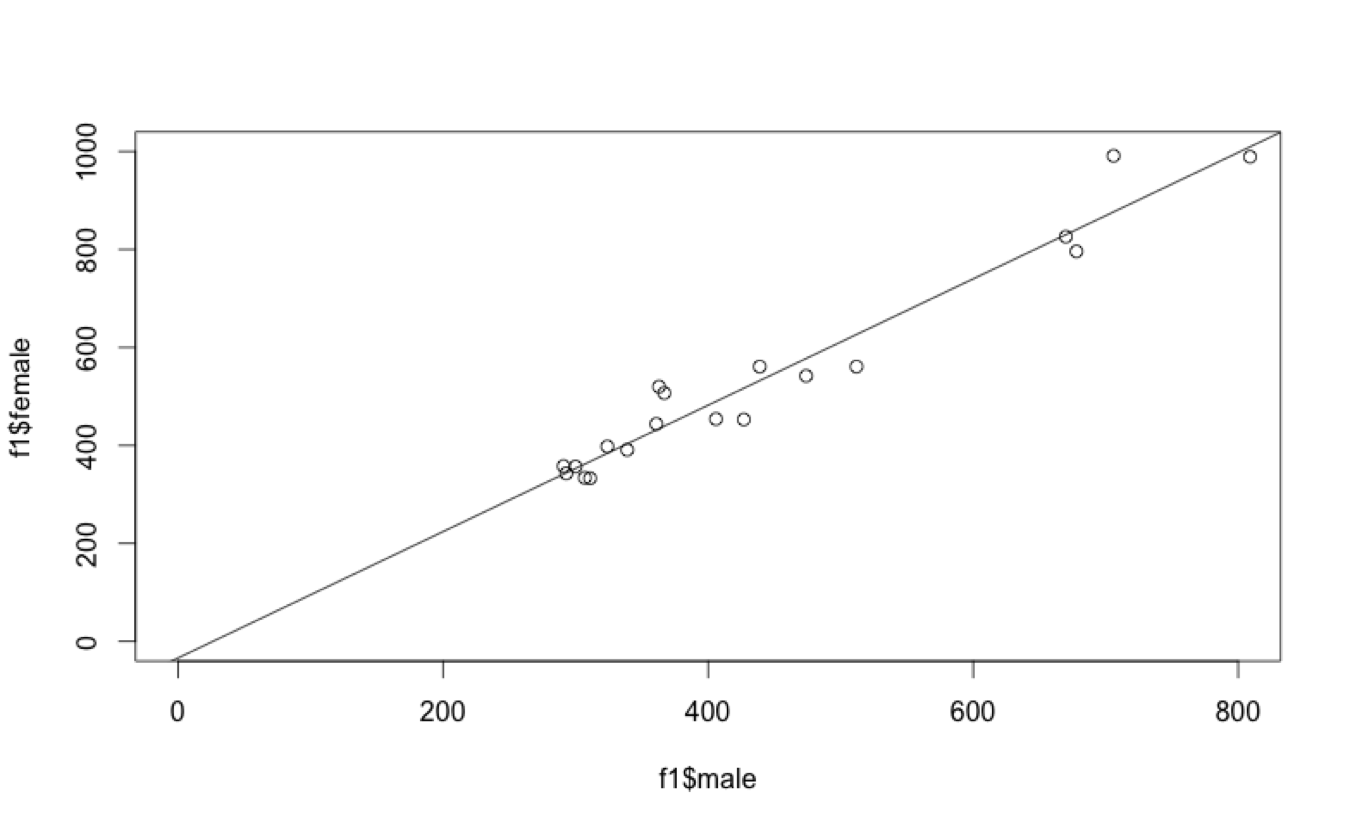
A regression line predicting female first formant frequencies from male formant frequencies, for speakers of several languages. Data from
A regression line predicting female first formant frequencies from male formant frequencies, for speakers of several languages. Data from Johnson (2011).

Let’s build up to the vocabulary of mixed effects models.  First, some basic vocabulary for talking about regression modelling.  Bear in mind that regression modelling–well, simple linear regression modelling–is about finding a formula that can predict the value for something on the basis of the value of something else.  The figure to the left plots F1 (first formant frequencies–part of what makes a vowel sound like what it sounds like) for female speakers of several language over the F1 for male speakers of the same language.  (The data comes from the web site accompanying Keith Johnson’s book Quantitative methods in linguistics.)  The line on the plot reflects a formula that will let you predict the F1 of a female speaker if you know the F1 of a male speaker.  Not surprisingly, the female frequencies are always higher–one of the determinants of overall patterns of F1 is that all other things being equal, the shorter your vocal tract is, the higher your F1 will be, and all other things being equal, women have shorter vocal tracts than men, on average.  What the line says is that you can get pretty close to an accurate prediction of the female F1 if you multiply the male F1 by 1.29.  (Yes, we’re glossing over the y intercept.)  OK, now on to that basic vocabulary:

  • le modèle: model.
  • le modèle de régression: regression model.
  • la régression linéaire: linear regression.
  • la régression logistique: logistic regression.
  • la régression linéaire simple: simple linear regression.

That got us through simple linear regression modelling.  Recall that in simple linear regression, you’re predicting a value for something on the basis of the value of something else.  But, most things don’t have simple one-to-one relationships.  Rather, it’s often the case that you need to predict one thing on the basis of multiple other things.  For example, suppose that you want to know what affects how long it takes a speaker of a language to respond to the question of whether or not a given sentence is grammatical (i.e., could be said in that language.  Colorless green ideas sleep furiously doesn’t mean anything, but you could say it in English.  On the other hand, green sleep colorless ideas furiously is something that you couldn’t say in English).  You might have to include multiple things in the model–how long the sentence is, how frequent the words in the sentence are, how long the words are, etc.  In this case–predicting one thing (response time) from multiple things (sentence length, word frequency, word length)–you need something called multiple linear regression.  This brings up more vocabulary:

  • la régression multiple: multiple regression.
  • la régression linéaire multiple: multiple linear regression.
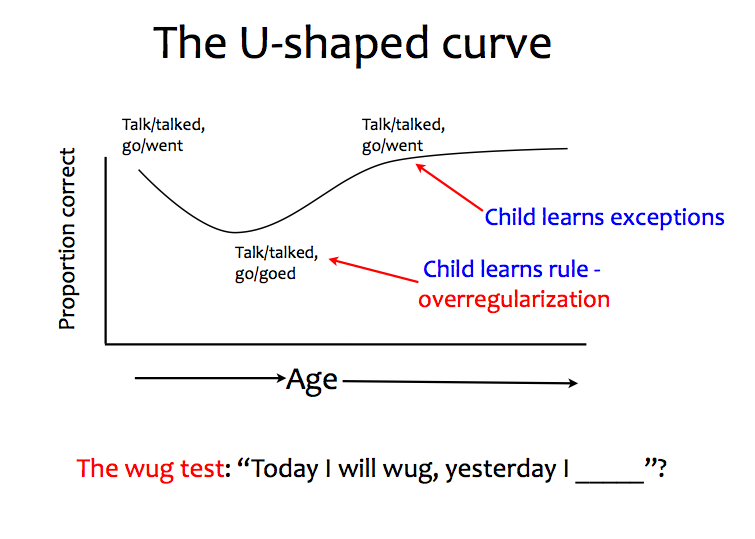
The relationship between age and the percentage of correctly formed past tense verbs. From https://www.studyblue.com/notes/note/n/cognition/deck/10754142.

So far, we know how to talk about linear regression.  What both kinds of linear regression have in common is that (a) we’re predicting a value from something else–from one value in the case of simple linear regression, or from multiple values in the case of multiple linear regression–and (b) we can describe the relationship between the value that we’re trying to predict and the value(s) that we’re trying to predict it from on the basis of a (straight) line.  Some relationships can’t be described by a straight line, though.  A classic example in linguistics is the U-shaped curve in language acquisition by children.  This describes a common phenomenon relating age to the percentage of correct productions of some linguistic target–say, irregular plurals, or the past tenses of verbs.  Initially, the child has a high percentage of correct productions.  Then, the child goes through a stage where the percentage of correct productions drops.  (As the figure suggests, this is thought to be because the child has made a transition from “memorizing” the regular and irregular forms to developing a hypothesis about a rule for forming plurals, or past tenses, or whatever.)  Finally, the child’s percentage of production of the correct forms climbs again.  Now we can’t describe the relationship between what we’re trying to predict (the percentage of correct productions and what we’re trying to predict it from (the child’s age) with a straight line.  However, there is another kind of regression that we can use.  It is called non-linear regression:

  • la régression non linéaire: non-linear regression.

We’ve now talked about three kinds of regression modelling.  They all have in common the fact that they are used to predict the value for something from the value(s) for something else.  If we’re trying to predict one value from one other value, that’s simple linear regression (la régression linéaire simple).  If we’re trying to predict one value from multiple other values, that’s multiple linear regression (la régression linéaire multiple).  And, if the relationship between what we’re trying to predict and what we’re trying to predict it from can’t be described by a straight line, then we have non-linear regression (la régression non linéaire).  (Before you ask: yes, there is such a thing as non-linear multiple regression, but I don’t know how to say it in French.  Heck, I’m not even sure how to say it in English–non-linear multiple regression?  Multiple non-linear regression?  It’s pretty rare.)  There’s one more kind of regression modelling that we need to talk about before we can move on to mixed effects regression modelling: logistic regression.

Logistic regression is used to predict the probability of something from something else.  Up ’til now, we’ve been predicting a value; now we’re predicting a probability.  What is the probability that a vowel will be unvoiced (whispered)?  What is the probability that I will pronounce -ing, versus -in’?  These are questions for logistic regression.  I’ll leave out the details, but we need to know the vocabulary:

  • la régression logistique: logistic regression.

OK, we can talk about a variety of types of regression modelling in French now.  But, to talk about mixed effects regression modelling, we also need to be able to talk about effects.  This post is already super-long, so let’s save that for next time.  In the meantime, here’s a shout-out to Bodo Winter, regression-modelling explainer extraordinaire: https://twitter.com/BodoWinter.

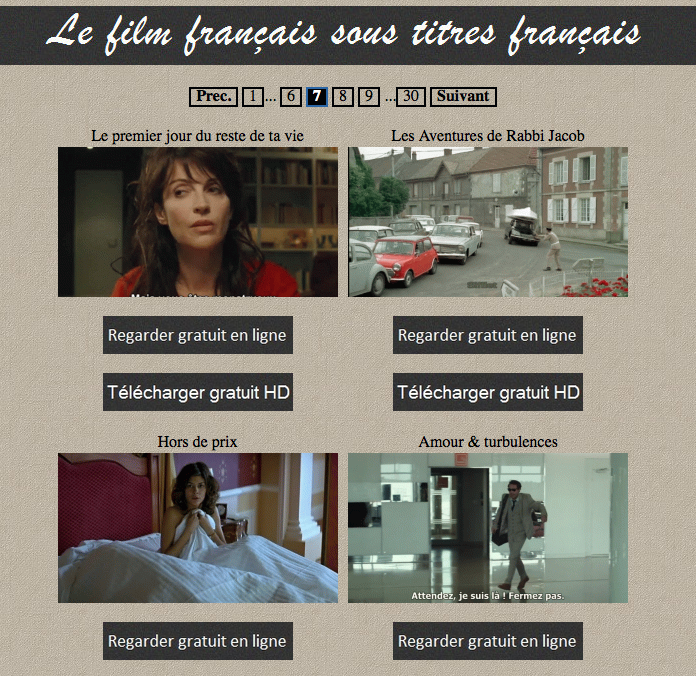
The adventures of Rabbi Jacob, or French movies subtitled in French

The filmfra.com web site.

French movies and TV shows with subtitles are great tools for practicing your listening skills.  However, it’s difficult to find French films with French subtitles in the US.  In France, all you have to do is go to Netflix, select a French movie, and turn the subtitles on–voila, French subtitles.  In the US, it’s not so easy–you can find French films on Netflix, but they’re subtitled in English.  So, I was very happy to discover the filmfra.com web site.  This site offers French films subtitled in French, free of charge.  The selection appears somewhat random.  I chose Les aventures de Rabbi Jacob (“The adventures of Rabbi Jacob”) tonight; here are some random words from the film.  I doubt that I would have picked them up without the French subtitles–thanks, filmfra.com!

  • (une) usine: factory; “tight ship.”  The plot line crucially involves a factory full of big vats of chewing gum–I think you can see where this will end up.
  • le traître: traitor.  I thought it was worth including this one because of the similarity to the word traiteur, a word that occurs all over Paris and always confuses Americans.  It means not “traitor,” but “caterer,” or more generally, someone who sells pre-prepared foods.  In Paris, a traiteur almost always sells Chinese food, and traiteurs are all over Paris–everywhere.
  •  dépanneur/dépanneuse: repairman/woman.

Frankly, I was too stunned by the brilliance of this movie–an avowed treasure of French culture, starring the comic genius Louis de Funès (you pronounce the final s of proper nouns ending with ès, by the way, or at least in general)–to be able to tear myself away from it enough to take notes, so let’s leave it at three words for today!  Just remember that somewhere in the world there is a web site where you can find free French movies–with French subtitles.

Excuse me, you can speak English question?

The entrance to a siheyuan residence in a hutong.  Photo from Wikipedia.
The entrance to a siheyuan residence in a hutong.

Life takes us to unexpected places sometimes, and at the moment, I am in Beijing (Pékin, in French).  I have a lot of conversations with people that go something like the following–if it’s underlined, it’s in Chinese:

Me: Excuse me, you can speak English question?

Other person: No. (Or, sometimes, in English: No.)

Me: (smile, walk away)

Beijing has a practically infinite number of huge buildings, but I have the good luck to be staying in a small hotel in a hutong.  A hutong is a small alley between siheyuan, or residences built around courtyards; it is also the word for a neighborhood made up of such alleys.  Beijing has had hutongs for maybe 700 years, and they are a traditional symbol of the city, although in recent decades, many of them have been demolished to make way for the huge buildings that compose much of the city today.

Nanluogu_Xiang_(6230757826)
Lanluoguxiang, the hutong that I walk through on the way to Banchan, which is my hutong.

Walking through the hutong from the metro station to my hotel, I passed by any number of signs marking public toilets.  “How nice,” I thought to myself, having recently come from Paris, where a free public toilet is a rare treasure.  My roommate explained the reason for the large number of free facilities to me: the old residences don’t have indoor plumbing.  The atmosphere is definitely interesting–on any given evening, I might walk past people cooking in the alley, or drying their laundry, or just hanging around, shirts off and smoking cigarettes.  I haven’t quite worked up the nerve to try the public bathrooms yet…

Here are a couple of sentences from the French Wikipédia article about hutongs:

Un hutong (en chinois :  ; en pinyin : hútong) est un ensemble constitué de passages étroits et de ruelles, principalement à Pékin en Chine.

  • passage: passage, pathway.  There are other meanings, but that’s the relevant one here.
  • étroit: narrow, close; strict
  • la ruelle: little street; back alley; way, lane.  It also seems to mean the space between a bed and the wall, but I might be reading that wrong!
  • Pékin: Beijing.  Some of you might be old enough to remember that the English word used to be Peking (still seen in “Peking Duck.”)

Le nom Hutong est un mot mongol, qui signifie le puits (худаг, khudag).

  • le puits: well.
Ukrainian Humanitarian Resistance

Resisting the russist occupation while keeping our humanity

Languages. Motivation. Education. Travelling

"Je suis féru(e) de langues" is about language learning, study tips and travelling. Join my community!

Curative Power of Medical Data

JCDL 2020 Workshop on Biomedical Natural Language Processing

Crimescribe

Criminal Curiosities

BioNLP

Biomedical natural language processing

Mostly Mammoths

but other things that fascinate me, too

Zygoma

Adventures in natural history collections

Our French Oasis

FAMILY LIFE IN A FRENCH COUNTRY VILLAGE

ACL 2017

PC Chairs Blog

Abby Mullen

A site about history and life

EFL Notes

Random commentary on teaching English as a foreign language

Natural Language Processing

Université Paris-Centrale, Spring 2017

Speak Out in Spanish!

living and loving language

- MIKE STEEDEN -

THE DRIVELLINGS OF TWATTERSLEY FROMAGE