How we’re sounding stupid today III

There’s an infinite number of ways to sound stupid in French, but only one right way to say a date in French.

A friend recently wrote to ask if I were in Paris.  I answered:

Screenshot 2016-02-26 07.00.05

She answered thusly:

Screenshot 2016-02-26 07.00.15
The 8th of March (you can’t not say it).”

We learn two things from this datum:

  • How to say dates
  • How to negate an infinitive with a direct object

Regarding dates: the definite article le always has to be there, as my interlocutor said.  Be careful: you say a date with the masculine definite article le, e.g. le 8 mars, “March 8th”–but, the word “date” itself is feminine–quelle est la date?  “What’s the date?”  For more on how to talk about dates in French, see this page on the Lawless French web sit.

Regarding negating infinitives: the first thing to note is that ne pas goes in front of the infinitive, so you would say ne pas manger “not to eat,” NOT ne manger pas.  Throw in a direct object pronoun and it goes in front of the infinitive, too: ne pas le dire, “not to say it.”

What happens if you have an indirect object pronoun? A direct pronoun and an indirect object pronoun?  A direct object pronoun, an indirect object pronoun, and a reflexive verb?  Here are some examples of those, from blogger and native speaker Bea dM:

  • Direct and indirect object pronouns: ne pas le lui donner, “not to give it to him.”  Moral of the story: ne pas precedes all of the object pronouns.
  • Reflexive pronoun and direct object pronoun: ne pas se le répéter, “not to repeat it to himself.”  Moral of the story: ne pas precedes the reflexive pronoun, as well.

Beauty is in the eye of the speaker: Beautiful French verbs

Beauty is not a linguistic concept, but that doesn’t mean that I don’t have some favorite verbs.

Cloître du prieuré Saint-Michel de Grandmont, Saint-Privat, Hérault, France
Cloister of Saint-Michel de Grandmont, Saint-Privat, Hérault, France. Picture source: By Myrabella / Wikimedia Commons, CC BY-SA 3.0, https://commons.wikimedia.org/w/index.php?curid=28563126.

As we saw in a recent post, beauty is not a linguistic concept.  Linguistics is about the scientific study of language, and science doesn’t have a concept of beauty, at least not for its objects of study (as opposed to, say, a really nice proof).  So, if I say that Brazilian Portuguese has the most beautiful consonnes fricatives (fricative consonants), I’m speaking as a civilian (or “normal person,” as we linguists call the rest of you), not in my official capacity.

Having gotten that disclaimer out of the way, you’ll find below a list of people’s thoughts about the most beautiful French verbs.  There aren’t a lot of repeats on this list (unlike a similar list of nouns that I saw the other day), so I’ll just pass it on without much comment, and add some of my favorite French verbs or verbal expressions to use:

  • rester cloîtré dans mon appartement: to stay shut up in my apartment–literally, to stay cloistered.
  • haussmanniser: to Haussmannize.
  • podcaster: to download a podcast, to listen to by podcast.  (In other words: the opposite of the English meaning, although if you look it up on Linguee.fr,you’ll see some translations with the English meaning, too.  I’ve only heard it with the opposite of the English meaning, though.)
  • retweeter: to retweet.
  • chunker: to break down into analyzable units.  This is a technical term in language processing, where the usual English verb is “to chunk.”

Here’s the list, from Quora:

https://www.quora.com/What-are-some-of-the-most-beautiful-French-verbs-youve-ever-come-across


Beauty is truth, truth beauty–except for language

I knew that I was meant to be a linguist the day that I was listening to a Brazilian guy being tortured on the radio.

Beauty is truth, truth beauty,–that is all
Ye know on earth, and all ye need to know.
–John Keats, Ode on a Grecian urn

250px-IPA_postalveolar_fricative.svg
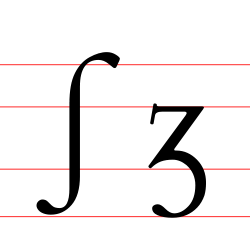
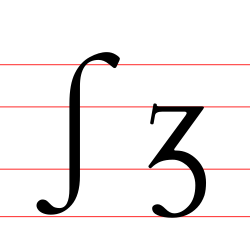
The symbols for voiceless and voiceless post-alveolar fricatives–two of the sounds that make Brazilian Portuguese sound like Brazilian Portuguese. Picture source: https://upload.wikimedia.org/wikipedia/commons/8/8b/IPA_postalveolar_fricative.svg.

I knew that I was meant to be a linguist the day that I was listening to a Brazilian guy being tortured on the radio.  As the Portuguese-speaking police officer questioned him and the guy screamed in the background, I thought: what beautiful fricativesI think that this is also strong evidence that I am a terrible person, but that’s a conversation for another time.

There’s something that you need to keep in mind about this story: my judgement about the relative beauty or lack thereof of a language isn’t a professional judgement at all.  Rather, it is an entirely personal one.  Linguists think of themselves as people who study language from a scientific perspective, and from a scientific perspective, beauty is not a relevant characteristic for describing a language.  Are there people who study language from a non-scientific perspective?  Sure–poets.  Poets typically have a very deep awareness of language, and fantastic insights into it.  However, a poet’s understanding of what language is and how language works is very different from a linguist’s understanding of what language is and how language works.  I can’t imagine protesting against a poet’s description of something linguistic as beautiful.  But, that’s not a word that you would hear coming out of my mouth as a linguist.  As a civilian?  Sure–for example, Brazilian Portuguese is beautiful.  But, as we’ve seen, I’m a terrible person–so, take my aesthetic judgements with a grain of salt.

  • la consonne: consonant.
  • fricatif (adj.): sibilant, fricative.
  • la consonne fricative: fricative consonant.
  • la voyelle: vowel.


Dead rock stars and the Poisson distribution

Is there a reason that so many rock stars have been dying lately? Here’s how to talk about it in French.

The Poisson distribution describes the probability of a given number of events occurring in a fixed interval of time and/or space if these events occur with a known average rate and independently of the time since the last event (definition from Wikipedia.com).  Who cares?  As Wikipedia puts it, with some highlighting by me: The Poisson distribution can be applied to systems with a large number of possible events, each of which is rare. How many such events will occur during a fixed time interval? Under the right circumstances, this is a random number with a Poisson distribution.  If you’ve been reading this blog for a while, you know that (a) a language has a lot of words, and b) most of the words in a language are rare–that’s why we can use Zipf’s Law to describe the distribution of words in a language, and that’s why I write this blog, which keeps track of the obscure words that I learn in the course of my day.  (Just some of them–there are far too many in any given day for me to track them all.)  So, you could imagine using the Poisson distribution to predict things like how many new words I will run into today.

There are many practical applications of the Poisson distribution.  For example, most of my colleagues work with genomic data of one sort or another.  Say you’re looking at the number of mutations in a particular stretch of DNA.  Mutations are rare.  You have a stretch of DNA that you think has a lot of mutations, and you think that you know what caused them.  Before you draw conclusions about whether or not the mutations were, in fact, caused by that, you need to be sure that the stretch of DNA couldn’t have acquired that large (you think) number of mutations by chance.  The Poisson distribution lets you assign a probability of that number of mutations occurring by chance in that one stretch of DNA.  If the Poisson distribution suggests that the probability of that number of mutations occurring by chance is greater than, say, 5%, then you probably shouldn’t draw the conclusion that you were considering concerning what caused it.  On the other hand, if the Poisson distribution suggests that the probability of that number of mutations occurring by chance is, say, 0.00001%, then you may be onto something.  Poisson distributions have been used in many fields; the most famous application was a study of the number of Prussian soldiers killed by horse-kicks.  Suppose that you suddenly have a large number of soldiers being killed by getting kicked by horses.  Do you need to be training your soldiers differently?  Has someone been selling you lousy horses?  If the incidence of deaths by horse-kicks follows a Poisson distribution (and deaths by horse-kick are rare events that are presumably independent of each other, so they do follow a Poisson distribution), then you can calculate the probability of the aforementioned large number of horse-kick deaths having occurred by chance.  If the probability of them having occurred by chance is large, then you probably don’t need to retrain your soldiers or start looking for a lousy horse-dealer.  If the probability of them having occurred by chance is low, then you might want to look into retraining your soldiers, or reconsidering your horse-buying practices, or whatever.  (I don’t know how the study turned out–see this Wikipedia page for a reference to the book.)

One of the practical consequences of the Poisson distribution is that even rare events will occasionally occur together.  The classic example: three rock stars die in the same month.  Here are some of the rock stars who died last month (January 2016):

…and there’s your classic three-rock-stars-in-one-month phenomenon.  Actually, it’s even weirder—three rock stars actually died on one day that monthJanuary 17th, 2016 saw the loss of Blowfly, Mic Gillette, and Dale Griffin.

What’s going on?  Is someone killing off the rock stars of the Anglophone world?  Probably not–the Poisson distribution tells us that such events, which are both rare and independent, will sometimes occur in bursts, despite their rarity and independence.

Some implications for the world of Zipf’s Law:

  1. I have to admit that I’ve been mischaracterizing the Poisson distribution somwhat in previous posts.  Briefly: I’ve been ignoring the independence assumption.  More on that later, because it’s a really big deal in language in general.
  2. When you’re learning a second language, you’re going to have some good days and some bad days.  On the bad days, you’re going to run across a lot of words that you don’t know.  The Poisson distribution tells you to not get down on yourself about this fact: it’s just the nature of rare events (including words) to show up in clusters sometimes.
  3. All of these dead rock stars have brought a new word into my life: la disparition.  As you probably know, this can mean “disappearance.”  What you might not be aware of is that it can also mean “death, passing,” or “demise.”  So, on the radio this morning, the host of Les Matins de France Culture was talking about la disparition of Umberto Eco.

Reviewing some relevant vocabulary (definitions from WordReference.com):

  • disparaître: to disappear; to die out.
  • disparu (adj.): vanished
  • le disparu: missing person; the deceased.


What’s making us sound stupid today II

linked-data-and-time-modeling-researcher-life-lines-by-events-26-638
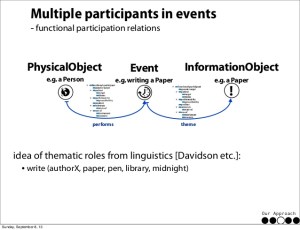
Objects and events. Picture source: http://www.slideshare.net/c_kessler/slides-26004724, by Johannes Trame, Carsten Keßler, and Werner Kuhn.

Is an event a thing?  In traditional grammar, they are, at least on the level at which we’re taught traditional grammar in the Anglophone education system.  Events are nouns, and specifically common nouns, as far as I know.  So, we see a similarity between many dogs and many breakdowns, and a difference between many storms and a lot of juice.  Dogs and breakdowns are easily pluralizable and take many, while juice is not pluralizable (it certainly is, but with different meanings) and takes a lot of.

So: in English, events are things.  However, today I ran across some evidence that in French, they are not.  Here’s how it went, and how I sounded stupid.

I’d been trying to work out the details of some flights for the past couple days.  My host in France was the go-between between me and the person booking the travel.  Eventually the person booking the travel sent me some flights, and I wanted to write back to say that they were fine–“that works,” as you might say in English:

Screenshot 2016-02-18 13.41.50
My email.

One of the things that I really, really appreciate about France is that many French people (as you will have read in innumerable books about France) are willing to point out your errors in French.  This is how we improve, and I love it!  Here’s what I got back:

Screenshot 2016-02-18 13.43.38
(Part of) the response.

What’s going on here?  It’s as my interlocutor described it: marcher is something that can refer to a thing, but not to an event.  From a linguist’s perspective, this is fascinating, because it sheds some light on the status of a basic, very fundamental question in the semantics of a language: what are the kinds of distinctions that the language makes?  Or, from a more poetic standpoint: from the point of this language, how is the world constructed?  This is a question of ontology, the subject of this post from a couple days ago.  Questions about language can be framed as very concrete questions about statistics, and they can be framed as very abstract questions about philosophy, and both approaches have their uses.  Either way, the answer to the question should come from actual data.

Anyways: that’s how I sounded stupid today.  Or, at least, that’s one way that I sounded stupid!  Oh, and one more thing: the French word for “event” is one of the words affected by the big spelling reform coming up this fall.  It’s going from événement to évènement.  You know what this means: one more word that I’ve been pronouncing incorrectly for the past two years!

Update, March 26th, 2016

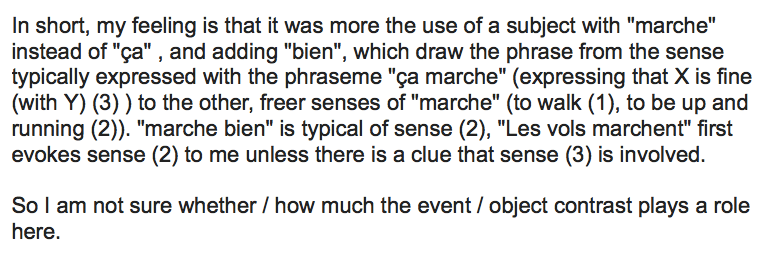
I showed this post to my interlocutor.  Here’s his response–an alternative analysis.

Screenshot 2016-02-26 15.00.37

American writers trying to explain themselves in French

Ta_Nehisi_Coates_2_BBF_2010_Shankbone
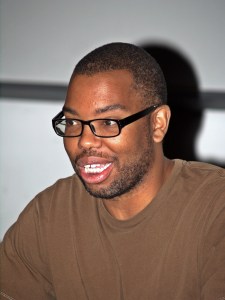
Ta-Nehisi Coates. Picture source: By David Shankbone (Shankbone) [CC BY 3.0 (http://creativecommons.org/licenses/by/3.0)%5D, via Wikimedia Commons.
Ta-Nehisi Coates is this super-cogent writer whose essays I love to read.  His second book, Between the world and me, won the 2015 National Book Award for Nonfiction, and he was recently awarded a MacArthur Genius Grant.  He took the MacArthur money and moved to Paris, as any reasonable person would.  Here is a wonderful video of him in the midst of trying to learn French.  I can completely relate to his pain.  As he puts it: he sounds like an intelligent guy in English, but in French…different story.  That’s totally the story of my life these days–I think I’m fairly articulate in English, but when I try to explain the simplest things in French, I sound like a bumbling idiot.  Oh, well–practice makes perfect.  I hope.

The video: http://bcove.me/yjr8cuhr

  • les réparations (n.f.pl.): reparations.

Testicles and the evolution of the intellectual

The unexpected connections between a Romani trailer park, Enlightenment intellectuals, and a police inspector.

220px-Joseph_D'Hemery
Joseph d’Hémery, policeman, inspector of the book trade and therefore of authors from 1748-1753. Picture source: by Nicolas-François Regnault (* 1746; † 1810) [Public domain], via Wikimedia Commons.
I’m watching a French movie about a Rom guy who finds God.  In the part of the movie that I’m currently at, the plot involves a feud between an old man and a young guy.  The old man feels disrespected, and wants revenge.  This gets expressed linguistically in part by the way that various participants are referred to in the script.  Specifically, disrespect for a man is communicated by referring to him with some variant or another of the word boy.  In the little world in which I spent my teenaged years in, this was a huge insult–far better to be called mother fucker than to be called boy.  The connotation is that you’re weak and insignificant.  In his essay on the development of the concept of the intellectual in Ancien régime France during the mid-1700s, Robert Darnton talks about how the policeman and inspector of the book trade Joseph d’Hémery referred in his files to writers without social distinction as boy, regardless of their age.  Gentlemen, in contrast, were referred to as men.  As Darnton puts it, Boy” implied marginality and served to place the unplaceable, the shadowy forerunners of the modern intellectual, who showed up in the police files as gens sans état (people without an estate).  I was quite shocked when I found myself living in the southern US later in life and discovered that it’s quite common for older men there to address younger men as boy.  Here are some of the words that are used in this way in the film:

  • le gosse: kid.  (In Quebec: testicle.)
  • le gamin: kid, youngster.

Simultaneously, there’s a lot of talk in the film about testicles.  It’s not cross-linguistically uncommon for testicles to be a metaphor for courage, and this Slate article by Juliet Lapidos maintains that such is the case in French.  (I don’t know anyone in France well enough for them to use that kind of slang around me, so I can’t speak from experience, one way or the other, but I was able to validate this claim on WordReference.com.)  (Another aside: an old friend used to claim that the following typology exists: languages that use the word nuts to refer to testicles, and languages that use the word eggs to refer to testicles.)  Testicles are referred to in the film as follows:

  • les couilles (f.pl.): balls (testicles).  We saw this recently in the expression je m’en bat les couilles (I don’t give a shit).

The ostrich and the platypus

Screenshot 2016-02-15 20.55.30
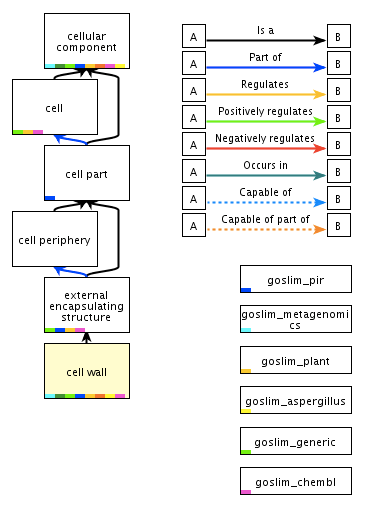
The representation of “cell wall” in the Gene Ontology. Picture source: screen shot from geneontology.org.

One evening in December I sat in the living room of a friend half an hour south of Paris.  We sipped wine and talked about the recent kidnappings of hens from her hen house.  She knew what kind of animal was stealing them, but neither of us knew what the French word for it was in English.  Words for animals are a great illustration of Zipf’s Law—you know so, so many of them, but the vast majority of those almost never get used.  We discussed this fact, and that discussion quickly led to the word ornithorynque: “platypus.”

Why the hell would a couple of computational linguists half an hour south of Paris need to talk about a platypus, or for that matter, an ostrich?  Me and my friend both work with things called ontologies.  You can think of an ontology as a set of things and a set of relationships between them, where the relationships are generally restricted to either “A is a B” or “X is part of Y.”  For example, the Gene Ontology contains the specifications that a cell wall is an external encapsulating structure, that an external encapsulating structure is a cell part, and that a cell part is part of a cell.  Armed with that information, a computer (or a person) can infer things, such as that a cell wall is part of a cell.  This might seem obvious to you, but it’s not obvious at all to a computer.  A computer can’t really understand language, and to a computer, cell wall and cell migration both look pretty similar—two nouns in a row, the first of which is cell—but, a cell wall is a part of a cell, and cell migration is not.  Ontologies are one way of encoding the kinds of information that we think humans use (and therefore computers presumably need) to understand language—for example, to be able to understand that if I say The children ate the cookies.  They were delicious, then they means the cookies, but if I say The children ate the cookies.  They were hungry, then they means the children.

necessary and sufficient conditions cow-venn-diagram
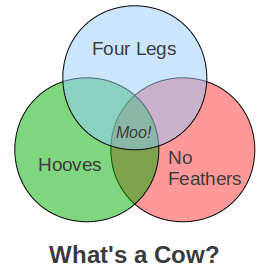
Necessary and sufficient conditions for being a cow. The claim of the diagram is that in order to be a cow, you must have four legs, hooves, and no feathers. The claim is also that if you have four legs, hooves, and no feathers, that is enough to establish that you are a cow. Do you buy (translation of buy in this context: “accept the claim of”) this cartoon? Picture source: http://searchengineland.com/how-prototype-theory-influences-a-social-media-strategy-59608.

Ontologies are great ideas, but in practice, it isn’t that easy to get them to work.  Let’s take mammals, since it’s a mammal that was stealing my friend’s chickens.  In an ontology, in order for something to be fully defined, you have to state the necessary and sufficient conditions for something to belong to a category.  That is, the conditions that must be met to belong to the category—the necessary conditions–and the conditions that, if they are met, are sufficient to let you belong to that category.  In French, we call these les conditions nécessaires et suffisantes, or CNS.  Let’s think about the necessary and sufficient conditions to be a mammal.  Nurse your young; three middle ear bones; hair; neocortex; endotherm; give live birth.  Damn–what about the platypus?  The platypus is a mammal, but it lays eggs.  That’s why the platypus—l’ornithorynque (n.m.)—came up in our conversation.  The fact that things like the platypus exist is a problem for ontologies (and ontologists).  Ontologies have to assume these really rigid boundaries for semantic categories, established by conditions nécessaires et suffisantes, and in practice, people don’t seem to think about semantics that way.


prototypes
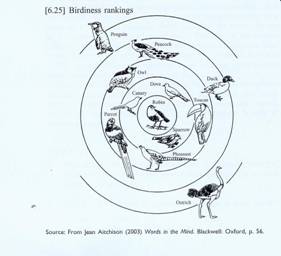
Prototypical and peripheral birds. Picture source: http://www.stylepinner.com/prototype-theory/cHJvdG90eXBlLXRoZW9yeQ/.

How do people think about semantics, then?  There’s decent evidence for what’s called the prototype theory.  The prototype theory posits that we have representations in terms of some prototypical member of the category.  Other things might be closer to the prototype, or other things might be farther from the prototype, but we can accommodate all of them within the category, since it doesn’t require rigid boundaries.  If you have feathers, and you’re bipedal, and you lay eggs, and you fly, then clearly you’re a bird–you’re like the prototype for a bird.  But, even if you don’t fly, you can still be a bird—and that’s how an ostrich gets into the conversation.  Last summer I was giving a talk about semantic representations, and I was reviewing prototype theory.  The ostrich is a classic example to use when you’re talking about prototype theory—unlike a prototypical bird, it doesn’t fly, but it’s still a bird.  I couldn’t remember the word for ostrich, which I constantly confuse with the word for Austria.  Mercifully, my host was sitting in the front row, and he told me: autruche. 

If you’re interested in reading about this kind of stuff in French, I’m a big fan of the book Initiation à l’étude du sens, “Introduction to the study of meaning,” by Sandrine Zufferey and Jacques Moeschler.  I don’t know of any book in English that’s better.

  • un ornithorynque: platypus
  • une autruche: ostrich.
  • Autriche (n.f.): Austria.
  • les conditions nécessaires et suffisantes: necessary and sufficient conditions
  • le modèle du prototype: prototype theory

Is a preposition a bad thing to end a sentence with?

To be, or not to be- that is the question:
Whether ’tis nobler in the mind to suffer
The slings and arrows of outrageous fortune
Or to take arms against a sea of troubles,
And by opposing end them. To die- to sleep-
No more; and by a sleep to say we end
The heartache, and the thousand natural shocks
That flesh is heir to.
–William Shakespeare, Hamlet

Is a preposition a bad thing to end a sentence with?  No: if you want to sound like a native speaker of English, then you need to end sentences with prepositions.  In his writing guide The sense of style: the thinking person’s guide to writing in the 21st century, the linguist Steven Pinker‘s take on the alleged rule against ending sentences with prepositions is that “mockery is appropriate.”

If you teach introductory linguistics, you’ve probably had undergraduates show up in your class convinced that there’s actually some problem with ending sentences with prepositions.  They never seem to have any clue why, beyond the fact that someone told them so at some point.  It’s a belief that puzzles the hell out of linguists, since ending sentences with prepositions is clearly part of the English language–indeed, there are many constructions that require it.

Think for a minute about what the alternative to ending a sentence with a preposition is.  There are two options: one for when you’re asking a question, and the other for a non-question.  If you’re asking a question–not just any question, but one that uses one of what linguists usually call wh-words or Q-words, like what or where–you can move the preposition to the front of the sentence, preceding the wh-word:

Normal English option: Formal English option:
Who are you going to give it to? To whom are you going to give it?
Where are you going to get it from? From where are you going to get it?

For non-questions, you can make a relative clause, and move the preposition to follow the relativizer:

Normal English option: Formal English option:
That’s the store I’m going to buy it from. That’s the store from which I’m going to buy it.
That’s the guy I’m going to give an ass-kicking to. That’s the guy to whom I’m going to give an ass-kicking.

Linguists call the option that’s more common in formal English pied pipingYou might remember the Pied Piper of Hamelin.  He was hired to remove all of the rats from a little town in Germany.  When the townspeople didn’t pay him, he led all of their children away.  Similarly, we think of the wh-word and/or the relativizer as “leading away” the preposition from where it would normally go.

I’ve never really understood how anyone could believe that there’s anything “real” about the don’t-end-a-sentence-with-a-preposition thing. In fact, there are plenty of things that you can’t say in English without a preposition at the end of the sentence. Do you want to take a dip in the pool before lunch? Only if you’re going to.  I found a nice one on pemberly.com:

What did you bring that book that I don’t like to be read to out of up for?

I tried to figure out a way to say this with pied piping:

For what did you bring up that book out of which I do not like to be read to?

For what did you bring up that book to which? whom? I do not like to be read out of?

I’m a native speaker, and I can’t come up with a way to do it.

At the top of this page, you’ll find a quote from Shakespeare featuring a sentence-final preposition.  My point in including it is to demonstrate that our greatest writers have used the construction.  However, you shouldn’t take a writer’s use of something as prima facie evidence that they approve of it–you need to look at who it’s used by (or by whom it’s used, if you prefer).  For example, when I translate my own speech from French into English, I typically do so using English in ways that I would never use it if I were speaking English, with the express purpose of trying to communicate how bad my French is: “This wants to say what, égout?,” I asked. I…um…likes Hawaii.  It’s OK—I is leaving early today.  Jane Austen puts some constructions only into the mouths of people who she wants to portray as idiots.  Who says the lines in the quote at the top of this page?  Hamlet, the protagonist of what is widely considered to be Shakespeare’s greatest play, the one that you’re likely to have read even if you haven’t read anything else by the man.  Point being: it’s tough to argue that Shakespeare put that preposition at the end of the sentence because he didn’t like it.

So, where did this whole “a preposition is a bad thing to end a sentence with” mishegas come from?    The linguist Steven Pinker attributes it to the seventeenth-century British poet and literary critic John Dryden, who he says originated it in an excoriation of playwright and poet Ben Jonson‘s work.  According to David Thatcher’s book Saving our prepositions, it then found its way into Robert Lowth’s 1762 book Short introduction to English grammar, and insinuated its way into English-language pedagogy from there.

Are there similar phenomena in France–alleged rules that don’t actually reflect at all how the language is used by native speakers?  Probably, but I don’t know what they are, and indeed, mixing language from different registers–saying the colloquial je crève d’envie de… (“I’m dying to…”) in a social context in which I should say je meure d’envie de… (also “I’m dying to,” but more appropriate for a formal situation) or failing to say ça me fait égale (“It doesn’t matter to me”) and instead saying je m’en bat les couilles (also “it doesn’t matter to me”, but more literally something like “I bang my balls about it”) is exactly the kind of thing that I mess up all the time.

I’ll leave you today with another quote from a non-stupid Shakespearean character:

We are such stuff as dreams are made on.

–William Shakespeare, The Tempest

…and, yes, it’s on, not of.



“They” is the American Dialect Society word of the year: gender neutrality and gender inclusivity in English and French

How do you do gender neutrality in a language in which every noun and adjective is either male or female? Here’s the French approach.

“And whoso fyndeth hym out of swich blame,
They wol come up . . .”

  “Whoever finds himself not guilty of such, they should come up…”

—Chaucer, The Pardoner’s Prologue. Translation by me–I was an English major.

The American Dialect Society’s Word Of The Year for 2015 was the word they used as a singular pronoun.  The usage goes back to the 1300s, probably less than a hundred years after we borrowed the word itself from the Old Norse pronoun þeir.  In the dialect of English that I grew up speaking, it’s used to refer to a single person in the third person when their (wow–there it is–I didn’t plan that!) gender is not known or not relevant.  If someone lost their cell phone, Beverly has it.  If one more person tells me “God needed your mother for an angel,” I’m going to punch them right in the fucking stomach.  If you see a dog with a bone in their mouth, don’t try to take it from them.  There’s a beautiful analysis of Jane Austen’s use of singular they at this web page on the pemberley.com web site, your home for all things Austentatious.  The author points out that there are some grammatical constructions that you can tell Austen disapproved of because she only puts them in the mouths of characters who are idiots.  This isn’t one of them–Austen uses it narratively.

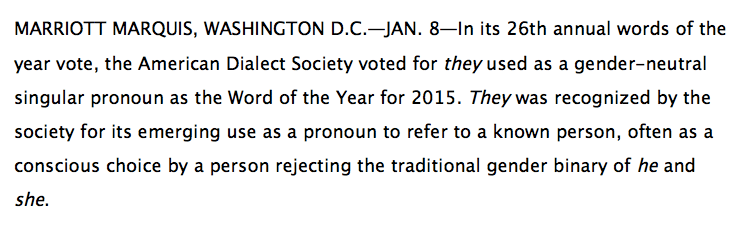
The American Dialect Society singled out they specifically for its conscious use as a gender-neutral or gender-non-binary pronominal referent for even a known person:

Screenshot 2016-02-12 05.22.54
Picture source: screen shot from http://www.americandialect.org/2015-word-of-the-year-is-singular-they.

As far as I know, France and the French language haven’t much gotten into the question of whether or not gender is binary and, if not, how we should do pronominal reference (i.e. using words like he/she/it/they/zhe/ix), but gender inclusivity is definitely an issue.  It’s an especially thorny issue in France because in French, every noun has a gender.  We have a very small number of such nouns in English–king/queen, actor/actress, man/woman, boy/girl, bachelor/bachelorette, etc.  In French, though, every noun has a gender.  Choix (choice)?  Male.  Liberté (liberty)?  Female.  Pied (foot)?  Male.  Main (hand)?  Female.  Many, many words referring to humans are gendered–director (directeur for a male, directrice for a female), actor (comédien for a male, comédienne for a female), dancer (danseur for a male, danseuse for a female), student (étudiant for a male, étudiante for a female)–on and on.  Some words only have one form, and French people struggle with those–for example, there’s a very current controversy over whether female ministers in the government should be referred to as Madame le ministre (with the male definite article le that ministre requires grammatically) or as Madame la ministre (with the female definite article that Madame seems like it ought to go with).  (I think that the ministers themselves prefer Madame la ministre, but the (female head of the) French Academy insists that it is Madame le ministre and that Madame le ministre it will stay.)

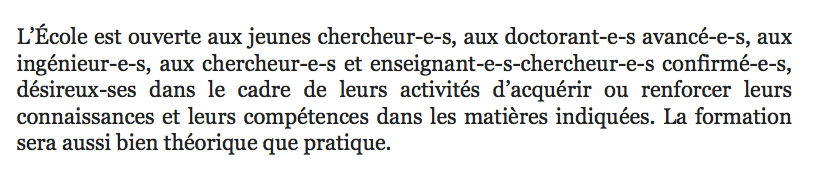
How do you go about being gender-neutral in French, then?  Here’s one attempt to do it.  It showed up in my email inbox yesterday.  What you’ll see is that the writer attempts to be not gender neutral, exactly, but rather gender inclusive: all of the nouns and adjectives have been modified so as to refer to both males and females.

Screenshot 2016-02-13 05.33.24
Picture source: screen shot of an email advertising a “summer school” in computational and statistical textual analysis.

All of the hyphenated things are attempts to make the words cover both genders, rather than just one.  Most of these work.  A male PhD student is a doctorant, and a female PhD student is a doctorante; the writer has written doctorant-e-s to try to cover the plural of both male and female PhD students.  “Advanced” would be avancés for the male plural and avancées for the female plural; the writer tries to cover both of them with avancé-e-s.  This technique doesn’t always work smoothly.  The male plural of “desirous of” or “wanting to” would be désireux de, and the female plural would be désireuses de; the writer has tried to cover both with désireux-ses, which doesn’t work out as cleanly as doctorant-e-s, but one gets the idea.  It works out even less well for the plural of “researcher,” which would be chercheurs for males and chercheuses for females; the writer went with chercheur-e-s, rather than chercheurs-seuses, as they did (there it goes again–I don’t know the writer’s gender, so my dialect uses they as a singular pronoun) for désireux-ses. 

A very common way that I see people try to be gender-inclusive in writing is by repeating nouns and pronouns that refer to people in the male and female forms.  Here’s an email about a Meetup in Paris about machine learning (a technique for getting computers to learn how to do things):

Screenshot 2016-02-13 05.45.50
Picture source: screen shot of an email from a Meetup group in Paris.

It’s saying “for those of us who stayed here in Paris,” but the word those is repeated: once in the female plural form celles, and once in the male form ceux.  It’s the same technique that we use in English if we write he or she. 

Ukrainian Humanitarian Resistance

Resisting the russist occupation while keeping our humanity

Languages. Motivation. Education. Travelling

"Je suis féru(e) de langues" is about language learning, study tips and travelling. Join my community!

Curative Power of Medical Data

JCDL 2020 Workshop on Biomedical Natural Language Processing

Crimescribe

Criminal Curiosities

BioNLP

Biomedical natural language processing

Mostly Mammoths

but other things that fascinate me, too

Zygoma

Adventures in natural history collections

Our French Oasis

FAMILY LIFE IN A FRENCH COUNTRY VILLAGE

ACL 2017

PC Chairs Blog

Abby Mullen

A site about history and life

EFL Notes

Random commentary on teaching English as a foreign language

Natural Language Processing

Université Paris-Centrale, Spring 2017

Speak Out in Spanish!

living and loving language

- MIKE STEEDEN -

THE DRIVELLINGS OF TWATTERSLEY FROMAGE