Working outside despite a downpour, in order to not interfere with somebody else’s distance teaching…
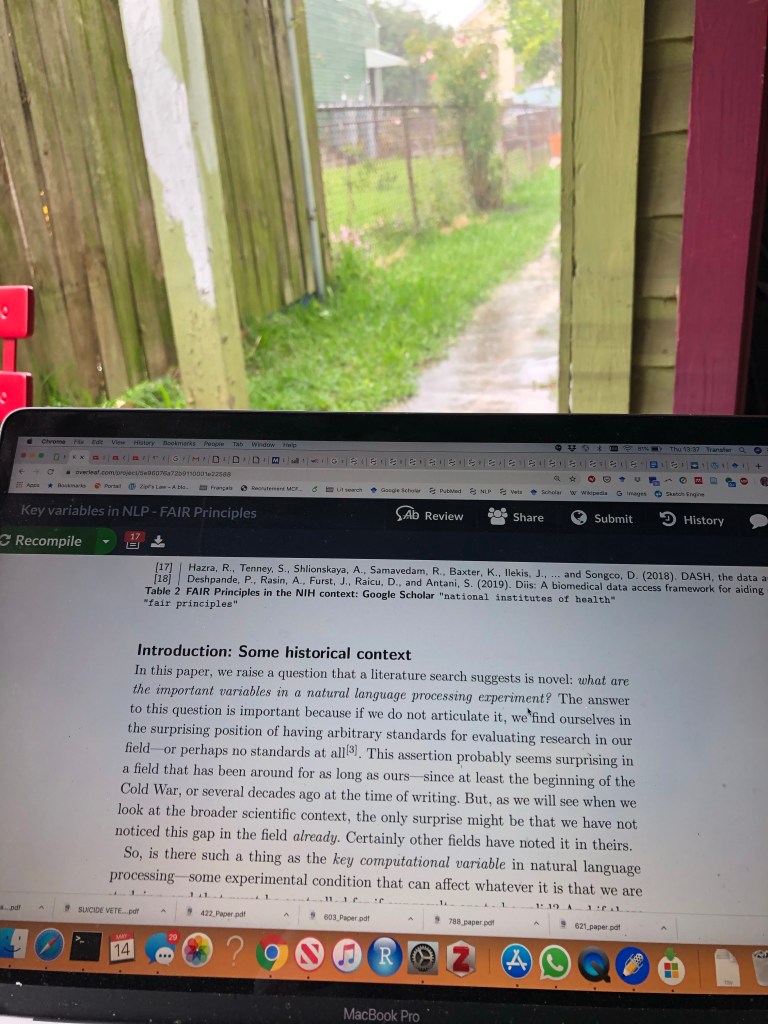
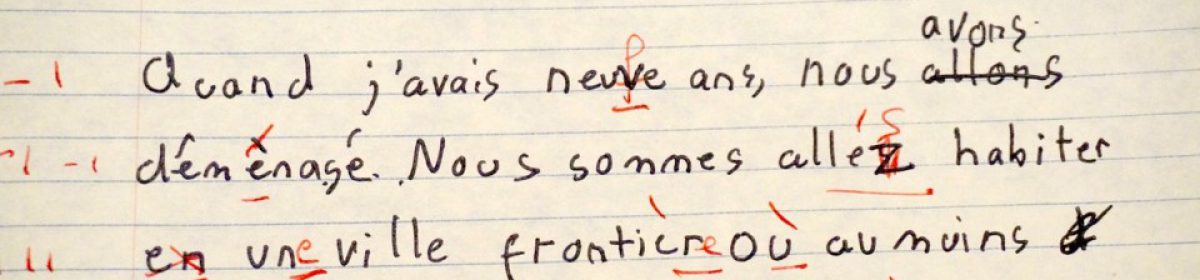
Working outside despite a downpour, in order to not interfere with somebody else’s distance teaching…
“Lapider”: to stone. Such a beautiful word for such a horrible way to kill someone.
As I write this, most of the US has been under confinement for going on two months. For me, it has been two months, ’cause I spent the week before everything went to shit isolating myself voluntarily–I was coughing like crazy, with what turned out to be whooping cough–and I didn’t want to get stoned to death on the Washington DC Metro. (Lapider–to stone. Such a beautiful word for such a horrible way to kill someone.)
So, the other night I’m watching a new apocalyptic series on Netflix. The crisis is not realistic, the most unrealistic of the characters is especially irritating, and…well, in general, it’s just an irritating show. I put down my iPad in frustration, step out on the porch, and light a cigarette.
I light my cigarette, and I’m thinking about what’s going on in the real apocalypse: people dying. People’s jobs disappearing. And all of it far worse than it has to be, because the Liar-In-Chief is characterologically incapable of seeing that the way for him to handle this is not by incessantly lying through his fucking teeth, but by telling our country the truth. By putting federal dollars into testing, not by claiming that there are plenty of tests available for everyone, which is manifestly false–all while having himself and his suppôts tested daily, while front-line medical personnel go without. Asshole.
I light my cigarette, and I’m thinking all of that, and I realize: escaping for a little while into the space of an unrealistic apocalypse would feel far better than thinking about the real one…and back into the night I go.
The unrealistic apocalyptic Netflix show to which I am now completely addicted is called Into The Night (Dans la nuit in French). It’s in French, and in a particularly interesting French, because many of the characters are not natively francophone, so they have accents, and that fucks me up totally. For my fellow amerloques, here’s a bit of the vocabulary that I had to look up in the first episode.
The passport control guy in the Brussels airport recognizes one of the main characters, sees that she’s flying to Moscow, and asks her:
One of the characters is buying a last-minute plane ticket, and the clerk says to him:
s’élever à: to come to, to amount to. You use these expressions in English primarily when a price has multiple components. So, if you buy a hamburger, and a hamburger costs $5.00, then the kid at the cash register might say: ok, that’s $5.00. But, if you add cheese at $1.00, a slice of tomato at $0.50, and pickles at $0.50 (I have no clue what the actual prices are–who orders a hamburger at a place like that?? Not that I haven’t worked in a couple of ’em), then the clerk might say: ok, that comes to $7.00. When do you use s’élever à in French? I have no idea–Phil d’Ange?
Here one of the characters–a Flemish dude with heavily accented French, so I don’t know how correct this is–sees people boarding the plane before him, and says the following. What I didn’t know the meaning of was ça, alors !
WordReference gives a number of meanings for it, all of which are expressions of surprise. Of them, the best translation for this case is probably well, I never! …which would typically have some connotations of a disagreeable surprise. Like, someone does something totally rude to you, or tells you a story about something shitty that someone did to them–Trump’s replacement for his original Attorney General just had the charges dropped against a guy who had already pled guilty twice of lying to the FBI about his interactions with the Russians during the transition. –Well, I never! Of course, that conversation implies that an American exists who can still be shocked by Trump’s betrayals of America…
…and I put out my cigarette, and back to Episode 5 I go.
Conflict of interest statement: I don’t have any conflicts of interest. I pay for my monthly Netflix subscription just like everybody else, and the tobacco industry sure as hell isn’t giving me any freebies.
American English oral comprehension practice, with coronavirus and some tattoos
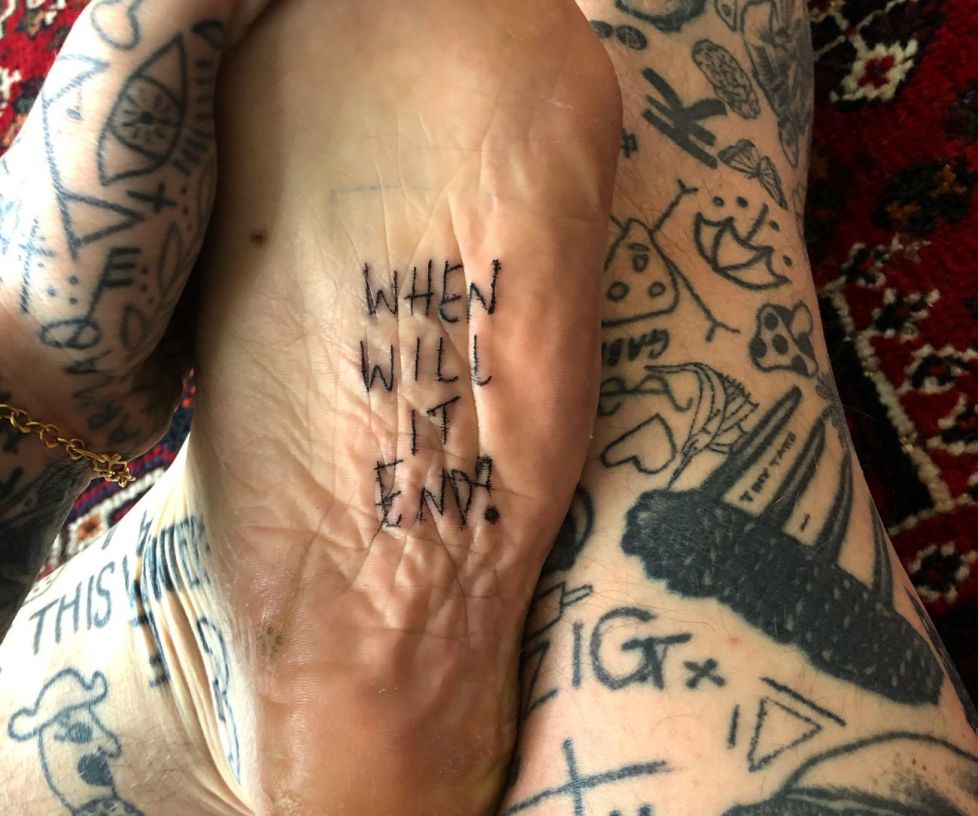
A bit of English listening practice: here’s an NPR story about a tattoo artist who is keeping himself entertained by tattooing…himself. I’ve put together a list of some vocabulary items that you might not have come across before. If you would like other aspects of the language of the story explained, please say so in the Comments section!
ink: The basic meaning of this word as a noun is encre. When the announcer says (at 12 seconds into the story) that the tattoo artist has given himself one new piece of ink every day in quarantine, he means that the man is giving himself one tattoo every day. Nowadays you can also use this word as a verb, to ink, which means to give a tattoo, or to tattoo. Examples below.
to sport [something]: to wear proudly. Merriam-Webster defines it this way: “to display or wear usually ostentatiously.” At 15 seconds into the story, the reporter says Woodhead, who already sported hundreds of tattoos…
CNN: A popular cable news channel. It is roughly the BFM-TV of the United States–relatively short stories versus a lot of in-depth programming; the same stories played over and over; and, it should be said, some very good commentators, particularly Fareed Zakaria, a pretty unattractive man who I would nonetheless love to have a cup of coffee with due to his great insights into the world and the news of the day.
I started a tattoo apprenticeship and i’d love to ink you 🥺👉🏻👈🏻 pic.twitter.com/SLVlgahNpC
— ミスター・デス (@tynepalic) May 2, 2020
I started a tattoo apprenticeship and i’d love to ink you 🥺👉🏻👈🏻 pic.twitter.com/SLVlgahNpC
— ミスター・デス (@tynepalic) May 2, 2020
One of the most delightful books I have ever read in French is named Les Mots et la chose–“Words and The Thing.” “The thing” is a euphemism for “sex.” The conceit of the book is that an actress who earns her keep by dubbing pornographic movies has grown weary of the limited vocabulary that her job calls for, so she writes to a retired linguist who specialized in words for la chose to ask for suggestions. He comes through in spades, with separate chapters for all of the relevant body parts, and of course for l’acte itself. My favorite: Le détroit des Dardanelles, the Strait of the Dardanelles, for that part of your body where poo comes out and where, between friends, other things might occasionally go in.
I keep seeing all of these articles in the paper about how to fight coronavirus-quarantine-related boredom. I don’t get it–I haven’t been this busy in ages. Telecommuting; reminding my father to eat, to take his medicine, and to let me do his laundry; making masked food runs to the grocery store; eating half of a chocolate babka in a single day (damn it, Zipf); sitting on the front porch smoking cigarettes and petting the dog–I barely have time to learn my 10 words per day of French vocabulary.
Of course, none of that has stopped me from spending inordinate amounts of time looking up French-language covers of classic American songs. For example, Fiche le camp, Jack is a cover of Hit the Road, Jack, a favorite from before my childhood (and hence, a long fucking time ago). A cover differs from a dubbed version in that where dubbing involves an original video version whose audio track is replaced, a cover is a de novo production. So, if there is a video involved, too, then it will be shot anew for the new version.
So, the above-mentioned French actress is dubbing movies so that they have a French-language soundtrack, while the video below shows a version of Hit the Road, Jack, nicely covered by Richard Anthony and some great back-up singers. I hope that it brings a smile to your quarantine day. Scroll down for the English notes if you are so inclined–today we will talk about some idioms involving the verb to hit, as well as discuss American Evangelical beliefs about what’s going to happen to us sinners.
English notes: idioms involving the verb to hit
In the following examples, note that hit is an irregular verb: its present tense, past tense, and past participle are all hit.
to hit the books: to study.
I can’t go to the party tonight–I gotta hit the books.
Gotta is colloquial language for to have to.
to hit the road: to leave.
This has been a great party, but it’s time for me to hit the road–I gotta go study for my stupid linguistics exam.
to hit bottom: to reach a/the really terrible part of your life. It is often used in conjunction with alcoholics and drug addicts–the belief is that before you can get dry (alcoholics)/clean (drug addicts), you have to “hit bottom.”
God had left her alone with the sinners, so she would sin. But, she hit bottom after going on a drunken binge with two men she met at a Catholic-sponsored conference on Poverty in the World of Change. She woke up naked in a hotel bathtub.
—The Forsaken, Book Two of The Apocalypse Trilogy. This is an amusing series of American Protestant fundamentalist fiction about The Rapture, an event in which non-sinners will be whisked up to Heaven, while the rest of us are left on Earth. (I think that we get damned to eternal Hell at some point.) The extract is fascinating to me, in that in three short sentences it evokes so many of the tropes of American Protestant fundamentalism: anti-Catholicism, resistance to social services for the poor, and of course loathing of sex.
to hit the sack: to go to bed.
I’m gonna hit the sack–I’ll study for that stupid linguistics test tomorrow.
to hit the hay: to go to bed.
Well, Jack finally hit bottom. He went to the party, but he hit the road early to go home and hit the books. But, instead, he hit the hay and didn’t study at all. So, he flunked the test, which dropped his final grade in the course, which dropped his overall GPA, so he lost his badminton scholarship. He went to his professor and asked him to raise his grade, but his professor said “Surely my course isn’t the only one in which you earned a lower grade than you needed? Why not go to one of your other professors, and ask them to raise your grade?” I guess you gotta hit bottom before you get sufficiently motivated as to get your shit together.
I have changed some details to protect the guilty. But, yeah–I was the professor.
Normalcy through vocabulary. And poetry.
The fact that covid-19 has 50% of the world’s population under lockdown orders does not change the fact that in the US, it is National Poetry Month. The French are getting cats to play tic-tac-toe (le morpion in French, which also means [genital] crab, and I cannot stop giggling like a schoolboy about that), Americans are watching Netflix, and the President of the United States is showing himself more and more to be le roi des cons–and Art goes on.
Jacques Prévert’s poem Pater noster has opening lines as good as any in the world of free verse (translations by me, sorry):
Notre Père qui êtes aux cieux
Restez-yOur Father who art in heaven
Stay thereEt nous nous resterons sur la terre
Qui est quelquefois si jolieAnd we’ll stay here on Earth
Which is sometimes so prettyAvec ses mystères de New York
Et puis ses mystères de ParisWith its mysteries of New York
And then its mysteries of Paris
So, yeah: the cool neighborhood near me is now empty except for the homeless people living under tarps in the sheltered doorways of now-abandoned shops, Macron is urging the French to support health-care workers, and Trump is urging Americans to support airlines; and I am trying to restore some sense of normalcy to my life by learning my usual 10 words of French vocabulary per day.
So, I’m on a French-language furniture web site the other day trying to find a picture of some obscure item of furniture or another that I ran across while reading Colette’s Chéri, when I came across this: the mystères de Paris. Literally, that means “the mysteries of Paris”–but it means so, so much more…and thus we have the Best. Vocabulary. Word. Ever.
It turns out that there is such a thing as a mystères de Paris–and it is a commode. Not a commode in the French sense of the word–what’s called in English a dresser–but a commode in the English sense of the word–a bedside chair with a receptacle for pooping. A bedside toilet, if you will. It’s not just any kind of commode, though:
From the Meubliz.com web site (translations by me, sorry):
Ce siège d’aisance prend la forme d’une pile de livres simulés. La partie supérieure s’ouvre comme un abattant pour laisser apparaître la cuvette. Ce petit meuble repose sur des pieds bas tournés en balustre ou découpés.
Généralement, ce siège de commodité assez original était décoré de belles et luxueuses couleurs.
This commode takes the form of a pile of fake books. The upper part opens as a lid to access the bowl. This small piece of furniture sits on feet that have been [not sure what those carpentry terms mean].
Typically, this rather unusual commode was decorated with pretty, luxurious colors.

If you’ve followed this site, you know that Prévert’s poetry is great for understanding what people mean when they talk about “the impossibility of translation.” This is a great example–I just can’t even imagine a way to render mystères de Paris into English, and forget about maintaining that rhyme:
….sur la terre
Qui est quelquefois si jolie…on Earth
Which is sometimes so prettyAvec ses mystères de New York
Et puis ses mystères de ParisWith its mysteries of New York
And then its mysteries of Paris
(Yes, jolie and Paris rhyme in French.)

(Wait, I forgot–more tic-tac-toe-playing cats…)
So…let’s all stay in, stay healthy, thank the people working in the grocery stores, thank the people working in the gas stations, thank the doctors, thank the nurses, thank the respiratory therapists–and ignore les maîtres de ce monde, les maîtres avec leurs prêtres, leurs traîtres et leurs reîtres–a line from later in the poem that is more than evocative of the coronavirus-era Trump. And let’s take care of each other.
See this post for the full poem, as well as for a discussion of the line that I just mentioned. You can exercise your oral comprehension skills with an English-language video, complete with subtitles, on how to make your own face mask here.

A scarf, a rubber band, et voilà.


US Surgeon General Jerome Adams demonstrates how to make a face mask—with subtitles.
For starters: how about if we fight to get the files open?
I know, I know—computational linguistics sounds like it would be the most glamorous job in the world, right? We have a dirty little secret, though: 85% percent of our time is spent just trying to read in, and clean up, data files.
The novel coronavirus covid-19 has me on lockdown just like anybody else. What to do all day? Well, the National Library of Medicine, the Allen Institute for Artificial Intelligence, and some other folks whose names escape me recently released a corpus (set of linguistic data) of scientific journal articles that might or might not be relevant to covid-19 research, named CORD-19, and asked the artificial intelligence people of the world to see what they could do with it. Great—what else would I do all day?
For starters, how about fight to get the fucking files to open?
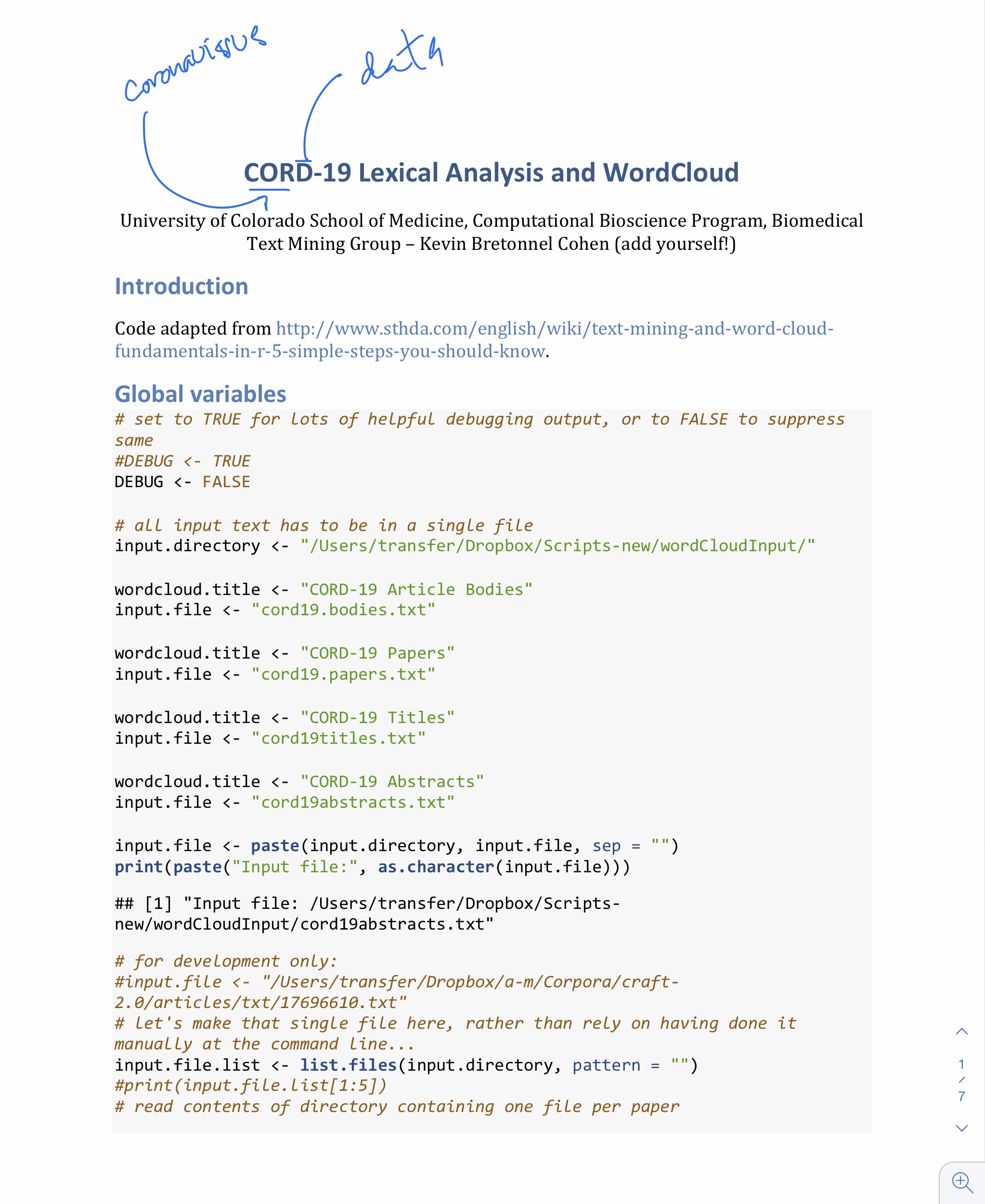
After that, we could clean some of the useless stuff out of the data—section headings (Introduction, Methods, Results…), puffery (important, significant), stuff like that…
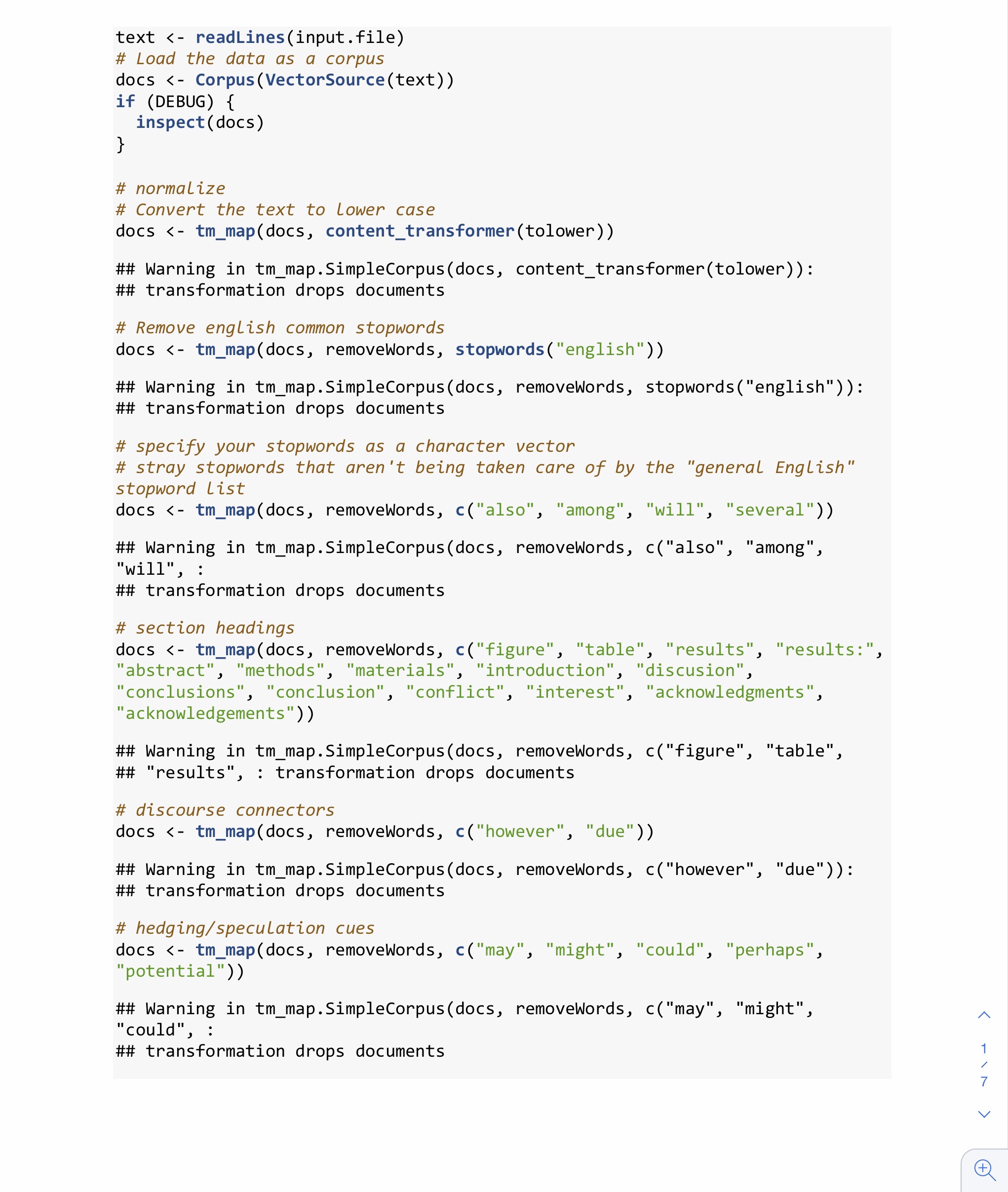
Get rid of spaces and that sort of nonsense…
…and then make a TermDocumentMatrix, a “data structure” that lists all of the words in the corpus and the documents in which they occur (or all of the documents in the corpus and which words occur in them, depending on how you flip it).
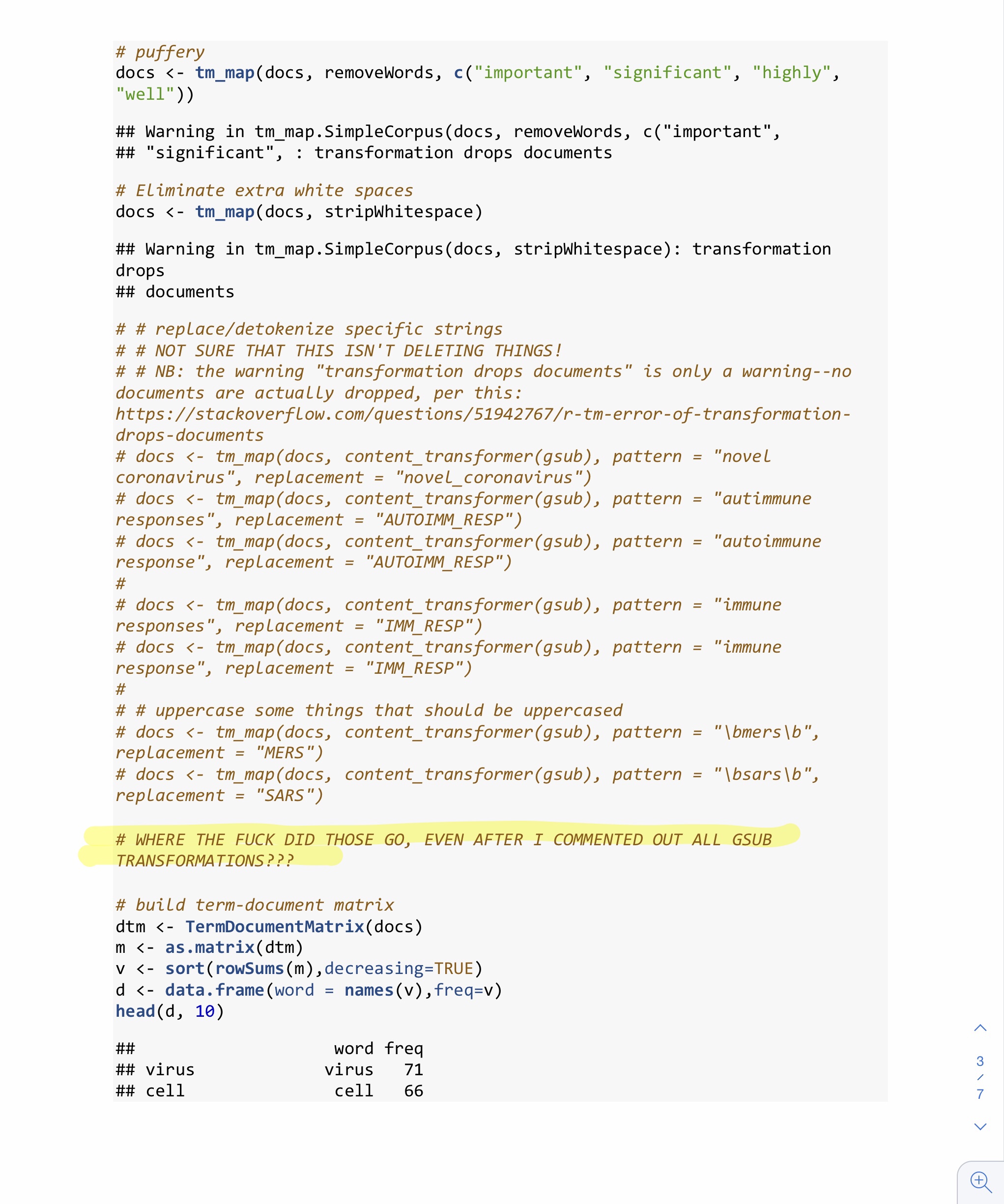
We’ll try to make a word cloud, which will result in us watching several pages’-worth of error messages fly by (most of them removed for your viewing pleasure):
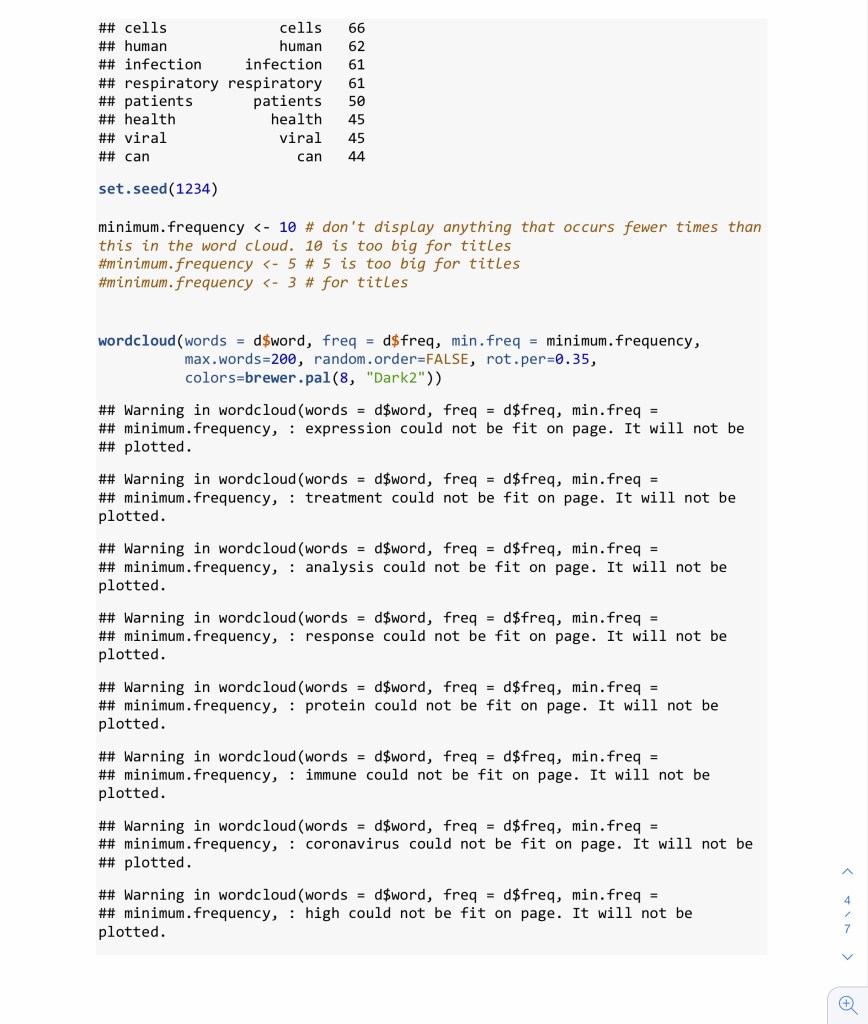
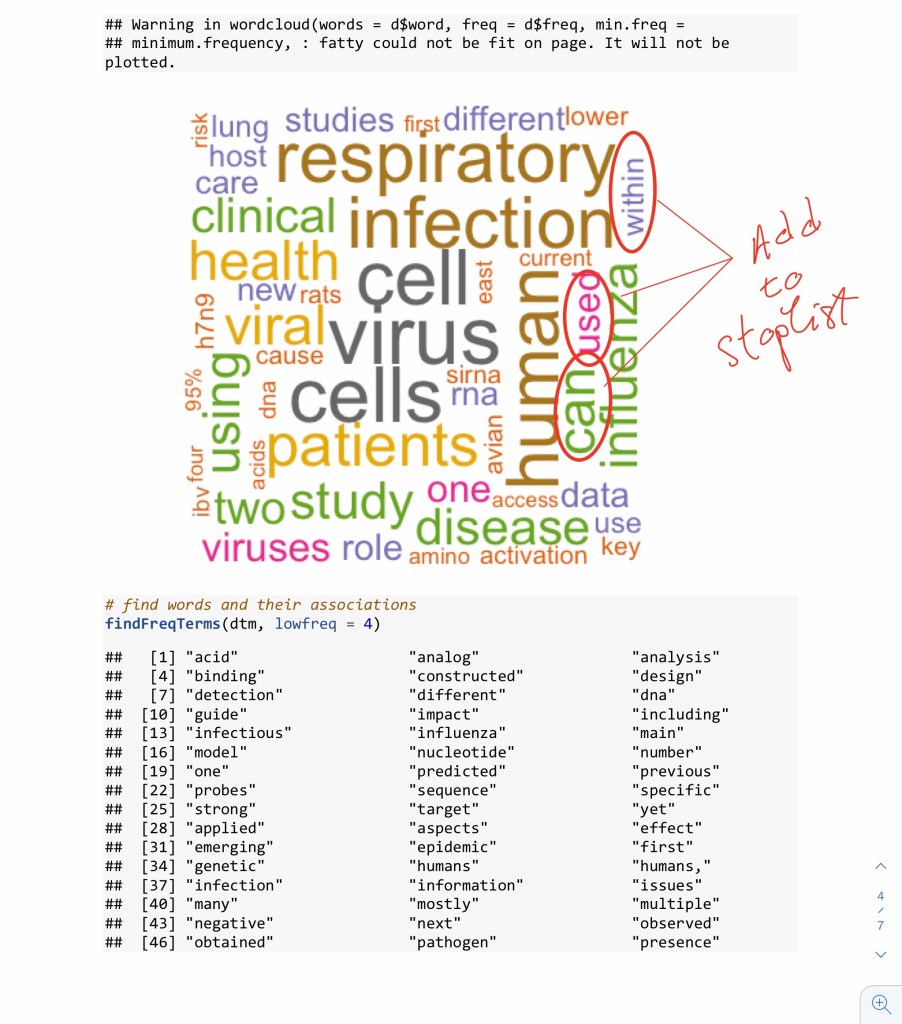
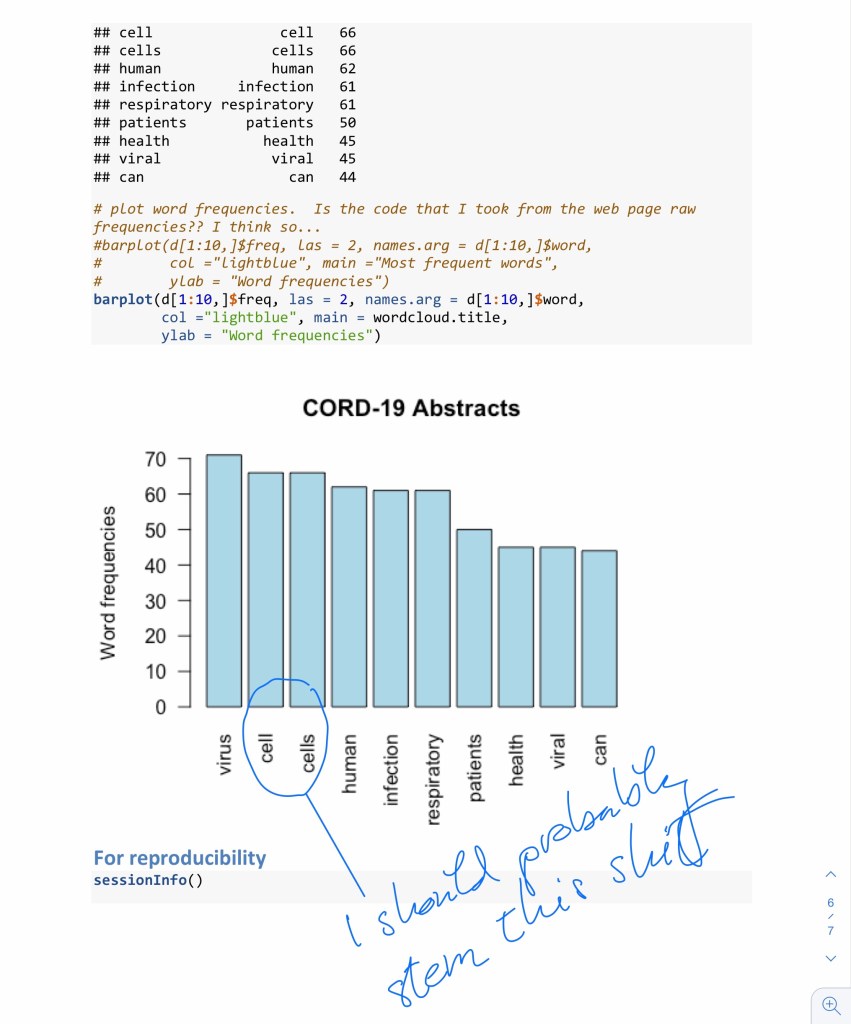
…and finally, we will record exactly what we did, in hopes of actually being able to do it on demand, which we obviously need to do immediately, or as soon as we fix the problems that we just identified, at any rate.

I know, I know–you think that computational linguists spend their time sitting around discussing morphological typology and its implications for the monogenetic versus polygenetic hypotheses of the origin of language. And we do–after work, over beers.
For most of us, though, our professional life consists of trying to get computers to do things that involve language in some way. One of the biggies is helping people find information. To teach a computer to do something like that, you need to have access to a lot of data to test the system that you are building.
Enter the covid-19 coronavirus. There is suddenly an enormous amount of research being done on something that we did not even know about just 6 months ago. At the same time, there is a lot of research already published on other coronaviruses, and it would be idiotic to try to do research on a novel coronavirus without taking advantage of what we already know about the others. But, how can anyone go through the 15,000+ papers on coronavirii (spelling?) that are already in the US National Library of Medicine’s PubMed/MEDLINE database?
Enter computational linguists. Sometimes considered a branch of artificial intelligence, we work on computer programs to do things like summarize large sets of publications. There are lots of things that you have to be able to do in order to do that–figure out what’s being talked about (coronavirus and medications? Coronavirus and transmissibility? Coronavirus and respiratory failure?); tell the difference between a positive statement, a negated statement, a speculative statement, and a negated speculative statement:
…and many other tasks that all have to be handled in order to solve the problem of summarizing those 15,000+ papers–and many other problems in getting computers to understand human language, too.
Like I said, though: in order to test our systems, we need data. Enter a number of the big players in computational linguistics, who have created, and made freely available to the public, a large dataset of relevant papers. Their hope? That computational linguists around the world will dive into them, using them to develop and test tools for dealing with all of those papers. Here’s an excerpt from the White House’s web site describing the effort to create and release the data, followed by a French-language appeal to the francophone computational linguistics community to work on it sent out by my colleague Pierre Zweigenbaum. C’est parti…
“One of the most immediate and impactful applications of AI is in the ability to help scientists, academics, and technologists find the right information in a sea of scientific papers to move research faster. We applaud the OSTP, WHO, NIH and all organizations that are taking a proactive approach to use the most advanced technology in the fight against COVID-19,” said Dr. Oren Etzioni, Chief Executive Officer of the Allen Institute for AI. “The Allen Institute for AI, and particularly the Semantic Scholar team, is committed to updating and improving this important resource and the associated AI methods the community will be using to tackle this crucial problem.”
“It’s difficult for people to manually go through more than 20,000 articles and synthesize their findings. Recent advances in technology can be helpful here. We’re putting machine readable versions of these articles in front of our community of more than 4 million data scientists. Our hope is that AI can be used to help find answers to a key set of questions about COVID-19,” said Anthony Goldbloom, Co-Founder and Chief Executive Officer at Kaggle.
Call to Action to the Tech Community on New Machine Readable COVID-19 Dataset
Bonjour,
Voici une série de tâches de recherche d’information / extraction d’information / fouille de textes / recherche de réponses à des questions lancées le 16 mars [1] sur un sujet d’actualité :
https://www.kaggle.com/allen-institute-for-ai/CORD-19-research-challenge/tasks
dans une base de 29000 articles (dont 13000 en texte intégral) concernant le coronavirus (bien sûr pas seulement le « nouveau ». Les questions sont listées sous la rubrique “Tasks”, et chaque question générique est déclinée en questions spécifiques. Voir par exemple “What is known about transmission, incubation, and environmental stability?”
(https://www.kaggle.com/allen-institute-for-ai/CORD-19-research-challenge/tasks?taskId=568).
Par ailleurs, un corpus (LitCovid) sur le Covid-19 est mis à jour en continu à la National Library of Medicine :
https://www.ncbi.nlm.nih.gov/research/coronavirus/ (1263 articles à
l’heure où j’écris ce message contre 1120 deux jours avant).
Le DBCLS à Tokyo a mis en place dans sa plateforme de gestion d’annotations un espace pour centraliser les informations extraites sur le corpus LitCovid sous forme d’annotations :
http://pubannotation.org/collections/LitCovid
Tous les spécialistes de TAL sont donc encouragés à appliquer leurs méthodes sur ces données et à les faire tourner sur Kaggle (CORD-19), à les appliquer au corpus LitCovid et à déposer les annotations sur PubAnnotation.
Bien cordialement,
[1] “Today, researchers and leaders from the Allen Institute for AI,
Chan Zuckerberg Initiative (CZI), Georgetown University’s Center for
Security and Emerging Technology (CSET), Microsoft, and the National
Library of Medicine (NLM) at the National Institutes of Health released
the COVID-19 Open Research Dataset (CORD-19) of scholarly literature
about COVID-19, SARS-CoV-2, and the Coronavirus group.”
Some of the most traumatic experiences of my life have involved me killing a mouse. Tonight was no exception.
Some of the most traumatic experiences of my life have involved me killing a mouse. Tonight was no exception. Delivering the coup de grâce was miserable for me–besides being soft-hearted, I have an incredible phobia about dead animals–but I felt like after a long and hard-fought battle, the furry little warrior deserved it.
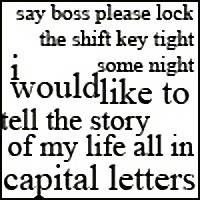
The experience brought to mind the end of this poem by Don Marquis. It is all in lower-case because it has been typed by a cockroach. Archie (yes, that’s the cockroach’s name) depresses the keys by jumping on them; this precludes ever hitting the shift key to make upper-case letters. Many thanks to the Don Marquis blog, where I found the text. Want to know more about the strange case of Archie the cockroach poet? See this post.
freddy the rat perishes
By Don Marquis, in “archy and mehitabel,” 1927
listen to me there have
been some doings here since last
i wrote there has been a battle
behind that rusty typewriter cover
in the corner
you remember freddy the rat well
freddy is no more but
he died game the other
day a stranger with a lot of
legs came into our
little circle a tough looking kid
he was with a bad eye
who are you said a thousand legs
if i bite you once
said the stranger you won t ask
again he he little poison tongue said
the thousand legs who gave you hydrophobia
i got it by biting myself said
the stranger i m bad keep away
from me where i step a weed dies
if i was to walk on your forehead it would
raise measles and if
you give me any lip i ll do it
they mixed it then
and the thousand legs succumbed
well we found out this fellow
was a tarantula he had come up from
south america in a bunch of bananas
for days he bossed us life
was not worth living he would stand in
the middle of the floor and taunt
us ha ha he would say where i
step a weed dies do
you want any of my game i was
raised on red pepper and blood i am
so hot if you scratch me i will light
like a match you better
dodge me when i m feeling mean and
i don t feel any other way i was nursed
on a tabasco bottle if i was to slap
your wrist in kindness you
would boil over like job and heaven
help you if i get angry give me
room i feel a wicked spell coming on
last night he made a break at freddy
the rat keep your distance
little one said freddy i m not
feeling well myself somebody poisoned some
cheese for me im as full of
death as a drug store i
feel that i am going to die anyhow
come on little torpedo don t stop
to visit and search then they
went at it and both are no more please
throw a late edition on the floor i want to
keep up with china we dropped freddy
off the fire escape into the alley with
military honors
archy
Picture source: https://gritinthegears.blogspot.com/2010/11/freddy-rat-perishes-revisited.html
Resisting the russist occupation while keeping our humanity
"Je suis féru(e) de langues" is about language learning, study tips and travelling. Join my community!
JCDL 2020 Workshop on Biomedical Natural Language Processing
Criminal Curiosities
Biomedical natural language processing
but other things that fascinate me, too
Adventures in natural history collections
FAMILY LIFE IN A FRENCH COUNTRY VILLAGE
PC Chairs Blog
Random commentary on teaching English as a foreign language
Université Paris-Centrale, Spring 2017
living and loving language
THE DRIVELLINGS OF TWATTERSLEY FROMAGE