Seeing the complexity of the simple: Comparative anatomy of the scapula

We can do a lot of things with our arms that a quadruped can’t do with theirs. Throw spears at edible quadrupeds. Throw tomatoes at sopranos. Throw bums out of office.

Being a scientist means finding delight in things that look complicated but are actually governed by pretty simple principles, as well as in things that look pretty simple but are actually pretty complex.  Case in point: the scapula.

Common English: shoulder blade.

Technical term: scapula, plural scapulae or scapulas.

French: l’omoplate (nf), la scapula (WordReference)

A scapula looks simple: they’re mostly flat, with a protruberance here and there.  Unlike closely associated bones, they don’t get broken very often–a Swedish study found a rate of scapular fractures of 10 per 100,000 people, while another Swedish study found 50 clavicular fractures per 100,000 people.

And yet: comparing the scapula across species, you see all kinds of interesting shit.  The point of comparative anatomy is that you can understand something better if you compare it to other ways that it could be, but isn’t.  So: let’s compare some scapulae.

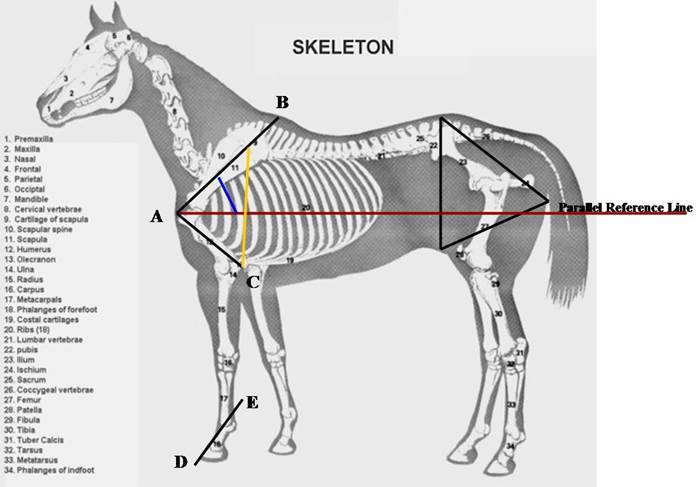
The most obvious thing about the scapula is that it is positioned differently in different species.  The basic situation for most living things with limbs is this: you’re a quadruped (i.e. have four legs), and the scapula is located on the side of the trunk.  In contrast: look at a human, and the scapula is on its back. Compare the position of the scapula in this lovely picture of a horse:

horse skeleton
The axis of the scapula is on the line between points A and B. Picture source: http://www.horsecoursesonline.com/college/conformation/lesson_two_893.htm

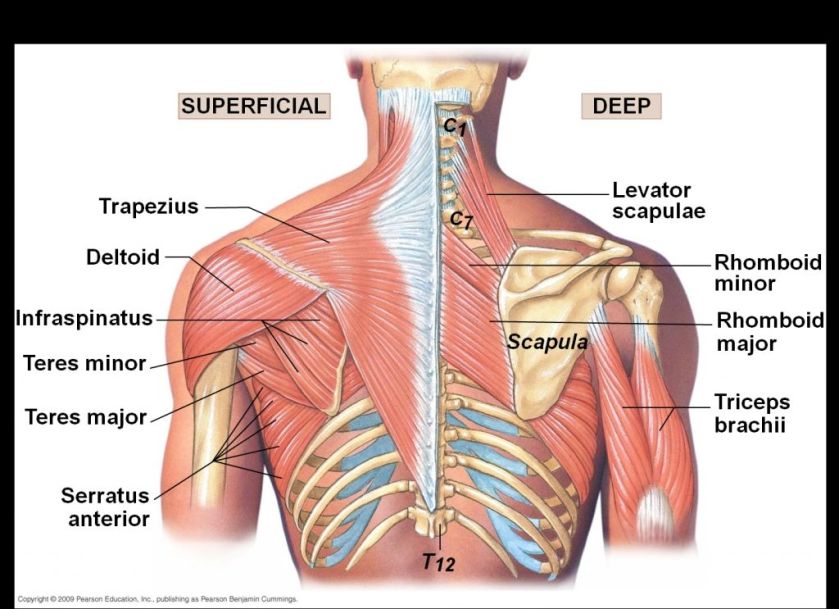
…with the position of the scapula in this lovely picture of a human:

0d2300b469dd6a2efc1ba75783a74ef5
Picture source: https://www.pinterest.com/pin/547891110909216204/?lp=true

…and you see the difference.  It’s even more striking when you look at our closer relatives.  We are primates, and specifically, members of a group of primates known as apes, and even more specifically, of the great apes.  One of the biggest differences between us and our various and sundry primate relatives is that we are full-time bipeds.  Autrement dit: we walk upright, all the time.  In contrast, monkeys–which are primates, but not apes–are full-time quadrupeds.  Going along with this difference in locomotion is a difference in the position of the scapula: it’s on our back, but on a monkey’s side.  

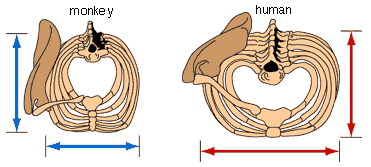
Here’s a really nice view of a primate (left) and human (right) trunk.  Looking at the left side, labelled “monkey,” you see the typical quadruped architecture: the scapula is on the side of the chest cage.  On the right side, labelled “human,” it’s a different story: the scapula is on the back.

The arrows in this illustration make an important point: primates also have the typical quadruped chest cage, which is relatively narrow in comparison to its depth. In contrast, the human chest cage is sorta flat–relatively wide in comparison to its depth.  (Remember that the human skeleton in the picture is viewed from above, as if you had ripped someone’s head off in order to shit down their neck. (Sorry–a little sailor-talk there.  Unlike Trump, I served my country.)  In contrast, the monkey is being viewed from the front–I have no great analogy for you here.)

chest_compar (1)
Picture source: https://evolution.berkeley.edu/evolibrary/article/0_0_0/lines_05

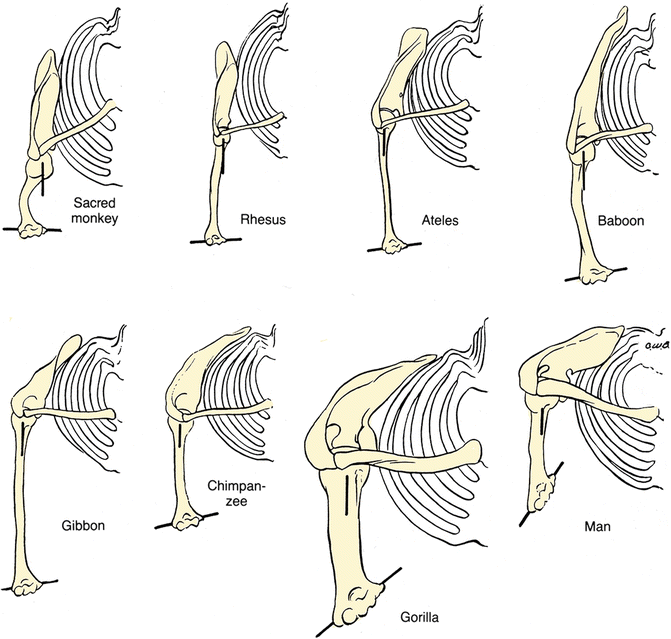
Amongst primates in general, there is quite a bit of variability.  Why? Well, there’s quite a bit of variability in the extent to which they are quadrupedal versus bipedal. There’s quite a bit of variability in the capacity of the creature to do stuff with its hands over its head.  Here’s a nice layout that shows aspects of the shoulder anatomy across a range from true monkeys, to great apes, ending up with the ape-iest of us all: the anatomically modern human.  Start with the sacred monkey in the upper-left corner, and the scapula is clearly on the side of the thoracic cage.  End with the human in the bottom-right corner, and it’s clearly on the back.  In between…well, gibbons are (lesser) apes, while chimps and gorillas are great apes, like us.

324233_1_En_1_Fig6_HTML
Relative positions of the scapula in monkeys versus apes: the scapula is on the side in monkeys, on the back in apes.  Note the angle of the clavicle, too: the more dorsal the scapula is, the more perpendicular the clavicle is to the midline. Picture source: https://link.springer.com/chapter/10.1007/978-3-662-45719-1_1

What functional difference goes along with this structural difference? Well: the quadrupeds are really good at locomotion–it’s difficult to think of a quadruped that can’t outrun a human.  Try to catch your dog or your cat for a trip to the vet–good fucking luck, buddy.  But, quadrupeds also tend to have a big limitation: although their front limbs are very good at moving back and forth–see above about moving fast–they suck at anything else.  For example, we can make big circles with our arms; we can spread them.  We don’t have the speed of a quadruped, but we can do a lot of things with our arms that a quadruped can’t do with theirs. Throw spears at edible quadrupeds. Throw tomatoes at sopranos. Throw bums out of office.

There are two broad families of quadrupeds that have their scapula on their back, and they’re pretty fucking interesting. Come back next time for the details.

ResizedImage300286-Skeleton-Leg-Bones
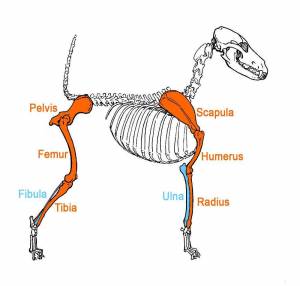
Position of the scapula in the dog. Picture source: https://janedogs.com/dog-anatomy-terminology/

English notes

There are a lot of expressions that involve the shoulder.  For example, to stand shoulder to shoulder with someone has a literal meaning of standing close to someone (Merriam-Webster), and a figurative one of being united with someone, sharing a goal with them (Merriam-Webster). Example:

  • This resolution was offered in response to President Trump standing shoulder to shoulder with Putin while the Russian President offered the Special Counsel a chance to interview twelve Russian Military Intelligence Officers who’ve been indicted for conducting “large scale cyber operations to interfere with the 2016 presidential election” in exchange for politically-motivated Russian interrogations of U.S. citizens.  President Trump initially endorsed Putin’s cynical ploy as “an incredible offer” and during yesterday’s White House press briefing President Trump’s spokesperson said he was still considering it.  https://www.reed.senate.gov/news/releases/us-senate-votes-98-0-to-tell-trump-not-to-hand-over-american-citizens-to-putin

To give someone the cold shoulder is to intentionally treat them in a way that is cold or unsympathetic (Merriam-Webster); I would add the meaning of intentionally avoiding or ignoring them.  Example:

  • Most Twitter reactions seem to compare the president’s behavior to that of a child—which is pretty much on the money with what we’ve been saying since the start of this tale. Sure, it’s an improvement over the cold shoulder he gave German Chancellor Angela Merkel when she extended her hand for a handshake during her March White House visit. If the president doesn’t pout does he still earn, like, a half-star on the behavior chart? Even still, pushing is not encouraged, young man. https://www.vanityfair.com/style/2017/05/trump-nato-shove

If you are the kind of person who would watch and carefully re-watch Dubstep Cat videos to see just how far back his arms do and don’t go: we should probably be planning our wedding.

https://youtu.be/aQeIDhz-_eg


These are all true stories: or, Language Generation For Dummies

In the 1990s, a physician examining an odd wart realized that it was, in fact, cancer.

In the 1990s, a surgeon was about to amputate a woman’s foot. To his surprise, he found that there were other ways to treat her condition, and the woman’s foot was saved. The thing that made the difference was a new technology that allowed the health care provider to search all of the articles in the National Library of Medicine via a computer. Known today as information retrieval, that technology is arguably the “killer app” that makes the Internet as we know it today useful in the daily life of much of the world. Today, it is a familiar technology, and one could be forgiven for assuming that there is nothing left to be learned about it.


Over the course of the past year or two, I’ve been writing a book about writing about what I do for a living.  Call it data science, call it natural language processing, call it machine learning–any way you slice it, the structure of the papers that we write in order to spread our little discoveries around is always pretty much the same.

In the 1990s, an emergency room physician noticed the outbreak of what became an epidemic of venereal disease in his American city. He was able to find a new treatment for the disorder, a bacterial infection known as chancroid, and the spread of the painful genital sores was halted. The new information came from a novel technology that allowed the health care provider to search all of the articles in the National Library of Medicine via a computer. Known today as information retrieval, that technology is arguably the “killer app” that makes the Internet as we know it today useful in the daily life of much of the world. Today, it is a familiar technology, to the point that one might think that there are no open research questions left in the field.

For people like me, that always inspires the same question: could I write a REALLY simple computer program to do this for me?

In the 1990s, a physician examining an odd wart realized that it was, in fact, cancer. Surgery was done, and the patient’s life was saved. The thing that made the difference was a new technology that allowed the health care provider to search all of the articles in the National Library of Medicine via a computer. We know that technology as information retrieval. By now it is a familiar technology, to the point that one might think that there are no open research questions left in the field.

One of my major obsessions in life is this: how do you START a research paper?  More precisely: how do you start a research paper in a way that isn’t BORING?

In the 1990s, an emergency room physician noticed the outbreak of what became an epidemic of venereal disease in his American city. He was able to find a new treatment for the disorder, a bacterial infection known as chancroid, and the spread of the painful genital sores was halted. The new information came from a novel technology that allowed the health care provider to search all of the articles in the National Library of Medicine via a computer. Known today as information retrieval, that technology is arguably the “killer app” that makes the Internet as we know it today useful in the daily life of much of the world. Today, it is a familiar technology, and one could be forgiven for assuming that there is nothing left to be learned about it.

Well, I do what I do in the medical field, specifically, and in the medical field, we have a saying: if no one dies in the first two sentences, your work is going to be ignored.

In the 1990s, a surgeon was about to amputate a woman’s foot. To his surprise, he found that there were other ways to treat her condition, and the woman’s foot was saved. The new information came from a novel technology that allowed the health care provider to search all of the articles in the National Library of Medicine via a computer. Known today as information retrieval, that technology is arguably the “killer app” that makes the Internet as we know it today useful in the daily life of much of the world. It is now an old technology, to the point that one might think that there are no open research questions left in the field.

I’m a little bit less pessimistic than that.  Inspired by openings like this favorite from a paper by Daniel Gildea and Daniel Jurafsky,

Recent years have been exhilarating ones for natural language understanding. The excitement and rapid advances that had characterized other language-processing tasks … have finally begun to appear in tasks in which understanding and semantics play a greater role. For example, …

In the 1990s, a physician examining an odd wart realized that it was, in fact, cancer. Surgery was done, and the patient’s life was saved. The new information came from a novel technology that allowed the health care provider to search all of the articles in the National Library of Medicine via a computer. Known today as information retrieval, that technology is arguably the “killer app” that makes the Internet as we know it today useful in the daily life of much of the world. Today, it is a familiar technology, to the point that one might think that there are no open research questions left in the field.

…I wonder if it couldn’t work as well to save someone’s life in the first two sentences?

In the 1990s, a physician examining an odd wart realized that it was, in fact, cancer. Surgery was done, and the patient’s life was saved. The new information came from a novel technology that allowed the health care provider to search all of the articles in the National Library of Medicine via a computer. We know that technology as information retrieval. Today, it is a familiar technology, to the point that one might think that there are no open research questions left in the field.

So, when I set out to write a simple computer program to generate the openings of research papers on a topic called information retrieval, I went looking for stories where someone landed in a doctor’s office–and came out of it better than one might have expected.

In the 1990s, a physician examining an odd wart realized that it was, in fact, cancer. Surgery was done, and the patient’s life was saved. The new information came from a novel technology that allowed the health care provider to search all of the articles in the National Library of Medicine via a computer. Known today as information retrieval, that technology is arguably the “killer app” that makes the Internet as we know it today useful in the daily life of much of the world. Today, it is a familiar technology, and one could be forgiven for assuming that there is nothing left to be learned about it.

Finding those happy endings was the hardest part of this whole little after-dinner project.

In the 1990s, a physician examining an odd wart realized that it was, in fact, cancer. Surgery was done, and the patient’s life was saved. The new information came from a novel technology that allowed the health care provider to search all of the articles in the National Library of Medicine via a computer. We know that technology as information retrieval. Today, it is a familiar technology, and one could be forgiven for assuming that there is nothing left to be learned about it.

From there, it was a simple matter of putting together a set of reasonable first sentences:

my @firstSentences = (“In the 1990s, a physician examining an odd wart realized that it was, in fact, cancer. Surgery was done, and the patient’s life was saved.”,

 “In the 1990s, a surgeon was about to amputate a woman’s foot. To his surprise, he found that there were other ways to treat her condition, and the woman’s foot was saved.”,

“In the 1990s, an emergency room physician noticed the outbreak of what became an epidemic of venereal disease in his American city. He was able to find a new treatment for the disorder, a bacterial infection known as chancroid, and the spread of the painful genital sores was halted.”);

In the 1990s, a surgeon was about to amputate a woman’s foot. To his surprise, he found that there were other ways to treat her condition, and the woman’s foot was saved. The new information came from a novel technology that allowed the health care provider to search all of the articles in the National Library of Medicine via a computer. Known today as information retrieval, that technology is arguably the “killer app” that makes the Internet as we know it today useful in the daily life of much of the world. By now it is a familiar technology, and one might think that there was nothing more to be learned about it.

…and a set of reasonable second sentences…

my @secondSentences = (“The thing that made the difference was a new technology that allowed the health care provider to search all of the articles in the National Library of Medicine via a computer.”,

    “The new information came from a novel technology that allowed the health care provider to search all of the articles in the National Library of Medicine via a computer.”);

In the 1990s, a surgeon was about to amputate a woman’s foot. To his surprise, he found that there were other ways to treat her condition, and the woman’s foot was saved. The thing that made the difference was a new technology that allowed the health care provider to search all of the articles in the National Library of Medicine via a computer. Known today as information retrieval, that technology is arguably the “killer app” that makes the Internet as we know it today useful in the daily life of much of the world. Today, it is a familiar technology, and one could be forgiven for assuming that there is nothing left to be learned about it.

…and so on.  I use a command called rand to pick a random sentence from the sets of possible first sentences, possible second sentences, and so on…

my $first_sentence   = rand @firstSentences;

my $second_sentence = rand @secondSentences;

In the 1990s, an emergency room physician noticed the outbreak of what became an epidemic of venereal disease in his American city. He was able to find a new treatment for the disorder, a bacterial infection known as chancroid, and the spread of the painful genital sores was halted. The new information came from a novel technology that allowed the health care provider to search all of the articles in the National Library of Medicine via a computer. Known today as information retrieval, that technology is arguably the “killer app” that makes the Internet as we know it today useful in the daily life of much of the world. Today, it is a familiar technology, to the point that one might think that there are no open research questions left in the field.

…and then I just glue my randomly selected first, second, third, fourth, and fifth sentences together…

$beginning_of_article = $first_sentence . $second_sentence . $third_sentence . $fourth_sentence . $fifth_sentence;

In the 1990s, a physician examining an odd wart realized that it was, in fact, cancer. Surgery was done, and the patient’s life was saved. The thing that made the difference was a new technology that allowed the health care provider to search all of the articles in the National Library of Medicine via a computer. We know that technology as information retrieval. By now it is a familiar technology, to the point that one might think that there are no open research questions left in the field.

…et voilà!  With only two options at each position for five different “sentence positions” (first sentence, second sentence, etc.), I have 2 to the 5th power (or 5 to the second power–I can never remember) possible openings that will work for any paper on information retrieval, ever.  That’s more papers on information retrieval than I will write between this evening and the day that I retire or die!

In the 1990s, an emergency room physician noticed the outbreak of what became an epidemic of venereal disease in his American city. He was able to find a new treatment for the disorder, a bacterial infection known as chancroid, and the spread of the painful genital sores was halted. The new information came from a novel technology that allowed the health care provider to search all of the articles in the National Library of Medicine via a computer. Known today as information retrieval, that technology is arguably the “killer app” that makes the Internet as we know it today useful in the daily life of much of the world. Today, it is a familiar technology, and one could be forgiven for assuming that there is nothing left to be learned about it.

My VERY simple little program does something called language generation.  That means that it produces output in “natural,”—i.e., human—language.  You can do REALLY fancy things with it–Google can now use its super-sophisticated language generation technology to produce entirely bogus news stories, novels, letters—or scientific articles, for that matter.

In the 1990s, a surgeon was about to amputate a woman’s foot. To his surprise, he found that there were other ways to treat her condition, and the woman’s foot was saved. The new information came from a novel technology that allowed the health care provider to search all of the articles in the National Library of Medicine via a computer. Known today as information retrieval, that technology is arguably the “killer app” that makes the Internet as we know it today useful in the daily life of much of the world. It is now an old technology, to the point that one might think that there are no open research questions left in the field.

So, two differences:

  1. Google’s shit is super-complicated, and mine is super-simple.
  2. Google’s shit is completely made up, and mine is completely true.

Am I fucking kidding?  Is Donald Trump beholden to Vladimir Putin???


Technical geekery

  1. Yes, I omitted the detail that rand() returns an integer that you then use as an index into the array of sentences, not a random sentence.
  2. Yes, I omitted the whitespace that you have to put between the sentences.
  3. Yes, I omitted the my in front of the output variable.
  4. Yes, I will submit one of those as the opening of a paper on information retrieval–how the fuck could I not????

Academic writing and how not to start a paper: Episode 2

Nobody gives a shit about medical terminology. Rethink your opening sentence.

This post is part of an occasional series on writing about academic research. Writing about writing about academic research on my blog allows me to avoid writing my book about writing about academic research. Techniques that other authors have used to avoid actually working on what they’re supposed to be working on include doing the laundry, abusing alcohol, and committing suicide. Personally, I think that writing about academic research on my blog is more adaptive than those techniques.  Well, obviously it’s not more adaptive than doing the laundry…

Introduction

Medical terminology is one of the best-studied aspects of the English language. This is important because… But, the complicated structure of its words makes it difficult to translate into other languages.  This is a problem because… To address this issue of decomposition, this paper describes a simple parser for biomedical terminology. This would allow…

To: Zipf

Subject: Comments on draft 

Zipf, nobody gives a shit about medical terminology. Rethink your opening sentence.

Introduction

When the first author’s grandmother had to visit her doctor–an increasingly common occurrence as she grew older–she understood more or less nothing that she was told.  But, she would take careful notes–and then call the first author to find out what it all meant. 

What was the problem here?  The first author’s grandmother was not an educated woman, but she was no dummy–a quick-witted and articulate woman who loved jokes of considerable linguistic sophistication. The issue here was not the first author’s grandmother.  Rather, it was the language used by her doctor–specifically, the highly specialized vocabulary of medicine. The first author was a medic in the military, and subsequently was awarded a doctoral degree in linguistics, writing a dissertation on biomedical language. He has no problem understanding medical terminology. But, for a normal person, the language with which their physician communicates with them can be every bit as much of an obstacle to their treatment as the rationing of care that characterizes the American health care system.

Medical terminology is one of the best-studied aspects of the English language. This is important because… But, the complicated structure of its words makes it difficult to translate into other languages.  This is a problem because… To address this issue of decomposition, this paper describes a simple parser for biomedical terminology. This would allow…

To: Zipf

Subject: Comments on draft

I wish I’d known your grandmother.

Screen Shot 2020-02-05 at 14.42.05
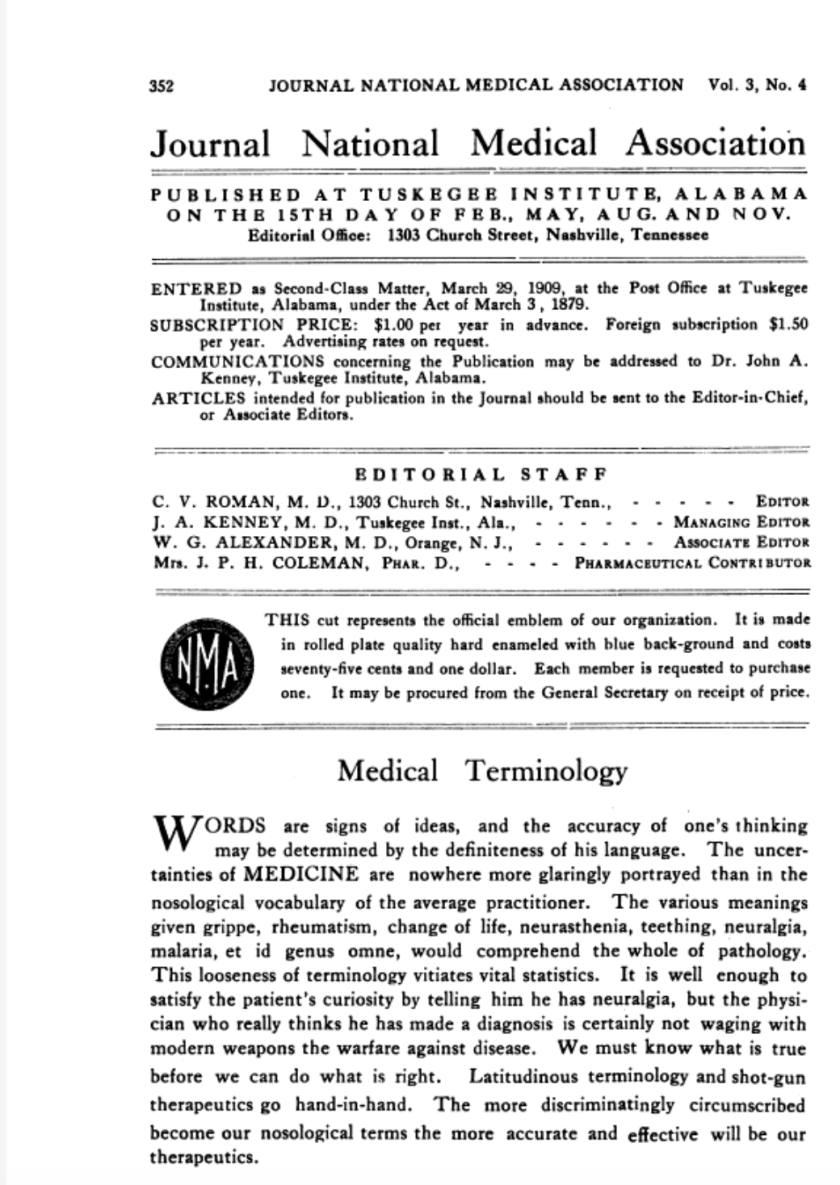
The oldest paper on medical terminology in PubMed/MEDLINE, the National Library of Medicine’s database of 27 million scientific publications. The piece was published in 1911–well over a hundred years ago as I write this–and the problems that it raises still have not been solved.  No author is listed.

For more Zipfian ravings on the topic of writing about academic research, see here. Or, buy my book.  Oh, wait–I’m writing this blog instead of working on the book… Damn it…


How to smile your way through the Parisian transit strike: Citymapper

The Internet has given us Trump, revenge porn, and catfishing; in recompense, it has also given us free on-line versions of a number of historical French dictionaries, and a way to weather public transportation strikes with a smile.

Executive summary: there’s an app called Citymapper available on the iPhone and Android that does an excellent job of staying on top of metro, train, and bus line operating hours.  Want to know about (1) linguistic trivia associated with strikes in French, and (2) public attitudes about the current action sociale?  Read on.

One of the things that I find very striking about Paris is that although the building located at any particular spot might change, the function carried out there can remain constant over centuries.  Millennia, even.  For example: the spot where Notre Dame de Paris is located has been a place of worship since the Druids were there.  The Palais de justice was the residence of the Roman administrator, and then the palace of the early French kings, before becoming the center of the French court system.  And, most relevant to today’s ravings: the location of the Parisian City Hall has been where the city was run out of for as long as Paris has been run by its bourgeois.

City Hall–in French, L’Hôtel de ville–is located on the Right Bank of Paris.  Although the Right Bank is very much the seat of Parisian power today, it started as mostly swampland.  (That fact figures into how the city was taken by the Romans–a story for another time.)  The expansion of Paris from the Left Bank to the Right in the early Middle Ages started with the area where the Hôtel de Ville is located today.  It was an early area of business, and the riverbank–la grève–in front of its current location was a gathering spot for laborers looking for work.  As the story goes (and I’m sorry that I can’t give you a citation for this, but I think that I ran across it in Metronome), over time the word for the place where laborers gathered became associated with strikes by laborers.

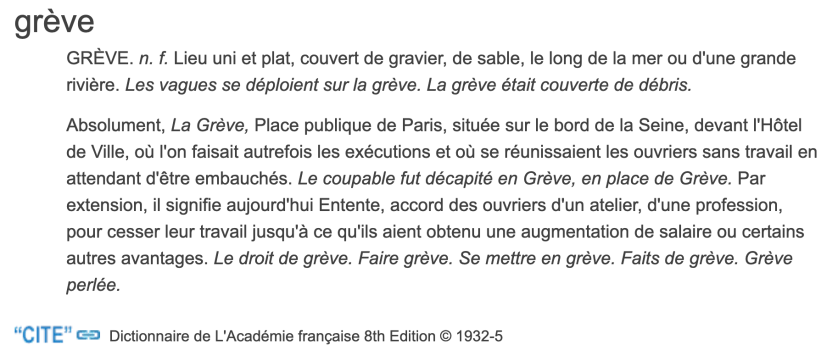
There’s some documentary evidence for this association.  Let’s work our way backward.  The Internet has given us Trump, revenge porn, and catfishing; in recompense, it has also given us free on-line versions of a number of historical French dictionaries.  Les-voilà.  Starting with the 8th edition of the Dictionnaire de l’Académie française, published 1932-1935, we have the following.  The first sentence is A level, flat surface covered with gravel or sand, going along the edge of a sea or a large river:

Screen Shot 2020-01-15 at 08.38.45
Screen shot from TheFreeDictionary.com. In the second paragraph (which I did not translate), they’re not shitting about the executions.  Notable ones that took place there that of include Jacques de Molay, the last grandmaster of the Knights Templar, who was burnt at the stake there on March 18th, 1314; and that of Robert-François Damiens, who was drawn and quartered there on March 28th, 1757.  (The event was extensively documented.  If you have a copy of Michel Foucault’s Discipline and Punish: The Birth of the Prison on your bookshelf, you’ll find an accurate description of the event in the first chapter.  The savagery was difficult to imagine–one of the professional executioners went into retirement after participating.)

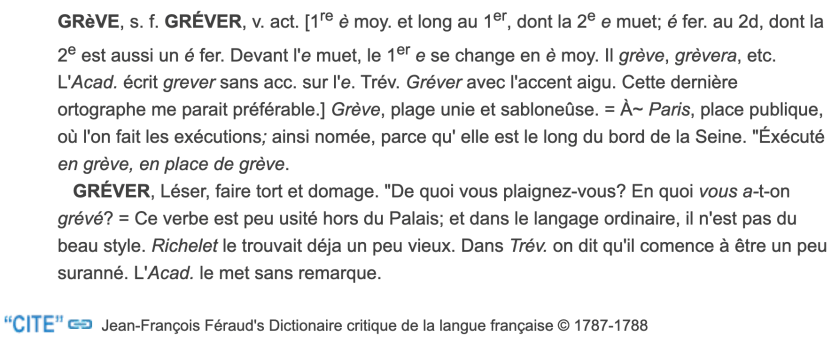
Continuing back in time to the 18th century, we have this from Jean-François Féraud’s Dictionnaire critique de la langue française, published 1787-1788.  It contains the definition level and sandy beach:

Screen Shot 2020-01-15 at 09.21.13
Linguists will notice the prescriptiveness of the entry, which includes the observation that the verbal form of the word, which means “to harm,” is “not often used outside of the Palace, and in ordinary language is not good style,” as well as the facts that (1) Richelet found it a bit old (Phil dAnge, who was Richelet?), (2) Trév says that it was becoming a bit outdated (Phil dAnge: Trév.??), and (3) the Academy includes it without comment. Do note that he is talking about a verb, not about the “(river) bank” sense of grève.) Source: screen shot from https://fr.thefreedictionary.com/gr%c3%a8ve

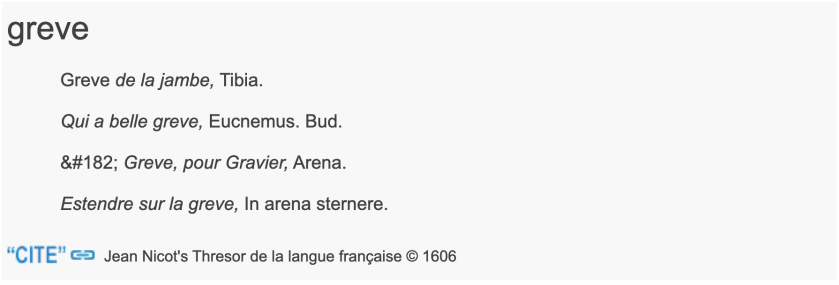
Finally, going back to Jean Nicot’s Thresor de la langue française, published in 1606, we have the following, which includes words that I believe to mean “gravel, sand” (gravier and arena):

Screen Shot 2020-01-15 at 08.36.52
Nicot’s entry includes another meaning of the noun, which I think is a part of a suit of armor that goes on the legs. Source: https://fr.thefreedictionary.com/gr%c3%a8ve

If you haven’t been reading the news from France lately: public transport workers in and around Paris have been on strike for the past six weeks.  A public transport strike in these parts does not mean a complete cessation, but rather a diminution, of service.  A given metro line might be operating at half capacity, or maybe only 1 out of 3 trains on the line are running; those services might be only available during the morning and evening rush hours (en heures de pointe), or just in the evening.  Trains are packed to bursting, electric scooter rentals are maxed out; Uber is running, but the automotive traffic is so heavy that a 30-minute ride can easily take an hour.  As I write this in mid-January of 2020, the exceptionally convenient low-cost mobility that is such a delight of normal life in the City of Light is only a fond memory.

Are Parisians frustrated by the disruptions caused by the strike?  Of course.  Are they complaining about it a lot?  Not really.  Here are typical comments from my friends about the motivation for the strikes–a proposed reorganization of the admittedly convoluted French retirement system:

  1. The reforms won’t hurt me, personally–but, I’m worried for my child.
  2. The transportation workers are striking for all of us.
  3. The strike has to screw up Paris, or it won’t have any effect.

The comments reflect some underlying widespread French attitudes about their famous work stoppages: (1) Everybody has to earn a living, and (2) Your strike may be screwing up my life today, but my strike will be screwing up yours tomorrow.  So: in general, people are pretty tolerant of this kind of thing.

…and with that, I’m off to check Citymapper to find the best way to get to the Musée de la paléontology et de l’anatomie comparéeone of the three best museums in the world, in my humble but reasonably informed opinion.

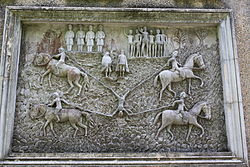
The picture of an écartèlement (“drawing and quartering” in English) at the top of this page is of a bas relief from northeastern Spain. I found it at https://fr.vikidia.org/wiki/%C3%89cart%C3%A8lement.

Conflict of interest statement: I don’t have any.  Citymapper does not pay me, nor do they offer me free services.

What computational linguists actually do all day: The read-between-the-lines edition

Watch a movie like Arrival and you’ll get the impression that linguists spend their professional lives sitting around speculating about Sanskrit etymologies and the nature of the relationship between language and reality.  I’m not saying that we never do such things, but, no: that’s not what we do with our typical workdays.  I’m a computational linguist, which among other things means that what I do involves computers, which among other things means that I spend a certain amount of my time sitting around writing computer programs that do things with language.  Often, those programs are doing things that do not look very…exciting.  Not to the untrained eye, at any rate.

For other glimpses into the daily life of computational linguists, click here.

Case in point: yesterday I wanted to see how the statistical characteristics of language are affected by different decisions about what you consider a “word.”  You would think that the word “word” would be easy to define–in fact, not only do linguists not agree on what a word is, but you would have a hard time getting all linguists to agree that words even exist.  (One of the French-language linguistics books that I have my nose stuck in the most is Maurice Pergnier’s Le mot, “The Word.”  The first 50 pages (literally) are devoted to theoretical controversies around the question of whether words actually exist–or not. Want a good English-language discussion of the issues?  See Elisabetta Jezek’s The lexicon: An introduction.)

So, yesterday I got to thinking about one of the questionable cases in English: contracted negatives of modal verbs.  Here’s what that means.

In English, there is a small number of frequently-occurring verbs that can (and do) get negated not by a separate word like no, but by adding a special ending, spelled -n’t:

  • is/isn’t
  • did/didn’t
  • have/haven’t
  • could/couldn’t
  • would/wouldn’t
  • does/doesn’t

Note that British English has another form:

I’ve not

…which means I haven’t.

Now, if you care about statistics, you care about counting things.  Think about how you would count the numbers of words in these examples:

  1. I want to go.
  2. I do want to go.
  3. I do not want to go.
  4. I don’t want to go.

(3) and (4) are both perfectly acceptable ways of negating (1) and (2).  How would they affect a program that counts the number of words?  It depends.  Here are the straightforward cases: if (1) has four words (I, want, to, and go), then (2) has five (add do to the previous four), and (3) has 6 (add not to the previous five).

The questionable case is (4).  You could make a reasonable argument that don’t is a single word.  You also could make a reasonable argument that don’t should be counted as two words.  But, which two words?  A reasonable person could propose do and n’t–just split the “stem” do from the negative n’t.  

Fine.  But, let’s look at a little more data:

  1. I will go.
  2. I will not go.
  3. I won’t go.
  4. I can go.
  5. I cannot go.
  6. I can’t go.

Clearly (1) has three words–I, will, and go.  …  (2) adds one more, with not.  What about (3), though?  Is it inconsistent to count will not as two words, but won’t as one?  Maybe.  If you’re going to split it into two “words,” what are they?  Presumably wo and n’t?  But, what the hell is wo?  Is it the same “word” as will?  Notice that we’ve now had to start putting “word” in “scare quotes,” which should tell you that knowing what, exactly, a “word” is isn’t quite as simple as it might appear at first glance.  Think about this: in science you need to know what it is, exactly, the thing that you’re studying, which implies that you can recognize the boundary between one of those things and another.

What’s the right answer?  Hell, I don’t know.  I do know this, though: if you’re interested in the statistics of language (wait–what’s you’re?  Hell, what’s what’s?), then you have to be able to count things, so you have to make some decisions about where the boundaries between them are.  My issue du moment is actually not choosing between the options, but rather seeing what the consequences of those specific decisions would be for the resulting statistical measures, so I need to be able to test the effects of different ways of splitting things up (or not), so I need to write some code…


What you see below is me using a computational tool called a “regular expression” to find words that have a negative thing attached at the end (e.g. n’t) and separate the negative thing from the rest of the word.  So, given an input like didn’t, I want my program to (1) recognize that it has a negative thing at the end, and (2) split it into two parts: did, and n’t.  Grok (see the English notes for what grok means) the code (code means “instructions in a programming language”–here I’m using one called Perl), and then scroll down past it for an explanation of how it illustrates a piece of advice that I often give to students…

# this assumes input from a pipe...
while (my $line = <>) {

print "Input: $line";

# this doesn't work--why?
#$line =~ s/\b(wo|ca|did|could|should|might)(n't)\b$/\$1 $\2)/gi;
# works...
#$line =~ s/(a)(n)/a n/gi;
# this does what I want...
#$line =~ s/(a)(n)/$1 $2/gi;
# works...
#$line =~ s/(ca)(n't)/$1 $2/gi;
# works...
#$line =~ s/(ca|wo)(n't)/$1 $2/gi;
# works...
#$line =~ s/\b(ca|wo)(n't)\b/$1 $2/gi;
# works...
#$line =~ s/\b(ca|wo|did)(n't)\b/$1 $2/gi;
# works...
#$line =~ s/\b(ca|wo|did|could)(n't)\b/$1 $2/gi;
# works...
#$line =~ s/\b(ca|wo|did|could|should|might)(n't)\b/$1 $2/gi;
# works...
#$line =~ s/\b(ca|wo|did|had|could|should|might)(n't)\b/$1 $2/gi;
# works...
#$line =~ s/\b(ca|wo|did|had|have|could|should|might)(n't)\b/$1 $2/gi;
# works...
#$line =~ s/\b(ca|wo|do|did|has|had|have|could|should|might)(n't)\b/$1 $2/gi;
# and finally: this pretty much looks like what I started with, but
# what I started with most definitely does NOT work...  what the fuck??

$line =~ s/\b(ca|wo|do|did|has|had|have|would|could|should|might)(n't)\b/$1 $2/gi;

       print $line;

} # close while-loop through input

The “regular expressions” in this code are the things that look like this:

s/\b(wo|ca|did|could|should|might)(n't)\b$/\$1 $\2)/gi

…or, in the case of a much shorter one, like this:

s/(a)(n)/a n/gi

(Note to other linguists: yes, I know that technically, the regular expression is just the part between the first two slashes, i.e. the underlined part s/(a)(n)/a n/gi in the second example.  Don’t hate on me–I’m trying to make this at least somewhat clear.) The lines that start with # are my notes to myself—the “reading between the lines” that you have to do to see how irritating it can be to troubleshoot this kind of thing.


regular expression is a way of describing a set of things.  What makes it “regular”–a mathematical term–is that those things can only occur in a very limited number of relationships.  In particular, that limited number of relationships do not include some phenomena that are very important in language, such as agreement between subjects and verbs–think of Les trois soeurs de ma grand-mère m’ont toujours aimé, “my grandmother’s three sisters have always loved me.”  The issue here is that regular expressions can only describe sequences of things that you might think of as “next to” each other; les trois soeurs is separated from the verb avoir, which must be in the third person plural form ont, by ma grand-mère, which would require the third person singular form a.  (Linguists: I know.)

Regular expressions, and the “regular languages” that they can describe, became of importance in linguistics when B.F. Skinner (yes, the famous psychologist) wrote a book about the psychology of language in which he suggested that they can describe human languages from a mathematical perspective.  This claim caught the attention of one Noam Chomsky, who wrote a book review pointing out the inadequacy of the idea of regular expressions as a description of human language.  The review brought him a lot of notice, and he went on to develop the ideas in that review into the most widespread and influential linguistic theory since the Tower of Babel.  Today, if you’ve only heard of one linguist, it was almost certainly Chomsky.

Chomsky’s critique of “regular languages” included the observation that there are perfectly natural things that can be said in any human language that can’t be described by a regular language.  For example:

Me, my brother, and my sister went to William and Mary, Indiana University, and Virginia Tech, respectively.

The problem that this illustrates for regular languages is that they don’t have a mechanism for accounting for the fact that you can have sentences where you have a list of things in an early part of the sentence, and then must have a list of things of the same length in a later part of the sentence.  Don’t believe me? Go read a book on “formal languages,” and then try it.


Linguistic geekery

Regular expressions are pretty natural tools for people who work with textual data, and they’re especially natural for linguists.  This is a surprise to a lot of computer scientists, some of whom are masters of regular expressions, but some of whom find them irritatingly bewildering.  It turns out that if you take a course on the “formal foundations” of linguistics, i.e. its groundings in logic and set theory, you will run across regular languages, which fact makes regular expressions pretty easy to learn.  And, for textual data, they are really useful even despite their limits–so much so that a programming language (named Perl) was created expressly for the purpose of making it easy to use regular expressions to “parse” textual data.  So, when I found myself wanting to be able to rip through a bunch of textual data and find the negative things like n’t, Perl and its regular expressions were a logical choice.


I love a good monosyllable III: Fleam

Fleam: An instrument for opening veins in bloodletting.

One of the oddities of the lexicon–that is, the set of words that you know–is that you keep learning it for pretty much your entire life.  This is quite different from anything else that you know about your native language: you know almost everything that you will ever know about the phonology and syntax of your language quite early in your childhood.  In contrast, learning new words can continue to your dying day.

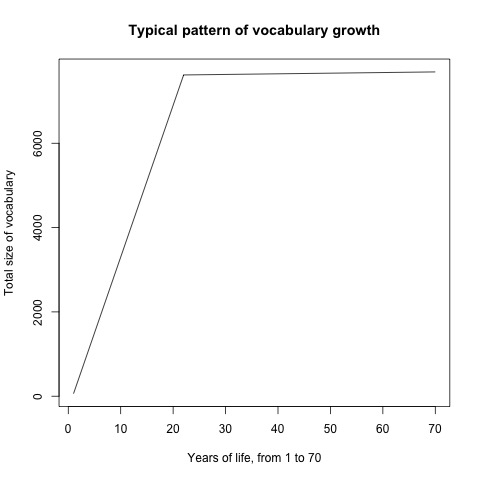
Of course, the rate of learning new words changes over the course of the lifespan.  Young toddlers may learn fewer than 5 words a month; between the ages of 2 and 6 years, they’re probably learning more like 30 words a month.  When you enter school, the range of semantic classes that the child is learning shifts in the direction of abstract words, from the concrete ones that formed most of their vocabulary acquisition up to that point.  If you go to college (la fac in French), you will probably see another spurt in your learning of new words; by the time you finish it, the typical person will know most of the vocabulary that they’re going to have.  Certainly not all of it, though.  If you were to graph the number of words that you know over time, it would look something like this–fast growth early in life, followed by slow growth later in life, but no end to the growth.  (Note that the numbers for vocabulary size are not realistic. Total vocabulary size by age 22 will be much larger than I have indicated, probably on the order of 30,000 words.)

vocabulary.size
Figure source: me. I generated it using a programming language called R. NOTA BENE: the vocabulary size figures are completely unrealistically low–the total vocabulary size should be something like 30,000 words, assuming a college-educated native speaker.

So: I’m 58 years old, and I spent a really long time in college and graduate school, but I am still learning new words in my native language.  Some recent ones:

  • morganitic: relating to marriage between an aristocrat and a non-aristocrat, such that the issue of the marriage do not inherit ranks, titles, and the like.
  • aramid: a group of synthetic materials used to make textiles and plastics.
  • mephitic: nasty-smelling.
  • irredentism: political policy of claiming territories occupied by members of your ethnic group (think Hitler in the Sudetenland), or that were historically part of your political group (think what Hungary would like to do with Transylvania).

What doesn’t happen very often, though: I don’t learn a new monosyllable in my native language very often.  Thus, when I run across one, it tickles me.  So, when a recent trip to New Orleans found me in a pharmacy museum, I was delighted to come across this exhibit:

Where the fuck does this come from?  Let’s go look. Merriam-Webster does not have an entry for fleam, although it does have one for fleam tooth:

A sawtooth shaped like an isosceles triangle

The Online Etymological Dictionary gives me this:

“sharp instrument for opening veins in bloodletting,” late Old English, from Old French flieme (Modern French flamme), from Medieval Latin fletoma, from Late Latin flebotomus, from Greek phlebotomos “a lancet”

So: I never would have guessed it, but it turns out to be historically related to our word phlebotomy, and in fact precedes it in English by centuries.  And thus the pathetic life of a fat, bald old man is made happy by learning a new one-syllable word…


Geeky linguist notes

  1. I’ve given 30,000 words as the size of a typical college-educated adult’s vocabulary.  Take that with a grain of salt–counting the size of someone’s vocabulary is really hard, for a lot of reasons.  You can find a good discussion of them in Elisabetta Jezek’s book The lexicon: An introduction.
  2. I calculated cumulative vocabulary size to age 22 (i.e. approximately the completion of an American college education) using the rate of growth that I gave in the post for the 2:6 age range, because that was the only age range for which I could find numbers.  This results in a drastic underestimate of total vocabulary size–by age 22, it gives just a bit over 7,600 words.  With slow growth after leaving college, there is no fucking way to hit 30,000 in a human lifetime.


What’s making me happy today: élucubrations

You have to grab happiness where you can find it. What’s making me happy today: élucubrations.

You have to grab happiness wherever you can find it, right? I mean, I would love to be feeling happy today because I knew that the Constitution of the United States of America slept as safely last night as I did, or because I was confident that tomorrow’s foreign policy will not further weaken America and strengthen Russia. But, such is not my lot this morning–Trump is still in the White House, and not even his own cabinet knows what he talked with Putin about for two hours in Finland. That doesn’t mean that there’s nothing to feel good about, though.

Today my heart is gladdened by the existence of the word élucubration. I ran across it while reading the French-language translation of the magisterial World War Z, Max Brooks’s allegorical reflection on American culture in the early 20th century. Brooks on conspiracy theorists:

Le secret, ça fonctionne comme un trou sans fond ; et il y a toujours des paranoïaques pour essayer de le combler avec leurs élucubrations.

Word Reference defines élucubrations as “flights of fancy, hare-brained ideas.” (A hare is a kind of rabbit–lièvre, maybe?) French definitions emphasize the amount of work that goes into them:

Discours, pensée issus de recherches laborieuses mais dépourvus de bon sens (Maxipoche 2014, Larousse 2013)

Coming across the word in a translation as I did, it seemed too adorable to be true: surely such a lovely and useful word could not really exist in normal language? Wroooong again, Zipf.

In 1966, the singer Antoine released the song Les Élucubrations d’Antoine. According to Wikipedia, it differentiated itself from the typical yéyé (hippie) music of the time by its militancy, proposing that The Pill be sold in supermarkets and insulting music legend Johnny Halliday. The song sold like crazy and made his career. So…apparently I am the last person in the world to learn the world élucubration, and once again we see the awesome power of Zipf’s Law: most words are very rare–but, they do occur. Enjoy!

Combinatorics and pod hostels

Go to the shitty part of any decent-sized American city–usually on the edges of the old downtown area–in the early evening, and you will find a line of battered-looking men standing in line outside of a building–usually run-down.  The building is a homeless shelter.  A typical one will give you two nights a month for free, and more if you can pay a small amount.  Dinner is a baloney sandwich or something similar, almost always preceded by a non-optional and decidedly denominational church service. A couple of guys will walk up to the front and accept Jesus Christ as their personal lord and savior.  The Christ will accept them with enthusiasm; the shelter staff, not so much, having seen it aaaaaaaall before.  Crusty old bums who may want to blow you, fuck you, get blown by you, or get fucked by you. (That’s 24 possible combinations of 1 or more sexual acts involving a crusty old bum and you, which equals 16; most of the time, nobody asks, and if they do, you politely say “no”–I am not judgmental, and I am not easily shocked–and that’s generally the end of it. So, a total of 17 possible outcomes, exactly one of which does not involve sexual contact between a crusty old bum and you.)  Breakfast is most likely to be a cup of coffee and a piece of toast (butter, unlike the church service, is optional), and then it’s out the door and on the street, regardless of the weather–no loitering during the day.  That’s fine, since you need to get to the day labor office really early if you want to find work, and if that part of your morning is unsuccessful, you need to haul ass to the plasma donation center as quickly as possible–otherwise your protein drops too low and they won’t let you donate, which means that you’re out round-trip bus fare and still have to figure out where you’re going to sleep that night.  The worst one that I’ve ever stayed in was a dank and dark one in Columbus, Ohio, next to a White Castle.  The best one that I’ve ever stayed in was a Veterans of America one outside of Sacramento, California–clean, sunny, and they offered some social-service-type stuff.  God bless the Veterans of America.  Hell, God bless anyone who will feed and house the homeless.


Then you join the Navy.  Boot camp is 80 guys in a large room; big, clean showers in the morning; 15 minutes three times a day to consume all of the food you can inhale (I actually gained weight in boot camp), and then it’s off to do interesting and/or fun things like make emergency flotation devices out of your clothing, learn what to do in case of nerve gas attack (gas mask on, syrette of atropine jammed hard into your thigh if you think you got exposed), and fight fires (pretty involved on a ship, since all of that water has to go somewhere outside of the vessel, or your ass is going to sink).  When you get to your ship, it’s three bunks deep in a compartment that smells of sweat, farts, and depression.  Plus, you learn to sleep with a 5-inch artillery piece firing directly over your head.  (I did, anyway.)  But, it’s warm, they feed you well, the food is quite good, and cigarettes are $1 a pack once you get out of American territorial waters.


Out of the Navy, you head to a super-nice college where everybody but you and the 12 kids in the theater department is polite; smart; attractive, even (possibly especially–who knows how the Upper East Side mates) in LL Bean boots; from New York, New Jersey, or Northern Virginia; and 18-22 years old.  But, you’re married and have a kid, and you’re paying your way via the GI Bill and weekends spent drawing arterial blood samples and adjusting the occasional ventilator at the local hospital, so you live in one of those apartment complexes.  That means (1) at night, entering the kitchen with your eyes closed, stomping like a motherfucker to kill as many cockroaches as possible, and then turning on the lights; and (2) during the day, hunting for their egg cases, ’cause every one that you crush and dump gleefully down the garbage disposal is 15 little cockroaches preemptively and preventatively obliterated.


…all of this to make it clear to my friends who have expressed concern about the fact that I’m living in a pod hostel at the moment that it is totally fine.  Warm, clean, and so far no bums have suggested blowing me, fucking me, me blowing them, or me fucking them.  Not that anyone makes a man of my age that kind of offer very often–I still politely say “no,” but being an old fat bald guy…at this point, I take it as a compliment.


English notes

Decent-sizednot small, but not necessarily big, either.  How much cake do you want?  Gimme a decent-size piece, but not too big, ’cause I’m old, fat, and bald.  How I used it in the post: Go to the shitty part of any decent-sized American city–usually on the edges of the old downtown area–in the early evening, and you will find a line of battered-looking men standing in line outside of a building–usually run-down.

To be out (something of value): To have spent a quantity of money or rendered something of value without getting anything in return.  I bought a bus ticket, but then I got stopped and frisked and I missed the bus, so now I’m out $25.50 and I’m still stuck in this shithole.  How I used it in the post:  You’re out round-trip bus fare and still have to figure out where you’re going to sleep that night.   

Boot camp is the American military’s basic training.  Recent graduates are known as boot camps, or just boots–confusing, I know.  No less than in France, where said recent graduates are either pieds-bleus (did I pluralize that correctly??), or just bleus.

Combinatorics is a branch of mathematics that (in my very limited understanding) has to do with efficiently calculating the number of  possible combinations of things.  No hate mail on this, please—just correct me in the Comments section.  The formula that appears in this post appeared on Quora–if you can prove it (in the mathematical sense), that would be much appreciated.  Note that I did not do the subtraction of 1, because the formula is for proper subsets only, and experience has given me no reason to exclude the non-proper subset option.

Proper subsets: subsets that do not contain all of the members of a set.

Non-proper subsets: subsets that include the subset containing all of the members of a set.  So, for the set = {1, 2}, the set of proper subsets is {1} and {2} (and maybe {}, the “empty set”–I don’t remember from Linguist School).  The set of non-proper subsets is {1}, {2}, and {1,2}.


Mechanism of deanimation of zombies by burning: Academic writing and how not to start a paper

Since the earliest known zombie attacks (Max and Roberson 2010), researchers have been aware that penetrating head injury is universally successful in deanimating zombies.

Comment: Zipf, don’t begin a paper by talking about what researchers know.  Nobody gives a shit about researchers.

Since the earliest known zombie attacks (Max and Roberson 2010), it has been known that penetrating head injury is universally successful in deanimating zombies.

Comment: Zipf, there is a time–and there are excellent places–for the passive.  The first sentence of your paper is not it.

Max and Roberson (2010) describe a zombie attack dated to no later than 140,000 years before the Common Era. It is the earliest known outbreak of The Plague–and the first time that hominids are known to have deanimated them via penetrating head injury.

Comment: Zipf, this is a TERRIBLE context in which to use the passive.  You have hominids fighting for their lives against relentless protoanthropophages (unfortunate terminology–so ambiguous…). Keep that alive for the reader–with the active voice.

Max and Roberson (2010) describe a zombie attack dated to no later than 140,000 years before the Common Era. It is the earliest known outbreak of The Plague–and the first time that hominids deanimated them via penetrating head injury.

Comment: Zipf, this is a shitty context for anaphoric reference.  Why did you use it?

Well, it’s frame-licensed, right?  When there is a zombie attack, there are zombies, and what else could be the antecedent of “them” here?

Comment: (1) to your second point: a zombie attack only requires a single zombie, and in fact your text as given provides only the slightest support for the notion that there were more than one. (2) to your first point: “bridging anaphora” is a much more constrained analysis of this than “frame-licensed.” (3) Don’t be ambiguous.  Say “zombies,” not “them.”

What’s a bridging reference

Zipf, what did you find when you looked up “bridging reference” before asking me that question?

By the way: in work-related emails, punctuation is not optional.  These are not text messages, and I am not your friend.

[no response…]

[no reponse…]

[no response…]

Zipf, we need to talk about your continued funding in this graduate program.

Bibliography:

Brooks, Max, and Ibraim Roberson. The Zombie Survival Guide: Recorded Attacks. Broadway Books, 2010.


Note to the reader: do not search Google Images for zombie penetrating head wound unless you have an even stronger stomach than I do.  For context: I brought home the bacon as a medic for many years, and I could not begin to count how many dead bodies I have seen.  Nonetheless: I hit the “back” button on that page as fast as I possibly could.

Picture source: https://open-shelf.ca/161001-phd/


Things I am grateful for today

Moral injury: distress related to having violated core moral boundaries.

I am grateful for some things today.  I mean, I’m grateful for something every day–my kid has health insurance; I slept in a warm, dry, safe place last night; I had breakfast this morning.  Not everybody can say all three of those things, and a lot of people can’t say any of them.

Today, though, is a little special: instead of feeling grateful for what is, today I’m feeling grateful for what is not.  Three things in particular:

  1. I am not in a war.  A lot of folks are–Kurdish fighters who did most of the fighting against ISIS for us, and who we then abandoned; Ukrainian soldiers defending their country against their historic enemy, and ours since the end of the Second World War, and why the president of the United States of America would hate them so much, I can’t imagine, beyond the two hours that he spent in a room with Vladimir Putin and then wouldn’t even tell his own cabinet members about.
  2. I am not in the bowels of a guided missile cruiser wishing that I hadn’t dropped out of high school–a place that I have certainly been before, unlike the president of the United States, who participated actively in sports throughout college, and then got out of the draft on the grounds that he was not sufficiently physically fit.
  3.  I am not going to kill myself today.  In contrast, about 20 of my fellow US military veterans will do just that today.  Why?  There isn’t just one reason why anyone kills themselves. (See Thomas Joiner’s excellent book Why people die by suicide for details.  He knows what he’s talking about–an eminent suicidologist, and editor of the journal Suicide and Life-Threatening Behavior.)  And, veterans share the same risk factors as anyone else.  But, there’s a particular contributor to suicidality in veterans that is not often present in the general population.  It’s called “moral injury.”  Here’s a definition of it, from a paper by H.G. Koenig, N.A. Youssef, and M. Pierce:

Moral injury (MI) involves distress over having transgressed or violated core moral boundaries, accompanied by feelings of guilt, shame, self-condemnation, loss of trust, loss of meaning, and spiritual struggles.

Koenig, Harold G., Nagy A. Youssef, and Michelle Pearce. “Assessment of moral injury in veterans and active duty military personnel with PTSD: a review.” Frontiers in psychiatry 10 (2019).

What I find especially striking about the concept of moral injury is that it has nothing to do what I suspect most people would think was the big cause of guilt in veterans, which is to say: survivor guilt.  Nope–nothing about surviving going on in moral injury.  It’s not about your buddies getting killed–it’s about who you killed.  Moral injury is not about what you experienced– it’s about what you did.  Sociopaths like to kill–nobody else does.  And our military does a good job of screening out sociopaths.


Here’s the original caption of the picture that you see at the top of this post:

American Special Forces worked closely with Kurdish troops to fight the Islamic State in Manbij, Syria, last year. Credit: Mauricio Lima for The New York Times. Headline of the article: Pullback Leaves Green Berets Feeling ‘Ashamed,’ and Kurdish Allies Describing ‘Betrayal’

You certainly don’t have to pull the trigger on someone to suffer moral injury, though.  “Pullback leaves Green Berets feeling ‘ashamed’.”  Do you begin to get a sense for why Trump’s level of support in the military is so low?  The guy has done some deeply un-American stuff, but contributing to the rate of veteran suicide–feel free to tell me if you think I’m stretching too far with this, but it’s a new low, even for a guy so deeply in the gutter.


English notes

Things I am grateful for today is the title of this post.  Some observations about it:

  1. It contains what is known as a bare relative clause: “I am grateful for today.”  The “non-bare” version would be Things that I am grateful for today.  I try to use the non-bare versions, on the theory that I imagine them easier for non-native speakers to process, and I spend far more time speaking with non-native speakers than with native speakers.
  2. Another way to say it would be Things for which I am grateful today.  If that’s easy for anybody to process, I’m not aware of the evidence for it.
  3. Yet another possibility: Things which I am grateful for today.  I don’t know of any situation in which that would be preferred.  Which does not, of course, mean that there aren’t any.
  4. Explain to me again how “English is so much less complicated than other languages”???


Ukrainian Humanitarian Resistance

Resisting the russist occupation while keeping our humanity

Languages. Motivation. Education. Travelling

"Je suis féru(e) de langues" is about language learning, study tips and travelling. Join my community!

Curative Power of Medical Data

JCDL 2020 Workshop on Biomedical Natural Language Processing

Crimescribe

Criminal Curiosities

BioNLP

Biomedical natural language processing

Mostly Mammoths

but other things that fascinate me, too

Zygoma

Adventures in natural history collections

Our French Oasis

FAMILY LIFE IN A FRENCH COUNTRY VILLAGE

ACL 2017

PC Chairs Blog

EFL Notes

Random commentary on teaching English as a foreign language

Natural Language Processing

Université Paris-Centrale, Spring 2017

Speak Out in Spanish!

living and loving language

- MIKE STEEDEN -

THE DRIVELLINGS OF TWATTERSLEY FROMAGE