The worst thing about being Jewish

It’s not what you’re thinking.

I’ve been exploring the back streets of my neighborhood.  This being France, that means a lot of houses of worship (for a very interesting reason, in this very secular country–another time, perhaps), and this being Paris, they are quite diverse.  When you think France, you think Gothic, but the other day, I visited an Art Deco church down the street from my house.  (Turns out Art Deco comes from France–who knew?  The name is short for arts décoratifs.)  On Saturday morning, I went to services at a shul (synagogue) a few blocks from my apartment.  I don’t have a religious bone in my body, but I like to sit in a synagogue every once in a while and be surrounded by the murmur of one of the languages of my childhood, and I find it interesting to see the varieties of Judaism in different countries.

France has tremendous importance in the intellectual history of Judaism.  This is due to the work of the medieval scholar Rashi.  He lived from 1040-1105 in Troyes, in the Champagne region of France, and is thought to have made his living as a vintner (wine maker).

Rashi’s importance comes from the set of commentaries that he wrote on the Bible and the Talmud, a 62-book set of volumes that is one of the central texts of Judaism.  His commentaries are clear and insightful.  They always serve to clarify, but also often form the basis of complex interpretations by later scholars.  In a traditional Jewish context, it would be strange to study either the Bible or the Talmud without consulting Rashi’s commentary–if you have a traditional religious education, you start with him as soon as you start studying the Bible in grade school, and continue with him until you die.  Rashi’s commentaries sometimes incorporate translations into Old French from a time when that language was not written very often, so they are one of the sources that scholars of Old French have for the pronunciation and lexicon of that language.  As an American kid, you just kinda gloss over those, but from my perspective as an adult and a linguist, I realize how precious they are.

So, yes–I went to services the other day.  The congregation that I went to is associated with what’s called the Conservative movement, which, despite the name, is the progressive movement in Judaism.  The people were about the same as what you would find in a typical Conservative shul in the United States–mostly white, a couple blacks; the main difference was that in the US, there would have been some Chinese girls, while here in France, there were quite a few North Africans.

A common courtesy in a shul is to offer a visitor an aliya–the honor of saying a blessing during the reading of the Torah (bible), and I was offered one.  More on this later.

A prominent feature of the Conservative movement is a strong commitment to gender equality, and the Torah readers included a little old French lady who was so tiny that she had to be helped up on a stool to be able to reach the upper part of the scroll.  She was helped up politely, and then her pronunciation while reading was corrected just as diligently as that of the men.  (Torah scrolls are written without vowels, and two people on either side of the lectern follow along during the reading in regular books that do have vowels in order to make sure that there are no pronunciation errors.)

So, back to the worst thing about being Jewish: the worst thing about being Jewish is that sometimes you have to stand up and sing in public.  No karaoke, no musical instruments accompanying you–it’s just you and your voice, and I truly can’t sing.  Assuming no genocides, the Jewish male has three trials in his life.  Number one: eight days after birth, he gets circumcised.  Number three: at his wedding, he has to stomp on, and break, a glass, with everyone watching and without slicing a tendon.  Number two: in the middle, at the age of 13 (12 for girls in those communities in which girls do this), he has his bar mitzvah, which means that he has to stand up in front of everyone and chant and sing.  (Totally different tonal systems, and you have to do both.)

Now, one of the problems with visiting congregations other than your own is this: the tunes are different.  I sound different from most Jews to begin with, since when I read Hebrew I have a Yiddish accent, while most Jews today read Hebrew with a Middle Eastern accent, and that is definitely the case in France, where there is a very heavy North African presence in the Jewish community.  (In turn, about 10% of Israelis speak French, again due to the large number of North Africans there.  I think it’s the third-most-studied foreign language in Israeli schools, after English and Arabic.  See Jean-Benoît Nadeau and Julie Barlow’s The story of French for the numbers.)  You can fake the tune OK in a different congregation if you’re lost in the crowd and you know the words already, but if you have to stand up and sing then you stand out, and that was exactly what I had to do when I said the blessing during the bible reading–stand up in front of the congregation and sing alone.  So, what to do about the different tunes?  I couldn’t possibly fake the French one, so I knew that I had to do the American one.  And, in case I haven’t been clear about this: I can’t sing a note, and I hate to do it in public.  Happily, my long and pathetic history of losing judo matches has made me comfortable with looking like an idiot in front of crowds, so I went up to the lectern, gave my name and my father’s name when asked (easy in French), and got ready to do my thing.  I fixed my eyes firmly on the siddur (prayer book) so that I wouldn’t see all the pretty French girls and get any more nervous than I already was, and belted it out–in my heavily Yiddish-accented Hebrew, and with the American tune.

“You’re American?”, asked the guy doing the reading–in English.  Bien sûr, I answered.  “I could hear it,” he said.  Oh, well.

Zipf’s Law comes up in a house of worship as much as it does anywhere else.  Consequently, here are some of the words that I had to look up later:

  • l’office (masculine noun): religious service.
  • Moïse: Moses.
  • le cercueil: coffin, casket.  (Pronunciation from WordReference.com: [sɛʀkœj].)  The sermon was a long analysis of the significance of the close conjunction in the Torah reading of two occurrences of the Hebrew word aron with its two different meanings: ark, and coffin.  Oddly, the French word also refers to some kind of beverage made by just dumping a bunch of different kinds of booze together.

Some days the bear eats you, some days you eat the bear

Some days the bear eats you, some days you eat the bear: bear-related vocabulary in French.

Some days the bear will eat you,

Some days you eat the bear.

–Joan Armatrading, Eating the Bear

2015-12-26 12.56.36
Les deux oursons, “The two bear cubs,” a tux/party dress rental store near the apartment that I rent when I’m in Paris. Picture source: me.

There’s a store in my little neighborhood whose sign has always puzzled me somewhat.  In order to understand it, I needed to learn bear-related vocabulary in French:


  • l’ours (nom masculin): male bear; boor, curmudgeon.
  • l’ourse (nom fémenin): female bear.  Pronounced [urs], not [urz].
  • l’ourson (nom masculin): bear cub; teddy bear.
  • le nounours: teddy bear.  Pronounced [nunurs]–the s is not silent, as you would expect it to be.

L’ourson (teddy bear) is not to be confused with:

  • l’oursin (nom masculin): sea urchin.  Yes, they are eaten in France, not just in Japan.

Some of the words meaning “bear” are used in idiomatic expressions:

  • un vrai nounours: “a real teddy bear.”  The French Etc. web site explains the expression like this: “un vrai nounours means ‘a real gem’…un vrai nounours is used to describe a person who is really sweet, going along with everything easily.”
  • un vrai ours: “a real bear.”  French Etc. explains it like this: “‘a real boor’, a person who isn’t sociable.”

“Bear” has some interesting slang meanings in English.  Here are a couple:

  • A difficult situation or thing.  “I have to finish a project proposal by New Year’s Eve–it’s a bear, because I have to find a way to smoothly integrate high-throughput assay analysis and theoretical linguistics.”
  • A gay man who is big, bearded, and hairy.

All Americans are apparently not created equal

The subtleties of ordering drinks.

Yesterday mid-afternoon I stepped into a cafe with a friend.  Good day–an espresso and an Americano, if it pleases you, I requested.  (If it’s in italics, it happened in French.)  My intent was to get my friend a café americano, or an espresso with hot water added–it’s something like American brewed coffee.  Careful, the waiter said–an américain [American] is a cocktail.  If you want an “Americano,” you have to ask for a café americano.  He explained to me that an américain is a sort of very dry martini with Campari.  Lesson learnt!

  • le café Americano: espresso with hot water added.  I’m not sure what the difference is between this and a café (r)allongé.
  • un américain: a type of cocktail.  No French Wikipedia entry for this, so no picture.


Loss of citizenship in France and the United States

Screenshot 2015-12-23 10.24.25
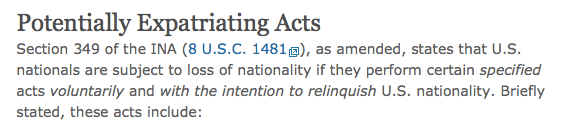
Screen shot from this State Department web page: http://travel.state.gov/content/travel/en/legal-considerations/us-citizenship-laws-policies/citizenship-and-dual-nationality.html

American Republican party presidential nomination candidate Donald Trump says that if he were elected president, he would repeal the  guarantee of American citizenship for anyone who is born in our country.  Even the right has mixed opinions about this, and certainly the left is opposed–citizenship for anyone born here is a national absolute, enshrined in the Constitution.  Dual citizenship is a bit more complicated; becoming an American citizen involves renouncing allegiance to any other country, but the United Kingdom does not recognize this as a way to lose UK citizenship. You can lose your American citizenship for committing certain acts involving allegiance to another government, but they have to be committed with the intention to relinquish US nationality–see the link in the caption to the screen shot from the State Department web page on the subject.  American Republican party presidential nomination candidate Ted Cruz held dual Canadian-American citizenship until 2014, even while serving in the Senate.

Related issues have come up in France since the 13 November attacks.  Of course, this brings Zipf’s Law into our lives.  The word of the day in France is déchéance.  It was all over the news this morning, and is going crazy on Twitter.  This word has a number of meanings, but the one that’s relevant here is “loss” or “forfeiture,” as in déchéance de nationalité, or loss of citizenship.  Three days after the murder of 130 people by Islamic State terrorists, Hollande announced that terrorists or people acting contrary to French values with dual citizenship would be stripped of their French citizenship, even if they were born here.  It’s back in the news because Hollande has backed off on the idea–it quickly became clear that there would be no agreement about this abrogation of rights (which would require a change to the French constitution), and it was seen as an “ideological gift” to the far-right National Front party.  In the name of national unity, the idea has been officially dropped.

Here is WordReference.com’s discussion of the word:

  • la déchéance: (physical or moral) decline, degredation, degeneration.
  • la déchéance: (loss of rights) loss, forfeiture.

Interestingly, the concept also brings Zipf’s Law into our lives with respect to English, unless your vocabulary is a hell of a lot better than mine.  In particular, we meet the verb to expatriate, which Merriam-Webster defines as “banish, exile” (transitive); “to withdraw (oneself) from residence in or allegiance to one’s native country” (transitive); “to leave one’s native country to live elsewhere; also :  to renounce allegiance to one’s native country” (intransitive).


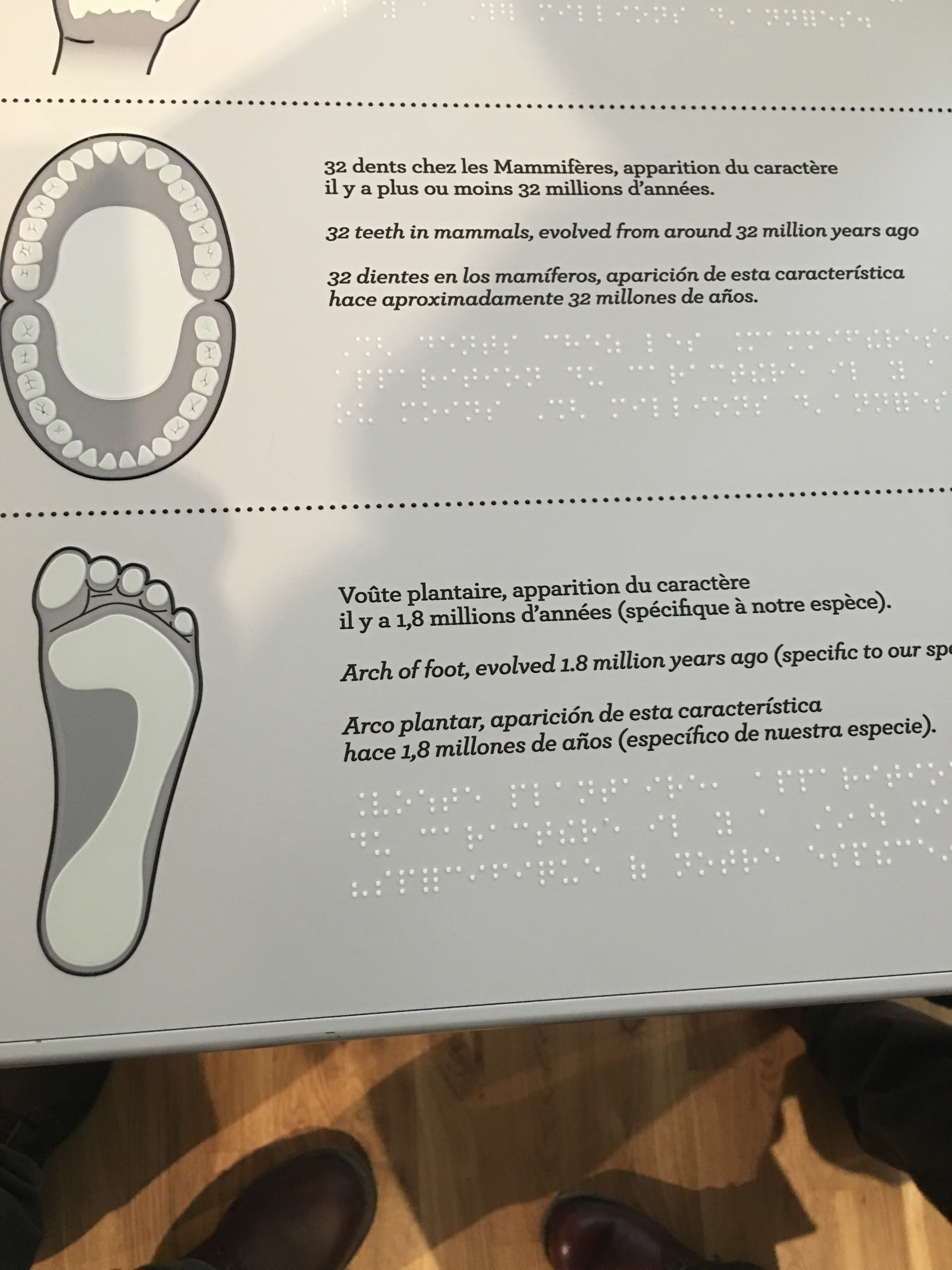
Musée de l’homme/Museum of Man

Picture source: me.
La voûte: vault.  La voûte plantaire: arch of the foot.  Apparently we’re the only species to have one.  Picture source: me.

I’m the son of an anthropology major, and have strong memories from childhood of a poster on the wall of the Department of Anthropology at the college that my parents attended of the evolution of the human foot.  Being a geek, I’ve remained fascinated ever since with the morphology of the body and how it changes over the course of evolution.  So, I was happy when recently, after a long closure for renovations, the Musée de l’homme (Museum of Man) in Paris just reopened.  As a connoisseur of museums of anatomy and anthropology, I have to say: this is a good one.

The main exhibits are framed around three questions: who are we, where do we come from, and where are we headed?  The answer to the first question is framed around the duality of the facts that we are all pretty similar to each other, and yet all unique.  A brief discussion of genomics is followed by a number of exhibits on human anatomy, especially those aspects of it that are unique, as those aspects contrast with those of other species.  (Apparently we’re the only species whose ears can swell in response to emotion.)  It covers the human as physical being, mental/spiritual being, social being, and language user.

img_3296
Close-up of the display, for those who are as old and  near-sighted as I am.

The second question is a good overview of human evolution, featuring lots of good skulls and/or skull casts.

Verdict: if you like science museums, you’ll probably like this one.  Things to be aware of: (1) as of the date of writing (December 2015), the museum has just recently reopened, and there is likely to be a line to get in; (2) there is very little English on the displays, and if you can’t read French, you’re going to have to do a lot of guessing. On that note: see below for more vocabulary from the exhibits.  Click on the pictures to see the Zipf’s Law words in the captions.

How to sound French: Winter 2015 edition

I’m always amazed by the American stereotype that France disdains American culture and the English language.  I recently read a web page on the subject of How you know you’re becoming French (sorry, I can’t find the link).  One of the clues was “you mix English in with your French.”  This is absolutely accurate.  We Americans avoid this if at all possible, and in French-speaking Canada it’s not looked upon well, but the French throw in English all the time–it’s considered cool, and makes you sound au courant.  I kept track of the English words that got thrown into conversation for a couple days.  Here’s what I came up with.

  • “Live:”  This came up while a friend made the point that modern classical music has to be listened to “live.”  I wasn’t expecting an English word, and asked: “live” as in en direct?  Yes, she said.
  • “Raw data:” This came up in a conversation about a kind of analysis that I was discussing with a research oncologist.  (France has one of the best health care systems in the world–totally comparable to America’s, except inexpensive.)  A minute later she used the French expression: données crudes.
  • “Outward-directed:” This came up in a discussion of the nature of happiness at a café philo.  The speaker immediately gave the French equivalent, dirigé à l’extérieur, so it’s clearly not the case that he didn’t know how to say it–it’s just cool to say it in English, right?
  • “Star:” This came up in a discussion of a job opening at a Parisian university: “they’re looking for a ‘star,'” said my interlocutor.  As I write this, there’s a conversation on the radio talking about what makes someone a star, versus a star de qualité, versus a navette (movie star), versus an étoile (star in the heavens)–do box office receipts equate to quality?
  • “Karma is a bitch:” This came up at the conclusion of a news story on the very hoity-toity radio program that I listen to in the morning.  It was at the conclusion of a story about well-known scumbag Martin Shkreli’s arrest.  I don’t know the French equivalent.
  • “The weather is pretty good:”  Same hoity-toity radio program.  (France culture matin–excellent program.  It’s like Morning Edition or All Things Considered in the US, multiplied by 10.)  No particular reason that I could tell of for throwing it in there–like I said, it’s just cool to mix English with your French here.

So, don’t sweat your vocabulary–speak French as much as you can, and if you have to mix in some English vocabulary, it’s not going to be the end of the world.


The smells of France: What’s missing

As an impoverished teenager, I lived near a bakery for a while.  It was torture–every morning, I could smell the fresh-baked bread as I went hollow-stomached off to school to get my free state-sponsored breakfast.  (Sticky buns–incredibly delicious, if not very nutritious.  I’ve never found their equal.)

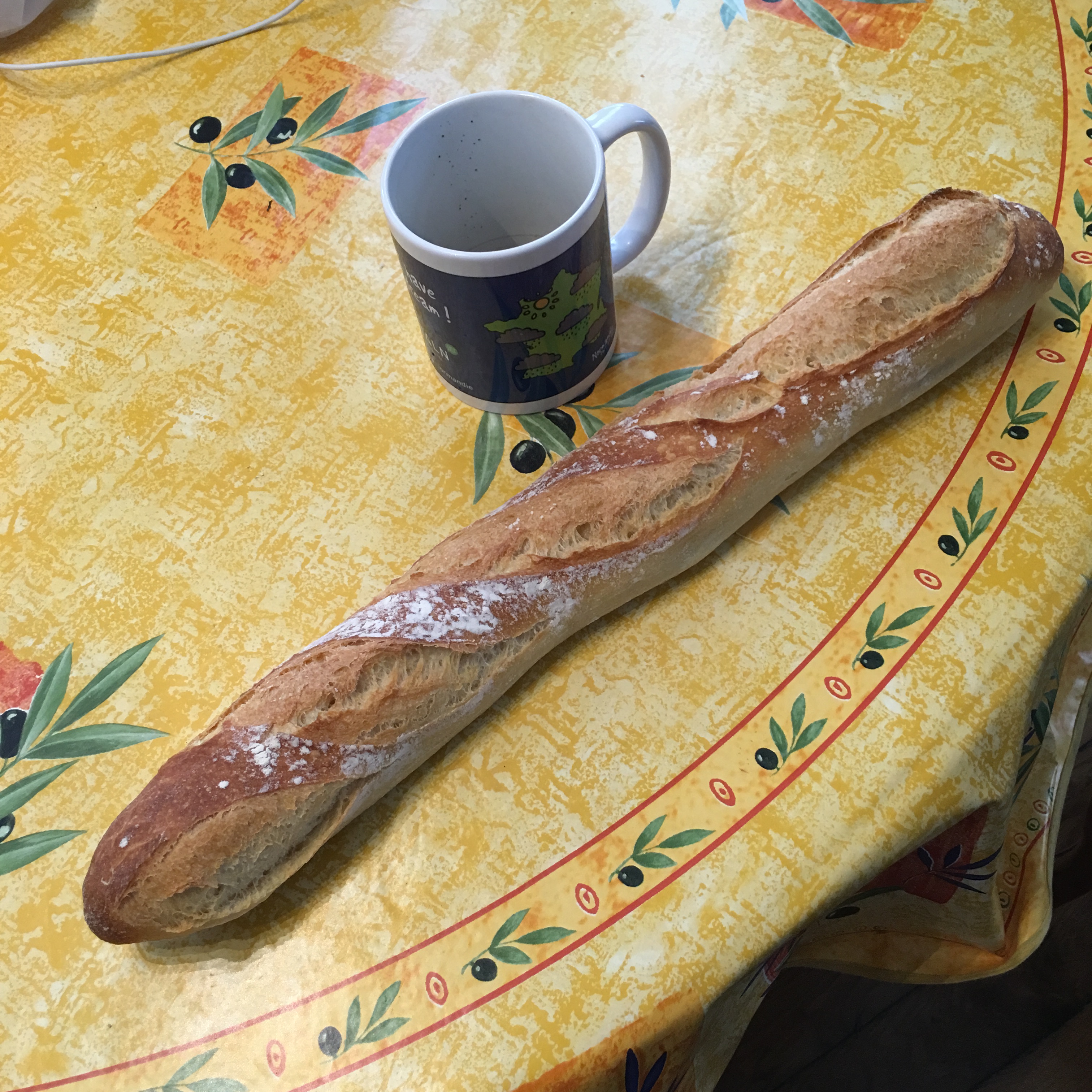
A flûte.  Picture source: me.
A flûte. Picture source: me.
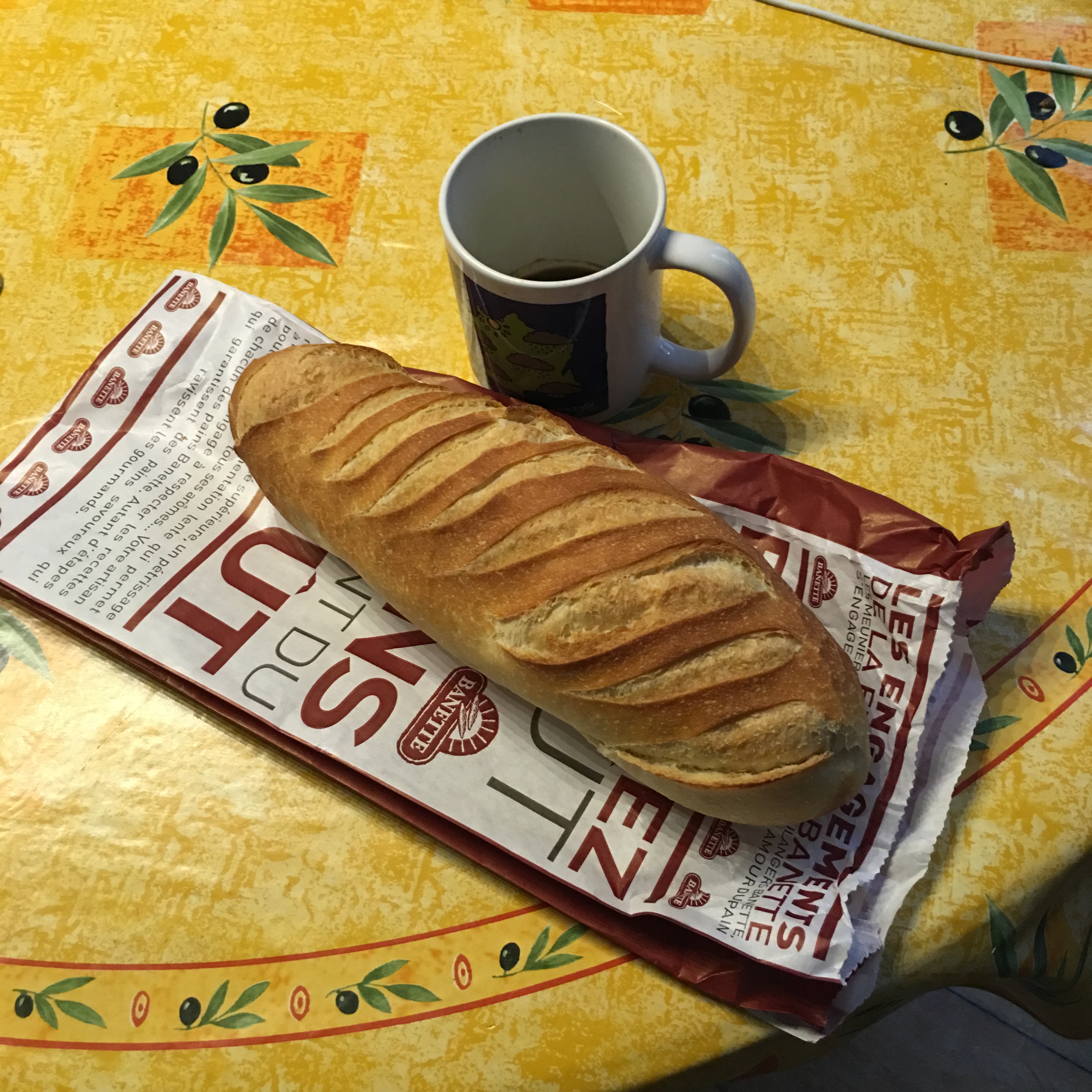
A bâtard "court" (short).  Coffee cup included to give an idea of the size.  Picture source: me.
A bâtard “court” (short). Coffee cup included to give an idea of the size. Picture source: me.

I haven’t been able to find an exact count of the number of bakeries in Paris, but the consensus seems to be that there are over a thousand.  So, here’s what I don’t understand: why doesn’t every square foot of the city smell like fresh-baked bread in the morning?  This is the mysteriously missing smell of Paris–I can’t recall ever smelling fresh-baked bread, despite the fact that there are multiple boulangeries in my neighborhood.

A stereotype that’s true: bread is really important here.  It’s free in the chow hall at work–you just pick what you want out of a big basket.  Little baguettes, or individual slices of some other kind of loaf.  (More on other kinds of loaves below.)  For well over 200 years–until August of this year–the government regulated when Parisian bakers could go on vacation, in order to ensure an uninterrupted bread supply in the city.

A stereotype that’s not true: not all French bread is amazing.  Some of it most definitely is.  Yesterday, the lady at the boulangerie at the bottom of the hill handed me a baguette and I could tell as soon as I put my hands on it that it was going to be incredible.  Indeed, it was–crunchy on the outside, firm and substantial–but soft–on the inside.  But, you can find meh stuff here, too.  Try different places until you find one that you like.  You might have trouble telling the good stuff from the bad stuff when you first get here, but your discriminatory abilities will improve with practice.

There are a number of different kinds of loaves, and I can’t claim any expertise with regard to them.  Here are some of the options in my boulangerie:

  • la baguette: this is the typical baguette.
  • la tradition: basically a traditional baguette–flour, water, salt, and nothing else.
  • le bâtard: larger around than a baguette.  Available in two sizes: long (long), and court (short).  I never thought that they looked particularly interesting, but must confess that when I bought the one pictured above, I immediately ate the entire thing for breakfast, despite the fact that I’ve been trying to cut down on my bread consumption due to my basic fatness.  Linguistic note: this is the only kind of bread that’s grammatically masculine.
  • la flûte: smaller around than a baguette.  Basically, within limits, the thinner the loaf, the higher the ratio of crust to inside.  These can have additional ingredients–added yeast, different grains, sesame seeds on the outside–stuff like that.
  • la ficelle: a much smaller loaf–roughly the diameter of a bread stick, but longer.
  • la boule: a round loaf.  (Note that if you make this masculine, it will mean something else different entirely–“ass” in France, “boob” in Quebec.  Go figure.)
  • champêtre: this is a weird one.  It’s not normally a noun, and I don’t know the gender.  In my favorite boulangerie, it’s used for a sort of peasant baguette–unevenly shaped, lumpy, delicious.  I haven’t seen this term used anywhere else, and it’s not always available at my boulangerie, either–the only place that I’ve ever been able to find them.
  • la fougasse: these look delicious, but actually aren’t.  They’re flat, have holes cut in them, and usually seem to be garnished with spices, some sort of dried stuff (maybe sun-dried tomatoes, maybe olives–that sort of thing).
  • la brioche: a sweet bread.

For more information, here’s a good article by David Lebovitz on the ins and outs of good (and bad) French bread.  He’s actually written many good articles on French bread–just search his site.


Things that we think are French, but aren’t

French kiss, French toast, French fries–what are they called in French?

Screenshot 2015-12-17 06.22.27
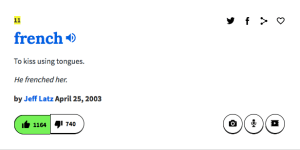
Picture source: screen shot from urbandictionary.com.

The American emotional relationship with France is somewhat complicated, but on the whole, it’s enormously positive.  One linguistic reflection of this is the number of nice things in the world that we call “French” something or other.  I got curious about what those things are called in French.  My methodology for finding the answers: I looked them up on Wikipedia, then followed the link to the French-language page.  Here’s what I found.

French toast:  Everyone loves French toast.  In French, it’s pain perdu–“lost bread.”

French fries: Everyone loves French fries.  In French, they’re frites–“frieds.”  (“D” intended–it’s a past participle.)

French kiss: Who doesn’t remember their first French kiss with fondness?  In French, it’s a baiser amoureux (“romantic/amorous/loving kiss”), a baiser avec la langue (“kiss with the tongue”), or a baiser profond (“deep kiss”).  The French Wikipedia page says that in the 19th century, it was called a baiser florentin (“Florentine kiss”), presumably after the Italian city of Florence.  I hope that any French readers will be amused, and not shocked, to learn that in colloquial American English, to “french” someone means to give them a baiser profond.

French bread: Wikipedia redirects this one to baguette.

French cuff: there’s no separate Wikipedia page for this one, so I don’t know the French-language equivalent.

French window: these actually are quite French, and in French, they’re just called “windows.”

French door: no Wikipedia page for these, so I don’t know the French-language equivalent.

French twist: ditto.

French braid: France actually does take credit for this one–it’s la tresse française. 

French press: this is le piston.

Naturally, the next thing one wants to know is this: what things do French people call “American”?  Here are the things that I’ve been able to find:

le castor américain: North American beaver.

le poing américain: brass knuckles.

le football américain: Football.

le plan américain: a kind of camera angle.

la cuisine américaine: I see this in ads for apartments a lot–I think it means a non-detached kitchen.  I’d show you a picture of mine, but it’s totally draped with drying laundry at the moment.

le frigo américain: a stand-up fridge with two vertical doors.

la sauce américaine: I’ve seen this in the French-speaking part of Belgium, but not in France.  It looks like mayonnaise with ketchup in it–definitely not something that an American would put on French fries.


The smells of France: nice stuff, yucky stuff

2015-12-14 16.18.32
Street sign on campus.  “Guichet Station: variant (way to get there) by the Gutter path.”  Picture source: me.

Brigitte wrinkled her nose as we walked back to the office from the dining hall the other day.  “It smells like an égout around here.”  “This wants to say what, égout?,” I asked.  It turns out to be “sewer.”  This was just the beginning of the sudden appearance in my life of a number of words related to things that wastewater runs through, none of which I knew before.  Zipf’s Law meets the Poisson Distribution, I guess–that is to say, even rare events show up in clusters sometimes.

According to the Wikipedia page on the subject, the first Parisian sewers date back to 1370.  The current Parisian sewer system dates to about 1855, and was ordered by Napoleon III.  The sewers feature in novels occasionally; Wikipedia claims that the battle to clear the sewers of Paris of zombies is one of the most hard-fought battles in Max Brooks’s amazing World War Z (the movie is practically unrelated and not very good), but I believe it was actually the catacombs.  There’s actually a sewer museum in Paris, if you want to know more.

Definitions from WordReference.com:

  • l’égout (m.): sewer, drain; (literary) cesspit.
  • la gouttière: gutter (for draining rainwater from a roof).
  • le caniveau: gutter (at the sides of a street). 

Why is the path in the street sign that is pictured above called le sentier de la Gouttière, the Gutter path?  I’m guessing that it’s because it’s basically a trough-shaped depression in the ground running down one side of the hill on which our campus is located.  Walking down it at this time of year, you smell wet leaves and wood smoke.  It’s a nice way to end my day.

The smells of France: scorched rubber

2015-12-02 10.12.53
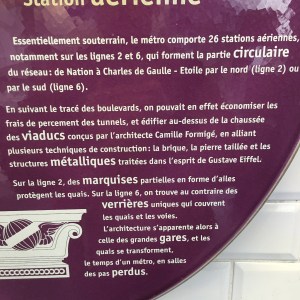
A plaque on the wall of the metro station by my house explaining the phenomenon of the aerial stations in Paris. Picture source: me.

The metro station by my apartment smells like something scorched in the morning. I’ve never been able to imagine why–the entire thing is built of metal, glass, and concrete.

The station is on a line that’s unusual in that part of it is aérienne–above ground, and in fact elevated, like the Chicago L.  The idea behind building some of the lines like this is that one can avoid the expense of underground excavation by building over the routes of the old viaducts.

Both of the aerial lines–2 and 6–offer nice views of Paris at some point of their route.

That smell of scorched something?  It might be rubber–some Googling reveals the fact that my line has rolled on rubber wheels since 1974.

Here are some words that Zipf’s Law brings us by way of the plaque mounted on the wall of the station, pictured above. Definitions from WordReference.com:

  • aérien(ne): air, aerial; (of cables or machinery) overhead; (of a track) elevated; ethereal.
  • notamment: especially, particularly, in particular; including, such as, for example, for instance
  • circulaire: circular; (of a ticket) round-trip.
  • le tracé: outline, drawing; route.
  • économiser: to save, economize.
  • le percement: opening.
  • le tunnel: tunnel; also, a difficult period; also, an advertising break.
  • édifier: to build, to construct.
  • le viaduc: viaduct.

There are lots more Zipf’s Law-type words on the sign, but this is a lot for one day, so let’s leave it at that. See the Wikipedia articles on lines 2 and 6 for specifics of where to get nice views of Paris on these lines.

Ukrainian Humanitarian Resistance

Resisting the russist occupation while keeping our humanity

Languages. Motivation. Education. Travelling

"Je suis féru(e) de langues" is about language learning, study tips and travelling. Join my community!

Curative Power of Medical Data

JCDL 2020 Workshop on Biomedical Natural Language Processing

Crimescribe

Criminal Curiosities

BioNLP

Biomedical natural language processing

Mostly Mammoths

but other things that fascinate me, too

Zygoma

Adventures in natural history collections

Our French Oasis

FAMILY LIFE IN A FRENCH COUNTRY VILLAGE

ACL 2017

PC Chairs Blog

Abby Mullen

A site about history and life

EFL Notes

Random commentary on teaching English as a foreign language

Natural Language Processing

Université Paris-Centrale, Spring 2017

Speak Out in Spanish!

living and loving language

- MIKE STEEDEN -

THE DRIVELLINGS OF TWATTERSLEY FROMAGE