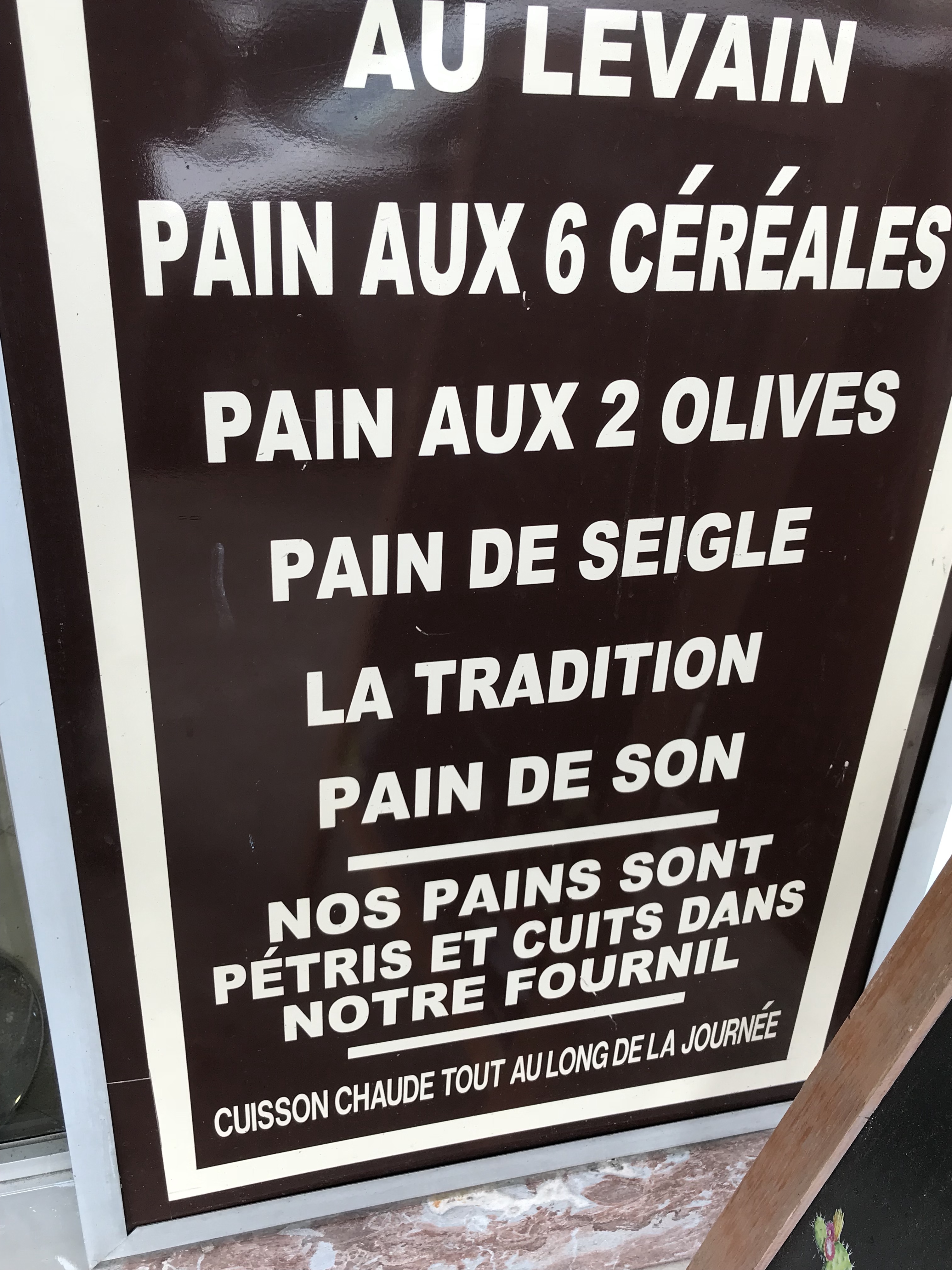
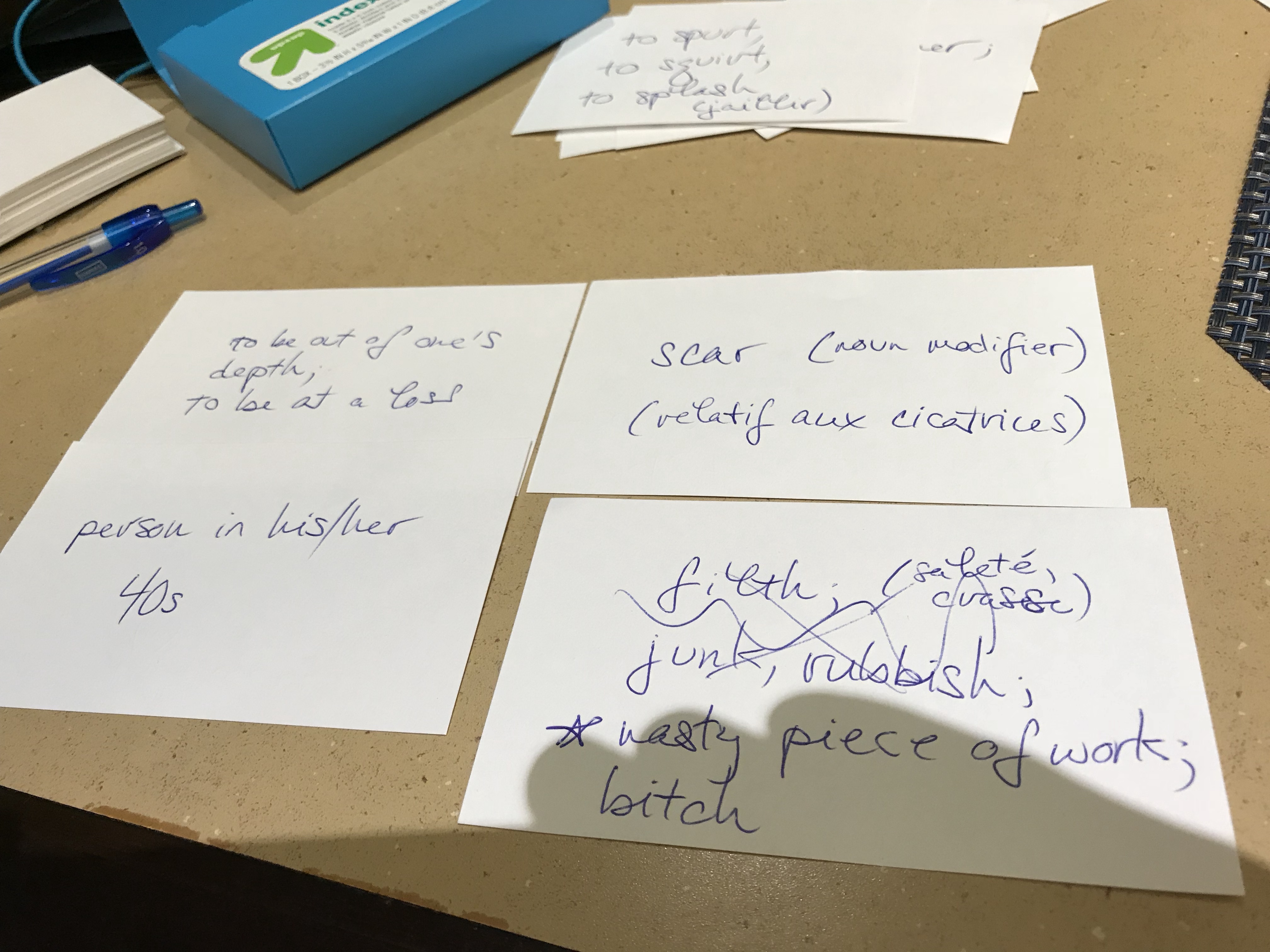
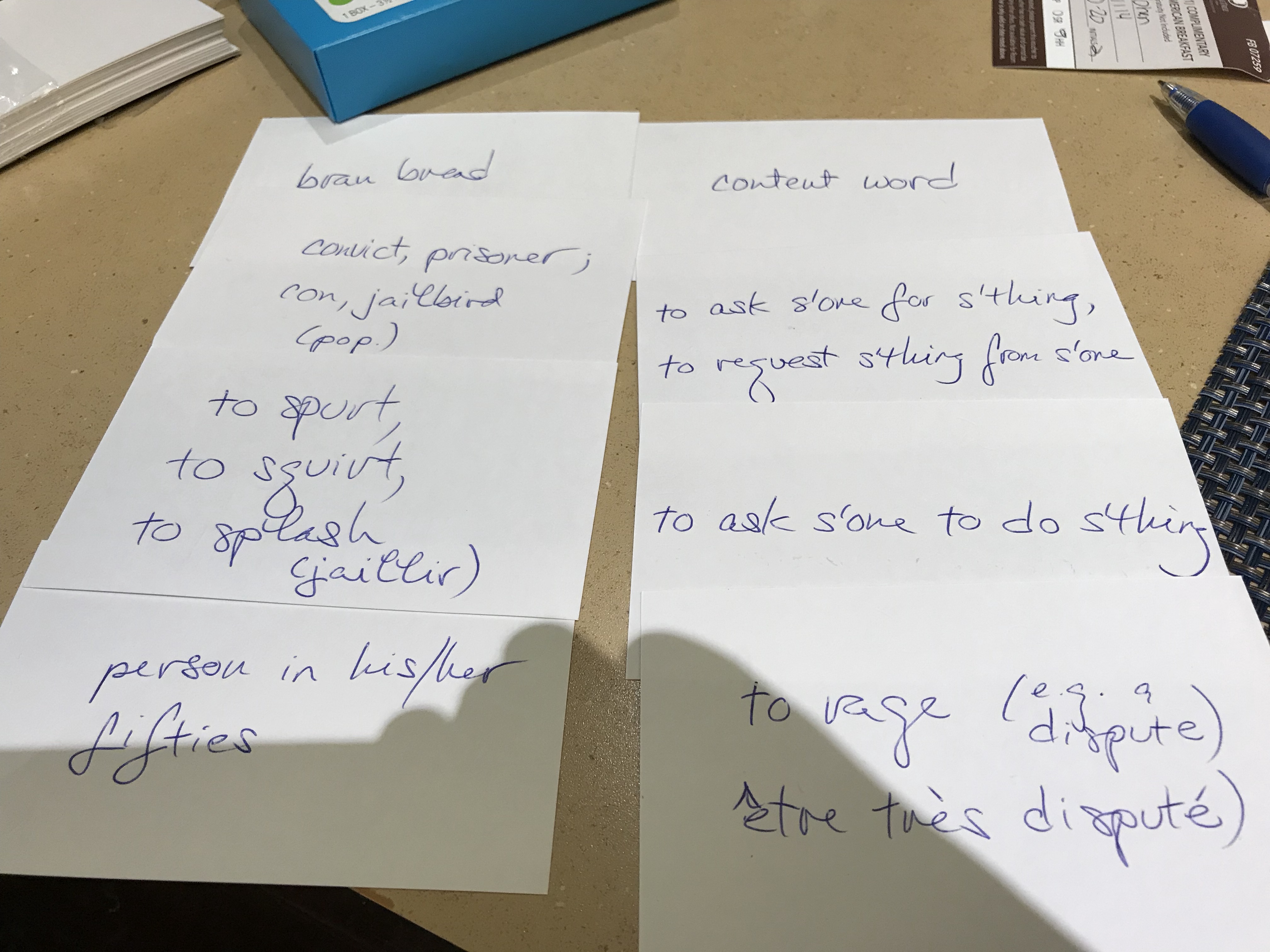
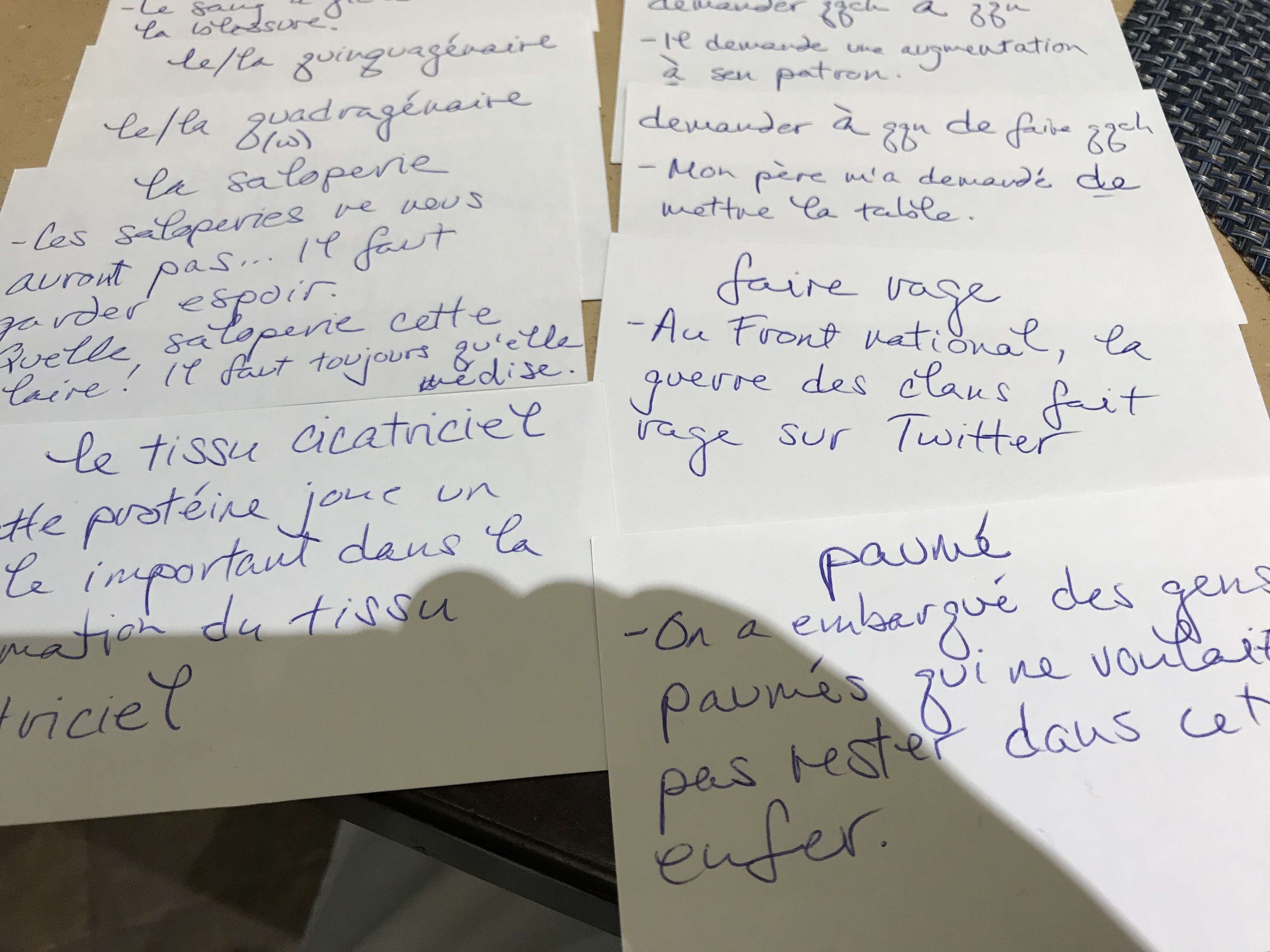
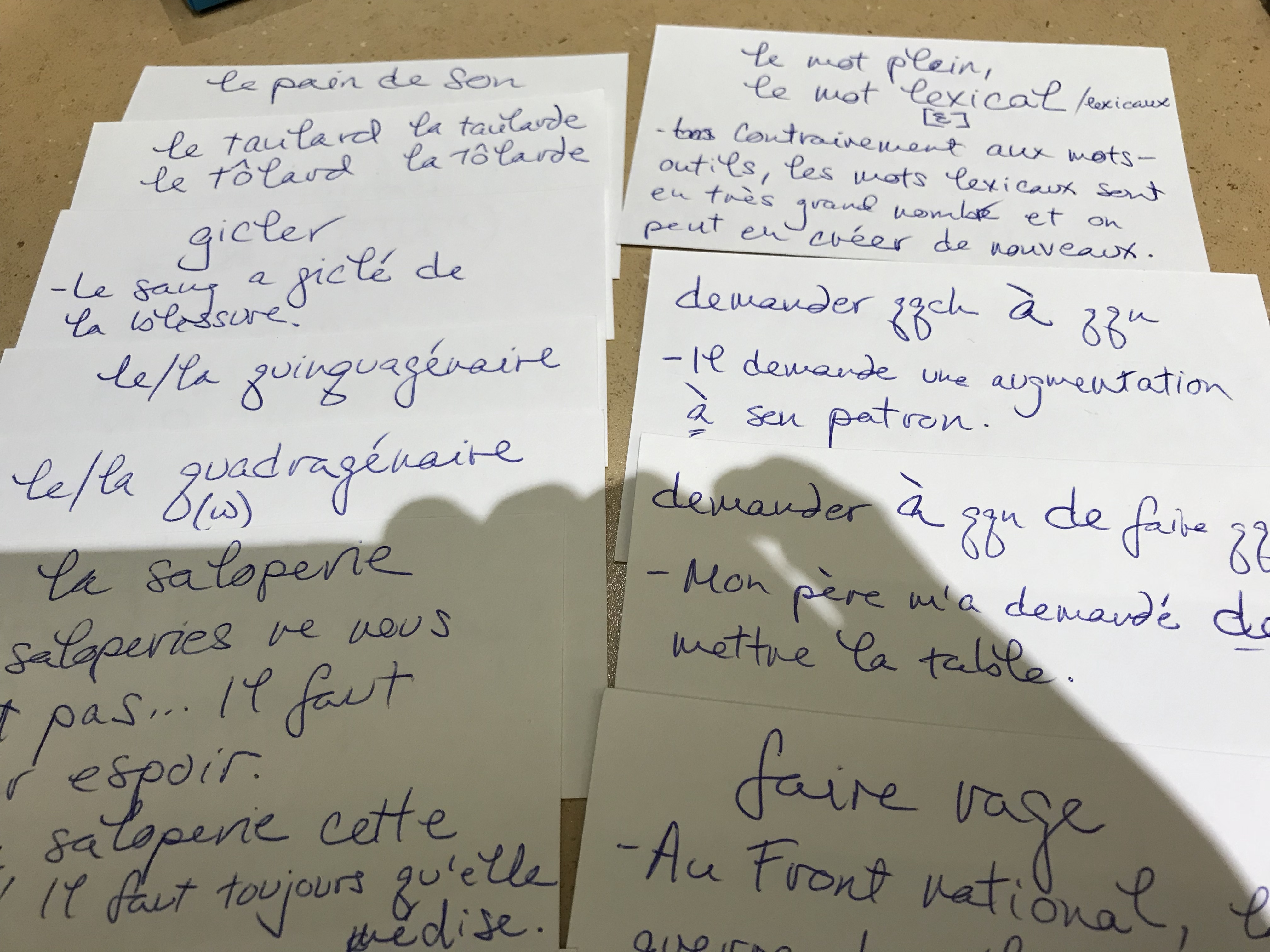
Today’s vocabulary items are brought to you by the Netflix series Marseille (Gérard Depardieu is the coke-snorting mayor of the notorious southern port town–shenanigans ensue) and by the bakery where I usually stop for a coffee, a viennoiserie, and a cigarette before tackling the hill that I have to walk up to get to the lab. I worry that many or most of the words that I learn from Marseille are words that I probably shouldn’t be using in public, but what’s a monolingual American to do? The bakery vocabulary brings out some subtleties of rye bread that I never would have imagined. You’ll notice a couple blanks, as there are a couple of words or expressions that I wasn’t sure how to translate–native speakers, can you help the rest of us out?
One of the things with the biggest effect on what language people will speak to you in Paris comes from the fact that if you’re a tourist, you’re mostly interacting with people in some sort of customer service role.
Today is Wednesday, and Wednesday is market day in my neighborhood, and I need a liter of milk. Normally I would pop into the supermarket across the street for that kind of thing, but if you want good milk–and if you want to support the little things that make life here what it is–you get your milk from a cheesemonger. (Cheesemonger explained in the English notes below.) The Wednesday market has plenty of cheesemongers, so under the metro tracks I went (I’m right by the elevated portion of the #6 line), and a cheesemonger I found. Bingo: lots of bottles of milk. I got in line.
The two most common complaints that I hear from Americans who have visited Paris:
Nobody there speaks English!
I tried and tried to speak French with them, but everybody just answered me in English…
Contradictory, right? How can they both be impressions that are shared by so many people? Seriously —I can’t tell you how many times I’ve heard both of these complaints. Actually, they both reflect the same truth: that what determines the language that people will use with you here is super-complicated. Briefly: you have to think about which language will be used in the context of every single interaction that you have. That interaction takes place with specific people trying to do specific things under a specific amount of pressure. Those people come into those interactions with specific amounts of background in the two languages, and with specific amounts of tolerance for embarrassment. One of the implications of this complicated interaction is that the same person may use a different language with you in different contexts; different people may use different languages with you in the same context. This is so complicated that it will take multiple posts to explain–hence, the title of this post: The two most common complaints of Americans in Paris: Part I.
One of the things with the biggest effect on what language people will speak to you here comes from the fact that if you’re a tourist, you’re mostly interacting with people in some sort of customer service role. The hotel desk clerk, the counter girl at the Monoprix (they’re almost all girls), and most of all, the waiter–these are people who have to deal with a lot of people, and deal with them quickly. In a situation like this, people will use whatever language they think will be most efficient for interacting with you. Your efforts to speak French are actually very much appreciated, but if that counter person or hotel clerk thinks that they’ll be able to take care of your needs and move on to taking care of the next person’s needs most quickly in English, then that’s what they’ll speak with you–if they can. Not everyone here is functional in English (and why would we be??), but if they can, and if they’re in a hurry, they’ll speak English with you if your French isn’t up to a super-efficient interaction.
The lady in line in front of me chez the cheesemonger started asking questions–in English. It was clearly her native language; it was clear that she was struggling to frame her questions simply and clearly–and slowly; and it was clear that the cheesemonger was not getting it, and was not happy. A deep breath, eyebrows down, and a worried look on his face. No problem–I speak English natively and I am passionné du fromage (crazy about cheese), so I jumped into the conversation. The relative strengths of some bleus were discussed; the significance of Mont d’Or in the cycle of the French year was summarized–the cheesemonger was happy to talk about his wares, as long as he could do it in a language that was shared across both sides of the counter. Euros were handed over, cheese was handed over in return, and the nice tourists went away, tickled with both the experience and the anticipation of some good cheese-eating.
I asked for, and received, my liter of milk. On an impulse, I picked up a small St-Félicien. The cheesemonger handed me my bag–and a small, wrapped package. A little something to thank you for the translation, he said. Would he have been happy to speak English with these folks, if he could? More than happy. Was he worried that these non-French-speaking tourists were going to throw his entire waiting line into disarray? Absolutely. Did it all turn out fine, with no hurt feelings on anyone’s part? Clearly. A tiny little moment in the cheesemonger’s day, the tourists’ day, and my day–and yet, pretty illustrative of the complexities of the question of who will speak what language to you, under what circumstances. That waiter who impatiently responds to your carefully-rehearsed-but-nonetheless-halting French in English? If it weren’t the lunch rush, he might very well be up for having a long conversation with you about the rignons de veaux à la sauce de moutard — in your halting French. But, in the context of a busy lunch hour, he’s going to go with whichever language works out most efficiently for getting your order taken and moving on to the next table.
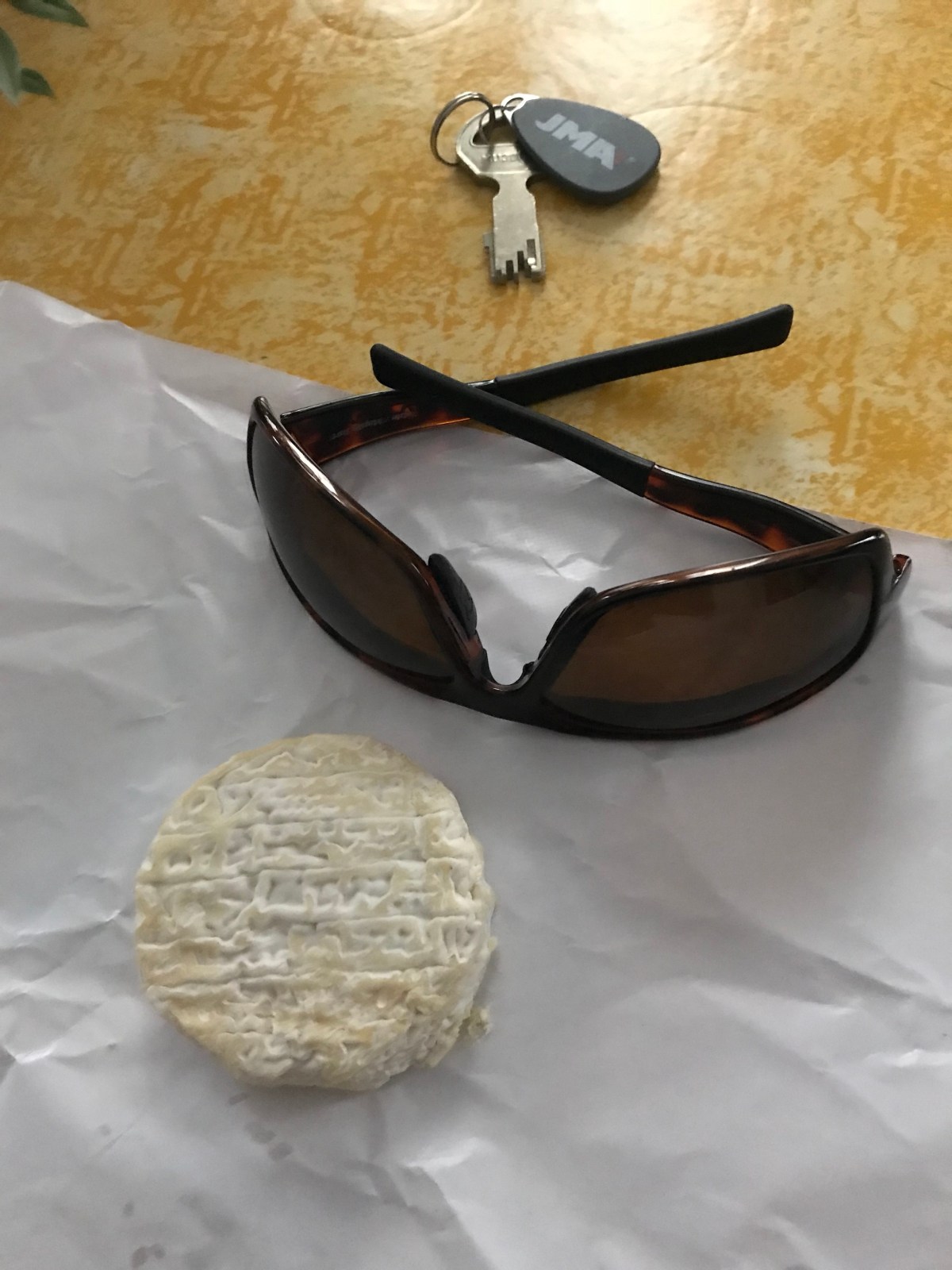
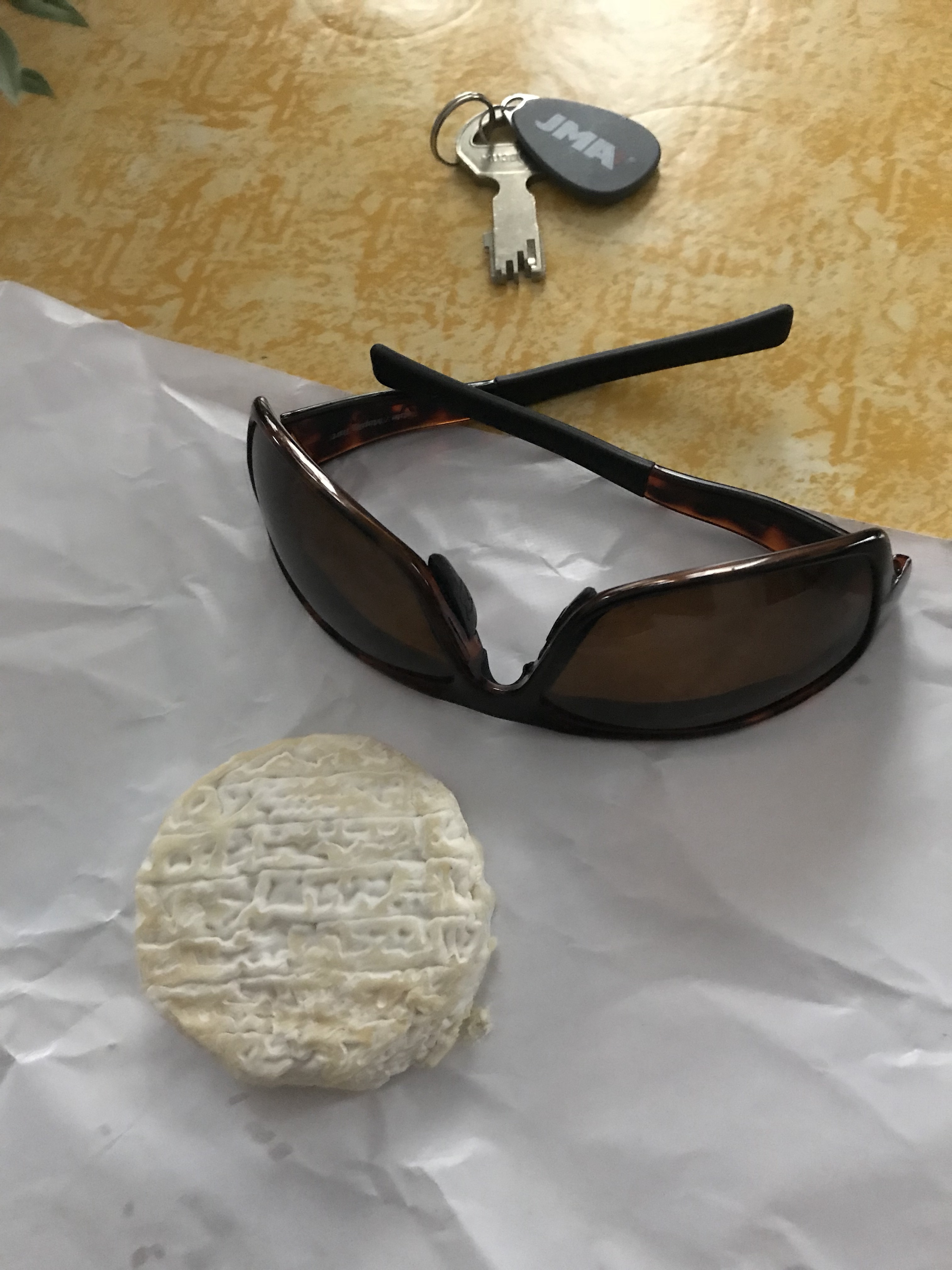
The small, wrapped package contained a cheese. Just a little guy–I’ve included my sunglasses and key in the photo to provide some scale. But, based on what I had ordered, this was a perfect choice–similar to the kind of cheese that he knows I like, ’cause I just bought some (a Saint-Félicien); but, different, in the subtle kinds of ways that lovers of French cheese savor (it’s probably a Saint-Marcellin or a Pélardon (I’ll know when I eat it)). Scroll down for the English notes. Sorry, no French notes today–gotta jump on the train to get my convention d’accueil so that I can RENEW MY VISA! 🙂
English notes
cheesemonger, fishmonger, hate-monger, war-monger: English has a number of words that end with -monger. The basic meaning of this affix is that it is someone who sells something specific. So, a fishmonger sells fish (there are a few of them in the market under the metro tracks; I understand that if they lop the head off of your fish for you, you’re supposed to tip them a euro), while a cheesemonger sells cheese.
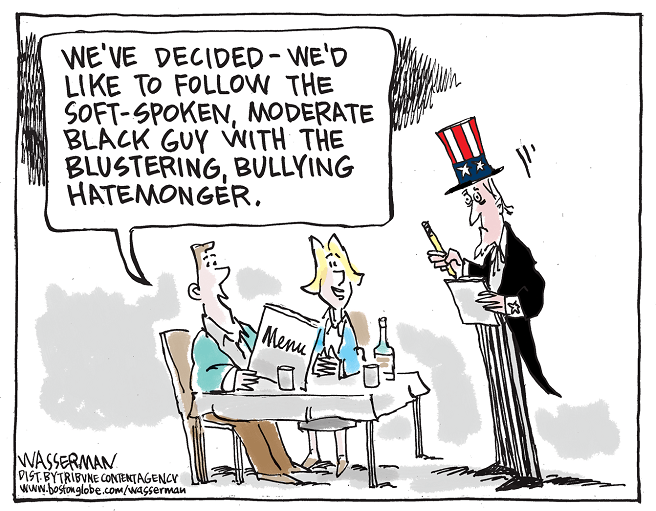
You also see this affix in words referring to people who try to spread something amongst people. A war-monger is a proponent of war; a hate-monger tries to get people to hate other people. Scroll down to see examples of all of these in use; be aware that the spelling of these words can be variable with respect to whether or not they’re written as one word, and if they are written as one word, variable as to whether or not it’s hyphenated.
…and then I start to notice stuff like this going across the screen…
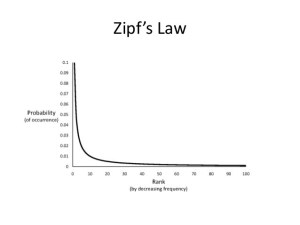
Zipf’s Law: a small number of words occur very frequently, while the vast majority of words occur very rarely–but, they do occur. Credit: @ASvanevik.
Zipf’s Law in brief: languages have a small number of words that occur very, very frequently (English examples: the, I, to, and; French examples: de, la, et, à), and an enormous number of words that occur very rarely–but, they do occur. Consequence for people trying to learn a second language: every day of your life, you’re going to come across words that you don’t know.
Now, even if you suck at math as badly as I do, Zipf’s Law isn’t that hard to wrap your head around–clearly words like the, too, and and are super-frequent, while words like hangnail and glory are not, and clearly there are hella more words (see the English notes below for an explanation of hella) like hangnail and glory than there are words like the, too, and and. However: understanding something in the abstract and really feeling it in your gut are two very different things, right? I mean, you don’t actually expect to get smacked in the face by Zipf’s Law on a regular basis.
And yet…
Translation: ‘”I’m going to do a little fast” versus “I’m going to fuck a young guy”: On the importance of the circumflex accent.’ 3.8 thousand likes, 8.4 thousand retweets, and thanks to Phil dAnge for telling me what it means before I got myself into even MORE trouble with this one than I already had.
Computational linguistics isn’t all drinking beer in Prague and dancing in the park with pretty girls long after midnight in Bulgaria. In fact, far more of it than anyone would guess is writing computer programs to process your data into a form that would let you actually do something fun with it. When you’re working with French, a common step in this procssing is to remove the accents from all of the letters. Yes, this seems like heresy. Yes, this creates ambiguity–jeûne (a fast)becomes jeune (a youth), châsse (reliquary–God, how I love casually dropping that one into a conversation) becomes chasse (hunt), and répéter becomes repéter (Um, Zipf… you have to say répéter (to repeat)—otherwise, you’re saying repéter (to fart again).) But, overall, the increase in ambiguity that comes from the deletion of accents (part of a set of techniques known as normalization of your text) is well-recompensed by the fact that you essentially (and probably counter-intuitively) get rid of a lot of potential errors by your program that way. For example, I work with biomedical data, so I might want to be able to process something like this:
Mon père a perdu l’ordonnance de médicament.
…and alert someone that this guy needs attention. Seulement voilà–the thing is–if I expect everything to be spelled correctly, then I’ll miss this:
Mon père a perdu l’ordonnance de medicament.
…and this:
Mon pere a perdu l’ordonnance de médicament.
…and this:
Mon pere a perdu l’ordonnance de medicament.
…and you don’t want to miss the fact that some little old guy (let’s say, me, but less bald and fat) has lost his prescription, right? So, if you’re working with French, you will probably–quite early in your processing–remove all of the accents from everything. Once you’ve done that, all four of the previous sentences look the same to the computer program, and you only have to write enough code to deal with one of them.
So, the other day I’m sitting in the lab getting ready for a meeting the next morning, and I’m working with French medical data, and I realize that I need some non-medical text so that I have something with which to compare my medical data. (Something to compare my medical data with, in spoken English.) I find some French novels available for free. I start running them through my program….and then I start to notice stuff like this going across the screen:
s’est-il \xe9cri\xe9, et il m’a saut\xe9 au cou. Les autres aussi m’ont embrass\xe9
Not intelligible (at least to a human), but not shocking, either. Here’s the thing: in their guts, computers were made to deal with the English alphabet, and only the English alphabet. Consequently, if you want to work with other languages, you have to find ways to “encode” their letters into a form that the computer can deal with. Those strings of backslashes, numbers, and weird letters are one way of doing that “encoding.”
So: what to do? The easy way out of this would be to replace all of those strings with the appropriate unaccented character. Easy enough: saut\xe9 seems likely to have been sauté once upon a time, and embrass\xe9 was probably embrassé, so replace all of the sequences \xe9 with e, and you’re good to go. Not nearly as glamorous as eating sea cucumbers in Hangzhou, but not super-difficult, either.
Then something like this flashes across your screen:
…l’abbaye de la Chapelle poss\xfc\xbe\x8e\x86\x94\xbcdait deux bergeries à Oye, et recevait la d\xfc\xbe\x99\xa6\x94\xbcme de…
With d\xfc\xbe\x99\xa6\x94\xbcme, we are clearly deep into the “long tail” of the Zipfian distribution. But, being obsessive memorizers of the at-minimum 10 words a day that we come across in our daily lives but don’t know, and being in the midst of Les Misérables, the word dîme (tithe) comes to mind immediately, and seeing the word abbaye (abbey) in the vicinity is all that we need to confirm it. So, now we know that \xfc\xbe\x99\xa6\x94\xbc should be replaced with i, and we go on about our business.
So, yes: Zipf’s Law is a thing–your day is full of words that are very, very rare, but that do occur. And, yes: obsessive memorization of French vocabulary will occasionally get you out of a tight spot at work. And, yes: computational linguistics is not all drinking beer in Prague and dancing in the park with pretty girls in Bulgaria long past midnight–but, when it is, it is so, so good! And, when it’s not–it’s hella better than digging ditches!
English notes
hella: an extremely casual intensifier, it means “very” or “a lot of,” depending on whether it’s modifying an adjective or a noun.
Equivalent to very:
Get you a girl who’s hella goofy, loyal, and will treat you right.. OH WAIT THATS MEEEE AHAAAA
The bathroom looked like a troop of foul-tempered chimpanzees had been in there.
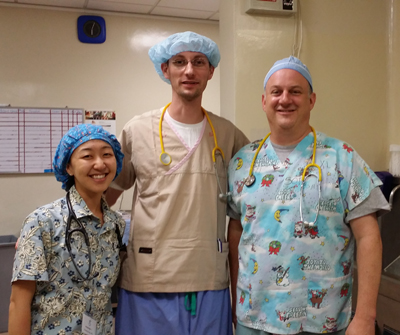
Dr. David Metro (right) and a couple of our anesthesiology residents. The man-baby is NOT pictured. Picture source: Surgicorps.org.
Once a year I go to Guatemala with a bunch of physicians, nurses, therapists, and technicians who use a week of their precious vacation time to provide free surgical care to people who are so poor that even the almost-free national health system is too expensive. One year I woke up on my first morning in-country, having let my roommate have first dibs at the shower–he was an anesthesiologist, and among their other duties, the anesthesiologists show up in the operating suite half an hour before everyone else to check their equipment. He left, I headed into the bathroom, and stopped at the door, shocked beyond words. Minus shit thrown on the walls, the bathroom looked like a troop of foul-tempered chimpanzees had been in there–I knew 5 minutes after meeting the guy that he was somewhere on the uncomfortable-to-be-around end of the Asperger’s spectrum, but didn’t realize until I let him shower first that apparently he’d also spent his entire life thus far with his mother walking behind him, picking up every blessed thing that he dropped on the floor. Towels, a small pond where he’d apparently gotten out of the shower before towelling off, and–horror of horrors–his dirty underwear.
I spent about 30 seconds deciding whether I should spend the rest of the week getting in the shower before this pig or spend the rest of the week cleaning up the bathroom before the maid showed up–it’s a shame to leave a nasty room for a maid. The decision was easy to reach–get in the shower before him, and leave an extra-good tip for the maid. Making it through the week without ripping the guy’s head off was easy, as I was positive about one thing: I would never see this spoiled man-baby again.
The reason that I knew that I would never see him again: he was a resident. In the context of health care, a resident is a physician who has finished medical school and is getting additional training in a specialty. Every year, our group’s chief anesthesiologist, Dr. David Metro, brings two anesthesiology residents to Guatemala with him. He typically brings one male and one female, and the male anesthesia resident is usually my roommate. They’re usually lovely people, happy to spend evenings explaining malignant hyperthermia to me or trying to describe how to intubate a kid for a cleft palate repair. (I am incapable of thinking in three dimensions, and after 5 years in Guatemala, I still can’t quite wrap my head around how you ventilate a kid who’s having a cleft repair done. To wrap one’s head around something explained in the English notes below.)
I’ve written elsewhere about what anesthesiologists contribute to a surgical procedure. (Click here for details, but be forewarned that it’s gory.) Briefly, before the invention of anesthesia, operations could only be done very quickly, which meant that anything much more involved than an amputation wasn’t very practical. The fact that today anesthesiologists can let someone be painless for hours–and then wake them up afterwards–means that we can now do long, complicated surgeries. That means that you can reconstruct a kid’s hand, or repair a baby’s cleft lip, or fix a woman’s disabling uterine prolapse—all of which our group does routinely in Guatemala, and none of which is possible without anesthesia.
On any given day, about half of our operating rooms are staffed by the anesthesiology residents that Dr. Metro brings from the United States. It is both an important educational experience for the residents, and a crucial contribution to the care that we give in Guatemala. As Dr. Metro put it, “The residents maintain the same standards of patient safety that they provide in the United States; here they learn to do it with far fewer technological resources, and they bring those skills back to Pittsburgh with them.”
The man-baby anesthesia resident never came back to Guatemala, of course. My roommates in subsequent years have included a delightfully Christian guy who had been on other missions elsewhere–and who spoke quite competent Spanish, which he learnt while working his way through college as a bartender; a very bald, very muscled young man who convinced me that I, too, could go full Yul Brynner with just a hand-held razor and a careful hand; the guy who enthusiastically followed me on my peripatetics to pick up my laundry on the crappy side of town, and then surprised me by ordering the very expensive room service every night, which admittedly did make more sense when I overheard his long phone calls about his investments. Currently the only man-baby in my life is the President of the United States of America, but I don’t have to use Trump’s bathroom, so as long as he doesn’t get us into a nuclear war because someone hurt his feelings (remember how he always said that Hillary wasn’t “tough enough”?), take away 20 million poor people’s health insurance to give yet another tax break to the wealthy, or sell us off to Russia because He Just Wants To Be Loved, it’s all good. (See here for a military person’s perspective on the Draft-Dodger In Chief…)
…and you know what else? That man-baby anesthesiology resident might have been a messy, entitled, arrogant slob, but he was a messy, entitled, arrogant slob who spent a week of his life making it possible for kids to get their hands reconstructed, and for babies to get their clefts repaired, and for women to get their disabling uterine prolapse fixed. That’s more than man-baby Donald Trump ever did–with all of his billions…
Enjoying these posts from Guatemala? Why not make a small donation to Surgicorps International, the group with which I come here? You wouldn’t believe how much aspirin we can hand out for the cost of a large meal at McDonald‘s–click here to donate. Us volunteers pay our own way–all of your donations go to covering the cost of surgical supplies, housing for patients’ families while their loved one is in the hospital, medications, and the like.
English notes
to wrap one’s head around something: to understand something; to absorb an idea or a concept. It’s usually used in a situation in which understanding something was or is difficult for you. Some examples:
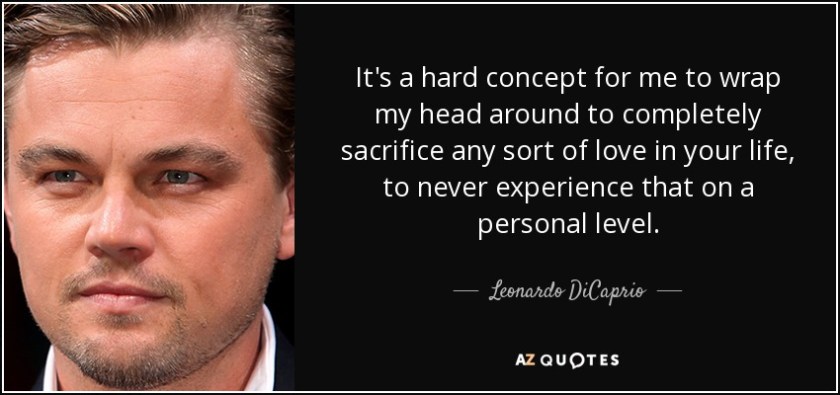
The wife of the Alexandria, Virginia, gunman says she’s shocked about the attack and had no idea what her husband was planning. “I just don’t know what to tell you people. I had no idea this was going to happen and I don’t know what to say about it. I can’t wrap my head around it, OK?” Sue Hodgkinson said. (CBS News)
I can’t wrap my head around my mother’s concept of a ‘Good Girl.’ Can you? (Avantika Says)
My five-year-old (once she wrapped her head around the fact that this particular gummy bear isn’t candy) begged to go to bed at four in the afternoon because she was so eager to use the Gummylamp as a nightlight. (Wired.com)
Hamill said that even hours before the ceremony, he hadn’t wrapped his head around receiving the honor (Daily Herald)
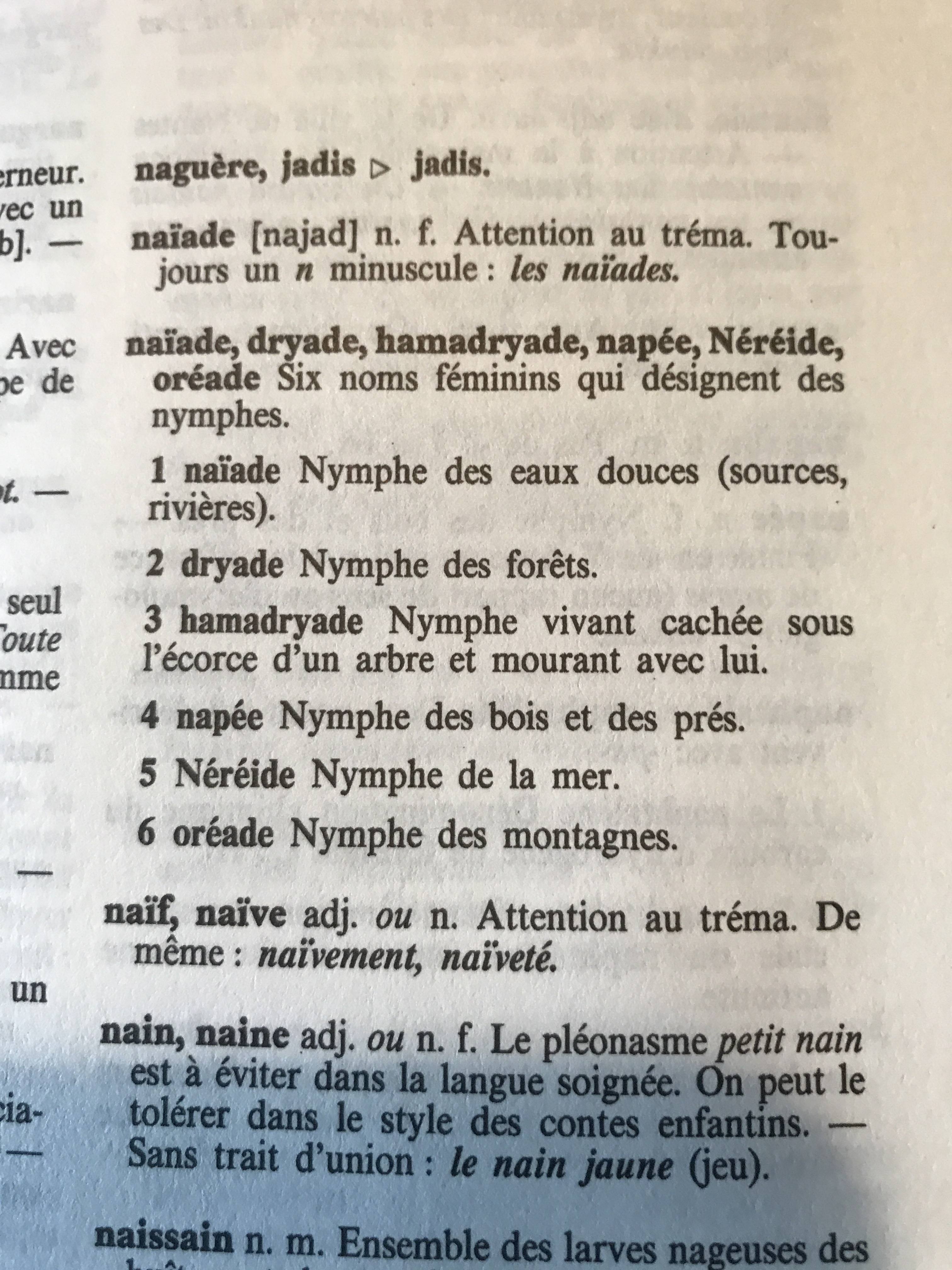
Just in case we need it today, here’s a practical guide to keeping your nymphs straight, from the immortal Pièges et difficultés de la langue française, by Jean Girodet. This book is so indispensable that I have two copies–one for at home in France, and one for when I’m in the US. Mind you, I couldn’t find an entry in it on the subject of whether or not you use the subjunctive after the word possibilité–but, at least I have some confidence that if I need to talk about a nymph today, I’ll use the correct noun…
Of all of my students, this is the one on whom my work habits rubbed off.
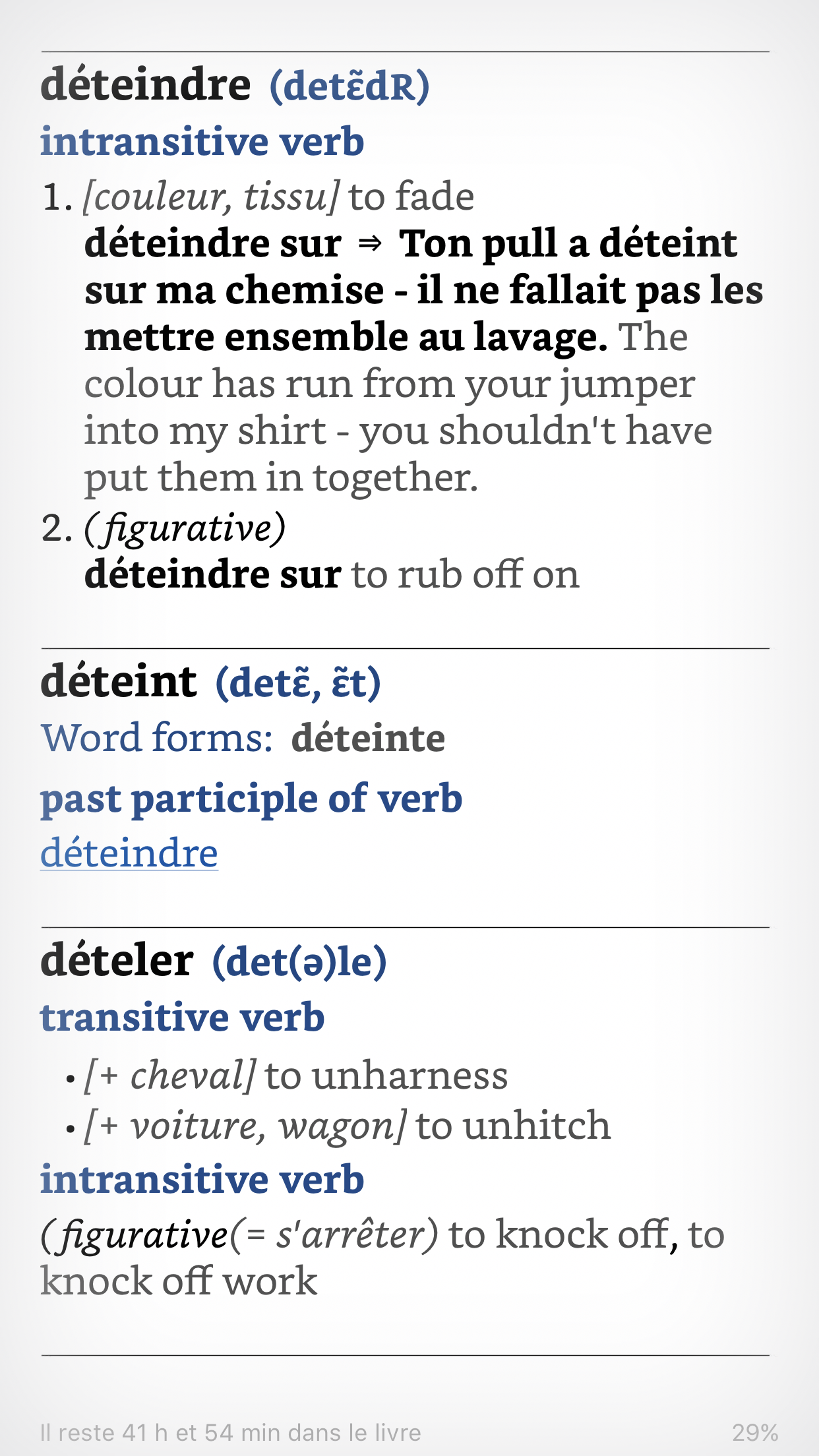
Déteindre sur: to rub off on. Ton pull à déteint sur ma chemise–il ne fallait pas les mettre ensemble au lavage. (Collins French-English Dictionary) Why ensemble and not ensembles, I have no clue…
Source: Yadav et al. (2017), Semantic relations in compound nouns: Perspectives from inter-annotator agreement
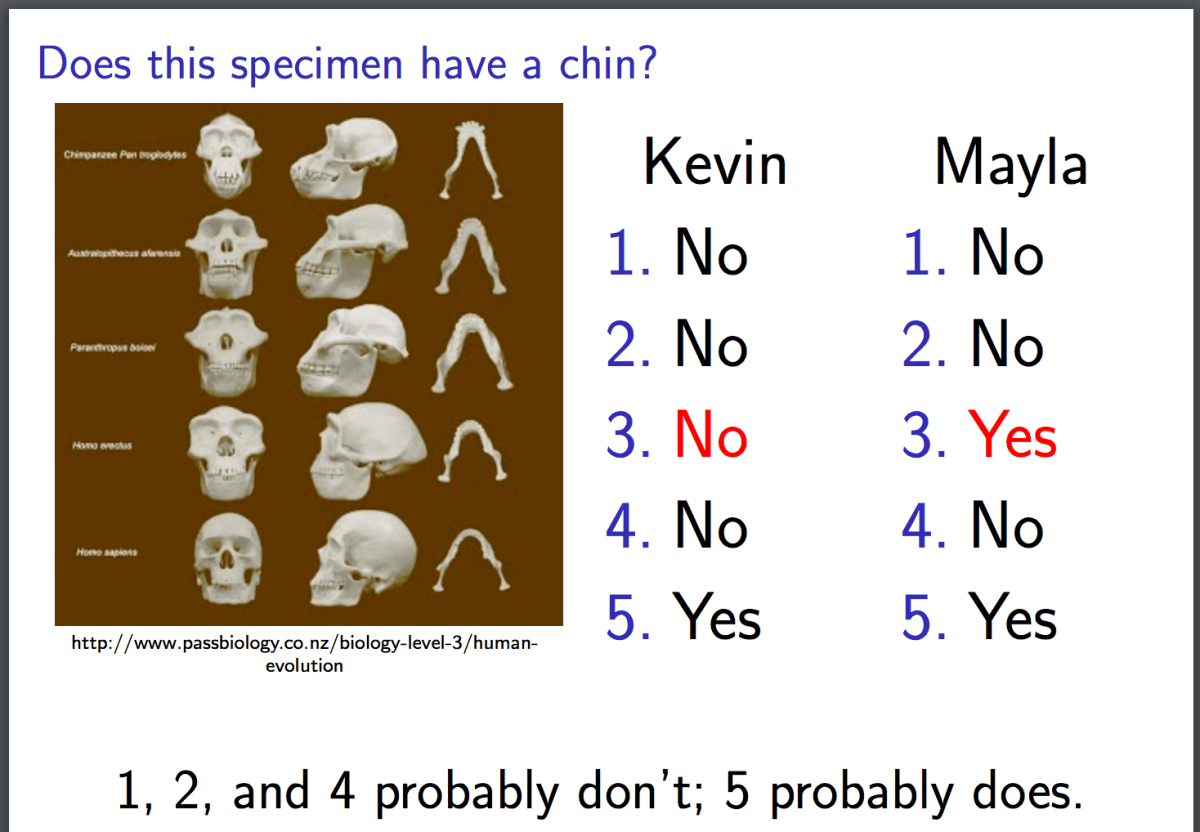
Question : Coucou, C’est quoi Cohen’s kappa ?
Réponse : Ce n’est pas moi, ce Cohen. 🙂 Cohen’s kappa est une façon de calculer l’accord entre deux personnes. Par exemple : Diap. 11, les deux personnes sont d’accord l’une avec l’autre 4/5, donc 80% des fois. Cohen’s kappa essaie de prendre en compte la possibilité d’être d’accord juste par hasard. On peut dire que la probabilité d’être d’accord juste par hasard, c’est 50% en ce cas. Imaginez qu’au lieu de bien zyeuter les crânes, chacun fait pile/face. On a donc ces possibilités :
Kevin oui, Mayla oui : 0.25
Kevin oui, Mayla non : 0.25
Kevin non, Mayla oui : 0.25
Kevin non, Mayla non : 0.25
Voilà les deux cas où ils sont d’accord :
Kevin oui, Mayla oui : 0.25
Kevin non, Mayla non : 0.25
0.25 + 0.25, cela fait 0.50. Donc, ils peuvent être d’accord 0.50 (50%) des fois… par hasard–rappelez-vous qu’ils ont fait pile/face.
Le calcul du kappa de Cohen, cela se fait comme ça :
…donc on prévoit que le kappa de Cohen, c’est toujours moins que l’accord “cru.” Vu que l’on ne veut pas surestimer la performance, on utilise le kappa de Cohen pour éviter cela.
Question : C’est un genre de coefficient correcteur de réalité j’ai l’impression pour ne pas s’emballer sur des résultats in vivo qui parfois peuvent être faussés par le caractère très humains des annotateurs. Enfin je crois comprendre ça 🙂
Réponse : Tu l’as dit mieux que moi ! 🙂
Why would anyone want to label skull specimens as to whether or not they have chins? See this post, and be sure to read MELewis‘s comment.
French notes
l’accord inter-annotateur : inter-annotator agreement. See a nice set of slides on the topic, in French, here.
zyeuter : to scrutinize. It seems like a soutenu word, but given the book where I ran across it, I would expect it to be familier. (Comment from native speaker Phil dAnge: zyeuter is definitively not “soutenu”but completely “familier, limite argot ”)
As far as I know, no videos of Morning Dance Party exist.
Thelenota ananas, a species of sea cucumber. Credit: By Leonard Low from Australia – Flickr, CC BY 2.0, https://commons.wikimedia.org/w/index.php?curid=1552175I mostly relate to places through two things: food, and language. (Presumably it would be better to be relating to people, rather than to places, but in the absence of a shared language, relating to people is difficult.) Both of those–food, and language–get you pretty quickly into odd and difficult-to-resolve questions of what one might call “authenticity:” people never want to teach you slang, but it’s the thing that interests the typical linguist-on-the-road the most; we’re all always looking for that “real” svíčková na smetaněin Prague, but looking for “real” anything these days gets you into either fun conversations about cultural appropriation or fun conversations about post-modernity, both of which are fairly instant buzz-killers for anyone other than, say, me and the two other people in the universe who enjoy talking about cultural appropriation from the perspective of post-modernism without having slept very much the night before. (Obviously, I’m not a very fun date–this may be related to my shitty divorce record.)
I think I cracked the “authenticity” nut on a recent evening in Hangzhou, though, where I had the funnest experience I’ve ever had in China that didn’t involve me, my niece and nephew, and Morning Dance Party. (As far as I know, no videos of Morning Dance Party exist, and we should all be thankful for that.) A colleague took me out for dinner to a buffet at a place that he described as typical and reasonably priced–the kind of place that any family could afford to go to. Indeed, it was packed with families–imagine a very loud room filled with long tables, those long tables filled with big families talking, laughing, and passing an ever-growing assortment of plates back and forth while various and sundry foods hiss over a grill built into the table.
The way that the restaurant works: you wander around and pick things from an enormous selection, then take them back to your table, where you grill them. When I say “enormous,” bear in mind that I’m talking about China here–“enormous” in China is really big. Then think about this: I only recognized perhaps 10% of the available foods. Some fruits; some vegetables; duck gizzards, certainly, and I guessed the avian liver correctly, too. But, for the most part, I hadn’t the faintest clue what I was looking at.
Zipf’s Law describes an important characteristic of language: about 50% of the words in any large sample of words almost never occur–but,they do occur. The word that came up in the Chinese restaurant: trepang. As a verb, Wikipedia defines it like this:
Trepanging is the act of collection or harvesting of sea cucumbers…
“Not to be confused with trepanning,” it adds. Indeed, indeed.
Zipf’s Law takes you into some pretty out-of-the-way corners of the lexicon. As Wikipedia points out, to trepang is a member of a larger group of English verbs. A trepang is a sea cucumber–a marine invertebrate animal related to starfish and crinoids. Totrepang is to harvest sea cucumbers, and in having that relation between the noun and the verb meaning to harvest things that are labelled by that noun, it resembles a number of more-familiar verbs. From Wikipedia again:
Other than the pure joy of having a verb that means “to collect or harvest sea cucumbers,” what’s interesting about this? In science, “interesting” usually means “different from what you would expect based on what you already know.” The interesting thing here, then, is that there are other verbs that come from a noun that refers to an animal–but, they don’t mean “acquisition of.” Consider, for example, the verb to flea. Don’t look for it in Merriam-Webster—it’s not there. What it means is to remove fleas from. It’s a transitive verb–here’s an example from a forum on pets:
Source: http://www.petforums.co.ukThe poster has a cat, the cat has fleas, and the poster would like to cause the cat to no longer have fleas, but is concerned about the fact that the cat has recently had kittens. Thus: Can I flea my cat a week after she’s had kittens?
To foal is another verb that comes from a noun that refers to an animal. A foal is a young horse, and to foal is to give birth to a foal. It can be transitive or intransitive:
I would say she willfoalin less than a week. (Intransitive. Source: enTenTen corpus, from Sketch Engine.)
Animal science students have been involved with the entire process of preparing the horses tofoaland bringing them to campus. (Intransitive. Source: enTenTen corpus, from Sketch Engine.)
Ada had just been up four hours helping tofoala horse and wasn’t prepared for the intrusion of the outside world. (Transitive. Source: enTenTen corpus, from Sketch Engine.)
To lamb is a similar verb–Merriam-Webster gives the example The ewes will lamb soon.
Getting into conversations like this over dinner is probably why I get divorced a lot, so I’ll point you to this YouTube video, One way to flea a cat, and get on with my day–I need to run a bunch of experiments on how to split up words in sentences in biomedical journal articles…
At some point in their life, everyone should spend some time in a place where they’ll be stared at
Picture source: me.
It’s 1981, and my ship has pulled into Istanbul for a week. Being a stupid young sailor, I’m wandering around alone. I pass some old men sitting on a stoop drinking tea (a common pastime for old men in Turkey). One of the old men gets up, walks over to me, spits on a finger, and tries to rub one of my many tattoos off. When he can’t, he shakes his head in disgust and sits down again.
It’s 1981, and my ship has pulled into Istanbul for a week. Being a stupid young sailor, I’m wandering around alone. Going down a busy street, I suddenly find myself surrounded by a crowd of young men. One of the guys emerges from the crowd, and in broken English starts translating for the rest of the crowd, telling me everything that they have to say about how much they love my tattoos.
It’s 2016. I’m waiting in line at an art show in China. A guy walks up to me: excuse me, I can take picture of you with my children? Sure, why not? Smiles all around as pictures are snapped, and we all go back to waiting in line.
My job and my pastimes take me far and wide, and in some of the places that they take me, I look unlike anyone else. Japan, Guatemala, China, Mexico, Turkey–in all of them, I am a “white guy,” a light-skinned, blue-eyed guy in a country where everyone else is brown-skinned, with black hair and brown eyes. In some of those countries, I go places where I may be the only “white guy” that I see all day, and in those countries, I get stared at–a lot. It’s not just me–it’s the experience of any Westerner in those places.
What I’ve learnt in those countries: how good it can feel to be smiled at. This morning I took a walk along the riverfront in Hangzhou, China. Men (and a couple women) did tai chi alone. Women (and a couple men) did synchronized dancing to music. Grandmothers pushed strollers, and grandfathers jogged–often in business casual–occasionally omitting a loud yell or two. (I have no clue what the purpose of the yells is–native speakers, do you have any insight into this?) For 45 minutes, I was the only “white guy” that I saw.
It was unusual for people not to stare at me. Sometimes out of the corner of their eyes, and sometimes quite openly, but almost everyone stared. Some of them, though–some of them smiled at me, too. 你好, they might say. 你好, I would answer. I waved at little kids, and their grandmothers smiled–and made them wave back at me if they were too shy to do it on their own. Not big-deal interactions–but, it always felt so good. What it cost them: nothing. What it gave me: a lot, actually.
I maintain that at some point in their life, everyone should spend some time in a place where they’ll be stared at. It’ll teach you the value of a smile for someone who doesn’t seem to fit. Lots of people get stared at in today’s America–Muslim women in hijab. Black men in nice hotels/white neighborhoods/academic conferences. Any woman at all in a computer science department. A smile at someone else costs nothing–and can give a lot.
English notes
on being stared at: I include this one in the English notes because of the commonly-taught, commonly-believed old bullshit that there’s something wrong with ending a sentence with a preposition. Is on being stared at English? Absolutely. Is there any other way to say it? Not that I know of.
their life: This is a good example of the use of a third-person plural pronoun to refer to a singular person. Since there is no reason to assume any particular gender here, some dialects of English use their gender-neutral pronoun, which looks like the plural pronoun, but in this context is not. You can read more about this phenomenon here.
stoop: Besides being a verb with a number of different meanings, stoop can also be a noun. Merriam-Webster defines it as a porch, platform, entrance stairway, or small veranda at a house door. How I used it in the post: I pass some old men sitting on a stoop drinking tea (a common pastime for old men in Turkey).















 Zipf's Law