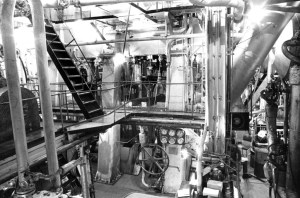
Engine room of the Liberty Ship John W. Brown. Picture source: https://goo.gl/aT2YhF
I spent my last few years in the Navy working in cardiac catheterization labs, doing physiological monitoring–mostly hemodynamics and electrophysiology. I started out on a ship, though–working in the engine room of a guided missile cruiser. It was hot down there–the coolest that it got was under one of the giant air vents, where it was about 100 degrees Fahrenheit (37.8 Celsius).
The good side of being on a naval vessel is visiting cool ports of call, seeing the sun and the moon both in the sky at sunrise after a midnight watch, eating roasted squid in Spain–stuff like that. The bad side is the Navy’s equivalent of combat training. At the time, that involved a few weeks in the Caribbean, doing “casualty drills” over, and over, and over again, until you could get them right over, and over, and over again.
When a ship is on the receiving end of a nuclear, chemical, or biological attack, you put on gas masks, and you shut its openings down completely while some guys put on serious protective gear, go up on the decks, and scrub down every inch of the vessel. This takes a long time–my ship, the USS Biddle, was 547 feet (167 meters) long.
So, there you are down in the engine room. The alarm for an NBC attack (nuclear/chemical/biological) is sounded. You put on your gas mask and you shut off all of the ventilation–in a space where it was already 100 degrees Fahrenheit in the cool places. Then you watch the temperature start to rise.
When you learn how to put on a gas mask, they teach you what to do if you vomit with the gas mask on. (If you can think of a way to not end that sentence with a preposition, I’d love to hear about it.) This is super-necessary, because one of the old dirty tricks of gas warfare is to mix in an emetic with the gas. An emetic is something that makes you vomit–the idea is to get you vomiting in the hopes that you’ll rip your gas mask off, in which case you’re toast. (To be toast explained in the English notes below.) So, you know what to do if you vomit–but, there’s nothing to be done about what happens when you’re in a super-hot space with a gas mask on, which is that the parts around your eyes fill up with sweat to the point that you can’t see anymore. We’d sit there, our eye ports filling up with sweat, and watch the thermometer go up, and up, and up.
The temperature in an unventilated engine room goes up fast. Around 120-130 degrees, the air is so hot that it’s painful to breathe, and when I say painful, I mean really painful. It’s very quickly so hot that they call it a day for the engineering spaces and let you take off your gas mask and open the ventilation again. Now, as I said, it takes a long time to scrub down a ship–but, it was clear to everyone that there was no way that we were going to be able to survive that long with the ventilation shut down. So much for What To Do In Case Of NBC Attack.
Today’s bow to National Poetry Month is about a gas attack. It’s by Wilfred Owen, an Englishman who fought in the Great War. You tend to think of poets as wispy, ethereal types who you wouldn’t want backing you up in a tight spot; Wilfred Owen is a pretty good counter-example to this widely-held prejudice. He was one of the great poets of the First World War–the poem that you’ll find below was the first one I ever memorized that didn’t involve words that I don’t really dare to put on this blog. He was also a gay man who wrote what appears to be a poem about anonymous sex–and a decorated military hero who volunteered to go to the front repeatedly, even after being wounded twice in artillery shellings. He was awarded the Military Cross–here’s the text of the commendation:
For conspicuous gallantry and devotion to duty in the attack on the Fonsomme Line on October 1st/2nd, 1918. On the company commander becoming a casualty, he assumed command and showed fine leadership and resisted a heavy counter-attack. He personally manipulated a captured enemy machine gun from an isolated position and inflicted considerable losses on the enemy. Throughout he behaved most gallantly. (Copied from Wikipedia.)
Before the war, he spent several years teaching French and English in France. He died there just days before the Armistice–in action.
DULCE ET DECORUM EST
by Wilfred Owen
blood-shod is an amazing neologism. “To be shod” means something like “to have footgear (e.g. shoes, boots, and the like).” Examples below in the English notes.
Bent double, like old beggars under sacks,
Knock-kneed, coughing like hags, we cursed through sludge,
Till on the haunting flares we turned our backs
And towards our distant rest began to trudge.
Men marched asleep. Many had lost their boots
But limped on, blood-shod. All went lame; all blind;
Drunk with fatigue; deaf even to the hoots
Of gas-shells dropping softly behind.
Gas! GAS! Quick, boys!—An ecstasy of fumbling
Fitting the clumsy helmets just in time,
But someone still was yelling out and stumbling
And flound’ring like a man in fire or lime.—
Dim, through the misty panes and thick green light,
As under a green sea, I saw him drowning.
In all my dreams before my helpless sight
He plunges at me, guttering, choking, drowning.
“…the white eyes writhing in his face…” Victim of gas attack by the Syrian government. Picture source: https://goo.gl/6nHTK6
If in some smothering dreams you too could pace
Behind the wagon that we flung him in,
And watch the white eyes writhing in his face,
His hanging face, like a devil’s sick of sin,
If you could hear, at every jolt, the blood
Come gargling from the froth-corrupted lungs,
Bitter as the cud
Of vile, incurable sores on innocent tongues,—
My friend, you would not tell with such high zest
To children ardent for some desperate glory,
The old Lie: Dulce et decorum est Pro patria mori.
You can find readings of this very famous poem here.
English notes
Examples of shod:
All horses’ hooves are healthier without shoes, and barefoot horses are healthier than shod horses. (Source)
…con el cabello gris, me acerco a los rosales del jardín…
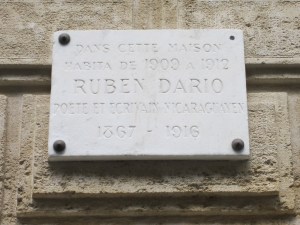
Darío lived in Paris for 4 months–who knew? 4, rue Herschel, 75006. Picture source: DanielaBPSept.
For National Poetry Month, here’s some Rubén Darío. I first came across this poem sitting in a night class at Old Dominion University, purveyor of fine educational experiences to a wide range of traditional and non-traditional students, including a hell of a lot of sailors. The first stanza was carved into the top of the desk at which I was sitting (the desk I was sitting at, more commonly):
Juventud, divino tesoro,
¡ya te vas para no volver!
Cuando quiero llorar, no lloro…
y a veces lloro sin querer…
Youth, divine treasure, // you’re gone, never to return! // When I want to cry, I can’t… // and sometimes I cry without wanting to….
I thought it was the saddest thing I’d ever read, and in isolation, it most certainly, certainly is.
In isolation. And, oddly: even more so at 25 or so than at 55.
Eventually, I tracked down the rest of the poem–much harder back in those pre-Google days–and made it to the end.
Mas a pesar del tiempo
terco, mi sed de amor no tiene fin;
con el cabello gris, me acerco a los
rosales del jardín…
But despite pig-headed // time, my thirst for love is endless; // gray-haired, I approach the rose-bushes in the garden…
(Don’t feel bad–I had to look up terco, too.)
As the grandson of a man who started a new family in the United States in his 60s (¡muy fuerte!, say my Mexican buddies when I tell them the story–I’ll spare you the accompanying gesture of admiration), I think I get the metaphor. You go, pépère. You go, Rubén. Do I ever cry without wanting to? Rarely–I am certainly an American male of my generation–but, yeah: it happens. Nonetheless: I’m headed out to the back porch for a cigarette next to the lilacs, and the plum tree, and the flowering chestnut…
JUVENTUD DIVINO TESORO DE RUBEN DARIO
Juventud, divino tesoro,
¡ya te vas para no volver!
Cuando quiero llorar, no lloro…
y a veces lloro sin querer…
Plural ha sido la celeste
historia de mi corazón.
Era una dulce niña,
en este mundo de duelo y de aflicción.
Miraba como el alba pura;
sonreía como una flor.
Era su cabellera obscura
hecha de noche y de dolor.
Yo era tímido como un niño.
Ella, naturalmente, fue,
para mi amor hecho de armiño,
Herodías y Salomé…
Juventud, divino tesoro,
¡ya te vas para no volver!
Cuando quiero llorar, no lloro…
y a veces lloro sin querer…
Y más consoladora y más
halagadora y expresiva,
la otra fue más sensitiva
cual no pensé encontrar jamás.
Pues a su continua ternura
una pasión violenta unía.
En un peplo de gasa pura
una bacante se envolvía…
En sus brazos tomó mi ensueño
y lo arrulló como a un bebé…
Y te mató, triste y pequeño,
falto de luz, falto de fe…
Juventud, divino tesoro,
¡te fuiste para no volver!
Cuando quiero llorar, no lloro…
y a veces lloro sin querer…
Otra juzgó que era mi boca
el estuche de su pasión;
y que me roería, loca,
con sus dientes el corazón.
Poniendo en un amor de exceso
la mira de su voluntad,
mientras eran abrazo y beso
síntesis de la eternidad;
y de nuestra carne ligera
imaginar siempre un Edén,
sin pensar que la Primavera
y la carne acaban también…
Juventud, divino tesoro,
¡ya te vas para no volver!
Cuando quiero llorar, no lloro…
y a veces lloro sin querer.
¡Y las demás! En tantos
climas, en tantas tierras siempre son,
si no pretextos de mis rimas
fantasmas de mi corazón.
En vano busqué a la princesa
que estaba triste de esperar.
La vida es dura. Amarga y pesa.
¡Ya no hay princesa que cantar!
Mas a pesar del tiempo
terco, mi sed de amor no tiene fin;
con el cabello gris, me acerco a los
rosales del jardín…
Juventud, divino tesoro,
¡ya te vas para no volver!
Cuando quiero llorar, no lloro…
y a veces lloro sin querer…
¡Mas es mía el Alba de oro!
I can’t find a picture of Dimitar Pantaleev, so here’s a picture of Schliemann’s wife. I’ve loved it since childhood, though I couldn’t tell you why. Here she’s dressed in jewelry that they dug up in Turkey. Picture source: Storia Illustrata n. 167. Public domain.
My father once told me that the archaeologist Heinrich Schliemann spoke 14 languages, all of which (other than his native German) he learnt by memorizing a book in the language. Whether or not this is true, I don’t know–my father’s level of willingness to just make things up is non-zero (although never malicious). But, memorizing things in your language of choice makes as much sense to me as any other way of learning a language, and it’s certainly more fun than memorizing long lists of vocabulary. Unfortunately, my choices of what to memorize are mostly drawn from the stuff that I like to read, which means that (from what I’m told), way too much of what comes out of my mouth is either off-color (Céline, Queneau) or marivaudage (Laclos, Molière). (See the English notes below for what off-color means.)
As National Poetry Month continues, here’s the first poem that I ever tried to memorize in Bulgarian. I only got as far as the first stanza, which may explain why my Bulgarian sucks (see here for a good example of the trouble you can get into when you don’t speak Bulgarian quite as well as you think you do). By Dimitar Pantaleev, in theory it’s a Communist poem, although I don’t understand why, since it’s entirely anti-authoritarian–the title means I cross against a red light. Also, as far as I can tell, he was considered a formalist, and Communists (Reds, if you will) were pretty anti-formalism, to the best of my (very limited) knowledge.
Amazingly, the poem was recorded as a song by the officially government-sanctioned rock group Diana Express. The production is as unfortunate as most music recorded in the 1980s that wasn’t either Joan Armatrading, Simon and Garfunkel, or Elton John, which isn’t to say that you shouldn’t spend $0.99 (literally) to buy it on Amazon, just for its inherent cool-value. Amazingly, these guys are still around–here’s footage of them giving a concert two months ago in Atlanta, Georgia.
минавам на червена светлина
by Dimitar Pantaleev
Аз пазя свято земните закони,
но в дни, когато леден дъжд се рони
и трябвада спася една старица,
едно дете, една ранена птица
или една разплакана жена –
минавам на червена светлина.
Когато гинат младите тополи,
когато нечий глас за помощ моли
или когато в топлата ни есен
внезапно слъхва млада чиста песен
по чужда необмислена вина –
минавам на червена светлина.
А някой път, когато трябва смело
да се спаси едно човешко дело,
една любов или една страна,
провиквам се на кръстопътя ясно:
минете, въпреки, че е опасно,
минете на червена светлина.
English notes
Off-colormeans something like not quite obscene, but not quite OK, either, at least not for the context. Here are some examples from the OPUS2 and enTenTen13 corpora, collections of 1.1 million and 19.7 billion words of English, respectively, that I searched through the Sketch Engine web site, purveyors of fine linguistic data in more languages than I care to count. You’ll notice that it frequently modifies either joke or remark, and almost always a noun whose semantics have inherently to do with communication–
It’s an off-color remark, it was highly inappropriate.
Tom never tells off-color jokes.
You also need to be careful of the language you use – nothingoff-color, or discriminatory.
For the most part, Smith said she overlooked theoff-colorjokes, sexist remarks and rituals that permeated the fighter pilot culture.
The event host was Leonard Maltin who remained professional during an event riddled with technical problems and a fewoff-colormoments.
…on many other websites normal people converse sans real names and do so without rancor, without hostility, without profanity, without racism, without sexism, without misogyny, without venom, without bile, without hatred, bigotry, obscenity and lameoff-colorjokes.
A disgruntled employee, or one with anoff-colorsense of humor, could post something reckless under the company’s name.
One of the most vivid characters in the show, whoseoff-colortantrums have become an audience favorite the way Kramer’s clumsy entrances once were.
This is the time to Get Yer Ya-Ya’s Out! in terms of cursing andoff-colortalk.
Crow is the most likely of the four movie-riffers to makeoff-coloror lewd comments during the film, and receives frequent scoldings from Joel, Mike, and occasionally Tom because of this habit (see Crow Syndrome ).
And we hear what is believed to be Tiger telling anoff-colorjoke.
Sure this is an extreme case but it’s a reminder that we all eventually have that moment when we get a complainer, anoff-colorremark, or misleading information posted by users on our social media sites.
The humor here is ribald andoff-colorand noone is safe from abuse including tuners, parents and vendors.
You’ll be teaching him the principles of keyword searching; at the same time, you’ll be able to steer him away from off-base oroff-colorcontent.
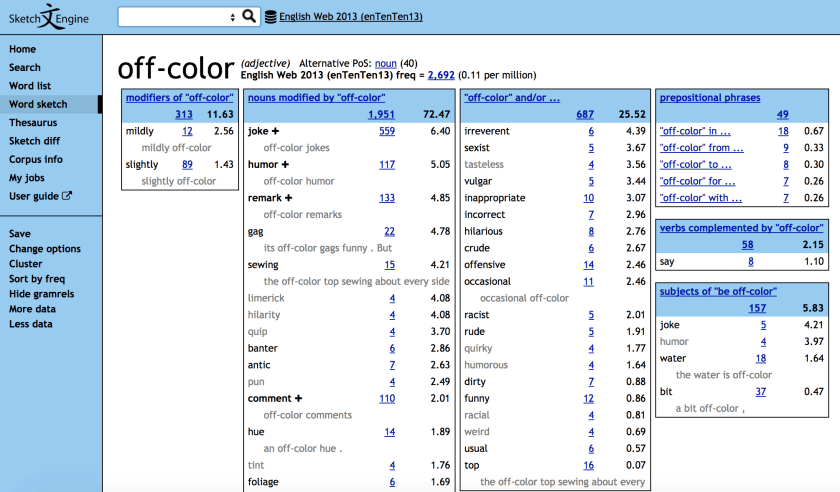
To get a really solid sense of how to use off-color, it’s useful to look at the other words that it occurs with. (With which it occurs, if you prefer your sentences non-preposition-final.) Here’s a screen shot of something called a “word sketch”–again, from the Sketch Engine web site. Scroll down past the figure and I’ll talk you through it.
Picture source: screen shot from the Sketch Engine web site.
At the top left, you see the adverbial modifiers that are most commonly associated with off-color. Note that they are similar–mildly and slightly. What you’re not seeing here are intensifiers–you wouldn’t typically say that something is very or horribly “off-color.” Why? I don’t know–that’s just the statistical tendency with this adjective. You certainly could say that–but, a native speaker probably wouldn’t.
In the next column, you see the nouns that have the strongest statistical associations with off-color. You won’t be surprised to see that the most common ones are joke, remark, and humor. Most of the other words with strong statistical associations are other nouns that refer to humor–gag, limerick, hilarity, quip, banter, antic, and pun.
The next column over is a nice example of how you can get insight into a word by seeing what other words it’s joined with by and or or. Most of the words that are joined with off-color in this way fall into one of two categories: they’re either related to humor, or they’re clearly negative. The first category is related to the fact that off-color itself is so often used to modify joke and, as we saw in the preceding paragraph, other words that refer to humor. In that category, we have:
hilarious
quirky
humorous
funny
In the second category, we have:
tasteless
vulgar
inappropriate
incorrect
crude
offensive
racist
rude
dirty
racial
If you had any questions about whether being off-color is good or bad, this should make it pretty clear to you that it’s not good.
In case you’re wondering: no, Sketch Engine does not pay me to shill for them. In fact, I pay them quite a bit of money every year for access to their corpora and search engine.
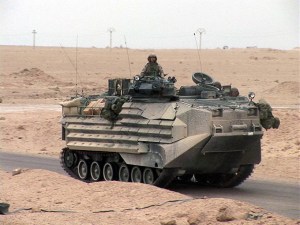
An LVTP7 amphibious assault vehicle. Picture source: USMC.
One day some decades ago, the amphibious assault vehicle in which I was riding around Camp Pendleton, California while we practiced assaulting hills and the like made an unplanned stop. I reached into one of those voluminous pockets that military uniforms tend to be covered with and pulled out a book to read while the platoon leader tried to figure out where the fuck we were. Whatcha reading, Doc?, some big, bulky Marine or another asked me. (I was a medic in the Navy. The US Marines don’t have their own medical personnel–they’re all provided by the Navy. This came as a surprise to lots of young men who volunteered to join the Navy during Vietnam thinking that there was no better way to avoid finding yourself in a rice paddy with leeches on your scrotum and somebody shooting at you than working in a naval hospital–and then found themselves in a rice paddy with leeches on their scrota and somebody shooting at them. Technically, the term for a Navy medic is hospital corpsman, but by long tradition, the Marines call us “Doc.” But, back to Camp Pendleton…)
The social animal, I said. Social psychology. (You might think that I wouldn’t remember what I was reading in the early 1980s–but, the paperback fit perfectly in my left thigh pocket. My right thigh pocket was for a bag of licorice. You never know when you will/won’t get to eat, and licorice doesn’t leave your hands covered with melted chocolate.) Social psychology…hm… I like to read about history, myself, said the big, bulky Marine. The Wars of the Roses–that was some crazy shit… The second lieutenant gave the staff sergeant an embarrassed smile and folded up his map; the big, bulky Marine and I climbed back into our hatches; and we all went back to assaulting whatever we were practicing assaulting–the Wars of the Roses would wait. In the military, every branch has their stereotypical insults for the other branches, and everyone’s insult for the Marines is that they’re stupid, but I’ll tell you this: I know exactly two guys who dropped out of high school, joined the service, and then got a doctorate, and the one who isn’t me is a Marine. (I don’t say “was” a Marine, because once a Marine, always a Marine, and they are, indeed, bad motherfuckers. “Bad motherfucker” explained in the English notes below.)
You tend to think of poets as ethereal, wispy types who are super-sensitive and probably wouldn’t be the person you would want to cover your back if you got into a fight in a metro station. However, if you’ve been paying attention to the stuff that we’ve been reading for National Poetry Month, you’re already aware that there are plenty of counter-examples to that. Case in point: Guillaume Apollinaire. He may or may not have been sensitive, but he was definitely a serious scrapper. He tried to join the army when the First World War came to France in August 1914, but was turned away due to not being a French citizen. No problem–he left Paris and headed south-east to Nice and tried again, this time successfully. He was initially assigned to an artillery unit, but this wasn’t hard-core enough for him, so he got himself transferred to a decimated infantry unit, picking up a promotion to second lieutenant in the process. (That’s a very low rank for an officer, but for an enlisted man to get promoted to it is a pretty big deal.)
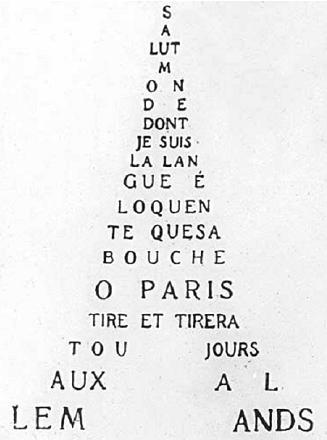
Calligramme. Public domain.
Apollinaire was one of the greats of French poetry; if you’ve only heard of one French poem, it was probably his Le pont Mirabeau. One of his innovations was his role in the development of what’s known as “concrete poetry.” It is “concrete” in the sense that not just its linguistic elements, but its typographic shape are essential to the poem. The one to the left is my favorite of his works in this genre. In the form of the Eiffel Tower, the words translate something like this:
Hello, world of which I am the eloquent tongue. Oh Paris, may your tongue stick out, and stick out always, at the Germans.
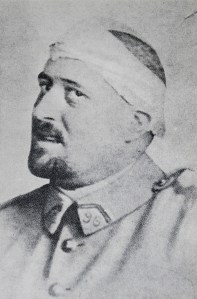
Guillaume Apollinaire. Public domain.
Now, being poetry, it is, of course, a bit more complicated than that. What I’ve given here as “may your tongue stick out” comes from a volume of translations of Apollinaire by Anne Greet and S.I. Lockerbie that I like. “To stick one’s tongue out” is a plausible translation of tirer la bouche, but it’s not necessarily the most obvious one. Certainly it fits with the facts that (a) Apollinaire refers to la langue éloquante, “the elegant tongue,” and the Eiffel Tower does have a tongue-like shape. But, given that this was written by a guy who was putting his life on the line in the trenches at the time, I tend to think that he was playing on another meaning of the verb tirer: to fire a weapon. For a poet in an infantry unit, the metaphor of the mouth as a weapon (que sa bouche…tire et tirera toujours aux Allemands) is certainly an apt one.
A cardiac catheterization lab. Picture source: Children’s Hospital of Philadelphia.
The Navy eventually sent me to school, and I finished my time in the service in a cardiac catheterization lab, which over the course of some rather bizarre decades led to me being a faculty member at a medical school, where I specialize in biomedical language. Apollinaire caught a shell fragment in the temple (when a bombardment started while he was reading a literary magazine, they say); although he survived trepanning, he never fully recovered, and in his weakened condition, died in the flu epidemic of 1918. Whenever I visit the Panthéon, I take a moment to slip away from my friends and find his name on the (long) list of writers who gave their lives for France–and to pay my respects.
English notes
bad motherfucker: One of the cute things about American English is that bad–and similar words, depending on the region of the country that you’re in–can have positive connotations. (Connotation is the cultural meaning of a word, as opposed to its denotation, which you could think of as its “dictionary meaning.” Connotation and culture both start with a C; denotation and dictionary both start with a d. That’s how I remember them, at any rate.)
So: a bad motherfucker is someone who is really tough, with some implication that this toughness involves fighting. You would want to be called a bad motherfucker. When I was a kid, it was common to use bad to mean something like cool, impressive–our favorite bands were “bad,” a nice leather jacket was “bad,” etc.
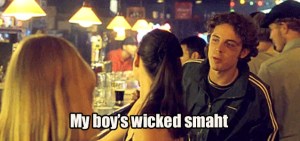
The spelling of “smart” as “smaht” here is important, in that it’s meant to reflect the stereotypical regional pronunciation of the Northeast US, where this use of “wicked” comes from.
Less common, but incontestably much cooler, is the use of wicked to mean “very” in front of an adjective, especially one with a positive meaning. I believe it’s a Northeast thing, although I’ve seen it as far west as Oregon. Scroll down for lots of examples.
The spelling of “smart” as “smaht” here is important, in that it’s meant to reflect the stereotypical regional pronunciation of the Northeast US, where this use of “wicked” comes from.
The Larousse version of Baudelaire’s “Les fleurs du mal.” Picture source: me.
Being old, bald, and fat, I don’t get a lot of admiring glances when I ride the train to work in the mornings. I do, however, get a lot of funny looks when I pull out a book to read. The reason: I’m fond of reading French literature, but I tend to read it in the sorts of annotated versions of a work that you would read if you were a middle-school student in France (collégien in French, I think–roughly 7th and 8th grades in the American system). For me, they’re perfect–they have definitions in simple French of the kinds of words that the editors think will be difficult for a French child, which as a non-native speaker, I have trouble with myself. (Think back to the footnoted versions of Shakespeare that you read in high school and college.) If this kind of thing interests you, you can find them used by the score (see this post for an explanation of what by the score means) in boxes in front of the Boulinier bookstore on boulevard Saint Michel in the Quartier Latin. They’re so cheap–typically one euro–that there’s no reason not to by multiple versions of a play that you’re planning to see. (17th-century French theater is actually probably more intelligible than Shakespeare is in English, although as is the case with Shakespeare, it’s a good idea to read a play before you go see it.) I find it interesting to see the contrast between the sorts of things that one would (not) dare to teach middle-school students in the US and the sorts of things that one can teach middle-school children in France–definitely edgier in France.
In honor of National Poetry Month, here’s some Baudelaire, from Les fleurs du mal. Baudelaire popularized poetry about cities, as opposed to nature, glorified ad nauseum by Romanticism. In his delightful book The flâneur, Edmund White describes him as “the great apostle of dandyism,” which explains a lot about the picture of him that you see below. Odd 6-degrees-of-separation stuff: he went to high school across the street from the university where my grandfather would later study.
dandy: in Baudelaire, this is a compliment, as you might guess from this painting of him by Emile Deroy from 1844. Picture source: Wikipedia.
La ruche: a strip of pleated fabric. La ruche qui se joue au bord des clavicules, Comme un ruisseau lascif qui se frotte au rocher… Picture source: https://goo.gl/0TignC
Fière, autant qu’un vivant, de sa noble stature,
Avec son gros bouquet, son mouchoir et ses gants,
Elle a la nonchalance et la désinvolture
D’une coquette maigre aux airs extravagants.
Note the inversion that moves un soulier pomponné, joli comme une fleur to the end of the sentence, indicated only by the relative maker que rather than qui.
s’écrouler: to fall, e.g. le mur s’est écroulé, s’écrouler sur le canapé.
Vit-on jamais au bal une taille plus mince ?
Sa robe exagérée, en sa royale ampleur,
S’écroule abondamment sur un pied sec que pince
Un soulier pomponné, joli comme une fleur.
la ruche: a strip of pleated cloth (see picture above)
lascif: sensual, lascivious
lazzi: jibes, ribbing
appas: “charms”
La ruche qui se joue au bord des clavicules,
Comme un ruisseau lascif qui se frotte au rocher,
Défend pudiquement des lazzi ridicules
Les funèbres appas qu’elle tient à cacher.
frêle: fragile, frail
attifé: dressed, not necessarily well
Ses yeux profonds sont faits de vide et de ténèbres,
Et son crâne, de fleurs artistement coiffé,
Oscille mollement sur ses frêles vertèbres.
Ô charme d’un néant follement attifé.
Note ivre here and enivré later.
armature: framework; also the underwiring of a bra, although I don’t know whether or not that sense was current in Baudelaire’s time
Aucuns t’appelleront une caricature,
Qui ne comprennent pas, amants ivres de chair,
L’élégance sans nom de l’humaine armature.
Tu réponds, grand squelette, à mon goût le plus cher !
éperonner: to spur, to spur on; also to ram
encor: an old literary spelling of “encore”
Viens-tu troubler, avec ta puissante grimace,
La fête de la Vie ? ou quelque vieux désir,
Éperonnant encor ta vivante carcasse,
Te pousse-t-il, crédule, au sabbat du Plaisir ?
Au chant des violons, aux flammes des bougies,
Espères-tu chasser ton cauchemar moqueur,
Et viens-tu demander au torrent des orgies
De rafraîchir l’enfer allumé dans ton coeur ?
aspic: asp
errer: to wander, roam, rove
Inépuisable puits de sottise et de fautes !
De l’antique douleur éternel alambic !
A travers le treillis recourbé de tes côtes
Je vois, errant encor, l’insatiable aspic.
Love the ne expletif after craindre!
Pour dire vrai, je crains que ta coquetterie
Ne trouve pas un prix digne de ses efforts ;
Qui, de ces coeurs mortels, entend la raillerie ?
Les charmes de l’horreur n’enivrent que les forts !
gouffre: gulf, chasm, abyss
Le gouffre de tes yeux, plein d’horribles pensées,
Exhale le vertige, et les danseurs prudents
Ne contempleront pas sans d’amères nausées
Le sourire éternel de tes trente-deux dents.
Pourtant, qui n’a serré dans ses bras un squelette,
Et qui ne s’est nourri des choses du tombeau ?
Qu’importe le parfum, l’habit ou la toilette ?
Qui fait le dégoûté montre qu’il se croit beau.
bayadère: sacred dancer from India
gouge: old word for a prostitute
offusqué: offended
musqé: musky
Bayadère sans nez, irrésistible gouge,
Dis donc à ces danseurs qui font les offusqués :
” Fiers mignons, malgré l’art des poudres et du rouge,
Vous sentez tous la mort ! Ô squelettes musqués,
Antinoüs: according to the footnotes in my middle-school-student version, jeune esclave d’une beauté parfaite, qui était le favori de l’empereur Hadrien
flétri: faded (beauty), withered, wilted (like the roses sitting on my table–I really need to toss them)
dandy: in Baudelaire, this is a compliment, as you might guess from the painting of him at left
lovelace: séducteur pervers et cynique, according to the footnotes in my middle school version of the poem
chenu: white-haired from age
le branle: a kind of dance. (If you are French: you can just imagine what happens when you try looking for videos of this on YouTube)
Antinoüs flétris, dandys, à face glabre,
Cadavres vernissés, lovelaces chenus,
Le branle universel de la danse macabre
Vous entraîne en des lieux qui ne sont pas connus !
se pâmer: to faint; to swoon, either literally or in a state of strong emotion, whether good (with synonyms délirer, exulter, se griser, s’émerveiller, s’enthousiasmer, s’exalter, s’extasier) or bad (elle s’est pâmée de douleur).
béant: gaping, wide open, cavernous
le tromblon: blunderbuss
Des quais froids de la Seine aux bords brûlants du Gange,
Le troupeau mortel saute et se pâme, sans voir
Dans un trou du plafond la trompette de l’Ange
Sinistrement béante ainsi qu’un tromblon noir.
la contorsion: contorsion, but also “a face” in the sense of “to make a face”
En tout climat, sous tout soleil, la Mort t’admire
En tes contorsions, risible Humanité,
Et souvent, comme toi, se parfumant de myrrhe,
Mêle son ironie à ton insanité ! “
Henry Reed’s “Returning of issue” for Day 6 of National Poetry Month.
Returning of issue is the sixth and final part of Henry Reed’s Lessons of the war cycle. Published two and a half decades after Naming of parts, it is in two voices, like the rest of the cycle, but they are difficult to tell apart. The recording of the poem on the Sole Arabia Tree web site (follow the link and scroll down to the bottom of the page) differentiates the two voices very nicely; it’s also a somewhat different version of the poem, and you may find the differences interesting. The version that you see here is the written one from the aforementioned site.
From a linguistic point of view, the most obvious (to me, anyways) thing going on in this poem is that Reed goes back to plays on the various meanings of the English word issue, and in the case of this poem–as opposed to his Unarmed combat–the sense of progeny is one of the meanings that he draws on, as the sadder parts of the poem are a dialogue with the trainee’s deceased father. Here are a couple of the relatively obscure items of vocabulary–scroll down past the illustrations to find the poem.
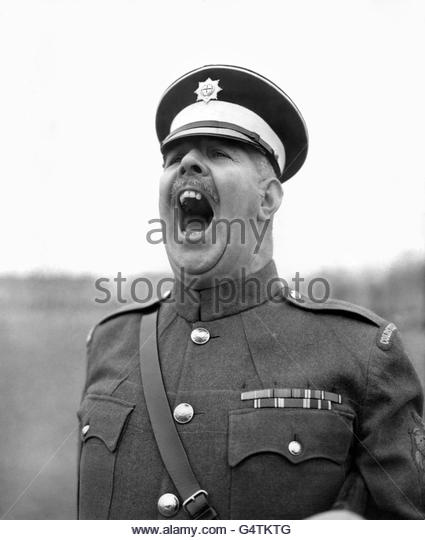
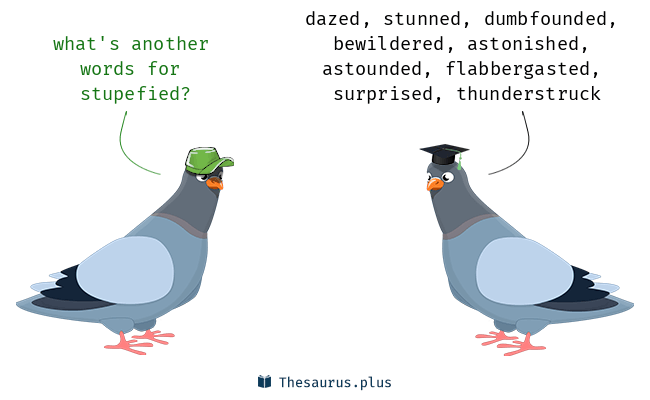
A sergeant-major is a very senior enlisted man in the US military; in the UK of Reed’s time, I think it was a warrant officer. The “RSM” of the poem is the regimental sergeant major, a leadership position that is held by someone who has been in the military for quite a while. The photo is of a British RSM; no date, sorry. Picture source: https://goo.gl/aV1Z9IIn theory, “stupefaction” is the state of being surprised into silence. You’ll also hear it use to mean something like a state of silence or dullness from any cause whatsoever. Picture source: https://goo.gl/SLM93N
Reed, Henry. “Returning of Issue.” Listener 84, no. 2170 (29 October 1970): 596-597.
LESSONS OF THE WAR
VI. RETURNING OF ISSUE
Tomorrow will be your last day here. Someone is speaking:
A familiar voice, speaking again at all of us.
And beyond the windows— it is inside now, and autumn—
On a wind growing daily harsher, small things to the earth
Are turning and whirling, small. Tomorrow will be
Your last day here,
But not we hope for always. You cannot see through the windows
If they are leaves or flowers. We hope that many of you
Will be coming back for good. Silence, and stupefaction.
The coarsening wind and the things whirling upon it
Scour that rough stamping-ground where we so long
Have spent our substance,
As the trees are spending theirs. How much of mine have I spent,
Father, oh father? How sorry we are to lose you
I do not have to say, since the sergeant-major
Has said it, the RSM has said it, and the colonel
Has sent over a message to say that he also says it.
Everyone sorry to lose us,
And you, oh father, father, once sorry too. I think
I can honestly say you are one and all of you now:
Soldiers. Silence, and disbelief. A fact that will stand you
In pretty good stead in the various jobs you go back to.
I wish you the best of luck. Silence. And all of you know
You can think of us here, as home.
As home: a home we shall any of you welcome you back to.
Most of you have, I know, some sort of work waiting for you,
And the rest of you now being, thanks to us, fit and able,
Will be bound to find something. I begin to be in want.
Would any citizen of this country send me
Into his fields? And
Before I finalise: one thing about tomorrow
I must make perfectly clear. Tomorrow is clear already:
I saw myself once, but now am by time forbidden
To see myself so: as the man who went evil ways,
Till lie determined, in time of famine, to seek
His father’s home.
Autumn is later down there: it should now be the time
Of vivacious triumph in the fruitful fields.
As he approached, he ran over his speeches of sorrow,
Not less of truth for being much-rehearsed:
The last distilment from a long and inward
Discourse of heartbreak. And
The first thing you do, after first thing tomorrow morning,
Is, those that leave not been previously detailed to do so,
Which I think is the case in most cases, is a systematic
Returning of issue. It is all-important
You should restore to store one of every store issued.
And in the case of two, two.
And I, as always late, shall never know that lifted fear
When the small hard-working master of those fields
Looked up. I trembled. But his heart came out to me
With a shout of compassion. And all my speech was only:
‘Father, I have sinned against heaven, and am no more worthy
To be called thy son.’
But if I cried it, father, you could not hear me now,
Where now you lie, crumpled in that small grave
Like any withering dog. Your fields are sold and built on,
Your lanes are filled with husks the swine reject.
I scoop them in my hands. I have earned no more; and more
I shall not inherit. And
A careful check will be made of every such object
That was issued to each personnel originally,
And checked at issue. And let me be quite implicit:
That no accoutrements, impedimentas, fittings, or military garments
May be taken as souvenirs. The one exception is shirts,
And whatever you wear underneath.
These may be kept, those that wish. But the rest of the issue
Must be returned, except who intend to rejoin
In regular service. Silence. Which involves a simple procedure
I will explain in a simple group to those that rejoin.
Now, how many will that be? Silence. No one? No one at all?
I see. Very well. I have up to now
Spoken with the utmost of mildness. I speak so still,
But it does seem to me a bit of a bloody pity,
A bit un-bloody-feeling, after the all
We have bloody done for you, you should sit on your dumb bloody arses,
Just waiting like bloody milksops till I bloody dismiss you.
Silence, embarrassed, but silent.
And am I to break it, father, to break this silence?
Is there no bloody man among you? Not one bloody single one?
I will break the silence, father. Yes, sergeant, I will stay
In a group of one. Father, be proud of me.
Oh splendid, man! And for Christ’s sake, tell them all,
Why you are doing this.
Why am I doing this? And is it too late to say no?
Come speak out, man: tell us, and shame these bastards.
I hope to shame no one, sergeant, in simply wishing
To remain a personnel. I have been such a thing before.
It was good, and simple; and it was the best I could do.
Here is a man, men! Silence.
Silence, indeed. How could I tell them, now?
I have nowhere else to go? How could I say
I have no longer gift or want; or how describe
The inexplicable tears that filled my eyes
When the poor sergeant said: ‘After the all
We have bloody done for you’?
Goodbye forever, father, after the all you have done for me.
Soon I must start to forget you; but how to forget
That reconcilement, never enacted between us,
Which should have been ours, under the autumn sun?
I can see it and feel it now, clearer than daylight, clearer
For one brief moment, now,
Than even the astonished faces of my fellows,
The sergeant’s uneasy smile, the trees, the relief at choosing
To learn once more the things I shall one day teach:
A rhetoric instead of words; instead of a love, the use
Of accoutrements, impedimenta, and fittings, and military garments,
And harlots, and riotous living.
For National Poetry Month, Day 5, here is “Psychological warfare,” Part 5 of Henry Reed’s “Lessons of the war.” Trigger warning: racist and homophobic language.
When I was a kid, my father would give me helpful life lessons, such as what to do when slapped to the ground by a German soldier versus what to do when slapped to the ground by a Japanese soldier. Note that there are two assumptions here: (a) you’re a prisoner of war when this happens, and (b) the advice was presented as what to do when you’re slapped to the ground by a German or Japanese prisoner-of-war-camp guard, not if you’re slapped to the ground by a German or Japanese prisoner-of-war-camp guard. This phrasing, amongst similar phrasing in many of my father’s life lessons for me, contributed to a number of things in my life: (a) I didn’t realize that the Second World War was over until I was probably 9 years old–I used to freak when planes would fly overhead, not knowing whether they were friend or foe–and (b) I always assumed that really horrid shit was going to turn my world and my life upside down, one way or the other. I tell you all of this to give you some context (which is to say: my selfishly personal context) for today’s celebration of National Poetry Month: the fourth in Henry Reed’s Lessons of the war cycle. I’ll warn you again that there is reprehensibly racist language, as well as homophobia, in this poem; in reading it, I keep in mind that this comes out of the mouth of a character that Reed is criticizing. Reading this as an adult who “gagne son croûte” by working with language, I’m reminded of Krippendorff‘s discussion of pre-WWII Fascist propaganda and by the similarity between that Fascist propaganda and Trump’s message; it’s the weird mix of nationalism, racism/homophobia, and craven cowardice (is that a pleonasm? probably) in the character’s words that brings both pre-WWII Fascist propaganda and Donald Trump to mind for me.
The version of the poem that I’m giving you here is from the Sole Arabian Tree web site, your source for all things Reedian. Unfortunately, I don’t have a source for a recording of Reed reading this one. The promised illustrations precede the poems, and explain (or try to) some of the language in the poem.
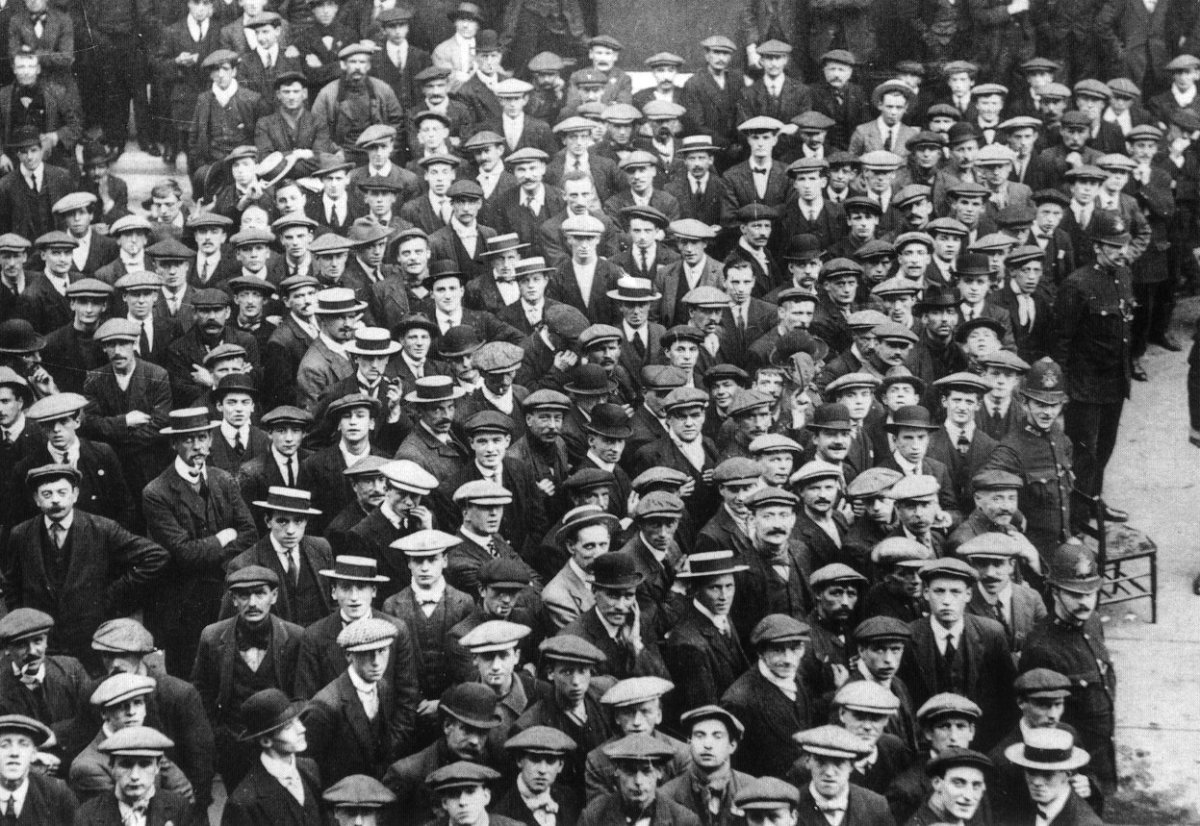
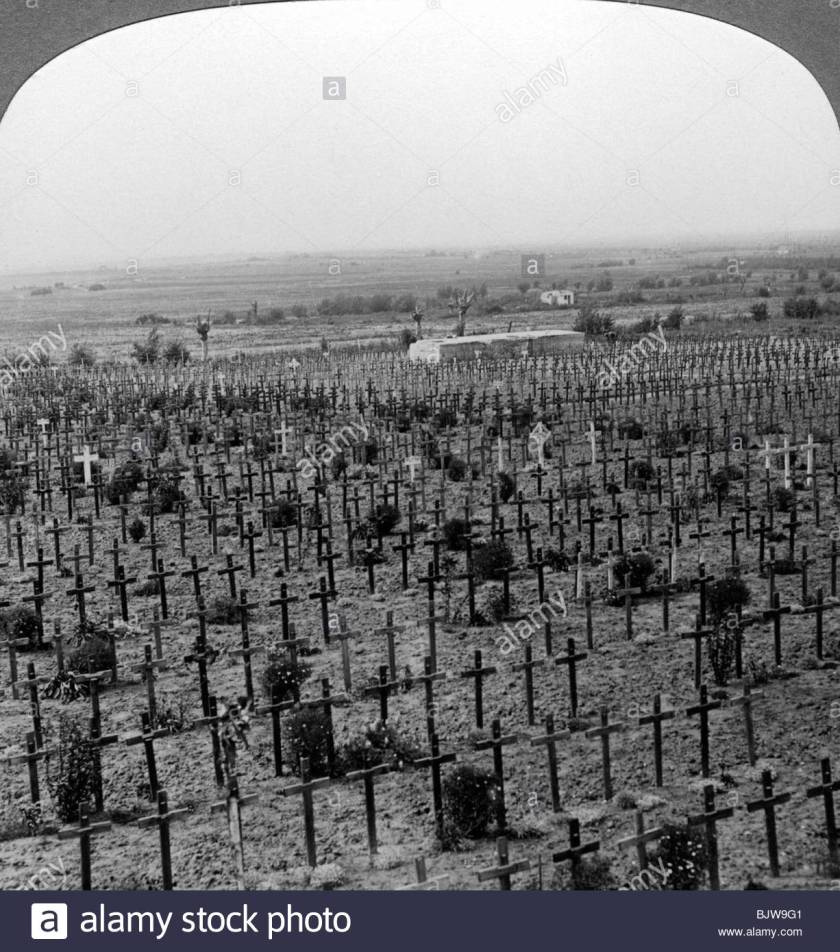
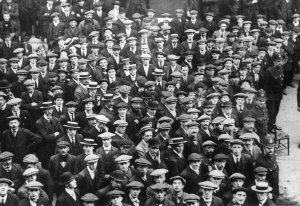
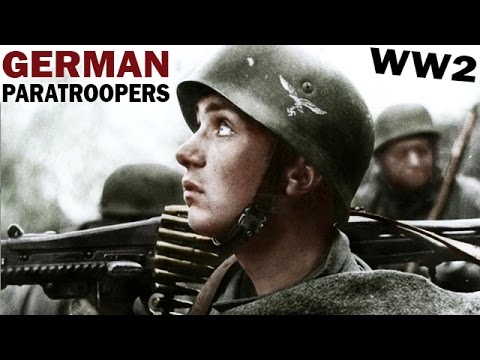
“To ebb” is to flow down, as in the receding of the tide. Note the wet sand–that is what has been left uncovered by the receding of the tide or of a wave. To “ebb up,” as it is used in the poem, sounds awfully odd, and I haven’t found it in the British National Corpus. Picture source: https://goo.gl/A8r13sPart of the cemetery at Passchendaele, the site of a prolonged battle that took about 400,000 lives and moved the front line only several kilometers. When the speaker asserts that the trainees will all have heard of it, he’s probably right; how he managed to get captured there is hard to imagine, given that the German casualties were enormous. I speculate that this is part of Reed’s way of showing us what an idiot this guy is. Picture source: https://goo.gl/ej8DpxWhen the speaker refers to the recent “mobs,” he’s using an old slang word for a “mobilization” or call-up of civilians to the military. Here are Brits responding to the August 1914 mob, I believe. Picture source: https://goo.gl/Eha36AThe “helpless men descending from the heavens” to whom the speaker refers are German paratroopers. Don’t spend too much time searching for pictures of them on line, or you will be looking at pictures of little children waiting in line for gas chambers before you know it. Picture source: https://goo.gl/pIYaly
LESSONS OF THE WAR
V. PSYCHOLOGICAL WARFARE
This above all remember: they will be very brave men,
And you will be facing them. You must not despise them.
I am, as you know, like all true professional soldiers,
A profoundly religious man: the true soldier has to be.
And I therefore believe the war will be over by Easter Monday.
But I must in fairness state that a number of my brother-officers,
No less religious than I, believe it will hold out till Whitsun.
Others, more on the agnostic side (and I do not condemn them)
Fancy the thing will drag on till August Bank Holiday.
Be that as it may, some time in the very near future,
We are to expect Invasion … and invasion not from the sea.
Vast numbers of troops will be dropped, probably from above,
Superbly equipped, determined and capable; and this above all,
Remember: they will be very brave men, and chosen as such.
You must not, of course, think I am praising them.
But what I have said is basically fundamental
To all I am about to reveal: the more so, since
Those of you that have not seen service overseas—
Which is the case with all of you, as it happens—this is the first time
You will have confronted them. My remarks are aimed
At preparing you for that.
Everyone, by the way, may smoke,
And be as relaxed as you can, like myself.
I shall wander among you as I talk and note your reactions.
Do not be nervous at this: this is a thing, after all,
We are all in together.
I want you to note in your notebooks, under ten separate headings,
The ten points I have to make, remembering always
That any single one of them may save your life. Is everyone ready?
Very well then.
The term, Psychological Warfare
Comes from the ancient Greek: psycho means character
And logical, of course, you all know. We did not have it
In the last conflict, the fourteen-eighteen affair,
Though I myself was through it from start to finish. (That is point one.)
I was, in fact, captured—or rather, I was taken prisoner—
In the Passchendaele show (a name you will all have heard of)
And in our captivity we had a close opportunity
(We were all pretty decently treated. I myself
Was a brigadier at the time: that is point two)
An opportunity I fancy I was the only one to appreciate
Of observing the psychiatry of our enemy
(The word in those days was always psychology,
A less exact description now largely abandoned). And though the subject
Is a highly complex one, I had, it was generally conceded,
A certain insight (I do not know how, but I have always, they say,
Had a certain insight) into the way the strangest things ebb up
From what psychoanalysts now refer to as the self-conscious.
It is possibly for this reason that I have been asked
To give you the gist of the thing, the—how shall I put it?—
The gist.
I was not of course captured alone
(Note that as point three) so that I also observed
Not only the enemy’s behaviour; but ours. And gradually, I concluded
That we all of us have, whether we like it or lump it,
Our own individual psychiatry, given us, for better or worse,
By God Almighty. I say this reverently; you often find
These deeper themes of psychiatry crudely but well expressed
In common parlance. People say: ‘We are all as God made us.’
And so they are. So are the enemy. And so are some of you.
This I in fact observed: point four. Not only the enemy
Had their psychiatry, but we, in a different sense,
Had ours. And I firmly believe you cannot (point six) master Their psychiatry before you have got the gist of your own.
Let me explain more fully: I do not mean to imply
That any, or many, of you are actually mentally ill.
Though that is what the name would imply. But we, your officers,
Have to be aware that you, and many of your comrades,
May have a sudden psychiatry which, sometimes without warning,
May make you feel (and this is point five) a little bit odd.
I do not mean that in the sense of anything nasty:
I am not thinking of those chaps with their eyes always on each other
(Sometimes referred to as homosensualists
And easily detected by the way they lace up their boots)
But in the sense you may all feel a little disturbed,
Without knowing why, a little as if you were feeling an impulse,
Without knowing why: the term for this is ambivalence.
Often referred to for some mysterious reason,
By the professionals as Amby Valence,
As though they were referring to some nigger minstrel.
(Not, of course, that I have any colour prejudice:
After all, there are four excellent West Nigerians among you,
As black as your boot: they are not to blame for that.)
At all events this ambivalence is to be avoided.
Note that as point seven: I think you all know what I mean:
In the Holy Scriptures the word begins with an O,
Though in modern parlance it usually begins with an M.
You have most of you done it absentmindedly at some time or another,
But repeated, say, four times a day, it may become almost a habit,
Especially prone to by those of sedentary occupation,
By pale-faced clerks or schoolmasters, sitting all day at a desk,
Which is not, thank God, your position: you are always
More or less on the go: and that is what
(Again deep in the self-conscious) keeps you contented and happy here.
Even so, should you see some fellow-comrade
Give him all the help you can. In the spiritual sense, I mean,
With a sympathetic word or nudge, inform him in a manly fashion
‘Such things are for boys, not men, lad.’ Everyone, eyes front!
I pause, gentlemen.
I pause. I am not easily shocked or taken aback,
But even while I have been speaking of this serious subject
I observe that one of you has had the effrontery—
Yes, you at the end of row three! No! Don’t stand up, for God’s sake, man,
And don’t attempt to explain. Just tuck it away,
And try to behave like a man. Report to me
At eighteen hundred hours. The rest of you all eyes front.
I proceed to point six.
The enemy itself,
I have reason to know is greatly prone to such actions.
It is something we must learn to exploit: an explanation, I think,
Is that they are, by and large, undeveloped children,
Or adolescents, at most. It is perhaps to do with physique,
And we cannot and must not ignore their physique as such.
(Physique, of course, being much the same as psychiatry.)
They are usually blond, and often extremely well-made,
With large blue eyes and very white teeth,
And as a rule hairless chests, and very smooth, muscular thighs,
And extremely healthy complexions, especially when slightly sunburnt.
I am convinced there is something in all this that counts for something.
Something probably deep in the self-conscious of all of them.
Undeveloped children, I have said, and like children,
As those of you with families will know,
They are sometimes very aggressive, even the gentlest of them.
All the same we must not exaggerate; in the words of Saint Matthew:
‘Clear your minds of cant.’ That is point five: note it down.
Do not take any notice of claptrap in the press
Especially the kind that implies that the enemy will come here,
Solely with the intention of raping your sisters.
I do not know why it is always sisters they harp on:
I fancy it must ebb up from someone’s self-conscious.
It is a patent absurdity for two simple reasons: (a)
They cannot know in advance what your sisters are like:
And (b) some of you have no sisters. Let that be the end of that.
There are much darker things than that we have to think of.
It is you they consider the enemy, you they are after.
And though, as Britishers, you will not be disposed to shoot down
A group of helpless men descending from the heavens,
Do not expect from them—and I am afraid I have to say this—gratitude:
They are bound to be over-excited,
As I said, adolescently aggressive, possibly drugged,
And later, in a macabre way, grotesquely playful.
Try to avoid being playfully kicked in the crutch,
Which quite apart from any temporary discomfort,
May lead to a hernia. I do not know why you should laugh.
I once had a friend who, not due to enemy action
But to a single loud sneeze, entirely his own, developed a hernia,
And had to have great removals, though only recently married.
(I am sorry, gentlemen, but anyone who finds such things funny
Ought to suffer them and see. You deserve the chance to.
I must ask you all to extinguish your cigarettes.)
There are other unpleasant things they may face you with.
You may, as I did in the fourteen-eighteen thing,
Find them cruelly, ruthlessly, starkly obsessed with the arts,
Music and painting, sculpture and the writing of verses,
Please, do not stand for that.
Our information is
That the enemy has no such rules, though of course they may have.
We must see what they say when they come. There can, of course,
Be no objection to the more virile arts:
In fact in private life I am very fond of the ballet,
Whose athleticism, manliness and sense of danger
Is open to all of us to admire. We had a ballet-dancer
In the last mob but three, as you have doubtless heard.
He was cruelly teased and laughed at—until he was seen in the gym.
And then, my goodness me! I was reminded of the sublime story
Of Samson, rending the veil of the Temple.
I do not mean he fetched the place actually down; though he clearly did what he could.
Though for some other reason I was never quite clear about,
And in spite of my own strong pressure on the poor lad’s behalf,
And his own almost pathetic desire to stay on with us,
He was, in fact, demobilized after only three weeks’ service,
Two and a half weeks of which he spent in prison.
Such are war’s tragedies: how often we come upon them!
(Everyone may smoke again, those that wish.)
This brings me to my final point about the psychiatry
Of our formidable foe. To cope with it,
I know of nothing better than the sublime words of Saint Paul
In one of his well-known letters to the Corinthians:
‘This above all, to thine own self be true,
And it must follow, as the night the day
No man can take thee in.’
‘This above all’: what resonant words those are!
They lead me to point nine, which is a thing
I may have a special thing about, but if so,
Remember this is not the first war I have been through.
I refer (point nine this is) to the question of dignity.
Dignity. Human dignity. Yours. Never forget it, men.
Let it sink deep into your self-consciousness,
While still remaining plentifully available on the surface,
In the form of manly politeness. I mean, in particular, this:
Never behave in a manner to evoke contempt
Before thine enemy. Our enemy, I should say.
Comrades, and brothers-in-arms,
And those especially who have not understood my words,
You were not born to live like cowards or cravens:
Let me exhort you: never, whatever lies you have heard,
Be content to throw your arms on the ground and your other arms into the air and squawk ‘Kaputt!’
It is unsoldierly, unwarlike, vulgar, and out of date,
And may make the enemy laugh. They have a keen sense of humour,
Almost (though never quite, of course) as keen as our own.
No: when you come face to face with the foe, remember dignity,
And though a number of them do fortunately speak English,
Say, proudly, with cold politeness, in the visitor’s own language:
‘Ich ergebe mich.’ Ich meaning I, Ergebe meaning surrender, and mich meaning me. Ich ergebe mich.’ Do not forget the phrase.
Practise it among yourselves: do not let it sound stilted,
Make it sound idiotish, as if you were always saying it,
Only always cold in tone: icy, if necessary:
It is such behaviour that will make them accord you
The same respect that they accorded myself,
At Passchendaele. (Incidentally,
You may also add the word nicht if you feel inclined to, Nicht meaning not. It will amount to much the same thing.)
Dignity, then, and respect: those are the final aims
Of psychiatric relations, and psychological warfare.
They are the fundamentals also of our religion.
I may have mentioned my own religious intuitions:
They are why I venture to think this terrible war will be over
On Easter Monday, and that the invasion will take place
On either Maundy Thursday or Good Friday,
Probably the Thursday, which in so very many
Of our great, brave, proud, heroic and battered cities,
Is early closing day, as the enemy may have learnt from their agents.
Alas, there may be many such days in the immediate future.
But remember this in the better world we all have to build,
And build by ourselves alone—for the government
May well in the next few weeks have withdrawn to Canada—
What did you say? The man in row five. He said something.
Stand up and repeat what you said.
I said ‘And a sodding good job’, sir, I said, sir.
I have not asked anyone for political comments, thank you,
However apt. Sit down. I was saying:
That in the better world we all have to try to build
After the war is over, whether we win or lose,
Or whether we all agree to call it a draw,
We shall have to try our utmost to get used to each other,
To live together with dignity and respect.
As our Lord sublimely said in one of his weekly Sermons on the Mount
Outside Jerusalem (where interestingly enough,
I was stationed myself for three months in 1926):
‘A thirteenth commandment I give you (this is point ten)
That ye love one another.’ Love, in Biblical terms,
Meaning of course not quite what it means today,
But precisely what I have called dignity and respect.
And that, men, is the great psychiatrical problem before you:
Of how on God’s earth we shall ever learn to attain some sort
Of dignity.
And due respect.
One man.
For another.
Thank you; God bless you, men. Good afternoon.
Henry Reed’s WWII poetry remains sadly relevant in the age of Trump: “Things may be the same again; and we must fight // Not in the hope of winning but rather of keeping // Something alive…”
More of Henry Reed’s WWII poetry, in honor of National Poetry Month 2017. Unarmed combat was published in 1945. I found this version on the Sole Arabian Tree web site, where you can find an audio recording of Reed reading it at the bottom of the page. English notes after the poem, as always.
LESSONS OF THE WAR
IV. UNARMED COMBAT
In due course of course you will all be issued with
Your proper issue; but until tomorrow,
You can hardly be said to need it; and until that time,
We shall have unarmed combat. I shall teach you
The various holds and rolls and throws and breakfalls
Which you may sometimes meet.
And the various holds and rolls and throws and breakfalls
Do not depend on any sort of weapon,
But only on what I might coin a phrase and call
The ever-important question of human balance,
And the ever-important need to be in a strong
Position at the start.
There are many kinds of weakness about the body,
Where you would least expect, like the ball of the foot.
But the various holds and rolls and throws and breakfalls
Will always come in useful. And never be frightened
To tackle from behind: it may not be clean to do so,
But this is global war.
So give them all you have, and always give them
As good as you get; it will always get you somewhere.
(You may not know it, but you can tie a Jerry
Up without rope; it is one of the things I shall teach.)
Nothing will matter if only you are ready for him.
The readiness is all.
The readiness is all. How can I help but feel
I have been here before? But somehow then,
I was the tied-up one. How to get out
Was always then my problem. And even if I had
A piece of rope I was always the sort of person
Who threw rope aside.
And in my time I had given them all I had,
Which was never as good as I got, and it got me nowhere.
And the various holds and rolls and throws and breakfalls
Somehow or other I always seemed to put
In the wrong place. And, as for war, my wars
Were global from the start.
Perhaps I was never in a strong position.
Or the ball of my foot got hurt, or I had some weakness
Where I had least expected. But I think I see your point.
While awaiting a proper issue, we must learn the lesson
Of the ever-important question of human balance.
It is courage that counts.
Things may be the same again; and we must fight
Not in the hope of winning but rather of keeping
Something alive: so that when we meet our end,
It may be said that we tackled wherever we could,
That battle-fit we lived, and though defeated,
Not without glory fought.
in due course:Merriam-Webster: after a normal passage of time : in the expected or allotted time. Reed uses it to have his drill sergeant say something that sounds both military (“in due course”) and silly, simultaneously–definitely a theme in this series of poems:
In due course of course you will all be issued with
Your proper issue
issue: Reed goes whole hog with this one, using it three times in the poem, each with a different meaning, mostly ambiguous even in context. There are many, many possible meanings for both the nominal (noun) and verbal uses of the word; I’ll give you only the ones that I suspect he means to play with here, all of them from Merriam-Webster:
Verb: British:provide 2b, supply. Now: Merriam-Webster says that this is a British usage, but the verb is most certainly used in that way in the US military. Note the weird preposition that can occur here, although it doesn’t have to, at least not in the US. In the poem: On Twitter: I read that all members will be issued with a new card valid for 10 years. On the other hand, it’s perfectly fine without a preposition, too: in Switzerland every single male has to serve in the military between 18-20 years old. they are issued a rifle and keep it after serving (Twitter) Now that DeVos is Secretary of Education will each teacher be issued a rifle to guard against Grizzly bears? #wcedchat(Twitter)
Noun: in the military, your “issue” is something that you receive, that gets distributed to you; in this case, it’s what you get in basic training. That’s typically uniforms, basic supplies, and stuff like that. Here’s an example from Quora: At Army boot camp, the recruits first process in at the reception station. There, they are given their initial clothing issue, which includes BDU’s, dress uniforms, boots, black shoes called low quarters, belts, hats, coats, and even towels, socks, and underwear. Another example: …we all received a complete Navy sea bag issue of clothing. (How I learned about life: Navy boot camp, by Edward Olsen)
Noun: this word can also mean children, offspring, progeny.
…and of course there is an issue in the sense of what Merriam-Webster calls a vital or unsettled matter.
Here’s the third appearance of issue in the poem:
But I think I see your point.
While awaiting a proper issue, we must learn the lesson
Of the ever-important question of human balance.
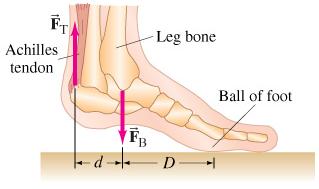
ball of the foot: a picture will be worth a thousand words here.
to go whole hog: in closing, here’s one that I somehow couldn’t find a way to not use. To go whole hog: Merriam-Webster defines it as to do something in a very thorough and complete way. How I used it: Reed goes whole hog with this one, using it three times in the poem, each with a different meaning, mostly ambiguous even in context.
Fields, lexical and otherwise: Henry Reed’s sweetly funny WWII poem “Movement of bodies.”
For the third day of National Poetry Month, here is more of the gentle humor of Henry Reed. This version of Movement of bodies, published in 1950, comes from the Sole Arabian Tree web site, where you can find a recording of Henry Reed reading the poem.
LESSONS OF THE WAR
III. MOVEMENT OF BODIES
Those of you that have got through the rest, I am going to rapidly
Devote a little time to showing you, those that can master it,
A few ideas about tactics, which must not be confused
With what we call strategy. Tactics is merely
The mechanical movement of bodies, and that is what we mean by it.
Or perhaps I should say: by them.
Strategy, to be quite frank, you will have no hand in.
It is done by those up above, and it merely refers to,
The larger movements over which we have no control.
But tactics are also important, together or single.
You must never forget that, suddenly, in an engagement,
You may find yourself alone.
This brown clay model is a characteristic terrain
Of a simple and typical kind. Its general character
Should be taken in at a glance, and its general character
You can, see at a glance it is somewhat hilly by nature,
With a fair amount of typical vegetation
Disposed at certain parts.
Here at the top of the tray, which we might call the northwards,
Is a wooded headland, with a crown of bushy-topped trees on;
And proceeding downwards or south we take in at a glance
A variety of gorges and knolls and plateaus and basins and saddles,
Somewhat symmetrically put, for easy identification.
And here is our point of attack.
But remember of course it will not be a tray you will fight on,
Nor always by daylight. After a hot day, think of the night
Cooling the desert down, and you still moving over it:
Past a ruined tank or a gun, perhaps, or a dead friend,
In the midst of war, at peace. It might quite well be that.
It isn’t always a tray.
And even this tray is different to what I had thought.
These models are somehow never always the same: for a reason
I do not know how to explain quite. Just as I do not know
Why there is always someone at this particular lesson
Who always starts crying. Now will you kindly
Empty those blinking eyes?
I thank you. I have no wish to seem impatient.
I know it is all very hard, but you would not like,
To take a simple example, to take for example,
This place we have thought of here, you would not like
To find yourself face to face with it, and you not knowing
What there might be inside?
Very well then: suppose this is what you must capture.
It will not be easy, not being very exposed,
Secluded away like it is, and somewhat protected
By a typical formation of what appear to be bushes,
So that you cannot see, as to what is concealed inside,
As to whether it is friend or foe.
And so, a strong feint will be necessary in this, connection.
It will not be a tray, remember. It may be a desert stretch
With nothing in sight, to speak of. I have no wish to be inconsiderate,
But I see there are two of you now, commencing to snivel.
I do not know where such emotional privates can come from.
Try to behave like men.
I thank you. I was saying: a thoughtful deception
Is always somewhat essential in such a case. You can see
That if only the attacker can capture such an emplacement
The rest of the terrain is his: a key-position, and calling
For the most resourceful manoeuvres. But that is what tactics is.
Or I should say rather: are.
Let us begin then and appreciate the situation.
I am thinking especially of the point we have been considering,
Though in a sense everything in the whole of the terrain,
Must be appreciated. I do not know what I have said
To upset so many of you. I know it is a difficult lesson.
Yesterday a man was sick,
But I have never known as many as five in a single intake,
Unable to cope with this lesson. I think you had better
Fall out, all five, and sit at the back of the room,
Being careful not to talk. The rest will close up.
Perhaps it was me saying ‘a dead friend’, earlier on?
Well, some of us live.
And I never know why, whenever we get to tactics,
Men either laugh or cry, though neither is strictly called for.
But perhaps I have started too early with a difficult task?
We will start again, further north, with a simpler problem.
Are you ready? Is everyone paying attention?
Very well then. Here are two hills.
English notes
This poem is full of delightful plays on multiple meanings of words, most of which I’ll skip to focus on the lexical field of geographic terms. Reed uses a bunch of terms that refer to elements of topography (Merriam-Webster: the art or practice of graphic delineation in detail usually on maps or charts of natural and man-made features of a place or region especially in a way to show their relative positions and elevations) as metaphors for a woman’s body. Many of these are terms that a typical native speaker (including myself) wouldn’t necessarily be able to define specifically, although I would guess that most people would at least know that they refer to elements of a terrain, and might even be able to group them into two classes: ones that refer to elevations (high points), and ones that refer to depressions (Merriam-Webster: a place or part that is lower than the surrounding area : a depressed place or part :hollow). I’ll split them out in that way, then follow them with a few miscellaneous terms. (All links to Merriam-Webster are to the definition for that word.) For a reminder, here’s a paragraph from near the beginning of the poem:
Here at the top of the tray, which we might call the northwards,
Is a wooded headland, with a crown of bushy-topped trees on;
And proceeding downwards or south we take in at a glance
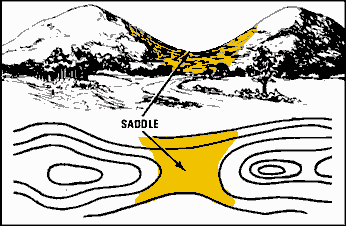
A variety of gorges and knolls and plateaus and basins and saddles,
Somewhat symmetrically put, for easy identification.
And here is our point of attack.
Elevations
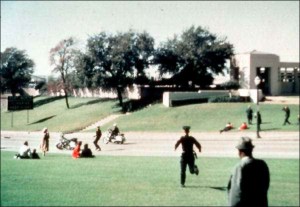
The famous “grassy knoll.” I got this off of a JFK assassination conspiracy theory website, but have no idea to whom it should actually be credited.
knoll: Merriam-Webster: a small round hill :mound. The term grassy knoll, a small hill covered with grass, is closely associated with the assassination of President John F. Kennedy, particularly with conspiracy theories about it.
headland: Merriam-Webster: a point of usually high land jutting out into a body of water :promontory
plateau:Merriam-Webster: a usually extensive land area having a relatively level surface raised sharply above adjacent land on at least one side :tableland
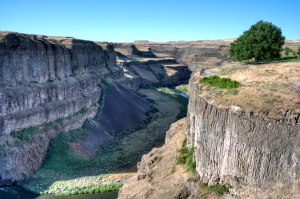
gorge:Merriam-Webster: a narrow passage through land; especially: a narrow steep-walled canyon or part of a canyon
basin:Merriam-Webster: a large or small depression in the surface of the land or in the ocean floor. As I speak a bit of French, it’s difficult not to make the association here with le bassin, the pelvis.
saddle:Merriam-Webster: a ridge connecting two higher elevations; a pass in a mountain range. In English, this has the same connections with sex as it does in French: J’en ai-t-y connu des lanciers, // Des dragons et des cuirassiers // Qui me montraient à me tenir en selle // A Grenelle!
engagement: In the context of the poem, the most obvious meaning is the military one of a hostile contact between enemy forces (Merriam-Webster). Presumably Reed is also playing here on the more commonly-used meaning of a commitment to marriage (my best guess on all of the crying trainees).
tactics versus strategy: tactics are short-term–a tactical nuclear weapon is one that you would use on the battlefield. (Not very fun to think about, is it? When I tell people that some aspects of the peacetime military seem kinda silly and they ask me for examples, I always tell them about our “what to do in case of nearby nuclear weapon explosion” drills.) In contrast, strategic nuclear weapons are meant for the bigger picture–the stuff that you would use to hammer the other guy’s country in such a way that he becomes unable to continue fighting at all. My tactics in my professional life mostly consist of making schedules to ensure that I don’t miss deadlines, while my strategy is the set of papers that I plan to publish in the next few years. From the poem:
Strategy, to be quite frank, you will have no hand in.
It is done by those up above, and it merely refers to,
The larger movements over which we have no control.
But tactics are also important, together or single.
You must never forget that, suddenly, in an engagement,
You may find yourself alone.
For the second day of National Poetry Month, here is more of Henry Reed’s wistful beauty. I got this version from the Sole Arabian Tree web site; at the bottom of their page for this poem, you can find a link to a recording of it. After the poem, you’ll find a couple of notes on the vocabulary.
LESSONS OF THE WAR, by Henry Reed
Published 1943
II. JUDGING DISTANCES
Not only how far away, but the way that you say it
Is very important. Perhaps you may never get
The knack of judging a distance, but at least you know
How to report on a landscape: the central sector,
The right of the arc and that, which we had last Tuesday,
And at least you know
That maps are of time, not place, so far as the army
Happens to be concerned—the reason being,
Is one which need not delay us. Again, you know
There are three kinds of tree, three only, the fir and the poplar,
And those which have bushy tops to; and lastly
That things only seem to be things.
A barn is not called a barn, to put it more plainly,
Or a field in the distance, where sheep may be safely grazing.
You must never be over-sure. You must say, when reporting:
At five o’clock in the central sector is a dozen
Of what appear to be animals; whatever you do,
Don’t call the bleeders sheep.
I am sure that’s quite clear; and suppose, for the sake of example,
The one at the end, asleep, endeavors to tell us
What he sees over there to the west, and how far away,
After first having come to attention. There to the west,
On the fields of summer the sun and the shadows bestow
Vestments of purple and gold.
The still white dwellings are like a mirage in the heat,
And under the swaying elms a man and a woman
Lie gently together. Which is, perhaps, only to say
That there is a row of houses to the left of the arc,
And that under some poplars a pair of what appear to be humans
Appear to be loving.
Well that, for an answer, is what we rightly call
Moderately satisfactory only, the reason being,
Is that two things have been omitted, and those are very important.
The human beings, now: in what direction are they,
And how far away, would you say? And do not forget
There may be dead ground in between.
There may be dead ground in between; and I may not have got
The knack of judging a distance; I will only venture
A guess that perhaps between me and the apparent lovers,
(Who, incidentally, appear by now to have finished,)
At seven o’clock from the houses, is roughly a distance
Of about one year and a half.
English notes
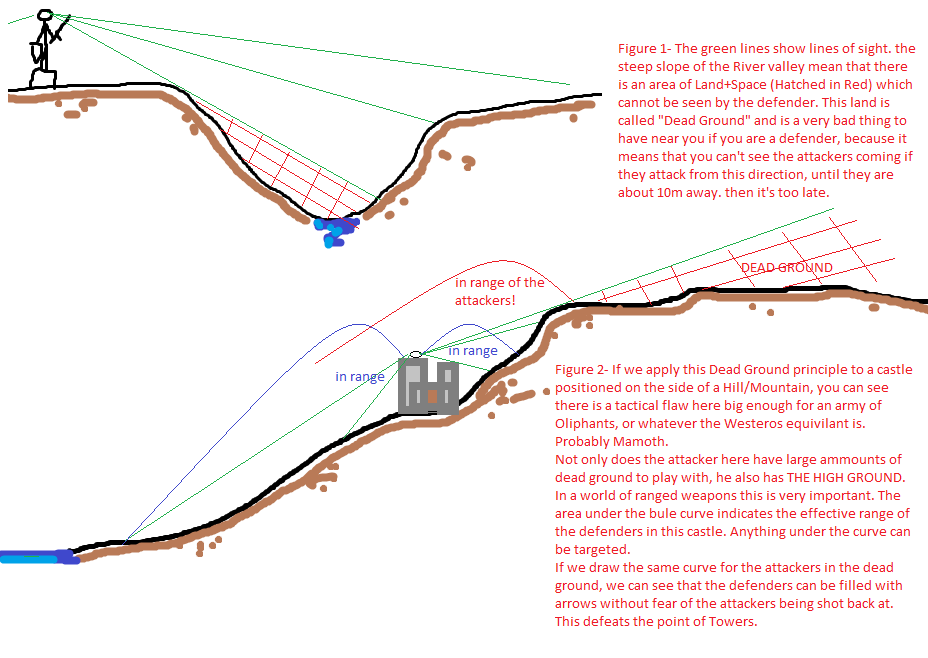
This illustration seems to come from a forum about a computer game or something. Nonetheless: it’s a pretty good illustration of dead ground! Picture source: https://goo.gl/5rWBHB
dead ground: technically, this is space that cannot be observed. Tracing back through references, it seems to have come from a term for describing parts of the base of a castle’s fortifying walls that were sheltered from fire by the defenders, and therefore were weak points vulnerable to attack. Here’s one Quora writer’s definition of it:
Dead Ground is when the observer is unable to resolve keeping eyes on over an intermediate part of the stretch of ground being observed. The observer may be interchanged with detection equipment and includes areas of surveillance which are obscured from a clear alarm signature (environmental distortion from clear auditory reception) or trigger reception (automatic pixel motion detection) by the way the observer is angled. Dead ground exists in hidden embankments and undulating paths, roads or desert open areas with heat waves rising and obscuring or creating distorted imagery.














 Zipf's Law