Death’s second self

Trigger warning: vulgar reference to reproductive anatomy.  Oh, and here’s an analysis of vocabulary in Shakespeare’s Sonnet 73, “That time of year thou mayst in me behold.”

Trigger warning: vulgar reference to reproductive anatomy.  Oh, and National Poetry Month continues with Shakespeare’s Sonnet 73, That time of year thou mayst in me behold.

Thanksgiving Day is a purely American holiday.  OK: it’s a harvest holiday, and practically everybody has a harvest holiday.  But, it’s ours, and we love it.  An American who is not with family and friends on Thanksgiving Day is a lonely American; les Amerloques will travel amazing distances and spend enormous amounts of money just to spend the last Thursday in November with their families, and then head back to wherever they normally are 48 hours later.

I studied literature and linguistics at a college in a little town in rural Virginia.  Nobody was from there, so essentially the entire student body left to go home for the holiday.  Thanksgiving Day is the last Thursday in November (I know I already mentioned that, but it seems weird enough to be worth repeating), and you have to leave a couple days before that to get home–but, when, exactly, can you leave?  The college’s rule was this: classes ended at noon on Tuesday, and then you could do as you wished.

Classes ended at noon, and I had a class at 11.  I was going nowhere, and I was a more-than-obsessive student, so you can bet your ass that I was there at 11.  (You can bet your ass that explained in the English notes below.)  Me–and the professor.  And nobody else.


If I were that professor today, I would just take that student out for a cup of coffee and make them teach me about logarithms, I suppose.  But, I’m a fat old bald guy who will be retired in the blink of an eye (English notes, don’t worry), and my professor was a young guy in need of tenure.  He shrugged his shoulders–and taught me.

No, he didn’t lecture: I sat at a desk, he sat on the desk, and he taught me how to do a “close reading” of a poem.  There must be a technical definition of close reading–my understanding of it is: look up every fucking word.  Do that, and you are likely to be surprised at the connections that you see, the networks of words, the multiple champs lexicaux in the poem–maybe one was obvious to you, but there are probably more than that, and noticing them is part of the pleasure of the whole thing.  (Taking pleasure in analyzing a poem to death might be another one of those reasons that I get divorced so often.)


The latest and greatest thing in literary studies is “distant reading.”  It’s called that precisely to draw the clearest possible contrast with “close reading.”  The idea behind distant reading is that you don’t actually read anything–rather, you use a computer to analyze entire literatures.  As Franco Moretti, the godfather of this stuff, puts it: you can read one book, and then another, and then another, for the rest of your life–at the end, all that you will know is those books.  If you want to understand literature, then you have to look at giant collections of it.  People who do distant reading do what I do with biomedical texts, except they write their papers about things like this:

“The Emotions of London”, written by Ryan Heuser, Franco Moretti, and Erik Steiner, inaugurates a new field of work for the Literary Lab — that of literary and cultural geography. Working on a corpus of 5,000 novels, and covering the two centuries from 1700 to 1900, this pamphlet charts the uneven development of social spaces and fictional structures, bringing to light the long-term connection between emotion and class in narrative representations of London.  Stanford Literary Lab

…rather than stuff like this, as I do:

Prior knowledge of the distributional characteristics of linguistic phenomena can be useful for a variety of language processing tasks. This paper describes the distribution of negation in two types of biomedical texts: scientific journal articles and progress notes. Two types of negation are examined: explicit negation at the syntactic level and affixal negation at the sub-word level. The data show that the distribution of negation is significantly different in the two document types, with explicit negation more frequent in the clinical documents than in the scientific publications and affixal negation more frequent in the journal articles at the type level and token levels.

I’ll leave it to you to decide which is the more interesting.  Or, don’t choose–immerse yourself in both.  Whatever–it’s all fun.

Today, we’ll go closer to the close reading end of the continuum with Shakespeare’s Sonnet 73–an appropriate one for a fat old bald guy such as myself, as it speaks of love at the end of life.  (Obviously, it would be even more appropriate if I could ever get a second date–alas.)  The target in our sights: the words Death’s second self, which have always puzzled me.  (For context: I took three semesters of Shakespeare in college, and I mostly wrote my papers about linguistic aspects of the Bard, so things in his work don’t usually perplex me for decades, like Death’ second self has.)  That second self is pretty goddamn opaque to a native speaker of English–today.  It is an old term that has a meaning of its own:

second self: one who associates so closely with a person as to assume that person’s mode of behavior, personality, beliefs, etc.  (Dictionary.com)

Now, you have to realize: linguists approach dictionaries with more than a little bit of suspicion.  Make it an on-line dictionary of unclear provenance, and my antennae really go up: is this a justifiable definition, or did whoever wrote it base it entirely on their interpretation of its appearance in Shakespeare’s sonnet?

I can’t know what was in the definition writer’s head–hell, I can’t even tell you what’s in any of my many ex-wives’ heads (see previous mentions on this blog of how often I get divorced).  Honestly, most of the time I’m not even sure what’s in my head.  But, I can look at some data–that’s what linguists do, right?  (That’s a bit of sarcasm, but I’m wandering way too far off the track of National Poetry Month already.)   Off I go to the Sketch Engine web site, purveyor of fine linguistic corpora and the tools for searching them, where I find the English Historical Books Collectioncontaining 826,000,000 words of text from English books published between 1473 and 1820.  A search for second self shows me that the phrase occurs at a rate of 0.04 times per million words, and gives me examples like this:

  • …one correspondent to him, suitable both to his nature and necessity, one altogether like to him in shape and constitution, disposition and affection, a second self …
  • THERE is the Relation of Trustees to those that trust them: for he who trusteth another doth thereby create a very near and intimate Relation to him; so far forth as he trusteth him, he putteth his case into his hands, and depositeth his Interest in his Disposal, and thereby createth him his Proxy, or his second self.
  • God is the most Pure, Simple, Uncompounded Being; and if God, who has no parts, and cannot be divided into any, begets a Son, he must Communicate his Whole, Undivided Nature to him: For to beget a Son, is to Communicate his own Nature to him; and if he have no parts, he cannot Communicate a part, but must Communicate the Whole; that is, he must Communicate his whole self, and be a second self in his Son.

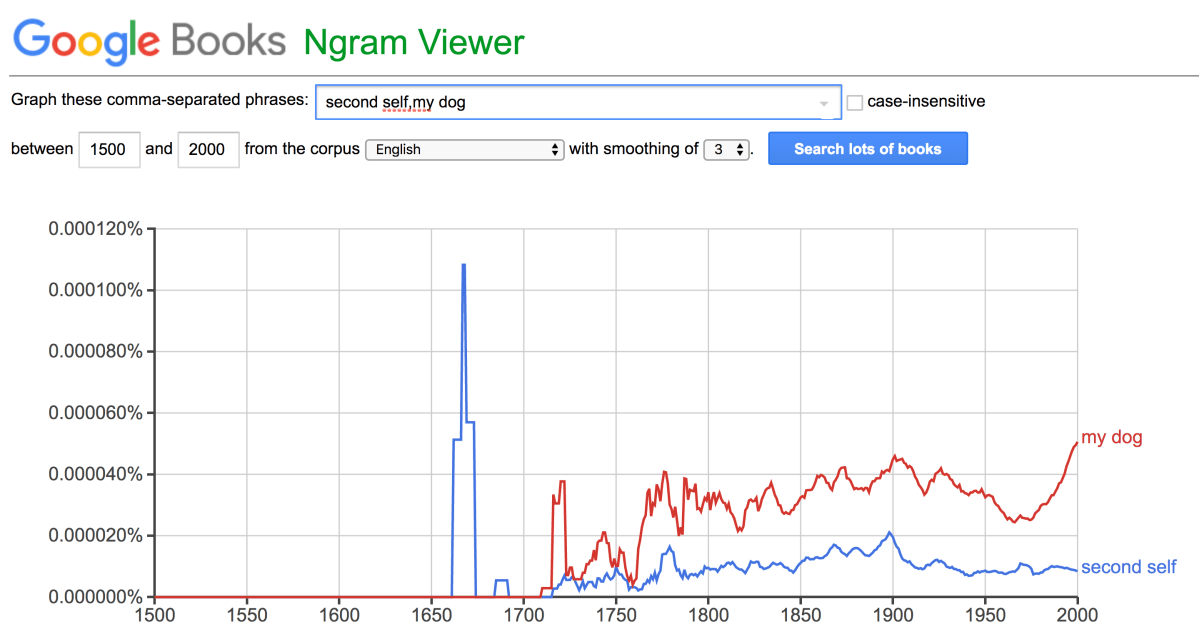
So: I don’t know how the lexicographer came up with their definition, but it looks pretty consistent with the data that I found.  How common was it, actually?  I did a search for it in Google Books between the years 1500 and 2000.  You’ll see a graph of the output at the end of this post.  Why did I also search for my dog?  Because numbers in isolation mean nothing–in order to know whether a number is large or small, you have to compare it to something else.  (The best movie line ever: 5 inches is a lot of snow, and it’s a TREMENDOUS amount of rain, but it’s not very much dick.)  So, I picked a phrase that isn’t necessarily very frequent (relatively speaking), but isn’t exactly weird, either.

…And with that fabulous line from the incredible film L.I.E.I’ll leave you with Shakespeare’s Sonnet 73.  Scroll down past the graph that follows it for the English notes, and I hope that your second self (should you have one) is every bit as nice as you are.

Sonnet 73

William Shakespeare

That time of year thou mayst in me behold
When yellow leaves, or none, or few, do hang
Upon those boughs which shake against the cold,
Bare ruined choirs, where late the sweet birds sang.
In me thou see’st the twilight of such day
As after sunset fadeth in the west;
Which by and by black night doth take away,
Death’s second self, that seals up all in rest.
In me thou see’st the glowing of such fire,
That on the ashes of his youth doth lie,
As the deathbed whereon it must expire,
Consumed with that which it was nourished by.
This thou perceiv’st, which makes thy love more strong,
To love that well which thou must leave ere long.


https://books.google.com/ngrams/interactive_chart?content=second+self%2Cmy+dog&year_start=1500&year_end=2000&corpus=15&smoothing=3&share=&direct_url=t1%3B%2Csecond%20self%3B%2Cc0%3B.t1%3B%2Cmy%20dog%3B%2Cc0
That spike centered around 1670 or so?  Could be real, but you would want to verify it–things like that in any kind of graph tend to reflect either some event that it should be very easy to track down, or a problem with the data itself.


English notes

you can bet your ass that…You can believe that it is absolutely true that…”  This is quite vulgar–don’t say it in front of my grandmother.  Some examples:

  • If someone is trying to kill me and/or my loved ones, you can bet your ass that I’ll take him out first.
  • #1 Rule … If it sounds like a good deal and is widely advertised, you can bet your ass that you are not the first person to call, and if its such a marvelous deal how come its still for sale?
  • Oh and you can bet your ass that neither one of them will be in a good mood at 6:00 when I wake them.
  • Sadly, Ted, if you examine his statements, then see that he specializes in benefits & employment law, you can bet your ass that his clients are vicious capitalist pigs, who love his union- & employee-busting ways.

(Examples from the enTenTen13 corpus–19.7 billion words of written English, searched via the Sketch Engine web site.)   How I used it in the post:  I was going nowhere, and I was a more-than-obsessive student, so you can bet your ass that I was there at 11. 

you bet your ass: this is basically a very emphatic (and vulgar–don’t say it in front of my grandmother) way of saying “yes.”

  • Am I using a bunch of recycled selfies? You bet your ass I am (Twitter)
  • Not even gonna lie, I ordered chinese food yesterday night and while I was eating I found a pinkie nail sized piece of plastic in it. Was I grossed out? Yeah. Did I keep eating? YOU BET YOUR ASS (Twitter)
  • Me, depressed? You bet your ass (Twitter)
  • Just got offered a trip to Florida so I can lay by the pool&drink at our family friend’s new house and be bait to get his son and college buddies there to help move furniture… You bet your ass I said yes (Twitter)

in the blink of an eye: very fast, very quickly, immediately.

  • One wrong turn in an Ikea and you can go from bathrooms to bedroom furniture in the blink of an eye, losing the other members of your party just as quickly.
  • Now, with the advent of social media, you can turn to a quarter million people and get their opinion in the blink of an eye–as long as you have sophisticated tools like NetBase’s to automatically analyze all that chatter so quickly.
  • But if they didn’t go along with her every whim, or worse, wanted to stop the relationship, she would go from singing their praises to trash-talking everything about them in the blink of an eye.

How I used it in the post: But, I’m a fat old bald guy who will be retired in the blink of an eye, and my professor was a young guy in need of tenure.  

We Real Cool, with controversy

We jazz June. We die soon.

National Poetry Month continues.  Today: Gwendolyn Brooks’s We real cool, probably known to anyone of my generation who went to high school (lycée) in the United States.

What has always impressed me about this poem: it has you thinking in seconds flat.  (This expression explained in the English notes below.)  You know what it’s about, you know that it’s telling a very short story, you know that it’s not a happy story–and yet: you couldn’t really say what most of this poem actually means.  (I say that as a native speaker of the language in which the poem is written–and one with a literature degree, too.)  The lines

           We
Jazz June.

…have been particularly controversial, allegedly leading it to have been banned by some districts (I haven’t been able to verify that, sorry)–to jazz can be interpreted as to fuck.  

We Real Cool
The Pool Players / Seven at the Golden Shovel
by Gwendolyn Brooks
We real cool. We
Left School. We

Lurk late. We
Strike straight. We

Sing sin. We
Thin gin. We

Jazz June. We
Die soon.

Scroll down past the video of Gwendolyn Brooks reading We real cool for the English notes.

https://www.youtube.com/watch?v=JBpxJb24O8A


English notes

in seconds flat: very quickly, very fast.  Some examples, courtesy of Twitter:


How I used it in the post: What has always impressed me about this poem: it has you thinking in seconds flat.

Mehitabel and her Kittens, with a bit of vocabulary

Punished for having been a vers libre poet in his previous life…

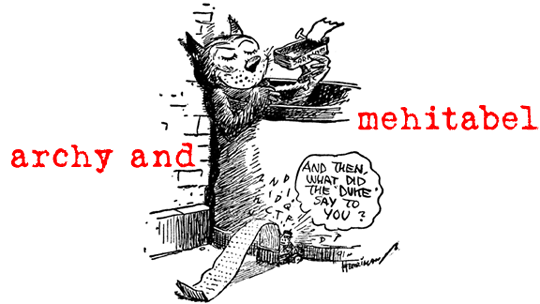
I’m pretty sure that Don Marquis’s archy and mehitabel was the only poetry that I ever read as a kid.  La trame: Archy is a cockroach–a cockroach who has been reincarnated as such as punishment for having been a vers libre poet in his previous life.  (As a child, that didn’t seem terribly bizarre to me–I wasn’t clear on what vers libre was, but I was in the process of receiving a pretty good Jewish religious education in a very traditional Ashkenazic community, and in such communities it’s not uncommon to believe in reincarnation.)  Archy now lives in a newspaper office, where at night he types out messages to Don Marquis (“boss”), a columnist for the New York Evening Sun at the time.  Being a cockroach and all, he has to type by jumping onto one key at a time; since capital letters require you to hold down the Shift key simultaneously, he is not physically capable of producing them.  Hence “boss,” rather than “Boss.”  The Mehitabel in this poem from 1927 is his closest friend, a more-than-a-little-disreputable cat.  Scroll down to the bottom of the page for an explanation of the words to hamper, to be shy on, and tom cat.

Mehitabel and her kittens

Don Marquis, 1927

well boss
mehitabel the cat
has reappeared in her old
haunts with a
flock of kittens
three of them this time

archy she says to me
yesterday
the life of a female
artist is continually
hampered what in hell
have i done to deserve
all these kittens
i look back on my life
and it seems to me to be
just one damned kitten
after another
i am a dancer archy
and my only prayer
is to be allowed
to give my best to my art
but just as i feel
that i am succeeding
in my life work
along comes another batch
of these damned kittens
it is not archy
that i am shy on mother love
god knows i care for
the sweet little things
curse them
but am i never to be allowed
to live my own life
i have purposely avoided
matrimony in the interests
of the higher life
but i might just
as well have been a domestic
slave for all the freedom
i have gained
i hope none of them
gets run over by
an automobile
my heart would bleed
if anything happened
to them and i found it out
but it isn t fair archy
it isn t fair
these damned tom cats have all
the fun and freedom
if i was like some of these
green eyed feline vamps i know
i would simply walk out on the
bunch of them and
let them shift for themselves
but i am not that kind
archy i am full of mother love
my kindness has always
been my curse
a tender heart is the cross i bear
self sacrifice always and forever
is my motto damn them
i will make a home
for the sweet innocent
little things
unless of course providence
in his wisdom should remove
them they are living
just now in an abandoned
garbage can just behind
a made over stable in greenwich
village and if it rained
into the can before i could
get back and rescue them
i am afraid the little
dears might drown
it makes me shudder just
to think of it
of course if i were a family cat
they would probably
be drowned anyhow
sometimes i think
the kinder thing would be
for me to carry the
sweet little things
over to the river
and drop them in myself
but a mother s love archy
is so unreasonable
something always prevents me
these terrible
conflicts are always
presenting themselves
to the artist
the eternal struggle
between art and life archy
is something fierce
my what a dramatic life i have lived
one moment up the next
moment down again
but always gay archy always gay
and always the lady too
in spite of hell
well boss it will
be interesting to note
just how mehitabel
works out her present problem
a dark mystery still broods
over the manner
in which the former
family of three kittens
disappeared
one day she was taking to me
of the kittens
and the next day when i asked
her about them
she said innocently
what kittens
interrogation point
and that was all
i could ever get out
of her on the subject
we had a heavy rain
right after she spoke to me
but probably that garbage can
leaks so the kittens
have not yet
been drowned

archy


English notes

to hamper: “to moderate or limit the effect or full exercise of” (Merriam-Webster).  As a noun, a hamper is a receptacle for dirty clothes.  Why?  Who the fuck knows…

How it was used in the poem:

archy she says to me
yesterday
the life of a female
artist is continually
hampered what in hell
have i done to deserve
all these kittens

to be shy on: to not have very much of, perhaps to not have enough of, something.  A common usage: to be shy on cash.  Example: I can’t go out for dinner with you–I’m a little shy on cash.  How it was used in the poem:

it is not archy
that i am shy on mother love
god knows i care for
the sweet little things
curse them

tom cat: a male cat.  Also, just tom.  A related expression: to tom-cat around, which is a verb for a guy that means to be having sex with a lot of women.  How it was used in the poem:

it isn t fair
these damned tom cats have all
the fun and freedom

A bonus for the reader who has made it this far: some examples of use of the verb to tomcat around.

  • There are many advice books for women on how to manipulate the male psyche. They suggest how to get him to propose, to be more faithful or simply to be better in bed. But a new book for men takes the opposite approach, counseling the male animal on how to tomcat around shamelessly, while avoiding commitments.  (Braden Kell, writing for the New York Post)
  • Venitucci claims Mechanic, a state-licensed social worker, was equally determined to get him and other men in a group session to tomcat around. “For 10 years, I was faithful. Then I just caved in and had an affair, and [Mechanic] said there was nothing wrong with that,” Venitucci said. (Kathianne Boniello and Brad Hamilton, writing for the New York Post–no link, sorry)
  • Ray, you know I’m right. I don’t really care who he fucks, as long as his tomcating around doesn’t harm our reputation. (M.J. Natali, Adara)


Guillaume Apollinaire: Exercice

Guillaume Apollinaire is another one of those folks who shows that you can be both a poet, and a very serious ass-kicker. 

2014-07-04 19.10.09
Street sign in the Saint-Germain-des-Prés neighborhood.

Guillaume Apollinaire is another one of those folks who shows that you can be both a poet–and a very serious ass-kicker.  Apollinaire tried to join the French army in Paris at the beginning of the First World War, but was turned down–because he wasn’t a French citizen.  (Polish, actually.)  Undaunted, he travelled south, tried again, and this time got in.  He was initially assigned to the artillery, but that wasn’t hard-core enough for him, and he asked for–and received–a transfer to the infantry.  He suffered a head wound in 1916, never really recovered from it, and in his weakened condition, died in the influenza epidemic of 1918.  Here is one of his poems, Exercice.

Exercice

Vers un village d l’arrière
S’en allaient quatre bombardiers
Ils étaient couvert de poussière
Depuis la tête jusqu’aux pieds

Ils regardaient la vaste plaine
En parlant entre eux du passé
Et ne se retournaient qu’à peine
Quand un obus avait toussé

Tous quatre de la classe seize
Parlaient d’antan non d’avenir
Ainsi se prolongeait l’ascèse
Qui les exerçait à mourir


French notes

In the last two lines, note the inversion: not L’ascèse qui les exerçait à mourir se prolongeait ainsi, but Ainsi se prolongeait l’ascèse qui les exerçait à mourir.  If you’d like to read an analysis of the various and sundry kinds of inversion that ainsi can trigger, as well as some quantitative data on ainsi-triggered inversion in Le Monde, see Lena Karssenberg and Karen Lahousse’s paper on the topic.

•    la poussière: dust.
•    la plaine: plain.
•    se retourner: (tourner la tête) turn around, do a double take; (changer de sens, de position) turn over, toss and turn; (se mettre à l’envers) turn over, overturn
•    la peine: punishment, sorrow, trouble—but, that’s not what it means here—see the next entry.
•    à peine: scarcely, hardly
•    un obus: shell (artillery).
•    tousser: to cough
•    d’antan: of yesteryear, of long ago
•    se prolonger: continue; perpetuate itself; persist; linger; go on; be continued; be extended
•    ascèse: This word is a tough one.  It’s not in any of my French-English dictionaries.  In Anne Greet’s translation (see below), it’s rendered as “ascesis.”  I found it in a monolingual (French-French) dictionary; the definition seemed to be something like asceticism.
•    exercer: to train, exercise, practice

What should we make of the past imperfect tense that is used throughout the poem?
Greet’s notes suggest that it produces a detachment between the poet and the four men: “The poet…is not part of the graphic little scene he is painting.  The verbs, in third person and imperfect tense, indicate that he is an omniscient observer.  This role produces a…fine balance in the poem between compassion and detachment.”

Towards a village in the rear
Marched four bombardiers
And they were covered with dirt
From head to foot

They stared at the vast plain
As they talked about the past
And they barely looked around
When a shell made a coughing sound

All four of class sixteen
Spoke of the past not future time
Thus the ascesis dragged on
That practiced them in dying

Translated by Anne Hyde Greet

You like Apollinaire, but like me, have trouble with the French?  I like Anne Hyde Greet’s translation of Calligrammes quite a bit.

Rest In Peace, Jacques Higelin

One of my friends once said this to me: “When I walked out of the room after finishing my bac [the French high school exit exam–your score on it determines a lot of the future course of your life], I said to myself: if I’d spent as much of the last four years studying as I did memorizing Higelin, I’d be going to a much better university.” 

One of my friends once said this to me: “When I walked out of the room after finishing my bac [the French high school exit exam–your score on it determines a lot about the future course of your life], I said to myself: if I’d spent as much of the last four years studying as I did memorizing Higelin, I’d be going to a much better university.”  Jacques Higelin died yesterday.  Go to his anglophone Wikipedia page and you’ll find a few short paragraphs–go to his francophone page, and it goes on for screen, after screen, after screen.  Here’s the most appropriate song of his that I could think of during this National Poetry Month–scroll down past the video for the lyrics.

https://www.youtube.com/watch?v=Ydf5e4kpTxM

J’suis mort qui qui dit mieux
Ben mon pauv’vieux, voilà aut’chose
J’suis mort qui, qui dit mieux
Mort le venin, coupée la rose
J’ai perdu mon âme en chemin
Qui qui la r’trouve s’la mette aux choses
J’ai perdu mon âme en chemin

Qui qui la r’trouve la jette aux chiens

J’m’avais collé avec une fumelle
Ben alors ça c’est la plus belle
J’m’avais collé avec une fumelle
L’jour où j’ai brûlé mes sabots
J’lui avais flanqué un marmot
Maint’nant qu’son père est plus d’ce monde
L’a poussé ce p’tit crève la faim
Faut qu’ma veuve lui cherche un parrain.

Elle lui en avait d’jà trouvé un
Eh j’ai pas les yeux dans ma poche

Elle lui en avait d’jà trouvé un
Dame faut prévoir, en cas d’besoin
C’est lui qui flanquera des taloches
A mon p’tiot pour qu’il s’tienne bien droit
C’est du joli, moi j’trouve ça moche
De cogner sur un plus p’tit qu’soi.

Cela dit dans c’putain d’cimetière
J’ai perdu mon humeur morose
Jamais plus personne ne vient
M’emmerder quand je me repose
A faire l’amour avec la terre
J’ai enfanté des p’tits vers blancs
Qui me nettoient, qui me digèrent
Qui font leur nid au creux d’mes dents.

Arrétez-moi si je déconne
Arrétez-moi ou passez m’voir
Sans violettes, sans pleurs ni couronnes
Venez perdre un moment d’cafard
J’vous f’rais visiter des cousins
Morts à la guerre ou morts de rien
Esprit qui vous cligne de l’oeil
Les bras tendus hors du cercueil

Aujourd’hui je vous sens bien lasse
Ne soyez plus intimidée
A mes côtés reste une place
Ne tient qu’à vous de l’occuper
Qu’est c’que tu as ? oui, le temps passe
Et le p’tit va rentrer de l’école
Dis lui q’son père a pas eu d’bol
‘L a raté l’train, c’était l’dernier

Attend un peu, ma femme, ma mie
Y’a un message pour le garçon
J’ai plus ma tête, voilà qu’j’oublie
Où j’ai niché l’accordéon
P’t’être à la cave, p’t’être au grenier
Je n’aurais repos pour qu’il apprenne
mais il est tard, sauve toi je t’aime
Riez pas du pauv’macchabé

Ceux qui ont jamais croqué d’la veuve
Les bordés d’nouilles, les tir à blanc
Qu’ont pas gagné une mort toute neuve
A la tombola des mutants
Peuvent pas savoir ce qui gigote
dans les trous du défunt cerveau
Quand sa moitié dépose une botte de rose
Sur l’chardon du terreau
Quand sa moitié dépose une botte de rose
Sur l’chardon du terreau


French notes

Je suis mort, qui qui dit mieux : This is a complicated line, combining an expression fron childish language (qui qui) with qui dit mieux, which is how an auctioneer tries to raise an amount that’s been bid.  An explanation from a friend:

“Qui dit mieux” est l’expression du commissaire priseur, mais pas “qui qui dit mieux”.   
En français commencer une phrase par “qui qui (veut des pâtes ?, chante si fort ?…etc…), est une formulation enfantine ou illettrée pour dire “Qui est-ce qui ? “.  La complexité de la construction grammaticale de ce bout de phrase non visible mentalement dans sa version orale, fait que jeunes élèves et adultes fâchés avec la belle langue le réduisent à “C’est qui qui + verbe” ou “Qui, qui + verbe”.

https://www.youtube.com/watch?v=Ydf5e4kpTxM


Mere anarchy

Ever since Obama got elected and the Republican Party went insane over the sight of a black man in the Oval Office, Yeats’s “The Second Coming” has become more and more meaningful to me.

I was never really all that struck by Yeats’ poem The Second Coming when I was an English major in college.  We mostly contented ourselves with showing off our knowledge of what a gyre is, and then moved on to Beowulf, or Salman Rushdie.  But, ever since Obama got elected and the Republican Party went insane over the sight of a black man in the Oval Office, The Second Coming has become more and more meaningful to me.  When Trump got elected, it went way past “meaningful” towards “frightening,” and nothing that has happened in the subsequent year+ that he’s been in office has done anything to make it less so.

As you can imagine, the imagery of this poem has generated enormous amounts of discussion, and I won’t pretend to even begin to get a handle on it.  Even the language is difficult to understand at points, and not just for reasons of obscure vocabulary.  Here are the two words that people have the most trouble with:

  • gyre: a spiral motion.  From what I understand, falcons hunt by flying in a widening spiral, or gyre.  I haven’t been able to find a video that shows it clearly, but if you have a strong stomach and want to see a falcon kill something: seek, and you shall find.
  • mere: the sense of the word here is an old one: pure, absolute.  See the Merriam-Webster entry here.  The typical meaning is something like “nothing more than”–He is a mere child.
  • to vexto trouble.

The Second Coming

W. B. Yeats, 1919

Turning and turning in the widening gyre
The falcon cannot hear the falconer;
Things fall apart; the centre cannot hold;
Mere anarchy is loosed upon the world,
The blood-dimmed tide is loosed, and everywhere
The ceremony of innocence is drowned;
The best lack all conviction, while the worst
Are full of passionate intensity.

Surely some revelation is at hand;
Surely the Second Coming is at hand.
The Second Coming! Hardly are those words out
When a vast image out of Spiritus Mundi
Troubles my sight: somewhere in sands of the desert
A shape with lion body and the head of a man,
A gaze blank and pitiless as the sun,
Is moving its slow thighs, while all about it
Reel shadows of the indignant desert birds.
The darkness drops again; but now I know
That twenty centuries of stony sleep
Were vexed to nightmare by a rocking cradle,
And what rough beast, its hour come round at last,
Slouches towards Bethlehem to be born?

À Grenelle

Suddenly Bruant’s poem made sense.

For the 3rd day of National Poetry Month, here’s a slice of life from Aristide Bruant.

IMG_3629
My little bookstore.

I live in the most boring arrondissement of Paris.  The 15th typically doesn’t even show up in tourist guide-books–it’s the biggest arrondissement in the city, but it’s just a residential neighborhood, plain and simple.  (Plain and simple is an adverb, not an adjective–see the English notes below.)  The pearl of my little corner of the 15th is a small used bookstore on the boulevard Grenelle.  The floor is almost completely covered with stacks of books, to the point that if the owner ever has a heart attack in there, they will have to empty the store to get the stretcher inside–it’s adorable, and if the owner sees something that he thinks I’ll like, he puts it aside for me.


bruant_aristide
Aristide Bruant. He’s usually pictured wearing a wide-brimmed hat, but you can find such depictions anywhere… Source: http://www.dutempsdescerisesauxfeuillesmortes.net, https://goo.gl/rcFw9e

And yet: this being Paris, there are centuries of history everywhere around me.  An afternoon’s walk often takes me through the side streets to the west of the École militaire, the military academy that was meant to increase the size of the French officer corps by making it possible for the sons of non-aristocrats to get into it.  (Napoleon learned his craft there.)  Amongst those streets was the red-light district of this very military neighborhood, and the poet Aristide Bruant immortalized it in À Grenelle.

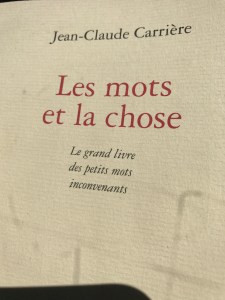
Much of this poem puzzled the shit out of me (see the English notes below for what that means) until the day that I walked into my little bookstore and the owner showed me something that he was saving for me.  Called Les mots et la chose, the trame (premise?) of Jean-Claude Carrière’s epistolary novel is that a retired lexicographer gets a letter in the mail from a struggling actress who pays her bills by dubbing pornographic films into French.  She’s tired of the limited vocabulary that she’s asked to use, and she requests that the lexicographer suggest some alternatives.  (Note the subjunctive: that the lexicographer suggest, not suggests.)  The rest of the book is his responses, with separate chapters for penises, breasts, la chose itself, etc.

IMG_0495Suddenly Bruant’s poem made sense.  Faire sentinelle: to stand guard, but also to have an erection.  La chapelle: chapel, but also vagina.  Other plays on words are more obvious, at least to a veteran (which I am, but Trump isn’t, having been excused from Vietnam due to a sore foot, although apparently said foot did not deter him from being an enthusiastic athlete).  Montaient à l’assaut de mes mamelons: the word le mamelon is a nipple or a small hill, and lemme tell ya, assaulting a hill is a highly technical undertaking–higher ground gives the defender a major advantage, and assaulting hills is the kind of thing that you really have to practice.  I was also impressed by the technical accuracy of this verse: …des lanciers, // Des dragons et des cuirassiers // Qui me montraient à me tenir en selle… Specifically, the fact that these soldiers who are teaching her “to stay in the saddle” (do French men all share the universally-held American man’s wish to “die in the saddle”?) are all mounted (i.e. on horseback) troops of one sort or another: lanciers and cuirassiers were cavalry troops, and dragons were “mounted infantry,” meaning that they travelled on horseback, but dismounted to fight.

There’s cool stuff in the poem for grammarians, as well–most notably, this line: J’en ai-t-y connu des lanciers…  Us anglophones struggle with both and en, and finding both of the together and with an inversion…well, good luck finding anything that complicated ever again, and if you do, please tell us about it in the comments…

738_yvette_guilbert
Yvette Guilbert in 1885. I HATE the Toulouse-Lautrec paintings of her, but looking at this photo, you can see why he did what he did with her… Source: franceculture.fr, https://goo.gl/RknwY1

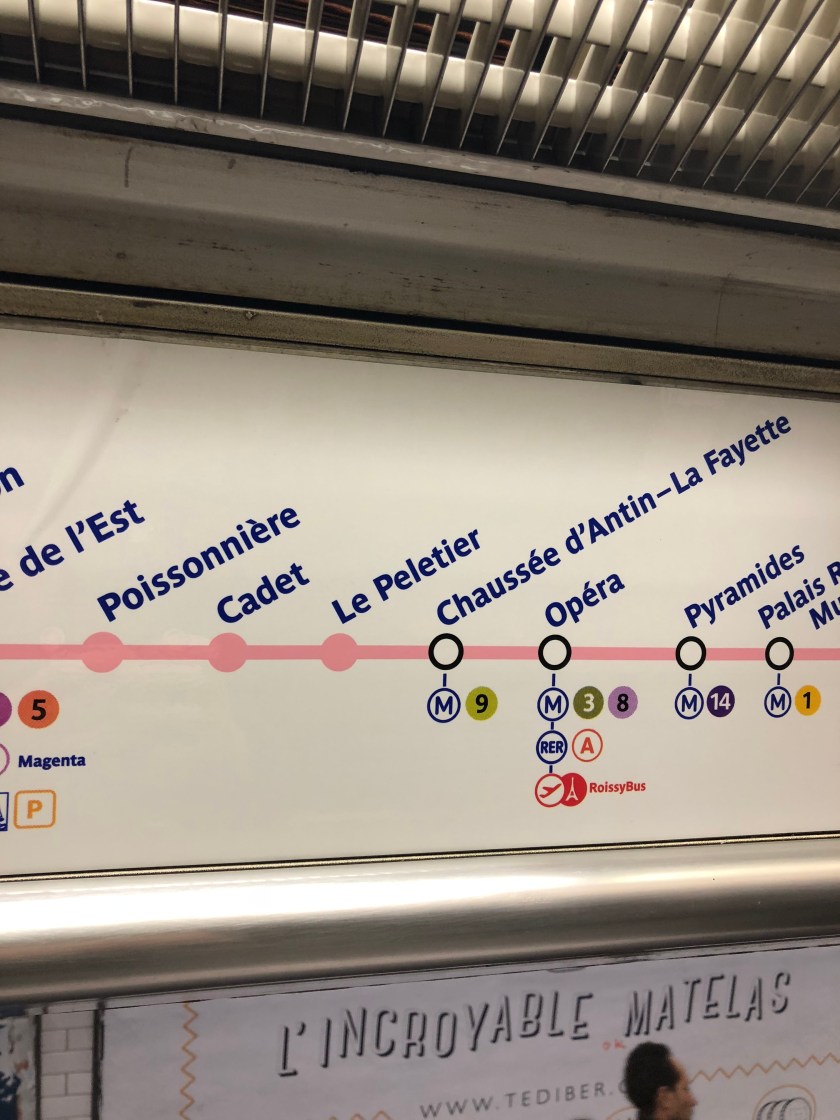
Bruant’s poem was eventually recorded by Yvette Guilbert, and more recently by Patachou.  I hum it in my head whenever my train passes by the Chaussée d’Antin metro station, for reasons that will become clear when you get to the last verse.


À Grenelle

Aristide Bruant

Quand je vois des filles de dix-sept ans,
Ça me fait penser qu’y a bien longtemps
Moi aussi, je l’ai été, pucelle,
A Grenelle!Mais c’est un quartier plein de soldats,
On en rencontre à tous les pas,
Jour et nuit, ‘font sentinelles,
A Grenelle!J’en ai-t-y connu des lanciers,
Des dragons et des cuirassiers
Qui me montraient à me tenir en selle
A Grenelle!Fantassins, officiers, colons,
Montaient à l’assaut de mes mamelons!
Ils me prenaient pour une citadelle!
A Grenelle!

Moi, je les prenais tous pour amants,
Je commandais tous les régiments,
On m’appelait “Mâme la Colonelle”,
A Grenelle!

Mais ça me rapportait que de l’honneur,
Car si l’amour, ça fait le bonheur,
On fait pas fortune avec elle,
A Grenelle!

Bientôt je m’aperçus que mes beaux yeux
Sonnaient l’extinction des feux,
On se mirait plus dans ma prunelle
A Grenelle!

Mes bras, mes jambes, mes appâts,
Tout ça foutait le camp à grands pas,
J’osais plus faire la petite chapelle
A Grenelle!

Aujourd’hui que j’ai plus de position,
Les régiments me font une pension:
On me laisse manger à la gamelle,
A Grenelle!

Ça prouve que quand on est putain,
Faut s’établir Chaussée d’Antin,
Au lieu de se faire une clientèle
A Grenelle!

Scroll down for the English notes.

IMG_5803
The Chaussée d’Antin stop on line 7. Picture source: me.

English notes

plain and simpleClearly; without any complexity (Wiktionary).  Plain and simple is what linguists call a sentential or sentence-level adverb.  It describes the speaker’s attitude towards the assertion being made by the rest of the sentence: in this case, that the assertion is indisputably true.  Plain and simple is unusual in that most sentential adverbs come at the beginning of the sentence (Luckily, we didn’t miss the train); in contrast, plain and simple usually comes at the end of the sentence.  Some examples from the enTenTen13 corpus at the Sketch Engine web site, purveyor of fine linguistic corpora and the tools for searching them:

  • It doesn’t work, plain and simple.
  • Those things are just evil, plain and simple.
  • A mood disorder is an illness, plain and simple.
  • Seriously addressing the long-term fiscal problem means restraining entitlement spending growth, plain and simple.
  • That is the reason for the obesity epidemic, plain and simple.

to verb the shit out ofa delightful English adverb (well, maybe American–I don’t actually know much about British English) that intensifies the action of the verb.

  • Found : At most gay bars, probably confusing the shit out of everyone.
  • When and if it does happen it won’t freak the shit out of you…
  • The group is preparing to shock the shit out of tourists.
  • If there is one thing ATLA is overflowing with, it’s ladies absolutely walloping the shit out of everyone.
  • There’s not a critic in the world who could say anything to me, because I kick the shit out of myself way worse than anybody ever could.
  • What happened here was the jury didn’t like the victim, and so the wrong-doer got a walk, and frankly that should scare the shit out of you.
  • If you want this to be a legitimate sport, start running it like one and stop embarassing the shit out of everyone who has supported your organization since the get go.

Note that the modified verb is usually one with a negative sense–to confuse, to beat, to shock, to wallop (to hit very hard), to scare, to embarrass.  (Yes, it’s spelled wrong in the example above.)  But, it doesn’t have to be a negative verb; using it with a positive one is odd, though, and that gives a certain flavor to such uses.

  • I plan to enjoy the shit out of it.
  • I’d buy the shit out of those tickets.
  • Then go find your Peter Brand and hire the shit out of him before someone else does.
  • Choir! – but you have, right? – they are everyday people who get together on Tuesdays or Wednesdays to sing the shit out of something, usually a popular song from the last 30 years or so.
  • I want to marry the shit out of you and then I want to put a baby inside you as soon as you’ll let me.

The Chad Gadya machine

Yehuda Amichai is a good illustration of the fact that nobody hates war more than the people who have to fight it.  Amichai fought in four wars–and wrote one of the great poems of peace of the past century.

YA6
Yehuda Amichai. Photo originally from Hana Amichai.

For the second day of National Poetry Month: Israeli poet Yehuda Amichai’s beautiful poem An Arab shepherd is searching for his goat on Mount Zion.  Amichai is yet another example of something that we’ve seen many times on this blog: being a poet doesn’t mean that you can’t kick ass.  From his Wikipedia entry:

He was a member of the Palmach, the strike force of the Haganah, the defense force of the Jewish community in Mandate Palestine. As a young man he volunteered and fought in World War II as a member of the British Army, and in the Negev on the southern front in the Israeli War of Independence.[4]

…In 1956, Amichai served in the Sinai War, and in 1973 he served in the Yom Kippur War.[6]

Amichai is also a good illustration of another thing that I hope you’ve gotten from this blog: nobody hates war more than the people who have to fight it.  Trump is, of course, a big fan of it–for other people, for other people’s children.  (He ditched out on Vietnam himself, and you’ll notice that none of his kids have served, either.)  Amichai fought in four wars–and wrote one of the great poems of peace of the past century.

An Arab Shepherd Is Searching For His Goat On Mount Zion

Yehuda Amichai

An Arab shepherd is searching for his goat on Mount Zion
and on the opposite hill I am searching for my little boy.
An Arab shepherd and a Jewish father
both in their temporary failure.
Our two voices met above
the Sultan’s Pool in the valley between us.
Neither of us wants the boy or the goat
to get caught in the wheels
of the “Chad Gadya” machine.

Afterward we found them among the bushes,
and our voices came back inside us
laughing and crying.

Searching for a goat or for a child has always been
the beginning of a new religion in these mountains.


…caught in the wheels of the “Chad Gadya” machine: this is a metaphor for a sort of process of tit-for-tat that snowballs out of control (whoops, another metaphor–sorry).  Chad Gadya is a song that’s sung at the end of the seder, the (loooooong) ritual meal eaten on the first two evenings of Pesach (Passover, or la Pâque des juifs, as it’s called in French–“Jewish Passover.”  This always makes me smile–and, yes, I’m Jewish.)  It’s a highly allusive/metaphorical story, like … well, like every Jewish story I’ve ever heard.  “Chad gadya” is Aramaic for “one kid”–in English, a baby goat is a kid.  The plot line of the song: Father buys a baby goat.  The cat eats the goat.  So, the dog bites the cat.  So, the stick hits the dog.  So, the fire burns the stick, the water puts the fire out, and on, and on, and on.  Hence:

Neither of us wants the boy or the goat
to get caught in the wheels
of the “Chad Gadya” machine.


In case you were wondering: Aramaic is similar to Hebrew–you can recognize Aramaic by the frequent presence of at the end of nouns where you wouldn’t expect them in Hebrew.  It’s the definite article (the), which in Hebrew is ha- at the beginning of the word. For example, here’s a chunk of the lyrics:

le-tora de-shatah le-mayathe ox that drank the water,

de-khavah le-nura de-saraf le-chutrathat put out the fire that burnt the stick,

de-hikkah le-khalba de-nashakh le-shunrathat hit the dog that bit the cat,

de-akhlah le-gadya dizabin abba bitrei zuzei.  that ate the kid that Dad bought for two zuzim.

“What about the at the end of abba,” you’re wondering?  No–that one’s just part of the word abba–Dad or Daddy.

…and with that, I’ll stop language-geeking and go watch an episode of Santa Clarita Diet.  The always-adorable Drew Barrymore as a zombie–brilliant, just brilliant.

The angelic wrath of hope

This being a blog about language, the beauty will mostly get lost in my analysis, unless you think that the analysis IS the beauty, in which case: let’s get married.

It’s April, and that means National Poetry Month in the US, and that means: poems.  This being a blog about language, the beauty will mostly get lost in my analysis, unless you think that the analysis is the beauty, in which case: let’s get married.

For the first day of April, I bring you a poem by my colleague Daniela Gîfu.  Besides being one of the few researchers in my field who publishes as much as I do (and maybe more–it’s not like it’s a competition), she is also a many-times-published poet and essayist–and journalist.

Daniela writes in Romanian.  I’ve used Google Translate on her poem Ianuarie, which certainly isn’t optimal, but it gives you the flavor of her work.

I don’t speak Romanian, but the language has a couple features that stand out.

  1. Like a typical Romance language, Romanian has definite articles (the); unlike a typical Romance language, they are at the end of whatever they modify.  The definite article has different forms for masculine, feminine, and neuter words, and also has different forms depending on the last sound of the noun to which it is added.  Here are the examples from the Wikipedia page on Romanian grammar:
  • Masculine nouns (singular, nominative/accusative):
codru – codrul (forest – the forest);
pom – pomul (tree – the tree);
frate – fratele (brother – the brother);
tată – tatăl (father – the father)
  • Neuter nouns (singular, nominative/accusative):
teatru – teatrul (theater – the theater);
loc – locul (place – the place)
  • Feminine nouns (singular, nominative/accusative):
casă – casa (house – the house);
floare – floarea (flower – the flower);
cutie – cutia (box – the box);
stea – steaua (star – the star)

2.  Many of the sounds from Latin became sounds.  (The “conditioning factor” was the vowel that came after the consonant.)  Some examples:

  • bună ziua (good day–compare Spanish buenos días)
  • zece (ten–compare Spanish diez)

IANUARIE

Sunt născută în ianuarie,
o lună cu ochii de gheaţă
în hibernarea greoaie a poverilor sufleteşti.
Alături,
înariparea îngerească a speranţei.
Zăbovesc pe străzi ca-ntr-o rugăciune.
În jur, doar pândele cerşetorilor
îmbrăţişaţi părinteşte de ger,
în uimirea trecătorilor indiferenţi.
Oriunde privesc,
abatere, risipă, pierzanie
de la drumurile moştenite de la facere,
în licărirea luceafărului de seară.

JANUARY

I was born in January,
one month with the eyes of the ice
in the cumbersome hibernation of soul burdens.
Together,
the angelic wrath of hope.
I walk in the streets as a prayer.
Around, just the beggars’ lusts
embrace parents with frost,
in the astonishment of indifferent passers-by.
Wherever I look,
miscarriage, waste, loss
from the roads inherited from the making,
in the glimpse of the evening star.

“The angelic wrath of hope”–I love it.  Want to read more of Daniela’s poetry?  See this web page.  Search around and you’ll find her doing readings.

Cautiously optimistic

img_0462
Graffiti that I saw on my way into a metro station this morning: “Neither Macron nor Le Pen means Le Pen.” Picture source: me.

A very good thing about France: the French don’t really do protest votes.  That’s not to say that we don’t have the ni-nis—those who say that they won’t vote ni for Macron, ni for Le Pen.  A ni-ni might abstain, or voter blanc–-submit a blank ballot.  But, it’s not exactly a common thing in France.  France has a two-round election process, with multiple candidates in the first round, and only the top two finishers in the second (except in the unlikely event where someone takes more than 50% in the first round.) People sometimes say that you vote the first round with your heart, and the second round with your head.

I would say that Americans vote 80% on emotion, and 20% on the basis of their takes on the candidates’ actual policies.  (I don’t except myself from that; “one’s take on something” explained in the English notes below.)  In contrast, I would guess that the French tend to vote 20% on emotion, and 80% on the basis of their takes on the candidates’ actual policies.  I know plenty of people who aren’t at all crazy about Macron’s proposals for the economy, but given a choice between someone about whom they’re not crazy and some Nazi sociopath, of course they’re going to vote for the guy about whom they’re not crazy.  The photo above–some graffiti that I saw as I walked into a metro station this morning–is representative of the opinion of everyone with whom I’ve talked: deciding not to vote for either of them is to vote for Le Pen.

The best lack all conviction, while the worst
Are full of passionate intensity.

–W. B. Yeats, The Second Coming, 1919

The worry of most of the people I know is that Macron is so far ahead of Le Pen in the polls that everyone will assume that he’s going to win, and too many people will decide that they don’t need to vote, and then the Le Pen voters all show up, and boum–Le Pen wins.

I was never really all that struck by Yeats’ poem The Second Coming when I was an English major in college.  We mostly contented ourselves with showing off our knowledge of what a gyre is, and moved on to Beowulf, or Salman Rushdie.  But, ever since Obama got elected and the Republican Party went insane over the sight of a black man in the Oval Office, The Second Coming has become more and more meaningful to me.  With Trump in office, it has gone past “meaningful” towards “frightening”–at the very least, foreboding.

The polls in France close in four hours.  We’ll see what happens.

The Second Coming

W. B. Yeats, 1919

Turning and turning in the widening gyre
The falcon cannot hear the falconer;
Things fall apart; the centre cannot hold;
Mere anarchy is loosed upon the world,
The blood-dimmed tide is loosed, and everywhere
The ceremony of innocence is drowned;
The best lack all conviction, while the worst
Are full of passionate intensity.

Surely some revelation is at hand;
Surely the Second Coming is at hand.
The Second Coming! Hardly are those words out
When a vast image out of Spiritus Mundi
Troubles my sight: somewhere in sands of the desert
A shape with lion body and the head of a man,
A gaze blank and pitiless as the sun,
Is moving its slow thighs, while all about it
Reel shadows of the indignant desert birds.
The darkness drops again; but now I know
That twenty centuries of stony sleep
Were vexed to nightmare by a rocking cradle,
And what rough beast, its hour come round at last,
Slouches towards Bethlehem to be born?


English notes

One’s “take on” something is your opinion, or analysis of, it.  Note that this is entirely different from the verbal idiom to take something/someone on.  

  • I want to comment on Trump’s take on the Civil War and Andrew Jackson… but, seriously, it hurts me. READ A BOOK!  (Twitter) (Context: Trump recently said something about a former populist president, Andrew Jackson, that is consistent with either (a) Trump being an uneducated idiot who, in particular, doesn’t know anything about American history, or (b) Trump being a very bad person.)
  • Gr8, some sources just hav a screwed up set of priorities. Who cares about Trump’s take on med marijuana when the health care plan sucks?! (Twitter) (Context: the Republican-controlled House of Representatives just voted to repeal Obamacare and replace it with a disaster.)
  • Trump’s take on Andrew Jackson isn’t astonishing; what is astonishing is that this country elected an ignorant pussy-grabbing Richie Rich.  (Twitter)
  • My take on Trump is that he just wants to be liked by whoever is in front of him, which makes him inconsistent and unreliable.  (Twitter)
  • My take on Trump’s worse-than-worthless briefing to every senator on the North Korean problem.  (Twitter) (Context: here’s a link to the Tweeter’s article on Trump’s attempt to swing the Senate in his favor with respect to whatever crap he’s brewing concerning North Korea.)

How I used it in the post: I would say that Americans vote 80% on emotion, and 20% on the basis of their takes on the candidates’ actual policies.  

Ukrainian Humanitarian Resistance

Resisting the russist occupation while keeping our humanity

Languages. Motivation. Education. Travelling

"Je suis féru(e) de langues" is about language learning, study tips and travelling. Join my community!

Curative Power of Medical Data

JCDL 2020 Workshop on Biomedical Natural Language Processing

Crimescribe

Criminal Curiosities

BioNLP

Biomedical natural language processing

Mostly Mammoths

but other things that fascinate me, too

Zygoma

Adventures in natural history collections

Our French Oasis

FAMILY LIFE IN A FRENCH COUNTRY VILLAGE

ACL 2017

PC Chairs Blog

Abby Mullen

A site about history and life

EFL Notes

Random commentary on teaching English as a foreign language

Natural Language Processing

Université Paris-Centrale, Spring 2017

Speak Out in Spanish!

living and loving language

- MIKE STEEDEN -

THE DRIVELLINGS OF TWATTERSLEY FROMAGE