I’m going to die in 2028

Montaigne2291wl
Michel de Montaigne, 16th-century French philosopher and essayist. We call him Eyquem around the office. Picture source: http://hua.umf.maine.edu/Reading_Revolutions/MontaigneT.html.

I’m going to die in 2028.  I calculated this by starting with my year of birth, adding the median of my father’s and paternal grandfather’s ages at the time of their first heart attacks, subtracting a bit for my smoking as a teenaged problem child, adding a bit for my maternal grandfather’s long life despite his smoking (a friend of my mother’s once described my grandfather’s apartment to me as “nothing but books and cigarette smoke”), subtracting a bit for the deleterious effects of years of high cortisol production due to years of incredible stress (I have my own problem child), and adding a bit for the salutary effects of ten years of intensive study of the incredibly physically demanding sport of judo.  2028 works out great for me–I can retire and spend a couple years sitting around reading, and then croak right about the time that my paltry retirement savings run out.

The verb mourir, “to die,” turns out to be quite irregular in French, and since we’ve been working our way through irregular verbs, il serait séant q’on l’étudiât.  (That’s a little French morphosyntax joke.  A double joke, actually, since séant means both the very literary “fitting, seemly” and “backside, behind”–roughly fesses, if you’re French.)  As far as I can tell, some verbs have similar conjugations, but no other French verb is conjugated quite the same as mourir.  Let’s tour the various and sundry tenses and aspects.

Present indicative

Mourir has a vowel change in the present tense that is almost all its own–the only similar verb that I can think of is émouvoir. But, émouvoir is quite different even in this tense, as the third person plural form (ils/elles) has the root-final consonant of the other plurals, rather than the (lack of a) root-final consonant in the singulars, which is how mourir works.

je meurs nous mourons
tu meurs vous
on meurt ils/elles mourez

 Imperfect indicative

As far as I know, even irregular verbs are all regular in the imparfait, or imperfect indicative.

je mourais nous mourions
tu mourais vous mouriez
on mourait ils/elles mouraient

Passé simple (past historic)

Mourir is irregular in its own special way in the passé simple.  It takes the same endings as a set of irregular verbs that have past participles that end with u, but its past participle does not end with u.  (It’s mort(e).)  (See Laura Lawless’s page on the passé simple on About.com for the full set.)

je mourus nous mourûmes
tu mourus vous mourûtes
on mourut ils/elles moururent

Passé composé (compound past)

Of course, mourir has to be different and make the compound past with être, rather than as most verbs do, with avoir:

je suis mort nous sommes morts
t’es mort vous êtes morts
on est mort ils sont morts

Futur simple (future indicative)

This is one of those double-rr-in-the-future-tense verbs that we ran into in a recent post on irregular future-tense verbs.

je mourrai nous mourrons
tu mourras vous mourrez
on mourra ils/elles mourront

Present subjunctive

Mourir has the same unusual root vowel change in the present subjunctive as it has in the present indicative.

je meure nous mourions
tu meures vous mouriez
on meure ils/elles meurent

Imparfait du subjonctif (imperfect subjunctive)

Mourir is irregular in the imperfect subjunctive in the same way that it’s irregular in the passé simple, which is to say that it has a u in the stem

je mourusse nous mourussions
tu mourusses vous mourussiez
on mourût ils/elles mourussent

Participles

There are only three French verbs that have irregular present participles, and amazingly, mourir isn’t one of them.  The past participle is irregular, though–it doesn’t end with the i that a regular -ir verb would end with, but rather with a t(e) (depending on whether we’re talking about something grammatically male or grammatically female):

present: mourant paste: mort

Imperatives

Weird stem vowel change, once again:

mourons!
meurs! mourez!

I believe it was the famous French philosopher and essayist Montaigne who said that “to learn to philosophize is to learn how to die.” (An interesting contrast with my peeps at the café philo who felt that the point of philosophy is to learn how to live.)  Any way you slice it, if you’re going to die (and at some point you are), now you know how to talk about it in French.


Linguists versus normal people

Linguists and normal people can be quite different. Here’s one way.

A difference between linguists and normal people: non-linguists get excited about irregular things in language, while linguists mostly don’t.  I can hardly go to a wedding, bar mitzvah, or quinceañera–any place where you meet new people, basically–without someone saying “isn’t it funny how the plural of foot is feet?”… or something along those lines.  From a linguist’s point of view, the irregular ones are the easy ones–for a child to learn them, all they have to do is remember them.  In contrast, for the regular forms, the child actually has to figure out a system–a much more abstract problem.  From another perspective, suppose that your job (like mine) has to do with figuring out how to make computers process language.  The irregular things are easy–there’s a limited number of them, so the program can just look them up.  In contrast, the regular ones are essentially infinite (languages add new words all the time, and they’re almost always regular), so the computer has to be able to figure them out somehow (and that’s how I stay employed).  So, linguists mostly aren’t that interested in irregular forms–regular ones are much more what we’re trying to figure out. But, one needs to know the irregular verbs–hence this post about verbs that are irregular in the future tense.  (See here for verbs that are regular in the future tense.)  Of course, like the majority of verbs, the frequency of any of these (irregular) verbs is quite low, so Zipf’s Law comes into effect–see below for how that led to an embarrassing incident for me in a bookstore.

The good news about verbs that are irregular in the future tense in French is that the inflections stay the same.  The bad news is, there are still a lot of verbs that manage to be irregular.  I’ll try to arrange them in some sort of structured way that makes it easier to see what kinds of patterns tend to recur in the irregularities.  Note: Watch the pronunciation of these–some of them are non-intuitive.  I suggest listening to the recordings on this page on the Tex’s French Grammar web site.

There are two things that make memorizing the irregular future tense forms a bit less intimidating:

  • The inflections (endings for person and number) are the same even in irregular futures.
  • There’s always going to be an r.

OK, let’s try to group these. What we’d like to find is groups where a particular infinitive form maps to a particular irregularity–not always possible, but when we can, it should help us in our memorization. Throughout, I’ll give the il/elle/on form of the conjugated verb.  Note that some verbs may show up in more than one
grouping. Don’t see that as a problem—see it as an extra opportunity to remember
the form.

One pattern is that roots that do not have a d get a d added in the future tense.

venir viendra
tenir tiendra
obtenir obtiendra

Do those have anything in common?  Hells yeah–the root ends with -enir.

Some verbs with an l lose it when this picking-up-a-d thing happens:

falloir faudra
vouloir voudra

Another pattern is that some verbs end up with a double r, sometimes losing the final consonant of the root in the process:

mourir mourra
courir courra
envoyer enverra
pouvoir pourra
voir verra

Here’s a pattern where oi goes away, leaving behind a v:

devoir devra
pleuvoir pleuvra
recevoir recevra

There’s one that I can’t make fit into any other grouping, and it’s one with an embarrassing story attached to it.  I went into a great travel book store in Paris (Librairie Ulysse on the Ile Saint-Louis) and asked for books about Benin.  (If it’s in italics, it happened in French.)  Are you going to Benin?  asked the owner.  I don’t know–I have an application in to a volunteer program there, I answered.  When will you saurez?, she asked.  I stood there with a panicked look on my face until I remembered that saurez is the irregular future tense of the verb savoir, “to know.”

savoir saura

There are some super-irregular ones that are very important, just because they occur very
frequently: être (to be), aller (to go), and faire (to do, to make).  This post is long enough already, so we’ll come back to these another time.

Remember: from a linguist’s point of view, the irregular verbs are the easy ones. So:
no complaining—just memorize them with me! And, if you can come up with any patterns/groupings that I missed, I would love to hear about them.

The US small arms market will sell $3,985,000,000 worth of firearms in 2020: the future tense in French

John_William_Waterhouse_-_The_Crystal_Ball
The Crystal Ball, by John William Waterhouse. La boule de cristal, in French. Picture attribution: John William Waterhouse [Public domain], via Wikimedia Commons
I’ve been reading predictions about the United States and France in 2020.  The Euromonitor International website says that the US had the largest economy in the world in 2010, but will have slipped to #2 (behind China) in 2020; it says that France had the 7th-largest economy in 2010, but will have been displaced by Brazil to drop to #8 by 2020.  According to the Congressional Research Service, France got 10.3% of its energy from renewable sources in 2005, and has a target of 23% by 2020. Statista.com thinks that the US small arms market will sell $3,985,000,000 worth of firearms in 2020, and that the total population of France (currently 64.21 million) will be 65.7 million.  (The US should be a bit above 330 million.) Americans are projected to eat 5,404 metric tons of cheese in 2020; statistica.com cut me off before I could get the relevant numbers for France, but revenues from cheese sales in France last year should have been about $37.71 billion.

Talking about any of these predictions requires that we be able to use the future tense.  And, there’s no time like the present to talk about the future, right?

For starters, let’s look at the inflection of a regular verb or two. Well: three… We’re going to concentrate on the particular future tense called simply the futur, as opposed to the futur proche.  As the French Crazy web site explains it: while the futur proche or “near future” tense (the one formed with the verb aller) is used to refer to “events that are certain to occur and are happening relatively soon”, the futur “is used to talk about more general or distant future events. These events are slightly more uncertain because the amount of time needed to elapse is greater than the near future.”  Here is the paradigm for the futur.  I recommend that you listen to the pronunciations of even the regular -er verbs on the Tex’s French Grammar web site. For your convenience, I’m going to use the same examples as Tex:

nager (to swim) réfléchir (to think) rendre (to give back)
je  nagerai  réfléchirai rendrai
tu  nageras  réfléchiras  rendras
on  nagera  réfléchira  rendra
nous  nagerons  réfléchirons  rendrons
vous  nagerez  réfléchirez  rendrez
ils/elles  nageront  réfléchiront  rendront

It’s way too easy to confuse the future with the conditional, and we’re going to need both of them to form the compound tenses that we’ve been talking about lately, so let’s look at the potential points of confusion between the two.

The potential problem comes from the fact that both the futur and the conditionnel maintain the r sound of the infinitive.  One of the linguist’s best approaches to everything is to look at “minimal contrasts,” so let’s try that.

In the first person singular (je), the futur and the conditionnel sound the same.  This screws me up constantly when I’m listening to someone else.  In writing, though, they are differentiated by the presence of a (silent) s in the conditional:

nager (to swim) réfléchir (to think) rendre (to give back)
Future je nagerai je réfléchirai je rendrai
Conditional je nagerais je réfléchirais je rendrais

The tu and on (first person singular informal and third person singular) inflections are not very confusable, but the nous (first person plural) inflections are.  Here the difference is that the conditional has an i:

nager (to swim) réfléchir (to think) rendre (to give back)
Future nous nagerons nous réfléchirons nous rendrons
Conditional nous nagerions nous réfléchirions nous rendrions

There’s a similar “minimal contrast” in the vous (second person singular formal or second person plural) inflections:

nager (to swim) réfléchir (to think) rendre (to give back)
Future vous nagerez vous réfléchirez vous rendrez
Conditional vous nageriez vous réfléchiriez vous rendriez

The ils/elles (third person plural) forms are pretty distinct, so we’ll skip those, too.

There are tons of verbs that are irregular in the future, so we’ll come back to the future in a future post.  (Sorry.)  There are also a number of differences in when the future tense versus the present tense get used in English versus French, and we’ll come back to those, too.  In the meantime: I’m going to have a cup of coffee.  (How many different ways have I formed the English future tense in this paragraph?)


Things I do in America that I would never do in France

When I’m in France, I don’t make any effort to look or to act French, other than common courtesies like saying bon jour when I walk into a shop, not talking loudly on the train, and of course speaking French.  I figure that it’s useless to try to “pass,” and it doesn’t really seem worth trying.

However, there are definitely things that I do routinely in America, but would never do in France.  Here are some examples.

Wear a beret

This is the big one.  In Paris, no one, no one, NO ONE wears a beret.  OK: once in a rare while, a girl, but only if it accessorizes her outfit perfectly.  Otherwise: it just doesn’t happen.  In a year and a half of hanging out in France off and on, I have seen exactly one man wearing a beret.  Just don’t do it.

On the other hand, in America, I feel free to do so.  It’s a little weird, but at my age, you’ve long since stopped worrying about looking normal.  For someone who, like me, is completely bald, in certain weather it’s the perfect way to keep my head warm.  As my baby brother would say: in the winter, I rock my beret.

Say hello to strangers on the street

I read somewhere that walking down the street in France smiling and nodding at people you don’t know will be taken as a sign of either insanity or senility.  However, saying hello to strangers is something that is difficult for us Americans not to do.  True, the whole thing is complicated by an interaction between race, gender, age, and social class, and it works differently in different parts of the country–but, yes: there are definitely situations in which you would say hello to a stranger while walking down the street in a typical American city.  I counted: three people said hello to me on my way to work today.  (I’m in America at the moment.)  I probably couldn’t tell you what internal calculations went into the largely unconscious decision about which strangers I greeted myself and which I didn’t, but it’s definitely a thing here.

Eat hamburgers

Eating a hamburger in France just seems wrong.  There are so many other great things to eat that we can’t get in America, and besides, why would you think that a French restaurant would do a good job with a hamburger?  Plus, there are strong cultural reasons not to do so.  As one French person said to me: I don’t ever walk into a McDonald’s–it’s against my beliefs.  In America, on the other hand, I will allow myself a Whopper every couple months.  Not healthy, but sooo good…

Hug people

At the end of my first stay in France, my host had a little pot for me–a small party with drinks.  When it was time for me to say my last goodbyes, Brigitte leaned towards me, and I towards her–her to give me a bise, and me to hug her.  We both jumped just a bit backward, in only partially hidden shock.  My host was watching, and observed, with a laugh: of course–he’s American, and he does what Americans do, and she’s French, and she does what French people do.  The people with whom you would hug in France are quite limited.  I didn’t even know that there was a verb for hugging in French (étreindre) until I was writing this–I’d only ever heard the expression prendre dans ses bras, to take someone in your arms.

In contrast, in America, I hug people all the time.  I haven’t seen my grad student for a while?  He gets a hug.  First time back in my lab after a few weeks in France?  Hugs from all of the administrative staff.  Judo tournament?  Hugs for all of my friends, then trying to kill each other, then hugs again.  Kisses, on the other hand, are only for family–my father, my son, my brother, my cousins, my aunt.

So: by the time I go back to France, I will have worn a beret, I will have said hello to strangers on the street, I will have eaten a hamburger, and I will have hugged people.  If I were going to admit to these behaviors which will be completed at some point in the future, what grammatical construction would I use?  In French, it’s the futur antérieur, or future perfect.  Remember that “perfect” refers to things that are completed–the future perfect tense is used to refer to things that will have been completed in the future.  (See, that’s a future perfect right there–will have been completed.)

The formula for the futur antérieur is quite simple:

future + past participle

The verb in the future can only be one of avoir or être, so the number of verbs for which we have to know the future tense in order to form the futur antérieur is not at all daunting.  Whether it will be avoir or être is determined by the usual rule(s).  Here are some straightforward examples–we’ll get into negation, reflexives, etc., in the future.

Screenshot 2016-01-06 12.06.16
You will have been the best thing that happens to me this year.
Screenshot 2016-01-06 12.08.08
You will have had what you wanted. (Note the coquille (typo): “se” should be “ce.”
Screenshot 2016-01-06 12.12.01
At least we’ll have eaten pizza.

By the time you read this, I will have spent, like, ages responding to emails.  I hate email!


Repetition is the mother of genius: more on the plus-que-parfait

keep-calm-it-s-only-organic-chemistry-1
Picture source: https://www.brainscape.com/blog/2015/06/organic-chemistry-hard/.

My organic chemistry professor used to say that repetition is the mother of genius.  I believe him to be right–certainly about language-learning.  I’m fairly sure that some strategies for repetition are better than others, though.  One that I believe comes from Georgetown University’s excellent applied linguistics program works like this:

  1. Repeat something several times.  For example: repeat the je form of some conjugation several times–that is, for several different verbs.
  2. Repeat things with which it contrasts several times.  For example: do the on form several times.  Do the nous form several times.  Do the ils/elles form several times.
  3. Mix them up.  Do je, then on, then tu, etc.

In that spirit, let’s go back to the plus-que-parfait.  (See this post if you don’t remember what that is.)  We’ll do a couple examples of each person and number.  Remember that the only auxiliaries are avoir and être, so in a way, we’re really practicing the conjugation of the imperfect forms of these verbs.  (See here for a review of the imperfect.)  Because it’s difficult to search for particular combinations of tenses, I’m going to focus on the pattern “had already,” since “already” in English will usually get you the plus-que-parfait in French.  Most of the examples will come from the linguee.fr web site, which makes it fairly easy to search by a phrase (as opposed to just a word).  The exception is the tu examples, since that’s a pronoun that doesn’t get used very often on the linguee.fr web site.  For tu, I’ll use Twitter.

Je:

Screenshot 2016-01-04 12.30.51
Source: linguee.fr.

Tu:

Screenshot 2016-01-04 12.47.20
“Why you re-tweet the tweet that you had already tweeted?”
Screenshot 2016-01-04 12.48.51
“@JuEymr because you had already started?”

Il/elle/on:

Screenshot 2016-01-04 12.36.56
Source: linguee.fr.

Nous:

Screenshot 2016-01-04 12.38.33
Source: linguee.fr.

Vous:

Screenshot 2016-01-04 12.34.43
Source: linguee.fr.

Ils/elles (and notice the lesquels in the second one):

Screenshot 2016-01-04 12.42.38

This one is just too delicious to allow to pass by without notice–back to it later:

Screenshot 2016-01-04 12.40.14
Source: linguee.fr.

He had vomited yesterday: the plus-que-parfait in French

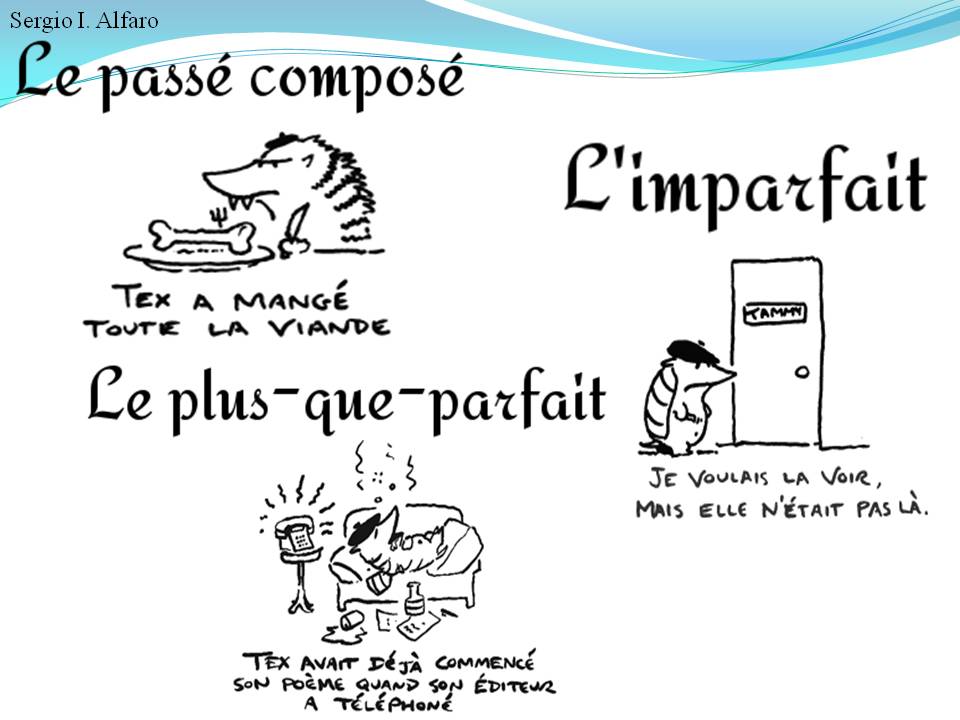
The passé composé, imparfait, and plus-que-parfait contrasted. Picture source: http://loiseaudufle.blogspot.com/2012/09/le-passe-passe-compose-imparfait-plus.html, who put it together from images on the excellent Tex's French Grammar web site, at https://www.laits.utexas.edu/tex/.
The passé composé, imparfait, and plus-que-parfait contrasted. Picture source: http://loiseaudufle.blogspot.com/2012/09/le-passe-passe-compose-imparfait-plus.html, who put it together from images on the excellent Tex’s French Grammar web site, at https://www.laits.utexas.edu/tex/.

Let’s talk about the plus-que-parfait.  This is the French tense (technically, it’s an aspect, but I’ll try to leave the technical stuff out of this) that corresponds to things like I had vomited in English.  (More on vomiting below.)  In English, we call it the past perfect.  It’s what we call a compound tense (see this post for an introduction to compound tenses and what makes them interesting).

If you want to talk about any of the compound tenses with your French teacher, you’re going to need to be able to remember their names. I find it easier to do that if I understand why a tense is called what it’s called, so let’s look at the Wikipedia page on the plus-que-parfait:

The word derives from the Latin plus quam perfectum, “more than perfect” – the Latin perfect refers to something that occurred in the past, while the pluperfect refers to something that occurred “more” (further) in the past than the perfect.

To expand on that a bit: the perfect, in grammatical terms, is used (in English, at any rate) to refer to an action that is completed. For example, while the past tense (a number of past tenses and aspects, actually) in English could be expressed as I vomited, the perfect would be I have vomited. If we wanted to express that the vomiting had been completed even before some other action, then we would use the past perfect: I had vomited. For example: I had vomited twice already before my mother came in and found me with my head in the toilet. Why this is the past perfect: it’s a perfect–a completed action–that is in the past tense with respect to something else. We’ve got two past-tense verbs in that sentence: came, and found. Prior to those events that we’re talking about in the past tense, the vomiting had been completed–in other words, a perfect that occurred prior to–in other words, in the “past tense” with reference to–something else that was in the past itself.

So, on to how to form the plus-que-parfait in French. It’s a simple formula:

imperfect + past participle

We looked at the imperfect in a recent post, so no need to go into that any further right now.  The past participle could be any verb, but the imperfect is always going to be either avoir or être, according to the same rules by which you would select one or the other for the passé composé. So, here’s a straightforward example:

Screenshot 2016-01-02 12.20.33
Shit, someone just told me that I had vomited yesterday….  (A little coquille (typo) there: it should be on vient, not on viens.)
Screenshot 2016-01-02 11.55.28
But why has Lassana Bathily who had aided the hostages of the Hypercasher been the only hero “forgotten” by the Legion of Honor 2015?

A nice one, with two examples–one with avait, and one with était:

Screenshot 2016-01-02 12.09.59
El-Shaarawy left Monaco.  At the same time, no one had noticed that he had arrived….

Here’s one with negation (it’s always important to think about negation early when you’re trying to figure out a verbal system):

Screenshot 2016-01-02 12.01.13
The moral of the story of Chloe Florin, it’s that even your closest friends can betray you one day.  She hadn’t asked for anything!

More negation:

Screenshot 2016-01-02 12.06.15
Remember the time when Louis almost kissed Harry because he hadn’t seen the camera.

Here’s another one with the verb être as the imperfect verb (I know, it’s weird that the perfect is marked with a verb that we call “imperfect,” but that’s language for you–it’s never logical in the ways that one would think it should be):

Screenshot 2016-01-02 12.14.36
I dreamt that I met @AjoyfulSquirrel for real and that there was a play Aventures that we had gone to see.

…and, a last one with être to wrap up our introduction to the plus-que-parfait:

Screenshot 2016-01-02 12.16.04
He would have met fewer idiots if he had gone to school a little longer to learn to write :-)))))

Click here if you’d like to read more about the French plus-que-parfait.


French compound tenses and the poverty of the stimulus argument

It’s not your fault that you’re having trouble with French compound tenses.

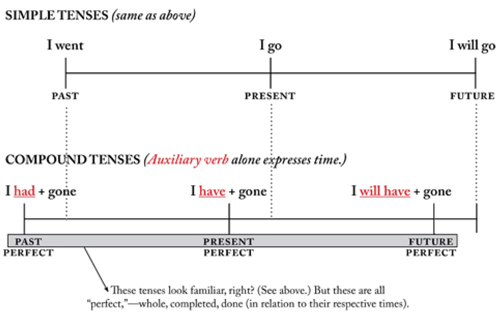
 As brilliant a schematization of compound tenses as any I have ever seen. Picture source: https://nycann.wordpress.com/tag/compound-tenses/.

As brilliant a schematization of compound tenses as any I have ever seen. Picture source: https://nycann.wordpress.com/tag/compound-tenses/.

The famous behavioral psychologist B.F. Skinner maintained that language-learning by children could be explained by the same process to which he attributed all learning: you get exposed to something, you get reinforced.  Chomsky pointed out that this couldn’t explain how children learn language, since we can produce and understand linguistic things that we have almost never been exposed.  One of my first professors used this example: he must have been being interviewed at that time.  If you are a native speaker of English, I would guess that you had no trouble understanding that sentence, and it probably doesn’t seem particularly strange to you.  For instance, you might have asked someone why Kevin didn’t show up for a meeting at 9 AM yesterday, and perhaps the person who you asked knows that Kevin was being interviewed for something or other at 9 AM, and answers he must have been being interviewed at that time.  However: the sentence is unusual in that it combines every possible place in a sentence where you could use a modal auxiliary in English.  (Modal auxiliaries in English are words like must, have (when it modifies another verb), and things like that.)  Chomsky pointed out that you will very, very rarely run into structures like that–and yet, as an adult native speaker, you have no problem whatsoever producing or understanding them.  This is known as the poverty of the stimulus argument against Skinner’s conception of how children learn language: if you’re not exposed to something, then Skinner has no explanation for how you can learn it.  (There are other aspects to the poverty of the stimulus argument–you can see some of them on this Wikipedia page.)

How this fits into my struggles to learn French: I suck at “compound tenses” like “had been interviewed,” and stuff like that.  In French, not in English!  Objective, third-party evidence of my suckiness in this respect: I recently took a French assessment test on the Lawless French web site, hoping to end up with something like the DALF C1 level that I’m planning to test for, and only got a DELF B1 level!  (That’s two below what I was hoping for.)  Looking at my results, a lot of my problems came from the compound tenses, of which French has many.  So: let’s learn them.

Looking over the various compound tenses in a Bescherelle, they’re somewhat less intimidating than I initially thought, in that as far as I can tell, they’re all formed with one of just two verbs: avoir “to have,” or être “to be.”  (Undoubtedly I could have looked this up somewhere, but I remember things better if I figure them out for myself.)  Some of the really outlandish ones are formed from tenses of these verbs that one would rarely see–j’eus été–but, you only have to know those tenses for these two verbs in order to be able to form all of those particular compound tenses.  Then, as far as I can tell, the last verb in the compound will always be the past participle–so, again, you don’t have to remember quite as much as you might have thought.

With this introduction, we’ll look at some of the compound tenses in future blog posts.  I’ll try to make the material less dry by including material from Twitter and the like (if I can find any–see above about the poverty of the stimulus).  While you wait, there’s a beautiful page on compound tenses here.


Imperfect verbs and sushi

2015-11-16 19.21.21
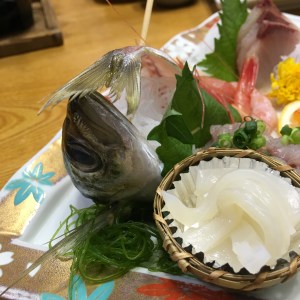
A rather unusual sushi dinner from a recent visit to Japan. If you look closely at the fish that still has its head and tail attached, you’ll see that the rest of the flesh has been removed, leaving only an almost paper-thin body surrounding the spinal column in between the cranial and caudal ends. Picture source: me.

I can’t think about imperfect verbs without thinking of sushi.  In the late spring of 2014, just before my first stay in France, I was frantically reviewing all of the grammar that I’m not sure I ever knew.  Sitting at a sushi bar not long before my departure, I read about imperfect verbs, and in particular, learnt that they are formed from the nous (first person plural) form of the present tense.  Really?  I couldn’t recall ever hearing that before–what other simple grammatical facts didn’t I know?  Should I be panicking?

Reading a book this morning, I came across a couple sentences–long sentences–in which the majority of the verbs are in the imperfect.  It’s a great Zipf’s Law sentence–lots of verbs that aren’t particularly unusual, but that I didn’t know anyway.  It also has an amazing array of irregular imperfects, considering that we’re just looking at three sentences here.  Let’s look at this little extract–the first three sentences of the nouvelle (short story) Le personnage, “The Character,” by Gloria Escomel (anthologized in Short stories in French: new Penguin parallel text, edited and translated by Richard Coward).

Pierre avait toujours eu peur des atterrissages.  Il mâchait rageusement sa gomme pour se déboucher les oreilles, rangeait machinalement livres et revues dans sa serviette, mettait ses lunettes de soleil, les enlevait pour bâiller, essuyer ses yeux, les remettait, se mouchait, enfouissait son mouchoir au fond de sa poche, le serrait convulsivement…Il sentait croître la peur, une peur absurde, irrationnelle; des mots sourdaient de lui, qu’il marmottait sans leur prêter attention.

“Pierre had always been afraid of landing.  He furiously chewed his gum to unblock his ears, mechanically tidied away books and magazines in his briefcase, put on his sunglasses, took them off to yawn, to wipe his eyes, put them back on, blew his nose, burying his Kleenex in the bottom of his pocket, squeezed in convulsively…He felt the fear growing, an absurd fear, irrational; words sprang to his mind, which he muttered without paying attention to them.”

Imperfect verbs are formed from the nous (first person plural) form of the present tense of the verb.  So, here are some verbs that are regular in the imperfect (examples taken from Laura Lawless‘s page on the imperfect on About.com, because I’m too lazy to go downstairs and get a grammar):

parler  finir
je -ais parlais  finissais
tu -ais parlais  finissais
on -ait parlait  finissait
nous -ions parlions  finissions
vous -iez parliez  finissiez
ils -aient parlaient  finissaient

You’ll notice that the inflections are all pronounced the same, except for nous and vous, so as long as you remember -ions and -iez, you’ll be fine. (Predictably, these are the ones that I mess up most often.)

Let’s see some reflections in the sentence of the fact that the imperfect is formed from the stem of the nous present tense form.  The main consequence of this is that we’re going to have some stem consonants that we wouldn’t have seen in the third person present tense.  In particular, look at enfouir, “to bury.”  The imperfect is enfouissait.  Where does the ss come from?  Because although the third person singular present tense is enfouit, the first person plural form of regular ir-class verbs is enfouissons (see here if you need a review), and that’s the form on which the stem of all imperfects is based.  How about the double tt in mettait and remettait, when the third person singular present tense is met,with a single t?  It’s because the first person plural present tense is mettons (and remettons).  (Note that that is not the cause of the tt in marmottait (he mumbled, he murmured)–the infinitive is marmotter, so even the third person singular present tense has marmotte, i.e. two tt’s.

Ranger has yet another irregularity.  You’ve noticed that the third person singular imperfect ending is ait.  So, where does the e come from in rangeait?  We could just say that it comes from the fact that the first person plural present tense has it, too–rangeons– but, that just pushes the question off to why the first person plural has it.  Here, it’s just a spelling thing.  To indicate that the g is pronounced like zh, it needs to be followed by an e.  That e is not, itself, pronounced–it just reflects the fact that the g is “soft.”  (That’s a non-technical term!  Technically, it’s a fricative, as opposed to the g without e or i after it in the spelling, which is what’s called a stop.)

Let’s move on to sentait, “he felt:” Il sentait croître la peur, he felt the fear growing.”  This comes from the verb sentir, to smell.  We saw that the other ir verb that we’ve seen in the story has ss in the stem–why not sentir?  You might remember from an earlier post on ir verbs that sentir is irregular, and has the basic form of a regular er verb in the present tense.  So, the first person plural (nous) form is sentons, and the imperfect is sentait. 

For the last irregular verb in the sentence, let’s look at avoir, “to have,” as in Pierre avait toujours eu peur des atterrissages–“Pierre had always been afraid of landings.”  (We’ll ignore for now the fact that this is one of the compound tenses: avoir eu.)  Avoir is one of the most irregular verbs, but it’s actually fairly simple here–the nous form is avons, and avait thus looks pretty much like any other imperfect.  (I call it “fairly simple” because the present tense nous form of avoir has the same root as the infinitive, unlike most of the present-tense forms of that verb.)

For thoroughness, let’s include the imperfect of the verb être “to be,” even though it doesn’t show up in our sentence–irregular, as always.  Just remember that the stem will be ét-:

j’étais nous étions
tu étais vous étiez
 on était ils/elles étaient

In the end, I messed up the nous and vous forms countless times by forgetting about the i, but the rule of forming the imperfect from the present tense nous form isn’t that difficult to remember, and I don’t think that I caused any diplomatic incidents by forgetting it, despite my sushi-related insecurities.  There are more irregulars in the imperfect related to spelling changes (see ranger above–there are lots of others), but from the point of view of the spoken language, it’s fairly straightforward to use.

There’s a whole nother issue related to this example, which is: why did the author use the imperfect?  These are “punctual” occurrences, meaning that they happened just once, so you would expect either the passé composé or the passé simple.  A mystery–feel free to explain in the comments, if you know.

Update, January 4th, 2015:

Here’s a nice application of the imparfait.  You can use it to make suggestions by preceding it with et si.  You would translate et si + imparfait as something like “how about” or “what if.”  See the Lawless French web site for more on this.

Screenshot 2016-01-04 09.33.45
What if we took 1 minute to change everything today?  How about taking 1 minute to change everything today?


Too many Killians, or the weirdest relative pronouns on Twitter

In which a relative pronoun about which I know nothing turns out to show up even in the most illiterate tweets imaginable.

Yesterday we met the various forms of the relative pronoun lequel:

Masculine Feminine
Singular lequel laquelle
Plural lesquels lesquelles

 We saw how when it’s the object of the preposition à, we get various derived forms:

Masculine Feminine
Singular auquel à laquelle
Plural auxquels auxquelles

There’s a similar set for the situation where it is the object of the preposition de.  Here’s the paradigm:

Masculine Feminine
Singular duquel de laquelle
Plural desquels desquelles

You don’t think anyone ever actually uses these?  Neither did I–Laura Lawless says that these are the hardest pronouns in French for English speakers, and I believe it.  I didn’t think that French people used them much, either.  Then I did a Twitter search.  Holy cow–they’re everywhere!  How did I manage not to run into these before?

Screenshot 2015-12-30 23.44.06
“There are too many Killians in this world–damn, I never know which one we’re talking about.”
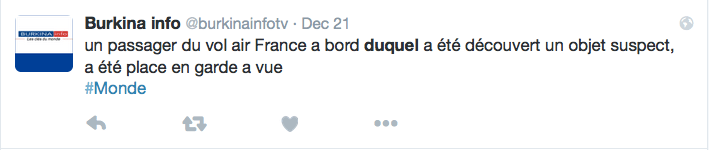
Screenshot 2015-12-30 23.46.22
“A passenger on the Air France flight on board which a suspicious object was discovered has been remanded to custody.”
Screenshot 2015-12-30 23.49.49
“Yeah, it’s cool to find a person who you don’t get tired of, but if she gets tired of you, it’s hard.”  (se lasser de: to get tired of, to get bored with)
Screenshot 2015-12-30 23.52.23
“The message of John Lennon: no religion in the name of which you are ready to kill or ready to die.”
Screenshot 2015-12-30 23.54.50
“Everything depends on which ones we’re talking about.”
Screenshot 2015-12-31 00.02.17
“Liberty, equality, education…Themes about which to think.”
Screenshot 2015-12-31 00.09.51
“Grand values in the name of which we are at war against Daesh, if I remember correctly.”
Screenshot 2015-12-31 00.11.40
“Pretending to not recognize the toxic people from whom I have drawn away when I run across them in the street. #Resolution2016″

Take this relative pronoun with a grain of salt

Just because you have a sweet voice doesn’t mean that you won’t use a relative pronoun here and there. Or poison someone.

https://youtu.be/klDeYwGdrRg&w=200

I’m a sucker for female singer-songwriters with a certain kind of voice.  Ingrid Michaelson has it.  Yael Naïm, too.  Regina Spektor has it, sometimes.  Carole King has it sometimes now that she’s older, but didn’t when she was younger.

Recently I’ve found a French-Canadian woman who has it in spades.  Ingrid St-Pierre is a woman from Quebec who studied psychology, then went on to become a singer.  Why she didn’t win when she competed on the Canadian equivalent of “The Voice,” I’ll never know; she has had a successful recording career, just having released her third album; gets daily airtime on Canadian radio; and is touring like crazy.

Her songs are generally serious, but she has one very funny one, Pâtes au basilic (“Basil pasta”), that is really quite cute.  See the video above–it’s about a psycho-killer ex-girlfriend.  The Zipf’s Law connection for the day: the first verse of the song uses a type of word that I’m not very comfortable with.  It can function as a relativizer, i.e. it can mark a relative clause; it can also be used to ask questions.  (Hence the fact that it is commonly called an interrogative something-or-other.)  In this case, it’s a marker of a relative object, i.e. it’s standing in for a relativized thing, and the thing that is modified by the relative clause is the object, rather than the subject, of the verb.

Enough grammatical terminology–let’s turn to Ingrid’s song.

Mon amour, je t’ai préparé des pâtes au basilic My love, I’ve made you basil pasta
j’ai pris soin d’y mélanger les trucs auxquels t’es allergique I’ve taken care to mix in all of the things that you’re allergic to
faut surtout pas t’inquiéter pour l’arrière goût qui pique  It’s especially important that you not worry about that last taste that burns
j’espère que j’ai bien dosé les gouttes d’arsenic I hope that I’ve regulated well the taste of arsenic

(Translation by me, so take it with a grain of salt.)  There are sooo many things that we could talk about just in this one verse, but let’s stick with the relative.

The word auxquels is related to the word lequel and its different gender-related and number-related forms.  For starters, let’s review those:

Masculine Feminine
Singular lequel laquelle
Plural lesquels lesquelles

 We typically see those forms when the word is being used as an interrogative (Je veux un de ces livres.  Lequel?  “I want one of these books.  Which one?”)  or as a subject relative.  However, even with object relatives, we can see this form in the feminine singular: J’aime la femme à laquelle je pense en ce moment “I love the woman about whom I’m thinking at this moment.”  When the word is being used to relativize an object, we’ll typically have a preposition in front of it, and if that preposition is à, then that undergoes the typical à + le = au and à + les = aux mergers.  So, that’s how we get auxquels in the song.  We have lesquels for trucs “things,” and we’re talking about the person being allergic “to” those things.  À plus les gives us aux, so we have les trucs auxquels t’es allergique–“The things to which you’re allergic.”  For the sake of completeness, here’s the full paradigm:

Masculine Feminine
Singular auquel à laquelle
Plural auxquels auxquelles

There’s a similar set for the situation where the preposition is de, but let’s do those another time.  In the meantime, enjoy the Ingrid St-Pierre video.

Ukrainian Humanitarian Resistance

Resisting the russist occupation while keeping our humanity

Languages. Motivation. Education. Travelling

"Je suis féru(e) de langues" is about language learning, study tips and travelling. Join my community!

Curative Power of Medical Data

JCDL 2020 Workshop on Biomedical Natural Language Processing

Crimescribe

Criminal Curiosities

BioNLP

Biomedical natural language processing

Mostly Mammoths

but other things that fascinate me, too

Zygoma

Adventures in natural history collections

Our French Oasis

FAMILY LIFE IN A FRENCH COUNTRY VILLAGE

ACL 2017

PC Chairs Blog

Abby Mullen

A site about history and life

EFL Notes

Random commentary on teaching English as a foreign language

Natural Language Processing

Université Paris-Centrale, Spring 2017

Speak Out in Spanish!

living and loving language

- MIKE STEEDEN -

THE DRIVELLINGS OF TWATTERSLEY FROMAGE