I broke my finger and now I’m writing Old French: why French and English spelling are both so bizarre

Where do all of those accented letters come from in French, and what does that have to do with my broken finger?

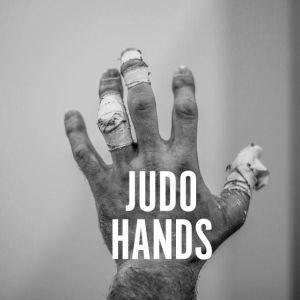
judo hands 1c3ac19fabe33edd524985ab92bbc972
Picture source: https://www.pinterest.com/pin/478296422904013134/

A few years ago, I broke a finger in a judo class.  It was nothing spectacular–I got my finger wrapped up in a guy’s collar, somebody moved the wrong way, and I felt it snap.  I scooted over to one of the aged teachers with half of my finger pointing out at a weird angle, he grabbed it and did something and it stopped hurting, and I went home and taped it up.

Over the course of the following weeks, I learned to type with one non-functional finger, and all was fine.  I spend the vast majority of my day typing, and I just kept doing the same thing for years–no problem.

Then I started hanging out in France, and writing lots of emails in French.  I never learnt to switch to a French keyboard, so I’ve been doing digital (in the sense of “with my fingers”) gymnastics to write the many accented characters, and that’s been fine, too.

However, the other night I was awake working into the wee hours of the morning.  2 AM came along, and I was tired and had an aching headache, along with the arthritis that I always have in that broken finger.  All of a sudden those digital gymnastics weren’t so OK.  In my next email, I included a little note: I’m going to start writing an s instead of an accent.  (If it’s in italics, it happened in French.)  So, même became mesme, écrire became escire, and so on.

This elicited no comment whatsoever–the email correspondence went on just as if I was using accents normally.  The reason that this could work without a hitch: in using an s instead of an accent, I was just going back to an older French spelling.

People often ask why French spelling is so bizarre.  They ask the same thing about English.  The cool thing is, they’re both bizarre in the same way.  This is because both spelling systems primarily try to reflect not the pronunciation of a word, but rather its meaning and/or history.  So, in English, we have the spellings electric, electricity, and electrician–three different pronunciations of that second c, which reflects how we say the word pretty poorly, but reflects very nicely the relationships in meaning between the three words.  We write knife and knight, which reflect the pronunciations of those words poorly, but reflect very nicely the history of those words, which originally did start with a k sound.

French spelling tends to work the same way.  Tête has an accent over the first ê to reflect the fact that it was originally teste.  Écrire with its accent over the first é reflects the fact that it was originally escrire. 

The title of this post implies that this is an Old French pronunciation and spelling, but I could just as well have said Middle French.  This is because there’s not a lot of cross-dialectal consistency in when these s‘s disappeared, and there’s also not a lot of consistency in when various and sundry authors started reflecting that change in pronunciation by replacing the disappeared s’s with accents.

You may be wondering: if s’s disappeared, why does French still have them?  How can we have saint, sacré, and savate?  In this case, it has to do with the fact that the s’s went away only before other consonants.  Saint: no problem, because the s is before a vowel.  Teste becomes tête because the s preceded a consonant.  So: how can we have écrire from the original escrire, but still have escroc?  How can we have tête from teste, but still have test?  The answer is typically related to when the words entered the language.  Teste is an original French word, descended from Latin.  Test was borrowed from English late in the 17th century, long after the loss of s in front of a consonant (probably around the 11th century, but see above about the inconsistency in the timing), and it didn’t undergo that change.

You can see similar patterns in English.  English words that start with the sh sound typically were originally pronounced with an sk–shirt, ship, shape, etcetera.  Often, though, we also have a corresponding word that comes from the same root historically, but is pronounced with an sk sound.  Shirt and skirt come from the same root; ship and skiff; and a number of others.  How can we have both the sh that developed from sk, and also the sk sequences?  Because the sh words were original to the various and sundry Anglo-Saxon varieties.  The words with sk were borrowed from various and sundry Old Norse words from the same roots, Old Norse being the language spoken by the Vikings who beat the shit out of England (and much of the rest of Europe, including a lot of northern France) in the Middle Ages.  This was after the sk t0 sh change had happened in Old English, and we kept the sk sounds in those new words.

Now, the whole accents-over-vowels thing in French is all more complicated than this.  Here are some facts that I’ve left out of the discussion:

  • other consonants disappeared and also get reflected with an accent
  • there was a vowel lengthening that I haven’t talked about that’s also reflected in the current uses of accents
  • some accents are probably there purely to indicate differences in meaning, without necessarily reflecting former differences in sound
  • the evolution of the spelling system is still ongoing, and the use of accents is one of the things that will change somewhat when the next spelling reform becomes official at the beginning of the 2016 academic year
  • there are other things that contribute to the bizarreness of both French and English spelling, particularly in the case of vowels in English

If you want more of the technical details and can read French, I would suggest starting with this Wikipedia page on French spelling, and then following the link to this page on the accent circonflex in French.

My arthritic formerly-broken finger still hurts most days, but I’m not as cranky as I was the other night, and I’ve gone back to typing accents again.  I find it interesting that when the spelling reform showed up in the news this past winter, many of the most vociferous complaints came from native speakers of English, rather than from French people–the general attitude was something along the lines of “I spent years learning those fucking accents–you can’t take them away from me now!”  For my part, I find them quite charming–half of the fun of writing French is those accents, and my favorite French words tend to be ones where every possible vowel has an accent.  So: yes, French and English spelling are both quite bizarre, but there’s a method to the madness, and you can make a good case that they improve reading comprehension.  So, try to accept them both in good humor–there are plenty of worse things to complain about in the world.

Case in point: Republican politicians are mostly up in arms about two things right now.  One of them is regulating which bathrooms transgender people should use.  The other is ensuring that Americans can easily get access to firearms.  The most frequently-cited justification for controlling which bathrooms transgender people use is the possibility of a male-t0-female transgender person sexually molesting a female.  I don’t know what the most frequently-cited justification for ensuring that Americans can easily get access to firearms is.  What I do find interesting in this context is the following sets of numbers.  The number of times that a male-to-female transgender person has sexually molested a female in a bathroom is 0.  That’s zero, if you have trouble reading numbers on a computer screen.  The number of firearm deaths in the United States in the past 72 hours is 69.  Here are some details on the most recent ones:

  • A two-year-old child in Minneapolis, Minnesota.  The shooter is unknown.  See here for the news story.
  • One person in Memphis, Tennessee.  See here for the news story.
  • Two people in one incident in Indianapolis, Indiana.  See here for the news story.
  • A guy shot by his seven-year-old son in Gratiot County, Michigan.  Quote from the news story: Police say the boy took the gun from a locked case after finding the keys and accidentally shot his dad.  See here for the news story.

And yet: many, many Republican politicians are passionate about keeping transgender people out of the bathroom of their choice, and even more passionate about ensuring that Americans have easy access to firearms.  Go figure…

Where to buy non-touristy souvenirs in Paris

Want to buy non-touristy souvenirs in Paris? Here are some places to check out. You can find stuff at a range of prices, a range of tastes, and a range of weights (important when you’re packing to head home).

Nalola, 51 rue Mouffetard, 75005

img_4832Nalola on the rue Mouffetard is one of my favorite places to pick up gifts for folks back in the US.  The rue Mouffetard is one of the most touristy places in Paris.  However, Nalola is not.  They sell a ton of stuff that wouldn’t be obviously touristy at all and that is aimed more at French customers than at tourists.  This includes stuff like:

  • Coffee cups saying things like Chieuse 24/7/365 (pain in the ass 24/7/365), Pousse pas mémé dans les orties (don’t piss off mama), Les hommes sont comme les grenouilles, ils ne veulent que sauter (men are like frogs–they just want to “jump” [sauter is slang for having sex with someone])
  • “3ème oeil” kitchen towels (famous picture of a cat’s butt)

Les Parisettes, 95 ave. Emile Zola, 75015

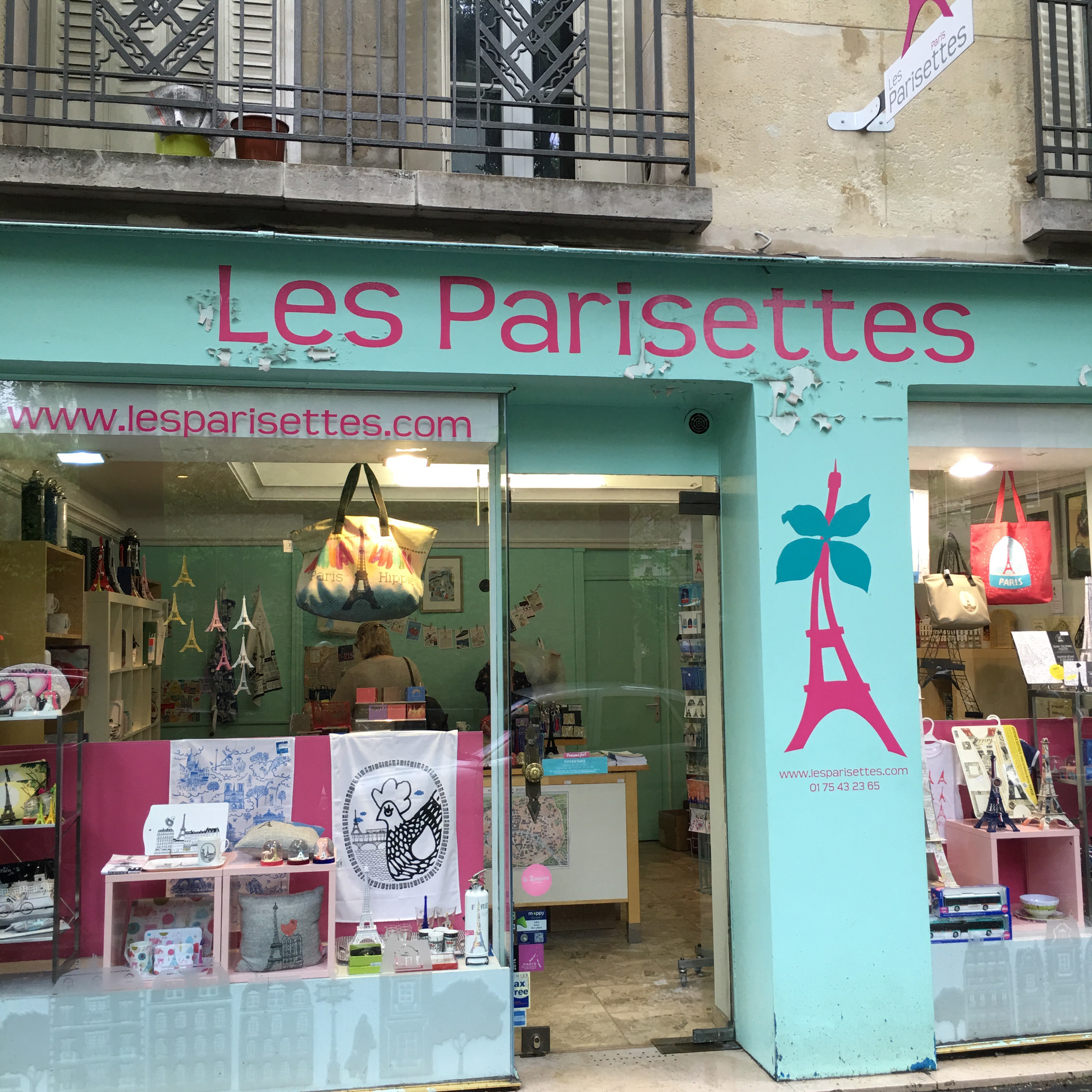
img_4823Les Parisettes mostly sells Eiffel-Tower-related stuff, but not the usual crappy little metal Eiffel Tower replicas and the like.  Lots of historical stuff–period photos, stuff like that; some unusual guide books, mostly in French, but some with English translations; all in all, this stuff is more clearly touristy than the stuff that you’ll find at Nalola (see above) in that it’s almost entirely explicitly related to things in Parisian (versus the Nalola stuff, which is culturally French but not in a souvenir-y way at all), but it’s a big cut above the usual crap that you find in souvenir stores.  There are a couple of locations, and I’ve only been to the one on Emile Zola, but I can vouch for it.  (If anyone goes to the other one, let me know what you think…)

Shakespeare and Company, 37 rue de la Bûcherie, 75005

Shakespeare and Company is the best-known English-language bookstore in Paris.  It has an interesting history and a great location–right across from the parvis of Notre Dame.  What you want to do here is to buy a good book (as you can imagine, there’s a great selection of books about France and French history, for example) and then get it stamped when you buy it.  This means that they put a “Shakespeare and Company” stamp on the title page.  Few people will see it, but those who do will know that this is a super-cool Parisian souvenir.  (They have other “personalization” options–one of them is spritzing your book with perfume.)  Note that this place is super-popular, and if you come on a weekend during tourist season, you can expect to wait in line to get in.

Breizh Café, 111 rue Vieille du Temple, 75003

Caramel au beurre salé (salted butter caramel) is an excellent food souvenir.  You can get them lots of places, at qualities ranging from average to really spectacular.  The Breizh Café is a restaurant with a little store attached, and that little store is where I go to pick up good-quality caramel au beurre salé.  Breizh means Brittany, and Brittany is where caramel au beurre salé originated.  The restaurant is quite good, by the way, but it showed up in a popular tourist guide a while ago, and now you generally have to wait in line to get in.  Another good option here would be a tin of crêpes dentelles, a sort of thin cookie that comes in a cool box (at Breizh Café, at any rate) with pictures of Breton girls in traditional dress on it.  I mentioned really spectacular caramel au beurre salé: see David Lebovitz‘s web site for his current recommendations.

Use an emoji, go to jail: semantics versus semiotics

If you send someone a pistol emoji, does that mean that you’re threatening them? It depends: what is “meaning,” and how can an emoji have it?

I was sitting in on a class on lexical semantics a couple years ago.  Lexical semantics is the study of the meanings of words.  What that means: think about the difference in meaning between The fairy godmother waved her baguette and The fairy godmother’s baguette waved her.  On some level, we can describe the difference in the meanings of those two sentences as coming from the facts that (a) an English sentence with a subject, a verb, and an object has the meaning that the subject did something to the object, and (b) the two sentences have different subjects and objects.  That’s not about lexical semantics, or the meanings of words–we could call that sentential semantics, perhaps.

In contrast with that, consider these sentences:

  1. Bobo swept the floor.
  2. Bobo swept.
  3. Bobo broke the glass.
  4. The glass broke.

In the case of sentence (2), Bobo did the sweeping.  In the case of sentence (4), though, the glass got broken.  To put it another way: in (2), the subject of the sentence carried out the action of the verb, while in (4), the subject of the sentence underwent the action of the verb.  This difference in meaning doesn’t have anything to do with the structures of the sentences, as was the case with the fairy godmother and her baguette–this is about the difference in meaning between sweep and break.  (For example: break involves a change in the state of something.  Sweep, in contrast, doesn’t.)  That’s lexical semantics–the study of the meaning of words.

So, back to that class: one of the folks in it started complaining about how deficient both of these approaches to thinking about semantics are.  Sure, we can formalize the meanings of words in a way that captures the differences in meaning between sweep and break.  We can formalize the meanings of sentences in a way that captures the differences in meaning between the two fairy godmother/baguette sentences.  But, what about the rest of the meaning?  How does the meaning of sweeping change, depending on whether Bobo is a property owner, or a member of the proletariat?   What does it mean that the fairy godmother is a godmother, and not a fairy godfather?  Indignation was widely shared.

Actually, this is a misunderstanding of what semantics is, versus semiotics.  Semantics is (in my version of the world) about how language means things.  Semiotics is about how meaning gets meant, in general.  If I say to you Bobo swept the floor, that’s got one kind of meaning.  If I give you a single red rose on our third date, that means something, too.  How does Bobo swept the floor mean what it means?  I can talk about that–we just did.  How does that single red rose on our third date mean what it means?  I don’t have a clue.  The meaning of the sentence: that’s semantics.  The meaning of the single red rose: that’s semiotics.  One way to think about why to study linguistics: suppose that you’re interested in the question of meaning.  You could think of language as the system of meanings that is the easiest to study.  So, if you’re into semiotics in general, then semantics might be a way to get a handle on what seems like a very large problem.  On that picture of the universe, semantics is a subset of semiotics.  (I don’t mean to imply that I think that we totally understand how meaning works in language, either–I don’t.  Indeed, we’ve had a number of posts on this blog about controversies and problems with representing the meanings of words.)

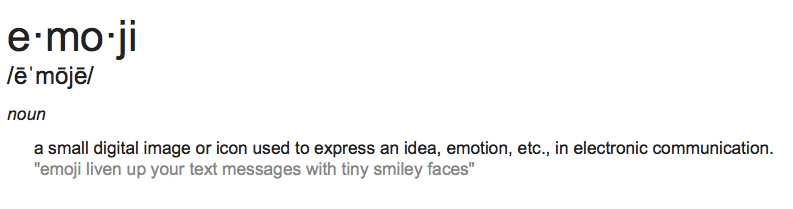
All of this came to mind recently when I came across a couple news stories on the use of emojis to convict people for various and sundry crimes.  (See below for a discussion of the differences/similarities between the English constructions a couple and a couple of.)  For those of you who have been in a digital wasteland for the past few years, here is a definition of emoji from Google:

Screenshot 2016-07-06 02.59.34
Picture source: screen shot of Google’s definition of “emoji.”

It is amazingly easy to find examples of the appearance of emoji in criminal cases.  I Googled this:

Screenshot 2016-07-06 03.04.55

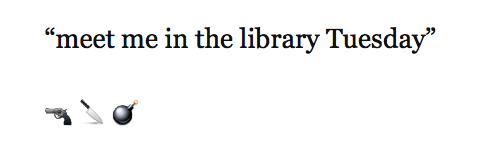
…and got tons of results.  A 12-year-old girl in Virginia is facing charges of threatening a classmate for sending her this message on Instagram:

Screenshot 2016-07-06 03.05.53
Picture source: https://www.washingtonpost.com/news/local/wp/2016/02/27/a-12-year-old-girl-is-facing-criminal-charges-for-using-emoji-shes-not-alone/

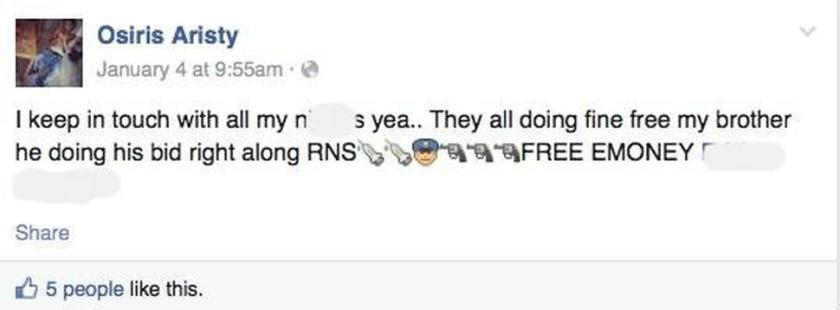
Last year, a 17-year-old male was arrested and charged with making terroristic threats for posting these emojis of a police officer and some guns on Facebook (a grand jury later declined to indict him):

aristypost

Picture source: http://www.cnet.com/uk/news/teen-arrested-after-alleged-facebook-emoji-threats/

David Fuentes and Matthew Cowan of South Carolina were arrested and charged with stalking after they sent these emoji to someone whom they’d beaten up the month before:

ambulance emoji-2-e1457457813222
Picture source: http://crimefeed.com/2016/03/3-times-emojis-landed-people-behind-bars/

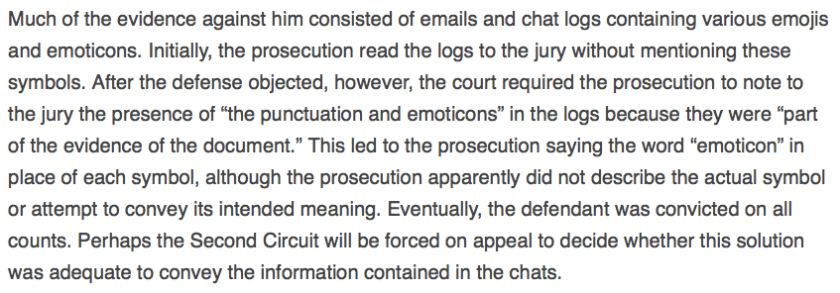
Smiley-faces show up repeatedly in court cases, both criminal and civil.  Anthony Elonis’s case went all the way to the U.S. Supreme Court.  A quote from an article by Karen Henry and Jason Henry on the Law360 web site:

The defendant in Elonis v. United States had argued that his conviction for posting threatening communications on Facebook should be reversed in part because the presence of emoticons in some of the posts made them “subject to misunderstandings” and not as threatening as they would otherwise have been. For example, one of the defendant’s posts said that his son should dress up as “matricide” on Halloween, perhaps by wearing a costume of her “head on a stick.” He followed that post with an emoticon of a face with its tongue sticking out. He argued that the emoticon signaled that he was joking…

In a civil lawsuit, Universal Music Corp. tried to argue that the person who was suing them hadn’t really been injured by them, presenting as evidence the claim that an emoji that she had used in an email in which she corresponded with a friend about the case showed that she didn’t really feel that she’d actually been injured (same source):

…the evidentiary value of emoticon/emoji evidence was examined fairly recently in Lenz v. Universal Music Corp. (widely referred to as “the Dancing Baby” case). In that case, plaintiff Stephanie Lenz moved for summary judgment on six affirmative defenses asserted by Universal in response to Lenz’s copyright claim. Of particular relevance, Universal argued Lenz alleged in bad faith that she had been “substantially and irreparably injured” by its takedown notice. To support this argument, Universal proffered an email exchange between Lenz and her friend. In that exchange, the friend writes, “love how you have been injured ‘substantially and irreparably’ ;-).” Lenz, in turn, responds, “I have ;-).”

Universal contended that Lenz’s use of the “winky” emoticon signified that she was “just kidding.” Lenz countered that her use of the “winky” emoticon replied to the “winky” in her friend’s email, which basically was teasing Lenz about using lawyerese in her complaint — i.e., “substantially and irreparably injured.” The court sided with Lenz, finding Universal’s proffered evidence insufficient to prove Lenz acted in bad faith and granting summary judgment in Lenz’s favor on that affirmative defense.

There are multiple legal issues involved in these emoji cases, some of them just really basic procedural stuff.  If you’re reading an email out loud in a court case, do you have to read any accompanying emojis out loud?  If so: how?  Back to the Elonis case in the Supreme Court–I’m going to add in a clause that I omitted in the earlier quote (same source again):

… one of the defendant’s posts said that his son should dress up as “matricide” on Halloween, perhaps by wearing a costume of her “head on a stick.” He followed that post with an emoticon of a face with its tongue sticking out. He argued that the emoticon signaled that he was joking, but his wife interpreted the tongue sticking out in that context as an insult.

This issue–read them out loud, or not, and if so, how–came up in a case that you may have read about–the “Silk Road” case against Ross Ulbricht for running a huge “dark Web” site for selling illegal stuff:

Screenshot 2016-07-06 03.32.40
Picture source: screen shot of http://www.law360.com/articles/727700/exhibit-a-winky-face-emoticon-evidence-enters-courts

I write about this here and now in part because there have recently been a couple of similar cases in France (see here for Bilal Azougagh’s case), and I suspect that the French courts will do a much better job of hashing out the theoretical issues behind this than the US courts have so far.  In reading about this issue in the US, I’ve come across “useful” observations like the claim that unlike words, emoji don’t have clear and unambiguous meanings–total linguistic bullshittery, as words don’t have clear and unambiguous meanings in any human language that I’m aware of.  These are difficult and (to me) interesting questions/problems, and I look forward to seeing the French legal system do a much better job of getting at the underlying philosophical issues than the American courts have so far, that being something that the French have much more of a propensity for (and much better educational preparation for) than Americans do.


French notes (scroll waaaay down for the English notes)

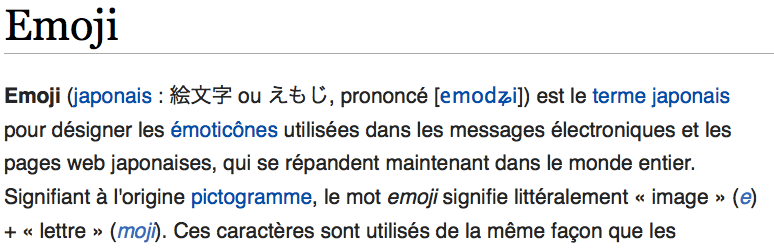
For some random Zipf’s-Law-induced vocabulary items, let’s look at the French Wikipedia page on emoji:

Screenshot 2016-07-06 03.46.33
Picture source: screen shot of https://fr.wikipedia.org/wiki/Emoji

Vocabulary item: I’ve been trying to get straight on the many uses of the verb répandre, and here it is!  (See above about words not having clear and unambiguous meanings.)  Two of the many potential meanings of se répandre that are possibly relevant here (from WordReference.com):

  • se répandre (s’etendre) (sur?): to spread.
  • se répandre (envahir, se disséminer) (dans?): to spread out, to invade.

I’d also like to know the genders of emoji and émoticône.  Let’s see what evidence we can find:

Screenshot 2016-07-06 03.54.43
Picture source: screen shot of https://fr.wikipedia.org/wiki/Emoji

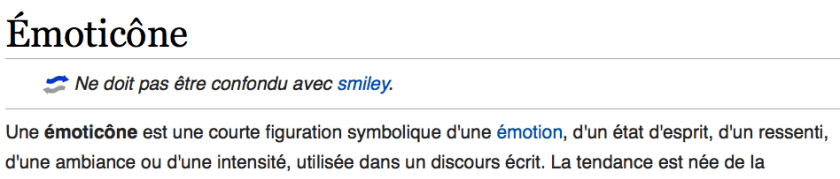
Certains rather than certaines suggests that emoji is a masculine noun.  Emoticône is easier to figure out:

Screenshot 2016-07-06 03.56.53
Picture source: screen shot of https://fr.wikipedia.org/wiki/%C3%89motic%C3%B4ne

Une, so: feminine noun.

Back to the lexical semantics lecture: I followed my classmate’s rant with my own, along the lines of the semantics/semiotics split that I talk about above.  The professor gave me an odd look when I suggested that it would mean something if I gave her a single red rose, but otherwise, there were no repercussions that I know of.  Watch this space for further developments.


English notes

I used the expression a couple a couple times in this blog post.  See these links for some discussions of the use of a couple versus a couple of:

It’s complicated–there are situations where either one is fine, and situations where only one of the two is fine.  Here is a little data.

A couple is mandatory:

  • I have a couple (fine)
  • I have a couple of (not OK at all)

A couple of is mandatory:

  • I have a couple them (not OK at all)
  • I have a couple of them (fine)

Either is fine (although I prefer a couple, personally):

  • I have a couple apples (fine)
  • I have a couple of apples (fine)

A couple of is mandatory:

  • I have a couple them (not OK at all)
  • I have a couple of them (fine)

How we’re sounding stupid today: I readed it in college

In which I try to talk about literature, and end up sounding even stupider than usual.

readed xqQV7
Picture source: http://english.stackexchange.com/questions/145638/why-do-we-say-and-write-read-instead-of-readed-for-the-past

Like I always say: it’s the little things that get you.  I was chatting with a friend the other day.  Stendahl’s The red and the black, one of the more famous French novels of the early 19th century, came up.  They know about “The red and the black” in the United States?, asked my friend?  (If it’s in italics, it happened in French.)  Oh, yes, I said–I readed it in college. 

I read it in college, my friend corrected me.  Readed–that’s cute!  But, it’s read. Fuck–it’s always those little things…  I got my only C on a literature paper–ever–for a paper on The red and the black, and consequently have never forgotten it.  So, I can talk about unfulfilled homosexuality in Stendahl’s masterpiece, but I can’t say the past tense of the verb to read in French without sounding like a 2-year-old.  ‘tain!

My problem here was the past participle.  This is a form of the French verb that is used in some past tenses, in passives, and occasionally as an adjective.  I need to take a French proficiency exam this fall and don’t want to make this kind of basic mistake, so let’s review.

You almost certainly know h0w to form the past participle of -er class verbs.  These make up about 80% of French verbs, so you hear that past participle a lot.  I’m not aware of any irregular -er verb past participles.  This includes -er verbs that have changes to the stem in some tenses.  For example:

donner donné
appeler appelé
récupérer récupéré
jeter jeté

Now: regular -ir class verbs.  Although the -er verbs are the most common in French, the Lawless French web site points out that there are several hundred regular -ir verbs.  The regular -ir verbs have an i at the end of their past participle.  Let’s look at a few, just to drill this into my head:

to act agir agi
to warn avertir averti
to build bâtir bâti
to choose choisir choisi
to obey obéir obéi

Now, lots of the fun of speaking French comes from its irregularities, and we do have some -ir verbs with irregular past participles.  The Lawless French web site has a helpful page on irregular -ir verbs.  We’ll work our way through it, starting with -ir verbs that have past participles that end with -ert:

to cover couvrir couvert
to open ouvrir ouvert
to offer offrir offert
to suffer souffrir souffert

Notice a pattern there?  It’s our old friends: verbs with a labiodental fricative followed by r. (Native speakers: anyone have an example of a verb with fr or vr in the root that belongs to the -ir class and doesn’t have a past participle with -ert?)

to hold tenir tenu
to come venir venu
to become devenir devenu
to support soutenir soutenu
to refrain, to abstain from s’abstenir abstenu (native speakers, is this right?)
to reach, to achieve parvenir parvenu
to suit, to be suitable convenir convenu

The generalization? All of those verbs end not just with -ir, but with -enir.  Here’s another fun little pattern with the past participles of -ir verbs:

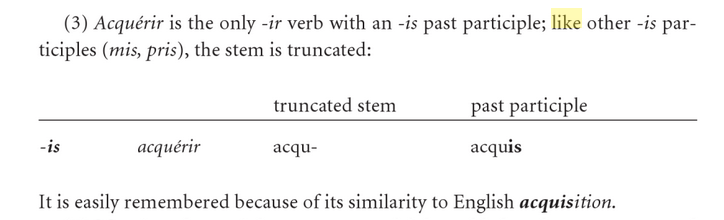
to acquire acquérir acquis
to conquer conquérir conquis
to inquire about s’enquérir de enquis
to recapture, to recover reconquérir reconquis
to requérir requis

I came across this little gem of advice related to this class of irregular -ir past participles in David Brodsky’s book French verbs made simple(r):

Screenshot 2016-07-03 13.17.27
Picture source: screen shot of “French verbs made simple(r),” by David Brodsky.

Easily remembered, my ass…

Now, I know what you’re thinking: I’ve given you all of these irregular past participles, but still haven’t gotten anywhere near the past participle of the verb “to read.”  To which I respond: you’re right.  However, my head is at near-explosion-point with irregular past participles already, so for now let’s just accept that I sound even stupider when speaking French than when speaking English, and let it go until another day.  Oh–number of gun deaths in the United States in the past 72 hours: 104.  Here are the most recent:

  • David Urban, South Londonderry Township, Pennsylvania (click here for news story–his wife did it)
  • Killeen, Texas.  Murder-suicide at a Dollar Store–names not released yet.  (click here for news story)
  • Pittsburgh, Pennsylvania.  54-year-old male, name not released yet.  Drove himself to the ER with a bullet in his chest, hitting a few walls while trying to pull into the parking lot.  Died in the ER.  (click here for news story)
  • Monroe, Louisiana.  Two people shot in the Civic Center parking lot.  Names not released yet.  (click here for news story)
  • Harvey, Illinois.  49-year-old woman, name not released yet.  (click here for news story)

How we’re sounding stupid today: noun phrases

Screenshot 2016-06-27 19.12.23
Picture source: screen shot of zombilingo.org.

Like I always say: it’s the little things that get you.  One of the things that I love about France is that people feel totally free to correct each other’s language, and they certainly feel free to correct mine.  (Truly, I love this–it’s such a help in trying to learn the language.)  I gave a talk in French the other day.  Descriptivism versus prescriptivism, duality of patterning, how even very small choices in building computer programs for processing human languages can imply stances on very contentious issues in linguistics–all that kind of good stuff.  I had memorized the relevant French vocabulary–la référentialité (referentiality), l’épistémologie (epistemology), inné (innate).  I was about as ready as I could be.

Not ready enough, it turns out.  One of the folks in the audience came up to me afterwards to explain a not-very-subtle word choice error that I had blown.  My mistake: I said “phrase” wrong. I was talking about groups of words smaller than a sentence, and used the French word la phrase.  Not okay!  La phrase means “sentence.”  If you want to talk about phrases, you need another word.  What that word is–that’s not so clear.

Why would one want to talk about phrases, anyway?  One of Chomsky’s contributions to linguistics that didn’t suck was demonstrating that syntax isn’t about relationships between words–rather, it’s about relationships between groups of words.  Matt Willsey gives a nice example that illustrates how this works.  In English, one could say:

  • If x, then y. 
  • Either x, or y.

You can embed these:

  • If (either x or y), then (either x or y).

You can embed things in those, too:

  • If either (a or b or c or d), then either (e and f or g and h) or (i and j but k and l).

The point: you get nowhere trying to explain this kind of hierarchical structure by means of the behavior of words.  On the other hand, you can get very far by discussing this kind of hierarchical structure in terms of groups of words.

In linguistics, we tend to refer to these groups of words as phrases.  English has noun phrases, verb phrases, and prepositional phrases–maybe more, but at least these.  (At some level, a sentence is just another kind of phrase, but we do tend to maintain some notion of “sentence.”)

Phrases are typically thought of as having something called a head.  From a syntactic point of view, you could think of the head of the phrase as the thing that determines whether the phrase behaves as a noun, a verb, or whatever.  In the following phrases, I’ve bolded the head:

  • those bananas from the corner store
  • this banana that I got from my cousins

To see why I say that the head determines how the phrase behaves, consider these sentences:

  • Those bananas from the corner store are almost rotten.
  • This banana that I got from my neighbors is just about ready for the trash can.

Prior to Chomsky, the most fully elaborated theory of how syntax works is that it was about connections between sequences of words.  What you can’t explain with that kind of model is how you can have sequences like the corner store are or my neighbors is.  To account for sequences like that, you have to have some notion of structure that can let you represent the fact that it’s the head of a group of words that controls whether the verb is singular (is) or plural (are). 

So, how do you talk about “phrases” in French?  That’s where my problem came up, and how I ended up sounding stupid.  One of my ways of trying to find acceptable technical terminology is to look things up on Wikipedia in English, and then follow the link to the corresponding French-language page.  No love: there’s an English-language page for noun phrase, but no corresponding French page.  Around the lab, some of the students call them phrases–phrase nominale, phrase verbale, etc.  The issue: la phrase is typically used to refer to a sentence.  When I gave my talk, I used the word la phrase to mean “phrase,” as some folks do around the lab.  It didn’t go over well.

So, what do you call a phrase in French?  Here are some options that I’ve found.  The one that has the most support in terms of the number of places where I found it used is one that I have never actually heard!

  • le groupe nominal/les groupes nominaux (Linguee.fr)
  • la locution nominale (Linguee.fr)
  • le syntagme nominal (Linguee.fr; Denis Roycourt’s Noam Chomsky: une théorie générative du langage, in Le langage: nature, histoire et usage, edited by Jean-François Dortier; Maurice Pergnier’s Le mot)

I even came across this, in Maurice Pergnier’s Le mot:

C’est également avec ce sens qu’on rencontre le terme [syntagme] dans les traductions françaises des ouvrages de Chomsky, pour traduire le mot anglais “phrase” (Noun-Phrase; Verb-Phrase = syntagme nominal; syntagme verbal). 

Perpignon goes on to add: Il faut noter cependant que, pour cette…école, le syntagme (angl. “phrase”) ne se définit pas seulement comme ensemble d’unités minimales, il se définit surtout comme partie de phrase, puisqu’il est dégagé par découpage de la phrase (“sentence”) selon la structure arborescente. 

So, we have a very explicit contrast between le syntagme (English “phrase”) and la phrase (English “sentence”).

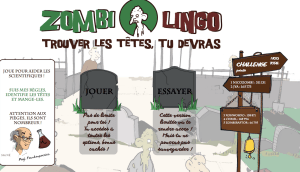
Now that we know how to talk about phrases, in French and otherwise: getting a computer to find the heads of phrases can be a lot harder than it is for humans to do it.  There’s a very cool web site that lets people play a game that’s designed to create data to be used to help computers learn for themselves how to find the heads of phrases in French.  It’s called Zombi Lingo: zombie, ’cause you have to find heads, and zombies like to eat brains.  (Clearly this is a pre-Walking-Dead conception of what it means to be a zombie.)  Check it out at this link–it’s quite fun.

So, yeah–I gave a talk in which I explained duality of patterning, but screwed up the word for “phrase.”  Oh, well–as Jigoro Kano, the founder of judo, would have put it: I got valuable insight into what I need to work on.

Incidentally, here are some details on some of the 85 gun deaths in the United States in the past 72 hours:

  • 3 people in one incident, Marion County, Oregon (source here)
  • 1 church deacon in Shelby County, Tennessee (source here)
  • 1 person in Houston, Texas (source here)
  • 1 person in San Antonio, Texas (source here)

I really don’t have the stomach to go through all 85 of them–sigh…  72 hours, 85 deaths…


How we’re sounding stupid today: synonyms

Synonyms are way more complicated than you might think.

For several years, my judo club in the States had a number of highly-ranked players on the junior national level.  The coaches decided to take them to Mexico to train at one of the national Olympic training centers, and they brought me along to interpret.  We spent a week at the training center in Guadalajara, and I interpreted for everything from practice sessions to our head coach explaining his philosophy of judo.

At the end of the week, we all piled into a bus and headed to Mexico City for the annual national tournament–a few of us grown-ups, our kids, and a lot of young Mexican children.

The bus ride was long, and going through the mountains, it was coooold.  As kids got cranky and the ride got miserable, I decided to kill two birds with one stone: distract the kids for a while, and take advantage of an opportunity to improve my Spanish.  I asked the busfull of kids what I sounded like when I spoke Spanish.  Could they imitate me?

I thought that I would learn something that I already knew–hilarious imitations of my aspirated voiceless stops, ludicrously elongated syllable nuclei, vocalic offglides, and the like. I figured that the kids would get a laugh out of it.  In fact, when you learn to do linguistic fieldwork on under-studied languages, you’re encouraged to go to adolescents for feedback–the idea is that teenagers being what they are, they might be less deferential than adults, and more willing to tell you the truth about how bad you sound.  No one was biting, though.

Finally, I managed to convince one of the older guys to speak up.  For once, the bus got quiet.  Well…you always say estoy contento (“I’m happy”) instead of  estoy feliz (also “I’m happy”). 

The kids roared–apparently, they had noticed.  They’re…you know…synonyms, he added apologetically.  Sometimes you use synonyms wrong.

Now other kids jumped in with poor synonym choices that I apparently made quite regularly.  Who knew??  It seemed to be the case that I made a lot of poor synonym choices, because this activity kept the kids in stitches for quite a while.  A bus-wide global meltdown was averted, and we reached Mexico City without any major traumas.

This story came back to me today while reading the comments on a blog post that I wrote the other day about faces.  A question came up: I gave the French words figure and visage for the English word “face,” but what about the French word face?

Simple answer: I didn’t know that the French word face meant “face.”  To my knowledge, I’ve only ever heard it in the expressions face à and faire face à.  My old nemesis: synonyms.

What is a synonym, though?  Here’s the definition from Merriam-Webster:

Screenshot 2016-06-17 06.50.30
Picture source: http://www.merriam-webster.com/dictionary/synonym

Linguists don’t typically like that definition of “synonym,” though.  Meaning is really, really hard to pin down (we’ve had a couple of posts on the difficulty of describing word meanings, looking at a number of options for doing so, none of which works out perfectly–see here for representing meanings with necessary and sufficient conditions, and here for representing meanings with prototypes).  We tend to use a definition more like this: two (or more) words are “synonyms” if they can freely replace each other in all contexts.  The idea would be that if you can say pail every place that you can say bucket, then they’re synonyms.  If you can’t, then they’re not.

The thing is this: on this “distributional” definition of the term “synonym,” there are almost no synonyms.  In American English, I can think of two pairs of synonyms:

  • pail/bucket
  • stone/pit (in the sense of the seed of a succulent fruit–a peach, or a plum, or an apricot)

Bullshit, you’re thinking–English is full of synonyms.  Good, virtuous, righteous, moral.  Bad, wicked, sinful, immoral.  If you look at data, though, you’ll soon see that there are almost no words in English that have this characteristic of being freely replaceable.  Rather, words that we think of as synonymous usually have subtle differences in how they’re used in the language.  In technical terms, they have different “distributions.”

Let’s take two words that I imagine every native speaker of American English would think of as synonymous: big, and large. 

All of the data on big and large in this post comes from Douglas Biber, Susan Conrad, and Randi Reppen’s 1998 book Investigating language structure and use, published by Cambridge University Press.  The graphics are from my lecture notes and are based on Biber, Conrad, and Reppen’s data.

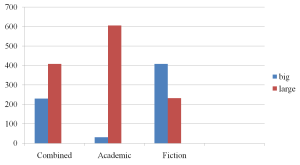
There’s a nice collection of naturally-occurring English texts called the Longman-Lancaster Corpus.  It contains 5.7 million words from fiction and from academic prose.  If you count the number of occurrences of big, the number of occurrences of large, and then convert those counts to frequencies per million words, you get this:

big versus large
Picture source: http://www.merriam-webster.com/dictionary/synonym

What are we seeing here?  If we look at the combined texts, we see that large occurs more frequently than big, and that’s about it–not much of interest.

If we break out the two categories of texts, though–academic prose, and fiction–something jumps out at us.  The two words have very different distributions in academic prose and in fiction.  In academic prose, large is far more common than big.  On the other hand, in fiction, big is far more common than large.  What the hell?

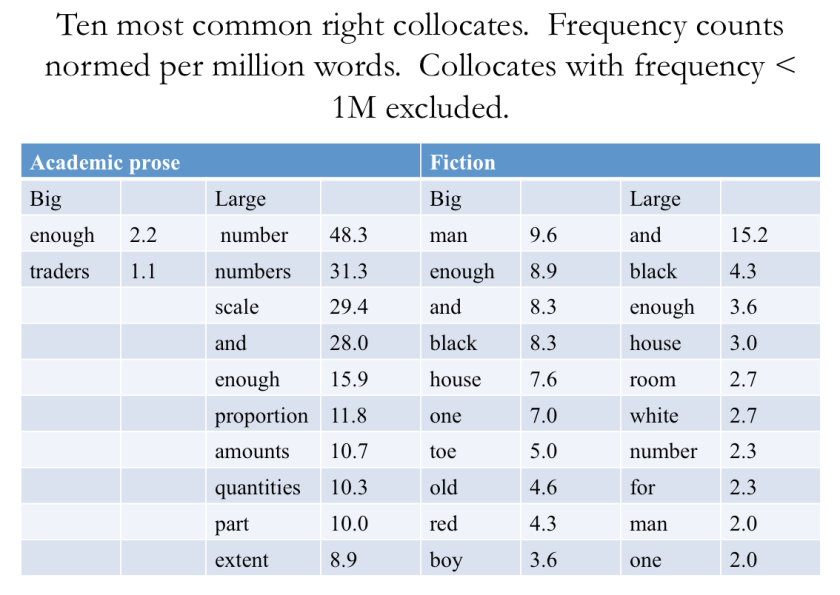
Let’s look at the contexts that the words show up in.  We’ll separate out academic prose and fiction, and within those categories, we’ll separate out big and large.  For each one, we’ll show the most common words that appear to the right of the word in question.

Screenshot 2016-06-17 07.15.10
Picture source: me.

We’ll only show words that show up to the right of these words at least 1 million times.  In the academic prose, that only leaves two–remember how big the bar for large was compared to the tiny bar for big in the academic prose part of the graph above.  In fiction, we see both, although you’ll notice that the numbers for the words to the right of large in the fictional texts are much smaller than the numbers for the words to the right of large in the academic prose–large just doesn’t show up as often in the fictional texts.

Think about the two sets of words–the ones that show up after big, and the ones that show up after large–and you might notice something:

  • big tends to appear before physical objects.
  • large tends to appear before amounts and quantities.

How does that relate to the differences in the distributions of the two words across academic prose, and fiction?

  • Fiction contains lots of physical descriptions, which can refer to size (and therefore uses big)
  • Academic prose is more likely to use measurements to describe size (and therefore is less likely to use big)
  • Academic prose deals more with amounts and quantities (and therefore uses large)

I’ll try not to drone on and on with details, but the effect is quite robust.  It shows up at longer distances, such as when the words are separated by an adjective: big black eyes, big black saucepan, big black mongrel dog.  It shows up when the words follow the words that they modify: The cart was not really big enough…. The revolver, which looked big enough to…. The ratio is large enough, however…. …a finite number of steps (which may be large enough to…

The moral of the story: could you substitute big and large for each other?  You could–it’s not like it’s not interpretible if you say large revolver or big quantity.  You probably do produce things like that–I’m sure I do, too.  This stuff is probabilistic–it’s about frequencies, about what you do more often or less often, not about always or never.  But: if you sound like a native speaker, you mostly don’t just swap these two words in and out randomly.  The distributions are different: if you’re a native speaker, you don’t just substitute big and large for each other freely.  You use them differently, in ways that are so subtle that you’re almost certainly not aware of it.  (I sure as hell wasn’t before I read the book.  I’ll point out that I’ve given linguistics graduate students the homework assignment of finding differences in the use of big and large for maybe ten years, and in all of that time, exactly one student has come up with this.)

So: back to the three French words visage, figure, and face, all of which correspond to the English word “face.”  How the hell could I not know that face meant “face”?  Why have I only ever heard it in face à and faire face à?  And why can’t I figure out the difference between visage and figure?  Let’s look at some data.

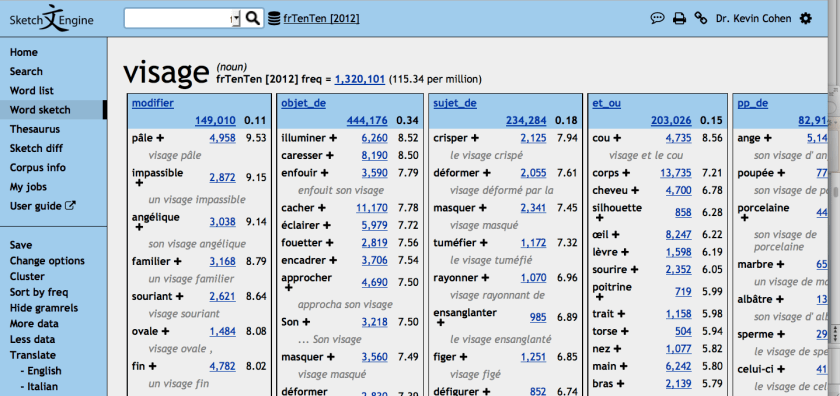
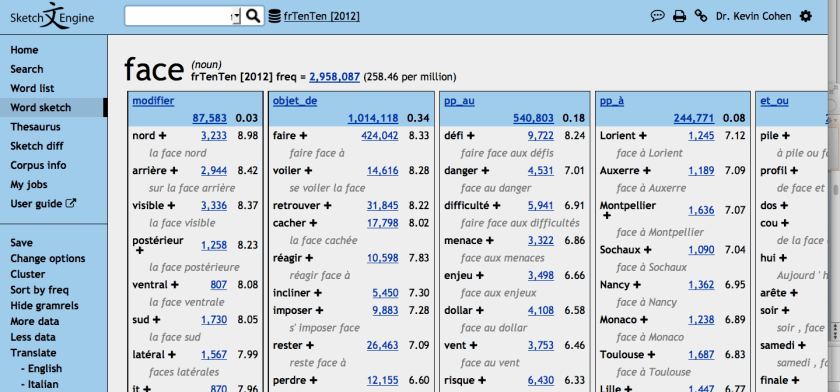
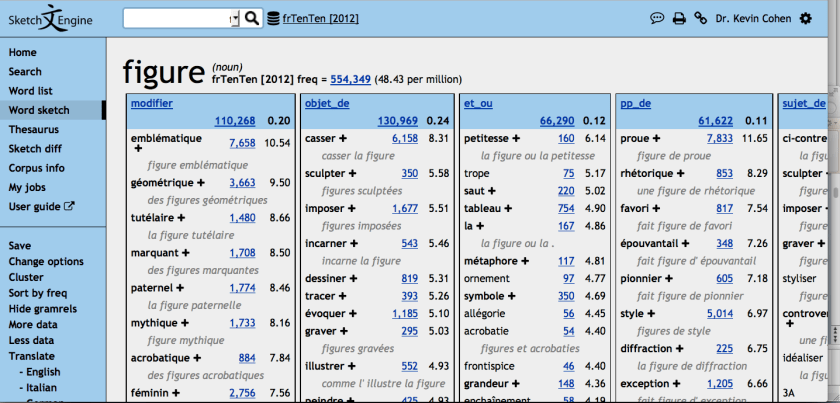
I went to the Sketch Engine web site.  This gives me access to a bunch of big collections of texts in an astounding variety of languages, and a tool for searching those collections.  The tool will also do analyses of statistical data–what other words a word tends to occur with in those text collections, what verbs it tends to be the subject and the object of (if it’s a noun), what nouns it tends to have as its subjects and objects (if it’s a verb), and so on.

I picked a corpus (collection of linguistic data) called frTenTen, just because it’s big–9.9 billion words.  For each word–visage, figure, and face–I got an analysis of the words that it tends to occur with, and the structures that it tends to occur in–what verbs it tends to be the subject and object of, which prepositions it tends to modify and to be modified by, and so on.  You can see screen shots of the three analyses below.

The first thing that we see is that the frequencies of the three words are different, and face is actually the most common.  In 9.9 billion words of French text, this is how often they show up:

  • visage: 115 times per million words
  • figure: 48 million times per million words
  • face: 258 times per million words

Seriously?  How did I miss face, when it shows up more than twice as often as visage, which shows up more than twice as often as figure?  If we look closely at how these words tend to combine with other words and structures, it starts to make sense.  In what follows, I’m going to focus on two things: (1) the kinds of words that modify the word that we’re talking about, and (2) the kind of words that it gets coordinated with–in other words, what kinds of words show up on the other side of the word “and” or the word “or” with the word in question.

We’ll start with le visage.  To begin with, let’s look at the words that modify it.  Visage is a noun, so these are probably going to be adjectives.  Why do I care about the words that modify it?  Because different kinds of things tend to get modified with different kinds of words.  Kittens are cuddly, warm, and cute.  Sharks are hungry, vicious, and deadly.  Knowing something about the kinds of words that modify something tells you something about how the people who speak a language think about that thing.
So, the words that modify visage: look at the box to the left in the figure below, labeled modifier.  Here are the words that we see most frequently modifying visage in that 9.9-billion-word sample:

Screenshot 2016-06-17 02.55.46
“Word sketch” of the French noun “visage.” Picture source: me.

Definitions from WordReference.com:

  • pâle:
  • impassible: impassive, calm, emotionless, and many related words
  • angélique: angelic
  • familier: familiar
  • souriant: smiling, cheerful, happy
  • ovale: oval
  • fin: in ths context: small or thin, according to what I found on Linguee.fr.

The generalization that I would suggest here is that these are all words that you would not be surprised to see being used to describe a human face.

Now let’s look at the words that most frequently show up with visage on the other side of the words “and” or “or.”  I care about this because words are often combined by and or or with similar categories of words.  For example, nouns tend to get joined with other nouns, verbs with other verbs, etc.  This time we’ll look at the fourth box from the left, labelled et_ou.  Let’s see if that suggests anything to us about how to understand visage:

  • cou: neck
  • corps: body
  • cheveu: hair (this probably shows up as cheveu rather than cheveux because Sketch Engine oftend does something called “lemmatization:” converting all forms of a word into what you might think of as their “basic” form–in the case of nouns, the singular form)
  • silhouette: profile, shape, contour
  • oeil: eye
  • lèvre: lip
  • sourire: smile

The generalization that I would suggest here is that these are mostly body parts.  Not surprising, if visage is a body part.

Now let’s look at the word that I’m struggling with–la face.  Here are the statistics:

Screenshot 2016-06-17 02.53.23
“Word sketch” of the no: northun “face” in French. Picture source: me.

Once again, let’s look at the most frequent modifiers.  Here’s what we get:

  • nord: north
  • arrière: rear
  • visible: visible
  • postérieur: back, posterior
  • ventral: ventral (this word refers to the side that your stomach is on.  To see why this is a useful word from an anatomical point of view, think about a person, and a fish.  On a person, the belly is to the front, while on a fish, the belly is on the bottom.  Using the word ventral lets you refer to the side that the stomach is on, regardless of the orientation of that side (forward, or down).
  • sud: south
  • latéral: lateral (side)

Here are some uses of ventral (and its opposite, dorsal)–scroll down past them to continue reading:

A totally different set of modifiers from visage!  These sound a lot more like words that word describe one of the several faces of a mountain, or of a building.  When we look for the words that face occurs with in coordinations with et or ou, we find:

  • pile: In pile ou face, it’s “heads or tails.”
  • profil: profile.
  • dos: back
  • cou: neck
  • arête: bridge (of nose)
  • soir: evening
  • samedi: Saturday
  • finale: final

Some of those are consistent with the interpretation of face as a body part–profile, back, necks, bridge of the nose.  The others aren’t.

When we look at the “word sketch” for figure, there’s very little that suggests that the word is used as a body part–at any rate, not as often as it’s used for other meanings:

Screenshot 2016-06-17 02.57.10
“Word sketch” of the French noun “figure.” Picture source: me.

So, what insight does this give us?  For one thing: it’s not surprising that I haven’t come across face with the meaning “face (of a person).”  Rather, it seems to be used more often for the “faces” of objects–buildings, mountains, computers, etc.  For another thing: it’s surprising that I’ve come across figure with the meaning “face” at all, since it doesn’t seem to be used for that as often as it’s used with other meanings.  Finally, the major point: it’s hard to see any of these as synonyms for the others, as the patterns of usage are quite different.  On the definition of “synonym” as “word that is freely replaceable for another word,” these aren’t.

Having said all of this: I don’t mean to imply that synonymy is not a useful concept.  In fact, there’s an enormously useful resource called WordNet that is organized completely around the notion of synonymy.  WordNet encodes relationships between words.  But, what’s the definition of word?  For WordNet, it’s what they call a “synset:” not a single word, but the full set of synonyms for that word.  Synsets are the basic unit of WordNet–this whole (very useful, as I said) resource is organized as relationships between them.

The kids did great at the tournament.  As Jigoro Kano, the founder of judo, would have put it: the ones who won got positive feedback on their training, and the ones who lost got valuable insight into the things that they needed to work on.  I got off the plane in the US a couple days later with my boots coated with dust from an Aztec temple, and thought a lot about how small the world is these days.

Paris is not all avant-garde theater and haute couture, but it charms me nonetheless

Music, the junkie across the street, and the Cratylus.

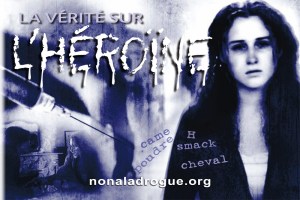
heroin_booklet_fr
“The truth about heroin.” Let me just point out (a) how cool it is that “heroïne” is spelt with a tréma (umlaut), and (b) that if you search Google Images for accro paris (junkie Paris), you would not believe how many pictures of Paris Hilton you find. Picture source: http://fr.drugfreeworld.org/drugfacts.html

It’s on evenings like this that I especially appreciate summertime in Paris.  The Euro 2016 is in full swing, and the streets of my neighborhood are full of little crowds of soccer fans wearing the jerseys of their team and chanting and singing in the language of whatever country they happen to be from.  Weaving in and out of them are women in cute dresses and impressive heels–not unusual here, but especially salient to me today due to their contrast with the junkie nodding off in a doorway across the street, who I would guess couldn’t tell you what she’s wearing or, indeed, what feet are for.

Fete-de-la-musique-par-Nicolas-Vigier-domaine-public_seve-illustration-article
Fête de la musique. Photograph by Nicolas Vigier, en domaine public sur Flickr.

It’s also June 21st, the summer solstice and the day of the Fête de la musique, the annual festival that is marked by musical happenings large and small all over France.  Standing on my balcony (don’t get excited, it’s about the size of a phone booth and occasionally splattered with bird shit), I can hear a guy playing the guitar and singing in front of a set of speakers that are much, much bigger than his limited skills merit.  In other neighborhoods you might hear a local choir singing on a street corner, or a full brass section in a park, or whatever.  It’s totally cool.

Screenshot 2016-06-21 14.06.56
Russian soccer hooligan association president Alexander Shprygin gets thrown out of France, two days later tweets a picture of himself at a match in Toulouse, and lands in jail this time. Picture source: Twitter.

Of course, with crowds come assholes.  I took a break from memorizing vocabulary about semantics and knowledge representation to take a walk by the Eiffel Tower just now, and saw seven guys running the ball-and-cup scam (the norm would be zero to one), including one guy who was speaking Russian (there are tons of them in town–the president of the Russian soccer hooligan association was escorted onto a plane and out of the country by the French police a couple days ago; today he tweeted a picture of himself in a stadium in Toulouse, having taken advantage of the Schengen Agreement to get back into France, and is now sitting in a jail cell) and one guy who, by his accent, his enthusiasm, and his backwards ball cap, seemed pretty clearly to be an American.  It is, after all, entre chien et loup at the moment, I guess–dusk, when dogs go home and the wolves come out.  Back to my apartment to memorize vocabulary and feel grateful that if Europe has to end, I had the good fortune to see a bit of what the glory was like first.

  • le shit: hash, pot. Probably not what the junkie across the street has been doing today.
  • l’essentialisme: essentialism.  Easy enough to spell, but I have no clue how to pronounce it–seems like there oughta be some accents in there somewhere.  This is the idea that language is the way it is because it reflects something real about the world–Cratylus’s position in Plato’s Cratylean dialogues.
  • l’arbitraire (n.m.): arbitrariness.  This is the idea that language is the way it is purely as a matter of social convention and chance–Hermogenes’s position in the same.
  • le normativisme: the attitude that language is something to be regulated by fiat.


The modern human face

Anatomically modern humans have a facial structure that is different from our evolutionary predecessors and close relatives. Here’s how to recognize it.

I’ve occasionally read that Neanderthals were so similar to modern humans that you wouldn’t notice one if you walked by them on the street.  This is probably not true.  Leaving aside the question of whether people who write things like that know anything about what I, personally, am and am not likely to notice, anatomically modern humans have quite different facial structures from anything else out there today, and also from any of our hominid relatives.  That includes Neanderthals.

In recent posts, we’ve talked about three unique features of the anatomically modern human face:

If you’re not sure about what any of those mean and you want to know, follow the links, which will take you to illustrated posts on each of those individual features.

The tendency to notice faces, and the ability to read facial expressions, seem to be very important in humans, based on things like the sophistication of the musculature that we have for controlling facial expressions, the amount of the motor nervous system that is developed to controlling those muscles, and the skill that most humans have in recognizing facial expressions of emotion.  For an accessible discussion of the psychology and biology of all of this, see this Wikipedia page.  Chimpanzees are lousy at recognizing human facial expressions–dogs can be pretty good at it, though.  (There’s a lot of variation here, so don’t get pissed at your dog if he doesn’t seem to be up to the task.  He undoubtedly has other charms.  Another cool thing that dogs can learn to do, but chimpanzees can’t: understand that when you point in a direction, they should look that way.)

If you’ve read the preceding posts, and you can remember these three features–forehead, chin, and being located under the eyes–then I’m guessing that you can impress your kids the next time you go to the zoo/museum/catacombs by explaining what to notice about the faces of the skulls of the various and sundry critters that they’ll see.  Want to test yourself?  Here are some skulls to check out.  See if you can tell which are anatomically modern humans and which aren’t.  Answers at the bottom of the post, along with some French vocabulary for talking about faces.

Skull-bonesballotbox
#1


human and neanderthal Skulls-800x430
#2
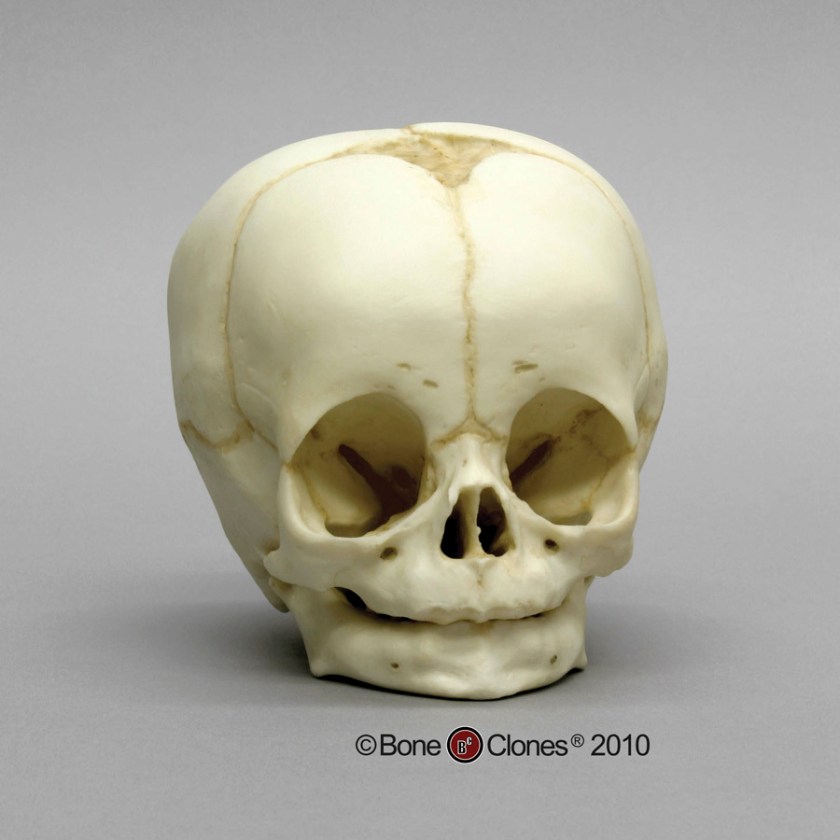
human infant skull replica product-754-main-original-1415040576
#3
australopithecus skull Mrs_Ples.jpg
#4
Hominid_Skull-Chimpanzee_bottom-900
#5
bornean orangutan variants_large_3886
#6
human skull discolored clone s521972503441136676_p925_i1_w640.jpeg
#7


  1. Modern human.  This is the ballot box from Yale’s Cross and Bones society.  Picture source: http://www.thehistoryblog.com/archives/4503
  2. Modern human in the front, Neanderthal behind it.  Picture source: http://www.rawstory.com/2015/12/dramatic-wall-of-skulls-to-be-built-at-london-museum-to-illustrate-human-evolution/
  3. Modern human infant.  (Trick question.)  This is a reproduction of the skull of a deceased 4-month-old child.  Human infant skulls are similar to chimpanzee infant skulls in that they both have foreheads (which the chimp will lose as it ages), but note that the human infant’s face is located beneath the eyes.  Picture source: https://boneclones.com/category/child-skulls/human-anatomy#view=grid&category=76&page=1&pageSize=30
  4. Australopithecus.  No lower jaw, so you can’t look for a chin, but notice the lack of a forehead and the forward-protruding muzzle (i.e., the face is not located under the eyes).  Picture source: http://www.wikiwand.com/en/Australopithecus
  5. Chimpanzee–underside of skull.  You don’t have to look for a forehead or a chin to know that this wasn’t an anatomically modern human–the muzzle protrudes way out in front.  Picture source: http://www.dlt.ncssm.edu/tiger/360views/Hominid_Skull-Chimpanzee_1200x900/bottom.htm
  6. Bornean orangutan.  Picture source: http://www.skullsunlimited.com/record_species.php?id=1767
  7. Modern human.  (Replica.)  If you got this one wrong: maybe the discoloration threw you off?  It’s totally typical, though–forehead, face below the eyes, and a chin.  Picture source: http://www.boneroom.com/store/c115/Museum_Quality_Human_Skull_%26_Skeleton_Casts.html
  • la figure: face.
  • le visage: face. I think this might be a higher register of language than la figure–perhaps more literary?  Not sure.  Here’s a link to the Noir Désir song Des visages des figures, just for fun: https://www.youtube.com/watch?v=wW533pwLMv0.
  • le sourcil: eyebrow.  The l at the end is silent, unlike most word-final l‘s.
  • le cil: eyelash.  This l is pronounced.
  • la joue: cheek.
  • un œil: eye.  Pronunction: [œj].  That is: the L is silent.  Follow the link to the Lawless French web site if you want to hear a recording of the proper pronunciation.  (I threw this one in despite the fact that we all probably know it because I was recently in a French theater class, and I noticed that NONE of the students (including me) was sure how to pronounce it when it would come up in a play, despite the fact that we all had good enough handles on French to talk about Molière in it.  Like I always say–it’s the little things that get you…)
  • les pattes: sideburns.
  • la barbe: beard.
  • barbe-à-papa: cotton candy.
  • la gueule: mouth.  Ta gueule!  Shut up!
  • être très physionomiste: to have a good memory for faces
  • le/la physionomiste: bouncer


Compound nouns: why my kid said friendgirl instead of girlfriend

The errors of a child learning their native language can be tremendously interesting.

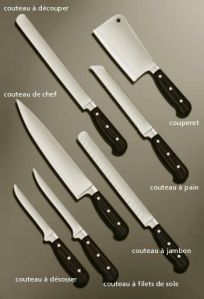
french knife vocabulary 09c37ab6157f4e281abd6477065caf2fWhen my kid was about four years old, he went through a period where he switched the orders of certain kinds of words.  It wasn’t random–this happened only with a particular kind of word formed by putting two nouns together.  For example, he would say:

  • light kitchen instead of “kitchen light”
  • friendgirl instead of “girlfriend”

On the other hand, if there were a noun preceded by an adjective, he got the order right:

  • big kitchen
  • mean girl

The phenomenon has some implications for theories of how children learn language.  In particular, it’s difficult to give a simple behaviorist explanation for this phenomenon, where the kid gets exposed to stimuli, repeats them, and gets reinforced for producing them correctly: to my knowledge, the kid was never exposed to things like friendgirl.  There are also interesting things about his pronunciation of these things on a smaller scale, though, and in particular, how we make compounds–read on, if you want to know more.

One of the most difficult problems in getting a computer to understand language is understanding compound nouns.  These are nouns that are made up of two or more words in a sequence.  The toughest ones can be compounds where the words that make up the compound are both nouns. For example, in English:

  • school bus
  • kitchen cupboard
  • fire engine

I’ve given you examples where the two nouns are written with a space between them, but they might also be spelt with a hyphen, or without a space.  For example:

  • gunboat (no space)
  • timesheet (no space)
  • rainbow (no space)
  • gun-carriage (hyphen)
  • train-spotting (hyphen, and yes, you are allowed to argue about whether or not spotting is a noun)

From a theoretical perspective, there isn’t a distinction between these–they’re all compound nouns.  From the point of view of writing a computer program that deals with language, we would tend to treat the ones that are written with a hyphen or with no space as single words that don’t necessarily get analyzed further, but the ones written with a space usually need special treatment.  (In fact, amongst people who do natural language processing, there’s a whole field of research concerning what are called multi-word expressions. 

From both a theoretical and a practical perspective, the big question about compound nouns is: how can you describe, understand, and get a computer to deal with the different kinds of relationships that can exist between the nouns?  It’s not a random thing–languages tend to exploit particular kinds of relationships in compounds.  Even describing these things from the perspective of theoretical linguistics is tough, though, separately from the practical problem of getting a computer program to process them.  A classic English example (due, I believe, to the recently departed linguist Chuck Fillmore) is the names for different kinds of knives in English.

  • bread knife: a knife for cutting bread
  • butter knife: a knife for spreading butter
  • pocket knife: a knife that is carried in a pocket
  • butcher knife: a knife that is used by a butcher
  • palette knife: a knife that is shaped like a palette
  • utility knife: a knife that is used in food preparation
  • paring knife: a knife that is used for paring
  • steak knife: a knife that is used for cutting steak
  • boning knife: a knife that is used to trim meat from a bone
  • boot knife: a knife that’s meant to be carried on or in a boot

Just with this partial list, we can see some patterns of semantic relationships between the nouns in the compound:

intended material bread knife, butter knife, steak knife
used by butcher knife
used for paring knife,  boning knife
carried in pocket knife, boot knife
 shaped as  palette knife
dog bones 1003118_10201602413728925_39172732_n
Dog bones at a Hungarian butcher shop in Cleveland, Ohio. Picture source: me.

How should we classify utility knife?  Or dog bone?  I don’t know.  As I said, this is difficult–it’s not like this is something that they teach you in linguistics grad school.  And, do you get to just make these kinds of relationships up on an ad hoc basis?  If so, you’ve got descriptions that couldn’t possibly be shown to be wrong, and from a scientific point of view, that’s bad–your theories need to be testable, and falsifiable.  (Generally we assume that we can’t prove anything, but we do try to construct theories in such a way that if they’re wrong, in principle we should be able to demonstrate that.)  Some people have proposed limited sets of relationships that they hope can capture all such compound nouns–for example, the Generative Lexicon theory of James Pustejovsky.  It’s not clear that all of the issues that are involved in this are resolved, though.

Rather than this kind of noun-noun compound, French generally has nouns modified by prepositional phrases.  That is, you have the noun, then a preposition, and then another noun.  For example, compare these English and French nouns:

railroad (rail + road) chemin de fer
windmill moulin à vent
wine glass verre à vin
goods transport transport de marchandises
shaped as palette knife

For more examples, see the picture in this post, which shows the vocabulary for a variety of kinds of knives in French.

It’s not the case that all French nouns of this sort follow the prepositional phrase pattern–for example, we have homme grenouille, “frogman.”  But, the pattern with the prepositional phrase is much more common. Having said that: one of the biggest mysteries of French for me is how you know when the preposition will be de versus à.  Is there some principle that would let me know that it’s a boîte à gants (glovebox) and a cuillere à café (coffee spoon), but a animal de compagnie (pet) and a crème de cacao?  A boîte à bijoux (jewelry box), but a boîte d’allumettes (matchbox)?  A boîte à chaussures (shoebox), but a boîte de nuit (nightclub)?  I have no clue.

Some details of compound nouns in English: the pronunciation of these things is different from phrases with adjectives.  In general, in a compound noun, you’ll have the stress on the first noun, e.g.:

  • chef’s knife is pronounced CHEF’S knife, while David’s knife would usually be pronounced equal stress on both words.
  • coffee spoon is pronounced COFFEE spoon, while yellow spoon would be pronounced with stress on both words.
  •   beat box is pronounced BEAT box, while big box would be pronounced with stress on both words.

Some details of compound nouns in French: I have no clue how to pluralize these things, and I’m not sure that all French people do, either.  Here’s what the Wikipedia page on French compound nouns has to say on the topic.  It breaks the compounds down to what they’re made up of: a noun plus a  noun, a verb plus a noun, a noun plus a verb, etc.:

  • noun + noun: pluralize both.  Example: oiseau-mouche, oiseaux-mouches (hummingbird).  Exception: I don’t understand the Wikipedia explanation for this, but sometimes you only pluralize the first noun: des chefs-d’œuvre (masterpiece), des arcs-en-ciel (rainbox).
  • verb + noun: plural only at the end.  Example: cure-dent, cure-dents.  Exception: I don’t understand the Wikipedia explanation for this, either, but sometimes you don’t mark the plural at all: des chasse-neige (snowplow) (= chasser la neige, devenu variable dans l’orthographe de 1990), des trompe-l’œil… (direct quote from Wikipedia)
  • adjective + noun: pluralize both.  Example: la basse-cour, des basses-cours (farmyard; chickens and rabbits; outer courtyard).
  • verb + verb: don’t mark the plural at all.  Example: des garde-manger (pantry).

If you’d like to know more about the Generative Lexicon theory and how it accounts for these kinds of relationships between nouns, but don’t feel like you want to tackle the primary sources (I have a PhD in linguistics and I’ve never been able to finish working my way through the last chapter), there’s a book called Generative Lexicon theory: A guide, by James Pustejovsky and Elisabetta Jezek, coming out. For a detailed discussion of relationships in this kind of noun in French and Italian, see this paper by Pierrette Bouillon, Elisabetta Jezek, Chiara Melloni, and Aurélie Picton. (I got some of the examples in this post from there.)

So, back to my poor kid: why friendgirl and light kitchen, but mean girl and big kitchenHe seems to have come up with some conception of there being a difference between the compound nouns and a sequence of an adjective and a noun.  Remember that he was maybe 4 years old, so no one taught him this.  As is characteristic of kids learning their native language(s), he came up with a hypothesis about how to produce the difference between these things, and what he came up with was an ordering difference for the compound nouns.  So: don’t freak out if your kid comes up with some weird things in the language department, and be aware that it’s mostly not trying to correct them–it’s not like they’re consciously aware of these “rules,” and nothing that you can say to them is going to change them.  However: they’ll figure it out.  Keep Calm And Keep Talking.

Some French vocabulary on the topic:

  • le mot composé: compound word

The Paris hustling ecosystem: the good side

There are plenty of people whose life in Paris consists of working their butts off selling the little trinkets that you’ll bring home as souvenirs or use to make your vacation more pleasant. Here’s the kind of stuff they do.

Just as Paris has a begging ecosystem and an ecosystem of hustling (in the bad sense of that word), it also has an ecosystem of hustling in the good sense of that word.  (See here for an explanation of the two senses of hustle in English.)  The people who make their living in this system are almost entirely foreigners, as far as I can tell, and they are pretty much just out there working their asses off, in good weather and bad–earning a mostly honest living within the law, if just on the edges of it.

I say “just on the edges” because the only thing that anyone could complain about concerning these people is that they aren’t licensed.  I find it hard to see how anyone could complain about what they do, really–personally, I admire their hustle (in the good sense of that word), how hard they work.  And, since these people have their little niches in the ecosystem, it’s not like they’re taking away money that could have been earned by French citizens, either–these people are doing things that no one else does.

Of course you’ll see people doing this kind of hustling anywhere, and supporting the people who do work of this kind can be a good way to help support the local economy.  In fact, in some places, the beggars are so totally controlled by criminal gangs that take a large chunk out of their earnings that if you want to support the local poor people, it’s much better to buy stuff from the little old ladies who show up in the town squares with a few pieces of fruit that they picked in their back yard or buns that they baked at home that morning than to give money to people begging on the street.  The begging situation isn’t under that kind of criminal control in France (with the possible exception of the Roma women that you’ll see–Roma women are very often exploited as beggars in this way in Eastern Europe).

Having said that, some of these things are quite Parisian.  As we’ve so often seen to be the case, different ethnic groups have different niches, and different kinds of selling take place in different parts of the city.  Here’s a sketch of the sorts of (the good kind of) hustling folks that you’re almost certain to see in Paris.

Eiffel Tower sellers

African Eiffel Tower seller
Eiffel Tower seller–notice the hoop with all of the small towers hanging off of it. Picture source: http://www.ottsworld.com/blogs/will-the-real-eiffel-tower-please-stand-up/.

These guys are the most common sight in the Parisian hustling ecosystem (in the good sense of “hustling”).  What they do: they sell little replicas of the Eiffel Tower.

They mostly work the area of the Eiffel Tower–a little bit on the steps of Sacré Coeur, too, but it’s primarily an Eiffel Tower thing–not surprising, given that that’s mostly what they sell.  (A year or two ago, they started peddling selfie sticks, too.)  There are two kinds of these guys:

  1. Guys that walk around with big metal hoops full of Eiffel Towers.
  2. Guys with a square piece of cloth with a bunch of Eiffel Towers on it–they try to sell stuff to passers-by.

The Eiffel Towers come in a range of sizes.  The smallest ones are on little key rings, at 5 for 1 euro.  They get as big as maybe 8 inches–no clue what those cost.

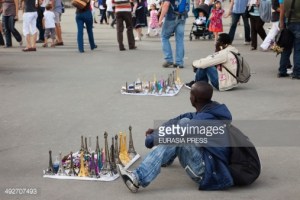
eiffel tower sellers non-mobile
Guys selling Eiffel Tower replicas. The cloths have straps along two sides so that they can be quickly picked up and run off with, along with their contents, when the police come. Picture source: http://www.gettyimages.fr/detail/photo/france-paris-african-souvenir-vendor-under-the-eiffel-tower-photo/492707493.

The square pieces of cloth that the guys who aren’t walking with a ringful use have a standard construction.  They’re roughly a yard or a meter square.  They have a strip of cloth running down opposite sides of the cloth.  When the police come around, they pick the cloth up by those strips, the square of cloth becomes a sort of pouch, and they take off running.

Selling the little Eiffel Tower things is a West African monopoly, and again, you almost entirely see it around the Eiffel Tower and on the steps of Sacré Coeur.  Why West African?  This post on Quora by Jacob Hood might shed some light on the question.

Wine and beer sellers

Another thing that’s quite specific to the Eiffel Tower area is the South Asian guys selling bottles of wine and beer.  More precisely, these guys wander the Champ de Mars (the big grassy area to the south of the Tower).  They spend their entire day carrying a heavy bucket full of ice, beer, and bottles of wine and champagne.  I’ve heard that they will try to charge outrageous prices for their wares, and that makes them the only people on this page with whom I have any problems whatsoever.  I’ve also heard that they will give you a reasonable price if you haggle with them, though (although perhaps they won’t give it to you very graciously–remember, these guys are hauling those heavy buckets around all day long).  There’s a perfectly good wine store a couple blocks away on the Rue Cler, and I don’t know why anyone would buy their booze from a guy with a bunch of bottles in a bucket–but, hey, these guys gotta make a living, too.  (You can read an American expat’s story of haggling with one of the wine sellers here.)

This is a South Asian monopoly–Indian and Pakistani guys.  I’ve only ever seen it on the Champ de Mars.

I spent way too much time trying to find a picture of these guys on line, with no luck.  Yesterday I left work early enough to walk up to the Champ de Mars and take a picture of one myself (questionable legality, with Europe’s privacy laws), only to discover that the Champ de Mars is completely fenced in until mid-July due to the Euros 2016, and the majority of these guys have been displaced for a month or so.  If you happen to have a picture of a Champ de Mars wine seller that I could post here, it would be great.

Water sellers

Water sellers sell…bottles of water, of course!  You’ll see them around a lot of the touristy areas. As Phildange has pointed out:

The water sellers are a modern echo of the “porteurs d’eau” from the Ancient Regime. They did exactly the same job, selling water to the thirsty, but in a time when there were no taps anywhere, and fountains could be far away. Amazing how globalized economy makes society regress to XIXth ot XVIIIth centuries, and in many points.
In the kings’ times there was also a glamour function that has not been replicated yet: some guys carried portable latrines, with a big blanket for privacy and water for cleanliness . Fantastic job, isn’t it ?

Water is generally 1 euro a bottle if it’s not oppressively hot, and 2 euros a bottle if it is oppressively hot.  (Don’t hate them for this–you can go cool off in the shade any time you want, but those guys are going to be out in the sun all day.) Personally, I think these folks are doing a public service.  Could be anybody doing this, but it’s mostly a South Asian thing–Indian and Pakistani guys.

Rose sellers

You’ll have seen these guys in most of the tourist cities of Europe.  They show up on the patios of restaurants, and very occasionally inside.  They carry a bouquet of roses, and primarily approach tables with couples at them.  This is mostly a South Asian thing, again.

In case I haven’t made it clear: I admire these guys.  (They’re almost always men.)  They’re not begging, and they’re not ripping people off–they’re out there every day, working their asses off for what can’t be very much money.  Good for them, I say.

  • mars (n.m.): March.  Note: the s is pronounced.
  • Mars (n.m.): Mars, the god.  Reminder: the s is still pronounced.
  • Mars (n.f.): Mars, the planet.  Yes, the s is pronounced.  Yes, WordReference.com says that the planet is a masculine noun.  Yes, I checked with multiple native speakers, and it does appear to be feminine.
Ukrainian Humanitarian Resistance

Resisting the russist occupation while keeping our humanity

Languages. Motivation. Education. Travelling

"Je suis féru(e) de langues" is about language learning, study tips and travelling. Join my community!

Curative Power of Medical Data

JCDL 2020 Workshop on Biomedical Natural Language Processing

Crimescribe

Criminal Curiosities

BioNLP

Biomedical natural language processing

Mostly Mammoths

but other things that fascinate me, too

Zygoma

Adventures in natural history collections

Our French Oasis

FAMILY LIFE IN A FRENCH COUNTRY VILLAGE

ACL 2017

PC Chairs Blog

Abby Mullen

A site about history and life

EFL Notes

Random commentary on teaching English as a foreign language

Natural Language Processing

Université Paris-Centrale, Spring 2017

Speak Out in Spanish!

living and loving language

- MIKE STEEDEN -

THE DRIVELLINGS OF TWATTERSLEY FROMAGE