One of my cousins says: “Wikipedia is the Devil. The Devil, I tell you!” Here’s a case in point.
One of my cousins says: “Wikipedia is the Devil. The Devil, I tell you!” Here’s a case in point.
It is sadly the case that women get mistreated in pretty much the same shitty ways all over the world. (Shitty and other American English expressions explained below.) Certainly there are some places where it is much worse for women than it is in other places, and in very regionally specific ways–female genital mutilation in some parts of Africa, honor killings in the Middle East, widow immolation in some parts of India, female infanticide in some parts of China–but, all in all, the same issues of violence, sexual abuse, and underpay plague women all over the planet.
Given a certain homogeneity of experience, you might expect feminism to be the same everywhere–the null hypothesis is that everything is the same as everything else, right? However, it has often been observed that feminism in America and feminism in France have different sets of concerns and preoccupations. Here’s a capsule description from the Wikipedia article on feminism in France:
In the English-speaking world, the term ‘French feminism’ refers to a branch of feminist theories and philosophies that emerged in the 1970s to the 1990s. French feminist theory, compared to its English-speaking, is distinguished by an approach which is more philosophical and literary. Its writings tend to be effusive and metaphorical being less concerned with political doctrine and generally focused on theories of “the body”.[13]
I’m surprised by the statement that French feminism’s “writings tend to be…less concerned with political doctrine…” …as that is completely the opposite of the impression that I have. The renaming of an important French feminist group seems relevant as an example of this. In the forward to their collection New French feminisms: An anthology, Elaine Marks and Isabelle de Courtivron describe it like this:
Women concerned with the woman question in France use the words “feminism” and “feminist” less often do their counterparts in the United States. …[T]here is a … profound reason. The desire to break with a bourgeois past–with the inadequacies and fixed categories of humanistic thought, including feminism–has led to a vigorous attack against the labels by one of the most influential and radical of the women’s groups (known originally as “Psychanalyse et Politique”–“Psych et Po”–and more recently as “politique et psychanalyse)…”
My point being: French feminists are really, really into critiquing psychoanalysis. (American feminists aren’t crazy about it, either–the amazing American sociolinguist Robin Lakoff and her colleague James Coyne wrote a book about Freud’s Dora case–but it’s not the subject of nearly as much discussion in the US.) If the group felt so strongly that politics should have top billing over psychoanalysis that they actually changed the name of the group to reflect that, then that’s an indication that they feel that politics is really, really important.
The third chapter of the feminist classic Le deuxième sexe, by Simone de Beauvoir (she’s shown up in this blog before, as Nelson Algren’s lover, before she dumped him for Sartre), is devoted to Engels. The Wikipedia page on her book describes one of its (indirect) effects like this:
European women became more involved in politics and by the 1990s held six to seven times more legislative seats than the United States, enabling them to influence the process in support of programs for women and children.[104]
The moral of the story: be as cautious of Wikipedia as you would with any other source. It’s great, but like anything else, it’s not foolproof–citations, or no citations.
French and English notes below.
Want to know more? Follow these links for:
What happens if you get caught crossing a border with a copy of New French feminisms in your backpack
Transcendence, immanence, existentialism, and feminism
French notes:
la psychanalyse: psychoanalysis. Pronunciation: [psikanaliz]
bien avant: well before, well in advance. Le féminisme en France naît au milieu du XIXe siècle mais bien avant des personnalités s’étaient préoccupés de l’égalité entre les hommes et les femmes. (Source: Wikipédie page on French feminism.)
le courant: branch (of a party); trend, movement. Either of them should work for this sentence: Plusieurs courants ont coexisté et des divergences existent encore même si le but est le plus souvent le même, à savoir l’égalité totale. (I’m not sure how to translate si in that sentence–even if?? Can a native speaker help?)
English notes:
shitty: (of a person or action) contemptible; worthless. (Definition from Google.) How it was used in the post: It is sadly the case that women get mistreated in pretty much the same shitty ways all over the world.
capsule (adjective): shortandconcise;briefandsummarized. (Definition from Dictionary.com.) How it was used in the post: Here’s a capsule description from the Wikipedia article on feminism in France.
top billing: thefirstormostprominentpositioninalistofactorsorentertainers,asonamarqueeorscreen. (Definition from Dictionary.com.) You can use it for any ordered list. How it was used in the post: If the group felt so strongly that politics should have top billing over psychoanalysis that they actually changed the name of the group to reflect that, then that’s an indication that they feel that politics is really, really important.
I was feeling good the other day. Chatting up a pretty French girl, showing off my (lack of) familiarity with 20th-century French philosophers, and using lots of great abstract nouns–transcendence, immanence, agency, objectivity. Feeling smart, feeling charming, feeling sparkling. Pride comes before a fall, and my fall came hard: Oh, Kevin–your neologisms are so cute. The way that you make up new words!
Shit–Not what I was going for. My mistake: throwing around deadjectival nouns too freely. Overgeneralizing from limited data. The Fallacy of Small N. Bref, as we say in French: I was making nouns from adjectives–transcendence from transcendent, objectivity from objective–but I was using the wrong word endings to do it, trying to generalize from too few examples (overgeneralizing from limited data), extracting a pattern that seemed to have held a few times (the Fallacy of Small N).
You can see from my very small set of examples that English has pretty good facilities for making nouns from adjectives. We call these deadjectival nouns. Start with the adjective objective, add -ity, and you’ve got a noun. Start with the adjective transcendent, add -ce, and you’ve got transcendence. You can see something else from my example, too: you don’t get to add just any ol’ word ending to the adjective. Transcendity? Not OK. Objectiveness? It’s OK, but it means something different from objectivity. French also has pretty good facilities for making nouns from adjectives. And, in French, as in English, you don’t get to add just any ol’ word ending to the adjective–you have to know, for any given adjective-noun pair, what the right word ending is. Let’s look at some examples, including of course some that are more or less randomly chosen from recent things I’ve said that have made people snicker, plus an encounter with the always-hilarious old lady who owns a bookstore near my apartment, and then some more thrown in just to show the diversity of possibilities. I’ve relied heavily on WordReference.com to make this table; if I indicate an English word as NFE, I mean to communicate that there is No French Equivalent, at least according to WordReference.
Adjective
Possible noun
Impossible or other nouns
radin stingy
la radinerie stinginess
câlin cuddly, affectionate
les câlineries cuddles (plural only, as far as I can tell)
la complicité complicity (which I’ve only ever heard in a positive sense, meaning something like closeness, bondedness)
NFE complicitness
banal common, banal, mundane
la banalité banality
abrasif abrasive
abrasivité abrasiveness (I think–can a native speaker help?)
impécunieux
impécuniosité
sûr
sûreté
las weary
la lassitude weariness
ingrat ungrateful; unattractive; unrewarding
l’ingratitude ingratitude, ungracefulness
transcendent, transcendental transcendent
la transcendance transcendence
immanent immanent
immanence immanence
obéissant obedient
obéissance obedience
Things to note:
There is a pretty tight requirement for specific endings to be added to specific adjectives.
There is quite a bit of phonology (technically, morphophonology) going on with some of these endings–for example, abrasif (with an f) versus abrasivité (with a v); impécunieux (with no consonant pronounced at the end of the adjective) versus impécuniosité (with an s, which of course is pronounced as a z).
As far as I can tell, there’s no simple mapping between the ending in English and the ending in French (or vice versa). English -ity might match to French -ité (e.g. English banality, French banalité), but then again, so might -ness (e.g. English impecuniousness, French impécuniosité). Of course, English -ness might map to something else, too (e.g. English stinginess, French radinerie). And, forget remembering how to spell any of this–I can’t spell either language anymore… Make me read and write in Spanish for a week, and I won’t be able to do any of the three…
Is there an easy way to predict, or at least to group together for memorization, any of this? I haven’t found one yet–suggestions appreciated…
Transcendence versus immanence becomes a major issue in the philosophy of feminism via Simone de Beauvoir: existentialism, to which she adhered, posits that we are not born what we are, but rather become it. This becomes a problem if you live in a cultural framework that posits that men transcend–go beyond what they are, change–but women remain immanent. She works through this in “The second sex.” Picture source: http://www.thinkphilosophy.org/thinkphilosophy-blog/on-the-provocations-of-existentialism-a-commentary
To put all of this in a bigger picture: what we’re looking at here–things that can change the part of speech of other words–are what is known as derivational morphemes. The whole phenomenon of derivational morphology has some pretty interesting implications for the nature of human language. You can read more about derivational morphology, and those implications, at this blog post. In fact, we’ve recently been talking about a very particular kind of morphological derivation–zero derivation, or changing part of speech without adding an affix, as in this recent post that discusses why that particular phenomenon is interesting, and then this recent post that explores at some depth the range of zero-derived verbs that come from nouns that refer to parts of the mouth and that refer to some form of communication.
English notes:
Not everyone would agree that some of the English nouns that I have in the third column are OK–particularly, affectionateness and complicitness.
I’m pretty much a technoskeptic. Not despite the fact that I make my living by doing computational things, but because I make my living doing computational things, I never expect anything digital to really work. Wanna read about why 166 start-ups failed? Click here. How about 21 heavily hyped technology projects that flopped? Click here. The Fleischmann-Pons cold fusion failure? Here is the Wikipedia write-up about how it ended. You get the point.
Smartphones, though: there’s an idea that was clearly going to make it. Certainly some brands, operating systems, and platforms have not survived. However, the basic idea of having a combined multi-platform communication device—voice, SMS, and email, with things like FaceTime widely available now—with a search engine interface, a music/video player, a camera, and the ability to run apps, is an idea whose time has come. About 334 million smartphones were sold in the first quarter of this year (I’m writing in 2016), with smartphones accounting for 78% of all mobile phone sales. I’ve seen poor kids in Mexico walking around with cell phones that they didn’t have service for, but that worked great as very inexpensive mp3 players. On my most recent visit to Guatemala, I saw plenty of teenagers in very traditional Mayan clothing with cell phone screens gleaming in their hands as they sat on the curbsides in the evening dark in Antigua, hoping for a few final sales of tourist trinkets. (You can read Rudy Girón’s article about Mayan use of smartphones here.) For a refugee, a smartphone is essential–you can use them to get maps; to share information about routes to wherever you’re trying to go, about border crossings to avoid or to seek, about sources of food and shelter; to let your family know that you’re still alive.
For me, cell phone service–getting it, keeping it, figuring out how to use it–has been a recurrent theme in my adventures in France. Looking back over the course of the past two years, I see that I’ve written posts on the language of cell phone service, the drole experience of dealing with an over-worked employee at a cheap telecommunications company, and precisely how much shit you’re in if something happens to the credit card that you pay your bill with–and that’s just the stuff that I had the energy to write about.
The thing is: with the amount of time that I spend on the road, my smartphone has become more or less indispensable to the smooth operation of my life, as well as to the maintenance of my sanity. Most of those essential functions come from the apps on my phone. Here are some apps that I’ve found especially useful for travelling. Suggestions welcome! (I’ve been able to put a link to a page where you can get both the iPhone and the Android versions for most of these–if I couldn’t, I put a link to the iPhone version.)
Pocket: this is the most recent thing that I don’t know how I ever lived without. What it does: it saves web pages and other assorted documents so that you can read them off line. If you looked at mine, you’d see long stories that I didn’t have the time to read when I first saw them, but that are great for reading on a plane or on the train ride to work; Wikipedia pages about cities that I’ve been to but didn’t have the energy to buy a guide book for; a bunch of sources for an editorial that I’m writing; and a bunch of Spanish vocabulary related to hand surgery. I use this app several times a day, every day. A podcast player: I used to subscribe to satellite radio so that I could listen to French-language radio stations in my car. Now: forget it. I start my mornings by downloading the podcast of a French news show that I like, and that gives me an hour of listening practice every day while driving back and forth from work when I’m in the US. I listen to podcasts to get to sleep on planes, to learn French, and just to amuse myself when I don’t have the focus to pick up a book. Be sure to download enough stuff before getting on a plane, leaving your home for that long train ride to work, or whatever. I actually use the podcast app that comes standard with the iPhone, but I hear that there are really good alternatives out there.
WordReference: this app is a great interface to the best-known English/French/Spanish on-line dictionary site. Unfortunately, you have to be on line to use it–if there’s an off-line mode, I don’t know about it. One curiosity: I discovered one day that it doesn’t like it when you look up obscenities. Apparently there’s some kind of licensing issue or something, and if you try to look up the f-word on it, it will refer you to the actual web site.
Google news: I must open this app 20+ times a day, regardless of where I am in the world. (Minus China, I guess–Google is entirely blocked there.) It’s a great way to get news on a personalized set of topics, and you can set it to not download pictures in your news feed, which lets it get by with less bandwidth.
Packing Pro: this app for managing packing lists is so good that I gave it to my beloved sister-in-law, who is one of the very few people I know who is on the road more than I am. I think it cost $3.99 or something, and I’ve been using it for years. I actually throw in an extra little donation every now and then, just to keep the guy working on it–it’s that good.
United: whatever airline you fly on, they probably have an app that will let you stay on top of what gate your next flight is at, monitor the status of the incoming flight, fiddle with your seating assignment, and stuff like that. I was once in a plane that was landing quite late. Tons of us had connections that we were going to have to run to, and nobody knew which gates they were at. One of the stewardesses suggested that we all download the United app while we taxied to the gate, and it saved my butt that day, and many times since.
Yelp: in theory, the Yelp app is for finding restaurants wherever you happen to be. In fact, you would be amazed at the range of things that you can find with it–in one of those very meta moments in life, I used it to find an excellent place to get my cell phone screen fixed in Paris. (Allo iPhone, at 15 rue de Senlis in the 17th arrondissement–I fully recommend them.) Yelp has been available everyplace I’ve been lately but a little town on the Slovenian coast.
The Free Dictionary: a not-bad dictionary, especially for English-English, and you can use it even when you’re off-line. (I guess I coulda said English monolingual. Coulda is explained below in the language notes.) Be sure that you download whichever dictionaries you want to have available before you get on the plane.
NPR One: If you go to NPR for your English-language news, this app is a real boon. It tries to figure out what kinds of stories you like, and then plays them for you, one after the other after the other. (Yes, that’s how you say it.) It’ll mix Morning Edition and All Things Considered stories, podcasts, and whatever else it has available.
French vocabulary of the day:
gagner sa croûte: I think this is a casual way of saying “to make/earn one’s living.” Gagner sa vie and gagner de quoi vivre are other options.
télécharger: to download.
une appli: app. Une appli géniale is allegedly a “killer app,” but I’ve never heard this used. Of course, that means nothing.
English notes of the day:
coulda: Casual form of writing could’ve, which is the contraction of could have. You can say this in most contexts, and you can write it in very casual communications, but don’t write it in anything remotely official or work-related—it’s too casual.
The most important part of a surgical mission: it’s not actually the surgeons. Plus, here’s how you can be a hamburger in the corner.
Yesterday I was interpreting for our hand therapist. She was putting bilateral (this and other obscure English words discussed below) splints on a young man. (Some patient details changed to protect privacy.) “The next splint is here,” she said. Great, I thought, looking around—where? I’ll grab it for her. I didn’t see a splint, though. “Where is it?”, I asked her, somewhat puzzled. She watched me look around. “No—there’s someone else coming in to get a splint, and he’s here.” Ahah—metonymy. More on this later, but first, let’s talk about those splints—and that hand therapist.
I’m in Guatemala at the moment, with a group called Surgicorps. We’re a team of all-volunteer surgeons, anesthesiologists, nurses, technicians, therapists, and assorted non-medical personnel, such as myself—I’m an interpreter. There are lots of groups like ours that come here to Guatemala—there’s an enormous need for surgical care, and not a lot of options for getting it for the very poor population that we serve.
What makes us special: among other things, it’s the fact that we have a hand surgeon. Hand surgery is a very specialized occupation—in the course of learning his trade, our hand surgeon did fellowships in both plastic surgery and orthopedics. A fellowship is about five years, and that’s on top of four years of college, four years of medical school, and a three-year residency—so, these guys are hard to come by.
As specialized and as in short supply as the hand surgeons of the world are, there’s another profession that’s even harder to find an expert in: hand therapists. Hand therapy is a subfield of occupational therapy, which is the art and science of teaching people how to function normally after things like strokes, heart attacks, and amputations. The other day, one of the physicians said to me: The first time I went on one of these missions, I heard that we had a hand therapist with us, and I thought: why the hell do we need one of those? What could she possibly do on a surgical trip? Then I saw her working, and I realized: she’s more important than the physicians.
Almost every kind of hand surgery requires some kind of splinting afterwards, and it’s to the extent that the splinting is or isn’t successful that the surgery is or isn’t successful. For example: an operation that our hand surgeon does here quite frequently is repairing something called syndactyly. Syndactylyis a condition in which fingers don’t separate from each other during development in the womb. It’s ruinous here in Guatemala, where most people’s educational opportunities are nil, and the only option for earning a living for most people is manual labor.
Our hand surgeon can undo the syndactyly. Typically what happens in syndactyly is that the genes that should cause the tissue between the fingers in the fetal hand to reabsorb don’t work right, and what the surgeon does is to cut that tissue away, and then graft some skin between the fingers. (I’m simplifying the description of the surgery!) Once that surgery is done, though, those fingers have to be kept apart for several months. Otherwise, the fingers will re-fuse. How you keep that from happening: a hand therapist builds you a special kind of splint. These have to be made to order after the surgery, as they have to fit the individual child very well, and they have to fit that child when he has bandages on his fingers after the surgery. (That’s why you can’t do it before the surgery.)
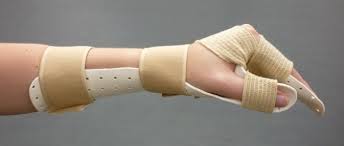
A custom-made splint. Imagine trying to mold that on a toddler who is scared, nauseous, doesn’t speak the same language as you, and thrashing around while screaming for mama at the top of his lungs. Picture source: https://plasticandhandsurgery.com.au/hand-surgery/hand-therapy/
The surgery to repair syndactyly is usually done when a child is small. So, here’s what it’s like to fit one of those custom-made splints after surgery: you’ve got a little kid. The kid is coming out from under anesthesia and is disoriented, nauseous, surrounded by funny-looking people speaking a language that he can’t understand—and he’s scared shitless. So, you’re trying to build a very precisely-sized splint for a kid whose hand you need to fit it to—while he cries, and screams, and tries to pull his arm away from you, and tries to make a little fist while you’re trying to get things between his fingers. Add to the mix the fact that the splint is made from a kind of epoxy that is rigid when cool, and flexible when heated. You heat it up, then take it over to the kid and try to mold it to the right size while he cries, and screams, and tries to pull his arm away from you, and tries to make a little fist while you’re trying to fit it between his fingers. The resin cools down while you’re trying to do your thing, and then it won’t bend any more? Tough shit—go back to your heat source, heat it up again, and then try again.
So: the surgery doesn’t work without a good hand therapist. Being a hand therapist is a difficult job to do, and it’s hard to find places to learn to do it, and in addition to having considerable technical skills in order to make the splints correctly, you need to be able to do it under very adverse conditions, and to keep your cool while you’re doing it. Indeed, it’s the hand therapist that is the key to our mission. We can replace a surgeon, or an anesthesiologist, or a nurse—or an interpreter—but a good hand therapist is hard to come by.
Kids with cerebral palsy. Picture source: torc2.com.
So, back to the young man and “the next splint:” he has cerebral palsy. This means that he has essentially no control over his muscles whatsoever. They twitch, and cramp, and they make his hands clench into useless fists that can’t be opened. He can’t speak. He can’t nod his head “yes,” or shake it “no.” Our hand therapist was making splints for the young man that would keep his hands open for half of the day. If they can stay open, he will be able to grasp things. This is a smart teenager who can’t hold so much as a pencil—having hands that function even a little bit would be life-changing for him. Can the hand surgeon make this happen? No—it’s only the hand therapist who can give him that new capacity, one that you and I probably never even think about.
So, “the next splint is here:” this is an example of a phenomenon called metonymy. Metonymyis the process of referring to something by one of its attributes. For example:
The hamburger in the corner is a slob and needs more napkins. Meaning: the person who is eating a hamburger and is in the corner is a slob, etc.
Would you ask if the right front flat in bay two is also supposed to get an oil change? Meaning: there’s a car that has a right front flat in bay two, and I need to know if it’s also supposed to get an oil change.
This is a different phenomenon from metaphor, in which we refer to something as something else entirely—love is a river, life is a journey, for example—as opposed to referring to it by some attribute that it has—the hamburger that the sloppy customer has, or the flat tire that the car has, or whatever. Metonymy is a super-common phenomenon in language that lets us take advantage of context in the course of communication—and not just linguistic context, but what you could think of as “world” context, and from a theoretical point of view, that’s pretty interesting, for the following reason. Most linguistic theories are entirely about language and its structure (I’m simplifying here—if you’re a sociolinguist, please don’t send me hate mail), and if you need to incorporate the world into your theory about how language works, that’s quite a challenge. Being context-dependent, it also requires that both the speaker and the hearer know what that context is—I didn’t know that the therapist had another patient scheduled, so I totally misunderstood her statement, thinking that she was referring to an actual splint, not to a person who was going to receive a splint.
Back to the kid again: he went home happy, him and his mother hopeful that next year his hands will be more functional. We’re talking about a kid who is super-happy to be spending his days in a wheelchair, because it means that he’s not spending his days in bed. (How’s your day going, dear reader?) If he gets some improvement over the course of this year, then when we come back with a hand therapist again next year, he can improve even more with another splint. Someday he might be able to hold a pencil and use writing to get all of the stuff that’s in his head out of it, like I do—he sure as hell isn’t ever going to be able to speak.
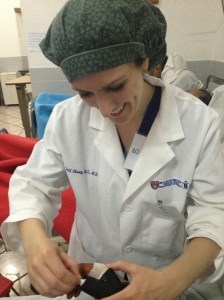
Courtney Retzer Vargo, PhD, checking a splint.
Here’s the thing: if there’s no Surgicorps, then there’s no hand therapist, and there’s no hope for functional hands for that kid—a teenager with a fully functional mind and not a lot of physical abilities. (OK: no physical abilities.) One of our hand therapists is Courtney Retzer Vargo. Courtney has a PhD in occupational therapy, two kids, a hot husband, and a busy job in the United States. But, every so often she burns up a week of her hard-earned vacation time and flies to Guatemala or Zambia to volunteer a week of her time doing exactly this. Like all of us in Surgicorps, she buys her own plane ticket, pays for her own food and lodging–contributes a week of hard-earned vacation time. Surgicorps pays for all of the costs of the patients’ treatments, and Surgicorps lives or dies on the basis of donations from nice people like you. Click on this link, and making a donation will take you less than 5 minutes. $250 will pay all surgical costs for one patient, or the expenses for transportation and lodging for a patient and their parent during the period of the surgery. (See this post for what that trip is like, and why they need us to put them up.) $100 will pay for four surgical packs. $10 will pay for all of the Tylenol that we’ll send our patients home with this week—and, yes, our patients go home with nothing stronger than that. Do it—if you don’t feel better about life immediately, I’ll give you your money back—and you know where I live!
English notes:
Bilateral: on both sides. Bilateral symmetry is one of the most common features of multi-celled animals. How it was used in the post: She was putting bilateral splints on a young man.
To be hard to come by: to be difficult to obtain. During a famine, there actually is usually food, but it’s very expensive and hard to come by. How it was used in the post: Indeed, it’s the hand therapist that is the key to our mission—we can replace a surgeon, or an anesthesiologist, or a nurse—or an interpreter—but a good hand therapist is hard to come by.
Physician: a somewhat technical or formal term for doctor, and specifically, a medical doctor. Non-health-care people don’t use it very often, but health care professionals use it frequently—especially doctors. 🙂 How it was used in the post: The other day, one of the physicians said to me: The first time I went on one of these missions, I heard that we had a hand therapist with us, and I thought: why the hell do we need one of those? What could she possibly do on a surgical trip? Then I saw her working, and I realized: she’s more important than the doctors.
Spanish notes:
Férula or tablilla: a splint. I’ve noticed over the course of the past four years that some people know one word, some people know the other, and many, many of them don’t know either. In that case, I ask the therapist if I can tell the patient that a férula is a piece of hard plastic that will keep their fingers apart/fist from closing/wrist from moving/whatever.
French notes:
une attelle: a splint. I think there’s also a word une éclisse, but I haven’t been able to verify that one.
Writing from Guatemala in the 1980s, Jonathan Maslow said that it is not true, as is often said, that life is cheap in Central America, but it is true that life is briefer there, and so takes place faster. I thought about this yesterday when a conversation went completely to shit. (I was talking about this with one of the anesthesiologists today. “It went completely to pieces,” I said. “Kevin, you can say it went to shit,” she said. This and other obscure English expressions discussed at the end of the post.)
There are two basic kinds of interpretation, known as consecutive interpretation and simultaneous interpretation. In consecutive interpretation, the person for whom you are interpreting says something, and when they stop, you repeat it.In simultaneous interpretation, the person for whom you are interpreting speaks without any pause other than their normal ones, and you repeat what they said immediately, essentially phrase by phrase.
Each form of interpretation has its advantages and disadvantages. I’ll summarize them:
Consecutive interpretation
Simultaneous interpretation
Plusses
· Much easier with some language pairs
· Easier for bilinguals to listen to
· Obligatory in “double interpretation” situations (see below)
· Greater accuracy
· Required in legal situations, where both languages are recorded
· Faster—as little as half the time of consecutive
· Better provider/patient contact
· Obligatory in certain situations: multilingual (more than two languages), speeches, conferences, and live media
Minusses
· Slower (see below for how you can make it less slow)
· Sometimes harder for bilinguals
· More difficult—special training required
· Interpreter can’t clarify without interrupting
· In many situations, requires two interpreters
A number of these are relevant to interpreting for Surgicorps, the group with which I’ve come to Guatemala. Here are some specifics:
“Double interpretation” refers to a situation where the interpreter and the person who speaks the “target language” don’t share a language. This happens on occasion here, and the solution is “double interpretation:” the health care provider speaks in English, the interpreter speaks in Spanish to a second person who speaks Spanish and one of the many indigenous languages, and then that person speaks to the patient in the language that they share—then it goes back in the other direction. This kind of situation has to be handled with consecutive interpretation. (I had a double interpretation situation on screening day. The gentleman who was doing the Spanish <-> indigenous language interpretation had no teeth, and it was a challenge to understand him, even for me.)
How you can help with the relative slowness of consecutive interpretation if you’re a health care provider: use shorter sentences. If you use long sentences, professional interpreters will often write down notes while you speak. The shorter your sentences, the less need there is for note-taking on the part of the interpreter.
How this all became relevant yesterday: I was interpreting between one of the Surgicorps people and one of the Guatemalan staff. The Surgicorps person was anticipating the end of the local nurse’s sentences while I was still repeating them, and responding in English. So, now I’m speaking a sentence that I’m having to remember in Spanish so that I can interpret it in the Spanish -> English direction, while someone is speaking to me in English. This is the kind of context in which you need two interpreters because you’re basically doing simultaneous interpretation instead of consecutive interpretation: this is the kind of situation where everything immediately goes to shit.
…and that’s when I thought about Maslow on Central America: life is briefer there, and so takes place faster. No problem: the other thing about Central America is that people here know how to make things work in suboptimal conditions. Ask everyone to stop, tell them that you’re having trouble and why, and people will do their best to accommodate—the Americans, as well as the Guatemalans. As is almost always the case: communicate what you need, because the only way to guarantee that you won’t get it is to not tell people what it is.
How about helping our work in Guatemala? Surgicorps provides free surgical care to people who cannot afford it. We pay for all of our patients’ costs through the generous donations of the kind of person who would read a blog like this. Click here to donate–I’m the funny-looking bald guy.
English notes here—French and Spanish vocabulary below:
Life is cheap: a delightfully ambiguous expression. The most common interpretation: it’s a way of saying that life is not valued. That’s not to say that people don’t value their own lives, but more that the society doesn’t, in general, value people’s lives. That’s the sense in which it is used in the Maslow quote: it is not true, as is often said, that life is cheap in Central America, but it is true that life is briefer there, and so takes place faster. The other possible interpretation is the more obvious, but the much less common one: it is inexpensive to live. For example: life is cheap in Benin—I think a nice apartment is maybe $50 a month. From the context, it will probably be clear which is which; in case of doubt, the default interpretation is the “life is not valued” one.
to go to pieces or to go to shit: for a situation to suddenly start going very badly, for things to stop working. To go to pieces is acceptable in pretty much any social context, but to go to shit is very casual and mildly obscene, and you should only use it with peers with whom you are very comfortable. Now: if you’re talking about a person, then to go to pieces (but not to go to shit) has a different meaning. It means something like to stop functioning, perhaps to start crying if you’re talking about an incident; or, if you’re talking about a chronic situation, not to cry, but to stop functioning normally in life. An example of the isolated incident version: I dropped her cell phone and the screen broke, and she completely went to pieces—locked herself in the bathroom and cried for maybe 15 minutes. The chronic one: After his wife died, he completely went to pieces—stopped showering, then stopped showing up for work, got fired, and ended up living with his daughter.
French notes:
merder: to go to shit, to get complicated.
Spanish notes:
embolismo: this word does not mean what it looks like—a false cognate. In Spanish it is basically a situation that has gone to shit. The word for “embolism” is embolia, e.g. una embolia cerebral, a cerebral embolism (a kind of stroke). (The other kind of stroke is a derrame.)
At 4 AM today I threw a suitcase full of clothes that will work for both hot, sweaty tropical evenings and freezing-cold operating rooms into the trunk of an Uber car and climbed into the passenger seat. As we pulled away from the house toward the airport and a plane to Guatemala, the driver made a sudden discovery: Oh, shoot! I’m out of gas! (Explanations of oh, shoot! and other obscure English expressions at the end of the post.)She was, too–a big ol’ red light was shining on the dash, and there was a big, glowing E (for Empty) showing on the gas gauge.
This was a problem: because of the balancing act that these ridiculously early morning flights require between not showing up before the airport opens but also not showing up late and missing your flight, I needed this ride to go as smoothly as Uber rides usually do–and I needed my driver to take me straight to the airport. What to do? Pull over and fill up the tank, and we risk missing my flight. But, if we run out of gas between the freeway and the airport, I am definitely missing my flight.
I stopped worrying about this and started worrying about other things pretty quickly, because she more or less immediately blew through a stop sign while checking her text messages. OK, down side: I may die on the way to the airport tonight. But, upside: I am super-heavily insured at the moment, and my loved ones will be nicely taken care of. Just a little bit more reflection, and I concluded that risking missing my flight was a better option than definitely missing my flight, so I encouraged my Uber driver to pull over and get some gas.
She was happy to do so, and drove straight to a station that she knew about. Only problem: at 4 in the morning, it was locked up tight. Hmmmm…. Back on the freeway, the big red light on the dash looking even brighter, deeper red, more ominous.
An aside: if I think I might be late for something important, I ask myself a question: can I move any faster than I’m moving? If the answer is yes: I speed up. If the answer is no: I figure that worrying about what will happen if I’m late is pointless, and instead I focus on whatever needs to be focussed on to get me to my destination in one piece. In this case, it was the nice Uber lady driving, not me, so there wasn’t really anything that I could do to affect the situation. Can’t affect the situation? Then it’s not efficient to worry about it. I like music, and hers was blasting, so why not pay attention? Turns out the lyrics went something like this: I’m gonna get drunk, I’m gonna get high, I’m gonna get drunk and high. (You probably think that I’m making this shit up, don’t you? Well: I’m not.) I thought my happy thoughts about how heavily insured I am again, and threw in some reflection of the fact that I’ve had a great life and I could totally die in a violent car crash with no regrets about untasted cheeses, undrunk pinot noirs, and so on. I kept thinking those thoughts as we pulled off the freeway and got some gas while the nice Uber lady told me stories about her childhood that made me doubt the existence of a future of any kind for America. I kept thinking those thoughts as we pulled back onto the freeway to the sounds of I’m gonna get drunk, I’m gonna get high, I’m gonna get drunk and high. I kept thinking them some more as we immediately pulled off of the freeway again and headed down some frontage road that I was pretty sure was going to take us to the UPS/FedEx terminal, not the airport for humans. (Back in the days when grant proposals got mailed to the National Institutes of Health in a big box, usually at the last minute, the prudent researcher learnt every possible way to drive to the UPS/FedEx terminal.) There was an erratic jag to the north. (Definitely happened–Uber showed me the route that we had followed when it was all over. This isn’t going to get us to the airport, I said. The normally loquacious nice Uber lady fell silent, for the first and only time of the night. Or morning. Whatever–it was really dark out.)
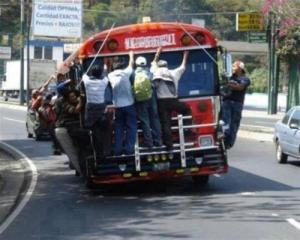
And then it was over–I saw the United doors appearing in the distance, and then I was thanking the nice Uber lady, dragging my suitcase up to the ticket counter, and pulling out my passport. The lady at the ticket counter was being nice to me in that way that the ticket counter agents are nice to you when you fly 100,000 miles a year, or at least they were treating me somewhat like a human being in that way that they do when you fly 100,000 miles a year. I drifted off, and soon we were landing in Houston, and then we were in the air towards Guatemala, and then in the van that takes us all from the airport to Antigua (and that was the reason that I really needed to not miss my flight–we all travel together from Guatemala City to the highlands). Traffic was beyond belief, and exhaust fumes were pouring in through the open windows, and the camioneta (colorful bus, usually packed with people and assorted livestock, roof covered with luggage) next to us was clearly going to sideswipe us–and I didn’t even care, because when the radio is not blasting I’m gonna get drunk, I’m gonna get high, I’m gonna get drunk and high, I figure: no problem!
…and now I’m sitting in my hotel room, getting ready for what will be the hardest day of the next week. I’m here in Guatemala with a group called Surgicorps. Our raison d’être (yes, we say that in English, too) is providing free surgical care to people who couldn’t afford it otherwise. Burn scars that leave men unable to use their hands–the only things that let them earn a living. Disfiguring acid burns on a woman’s face and chest, courtesy of…I don’t have a good word to describe the guy that did it to her. Kids with congenital malformations of pretty much anything that can be congenitally malformed. Women who can’t go to the market to sell their corn because they’re incontinent and they can’t ride the bus. The Surgicorps surgeons, nurses, anesthesiologists, techs, and therapists take care of pretty much anyone, and I interpret for them.
We just got into Antigua tonight–Saturday. Sunday is the most intense day of the week: screening day. The surgeons will spend the entire day seeing everyone who walks in the door wanting surgery for their kid, or themself, or their mother, or whoever. They’ll be able to help a lot of them, and those folks will go off to be seen by one of our anesthesiologists. If the anesthesia folks clear them for surgery, then other people will start the process of getting their lab work, find a place for their family to stay while they wait, and so on. Eventually we’ll end up with a bit over 90 or so people who will get operated on in the week to come.
A couple of our surgeons speak Spanish, but most of those people will run into an interpreter multiple times. For us interpreters, it’s a long day of constant, constant bouncing back and forth between the two languages, in both directions—English to Spanish to repeat the doctors’ questions and instructions, and Spanish to English to repeat the patients’ answers. The long day is tiring, but it’s the difficulty of the interpreting itself that wears me out.
I get pretty similar remarks from people when I tell them about my annual Surgicorps trip: it must be hard, learning all of that medical vocabulary. Actually, that’s not the hard part at all. Here’s the thing about medical vocabulary: it’s finite. It is related to what we call in computational linguistics a closed domain: there are only so many things that can be talked about in it. If you had a big enough book, you could learn all of the medical terminology in Spanish (or whatever language you deal with), and then you’d be done.
The sign marking the hand surgery screening area last year. Picture source: me.
I usually spend screening day with a hand surgeon. I learn more hand vocabulary every year–this year I’ve been focussing on parts of the finger. I don’t worry about that stuff–the chances of me being called upon to use words that differentiate between the body of the fingernail and the end of the fingernail are pretty slim.
Here’s the thing, though. Take a seat in front of our hand surgeon, show him the scars that are keeping you from opening your fist, or the finger sticking out at an angle, or whatever, and the first thing that he’s going to ask is: how did that happen? The answer to that question doesn’t come out of the closed domain of medicine–it comes out of the open domain of life. Here are some possible answers:
I cut it while I was cutting up a chunk of frozen spinach to cook for my son.
I jammed a thorn into my hand.
I was sitting in my friend’s car and the fuel pump blew up.
I fell into the cooking fire.
A snake bit me.
(Can you guess which one of those was me when I paid my visit to the hand surgeon to get a joint capsule repaired?) So: the closed domain of hand anatomy has a finite vocabulary, and it’s not actually that big–no problem memorizing it all. The open domain of the world at large has an enormous vocabulary, and you know what Zipf’s Law tells us about the nature of that vocabulary: most of the words in it are going to occur at the statistical equivalent of never–but, they do occur. And as a non-native speaker, they’re going to bite you.
And that’s it: what makes doing medical interpretation hard. It’s not the medical vocabulary–it’s the entire rest of the world. It’s all of the stuff that led to what happened to your hand, which led to you sitting in front of our hand surgeon, which led to me talking to you after an exciting trip through the wilds of the Denver night and the Guatemala City traffic. And that’s why I’m going to bed a little nervous tonight–it’s screening day tomorrow.
Want to support Surgicorps’s work? You really should–if you don’t feel better about life after you make a donation, I’ll give you your money back! I’m not asking you to support my participation–like all Surgicorps volunteers, I pay for my own plane ticket, lodging, etc. Your donation goes to the costs of surgery for someone’s kid, or mother, or wife, or… They’re human. That’s all. Click here to donate.
English notes:
Oh, shoot! This is a very mild way of expressing surprise, disappointment, and similar emotions occurring together. It’s a bowdlerized form of oh, shit! …but, truly, it’s so mild that your grandmother could use it. Not my grandmother–she preferred oh, sugar! …but, one’s grandmother could. How it showed up in the post: As we pulled away from the house toward the airport and a plane to Guatemala, the driver made a sudden discovery: Oh, shoot! I’m out of gas!
Big ol’: On some level, this is a contracted form of big old. Syntactically, it functions as an adjectival expression, although a somewhat strange one. Semantically, it describes size–but, not age. Big ol’ means big. It does not mean old. Sociolinguistically, it’s stigmatized–the associations are with being rural, uneducated, probably Southern. (I’m not asserting that Southerners are all rural and uneducated–they certainly are not. I’m asserting that these are the associations that native speakers are likely to have with the expression.) Used by someone like me–that is to say, an extremely urban Northerner with a graduate degree–the effect is to add an air of humor and casualness to the story. How it showed up in the post: She was, too–a big ol’ red light was shining on the dash, and there was a big, glowing E (for Empty) showing on the gas gauge.
Pretty + adjective/adverb: “Pretty” is an intensifier here, meaning something like “very, or at least more than a normal amount, but not necessarily as much as possible.” I’d be pretty careful about doing that, if I were you. It’s pretty late–I’m going to bed. That’s a pretty big mess you’ve made there. How it showed up in the post: I quickly stopped worrying about this and started worrying about other things pretty quickly, because she more or less immediately blew through a stop sign while checking her text messages.
French and Spanish vocabulary:
English
French
Spanish
open domain
le domaine ouvert
el ámbito abierto
closed domain
le domaine fermé
el ámbito cerrado
Want to know more about hand surgery? Here are some posts from the past. Sorry, no French–the vocabulary under discussion is all Spanish.
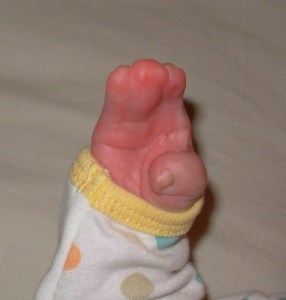
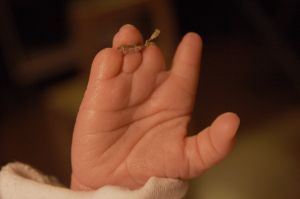
This is what your hand looks like if you’re born with amniotic band syndrome. The thought is that it happens when there’s a partial rupture of the amniotic sack and the hand gets caught up in it. It’s supposed to be purely mechanical. But: amniotic band syndrome often co-occurs with other congenital anomalies that aren’t even possibly remotely mechanically related, such as cleft lip and cleft palate. This leads to another theory about where amniotic band syndrome comes from, which is that it’s related to some kind of circulatory disorder that can affect both the digits and the developing palate.
In a region where people don’t typically get very much education and the most common way of supporting yourself is manual labor, a person who isn’t treated for this congenital defect can pretty easily find themselves in a life of poverty without an obvious way out. That means a childhood of poverty for their kids, too. That’s a lot of suffering.
You might be thinking: having amniotic band syndrome would suck, but there’s nothing that I can do about all of those little kids who are born with it. I’m happy to tell you: that’s not true!
There’s a group called Surgicorps that goes to various and sundry places around the world to do free surgeries for the most destitute of the destitute. There are lots of groups like that, but there’s something special about Surgicorps: they have a hand surgeon. The goal of surgery for something like amniotic band syndrome is to restore function to the hand. Doing this is difficult, and requires a lot of very specialized training–the Surgicorps hand surgeon did fellowships in both plastic surgery and orthopedics. (For doctors, a fellowship is advanced training that you do after your residency if you want to develop very specialized skills. A fellowship can easily be five years long, and that’s on top of four years of college, four years of medical, and a three-year residency.)
Where you fit into this: Surgicorps does its work entirely on the basis of donations. The surgeons, anesthesiologists, nurses, technicians, interpreters (I’m one of them), and others all donate their time, pay for their own travel expenses, and pay for their lodging. Surgicorps pays for all aspects of the patients’ treatment–the surgical equipment and supplies, housing for the parents while the kid is hospitalized afterwards, the anesthesia, medications–everything. That money comes from charitable donations.
That’s where you come in! In the days to come, I’m going to hit you up for a donation. I’ll tell you more about what Surgicorps does, tell you about some of the people we treat (within the bounds of privacy), and try to give you a bit of the feel of what it’s like to be in Guatemala.
Language stuff: I work closely with our hand surgeon, which means that I need to know a lot of terms related to the kinds of feelings that you might have in your hands and fingers. Here are some of those words, in English, Spanish, and of course French. Scroll down past them for notes on the English in this post. Spoiler alert: in the English section, I’ll be talking about the verb to cleave, the noun digit, and the idiom to come in.
One meaning of to cleave is to forcefully split something, or (intransitively) to split, especially along a natural line. This is the origin of the name of the kind of heavy knife called a cleaver.
One swallow does not make a summer, but one skein of geese, cleaving the murk of March thaw, is the Spring. Aldo Leopold.
Hamlet thou has’t cleft my heart in twain. Shakespeare, Hamlet.
I tend to foster drama via bleakness. If I want the reader to feel sympathy for a character, I cleave the character in half, on his birthday. And then it starts raining. And he’s made of sugar. George Saunders.
When I was at Babbo, I was covered in scars and scabs and burned bits – melted hair, ribbed burns I got reaching across the top of a hot skillet… I sliced off the tip of my finger. I cleaved my forehead – a deep, ugly wound. Luckily, it regenerated. Bill Buford
Like Honeycrisp, SweeTango has much larger cells than other apples, and when you bite into it, the cells shatter rather than cleaving along the cell walls, as is the case with most popular apples. The bursting of the cells fills your mouth with juice. Chunks of SweeTango snap off in your mouth with a loud cracking sound. John Seabrook. (This is the intransitive use.) Cupid’s arrow, Hafiz’s heart tore and cleaved
I see his verses, with their wet ink, bleed. Khajeh Shamseddin Mohammad Hafiz Shirazi
The other meaning of to cleave is to stick to something.
Cleave to no faith when faith brings blood. Arthur Miller, The crucible.
She counted to ten as she had been taught when about to deliver a big speech, but when she tried to force some words of outrage from between her teeth her tongue clove to the roof of her mouth and the most she could do was make a small cry of protest deep in her throat. (British National Corpus. Like that past tense? J’adore!)
We all are originally sinners as Adam and in Adam, his leprosy cleaving faster to us than Naaman’s did to Gahazai, so that even the infant, before it has seen the light of the world, has this blemish inherent in its unborn members. John Wycliffe. (A little language/interpretation connection: Wycliffe Bible Translators, the biggest Bible-translating group in the world, is named after John Wycliffe.)
Therefore shall a man leave his father and his mother, and shall cleave unto his wife, and they shall be one flesh. God, Genesis 2:24.
תִּדְבַּק-לְשׁוֹנִי, לְחִכִּי– אִם-לֹא אֶזְכְּרֵכִי: Let my tongue cleave to the roof of my mouth, if I remember thee not. Psalms 137:6.
I ran into this example in the British National Corpus, and I have no idea whatsoever what it means: The horse shied a little and the butt cleaved into the side of my head, almost taking my ear off.
digit: you know that this can mean a number, but it can also mean a finger or toe. From the post: This leads to another theory about where amniotic band syndrome comes from, which is that it’s related to some kind of circulatory disorder that can affect both the digits and the developing palate.
Painful, rapidly growing tumor in the subungual area of the first digit of the right hand.Perelló-Alzamora et al.
Surgical amputation of the digit: an investigation into the technical variations among hand surgeons.Li et al.
to come in: this idiom has a few meanings. Here’s the definition for the way that I used it, from Merriam-Webster: to assume a role or function <that’s where you come in>. From the post: That’s where you come in! In the days to come, I’m going to hit you up for a donation.
Metaphors and frames play an important role in how we talk–and think–about the world. Here’s what you need to know to read an essay on how this relates to the 2016 American presidential campaign by one of the world’s most famous linguists.
George Lakoff may be the most heavily cited linguist in the world–way more than Chomsky, believe it or not. (I checked their citation counts on Google Scholar.) He revolutionized the study of metaphor in his books Metaphors we live by (written with Mark Johnson) and Women, fire and dangerous things. Lately he’s been writing about how metaphors shape the world-views of both liberals and conservatives, and his book Moral politics on that subject is amazing. (The title comes from his view that political stances are, at their roots, moral stances, and that liberals and conservatives have different takes on morality. There’s a third edition due out in September, so don’t rush out and buy it just yet.)
Here’s Lakoff’s take on the unexpected rise of Trump and Trumpism in the Republican party. It’s a good (if rather sloppily edited) and much-shorter-than-book-length) picture of how he explains the relationship between metaphor and political thought, with specific reference to the Trump phenomenon.
Lakoff often makes reference to the concept of framing in this essay, without ever defining it. Here’s the definition of framing from Wikipedia:
The framing effect is an example of cognitive bias, in which people react to a particular choice in different ways depending on how it is presented; e.g. as a loss or as a gain.[1]
Framing is an important concept in cognitive science, linguistics, and computer science (especially artificial intelligence). Here’s an example of a frame related to commerce, from a linguistic perspective:
You can talk about that frame in English using a variety of words:
Abby bought a car from Robin for $5,000.
Robin sold a car to Abby for $5,000.
Abby paid Robin $5,000 for a car.
Same frame, same event, multiple perspectives: what Abby did, what Robin did, and the price that was paid.
Here’s an example of how framing can work out in language in a political context: refer to something as a baby, and it’s tough to be pro-choice. Refer to it as a fetus, and it’s tough to support the anti-choice position. Framing can interact with metaphor in very powerful ways: talk about a nation in terms of being a family–in American English terms, our founding fathers, the homeland where we all live, the sons and daughters that we send to war–and you trigger conceptions of very particular kinds of relationships between parent and child. From the conservative perspective (quoted from the Wikipedia article on Lakoff):
Conservatives would subscribe more strongly and more often to a model that he calls the “strict father model” and has a family structured around a strong, dominant “father” (government), and assumes that the “children” (citizens) need to be disciplined to be made into responsible “adults” (morality, self-financing). Once the “children” are “adults”, though, the “father” should not interfere with their lives: the government should stay out of the business of those in society who have proved their responsibility.
From the liberal perspective:
In contrast, Lakoff argues that liberals place more support in a model of the family, which he calls the “nurturant parent model“, based on “nurturant values”, where both “mothers” and “fathers” work to keep the essentially good “children” away from “corrupting influences” (pollution, social injustice, poverty, etc.).
I’ve read Lakoff’s book–the Wikipedia article reflects it pretty accurately.
Now that we understand the basic concepts of framing and have some examples of the metaphors, here’s Lakoff’s article on Trump and how he’s managed to get the Republican party nomination by appealing to various and sundry aspects of the (American) conservative world-view:
An excellent interview with Lakoff, in which he develops and expands on these ideas better than he did in the article that I link to just above, appeared yesterday (January 17th, 2016). Here‘s the link…and in this one, he’s talking about how the Democratic party got metaphored to death.
Language notes: English and French
English: metaphor is not a verb. I used the form metaphored “for effect.”
to rush out and do something: to do something immediately. From the post: Don’t rush out and buy it just yet. Note that this meaning is specific to the construction rush out (and verb). You can also rush out of a location, e.g. She rushed out of the house in a panic, jumped on her bike, yelled, “Say hi to your mom for me!” and disappeared down the drive. (Source: here.) You can also rush out a product, e.g. Microsoft rushed out a fix for a serious vulnerability in the way Windows handled the Windows Meta File image format. (Source: here.)
En psychologie du raisonnement et de la décision ainsi qu’en psychologie sociale, le cadrage est l’action de présenter un « cadre cognitif » comme approprié pour réfléchir sur un sujet. Ce cadrage peut avoir un effet sur le raisonnement et conduire à des choix différents en fonction de la façon dont le problème a été formulé.
le raisonnement: reasoning, argumentation.
le cadrage: framing.
le cadre: framework, among other things. I like to say cadre juridique, “legal framework.” I have no idea–it just sounds cool to me.
approprier: to adapt. Warning: the reflexive or pronominal version, s’approprier, means to appropriate or to seize.
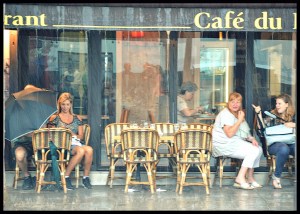
I was waiting in line at the boulangerie the other day. Outside, a nicely dressed woman sat and sipped a coffee while the rain poured down.
Suddenly the rain stopped. The lady popped in the door, put her empty coffee cup and some money on the counter, and said: I’m going to leave before it starts raining again. She dashed across the street, and I went home happy. Why?
In the United States, I can tell quite a bit about you as soon as you open your mouth. It’s not that I’m an expert in American speech–I’m not. But, I can give a pretty good guess about the following, and I would guess that most Americans can, too:
Your probable ethnic self-identity
What kind of music you’re likely to listen to
Possibly part of the country that you’re from
Whether or not you went to college
Whether you’re more likely to vote for Hillary, or for Trump
In contrast: in France, hearing you speak gives me no insight into you whatsoever. The director of the research institute where I hang out when I’m in France, the kid working the counter in the cafe outside the train station, a drunk panhandling by the ATM across the street from my apartment–their French all sounds the same to me. Marine Le Pen, my radical colleague–if there’s a difference in their French, I can’t hear it. In English, though…well, let me just say that if you have a high front tense rounded vowel in the word who’d, I’ll bet you’re voting for Trump (and that you would spell that sentence I’ll bet your voting for Trump).
Even I could tell that the woman who had her coffee spoke French quite elegantly, though. Here’s how she said “before it starts raining again:” avant qu’il ne repleuve. What’s so special about that: the tiny little ne.
The first thing that you have to know about that tiny little ne is that it’s not a negation marker. What it does: it makes your speech sound more elegant, more formal. That’s the explanation that I’ve gotten from every native speaker that’s brought it up with me, at any rate. It’s called the ne explétif, or (in English) expletive ne.
One of the cool things about the ne explétif is that as far as I can tell, it’s always used with the subjunctive. Now, one of the cool things about that is that although we are taught in school to think of the subjunctive as being triggered by verbs, in a number of cases we see the ne explétif + subjonctif being triggered by other parts of speech (none of which I can actually describe very well, PhD in linguistics or no PhD in linguistics!). One set of them connects clauses (more or less, sentences):
Les médias boudent le Front National … à moins que ce ne soit l’inverse? “The media give the cold shoulder to the National Front–unless it’s the other way around?” (see the news story here)
A moins que Maurice Szafran ne bascule dans un Antihollandisme aigu… “Unless Maurice Szafran swings toward an intense anti-Hollandeism…” (see the comment here)
When #JasonBourne aka Matt Damon asks you to take a selfie…Unless it’s the other way around -ok I admit it!
You can find more of these on the Lawless French web site.
Another cool thing about this ne is that although the subjunctive will always be there when you use it, you don’t use it every time that you use the subjunctive–rather, it’s used only in very specific constructions. You can’t make your speech more refined and elegant by just sprinkling it with ne‘s willy-nilly. If you use it when you’re not supposed to, that just shows that you’re trying to be one of the refined, elegant people—but, you’re not. And that’s where I get into trouble–I’m sure that I tend to use the expletive ne when I shouldn’t. There’s a name for the phenomenon of trying to speak more elegantly, but screwing it up exactly by trying to be more formal. It’s called hypercorrection. Here’s the definition from Wikipedia:
In linguistics or usage, hypercorrection is a non-standard usage that results from the over-application of a perceived rule of grammar or a usage prescription. A speaker or writer who produces a hypercorrection generally believes that the form is correct through misunderstanding of these rules, often combined with a desire to appear formal or educated.[1][2]
The example that we were always given in linguist school was the pronunciation of the t in often. If you’re not a native speaker, let me point out that that t is silent. But, you’ll sometimes hear native speakers who are making an extra effort to try to speak “correctly” pronounce it.
The “perceived rule” that they’re applying: typically, if there’s an ft sequence in the pronunciation of a word, then the word is spelt with an ft sequence.
after
laughter
crafty
lift
raft
Sometimes, though, you come across words that don’t have a t in their pronunciation, but they’re written with one, like in these consonant clusters:
listen
Christmas
mortgage
wrestle
For more words with silent ts, see this list. Often is a word in which the t is silent, and it’s rarely pronounced with the t. Take someone who’s insecure about how they sound, though, and put them in a formal situation, and that t in often might show up in their pronunciation. Someone who’s not insecure about how they sound in formal situations? Probably not. Someone who’s insecure about how they sound in formal situations, but is not actually in a formal situation at the moment? Also probably not–no t in often. It’s just the mix of insecurity and a specific context that brings it out. (This is laid out very nicely in the French Wikipedia page on hypercorrection.)
So, why do I not call out Wikipedia for calling this “non-standard” and using the word “incorrect” to refer to the pronunciation of often with a t, when as a linguist, “correct” and “incorrect” are not meaningful concepts to me?It’s the pattern of variation. The reasoning might be circular, but I will ‘fess up to that and explain it to you.
The speaker typically doesn’t use the t-pronunciation all the time: there is variability.
The speaker typically doesn’t use the t-pronunciation when speaking informally.
The speaker typically uses the t-pronunciation only when speaking formally.
Other speakers don’t use the t-pronunciation. Notice that I’m not saying that higher-class speakers don’t use it, or that lower-class speakers don’t use it, or that educated people don’t use it: I’m asserting that other speakers don’t typically use it at all, regardless of the formality of the situation.
Do native speakers of French make hypercorrective uses of the ne expletif? Of the subjunctive? I would predict that they do, but I haven’t been able to find any data on this. Native speakers, can you tell us anything about this?
Why that tiny little incident made me happy: I like it when I can see some of the huge complexity that is any language–French or otherwise–being reflected in the small things of life. That lady just wanted to take off in a hurry before it started raining again. She had probably already forgotten about that tiny little moment in her life before she ever got home–setting her coffee cup and some money on the counter, with a hurried explanation as she dashed out the door. For me, though, it was a little point of contact with some of the larger mysteries of French that are waiting for me; a sign of some progress (I hope) in that I was able to recognize sophisticated speech when I heard it; a source of questions about how to describe the structures that can trigger the use of the expletive ne, and you know how much I enjoy that kind of shit; hours of thought, really, and a bit of positive feedback on my language-learning adventure.
French details: See this page on the Lawless French web site for more fun things that can happen with ne in French–I had no clue!
English details: here are some moderately obscure words and expressions from this post.
to panhandle: this is a verb that means to beg, typically by sticking out your hand or a receptacle of some sort. If someone were sitting on the sidewalk with a cup, you would probably be more likely to call that begging. If someone were walking down the street asking strangers for money, you would probably call that panhandling.
willy-nilly: haphazardly; without any plan; randomly. According to the definitions that I found on the web, it has another meaning: under compulsion, without having a choice in the matter. I’ve never heard the word used in this sense, but I can attest that that is, indeed, the origin of the word, and I picked it specifically for this post because it has an old negative in it. The original form was willan-nillan. In Old/Middle English, willan was the verb to want, and nillan was the negative–to not want. So, willy-nilly was whether he wants to or not.
to lay out: this idiom can have many meanings.
to display, arrange, and/or explain very clearly and systematically. That’s the sense in which I used it in this post: This is laid out very nicely in the French Wikipedia page on hypercorrection.
to knock unconscious, or at least to hit so hard that the person is lying on the floor afterwards. I laid that motherfucker out. Asshole.
of a person: to lay out in the sun is to spend time sunbathing. She would lie out for hours every day.
of a thing in a location: to be left unattended and not taken care of. My toy rifle laid out in the playground overnight. When my father found out, he made me stand attention while he broke it across his knee.
See this page on the Merriam-Webster web site for some others.
When I was in grad school, I did research on a language spoken by about 30,000 people in a town in what is now South Sudan. Getting to that town was impossible–too many civil wars in the area. I worked with a guy who was a political refugee in the US. Every week, we met for two hours, and I would collect data.
At the time, there were maybe 40 people in the US who spoke the language. The guy with whom I worked was the only one in our part of the country. So: I had no examples of natural use of the language at all, other than the occasional phone message or email–just the data that came from our weekly meetings.
One fine day my consultant told me that there was going to be a conference in town, and a couple guys from his town would be coming. My first chance to get actual conversational data! His friends very kindly consented to be recorded, and one warm summer day the three of them got into the linguistics department’s sound-proof booth, I stuck a tape in the recorder (this was a while ago), and they started talking.
To picture the scene, you have to realize that the people in this town tend to be more educated than other folks in the area, and the people in the US who speak the language are often quite educated–two of these three guys were college professors. So: three dignified, educated guys in suits in a stuffy little sound-proof booth in the middle of the summer, humoring some grad student by speaking their native language, sweating their butts off until I ran out of tape. Humans can be very nice to each other sometimes.
Today, the Web has made getting data simple. You want to hear formal speeches in Bari (480,000 speakers in South Sudan and Uganda)? Go to YouTube. You want to hear comedy routines in Dinka (1.4 million speakers in South Sudan)? Go to YouTube. You want to hear a bilingual song in Kukú and Ma’di (314,000 speakers in South Sudan and Uganda)? Go to YouTube. Kukú ko Ma’di, yi’ geleng–“Kukú and Ma’di, we are one.” (Here’s the video.)
That’s the situation for those languages that you never hear about–thanks to the internet, I can sit in my pajamas and listen to more hours of the language on my laptop than I heard in three years of research. For popular languages like French, there are far more instructional materials than any one person could possibly use in a lifetime.
That’s the situation for beginning students, at any rate. Past a certain level, it gets hard to find structured material for learning a language, even one of the big ones–there are countless books, web sites, YouTube videos, etc. that will teach you the basics, but it’s much tougher to find instructional materials once you pass that point.
One of the best resources that I’ve found in this respect is the Coffee Break French podcast series. The basic idea behind Coffee Break French is the 15-minute lesson: just long enough for a coffee break, so to speak. It’s entirely audio. There are four seasons of the series. They take you from complete beginner in the first series to totally idiomatic French as it’s actually spoken in the fourth season. I’ve only listened to the fourth series, which is targeted towards the more advanced speakers for whom there isn’t that much else available. The basic format of the fourth season is this: you hear a text–an email, read out loud, from one of the characters in a season-long story to another of the characters. The gist of the text is recounted in English. Then, you’re given discussions of 3-4 expressions or grammatical constructions from the text. Finally, you hear the text again.
One of the things that I like about Coffee Break French is that the expressions that they go over are not just idiomatic, but so colloquial that native speakers are surprised to hear them come out of the mouth of a non-native speaker. The result of this is that I can often make girls laugh by using them. Making girls laugh is pretty much my favorite thing to do in the entire world, and if you can do it in a foreign language: extra points. And, they’re by no means obscure–pretty much everything that I’ve learnt from Coffee Break French is stuff that I hear native speakers say all the time. Some of my favorites from Season 4:
un de ces quatre–“one of these days.” Literally, it’s “one of these four.” As they explain on the podcast, the original form is tous les quatre matins–literally “every four mornings,” but meaning “often.” Related to that is un de ces quatres matins, “one of these days,” and that can get shortened to un de ces quatre.
parler français comme une vache espagnole–“to speak broken French.” Literally, it’s “to speak French like a Spanish cow”–I get so much mileage out of this one that I wrote an entire blog post about it.
There are also lots of discussions of the sorts of grammatical things that can be difficult for native speakers of English–when to use the future versus the present, when to use the subjunctive, agreement phenomena, irregular verb forms, etc.
The other thing that I like about Coffee Break French: it’s fun to listen to. The two guys who do it clearly love what they’re doing, and delight in the language and its twists and quirks. Hoho, that’s a nice subjunctive, Marc! Who wouldn’t want to hang out with guys who admire a good subjunctive? Plus, when they speak English, they both have these amazing Scottish accents–it’s a scream. I worked my way through all 40 episodes of Season 4, which is longer than I’ve hung in there with any similar resource. And, the fact that it’s a podcast, rather than a YouTube video, means that I can listen to it while in the car, or walking to work, or whatever–I’m not chained to a computer.
The 15-minute podcasts are totally free. As is the case with many such similar resources, you can subscribe and get additional content for a price–longer audio lessons, and transcripts.
Are those French girls giggling at my clever use of the language, or because I sound like an idiot? I don’t know how to design the experiment that would answer that question. I do know that Coffee Break French improved both my comprehension and my speaking considerably–check it out. For other posts about instructional materials for advanced students of French, see the following. Scroll down past this list for some notes on English words and expressions in this post.
The Lawless French web site (my post here, the web site here)
The blog post where I explain that I don’t get paid to shill for any of these guys
English notes:
to be a scream: to be very funny.
to recount: to relate in detail; to narrate (Merriam-Webster). This can also mean “to count again.” With the meaning of “to relate in detail, to narrate,” the word first shows up in the 1400s–the tail end of the Middle English period–when it was borrowed from the Anglo-French recunter.
to shill: to say nice things about something because you’re being paid to do so.












 Zipf's Law