We’re going to get past this–America always does. And someday, your grand-kids are going to ask you: what did you do during the Trump administration?
The Croix de Lorraine, symbol of the French Resistance during World War II. Picture source: https://goo.gl/lChOU1I went to a “language exchange” the other night. 7 minutes in one language, 7 minutes in the other, and then you change to someone new. It works out well–you speak with a pretty random cross-section of people, you get to try your hand at understanding lots of dialects, ages, and speech rates, and usually you learn something. Hopefully they do, too.
With one of my conversation partners, we started in English. “Since we’re speaking English, I’m going to ask you all of the questions that an American would ask you, but a French person wouldn’t–where you’re from, what your job is…”
“Actually, French people ask each other those kinds of questions when they meet, too,” he replied. ” What we don’t ask each other about is families–you don’t talk about family with someone you don’t know well.”
Indeed, the French are, in general, far slower to talk about family than Americans are. And there’s one question that, I think more than any other, you don’t ask a French person: what did your family do during the war? If they want you to know, they’ll tell you. Uncle Jean-Paul was a fighter in the Resistance? It’ll get worked into the conversation. Mom got arrested by the Gestapo while she was pregnant with your big sister? It’ll come up without you asking. (I’ll tell you mine: one of my uncles was in the Resistance. According to another uncle’s autobiography, he was executed by the Germans, along with a bunch of his buddies. The uncle who survived to write an autobiography was in the Army, apparently mostly spending his time driving trucks and teaching boxing to the son of an Army officer who thought his kid was a bit effeminate and wanted him toughened up a bit.) Otherwise: don’t ask. Plenty of French resisted the Nazis, and plenty of those, like my uncle, paid with their lives. Others collaborated–the reason that the French government is not allowed to collect most demographic information today is that when the Germans told the Parisian police to go round up the Jews, they had no trouble finding them, because everyone’s religion was recorded in the local records. (Altogether, French people sent around 70,000 French Jewish fellow citizens to the death camps. (Wikipedia says 78,853.) Under 1,000 came back.) Most people just ate Jerusalem artichokes and rutabaga (cattle fodder otherwise) and tried to stay alive.
French Resistance message: “To obey is to betray. To disobey is to serve.” Picture source: https://goo.gl/a5Ep9YThe reason I bring this up: America is in a world of shit right now. But, we’re not going to be in this particular world of shit forever. The hallucinatory world that Trump has brought us will end–eventually, America always rights itself. As a nation, we’ve overcome slavery, overcome institutionalized racism, overcome extermination of Native Americans and then of their languages, overcome prejudice against Jews, prejudice against Catholics, and prejudice against Mormons. Some day we’re going to get past the band of sociopaths who are currently running our government, we’re going to get past their reprehensible and un-American anti-Muslim and anti-Mexican prejudices, and we’re going to become a moral and exceptional country again.
So, if you’re an American: someday your kids and your grand-kids are going to have questions. We’re not French, and we do ask about family. Your grand-kids are going to want to know what Grandma and Grandpa did during the Trump administration. Did you speak up? Did you collaborate? Did you just try to get along and let the refugees, the religious and racial minorities, and the people losing their health insurance worry about themselves? We’re not French–we do ask. Your grand-kids will. They’ll ask you.
English notes
to be in a world of shit: to be in a very bad situation. There are a number of shit-related expressions for describing the state of being in a bad situation–to be in deep shit, to be up shit creek without a paddle, and I imagine others that slip my mind at the moment. How it was used in the post: America is in a world of shit right now.
French notes
la Résistance intérieure: the Resistance within France. What we would call in English “the Resistance.”
la Résistance extérieure: the Free French forces operating out of London.
clandestin: clandestine, underground, secret.
la presse clandestine: the underground press. Putting out newspapers was a big move during the Nazi occupation–Germany took the press so seriously that in Germany the Nazi government killed intellectuals and writers who published underground anti-government writings. It was a difficult one, too–it was illegal to sell paper, ink, or stencils.
The older you get, the more you realize that your parents knew what they were talking about. I’ve spent an entire education ignoring the existence of rhetoric, and specifically, “rhetoric” as in this definition from Merriam-Webster:
: the art of speaking or writing effectively: such as
a: the study of principles and rules of composition formulated by critics of ancient times
I mean, I knew that there were all of these fancy names for rhetorical moves–but, who could be bothered to memorize them, and why bother? Then I started studying for the C1 DALF exam, and realized that understanding discourse markers could be damn useful. From there, it’s a short step to thinking in a more principled way about how to put an argument together, and from there…well, rhetoric and its “rhetorical figures” are just right around the corner.
The key words: inform, persuade or motivate. At this, Trump is, unfortunately, a master: he persuades the hell out of people. (We’ll get back to which people in a bit.) Did he soak up a bunch of rhetoric courses at whatever college he did his draft-dodging in? I don’t know–but, you can see lots of fancy–and some not-so-fancy–rhetorical techniques in his communication. For example: the ad hominem argument. As Wikipedia defines it:
Ad hominem (Latin for “to the man” or “to the person”[1]), short for argumentum ad hominem, is a logical fallacy in which an argument is rebutted by attacking the character, motive, or other attribute of the person making the argument, or persons associated with the argument, rather than attacking the substance of the argument itself.[2]Wikipedia
For example:
Sen. McCain should not be talking about the success or failure of a mission to the media. Only emboldens the enemy! He’s been losing so….
Does Trump respond to the content of what Sen. McCain said? No–not at all. What he does: he attacks the person who communicated the content.
Does this work? Well: he’s the president of the United States of America. Did he get the most votes? No–but, he’s still the president.
A different question: on who does this kind of crap argument work? And it is a crap argument: an example of a fallacy. You could argue that it works on people who are too stupid to catch the move. In this particular case, I’m guessing that you would be correct. Back to the definition of rhetoric again: discourse that is used to inform, persuade or motivate particular audiences in specific situations. You could take the position that the “particular audience” at whom he aims this crap is mostly made up of people who either (a) don’t begin to understand the implications of what the guy is pushing, or (b) do, but are deluded enough to think that burning the world down would be a cool way to start over. You could take the position that the “specific situation” is a shared delusion, a sort of mass hysteria. But, that clearly isn’t the only time when ad hominem arguments get taken seriously: there is a version of this that is common on the left, as well. (Just to be clear: I am on the left.) In that version, you don’t even bother to claim that the content is flawed because the person is flawed: you argue that the content shouldn’t be listened to, because the person is flawed–irrespective of whether or not it’s relevant in any way, shape, or form, to anything about the person whatsoever. Again, to be clear: just because people on my side of the aisle do it doesn’t make it right. Doesn’t make it valid. Doesn’t make Trump any less of an asshole, and doesn’t make the majority of the people who voted for him any less deluded.
I’ll close with an observation about France versus the US: as far as I can tell, ad hominem arguments work a hell of a lot less well in France than they do in my country of origin. Is it because the French are (as far as I can tell) generally less into emotion and more into logic than Americans are, and vice versa? Is it because French students are required to take philosophy in college, and we’re not? I don’t know. I do know that in France, your art will not be boycotted if you happen to be, say, a recidivist thief (Jean Genet), a rapist (Roman Polanski), or a horribly vicious Nazi collaborator (Louis-Ferdinand Céline). (This isn’t an absolute. On the 50th anniversary of his death, Céline was to be included in the list of people included in the Célébrations nationales. Mitterand nixed his inclusion. As Le Figaro put it: Une vive polémique s’est ensuivie.) In contrast: in America, if you’re an asshole, your art will, in fact, probably be boycotted. The point of all this: as far as I can tell, the French are not nearly as susceptible to the ad hominem argument as the Americans. Yes, I’m generalizing, and no, nobody fits their stereotypes, and no, I am an expert neither on America, nor on France. Nonetheless… You can certainly give counter-examples, and plenty of them–but, as a general rule, this holds.
In which a cook thinks I’m an idiot because of some vowels.
French and English have pretty different sets of vowels. (Vowel inventories is the technical term in linguistics.) One of the basic facts of humans and languages is that we can be unable to hear differences between sounds that we don’t have in our native tongue, and each of the two languages has lots of vowels that the other doesn’t have. When I say that we can’t hear differences between sounds, that implies that there are sounds with which we confuse them, and which sounds those are is not random at all: people categorize the sounds of their language in pretty structured, principled ways, and when they fail to distinguish the sounds in other languages, that “failure to distinguish” manifests itself as (se traduit par, I think, in French) putting sounds from the other guy’s language into the same category as some sound in your language.
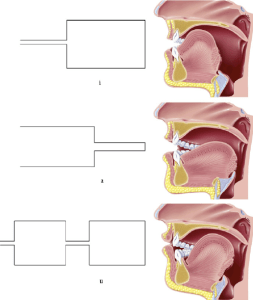
Two-tube models of the vowels [i], [u], and [a]. The third author of the paper from which I took this figure once left a note on my desk that had the effect of getting my office mates off my fucking back about the messiness of said desk for the remainder of my post-graduate education, but that’s a story for another time. Picture source: https://goo.gl/9u7BNpThe principles by which this kind of thing gets structured can be described in terms of the articulatory characteristics of the sounds (what you do with your mouth parts to make them), the acoustic characteristics of the sounds (what the waveform would look like if you graphed it), and the auditory perception system (how your brain and your peripheral nervous system interpret incoming sounds). I mention this not because I think that you’ll be fascinated by the details of the effects of, say, Helmholtz resonators versus two-tube models (see the picture) of vowels, but so that you know that there’s a reason that you (if you’re a native speaker of English), me, and all of our fellow “Anglo-Saxons” (a term which seems to be falling out of use in France today, but which I still find amusing, since if there’s anything that I’m not, it’s an Anglo-Saxon) are confusing the same vowels.
For English speakers (Americans, anyway–I don’t know very many of our friends from the Commonwealth and wouldn’t presume to speak for them), one problem pair in French is the vowels that are spelt ou and u. Technically, those are both what are called high tense rounded vowels (here’s a post with a link to a nice video about them from the Comme une française YouTube series). In English, we only have the vowel that’s written ou, which is more or less the same vowel that we have in the words who’d and boot. We tend to hear French words with the vowel spelt u as the vowel spelt ou. Both of them are super-common in French; here are some examples, from the amazing site MinimalPairs.net (y is the International Phonetic Alphabet symbol for the French vowel spelt u):
Words that differ only in having the French sound spelt u versus the French sound spelt ou. Picture source: screen shot from http://minimalpairs.net/en/fr.
Most of the time, even us Anglo-Saxons (see the disclaimer above) can get by on context: there just aren’t that many times when the situation doesn’t let you figure out whether your waiter is asking you about joue (cheek) versus jus (juice), or when the rest of the sentence won’t give you a pretty good guess as to whether your interlocutor just said coup (a blow, roughly) or q (the letter of the alphabet).
However: there’s one French “minimal pair”–set of two words that only differ by a single sound–that can pretty much always show up in the same context. To wit: au dessus and au dessous. What those mean: roughly, over and under. The only difference in the sounds of those is the ou (which we have in English) of under, and the u of over. Have you seen my cigarettes? Yeah, they’re (on top of/underneath) your sweater. Would you do me a favor and put this (on/under) that box? It happens all the time.
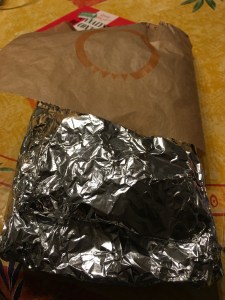
Still life with buckwheat: two foil-wrapped gallettes, one on top of the other. Picture source: me, right before dinner.
To wit: I was feeling badly in need of an actual meal the other day, but too tired to cook after work. Not a problem, as there’s a little Breton place right across the street from the metro station that’s popular for take-out. I popped in on my way home and ordered a couple gallettes de sarazin–a buckwheat crêpe–one a complet (“with everything”), and one with zucchini and cheese. The nice lady brought them out to me in the bag that you see in the picture, and explained: The complet is on the (top/bottom), and the gratinée is on the (top/bottom).
Fuck: my old nemesis, au-dessus and au-dessous. I gave her a baffled look. She gave me a baffled look right back: what could I possibly not be understanding?? We’d just had an involved conversation on the topic of why I should really be topping off my dinner with her home-made apple crumble (her position on the topic) and why my general fatness suggested that I should not, in fact, be doing so (my position), so why would I suddenly be confused by something that any French toddler would understand? She looked at me for a bit, with that look on her face that means Is this bizarre foreigner jerking me around, or what?, and then finally tried again: en haut–gratinée. En bas–complet. No verbs, no pronouns, none of that fancy stuff–two prepositions, two nouns.
Message received. I left a good tip in hopes of maintaining some semblance of normalcy in the relationship, ’cause I am, in fact, de souche Bretonne (half, anyway), and I do love my cider and chicken gizzards, and that restaurant is the best place in the neighborhood to get them. It’s not like there aren’t other good Breton restaurants in Paris, but this one’s mine, damn it.
Quine wasn’t kidding: Gavagai really is a thing, and you don’t have to go any further than the grocery store to experience it.
Winters in Paris are nothing to write home to mom about, but they’re nothing to complain about, either. (To be nothing to write home to mom about explained in the English notes below.) If you can get past the crushing darkness, which descends on you at the relatively civilized hour of 5 PM but doesn’t lift until a quarter past 8 in the morning, the weather is relatively mild. Your mileage may vary depending on the strength of your heater, but overall, the winter weather here isn’t really that bad.
One of the beauties of life here is the produce in the markets. The stuff in the supermarkets is as crappy as the produce in the supermarkets in the US, but if you go to your neighborhood market, the situation changes totally. In my neighborhood, the market takes place Sunday and Wednesday mornings. The produce, eggs, meat, and dairy products are pretty local. In the US, the situation is quite different, for very specific reasons. Most food gets shipped long distances, and that has consequences for produce in particular. The plus side of the American supermarket is that you can buy any fruit or vegetable whatsoever 365 days a year. The downside is that to make those fruits and vegetables available year-round, they have to be shipped from distant climes, which means that they cannot be ripe, or they’ll bruise in transit. So: you can have any fruit or vegetable you want, but it will always be unripe and tasteless. That’s pretty much the situation in French supermarkets, too, at least in Paris. (I have no clue what goes on elsewhere. I avoid leaving Paris as much as possible, due to the whole lapins anthropophages issue in the countryside. Don’t say you haven’t been warned.)
The supply chain for Parisian markets is pretty local, which means that you don’t have the constraint against ripe produce–you don’t have to worry about everything getting ruined in transit because it doesn’t get shipped very far. That means that in the summer you can buy pretty much anything, but in the winter it’s mostly apples and potatoes, and you can tell how long they’ve been sitting in someone’s cellar. (I exaggerate here, but just a bit. I did say mostly.) The payback: in the summer, the produce is incredible. If you have never walked by a crate of strawberries that were so ripe you could smell them: it’s amazing. If you have never had a merchant ask you when you were going to eat your produce, and then pick it out for you so that it would last exactly as long as you needed it to before being overripe: it’s quite the service.
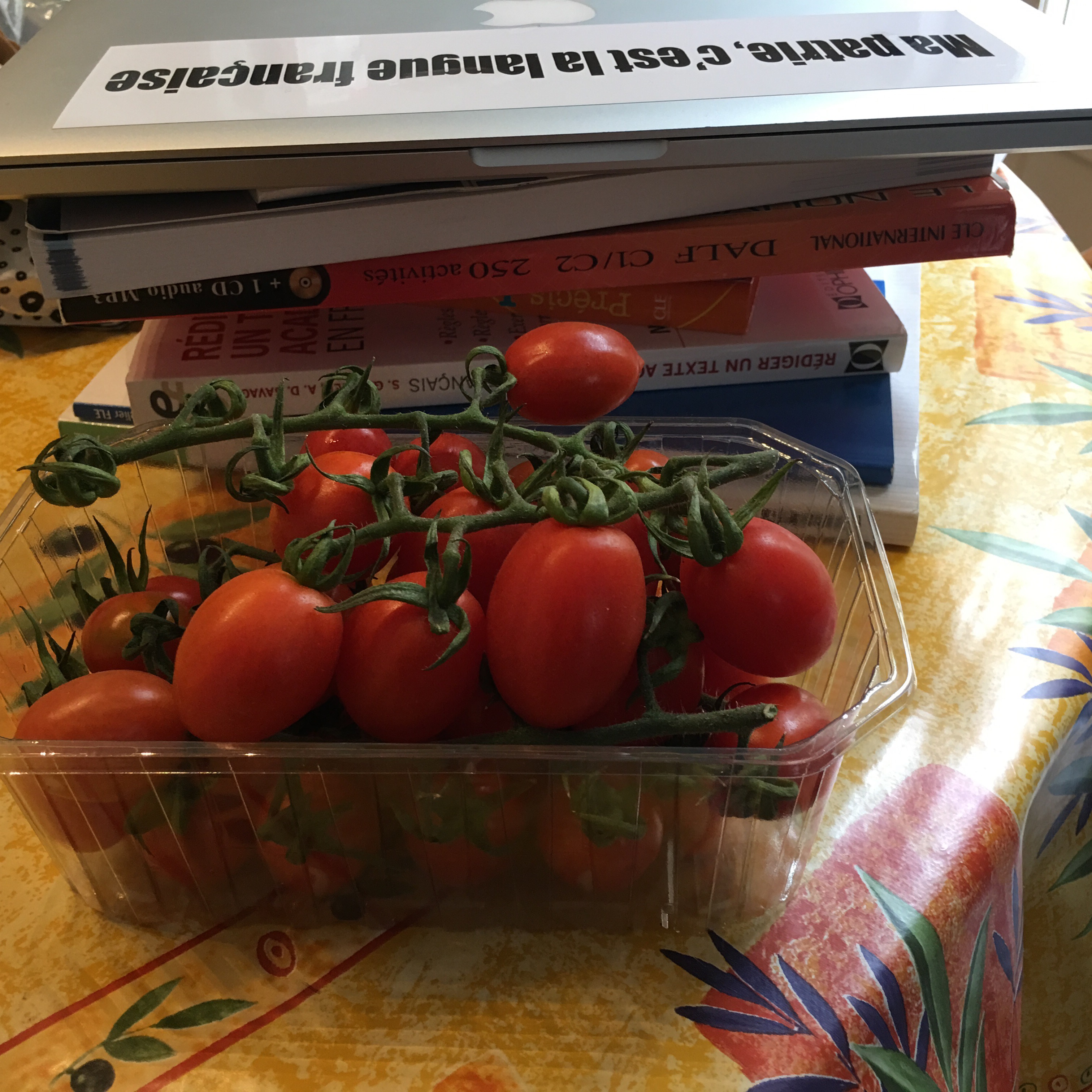
So: it’s Sunday, which means my market day, which means my weekly dose of vegetables. (I try to keep my vegetable consumption down to the minimum required for life. Where there are vegetables, there are des lapins anthropophages, and…well, like I said: you’ve been warned.) My marchand préféré (I suggest that you pick yours based on the length of their line–longer lines are better, and they get extra points for higher ratios of old ladies) had some cherry tomatoes, and they were lookin’ good. Price: 2.95 a barquette.
Seulement voilà (the problem is): what’s a barquette? If it’s a container, I’m in good shape. If, on the other hand, it’s a vine with attached little red things, then since there are several of those in one of those containers, we’re talking about more money than I’m willing to pay to run the risk of attracting the unwanted attention of the aforementioned lapins. (Some of you will recognize this as the classic Gavagaiproblem. In the language of Molière, you can also spell it Gavagaï.)
Solution: ask for just one barquette, and see what the guy hands me. That done, I took my purchases home. Once out of my shopping bag (you must carry a shopping bag–disposable plastic grocery bags are illegal here now), I set my barquette of cherry tomatoes on the table and took a whiff. Boom: right back to my childhood. A warm summer day, tomatoes warm in the sun. You get that kind of “sense memory” in an American grocery store exactly never. You get soft towels here in Paris exactly never, but oh, the produce…
You’ll find notes on the English and French vocabulary used in this post below. For more on the role of cherry tomatoes in Parisian life, check out Olivier Magny’s book Stuff Parisians like, which turns out to be accurate far more often than I ever would have thought it would be.
French notes
la barquette: small basket (of fruit or little vegetables), tub (of ice cream or margarine)
English notes
produce (noun): agricultural products and especially fresh fruits and vegetables as distinguished from grain and other staple crops (from Merriam-Webster). Note: this is a noun, and is pronounced with stress on the first syllable, not on the last syllable (as is the case with the verb). How it was used in the post: One of the beauties of life here is the produce in the markets.
to not be anything to write home to mother about: to not be particularly special (in the American sense of the word special, not the French sense).
“I mean it was fun, but nothing to write home to mom about”
Spoken American English can be very difficult to understand. Here’s a video to help you cope with one of the problems therewith.
Walking out of the exam on oral comprehension during the testing for the Diplôme approfondi de langue française a couple months ago, I found a very unhappy-looking young man waiting for the elevator. Are you OK? He shook his head glumly: I flunked again, I know it. I made sympathetic noises. Was this your first time taking the test? I responded in the affirmative. He gave me a look of pity–clearly the expectation was that I was going to find the experience as brutal as he had. Repeatedly, apparently.
Indeed, the oral comprehension exam got me my worst score out of the whole test. Spoken French and spoken English can both be brutally difficult to understand if they’re not your native language, and for many of the same reasons. One of those is their sets of vowels–both languages have vowel “inventories” (the technical term) that are shared by relatively few languages. Another is a process called reduction, which leads to things having a range of ways that they could be pronounced, some of which are less distinct than others. For example, in French, some unstressed vowels are optional in casual spoken language, so that cheveux is often pronounced chveux, matelot can be pronounced matlot, and so on. Furthermore, the sounds that are “left behind” can be changed as a result, so that, for example, the j in je becomes pronounced as ch when je suis is “reduced” to chuis. So, when I describe this as becoming “less distinct,” think about this. In French, there are these two words, and the difference between them is the sound of j versus the sound of ch:
le jar: secret language, argot
le char: chariot; in Canada, car.
When j becomes ch, as in chuis, the difference between the two sounds goes away, and in that sense, a “reduced” word is less distinct from other words than it might have been.
Reduction processes are rampant in spoken American English, and they can make the language pretty difficult to understand if you’re not a native speaker. I’m trying my hand at putting some videos together that aim to help people learn to understand these reductions. You can find the first one, on the topic of the reduction of let meto lemme, at the link below. If you’re as mystified by spoken American English as I am by spoken French, check it out–I’d love to have feedback on what does and doesn’t work, whether that be here on this blog, or in the Comments section on YouTube. Unfortunately, I haven’t figured out the whole subtitle thing, and I’d like to know to what extent that does or doesn’t interfere with the effectiveness (or lack thereof) of the video. Any input at all would be appreciated, though!
I can’t sleep, which leads to tokenization issues and the definition of “for my money.”
I don’t sleep well. That is to say: I don’t sleep very much. Not at night, anyway.
In the best-case scenario, the middle of the night, when in theory I should be sleeping, is my time to study vocabulary or to read. In the worst-case scenario, the middle of the night is when I return emails from people who are in North America, and therefore awake.
Tonight’s email brought a help-wanted ad from the School of Informatics at the University of Edinburgh, posted by the amazing Mirella Lapata. (I say “amazing” because her paper with Regina Barzilay at the Association for Computational Linguistics annual meeting in 2005 opened my eyes to the possibilities for inventive evaluation strategies in computational linguistics in a way that my eyes had not previously been opened.) For my money, the University of Edinburgh’s graduate program in computational linguistics is the best in the world, so I forwarded Mirella’s email to the students in our program, most of whom are not computational linguists, but most of whom would be quite suited for one of the advertised jobs in the School of Informatics. I added the following introduction to the email:
Picture source: me.
This got me the following response from one of my students in the US (and therefore awake):
Picture source: also me.
Now, I love getting this kind of question, for many reasons. It lets me repay the apparently endless patience of my colleagues in France for my crappy command of their language. It lets me be the person who knows the answer to a question about language, which in French happens exactly never. It gives me a socially acceptable excuse for talking about language, which I enjoy way more than is cool. It suggests that someone actually both read and thought about what I wrote. (You pick whichever one you think portrays me in the best light.) In fact, I love that kind of question so much that I will often go out and find naturally-occurring examples, which like any good linguist these days, I do on the Interwebs. A trip to the Sketch Engine web site and a search of the Open American National Corpus found me these:
Picture source: screen shot of the Sketch Engine web site.
…which, of course, like most things of interest, leads to a question. In this case, the question is: what’s wrong with the Sketch Engine web site? Where did all of those spaces come from?
The answer: there’s nothing wrong with the Sketch Engine web site. Part of any analysis of written data is choosing an answer to this question: what is a word? It’s not typically obvious what the answer is. Give students in a beginning language processing class this sentence, and ask them what the words are:
My dog has fleas.
(For reasons that are obscure to me but that I think have something to do with playing the ukulele, that is a famous sentence.) Ask them what the words are, and the first answer will be anything separated by white space:
My
dog
has
fleas.
…at which point they quickly realize that they’ve just posited that fleas. is a word, and they modify their hypothesis, to be anything separated by white space and stripped of punctuation:
My
dog
has
fleas
.
(I’m not making this up–in fact, I did it in class last Tuesday.) Next they figure out that they probably want My and my to be considered the same word, which means that they need to do something about the case of letters, and if they speak any of the bazillion languages that have more inflectional morphology (example in a minute) than English does, then they might want to do something with aller/allais/allai/allasse, etc.
Things get pretty complicated pretty quickly, though. Suppose that you’re dealing with English. What do you do with
wouldn’t don’t haven’t didn’t
Seems pretty straightforward–you want something like this:
would n’t do n’t have n’t did n’t
…except that it’s not straightforward at all, because then you have to propose
wo n’t
…which people generally aren’t happy about.
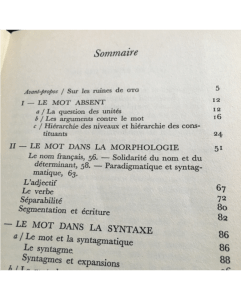
The table of contents of “Le mot,” by Maurice Pergnier. The point of the picture is that the first 46 pages of the book address the various arguments for and against the whole idea of the word. Picture source: me.
There are a variety of ways to answer these sorts of questions, and it does actually matter. From a practical point of view, the choices that you make about how you do this–the process is called tokenization–is important enough that it affects the performance of computer programs that do things with language. (Here’s a recent paper on the topic.) From a theoretical point of view, your choice takes a position on a hugely controversial topic in linguistics: what a word is. (The best discussion of the controversy that I’m aware of is in the book Le mot, by Maurice Pergnier.)
So, why are those spaces there in the Sketch Engine output? Let’s look at it again:
Picture source: screen shot of the Sketch Engine web site.
One of the immediately obvious things is that they have “tokenized” the punctuation off, so that “personal growth” becomes ” personal growth ” and (1995) becomes ( 1995 ). The next thing that you might notice is that there is some ambiguity in the output. Look at what happens to that’s and people’s ..
…which become
that ‘s and people ‘s
Now we have two ‘s …and they are different, but look the same. What is a computer program to do with that? Welcome to my world. Nobody said that computational linguistics was going to be all about suicide prevention and curing cancer, right?
The Regina Barzilay and Mirella Lapata paper that I mentioned above:
Regina Barzilay and Mirella Lapata. 2005. Modeling Local Coherence: An Entity-based Approach. In Proceedings of the 43rd Annual Meeting of the Association for Computational Linguistics, 141-148. Ann Arbor.
The declaration of competing interests: I don’t have any. Sketch Engine doesn’t pay me–I pay them, and I get a hell of a lot of use out of it.
French notes
— Je vous regardais tout à l’heure, vous étiez marants tous les deux le flicmane et vous.
— A tes yeux, dit la veuve Mouaque.
— “A mes yeux? Quoi, “à mes yeux”?
— Marants, dit la veuve Mouaque. A d’autres yeux, pas marants.
How would you say for my money in French, or more generally, label something as someone’s opinion, yours or otherwise? There are a lot of options, and unfortunately, I don’t know the status of any of them with respect to register of language, contexts in which they are or aren’t appropriate, etc. Here’s what I’ve come across so far, and I should point out that I also don’t know which of these can only gracefully be used to introduce your own opinion, versus which could also be used to introduce someone else’s opinion. I’ll also mention (and then I’ll shut up) that of all of these, I’ve heard the first one (à mon avis) the most, the second one exactly once (in Raymond Queneau’s Zazie dans le métro), and the rest never, as far as I know. If any of you native speakers out there can offer suggestions about when and where to use which of these, it would be great.
à mon avis
a mes yeux
selon moi
à mon gré
de mon point de vue
d’après moi
d’après mon point de vue
à mon sens
de l’aveu de qqn: I think that this one implies something negative, along the lines of “as Chomsky himself admits,” as opposed to relaying an opinion about which you’re not necessarily making any judgment one way or the other.
“Wakarimasen” means “I don’t understand” or “I don’t know.” Picture source: https://goo.gl/qImFiq
I was walking down the street in Tokyo this morning when a fellow foreigner acknowledged my existence.
This is a far rarer occurrence than you might think in this country with a very low immigration rate, where running into another “Western” foreigner is pretty uncommon outside of tourist areas, and you might expect that it would lead to at least a smile, if not an actual conversation. I’ve had many occasions when Japanese who spoke some English struck up random chats with me, but I’ve noticed that the few foreigners who you run into in Japan will, in general, resolutely avoid meeting your eyes. (Note that I’m talking about foreigners who live here–not tourists.) Why? I can only guess. OK, my guess: foreigners here in Japan struggle so very hard to integrate themselves into the culture that I suspect that they’re loath to, in some sense, admit that they are “others” by sharing in the otherness of some random visitor such as myself.
So, when a clearly foreign guy caught my eye and smiled at me this morning on my way back from a morning visit to the neighborhood shrine, I was so surprised that I don’t think I smiled back. Then I felt like a total jerk. Maybe being someone who lives here–you don’t come out of the very busy Ochanomizu station at that time of the morning unless you’re going to work, so I’m guessing that he does–he’s used to getting that reaction from other foreigners. Still: I felt like even more of an asshole than I usually do.
French notes
le sanctuaire shinto: Shinto shrine
English notes
to meet someone’s eyes: to look directly into someone’s eyes, acknowledging the contact.
I wonder if you meet my eyes out of kindness sometimes
How it was used in the post: I’ve noticed that the few foreigners who you run into will, in general, resolutely avoid meeting your eyes.
to be loath to: to be deeply unwilling to do something. (Definition adapted from Merriam-Webster.)
to loathe: to dislike to the point of disgust.
Keeping track of the difference between these two is actually quite difficult even for native speakers. You can read an article about the history of the problem here on the Merriam-Webster web site. There are two parts to it. One is keeping straight the fact that the verb ends with an e, and the adjective doesn’t. The other is that the verb is pronounced with the th of this and the, while the th of the adjective can be pronounced with the th of this and the,or with the th of thin.
I will NEVER understand why Elena picked Damon, I loathe her
How this showed up in the post: foreigners here in Japan struggle so very hard to integrate themselves into the culture that I suspect that they’re loath to, in some sense, admit that they are “others” by sharing in the otherness of some random visitor such as myself.
You can unscrew a lightbulb, you can unplug your monitor, and you can unbuckle your suspenders, so why can’t you unsee things? It has to do with the prefix un- when it’s attached to verbs. In order to be able to un- a verb:
The verb has to refer to changing the state of something. So, you can undress yourself (changing your state from being dressed to not), you can unclog a pipe (changing its state from being clogged to not), and you can unlock a door (changing its state from being locked to not).
The state has to be reversible. So, you can dress/undress yourself, you can clog/unclog a pipe, and you can lock/unlock a door. But: you can bake a cake, but can’t unbake it; you can dry a shirt, but as far as I know, you can’t undry it; you can breakan egg, but you can’t unbreak it.
So: you can see something, but you can’t unsee it, because when you see something, you’re not changing its state, and that’s the sine qua non of verbs that can take un-.
Ack–data! I almost forgot that I’m an empiricist! In fact, the verb to unsee occurs a lot. It occurs with a frequency of 0.02 words per million in the enTenTen13 corpus (19.7 billion words of English, available on the Sketch Engine web site). But, it’s cool: it doesn’t mean to undo the seeing of something. When we talk about unseeing things, we’re usually talking about the very fact of not being able to unsee them, and what that actually means is this: we can’t forget them, and/or we can’t move beyond whatever we learned from what we saw.
In fact, the interwebs are full of talk about things that can’t be “unseen.” Some examples:
Old guy at the YMCA was pooping with the door open. C’mon man I can’t unsee that.
Why does unsee work so well for this use, when it can’t have the meaning that you would think it would? I suspect that it’s precisely because (a) it’s basically an impossible verb, and (b) it’s used only to describe an impossible action. And, the fact that the meaning of unsee is not the meaning of see plus the meaning of un- is important here. We’ve talked often about the basic principle of compositionality–the idea that meaning in language comes from something like “adding together” the meanings of different things. Here is a case where the meaning is clearly not compositional–to unsee something, were it possible, would not be what it is if it were compositional. (Were it possible explained below in the English notes.) So: cool, if you think that it’s cool to violate the expectations of linguistics, computer science, and philosophy. (I do think it’s cool, but maybe that’s why I’m single.)
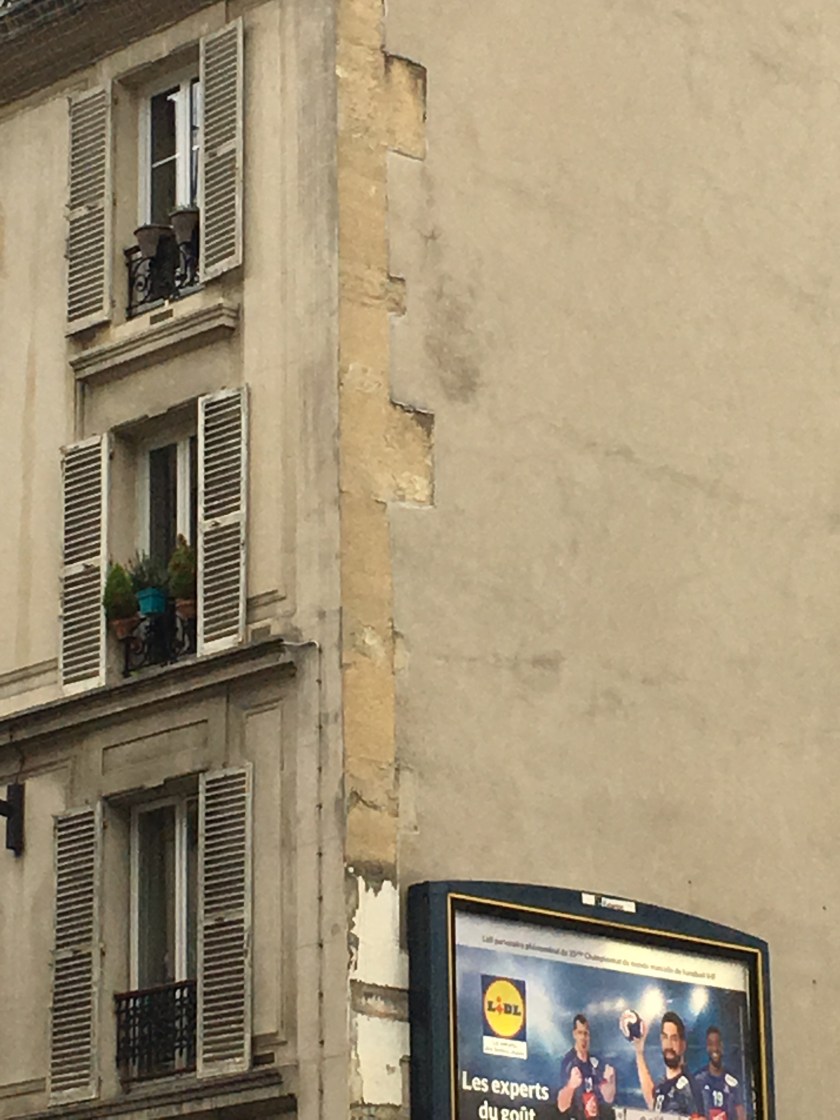
What I can’t unsee: pierres d’attente. I took a guided tour of Haussmannian Paris the other day. What that means: the enormous redesign of Paris in the 3rd quarter of the 19th century, when huge swaths of the city were torn down and rebuilt into the stereotype that you’re thinking of when you visualize Paris today. (See here for a post about the typical Haussmannian streets and how they relate to your ability to survive the zombie apocalypse in Paris, as well as here for a post about the typical Haussmannian apartment buildings and how they, too, relate to your ability to survive the zombie apocalypse in Paris.)
The new Haussmannian buildings went up in the order in which their lots were appropriated, the old buildings torn down, and the new buildings financed. That meant that it was often the case that buildings were put up that one day would have neighbors, but didn’t yet. In anticipation of the need to line up with adjacent buildings–lining up with things was very important in Haussmann’s Paris–the front-facing walls of the buildings had projections that were meant to facilitate alignment with future neighbors. So, pierre d’attente: “waiting stone,” I guess. (I think they can also be called pierres d’accord.)
Pierres d’attente. Picture source: me, on the rue La Fayette, on a rainy day in January 2017.
Pierres d’attente. Picture source: me.
Now, at some point, architects realized that if you have pierres d’attente sticking out of the side of your building, they catch rain, and then it can run into your walls, and that is most definitely not a good thing for your building. So, people started cutting them off, which is why you will see things like this:
Apartment building with pierres d’attente removed. Picture source: me, on the rue La Fayette.
But: not everyone was happy about this. Haussmannian apartment buildings are part of our patrimoine, and pierres d’attente are part of Haussmannian apartment buildings, so those pierres d’attente are part of our patrimoine, and no asshole should be cutting them off, right? Point taken, and cutting off your pierres d’attente is apparently no longer allowed. But, hey, this is France, and we’re logical–so, what you can do is, you can cut them so that there’s a pente, a slope, on the top edge. (I just had to throw the French word in there, on account of the fact that when I memorized it, I thought that I would never, ever get to use it–and there, my friends, is a very concrete example of Zipf’s Law in action.)
The guided tour was great. Seulement voilà (the thing is)…the tour guide explained pierres d’attente to us, and now I can’t stop seeing them. It’s OK–frankly, the more there is to occupy my fevered little brain, the better…
English notes
Anglophone students of French whine about the French subjunctive, and frankly, I’m not sure that Francophone professors are thrilled about teaching it to us, but: the fact is, English has a subjunctive voice, too. Or, more accurately: it can. This varies quite a bit by dialect, but English can have a subjunctive, in at least the following circumstance: talking about things that are not real at the moment. For example, here are some options, with and without the subjunctive:
If I were you, I wouldn’t tell him to fuck off–he’s a lot bigger than you are.
If I was you, I wouldn’t tell him to fuck off–he’s a lot bigger than you are.
You can recognize the subjunctive by the weird agreement of If I were you, rather than If I was you. Both are correct, and most Americans would say If I was you, but If I were you is more natural in my dialect. (I come from a relatively obscure area in the northwest of the country.)
Would you prefer that he give you a pat on the back, or a kick in the ass?
Would you prefer that he gives you a pat on the back, or a kick in the ass?
Again, you can recognize the subjunctive by the weird agreement of he give you versus he gives you.
How the subjunctive was used in the post: Here is a case where the meaning is clearly not compositional–to unsee something, were it possible, would not be what it is if it were compositional. I chose obscenity-laden examples to make clear that this isn’t a formality thing–the subjunctive is just more natural in my dialect. Again, most American speakers of English would say the form of these two sentences without the subjunctive, but both are fine. I have no idea how this works in the United Kingdom–can any of you Brits comment on this?
Who among us has not looked across the majestic sweep of the Place de la Concorde, up the stretch of the Champs Elysées, or through the luxurious Luxembourg Gardens and wondered: what will this place look like when it’s overrun by zombies?
I first published this on November 13, 2015, from Denver, Colorado. Not long afterwards, phone calls and texts started coming in fast and furious: relatives who were hearing about the Islamic State terrorist attacks that would kill 130 people and injure another 368 that evening. The post didn’t seem so funny in that context, and I took it down after an evening of trying to reach family and friends in Paris. 14 months later, Paris has brushed off her shoulders and kept walking, as she always does, and I am ready to play my infinitesimally small part in that.
Who among us has not looked across the majestic sweep of the Place de la Concorde, up the stretch of the Champs Elysées, or through the luxurious Luxembourg Gardens and wondered: what will this place look like when it’s overrun by zombies? Who among us has not looked down an unending line of the 7-story Hausmannian apartment blocks that make Paris look like Paris and thought: it would really suck to have to clear 7-story building after 7-story building–with optional basement–of zombies…
The English Wikipedia page on zombies is quite long, and discusses zombies from every angle that one could think of–folklore, the evolution of the zombie archetype, the zombie in modern fiction, the significance of the zombie apocalypse, and the zombie in popular culture–each with its sections and subsections. In contrast, the French Wikipedia page on zombies is pretty much just this sentence:
Un zombie (ou zombi) est, dans le folklore, un mort-vivant ou un individu infecté d’un virus nuisible à certaines parties du cerveau.
Of course, even with just one sentence, Zipf’s Law brings us some new vocabulary items:
le mort-vivant: living dead.
nuisible: harmful, damaging, injurious; pest.
I have no idea what it means that there is a long English Wikipedia page on zombies and a very short French one. Probably something profound about France and America, but I don’t know what. I do know this: I hate zombies.
About 14 months later, the French Wikipedia page on zombies is considerably longer, and I’ve reached a new level in my thinking about the relationship between zombies and those Haussmannian apartment buildings: they will contain the zombies nicely, so they’re actually going to be a big help in recovering from the zombie apocalypse. However, I’m leaving this post as it was on November 13th, 2015–a fond memory of a more insouciant time.
I live in the most boring neighborhood in Paris, but that doesn’t mean there’s nothing going on.
My little street, Christmas Eve or so.
The 15th arrondissement, where I live when I’m in France, is so boring that it typically doesn’t show up in guidebooks for tourists. A friend, Paris born and raised, once said this to me about the 15th: the rest of us don’t even think about it.
And yet: one of the things that makes Paris what it is to me is that anywhere you go, there’s a story. This morning on the way to the metro, I heard music and turned to see a taxi driver waiting at the stand–playing an electric guitar in the driver’s seat. Further down the block from my apartment is a little park. There used to be a château there, but after the revolution of 1789 it got turned into a gunpowder factory, and early one morning, it blew up. There were surprisingly few casualties–about a hundred–but they say that people found bits of clothes and body parts across the Seine in what is now the 16th.
Continue down the street and you get to the Dupleix metro station. It’s on the number 6 line, which follows one of the old city walls, and right outside the exit of the metro station was, for a long time, the place where you got taken to face the firing squad.
Turn left and you’ll soon find the rue du Commerce on your right. The famous British author George Orwell washed dishes there before he became a famous British author–if you are a Parisophile and you haven’t read his book about that time of his life, Down and out in Paris and London, you really should. And, although it would be tough to get further from an haute couture neighborhood than mine, this morning I was treated to the sight of a little old lady coming down the street in a full-length leopard skin coat. Matching high-heeled leopard skin boots. Oh–and matching leopard skin shopping bag.
Indeed, there’s a story everywhere you go in this city, and sometimes that story is personal. The 16th arrondissement (where the body parts landed when the gunpowder factory blew up in the 15th) really is the most boring arrondissement in Paris, but I never mind going there, because it’s where my grandfather lived.
I edited just a bit what my Paris-born-and-raised friend said. What she really said was this: people who live in the 15th love it, but the rest of us don’t even think about it. She’s definitely right about one thing–those of us who live here love it.
English notes (French notes follow)
To show up: to appear. Usually the subject is a human:
Party at my place Saturday night! Show up at 8…means that you should arrive at my house at 8.
Fifty percent of life is just showing up…means something like a lot of what it takes in life is to just try. (A Robin Williams quote, I think.)
…but the subject doesn’t have to be human, by any means:
My dog ran off last night, but thank God, he showed up on the back porch this morning, smelling like a garbage dump and looking pretty pleased with himself.
I was freaked because I lost my wallet, but then it showed up on my desk.
How it was used in the post: The 15th arrondissement, where I live when I’m in France, is so boring that it typically doesn’t show up in guidebooks for tourists.
to be born and raised somewhere: to be completely native to a place, because of having been born there and also having grown up there. You can use it with a normal sentence structure:
I don’t understand how someone can be born and raised In Pennsylvania but hate the steelers.
(The Steelers are the football team of the city of Pittsburgh, in Pennsylvania. In reality, the Eagles are the best football team in Pennsylvania, of course.)
The north trash. I thank God everyday that I was born and raised in the south.
(“GF” is girlfriend. Oakland is a city in California.)
How it was used in the post: I edited just a bit what my Paris-born-and-raised friend said. What she really said was this: people who live in the 15th love it, but the rest of us don’t even think about it. She’s definitely right about one thing–those of us who live here love it.
French notes:
le parigot/la parigote:Parisian. Pejorative. I wear it with pride.
très 16e:“very 16th”–in English, we would probably say “bouge,” or “boozh,” or something.












 Zipf's Law