Postmodernism, Burkina Faso, and dissolving stuff

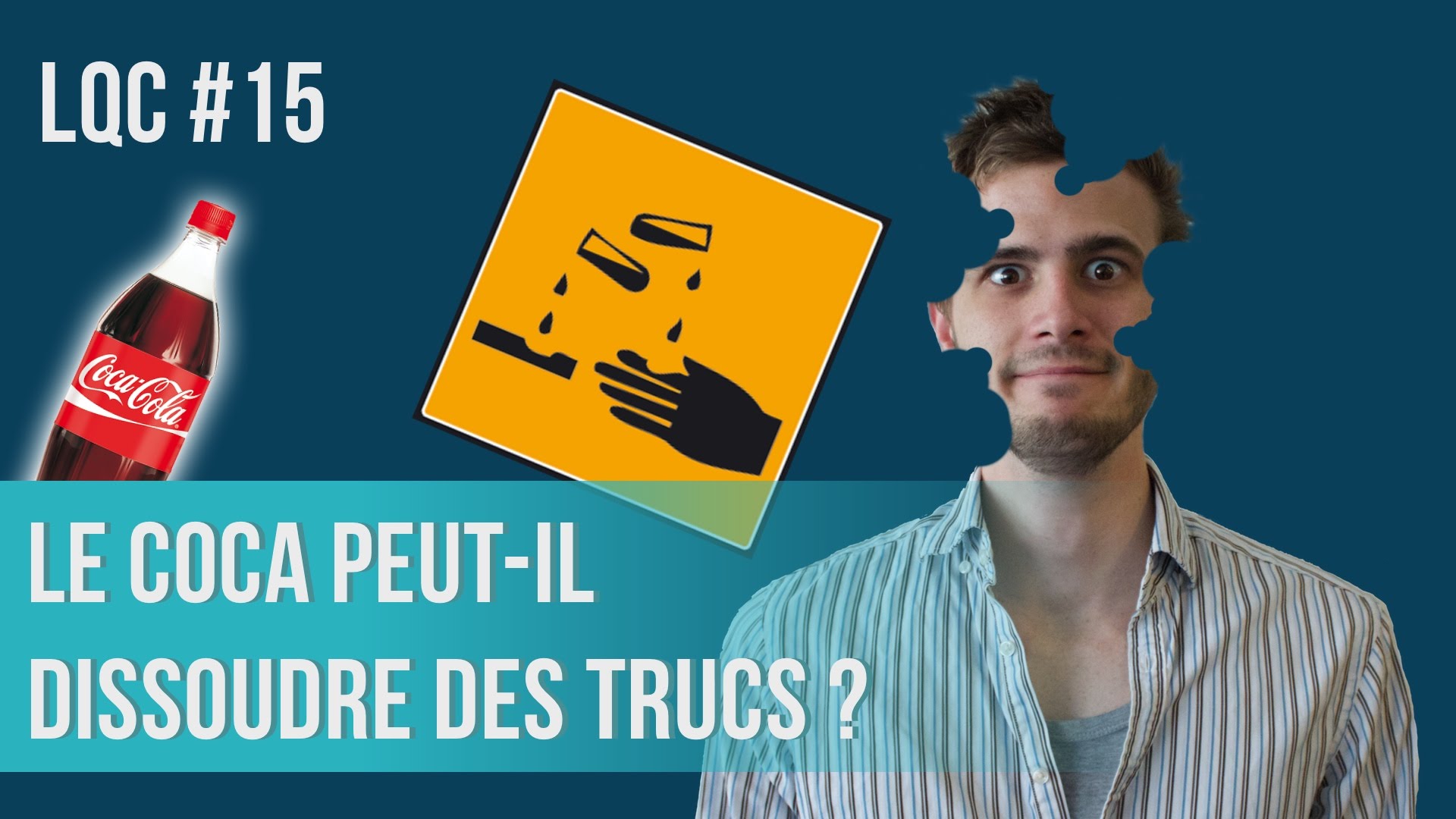
"Can Coke dissolve things?"  Picture source: https://www.youtube.com/watch?v=68lhTEFp3qw
“Can Coke dissolve things?” Picture source: https://www.youtube.com/watch?v=68lhTEFp3qw

It’s sort of a postmodern cliché that the media exerts tremendous influence over what, and how, we think.  I didn’t take this seriously until I was in Paris last summer.  We went through a period of pretty serious anti-Semitic violence–a synagogue was attacked by a mob during services, Jewish businesses were bombed, cars in a Jewish neighborhood were set afire.  A young woman was raped.  This was reported on my favorite American news channel as follows: “There was unrest in Paris yesterday.”  Really?!  To my astonishment, the most reliable source of news about what was going on turned out to be Twitter.

I thought again about how different media have different takes on what is newsworthy during the recent coup in Burkina Faso.  There wasn’t much news coverage of it in the United States, but it was covered quite heavily in the French media.  In fact, Radio France International’s podcast about French words used it to establish the context for a discussion of the word dissoudre, “to dissolve,” as in the rebels dissolving the government.

Dissoudre turns out to fit nicely into our recent discussions of verb conjugations.  In general, verbs ending with -re tend to be at least somewhat irregular.  In that way, dissoudre is a doozy.  Let’s look at the present tense:

je dissous nous dissolvons
tu dissous vous dissolvez
il/elle/on dissout ils/elles dissolvent

Where does the LV come from? Where does it go? The mysteries of morphology. Here are some verbs that are conjugated like dissoudre.  These might be the only three that follow this pattern; they share other oddities, including irregular past participles and possibly not having passé simple or imperfect subjunctive forms.

  • absoudre: to absolve.
  • résoudre: to solve, resolve.

A magot is not a maggot

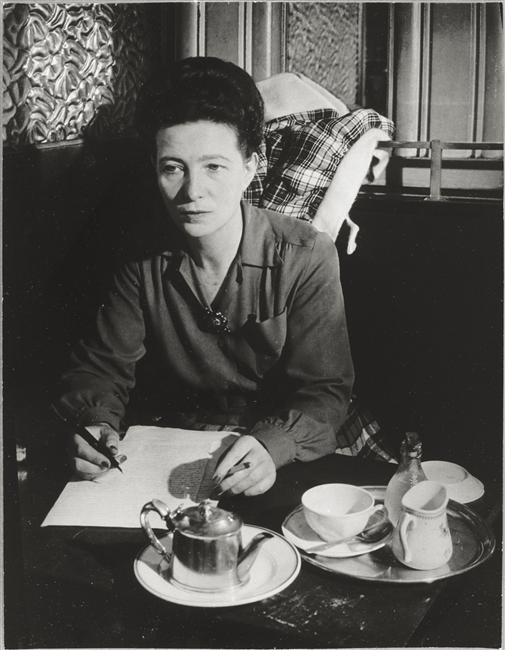
Simone de Beauvoir in an unnamed cafe. Photo source: http://fuckyeahexistentialism.tumblr.com/post/3736286827/simone-de-beauvoir-says-celebrate-international.

I’ve always been attracted to depth over breadth.  Visiting a new city, I might eat in the same restaurant every night, trying to explore the entire menu.  Discovering a new bookstore, I’m unlikely to only visit the sections that I’m interested in and know that I’ll buy from, but very likely to walk around the entire store, seeing what it’s strong in (in Denver, the former Borders in Northglenn for judo, the Tattered Cover for history, Barnes and Noble for obscure French books; in Paris, Gibert Jeune for theoretical semantics, Attika for bilingual French/English novels, and Gibert Joseph for cheese, kids’ books, and general linguistics).  This makes me a super-boring person to visit a new city–or a new bookstore–with, but I love the feeling of knowing a place deeply, and prefer it to knowing lots of places more shallowly.

I’d always been interested in an in-depth exploration of the cafes of Paris, but had trouble finding a good, and preferably literary, guide to them.  Then today I read a chapter in John Baxter’s Five nights in Paris: After dark in the City of Lights on just that topic.  Baxter starts by debunking the myth that Parisian writers work in cafes.  He says that Hemingway was the last writer of importance to actually write in cafes in Paris.  He also, however, quotes a friend as saying that only one of her writer friends still writes in a Parisian cafe.  There’s a clear inference from this: writing in Paris cafes has certainly been popular, and people still do it.  I will even confess to having spent a pleasant afternoon or two sitting on the terrasse of a Paris cafe working on a (not very interesting, unfortunately) book myself.  He lists a number of cafes frequented by writers, musicians, or other folks of interest; I’ll round it out a bit with material from Graham Robb’s Parisians: An adventure history of Paris.

  • Cafe Procope: I’ve heard different stories as to whether this was the first cafe in Paris, or the first successful cafe in Paris.  Graham Robb describes the original offerings: coffee and sherberts.  Habitués over the years have included Voltaire, Rousseau, Benjamin Franklin, John Paul Jones, Thomas Jefferson, and Léon Gambetta.  6th arrondissement, which I think is not its original location, but I haven’t been able to verify that.
  • Les Deux Magots: one of the most famous cafes in Paris.  It was opened in 1885 in the former location of a silk store.  According to the Paris-Bistro.com web site, the name comes from the two magot, or seated Oriental figurines, that are mounted on the wall and are the last vestiges of the silk shop.  Expect to pay about double the cost of a coffee or beer anywhere else in town for the privilege of hanging out in the same place as Rimbaud, Mallarmé, André Breton, Paul Eluard, Simone de Beauvoir, Jean-Paul Sartre, Ernest Hemingway, Albert Camus, Pablo Picasso, James Joyce, and Bertolt Brecht, once did (list from Wikipedia and the Paris-Bistro.com web site).  I was really surprised at how small it was on the inside–it’s easy to imagine the air choking with cigarette smoke and the smell of espresso.  6th arrondissement.
  • Cafe Flore: right up there with Les Deux Magots in the fame department, and still popular.  Like Les Deux Magots, it was built in the 1880s.  Habitués have included Pablo Picasso and Zhou EnlaiAdam Gopnik‘s essay A tale of two cafes (reprinted in his Paris to the Moon, which I can’t recommend highly enough–my favorite book about Paris) contains a variety of wildly speculative explanations for why Les Deux Magots stopped being the cool place to be while the Flore remained popular; all or none of them may be true.  6th arrondissement.
  • Cafe Beaubourg: Edmund White hung out here.  As Baxter relates, and White himself says in his memoir Inside a Pearl: My years in Paris, part of the attraction was walking by the air intake of the Institut de Recherche et Coordination Acoustique/Musique afterwards, so that his dog could poop in it–a dispute over being refused an interview.  4th arrondissement, in the Marais.
  • La Closerie des Lilas: Hemingway liked to write here.  Other habitués have included Pablo Picasso, Jean-Paul Sartre, André Gide, Paul Éluard, Oscar Wilde, Samuel Beckett, Man Ray, Ezra Pound (list from French Wikipedia page).  6th arrondissement.
  • Café Fleurus:  I haven’t been able to find much in the way of information about this one, but it appears that Gertrude Stein lived right up the street, at 27 rue de Fleurus.  14th arrondissement.
  • Wepler: This was a favorite of Henry Miller.  The character Joey in Miller’s book Quiet Days in Clichy has a relationship with a prostitute that he meets there.  18th arrondissement.
  • Tournon: This was a favorite of post-war African-American expats in Paris, as well as the early male-female transsexual April Ashley.  6th arrondissement.

As Baxter points out, these days Paris cafes are about food as least as much as coffee, but I wouldn’t necessarily recommend eating at any of these.  A number of the cafes that I’ve listed are in the 6th arrondissement.  If a cafe tour takes you there, I would recommend that you eat at Au Pied de Fouet.  This is an island of affordable meals in the midst of a sea of super-overpriced places, and the food is some of my favorite stuff in Paris, particularly for French stuff (yes, Paris has a bazillion great restaurants serving things other than French food).

For a Zipf’s Law connection, let’s look at the vocabulary items that appear in some of the cafe names:

Do you have a cafe to add to my list?  How about mentioning it in the Comments?  I’ve focused here on cafes with some literary history; you can find a list of other cafes here.  Some of them look pretty interesting.

Zipf’s Law in the context of getting screamed at by a taxi driver

In which I get screamed at by a taxi driver, and then have oatmeal.

There’s something about Zipf’s Law–the property of language that about 50% of the words that you run into are quite rare, statistically, and yet they do occur–that seems quite random when you’re face to face with it. However, it’s just as context-dependent as anything else linguistic. So, getting up at 3 AM to catch a plane exposed me to lots of new words, as you would expect–but, as you can see from the list below, they mostly do go together, in some sense, at least from the second word in the list on.  Here are the words that I had learnt before breakfast:

  • illégal: illegal, banned, outlawed, criminal.  You would’ve thought that I would’ve heard this word before this, and certainly I’ve come across interdit and défense (de).  However, I don’t recall ever coming across illégal until 4 AM today, when I was standing in front of the hotel in Montréal with a suitcase, a taxi driver came by, I shook my head “no,” and he pulled over, rolled down his window, and screamed UberX is banned! at me repeatedly.
  • le gruau: in theory, “gruel.”  In practice, “oatmeal.”  I’m looking forward to a bowl of gruau while I wait for my plane.
  • érable (nm): maple.  Where there is gruau, there always seems to be sirop d’érable (maple syrup).  
  • la garniture: side dish.  Way more meanings than you would think, actually.  In this case, roughly equivalent to “condiments.”  That might be a Canadian usage, though–not sure.
  • la cassonade: brown sugar.  Wondering about the etymology of the word, I looked it up on the French Wikipedia, and learnt that it refers to a different kind of brown sugar in the north of France and in Belgium than elsewhere.  Who knew that brown sugar was so complicated?
  • la canneberge: cranberry.  Cranberry production is mostly a North American thing, so it’s not shocking that I would have come across this word in Canada, but not in France.

That’s a lot of words to learn before sunrise, though, so I’m going to eat my gruau and make another cup of coffee now–flight boards in 15 minutes…

Funny, you don’t look like a mechanic: the mysterious art of identifying language preference

Picture source: thejumpingfrog.com.

There’s something about the French-speaking parts of Canada that has always amazed me.  In any French Canadian city that I’ve been in, there’s always a substantial English-speaking minority.  If you watch a cashier with a line of people in front of them, you’ll see the following.  As each person gets up to the cash register, the cashier looks at them for a split second, and then greets them–either in French, or in English.  The customer will almost always answer them in the same language.  I can’t begin to imagine how they know which one to use.  I asked my cousin about it the other day.  She grew up here, and works in customer service.  She says that she has no idea how she does it, but that she almost never gets it wrong–she can tell which language you speak by looking at you.  (Like a typical Québécoise immigrant of her generation, she speaks three languages–in her case, Italian, English, and French.)  If you have any insight into how this works, perhaps you could tell us in the Comments section?

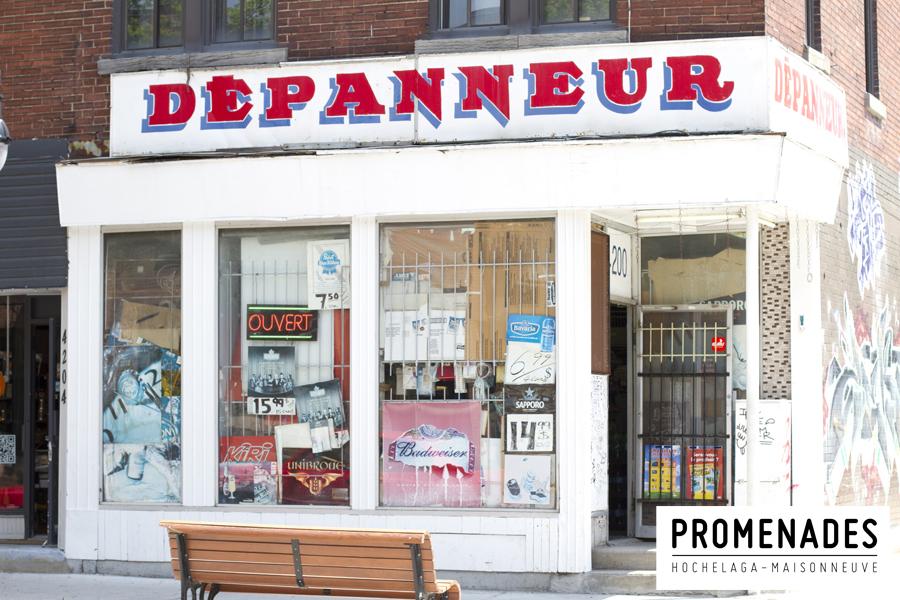
A Quebecois convenience store. Picture source: http://www.promenadeshm.ca/fr/commerces/c/depanneur.

There are countless books about the French language of Quebec–I saw several in every bookstore that I went into in this city.  Stereotypical Quebequisms abound, but the one that struck me as most salient doesn’t show up in any of the obvious places, like on T-shirts.  You might remember the word le dépanneur from a previous post (it showed up in an incredibly stupid French movie that I watched).  Normally, it means a mechanic.  In Quebec, however, it is a convenience store.  I haven’t seen a single 7-11, but I saw stores labelled dépanneur all over the place–mystifying, until I looked it up.

How you hold your rhinoceros head: Francophone used bookstores of Montreal

Le port de tête: the way you hold your head. Picture source: http://www.mesacosan.com/conseil-en-image-femme/comment-etre-elegante-avec-un-joli-port-de-tete-a2183.html.

When you find a great bookstore, there’s always that question: do you keep it to yourself so that no one else gets the really good books, or do you tell the entire world about it so that the bookstore stays in business?  The long-term solution is clear: you have to tell people about it.  In that spirit, I’ll tell you how to find great Francophone used bookstores in Montreal.  All you have to do is go to rue Mont-Royal Est in the Plateau neighborhood and wander up and down the street.  Even on a Sunday afternoon, I found a number of used bookstores open–more accurately, bookstores with a mix of used and new books, for the most part–and they were all great.  If you want a place to sit and read your purchases, I recommend the Kahwa Café (more on that below).

If you want to find addresses for specific bookstores in the Plateau, as well as other Francophone used bookstores in Montreal, grouped by neighborhood, try this link.

Zipf’s Law strikes, as always, and I had to consult a dictionary just to understand the names of some of the bookstores:

  • Le port de tête: WordReference.com translates this as “the way you hold your head.”  Le port de tête is the name of one of the bookstores that I visited.  Looking for a way to use this expression, I found two pages of Google hits about the bookstore–and the picture on this blog post, in an article titled Comment être élégante avec un joli port de tête?  (How to be elegant, with a pretty port de tête?)
  • Le port: port, harbor, shelter; bearing, wearing (e.g. le port de lunettes, “wearing glasses”); bearing, way of holding, way of carrying.  That final sense is the one that we see in le port de tête.
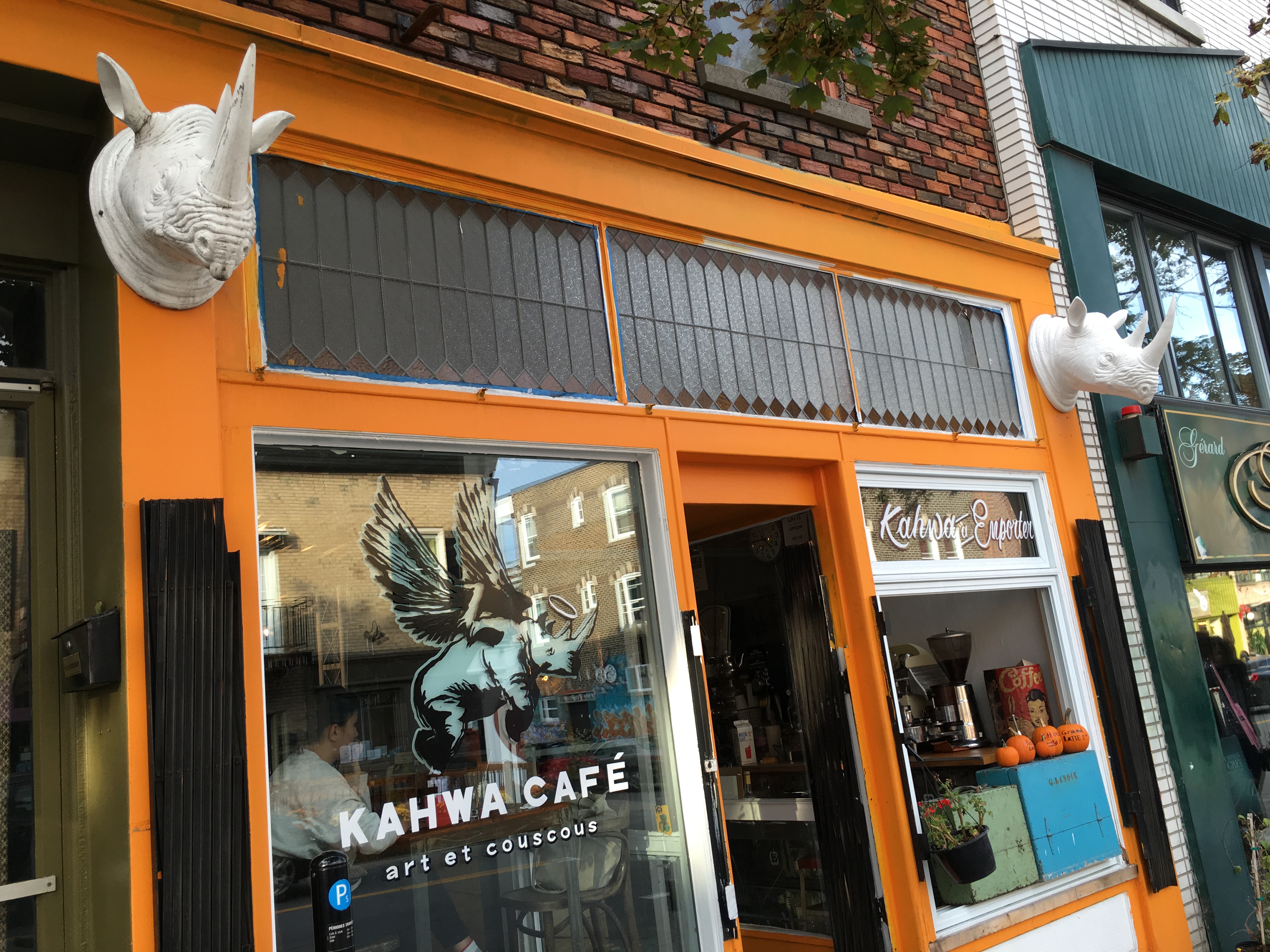
  • le rhinocéros: rhinoceros.  In the Le port de tête bookstore, I asked the owner if she could recommend a cafe.  She told me about the Kawha Café, and told me that it was on the other side of the street, down the block, and had two [unintelligibles] sticking out of the wall, making this odd gesture of showing things sticking out of her forehead.  Turned out that the unintelligible words were “rhinoceros heads.”  Hard to catch, out of context, even with the helpful hand-gestures–I guess that now I know the international hand signal for “rhinoceros head,” though…  Picture below.
The Kahwa Café, in the Plateau district of Montreal. Picture by me.

Flashing, nibbling, and the Poisson distribution

The Poisson distribution rears its ugly head in a discussion of flashing lights.

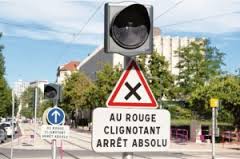
"Complete stop on flashing red."  Picture source: http://www.gazetteinfo.fr/2012/09/04/tramway-de-dijon-signifient-les/.
“Complete stop on flashing red.” Picture source: http://www.gazetteinfo.fr/2012/09/04/tramway-de-dijon-signifient-les/.

If you’ve been reading this blog for a while–or just have a degree in something quantitative–you know about Zipf’s Law.  This formula describes the distribution of word frequencies, and captures the fact that our daily language is filled with a small number of words that occur extremely frequently (in English, the, a, me, and the like; in French, le, un, moi), and a very large number of words that almost never occur–and yet, they do occur, thus damning second language learners to a hell of constant dictionary consultation for the rest of their lives.

We’ve talked far less often about the Poisson distribution.  The related formula has the consequence that even rare events will sometimes occur in clusters.  Maybe three rock stars die in the same month, or the same tree gets hit with lightning twice in a week.  Similarly, it’s not that unusual to see unusual words in clusters.

I was reminded of that last night, when I ran into the verb clignoter, which is used in reference to lights and means to flicker or to blink.  I don’t think I’d ever run across it before, but I saw it not once, but twice yesterday: once in the elevator, related to the light that lets you know if your emergency call to whoever it is that answers emergency calls from elevators has succeeded, and once on a big sign at an intersection with a bunch of construction going on.  (Yes, I’m such a geek that I am basically constantly looking up new words.  That’s what smart phones were made for, right?)

Now that we know this rare-but-it-happens word, we need to cover another word to go with it.  For reasons that will be obvious to the phonologists in the audience, it looks almost identical to the word clignoter to a linguist, and I know that I’m going to confuse these two constantly, so let’s memorize them:

  • clignoter: [of a light] to blink or flash.
  • grignoter: to snack or nibble; to edge forward, to gain on.

There’s room for us all under the Big Red Maple Leaf, but the weather is iffy

Clouds over Montreal. Picture from http://static.panoramio.com/photos/large/60752208.jpg.

Due to my poor command of the French language, I scared the heck out of my cousin.

I’m in Montréal for a family wedding.  Riding from the airport to the hotel, the cab driver was listening to the radio.  I heard this (if it’s in italics, it happened in French): 3 degrees tonight, 0 in the suburbs, chance of freezing.  Snow likely tomorrow. 

This wasn’t good news–lots of family coming into town for the wedding.  Really?, I asked the taxi driver.  Snow?  Tomorrow?  Yep, he answered.

Arriving at the hotel, I called my cousin, whose daughter is getting married this weekend.  “How’s the weather where you came from today, as opposed to here?”, he asked me.  (If it’s not in italics, it happened in English.)  “About like here,” I said–it’s quite nice here in Montreal today–“but I understand there might be snow tomorrow.”  “No.  No.  You’re kidding.  Snow?  It can’t,” says my cousin.  You see, several years ago, he had another occasion here.  It was April.  With all of the family in town, it snowed 12 inches, and no one could get out of town the next day.  “Well, maybe I misunderstood,” I said.  “My French isn’t that great.”

After we hung up, I looked up the word that I had heard on the radio that described what the weather was going to be like the next day.  Crap!  I always mistake these two words:

  • la neige: snow.
  • le nuage: cloud.

Indeed, it’s going to be cloudy tomorrow, not snowy–no need to panic.  I won’t soon be forgiven for the 5 years that I probably took off of my cousin’s life with that mistake, though!

Daughter of the King in a personals ad

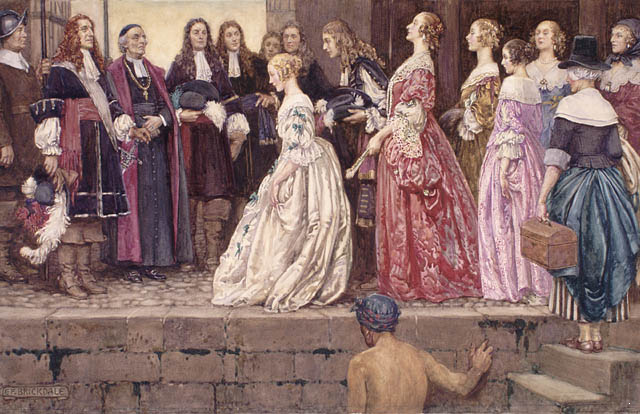
“Arrival of the Brides,” a painting of the Filles du Roi by English artist Eleanor Fortescue-Brickdale.

When I started studying French last winter, I fell in love with a song from Quebec called Petite annonce amoureuse (“Personals ad”–for those of you who are too young to remember, personals ads were the precedents of Match.com; they were short advertisements that ran in newspapers, from people looking for love).  The song was originally recorded by Kate and Anna McGarrigle, and recently re-recorded by Chloé Sainte-Marie.  The song begins with these words:

Je cherche un homme qui a cinq pieds trois I’m looking for a man who is 5 foot three
Moi, je ne suis pas fille du roi Me, I’m not a daughter of the king

In French, trois (“three”) and roi (“king”) rhyme–no big deal.  Just a quirky line in a song, right?

Fast forward two years, and I’m now reading The story of French, a book about the history of the French language by the always-interesting Jean-Benoît Nadeau and Julie Barlowe. The book tells the story of the population of French Canada. While the population of the English colonies was booming in the 1600s, the French Canadian population most definitely was not, with a ratio of six men to every female. The administration tried to address the situation by sending marriageable young women, mostly from orphanages, from France to the New World. These women were accompanied by dowries provided by the Crown, and were known as filles du roi (filles du roy, in the orthography of the time)–“daughters of the King.”  The King’s Daughters feature strongly in the creation myth of Canada, and various and sundry people of whom you would have heard are descended from filles du roi, including Hillary Clinton, Angelina Jolie, and Madonna, according to Wikipedia.  Here are some words related to the filles du roi:

  • l’orphelin, l’orpheline: orphan
  • l’orphelinat (masc.): orphanage
  • le foyer de l’enfance: orphanage (more current term, according to the French Wikipedia entry)

Irregular IR-class verbs, or why I’m not losing weight

Exploring group III French verbs through my failure to lose weight.

So embarrassing–I had a great opportunity to use an obscure IR-class verb (mincir, meaning to lose weight or to make you look thin) yesterday, but in the first person singular present tense, not the third person plural present tense that we worked on last time–and I blew it.  Attempting to explain the connection between the delicious French-Canadian dish called poutine–fries covered with cheese curds and gravy–and why I’m not losing weight, I conjugated it as an ER verb, not IR.  !@#$%$!  I guess I just gotta work on those IR-class verbs some more.  So, for the moment let’s just point out that there’s a Montréal restaurant, La Banquise, that serves 25 different kinds of poutine, agree amongst ourselves that I’ll go there this week when I visit our neighbors under the Big Red Maple Leaf, and focus on irregular IR verbs.

In that spirit, let’s look at the present tense of some irregular IR verbs.  In the singular forms, the final written consonant is the same, but where the regular IR verbs have the vowel i in front of that consonant, the irregular IR verbs do not. We’ll use finir (to finish) as our prototype of a regular IR verb–all of the other verbs in these tables are irregular IR verbs:

finir courir dormir partir sortir
je finis cours dors pars sors
tu finis cours dors pars sors
on finit court dort part sort

In the plural forms, the regular IR verbs (like finir) and the irregular verbs (all of the other verbs in this post) are quite different, and actually look a lot like ER verbs:

finir courir dormir partir sortir
nous finissons courons dormons partons sors
vous finissez courez dormez partez sortez
ils/elles finissent courent dorment partent sortent

Similar verbs include mentir (to lie), sentir (to smell), and compounds of all of these.

How many verbs like this are there? It’s surprisingly difficult to say. It’s even unclear what exactly “this” means. The traditional answer would be “the set of third-conjugation verbs,” but “third-conjugation verbs” include a number of verbs of entirely different classes. Just looking at the example verbs on this page, there’s a clear difference between verbs like courir and verbs like dormir–they share the same endings, sure, but the stem of the verbs like dormir lose a consonant in the singular forms.  Would you count mourir?  The endings are the same, but there’s a change in the stem vowel.  How about démentir (to deny)?  It’s conjugated like mentir,  but while the past participle menti is invariable, the past participle of démentir can be inflected for gender, and be démenti or démentie.  Does it count as like “this”?  And, there are words related to the words that I’ve used as examples here.  For example, related to courir (to run), we have (from the web site L’Obs–la conjugaison):

parcourirencourirdiscouriraccourirconcourirrecourirsecourir

Counting word types is always an ugly business–this shows you one thing that contributes to that kind of ugliness.  Mincir (to lose weight) is totally regular, by the way, although at this point in my life, for me to lose weight would, unfortunately, be quite irregular.

3rd person plural present tense of regular IR-class verbs: anonymous sex in the Tuileries Garden

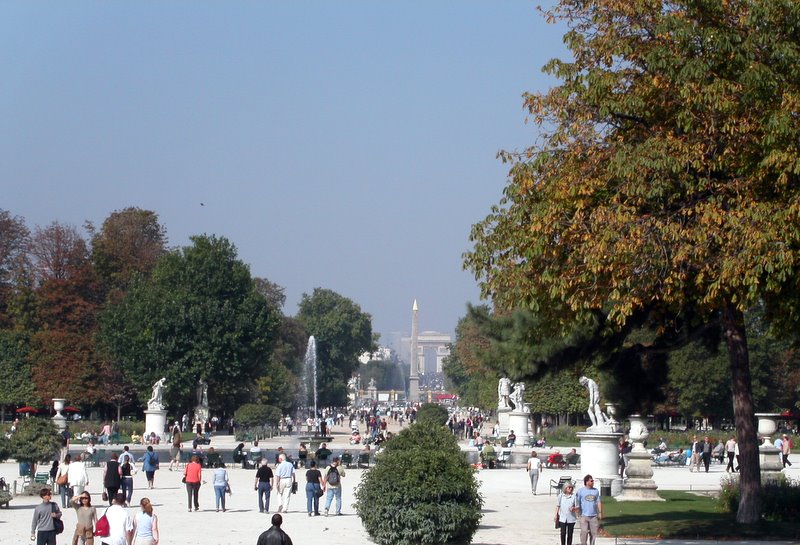
The Tuileries Garden today. Source:
The Tuileries Garden today. Source: “Tuileries gardenview” by User:Munford – Own work (Taken by me). Licensed under CC BY-SA 3.0 via Commons – https://commons.wikimedia.org/wiki/File:Tuileries_gardenview.jpg#/media/File:Tuileries_gardenview.jpg

There’s good evidence that men have been jumping the walls of the Tuileries Garden (built in 1564) to have sex with each other at night since at least the 17th century.  We know about this because although France has no laws forbidding sex or marriage between consenting adults today, it wasn’t always so enlightened.  At one time, the police paid men called mouches (flies) to entrap gay men into making sexual propositions and then have them arrested.  The police reports of the mouches give quite a bit of insight into gay cruising culture in the decades before the French Revolution (1789).  In 1791, the new French penal code decriminalized homosexuality.

Now that I’ve got your attention, it’s time to get back to the basics.  I’m preparing for a French certification test (see this post for a description of the oral comprehension portion), and I am realizing that I am woefully out of practice with the conjugations of some verb classes.  About 20% of French verbs end with -ir.  The 3rd person plural present tense of these verbs (they walk, they are walking, etc.) is a weakness for me, so humor me and let’s work on it.

For the 80% or so of French verbs that belong to the ER class, the 3rd person plural present tense is pronounced the same as the 1st, 2nd, and 3rd person singular.  For the IR verbs, the stem is pronounced the same as the 1st and 2nd person plurals.  (It’s always written differently from all of the others.)  The ending for the 3rd person plural present tense of regular IR verbs is -issent:

je finis nous finissons
tu finis vous finissez
on finit ils finissent

With that reference in hand, let’s practice. A list of sentences follows. Change the highlighted pronoun and verb to ils, and give the appropriate verb form.

  1. Nous ne choisissons pas notre orientation sexuelle.  We don’t choose our sexual orientation.
  2. Je vomis les “mouches.”  I loathe the “mouches.”
  3. Je suis ravi qu’il abolit les lois contre l’homosexualité.  I’m delighted that he is abolishing the laws against homosexuality.
  4. Est-ce que tu rougis quand je parle de ces affaires?  Do you blush when I talk about these things?
  5. Réfléchissez-vous à ce que j’ai dit?  Are you thinking about what I said?

Answers:

  1. Ils ne choisissent pas leur orientation sexuelle.
  2. Ils vomissent les mouches.  They loathe the mouches.
  3. Je suis ravi que qu’ils abolissent les lois contre l’homosexualité.
  4. Est-ce que ils rougissent quand je parle de ces affaires?
  5. Réfléchissent-ils à ce que j’ai dit?
Ukrainian Humanitarian Resistance

Resisting the russist occupation while keeping our humanity

Languages. Motivation. Education. Travelling

"Je suis féru(e) de langues" is about language learning, study tips and travelling. Join my community!

Curative Power of Medical Data

JCDL 2020 Workshop on Biomedical Natural Language Processing

Crimescribe

Criminal Curiosities

BioNLP

Biomedical natural language processing

Mostly Mammoths

but other things that fascinate me, too

Zygoma

Adventures in natural history collections

Our French Oasis

FAMILY LIFE IN A FRENCH COUNTRY VILLAGE

ACL 2017

PC Chairs Blog

Abby Mullen

A site about history and life

EFL Notes

Random commentary on teaching English as a foreign language

Natural Language Processing

Université Paris-Centrale, Spring 2017

Speak Out in Spanish!

living and loving language

- MIKE STEEDEN -

THE DRIVELLINGS OF TWATTERSLEY FROMAGE