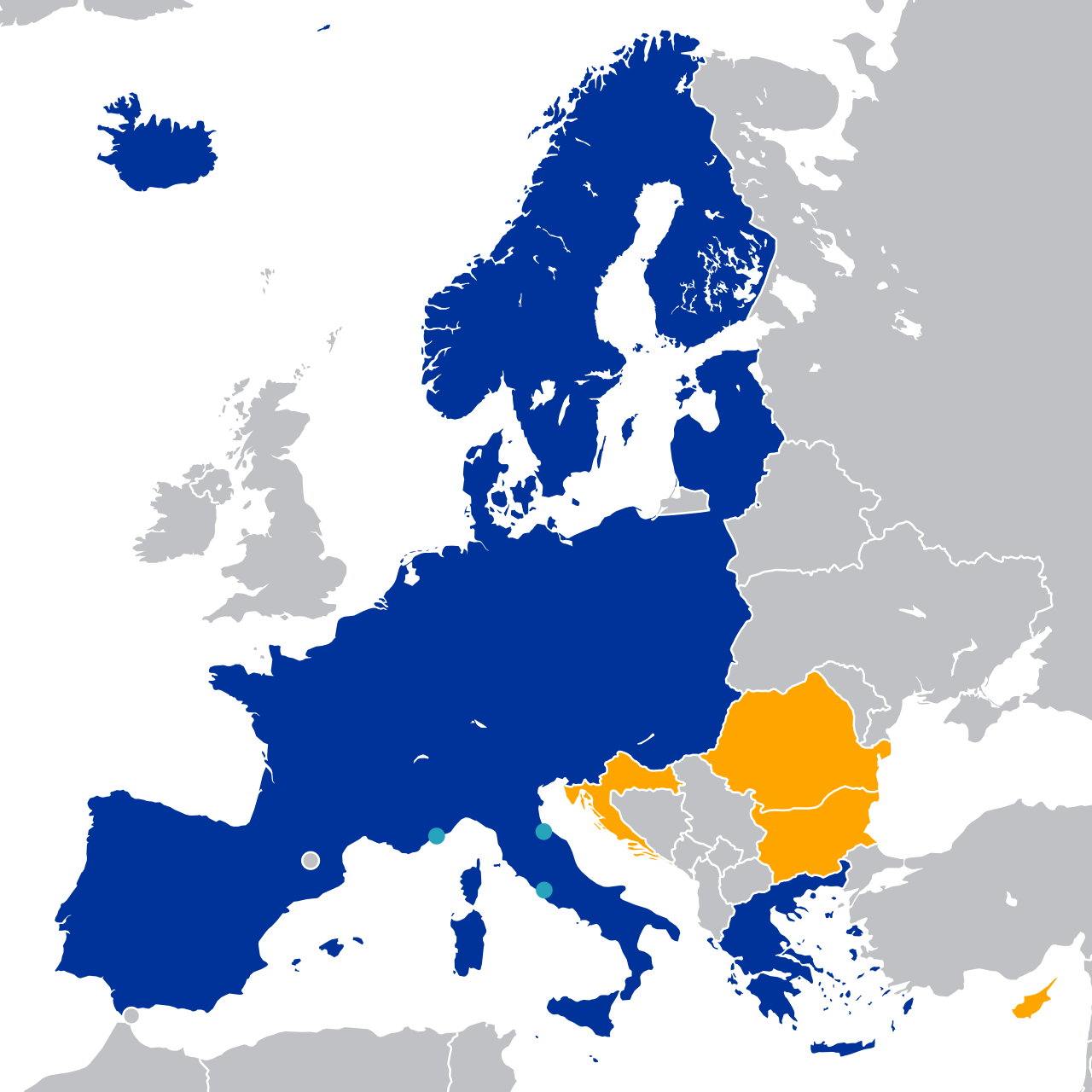
Listening to the news this morning, I heard an interesting new term. Part of what was interesting was that the broadcaster felt it necessary to explain what the term meant. The term was la frappe oblique, or “oblique strike.” If I understood the story correctly (never a given), there is a European commission meeting on the subject of what to do about Islamic State (usually referred to as Daesh in French, the same as in Arabic) plans for “oblique strikes.” As the broadcaster explained, an “oblique strike” is carried out by having a citizen of one European country carry out a terrorist attack in another European country. The idea is that if you have, say, a French citizen who is associated with a terrorist group, that person might be under investigation by the French police, but they won’t be under surveillance by, say, the German or Spanish police. Within the Schengen Area (the territories of the 26 European countries that don’t have any restrictions on travel between them), that French citizen could travel to any other country–say, Germany–at which point they drop off of the French police’s radar, and are much freer to carry out an attack.
It’s so nice to have terms explained on French radio. Even in your own native language (that’s English for me, not French), Zipf’s Law strikes on occasion. As a side note, the ability of speakers of a language to explain words to one another is theoretically interesting to some extent, as on a very strong version of structuralism, it shouldn’t be possible for them to do that. Clearly we can. That doesn’t negate more reasonable versions of structuralism, though–it’s a useful way of thinking about language.
The Saturday Morning Breakfast Cereal from the 24th:
And no wonder: Baby Noam knows enough about Language to start a sustained argument that animals don’t have it, but not enough about the details of English to understand that the woman was asking what the conom (conventional onomatopoetic word — see discussion in the last section of my posting on Liam Walsh) is in English for the sound made by a chimp. (Note: there isn’t one, so far as I know). The facts of English usage in this domain are fairly complex, but little kids (other than Baby Noam, it seems) manage to cope very well with it.
In English, the spelling of a word doesn’t tell you how to pronounce it—it just gives you some clues about how to pronounce it. Through, though, tough, and plough are famous examples. French is the same. But, even more so, it’s the case that in French, knowing how to pronounce a word only gives you the slightest clue how to spell it. In a previous post, we looked at several ways to spell words that sound like mur. Here are nine different words that all sound identical in French. Specifically, they all sound like the English word oh:
o: this is the letter of the alphabet.
ô: this is the poetic “oh”–“Oh, bird of my soul, fly away now, For I possess a hundred fortified towers.” (Rumi)
au: in theory, this means “to the,” but you see it in lots of other uses, like things that would be compound nouns in English— for example, pain au chocolat, a delicious chocolate-filled square croissant.
aux: “to the” again, but this time plural.
eau: water.
eaux: waters.
haut: high (male singular)
hauts: high (male plural)
os: bone
Of course, that doesn’t mean that the same letters or letter combinations always sound the same. My favorite is notre and nôtre. Despite the fact that the words o and ô are pronounced the same (see above for their meanings), notre and nôtre, which mean almost the same thing (roughly “our” and “ours”), are pronounced quite differently.
Incidentally: the technical term for words that sound the same as other words is homophones. You see them in lots of languages. They may or may not also be homographs—words that are spelt the same. We talked about the ubiquity of ambiguity in human languages in a previous post–homophones are a source of ambiguity in spoken language, and homographs are a source of ambiguity in written language.
Can you add any more words to my list of French words that are pronounced o? If so, how about putting them in the Comments section?
Randomly Googling Zipf’s Law, I came across this web page that talks about one aspect of the significance of Zipf’s Law for natural language processing–that is, getting computers to deal with human language.
The page is on the web site for A.L.I.C.E., a computer program that uses frequently-occurring patterns to give the appearance of understanding, and replying to, things that are “said” to it in English. The page points out that for A.L.I.C.E., there’s an advantage that comes from Zipf’s Law: it means that a relatively small number of patterns encoded into A.L.I.C.E. allow it to process a very large percentage of the things that people say to it. Here are the most common things that people “say” to A.L.I.C.E.:
531 WHAT IS YOUR NAME
352 WHAT IS MY NAME
171 WHAT IS UP
137 WHAT IS YOUR FAVORITE COLOR
126 WHAT IS THE MEANING OF LIFE
122 WHAT IS THAT
102 WHAT IS YOUR FAVORITE MOVIE
92 WHAT IS IT
75 WHAT IS A BOTMASTER
70 WHAT IS YOUR IQ
59 WHAT IS REDUCTIONISM
(I don’t know what the total count is–it would be nice if the web page gave percentages.) What is What is reductionism doing there? I’m guessing that it’s because A.L.I.C.E. is presented as an artificial intelligence application, and reductionism is a theoretical topic in artificial intelligence. (Here’s Neil Rowe‘s take on reductionism: “Perhaps the key issue in artificial intelligence is reductionism, the degree to which a program fails to reflect the full complexity of human beings. Reductionism includes how often program behavior duplicates human behavior and how much it differs when it does differ. Reductionism is partly a moral issue because it requires moral judgments. Reductionism is also a social issue because it relates to automation.”) Apparently a lot of geeks like to talk to A.L.I.C.E.–either that, or there are hella people in the world that are interested in reductionism.
Of course, the flip side of Zipf’s Law for natural language processing is that an enormous number of the inputs to your program will only occur very infrequently, and it’s going to be very difficult to cope with all of those. Zipf’s Law cuts both ways.
Here are some words that I didn’t know on the French Wikipedia page about artificial intelligence:
se vouloir: to claim to be. L’intelligence artificielle est le nom donné à l’intelligence des machines et des logiciels. Elle se veut discipline scientifique recherchant des méthodes de création ou de simulation de l’intelligence. “Artificial intelligence is the name given to the intelligence of machines and computer programs. It claims to be a scientific discipline researching methods of creation or simulation of intelligence.”
abréger: to shorten, abbreviate, abridge, summarize; to make (something) fly by. Le terme « intelligence artificielle », créé par John McCarthy, est souvent abrégé par le sigle « I.A. » (ou « A.I. » en anglais, pour Artificial Intelligence). “The term ‘artificial intelligence,’ created by John McCarthy, is often abbreviated by the acronym ‘I.A.’ (or ‘A.I.’ in English, for Artificial Intelligence).”
In a previous post, I explained why I love learning new English monosyllables. Today I ran across the English word voile. Wiktionary defines voile as a light, translucent cotton fabric used for making curtains and dresses. This particular word is a nice Zipf’s Law phenomenon both because I’m 53 and I just learnt it today, and because its etymology is French.
In French, voile actually has a number of meanings, depending on whether it’s male or female. None of them are quite the same as the meaning in English:
le voile: this is “veil,” and now also “headscarf” or “hijab.” You will see this meaning in France quite a bit these days, because of la loi sur le voile intégral. This is the informal name for a law which, among other things, forbids wearing the full-face veil in public. It is quite controversial. (I should note that I see women in full-face veils in Paris routinely, and I have never seen the law enforced.) WordReference.com also gives a meaning related to what sounds like a sort of skin forming on top of a liquid, and the buckling of a wheel. I don’t think I’ve ever run into either of those, but Zipf’s Law being what it is, I’ll probably see them both tomorrow…
la voile: this is a “sail,” and also “sailing.”
Life being weird, I learnt the English word voile in a post about renovating a house in France–you can check it out here.
I’m a computational linguist. You could say that what my job is all about is dealing with ambiguity. If there were no ambiguity in language, computers would be able to understand it. But, language is full of ambiguity. If I say “what we need is more intelligent waiters,” does that mean that we need more waiters that are intelligent, or waiters that are more intelligent? Either meaning is possible–it’s ambiguous. If you read “lead,” is that the verb, or the metal? Either is possible–it’s ambiguous. In fact, you will hear and read very little today that is not ambiguous in some way.
The Zipf’s Law connection: today I had blackberries with my breakfast. I didn’t know the word for that in French. It turns out that the word for blackberry in French is la mure. In fact, there are three words that are pronounced exactly the same:
lamûre: blackberry
le mur: wall
mûr: ripe, mature
That’s just the roots, though. All of these words have plurals (for the nouns and the adjective), and the adjective has male and female forms, too. So, you have:
mûre blackberry
mûres blackberries
mur wall
murs walls
mûr ripe, mature (male singular)
mûrs ripe, mature (male plural)
mûre ripe, mature (female singular)
mûres ripe, mature (female plural)
Note that mûre “blackberry” and mûre “ripe, mature (female singular)” are spelt the same, and mûres “blackberries” and mûres “ripe, mature (female plural)” are spelt the same. Here’s the kicker: every single one of the words listed in this blog post is pronounced the same!
So, now that you know all this, you’ll understand this story: one fine summer day, I went to the fruit stand up the street. I asked the marchande for some figs. She asked me if I wanted wall figs.Wall figs, I wondered to myself? What the hell are those? I looked at her with that dumb look that I’m giving everyone in France 50% of the time due to my inability to understand the simplest sentences. She tried again: Are you going to eat them today? Do you see where I had resolved an ambiguity incorrectly?
When I was a youngster, I had a landlord who was what you might call polymorphously perverse. Freud developed the notion of polymorphous perversity to describe the ability of the infant and young child to derive pleasure from anything—as the Wikipedia page puts it, “deriving sexual pleasure from any part of the body. The objects and modes of sexual satisfaction are multifarious, directed at every object that might provide pleasure.” I’m fairly sure that my landlord was the most sexually unselective person I’ve ever met–woman, man, both, or neither, I don’t think he ever met an adult that he wouldn’t have sex with.
A couple years after I joined the military–1982 or so—I took advantage of a transfer to go to my home town and visit my father. While I was there, I stopped by my former landlord’s place to drop something off. He told me about an “interesting” new disease. It was fatal, no one knew what caused it, and it was only found in gay men who had had thousands of sexual partners. Was he at risk for it, I asked? Oh, no—no risk at all. He only wished he’d had thousands of sexual partners.
That was about 1982. Long before the 1980s were over, I got a panicked call from my child’s godfather. Could I take him to the doctor? He’d found a dark spot on the bottom of his foot, and he was terrified that it was Kaposi’s sarcoma–one of the death-knells of AIDS in those days. I took him to the clinic, and it turned out that it was just a bruise—but, a couple weeks later, his blood test came back positive for HIV, the virus that causes AIDS. He was devastated—and baffled. He’d had a minuscule number of sexual partners, and had never had unsafe sex. He died without ever knowing how he had gotten infected.
These were my first contacts with HIV/AIDS. In less than a decade, it had gone from a mysterious disease thought to affect only a tiny segment of the population to one that would kill even my practically virginal friend. I would guess that anyone my age has similar stories to tell, or much worse. Today, the majority of HIV transmission takes place through heterosexual contact (see here). As of 2011, 23.4% of the adult population of Botswana was HIV positive. 23.3% of the adult population of Lesotho. 26.0% of the adult population of Swaziland. 17.3% of the adult population of South Africa. (These statistics are from the AVERT web site.) For an insider’s picture of the hell on earth that HIV/AIDS has turned South Africa into, see Gary Cornelius’s Dancing with gogos: A Peace Corps memoir.
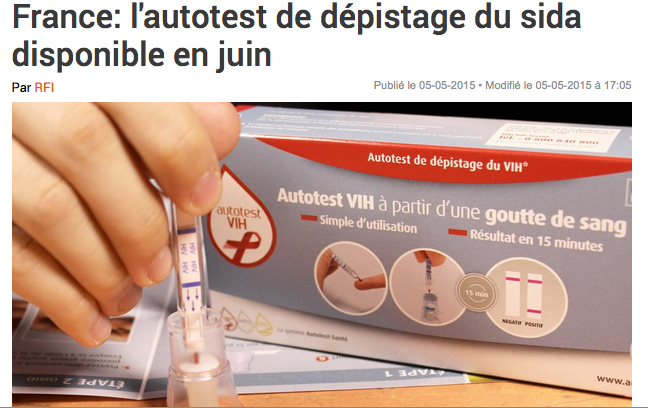
Here are some of the vocabulary items that I didn’t know in the RFI story:
dépistage: in a medical context, “screening.” Otherwise, tracking down, tracing, or detecting.
dépister: to screen or detect; in the case of a thief, to track down; in the case of a pursuer, to throw off the scent or to disorient.
le VIH: HIV. Abbreviation for virus de l’immunodéficience humaine.
la lingette: a baby wipe or other disposable wipe.
le pansement: band-aid. (Don’t pronounce the e between s and m.)
la grossesse: pregnancy.Une lingette, un pansement, une aiguille et le fameux test qui ressemble plus ou moins à un test de grossesse : voilà le kit qui permettra à chacun de se dépister soi-même. “An alcohol wipe, a bandaid, a needle, and the famous test that more or less resembles a pregnancy test: there you have the kit that will let everyone screen themself.”
banaliser: The most context-appropriate definition for this that I can find on WordReference.com is “to make commonplace.” I think there’s more to it than that, as I ran across the past participle of this verb the other day in the expression voiture banalisée, “unmarked car.” Pour les associations de lutte contre le sida, ces autotests sont précieux, ils permettront de banaliser le dépistage du VIH car aujourd’hui encore, en France, 28 000 personnes ignorent être séropositives.
ignorer: to not know, to be ignorant of, to ignore. Pour les associations de lutte contre le sida, ces autotests sont précieux, ils permettront de banaliser le dépistage du VIH car aujourd’hui encore, en France, 28 000 personnes ignorent être séropositives.
Police in France are pissed. In France, pretty much any group can and will demonstrate and/or go on strike. Manifestation (“demonstration”) is a word that you learn in French 101–it’s not typically a 101-level vocabulary item, but it’s so totally culturally relevant in France that you really need to know it.
The police are generally an exception to the French tendency to demonstrate–in fact, they haven’t done so in 30 years. All of that changed this week, when thousands of French police officers demonstrated in cities all over France. They are protesting a lack of resources, as well as a general laxness in the criminal justice system, the latter complaint having been stimulated by the murder of a police officer by a criminal on leave from jail.
Policing in France, especially in Paris, is interesting. As Jean-Benoît Nadeau and Julie Barlow explain in their book 60 million Frenchmen can’t be wrong, French mayors generally have control of the local police force in their town. Paris is the exception to this. Rather than being policed by a local force, Paris is protected by the National Police. (Look at the shoulder patches of every policeman you see in Paris the next time you’re there–you’ll see.) Nadeau and Barlow explain that this is because France doesn’t trust Paris with a police force of its own, for fear that the city will rebel. I couldn’t understand why people would think this was a possibility until recently, when I read about the Paris Commune of 1871 in Graham Robb’s Parisians: An adventure history. The Commune was an anarchist revolutionary government under which Paris briefly broke off from the rest of France after basically having been abandoned in the 1870-1871 Franco-Prussian War. The army crushed the Parisian populace in a brutal assault known as la semaine sanglante (“the bloody week”).
The National Police themselves have an interesting and somewhat bizarre history, having been founded by Eugène François Vidocq, a career criminal who became a law officer and later started the world’s first private detective agency. (He may also have faked the storming of a barricade during the Commune–see above.) But, we’ll save that for another time.
défiler sous les fenêtre de quelqu’un: No exact translation. It means something like to protest in front of someone. Literally, it’s “to parade under the windows of someone.” The police have been défiler sous les fenêtres’ing the Ministry of Justice.
In hopes of getting me able to pass the DALF, we’ve been looking at verbs whose infinitive ends with IR. We’ve looked at regular IR verbs, like finir.
We’ve looked at irregular verbs like courir, dormir, partir, sentir, and sortir:
finir
courir
dormir
partir
sortir
je
finis
cours
dors
pars
sors
tu
finis
cours
dors
pars
sors
on
finit
court
dort
part
sort
nous
finissons
courons
dormons
partons
sors
vous
finissez
courez
dormez
partez
sortez
ils/elles
finissent
courent
dorment
partent
sortent
Now let’s look at yet another set of irregular IR verbs. This time, we’re going to figure out a way to remember which verbs belong to this class:
ouvrir
couvrir
offrir
souffrir
je
ouvre
couvre
offre
souffre
tu
ouvres
couvres
offres
souffres
on
ouvre
couvre
offre
souffre
nous
ouvrons
couvrons
offrons
souffrons
vous
ouvrez
couvrez
offrez
souffrez
ils/elles
ouvrent
couvrent
offrent
souffrent
First, what’s unusual about this class? It’s the endings–they are the same as for ER verbs, which the IR verb endings usually differ from quite a bit.
Now, how can we remember these? It turns out that finding patterns in this kind of data is what linguists do all day. Here, the pattern appears to be related to the consonantal structure of the verb roots. To understand what’s going on, you need to know a few things about the sounds of language.
To simplify quite a bit: speech sounds are produced by making air leave the lungs through the mouth. Look in the mirror while you make the sound ah. Close your mouth and try to make the sound ah. Doesn’t work.
Consonants are made by obstructing the flow of air through the mouth. Look in the mirror while you say bah-bah-bah. See how the flow of air is obstructed completely when you make the sound that we represent with the letter b?
Different consonants are made by obstructing the flow of air at different places. Look in the mirror while you make the sounds bah and kah. Does your mouth look the same, or different?
Now that you have some of the basics of how consonants work, let’s look at the sounds in the roots of these verbs. You notice that (1) there is a cluster of consonants (i.e., more than one); the second consonant is r; and the first consonant is one of f or v. Look in the mirror while you make the sounds fah and vah. You’ll notice that the obstruction for these consonants is made with the lips and teeth. (We’ll talk about how you differ between the f and the v some other time.) Consonants that are produced with an obstruction made by the lips and teeth (actually, just one lip) are called labiodental consonants, or labiodentals.
It turns out that French has exactly two labiodentals: the sound that we usually spell with the letter f, and the sound that we usually spell with the letter v. (In the languages of the world, there are two other labiodental consonants. We don’t have a way to spell them in English, but you probably have one of them–the labiodental nasal–in the English word emphasis.) So, we can say that you see this particular pattern of verb endings when a verb has a consonant cluster in the middle, the first consonant is a labiodental, and the second consonant is r.
I know of three verbs that don’t have the labiodental-r root but that do have this pattern in the present indicative. However, they behave differently from the others with respect to their past participles. Those verbs are cueillir (to pick, to gather), acceuillir (to receive, to greet), and recueillir (to collect, to gather). The present indicative is like the labiodental-r verbs that we’ve seen.
However, the past participle of these verbs is different from the labiodental-r verbs: couvert versus ceuilli. There are also a couple of verbs that have -aillir in the stem that have the same present tense pattern, maybe–one of my Bescherelles has a note about how even famous writers sometimes don’t follow this pattern for those verbs.
So, with a little bit of linguistics, you don’t have to memorize the fact that it’s verbs with fr and vr in the root that have this conjugation–all you have to do is remember that it’s verbs with a consonant cluster in the root where the first consonant in the cluster is a labiodental. Fun, huh?
Update, 1 March 2016: pubmed.mineR has recently been updated a couple times. Since the most recent update (1.0.5), the old API works again, so the code on this page will work. However, I have not been able to reproduce the (wonderful) results that I had before the recent updates to pubmed.mineR. Use with caution.
Something a bit different today: a little manual for using a package for the R programming language for text mining.
Pubmed.mineR is a “library” for doing text mining from the PubMed/MEDLINE collection of documents. PubMed/MEDLINE contains references to about 23 million articles in the domain of biomedical science, broadly construed. It was released with documentation for the various and sundry methods that it provides, but no manual. This blog post is an attempt to put together a basic manual for using it, with some code examples. Pubmed.mineR was written by Jyoti Rani, Ab Rauf Shah, and Srinivasan Ramachandran. You can find an article about it here, and some documentation here.
First, you need to have the input data in the right format. Here’s a screenshot from one of the authors, Ramachandran, showing how to do a manual query and then save the results in the proper format:
Downloading PubMed/MEDLINE abstracts in a format the Pubmed.mineR can deal with. Photo source: Ramachandran.
Here is some sample R code for the library:
# import the library library(pubmed.mineR)
# read in the abstracts abstracts <- readabs(“pubmed_result.txt”)
abstracts is an object of type S4. This is a kind of class used for doing object-oriented programming in R. abstract is printable with print(abstracts). An S4 object stores its data in slots. To understand slots in R, try this web page: http://stackoverflow.com/questions/4713968/r-what-are-slots.
The abstracts class has the following slots:
Journal: This returns a vector of the names of the journals for each publication in the whole collection.
Abstract: This returns a vector of the abstracts for the whole collection.
PMID: This returns a vector of the PMIDs for the whole collection.
(It’s worth noting that the elements of some of these vectors have some oddities. For example, when you get the vector of titles, you’ll notice that each one is prefaced with the number of the element of the vector. I suggest looking at these outputs closely, as I’m sure that I haven’t picked up on all of these oddities.)
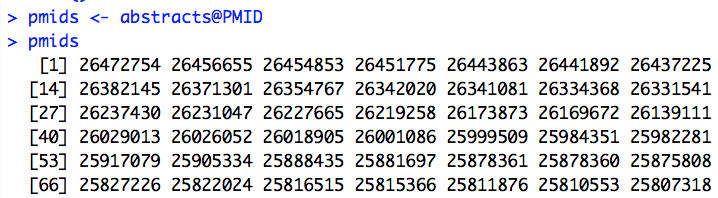
So, this line of code will get you a vector of the PMIDs (some columns trimmed from the output for readability):
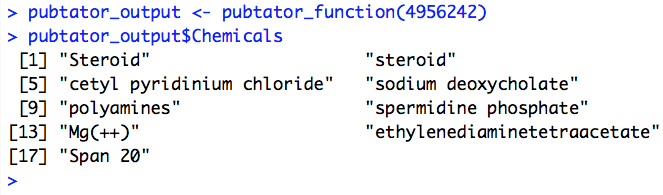
Once we’ve got a PMID for an abstract, one thing that we can do with it is send it to PubTator. Once we can do that, we can get access to lists of the genes, mutations, diseases, and chemicals that are mentioned in the abstract. (Some columns of output omitted for readability.)
These lines of code will get you access to the rest of the stuff in the PubTator results:
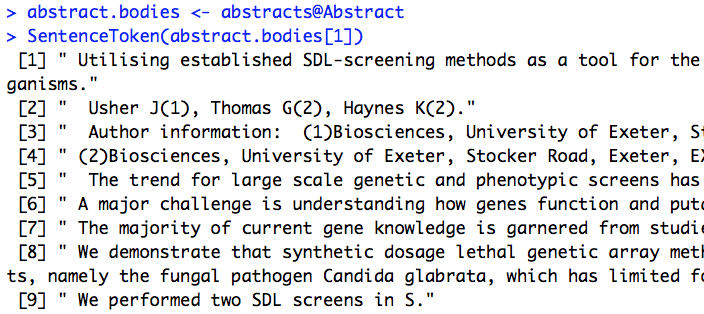
It’s pretty common to want to iterate over all of the sentences in an abstract. You can do that by getting a vector of the sentences with the SentenceToken() method. It has to be passed a character string, so you’ll want to pass it an element of the vector of abstract bodies that you get from abstracts@Abstract:
A question that immediately arises is whether you can pass individual sentences to the PubTator function. I haven’t had good luck with that–it always seems to return “No data.” So, I guess that I would try running pubtator_function() on the whole abstract, and then search individual sentences for the things that pubtator_function() returns with a regular expression or substring function or something.
This doesn’t exhaust everything that you can do with pubmed.mineR, but it should be enough to get you started. Good luck, and if you figure out how to do something cool with it that I haven’t talked about, please tell us in the comments!








 Zipf's Law

