With the world apparently going violently crazy–this year is only 14 days old, and so far we’ve had terrorist attacks in Istanbul, Tel Aviv, Jakarta, Hurghada (Egypt), Marseille, Kabul–more than I have the patience to list, actually (Wikipedia says 28 of them), and that’s not even counting the nutjobs occupying federal property in Oregon, who haven’t actually killed anyone yet–the news from France is full of stories of searches, arrests, and the like. A bit of trivia: according to Wikipedia, the English word terrorism comes from the French word terrorisme, which originally referred to the policies of the revolutionary government during the Reign of Terror (1793-1794). Here’s some of the relevant vocabulary that keeps showing up in the news these days. Definitions from WordReference.com:
la garde à vue: custody. Not to be confused with:
le garde-à-vous: attention (the military posture). If you’re French: to us Americans, this sounds just like garde à vue–really.
être placé en garde à vue: to be held in custody.
mettre en garde à vue: to put in custody or to send back to custody–I’m not sure about this one.
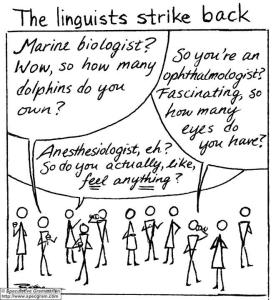
Linguists and normal people can be quite different. Here’s one way.
A difference between linguists and normal people: non-linguists get excited about irregular things in language, while linguists mostly don’t. I can hardly go to a wedding, bar mitzvah, or quinceañera–any place where you meet new people, basically–without someone saying “isn’t it funny how the plural of foot is feet?”… or something along those lines. From a linguist’s point of view, the irregular ones are the easy ones–for a child to learn them, all they have to do is remember them. In contrast, for the regular forms, the child actually has to figure out a system–a much more abstract problem. From another perspective, suppose that your job (like mine) has to do with figuring out how to make computers process language. The irregular things are easy–there’s a limited number of them, so the program can just look them up. In contrast, the regular ones are essentially infinite (languages add new words all the time, and they’re almost always regular), so the computer has to be able to figure them out somehow (and that’s how I stay employed). So, linguists mostly aren’t that interested in irregular forms–regular ones are much more what we’re trying to figure out. But, one needs to know the irregular verbs–hence this post about verbs that are irregular in the future tense. (See here for verbs that are regular in the future tense.) Of course, like the majority of verbs, the frequency of any of these (irregular) verbs is quite low, so Zipf’s Law comes into effect–see below for how that led to an embarrassing incident for me in a bookstore.
The good news about verbs that are irregular in the future tense in French is that the inflections stay the same. The bad news is, there are still a lot of verbs that manage to be irregular. I’ll try to arrange them in some sort of structured way that makes it easier to see what kinds of patterns tend to recur in the irregularities. Note: Watch the pronunciation of these–some of them are non-intuitive. I suggest listening to the recordings on this page on the Tex’s French Grammar web site.
There are two things that make memorizing the irregular future tense forms a bit less intimidating:
The inflections (endings for person and number) are the same even in irregular futures.
There’s always going to be an r.
OK, let’s try to group these. What we’d like to find is groups where a particular infinitive form maps to a particular irregularity–not always possible, but when we can, it should help us in our memorization. Throughout, I’ll give the il/elle/on form of the conjugated verb. Note that some verbs may show up in more than one
grouping. Don’t see that as a problem—see it as an extra opportunity to remember
the form.
One pattern is that roots that do not have a d get a d added in the future tense.
venir
viendra
tenir
tiendra
obtenir
obtiendra
Do those have anything in common? Hells yeah–the root ends with -enir.
Some verbs with an l lose it when this picking-up-a-d thing happens:
falloir
faudra
vouloir
voudra
Another pattern is that some verbs end up with a double r, sometimes losing the final consonant of the root in the process:
mourir
mourra
courir
courra
envoyer
enverra
pouvoir
pourra
voir
verra
Here’s a pattern where oi goes away, leaving behind a v:
devoir
devra
pleuvoir
pleuvra
recevoir
recevra
There’s one that I can’t make fit into any other grouping, and it’s one with an embarrassing story attached to it. I went into a great travel book store in Paris (Librairie Ulysse on the Ile Saint-Louis) and asked for books about Benin. (If it’s in italics, it happened in French.) Are you going to Benin? asked the owner. I don’t know–I have an application in to a volunteer program there, I answered. When will you saurez?, she asked. I stood there with a panicked look on my face until I remembered that saurez is the irregular future tense of the verb savoir, “to know.”
savoir
saura
There are some super-irregular ones that are very important, just because they occur very
frequently: être (to be), aller (to go), and faire (to do, to make). This post is long enough already, so we’ll come back to these another time.
Remember: from a linguist’s point of view, the irregular verbs are the easy ones. So:
no complaining—just memorize them with me! And, if you can come up with any patterns/groupings that I missed, I would love to hear about them.
Screen shot of Rolling Stone’s tweet announcing the Sean Penn/El Chapo interview. That’s Penn on the left and El Chapo on the right.
The French press is just as abuzz about the whole Sean Penn/El Chapo thing as the American press is. In case you’re reading this 10 years from now: “El Chapo” is the nickname of Joaquin Guzman, until recently one of the biggest drug dealers in the world–he may still be, although from behind bars. He was arrested and imprisoned in 1991, and then escaped. He remained free until 2014, when he was recaptured and, again, imprisoned. In 2015 he escaped again, this time apparently being driven down an underground tunnel on the back of a motorcycle.
All was well for him until he decided that a movie should be made about his life. He reached out to the motion picture industry, which somehow led to him being “interviewed” by American actor Sean Penn, the resulting interview being published in Rolling Stone magazine. This exposure led to him being captured once again, and at the time that I write this, he is still in jail, hoping like hell he doesn’t get extradited to the United States.
We actually have two Zipf’s Law connections with this story–one regarding Sean Penn, and one regarding El Chapo.
Some time ago, we read about the filles du roi–the French orphans who were sent to Canada to get married and increase the French-speaking population in North America between 1663 and 1673. You might recall from that post that Madonna is descended from a fille du roi. In 1985, she broke the heart of every young man in America by marrying Sean Penn.
El Chapo’s Zipf’s Law connection is lexical–i.e., one of those bazillion words that is not particularly unusual, but that you nonetheless almost never hear (in the big scheme of things). As I said, El Chapo is all over the news, and he is almost referred to by his name–Joaquin Guzman–followed by surnommé El Chapo, meaning “nicknamed El Chapo.” Here’s an example from France 24‘s web site:
Les autorités mexicaines ont annoncé vendredi l’arrestation de Joaquin Guzman, surnommé “El Chapo”, le plus important narcotrafiquant mexicain, qui s’était évadé de façon rocambolesque d’une prison de haute sécurité le 11 juillet dernier.
On Friday, Mexican authorities announced the arrest of Joaquin Guzman, nicknamed “El Chapo,” the most important Mexican drug trafficker, who had escaped in an extraordinary fashion from a high-security prison last July 11th.
Surnommer is a great example of Zipf’s Law–not particularly unusual, but low-frequency enough that I haven’t run into it in two years of studying French quite seriously. Again, it means “to nickname.” I’m not telling you any of my nicknames…
The Crystal Ball, by John William Waterhouse. La boule de cristal, in French. Picture attribution: John William Waterhouse [Public domain], via Wikimedia CommonsI’ve been reading predictions about the United States and France in 2020. The Euromonitor International website says that the US had the largest economy in the world in 2010, but will have slipped to #2 (behind China) in 2020; it says that France had the 7th-largest economy in 2010, but will have been displaced by Brazil to drop to #8 by 2020. According to the Congressional Research Service, France got 10.3% of its energy from renewable sources in 2005, and has a target of 23% by 2020. Statista.com thinks that the US small arms market will sell $3,985,000,000 worth of firearms in 2020, and that the total population of France (currently 64.21 million) will be 65.7 million. (The US should be a bit above 330 million.) Americans are projected to eat 5,404 metric tons of cheese in 2020; statistica.com cut me off before I could get the relevant numbers for France, but revenues from cheese sales in France last year should have been about $37.71 billion.
Talking about any of these predictions requires that we be able to use the future tense. And, there’s no time like the present to talk about the future, right?
For starters, let’s look at the inflection of a regular verb or two. Well: three… We’re going to concentrate on the particular future tense called simply the futur, as opposed to the futur proche. As the French Crazy web site explains it: while the futur proche or “near future” tense (the one formed with the verb aller) is used to refer to “events that are certain to occur and are happening relatively soon”, the futur “is used to talk about more general or distant future events. These events are slightly more uncertain because the amount of time needed to elapse is greater than the near future.” Here is the paradigm for the futur. I recommend that you listen to the pronunciations of even the regular -er verbs on the Tex’s French Grammar web site. For your convenience, I’m going to use the same examples as Tex:
nager (to swim)
réfléchir (to think)
rendre (to give back)
je
nagerai
réfléchirai
rendrai
tu
nageras
réfléchiras
rendras
on
nagera
réfléchira
rendra
nous
nagerons
réfléchirons
rendrons
vous
nagerez
réfléchirez
rendrez
ils/elles
nageront
réfléchiront
rendront
It’s way too easy to confuse the future with the conditional, and we’re going to need both of them to form the compound tenses that we’ve been talking about lately, so let’s look at the potential points of confusion between the two.
The potential problem comes from the fact that both the futur and the conditionnel maintain the r sound of the infinitive. One of the linguist’s best approaches to everything is to look at “minimal contrasts,” so let’s try that.
In the first person singular (je), the futur and the conditionnel sound the same. This screws me up constantly when I’m listening to someone else. In writing, though, they are differentiated by the presence of a (silent) s in the conditional:
nager (to swim)
réfléchir (to think)
rendre (to give back)
Future
je nagerai
je réfléchirai
je rendrai
Conditional
je nagerais
je réfléchirais
je rendrais
The tu and on (first person singular informal and third person singular) inflections are not very confusable, but the nous (first person plural) inflections are. Here the difference is that the conditional has an i:
nager (to swim)
réfléchir (to think)
rendre (to give back)
Future
nous nagerons
nous réfléchirons
nous rendrons
Conditional
nous nagerions
nous réfléchirions
nous rendrions
There’s a similar “minimal contrast” in the vous (second person singular formal or second person plural) inflections:
nager (to swim)
réfléchir (to think)
rendre (to give back)
Future
vous nagerez
vous réfléchirez
vous rendrez
Conditional
vous nageriez
vous réfléchiriez
vous rendriez
The ils/elles (third person plural) forms are pretty distinct, so we’ll skip those, too.
There are tons of verbs that are irregular in the future, so we’ll come back to the future in a future post. (Sorry.) There are also a number of differences in when the future tense versus the present tense get used in English versus French, and we’ll come back to those, too. In the meantime: I’m going to have a cup of coffee. (How many different ways have I formed the English future tense in this paragraph?)
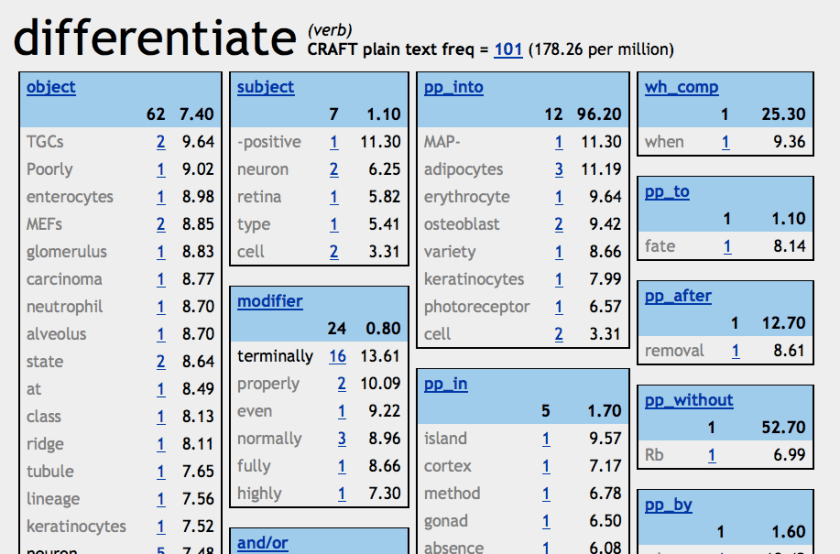
Picture source: screen capture by me of Sketch Engine’s analysis of the behavior of the word “differentiate” in a set of documents about mouse genomics.
One of my pet peeves is people making spurious claims that there are some languages in which there are ideas that just can’t be expressed. This is often preceded by uninformed crap like “there are primitive languages that only have 100 words, right?” (There are no such languages.) Do I know words in language X that we don’t have in English? Sure. For example, there is no equivalent single word in English for the Yiddish word נחת (nakhes). Does that mean that you can’t express the idea in English? Certainly not. Nakhes is a mixture of pride and pleasure–in the prototypical case, you get it when your children do something good.
Now, you may be thinking of a Wittgensteinian counter-argument to this. My French tutor has the following quote from Wittgenstein in her email signature: The limits of my language are the limits of my world. What did Wittgenstein mean by this? He didn’t mean (and, yes, I will have this post reviewed by a philosopher, as I am not one) that it’s the limits of his language that form the limits of his world, and that if he spoke some other language, perhaps the limits of his world would be different. Rather, his point was that the limits of language in general are the limits of philosophy–he maintained that what we can’t talk about, we can’t think about, and so–as they might put it on the French high school exit exam–philosophy is doomed to always be betrayed by language. Wittgenstein is not claiming that his language limits his “world”–he’s claiming that all language in general limits the ability to think, and hence to philosophize.
The Zipf’s Law connection: I needed a word today, and I couldn’t find it in my native language, but I did find exactly what I needed in French. I was writing an email in which I tried to explain the good points and the bad points of a web-based tool that I use in my work, some of which involves formalizing the semantics of the language of bioscience. As an example, I pointed out what hints it gives me about the kinds of prepositions that can go with the word differentiate, and in particular, how they encode the fact that a cell can differentiate in a particular location–cortex and gonad in the examples above–but that if it differentiates into something, that has nothing to do with location at all, but rather with the outcome of the differentiation–in the examples, we’re talking about cells differentiating into different kinds of cells. (It’s the ability of stem cells to do this that makes them stem cells. Cellules de souche, I think they’re called.) This is a specific weirdness of the word differentiate–it has a very word-specific relationship with the preposition into. What to call that “specific weirdness”? Here’s the best that I could come up with:
I was using the French word spécificité here. La spécificité refers to a special feature of something. You could translate it with the word specifics, but that wouldn’t go right in this sentence. I could imagine using the word idiosyncracies here, but that has an implication of abnormality that wasn’t quite right for the context, either–as a linguist, I don’t think in terms of normativity where language is concerned. Spécificité has no such connotation in French, as far as I know–for example, when people describe me in French in terms of my profession, they often say that one of my spécificités is that I work on biomedical language.
So: on my journey to learn to speak French, I’ve finally come upon one little thing that I know how to say in French, but not in English (my native language). If you don’t mind, I’m going to think about this not as a reflection of my inarticulateness in English, but as a mark of improvement in my French. Undoubtedly this bit of hubris will be retaliated for by the embarrassment of me not understanding a simple question about the location of the bathroom at some point in the course of the day, but I’ll live with that.
Want to irritate a linguist? Caution: this technique will get you an immediate lecture, and you’re probably not going to find that lecture very interesting. Here’s what you do: ask them how many languages they speak. This will irritate the shit out of us. We will respond something like this: “linguists are not people who speak lots of languages. People who speak lots of languages are called polyglots. Linguists are people who study the phenomenon of language as a system–not necessarily any particular language, but language in general.” For example: my master’s thesis was about vowels and the evolution of the vocal tract. My doctoral dissertation was about using linguistic field work techniques to test software programs.
Personally, if you push me, I will disappoint you by responding “one–English.” I would never say that I “speak” Spanish, although I’m quite at home in it, or that I “speak” French, even though I’m reaching the point where I can use it professionally. This is a guaranteed technique for irritating a linguist! It’s not the only one, though–watch this space for others.
Le/la polyglotte: polyglot. Note that it can be either grammatically masculine or grammatically feminine. This democratization of the grammatical gender of words for professions that don’t have explicit gender-marking is a hot topic in France right now, particularly in the case of Madame le ministre versus Madame la ministre for government ministers like Ségolène Royal. (By the way: I just Googled her to make sure that I was spelling Royal correctly, and discovered that Google’s autocomplete suggestions are consistent with the hypothesis that people often look for naked pictures of her.) The French Academy declines to endorse the Madame la ministre construction, but nobody listens to the French Academy much anyway.
When I’m in France, I don’t make any effort to look or to act French, other than common courtesies like saying bon jour when I walk into a shop, not talking loudly on the train, and of course speaking French. I figure that it’s useless to try to “pass,” and it doesn’t really seem worth trying.
However, there are definitely things that I do routinely in America, but would never do in France. Here are some examples.
Wear a beret
This is the big one. In Paris, no one, no one, NO ONE wears a beret. OK: once in a rare while, a girl, but only if it accessorizes her outfit perfectly. Otherwise: it just doesn’t happen. In a year and a half of hanging out in France off and on, I have seen exactly one man wearing a beret. Just don’t do it.
On the other hand, in America, I feel free to do so. It’s a little weird, but at my age, you’ve long since stopped worrying about looking normal. For someone who, like me, is completely bald, in certain weather it’s the perfect way to keep my head warm. As my baby brother would say: in the winter, I rock my beret.
Say hello to strangers on the street
I read somewhere that walking down the street in France smiling and nodding at people you don’t know will be taken as a sign of either insanity or senility. However, saying hello to strangers is something that is difficult for us Americans not to do. True, the whole thing is complicated by an interaction between race, gender, age, and social class, and it works differently in different parts of the country–but, yes: there are definitely situations in which you would say hello to a stranger while walking down the street in a typical American city. I counted: three people said hello to me on my way to work today. (I’m in America at the moment.) I probably couldn’t tell you what internal calculations went into the largely unconscious decision about which strangers I greeted myself and which I didn’t, but it’s definitely a thing here.
Eat hamburgers
Eating a hamburger in France just seems wrong. There are so many other great things to eat that we can’t get in America, and besides, why would you think that a French restaurant would do a good job with a hamburger? Plus, there are strong cultural reasons not to do so. As one French person said to me: I don’t ever walk into a McDonald’s–it’s against my beliefs. In America, on the other hand, I will allow myself a Whopper every couple months. Not healthy, but sooo good…
Hug people
At the end of my first stay in France, my host had a little pot for me–a small party with drinks. When it was time for me to say my last goodbyes, Brigitte leaned towards me, and I towards her–her to give me a bise, and me to hug her. We both jumped just a bit backward, in only partially hidden shock. My host was watching, and observed, with a laugh: of course–he’s American, and he does what Americans do, and she’s French, and she does what French people do. The people with whom you would hug in France are quite limited. I didn’t even know that there was a verb for hugging in French (étreindre) until I was writing this–I’d only ever heard the expression prendre dans ses bras, to take someone in your arms.
In contrast, in America, I hug people all the time. I haven’t seen my grad student for a while? He gets a hug. First time back in my lab after a few weeks in France? Hugs from all of the administrative staff. Judo tournament? Hugs for all of my friends, then trying to kill each other, then hugs again. Kisses, on the other hand, are only for family–my father, my son, my brother, my cousins, my aunt.
So: by the time I go back to France, I will have worn a beret, I will have said hello to strangers on the street, I will have eaten a hamburger, and I will have hugged people. If I were going to admit to these behaviors which will be completed at some point in the future, what grammatical construction would I use? In French, it’s the futur antérieur, or future perfect. Remember that “perfect” refers to things that are completed–the future perfect tense is used to refer to things that will have been completed in the future. (See, that’s a future perfect right there–will have been completed.)
The formula for the futur antérieur is quite simple:
future + past participle
The verb in the future can only be one of avoir or être, so the number of verbs for which we have to know the future tense in order to form the futur antérieur is not at all daunting. Whether it will be avoir or être is determined by the usual rule(s). Here are some straightforward examples–we’ll get into negation, reflexives, etc., in the future.
You will have been the best thing that happens to me this year.You will have had what you wanted. (Note the coquille (typo): “se” should be “ce.”At least we’ll have eaten pizza.
By the time you read this, I will have spent, like, ages responding to emails. I hate email!
My organic chemistry professor used to say that repetition is the mother of genius. I believe him to be right–certainly about language-learning. I’m fairly sure that some strategies for repetition are better than others, though. One that I believe comes from Georgetown University’s excellent applied linguistics program works like this:
Repeat something several times. For example: repeat the je form of some conjugation several times–that is, for several different verbs.
Repeat things with which it contrasts several times. For example: do the on form several times. Do the nous form several times. Do the ils/elles form several times.
Mix them up. Do je, then on, then tu, etc.
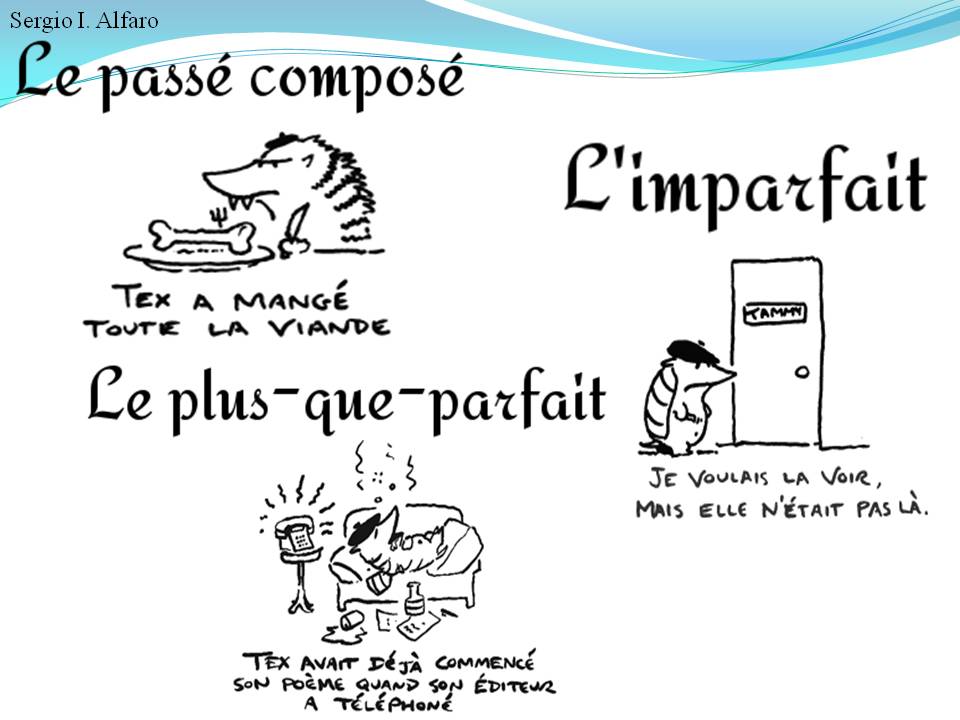
In that spirit, let’s go back to the plus-que-parfait. (See this post if you don’t remember what that is.)We’ll do a couple examples of each person and number. Remember that the only auxiliaries are avoir and être, so in a way, we’re really practicing the conjugation of the imperfect forms of these verbs. (See here for a review of the imperfect.) Because it’s difficult to search for particular combinations of tenses, I’m going to focus on the pattern “had already,” since “already” in English will usually get you the plus-que-parfait in French. Most of the examples will come from the linguee.fr web site, which makes it fairly easy to search by a phrase (as opposed to just a word). The exception is the tu examples, since that’s a pronoun that doesn’t get used very often on the linguee.fr web site. For tu, I’ll use Twitter.
Je:
Source: linguee.fr.
Tu:
“Why you re-tweet the tweet that you had already tweeted?”“@JuEymr because you had already started?”
Il/elle/on:
Source: linguee.fr.
Nous:
Source: linguee.fr.
Vous:
Source: linguee.fr.
Ils/elles (and notice the lesquelsin the second one):
This one is just too delicious to allow to pass by without notice–back to it later:
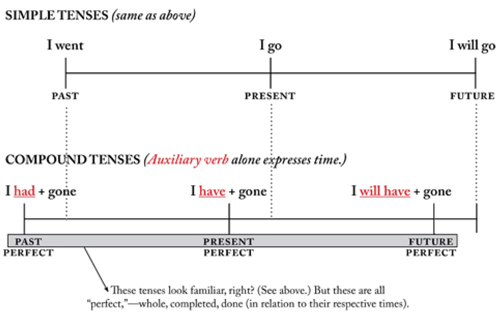
Let’s talk about the plus-que-parfait. This is the French tense (technically, it’s an aspect, but I’ll try to leave the technical stuff out of this) that corresponds to things like I had vomited in English.(More on vomiting below.) In English, we call it the past perfect. It’s what we call a compound tense (see this post for an introduction to compound tenses and what makes them interesting).
If you want to talk about any of the compound tenses with your French teacher, you’re going to need to be able to remember their names. I find it easier to do that if I understand why a tense is called what it’s called, so let’s look at the Wikipedia page on the plus-que-parfait:
The word derives from the Latinplus quam perfectum, “more than perfect” – the Latin perfect refers to something that occurred in the past, while the pluperfect refers to something that occurred “more” (further) in the past than the perfect.
To expand on that a bit: the perfect, in grammatical terms, is used (in English, at any rate) to refer to an action that is completed. For example, while the past tense (a number of past tenses and aspects, actually) in English could be expressed as I vomited, the perfect would be I have vomited. If we wanted to express that the vomiting had been completed even before some other action, then we would use the past perfect: I had vomited. For example: I had vomited twice already before my mother came in and found me with my head in the toilet. Why this is the past perfect: it’s a perfect–a completed action–that is in the past tense with respect to something else. We’ve got two past-tense verbs in that sentence: came, and found. Prior to those events that we’re talking about in the past tense, the vomiting had been completed–in other words, a perfect that occurred prior to–in other words, in the “past tense” with reference to–something else that was in the past itself.
So, on to how to form the plus-que-parfait in French. It’s a simple formula:
imperfect + past participle
We looked at the imperfect in a recent post, so no need to go into that any further right now. The past participle could be any verb, but the imperfect is always going to be either avoir or être, according to the same rules by which you would select one or the other for the passé composé. So, here’s a straightforward example:
Shit, someone just told me that I had vomited yesterday…. (A little coquille (typo) there: it should be on vient, not on viens.)But why has Lassana Bathily who had aided the hostages of the Hypercasher been the only hero “forgotten” by the Legion of Honor 2015?
A nice one, with two examples–one with avait, and one with était:
El-Shaarawy left Monaco. At the same time, no one had noticed that he had arrived….
Here’s one with negation (it’s always important to think about negation early when you’re trying to figure out a verbal system):
The moral of the story of Chloe Florin, it’s that even your closest friends can betray you one day. She hadn’t asked for anything!
More negation:
Remember the time when Louis almost kissed Harry because he hadn’t seen the camera.
Here’s another one with the verb être as the imperfect verb (I know, it’s weird that the perfect is marked with a verb that we call “imperfect,” but that’s language for you–it’s never logical in the ways that one would think it should be):
I dreamt that I met @AjoyfulSquirrel for real and that there was a play Aventures that we had gone to see.
…and, a last one with être to wrap up our introduction to the plus-que-parfait:
He would have met fewer idiots if he had gone to school a little longer to learn to write :-)))))
Click here if you’d like to read more about the French plus-que-parfait.
The famous behavioral psychologist B.F. Skinner maintained that language-learning by children could be explained by the same process to which he attributed all learning: you get exposed to something, you get reinforced. Chomsky pointed out that this couldn’t explain how children learn language, since we can produce and understand linguistic things that we have almost never been exposed. One of my first professors used this example: he must have been being interviewed at that time. If you are a native speaker of English, I would guess that you had no trouble understanding that sentence, and it probably doesn’t seem particularly strange to you. For instance, you might have asked someone why Kevin didn’t show up for a meeting at 9 AM yesterday, and perhaps the person who you asked knows that Kevin was being interviewed for something or other at 9 AM, and answers he must have been being interviewed at that time. However: the sentence is unusual in that it combines every possible place in a sentence where you could use a modal auxiliary in English. (Modal auxiliaries in English are words like must, have (when it modifies another verb), and things like that.) Chomsky pointed out that you will very, very rarely run into structures like that–and yet, as an adult native speaker, you have no problem whatsoever producing or understanding them. This is known as the poverty of the stimulus argument against Skinner’s conception of how children learn language: if you’re not exposed to something, then Skinner has no explanation for how you can learn it. (There are other aspects to the poverty of the stimulus argument–you can see some of them on this Wikipedia page.)
How this fits into my struggles to learn French: I suck at “compound tenses” like “had been interviewed,” and stuff like that. In French, not in English! Objective, third-party evidence of my suckiness in this respect: I recently took a French assessment test on the Lawless French web site, hoping to end up with something like the DALF C1 level that I’m planning to test for, and only got a DELF B1 level! (That’s two below what I was hoping for.) Looking at my results, a lot of my problems came from the compound tenses, of which French has many. So: let’s learn them.
Looking over the various compound tenses in a Bescherelle, they’re somewhat less intimidating than I initially thought, in that as far as I can tell, they’re all formed with one of just two verbs: avoir “to have,” or être “to be.” (Undoubtedly I could have looked this up somewhere, but I remember things better if I figure them out for myself.) Some of the really outlandish ones are formed from tenses of these verbs that one would rarely see–j’eus été–but, you only have to know those tenses for these two verbs in order to be able to form all of those particular compound tenses. Then, as far as I can tell, the last verb in the compound will always be the past participle–so, again, you don’t have to remember quite as much as you might have thought.
With this introduction, we’ll look at some of the compound tenses in future blog posts. I’ll try to make the material less dry by including material from Twitter and the like (if I can find any–see above about the poverty of the stimulus). While you wait, there’s a beautiful page on compound tenses here.
























 Zipf's Law