How graduate school is like (American) football

This is an email that I wrote to a graduate student as they finished up an exceptionally heroic dissertation-writing experience. All identifying information has been changed: Robin is a gender-neutral name. Dalmatian was a Romance language spoken in Croatia. (It became extinct when the last known speaker, Antonio Udina, died in an accidental explosion in 1898.) Slivovitz is a delicious plum brandy that I recommend you drink with roasted lamb. Ilse Lehiste was a major phonetician and historical linguist of the 20th century, and the author of the classic Suprasegmentals. (I applied to Ohio State planning to study with her, not realizing that she had just retired—see my post on how not to apply to grad school.) David Sternberg is the author of the excellent How to complete and survive a doctoral dissertation. “T&K” is Sarah Thomason and Terrence Kaufman, the authors of Language contact, creolization, and genetic linguistics—when my undergraduate advisor made me read it, I lost all faith in distant reconstruction (in historical linguistics, at any rate) and ended up doing lexical semantics in a medical school. Banitsa is a delicious Bulgarian pastry.

Hi, Robin,

I’ve read through the most recent chapters that you sent.  Lots of progress–that’s great.

I’m going to start with what sounds like bad news, but actually isn’t: you should rethink this–a lot.  You are chasing some very specific hypotheses, and betting a lot on them.  What I recommend that you do instead is take a step back and look at the more general contributions that your dissertation can make, focus on those throughout the first chapters, and leave the theoretical implications for a later chapter.

What follows is based pretty heavily on my own approach to science in general, and other people could certainly have their own takes on the scientific enterprise, so if you decide to take my advice in this matter of the overall direction of your dissertation, you should discuss it with your advisor at the minimum, and preferably with the rest of your committee, too.  (Feel free to forward this email to the rest of your committee–I thought about copying everyone, but decided to let you stew on this yourself and then make your own decision about whether or not to do that.)
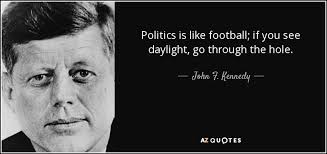
kennedy football daylight images
Picture source: http://www.azquotes.com/quote/156221

One of my fundamental ways of thinking about how to figure out what to publish in general, and how to focus a dissertation in particular, is David Sternberg’s notion of “daylight.”  “Daylight” is actually an idea from American football.  The goal there is to move a ball in a particular direction, while a bunch of big bruisers try to stop you from doing so.  [“Big bruiser” and other obscure American English expressions explained at the bottom of the post, as always.] The most basic advice for how to accomplish this is to look for an open spot between the big bruisers–one through which you can see “daylight”–and then run through it.  (Other approaches would be to try to knock the big bruisers down and run over them–if one wants to finish one’s dissertation in this lifetime, or score a goal in American football, it’s definitely easier to run through the open spot.  I think so, anyway.  ([Note to blog readers: no, I don’t play football–the real tough people play judo.]) 

In the context of a dissertation (and, to some extent, scientific publishing in general), “daylight” is whatever you can contribute to science that hasn’t been contributed to science before.  There are a lot of forms that “daylight” can take:

1) No one has ever written about X before.

2) Someone has written about X before, and/but you looked at it again, and found different facts.

3) Some theory makes a prediction about X, but no one has ever actually tested it.

4) Even better: some theory makes a prediction about X, but no one has ever actually tested it, and you have data that suggests that the prediction is wrong.

5) There are contradictions in the literature.

There are others, but these seem like the most salient ones, at least for a linguist.

So, what do you want to see in a linguistics dissertation, in particular?  Personally, I want to see two things.  In particular, I’d like to see the two main things in (American) linguistics:

1) Description

2) Theoretical implications

football run to daylight 58106302-19ef-4fab-8b03-e665e1731df5_red_rtd_itunes_3000
Picture source: http://www.azquotes.com/quote/156221

Back to the generalities: in general, you want (or I want, at any rate), in science in general, to work on questions such that whatever the answer turns out to be, it’s interesting.  For example, (3) and (4) on my partial list of kinds of “daylight” are both versions of the same method: let’s test theory X.  Theory X works in the case of your question?  Great, if no one has ever published that before.  Theory X doesn’t work in the case of your question?  Even better.  Either way: you win.  You win because you’re not invested in any particular outcome–this is the time to be that most dispassionate of dispassionate scientists, only interested in knowing what the truth is.

 

vince lombardi run-to-daylight-9781476767178_lg
Picture source: http://www.simonandschuster.com/books/Run-to-Daylight!/Vince-Lombardi/9781476767178

If you buy all of that: let’s think about your dissertation in terms of where the daylight is.  Let’s also think about it as linguistics, per se–that is, in terms of description and theory.  When I write the following, I’m writing it on the basis of my knowledge of what the literature already covers, and you certainly know the relevant literature better than I do, so if you disagree, I’m going with your judgement, not mine.  I went through the current chapters and highlighted every place where you mention that no one has ever done something before, and you have:

1) Dalmatian is phonetically understudied.  This is the first acoustic phonetics study of Dalmatian.

2) “To my knowledge, there has never been any study performed to compare the acoustic variations in different dialect groups of Dalmatian speakers.”

3) From p. 16: “My data provides examples of phonological processes that have not been previously mentioned or evaluated.”

4) Does the acoustic observation of sound variation in Dalmatian show consistency in all Dalmatian dialects?  No one else has looked.

5) No one has ever studied code-switching in Dalmatian speakers before–you have.

Now the disagreements (see 5 on my partial list of kinds of daylight):

1) There is disagreement on the number of vowels and consonants in Dalmatian.  You have an answer.  (I didn’t say “the” answer–you don’t have to have “the” answer–just an answer that is well-supported by data and by argument.)

2) Lehiste gives an excellent account of Dalmatian contrasts, but doesn’t capture the variation between dialects.  You do.

3) P. 29: “…there is a disagreement among scholars, whether or not this sound belongs to the vowel inventory of Dalmatian.”

Predictions:

1) Slivovitz says that U and o are allophones–you show that it’s more complicated.

2) Banitsa predicts palatalization–your data shows otherwise.  (Your effort to elicit the palatalized consonants was not “unsuccessful,” as you described it–it was a *successful* effort to find out whether or not they’re there.  Turns out they aren’t, for your speakers.)

3) From p. 20: “According to Mongo (2011), words typically have a single primary stress, which falls on the final syllable….My data shows that stress can also appear on the first syllable, as well as the penultimate syllable.”

4) Slivovitz claims all three insertion processes for all three dialects; you show that it doesn’t happen in Central.

5) P. 25: “The results of my examination demonstrate whether or not Thomason and Kaufman’s assertion applies to Dalmatian.”

Would any single one of these get you a PhD?  Unlikely.  Should all of them get you a PhD?  With some examination of the theoretical implications: yes.  I just gave you THIRTEEN contributions that your dissertation makes, and we haven’t even gotten to the stuff that you’ve mainly been focussing on, which is the whole language contact thing.

So: you’ve got the descriptive part of this covered.  Now you need some theory.  The theories: (a) language contact, (b) the internal, community-identity model (T&K) versus the structure model.  You know what you think Croatian contact might throw into the mix.  You know what you think Slovenian contact might throw into the mix.  You know what you think education, urban versus rural, and age might throw into the mix.  You didn’t just make those predictions up–they’re based on what we know about how language contact usually works, as well as what education does, urbanity does, age does.  Now: is what you would expect to be true based on all of that, true?  Do the predictions all hold?  If so: that’s nice.  Not very interesting, but nice–validation that you got the facts right.  Do the predictions not all hold?  That’s GREAT.  In science, we LOVE data that doesn’t fit theories!  That’s, like, the best thing in the world.  The key: don’t have an investment in the outcome.  Think about all of this such that whatever the answer is, you know what its significance is.  You know that it fits the theories?  Great–you know the theories, and you have a bunch of new data, and that would fit the minimally accepted requirements for giving Robin a PhD, so let’s do so.  You know that it doesn’t fit the theories?  GREAT–Robin realizes that she’s found a problem with the theory, and that’s how science advances, so let’s give her a PhD.

If you buy all of this: you need to do some rewriting.  You don’t need to change the content, really–you just need to move some of it.  Start with facts–just facts. Description.  Tell your reader what the previous literature says, and what’s missing from it.  Tell the reader what your data says.  Point out where the previous literature was right, and where you’ve contributed the new knowledge that it was wrong, and where you’ve filled the empty holes. Then theory, later. Later.  Take all of your speculations, predictions, explanations, etc. about language contact, age, education, etc., out of those earlier chapters.  Put them in a later chapter or chapters.  That’s where you’re going to test the theories–theories about language contact, about the effects of education, age, etc.  When you get there, you’re already going to have half of your PhD in hand, because you’ll already have contributed 13 things (see above) to our incomplete descriptions of Dalmatian.  Now you’re going to be a good linguist and talk about theory, and then you’re going to tell your committee that it’s time to award you your PhD, and you’re going to go on with your life.

On my paper copy, I wrote tons of comments about specific points in the dissertation–things that I don’t agree with, areas where I don’t think that you present the data convincingly, but mostly, place after place after place where you get caught up in the specifics of your predictions about the effects of language contact, etc. and should pull that material out and move it later.  I’m not talking about rewriting five chapters–I’m talking about moving material out of four chapters and putting it later.  You can absolutely do this between now and when your dissertation is due.  If you want the paper copy, come by my office.

Let me know if you have questions about this.  If you agree with the approach that I’m suggesting, I suggest that you forward this email, or some condensed version of it, to your advisor and to the rest of the committee.  If they agree with the approach, too, then you’re on very safe ground.

Postscript: Robin finished their dissertation, and defended it to wide acclaim.  English notes follow–back to French next time.

  •  bruiser: Definition from Merriam-Webster: a large, strong man. (If you’ve been reading this blog for a while, you know that the combination of large plus a physical object is not typical–see this post on large and big as things that seem like synonyms, but aren’t, exactly.)  How it appeared in the post: The goal there is to move a ball in a particular direction, while a bunch of big bruisers try to stop you from doing so.
  •  tons of: a large quantity of, a lot of. How it appeared in the post: On my paper copy, I wrote tons of comments about specific points in the dissertation–things that I don’t agree with, areas where I don’t think that you present the data convincingly, but mostly, place after place after place where you get caught up in the specifics of your predictions about the effects of language contact, etc. and should pull that material out and move it later. 
  •  judgement: the British spelling of judgment. The American spelling always rubbed me wrong, somehow—sue me.
  •  investment: this has many meanings.  I meant it in this sense, from The Free Dictionary: “a devoting, using, or giving of time, talent, emotional energy, etc., as to achieve something.”  How it appeared in the post: The key: don’t have an investment in the outcome.  Think about all of this such that whatever the answer is, you know what its significance is.  That is: the advice is to be able to not care (to not devote emotional energy) to what the specific answer happens to be.
  • allophone: a technical term in linguistics. We’ll save it for another time.
What happens when you spend less than 24 hours in Peru: the English perfect tenses

Trigger warning: lots of grammar, occasional obscenities, and photo of deceased Cavia porcellus.

I should’ve expected trouble from the moment that the stewardess on the Lima-to-Houston flight recognized me. ¿No venimos de hacer este viaje anoche? “Didn’t we just do this trip last night?” I smiled a “yes” at her. She switched to English: Couldn’t wait to see me again, huh?  I’m sure I blushed.


The English word before belongs to a couple of parts of speech. Rarely, it can be a preposition indicating location:

  • Sufficiently stoned but not unreasonably so, we stand before the bathroom mirror, marvelling at the crisp clean surfaces of ourselves and one another.
  • How can you stand before her and offer her the nothing, the nothing, that you are?
  •  When the last trump sounds and I stand before the Lord our God and am judged I will be found wanting and know not what to do.

(All examples from the British National Corpus, a collection of 100 million words of British English that is commonly used in linguistic research, courtesy of the Sketch Engine web site.)

More commonly, before is adverbial, indicating a point in a temporal (time) sequence:

  • It should be hard enough to secure the tesserae, but it must not harden before the local pattern has been completed.
  • Admittedly, there is a larger number of fourth century pavements (differential preservation may be an important factor here): before the 1960’s, but for those from Wheeler’s excavation at Verulamium, few pre-fourth century pavements were datable at all.
  • That means that the court has to consider the position immediately before an emergency protection order, if there was one, or an interim care order, if that was the initiation of protection, or, as in this case, when the child went into voluntary care.

In constructions with the perfect tenses, it has a special meaning. The perfect tenses in English are the ones with have used in what’s called a modal sense, followed by a past participle:

  • I have never been able to understand why anyone would want to wake up at the dead of night (5 a.m.) to go and paddle a canoe, but I am assured that the challenge is worth it.
  • I don’t suppose you’ve ever heard it sung in Latin, I certainly haven’t.
  •  She has written various articles on medieval theatre.
  • I saw everything had been tidied up.
  • He was president of the Carnegie Endowment for International Peace when Whittaker Chambers, a renegade and self-confessed Communist ‘spy’ then on the staff of Time magazine, accused him of having passed him documents from the State Department during the late 1930s.

When you combine before with a perfect tense, it has a very specific interpretation: it refers to something that has happened at an earlier point in time, and is happening again now, or is about to happen, or will certainly happen at some point in the future:

  • But, as I‘ve said before , you do have such interesting friends.

Here the speaker is both asserting right now that you have such interesting friends, and asserting that they have said that on some previous occasion.

  • You‘ve heard before that Leeds works within the rules of the framework set down by regional planning guidance…

The speaker is asserting right now that Leeds works within some framework or other, and also asserting that such has been asserted on some previous occasion.

  • I’ve never been to Venice before, I can prove it, nor have I met your father.

 The speaker is in Venice now, but is asserting that they have not been to Venice on a previous occasion.

What you should take away from these examples: in English, the perfect tense plus before refers to something that is happening now, or is about to happen. So, when a U.S. Customs and Border Protection officer said to me yesterday morning at 7 AM after a long night spent in an unusually uncomfortable aircraft: Have you ever been arrested before? …I thought: This morning is not going to go quite as I had planned.


549px-Peru_(orthographic_projection).svg
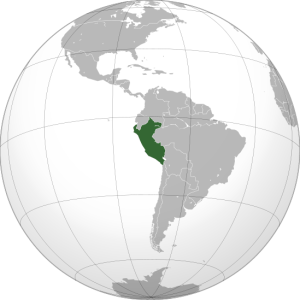
Peru. Picture source: https://commons.wikimedia.org/wiki/File:Peru_(orthographic_projection).svg

A friend who was scheduled to give a keynote speech at a conference on Big Data in Cuzco, Peru had taken ill, and I was asked to fill in for her at the last minute.  I had a commitment right before the conference and a commitment right after it, so giving the talk required that I land in Cuzco at 5 AM, give my talk at 2 PM, and then get on a flight back to the U.S. at 7 PM–a passage éclair, “lighting visit,” as we say in French.

The most salient fact about Peru is this: it’s wonderful. A beautiful place that has a lovely Southern Hemisphere ambience without the constant in-your-face grinding poverty of, say, Guatemala. The people that I met were delightful, and the grilled meats that I had for all three of my meals in-country were probably the best I’ve ever had in my life (and I say that as someone who knows a few good restaurants in Paris). It’s also one of the world’s biggest producers of cocaine.


Cocaine entered the European context when an Italian doctor ran across it in South America. As Wikipedia tells it:

In 1859, an Italian doctor, Paolo Mantegazza, returned from Peru, where he had witnessed first-hand the use of coca by the local indigenous peoples. He proceeded to experiment on himself and upon his return to Milan he wrote a paper in which he described the effects. In this paper he declared coca and cocaine (at the time they were assumed to be the same) as being useful medicinally, in the treatment of “a furred tongue in the morning, flatulence, and whitening of the teeth.”

As he put it in his work Sulle Virtù Igieniche e Medicinali della Coca e sugli Alimenti Nervosi in Generale (“On the hygienic and medicinal properties of coca and on nervous nourishment in general”, translation and quote from Wikipedia):

“… I sneered at the poor mortals condemned to live in this valley of tears while I, carried on the wings of two leaves of coca, went flying through the spaces of 77,438 words, each more splendid than the one before…An hour later, I was sufficiently calm to write these words in a steady hand: God is unjust because he made man incapable of sustaining the effect of coca all life long. I would rather have a life span of ten years with coca than one of 10 000 000 000 000 000 000 000 centuries without coca.”


I don’t actually know how many countries I’ve been to. Between 9 ½ years in the military and a subsequent career that involves a lot of international collaborations, it’s got to be somewhere north of twenty (north of and other obscure American English expressions explained below, as usual). I cross many national borders, and I have never had any problems, either in foreign countries, or when returning to the United States. (I was really worried the time that I passed through French customs with a little bottle of American-made kosher wine in my luggage—I was going to be in Germany for Passover—but, they didn’t catch my nervousness, and I made it into the country without being searched.) Normally, when I return to the United States, I stick my passport into a Global Entry machine, it spits out a piece of paper with my photograph and various bits of information on it, I show that piece of paper to an Immigration officer, he waves me on, and I go about my business. This time, the paper was different: it had a big, black X on it. I showed it to the immigration officer. He asked for my passport, stuck it in an electric reader, and pushed buttons on his computer. Then more buttons, more buttons, and more buttons. Finally: how long have you been out of the country? “Less than 24 hours,” I said.

He pointed me towards an area off to the side of the Customs area that I’d never been to before. (Note the perfect tense had (never) been to and before—that means that I’m going there now.)

I took my suitcase and stood waiting while several Customs agents let me stand there and think for a while. Finally, a couple of them waved me over. Put your suitcase, backpack, and jacket on this table. I did. Then one of them asked me two questions: Is there anything you’d like to tell me before I open this? No. Have you ever been arrested before?

Uh-oh. As it turns out: no, I have never been arrested. (This might come as a surprise to those of you who know just how many tattoos I have, but: no, I haven’t.) Then they started going through my stuff, and when I say “going through,” I mean: searching, and searching very thoroughly. Throughout this, two Customs agents asked me the same questions, over and over, in a variety of ways: Why did you go to Peru? How long were you in Peru? How much cash are you carrying?

The answers didn’t change: For work. Under 24 hours. Under $100. Occasionally they threw in something different: do you have any narcotics? I carry a couple pills containing butalbital for migraines. Your employer paid for your plane ticket? Yes. (Actually, the organizers of the conference at which I gave a keynote paid for it, but my employer actually purchased the ticket—it didn’t seem like a good idea to introduce that level of complication into the conversation, though.) Their question about why I have so many pills in my luggage was easily dealt with—I’m old, I have shit wrong with me, although I didn’t put it in quite those terms—just said that I have prescriptions for everything, which is true. What really raised their eyebrows surprised me—the copy of New French feminisms in my backpack (edited by Elaine Marks and Isabelle de Courivron—it’s quite good), and the laminated photocopy of my passport that I carry in my suitcase in case of emergency.

cuycuit-rdok
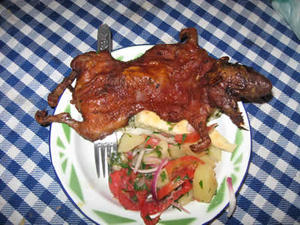
Roasted guinea pig, a specialty of Peru and some other Andean countries. Picture source: http://toro-peru.over-blog.org/article-25467945.html

It’s a good thing that I had a decently long layover, because this went on for quite a while. They pulled back the lining on the bottom of my suitcase. The nature of the bags of salted dried corn (corn is a Peruvian specialty, raised in many species and prepared in many ways) that I had purchased as gifts for friends back home were questioned. Inquiries were made as to my profession, what exactly informatics is, and in which countries my relatives reside. (For me, the most nervous-making part of an American border crossing is when the Immigration officer asks me to explain what I do for living—that used to happen a lot before I got my Global Entry card, and it’s hard enough for me to explain my profession in one sentence even when I haven’t just spent six to twelve hours sleeping only very fitfully during an airborne traversal of a very large ocean.) Finally they harrumphed, told me to take my stuff, and I was off to my next flight. Many years ago, I read a novel about a customs inspector, and marveled at/was skeptical about how easy it was for him to spot the lady with a fortune in undeclared currency sewn into the lining of her overcoat, or the man with a king’s ransom of diamonds encased in a salami. I didn’t bother asking why they had flagged me for a thorough search, though—it’s easy enough to guess that some algorithm noted my frequent international travel and my under-24-hours visit to a cocaine-producing country. No big mystery there–that’s what happens when you spend less than 24 hours in Peru, I guess. So: if you ever have the opportunity to visit that beautiful country, plan to stay a while—I plan to visit again, and next time, I’m going to eat some guinea pig.

Thanks to Sketch Engine, purveyor of fine linguistic search tools and corpora, for the examples. Check out their web site to see what sorts of things you can learn by exploring huge collections of naturally occurring language. No, they didn’t pay me to mention them–the opposite.  I pay them a few hundred dollars a year for access to their fine offerings.


English notes:

“North of 40” means “more than 40 years old.”  Note: “You’re” should be the possessive pronoun “your.”  Picture source: https://memegenerator.net/instance/65847931

North of/south of: these expressions mean more than and less than, respectively. See the picture for a good example. How it showed up in the post: Between 9 ½ years in the military and a subsequent career that involves a lot of international collaborations, it’s got to be somewhere north of twenty [countries].

To catch: lots of idiomatic meanings. I used it in the post in this sense, taken from The Free Dictionary: To become cognizant or aware of suddenly: caught her gazing out the window. How it showed up in the post: they didn’t catch my nervousness, and I made it into the country without being searched.

How we’re sounding stupid today: deadjectival nouns

transcendence and immanece
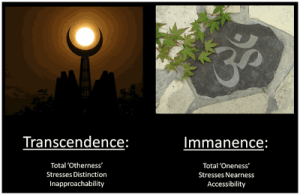
Transcendence and immanence as descriptions of the relationship between God and reality. Picture source: https://missniven11sor.wikispaces.com/Term+01+Lesson+04

I was feeling good the other day.  Chatting up a pretty French girl, showing off my (lack of) familiarity with 20th-century French philosophers, and using lots of great abstract nouns–transcendence, immanence, agency, objectivity.  Feeling smart, feeling charming, feeling sparkling.  Pride comes before a fall, and my fall came hard: Oh, Kevin–your neologisms are so cute.  The way that you make up new words! 

Shit–Not what I was going for.  My mistake: throwing around deadjectival nouns too freely.  Overgeneralizing from limited data.  The Fallacy of Small N.  Bref, as we say in French: I was making nouns from adjectives–transcendence from transcendent, objectivity from objective–but I was using the wrong word endings to do it, trying to generalize from too few examples (overgeneralizing from limited data), extracting a pattern that seemed to have held a few times (the Fallacy of Small N).

You can see from my very small set of examples that English has pretty good facilities for making nouns from adjectives.  We call these deadjectival nouns.  Start with the adjective objective, add -ity, and you’ve got a noun.  Start with the adjective transcendent, add -ce, and you’ve got transcendence.  You can see something else from my example, too: you don’t get to add just any ol’ word ending to the adjective.  Transcendity?  Not OK.  Objectiveness?  It’s OK, but it means something different from objectivity.  French also has pretty good facilities for making nouns from adjectives.  And, in French, as in English, you don’t get to add just any ol’ word ending to the adjective–you have to know, for any given adjective-noun pair, what the right word ending is.  Let’s look at some examples, including of course some that are more or less randomly chosen from recent things I’ve said that have made people snicker, plus an encounter with the always-hilarious old lady who owns a bookstore near my apartment, and then some more thrown in just to show the diversity of possibilities.  I’ve relied heavily on WordReference.com to make this table; if I indicate an English word as NFE, I mean to communicate that there is No French Equivalent, at least according to WordReference.

Adjective Possible noun Impossible or other nouns
radin stingy la radinerie stinginess
câlin cuddly, affectionate les câlineries cuddles (plural only, as far as I can tell) affection affection

NFE affectionateness

malin smart, clever intelligence, astuce cleverness (intelligence); ingéniosité, habilité cleverness (ingenuity) malinerie doesn’t exist (thought we had a pattern going there, didn’t you?  I sure did!)
complice complicit (involved in) la complicité complicity (which I’ve only ever heard in a positive sense, meaning something like closeness, bondedness) NFE complicitness
banal common, banal, mundane
la banalité banality
abrasif abrasive
abrasivité abrasiveness (I think–can a native speaker help?)
impécunieux impécuniosité
sûr sûreté
las weary la lassitude weariness
ingrat ungrateful; unattractive; unrewarding l’ingratitude ingratitude, ungracefulness
transcendent, transcendental transcendent la transcendance transcendence
immanent immanent immanence immanence
obéissant obedient obéissance obedience

Things to note:

  • There is a pretty tight requirement for specific endings to be added to specific adjectives.
  • There is quite a bit of phonology (technically, morphophonology) going on with some of these endings–for example, abrasif   (with an f) versus abrasivité (with a v); impécunieux (with no consonant pronounced at the end of the adjective) versus impécuniosité (with an s, which of course is pronounced as a z).   
  • As far as I can tell, there’s no simple mapping between the ending in English and the ending in French (or vice versa).  English -ity might match to French -ité (e.g. English banality, French banalité), but then again, so might -ness (e.g. English impecuniousness, French impécuniosité).  Of course, English -ness might map to something else, too (e.g. English stinginess, French radinerie). And, forget remembering how to spell any of this–I can’t spell either language anymore…  Make me read and write in Spanish for a week, and I won’t be able to do any of the three…
  • Is there an easy way to predict, or at least to group together for memorization, any of this?  I haven’t found one yet–suggestions appreciated…
man is nothing else but 7644721
Transcendence versus immanence becomes a major issue in the philosophy of feminism via Simone de Beauvoir: existentialism, to which she adhered, posits that we are not born what we are, but rather become it.  This becomes a problem if you live in a cultural framework that posits that men transcend–go beyond what they are, change–but women remain immanent.  She works through this in “The second sex.”  Picture source: http://www.thinkphilosophy.org/thinkphilosophy-blog/on-the-provocations-of-existentialism-a-commentary

To put all of this in a bigger picture: what we’re looking at here–things that can change the part of speech of other words–are what is known as derivational morphemes.  The whole phenomenon of derivational morphology has some pretty interesting implications for the nature of human language.  You can read more about derivational morphology, and those implications, at this blog post.  In fact, we’ve recently been talking about a very particular kind of morphological derivation–zero derivation, or changing part of speech without adding an affix, as in this recent post that discusses why that particular phenomenon is interesting, and then this recent post that explores at some depth the range of zero-derived verbs that come from nouns that refer to parts of the mouth and that refer to some form of communication.

English notes:

Not everyone would agree that some of the English nouns that I have in the third column are OK–particularly, affectionateness and complicitness. 

Mouthing off: English denominal verbs that come from mouth parts

To jaw-jaw is always better than to war-war.

Winston Churchill, at the White House in 1954.  Source: http://www.bartleby.com/73/1914.html

I’ve always been more into depth than breadth.  It’s more like me to explore every restaurant on a single street than to try to cover the top ten eateries of a city; to try everything on the menu of one restaurant, going back week after week, than to go from restaurant to restaurant; to spend years with one woman, rather than flitting from flower to flower, as the girls say in the Philippines.  (This hasn’t stopped me from being married three times, or perhaps that’s why I’ve been married three times.)

Want to know more about denominal verbs?  See this blog post, and Carolyn Gottfurcht’s fascinating doctoral dissertation on the subject of the kinds of relationships that can exist between the original noun and the derived verb.

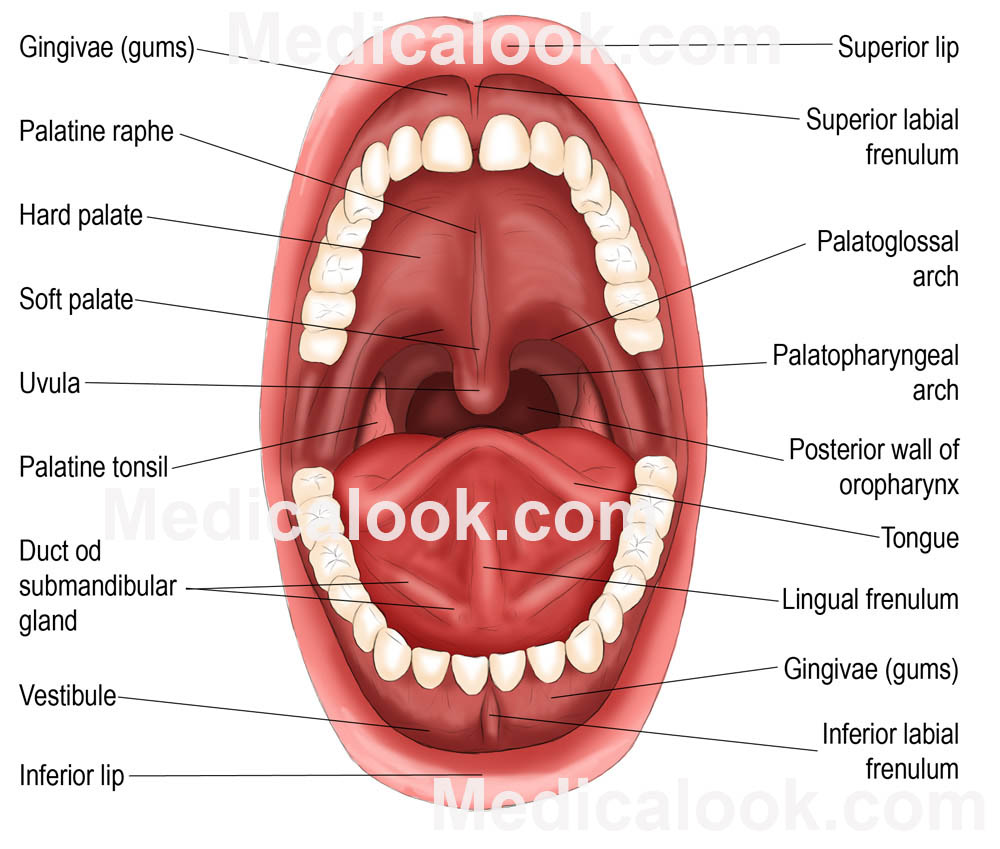
So, when learning vocabulary, I like to pick one subject, and dive deep.  Lately I’ve been struck by my crappy command of words for common things–in particular, parts of the face.  In the way that things always seem to spin out of control, or to become more complicated, or to just be connected to everything else, that soon branches out into questions of pronunciation, questions of how words are put together, and who knows where else I’ll end up–which is to say, what I’ll be distracted by–but, let’s be polite–by the time I finish writing this.  For today, let’s talk about English verbs that come from parts of the face.  We recently talked about the phenomenon of denominal verbs–that is, verbs that are made from what were originally nouns.  English has a bunch of these verbs that are related to body parts.  We’ll focus today on denominal verbs that come from parts of the mouth.  They tend to be related to three ideas: producing language, chewing, and making contact with a physical object.  As we go along, we’ll see others, too.

English notes

Screenshot 2016-08-22 07.23.47
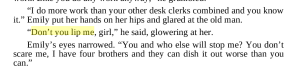
Example of the verb “to lip.” Picture source: screen shot of https://goo.gl/c38BRF

to lip: to speak in a disrespectful way to someone, perhaps especially if answering something said to you by an authority figure.  You can’t lip just anyone–it has to be someone to whom you’re supposed to show respect.


Screenshot 2016-08-22 07.30.11
Example of the verb “to jaw.” Picture source: screen shot of https://goo.gl/v0eD2e

to jaw: to talk, particularly at length and about nothing very important.


Screenshot 2016-08-22 08.20.02
Example of the verb “to lip.” Picture source: screen shot of https://goo.gl/c38BRF

to mouth (first definition): From Google: say (something dull or unoriginal), especially in a pompous or affected way.  From The Free Dictionary: To utter without conviction or understanding; To declare in a pompous manner; declaim.


Screenshot 2016-08-22 07.44.05
Example of “to mouth” in the sense of saying something without making any sound. Picture source: screen shot of https://goo.gl/61Y0V5

to mouth (second definition): to say or sing without making a sound.  From The Free Dictionary: To form soundlessly


Screenshot 2016-08-22 08.16.55
Example of “to mouth” in the sense of saying something that you don’t really mean. Picture source: screen shot of https://goo.gl/BIF7Kp

to mouth off to someone: to speak disrespectfully to someone.  Again, this needs to be someone in a position of authority, someone to whom you owe respect.


Native speakers of French: are there French verbs that come from the nouns referring to parts of the mouth, whether they denote acts of speaking, or anything else?  I’d love to hear about them.


Apps you’ll need while traveling (and will want to keep using after you get back home)

I’m pretty much a technoskeptic.  Not despite the fact that I make my living by doing computational things, but because I make my living doing computational things, I never expect anything digital to really work.  Wanna read about why 166 start-ups failed?  Click here.  How about 21 heavily hyped technology projects that flopped?  Click here.  The Fleischmann-Pons cold fusion failure?  Here is the Wikipedia write-up about how it ended.  You get the point.

mayan woman cell phone p1528958387-41
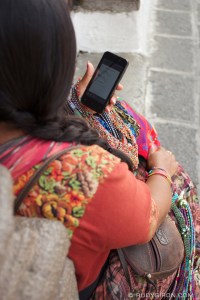
Mayan woman with a smartphone in Antigua Guatemala. Picture source: http://antiguadailyphoto.com/2015/10/05/tradition-and-technology-in-la-antigua-guatemala/#.V7ag7I47QQU

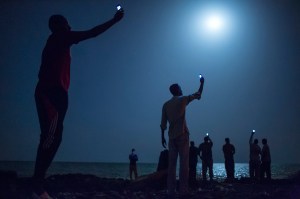
Smartphones, though: there’s an idea that was clearly going to make it.  Certainly some brands, operating systems, and platforms have not survived.  However, the basic idea of having a combined multi-platform communication device—voice, SMS, and email, with things like FaceTime widely available now—with a search engine interface, a music/video player, a camera, and the ability to run apps, is an idea whose time has come.  About 334 million smartphones were sold in the first quarter of this year (I’m writing in 2016), with smartphones accounting for 78% of all mobile phone sales.  I’ve seen poor kids in Mexico walking around with cell phones that they didn’t have service for, but that worked great as very inexpensive mp3 players.  On my most recent visit to Guatemala, I saw plenty of teenagers in very traditional Mayan clothing with cell phone screens gleaming in their hands as they sat on the curbsides in the evening dark in Antigua, hoping for a few final sales of tourist trinkets.   (You can read Rudy Girón’s article about Mayan use of smartphones here.)  For a refugee, a smartphone is essential–you can use them to get maps; to share information about routes to wherever you’re trying to go, about border crossings to avoid or to seek, about sources of food and shelter; to let your family know that you’re still alive.

Out of Africa
Migrants in Djibouti trying to catch a Somali cell phone signal. Picture source: http://proof.nationalgeographic.com/2014/02/19/world-press-2014-signals-from-djibouti/

For me, cell phone service–getting it, keeping it, figuring out how to use it–has been a recurrent theme in my adventures in France.  Looking back over the course of the past two years, I see that I’ve written posts on the language of cell phone service, the drole experience of dealing with an over-worked employee at a cheap telecommunications company, and precisely how much shit you’re in if something happens to the credit card that you pay your bill with–and that’s just the stuff that I had the energy to write about.

The thing is: with the amount of time that I spend on the road, my smartphone has become more or less indispensable to the smooth operation of my life, as well as to the maintenance of my sanity.  Most of those essential functions come from the apps on my phone.  Here are some apps that I’ve found especially useful for travelling.  Suggestions welcome!  (I’ve been able to put a link to a page where you can get both the iPhone and the Android versions for most of these–if I couldn’t, I put a link to the iPhone version.)

Pocket: this is the most recent thing that I don’t know how I ever lived without.  What it does: it saves web pages and other assorted documents so that you can read them off line.  If you looked at mine, you’d see long stories that I didn’t have the time to read when I first saw them, but that are great for reading on a plane or on the train ride to work; Wikipedia pages about cities that I’ve been to but didn’t have the energy to buy a guide book for; a bunch of sources for an editorial that I’m writing; and a bunch of Spanish vocabulary related to hand surgery.  I use this app several times a day, every day.
A podcast player: I used to subscribe to satellite radio so that I could listen to French-language radio stations in my car.  Now: forget it.  I start my mornings by downloading the podcast of a French news show that I like, and that gives me an hour of listening practice every day while driving back and forth from work when I’m in the US.  I listen to podcasts to get to sleep on planes, to learn French, and just to amuse myself when I don’t have the focus to pick up a book.  Be sure to download enough stuff before getting on a plane, leaving your home for that long train ride to work, or whatever.  I actually use the podcast app that comes standard with the iPhone, but I hear that there are really good alternatives out there.

WordReference: this app is a great interface to the best-known English/French/Spanish on-line dictionary site.  Unfortunately, you have to be on line to use it–if there’s an off-line mode, I don’t know about it.  One curiosity: I discovered one day that it doesn’t like it when you look up obscenities.  Apparently there’s some kind of licensing issue or something, and if you try to look up the f-word on it, it will refer you to the actual web site.

Google news: I must open this app 20+ times a day, regardless of where I am in the world.  (Minus China, I guess–Google is entirely blocked there.)  It’s a great way to get news on a personalized set of topics, and you can set it to not download pictures in your news feed, which lets it get by with less bandwidth.

Packing Pro: this app for managing packing lists is so good that I gave it to my beloved sister-in-law, who is one of the very few people I know who is on the road more than I am.  I think it cost $3.99 or something, and I’ve been using it for years.  I actually throw in an extra little donation every now and then, just to keep the guy working on it–it’s that good.

United: whatever airline you fly on, they probably have an app that will let you stay on top of what gate your next flight is at, monitor the status of the incoming flight, fiddle with your seating assignment, and stuff like that.  I was once in a plane that was landing quite late.  Tons of us had connections that we were going to have to run to, and nobody knew which gates they were at.  One of the stewardesses suggested that we all download the United app while we taxied to the gate, and it saved my butt that day, and many times since.

Yelp: in theory, the Yelp app is for finding restaurants wherever you happen to be.  In fact, you would be amazed at the range of things that you can find with it–in one of those very meta moments in life, I used it to find an excellent place to get my cell phone screen fixed in Paris.  (Allo iPhone, at 15 rue de Senlis in the 17th arrondissement–I fully recommend them.)  Yelp has been available everyplace I’ve been lately but a little town on the Slovenian coast.

The Free Dictionary: a not-bad dictionary, especially for English-English, and you can use it even when you’re off-line.  (I guess I coulda said English monolingual.  Coulda is explained below in the language notes.)  Be sure that you download whichever dictionaries you want to have available before you get on the plane.

NPR One: If you go to NPR for your English-language news, this app is a real boon.  It tries to figure out what kinds of stories you like, and then plays them for you, one after the other after the other.  (Yes, that’s how you say it.)  It’ll mix Morning Edition and All Things Considered stories, podcasts, and whatever else it has available.

French vocabulary of the day:

gagner sa croûte: I think this is a casual way of saying “to make/earn one’s living.”  Gagner sa vie and gagner de quoi vivre are other options.

télécharger: to download.

une appli: app.  Une appli géniale is allegedly a “killer app,” but I’ve never heard this used.  Of course, that means nothing.

English notes of the day:

coulda: Casual form of writing could’ve, which is the contraction of could have.  You can say this in most contexts, and you can write it in very casual communications, but don’t write it in anything remotely official or work-related—it’s too casual.


I can’t tortilla: denominal verbs and hand surgery

When we talk about hand surgery being all about function: it’s about the function of the hand, sure. But: it’s also about the function of the person. 

I’m in Guatemala at the moment. I come here once a year with a group called Surgicorps. We’re volunteer surgeons, anesthesiologists, nurses, technicians, therapists, and interpreters (that’s me) who provide surgical services to people who are so poor that for them, even the almost-free Guatemalan health care system is too expensive. There are a lot of groups like us, actually–you can find them all over the world. What makes Surgicorps special is the set of surgical specialties that we bring with us. One of those is hand surgery. Hand surgery is a very specialized occupation—in the course of learning his trade, our hand surgeon did fellowships in both plastic surgery and orthopedics. A fellowship is about five years, and that’s on top of four years of college, four years of medical school, and a three-year residency—so, these guys are hard to come by.

Every medical and surgical specialty has its central concept, its central concern. In hand surgery, that’s function. When our hand surgeon told me about this, he was talking about the function of the hand–the goal is to take something that isn’t working, and make it able to do things again. Hand surgery is about function in a larger sense, too, though. The thing is: in a country like Guatemala, most people work either in agriculture or in manufacturing, and opportunities for education are few. (In 2010, 31% of the female population was illiterate.)  In that kind of economy, for most people it’s the case that either you work with your hands, or you don’t feed your children.  Functioning here means doing manual labor, which for men is likely to be farming and for women is likely to include weaving and doing housework.  You’ve got a hand that doesn’t function?  Then you don’t function.

2016-08-07 12.05.28
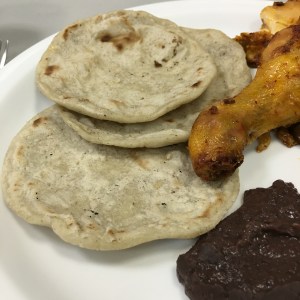
Guatemalan handmade tortillas from the hospital cafeteria. Picture source: me.

For women here, part of functioning is making tortillas.  Guatemalans might not get much in the way of nutrition, but getting enough calories per se is usually not a problem: when there’s no drought, corn is plentiful and cheap.  If a Guatemalan is poor enough, he might be living on tortillas and salt–but, he’s living, not dying.  Not from hunger, at any rate.  (The top five causes of death in Guatemala: respiratory/pulmonary diseases (influenza and pneumonia), violence, coronary artery disease, diabetes, and stroke.)


dupuytren's contracture ArticleImageHandler.ashx
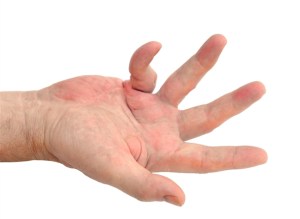
A contracture.  I’m showing you one called a Dupuytren’s contracture because after a week of looking at poorly healed burns, skin grafts gone bad, and the like, I just can’t take any more. Call me a wimp, but it’s difficult. Picture source: https://www.thebmc.co.uk/dupuytrens-contracture-research-survey

You make tortillas with your hands.  They’re actually made somewhat differently here in Guatemala, as compared to elsewhere: not so much with the palms, as patted out with the fingers.  So, when women show up on screening day with a contracture in one of their hands from a burn, or a cut, or whatever horrid thing has happened to them and won’t let them open their hand all the way, and our hand surgeon asks them what the matter is, they say: No puedo tortillar–I can’t make tortillas–while making a characteristic slapping-your-fingers-together-while-turning-your-hands-over motion.

Here’s a short video that shows you how a Guatemalan woman makes tortillas.  Like 70% of the country, she’s Mayan.  There are a bunch of things to notice in the clip:

  • When the video starts, the language that you’re hearing is one of the 20-22 different Mayan languages spoken in Guatemala.  (There are some more spoken in Mexico.)
  • The women are wearing the traditional clothing of their village.  Mayan women most definitely do still wear the traditional clothing, every single day.  Choosing not to wear it makes a huge statement about your personal identity and affiliation, and the waiting rooms of the hospital where we do our thing are jammed with people in this kind of clothing.  I’ll point out that every village has its pattern of dress, apron, and huipil (the shirt that the ladies are wearing), and leave it at that.
  • The lady is cooking over an open fire.  Super-common here, and I haven’t yet been here without a few people showing up on screening day to show us their burn-scar-contracted hands.
  • The American speaking crappy Spanish.  One of the main industries of the town that we’re in is intensive Spanish lessons.
  • The lady’s hands are wide open, and fingers are flat–with a contraction like the one that you see above, she couldn’t do it.
  • At about 1:05, the verb tortillar. 

Tortillar is an interesting little verb (at least if you’re the kind of person who gets excited about verbs).  As far as I can tell, it doesn’t exist anywhere else.  Here’s where I looked:

  • WordReference.com, which has an amazingly complete on-line dictionary.  No luck.
  • The Bantam New College Spanish and English Dictionary, which is by no means huge, but has excellent coverage of Central American Spanish.  (If you’re an American, and therefore don’t know where Guatemala is: it’s in Central America.)  Also no luck.
  • Google, through which I found a number of blog posts written by people who ran across the word while travelling this part of the world, but no evidence that the word exists anywhere else.
  • (I did find a French dictionary of the natural sciences from 1845 that lists the word as the common name of some species of Orme with a tall trunk and small leaves.  I have no clue what an Orme is.)

What the verb tortillar means: to make tortillas.  It’s a nice example of a verb that comes from a noun–what’s called in linguistics a denominal verb.  We have lots of these in English–“bare” or “zero-derived” ones like to tango, to cash, to water; ones made with prefixes, like to defrost and to encage; and ones made with suffixes, like to victimize, to vaccinate, and to classify.  (Language geeks: yes, I am leaving out back-formation.  No hate mail, please.)

One of the interesting things about the process of making nouns of out verbs is that there is some systematicity to it–there are particular types of relationships that tend to exist between the original noun and the derived verb.  You might remember a post in which we talked about the particular kinds of relationships that exist between the nouns in compound nouns, like kitchen knife (knife that is used in a kitchen), bread knife (knife that is used to cut butter), and pocket knife (knife that is carried in a pocket).  In that post we talked about how the set of relationships between those nouns is limited, and about how trying to explain that set of relationships is a good example of the issue of falsifiability in scientific theories–if you can posit any old relationship on the basis of any particular compound noun that you happen to run across, then you have a theory that cannot, even in theory, ever be shown to be wrong (“falsified”).  That’s a theory that can’t actually be tested, and a theory that can’t be tested is a crappy theory.

How about verbs?  Carolyn Gottfurcht wrote a fascinating doctoral dissertation on the subject of denominal verbs and the kinds of relationships that can exist between the original noun and the derived verb.  (All of the English verb examples in this post are from her dissertation.) She looked at 8,900 English verbs and found that in that language, one of the most common relationships is what is called the resultative

The resultative relationship is especially relevant to us today, because that’s what the Guatemalan verb tortillar is based on.  The resultative relationship holds between a noun and a verb that is derived from that noun when doing the verb brings the noun into being.  For example:

  • to granulate: to cause something to exist as granules
  • to enslave: to cause someone to be a slave
  • to mummify: to cause someone to be a mummy
  • to summarize: to cause a summary to exist
  • to cripple: to cause someone to be a cripple

This is the kind of verb that tortillar is: to tortillar is to cause tortillas to exist.

Here’s the thing about causing tortillas to exist: if you’re a functioning Mayan woman, that’s one of the things that you do.  That’s not the only thing that you do–but, if you can’t do it, you can’t take care of your family.  So, when we talk about hand surgery being all about function: it’s about the function of the hand, sure.  But: it’s also about the function of the person

Like the rest of us Surgicorps volunteers, our hand surgeon donates his services, buys his own plane ticket, pays for his food and lodging, and contributes a week of hard-earned vacation.  The costs of the surgeries themselves–instruments, medications, dressing materials, anesthetic agents, pain medications, etc.–are covered by Surgicorps.  Surgicorps lives or dies on the basis of donations from nice folks like you.  Want to make a donation?  Click here.  $250 will pay for all of the costs of surgery for one patient.  $100 will pay for four surgical packs.  $25 will pay for a nice lunch for you–or one surgical pack for us.  $10 will pay for all of the Tylenol that we’ll send our patients home with all week–and, yes, we send our patients home with nothing stronger than Tylenol, in the vast majority of cases–or, it’ll buy you a latte and a scone.  I have nothing against lattes and scones–I’m a big fan of both–but, when you think about it from that perspective, how can you not click on this link and make a donation?

No French stuff today–back to the language of Molière on Monday.  Now, donate some money!  I’ll stop hitting you up for donations next week.


The next splint is here: metonymy and hand surgery in the Guatemalan highlands

The most important part of a surgical mission: it’s not actually the surgeons. Plus, here’s how you can be a hamburger in the corner.

Yesterday I was interpreting for our hand therapist. She was putting bilateral (this and other obscure English words discussed below) splints on a young man. (Some patient details changed to protect privacy.) “The next splint is here,” she said. Great, I thought, looking around—where? I’ll grab it for her. I didn’t see a splint, though. “Where is it?”, I asked her, somewhat puzzled. She watched me look around. “No—there’s someone else coming in to get a splint, and he’s here.” Ahah—metonymy. More on this later, but first, let’s talk about those splints—and that hand therapist.

I’m in Guatemala at the moment, with a group called Surgicorps. We’re a team of all-volunteer surgeons, anesthesiologists, nurses, technicians, therapists, and assorted non-medical personnel, such as myself—I’m an interpreter. There are lots of groups like ours that come here to Guatemala—there’s an enormous need for surgical care, and not a lot of options for getting it for the very poor population that we serve.

What makes us special: among other things, it’s the fact that we have a hand surgeon. Hand surgery is a very specialized occupation—in the course of learning his trade, our hand surgeon did fellowships in both plastic surgery and orthopedics. A fellowship is about five years, and that’s on top of four years of college, four years of medical school, and a three-year residency—so, these guys are hard to come by.

As specialized and as in short supply as the hand surgeons of the world are, there’s another profession that’s even harder to find an expert in: hand therapists. Hand therapy is a subfield of occupational therapy, which is the art and science of teaching people how to function normally after things like strokes, heart attacks, and amputations. The other day, one of the physicians said to me: The first time I went on one of these missions, I heard that we had a hand therapist with us, and I thought: why the hell do we need one of those? What could she possibly do on a surgical trip? Then I saw her working, and I realized: she’s more important than the physicians.

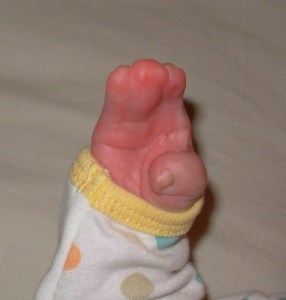
Almost every kind of hand surgery requires some kind of splinting afterwards, and it’s to the extent that the splinting is or isn’t successful that the surgery is or isn’t successful. For example: an operation that our hand surgeon does here quite frequently is repairing something called syndactyly. Syndactyly is a condition in which fingers don’t separate from each other during development in the womb. It’s ruinous here in Guatemala, where most people’s educational opportunities are nil, and the only option for earning a living for most people is manual labor.

syndactyly 7232340_orig
Syndactyly. Picture source; http://thehurds.weebly.com/aidens-syndactyly-surgeries.html

Our hand surgeon can undo the syndactyly. Typically what happens in syndactyly is that the genes that should cause the tissue between the fingers in the fetal hand to reabsorb don’t work right, and what the surgeon does is to cut that tissue away, and then graft some skin between the fingers. (I’m simplifying the description of the surgery!) Once that surgery is done, though, those fingers have to be kept apart for several months. Otherwise, the fingers will re-fuse. How you keep that from happening: a hand therapist builds you a special kind of splint. These have to be made to order after the surgery, as they have to fit the individual child very well, and they have to fit that child when he has bandages on his fingers after the surgery. (That’s why you can’t do it before the surgery.)

Splint-1
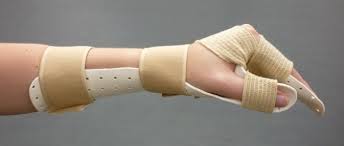
A custom-made splint. Imagine trying to mold that on a toddler who is scared, nauseous, doesn’t speak the same language as you, and thrashing around while screaming for mama at the top of his lungs. Picture source: https://plasticandhandsurgery.com.au/hand-surgery/hand-therapy/

The surgery to repair syndactyly is usually done when a child is small. So, here’s what it’s like to fit one of those custom-made splints after surgery: you’ve got a little kid. The kid is coming out from under anesthesia and is disoriented, nauseous, surrounded by funny-looking people speaking a language that he can’t understand—and he’s scared shitless. So, you’re trying to build a very precisely-sized splint for a kid whose hand you need to fit it to—while he cries, and screams, and tries to pull his arm away from you, and tries to make a little fist while you’re trying to get things between his fingers. Add to the mix the fact that the splint is made from a kind of epoxy that is rigid when cool, and flexible when heated. You heat it up, then take it over to the kid and try to mold it to the right size while he cries, and screams, and tries to pull his arm away from you, and tries to make a little fist while you’re trying to fit it between his fingers. The resin cools down while you’re trying to do your thing, and then it won’t bend any more? Tough shit—go back to your heat source, heat it up again, and then try again.

So: the surgery doesn’t work without a good hand therapist. Being a hand therapist is a difficult job to do, and it’s hard to find places to learn to do it, and in addition to having considerable technical skills in order to make the splints correctly, you need to be able to do it under very adverse conditions, and to keep your cool while you’re doing it. Indeed, it’s the hand therapist that is the key to our mission.  We can replace a surgeon, or an anesthesiologist, or a nurse—or an interpreter—but a good hand therapist is hard to come by.

cerebral palsy index
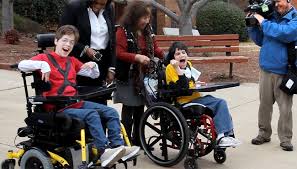
Kids with cerebral palsy. Picture source: torc2.com.

So, back to the young man and “the next splint:” he has cerebral palsy. This means that he has essentially no control over his muscles whatsoever. They twitch, and cramp, and they make his hands clench into useless fists that can’t be opened. He can’t speak.  He can’t nod his head “yes,” or shake it “no.”  Our hand therapist was making splints for the young man that would keep his hands open for half of the day. If they can stay open, he will be able to grasp things. This is a smart teenager who can’t hold so much as a pencil—having hands that function even a little bit would be life-changing for him. Can the hand surgeon make this happen? No—it’s only the hand therapist who can give him that new capacity, one that you and I probably never even think about.

So, “the next splint is here:” this is an example of a phenomenon called metonymy. Metonymy is the process of referring to something by one of its attributes. For example:

  • The hamburger in the corner is a slob and needs more napkins. Meaning: the person who is eating a hamburger and is in the corner is a slob, etc.
  • Would you ask if the right front flat in bay two is also supposed to get an oil change? Meaning: there’s a car that has a right front flat in bay two, and I need to know if it’s also supposed to get an oil change.

This is a different phenomenon from metaphor, in which we refer to something as something else entirely—love is a river, life is a journey, for example—as opposed to referring to it by some attribute that it has—the hamburger that the sloppy customer has, or the flat tire that the car has, or whatever. Metonymy is a super-common phenomenon in language that lets us take advantage of context in the course of communication—and not just linguistic context, but what you could think of as “world” context, and from a theoretical point of view, that’s pretty interesting, for the following reason.  Most linguistic theories are entirely about language and its structure (I’m simplifying here—if you’re a sociolinguist, please don’t send me hate mail), and if you need to incorporate the world into your theory about how language works, that’s quite a challenge. Being context-dependent, it also requires that both the speaker and the hearer know what that context is—I didn’t know that the therapist had another patient scheduled, so I totally misunderstood her statement, thinking that she was referring to an actual splint, not to a person who was going to receive a splint.

a-abbott-3-353x239
Hand contracture in cerebral palsy. Picture source: http://www.cerebralpalsy.org/inspiration/artists/anne-abbott

Back to the kid again: he went home happy, him and his mother hopeful that next year his hands will be more functional. We’re talking about a kid who is super-happy to be spending his days in a wheelchair, because it means that he’s not spending his days in bed. (How’s your day going, dear reader?)  If he gets some improvement over the course of this year, then when we come back with a hand therapist again next year, he can improve even more with another splint. Someday he might be able to hold a pencil and use writing to get all of the stuff that’s in his head out of it, like I do—he sure as hell isn’t ever going to be able to speak.

Courtney IMG_1910
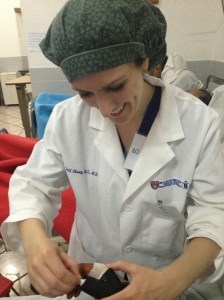
Courtney Retzer Vargo, PhD, checking a splint.

Here’s the thing: if there’s no Surgicorps, then there’s no hand therapist, and there’s no hope for functional hands for that kid—a teenager with a fully functional mind and not a lot of physical abilities.  (OK: no physical abilities.)  One of our hand therapists is Courtney Retzer Vargo.  Courtney has a PhD in occupational therapy, two kids, a hot husband, and a busy job in the United States.  But, every so often she burns up a week of her hard-earned vacation time and flies to Guatemala or Zambia to volunteer a week of her time doing exactly this.  Like all of us in Surgicorps, she buys her own plane ticket, pays for her own food and lodging–contributes a week of hard-earned vacation time. Surgicorps pays for all of the costs of the patients’ treatments, and Surgicorps lives or dies on the basis of donations from nice people like you. Click on this link, and making a donation will take you less than 5 minutes. $250 will pay all surgical costs for one patient, or the expenses for transportation and lodging for a patient and their parent during the period of the surgery. (See this post for what that trip is like, and why they need us to put them up.) $100 will pay for four surgical packs. $10 will pay for all of the Tylenol that we’ll send our patients home with this week—and, yes, our patients go home with nothing stronger than that. Do it—if you don’t feel better about life immediately, I’ll give you your money back—and you know where I live!

English notes:

  • Bilateral: on both sides. Bilateral symmetry is one of the most common features of multi-celled animals. How it was used in the post: She was putting bilateral splints on a young man.
  • To be hard to come by: to be difficult to obtain. During a famine, there actually is usually food, but it’s very expensive and hard to come by. How it was used in the post: Indeed, it’s the hand therapist that is the key to our mission—we can replace a surgeon, or an anesthesiologist, or a nurse—or an interpreter—but a good hand therapist is hard to come by.
  • Physician: a somewhat technical or formal term for doctor, and specifically, a medical doctor. Non-health-care people don’t use it very often, but health care professionals use it frequently—especially doctors. 🙂  How it was used in the post: The other day, one of the physicians said to me: The first time I went on one of these missions, I heard that we had a hand therapist with us, and I thought: why the hell do we need one of those?  What could she possibly do on a surgical trip?  Then I saw her working, and I realized: she’s more important than the doctors.

Spanish notes:

  • Férula or tablilla: a splint. I’ve noticed over the course of the past four years that some people know one word, some people know the other, and many, many of them don’t know either. In that case, I ask the therapist if I can tell the patient that a férula is a piece of hard plastic that will keep their fingers apart/fist from closing/wrist from moving/whatever.

French notes:

  • une attelle: a splint. I think there’s also a word une éclisse, but I haven’t been able to verify that one.


Life isn’t cheap here, but sometimes things go to sh…: consecutive and simultaneous interpretation

Writing from Guatemala in the 1980s, Jonathan Maslow said that it is not true, as is often said, that life is cheap in Central America, but it is true that life is briefer there, and so takes place faster. I thought about this yesterday when a conversation went completely to shit. (I was talking about this with one of the anesthesiologists today. “It went completely to pieces,” I said. “Kevin, you can say it went to shit,” she said. This and other obscure English expressions discussed at the end of the post.)

There are two basic kinds of interpretation, known as consecutive interpretation and simultaneous interpretation. In consecutive interpretation, the person for whom you are interpreting says something, and when they stop, you repeat it.   In simultaneous interpretation, the person for whom you are interpreting speaks without any pause other than their normal ones, and you repeat what they said immediately, essentially phrase by phrase.

Each form of interpretation has its advantages and disadvantages. I’ll summarize them:

  Consecutive interpretation Simultaneous interpretation
Plusses ·      Much easier with some language pairs

·      Easier for bilinguals to listen to

·      Obligatory in “double interpretation” situations (see below)

·      Greater accuracy

·      Required in legal situations, where both languages are recorded

·      Faster—as little as half the time of consecutive

·      Better provider/patient contact

·      Obligatory in certain situations: multilingual (more than two languages), speeches, conferences, and live media

Minusses ·      Slower (see below for how you can make it less slow) ·      Sometimes harder for bilinguals

·      More difficult—special training required

·      Interpreter can’t clarify without interrupting

·      In many situations, requires two interpreters

A number of these are relevant to interpreting for Surgicorps, the group with which I’ve come to Guatemala. Here are some specifics:

  • “Double interpretation” refers to a situation where the interpreter and the person who speaks the “target language” don’t share a language. This happens on occasion here, and the solution is “double interpretation:” the health care provider speaks in English, the interpreter speaks in Spanish to a second person who speaks Spanish and one of the many indigenous languages, and then that person speaks to the patient in the language that they share—then it goes back in the other direction. This kind of situation has to be handled with consecutive interpretation. (I had a double interpretation situation on screening day. The gentleman who was doing the Spanish <-> indigenous language interpretation had no teeth, and it was a challenge to understand him, even for me.)
  • How you can help with the relative slowness of consecutive interpretation if you’re a health care provider: use shorter sentences. If you use long sentences, professional interpreters will often write down notes while you speak. The shorter your sentences, the less need there is for note-taking on the part of the interpreter.

How this all became relevant yesterday: I was interpreting between one of the Surgicorps people and one of the Guatemalan staff. The Surgicorps person was anticipating the end of the local nurse’s sentences while I was still repeating them, and responding in English. So, now I’m speaking a sentence that I’m having to remember in Spanish so that I can interpret it in the Spanish -> English direction, while someone is speaking to me in English. This is the kind of context in which you need two interpreters because you’re basically doing simultaneous interpretation instead of consecutive interpretation: this is the kind of situation where everything immediately goes to shit.

…and that’s when I thought about Maslow on Central America: life is briefer there, and so takes place faster. No problem: the other thing about Central America is that people here know how to make things work in suboptimal conditions. Ask everyone to stop, tell them that you’re having trouble and why, and people will do their best to accommodate—the Americans, as well as the Guatemalans. As is almost always the case: communicate what you need, because the only way to guarantee that you won’t get it is to not tell people what it is.

How about helping our work in Guatemala?  Surgicorps provides free surgical care to people who cannot afford it.  We pay for all of our patients’ costs through the generous donations of the kind of person who would read a blog like this.  Click here to donate–I’m the funny-looking bald guy. 

English notes here—French and Spanish vocabulary below:

  • Life is cheap: a delightfully ambiguous expression. The most common interpretation: it’s a way of saying that life is not valued. That’s not to say that people don’t value their own lives, but more that the society doesn’t, in general, value people’s lives. That’s the sense in which it is used in the Maslow quote: it is not true, as is often said, that life is cheap in Central America, but it is true that life is briefer there, and so takes place faster. The other possible interpretation is the more obvious, but the much less common one: it is inexpensive to live. For example: life is cheap in Benin—I think a nice apartment is maybe $50 a month. From the context, it will probably be clear which is which; in case of doubt, the default interpretation is the “life is not valued” one.
  • to go to pieces or to go to shit: for a situation to suddenly start going very badly, for things to stop working. To go to pieces is acceptable in pretty much any social context, but to go to shit is very casual and mildly obscene, and you should only use it with peers with whom you are very comfortable. Now: if you’re talking about a person, then to go to pieces (but not to go to shit) has a different meaning. It means something like to stop functioning, perhaps to start crying if you’re talking about an incident; or, if you’re talking about a chronic situation, not to cry, but to stop functioning normally in life. An example of the isolated incident version: I dropped her cell phone and the screen broke, and she completely went to pieces—locked herself in the bathroom and cried for maybe 15 minutes. The chronic one: After his wife died, he completely went to pieces—stopped showering, then stopped showing up for work, got fired, and ended up living with his daughter.

French notes:

  • merder: to go to shit, to get complicated.

Spanish notes:

  • embolismo: this word does not mean what it looks like—a false cognate. In Spanish it is basically a situation that has gone to shit. The word for “embolism” is embolia, e.g. una embolia cerebral, a cerebral embolism (a kind of stroke).  (The other kind of stroke is a derrame.)

15 hours with a chicken on your lap, and how to schedule an operating room

Why is it so hard to get to see a surgeon and get your surgery scheduled?  If you haven’t thought about it much, you probably figure: first come, first served.  (This and other obscure English expressions explained below.)  If you have, in fact, thought about it a bit, you probably figure: emergencies first, and then elective surgeries.  Makes sense–it’s “truthy,” as Stephen Colbert would say.

It turns out that it’s more complicated than either of these.  Setting up the operating room schedule is one of the most difficult tasks for the organizers of the Surgicorps mission that brings me to Guatemala this week.  Here are some of the things that you have to balance:

  1. Any non-insane surgeon with an operating staff that’s new to each other will start off with some easy cases.  It gives everyone a chance to get to know each others’ rhythms and quirks in a relatively low-pressure environment.  So, after we screen a couple hundred patients on Sunday and sit down to schedule a bit over 90 of them for surgery in the week to come, some of the easy ones get put down for Monday.
  2. One of our major, major goals is to not have anyone left in the hospital when we leave, which is the Saturday after we arrive.  This means that difficult cases that will require longer recovery times need to be done early in the week to maximize the chances of getting them discharged before we leave.
  3. A corollary of requirement (2) is that you want to do relatively easy stuff that’s not likely to require overnight hospitalization on Friday.  So, Friday is the time for complicated dressing changes and the like.

So: requirements (1) and (3) compete for the easy patients.  Requirements (1) and (2) compete for Mondays.  There are a couple other things that come into play, though.

15 hours with a chicken on your lap

There are lots of volunteer groups that come to Central America to provide free surgical services to people who can’t begin to afford them.  What makes Surgicorps different is the mix of specialties that we bring.  Lots of groups have a specialty of one sort or another, and people throughout the Guatemalan health care system know what they are, where those groups will be, and when they’ll be there.  If you need hand surgery, then since that’s one of our specialties–and a hard-to-find one–then if you’re lucky, you’ll be advised to show up in Antigua Guatemala–same place, same week, every year.

camioneta img_0919
A Guatemalan camioneta. Picture source: https://camino55.wordpress.com/2011/09/16/la-camioneta/

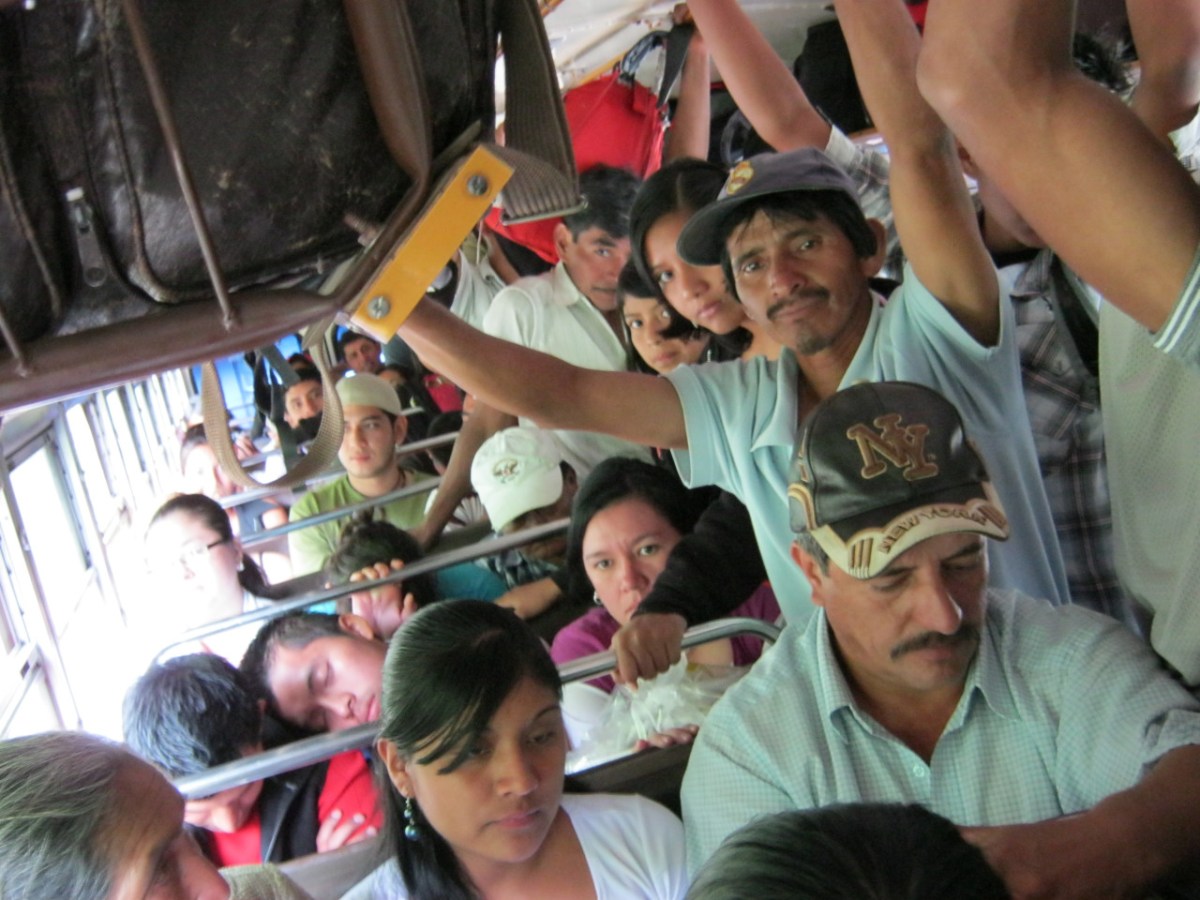
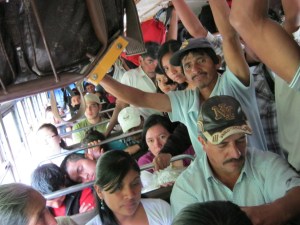
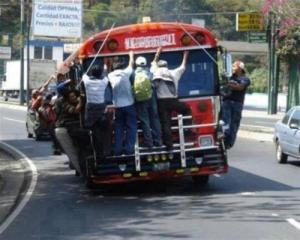
Consequently, people show up for screening day from all over the country.  If you have the average income–which is to say, not very much money at all–then your options for long-distance transportation boil down to just one: a camioneta.  This is a bus.  But, not just any bus.  It’s basically an old school bus, typically painted in some colorful and multihued way.  These things get packed full of all the people–and stuff–that they can carry, and you may do your travelling in the company of various and sundry species of livestock.  If you’re from the farther reaches of Guatemala, it’s maybe a 15-hour camioneta ride to the town in the highlands where we do our thing.  15 hours, quite likely with your kid, who is about as likely to be able to sit still for that long as any other toddler on the planet.  15 hours with three people jammed onto a school bus bench meant for two children.  15 hours with, quite possibly, somebody’s chicken on your lap.

2016-08-07 08.25.58
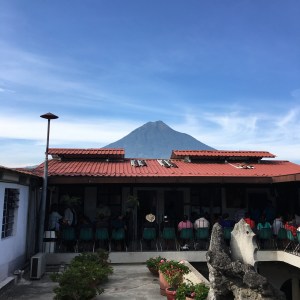
View of a volcano from the screening area, just because I like to show you something non-depressing once in a while.  Picture source: me.

So, if you’re the person trying to put together the schedule for the week’s surgeries: now you’ve got an issue.  Let’s say that you have someone with an easy surgery to do.  You want to save a bunch of those for Friday, so if you have people who are local, you send them home, and have them come back Friday morning.  But, you can’t do that with someone who travelled for hours to get there.  So, you might need to move them earlier in the week.  Let’s call this requirement (4).

Then you’ve got the fact that most of the people who show up on screening day fall into one of two groups: (1) kids, and (2) people who do manual labor to support themselves and their families.  If the patient is in the “kids” group, then they were brought by at least one of their parents.  If the patient is in the “manual labor” group, then they’re not working, which means that they’re not supporting themselves and their families.  So, this plays into the equation, too: these folks might have typical surgeries, in which case you want them in the middle of the week, or easy surgeries, in which case you probably want them at the end—unless they get picked for Monday, when you will recall that you want the easy surgeries to get your team used to working together–but, economics dictates that it’s best if you can do them early.  (The same applies to the parents of the kids, who are not working as long as they’re sitting in Antigua waiting for their child to be operated on, but at this point, I can’t wrap my head around how to explain just how complicated that one can get.  It’s been a long day–see here for what a description of what a Sunday is like on one of this trips.)  We’re going to call this requirement (5).

So, let’s review the conflicting constraints:

  • (1) and (2) compete for Mondays.
  • (1) and (3) compete for the easy patients.
  • (1) and (4) compete for the beginning of the week.
  • (1) and (5) compete for the beginning of the week.

How do you work all of this out?  I don’t know–yet another reason that I’m just an interpreter.  There are people in the artificial intelligence field who have been trying to figure this kind of thing out for years—the military is happy to pay for the research, because you have to figure out a similar kind of problem if you have a bunch of different kinds of troops, supplies, and equipment that you need to get to an area of armed conflict, and only a limited number of ships and planes to move them in.  I don’t know of anyone who is jumping up and down to do this for a little volunteer group, though.  And, I’ll tell you the truth: I seriously doubt that anyone could do this better than our people do.  There are an enormous amount of variables that go into this–I’ve only sketched out the ones that are so obvious that even an interpreter would notice them.  (For context: I was a medic in the military for some years, so my “obvious” might be different from your “obvious.”)

So: what happens to the people who don’t get to go early in the week, and who live too far to go home and come back later in the week?  It depends.  A routine sight on our way to the hospital in the morning: a family waking up after spending the night in the open bed of a pickup truck.  They’re not our patients, though.  We provide housing for families while they’re waiting for their kids to get operated on, and while the kids are recovering before their discharge from the hospital.  Who pays for that: generous donations from people like you.  Us volunteers pay for our plane tickets, lodging, and other needs, as well as kicking in a week of vacation time.  Surgicorps pays for the patients’ costs, and Surgicorps’s money comes entirely from donations.  You could make one of those donations right now!  $250 will pay for transportation, food, and lodging for a patient and their family during the hospital stay.  $250 can also cover all surgical costs for one patient.  $100: four surgical packs.  $25: one surgical pack.  $10: all of the ibuprofen that we will hand out all week long–and, yes, our patients go home with nothing but ibuprofen.  Are you feeling like life is shitty today?  Give some money to help someone who needs it–you’ll feel better instantly.

English notes below.  Spoiler alert: we’ll talk about first come, first served; truthiness; and to be put down.

  • First come, first served: This is a saying that expresses the cultural belief that all other things being equal, services are rendered or goods are given in the order in which they are requested.  How it was used in the blog: If you haven’t thought about it much, you probably figure: first come, first served.
  • Truthiness: This is a recently invented word that unfortunately has quickly become indispensable.  Wikipedia’s definition:  Truthiness is a quality characterizing a “truth” that a person making an argument or assertion claims to know intuitively “from the gut” or because it “feels right” without regard to evidence, logic, intellectual examination, or facts.[1]It was invented by the comedian Stephen Colbert in reference to assertions made by President George Bush with respect to a Supreme Court nomination and the invented excuses for invading Iraq, among other things.  How it was used in the post: Makes sense–it’s “truthy,” as Stephen Colbert would say.  It turns out that it’s more complicated…
  • To be put down: This is an idiomatic expression with multiple possible meanings.  Here are the ones that I can think of:
    • From Google: to lower someone’s self-esteem by criticizing them in front of others.
      An example of this usage from Twitter: Why does my dad always find a way to put me down.  
    • There’s a related form of this idiom that adds the preposition for plus something else.  In that case, the “something else” is the excuse for the criticism.  An example of this from Twitter: My nephew dressed up in girls clothes and my family are just putting him down for it, it makes me so mad.  Another Twitter example:  people calling him ugly he’s been through so much but he can still find happiness stop putting him down for something unimportant.
    • Also from Google: to lay a baby down to sleep.  An example from Twitter: still awake 24 hours later.. someone send Ana to put me down.  Another Twitter example, with an optional for: Holding my brother and putting him down for a nap makes me fall asleep too. Gets me every time.  Another Twitter example, with another optional for + something else, this time with a totally different meaning of the “for:”  Not that putting him down for 20 minutes is a bad thing”
    • We saw some examples of idioms with put someone down for something, where the “for” and the following phrase were optional.  There’s another form of this idiom that has to appear with the preposition for, and then something elseThe definition of one of them, from Wiktionary: to record that someone has offered to help, or contribute something.  In this case, the “something else” is what the person has offered to provide as help or as a contribution.  Put me down for twenty bucks. 
    • …and, finally: the sense with which the idiom was used in the post!  This meaning also has to appear with for plus something else, but in this case, the “something else” is something that you’re associated with in some unspecified way.  From a tweet by Jon Favreau: Go ahead and put me down for no, Trump will never drop out.  Meaning: associate my name with the set of people that ascribe to the idea that “no, Trump will never drop out.”  Another Twitter example: Being opposed to strawberry doesn’t mean I want vanilla. Put me down for chocolate, or mint chip, or blackberry, or praline, or sherbet…  Meaning: the person would like to have chocolate, or mint chip, or…see whatever.  Here’s the example from the post: So, after we screen a couple hundred patients on Sunday and sit down to schedule a bit over 90 of them for surgery in the week to come, some of the easy ones get put down for Monday.  Meaning: some of the easy patients are put on the list of people who will be operated on on Monday. 

Back to French and Spanish when I’m a little less frazzled–screening day is a handful!


Open domain, closed domain: what makes medical interpreting hard

What makes medical interpreting hard: it’s not what you think. Plus, the Uber driver from Hell.

guatemala camioneta tumblr_lywjcqtcme1r1ymoao1_5001
A camioneta in Guatemala. People routinely ride these things for 15 hours to bring us their kids for surgery. Picture credit: Fotografía obtenida de Así es mi Guatemala: http://www.facebook.com/ELRINCONCHAPINN. Picture source: https://analistasindependientes.wordpress.com/2012/05/08/las-prioridades-del-alcalde-y-su-muni/

At 4 AM today I threw a suitcase full of clothes that will work for both hot, sweaty tropical evenings and freezing-cold operating rooms into the trunk of an Uber car and climbed into the passenger seat.  As we pulled away from the house toward the airport and a plane to Guatemala, the driver made a sudden discovery: Oh, shoot!  I’m out of gas!  (Explanations of oh, shoot! and other obscure English expressions at the end of the post.)  She was, too–a big ol’ red light was shining on the dash, and there was a big, glowing E (for Empty) showing on the gas gauge.

This was a problem: because of the balancing act that these ridiculously early morning flights require between not showing up before the airport opens but also not showing up late and missing your flight, I needed this ride to go as smoothly as Uber rides usually do–and I needed my driver to take me straight to the airport.  What to do?  Pull over and fill up the tank, and we risk missing my flight.  But, if we run out of gas between the freeway and the airport, I am definitely missing my flight.

I stopped worrying about this and started worrying about other things pretty quickly, because she more or less immediately blew through a stop sign while checking her text messages.  OK, down side: I may die on the way to the airport tonight.  But, upside: I am super-heavily insured at the moment, and my loved ones will be nicely taken care of.  Just a little bit more reflection, and I concluded that risking missing my flight was a better option than definitely missing my flight, so I encouraged my Uber driver to pull over and get some gas.

She was happy to do so, and drove straight to a station that she knew about.  Only problem: at 4 in the morning, it was locked up tight.  Hmmmm….  Back on the freeway, the big red light on the dash looking even brighter, deeper red, more ominous.

An aside: if I think I might be late for something important, I ask myself a question: can I move any faster than I’m moving?  If the answer is yes: I speed up.  If the answer is no: I figure that worrying about what will happen if I’m late is pointless, and instead I focus on whatever needs to be focussed on to get me to my destination in one piece.  In this case, it was the nice Uber lady driving, not me, so there wasn’t really anything that I could do to affect the situation.  Can’t affect the situation?  Then it’s not efficient to worry about it.  I like music, and hers was blasting, so why not pay attention?  Turns out the lyrics went something like this:  I’m gonna get drunk, I’m gonna get high, I’m gonna get drunk and high.   (You probably think that I’m making this shit up, don’t you?  Well: I’m not.)  I thought my happy thoughts about how heavily insured I am again, and threw in some reflection of the fact that I’ve had a great life and I could totally die in a violent car crash with no regrets about untasted cheeses, undrunk pinot noirs, and so on.  I kept thinking those thoughts as we pulled off the freeway and got some gas while the nice Uber lady told me stories about her childhood that made me doubt the existence of a future of any kind for America.  I kept thinking those thoughts as we pulled back onto the freeway to the sounds of I’m gonna get drunk, I’m gonna get high, I’m gonna get drunk and high.  I kept thinking them some more as we immediately pulled off of the freeway again and headed down some frontage road that I was pretty sure was going to take us to the UPS/FedEx terminal, not the airport for humans.  (Back in the days when grant proposals got mailed to the National Institutes of Health in a big box, usually at the last minute, the prudent researcher learnt every possible way to drive to the UPS/FedEx terminal.)  There was an erratic jag to the north.  (Definitely happened–Uber showed me the route that we had followed when it was all over.  This isn’t going to get us to the airport, I said.  The normally loquacious nice Uber lady fell silent, for the first and only time of the night.  Or morning.  Whatever–it was really dark out.)

And then it was over–I saw the United doors appearing in the distance, and then I was thanking the nice Uber lady, dragging my suitcase up to the ticket counter, and pulling out my passport.  The lady at the ticket counter was being nice to me in that way that the ticket counter agents are nice to you when you fly 100,000 miles a year, or at least they were treating me somewhat like a human being in that way that they do when you fly 100,000 miles a year.  I drifted off, and soon we were landing in Houston, and then we were in the air towards Guatemala, and then in the van that takes us all from the airport to Antigua (and that was the reason that I really needed to not miss my flight–we all travel together from Guatemala City to the highlands).  Traffic was beyond belief, and exhaust fumes were pouring in through the open windows, and the camioneta (colorful bus, usually packed with people and assorted livestock, roof covered with luggage) next to us was clearly going to sideswipe us–and I didn’t even care, because when the radio is not blasting I’m gonna get drunk, I’m gonna get high, I’m gonna get drunk and high, I figure: no problem!

…and now I’m sitting in my hotel room, getting ready for what will be the hardest day of the next week.  I’m here in Guatemala with a group called Surgicorps.  Our raison d’être (yes, we say that in English, too) is providing free surgical care to people who couldn’t afford it otherwise.  Burn scars that leave men unable to use their hands–the only things that let them earn a living.  Disfiguring acid burns on a woman’s face and chest, courtesy of…I don’t have a good word to describe the guy that did it to her.  Kids with congenital malformations of pretty much anything that can be congenitally malformed.  Women who can’t go to the market to sell their corn because they’re incontinent and they can’t ride the bus.  The Surgicorps surgeons, nurses, anesthesiologists, techs, and therapists take care of pretty much anyone, and I interpret for them.

We just got into Antigua tonight–Saturday.  Sunday is the most intense day of the week: screening day.  The surgeons will spend the entire day seeing everyone who walks in the door wanting surgery for their kid, or themself, or their mother, or whoever.  They’ll be able to help a lot of them, and those folks will go off to be seen by one of our anesthesiologists.  If the anesthesia folks clear them for surgery, then other people will start the process of getting their lab work, find a place for their family to stay while they wait, and so on.  Eventually we’ll end up with a bit over 90 or so people who will get operated on in the week to come.

A couple of our surgeons speak Spanish, but most of those people will run into an interpreter multiple times.  For us interpreters, it’s a long day of constant, constant bouncing back and forth between the two languages, in both directions—English to Spanish to repeat the doctors’ questions and instructions, and Spanish to English to repeat the patients’ answers.   The long day is tiring, but it’s the difficulty of the interpreting itself that wears me out.

I get pretty similar remarks from people when I tell them about my annual Surgicorps trip: it must be hard, learning all of that medical vocabulary.  Actually, that’s not the hard part at all.  Here’s the thing about medical vocabulary: it’s finite.  It is related to what we call in computational linguistics a closed domain: there are only so many things that can be talked about in it.  If you had a big enough book, you could learn all of the medical terminology in Spanish (or whatever language you deal with), and then you’d be done.

2015-08-09 14.12.25
The sign marking the hand surgery screening area last year.  Picture source: me.

I usually spend screening day with a hand surgeon.  I learn more hand vocabulary every year–this year I’ve been focussing on parts of the finger.  I don’t worry about that stuff–the chances of me being called upon to use words that differentiate between the body of the fingernail and the end of the fingernail are pretty slim.

Here’s the thing, though.  Take a seat in front of our hand surgeon, show him the scars that are keeping you from opening your fist, or the finger sticking out at an angle, or whatever, and the first thing that he’s going to ask is: how did that happen?  The answer to that question doesn’t come out of the closed domain of medicine–it comes out of the open domain of life.  Here are some possible answers:

  • I cut it while I was cutting up a chunk of frozen spinach to cook for my son.
  • I jammed a thorn into my hand.
  • I was sitting in my friend’s car and the fuel pump blew up.
  • I fell into the cooking fire.
  • A snake bit me.

(Can you guess which one of those was me when I paid my visit to the hand surgeon to get a joint capsule repaired?)  So: the closed domain of hand anatomy has a finite vocabulary, and it’s not actually that big–no problem memorizing it all.  The open domain of the world at large has an enormous vocabulary, and you know what Zipf’s Law tells us about the nature of that vocabulary: most of the words in it are going to occur at the statistical equivalent of never–but, they do occur.  And as a non-native speaker, they’re going to bite you.

And that’s it: what makes doing medical interpretation hard.  It’s not the medical vocabulary–it’s the entire rest of the world.  It’s all of the stuff that led to what happened to your hand, which led to you sitting in front of our hand surgeon, which led to me talking to you after an exciting trip through the wilds of the Denver night and the Guatemala City traffic.  And that’s why I’m going to bed a little nervous tonight–it’s screening day tomorrow.

Want to support Surgicorps’s work?  You really should–if you don’t feel better about life after you make a donation, I’ll give you your money back!  I’m not asking you to support my participation–like all Surgicorps volunteers, I pay for my own plane ticket, lodging, etc.  Your donation goes to the costs of surgery for someone’s kid, or mother, or wife, or…  They’re human.  That’s all.  Click here to donate.

English notes:

  • Oh, shoot!  This is a very mild way of expressing surprise, disappointment, and similar emotions occurring together.  It’s a bowdlerized form of oh, shit!  …but, truly, it’s so mild that your grandmother could use it.  Not my grandmother–she preferred oh, sugar!  …but, one’s grandmother could.  How it showed up in the post: As we pulled away from the house toward the airport and a plane to Guatemala, the driver made a sudden discovery: Oh, shoot!  I’m out of gas!
  • Big ol’: On some level, this is a contracted form of big old.  Syntactically, it functions as an adjectival expression, although a somewhat strange one.  Semantically, it describes size–but, not age.  Big ol’ means big.  It does not mean old.  Sociolinguistically, it’s stigmatized–the associations are with being rural, uneducated, probably Southern.  (I’m not asserting that Southerners are all rural and uneducated–they certainly are not.  I’m asserting that these are the associations that native speakers are likely to have with the expression.)  Used by someone like me–that is to say, an extremely urban Northerner with a graduate degree–the effect is to add an air of humor and casualness to the story.  How it showed up in the post: She was, too–a big ol’ red light was shining on the dash, and there was a big, glowing E (for Empty) showing on the gas gauge.
  • Pretty + adjective/adverb: “Pretty” is an intensifier here, meaning something like “very, or at least more than a normal amount, but not necessarily as much as possible.”  I’d be pretty careful about doing that, if I were you.  It’s pretty late–I’m going to bed.  That’s a pretty big mess you’ve made there.  How it showed up in the post: I quickly stopped worrying about this and started worrying about other things pretty quickly, because she more or less immediately blew through a stop sign while checking her text messages.

French and Spanish vocabulary:

English French Spanish
open domain le domaine ouvert el ámbito abierto
closed domain le domaine fermé el ámbito cerrado

Want to know more about hand surgery?  Here are some posts from the past.  Sorry, no French–the vocabulary under discussion is all Spanish.


Ukrainian Humanitarian Resistance

Resisting the russist occupation while keeping our humanity

Languages. Motivation. Education. Travelling

"Je suis féru(e) de langues" is about language learning, study tips and travelling. Join my community!

Curative Power of Medical Data

JCDL 2020 Workshop on Biomedical Natural Language Processing

Crimescribe

Criminal Curiosities

BioNLP

Biomedical natural language processing

Mostly Mammoths

but other things that fascinate me, too

Zygoma

Adventures in natural history collections

Our French Oasis

FAMILY LIFE IN A FRENCH COUNTRY VILLAGE

ACL 2017

PC Chairs Blog

Abby Mullen

A site about history and life

EFL Notes

Random commentary on teaching English as a foreign language

Natural Language Processing

Université Paris-Centrale, Spring 2017

Speak Out in Spanish!

living and loving language

- MIKE STEEDEN -

THE DRIVELLINGS OF TWATTERSLEY FROMAGE