
Spoiler alert: there is no great map of Paris. There never has been.
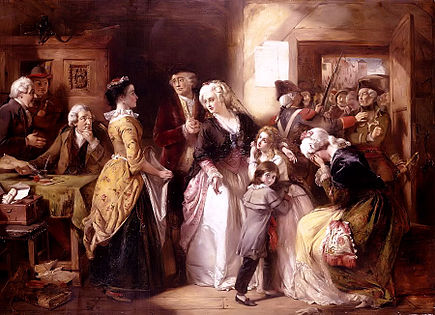
Graham Robb maintains that Louis XVI and Marie Antoinette lost their heads in part because of the lack of a good map of Paris. In his book Parisians: An adventure history of Paris, he tells the story of how the French royal family planned to sneak out of the Tuileries Palace under cover of darkness. Unfortunately for them, their departure was badly delayed when Marie got lost trying to find the place where the carriage was waiting for them; due to the delay, they were spotted in Varennes the next day, stopped, arrested, and eventually beheaded. (See this Wikipedia page for more details.)
It really wasn’t that hard to get lost. Until the Hausmannian reconstruction in the mid-19th century, Paris was a typically medieval mess of tiny streets intersecting at bizarre angles, and in truth, it mostly still is. Robb explains the maplessness situation like this:
It still isn’t that hard to get lost in Paris. And, there still isn’t a great map. However, there are certainly more maps than there were in 1791, and they each have their strong points. The basic issues to think about when picking your map(s) of Paris are:
- You need sufficient detail. Paris is still full of those tiny, crooked medieval streets, and you want a map that shows all of them.
- You want to know which metro lines the metro stations on your map serve.
- You want a size that will be convenient for you to carry and wrestle with.
The problem is that if there’s a map that does a good job with both of these, I haven’t found it yet. Here’s a quick review of what’s available.
- Don’t rely on any map in a guidebook that you’ll be reading on a Kindle. I’ve found Kindle maps (at least of Paris) to be more or less worthless.
- Paris Pratique is more or less the standard, as far as I can tell. If you see a Parisian pull out a map, it’s probably going to be this one. It’s sold in every news kiosk in Paris, so you can wait until you get there before buying one. There are different versions–with and without the suburbs, large and small format, and probably others. Advantages: the version that you see the most is small enough to carry in a back pocket, and it is super detailed. It gets updated every year–you’ll see the publication date on the cover. Disadvantages: it’s so detailed that if you’re as old as I am, it might be hard for you to read, and it doesn’t show which metro lines the stations serve.
- Streetwise Paris: this is the easiest map to find in the US. It’s printed on heavy stock and laminated, so it will take a beating while you carry it around on your adventures, and it also won’t flop around in your hands as you attempt to figure out where you are while your kids whine about wanting to go to McDonald’s. Advantages: It shows the metro lines that serve the metro stations. It’s both detailed and big enough to read, and you can buy it before you leave the US. Disadvantages: it only shows the main parts of the city, which will be fine if you’re only planning on going to the usual areas that tourists go to, but if you plan on exploring more extensively, it may not cover every area that you plan to visit. The trade-off for the easy readability is that it’s too big to fit in a back pocket, so unless you’re carrying a purse, it’s an obvious marker of touristness. (More on this word below.) It’s also hard to tell when the most recent update was done.
- The free maps that you get at metro stations: not surprisingly, these are the best maps for navigating the metro. They come in a larger size and a smaller size, and I would guess that most Parisian women have the smaller one in their purse. (Not that I know every Parisian woman, but I do know a few, and they all carry one of these.) Advantages: very good for the metro, and they don’t immediately mark you as a tourist–see above about Parisian women. Disadvantages: not enough detail to be useful in finding your way around once you’re out of the metro station; printed on regular paper, so they flap around in the breeze.
There are plenty of mapping apps for your smart phone, and there seem to be new ones all the time. I don’t have a favorite; features to think about when picking one:
- Does it update to your current location automatically when you open the map? Some do, some don’t, and sometimes you want this feature, and sometimes you don’t (e.g. if you want to keep consulting the same map without it updating to your current location constantly).
- Can you search it for categories of places–restaurants, cafes, etc.–or just by address?
- What kind of support does it have for walking directions?
One app that I do recommend that you download is the RATP app. This will do a good job of finding the best metro routes for getting from point A to point B.
Earlier in this post, you saw the word touristness. Whether or not you’ve ever seen that word before, if you’re a native speaker, you probably had no trouble understanding it. How can that be, when common conceptions of meaning hold that they are attached to words? If that word isn’t in the language, how could I use it to say something, and how could you understand it? The answer: the productivity of derivational morphology.
Morphology is the (study of) the structure of words. What do I mean by the “structure” of words? Think about the English word unlockable. What does it mean? It’s actually ambiguous. It can mean capable of being unlocked, in which case you have un + lock, with unlock having able attached to it. It can also mean not capable of being locked, in which case you have lock + able, with un attached to lockable. These are two different structures of the parts that make up the word. Those “parts” are called morphemes–the basic units of meaning in a language. (We see here a problem with the common conception of meaning as being something that’s attached to words, per se, but we’ll come back to that another time.)
Morphemes–those minimal units of meaning, like un, lock, and able–can be grouped into a number of categories. Derivational morphemes change either the meaning or the part of speech of what they’re attached to. So, un changes the meaning of lock or of lockable to mean something like the opposite of whatever it means without un, and able changes the part of speech of lock or unlock from a verb to an adjective. So, now you understand what I meant by derivational morphology when mentioned the productivity of derivational morphology earlier.
One of the characteristics of human language is that it is productive. That means that we can use it to say and to understand things that haven’t been said before. Derivational morphology in English is something that’s quite productive–we can use it to form words that we haven’t used or heard before, and when we hear those words that we haven’t heard before, we can understand them. Hence: it’s the productivity of derivational morphology that let me say, and that let you understand, the word touristness, even if you haven’t run across it before.
So, this is nice: we know a couple facts about language that perhaps we didn’t know before. But: facts are generally interesting (at least from a scientific point of view) only to the extent that they have larger implications. Here are some larger implications of the productivity of derivational morphology:
- It illustrates a basic difference between human language and animal communication systems. There are some fascinating animal communication systems. The thing about them is: even the really fascinating ones only communicate a pretty limited range of meanings. Vervet monkeys have this really cool system of calls that communicate the presence of three different kinds of threats: airborne predators, terrestrial predators, and snakes. It’s cool because it reflects interesting abilities to categorize, and because juvenile vervet monkeys display errors in using the system that are very much like a type of error that human children display when learning human languages. But: the only things that it can communicate are the presence of one of these three kinds of threats. A vervet monkey can’t say anything that hasn’t been said before. Contrast that with your ability to use derivational morphology productively, which lets you say–and understand–things that have never been said before.
- It raises a problem for the idea that meaning is a property of words. A couple problems, actually. One problem: it suggests that there has to be a unit of meaning that is smaller than the word. Another problem: if words have their meanings by being shared within the community of speakers of a language, then how can you explain the ability of speakers of the language to understand a new word, which by definition cannot have been shared?
- It raises a problem for any easy behaviorist explanation of human linguistic behavior. If you want to claim that know a word because you’ve learnt some association between a stimulus (presumably the word) and a response (harder to define, but let’s say that your response was some sort of reinforcement, even if indirect, for having understood it), how can you explain the production and the understanding of words that you haven’t been exposed to before?
So, you probably want to draw conclusions something like these:
- Meaning is attached to morphemes, not to words. We can share the meanings of the morphemes within a community of speakers of a language–no problem. We probably don’t understand those morphemes by means of any simple behaviorist phenomenon of stimulus/reinforcement, though.
You can find 22 interesting maps of Paris at this link. They won’t help you find the street that you’re looking for, but they have lots of interesting information on things like rental prices, where to rent bikes and scooters, locations where movie scenes were filmed, refugee camps–all sorts of stuff.
Back to maps: when figuring out your way around town, keep in mind that streets have a bad habit of changing names abruptly. One minute you’re on blvd. Grenelle, and the next it’s turned into ave. Garibaldi. This is important if you’re planning on walking down street X until you come to street Y–you have to bear in mind that street Y might be called one thing to your left, but something entirely different to your right.
Back to Marie Antoinette: the failure of the attempt to escape from Paris had a number of consequences. Any claim that the king was in agreement with the Republican government was pretty much trashed by the fact that the king had attempted to escape from it. Other European monarchies then worried even more that the Republican revolution would spread to other countries, which trashed relations between the new government and the rest of Europe, or a lot of it. Louis XVI and his family were imprisoned thereafter; they were eventually tried for treason, and he and Marie Antoinette had their heads lopped off. Something to think about the next time you pull a map out of your pocket…
Want to know more about new words and how to spot them? Check out Orin Hargraves’s book New Words.
 If you’ve spent any time at all researching the French language on the internet, you’ve almost certainly run across Laura Lawless. For 15 years, Laura was in charge of the biggest source on the internet for French language instructional content, and the folks that run the site tell me that her materials are still their biggest traffic draw. Laura took time off from her busy schedule as the owner of the

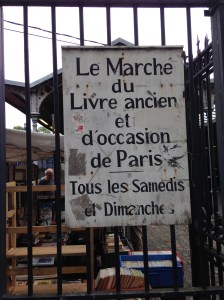 Marché du livre ancien et d’occasion: tons and tons of people selling antique and used books. I’ve occasionally found really cool stuff there, and occasionally found more or less nothing. You can also find paper ephemera–posters, theater bills, stuff like that. There’s a highly-rated little cafe right across the street.







 Zipf's Law