15 hours with a chicken on your lap, and how to schedule an operating room

Why is it so hard to get to see a surgeon and get your surgery scheduled?  If you haven’t thought about it much, you probably figure: first come, first served.  (This and other obscure English expressions explained below.)  If you have, in fact, thought about it a bit, you probably figure: emergencies first, and then elective surgeries.  Makes sense–it’s “truthy,” as Stephen Colbert would say.

It turns out that it’s more complicated than either of these.  Setting up the operating room schedule is one of the most difficult tasks for the organizers of the Surgicorps mission that brings me to Guatemala this week.  Here are some of the things that you have to balance:

  1. Any non-insane surgeon with an operating staff that’s new to each other will start off with some easy cases.  It gives everyone a chance to get to know each others’ rhythms and quirks in a relatively low-pressure environment.  So, after we screen a couple hundred patients on Sunday and sit down to schedule a bit over 90 of them for surgery in the week to come, some of the easy ones get put down for Monday.
  2. One of our major, major goals is to not have anyone left in the hospital when we leave, which is the Saturday after we arrive.  This means that difficult cases that will require longer recovery times need to be done early in the week to maximize the chances of getting them discharged before we leave.
  3. A corollary of requirement (2) is that you want to do relatively easy stuff that’s not likely to require overnight hospitalization on Friday.  So, Friday is the time for complicated dressing changes and the like.

So: requirements (1) and (3) compete for the easy patients.  Requirements (1) and (2) compete for Mondays.  There are a couple other things that come into play, though.

15 hours with a chicken on your lap

There are lots of volunteer groups that come to Central America to provide free surgical services to people who can’t begin to afford them.  What makes Surgicorps different is the mix of specialties that we bring.  Lots of groups have a specialty of one sort or another, and people throughout the Guatemalan health care system know what they are, where those groups will be, and when they’ll be there.  If you need hand surgery, then since that’s one of our specialties–and a hard-to-find one–then if you’re lucky, you’ll be advised to show up in Antigua Guatemala–same place, same week, every year.
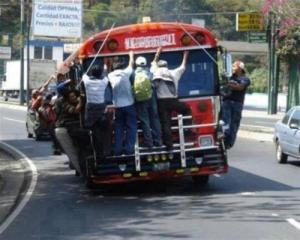
camioneta img_0919
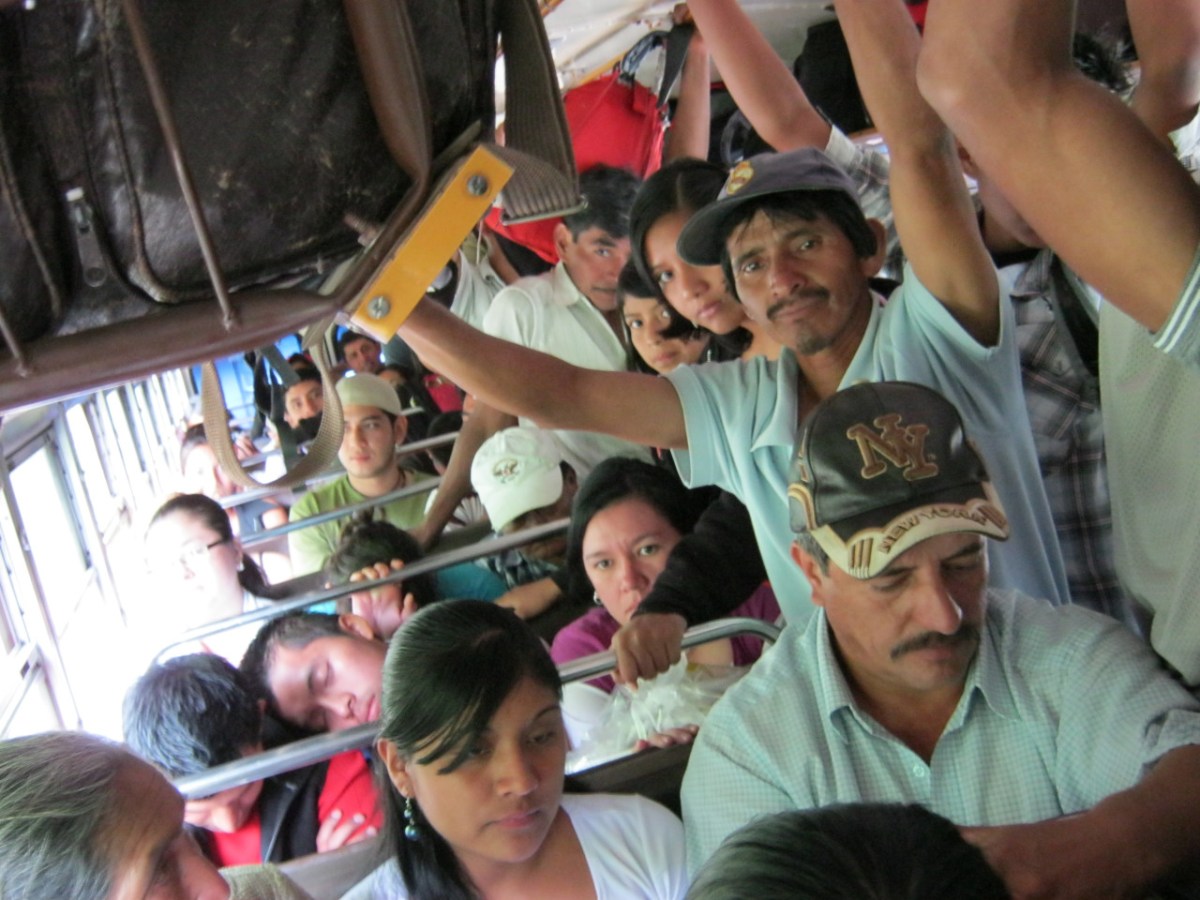
A Guatemalan camioneta. Picture source: https://camino55.wordpress.com/2011/09/16/la-camioneta/

Consequently, people show up for screening day from all over the country.  If you have the average income–which is to say, not very much money at all–then your options for long-distance transportation boil down to just one: a camioneta.  This is a bus.  But, not just any bus.  It’s basically an old school bus, typically painted in some colorful and multihued way.  These things get packed full of all the people–and stuff–that they can carry, and you may do your travelling in the company of various and sundry species of livestock.  If you’re from the farther reaches of Guatemala, it’s maybe a 15-hour camioneta ride to the town in the highlands where we do our thing.  15 hours, quite likely with your kid, who is about as likely to be able to sit still for that long as any other toddler on the planet.  15 hours with three people jammed onto a school bus bench meant for two children.  15 hours with, quite possibly, somebody’s chicken on your lap.

2016-08-07 08.25.58
View of a volcano from the screening area, just because I like to show you something non-depressing once in a while.  Picture source: me.

So, if you’re the person trying to put together the schedule for the week’s surgeries: now you’ve got an issue.  Let’s say that you have someone with an easy surgery to do.  You want to save a bunch of those for Friday, so if you have people who are local, you send them home, and have them come back Friday morning.  But, you can’t do that with someone who travelled for hours to get there.  So, you might need to move them earlier in the week.  Let’s call this requirement (4).

Then you’ve got the fact that most of the people who show up on screening day fall into one of two groups: (1) kids, and (2) people who do manual labor to support themselves and their families.  If the patient is in the “kids” group, then they were brought by at least one of their parents.  If the patient is in the “manual labor” group, then they’re not working, which means that they’re not supporting themselves and their families.  So, this plays into the equation, too: these folks might have typical surgeries, in which case you want them in the middle of the week, or easy surgeries, in which case you probably want them at the end—unless they get picked for Monday, when you will recall that you want the easy surgeries to get your team used to working together–but, economics dictates that it’s best if you can do them early.  (The same applies to the parents of the kids, who are not working as long as they’re sitting in Antigua waiting for their child to be operated on, but at this point, I can’t wrap my head around how to explain just how complicated that one can get.  It’s been a long day–see here for what a description of what a Sunday is like on one of this trips.)  We’re going to call this requirement (5).

So, let’s review the conflicting constraints:

  • (1) and (2) compete for Mondays.
  • (1) and (3) compete for the easy patients.
  • (1) and (4) compete for the beginning of the week.
  • (1) and (5) compete for the beginning of the week.

How do you work all of this out?  I don’t know–yet another reason that I’m just an interpreter.  There are people in the artificial intelligence field who have been trying to figure this kind of thing out for years—the military is happy to pay for the research, because you have to figure out a similar kind of problem if you have a bunch of different kinds of troops, supplies, and equipment that you need to get to an area of armed conflict, and only a limited number of ships and planes to move them in.  I don’t know of anyone who is jumping up and down to do this for a little volunteer group, though.  And, I’ll tell you the truth: I seriously doubt that anyone could do this better than our people do.  There are an enormous amount of variables that go into this–I’ve only sketched out the ones that are so obvious that even an interpreter would notice them.  (For context: I was a medic in the military for some years, so my “obvious” might be different from your “obvious.”)

So: what happens to the people who don’t get to go early in the week, and who live too far to go home and come back later in the week?  It depends.  A routine sight on our way to the hospital in the morning: a family waking up after spending the night in the open bed of a pickup truck.  They’re not our patients, though.  We provide housing for families while they’re waiting for their kids to get operated on, and while the kids are recovering before their discharge from the hospital.  Who pays for that: generous donations from people like you.  Us volunteers pay for our plane tickets, lodging, and other needs, as well as kicking in a week of vacation time.  Surgicorps pays for the patients’ costs, and Surgicorps’s money comes entirely from donations.  You could make one of those donations right now!  $250 will pay for transportation, food, and lodging for a patient and their family during the hospital stay.  $250 can also cover all surgical costs for one patient.  $100: four surgical packs.  $25: one surgical pack.  $10: all of the ibuprofen that we will hand out all week long–and, yes, our patients go home with nothing but ibuprofen.  Are you feeling like life is shitty today?  Give some money to help someone who needs it–you’ll feel better instantly.

English notes below.  Spoiler alert: we’ll talk about first come, first served; truthiness; and to be put down.

  • First come, first served: This is a saying that expresses the cultural belief that all other things being equal, services are rendered or goods are given in the order in which they are requested.  How it was used in the blog: If you haven’t thought about it much, you probably figure: first come, first served.
  • Truthiness: This is a recently invented word that unfortunately has quickly become indispensable.  Wikipedia’s definition:  Truthiness is a quality characterizing a “truth” that a person making an argument or assertion claims to know intuitively “from the gut” or because it “feels right” without regard to evidence, logic, intellectual examination, or facts.[1]It was invented by the comedian Stephen Colbert in reference to assertions made by President George Bush with respect to a Supreme Court nomination and the invented excuses for invading Iraq, among other things.  How it was used in the post: Makes sense–it’s “truthy,” as Stephen Colbert would say.  It turns out that it’s more complicated…
  • To be put down: This is an idiomatic expression with multiple possible meanings.  Here are the ones that I can think of:
    • From Google: to lower someone’s self-esteem by criticizing them in front of others.
      An example of this usage from Twitter: Why does my dad always find a way to put me down.  
    • There’s a related form of this idiom that adds the preposition for plus something else.  In that case, the “something else” is the excuse for the criticism.  An example of this from Twitter: My nephew dressed up in girls clothes and my family are just putting him down for it, it makes me so mad.  Another Twitter example:  people calling him ugly he’s been through so much but he can still find happiness stop putting him down for something unimportant.
    • Also from Google: to lay a baby down to sleep.  An example from Twitter: still awake 24 hours later.. someone send Ana to put me down.  Another Twitter example, with an optional for: Holding my brother and putting him down for a nap makes me fall asleep too. Gets me every time.  Another Twitter example, with another optional for + something else, this time with a totally different meaning of the “for:”  Not that putting him down for 20 minutes is a bad thing”
    • We saw some examples of idioms with put someone down for something, where the “for” and the following phrase were optional.  There’s another form of this idiom that has to appear with the preposition for, and then something elseThe definition of one of them, from Wiktionary: to record that someone has offered to help, or contribute something.  In this case, the “something else” is what the person has offered to provide as help or as a contribution.  Put me down for twenty bucks. 
    • …and, finally: the sense with which the idiom was used in the post!  This meaning also has to appear with for plus something else, but in this case, the “something else” is something that you’re associated with in some unspecified way.  From a tweet by Jon Favreau: Go ahead and put me down for no, Trump will never drop out.  Meaning: associate my name with the set of people that ascribe to the idea that “no, Trump will never drop out.”  Another Twitter example: Being opposed to strawberry doesn’t mean I want vanilla. Put me down for chocolate, or mint chip, or blackberry, or praline, or sherbet…  Meaning: the person would like to have chocolate, or mint chip, or…see whatever.  Here’s the example from the post: So, after we screen a couple hundred patients on Sunday and sit down to schedule a bit over 90 of them for surgery in the week to come, some of the easy ones get put down for Monday.  Meaning: some of the easy patients are put on the list of people who will be operated on on Monday. 

Back to French and Spanish when I’m a little less frazzled–screening day is a handful!


Open domain, closed domain: what makes medical interpreting hard

What makes medical interpreting hard: it’s not what you think. Plus, the Uber driver from Hell.

guatemala camioneta tumblr_lywjcqtcme1r1ymoao1_5001
A camioneta in Guatemala. People routinely ride these things for 15 hours to bring us their kids for surgery. Picture credit: Fotografía obtenida de Así es mi Guatemala: http://www.facebook.com/ELRINCONCHAPINN. Picture source: https://analistasindependientes.wordpress.com/2012/05/08/las-prioridades-del-alcalde-y-su-muni/

At 4 AM today I threw a suitcase full of clothes that will work for both hot, sweaty tropical evenings and freezing-cold operating rooms into the trunk of an Uber car and climbed into the passenger seat.  As we pulled away from the house toward the airport and a plane to Guatemala, the driver made a sudden discovery: Oh, shoot!  I’m out of gas!  (Explanations of oh, shoot! and other obscure English expressions at the end of the post.)  She was, too–a big ol’ red light was shining on the dash, and there was a big, glowing E (for Empty) showing on the gas gauge.

This was a problem: because of the balancing act that these ridiculously early morning flights require between not showing up before the airport opens but also not showing up late and missing your flight, I needed this ride to go as smoothly as Uber rides usually do–and I needed my driver to take me straight to the airport.  What to do?  Pull over and fill up the tank, and we risk missing my flight.  But, if we run out of gas between the freeway and the airport, I am definitely missing my flight.

I stopped worrying about this and started worrying about other things pretty quickly, because she more or less immediately blew through a stop sign while checking her text messages.  OK, down side: I may die on the way to the airport tonight.  But, upside: I am super-heavily insured at the moment, and my loved ones will be nicely taken care of.  Just a little bit more reflection, and I concluded that risking missing my flight was a better option than definitely missing my flight, so I encouraged my Uber driver to pull over and get some gas.

She was happy to do so, and drove straight to a station that she knew about.  Only problem: at 4 in the morning, it was locked up tight.  Hmmmm….  Back on the freeway, the big red light on the dash looking even brighter, deeper red, more ominous.

An aside: if I think I might be late for something important, I ask myself a question: can I move any faster than I’m moving?  If the answer is yes: I speed up.  If the answer is no: I figure that worrying about what will happen if I’m late is pointless, and instead I focus on whatever needs to be focussed on to get me to my destination in one piece.  In this case, it was the nice Uber lady driving, not me, so there wasn’t really anything that I could do to affect the situation.  Can’t affect the situation?  Then it’s not efficient to worry about it.  I like music, and hers was blasting, so why not pay attention?  Turns out the lyrics went something like this:  I’m gonna get drunk, I’m gonna get high, I’m gonna get drunk and high.   (You probably think that I’m making this shit up, don’t you?  Well: I’m not.)  I thought my happy thoughts about how heavily insured I am again, and threw in some reflection of the fact that I’ve had a great life and I could totally die in a violent car crash with no regrets about untasted cheeses, undrunk pinot noirs, and so on.  I kept thinking those thoughts as we pulled off the freeway and got some gas while the nice Uber lady told me stories about her childhood that made me doubt the existence of a future of any kind for America.  I kept thinking those thoughts as we pulled back onto the freeway to the sounds of I’m gonna get drunk, I’m gonna get high, I’m gonna get drunk and high.  I kept thinking them some more as we immediately pulled off of the freeway again and headed down some frontage road that I was pretty sure was going to take us to the UPS/FedEx terminal, not the airport for humans.  (Back in the days when grant proposals got mailed to the National Institutes of Health in a big box, usually at the last minute, the prudent researcher learnt every possible way to drive to the UPS/FedEx terminal.)  There was an erratic jag to the north.  (Definitely happened–Uber showed me the route that we had followed when it was all over.  This isn’t going to get us to the airport, I said.  The normally loquacious nice Uber lady fell silent, for the first and only time of the night.  Or morning.  Whatever–it was really dark out.)

And then it was over–I saw the United doors appearing in the distance, and then I was thanking the nice Uber lady, dragging my suitcase up to the ticket counter, and pulling out my passport.  The lady at the ticket counter was being nice to me in that way that the ticket counter agents are nice to you when you fly 100,000 miles a year, or at least they were treating me somewhat like a human being in that way that they do when you fly 100,000 miles a year.  I drifted off, and soon we were landing in Houston, and then we were in the air towards Guatemala, and then in the van that takes us all from the airport to Antigua (and that was the reason that I really needed to not miss my flight–we all travel together from Guatemala City to the highlands).  Traffic was beyond belief, and exhaust fumes were pouring in through the open windows, and the camioneta (colorful bus, usually packed with people and assorted livestock, roof covered with luggage) next to us was clearly going to sideswipe us–and I didn’t even care, because when the radio is not blasting I’m gonna get drunk, I’m gonna get high, I’m gonna get drunk and high, I figure: no problem!

…and now I’m sitting in my hotel room, getting ready for what will be the hardest day of the next week.  I’m here in Guatemala with a group called Surgicorps.  Our raison d’être (yes, we say that in English, too) is providing free surgical care to people who couldn’t afford it otherwise.  Burn scars that leave men unable to use their hands–the only things that let them earn a living.  Disfiguring acid burns on a woman’s face and chest, courtesy of…I don’t have a good word to describe the guy that did it to her.  Kids with congenital malformations of pretty much anything that can be congenitally malformed.  Women who can’t go to the market to sell their corn because they’re incontinent and they can’t ride the bus.  The Surgicorps surgeons, nurses, anesthesiologists, techs, and therapists take care of pretty much anyone, and I interpret for them.

We just got into Antigua tonight–Saturday.  Sunday is the most intense day of the week: screening day.  The surgeons will spend the entire day seeing everyone who walks in the door wanting surgery for their kid, or themself, or their mother, or whoever.  They’ll be able to help a lot of them, and those folks will go off to be seen by one of our anesthesiologists.  If the anesthesia folks clear them for surgery, then other people will start the process of getting their lab work, find a place for their family to stay while they wait, and so on.  Eventually we’ll end up with a bit over 90 or so people who will get operated on in the week to come.

A couple of our surgeons speak Spanish, but most of those people will run into an interpreter multiple times.  For us interpreters, it’s a long day of constant, constant bouncing back and forth between the two languages, in both directions—English to Spanish to repeat the doctors’ questions and instructions, and Spanish to English to repeat the patients’ answers.   The long day is tiring, but it’s the difficulty of the interpreting itself that wears me out.

I get pretty similar remarks from people when I tell them about my annual Surgicorps trip: it must be hard, learning all of that medical vocabulary.  Actually, that’s not the hard part at all.  Here’s the thing about medical vocabulary: it’s finite.  It is related to what we call in computational linguistics a closed domain: there are only so many things that can be talked about in it.  If you had a big enough book, you could learn all of the medical terminology in Spanish (or whatever language you deal with), and then you’d be done.

2015-08-09 14.12.25
The sign marking the hand surgery screening area last year.  Picture source: me.

I usually spend screening day with a hand surgeon.  I learn more hand vocabulary every year–this year I’ve been focussing on parts of the finger.  I don’t worry about that stuff–the chances of me being called upon to use words that differentiate between the body of the fingernail and the end of the fingernail are pretty slim.

Here’s the thing, though.  Take a seat in front of our hand surgeon, show him the scars that are keeping you from opening your fist, or the finger sticking out at an angle, or whatever, and the first thing that he’s going to ask is: how did that happen?  The answer to that question doesn’t come out of the closed domain of medicine–it comes out of the open domain of life.  Here are some possible answers:

  • I cut it while I was cutting up a chunk of frozen spinach to cook for my son.
  • I jammed a thorn into my hand.
  • I was sitting in my friend’s car and the fuel pump blew up.
  • I fell into the cooking fire.
  • A snake bit me.

(Can you guess which one of those was me when I paid my visit to the hand surgeon to get a joint capsule repaired?)  So: the closed domain of hand anatomy has a finite vocabulary, and it’s not actually that big–no problem memorizing it all.  The open domain of the world at large has an enormous vocabulary, and you know what Zipf’s Law tells us about the nature of that vocabulary: most of the words in it are going to occur at the statistical equivalent of never–but, they do occur.  And as a non-native speaker, they’re going to bite you.

And that’s it: what makes doing medical interpretation hard.  It’s not the medical vocabulary–it’s the entire rest of the world.  It’s all of the stuff that led to what happened to your hand, which led to you sitting in front of our hand surgeon, which led to me talking to you after an exciting trip through the wilds of the Denver night and the Guatemala City traffic.  And that’s why I’m going to bed a little nervous tonight–it’s screening day tomorrow.

Want to support Surgicorps’s work?  You really should–if you don’t feel better about life after you make a donation, I’ll give you your money back!  I’m not asking you to support my participation–like all Surgicorps volunteers, I pay for my own plane ticket, lodging, etc.  Your donation goes to the costs of surgery for someone’s kid, or mother, or wife, or…  They’re human.  That’s all.  Click here to donate.

English notes:

  • Oh, shoot!  This is a very mild way of expressing surprise, disappointment, and similar emotions occurring together.  It’s a bowdlerized form of oh, shit!  …but, truly, it’s so mild that your grandmother could use it.  Not my grandmother–she preferred oh, sugar!  …but, one’s grandmother could.  How it showed up in the post: As we pulled away from the house toward the airport and a plane to Guatemala, the driver made a sudden discovery: Oh, shoot!  I’m out of gas!
  • Big ol’: On some level, this is a contracted form of big old.  Syntactically, it functions as an adjectival expression, although a somewhat strange one.  Semantically, it describes size–but, not age.  Big ol’ means big.  It does not mean old.  Sociolinguistically, it’s stigmatized–the associations are with being rural, uneducated, probably Southern.  (I’m not asserting that Southerners are all rural and uneducated–they certainly are not.  I’m asserting that these are the associations that native speakers are likely to have with the expression.)  Used by someone like me–that is to say, an extremely urban Northerner with a graduate degree–the effect is to add an air of humor and casualness to the story.  How it showed up in the post: She was, too–a big ol’ red light was shining on the dash, and there was a big, glowing E (for Empty) showing on the gas gauge.
  • Pretty + adjective/adverb: “Pretty” is an intensifier here, meaning something like “very, or at least more than a normal amount, but not necessarily as much as possible.”  I’d be pretty careful about doing that, if I were you.  It’s pretty late–I’m going to bed.  That’s a pretty big mess you’ve made there.  How it showed up in the post: I quickly stopped worrying about this and started worrying about other things pretty quickly, because she more or less immediately blew through a stop sign while checking her text messages.

French and Spanish vocabulary:

English French Spanish
open domain le domaine ouvert el ámbito abierto
closed domain le domaine fermé el ámbito cerrado

Want to know more about hand surgery?  Here are some posts from the past.  Sorry, no French–the vocabulary under discussion is all Spanish.


Zipf’s Law comes out of the closet

After two years of writing this blog anonymously, I’m going public. Here’s why.

Feeling crappy today?  Do something to help someone else–you’ll feel sooooo much better!  Here’s one option for doing it.

2015-08-10 15.39.52
In the recovery room with Joyce. I spend a lot of my time there–a challenge, since I’m interpreting for people who are coming out from under anesthesia.

After two years of writing this blog anonymously, I’m going public.  The reason: I’m going to hit you up for money to pay for surgery for people who need it more than you can imagine, and who won’t get it without your help.

My name is Kevin Bretonnel Cohen.  (If you’re French, and you recognize my middle name: yes–they were my uncles.)  51 weeks a year I’m a computational linguist at the University of Colorado School of Medicine, where I teach in the Computational Bioscience Program.  One week a year I am an interpreter in Guatemala, where I work with Surgicorps International.  We are an all-volunteer group of surgeons, anesthesiologists, nurses, operating room technicians, therapists, and assorted support staff (like me).

There are many volunteer surgical groups like us that travel to spots where medical care is out of the reach of most people and donate their services.  What’s different about us is that we bring with us some uncommon surgical specialties.  One of those is hand surgery.   Hand surgery is a highly specialized area of practice that focuses on restoring function to hands that don’t work, whether from congenital (birth) defects, burn scars, injuries, or any of the other things that can happen to these crucial but surprisingly fragile parts of your body.  The hand is an amazingly complicated organ, and restoring function to a hand with no fingers requires an enormous amount of training—Dr. Kim, our hand surgeon, did fellowships in both orthopedics and plastic surgery.  (In medicine, a fellowship is a period of highly specialized training.  It can last as long as five years—and that’s after four years of college, four years of medical school, and a 3-year residency program.)

Our patients typically have little access to education and few options for a future that doesn’t involve physical labor.  A child who is born with a non-functioning hand or a kid with a burn contracture will have few options to support themselves, and may not just live in poverty themselves, but raise children in poverty.  That’s a lot of suffering…

…and you can do something to prevent it.  Surgicorps pays all costs of the surgeries that we provide–the supplies, the anesthesia, the medications, a hospital room for the patient, a bed for the family member that brought them (often by riding 15 hours in the back of a truck or on a crowded bus), x-rays, lab tests.  Why not donate some money to cover some of that?

I’m not asking you to fund my participation.  Like all Surgicorps members, I don’t just volunteer my time–I buy my plane ticket, pay for my hotel room, meals, etc.  Your money goes to cover the costs of surgeries.   

How much should you give?  The more you give, the better you’ll feel!  🙂  Here are some ideas:

$25: a surgical pack

$100: four surgical packs!

$250: transportation, food, and lodging for a patient and their family during the hospital stay; or, all surgical costs for one patient

If you can’t spare $25: no problem.  Give $10.  That will fund all of the ibuprofen that we send our patients home with for the entire week (and yes, almost all will go home with nothing stronger than ibuprofen).   Don’t have $10?  Give $5.  You will feel better for it–if you don’t, I’ll give you your money back!  Now that I’m not anonymous anymore: you know how to find me!  Here’s how to donate:

https://www.crowdrise.com/surgicorps-international-guatemala-2016/fundraiser/kbcohen

No linguistic oddities today, but we’ll get back to our normal discussion of our daily encounters with Zipf’s Law in French and English soon.

Hold Infinity in the palm of your hand: Amniotic band syndrome

Amniotic_band_hand
Amniotic band syndrome. Picture source: By Moscowmom – Own work, Public Domain, https://commons.wikimedia.org/w/index.php?curid=10953831

To see a world in a Grain of Sand,
And a Heaven in a Wild Flower,
Hold Infinity in the palm of your hand,
And eternity in an hour.

William Blake

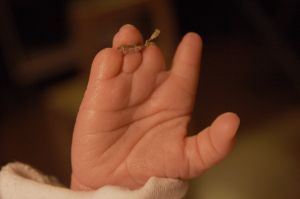
This is what your hand looks like if you’re born with amniotic band syndrome.  The thought is that it happens when there’s a partial rupture of the amniotic sack and the hand gets caught up in it.  It’s supposed to be purely mechanical.  But: amniotic band syndrome often co-occurs with other congenital anomalies that aren’t even possibly remotely mechanically related, such as cleft lip and cleft palate.  This leads to another theory about where amniotic band syndrome comes from, which is that it’s related to some kind of circulatory disorder that can affect both the digits and the developing palate.

In a region where people don’t typically get very much education and the most common way of supporting yourself is manual labor, a person who isn’t treated for this congenital defect can pretty easily find themselves in a life of poverty without an obvious way out.  That means a childhood of poverty for their kids, too.  That’s a lot of suffering.

You might be thinking: having amniotic band syndrome would suck, but there’s nothing that I can do about all of those little kids who are born with it.  I’m happy to tell you: that’s not true!

There’s a group called Surgicorps that goes to various and sundry places around the world to do free surgeries for the most destitute of the destitute.  There are lots of groups like that, but there’s something special about Surgicorps: they have a hand surgeon.  The goal of surgery for something like amniotic band syndrome is to restore function to the hand.  Doing this is difficult, and requires a lot of very specialized training–the Surgicorps hand surgeon did fellowships in both plastic surgery and orthopedics.  (For doctors, a fellowship is advanced training that you do after your residency if you want to develop very specialized skills.  A fellowship can easily be five years long, and that’s on top of four years of college, four years of medical, and a three-year residency.)

Where you fit into this: Surgicorps does its work entirely on the basis of donations.  The surgeons, anesthesiologists, nurses, technicians, interpreters (I’m one of them), and others all donate their time, pay for their own travel expenses, and pay for their lodging.  Surgicorps pays for all aspects of the patients’ treatment–the surgical equipment and supplies, housing for the parents while the kid is hospitalized afterwards, the anesthesia, medications–everything.  That money comes from charitable donations.

That’s where you come in!  In the days to come, I’m going to hit you up for a donation.  I’ll tell you more about what Surgicorps does, tell you about some of the people we treat (within the bounds of privacy), and try to give you a bit of the feel of what it’s like to be in Guatemala.

Language stuff: I work closely with our hand surgeon, which means that I need to know a lot of terms related to the kinds of feelings that you might have in your hands and fingers.  Here are some of those words, in English, Spanish, and of course French.  Scroll down past them for notes on the English in this post.  Spoiler alert: in the English section, I’ll be talking about the verb to cleave, the noun digit, and the idiom to come in.

English Spanish French
numb entumido, entumecido engourdi, insensible
sleepy/numb adormecido
itchy hormigoso qui démange, qui gratte
tingly corrientazo qui picote
  • cleft: this is the past participle of the super-interesting verb to cleave.  What’s cool about to cleave: it is its own opposite.  That is to say: it has two meanings, and they are each other’s opposites.  (Quotes from http://www.quotationspage.com, http://www.brainyquote.com, http://www.mechon-mamre.org, Jewish Publication Society, and http://www.sattor.com.)
    • One meaning of to cleave is to forcefully split something, or (intransitively) to split, especially along a natural line.  This is the origin of the name of the kind of heavy knife called a cleaver
      • One swallow does not make a summer, but one skein of geese, cleaving the murk of March thaw, is the Spring.  Aldo Leopold.
      • Hamlet thou has’t cleft my heart in twain.  Shakespeare, Hamlet.
      • I tend to foster drama via bleakness. If I want the reader to feel sympathy for a character, I cleave the character in half, on his birthday. And then it starts raining. And he’s made of sugar.  George Saunders. 
      • When I was at Babbo, I was covered in scars and scabs and burned bits – melted hair, ribbed burns I got reaching across the top of a hot skillet… I sliced off the tip of my finger. I cleaved my forehead – a deep, ugly wound. Luckily, it regenerated.  Bill Buford
      • Like Honeycrisp, SweeTango has much larger cells than other apples, and when you bite into it, the cells shatter rather than cleaving along the cell walls, as is the case with most popular apples. The bursting of the cells fills your mouth with juice. Chunks of SweeTango snap off in your mouth with a loud cracking sound.  John Seabrook.  (This is the intransitive use.)
        Cupid’s arrow, Hafiz’s heart tore and cleaved
        I see his verses, with their wet ink, bleed. 
        Khajeh Shamseddin Mohammad Hafiz Shirazi
    • The other meaning of to cleave is to stick to something.
      • Cleave to no faith when faith brings blood.  Arthur Miller, The crucible. 
      • She counted to ten as she had been taught when about to deliver a big speech, but when she tried to force some words of outrage from between her teeth her tongue clove to the roof of her mouth and the most she could do was make a small cry of protest deep in her throat. (British National Corpus.  Like that past tense?  J’adore!)
      • We all are originally sinners as Adam and in Adam, his leprosy cleaving faster to us than Naaman’s did to Gahazai, so that even the infant, before it has seen the light of the world, has this blemish inherent in its unborn members.  John Wycliffe.  (A little language/interpretation connection: Wycliffe Bible Translators, the biggest Bible-translating group in the world, is named after John Wycliffe.)
      • Therefore shall a man leave his father and his mother, and shall cleave unto his wife, and they shall be one flesh.  God, Genesis 2:24.
         תִּדְבַּק-לְשׁוֹנִי, לְחִכִּי–    אִם-לֹא אֶזְכְּרֵכִי: Let my tongue cleave to the roof of my mouth, if I remember thee not.  Psalms 137:6.
    • I ran into this example in the British National Corpus, and I have no idea whatsoever what it means: The horse shied a little and the butt cleaved into the side of my head, almost taking my ear off.
  • digit: you know that this can mean a number, but it can also mean a finger or toe.  From the post: This leads to another theory about where amniotic band syndrome comes from, which is that it’s related to some kind of circulatory disorder that can affect both the digits and the developing palate.
    • Painful, rapidly growing tumor in the subungual area of the first digit of the right hand.  Perelló-Alzamora et al.
    • Surgical amputation of the digit: an investigation into the technical variations among hand surgeons.  Li et al.
  • to come in: this idiom has a few meanings.  Here’s the definition for the way that I used it, from Merriam-Webster: to assume a role or function <that’s where you come in> From the post: That’s where you come in!  In the days to come, I’m going to hit you up for a donation.


Strict fathers, nurturant parents, and how the Republican Party got metaphored to death

Metaphors and frames play an important role in how we talk–and think–about the world. Here’s what you need to know to read an essay on how this relates to the 2016 American presidential campaign by one of the world’s most famous linguists.

George Lakoff may be the most heavily cited linguist in the world–way more than Chomsky, believe it or not.  (I checked their citation counts on Google Scholar.)  He revolutionized the study of metaphor in his books Metaphors we live by (written with Mark Johnson) and Women, fire and dangerous things.  Lately he’s been writing about how metaphors shape the world-views of both liberals and conservatives, and his book Moral politics on that subject is amazing.  (The title comes from his view that political stances are, at their roots, moral stances, and that liberals and conservatives have different takes on morality.  There’s a third edition due out in September, so don’t rush out and buy it just yet.)

Here’s Lakoff’s take on the unexpected rise of Trump and Trumpism in the Republican party.  It’s a good (if rather sloppily edited) and much-shorter-than-book-length) picture of how he explains the relationship between metaphor and political thought, with specific reference to the Trump phenomenon.

Lakoff often makes reference to the concept of framing in this essay, without ever defining it.  Here’s the definition of framing from Wikipedia:

The framing effect is an example of cognitive bias, in which people react to a particular choice in different ways depending on how it is presented; e.g. as a loss or as a gain.[1]

Framing is an important concept in cognitive science, linguistics, and computer science (especially artificial intelligence). Here’s an example of a frame related to commerce, from a linguistic perspective:

Screenshot 2016-07-24 09.28.04
Screenshot of a FrameNet entry. Source: https://framenet2.icsi.berkeley.edu/fnReports/data/frameIndex.xml?frame=Commerce_buy

You can talk about that frame in English using a variety of words:

  • Abby bought a car from Robin for $5,000.
  • Robin sold a car to Abby for $5,000.
  • Abby paid Robin $5,000 for a car.

Same frame, same event, multiple perspectives: what Abby did, what Robin did, and the price that was paid.

Here’s an example of how framing can work out in language in a political context: refer to something as a baby, and it’s tough to be pro-choice.  Refer to it as a fetus, and it’s tough to support the anti-choice position.  Framing can interact with metaphor in very powerful ways: talk about a nation in terms of being a family–in American English terms, our founding fathers, the homeland where we all live, the sons and daughters that we send to war–and you trigger conceptions of very particular kinds of relationships between parent and child.  From the conservative perspective (quoted from the Wikipedia article on Lakoff):

Conservatives would subscribe more strongly and more often to a model that he calls the “strict father model” and has a family structured around a strong, dominant “father” (government), and assumes that the “children” (citizens) need to be disciplined to be made into responsible “adults” (morality, self-financing). Once the “children” are “adults”, though, the “father” should not interfere with their lives: the government should stay out of the business of those in society who have proved their responsibility.

From the liberal perspective:

In contrast, Lakoff argues that liberals place more support in a model of the family, which he calls the “nurturant parent model“, based on “nurturant values”, where both “mothers” and “fathers” work to keep the essentially good “children” away from “corrupting influences” (pollution, social injustice, poverty, etc.).

I’ve read Lakoff’s book–the Wikipedia article reflects it pretty accurately.

Now that we understand the basic concepts of framing and have some examples of the metaphors, here’s Lakoff’s article on Trump and how he’s managed to get the Republican party nomination by appealing to various and sundry aspects of the (American) conservative world-view:

Understanding Trump

An excellent interview with Lakoff, in which he develops and expands on these ideas better than he did in the article that I link to just above, appeared yesterday (January 17th, 2016).  Here‘s the link…and in this one, he’s talking about how the Democratic party got metaphored to death.

Language notes: English and French

English: metaphor is not a verb.  I used the form metaphored “for effect.”

to rush out and do something: to do something immediately. From the post: Don’t rush out and buy it just yet.  Note that this meaning is specific to the construction rush out (and verb).  You can also rush out of a location, e.g. She rushed out of the house in a panic, jumped on her bike, yelled, “Say hi to your mom for me!” and disappeared down the drive.  (Source: here.)  You can also rush out a product, e.g. Microsoft rushed out a fix for a serious vulnerability in the way Windows handled the Windows Meta File image format.  (Source: here.)

French: here’s the French Wikipedia article on framing.  We’ll go through some of the vocabulary in a minute:

En psychologie du raisonnement et de la décision ainsi qu’en psychologie sociale, le cadrage est l’action de présenter un « cadre cognitif » comme approprié pour réfléchir sur un sujet. Ce cadrage peut avoir un effet sur le raisonnement et conduire à des choix différents en fonction de la façon dont le problème a été formulé.

le raisonnement: reasoning, argumentation.

le cadrage: framing.

le cadre: framework, among other things.  I like to say cadre juridique, “legal framework.”  I have no idea–it just sounds cool to me.

approprier: to adapt.  Warning: the reflexive or pronominal version, s’approprier, means to appropriate or to seize.

Why I’m not afraid to go to Paris

Trigger warning: graphic description of what happens when you shoot an infant with a shotgun.

I get the same question from Americans pretty frequently: aren’t you afraid to be in Paris, with all of the terrorist attacks?  In truth: I’m not afraid to be in Paris in the least.  To be in the US, though: that’s more complicated.

Thanks to my work, some relatives overseas, and a little volunteering, I travel out of the US pretty regularly.  I do go some places that are a little dicey on occasion.  (Dicey and other obscure English expressions explained at the end of the post.)  However: I am far more cautious in the US than I am anywhere else.

Screenshot 2016-07-11 11.01.08
Picture source: http://www.nytimes.com/2016/06/14/upshot/compare-these-gun-death-rates-the-us-is-in-a-different-world.html?_r=0

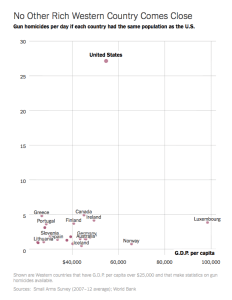
The reason: we have far more gun deaths in the US than any other country, anywhere in the world.  You might respond that we have more gun deaths in absolute terms, but only because we have more people than most countries.  That’s not the case, though: in relative, per capita terms, we still have far more gun deaths than any country in the world.  The graph to the left takes exactly this question into account–the larger population in the US–and models the number of gun deaths that you would see in other countries if you adjusted their numbers of gun deaths for the same population size as the US.  Far more in the US…  Could I get blown away by a terrorist in Paris?  Sure.  But, I’m way more likely to be shot in a random road rage incident while driving to work in the US.

Lately I’ve occasionally been wrapping up my blog posts by giving the number of gun deaths in the US in the past 72 hours, along with links to the news stories on 5 or so of the most recent ones.  I’ve been doing this because I think that there’s some value in raising awareness of just how frequent firearm deaths are in this country.  But, I’m going to stop.  The reason: it’s just soooo depressing.  It turns an activity that I do just for fun, just because I enjoy it—writing about whatever random crap happens to be in my head on this blog—and turns it into a confrontation with the sadness of every one of those families that lost someone to the curse of firearms in America.  I just don’t have the stomach for it.  I feel like a wimp for that, but: I really don’t have the stomach for it.  It’s just overwhelming.

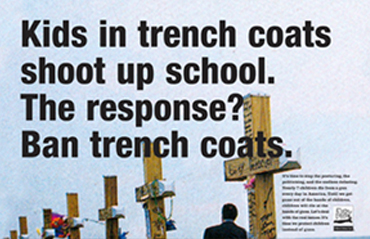
Let me give you some idea of the magnitude of our problem.  According to statista.com, a web site that aggregates statistics on pretty much anything that you can count, the largest number of deaths of American soldiers in Iraq in a single year was 904 in 2007.  The total number of civilian deaths in Iraq since the war started is somewhere in the range of 160,000 to 174,000.  In contrast, in the US we’ve had about 12,000 firearm deaths in the US every year since the Iraq war started.  That works out to more firearm deaths in the US than in Iraq. 

ban trench coats CWC_solo_images_tranchcoats_
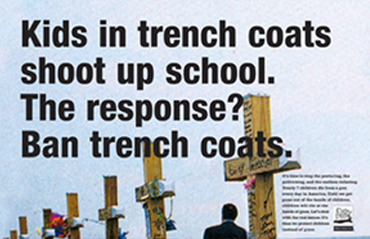
Sad to say, but: this is not an exaggeration. Picture source: http://cdf.childrensdefense.org/images/content/pagebuilder/CWC_solo_images_tranchcoats_.jpg

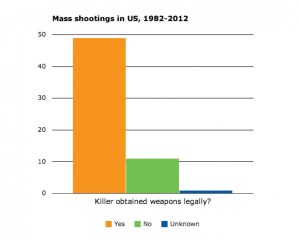
After any especially horrific shooting in the US, you hear this explanation from some gun nut or another: he got the gun illegally–there’s nothing that could have been done about it.  This is bullshit.  The graph below shows the distribution of legally obtained, illegally obtained, and unknown-provenance firearms in mass shootings in the US over the 30-year period from 1982-2012.  Most of them were obtained legally.


mass shootings guns legal or not imrs.php
Picture source: http://www.nytimes.com/2016/06/14/upshot/compare-these-gun-death-rates-the-us-is-in-a-different-world.html?_r=0

The most common Republican justification for why Americans ought to have easy access to firearms: in the US, it’s a civil liberty, enshrined in the Bill of Rights, the first ten amendments to our Constitution.  I find this amusing and more than a little hypocritical, for the following reason: we have a lot of other civil liberties enshrined in our Constitution, too, and Republicans typically seem pretty willing to let them go.  For example:

  • Congress shall make no law respecting an establishment of religion (First Amendment): …and yet Republican politicians pretty widely defended the county clerk who refused to give marriage licenses to gay couples, as Christianity (her version, at least) forbids it.  (You have to wonder if they would have been so enthusiastic about defending the clerk if she had been a niqab-clad Wahhabi.)
  • The right of the people to be secure in their persons, houses, papers, and effects, against unreasonable searches and seizures, shall not be violated…  (Fourth Amendment): …and yet many Republicans have been falling all over themselves to make it easier to monitor the communications of US citizens since 9/11.  (Not all Republicans: after the Snowden revelations, there was some outcry amongst Republicans, too.)
  • No person shall be held to answer for a capital, or otherwise infamous crime, unless on a presentment or indictment of a grand jury, except in cases arising in the land or naval forces, or in the militia, when in actual service in time of war or public danger; nor shall any person be subject for the same offense to be twice put in jeopardy of life or limb; nor shall be compelled in any criminal case to be a witness against himself, nor be deprived of life, liberty, or property, without due process of law…  (Fifth Amendment): …and yet: Guantanamo, 15 years after 9/11, no trials, and Republican politicians fighting like crazy to keep them there.
  • In all criminal prosecutions, the accused shall enjoy the right to a speedy and public trial... (Sixth Amendment)…and yet: Guantanamo, again.
  • nor shall be compelled in any criminal case to be a witness against himself… (Fifth Amendment, again) …and yet Republicans will support torture?  Torture?  (See here for my thoughts, as a military veteran, on torture–I don’t know of anyone in America more opposed to torture than military veterans…)
  • And yet: they want to claim that the Second Amendment (firearms) is sacrosanct, unambiguous, and good.  Assholes.

Scroll down past the graph for notes on English expressions used in this post.

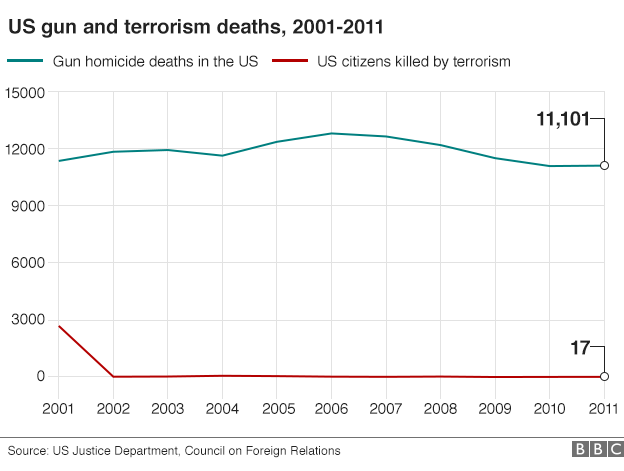
us gun versus terrorism deaths _85876098_us_gun_terrorism_624_v4
Picture source: http://www.bbc.com/news/world-us-canada-34996604


English notes:

151208-ja-quail-mansaw-mn-1300_0dacc0b28c99f76d2d3378ce4a6565db.nbcnews-ux-2880-1000
Ja’Quail Mansaw. Shot at the age of 7 months. Picture source: http://www.nbcnews.com/news/us-news/they-were-killed-gun-faces-child-victims-n477386

To be dicey: From Merriam-Webster.com: involving a chance that something bad or unpleasant could happen.  Also from Merriam-Webster.com: risky, unpredictable <a dicey proposition> <dicey weather>.  From the post: I do go some places that are a little dicey on occasion.

To fall all over oneself to do something: to be very eager to do something.  …and yet many Republicans have been falling all over themselves to make it easier to monitor the communications of US citizens since 9/11. 

Clad (in): to be clad in something is to be dressed in or covered with it, where the covering is in some sense permanent, as in an iron-clad promise.  From the post: You have to wonder if they would have been so enthusiastic about defending the clerk if she had been a niqab-clad Wahhabi.

To be/get blown away: one meaning is to be killed by a firearm or explosive–the sense in which I used it here.  Could I get blown away by a terrorist in Paris?  Sure.  But, I’m way more likely to be shot in a random road rage incident while driving to work in the US.  Another (and very common) meaning is to be surprised and overwhelmed by something.  It could be in a good way, or a bad way.  I was blown away by her unexpected kindness.  (That’s good.)  I was blown away by the savagery of the Nice attack on 14 juillet.  (That’s bad.)

Road rage: an outburst of anger by a driver, related to something that some other driver has done. The Wikipedia definition: Road rage is aggressive or angry behavior by a driver of an automobile or other road vehicle which includes rude gestures, verbal insults, physical threats or dangerous driving methods targeted toward another driver in an effort to intimidate or release frustration.  Road rage can lead to altercations, assaults and collisions that result in serious physical injuries or even death.

To wrap something up: multiple meanings; in this case, to finish something.  Lately I’ve occasionally been wrapping up my blog posts by giving the number of gun deaths in the US in the past 72 hours, along with links to the news stories on 5 or so of the most recent ones. 

To (not) have the stomach for something: it’s this meaning of the word “stomach” (definition from Merriam-Webster.com): the desire, courage, etc., that is needed to do or accept something difficult or unpleasant.  Example: I just don’t have the stomach for it.  I feel like a wimp for that, but: I really don’t have the stomach for it.

151201-nathaniel-w-hitt-jpo-533a_0f244effda2f8bff5c2cdd43006d6736.nbcnews-ux-2880-1000
Nathaniel Hitt. Killed at 7 months. From the news story: “Not long after Henry Bartle, 18, bought a shotgun at the Mohawk Sport Shop in Rome, New York, he used it to bag a deer. About a month later, he killed a turkey with it. And just a day after that, he accidentally shot his girlfriend’s baby. Seven-month-old Nathaniel Hitt was sitting in his walker while Bartle cleaned the Mossberg 500 12-gauge pump shotgun and installed a pistol grip on Nov. 28. He laid the weapon across his lap, leaned forward and went to get up, he told police. “The gun just went off,” Bartle said. “There was blood everywhere.””  Really? It “just went off”? That’s strange–in the Navy, they told us that weapons “going off” involved having your finger on the trigger. But, unlike getting a driver’s license, there’s no training required to own a shotgun… Picture source: http://www.nbcnews.com/news/us-news/they-were-killed-gun-faces-child-victims-n477386

No clever title: news of Genie

Trigger warning: horrific child abuse.

There isn’t typically that much drama in linguistics.  The last speaker of a language dies–a tragedy, but one that we’ve seen before many, many times, and one that we will see more and more of in the future.  A language previously thought to be extinct is rediscovered–fantastic.  Someone comes up with a new way to glue radiopaque pellets onto your tongue, or filter fMRI data, or calculate distributed semantic representations more efficiently, and we giddily try out the new technology.

There’s an exception to this drama-freeness: pretty much any news about Genie.  “Genie” is the pseudonym of a woman who was the victim of what might be the most horrific case of child abuse discovered so far in the United States.  Among other things, this involved having almost no contact whatsoever with language of any kind.  When she was found, at the age of 13, she had no language at all.  There was a huge debate in the linguistics community at the time about whether or not there was an upper limit to the age at which you can learn language.  Among the people who worked closely with Genie, giving her intensive language tutoring for years, were a lot of speech/language therapists–and Susan Curtiss, a graduate student in linguistics at the time, and today a faculty member at UCLA, one of the best linguistics programs in the world.

Genie is in her 60s now.  She never learnt to speak.  She can communicate with pictures, gestures, apparently very eloquent facial expressions, and sometimes words–but, she was never able to learn any language beyond individual words, whether spoken or signed.  She has been out of the sight of the world for quite a while, but occasionally some information surfaces in the news.

When that happens, it travels pretty quickly through the linguistics community.  Her case is famous–the only one of its kind, at least in modern times.  (There’s a French case from the 1800s–Victor, the Wild Boy of Aveyron–but, it was nothing like Genie’s, either with respect to the horrible abuse that she suffered, or the level at which he was studied (more accurately: wasn’t studied) by scientists or provided with attempts at therapy afterwards.

Genie’s case being an important one in linguistics, you tell it when you teach Linguistics 101.  I have told the story many times, and to my best recollection, I have never told it without someone in the class crying.  (I used to think that this was a testament to my story-telling skills–now I think that it’s probably just a testament to how very much I am an asshole.)

A story about Genie appeared in The Guardian yesterday, and I know that it will be of interest to my linguistics peeps, so I’m posting a link here.  But, if you don’t already know the story: think carefully about how depressed you’re willing to get today before you click on it.  You can read the story in The Guardian here.  It’s actually pretty mild–some of the details that make me the saddest are omitted.  But, it’s more than enough to ruin your afternoon.


Before it rains again, and often: hypercorrection

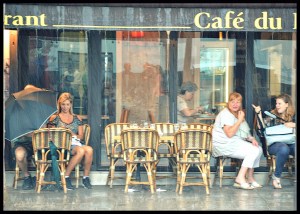
cafe rain 7538889068_a8800ee4f3_b
Picture source: https://www.flickr.com/photos/marylise-doctrinal/7538889068

I was waiting in line at the boulangerie the other day.  Outside, a nicely dressed woman sat and sipped a coffee while the rain poured down.

Suddenly the rain stopped.  The lady popped in the door, put her empty coffee cup and some money on the counter, and said: I’m going to leave before it starts raining again.  She dashed across the street, and I went home happy.  Why?

In the United States, I can tell quite a bit about you as soon as you open your mouth.  It’s not that I’m an expert in American speech–I’m not.  But, I can give a pretty good guess about the following, and I would guess that most Americans can, too:

  • Your probable ethnic self-identity
  • What kind of music you’re likely to listen to
  • Possibly part of the country that you’re from
  • Whether or not you went to college
  • Whether you’re more likely to vote for Hillary, or for Trump

In contrast: in France, hearing you speak gives me no insight into you whatsoever.  The director of the research institute where I hang out when I’m in France, the kid working the counter in the cafe outside the train station, a drunk panhandling by the ATM across the street from my apartment–their French all sounds the same to me.  Marine Le Pen, my radical colleague–if there’s a difference in their French, I can’t hear it.  In English, though…well, let me just say that if you have a high front tense rounded vowel in the word who’d, I’ll bet you’re voting for Trump (and that you would spell that sentence I’ll bet your voting for Trump).

Even I could tell that the woman who had her coffee spoke French quite elegantly, though.  Here’s how she said “before it starts raining again:” avant qu’il ne repleuve.  What’s so special about that: the tiny little ne. 

The first thing that you have to know about that tiny little ne is that it’s not a negation marker.  What it does: it makes your speech sound more elegant, more formal.  That’s the explanation that I’ve gotten from every native speaker that’s brought it up with me, at any rate.  It’s called the ne explétif, or (in English) expletive ne.

One of the cool things about the ne explétif is that as far as I can tell, it’s always used with the subjunctive.  Now, one of the cool things about that is that although we are taught in school to think of the subjunctive as being triggered by verbs, in a number of cases we see the ne explétif + subjonctif being triggered by other parts of speech (none of which I can actually describe very well, PhD in linguistics or no PhD in linguistics!).  One set of them connects clauses (more or less, sentences):

  • Les médias boudent le Front National … à moins que ce ne soit l’inverse?  “The media give the cold shoulder to the National Front–unless it’s the other way around?”  (see the news story here)
  • A moins que Maurice Szafran ne bascule dans un Antihollandisme aigu…  “Unless Maurice Szafran swings toward an intense anti-Hollandeism…”  (see the comment here)
Screenshot 2016-07-19 17.29.41
When #JasonBourne aka Matt Damon asks you to take a selfie…Unless it’s the other way around -ok I admit it!


You can find more of these on the Lawless French web site.

Another cool thing about this ne is that although the subjunctive will always be there when you use it, you don’t use it every time that you use the subjunctive–rather, it’s used only in very specific constructions.  You can’t make your speech more refined and elegant by just sprinkling it with ne‘s willy-nilly.  If you use it when you’re not supposed to, that just shows that you’re trying to be one of the refined, elegant people—but, you’re not.  And that’s where I get into trouble–I’m sure that I tend to use the expletive ne when I shouldn’t.  There’s a name for the phenomenon of trying to speak more elegantly, but screwing it up exactly by trying to be more formal.  It’s called hypercorrectionHere’s the definition from Wikipedia:

In linguistics or usage, hypercorrection is a non-standard usage that results from the over-application of a perceived rule of grammar or a usage prescription. A speaker or writer who produces a hypercorrection generally believes that the form is correct through misunderstanding of these rules, often combined with a desire to appear formal or educated.[1][2]

The example that we were always given in linguist school was the pronunciation of the t in often.  If you’re not a native speaker, let me point out that that t is silent.  But, you’ll sometimes hear native speakers who are making an extra effort to try to speak “correctly” pronounce it.

The “perceived rule” that they’re applying: typically, if there’s an ft sequence in the pronunciation of a word, then the word is spelt with an ft sequence.

  • after
  • laughter
  • crafty
  • lift
  • raft

Sometimes, though, you come across words that don’t have a t in their pronunciation, but they’re written with one, like in these consonant clusters:

  • listen
  • Christmas
  • mortgage
  • wrestle

For more words with silent ts, see this listOften is a word in which the t is silent, and it’s rarely pronounced with the t.  Take someone who’s insecure about how they sound, though, and put them in a formal situation, and that t in often might show up in their pronunciation.  Someone who’s not insecure about how they sound in formal situations?  Probably not.  Someone who’s insecure about how they sound in formal situations, but is not actually in a formal situation at the moment?  Also probably not–no t in often.  It’s just the mix of insecurity and a specific context that brings it out.  (This is laid out very nicely in the French Wikipedia page on hypercorrection.)

So, why do I not call out Wikipedia for calling this “non-standard” and using the word “incorrect” to refer to the pronunciation of often with a t, when as a linguist, “correct” and “incorrect” are not meaningful concepts to me?   It’s the pattern of variation.  The reasoning might be circular, but I will ‘fess up to that and explain it to you.

  • The speaker typically doesn’t use the t-pronunciation all the time: there is variability.
  • The speaker typically doesn’t use the t-pronunciation when speaking informally.
  • The speaker typically uses the t-pronunciation only when speaking formally.
  • Other speakers don’t use the t-pronunciation.  Notice that I’m not saying that higher-class speakers don’t use it, or that lower-class speakers don’t use it, or that educated people don’t use it: I’m asserting that other speakers don’t typically use it at all, regardless of the formality of the situation.

Do native speakers of French make hypercorrective uses of the ne expletif?  Of the subjunctive?  I would predict that they do, but I haven’t been able to find any data on this.  Native speakers, can you tell us anything about this?

Why that tiny little incident made me happy: I like it when I can see some of the huge complexity that is any language–French or otherwise–being reflected in the small things of life.  That lady just wanted to take off in a hurry before it started raining again.  She had probably already forgotten about that tiny little moment in her life before she ever got home–setting her coffee cup and some money on the counter, with a hurried explanation as she dashed out the door.  For me, though, it was a little point of contact with some of the larger mysteries of French that are waiting for me; a sign of some progress (I hope) in that I was able to recognize sophisticated speech when I heard it; a source of questions about how to describe the structures that can trigger the use of the expletive ne, and you know how much I enjoy that kind of shit; hours of thought, really, and a bit of positive feedback on my language-learning adventure.


French details: See this page on the Lawless French web site for more fun things that can happen with ne in French–I had no clue!

English details: here are some moderately obscure words and expressions from this post.

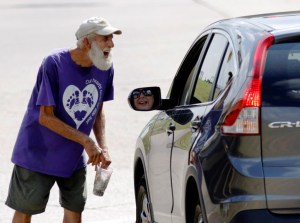
panhandler Jeff-Schultze
Jeff Schultze, a well-known panhandler in Dallas. Lest you think that I’m making fun of him: I think that if you’ve never found yourself in the position of doing this, you should realize that you have a reason to be thankful. Picture source: http://crimeblog.dallasnews.com/2016/02/dallas-police-crackdown-on-aggressive-panhandlers-is-underway-arrests-already-made.html/

to panhandle: this is a verb that means to beg, typically by sticking out your hand or a receptacle of some sort.  If someone were sitting on the sidewalk with a cup, you would probably be more likely to call that begging.  If someone were walking down the street asking strangers for money, you would probably call that panhandling. 

willy-nilly: haphazardly; without any plan; randomly.  According to the definitions that I found on the web, it has another meaning: under compulsion, without having a choice in the matter.  I’ve never heard the word used in this sense, but I can attest that that is, indeed, the origin of the word, and I picked it specifically for this post because it has an old negative in it.  The original form was willan-nillan.  In Old/Middle English, willan was the verb to want, and nillan was the negative–to not want.  So, willy-nilly was whether he wants to or not.

to lay out: this idiom can have many meanings.

  • to display, arrange, and/or explain very clearly and systematically.  That’s the sense in which I used it in this post: This is laid out very nicely in the French Wikipedia page on hypercorrection.
  • to knock unconscious, or at least to hit so hard that the person is lying on the floor afterwards.  I laid that motherfucker out.  Asshole.
  • of a person: to lay out in the sun is to spend time sunbathing.  She would lie out for hours every day.
  • of a thing in a location: to be left unattended and not taken care of.  My toy rifle laid out in the playground overnight.  When my father found out, he made me stand attention while he broke it across his knee.

See this page on the Merriam-Webster web site for some others.

Things to do in Paris in the evening

2840d865ad3e7d6578d5bd5dd19a1d38
Not me, but it certainly could have been. I would’ve been the third kid from the front, totally failing to focus on whatever we were supposed to be learning at the time. Picture source: https://s-media-cache-ak0.pinimg.com/564x/28/40/d8/2840d865ad3e7d6578d5bd5dd19a1d38.jpg

When I was a kid, I spent some time in Philadelphia, a large city on the East Coast of the United States.  I was part of a very religious Jewish community, and we didn’t handle money on the Sabbath–that’s Saturday.  This left Sunday for buying baseball cards, karate magazines, and the other necessities of a young boy’s life.  Problem: a set of laws known as the Blue Laws restricted what items could be sold in the city on Sundays.

Blue Laws are meant to enforce religious standards, and Christianity is not happy about doing business on Sunday.  It’s pretty common in the US to have Blue Laws restricting the sale of alcohol on Sundays.  The laws in Philly at the time were far more restrictive–shoelaces were off-limits, as I recall.   The alcohol-related laws are still alive and well in many of our states, but the many other restrictions are mostly gone.  (Bergen County, New Jersey is a notable hold-out—the residents like their Blue Laws, which currently forbid the sale or purchase of “clothing, shoes, furniture, home supplies and appliances” (quote from this Wikipedia page).  (Hold-out and some of the other obscure English vocabulary items in the post are discussed at the bottom of the page.)

As a bazillion expats in France have noted, usually with unhappiness (I’ll admit to having participated in this myself): not only does everything close in France on Sunday, but everything closes in France in the evening, too.  This is not a Blue Law thing (nor are the Sunday closings), but a reflection on the typical French value of family and one’s own life over making a bit more money by staying open later.  The package of changes to the labor laws that is provoking demonstrations and the occasional riot in France right now includes a plan to let some stores in heavily touristy parts of the city stay open until midnight.  There’s far, far more to the anger than stores staying open late, but it’s certainly part of the zeitgeist.

I admit to having participated in the whole expat why-the-hell-can’t-the-stores-stay-open-late-enough-so-that-I-can-work-late-and-still-buy-a-nail-file-on-the-way-home-from-work thing myself.  That was early in my French adventures, though.  At this point in the game, I get it, I think.  I can see that the guy who sells nail files wants to be able to spend time with his family, too–if I want to stay in the lab late and I really need a nail file that fucking bad, I can pick it up on the way to work in the morning, right?  But, if you are a tourist, the Parisian evening can present a challenge—so much so that John Baxter wrote a whole book on the subject: Five nights in Paris: after dark in the City of Light.

Dinner: this is, of course, the most obvious evening activity of all, but it bears some consideration nonetheless.  Some things to keep in mind: (a) Americans typically eat dinner much earlier than French people, and the restaurant that is full of tourists at 6 PM may have an entirely local customer base at 9; (b) it is most definitely possible to get a crappy meal in Paris, so check Yelp or otherwise plan ahead; (c) Paris has amazing ethnic food, especially from North Africa; (d) see this blog post for some advice on how to interact with Parisian waiters and the whole dining-out experience might make more sense.

Movies: the cinema is very popular in France, and that includes movies in English.  France values its own cinema so strongly that it negotiated the idea of the cultural exception in international trade, which allows a country to use quotas and subsidies to support culture-related industries even when the international trade laws don’t allow it to use quotas and subsidies to protect anything else.  France taxes movie tickets and uses the proceeds to subsidize film-making in the country, and as a result, French movies are famous for their high quality.  Around 50% of the movies in France are American, but they may be subtitled; if you want to see them in English, look for VO (“version originale”) on the schedule.  (France subsidizes its own film industry because the French like American movies so much, not because they don’t!)  There are movie theaters all over the place in Paris; I especially like the ones in St. Germaine (6th arrondissement) because it’s so easy to find a place to have a dessert before or after.

Theater: the theater scene in Paris is incredible–really, there’s no other word for it.  There seem to be little theaters hidden all over the city–I think my own arrondissement might be the only one in which I haven’t seen a play!  You can see live theater every night of the week in Paris, and it doesn’t have to cost very much, either. The variety of stuff that you can find in the city is incredible—this spring I saw Lysistrata, three plays by Molière, Jarry’s Ubu Roi, Ionesco’s La cantatrice chauve, and a ton of other things—one-person shows, poetry readings, all kinds of stuff.  I like the BilletReduc.com web site for cheap tickets.  As in any city, note that matinees might be full of kids.  Almost all theater in Paris is in French—if your French is not up to a two-hour play, try How to be Parisian in one hour, which is entirely in English and quite funny.  (You’ll see plenty of French people there, too.)

Music: before coming to Paris, I had no idea how orgasmic it could be to hear baroque music in an old stone cathedral.   Paris also continues the love affair with jazz that it’s been carrying on shamelessly since the First World War–John Baxter’s book  Five nights in Paris: after dark in the City of Light has an entire chapter on the phenomenon.  There’s an enormous amount of free or inexpensive music in Paris in the evenings.  Some options for finding it:

  • Keep an eye open as you walk around town and you will notice posters advertising musical events, mostly classical and mostly in churches, pretty much everywhere.
  • There are web sites galore that list musical events all over Paris, usually searchable by type of music, by date, by price, etc.  Note that Entrée libre means that they will pass the hat.
  • Check the web sites of some of the really special locations–St. Germain des prés, Sainte-Chappelle, La Madeleine…  (Note that Sainte-Chapelle can be really cold at night in wintertime.  Dress super-warmly, and bring a blanket.)

Shakespeare and Company: the most famous English-language bookstore in Paris is open until 11 PM.

Rocky Horror Picture Show: if you know what this is, I can tell you that seeing it in Paris will be one of the more memorable experiences of your life.  If you don’t know what this is: seeing it in Paris would still be one of the more memorable experiences of your life, but you would be totally lost for two hours.

notredame
The back side of Notre Dame at night. Picture source: http://www.leirdal.net/blog/uploads/NotreDamebynight_7F5E/notredame.jpg

Notre Dame: after dark is actually the best time to see Notre Dame, as far as I’m concerned.  Walk around to the back of the cathedral and you’ll find that they illuminate the flying buttresses at night–and that the view is truly special.  Pro tip: the movie theater that shows the Rocky Horror Picture Show is in the Latin Quarter just across the river from Notre Dame, and so is Shakespeare and Company, so combine these last three suggestions.

The cafe at the Musée Branly: I’ve heard that the view of the sun setting behind the Eiffel Tower from the cafe at the Branly is amazing.  I’ll leave it to you to figure out what time of year the cafe would be open at sunset.  I’ll also leave it to you to figure out how the sun could be behind the Eiffel Tower if you’re at the Branly–it doesn’t seem physically possible to me, but then I am lost even in as few as two dimensions.

Everything in France has its “in theory” and its “in practice,” right?  In theory, there is stuff to do seven nights a week in this town.  In practice, I’m usually too beat to do anything after work but go home, eat a TV dinner (admittedly a much more pleasant experience in France than in the US), and go to sleep.  I drag myself out to listen to jazz at the cafe downstairs on Monday evening, but otherwise, my wild nightlife mostly takes place on the weekends.   Well, the occasional Thursday night at the Philharmonic…  and sometimes Franglish on Tuesday evening… maybe a play on Wednesday…  Sometimes there’s a café philo on Thursday…  Life in this town truly does not suck.

English notes:

  • hold-out: someone who resists making some change that others have made.  One of the definitions on the Merriam-Webster web site puts it this way: a person who continues to do or use something after others have stopped doing or using it. 
  • zeitgeist: the spirit of the times.

…and some French:

  • Paname: a slang name for Paris.  (My French sucks so badly that until I went to YouTube this evening to look for a recording, I thought that Edith Piaf’s song Padam, Padam was Paname, Paname.)

Resources for learning French: Coffee Break French

Once you’re past the beginner stage, it’s tough to find French instructional materials. Here’s one good option.

faites la pause cafe 09b72d2e690b76d08c88136435f97787
“Take a coffee break every day.” Picture source: https://www.pinterest.com/pin/532058143449100826/

When I was in grad school, I did research on a language spoken by about 30,000 people in a town in what is now South Sudan.  Getting to that town was impossible–too many civil wars in the area.  I worked with a guy who was a political refugee in the US.  Every week, we met for two hours, and I would collect data.

At the time, there were maybe 40 people in the US who spoke the language.  The guy with whom I worked was the only one in our part of the country.  So: I had no examples of natural use of the language at all, other than the occasional phone message or email–just the data that came from our weekly meetings.

One fine day my consultant told me that there was going to be a conference in town, and a couple guys from his town would be coming.  My first chance to get actual conversational data!  His friends very kindly consented to be recorded, and one warm summer day the three of them got into the linguistics department’s sound-proof booth, I stuck a tape in the recorder (this was a while ago), and they started talking.

To picture the scene, you have to realize that the people in this town tend to be more educated than other folks in the area, and the people in the US who speak the language are often quite educated–two of these three guys were college professors.  So: three dignified, educated guys in suits in a stuffy little sound-proof booth in the middle of the summer, humoring some grad student by speaking their native language, sweating their butts off until I ran out of tape.  Humans can be very nice to each other sometimes.

Today, the Web has made getting data simple.  You want to hear formal speeches in Bari (480,000 speakers in South Sudan and Uganda)?  Go to YouTube.  You want to hear comedy routines in Dinka (1.4 million speakers in South Sudan)?  Go to YouTube.  You want to hear a bilingual song in Kukú and Ma’di (314,000 speakers in South Sudan and Uganda)?  Go to YouTube.  Kukú ko Ma’di, yi’ geleng–“Kukú and Ma’di, we are one.”  (Here’s the video.)

That’s the situation for those languages that you never hear about–thanks to the internet, I can sit in my pajamas and listen to more hours of the language on my laptop than I heard in three years of research.  For popular languages like French, there are far more instructional materials than any one person could possibly use in a lifetime.

That’s the situation for beginning students, at any rate.  Past a certain level, it gets hard to find structured material for learning a language, even one of the big ones–there are countless books, web sites, YouTube videos, etc. that will teach you the basics, but it’s much tougher to find instructional materials once you pass that point.

One of the best resources that I’ve found in this respect is the Coffee Break French podcast series.  The basic idea behind Coffee Break French is the 15-minute lesson: just long enough for a coffee break, so to speak.  It’s entirely audio.  There are four seasons of the series.  They take you from complete beginner in the first series to totally idiomatic French as it’s actually spoken in the fourth season.  I’ve only listened to the fourth series, which is targeted towards the more advanced speakers for whom there isn’t that much else available.  The basic format of the fourth season is this: you hear a text–an email, read out loud, from one of the characters in a season-long story to another of the characters.  The gist of the text is recounted in English.  Then, you’re given discussions of 3-4 expressions or grammatical constructions from the text.  Finally, you hear the text again.

One of the things that I like about Coffee Break French is that the expressions that they go over are not just idiomatic, but so colloquial that native speakers are surprised to hear them come out of the mouth of a non-native speaker.  The result of this is that I can often make girls laugh by using them.  Making girls laugh is pretty much my favorite thing to do in the entire world, and if you can do it in a foreign language: extra points.  And, they’re by no means obscure–pretty much everything that I’ve learnt from Coffee Break French is stuff that I hear native speakers say all the time.  Some of my favorites from Season 4:

  • un de ces quatre–“one of these days.”  Literally, it’s “one of these four.”  As they explain on the podcast, the original form is tous les quatre matins–literally “every four mornings,” but meaning “often.”  Related to that is un de ces quatres matins, “one of these days,” and that can get shortened to un de ces quatre. 
  • parler français comme une vache espagnole–“to speak broken French.”  Literally, it’s “to speak French like a Spanish cow”–I get so much mileage out of this one that I wrote an entire blog post about it.

There are also lots of discussions of the sorts of grammatical things that can be difficult for native speakers of English–when to use the future versus the present, when to use the subjunctive, agreement phenomena, irregular verb forms, etc.

The other thing that I like about Coffee Break French: it’s fun to listen to.  The two guys who do it clearly love what they’re doing, and delight in the language and its twists and quirks.  Hoho, that’s a nice subjunctive, Marc!  Who wouldn’t want to hang out with guys who admire a good subjunctive?  Plus, when they speak English, they both have these amazing Scottish accents–it’s a scream.  I worked my way through all 40 episodes of Season 4, which is longer than I’ve hung in there with any similar resource.  And, the fact that it’s a podcast, rather than a YouTube video, means that I can listen to it while in the car, or walking to work, or whatever–I’m not chained to a computer.

The 15-minute podcasts are totally free.  As is the case with many such similar resources, you can subscribe and get additional content for a price–longer audio lessons, and transcripts.

Are those French girls giggling at my clever use of the language, or because I sound like an idiot?  I don’t know how to design the experiment that would answer that question.  I do know that Coffee Break French improved both my comprehension and my speaking considerably–check it out.  For other posts about instructional materials for advanced students of French, see the following.  Scroll down past this list for some notes on English words and expressions in this post.

English notes:

  • to be a scream: to be very funny.
  • to recount: to relate in detail; to narrate (Merriam-Webster).  This can also mean “to count again.”  With the meaning of “to relate in detail, to narrate,” the word first shows up in the 1400s–the tail end of the Middle English period–when it was borrowed from the Anglo-French recunter. 
  • to shill: to say nice things about something because you’re being paid to do so.
Ukrainian Humanitarian Resistance

Resisting the russist occupation while keeping our humanity

Languages. Motivation. Education. Travelling

"Je suis féru(e) de langues" is about language learning, study tips and travelling. Join my community!

Curative Power of Medical Data

JCDL 2020 Workshop on Biomedical Natural Language Processing

Crimescribe

Criminal Curiosities

BioNLP

Biomedical natural language processing

Mostly Mammoths

but other things that fascinate me, too

Zygoma

Adventures in natural history collections

Our French Oasis

FAMILY LIFE IN A FRENCH COUNTRY VILLAGE

ACL 2017

PC Chairs Blog

EFL Notes

Random commentary on teaching English as a foreign language

Natural Language Processing

Université Paris-Centrale, Spring 2017

Speak Out in Spanish!

living and loving language

- MIKE STEEDEN -

THE DRIVELLINGS OF TWATTERSLEY FROMAGE