Resources for learning French: One Thing In A French Day

From the home page of the
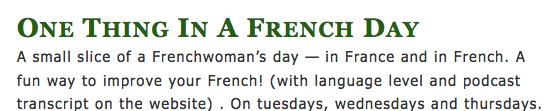
From the home page of the “One thing in a French day” web site, a good resource for intermediate students of French. Picture source: screenshot of http://onethinginafrenchday.podbean.com/

The world is full of books, YouTube videos, etc. for people who speak English and want to start learning French.  It’s harder to find materials that are suited for somewhat advanced students of the language.  It turns out, however, that there are some very good resources out there, if you can find them.

One that I think is good for people at about the intermediate level is the podcast One thing in a French day.  The podcast consists of a short, read essay (i.e., it was written and then read out loud, versus being spontaneous speech) about some thing or another in the podcast creator’s day.  Perhaps Laetitia buys a new printer.  Maybe she meets a friend at a patisserie for coffee and a pastry.  Maybe one of her daughters loses her Pass Navigo.  Whatever it is, Laetitia tells you about it, and Zipf’s Law strikes–you are quite likely to learn some new words in every podcast.

The podcasts are free, and a transcription of the beginning of the podcast is available on the web site, also gratis.  New ones come out 2-3 times a week.  For 3 euros a month, Laetitia will email you a full transcript of every podcast, along with some grammatical or vocabulary points of interest, and will answer questions.

As I said, Laetitia reads the essays, and her pronunciation is quite clear.  This makes One thing in a French day quite good for intermediate students, but possibly not as challenging as it could be for advanced students.  (Laetitia does point out that Il est vrai que c’est un texte lu, par contre je ne fais pas d’effort particulier pour ralentir le débit. Le rythme est mon rythme naturel.  “It’s true that it’s a read text.  On the other hand, I don’t make any particular effort to reduce the speed.  The rhythm is my natural rhythm.”) Still, no matter what level you are at, you will learn stuff from the  podcasts, and it’s nice to keep up with what’s going on with Laetitia and her family, as well as to get a little glimpse into the life of a normal French family.  To give you the flavor of the podcast, here are some words that I learnt from the most recent one (definitions from WordReference.com):

  • entrecoupée par: broken up by.
  • ensoleillé: sunny, bathed in sunlight.
  • la voie verte: I had to write to Laetitia herself for this one.  Here’s her answer: Pour répondre à votre question : La voie verte est une ancienne voie de chemin de fer entre Chalon-sur-Saône et Mâcon qui a été goudronnée et qui est maintenant réservée aux piétons, aux vélos, aux fauteuils roulants ou aux rollers. Il y a plus de quarante kilomètres de promenade.
  • prendre le pli: to get used to something, to get into the groove of something.  Prendre le pli de faire qqch: to get into the habit of doing something.
  • perché: perched, sitting on.

Nous avons fait d’autres belles visites pendant cette semaine en Bourgogne, entrecoupée par deux voyages à Lyon et de longues promenades ensoleillées sur la voie verte. Lisa est une bonne marcheuse, une fois qu’elle a pris le pli. Son record sur la voie verte : sept kilomètres.

Nous avons visité le site médiéval de Brancion. Un petit village perché sur une colline.

That’s 5 words in the first 5 sentences–as I said, you will learn stuff from One thing in a French day! 
It’s tough to be dispositive about dispositif

In which a French word means nothing like the English word that it looks like, and I remain puzzled even after looking it up.

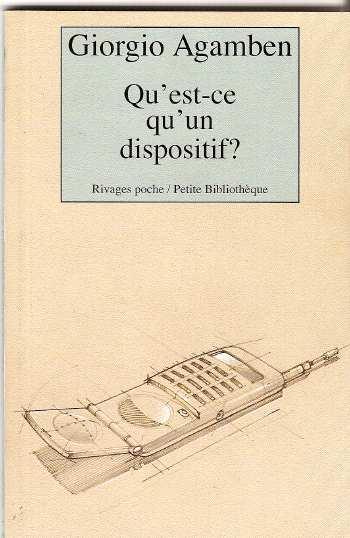
dispositif?” Read this post and you’ll see why it strikes me as funny. Picture source: cover of the book by Giorgio Agamben.” The title of the book means “what is a dispositif?” Read this post and you’ll see why it strikes me as funny. Picture source: cover of the book by Giorgio Agamben.

In France, I often ran across the word dispositif, but somehow never got around to looking it up.  I see now why I had trouble even guessing at its meaning–besides looking like an English word that it has nothing in common with semantically, it has a number of quite different meanings.  Here’s how it showed up in an email at work one day:

Nous avons commencé une expérience sur la collaboration et cohabitation des deux utilisateurs dans un même dispositif immersif (EVE) et on cherche toujours des participants.

In the context of where I work, it’s likely that the intended meaning is a “device, machine, apparatus,” as in this example from WordReference.com: C’est un dispositif de chauffage très perfectionné “It’s a very sophisticated heating device.”

If you’re talking about the police or the military, it would translate as “presence,” as in this example from WordReference.com: L’Etat a prévu un gros dispositif policier pour le prochain G20 “The government has organized a significant police presence for the next G20.”

It can also mean “plan.”  Here’s an example sentence, again from WordReference.com: Le dispositif de défense aérienne est revu tous les ans “The air defense plan is reviewed every year.”

The meanings can be more diverse than that, though, including things like “measures,” “system,” and others.  Here are some examples from linguee.fr:

  • Pour les véhicules équipés d’un dispositif antiblocage…  For vehicles with anti-lock systems… (Source: europarl.europa.eu)
  • Le Fonds monétaire international (FMI) participera au dispositif de financement et devrait fournir un montant correspondant à la moitié au moins de la contribution de l’UE.  The International Monetary Fund (IMF) will participate in financing arrangements and is expected to provide at least half as much as the EU contribution. (Source: consilium.europa.eu)
  • Ce sera probablement la mise en place d’un véritable dispositif de financement This will probably entail setting up a real funding scheme.  (Source: rencontres-montblanc.coop)

So, what’s the English word that I was confusing this with?  Dispositive.  Something is “dispositive” if it brings something to a resolution–it “disposes” of the issue, in essence.  Here are some examples from the enTenTen corpus (19.7 billion words of English):

  • The dispositive issue in these cases, simply put, is whether, for purposes of allocating its finite resources, a state has a legitimate reason to differentiate between persons who are lawfully within the state and those who are unlawfully there.
  • First, particularly in a highly hierarchical employment setting such as law enforcement, whether or not the employee confined his communications to his chain of command is a relevant, if not necessarily dispositive, factor in determining whether he spoke pursuant to his official duties.
  • To the recently admitted student: embrace your cultural heritage, and know that test scores and GPA were not dispositive factors in your acceptance.
  • One data point is not dispositive.
  • The Court found it dispositive, for instance, that 1-40-121 did not regulate candidate elections, and that the risk of corruption so prevalent in such elections was minimal in the initiative context.

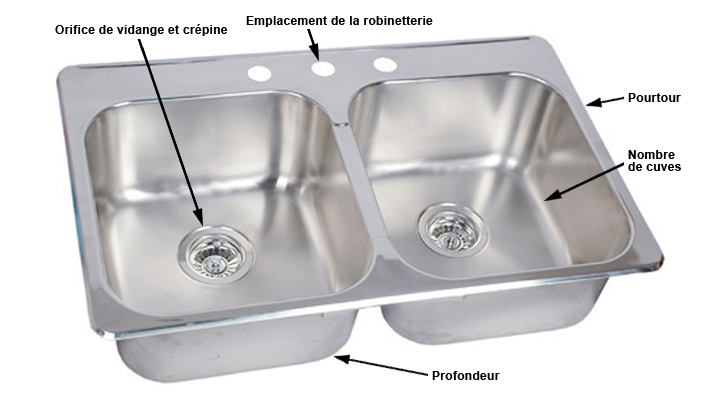
The term for term is terme

The technical terminology of kitchen sinks. Picture source: http://www.homeblog.link/tag/kitchen-sink-components

In the United States, many people have the conception that France is somehow opposed to the English language.  This couldn’t be further from the truth.  Sprinkling your French with English is considered cool and au courant; so many French singers now record in English that it’s increasingly difficult for French radio stations to find French-language music to play; and you see advertisements on TV in English in France more than you would believe.  (One morning in Paris this summer, I had the news on the TV while I was eating breakfast.  As usual, I was struggling pretty hard to understand anything.  Suddenly, I was understanding everything, and the past year and a half of intensive French study had clearly paid off, and I was finally, finally, getting it.  Then I realized: I was hearing an advertisement, and it was in English.  Sigh!)

As you might suspect, the area where the greatest incursion of English into French happens is in technical terminology.  The leaders in creating French-language equivalents for English technical terms are actually not the French, but the Canadian folks at the Office Québécois de la langue française.  They maintain the Grand Dictionnaire Terminologique web site.  This is an on-line dictionary that lets you search for technical terms in a specific domain, or in all domains simultaneously.  Jean-Benoît Nadeau and Julie Barlow say in their book The story of French that the French Academy’s web site gets two million hits a year, while the Grand Dictionnaire Terminologique gets fifty million hits a year.  Quebec’s work in keeping French terminology up-to-date and a viable alternative to English terminology has been adopted as an approach by countries all over the world.

  • le terme: term, word; also term, date, or limit.
  • la terminologie: terminology, in the sense of specialized vocabulary.
  • le vocabulaire: vocabulary.
  • le lexique: lexicon, vocabulary; glossary; small pocket bilingual dictionary or phrase book.  I think it’s also the set of words in a text, but I can’t prove that right at this moment.

(Yes, the title of this blog post is an Ursula K. Le Guin reference: The word for world is forest.)

A certain convocation of politic worms are e’en at him

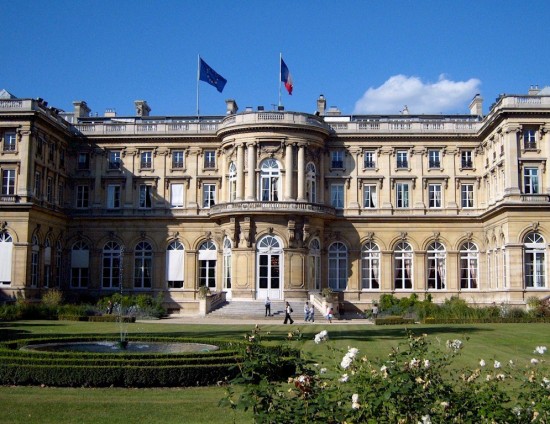
The French Ministry of Foreign Affairs, usually known by its nickname, the Quai d'Orsay. Picture source: this blog, which has a nice post about the building. http://davidplusworld.com/french-ministry-foreign-affairs/
The French Ministry of Foreign Affairs, usually known by its nickname, the Quai d’Orsay. Picture source: this blog, which has a nice post about the building. http://davidplusworld.com/french-ministry-foreign-affairs/

It’s the political season in many parts of the world.  Lots of Europe is having elections, and the presidential campaign is well along in the United States.  Last night there was a debate amongst the contenders for the nomination for Republican presidential candidate.  Jeb Bush attacked his erstwhile protege, and now opponent, Marco Rubio over his attendance record in the Senate, saying “The Senate, what is it like a French work week? You get, like, three days where you have to show up?””  Hearing this, I was struck by the difference between “in theory” and “in practice” that is ever-present in France.  In theory, France has a 35-hour work-week (versus 40 hours in the US).  In practice, only about 50% of the French working population qualifies for the restriction.  The lab where I work when I’m in France qualifies for the 35-hour week in theory, but in practice, they have a 37.5 hour work-week, the idea being that they get more holidays than most people, so it balances out.  37.5 hours in theory, mind you–in practice, I frequently get responses to emails at midnight.

With politics being a hot topic in the French news right now, we need some new vocabulary if we’re going to be able to listen to the news on the way to work in the morning.  A word that’s been coming up quite a bit lately is politique.  It has a number of meanings:

  • politique: as an adjective, it means “political.”
  • la politique: politics, but also policy, which is actually the sense that I’ve been hearing the most on the news.  Politique extérieure: foreign policy.
  • le politique: politician.

You probably noticed that this is one of those nouns that has different meanings depending on whether it’s masculine or feminine.  Masculine: a politician.  Feminine: politics or policy.

Putting together this blog post on the word politique, I was reminded of the “politic worms” of Hamlet:

Not where he eats, but where he is eaten. A certain convocation of politic worms are e’en at him. Your worm is your only emperor for diet. We fat all creatures else to fat us, and we fat ourselves for maggots. Your fat king and your lean beggar is but variable service—two dishes, but to one table. That’s the end.

(William Shakespeare, Hamlet: Act 4, Scene 3.)

The Shakespeare Navigators web site translates politic here as “crafty, prying.”  I don’t know whether or not that pejorative meaning is intended–the Oxford English Dictionary says that during the same period, it could also mean “prudent, shrewd, sagacious.”  Given Hamlet’s overall affect in that scene, I guess that the pejorative interpretation is probably justified.  In any case: a great image to keep in mind as you listen to the political news these days.

Starting your day with Zipf’s Law

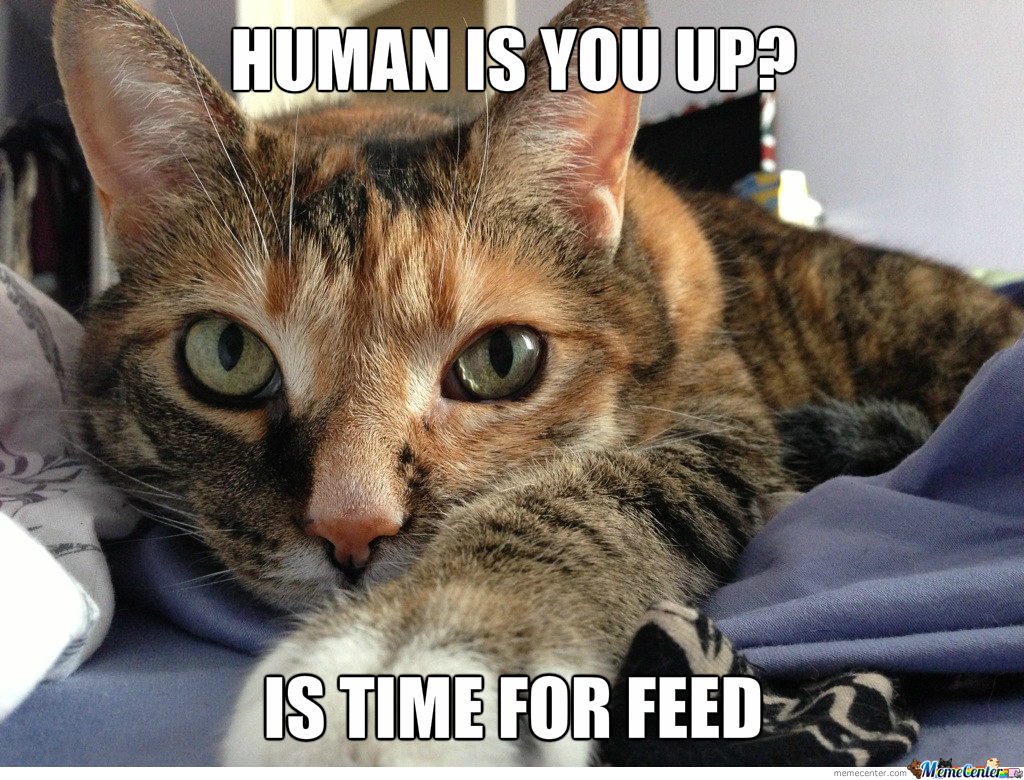
Picture source: http://www.memecenter.com/fun/1898983/cat-alarm-clock

News stories are one of the great ways to start your day with an encounter with Zipf’s Law–by virtue of being the “new”s, they bring new words into your life, and by virtue of things usually staying in the news for a few days, you’ll get to review them in the days to come.  I’ve found a great French news podcast, and I like to listen to it on the way to work every morning.  (Sorry–I can’t find a web page, but you can see their Twitter feed here.  Try searching iTunes for France Culture Matin.)  My command of French being as weak as it is, I run into Zipf’s Law in the first sentence every morning.  The announcer always opens the broadcast with  Bon jour, bon réveil a tous.  What the heck is réveil?  Turns out that it has multiple meanings.

  • le réveil (fin du sommeil): waking, waking up, awakening.
  • le réveil (horloge qui sonne): alarm clock.

Yesterday I talked about the cute video about the guy and his cat.  In the video, the guy says that one good thing about having a cat is that it can be a réveil–alarm clock–for you.  (He also says that the bad thing is that the time is completely random.)

There’s a related word:

  • le réveillon: Christmas Eve or New Year’s Eve dinner.

One evening I had a glass of wine with the beautiful Françoise after work.  At the end of the evening, she either told me that she was going to visit her mother in Brittany for Christmas Eve, or that we should get together for Christmas Eve.  My French is so bad that I couldn’t tell, and no matter how many times I ask her to repeat herself, she never seems to believe that I don’t understand half of what I hear.  I didn’t know what was happening on Christmas until I got a text from her on Christmas Eve saying that the only lift that she could find to the réveillon that we were apparently going to in the ‘burbs was on a motorcycle.  Zipf’s Law!

Now, where there’s a noun, you might suspect that there’s a verb, and sure enough, we have one:

  • réveillonner: to celebrate Christmas Eve or New Year’s Eve.  A delightful verb if I’ve ever heard one.

Where does all of this come from?  I would guess from this verb:

  • veiller: to stay awake, or to keep a vigil over someone, to sit by their bedside.

Bon réveil, and may the odds of Zipf’s Law be ever in your favor!

Oblique strikes

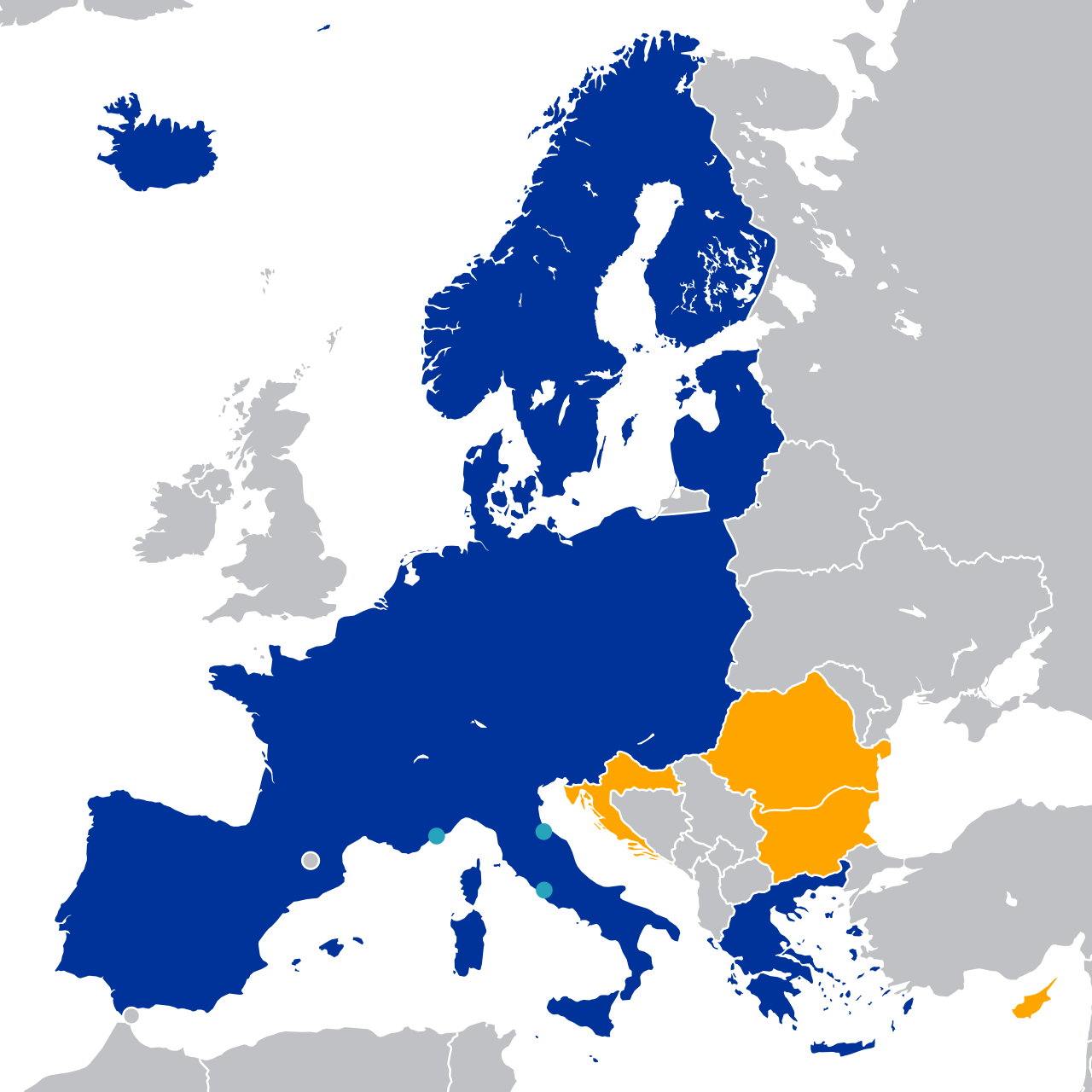
Map of the Schengen Area. Countries in blue are already members, and countries in orange will be joining. Photo source:
Map of the Schengen Area. Countries in blue are already members, and countries in orange will be joining. Photo source: “Map of the Schengen Area” by Rob984 – Derived from File:Schengen Area.svg. Licensed under CC BY-SA 4.0 via Commons – https://commons.wikimedia.org/wiki/File:Map_of_the_Schengen_Area.svg#/media/File:Map_of_the_Schengen_Area.svg.

Listening to the news this morning, I heard an interesting new term.  Part of what was interesting was that the broadcaster felt it necessary to explain what the term meant.  The term was la frappe oblique, or “oblique strike.”  If I understood the story correctly (never a given), there is a European commission meeting on the subject of what to do about Islamic State (usually referred to as Daesh in French, the same as in Arabic) plans for “oblique strikes.”  As the broadcaster explained, an “oblique strike” is carried out by having a citizen of one European country carry out a terrorist attack in another European country.  The idea is that if you have, say, a French citizen who is associated with a terrorist group, that person might be under investigation by the French police, but they won’t be under surveillance by, say, the German or Spanish police.  Within the Schengen Area (the territories of the 26 European countries that don’t have any restrictions on travel between them), that French citizen could travel to any other country–say, Germany–at which point they drop off of the French police’s radar, and are much freer to carry out an attack.

It’s so nice to have terms explained on French radio.  Even in your own native language (that’s English for me, not French), Zipf’s Law strikes on occasion.  As a side note, the ability of speakers of a language to explain words to one another is theoretically interesting to some extent, as on a very strong version of structuralism, it shouldn’t be possible for them to do that.  Clearly we can.  That doesn’t negate more reasonable versions of structuralism, though–it’s a useful way of thinking about language.

Oh, my

Photo source: http://www.keepcalm-o-matic.co.uk/p/keep-calm-and-love-phonetics/.

In English, the spelling of a word doesn’t tell you how to pronounce it—it just gives you some clues about how to pronounce it. Through, though, tough, and plough are famous examples.  French is the same. But, even more so, it’s the case that in French, knowing how to pronounce a word only gives you the slightest clue how to spell it. In a previous post, we looked at several ways to spell words that sound like mur. Here are nine different words that all sound identical in French. Specifically, they all sound like the English word oh:

  • o: this is the letter of the alphabet.
  • ô: this is the poetic “oh”–“Oh, bird of my soul, fly away now, For I possess a hundred fortified towers.”  (Rumi)
  • au: in theory, this means “to the,” but you see it in lots of other uses, like things that would be compound nouns in English— for example, pain au chocolat, a delicious chocolate-filled square croissant.
  • aux: “to the” again, but this time plural.
  • eau: water.
  • eaux: waters.
  • haut: high (male singular)
  • hauts: high (male plural)
  • os: bone

Of course, that doesn’t mean that the same letters or letter combinations always sound the same.  My favorite is notre and nôtre. Despite the fact that the words o and ô are pronounced the same (see above for their meanings), notre and nôtre, which mean almost the same thing (roughly “our” and “ours”), are pronounced quite differently.

Incidentally: the technical term for words that sound the same as other words is homophones.  You see them in lots of languages.  They may or may not also be homographs—words that are spelt the same.  We talked about the ubiquity of ambiguity in human languages in a previous post–homophones are a source of ambiguity in spoken language, and homographs are a source of ambiguity in written language.

Can you add any more words to my list of French words that are pronounced o?  If so, how about putting them in the Comments section?

ALICE in Zipf’s Law Land

Screenshot 2015-10-25 15.58.11Randomly Googling Zipf’s Law, I came across this web page that talks about one aspect of the significance of Zipf’s Law for natural language processing–that is, getting computers to deal with human language.

The page is on the web site for A.L.I.C.E., a computer program that uses frequently-occurring patterns to give the appearance of understanding, and replying to, things that are “said” to it in English.  The page points out that for A.L.I.C.E., there’s an advantage that comes from Zipf’s Law: it means that a relatively small number of patterns encoded into A.L.I.C.E. allow it to process a very large percentage of the things that people say to it.  Here are the most common things that people “say” to A.L.I.C.E.:

531 WHAT IS YOUR NAME
352 WHAT IS MY NAME
171 WHAT IS UP
137 WHAT IS YOUR FAVORITE COLOR
126 WHAT IS THE MEANING OF LIFE
122 WHAT IS THAT
102 WHAT IS YOUR FAVORITE MOVIE
92 WHAT IS IT
75 WHAT IS A BOTMASTER
70 WHAT IS YOUR IQ
59 WHAT IS REDUCTIONISM

(I don’t know what the total count is–it would be nice if the web page gave percentages.)  What is What is reductionism doing there?  I’m guessing that it’s because A.L.I.C.E. is presented as an artificial intelligence application, and reductionism is a theoretical topic in artificial intelligence.  (Here’s Neil Rowe‘s take on reductionism: “Perhaps the key issue in artificial intelligence is reductionism, the degree to which a program fails to reflect the full complexity of human beings. Reductionism includes how often program behavior duplicates human behavior and how much it differs when it does differ. Reductionism is partly a moral issue because it requires moral judgments. Reductionism is also a social issue because it relates to automation.”)  Apparently a lot of geeks like to talk to A.L.I.C.E.–either that, or there are hella people in the world that are interested in reductionism.

Of course, the flip side of Zipf’s Law for natural language processing is that an enormous number of the inputs to your program will only occur very infrequently, and it’s going to be very difficult to cope with all of those.  Zipf’s Law cuts both ways.

Here are some words that I didn’t know on the French Wikipedia page about artificial intelligence:

    • se vouloir: to claim to be.  L’intelligence artificielle est le nom donné à l’intelligence des machines et des logiciels. Elle se veut discipline scientifique recherchant des méthodes de création ou de simulation de l’intelligence.  “Artificial intelligence is the name given to the intelligence of machines and computer programs.  It claims to be a scientific discipline researching methods of creation or simulation of intelligence.”
    • abréger: to shorten, abbreviate, abridge, summarize; to make (something) fly by. Le terme « intelligence artificielle », créé par John McCarthy, est souvent abrégé par le sigle « I.A. » (ou « A.I. » en anglais, pour Artificial Intelligence). “The term ‘artificial intelligence,’ created by John McCarthy, is often abbreviated by the acronym ‘I.A.’ (or ‘A.I.’ in English, for Artificial Intelligence).”

I love a good monosyllable II: voile

In a previous post, I explained why I love learning new English monosyllables.  Today I ran across the English word voile.  Wiktionary defines voile as a light, translucent cotton fabric used for making curtains and dresses.  This particular word is a nice Zipf’s Law phenomenon both because I’m 53 and I just learnt it today, and because its etymology is French.

In French, voile actually has a number of meanings, depending on whether it’s male or female.  None of them are quite the same as the meaning in English:

  • le voile: this is “veil,” and now also “headscarf” or “hijab.”  You will see this meaning in France quite a bit these days, because of la loi sur le voile intégral.  This is the informal name for a law which, among other things, forbids wearing the full-face veil in public.  It is quite controversial.  (I should note that I see women in full-face veils in Paris routinely, and I have never seen the law enforced.)  WordReference.com also gives a meaning related to what sounds like a sort of skin forming on top of a liquid, and the buckling of a wheel.  I don’t think I’ve ever run into either of those, but Zipf’s Law being what it is, I’ll probably see them both tomorrow…
  • la voile: this is a “sail,” and also “sailing.”

Life being weird, I learnt the English word voile in a post about renovating a house in France–you can check it out here.

The ambiguity of blackberries

Ripe, ripening, and unripe blackberries. Photo source: https://commons.wikimedia.org/wiki/File:Ripe,_ripening,_and_green_blackberries.jpg

I’m a computational linguist.  You could say that what my job is all about is dealing with ambiguity.  If there were no ambiguity in language, computers would be able to understand it.  But, language is full of ambiguity.  If I say “what we need is more intelligent waiters,” does that mean that we need more waiters that are intelligent, or waiters that are more intelligent?  Either meaning is possible–it’s ambiguous.  If you read “lead,” is that the verb, or the metal?  Either is possible–it’s ambiguous.  In fact, you will hear and read very little today that is not ambiguous in some way.

The Zipf’s Law connection: today I had blackberries with my breakfast.  I didn’t know the word for that in French.  It turns out that the word for blackberry in French is la mure.  In fact, there are three words that are pronounced exactly the same:

  • la re: blackberry
  • le mur: wall
  • mûr: ripe, mature

That’s just the roots, though.  All of these words have plurals (for the nouns and the adjective), and the adjective has male and female forms, too.  So, you have:

  • mûre blackberry
  • mûres blackberries
  • mur wall
  • murs walls
  • mûr ripe, mature (male singular)
  • mûrs ripe, mature (male plural)
  • mûre ripe, mature (female singular)
  • mûres ripe, mature (female plural)

Note that mûre “blackberry” and mûre “ripe, mature (female singular)” are spelt the same, and mûres “blackberries” and mûres “ripe, mature (female plural)” are spelt the same.  Here’s the kicker: every single one of the words listed in this blog post is pronounced the same!

So, now that you know all this, you’ll understand this story: one fine summer day, I went to the fruit stand up the street.  I asked the marchande for some figs.  She asked me if I wanted wall figs.  Wall figs, I wondered to myself?  What the hell are those?  I looked at her with that dumb look that I’m giving everyone in France 50% of the time due to my inability to understand the simplest sentences.  She tried again: Are you going to eat them today?  Do you see where I had resolved an ambiguity incorrectly?

Ukrainian Humanitarian Resistance

Resisting the russist occupation while keeping our humanity

Languages. Motivation. Education. Travelling

"Je suis féru(e) de langues" is about language learning, study tips and travelling. Join my community!

Curative Power of Medical Data

JCDL 2020 Workshop on Biomedical Natural Language Processing

Crimescribe

Criminal Curiosities

BioNLP

Biomedical natural language processing

Mostly Mammoths

but other things that fascinate me, too

Zygoma

Adventures in natural history collections

Our French Oasis

FAMILY LIFE IN A FRENCH COUNTRY VILLAGE

ACL 2017

PC Chairs Blog

Abby Mullen

A site about history and life

EFL Notes

Random commentary on teaching English as a foreign language

Natural Language Processing

Université Paris-Centrale, Spring 2017

Speak Out in Spanish!

living and loving language

- MIKE STEEDEN -

THE DRIVELLINGS OF TWATTERSLEY FROMAGE