In his book Babel no more: The search for the world’s most extraordinary language learners, Michael Erard talks about Cardinal Giuseppe Mezzofanti. Mezzofanti spoke a lot of languages. It’s not clear exactly how many–certainly that depends on your definition of what it means to “speak” a language–but, nevertheless, it was a ridiculously large number of languages. Something that Erard says about him really struck me: What [we] can’t explain is how he could switch from one language to another without confusing them. Here’s an anecdote from the book:
On one occasion, Pope Gregory XVI (1765-1846), a friend of Mezzofanti, arranged for dozens of international students to surprise him. When the signal was given, the students knelt before Mezzofanti and then rose quickly, talking to him “each in his own tongue, with such an abundance of words and such a volubility of tone, that, in the jargon of dialects, it was almost impossible to hear, much less to understand them.” Mezzofanti didn’t flinch but “took them up singly, and replied to eachin his own language.” The pope declared the cardinal to be victorious. Mezzofanti could not be bested.
Why this struck me: we’ve talked before about the difficulty that many people have with keeping foreign languages “separate.” Before a recent trip to Guatemala, I prepared by basically purging French from my life completely for the month before I went there. I didn’t study French vocabulary, I didn’t listen to the news in French, and I didn’t read in French. Of course, I listened to Spanish podcasts, I read in Spanish (a book about semantics, and The Walking Dead–I’m not picky), and I watched Spanish-language movies. But, pushing French out of my head was as important to the process as packing Spanish into it.
So, when I got to Guatemala, it was interesting to see where I had trouble keeping the two apart. I don’t really know what to make of it. Here are the facts.
For background: I would never claim to speak either French or Spanish. I’m pretty comfortable in Spanish, which serves very nicely with my siblings if we want to have a private conversation in Shanghai, and when I’m in France, I don’t speak English very often–I live my life in French, both personal and professional. I would guess that my vocabulary is a thousand times better in French than in Spanish, and that my grammar is a thousand times better in Spanish than in French. Pronunciation: who knows.
So: as it turns out, I didn’t have trouble keeping the vocabulary apart. What I had trouble with was the little stuff. Here are some specific things that struck me:
Possessives
In French, there are three (simplifying by just talking about the second person informal, since that’s what I use the most in the hospital):
tes for plural nouns. Sou: tes parents your parents, tes soeurs your sisters.
ton for masculine nouns and before any noun that begins with a vowel. So: ton chiot, your puppy, because chiot ‘puppy’ is masculine; ton orange, your orange, even though orange ‘orange’ is feminine, because it begins with a vowel.
ta for feminine nouns that don’t begin with a vowel. So: ta chaussette your sock.
In contrast, Spanish only has two:
tus for plural nouns. So: tus padres your parents, tus hermanas your sisters.
tu for singular nouns. So: tu perrito your puppy, tu amigito your little friend.
It’s things like tu amigito that threw me. I just could not wrap my tongue around the sequence tu + vowel. It just…stopped. Eventually I would push it out, while people turned and looked at me like what’s up with the old dude?
The word after
Even after a week incountry, if I did not pay attention, the Spanish word después ‘after’ would not come out of my mouth. Instead, it was the equivalent French word: après. Even if I did pay attention, I really had to struggle to dig up después. I eventually started pausing every time I needed to say after, and thinking to myself: say después, notaprès.
Excuse me
If I had a nickel for every time that I said pardon or désolé instead of con permiso or disculpe…
The “excuse me” problem doesn’t puzzle me that much–that’s right-brain language. The little function words, though–I’m not sure what to think about that particular phenomenon. It’s a pretty small sample, so maybe I shouldn’t generalize.
The other funny thing about Cardinal Mezzofanti: apparently, he didn’t actually have much of interest to say. As Erard puts it:
Despite this…Mezzofanti was…the target of sarcastic barbs. Irish writer Charles Lever wrote that Mezzofanti “was a most inferior man….An old dictionary would have been to the full as companionable.” Baron Bunsen, a German philologist, said that in all the countless languages which Mezzofanti spoke he “never said anything.” He “has not five ideas,” said a Roman priest quoted in a memoir.”
Speaking as someone who was once married to a woman who coined the term of venerya boring of linguists, I fear that there may be a cautionary note for me here…
At this point in my French adventures, I’m reasonably capable of helping an American visitor navigate a French menu. Quail, lamb, artichokes–I’ve got those under control. The subtleties of the cheese plate–you’d be amazed. Tajines versus couscous–I’m getting there. Sausages–you want dry? Spicy? Halal? Pork guts?
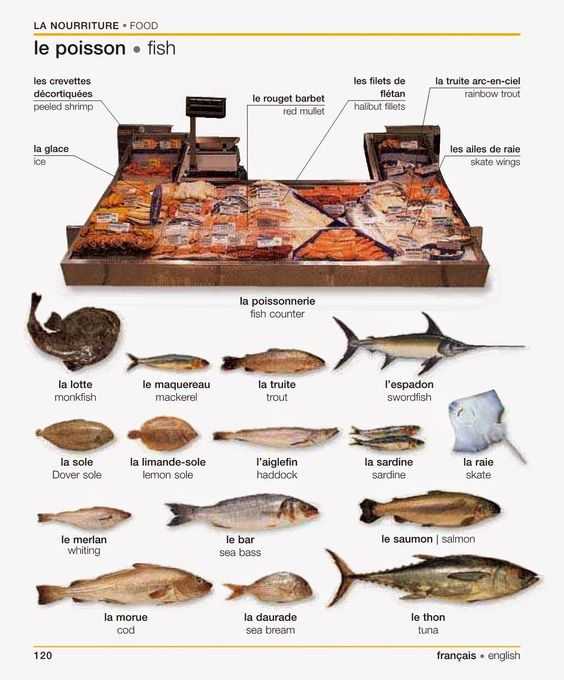
There’s still one part of the menu where I’m pretty hopeless, though. It’s the fish section. Here’s the thing: I don’t even know what the fish are in English. Is flounder the flat one, or is that halibut? Is haddock a dark fish, or a light fish? I have no clue. I know that tuna are really, really big and anchovies aren’t, but if you put me face to face with a monkfish and a sea bream, I’d be pretty lost.
This is curious. Here’s the thing about lexical semantics–the meanings of words: theories of lexical semantics all assume that what we know about the meaning of a word is sufficient (a) to identify what it refers to, and (b) to distinguish what it refers to from what it doesn’t refer to. Linguistics as we know it today begins with Saussure‘s observation that all meaning boils down to what you are not: I believe the quote is Dans la langue, il n’y a que des différences. (“In language, there is nothing but differences.”) We’re looked at a number of ways of representing word meanings in the past, including ontologies, prototypes, and necesssary and sufficient conditions. The ability of a definition to distinguish between things is crucial to all of them. The currently most popular approach to representing the meanings of words in the field of natural language processing, known as word embeddings, is based entirely on a spatial metaphor–similarities in meaning are closeness in meaning, differences in meaning are distances. Nothing is defined in terms of any of its characteristics–it’s all about which other words a word is more, or less, different from. All of these approaches to semantics require not just that you be able to define what a thing is, but also differentiate it from the things that it isn’t.
So, how do you fit fish into this? They’re just one example of a phenomenon that is not uncommon. It doesn’t have a name, that I know of, but I’ll bet that you can give your own examples of it. Here are some from my own experience:
A
B
C
opaline
birch
ochre
amethyst
alder
taupe
garnet
poplar
cerise
tourmeline
yew
ecru
I know what everything in columns A, B, and C have in common. Column A is precious stones. Column B is trees. Column C is colors. But, which stones, trees, colors? I haven’t a clue. I know how they’re similar, very broadly–they’re all stones/trees/colors. But, I couldn’t tell which was which if my life depended on it.
So: how do you explain this phenomenon where I know what kinds of things they are, but I don’t know specifically what they are? I know a similarity–it’s the difference that I don’t know. How you fit that into a theory of meaning that relies crucially on being able to differentiate between things, I have no clue. And, it’s not like this is rare, either: I’ll bet that if pushed, you could come up with a list of things that you know are geographic features, without actually being able to define them (hill, hillock, dale, dell, valley, hollow, swale); same for furniture (settee, chaise lounge, tuffet, ottoman); fish, perhaps? A request: if I’m the only freak in the world who knows categories of words that he can’t tell apart, feel free to leave me in peace. But, if there are categories of words like that that you don’t know how to define the members of, either, could you let me know that I’m not alone in my weirdness by giving me examples? And, if you’re a linguist, and you know the name of this phenomenon: please enlighten me…
Some questions are deceptively simple, masking quite a bit of complexity and some non-obvious answers.
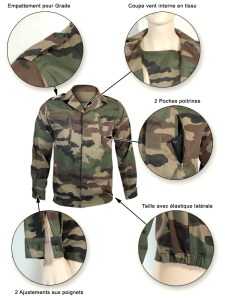
What could possibly be more French than wearing a scarf with your cammies? I don’t think that this is in any sense official, though–I found the picture on the web site of a French army surplus store. Certainly I’m not aware of any military that allows its members to lounge about with their hands in their uniform pockets. Picture source: http://www.lecasquebleu.fr/88-veste-militaire-armee-francaise-neuf.html
Some questions are deceptively simple, masking quite a bit of complexity and some non-obvious answers. I ran across this one on Quora, a web site where you can post a question, and if you’re lucky, random strangers will answer it:
As you can tell from the responses: (a) there’s no one answer, and (b) people really do devote a lot of thought to this. Reading through them, you’ll notice some basic themes: (1) the necessities of life, like eating and pooping; (2) the necessities of staying alive, like first aid kits; and (3) the necessities of keeping your mind/spirit alive at the same time as the rest of yourself. Focussed around those basic themes, you’ll see a lot of variety and creativity–the Turkish soldier who carries sanitary pads to staunch bleeding and catch sweat, as well as women’s nylon stockings (I’m surprised more people didn’t mention those–they’re popular in areas where there are heavy mosquitoes); writing materials; be sure to read the one about the Marine and his stuffed frog…
So, when you read my posts about the incredible number of needless gun deaths in the US and think about what a naive lefty liberal I must be: yes, I am a lefty liberal, and, yes, I can fire a weapon just fine, and, yes: I am a pretty good shot, actually.
le treillis: [treji] fatigues, battledress, “cammies.”
Even more than soccer, flirting is often said to be France’s national sport. I like it–it’s fun, and (so far) a harmless way to practice my French. So, I was chatting with a girl over a cup of coffee in a café by the Museum of Comparative Anatomy and Paleontology one day (no, I’m not making that museum up–along with the Pergamon in Berlin and the British National Museum in London, it’s one of my favorites in the entire world, and I can’t even imagine how many hours I’ve spent there) when she said something that made my ears perk up: she mentioned la partie inférieure de la mâchoire. The “lower part of the jaw:” what you and I probably know as the mandible, and most French speakers as la mandibule.
On the surface, the jaw doesn’t look that interesting. One bone, with a pretty simple hinge on each side. It’s got a lot of subtleties, though, and if you look at how jaws vary across species, a jaw can tell you a lot about an animal.
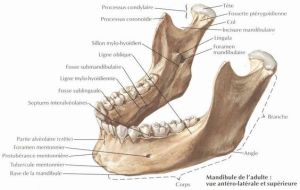
Let’s look at the “gross anatomy” first–the basic parts. In many species, the mandible has two main parts: the body, and the ramus. The body is the part that’s parallel to the ground, and the ramus is the part that goes up vertically. We’ll go through the French vocabulary now, rather than at the end of the post, because it’s essential to understanding my flirty ways.
la mâchoire: the jaw; jawbone.
la partie inférieure de la mâchoire: the lower part of the jaw. The official term for the mandible.
la partie supérieure de la mâchoire: the maxilla–again, the “official” term.
la branche de la mandibule: the ramus of the mandible.
le corps de la mandibule: the body of the mandible.
Why it made my ears perk up when she said la partie inférieur de la mâchoire: as far as I know, that’s the technical term for the mandible, versus la mandibule, which I believe to be more general language. How often do you meet someone whose idea of witty repartee includes throwing around technical terms for bones? Of course, then a bum walked by. Blah blah blah blah, you gotta blah blah for me?
What’s a blah-blah? …I asked my terminologically gifted new friend. He wants a cigarette, she replied. And what does blah blah blah blah mean?
“Kevin Costner”–he called you Kevin Costner.
How the fuck does he know my name’s Kevin?
He doesn’t–you’re an American, and you’re bald, so…
Whatever.
English notes:
to make someone’s ears perk up: to make someone suddenly interested in what you’re saying. How it was used in the post: She said something that made my ears perk up: she mentioned la partie inférieure de la mâchoire.
repartee: (Yes, this is an English word.) Witty conversation that goes back and forth. From Merriam-Webster: conversation in which clever statements and replies are made quickly. How it was used in the post: How often do you meet someone whose idea of witty repartee includes throwing around technical terms for bones?
In truth, though: it’s not so clear that it’s a great thing. One of the problems with Big Data is a special case of a general problem in the ethics of technology: the kinds of things that can go wrong when the public perception of how well/poorly technology performs doesn’t match well with the truth. In particular: when the public thinks that technology performs way better than it does.
You will occasionally hear people talking about how algorithms are going to take our jobs, bring about the zombie apocalypse prematurely, etc. More commonly, technology gee-whizzers will tell you the opposite: that they will remove bias and introduce complete objectivity to sentencing guidelines, for instance. In fact, an algorithm is nothing more (or less) than a defined set of procedures. In the case of an algorithm for computing, it’s typically a set of calculations. An algorithm can’t be biased. It can’t be unbiased, either. The data, though: that can be biased. An example from the interview: train an algorithm to evaluate resumes from applicants for jobs at an engineering firm. You could imagine training it with the resume of everyone who has ever been hired in the past, and the following piece of information for each person: whether or not they were a successful employee. If the engineering firm is a typical one, those previous hires are mostly going to have been males. Now the program learns the characteristics of a successful hire, and among other things, the program will conclude that a successful hire is going to be a male, since that’s all that it’s ever seen. Is the algorithm biased? No. Is the person who programmed it biased? No. What’s biased? The data. Not biased in the way that a person is biased–rather, biased in the statistical sense: not every member of the population had an equal likelihood of being included in the training set.
Where people get seduced by things with the Big Data label on them is by the bigness. Most people know that the bigger your data set is, the more reliable the statistical model that comes out of it will be. A lot of people look at Big Data and think: there’s a LOT of data, so it’s GOT to be good. That’s where the trouble comes from.
I like this interview because it’s neither a gee-whiz-this-technology-is-so-great story, nor an ignorant oh-my-God-the-data-miners-are-going-to-kill-us story. The interviewee, Cathy O’Neil, knows what she’s talking about, and she explains it well. The unbiased sentencing program? It didn’t work out so great–see a very detailed story about it here.
to sentence to (a punishment): to assign a punishment or penalty to someone. Examples: A 46-year-old man threw feces in a Clark County, Ohio, courtroom Wednesday after learning he was being sentenced to 40 years in prison for armed robbery. (Story here.) Alan Turing, the pioneering computer scientist and cryptanalyst who cracked the Nazis’ Enigma code, was sentenced to chemical castration as a punishment for his homosexuality.
sentencing guidelines: instructions for how to determine the length of the jail or prison sentence of someone who has been convicted of a crime. How it was used in the post: More commonly, technology gee-whizzers will tell you the opposite: that they will remove bias and introduce complete objectivity to sentencing guidelines, for instance.
Help! I need advice on memorizing conjugations. I don’t remember how the hell I did it in school, and I’ve got 30 days left to prepare for the DELF/DALF exams. I have no clue about how to handle the fact that I don’t know which conjugations I don’t know. I’m pretty sure that there are some tenses that I’m weaker on than others, some verb classes that I’m weaker on than others, and some irregulars that I’ve never even heard about… I’ve got the things that I know that I’m weaker on on my todo list for the month leading up to the exams, but I don’t know how to figure out what I don’t know. How do you do it? (I am not a big fan of ending blogs that way, but: how DO you do it??)
English notes:
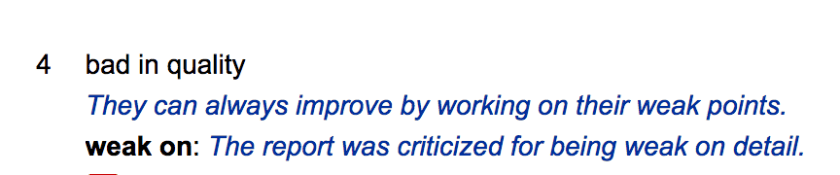
to be weak on [a subject]: to not have sufficient knowledge of some subject. See the definition below from Macmillan. (There’s also a use that means something like not taking a strong or effective stance against something, and you see that in the news all the time right now–candidates accuse each other of being weak on crime, weak on ISIS, weak on Russia, etc. That’s a different sense, though.) How it appeared in the post: I’m pretty sure that there are some tenses that I’m weaker on than others, some verb classes that I’m weaker on than others, and some irregulars that I’ve never even heard about…
Linguists are sometimes accused of spending their time navel-gazing over sentences that are not realistic. The truth is that you don’t have to look any further than your daily life for real linguistic puzzles.
Sign on the wall of a Village Inn. Picture source: me.
Linguists and philosophers are sometimes accused of spending their time navel-gazing over sentences that are not realistic. However, the truth is that you don’t have to look any further than your daily life for real puzzles, and sometimes for real challenges to linguistic theory.
Right at this moment, I’m sitting in a Village Inn. If you’re French: that’s a restaurant chain that’s known for being somewhat déclassé (déclassé and other obscure English expressions explained below in the English and French notes), and for having great pancakes. I’m somewhat déclassé, and it’s Saturday morning, so I’m sitting here treating myself to pancakes. (Village Inn is not so redneck as to not have wifi.) On the wall opposite me is the poster that you see at the beginning of this post. It says:
Men, chocolate and coffee are all better rich.
Now: that is a joke. It plays on multiple meanings of the word rich. Something like this:
rich man: A man with a lot of money.
rich chocolate:Containing a largeamount of choiceingredients,such as butter,sugar, or eggs,andthereforeunusuallyheavy or sweet:a richdessert
(from thefreedictionary.com).
A reasonable native speaker could disagree with me over whether or not rich has different meanings in rich chocolate and rich coffee, but the essential fact about the example remains: rich has more than one sense in this sentence.
Who cares? It’s like this. One of the fundamental assumptions in the vast majority of approaches to understanding semantics (in the sense of the meaning of language) is something called compositionality. Compositionality is the process of meaning being produced by something that you could think of as similar to addition (technically, it’s a more general “function,” but “addition” will work for our positions–linguists, no hate mail, please): the idea is that the meaning of Khani stole the butter is the adding together of the meanings of Khani, steal, butter, and the meaning of being in the subject position versus the object position of an active, transitive sentence.
That’s compositionality. Another bit of background that we need: the mapping problem. The mapping problem is the question of how the semantics of a sentence–its meaning–is related to the syntax of the sentence–the structure of the phrases of which the sentence is made up. There are all sorts of problems here. To give you one example: take a situation where my dog stole some butter. The semantics are: there’s a dog, it’s my dog, there’s some butter, and the butter was taken, by the dog, without permission. (You can’t believe how horrible the poo that I had to pick up over the course of the next 24 hours was.) The syntax, though: there are multiple possibilities. My dog stole the butter. The butter was stolen by my dogs. The meaning is the same–how do you account for multiple syntactic structures being usable for communicating that meaning? I’m giving you a very simple example of a very complex and nuanced topic–again, no hate mail from linguists, please.
So: we have the mapping problem. Your answer to it is probably going to involve compositionality. Imagine this sentence:
Men are better rich, kind, and patient.
How do we map the semantics to the syntax via composition? Let’s see:
Take the significance of the subject position and the adjective relative to that verb in a declarative sentence…
…add the meaning of to be, and
…add the meaning of men…
…add the meaning of rich…
…add the meaning of kind…
…and add the meaning of patient.
No probs–sentence structure meaning + word meanings = the meaning of the assertion. Now let’s go back to the sign on the wall:
Men, chocolate and coffee are all better rich.
How do we map the semantics to the syntax via composition? Let’s see:
Take the meaning of to be and the significance of the subject position and the adjective relative to that verb in a declarative sentence…
…add the meanings of men, chocolate, and coffee…
…and add the meaning of rich.
Ooooh–what the hell?? We have the one word rich, but we have three meanings. We’ve been mapping one word to one meaning–how the hell can we get three meanings out of one word? This works as a joke, versus just a simple statement, precisely–and only–because you can have that single word rich contributing three different meanings to the “utterance,” as we linguists say (énoncé in French). Myself, though: I can’t for the life of me see how to reconcile it with linguistic theory. That’s not a problem–it’s a good thing. Personally, I am pretty happy with the notion that science gets pushed forward by finding problems with theories, not by showing how they work. Something fun to think about while I listen to the hum of Berber, Spanish, and some very stigmatized dialects of English around me as I eat my redneck, Saturday-morning pancakes…
Native speakers of French: I’d love a similar example in the language of Molière–do you have one for me?
Postscript: the sentence that is the topic of this post contains the word and. The word and is (believe it or not) actually one of the toughest problems in computational linguistics, and I have glossed over it in this discussion deliberately, despite the fact that it is crucial to the nature of the problem. Another time, perhaps. English and French notes below.
Englishnotes:
déclassé: having inferior social status. It can also have a similar meaning to the French meaning–“fallen or lowered in class, rank, or social position,” per Merriam-Webster–but, I don’t believe I’ve ever heard it used in that sense. How it appears in the post: That’s a restaurant chain that’s known for being somewhat déclassé, and for having great pancakes.
redneck: from Merriam-Webster: a white person who lives in a small town or in the country especially in the southern U.S., who typically has a working-class job, and who is seen by others as being uneducated and having opinions and attitudes that are offensive. It can also be an adjective, which is how I used it in the post. How it appears in the post: Village Inn is not so redneck as to not have wifi.Note: this can be a very offensive term if you are not yourself a redneck, and if you are not a native speaker, I recommend that you never use it.
French notes:
déclassé: downgraded, relegated, demoted.
le déclassé: dropout (societally, not from school)
gaulois: redneck, among other things. See above for the definition of redneck; I don’t actually know whether or not the French word is offensive.
One of the many things to like about France: random people will occasionally toss out words and concepts that would be quite unusual in the United States. (To toss out explained below in the English notes.) Case in point: the expression “lexical field.” A lexical field, also known as a semantic field, is a set of words that share some focus of meaning. In American English, this is a highly technical term, and you wouldn’t expect to hear it come out of the mouth of anyone who isn’t an academic of some sort. As Wikipedia puts it: The kinds of semantic fields vary from culture to culture and anthropologists use them to study belief systems and reasoning across cultural groups.[7] ….The term is also used in other academic disciplines, such as … computational semiotics,[4] and technical exegesis.[5]
In France: not nearly so obscure. It came up over a glass of wine with a friend one night, and I’m talking about a music person, not a linguist friend. Yesterday evening I ran across it on a web site for kids who are preparing for the bac, the high school exit exam. Here is how it showed up:
Montaigne parsème ainsi son texte du champ lexical du combat: “César,” “Alexandre,” “grand besogne,” “vigueur,” “courage,” “violentes occupations,” “grands maniements,” “batailles,” “provinces,” “grand et glorieux.”
In English:
Thus, Montaigne sprinkles his text with the lexical field of combat: “Caesar,” “Alexander,” “great work,” “vigor,” “courage,” “violent activities,” [not sure how to translate maniements–can a native speaker help?], “battles,” “provinces” [Montaigne refers to conquering them–bear in mind that at the time of writing in the 1500s, it wasn’t that long since Louis XIV had finished the unification of France], “great and glorious.”
Wrap your head around that one: a concept that most of us almost certainly didn’t run into until college, and probably not even then—the lexical field—is used in test-prep materials for high school students, without explanation. And people ask me why I like to hang out there…
French and English notes follow…
English notes:
to toss out: in this sense, it means something like “to mention casually,” similar to Definition 2 on the Merriam-Webster web site. Note that it has many other meanings, mostly negative ones having to do with discarding something. An example of the sense in which I’m using it here, from this story by Alexandra Rosenmann: “Tell me,” Trump continued. “I mean, I don’t know. You tell me.” It’s a phrase Trump tosses out a lot: Discussions on everything from Obama’s birthplace, to why gays support Clinton, to why Ghazala Khan stayed silent at the DNC all end the same. Either Trump’s stumped, or he thinks we are. How it appeared in the post: One of the many things to like about France: random people will occasionally toss out words that would be quite unusual in the United States.
besogner quelqu’un: to have sex with someone. WordReference.com gives pénétrer as an explanation of the phrase, so presumably this can only have a man as the logical subject (a technical term–my dog is the logical subject of both My dog stole the butter and The butter was stolen by my dog, but it is the grammatical subject only of My dog stole the butter. She did, too–horrible shit to clean up for the next 24 hours or so…).
C’est aller en peu vite en besogne: to be a bit hasty or premature, to get ahead of oneself a bit.
la basse besogne: dirty work. From Twitter: Honte à ceux qui utilisent les enfants pour leur basse besogne. Another tweet: @TLaFronde au fait ce ne sont pas des flics femmes qui auraient dû faire cette basse besogne?????????
One of my cousins says: “Wikipedia is the Devil. The Devil, I tell you!” Here’s a case in point.
One of my cousins says: “Wikipedia is the Devil. The Devil, I tell you!” Here’s a case in point.
It is sadly the case that women get mistreated in pretty much the same shitty ways all over the world. (Shitty and other American English expressions explained below.) Certainly there are some places where it is much worse for women than it is in other places, and in very regionally specific ways–female genital mutilation in some parts of Africa, honor killings in the Middle East, widow immolation in some parts of India, female infanticide in some parts of China–but, all in all, the same issues of violence, sexual abuse, and underpay plague women all over the planet.
Given a certain homogeneity of experience, you might expect feminism to be the same everywhere–the null hypothesis is that everything is the same as everything else, right? However, it has often been observed that feminism in America and feminism in France have different sets of concerns and preoccupations. Here’s a capsule description from the Wikipedia article on feminism in France:
In the English-speaking world, the term ‘French feminism’ refers to a branch of feminist theories and philosophies that emerged in the 1970s to the 1990s. French feminist theory, compared to its English-speaking, is distinguished by an approach which is more philosophical and literary. Its writings tend to be effusive and metaphorical being less concerned with political doctrine and generally focused on theories of “the body”.[13]
I’m surprised by the statement that French feminism’s “writings tend to be…less concerned with political doctrine…” …as that is completely the opposite of the impression that I have. The renaming of an important French feminist group seems relevant as an example of this. In the forward to their collection New French feminisms: An anthology, Elaine Marks and Isabelle de Courtivron describe it like this:
Women concerned with the woman question in France use the words “feminism” and “feminist” less often do their counterparts in the United States. …[T]here is a … profound reason. The desire to break with a bourgeois past–with the inadequacies and fixed categories of humanistic thought, including feminism–has led to a vigorous attack against the labels by one of the most influential and radical of the women’s groups (known originally as “Psychanalyse et Politique”–“Psych et Po”–and more recently as “politique et psychanalyse)…”
My point being: French feminists are really, really into critiquing psychoanalysis. (American feminists aren’t crazy about it, either–the amazing American sociolinguist Robin Lakoff and her colleague James Coyne wrote a book about Freud’s Dora case–but it’s not the subject of nearly as much discussion in the US.) If the group felt so strongly that politics should have top billing over psychoanalysis that they actually changed the name of the group to reflect that, then that’s an indication that they feel that politics is really, really important.
The third chapter of the feminist classic Le deuxième sexe, by Simone de Beauvoir (she’s shown up in this blog before, as Nelson Algren’s lover, before she dumped him for Sartre), is devoted to Engels. The Wikipedia page on her book describes one of its (indirect) effects like this:
European women became more involved in politics and by the 1990s held six to seven times more legislative seats than the United States, enabling them to influence the process in support of programs for women and children.[104]
The moral of the story: be as cautious of Wikipedia as you would with any other source. It’s great, but like anything else, it’s not foolproof–citations, or no citations.
French and English notes below.
Want to know more? Follow these links for:
What happens if you get caught crossing a border with a copy of New French feminisms in your backpack
Transcendence, immanence, existentialism, and feminism
French notes:
la psychanalyse: psychoanalysis. Pronunciation: [psikanaliz]
bien avant: well before, well in advance. Le féminisme en France naît au milieu du XIXe siècle mais bien avant des personnalités s’étaient préoccupés de l’égalité entre les hommes et les femmes. (Source: Wikipédie page on French feminism.)
le courant: branch (of a party); trend, movement. Either of them should work for this sentence: Plusieurs courants ont coexisté et des divergences existent encore même si le but est le plus souvent le même, à savoir l’égalité totale. (I’m not sure how to translate si in that sentence–even if?? Can a native speaker help?)
English notes:
shitty: (of a person or action) contemptible; worthless. (Definition from Google.) How it was used in the post: It is sadly the case that women get mistreated in pretty much the same shitty ways all over the world.
capsule (adjective): shortandconcise;briefandsummarized. (Definition from Dictionary.com.) How it was used in the post: Here’s a capsule description from the Wikipedia article on feminism in France.
top billing: thefirstormostprominentpositioninalistofactorsorentertainers,asonamarqueeorscreen. (Definition from Dictionary.com.) You can use it for any ordered list. How it was used in the post: If the group felt so strongly that politics should have top billing over psychoanalysis that they actually changed the name of the group to reflect that, then that’s an indication that they feel that politics is really, really important.
This is an email that I wrote to a graduate student as they finished up an exceptionally heroic dissertation-writing experience. All identifying information has been changed: Robin is a gender-neutral name. Dalmatian was a Romance language spoken in Croatia. (It became extinct when the last known speaker, Antonio Udina, died in an accidental explosion in 1898.) Slivovitz is a delicious plum brandy that I recommend you drink with roasted lamb. Ilse Lehiste was a major phonetician and historical linguist of the 20th century, and the author of the classic Suprasegmentals. (I applied to Ohio State planning to study with her, not realizing that she had just retired—see my post on how not to apply to grad school.) David Sternberg is the author of the excellent How to complete and survive a doctoral dissertation. “T&K” is Sarah Thomason and Terrence Kaufman, the authors of Language contact, creolization, and genetic linguistics—when my undergraduate advisor made me read it, I lost all faith in distant reconstruction (in historical linguistics, at any rate) and ended up doing lexical semantics in a medical school. Banitsa is a delicious Bulgarian pastry.
Hi, Robin,
I’ve read through the most recent chapters that you sent. Lots of progress–that’s great.
I’m going to start with what sounds like bad news, but actually isn’t: you should rethink this–a lot. You are chasing some very specific hypotheses, and betting a lot on them. What I recommend that you do instead is take a step back and look at the more general contributions that your dissertation can make, focus on those throughout the first chapters, and leave the theoretical implications for a later chapter.
What follows is based pretty heavily on my own approach to science in general, and other people could certainly have their own takes on the scientific enterprise, so if you decide to take my advice in this matter of the overall direction of your dissertation, you should discuss it with your advisor at the minimum, and preferably with the rest of your committee, too. (Feel free to forward this email to the rest of your committee–I thought about copying everyone, but decided to let you stew on this yourself and then make your own decision about whether or not to do that.)
One of my fundamental ways of thinking about how to figure out what to publish in general, and how to focus a dissertation in particular, is David Sternberg’s notion of “daylight.” “Daylight” is actually an idea from American football. The goal there is to move a ball in a particular direction, while a bunch of big bruisers try to stop you from doing so. [“Big bruiser” and other obscure American English expressions explained at the bottom of the post, as always.] The most basic advice for how to accomplish this is to look for an open spot between the big bruisers–one through which you can see “daylight”–and then run through it. (Other approaches would be to try to knock the big bruisers down and run over them–if one wants to finish one’s dissertation in this lifetime, or score a goal in American football, it’s definitely easier to run through the open spot. I think so, anyway. ([Note to blog readers: no, I don’t play football–the real tough people play judo.])
In the context of a dissertation (and, to some extent, scientific publishing in general), “daylight” is whatever you can contribute to science that hasn’t been contributed to science before. There are a lot of forms that “daylight” can take:
1) No one has ever written about X before.
2) Someone has written about X before, and/but you looked at it again, and found different facts.
3) Some theory makes a prediction about X, but no one has ever actually tested it.
4) Even better: some theory makes a prediction about X, but no one has ever actually tested it, and you have data that suggests that the prediction is wrong.
5) There are contradictions in the literature.
There are others, but these seem like the most salient ones, at least for a linguist.
So, what do you want to see in a linguistics dissertation, in particular? Personally, I want to see two things. In particular, I’d like to see the two main things in (American) linguistics:
Back to the generalities: in general, you want (or I want, at any rate), in science in general, to work on questions such that whatever the answer turns out to be, it’s interesting. For example, (3) and (4) on my partial list of kinds of “daylight” are both versions of the same method: let’s test theory X. Theory X works in the case of your question? Great, if no one has ever published that before. Theory X doesn’t work in the case of your question? Even better. Either way: you win. You win because you’re not invested in any particular outcome–this is the time to be that most dispassionate of dispassionate scientists, only interested in knowing what the truth is.
If you buy all of that: let’s think about your dissertation in terms of where the daylight is. Let’s also think about it as linguistics, per se–that is, in terms of description and theory. When I write the following, I’m writing it on the basis of my knowledge of what the literature already covers, and you certainly know the relevant literature better than I do, so if you disagree, I’m going with your judgement, not mine. I went through the current chapters and highlighted every place where you mention that no one has ever done something before, and you have:
1) Dalmatian is phonetically understudied. This is the first acoustic phonetics study of Dalmatian.
2) “To my knowledge, there has never been any study performed to compare the acoustic variations in different dialect groups of Dalmatian speakers.”
3) From p. 16: “My data provides examples of phonological processes that have not been previously mentioned or evaluated.”
4) Does the acoustic observation of sound variation in Dalmatian show consistency in all Dalmatian dialects? No one else has looked.
5) No one has ever studied code-switching in Dalmatian speakers before–you have.
Now the disagreements (see 5 on my partial list of kinds of daylight):
1) There is disagreement on the number of vowels and consonants in Dalmatian. You have an answer. (I didn’t say “the” answer–you don’t have to have “the” answer–just an answer that is well-supported by data and by argument.)
2) Lehiste gives an excellent account of Dalmatian contrasts, but doesn’t capture the variation between dialects. You do.
3) P. 29: “…there is a disagreement among scholars, whether or not this sound belongs to the vowel inventory of Dalmatian.”
Predictions:
1) Slivovitz says that U and o are allophones–you show that it’s more complicated.
2) Banitsa predicts palatalization–your data shows otherwise. (Your effort to elicit the palatalized consonants was not “unsuccessful,” as you described it–it was a *successful* effort to find out whether or not they’re there. Turns out they aren’t, for your speakers.)
3) From p. 20: “According to Mongo (2011), words typically have a single primary stress, which falls on the final syllable….My data shows that stress can also appear on the first syllable, as well as the penultimate syllable.”
4) Slivovitz claims all three insertion processes for all three dialects; you show that it doesn’t happen in Central.
5) P. 25: “The results of my examination demonstrate whether or not Thomason and Kaufman’s assertion applies to Dalmatian.”
Would any single one of these get you a PhD? Unlikely. Should all of them get you a PhD? With some examination of the theoretical implications: yes. I just gave you THIRTEEN contributions that your dissertation makes, and we haven’t even gotten to the stuff that you’ve mainly been focussing on, which is the whole language contact thing.
So: you’ve got the descriptive part of this covered. Now you need some theory. The theories: (a) language contact, (b) the internal, community-identity model (T&K) versus the structure model. You know what you think Croatian contact might throw into the mix. You know what you think Slovenian contact might throw into the mix. You know what you think education, urban versus rural, and age might throw into the mix. You didn’t just make those predictions up–they’re based on what we know about how language contact usually works, as well as what education does, urbanity does, age does. Now: is what you would expect to be true based on all of that, true? Do the predictions all hold? If so: that’s nice. Not very interesting, but nice–validation that you got the facts right. Do the predictions not all hold? That’s GREAT. In science, we LOVE data that doesn’t fit theories! That’s, like, the best thing in the world. The key: don’t have an investment in the outcome. Think about all of this such that whatever the answer is, you know what its significance is. You know that it fits the theories? Great–you know the theories, and you have a bunch of new data, and that would fit the minimally accepted requirements for giving Robin a PhD, so let’s do so. You know that it doesn’t fit the theories? GREAT–Robin realizes that she’s found a problem with the theory, and that’s how science advances, so let’s give her a PhD.
If you buy all of this: you need to do some rewriting. You don’t need to change the content, really–you just need to move some of it. Start with facts–just facts. Description. Tell your reader what the previous literature says, and what’s missing from it. Tell the reader what your data says. Point out where the previous literature was right, and where you’ve contributed the new knowledge that it was wrong, and where you’ve filled the empty holes. Then theory, later. Later. Take all of your speculations, predictions, explanations, etc. about language contact, age, education, etc., out of those earlier chapters. Put them in a later chapter or chapters. That’s where you’re going to test the theories–theories about language contact, about the effects of education, age, etc. When you get there, you’re already going to have half of your PhD in hand, because you’ll already have contributed 13 things (see above) to our incomplete descriptions of Dalmatian. Now you’re going to be a good linguist and talk about theory, and then you’re going to tell your committee that it’s time to award you your PhD, and you’re going to go on with your life.
On my paper copy, I wrote tons of comments about specific points in the dissertation–things that I don’t agree with, areas where I don’t think that you present the data convincingly, but mostly, place after place after place where you get caught up in the specifics of your predictions about the effects of language contact, etc. and should pull that material out and move it later. I’m not talking about rewriting five chapters–I’m talking about moving material out of four chapters and putting it later. You can absolutely do this between now and when your dissertation is due. If you want the paper copy, come by my office.
Let me know if you have questions about this. If you agree with the approach that I’m suggesting, I suggest that you forward this email, or some condensed version of it, to your advisor and to the rest of the committee. If they agree with the approach, too, then you’re on very safe ground.
Postscript: Robin finished their dissertation, and defended it to wide acclaim. English notes follow–back to French next time.
bruiser: Definition from Merriam-Webster: a large, strong man. (If you’ve been reading this blog for a while, you know that the combination of large plus a physical object is not typical–see this post on large and big as things that seem like synonyms, but aren’t, exactly.) How it appeared in the post: The goal there is to move a ball in a particular direction, while a bunch of big bruisers try to stop you from doing so.
tons of: a large quantity of, a lot of. How it appeared in the post: On my paper copy, I wrote tons of comments about specific points in the dissertation–things that I don’t agree with, areas where I don’t think that you present the data convincingly, but mostly, place after place after place where you get caught up in the specifics of your predictions about the effects of language contact, etc. and should pull that material out and move it later.
judgement: the British spelling of judgment. The American spelling always rubbed me wrong, somehow—sue me.
investment: this has many meanings. I meant it in this sense, from The Free Dictionary: “a devoting,using, or giving of time,talent,emotionalenergy,etc., as to achievesomething.” How it appeared in the post: The key: don’t have an investment in the outcome. Think about all of this such that whatever the answer is, you know what its significance is. That is: the advice is to be able to not care (to not devote emotional energy) to what the specific answer happens to be.
allophone: a technical term in linguistics. We’ll save it for another time.













 Zipf's Law