As a combat medic, I ask you not to buy this tourniquet

Tourniquets are life-saving. Some more so than others…

As I write this (not long after the ruzzian missile and drone attacks on Ukraine of Chrismas 2024 and New Year’s Day 2025), there are many brands and styles of tourniquets available on the market. I am a combat medic (військовий парамедик) in Ukraine, so donors often ask me which kind to buy. This letter to a friend and supporter in the United States is the answer. The executive summary: do buy the Dnipro Gen 2 or the CAT Gen 7. Don’t buy the SOF-T or the Sich. If you’re just looking to learn some new English vocabulary, you will find it in the English notes section at the end of the post. You will also find donation information there, if you would like to support our work.

Hello, my dear! You asked me what kind of tourniquets to buy for our boys and girls at the front. Thank you for asking. People like to buy tourniquets, and I get it– it is obvious, and I think obvious on a visceral level, that they are life-saving. 

There are two good options for tourniquets, and one that isn’t terrible. I will tell you the two good options:

  1. The CAT (Combat Application Tourniquet) Gen 7, by North American Rescue. These typically sell for $30-35 retail, or $22 with a humanitarian discount from the manufacturer.
  2. The Dnipro Gen 2, by a Ukrainian manufacturer. These go for $22 retail, or $14 in bulk. 

They are both excellent tourniquets. I carry the Dnipro Gen 2 for my own personal tourniquets. You might hear people complain about the first generation. The second generation is great–as I said, it’s what I carry for my own use. The retail prices are obviously hugely different, with the Dnipro Gen 2 being significantly less expensive. The Dnipro Gen 2 has an additional advantage: you don’t have to shlep them from the US.

The option that isn’t terrible is to buy the shittiest models that you can find. We call them “Chinese tourniquets,” which is probably unfair to China–I think the North American Rescue CATs are made in China, too. Amazon is currently selling a pack of eight of these things for $23. What you have to be aware of is that we only use them for training. For training, we really like them! The reason that we like them for training is that you can tell people that their quality is so poor that they should never, ever carry them until you’re blue in the face, but it mostly doesn’t get through. On the other hand, if they see a few of them break in a training course, they get it. So, on the medical logistics chat, you will see messages like this: “Anyone have Chinese tourniquets, the shittier the better? I need them for a training course.” So, it’s not a bad idea to bring a few of these. But, personally, I only bring them if I have a bit of space to fill in a duffle bag, and a bit of my weight allowance to spare. 

Let me tell you about a couple of other kinds of tourniquets on the market. I most definitely do *not* recommend spending any money on them. They are variants on the same design, called a SOF-T (I think it stands for “Special Operations Forces Tourniquet”). Rather than using a pair of “wings” to hold the windlass (rod) in place, SOF-Ts have a metal clip at one end that you flip over the end of the windless, locking it in place at the tip of the clip. They will most certainly stop bleeding, and with that clip and a strip of duct tape, that windlass is never going to be dislodged. But, there are three problems with them, and the third is a really big one. 

  1. They are really hard to put on with one hand. It is crucial to be able to put on a tourniquet with one hand–including with your non-dominant hand–if you have a serious wound in your own arm, and you have to put on your own tourniquet yourself. It’s possible to self-apply these, but it’s pretty tough to do so even when you’re not bleeding to death in the dark. In contrast, the CAT/Dnipro design does not have that problem.
  2. When put on over winter clothing, SOF-T-style tourniquets are more likely not to achieve adequate compression pressure than they are to achieve it, and they have a tendency to slip off of winter clothing. The CAT/Dnipro design is much less likely to do this. (Here’s a link to a paper on the topic of tourniquet use over winter clothing.)
  3. Most people are not trained to use them.

#3 is by far the biggest of these problems. There must be dozens of thousands of people in UA who have been trained to use the North American Rescue CAT/Dnipro Gen 2-style tourniquets. (One humanitarian group claims to have trained over 100,000 people themselves.) In the US, there is a popular course called Stop The Bleed, in which anyone and everyone can get trained to use the NAR/Dnipro-style tourniquet. (If you haven’t taken that course: it’s the minimum that ANYONE should have before coming to UA.) But, it would be rare for a training course to include using the SOF-T design–personally, I have never taken such a course, and I have never heard of anyone teaching one. To me, it seems like absolute foolishness to distribute a tourniquet that the statistical equivalent of no one knows how to use, when there are excellent tourniquets that many thousands of people have been trained to use.

The issue of the SOF-T style of tourniquet comes up here a lot because there is a competing Ukrainian-made product called the Sich tourniquet. It is of the SOF-T design, and it is aggressively marketed/advertised. As a medic, I ask you not to spend donated money on Sich tourniquets–see issues 1-3 above.

Finally, a few words on colors. Tourniquets are typically available in three colors: black, orange, and blue. They work identically, and are of identical quality–only the color differs. Black is meant for situations where you don’t want to be seen, so they are what we carry. In contrast, orange is meant for when you want to be seen. The orange tourniquets are intended for civilian use. In a civilian context, they’re great, because when you get a casualty to the hospital, it is easy to see that there’s a tourniquet in place, so even if the fact that the person has had a tourniquet placed gets lost in the communicative shuffle of turn-over to hospital personnel, the very visible color brings it to the staff’s attention. Finally, blue is for training. In this context, the purpose of the color is simply to remind you that it’s one of your training tourniquets, and no one should be carrying it. (Tourniquets are single-use items, so you need separate TQs for training and for actual use. I don’t have any blue ones, so I mark mine with a Sharpie as тренування (training)). 

​Regards, and thank you for all that you do to keep us alive and kicking during this war of ruzzian aggression, 

​Your friend Zipf


English notes

turnstile: this is a thing that is used to control access to an area. You will see them in subway stations, train stations, etc. You pay, a set of bars turns, and you can walk through the thing to get where you are going. I bring it up here because it is far and away the most common translation error that I see in Ukraine (Far and away explained in the English notes). To wit: the Ukrainian word турнікет, pronounced much like the English word tourniquet, is often translated as turnstile. So, you will often see requests like this in the medical logistics chat group: Need 10 turnstiles for a recon platoon. To an English speaker, this is uninterpretable.

There is a perfectly good reason for this common translation mistake: the Ukrainian word турнікет most properly means turnstile. There is a natively Ukrainian word for tourniquet: джгут (unpronounceable in English–it’s something like the English word jute, but with an h inserted after the j.) However, the word джгут is now used primarily to refer to the constricting band that a medic puts on your arm when drawing blood or starting an IV, while турнікет is used to refer to the tourniquets that we use to control massive hemorrhage. For the many readers of this blog who don’t speak French, I will point out that tourniquet means turnstile in French, too. Turnstile in Spanish is torniquete, in Czech it’s turniket–English is the oddball here.)

far and away: this means “by a large amount.” Merriam-Webster gives this definition for it: by a considerable margin. As far as I know, it functions as an adverb and appears with an adjectival phrase. Here are some examples of its use:

  • A return of ruzzian troops to their own homes would be far and away the easiest way to end the war in Ukraine.
  • putin’s assumption that Russian speakers identify as ruzzians and would welcome his invasion of Ukraine was far and away his greatest mistake. Instead, tens of thousands of them rushed to join the Armed Forces and protect Ukraine.
  • ruzzia’s utter disregard for the lives of its own troops has always been, and remains today, far and away its most powerful weapon. In contrast, Ukrainians’ intelligence is far and away its most powerful weapon.

to wit: this phrase introduces a specification of something more general. Merriam-Webster defines it as that is to say or namely. Here is an example of it in use, with an analysis of the generality and the specification:

  • A tug-of-war over Ukrainian identity (and history) has taken place in some fashion between Kyiv and Moscow since Ukraine’s independence in 1991 — and in earnest since Russia’s 2014 invasion. Nevertheless, this contest has intensified dramatically since the start of the Kremlin’s “special military operation.” To wit, Moscow has intentionally targeted Ukrainian schools, according to Ukrainian sources, in order to hit “soft targets” and disrupt education in Ukraine.(Paraphrased for clarity from an article by Ilan Berman.)
  • The general statement: the fight over Ukrainian identity has intensified since the start of the full-scale invasion in February 2022. The specification: To wit, Moscow has intentionally targeted Ukrainian schools.

My name is Kevin Bretonnel Cohen. I am a combat medic (військовий парамедик) in Ukraine. If you would like to support the Ukrainian Humanitarian Resistance non-governmental organization (501(c)3, EIN 99-4530777), PayPal to kevin.cohen@gmail.com works fine, as does Zelle to 303-916-2417. If you use PayPal, please be sure to choose the friends and family option, so that your donation does not get deducted from my Social Security check. However you choose to help, please be sure to add a message with your contact information, so that I can thank you!

All views expressed in this post are my own.
Ukraine Notebook: Help us get you medical supplies

You’re a medic in Ukraine? Plenty of people want to help you. But, you have to help them do it.

A smarter person than me once said this about war: “Amateurs talk about strategy. Professionals talk about logistics.” America wins wars for two reasons:

  1. We never stop training. Never.
  2. We have the most highly-developed logistics system in the world.

Ukraine has the most important ingredient for victory. Call it spirit, call it heart, call it motivation: when your family is literally behind you, you will fight very, very hard. Training: we have more and more of it all the time, thanks in large part to nice people like you. Logistics: it’s a fucking mess. We went from having a busy shipping port in Odessa to not having any shipping. We went from a busy commercial air transport system to no air travel at all. We went from a trucking system focused on commercial transport to a trucking system focused on military transport. So, suppose that you own a Ukrainian business that manufactures cardboard boxes. If your shipping clerk was a woman, she probably evacuated with her kids at the beginning of the war. If your delivery guy was a man, the chances are not bad that he joined the army. Your shipping clerk has probably returned to Ukraine by now (the vast majority of refugees have done so already), but your business was screwed up for months, your delivery guy is still in the army, and if you can find another one, he’s going to be driving on roads that have been absolutely ruined by the russists in about 20% of the country while rerouting to avoid destroyed bridges and the like. You still can’t import materials by ship or by air, and the Poles hold up everything at the border. Everything. For a loooong time. And now a tourniquet manufacturer wants to ship out a bunch of tourniquets–but, you don’t have any cardboard boxes to sell him.

The fight continues in large part due to a huge number of Ukrainian and foreign volunteer organizations that work to find things that are needed at the front or by refugees, and then get those things to where they need to go. By now–as I write this, in three days it will be two years since the russists rolled across the northern and southern borders with a lot of tanks and ambitions of colonizing our country–many of those organizations have built informal networks of mutual assistance to get our goals met. So, if you need, say, sterile 4x4s and some tourniquets, you can put the word out on a medical logistics chat group. Tell us what you need, how much of it you need, who needs it, where you need it, and when you need it, and someone will probably send it to you. 

Sounds pretty obvious, right? Often, though, we have to teach people how to help you help them. If you have someone with experience in a military medical system, you make requests in a way that we can probably respond to effectively. If you don’t have that experience, you probably engage in conversations like this:

  • Me: I heard you need some medical supplies. What do you need?
  • You: We need everything!!
  • Me: How much? 
  • You: We have nothing at all, we need huge amounts!
  • Me: When do you need it?
  • You: Yesterday!

Guess what I’ll send you? Nothing. I don’t have everything, I don’t have huge amounts of anything, and I can’t travel backwards in time. Plus, now I am working on the assumption that you don’t know what you’re doing, so I am more likely to want to help you find someone to replace you while you go away and get trained (see the list of reasons that America wins wars, Item #1) than I am to want to send you a bunch of medical supplies that I could be sending to someone who does know what they’re doing.

I would react pretty differently if our conversation went something like this:

  • Me: I heard you need some medical supplies. What do you need?
  • You: I need IFAKs and combat application tourniquets for ten guys, enough space blankets for half of a motor transport platoon, and two blood pressure cuffs. We’re in the area of Dnipro, and we deploy to the front in a month.

Now I can plan:

  1. You go high on my list of things to do and needs to prioritize. You’re not at the front yet, but you’re going to be there soon, so that puts you behind people who are already at the front, but in front of everyone else.
  2. I’ll call Colonel Monte, since I know that he usually has IFAKs someplace between the Kyiv and Kharkiv areas at all times, and is very generous. And since you told me that you’re a Motor T unit, I am going to ask for a specific configuration for your IFAK pouch.
  3. I know that Dnipro can fill an order for ten combat application tourniquets pretty quickly, and I’ll pay a little bit extra for rush shipping, because no way do I want you deploying without THOSE. Hell, if I have some extra cash, I’ll get you more than you asked for, because for an order of that size, I’ll get a nice discount.
  4. I don’t want to ask you for too many details about the size of your unit–OPSEC is important. But, you said you needed space blankets for half of a platoon, and I know that a platoon is roughly forty people, so I know that I need to find twenty.
  5. For the blood pressure cuffs, I can wait for my next shipment from the US since I know that you’re not deploying until a month from now. Waiting for that shipment from the US lets me supply you with my favorite blood pressure cuffs–the ones that I can put on in the dark in the back of a moving vehicle. And if my next shipment happens to show up late, I can get you two BP cuffs from Prom.UA. Not my favorites–but, they’ll work just fine.
  6. How will I get this stuff to you? You told me that you’re in the general area of Dnipro, so I know that I can ship things via Nova Poshta, and if by chance they move you to Kramatorsk, no problem–I know a girl who will bring them to you on the bus before you move out from there. 

A final pro tip: if I offer you something and ask how many you need, don’t say “how many have you got?” In the best-case scenario, I will figure that you don’t actually know how many you need, in which case I’m going to send you off to find out, and turn my attention to someone else’s request. In the almost-worst-case scenario, I’m going to guess that you don’t want to give them to a military or humanitarian unit, but rather to sell them to a military or humanitarian unit. In that case: fuck you. In the absolute-worst-case scenario, I will wonder if you might not be a russist spy who’s trying to scope out the availability of military medical supplies in Ukraine, and guess what? I’m going to make a quick phone call and let the military intelligence guys answer that question. 

Does America win all of its wars? No. Is our logistical system perfect? Absolutely not, and unlike Ukraine, we’ve been working on our military medical logistics system since the 1860s. And maybe I sound like an unbearably arrogant asshole–I didn’t ask anyone else to read this, so I don’t know. Plus, I probably am an asshole. (You can check with any of my many ex-wives.) But, I did spend a large chunk of my adult life in the American military, and I didn’t just show up in Ukraine yesterday, and I’m at least as busy as you are, and I can tell you from experience: tell any humanitarian worker what you need, how much of it you need, who you need it for, where you need it, and when you need it, and you’re a hell of a lot more likely to get it than if you don’t tell us that. We want to help you–just help us do so.

Our work in Ukraine is possible only because of the generous support of people like you. If you would like to support my work here, PayPal to kevin.cohen@gmail.com works great. So does Zelle to 303-916-2417. If you use PayPal, please pick the “friends and family” option, so that it doesn’t get deducted from my Social Security check. 🙂 And if I don’t know you personally–please, please, please add a message with your contact information, so that I can thank you! 

Decline Ukrainian adjectives in all cases: Exercise!

Learning how to decline Ukrainian adjectives? Here are some exercises. 

Learning how to decline Ukrainian adjectives? Here are some exercises.  We will do a few basic ones in which you will do one case or one gender at a time, and then we will switch to working on the instrumental case. At the bottom of the page, I will give you the sources that I used here. Of course, I will also give you information on how to donate to support my work here in Ukraine. Ready to go? Fill in the blanks!

називнийвели́кийвели́кавели́кевели́кі
родовий________________________________________
давальнийвели́комувели́кійвели́комувели́ким
знахіднийвели́кий, вели́коговели́кувели́кевели́ких, вели́кі
оруднийвели́кимвели́коювели́кимвели́кими
місцевийвели́кому, вели́кімвели́кійвели́кому, вели́кімвели́ких
називнийнови́йнова́нове́нові́
родовийново́гоново́їново́гонови́х
давальнийново́мунові́йново́мунови́м
знахідний________________________________________
оруднийнови́мново́юнови́мнови́ми
місцевийново́му, нові́мнові́йново́му, нові́мнови́х
називнийглибо́кийглибо́каглибо́кеглибо́кі
родовийглибо́когоглибо́коїглибо́когоглибо́ких
давальнийглибо́комуглибо́кійглибо́комуглибо́ким
знахіднийглибо́кий, глибо́когоглибо́куглибо́кеглибо́ких, глибо́кі
орудний________________________________________
місцевийглибо́кому, глибо́кімглибо́кійглибо́кому, глибо́кімглибо́ких
називнийдороги́йдорога́дороге́дорогі́
родовийдорого́годорого́їдорого́годороги́х
давальний________________________________________
знахіднийдороги́й, дорого́годорогу́дороге́дороги́х, дорогі́
оруднийдороги́мдорого́юдороги́мдороги́ми
місцевийдорого́му, дорогі́мдорогі́йдорого́му, дорогі́мдороги́х
називнийнебезпе́чний__________небезпе́чненебезпе́чні
родовийнебезпе́чного__________небезпе́чногонебезпе́чних
давальнийнебезпе́чному__________небезпе́чномунебезпе́чним
знахіднийнебезпе́чний, небезпе́чного__________небезпе́чненебезпе́чних, небезпе́чні
оруднийнебезпе́чним__________небезпе́чнимнебезпе́чними
місцевийнебезпе́чному, небезпе́чнім__________небезпе́чному, небезпе́чнімнебезпе́чних
називний__________широ́ка__________широ́кі
родовий__________широ́кої__________широ́ких
давальний__________широ́кій__________широ́ким
знахідний__________широ́ку__________широ́ких, широ́кі
орудний__________широ́кою__________широ́кими
місцевий__________широ́кій__________широ́ких
називнийвійсько́ви́йвійсько́ва́військо́ве́__________
родовийвійсько́во́говійсько́во́ївійсько́во́го__________
давальнийвійсько́во́мувійсько́ві́йвійсько́во́му__________
знахіднийвійсько́ви́й, військо́во́говійсько́ву́військо́ве́__________
оруднийвійсько́ви́мвійсько́во́ювійсько́ви́м__________
місцевийвійсько́во́му, військо́ві́мвійсько́ві́йвійсько́во́му, військо́ві́м__________

Fill in the blank with the adjective that I have indicated in English. 

  1. Slow: Тому черепашка не спить, а просто стає __________.
  1. Big: Ліжко в такому стилі повинна бути _________ і широкою.
  1. Long: Вона не повинна бути дуже __________.
  1. New: Багато з них мають всі шанси стати нашим __________ будинком.
  1. Old: Біг туди і назад з кухні на патіо стає _________.
  1. Glorious: Життя стане одним _________ досвідом.
  1. Easy: Перехід в доросле життя навіть в найкращі часи не є __________ завданням.
  1. Slow: Зробити всі ваші рухи __________.
  1. Gray: Лежать на острівному цвинтарі під __________небом.
  1. Big: Будинки з високими стелями і __________ кімнатами потребують збільшення площі радіаторів.
  1. Old car: Я розтався зі своєю __________ __________.

How I put this material together: 

  1. The declension tables are from the Goroh web site, your source for fine Ukrainian inflectional morphology.
  2. The sentences in the second half of the exercise come from the Reverso web site.

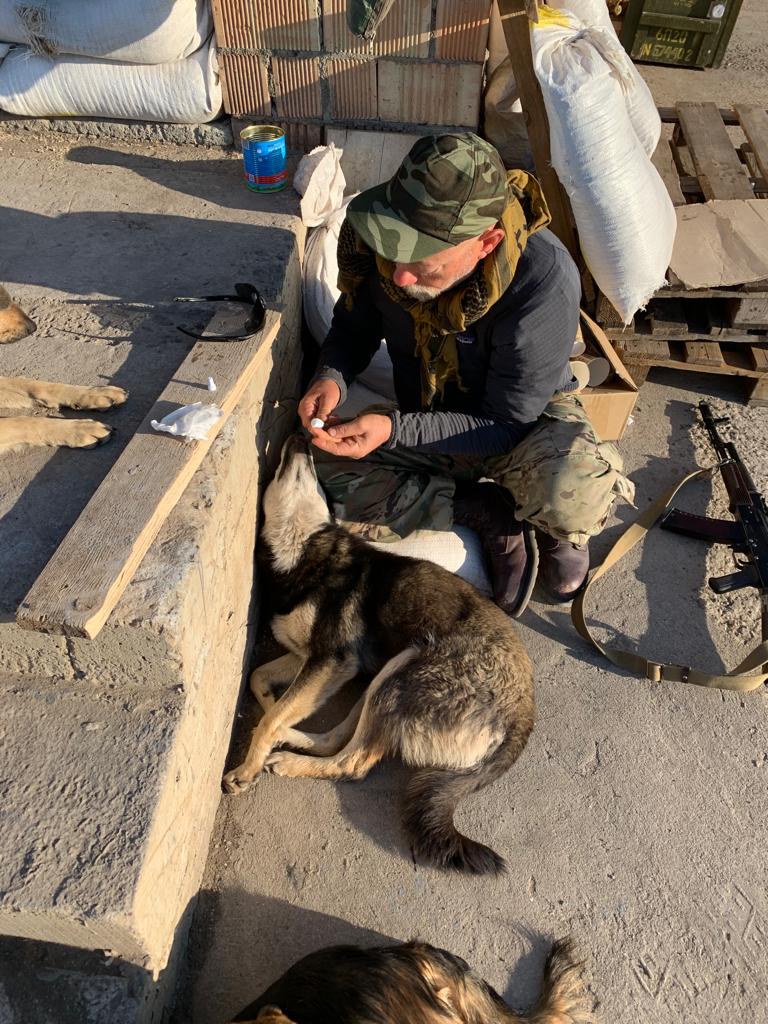
The dog in the photo was my very first patient in Ukraine–he had an infected sore on his ear. Our work here is possible only because of the generous support of people like you. If you would like to support my work here, PayPal to kevin.cohen@gmail.com works great. So does Zelle to 303-916-2417. If you use PayPal, please pick the “friends and family” option, so that it doesn’t get deducted from my Social Security check. 🙂 And if I don’t know you personally–please, please, please add a message with your contact information, so that I can thank you! Thank you for remembering us, and remember this, too: the best way to support Ukraine is to write to your representatives in Congress and the Senate and tell them that this is important to you.

Here are the responses for the fill-in-the-blank exercise. Ignore letter case–most of them should be lower-case-initial, but I am too tired and cranky to fix them right now:

  1. Пові́льною
  2. Великою
  3. Довгою
  4. Новим
  5. Старим
  6. Славним
  7. Легким
  8. Повільними
  9. Сірим
  10. Великими
  11. старою машиною

Ukrainian military nouns, by stem consonant

My Ukrainian teacher cried when she realized that I know how to say “trench” and “massive hemorrhage,” but not “carrot.”

Слава Україні! My Ukrainian teacher cried when she realized that I know how to say “trench” and “massive hemorrhage,” but not “carrot” or “baby.” Nonetheless: military vocabulary is just as good for morphophonology exercises as anything else. So, here is a list of Ukrainian military nouns, organized by stem-final consonant for your declensional pleasure.

Soft: біно́кль (binoculars), броня́ (armor), в’я́зень (prisoner), вбивця (murderer (female)), вого́нь (fire, as in gunfire or suppressing fire), га́убиця (howitzer), злочинність (crime, criminality), їда́льня (chow hall), ку́ля (bullet (projectile of)), міць (power, force), міше́нь (target), патру́ль (patrol), столи́ця (capital (of a country)), стрілець (shooter)

Hard: полк (regiment), флот (navy), дрон (drone), зонд (probe), льох (root cellar), мир (peace), міст (bridge), пульт (remote control), склеп (root cellar? crypt??), ствол (barrel of firearm), танк (tank), чуб (Cossack hairlock), шнур (cord), цинк (canister), штурм (assault)

Palatals or Р: сабота́ж (sabotage), блінда́ж (improvised trench shelter), ніж (knife), меч (sword), переклада́ч (interpreter), бу́нкер (bunker), затво́р (bolt (of firearm))

Feminine nouns in -ка: сержантка (sergeant (female)), апте́чка (IFAK), арафатка (shemagh), безпе́ка (safety), вибухі́вка (explosive), гвинті́вка (rifle, not automatic), гуманіта́рка (humanitarian aid (slang)), за́сідка (ambush), за́сувка (bolt, bar; fastener), зені́тка (antiaircraft gun), контрро́звідка (counterintelligence), краді́жка (theft, stealing, robbery), кри́шка (cover, lid, e.g. of spring in AK-47), па́стка (trap), пора́зка (defeat), пу́шка (gun, pistol), рі́чка (river), ро́зві́дка (intelligence), розтя́жка (tripwire, booby trap), рукави́чка (glove), рукоя́тка (grip (of firearm)), су́мка (bag, e.g. carried by refugees), терористка (terrorist (female))

Feminine nouns in -ія: а́рмія (army), артиле́рія (artillery), диве́рсія (diversion), диві́зія (division), евакуа́ція (evacuation), мі́сія (mission), пози́ція (position), ра́ція (two-way radio), траєкто́рія (trajectory)

Feminine nouns with other consonants: би́тва (battle), бо́мба (bomb), брига́да (brigade), війна́ (war), гарма́та (cannon), грана́та (grenade), каза́рма (barracks), ка́рта (map), кінно́та (cavalry), мі́на (mine), піхо́та (infantry), пружи́на (spring (device)), раке́та (rocket; missile), ро́та (company), стріляни́на (shooting), фо́рма (uniform), шко́да (damage)

Neuter nouns in o or e: дуло (muzzle (of firearm)), вби́вство (murder), по́нчо (poncho), село́ (village)

Neuter nouns with double consonants: вто́ргнення (invasion), запа́лення (inflammation), запа́морочення (dizziness, lightheadedness), очи́щення (cleaning; clearing), спостере́ження (observation, watching), бомбардува́ння (bombardment), знебо́лювання (analgesia), приці́лювання (aiming, pointing, sighting), порівня́ння (comparison)

Neuter nouns with other double consonants: життя́ (life), сухожи́лля (tendon), прикриття́ (concealment (from enemy view), піднебіння (palate (anatomy)), укриття́ (shelter, e.g. bomb shelter)

Neuter nouns for baby animals: щеня́ (puppy), кошеня́ (kitten), цуценя́ (puppy) It might seem odd to have this category, but (a) no Ukrainian military position is complete without its dog or cat–there is a kitten playing with my rifle’s sling as I write this–and (b) words referring to baby animals have special morphology in Ukrainian.

Masculine nouns in -ій: бій (battle, fight), зло́дій (thief), воді́й (driver)

E or o in the final syllable: to drop, or not to drop? авіано́сець (aircraft carrier), ви́рок (verdict), вого́нь (fire, as in gunfire or suppressing fire), во́рог (enemy), гранатоме́т (RPG, bazooka), доброво́лець (military volunteer), куро́к (trigger), офіце́р (officer), оско́лок (shell fragment), плаве́ць (swimmer), по́рох (gunpowder)

No singular OR no plural: берці (combat boots), кров (blood), вода (water), штани (pants)

Velar shift (also see feminine nouns in -ка above): му́ха (fly; front sight), бреху́ха (liar), завірю́ха (blizzard, snowstorm), риба́ха (fisherwoman? fisherman?) (Yes, I had to allow for a bit of drift out of the military lexical field to find some good examples of this stem type), свекруха (mother-in-law); допомо́га (help, aid), нога́ (leg), обло́га (siege), перемо́га (victory), тривога (alarm, alert; anxiety), підлога (floor), дорога, тринога (tripod), двонога (bipod)

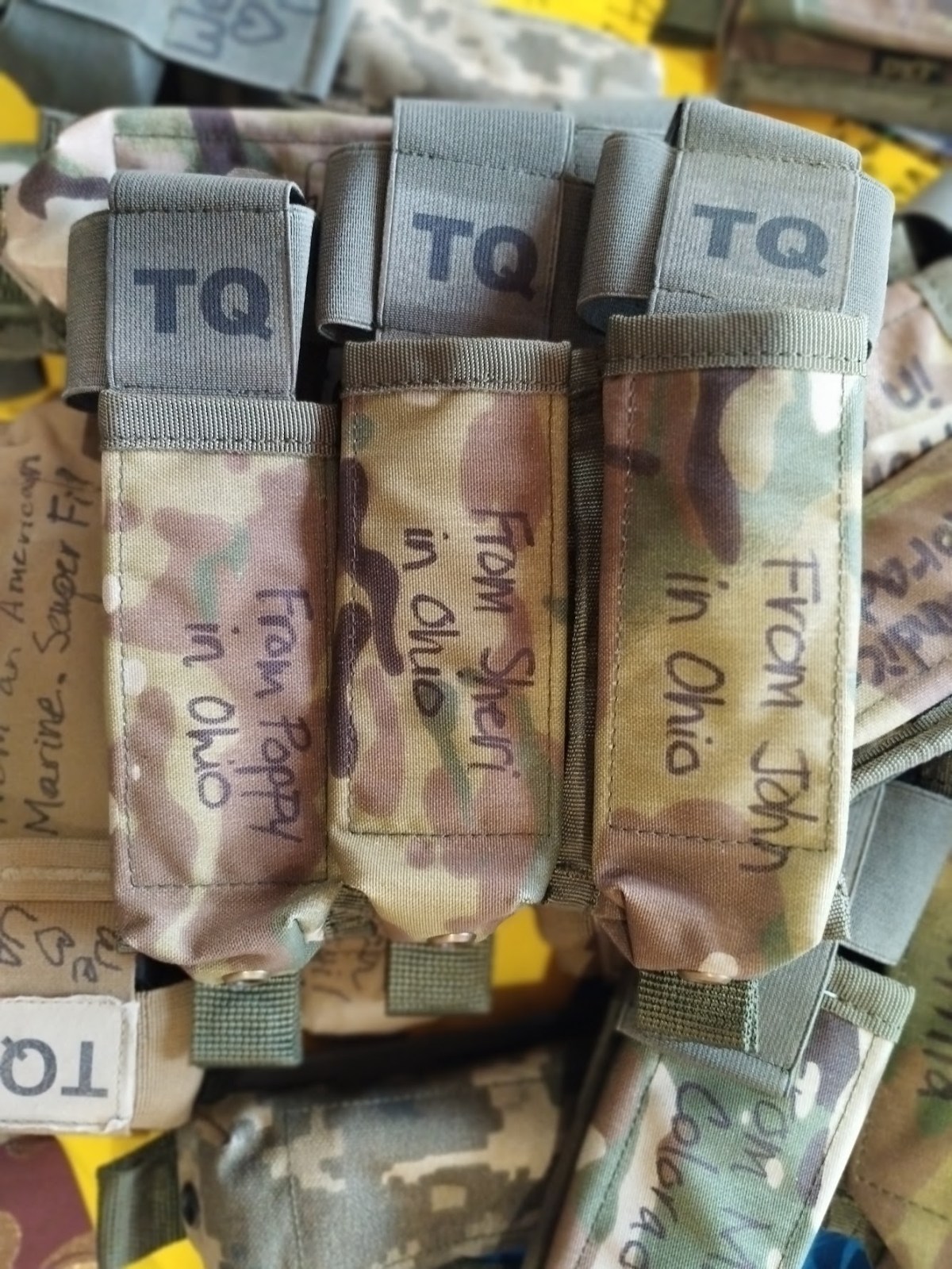
Do you have some cool additions? Please tell us about them in the comments. If you would like to support my work in Ukraine, you can do so via PayPal to kevin.cohen@gmail.com. For tax-deductible options, please contact me directly. Photo: tourniquets purchased with your donations.

Spoken English future tense, plus IFAK vocabulary

The English future tense is easy to produce, but difficult to understand. Practice it here with the vocabulary of Individual First Aid Kits!

The future tense in English can be produced in two ways:

  1. With will. For example: I will bring you a tourniquet.
  2. With going to. For example: I am going to bring you a tourniquet.

Simple, right? Not in the spoken language. When these are said, many contractions are used. These are common ways of saying the future tense:

  1. I’ll bring you a tourniquet.
  2. He’ll bring you a tourniquet.
  3. Kevin’ll bring you a tourniquet.
  4. I’m goin’ to bring you a tourniquet.
  5. Kevin’s goin’ to bring you a tourniquet.
  6. I’m gonna bring you a tourniquet.
  7. Kevin’s gonna bring you a tourniquet.

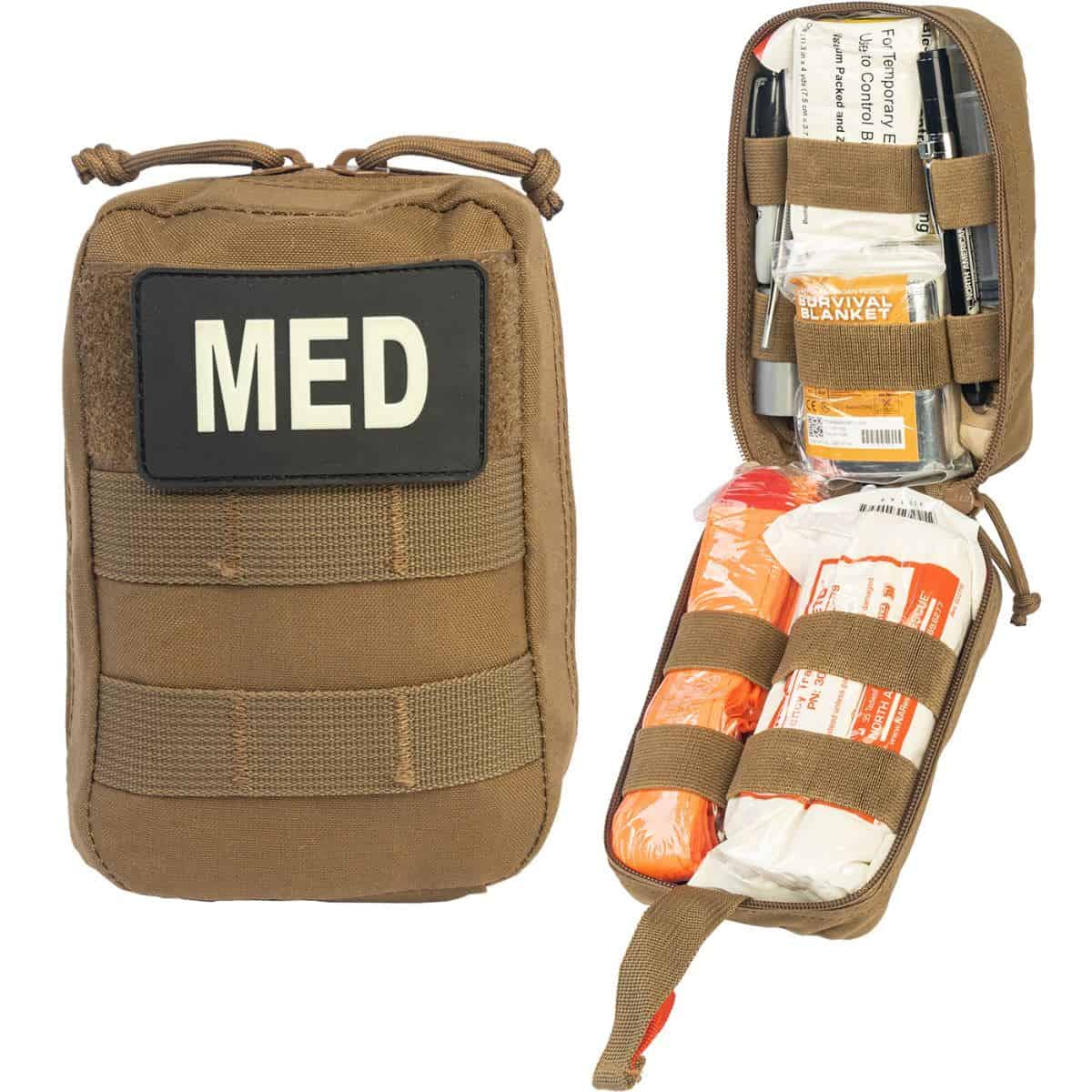
In our exercises, we will use vocabulary related to the contents of an IFAK (аптечка):

  • підсумок: Pouch
  • турнікет: Tourniquet. Also called TQ. The tourniquets that we use in combat are called CATs or CAT tourniquetsCAT stands for Combat Application Tourniquet.
  • Гемостатична марля: Hemostatic gauze. Also called Combat Gauze or Quik Clot. (Quik is normally spelled quick.)
  • Повітропровід назофарингеальний: Nasopharyngeal airway. Also called NPA.
  • Пов’язка оклюзійна вентильована: Chest seal
  • Голка декомпресійна: Chest decompression needle or decompression needle
  • Ізраїльський бинт: Israeli bandage, or Israeli, or pressure bandage
  • Марля: Compressed gauze, or Z-folded gauze, or Z-fold gauze. Also sterile gauze, or just gauze.
  • Термоковдра: Space blanket or Mylar blanket or rescue blanket
  • Шапочка для душу: Shower cap
  • Скоч: Duct tape (sounds like “duck tape”)
  • Ножиці для розрізання одягу: Scissors or shears or trauma shears

Our work in Ukraine is possible only because of the generous support of people like you. If you would like to support my work here, PayPal to kevin.cohen@gmail.com works great. So does Zelle to 303-916-2417. If you use PayPal, please pick the “friends and family” option, so that it doesn’t get deducted from my Social Security check. 🙂 And if I don’t know you personally–please, please, please add a message with your contact information, so that I can thank you!

IFAK vocabulary, and how to ask for things in English

Objectives:

  1. Know vocabulary for the contents of an IFAK (аптечка)
  2. Understand phrases for asking someone to bring you something
  3. Be able to ask someone to bring you something

There are many ways to ask someone to bring you something. You should understand a few of them, and you should be able to use at least one of them.

Here are a few structures for asking someone to bring you something. In the examples, we will ask someone to bring us a tourniquet.

  1. Bring me a tourniquet.
  2. Get me a tourniquet.
  3. Give me a tourniquet.
  4. Hand me a tourniquet.
  5. Gimme a tourniquet. Gimme is a spoken form of “give me.”

We can also use the words would you and could you to make a request. These requests look like questions. For example:

  1. Would you bring me a tourniquet?
  2. Could you get me a tourniquet?
  3. Give me a tourniquet, would you?
  4. Would you hand me a tourniquet?
  5. Could you give me a tourniquet?

We could even use expressions like where is… pronounced where’s…

  1. Where’s a tourniquet?

Now let’s look at the vocabulary of things in an IFAK (Individual First Aid Kit).

підсумок: Pouch

турнікет: Tourniquet. Also called TQ. The tourniquets that we use in combat are called CATs or CAT tourniquets. CAT stands for Combat Application Tourniquet.

Гемостатична марля: Hemostatic gauze. Also called Combat Gauze or Quik Clot. (Quik is normally spelled quick.)

Повітропровід назофарингеальний: Nasopharyngeal airway. Also called NPA.

Пов’язка оклюзійна вентильована: Chest seal

Голка декомпресійна: Chest decompression needle or decompression needle

Ізраїльський бинт: Israeli bandage, or Israeli, or pressure bandage

Марля: Compressed gauze, or Z-folded gauze, or Z-fold gauze. Also sterile gauze, or just gauze.

Термоковдра: Space blanket or Mylar blanket or rescue blanket

Шапочка для душу: Shower cap

Скоч: Duct tape (sounds like “duck tape”)

Ножиці для розрізання одягу: Scissors or shears or trauma shears

Our work in Ukraine is possible only because of the generous support of people like you. If you would like to support my work here, PayPal to kevin.cohen@gmail.com works great. So does Zelle to 303-916-2417. If you use PayPal, please pick the “friends and family” option, so that it doesn’t get deducted from my Social Security check. 🙂 And if I don’t know you personally–please, please, please add a message with your contact information, so that I can thank you!

Ukraine Notebook: Onboarding

“Onboarding:” getting a new person integrated into your unit. Here’s how to do it.

When a new volunteer arrives at your unit, you need to be able to get them functional quickly, while ensuring that they have all of the skills and information that they will need to be both effective and safe. The US military has a lot of practice moving people in and out of new jobs quickly and efficiently. It revolves around a “sign-off” sheet. This is a form of checklist. It lists the people that you need to see–pay clerk, medic, postal clerk, etc., etc., etc. As you meet each one, they take care of whatever you need, sign your form, and send you off to the next person. In two days, you have taken care of everything, and you’re ready to start working.


Here is an onboarding sign-off sheet for a new volunteer in Ukraine with a unit doing “hot extractions–” evacuation of civilians from the front line. This is a very common occupation for foreign volunteers. Adapt it to your group’s mission, operating environment, etc. The sign-off process starts with assembling information, and then proceeds to ensuring that the new volunteer can demonstrate the required skills, and familiarity with the equipment for, whatever it is that you’re doing. Do you have suggestions for additions? Please tell us about them in the Comments section!

Personal information

Name:Stepan Bandera
Phone number:+1 503-456-7890
Emergency contact:Olha Kyïva
Allergies:NKDA
Medications:metoprolol 25 mg/day
Blood type:A+
Immunizations:COVID 12/22, DPT 3/2020
“NKDA” means “no known drug allergies.” Note that the Eastern and Western European blood-typing systems are different.

Personal Protective Equipment

DateInitials
Explain purpose and limits of body armor
Explain purpose and limits of helmet
Explain purpose and limits of ballistic glasses
Demonstrate proper adjustment of plate carrier
Demonstrate proper adjustment of helmet

Mission protocol

DateInitials
Install navigation system
Explain crew numbering system
Demonstrate injured driver procedure
Demonstrate injured navigator procedure
Demonstrate injured crew member procedure
Demonstrate body armor buddy check
Don’t know what an “injured driver procedure” or a “buddy check” is? Stay tuned for future blog posts.

Vehicles

For every vehicle:

DateInitials
Demonstrate checking oil
Demonstrate checking other fluids 
Demonstrate checking tire pressure
Show location of spare tire
Show location of jack
Demonstrate how to open and close doors
Demonstrate how to lock and unlock doors
State when to shut off engine
Do you really have to learn how to open, close, and unlock the doors of a vehicle? Absolutely. Many humanitarian groups use old cash-carrying vans with doors that can only be opened from one side, or that prevent the engine from being started if they are not locked, or… Multiply this by the number of vehicles in your unit, and then by how hard it is to remember details when someone is shooting at you. You’d be amazed.

Safehouse

DateInitials
Show location of bomb/fallout shelter
Show location of electrical cut-off switch
Show location of gas cut-off switch
Show location of water cut-off valve
Show location of fire extinguishers
Show location of keys
Show three potential exits from building
Location of first aid kit
Explain contents of first aid kit
Demonstrate use of fire extinguisher
Demonstrate locking and unlocking doors

Tactical skills

DateInitials
Explain cover versus concealment
Prone position for shelling
Aerial attacks
Situational awareness
Personal protective equipment: purpose and limits
PPE: use and wearing
Use of radiation monitor
Procedure for nuclear accident
Stay off of the fucking grass
Identify common land mines, cluster bombs, and booby traps
Identify common land mine injuries
Identify friendly and Russian uniforms
Blood chit
Define and state purpose of rally point
Indicate major roads on map (Kramatorsk)
Indicate major roads on map (area of operations)
Demonstrate first aid skills
Is there an entire sign-off sheet for first aid skills? Of course.

Go back

Your message has been sent

Warning
Warning
Warning
Warning

Ukraine Notebook: Driver’s daily checklist

Roads near the areas of combat in Ukraine have typically been heavily damaged by shelling, tracked vehicles, and the like, and are hell on the vans that extraction teams rely on. If you do not take care of yours, it will not be able to take care of you–or of the civilians for whose lives you are responsible…

Many foreign volunteers in Ukraine spend their time doing “hot extractions:” evacuation of civilians from the front line. That means driving into an area under fire, quickly loading little old grandmas into your vehicle, and getting out of there–fast. The typical crew will include a driver, a navigator, and a medic, and each of them has a crucial role to play in getting everyone to safety. The following list will help you make sure that your vehicle contains everything that you need. Following the list, you will find the rationale for each item, as well as explanations of obscure words (replacing our usual English notes). The driver should go through this list daily, and the team leader should verify that you did so. Have something to add? Tell us about it in the Comments section.

Daily vehicle checklist

  • Oil and fluids checked
  • Tires checked
  • Battery expiration date checked
  • Lights and turn signals checked
  • Spare tire air pressure checked
  • Jack in place
  • Medical bag in place
  • Tool kit in place
  • Crew snacks and water
  • Water for civilians
  • Radio present
  • Litter present (it’s not what you think–see below, or this video)
  • Phone cables present
  • Powerbank present
  • Fire extinguisher present
  • Jumper cables present
  • Blankets present

Problems noted: Here you should document anything that you need to take care of before departing on a mission.

Roads near the areas of combat in Ukraine have typically been heavily damaged by shelling, tracked vehicles (tanks, armored personnel carriers, etc.), and the like, and are hell on the vans that extraction teams rely on. If you do not take care of yours, it will not be able to take care of you–or of the civilians for whose lives you are responsible… Hence this checklist. Here are explanations of some of the words that appear on the list.

Spare tire: This is the extra tire that you will use if your tire is damaged. “Spare” means an extra thing that you have in case you need it. “Spare tire” is also a slang word for the fat hanging off of the waist of a man. (On a woman, it’s a “muffin top.”)

Jack: This is the mechanical device that you use to raise a vehicle in order to change a flat tire. This video will help you learn this obscure English word.

Medical bag: This is an easily identifiable bag containing more than you carry in your individual first aid kit (IFAK). In my group, the medical bags include everything that goes in our IFAKs, plus a splint, eye covers, a windlass for improvising junctional tourniquets, a radiation monitor, trauma scissors, and extra gauze. Lots of extra gauze.

Litter: This is a device for carrying an injured person, or more often, an old person who cannot walk. Speed is of the essence if you want to avoid Russian artillery figuring out exactly where you are, so anyone with limited mobility needs to be moved by you, not hobble along at their own speed. This video will help you learn this obscure meaning of the word litter.

Want to support our work in Ukraine? You can send donations directly to me via PayPal using my email address, if you know me. Otherwise, I recommend these three groups. One of them is mine, and the others I have worked with very closely. Please mention that you came to them via me/the Zipf’s Law blog.
Base UA/База ЮА is a Ukrainian organization that does hot extractions, sets up mobile medical clinics, and runs tactical medicine courses and an art camp for refugee children in the beautiful Carpathian mountains. With our comrades from the US and Germany, we have evacuated thousands of civilians from Luhansk and Donetsk in the Donbas region.
Community Self Help is a Ukrainian organization that has worked with refugees from the Donbas region since the start of the Russian invasion in 2014 providing mental health care. Since the current phase of the war started in February 2022, they have also provided medical supplies, documented war crimes, and fought back against Russian propaganda and disinformation.
Global Augmentation is an American and Irish organization that sends volunteers to Ukraine (and has a group about to leave for Turkey for search and rescue operations). Global Augmentation folks are drivers, navigators, medics, trainers, and all-around fearless guys and gals. (And yes, that’s my picture on the web site.)

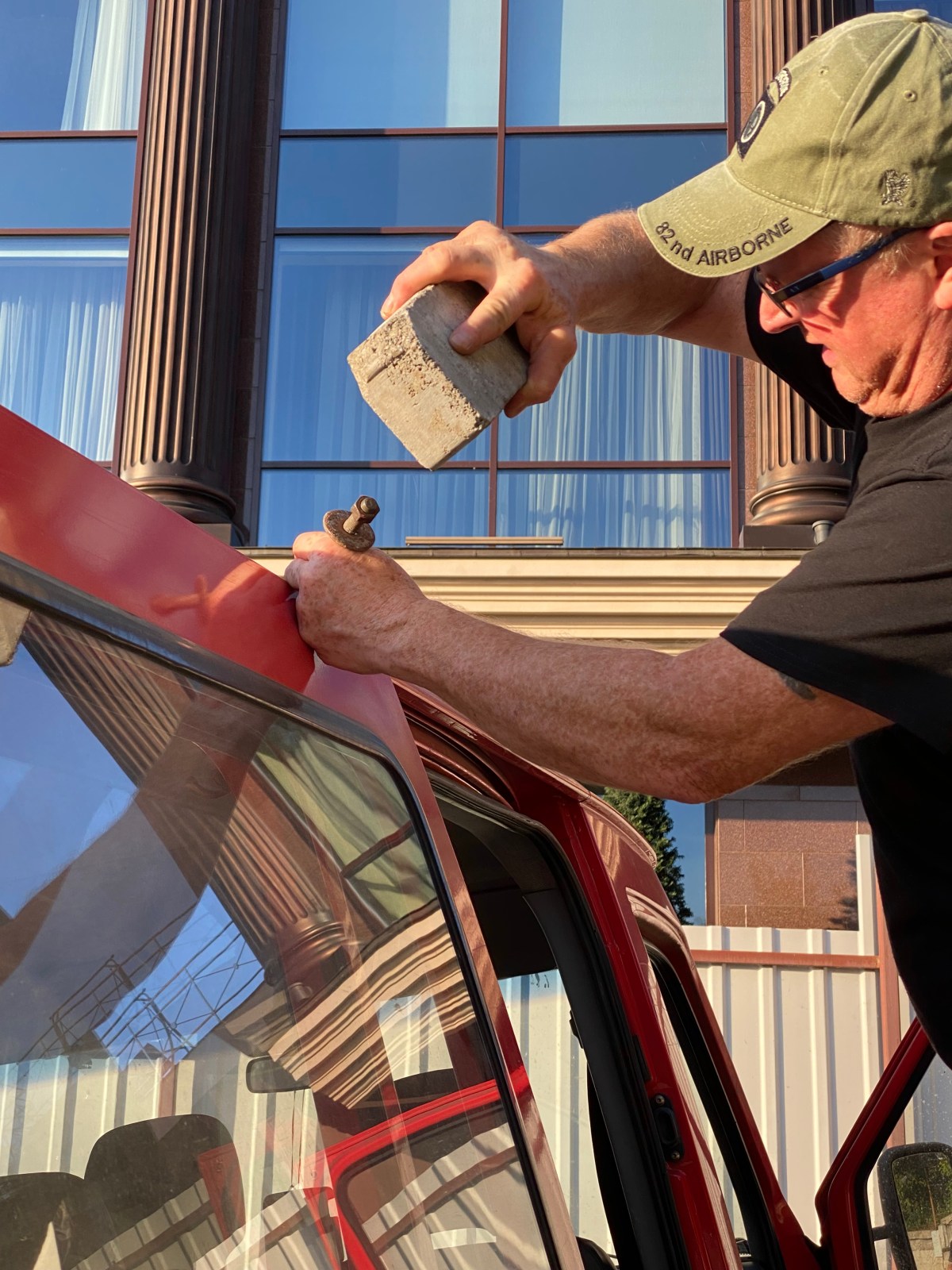
Photo: Paul Wall, an American veteran paratrooper, a thinker, and a man of courage, fixes a vehicle in Kyiv before leaving for a month in Bakhmut

Ukraine Notebook: Abandon ship protocol

On January 6th, 2023, two British volunteers, Andrew Bagshaw and Christopher Parry, went missing near Soledar in the Donetsk region of Ukraine. As I write this, in late January 2023, there have been no verified sightings of them, and they are presumed dead or captured. Their vehicle was found soon after their disappearance–locked. Presumably they had to abandon it and head out on foot. You should prepare and practice for this situation. The protocol that I am suggesting for you here is based on the US Navy’s procedure for abandoning a sinking ship. Air crew members: if you can add something, please tell us about it in the comments.

  1. Count to ensure that everyone is present or accounted for.
  2. Check that all survival equipment is on someone’s back or in their pockets: BOB, medical bag, communication tools, escape route maps, water and food.
  3. Destroy all sensitive information.
  4. Consider destroying or disabling the vehicle.
  5. Notify someone.

Everyone present or accounted for: “everyone” means all team members and any passengers. Passengers are most often civilians who are being evacuated from the front (with attendant communication problems related to lack of a shared language), but may also be journalists (who can present their own set of challenges). If you must leave behind bodies, note their location. Take their passport, wallet, telephone, and any other personal effects or useful items (for example, individual first aid kit (IFAK), helmet, body armor, water). Consider leaving identification of some kind with them, or writing identifying information (including nationality so that the appropriate embassy can be contacted) on their clothes or body. Also consider taking a lock of their hair, some bloody clothing, or a cheek swab for later DNA matching. (Back in the day, American medics took fingerprints of bodies that would be buried overseas. See below for a link to an article on digital collection of fingerprints–no pun intended…)

Bug-out bag (“BOB”): this is an easily carryable container, typically a small- or medium-sized backpack, containing everything that you would want to have with you if you had to abandon your home (or office, or vehicle) in an emergency. You can find plenty of advice elsewhere on what a BOB should contain. Customize it for your operating environment, and update it as that changes, as the weather changes, as your crew size changes, etc.

Medical bag: this contains more things than one would have in an individual first aid kit (IFAK, or аптечка). Ours have the usual things, plus a splint, extra bandaging materials, and a radiation monitor.

Destroy all sensitive information: Destroy information on evacuees you have picked up or were on the way to pick up. Delete from your phone/destroy paper maps that show your safehouse, checkpoints, military units, humanitarian centers, routes… You should have left for your day’s mission with a separate map that shows the area that you would have to walk through to reach safety, and nothing else.

Destroying or disabling the vehicle: Even a vehicle that no longer runs is a valuable source of spare parts for the enemy in a war where logistics has been a/the major struggle for both sides. It also might contain sensitive information that you missed when you left it. I don’t know shit (to “not know shit” means to not know anything at all) about destroying vehicles–if you do, dear reader, please tell us about it in the Comments section. (In the Navy, you place explosive charges in relevant places so that the ship is guaranteed to go down.)

Notify someone: Tell them who is with you, where you are, and where you are heading.


The British reporter Tom Mutch knew one of the two missing British volunteers. He describes them as brave guys doing life-saving work–and as under-equipped and ill-prepared for working in a combat zone. You do not have to be ill-prepared. Practice this protocol before you need it. Andrew Bagshaw and Christopher Parry: I hope we see you again some day.

Want to support my work as a medic in Ukraine? If you know me, you can send money to me via PayPal using my email address. $2.99 will buy a pack of gauze, $20 will buy a pair of tactical glasses, $30 will buy a tourniquet, $125 will buy an individual first aid kit, $400 will buy a medical bag, $800 will buy a set of body armor. If you don’t know me, you can donate through any of these organizations. I work with all of them, and they’re all quite good.
baseua.org
globalaugmentation.org/
communityselfhelp.org/


Bryan T. Johnson & John A. J. M. Riemen (2019) Digital capture of fingerprints
in a disaster victim identification setting: a review and case study
, Forensic Sciences Research, 4:4,
293-302, DOI: 10.1080/20961790.2018.1521327

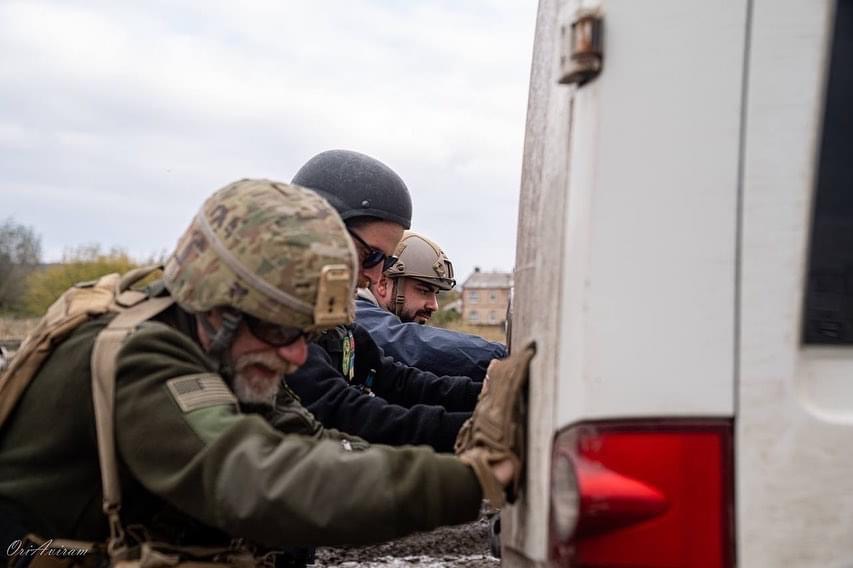
Picture at top of page: van stuck in the mud in the middle of an artillery duel, east side of Bakhmut. Photo by Ori Aviram.

Ukraine Notebook: What medications to bring when you volunteer

Bring these medications to Ukraine when you come to volunteer and your contribution will be even bigger.

  1. Moxifloxacin is what an American combat medic will give you if you have a penetrating wound. I have no idea how to find it in Ukraine, but your doctor can give you a prescription for it. I was very, very happy to have some with me here when a frightened cat sunk a fang very, very deep into my arm. (I was also very, very happy to have clear ballistic glasses with me when I was trying to get her out from under a bathtub while she was trying to scratch me to death, but that’s a topic for a post about ballistic glasses, right? Fang explained in the English notes at the end of the post.)
  2. Do not bring aspirin or ibuprofen. US Department of Defense guidelines say not to take them for a week before entering a war zone. And, yes: since Putin deliberately targets civilian targets of no military value, all of Ukraine is a war zone.
  3. Meloxicam is what an American combat medic will give you for any battlefield injury. See above regarding the situation in Ukraine.
  4. Acetaminophen (sold in the US as Tylenol or in generic form) is the third thing that an American medic will give you if you are injured.
  5. The antidiarrheal medication of your choice. You shouldn’t travel ANYWHERE without this anyway.
  6. All medications that you normally take. Bring more than you think you will need. All problems in Ukraine are supply chain problems, so do not assume that you will be able to buy ANYTHING wherever it is that you happen to find yourself. Yes, I do understand that it is difficult to get more than your allotted quantity of prescription medications in the US, since your insurance company rations your health care.

Want to help the situation in Ukraine? Base UA/База ЮА is an excellent organization doing evacuation of civilians from the front lines (and a bunch of other stuff). I vouch for them completely. Send PayPal contributions to donate@baseua.org, and please mention that you found us through the Zipf’s Law blog.

Photo source: https://www.purina.co.uk/articles/cats/health/dental/looking-after-cat-teeth

English notes

fang: “A fang is a long, pointed tooth.” (Wikipedia) Fang often occurs with the verbs to bare and to sink into. Examples from Sketch Engine, purveyor of fine linguistic corpora and tools for searching them:

  1. He sank his fangs into her shoulder.
  2. Spike longed to sink his fangs into Xander’s hot flesh.
  3. “Then you deserve this,” he said as he sunk his fangs into the man’s throat and drank hungrily.
  4. Sink those fangs into one of our mini milk chocolate caskets.
  5. How I used it in the post: A frightened cat sunk a fang very, very deep into my arm.

To bare means to uncover completely:

  1. He raised his lips, baring his fangs.
  2. His ears lay back and his fangs were bared.
  3. But a beaten dog will bare its fangs eventually.
Ukrainian Humanitarian Resistance

Resisting the russist occupation while keeping our humanity

Languages. Motivation. Education. Travelling

"Je suis féru(e) de langues" is about language learning, study tips and travelling. Join my community!

Curative Power of Medical Data

JCDL 2020 Workshop on Biomedical Natural Language Processing

Crimescribe

Criminal Curiosities

BioNLP

Biomedical natural language processing

Mostly Mammoths

but other things that fascinate me, too

Zygoma

Adventures in natural history collections

Our French Oasis

FAMILY LIFE IN A FRENCH COUNTRY VILLAGE

ACL 2017

PC Chairs Blog

Abby Mullen

A site about history and life

EFL Notes

Random commentary on teaching English as a foreign language

Natural Language Processing

Université Paris-Centrale, Spring 2017

Speak Out in Spanish!

living and loving language

- MIKE STEEDEN -

THE DRIVELLINGS OF TWATTERSLEY FROMAGE