Humans are so good at “resolving” ambiguities that they usually don’t even notice them. Computers, though–computers have no such abilities, unless their designers give them to them.
One of the properties of every known human language is that they are ambiguous. Being “ambiguous” means that something can have more than one interpretation. Humans are so good at “resolving” ambiguities (i.e., figuring out the intended interpretation) that we rarely notice them, but in fact almost everything that you will hear/read or say/write today will be ambiguous in some way or another.
Humans are indeed quite good at resolving ambiguities. If you want to get a computer program to do anything whatsoever with language, though, you have to give it the ability to deal with ambiguity–computer programs are just as incapable of ignoring ambiguity as humans are capable of resolving it. So, one of my standard exercises for students in natural language processing (treatment of language by computers) courses is to have them go through some texts and find the ambiguities. I typically have them do that with cartoons, since their humor is often based on playing with ambiguities. Tomorrow, though, I’ll be teaching at the EUROLAN “summer school” on biomedical natural language processing, so I feel obligated to give the students a biomedical example. Here’s what it’ll be. It’s a text that would be completely typical in a health record (but it is not from an actual patient). I read through it until I found 10 ambiguities, and then stopped–so, you should be able to find at least 10 points of ambiguity here–in just the first two sentences:
CLINICAL HISTORY: This prolonged video/EEG was performed on a 17 year and 4 month-old female. This study was done to completion of Phase I surgical evaluation
TECHNICAL SUMMARY: The patient underwent…
Now, if you’re a normal human, you will not, in fact, be able to find 10 ambiguities in this text–we just don’t notice them, for the most part. And that, in fact, is the point of the exercise. I’ll follow the exercise with an illustration of those 10 points of ambiguity, many–or most–of which the students won’t have noticed. Their computer programs, though–their computer programs won’t be able to miss them, and it’s their very ubiquity that beginning researchers need to have pounded into their heads.
See how many you can come up with, and then watch this space for the (or, at least, some) answers!
Of all of my students, this is the one on whom my work habits rubbed off.
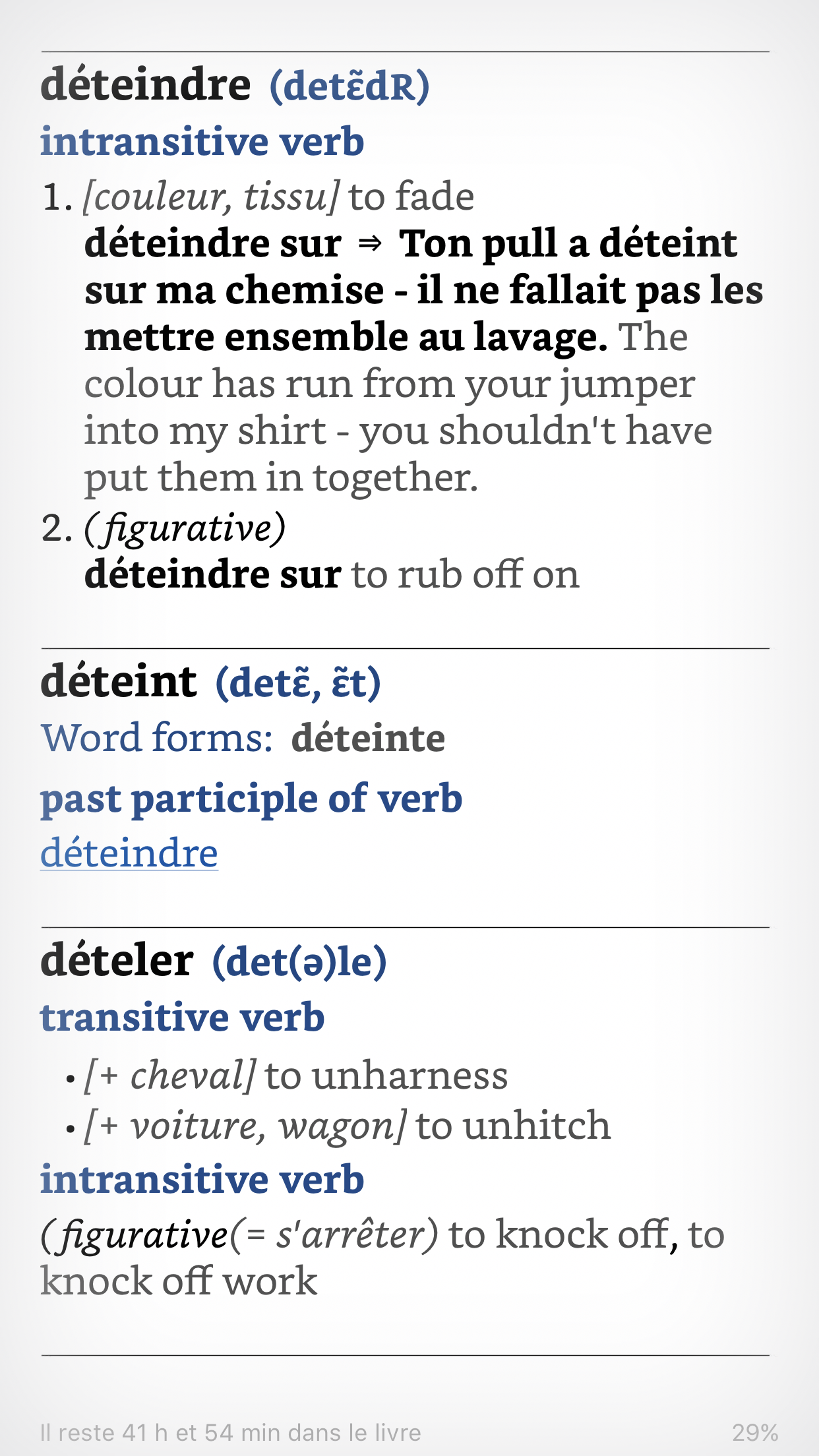
Déteindre sur: to rub off on. Ton pull à déteint sur ma chemise–il ne fallait pas les mettre ensemble au lavage. (Collins French-English Dictionary) Why ensemble and not ensembles, I have no clue…
At some point in their life, everyone should spend some time in a place where they’ll be stared at
Picture source: me.
It’s 1981, and my ship has pulled into Istanbul for a week. Being a stupid young sailor, I’m wandering around alone. I pass some old men sitting on a stoop drinking tea (a common pastime for old men in Turkey). One of the old men gets up, walks over to me, spits on a finger, and tries to rub one of my many tattoos off. When he can’t, he shakes his head in disgust and sits down again.
It’s 1981, and my ship has pulled into Istanbul for a week. Being a stupid young sailor, I’m wandering around alone. Going down a busy street, I suddenly find myself surrounded by a crowd of young men. One of the guys emerges from the crowd, and in broken English starts translating for the rest of the crowd, telling me everything that they have to say about how much they love my tattoos.
It’s 2016. I’m waiting in line at an art show in China. A guy walks up to me: excuse me, I can take picture of you with my children? Sure, why not? Smiles all around as pictures are snapped, and we all go back to waiting in line.
My job and my pastimes take me far and wide, and in some of the places that they take me, I look unlike anyone else. Japan, Guatemala, China, Mexico, Turkey–in all of them, I am a “white guy,” a light-skinned, blue-eyed guy in a country where everyone else is brown-skinned, with black hair and brown eyes. In some of those countries, I go places where I may be the only “white guy” that I see all day, and in those countries, I get stared at–a lot. It’s not just me–it’s the experience of any Westerner in those places.
What I’ve learnt in those countries: how good it can feel to be smiled at. This morning I took a walk along the riverfront in Hangzhou, China. Men (and a couple women) did tai chi alone. Women (and a couple men) did synchronized dancing to music. Grandmothers pushed strollers, and grandfathers jogged–often in business casual–occasionally omitting a loud yell or two. (I have no clue what the purpose of the yells is–native speakers, do you have any insight into this?) For 45 minutes, I was the only “white guy” that I saw.
It was unusual for people not to stare at me. Sometimes out of the corner of their eyes, and sometimes quite openly, but almost everyone stared. Some of them, though–some of them smiled at me, too. 你好, they might say. 你好, I would answer. I waved at little kids, and their grandmothers smiled–and made them wave back at me if they were too shy to do it on their own. Not big-deal interactions–but, it always felt so good. What it cost them: nothing. What it gave me: a lot, actually.
I maintain that at some point in their life, everyone should spend some time in a place where they’ll be stared at. It’ll teach you the value of a smile for someone who doesn’t seem to fit. Lots of people get stared at in today’s America–Muslim women in hijab. Black men in nice hotels/white neighborhoods/academic conferences. Any woman at all in a computer science department. A smile at someone else costs nothing–and can give a lot.
English notes
on being stared at: I include this one in the English notes because of the commonly-taught, commonly-believed old bullshit that there’s something wrong with ending a sentence with a preposition. Is on being stared at English? Absolutely. Is there any other way to say it? Not that I know of.
their life: This is a good example of the use of a third-person plural pronoun to refer to a singular person. Since there is no reason to assume any particular gender here, some dialects of English use their gender-neutral pronoun, which looks like the plural pronoun, but in this context is not. You can read more about this phenomenon here.
stoop: Besides being a verb with a number of different meanings, stoop can also be a noun. Merriam-Webster defines it as a porch, platform, entrance stairway, or small veranda at a house door. How I used it in the post: I pass some old men sitting on a stoop drinking tea (a common pastime for old men in Turkey).
Once a year I spend a week in Antigua, Guatemala, where I interpret for a group that does free surgeries for people for whom even the almost-free national health care system is too expensive. I spend a lot of time in the recovery room. It’s a challenge–you’re interpreting for people who are half-asleep, and often wearing an oxygen mask–and I do like a challenge. (This use of do explained in the English notes below.) Sometimes the challenges are unexpected ones, though.
One day last year a recovery room nurse asked me to tell a little boy to cough. That’s not unusual in a recovery room–sometimes post-operative secretions in your lungs cause a minor drop in the amount of oxygen that you’re getting, and a cough or two will clear them right up.
Tosa, I said. The kid looked at me uncomprehendingly. Hmmm, I thought to myself–does the kid not speak Spanish? That’s not uncommon in Guatemala, where 70% of the population is indigenous and over 20 Mayan languages are spoken.
The father looked at me and smiled. Tosá, he said. The kid coughed. So: no cough when I said tosa, but tosé elicited the desired response.
The father was using a verbal form that’s used in Guatemala and a few other places in Central and South America. Indeed, it’s probably the most distinctive thing about Guatemalan Spanish. However, although I know a few local regional nouns and usually get a happy laugh when I use them, I had never learnt this particular verbal form–Americans would rarely have an occasion to use or to hear it, as it’s used only in the context of particular social relationships, and it wouldn’t be at all typical for a foreigner to have one of those.
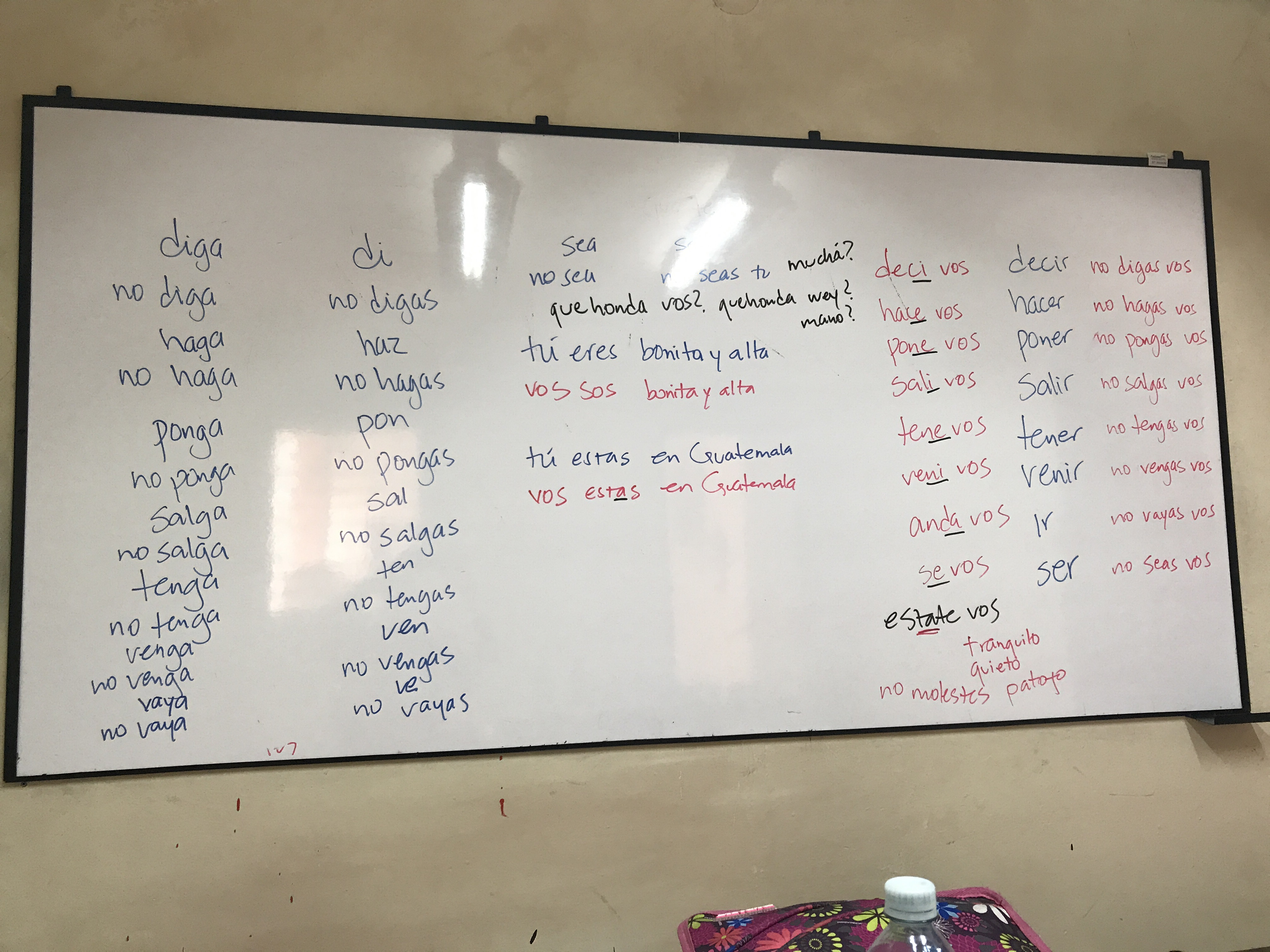
My “voseo” lesson at Maximo Nivel, a Spanish language school in Antigua, Guatemala. Picture source: me.
The verbal form in question is called voseo. It’s used in very close relationships–between friends of long duration is the typical one. In Guatemala, the tu form of verbs is used in many situations in which the usted form would be used anywhere else in the Spanish-speaking world–for example, waiters in restaurants and the ubiquitous vendedores ambulantes (people who stroll constantly through the tourist areas selling stuff, primarily Mayan women of a variety of ethnicities from the surrounding pueblos) will typically address you with the formal terms señor or señora (sir or ma’am)–and then use the tu form of verbs with you, which even on my fifth time in-country sounds weird.
So, you’re wondering: how does one form this mysterious conjugation? For starters, let’s go over the present indicative. It’s almost entirely regular, and very easy to relate to the three classes of Spanish verbs.
Spanish verbs end with either -ar, -er, or -ir, with the -ar verbs mostly being homologous with the French -er verbs. (Sorry–I havent even thought about the others!) To form the voseo present indicative of almost all verbs, you keep the vowel of the infinitive, add the -s that you would expect in the tu form of the verb, and put the stress on the final syllable. So:
escribir – escribís
decir – decís
venir – venís
tener – tenés
comer – comés
volver – volvés
tomar – tomás
buscar – buscás
caminar – caminás
Of course, just because I‘ve learnt the voseo forms doesn‘t mean that I have anyone with whom to use them–as I said, there are only some relationships in which it‘s OK. I did use them with the dog at my host family‘s apartment. I listened carefully, and they use the formal usted form with him, but he didn‘t seem to mind my voseo–although I was sneaking him treats, so who knows…
Enjoying these posts from Guatemala? Why not make a small donation to Surgicorps International, the group with which I come here? You wouldn t believe how much aspirin we can hand out for the cost of a large meal at McDonald‘s–click here to donate. Us volunteers pay our own way–all of your donations go to covering the cost of surgical supplies, housing for patients’ families while their loved one is in the hospital, medications, and the like. Scroll down for the English notes, per usual.
English notes
I do like… This use of do emphasizes something. As far as I can tell, the primary use, although not the only one, is to emphasize something that is contrary to expectations. For example, in this Dashiell Hammett quote
I do like a man that tells you right out he’s looking out for himself. Don’t we all? I don’t trust a man that says he’s not. And the man that’s telling the truth when he says he’s not I distrust most of all, because he’s an ass and ass that’s going contrary to the laws of nature.
…you wouldn‘t expect anyone to like a person who is looking out for himself (a very Trumpian behavior, particularly if you‘re only looking out for yourself)–hence the do. How I used it in the post:
It’s a challenge–you’re interpreting for people who are half-asleep, and often wearing an oxygen mask–and I do like a challenge. Liking a challenge is presumably at least somewhat contrary to expectations–hence, the do.
In-country:being or taking place in a country that is the focus of activity (such as military operations or scientific research) by the government or citizens of another country (Merriam-Webster)
For me, it became clear that we had crossed some horrible line between sanity and madness when journalists started laughing during news stories. On the plus side, this leads to a discussion of the role of recursion in language.
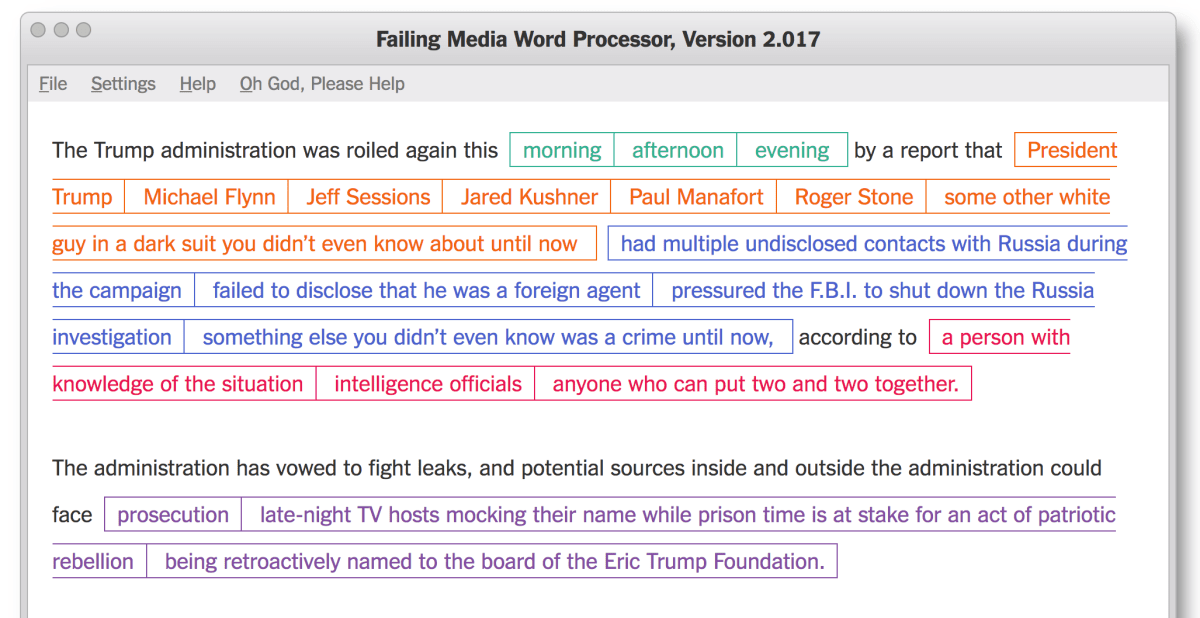
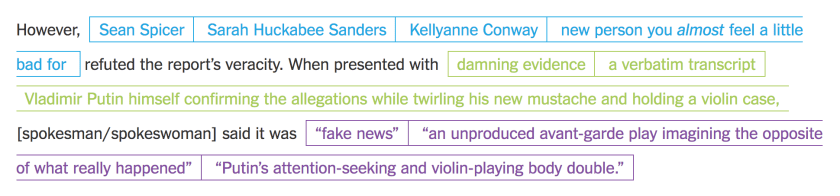
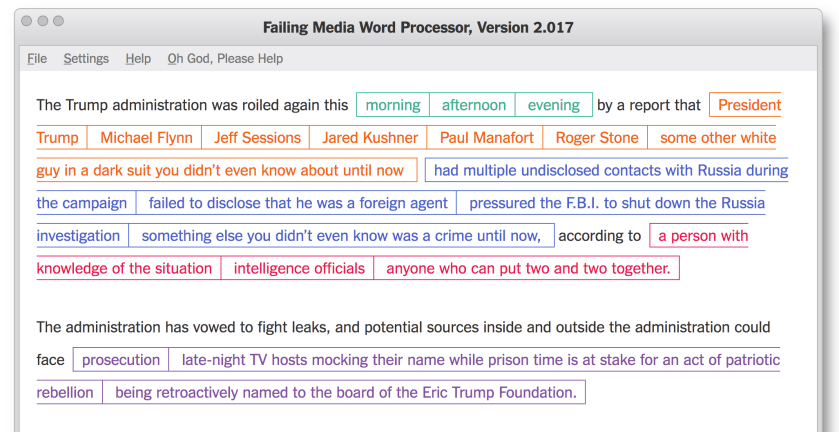
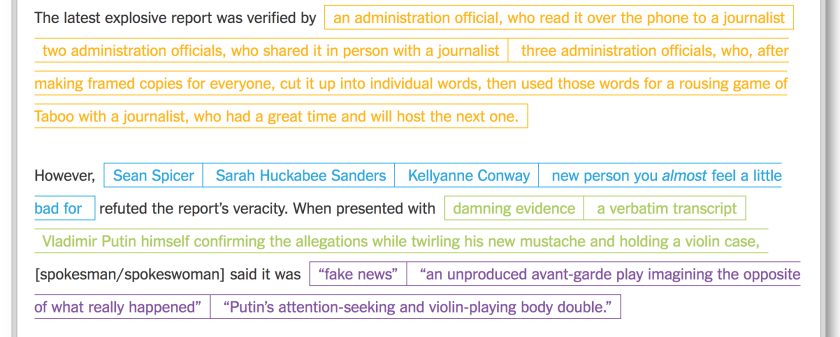
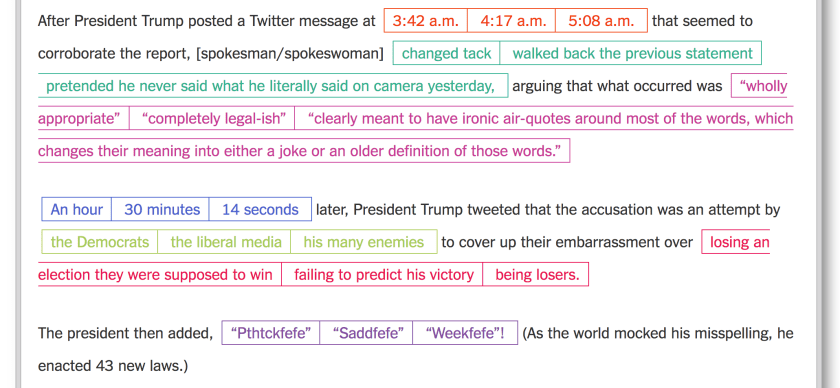
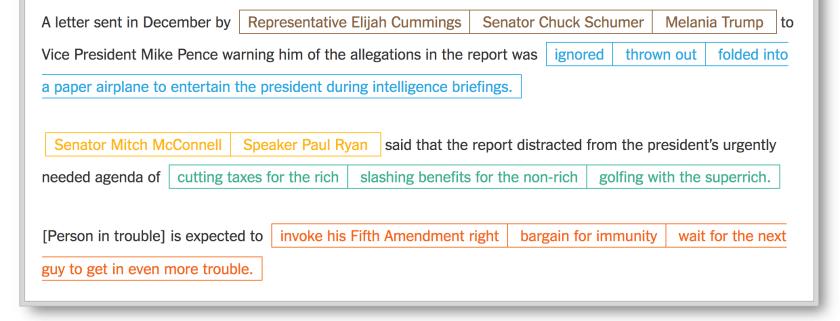
For me, it became clear that we had crossed some horrible line between sanity and madness when journalists started laughing during news stories. Leaks of stories of hallucinatory misbehavior, treason, criminality, and just plain evil have been coming out of the Trump government so fast that it’s become surreal. Potential reasonable reactions include despair, and humor. Taking the second option, the New York Times web site recently published a satire piece called The White House Leak Template for Journalists. You click on various and sundry choices…
…and it generates a little news story about a leaked Trump administration scandal for you.
Scroll to the bottom of this page, and you’ll find screen shots of the whole thing. It’s sadly hilarious, but behind the hilarity is an important point about how language works.
One of the things that’s interesting about language is that every human language (what we call in my line of work “natural” languages, as opposed to computer languages) is capable of saying an infinite number of things. “Infinite” is a big claim, and you’re right to be skeptical about it. So, let me just show you that with even a very small amount of knowledge of a language, you can say an enormous number of things–much more than you might ever have thought–and as you’ll see at the end of the post, this is a fact that has important implications for the many people reading this blog who are trying to learn a second language.
Let’s suppose that you know how to say a simple declarative sentence in some language or another–my dog ate my shoes. You’ve got a subject, a verb, and an object. Suppose that you know 10 nouns and 10 verbs. You can now say the following number of sentences:
10 nouns * 10 verbs * 9 nouns = 900 sentences
Why only 9 nouns in the object position? Because I’m assuming that you won’t use the same noun for the object as you did for the subject. So, whichever noun you pick for the subject, you now have nine choices left for the object, rather than the 10 that you started with.
Let’s suppose that you have a language–like French or Spanish–that inflects all verbs differently for singular versus plural subjects. Let’s also suppose that in our calculation above, we included only singular forms of the verbs. Add the plural form of the nouns and the plural form of the verbs, and now you have the following additional sentences:
To recap: 900 sentences if you only know the singulars, plus another 1800 if you add the plurals, so you’ve got 2700 sentences that you can say.
Note: this post relies heavily on a branch of math called combinatorics. I stink at combinatorics, so please be kind! Corrections are welcome in the Comments section.
To this point, we’ve only been using nouns and verbs. Let’s add a new kind of word: and. Even if we didn’t know the plural forms of the verbs, and lets us say a truly remarkable number of sentences with just our 10 singular nouns and our 10 singular verbs. Recall how many simple declarative sentences we could say with just 10 nouns and 10 verbs:
10 nouns * 10 verbs * 9 nouns = 900 sentences
Once you’ve picked a noun for the subject, you have 9 nouns left for your object, leaving eight unused nouns. Suppose that you’re going to use and in your object: you have 9 possibilities for the first noun (since you used 1 for the subject) , and 8 possibilities for the second one (since you used one for the subject, and you’ve already used one in the object). So, with and, you have the following number of possibilities:
…and if you’re keeping track, that’s 900 + 1800 + 1700 sentences, or 4,400 sentences.
Of course, we’re not done with and yet–since you’ve learnt to use the plural forms of verbs, you can use and in the subject, too. The calculation of the number of sentences that you can make with and in the subject (but just a single noun in the object) is similar to what we just did:
Of course, you can have two nouns in the subject and two nouns in the object, as well–you can do the math. What’s cooler is that you can use and to join together two sentences, too. Let’s take the “formula” that gave us the smallest number of sentences: singular subject, singular verb, singular object. Remember how we calculated the number of sentences that we could make with only 10 nouns and 10 verbs:
10 nouns * 10 verbs * 9 nouns = 900 sentences
How many sentences can you make by joining two sentences together with and? The possible assumptions are numerous. Can you repeat the subject? Why not? (Dogs chase cats and dogs chase balls.) Can you repeat the object? Why not? (Dogs chase cats and children chase cats.) Certainly those are weird, though, so let’s estimate that maybe 10% of our possibilities aren’t going to be OK, and just calculate from the numbers that we used for the simple declarative sentences. That gives us this:
10 nouns * 10 verbs * 9 nouns and 10 nouns * 10 verbs * 9 nouns = 1800 sentences; subtract 10% of that for the ones that repeat too much and you still went from 900 sentences to 1620 sentences with just one additional word.
…in other words: as soon as you throw and into the mix at the level of sentences, you double the number of sentences that you can make. (The last time we tried to total how many sentences we could make, we had 5,920. Double that with and, subtract 10% for the sentences that repeat too much, and you have 10,656 sentences.)
What happens if you add or to your armamentarium? You just doubled the number of sentences that you can make again. How about throwing but in there? You just doubled it again. (We’re around 40,000 sentences right now, even with our 10% adjustment for repeated things.) Add one more tense and you just…well, it just got really, really big. And let’s review what you know–it’s very little:
10 nouns, singular and plural
10 verbs, singular and plural
two tenses
and
or
but
For those of us who are as math-challenged as I am: that’s 23 words and two tenses to give you around 40,000 sentences. Throw in some adjectives… Learn how to turn a simple declarative sentence into a question… Learn a few names… Learn to say he, she, and it… Add because…
Now, I know what you’re thinking: I know a hell of a lot more than 10 nouns and verbs in French, but it sure doesn’t feel like I know how to say very many things. Remember, though: as we discussed recently, you can get a surprisingly long way on a pretty small amount of a language. This is a skill that you can develop with practice: think about simple ways to communicate your wants and needs, and I bet you’ll come up with creative ways to work around your lack of knowledge of a language.
A technical excursus: recursion
When we got into and, we touched on an important mechanism of language that leads to the fact that every human language is capable of saying an infinite number of things. Called recursion, it has a specific definition in mathematical formalism that you can find here; for our point of view, it means that some things in language that we care about, such as sentences, can be made up of other things of the same type. For example, we used recursion when we made the sentence Dogs chase cats and dogs chase balls out of two sentences: dogs chase cats and dogs chase balls. We could also use recursion to make noun phrases (the groups of words that make up the subjects and objects in our examples): the noun phrase my dog and your cat is made up of the noun phrase my dog and the noun phrase your cat. In principle, is there any limit to this? No, actually. You would die before you could say an infinitely long sentence, and even if you could live long enough to hear one, by the time you got to the end you would most likely have forgotten the beginning. But, that doesn’t change the fact that the language, by virtue of having this fundamental property of recursion, can produce an infinite number of things to say.
If no one could ever say an infinitely long sentence, who cares about understanding how and why languages can produce the things? For one thing, infinity is a pretty big deal, and if you’re dealing with a system of any sort that’s capable of infinity, then if you want to be able to understand how it works, you need to understand that aspect of it. I believe it was Chomsky (who in many ways was a horrible thing to have happen to linguistics) who made the analogy that just because no marathon runner can run forever doesn’t mean that it’s not useful and important to understand the physiological mechanisms that let them do it.
You made it this far? Great! Your reward is the New York Times Leak Template. Read it and laugh–then go subscribe to a newspaper. Keeping journalism alive is essential to getting the traitors that are currently running our federal government out of the White House. Feeling geeky? Calculate how many news stories about Trumpworld scandals this would generate–and ask yourself if that would be enough…
One of the disorienting things about being in a foreign country is that you often find that you’re incapable of doing the simplest things–things that you could do without really having to think about them in your country of origin. Getting and maintaining cell phone service? I have spent weeks of my life struggling with that in France. Where to buy a breadbox? No clue–one of the charms of France is that stores are pretty specialized here, but you have to find the right kind for whatever it is that you’re looking for. Fastoche for a French adult, but often baffling for me. Using a credit card? The stories I could tell…
Case in point: I struggle with grammatical points of listening to the news here. I am completely addicted to listening to and reading the news, and one of the nice things about having a bit of familiarity with French is that I can consume news from a whole nother perspective. (A whole nother explained in the English notes.) What throws me off is the use of the conditional mood in French news reporting. (The term mood, as opposed to tense, refers to something like a grammatical structure that communicates something about the reality of a situation, as opposed to the time of its occurrence–the latter is tense. The conditional and the subjunctive are usually described as moods, while the past and the present are tenses (usually–it gets complicated in Bulgarian and other languages in which verbs are inflected for evidentiality, or whether and how the speaker knows something to be true). The future? It varies from language to language. See irrealis if you’re interested.)
In French, one use of the conditional is to convey something like the as-yet-unverified status of something that you’re saying. Here’s an extract from the Tex’s French Grammar description of how this works:
The conditional is also used to give information whose accuracy cannot be guaranteed. Journalists often use it to report events which are not [yet verified].
‘Une tornade vient de s’abattre sur Hubbard, Texas. Il y aurait plusieurs victimes. Un tatou et un écureuil seraient gravement blessés. Restez avec nous, nous devrions avoir plus de détails d’ici quelques secondes …’
‘A tornado just struck in Hubbard, Texas. Allegedly, there are several casualties. An armadillo and a squirrel seem to be seriously wounded. Stay with us, we should have more details in a few seconds …’
Here’s an example of journalistic use of the imperfect, from a news story in Le monde about persecution of gays in Chechnya. (I picked Le monde because it’s pretty middle-of-the-road.) Look for auraient été arrêtées:
Here you see it in the title of a web page–note serait, in place of est:
La Tchétchénie serait-elle en train de se «débarrasser des homosexuels» en les torturant dans des camps ? La communauté internationale s’interroge
What’s the point of the torture? To get you to give up the names of other gays. In this news story, watch for aurait procédé and serait ensuite soumis:
Selon ces témoignages de rescapés, la police tchétchène aurait procédé à une vague d’enlèvement de membres de la communauté LGBT ou de personnes soupçonnées d’en faire partie. Les détenus seraient ensuite soumis à des tortures et des interrogatoires pour dénoncer d’autres personnes ayant les mêmes orientations sexuelles.
Just how thoroughly tortured can you be if you’re gay in Chechnya? To death–look for auraient été tuées in this sentence from the same article:
Trois personnes au moins auraient été tuées, selon des sources au sein de la police et du gouvernement.
You’ll notice a repeated pattern in these examples–it’s made explicit that what’s being reported is something that was initially said by someone else:
Selon ces témoignages de rescapés, la police tchétchène aurait procédé à une vague d’enlèvement…
Selon un témoin, il s’agirait de “voyageurs d’Europe de l’Est” qui se sont montrés “incroyablement agressifs”. (Not from a story about gays being tortured in Chechnya–see here)
I’ve heard the construction used in spoken language without that kind of reference to a third party who was the origin of the information, in situations like reporting on something that had just happened, e.g. when reporting on the number of deaths in a big traffic accident while it still wasn’t clear if the final number of deaths were known, so it’s clearly not necessary–but, it’s probably not an accident that we’re seeing this co-occurrence of source and conditional mood in written news stories.
Want to do something to help? Slacktivism is always an option–click “like” on a Facebook post, or retweet something, and go on about one’s business. Give 20 euros or 20 bucks, though, and you’ve already done more than most people ever will–and maybe help save a life in the process. For the cost of a pizza… 5 euros/bucks would still be more than most people do, and for the cost of a cup of coffee and a croissant. Here are some places where you can make donations:
a whole nother: this means something like an entirely different. It’s so uncommonly used in writing that native speakers typically aren’t even sure how to spell it–WordReference’s spell checker doesn’t recognize it. I was pleasantly surprised to find an entry for it on the Merriam-Webster web site.
When’s the last time you saw a dog shoot a bunch of kids at a grade school, or post a video of someone beheading someone else on Twitter, or vote for Trump?
I’m not necessarily that crazy about people, but I like animals. (Except for man-eating rabbits–I hate man-eating rabbits.) Seriously, when was the last time you saw a dog or a cat sell a teen-ager drugs, or kill a bunch of kids at a grade school (yes, this happened in the US), or vote for Trump (that happens in the US, too)? Yes, my dog bit a couple people on the croupion when they walked into the house uninvited. Yes, my cat once pooped in my favorite sandals. But, rip off a tourist visiting from a foreign land? Sell someone a counterfeit Beanie Baby on eBay? Video someone beheading another living person in the name of God, and distribute it on Twitter? Only a human would do that.
Consequently, when I’m in the US, I carry a leash and a can of cat food in my car. Dogs love cat food, and when I see an obvious runaway/lost dog trotting down the street, I pull over and offer him a whiff. I can usually catch them, and I’ve gotten maybe 12 or 15 dogs back to their happy homes in the 20 years (almost) that I’ve been in my current town.
Something that makes this a hell of a lot easier is if people have had their animal microchipped. In this context, a “microchip” is a little thing about the size of a grain of long-grain rice that a veterinarian injects under a dog or cat’s skin. They don’t notice it in the least, as far as I can tell. A veterinarian can wave a sort of wand over it, and it will send off a signal with an identifying number. The vet sends the number to a company, the company sends back contact information from the owner, et voilà: Spot is home in time for dinner. It’s quite wonderful, really.
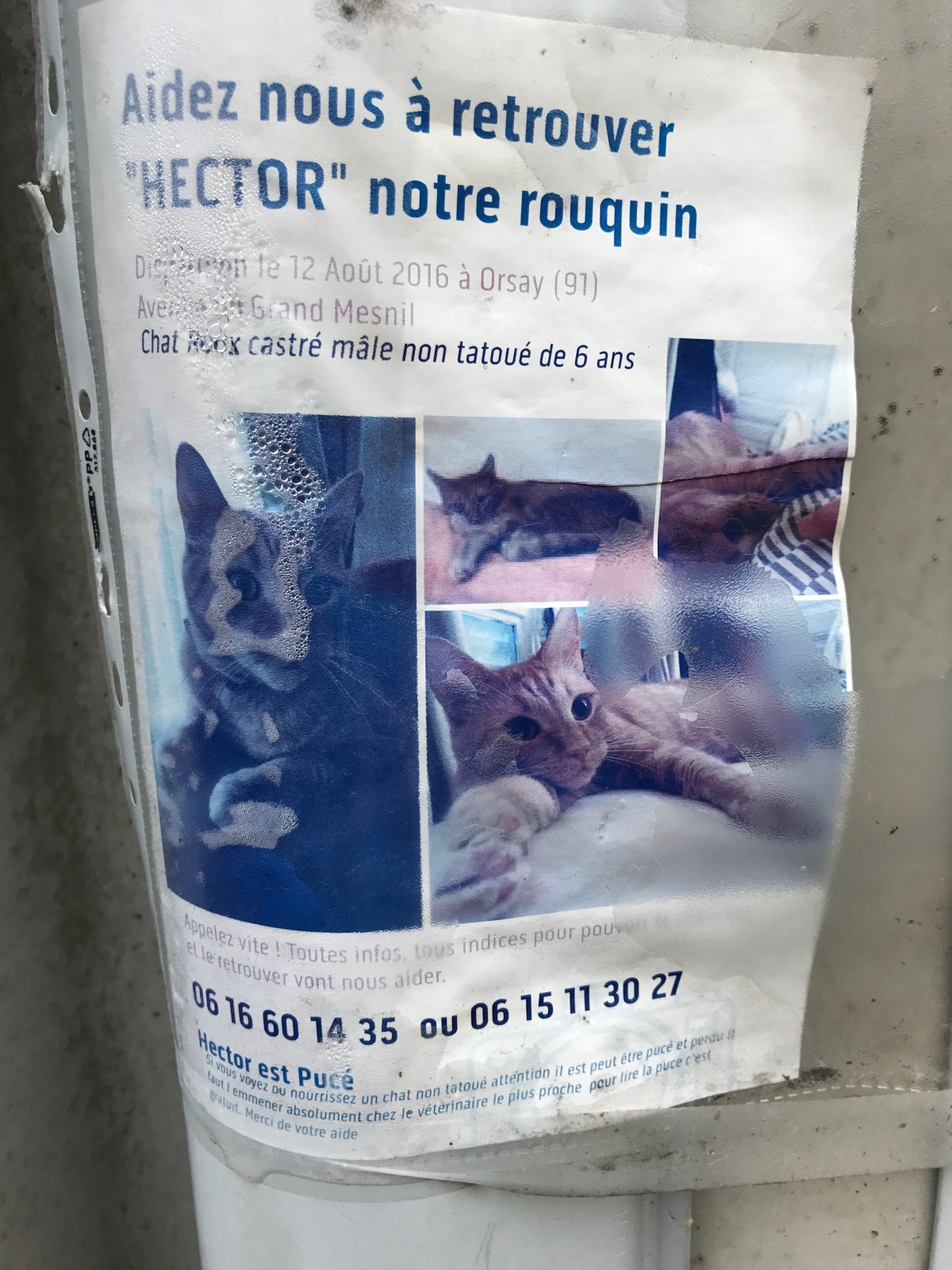
This sign’s been around for a while. I walk by it on my way to the train station after work. The effort to get him back to his happy home will definitely be a lot easier than it would have been otherwise: Hector has been chipped. Check out the poster, then scroll down, and let’s talk about how it’s interesting from a linguistic point of view.
The linguistically cool thing is at the bottom: Hector est Pucé. What that means: Hector has been chipped. Now, we know that that’s going to increase the chances of Hector making his way home, but it’s cool from a linguistic point of view, too. Recall from this blog post that French has a class of verbs that relate to undoing some noxious state of infestation–dératiser (to exterminate the rats in something), dénicotiniser (to remove the nicotine from something), and the like. The interesting thing that we noted about these verbs is that they share an odd set of characteristics:
They all have an -is– added on to the end.
They all describe the reversal of a state of affairs that a human could create, but wouldn’t be expected to.
None of them has a corresponding verb for creating that state of affairs. That is, there is no ratiser, nicotiniser, etc. (or that is the claim, at any rate–read the other blog post if you don’t agree).
Now, puce, the word that is being used for a microchip here (it’s also the word for the chip on your credit card), comes from puce, a flea. There is a verb épucer, to deflea, which clearly doesn’t fit the pattern of the verbs about which we just talked. And, here’s an example of pucer! Certainly the meaning here is to microchip, not to infest with fleas–but, it’s worth a second look and a quick blog post anyway, right?
I hope these folks have found their rouquin, their ginger (in the sense of red-haired). I’d like to think that he’s found his way home. If not: I hope he’s happily shacked up with some girl cat somewhere. It would have to be a purely platonic relationship–in addition to being pucé, he’s also been neutered–but, a lifelong flirtation can be pretty exciting in and of itself. The French are pretty damn good at that, too.
Want to be amused/horrified by the stupidity of the world? Go to Google Images, do a search for microchips, and check out some of the “mark of the Beast” stuff that comes up.
I was going through Elisabetta’s book (the one I was supposed to return you on Friday and I forgot, sorry!), there is a sentence “Typical lexical structures are, for example: morphological word families, such as book, booking, booklet, bookstore, based on presence of the word book; semantic network such as buy, acquire, purchase, sell, negotiate, pay, own, based on meaning associations; and groups of words with similar syntactic behavior, for example nouns, verbs, or adjectives”. I was wondering how “buy, acquire, purchase, sell, negotiate, pay, own” can be combined together in a single semantic network? Semantic network consists of words with similar meanings, right? How can “buy” and “sell” have similar meanings?
Yours,
P
Hi, P,
I LOVE it when you ask me questions like this!
In addition to their use in describing language, frames are useful in the broader context of cognitive science. For more on how that works, see this post on the subject of linguist and cognitive scientist George Lakoff’s framing-based explanation for Trump’s takeover of the Republican Party in 2016.
Regarding the specific example: this is what is called a “frame.” The idea is that there are some things:
– two people
– an object
– a quantity of money
You can talk about the relationships between those from different perspectives:
John sold Mary a car for $5,000.
Mary bought a car from John for $5,000.
Mary paid John $5,000 for the car.
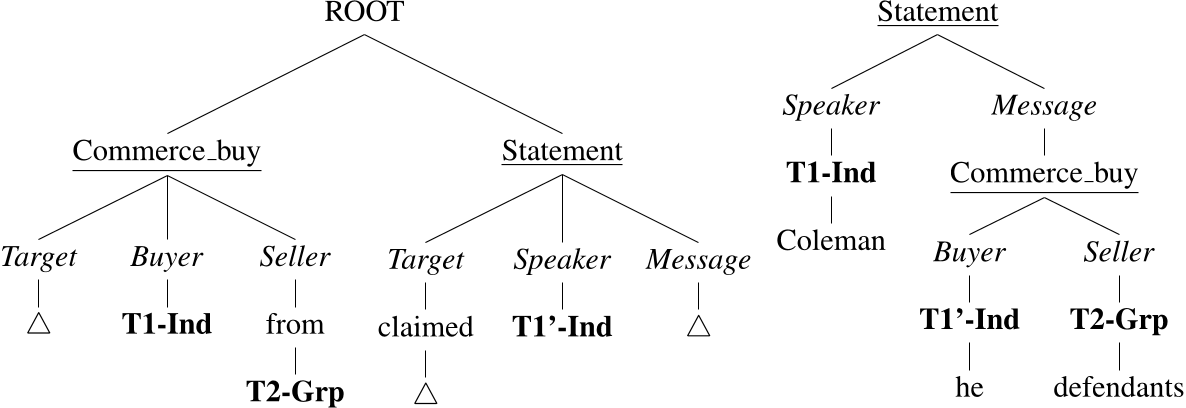
Picture source: Agarwal, Apoorv, Daniel Bauer, and Owen Rambow. “Using Frame Semantics in Natural Language Processing.” Proceedings of Frame Semantics in NLP: A Workshop in Honor of Chuck Fillmore. Vol. 1929. 2014.
If you think about “semantics” as being a mapping between language and a model of the world, then the model of the world is the same in the case of all three sentences, so in some sense, the meaning is the same in all three cases. What’s different is whether we talk about it from the perspective of John (sell), Mary (buy), or the quantity of money (pay). You could argue about whose perspectives these are, and perspective isn’t necessarily even the best word for this, but that’s the sense in which those are related. To get the others in there, consider, for example, that selling is about a change in ownership; selling involves a previous negotiation between the same two people (John and Mary) concerning the price that will be paid for the car; etc.
Pride comes before a fall, and sometimes the fall is worse than others.
Most mornings, I sit with my first cup of coffee and a stack of index cards and look up all of the words that I ran into the day before and didn’t know. My 15 minutes or so of vocabulary every morning is a given–I typically learn about 10 new words a day, which means that despite having grammar that makes my French tutor shudder and an accent like fingernails on a blackboard, I know three ways to say “unremittingly.”
Everything else–conjugation, grammar, pronunciation–I rotate between. Which is to say: I try to make sure that every week I spend a day on some new verb form, a new tense I don’t know, the order of double pronominal preverbal objects (my current bugaboo–il me le rend? Il le me rend? FUCK), or something of that ilk. Hence, I know lots of obscure things to say–but, I don’t necessarily know how to say them, if that makes any sense.
The other morning my plane landed in Paris after a long weekend in the US. (A work thing, and then I surprised my father for his birthday. We made fried matzah with schmaltz, which is to say: rendered chicken fat.) On your first day in Europe, the challenge is to stay awake–fall asleep when you get off the plane and you’ll find yourself in a cycle of décalage horaire-induced sleep cycle disturbance that you won’t work your way out of for a week. Sundays and Wednesdays it’s easy–there’s a market under the Metro tracks down the block, and getting out in the fresh air and sunshine is a good way to keep yourself moving and conscious.
On market days, I actually start not at the market, but at the fromagerie at the Dupleix metro station. (Right outside the station was the spot where you were most likely to get taken to face the firing squad, at least as recently as 1871, the last date of which I’m sure.) Although as an American, I had no clue about this ’til I got here, it turns out that cheeses have seasons; the first thing that I do when I get to Laurent Dubois is check the ardoise in the window to see what’s just come in.
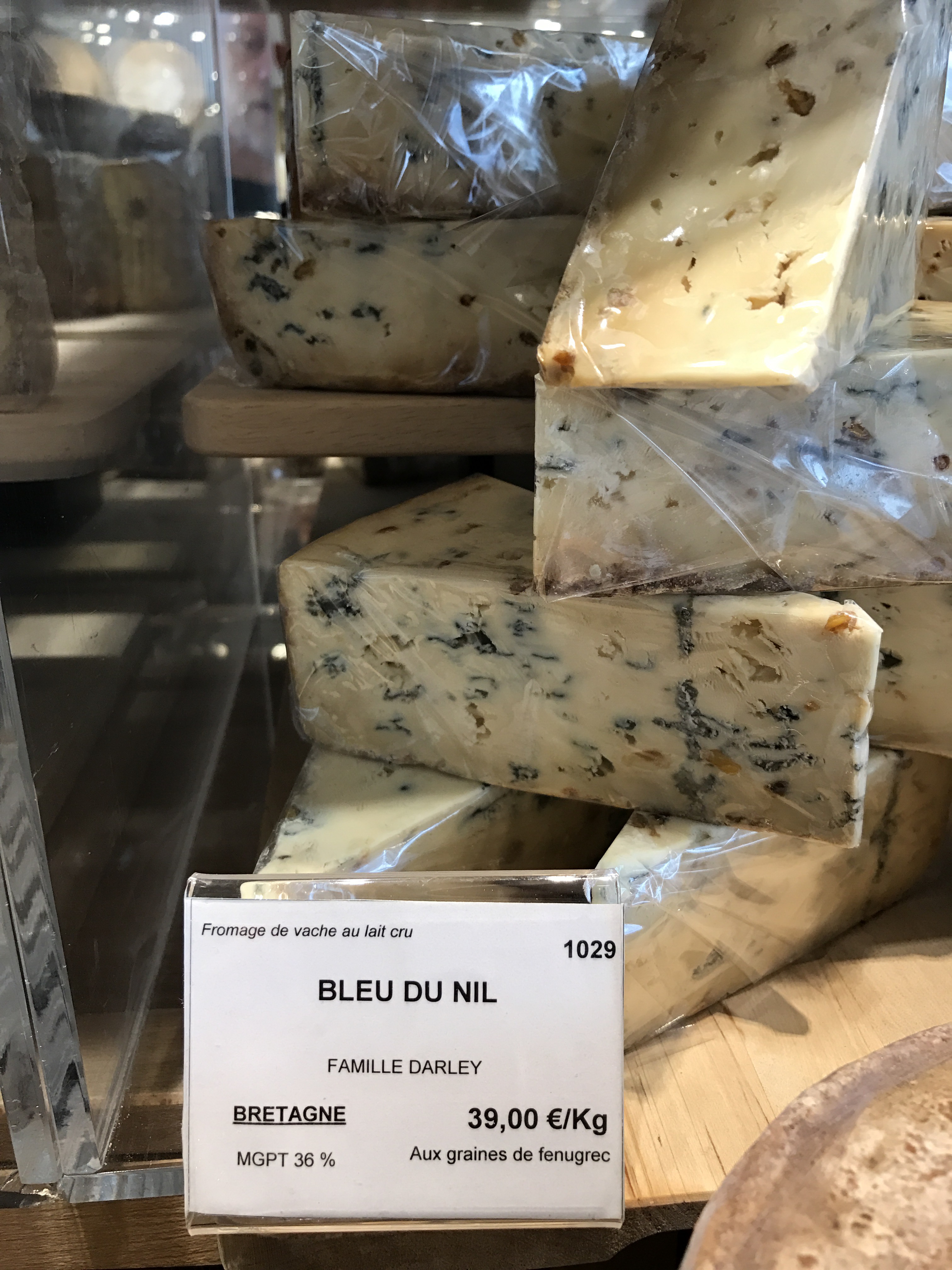
This week: 3 “rare” cheeses. Bleu du Nil, an obscure tomme, and something even more obscure that had already sold out. Now, you’ll hear numbers about how many cheeses France has, but in truth, no one really knows how many cheeses France has. Like the apocryphal Eskimo words for snow (that’s bullshit, by the way), some say 200, some say 300, some say 350… In truth, there’s no way to know, because it’s not clear how to define “a cheese.” In the limiting case, since every farmwife who still makes her own cheese is making a cheese unlike any other, the cheeses of France are essentially uncountable. (That’s not to say that there’s an infinite number–uncountable and infinite are different things. I remember well being baffled by the idea of being countably infinite versus uncountably infinite as a graduate student. As my wife of the moment said to me: Kevin, if you can’t wrap your head around this, you just can’t take any more math classes. I thought that that was adorable, since I haven’t taken a math course since the obligatory algebra and trig course in college, and in fact am completely innumerate.)
But, back to the fromagerie. My copy of Marie-Anne Cantin’s Guide de l’amateur de fromages(“”Cheese-lover’s guide”) lists somewhere around 200 or so French cheeses, but it doesn’t list any of the cheeses that had come in this week, so I asked the adorable pixie-cut saleslady to tell me about them. It developed that the name of one of them comes from the valley where the cows from whose milk it is made graze. Except…she didn’t use the word graze, and I didn’t catch the word that she did use. No problem–I recently learnt the verb to graze. “Where they paissent?” …I asked, using the verb paître–a favorite of mine, because I love circumflex accents. Seulement voilà, the only thing is: I’d never had the opportunity to use this delightful lexical item before, and I screwed it up. I should have said paissent–but, my mind wandered off into the delights of that circumflex, and instead I said paîtent. Which sounds like pètent… Which means that I had just asked the nice lady if she were referring to where the cows fart. Damn it. Pride before a fall, and all that. She had the good grace not to laugh. At least, I think she didn’t–I was too embarrassed to look at anything but the floor.
In the English notes, we talk about the little-known English subjunctive. The French notes are, of course, devoted to the verb paître. The bleu du Nil comes from exactly one farm, in Brittany–see the picture above. It’s delicious–as creamy as butter, with little bits of fenugreek.
English notes
Anglophones complain constantly about the French subjunctive. Even French teachers get into it, commiserating with us about its chiant existence and teaching us ways to avoid it. In reality, this most charming of the conjugations of the French language is not one that is completely foreign to us. Although it’s not widespread, my dialect still has a subjunctive. It’s easiest to say in the case of the verb to be. Here’s how it showed up in this post:
I had just asked the nice lady if she were referring to where the cows fart.
The subjunctive here is were. You would expect was:
I had just asked the nice lady if she was referring to where the cows fart.
…and indeed, (a) you most certainly could say that, and (b) I would guess that most Americans would say that. (I hate to guess, but I don’t have any statistics on this–sorry.) You can find some exercises on the use of the subjunctive in English here, if you’d like to pursue this. Be aware that there are some differences between American and British English in the use of the subjunctive–the Wikipedia page on the English subjunctive goes into them at some length.
French notes
Paître is the kind of delightfully irregular verb that I just adore. Along with repaître, native speakers don’t seem to agree on whether either, both, or neither of them can be used for humans, or just for cows and the like; whether either, both, or neither of them can be transitive only, intransitive only, or both; or in which tenses the i gets its little chapeau chinois. (From what I can tell, the Academy’s decision on this has not always been gracefully accepted.) My Bescherelle maintains that (a) it doesn’t have any of the compound tenses, and (b) le participe passé pu, invariable, n’est utilisé qu’en termes de fauconnerie…. and if you can find a verb that’s cooler than that, I will buy you a beer–and if you’re a woman, I’ll marry you.
Usually you change your socks, but one day socks changed me.
I got my start on an education by going to college classes at night after work. I was in the Navy at the time, and the evening classes in the Norfolk, Virginia-area universities were full of people looking to advance their careers, squids like me (squid is military slang for a sailor), and of course typical college students. Waiting for class to start one evening, I listened to two of them discuss their distaste for dating sailors. One of them shared her hint for avoiding doing so inadvertently: she identified them by their black socks. Indeed, we were issued a kind of heavy, padded black sock that was great for supporting your feet inside the low boots that were part of the uniform at the time. Your tiny little locker on a ship doesn’t allow you the room to have much in the way of clothes other than your uniform, so we wore them all the time, whether in uniform or in civvies. I’m sure that I was wearing a pair at that very moment.
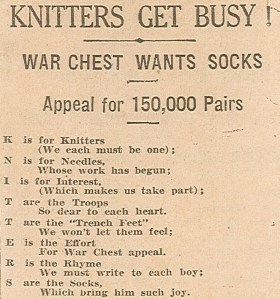
Poem about knitting socks for soldiers. From a 1918 newspaper, original source unknown. My source: https://goo.gl/dUYUG7
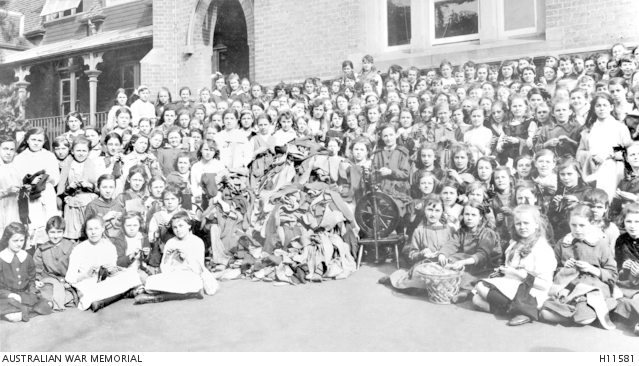
In fact, socks are a crucial part of the military uniform. In the First World War, they were crucial to the avoidance of trench foot, which could (and frequently did) lead to the loss of a foot, or a leg, or two of them. They remained important in World War II–socks are crucial to your ability to march. Today, nothing has changed but the sales platform–whether you’re standing on your feet for hours guarding jets on an air base in Alaska (my cousin did that–he’s in Hawaii now, which makes a hell of a lot of sense to me) or standing on your feet for hours in a military hospital shooting radiopaque dye into people’s coronary arteries (that was me), nothing about the technologization of the American military changes the fact that what’s on your feet is part of your equipment, just like anything else, and you need the best you can get.
The formidable Queen Mary led the movement to keep our troops warm during winter in the trenches, when Lord Kitchener asked her to undertake the huge task of providing 30,000 pairs of socks for our brave lads. Unfortunately with all the nice middle class ladies knitting away, many working class women lost out on a valuable revenue stream. After a meeting with the Queen it was suggested that ladies from the upper echelons might buy the wool and pay the lower classes to knit the socks, keeping everyone happy. —Juliet Bernard, HuffPost United Kingdom, https://goo.gl/ew4Z27
I spent my last few years in the Navy working in a large hospital. Every fourth day, the people in my group spent 24 hours in the hospital–“on duty,” or “having the dutes,” as we called it. You know how in the movies when someone’s heart stops, someone comes running down the hall with a big red cart and a defibrillator and shocks them until their heart (hopefully) restarts? That was us.
That doesn’t actually happen very often, so we spent a lot of time sitting around reading. This was before the Internet, smart phones, etc., so we brought piles of books, magazines, whatever. I used to write long letters to my father. On a typewriter–can you imagine?
One night I was sitting in the lab flipping through a National Geographic. This was in the late 1980s–less than 10 years after the taking of the hostages at the American embassy in Iran, with the subsequent end of relations between the two countries (except, of course, for the illegal Iran-Contra affair, brought to you by the Reagan administration). National Geographic is basically a collection of photographs from around the world, with a bit of accompanying text and occasionally a gorgeous map thrown in. I found one of the photographs particularly interesting. It was a close-up of an Iranian soldier’s socks, one of which was embroidered with the following words: Through Iraq to theMediterranean–this was in the midst of the Iran-Iraq war. The other was embroidered with the words Fill the sea with the blood of the Jews.
Now, I’m Jewish, like my grandmother, and my sister, and my aunts, and my uncles, and my cousins, and…you get the idea. So, when you talk about filling the sea with the blood of the Jews, I presume that you’re not going to leave my grandmother out of that particular adventure, or my sister, or my aunts, or…you get the picture.
As it happens, I am also a sharpshooter with the .45 caliber pistol (the handgun of the American military of those times). I’m not a gun nut–in fact, I hate firearms. But, when you’re in the military, one of the many things that you learn how to do is shoot people. It’s fairly standard.
So I figured: fine, fuck you. You know how to use your weapon, I know how to use mine–maybe one day we’ll meet in a “shooting war,” and then whoever’s the best shot gets to walk away. I’ll take my chances with that. And I turned the page…
…to find a picture of a farmer holding his adult son in his arms in the waiting room of a hospital in Tehran. The kid was a soldier, and had been blinded in the war against Iraq. The farmer was utterly uneducated, and had brought his son to the Big City to see if the doctors could take his eyes out of his head and transplant them into his son’s.
It was one of the biggest “light bulb moments” of my life. I was a new father myself at the time, and I would have done anything for my baby, and the connection that I felt with that Iranian father was absolute, total, and complete. It’s difficult for me to describe what that was like–a sudden awareness of a connection between my soul (and I say that as an atheist) and that of someone on the other side of the world who was quite possibly offended by my very existence (and that of my grandmother, and my sister, and my aunts, and…you get the picture.) I knew something, immediately, in that moment: I was never going to be OK with killing anybody. If you’re trying to kill my grandmother, or my sister, or–you know the list–sure, I will put a bullet in you, and thanks to your tax dollars and my fine Navy training, I know how to do it. But, fine, fuck you? Not after that moment.
I’m very sorry that I haven’t been able to find the picture of the soldier’s socks, nor the picture of the farmer with his blind son. I spent a couple hours looking for them on line, with no luck. If by some chance a reader of this post happens to be able to track them down… English notes below.
I found this jewel of a review of a pair of socks on the THORLO web site. “Basic” is “basic training,” more commonly known as “boot camp”–your first training in the transition from civilian to soldier/sailor/whatever. Picture source: screen shot of https://goo.gl/Uk1IYN
English notes
shooting war: in opposition to the Cold War, which did not actually involve violence (overtly), a “shooting war” is the usual kind. How it was used in the post: So I figured: fine, fuck you. You know how to use your weapon, I know how to use mine–maybe one day we’ll meet in a “shooting war,” and then whoever’s the best shot gets to walk away.
light bulb moment: when you suddenly realize something. The image is that the realization comes to you as suddenly as a light bulb turning on. How it was used in the post: It was one of the biggest “light bulb moments” of my life.
dating sailors: this is an example of ambiguity on multiple levels. Let me give you a parallel example with less uncommon lexical items–it probably comes from an old edition of Language Files, the Ohio State University linguistics department textbook:
Visiting relatives can be annoying. (You have some relatives, and some of them visit you, and those relatives that visit you can be annoying to you.)
Visiting relatives can be annoying. (You have some relatives, and when you visit them, doing it can be annoying to you.)
On one level, this is ambiguity related to the fact that visiting can belong to multiple lexical categories (what normal people, i.e. non-linguists, call parts of speech).
Visiting relatives can be annoying. (You have some relatives, and some of them visit you, and those relatives that visit you can be annoying to you.) In this case, visiting is an adjective, and it modifies relatives: it takes the universe of all possible relatives and restricts it to just those that visit.
Visiting relatives can be annoying. (You have some relatives, and when you visit them, doing it can be annoying to you.) In this case, visiting is a verb, and in particular, a non-finite one–that is, one that doesn’t have a tense, per se.
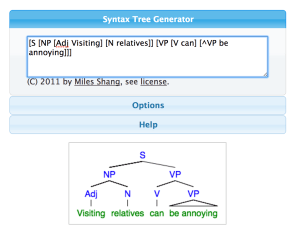
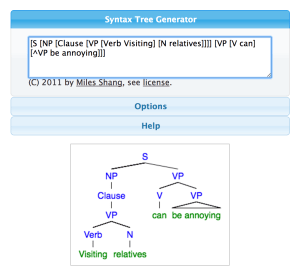
Going along with that ambiguity with respect to lexical category (part of speech) is a difference in syntactic structure, as well. In the case where visiting is an adjective, the group of words visiting relatives is what’s called a noun phrase (le groupe nominal, I think), formed by an adjective and a noun. From a syntactic point of view, this is a relatively simple structure. (I said relatively–no hate mail from afficionadoes of deeply-embedded X-bar structures and the like, please.) Scroll down a bit and you’ll find a picture of what this looks like. In the case where visiting is a non-finite verb, I think that you need to posit something pretty complicated, along the line of a verb phrase within a dependent clause within a noun phrase.
S is “sentence,” NP is “noun phrase,” and VP is “verb phrase.” Picture source: screen shot from http://mshang.ca/syntree/. Try it out, it’s super-fun! I mean, for a syntactic tree generator… and if you like bracketing phrases… Certainly more fun than sitting here in my hotel room in the middle of the night thinking about the bullshit-filled speech that I just watched Trump give at his inauguration…
VP is “verb phrase.” The verb phrase forms a clause, and the clause has to be inside a “noun phrase” (NP), or else you have to posit that you don’t need to have nouns to have a subject, which you can do, but then you trade off the less-complex structure for a more-complex set of syntactic categories. You choose. Picture source: screen shot from http://mshang.ca/syntree/.
Want to try your hand at this? Here are some examples. (I think I found them on the Sketch Engine web site, but I started writing this post back on the day of Trump’s inauguration, and my memory is a bit hazy, mostly being masked by my horror at the event.) Label each one as adjectival or verbal, and I’ll tell you what I think the answers are at the bottom of the page.
In the morning our team of highly experienced instructors will kit you out with yourriding gearand a Yamaha off road bike, and introduce you to the principles of off road riding.
We all know training is the key toutilizing technologyto its fullest extent and saves BIG money in the long run .
These color tiers provide a quick, visual means ofcomparing playersat different positions with similar fantasy value.
Walking distanceto the centre, car parking spaces are a god-send, lovely comfortable beds and clean bathrooms and kitchen.
There are variouseating establishmentsin the village of Gairloch which is about 10 miles away.
The upstairs rooms offer fantastic panoramic views oversurrounding croftlandto the Torridon Mountains to the east, and over the Minch to the Isle of Skye and Outer Hebrides to the west.
Surveying developmentsin the medical sciences allows for the identification of those areas, which have particular relevance to cardiovascular disease.
Making our research accessible to a wide range of audiences, andinvolving peoplefrom different sectors and backgrounds in the development of our work has always been one of our key aims.
Her torturers constantly accused her of recruiting andtraining youthsfor banditry, and of working with the opposition Movement For Democratic Change (MDC) in an alleged plot to topple Mugabe.
My sources within the Central Intelligence Organisation (CIO) tell me that days before my piece appeared, the agency had submitted a report to Mugabe’s office specifically accusing both Zambia and Botswana of offering their lands as “launching pads” for a military attack.
Theincreasing realizationthat their access to ancestral lands was diminishing encouraged many of the Indians to strike at the encroaching whites.
The plan called for theconverging columnsto maintain a continuous offensive until a decisive defeat had been inflicted on the Indians.
U.S. Army soldiers and Indian warriors engaged inrunning battlesthrough rugged terrain such as this near Palo Duro Canyon during the Red River War.
This sequence of -ing + noun is very common in English. It shows up at least three times in this post, once in a verbal construction, the other adjectival:
Waiting for class to start one evening, I listened to two of them discuss their distaste for dating sailors. (Verb)
National Geographic is basically a collection of photographs from around the world, with a bit of accompanying text and occasionally a gorgeous map thrown in. (Adjective)
You know how to use your weapon, I know how to use mine–maybe one day we’ll meet in a “shooting war,” and then whoever’s the best shot gets to walk away. (Adjective)
You may have noted an attempt at humor in the title of this post: How socks changed me. Usually we talk about changing one’s socks, which means to put on clean socks. For socks to change a person is quite bizarre not just semantically, but in terms of the odd combination of the verb change and the noun socks that native speakers are quite accustomed to.
Australian schoolchildren during WWI with a pile of socks they’ve knitted. 1918. Picture source: Australian War Memorial, public domain. https://goo.gl/dUYUG7
My best shot at the answers
Adjective In the morning our team of highly experienced instructors will kit you out with yourriding gearand a Yamaha off road bike, and introduce you to the principles of off road riding.
Verb We all know training is the key toutilizing technologyto its fullest extent and saves BIG money in the long run .
Verb These color tiers provide a quick, visual means ofcomparing playersat different positions with similar fantasy value.
Adjective Walking distanceto the centre, car parking spaces are a god-send, lovely comfortable beds and clean bathrooms and kitchen.
Adjective There are variouseating establishmentsin the village of Gairloch which is about 10 miles away.
Adjective The upstairs rooms offer fantastic panoramic views oversurrounding croftlandto the Torridon Mountains to the east, and over the Minch to the Isle of Skye and Outer Hebrides to the west.
Verb Surveying developmentsin the medical sciences allows for the identification of those areas, which have particular relevance to cardiovascular disease.
Verb Making our research accessible to a wide range of audiences, andinvolving peoplefrom different sectors and backgrounds in the development of our work has always been one of our key aims.
V Her torturers constantly accused her of recruiting andtraining youthsfor banditry, and of working with the opposition Movement For Democratic Change (MDC) in an alleged plot to topple Mugabe.
Adjective My sources within the Central Intelligence Organisation (CIO) tell me that days before my piece appeared, the agency had submitted a report to Mugabe’s office specifically accusing both Zambia and Botswana of offering their lands as “launching pads” for a military attack.
Adjective Theincreasing realizationthat their access to ancestral lands was diminishing encouraged many of the Indians to strike at the encroaching whites.
Adjective The plan called for theconverging columnsto maintain a continuous offensive until a decisive defeat had been inflicted on the Indians.
Adjective U.S. Army soldiers and Indian warriors engaged inrunning battlesthrough rugged terrain such as this near Palo Duro Canyon during the Red River War.






 Zipf's Law