Ambiguity II: Trump, cognitive issues, and no heart

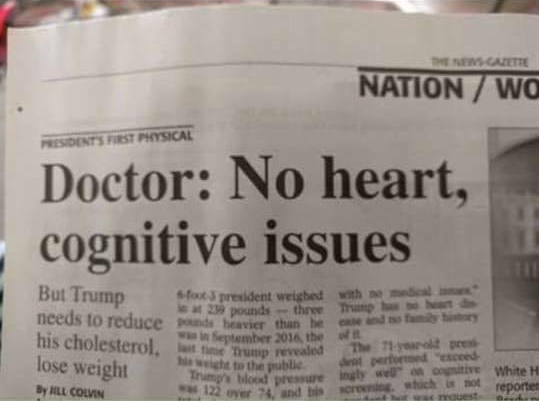
Out of the 256 possible interpretations of this headline, only TWO seem to be the most obvious ones. Why?

We’ve recently been talking about ambiguity.  Ambiguity, from a linguist’s perspective, is the situation of having more than a single possible meaning, and as we’ve seen, there are MANY ways to be ambiguous.

Here’s a nice example.  It comes from the renowned linguist and cognitive psychologist Steven Pinker.  Like many linguists, he collects ambiguous headlines.  They are not at all difficult to find, but some are cooler than others.  Here’s his current favorite:
26994155_10215860788379380_4969277272959803763_n

What can one say about this? From a linguistic perspective, what are the possible interpretations?

  • There is some doctor who does or does not have things going on with respect to his or her heart–we’ll get into what those things could be momentarily.
  • There is some doctor who said something about someone who does or does not have things going on with respect to his or her heart.

Now, the second interpretation is the intended one, so let’s go with it for the rest of the discussion.  (We’ll talk later about what happens if we don’t.)  What’s the issue with the rest?

  • One interpretation is that the comma indicates what’s called a kind of coordination or conjunction: it corresponds to or, and the intended meaning is that the person who’s being talked about does not have heart or cognitive issues.  (That’s not the full story here–more below.)
  • Another interpretation is that the comma indicates a new clause.  In this case, it would correspond to the doctor saying that the person under discussion does not have a heart, and also has cognitive issues.

How many possible meanings so far?  We’ve listed four, but it’s a big underestimate.

Why does Pinker like this one so much?  Because that last interpretation says this: Trump has no heart, and he also has cognitive issues.  That jives pretty well with what I would say, personally, and apparently Pinker, too–so, yeah, I would love to see that in a newspaper (assuming that his cognitive issues didn’t lead to him nuking somebody in a petulant frenzy before he could be (legally) put out of office.


Now: we’re not done yet.  Here are some remaining issues:

  • What is the scope of issues?  Are we talking about heart issues and/or cognitive issues, or are we talking about cognitive issues, and some unspecified thing about the heart?
  • What is the scope of no?  Are we talking about no heart and no cognitive issues, or are we asserting something about cognitive issues, plus something about there being no heart involved in some way?
  • What does heart mean?  Are we talking about an anatomical organ, or are we talking metaphorically, where heart can mean something like inherent kindness?  Or maybe we’re talking metaphorically, but where the metaphorical meaning of heart is something like courage?  (See this video for the meaning of “heart,” “heart checks,” and “showing heart” in prison.) Does it mean a seasonal check on the core of timber?  (Seriously–check it out on DictionaryOfConstruction.com.)
  • What does issue mean?  We actually had a blog post that was primarily on that question, in the context of analyzing Henry Reed’s poem Returning of Issue.

So: how many interpretations of that headline are there?  A low estimate would be two for each of the questions that we thought about above, so each one of those points doubles the number of possible interpretations.  That’s 2 to the 8th power: 256 possible interpretations.  You found another point of ambiguity?  You just doubled the number of interpretations again, to 512.  (Go ahead–find another one, and tell us about it in the Comments section.)


Here’s a question for you: of the 256 possible interpretations, just two of them seem to be the most obvious ones:

  1. The one where the doctor is talking about someone else, where issues modifies (technically, “has scope over”) both heart and cognitive, the meaning of heart is the anatomical organ, and no modifies both of heart issues and cognitive issues.
  2. The one where Trump is unkind and has cognitive issues.

Why?


…and here’s an observation for you: my profession is about getting computers to differentiate between the possible interpretations in biomedical journal articles and in health records, finding the one intended interpretation out of all of the possible ones.  I don’t expect to have it solved any time soon.  🙂

How linguists think: Tag questions in English IV

Linguistics is similar to organic chemistry in some respects: how things combine tells you something about what those things are. 

Tag questions are those simple little things that you use to get someone to give you a yes-or-no answer:

  • Trump sure needs a lot of little golf mini-vacays, doesn’t he?
  • Trump screwed the pooch on health care, didn’t he?
  • Trump lies a lot, doesn’t he?

Actually, they’re not so simple, those little questions…. They have an odd quirk that will give you a little bit of insight into how linguists think through things.


I often explain linguistics to people as being similar to organic chemistry in some respects: on one level, it’s about figuring out what the parts of language are, and how they go together.  As is the case in organic chemistry, how the parts go together–or don’t–tells you something about what those parts are.  An example: the distinction between auxiliary verbs and other verbs.

prague-couvent-strahov-14
The main library at the Strahov monastery in Prague. Enlarge the picture and look closely at the upper-left corner–that’s Les Encyclopédistes being cast into hell. Source: https://www.avantgarde-prague.fr/

In general, scientists tend to start with the assumption that everything is the same until proven otherwise.  Proving it to be otherwise is not always as simple as you might think–consider the fuzzy separation between things as basic as matter and energy in the physical universe.  For the Encyclopédistes, separating the realm of the Divine from the realm of everything else was a major nouveauté–and one that they were condemned for.  (This summer I saw a monastery library in Prague that had a gorgeous painted ceiling; the fresco included a scene of the Encyclopédistes being cast into Hell.  This is why.)

Back to tag questions… In English, the verbs in tag questions exhibit an odd behavior.  There are some verbs that can be in the “sentence” to which the tag is added, as well as in the tag.  For example:

  • Trump is an asshole, isn’t he?
  • Trump could get impeached, couldn’t he?
  • Trump did reveal intelligence to the Russian ambassador, didn’t he?

But, most verbs can’t show up in the tag.  Instead, they are replaced by did.  For example:

  • Trump screwed the people who elected him with that tax bill, didn’t he?
  • Trump went kinda apeshit over the whole inauguration crowd thing, didn’t he?  Insecure loser…
  • Trump lied about Obama’s birth certificate, didn’t he?

To a linguist, the fact that English verbs cluster into two groups–ones that can appear in the tag of a tag question, and ones that can’t–suggests that there are two distinct kinds of verbs in the language.  This is one piece of evidence that you could use if you wanted to argue (and linguists do love to argue about language) that there is such a thing as a distinction between auxiliary verbs and other kinds of verbs.  It’s just like organic chemistry–knowing how the parts go together tells you something about what they are.


See these previous posts on forming tag questions:

3rd person singular tag questions with the verb is

3rd person plural tag questions with the verb are

3rd person singular past tense tag questions with was

We’ve been working on tag questions with the verb to be recently.  We worked on the third person singular (Trump is an asshole, isn’t he?) and the third person plural (Trump and his cronies ARE the swamp, aren’t they?).  We did that in the present tense–let’s try the past tense now, ’cause the verb in the tag has to agree with the verb in the base sentence with respect to tense.  (Still think that tag questions are simple?)

We’ll follow our usual structure for drills–half a dozen on the same model, half a dozen on a similar model, and then mix ’em up.  Remember: we’re not testing ourselves–we’re practicing.  This is fun!  (…and this is why I never get a second date.)

Model:

  • Trump was a draft dodger during the Vietnam war.
  • Trump was a draft dodger during the Vietnam war, wasn’t he?
  1. Trump was a draft dodger during the Vietnam war.
  2. Trump was remarkably silent about Roy Moore for quite a while.
  3. Obama was fucking wonderful for the economy.
  4. Trump was given a draft deferment for bone spurs in his feet.  Now he says he’s the healthiest president ever.  Fucking coward.
  5. Trump was more pissed about being criticized for his defense of the bigots in Charlottesville than he was about the poor girl that was murdered by a white supremacist.

Scroll down past the picture for the answers.

ckvzcty

  • Trump was a draft dodger during the Vietnam war, wasn’t he?
  • Trump was remarkably silent about Roy Moore for quite a while, wasn’t he?
  • Obama was fucking wonderful for the economy, wasn’t he?
  • Trump was given a draft deferment for bone spurs in his feet, wasn’t he?  Now he says he’s the healthiest president ever.  Fucking coward.
  • Trump was more pissed about being criticized for his defense of the bigots in Charlottesville than he was about the poor girl that was murdered by a white supremacist, wasn’t he?

…and now the opposite polarity:

  1. Trump wasn’t actually a very successful businessman.
  2. Trump wasn’t above refusing to pay small businessmen who had done work for him.
  3. Trump wasn’t embarrassed to declare bankruptcy.
  4. Trump wasn’t honest with the students in his real estate “school.”
  5. Trump wasn’t eager for war when he was still young enough to be drafted.

…and scroll down past the picture for the answers once again!

mccain-trump

  • Trump wasn’t actually a very successful businessman, was he?
  • Trump wasn’t above refusing to pay small businessmen who had done work for him, was he?
  • Trump wasn’t embarrassed to declare bankruptcy, was he?
  • Trump wasn’t honest with the students in his real estate “school,” was he?
  • Trump wasn’t eager for war when he was still young enough to be drafted, was he?

French notes

la fresque: fresco.

English notes

vacay: slang for “vacation.”  How it was used in the post: Trump sure needs a lot of little golf mini-vacays, doesn’t he?

to screw the pooch: “Pooch” is a slang term for “dog.”  I would call it archaic, personally–but, I think I might be wrong about that.  To wit: if you compare its frequency to the frequency of the word dog, it’s clearly quite rare–here’s a graph of their frequencies in English-language books over the course of the 200 years from 1800 to 2000:

https://books.google.com/ngrams/interactive_chart?content=pooch%2Cdog&year_start=1800&year_end=2000&corpus=15&smoothing=3&share=&direct_url=t1%3B%2Cpooch%3B%2Cc0%3B.t1%3B%2Cdog%3B%2Cc0

…but, if you look just at the frequency of pooch alone, you see that it climbs quite a bit in the mid-1980s. Why? I have no clue.

https://books.google.com/ngrams/interactive_chart?content=pooch&year_start=1800&year_end=2000&corpus=15&smoothing=3&share=&direct_url=t1%3B%2Cpooch%3B%2Cc0

Now, to screw the pooch: Wiktionary defines it as to screw up; to fail in dramatic and ignominious fashion.  That’s bad.  Ooooooh, this is interesting–I just looked for screw the pooch (and its past tense and present participial forms) on Google Ngrams, and look what I found–its frequency jumps around the same time that we saw a jump in pooch: 

https://books.google.com/ngrams/interactive_chart?content=screw+the+pooch%2Cscrewed+the+pooch%2Cscrewing+the+pooch&year_start=1800&year_end=2000&corpus=15&smoothing=3&share=&direct_url=t1%3B%2Cscrew%20the%20pooch%3B%2Cc0%3B.t1%3B%2Cscrewed%20the%20pooch%3B%2Cc0%3B.t1%3B%2Cscrewing%20the%20pooch%3B%2Cc0

Could the mid-1980s resurgence of pooch that we saw in the second graph be due to a growth in the use of screw the pooch?  Possibly so.  Wiktionary says that the expression to screw the pooch became popular due to its appearance in Tom Wolfe’s book The right stuff in 1979 and its film adaptation in 1983–these graphs certainly support that timing!


Ah, Josephine, if I dared…

Adventures in anaphora resolution: the Alain Bashung version.

A l’arrière des berlines
on devine
des monarques et leurs figurines
juste une paire de demi-dieux
livrés à eux
ils font des petits
ils font des envieux

What the hell is being delivered, and who the hell is it being delivered to? Livrés is masculine plural.  Berlines is feminine plural, so it can’t be the berlines; monarques is masculine plural, so it could be that; figurines is feminine plural, so it can’t be that; une paire de demi-dieux, I don’t know what to say about.  Demi-dieu is masculine (I think), but une paire is feminine and singular–WTF?  I’ve got livrés narrowed down to monarques or demi-dieux, in any case… Then we get to eux in livrés à eux.  My hypothesis: the figurines are being delivered to the monarchs.  Counter-arguments?

à l’arrière des dauphines
je suis le roi des scélérats
à qui sourit la vie

marcher sur l’eau
éviter les péages
jamais souffrir
juste faire hennir
les chevaux du plaisir

osez, osez Joséphine

plus rien ne s’oppose à la nuit
rien ne justifie

usez vos souliers
usez l’usurier
soyez ma muse
et que ne durent que les moments doux
durent que les moments doux
et que ne durent que les moments doux

osez, osez Joséphine
plus rien ne s’oppose à la nuit
rien ne justifie

Coffee is expensive, isn’t it: Tag questions in English III

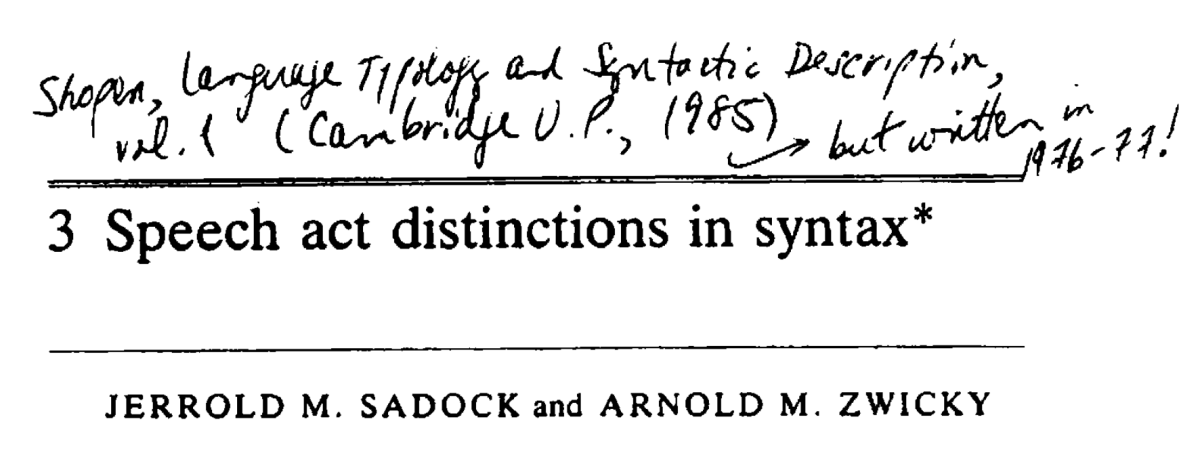
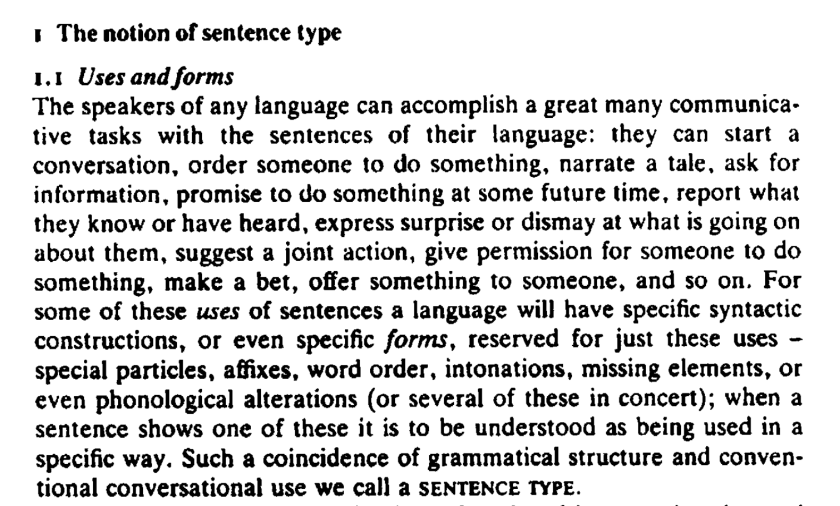
The purpose of language is to communicate, right?  Seems obvious.  In fact, it is not so obvious.  One way in which language is not clearly about communication per se is when we use language to do things.  Consider the following, from the introduction to the paper Speech act distinctions in syntaxby Jerry Sadock and Arnold Zwicky.  They refer to “communicative tasks,” which sounds like a counter to my claim here, but I think it’s a bit of a misnomer: they are mixing together things that are mainly communicative (e.g. “express surprise or dismay”) with things for which “task” would be a more appropriate label:

Screen Shot 2017-12-24 at 15.16.54

Consider, for example, the following:

I now pronounce you man and wife.

It is by saying those words of the (more or less) traditional American wedding ceremony that one performs the action of marrying someone.  Or this:

I promise to try to do better.

Again, it is precisely by saying that sentence that one performs the action of making a performance.  Certainly there’s some communication going on both in I now pronounce you man and wife and I promise to try to do better, but there’s a whole lot more going on than communication, too–in the first case, you are committing two people to sleeping with each other and no one else (presumably until death does them part), while in the second case, you are causing a commitment to exist on your part where no such commitment existed before.


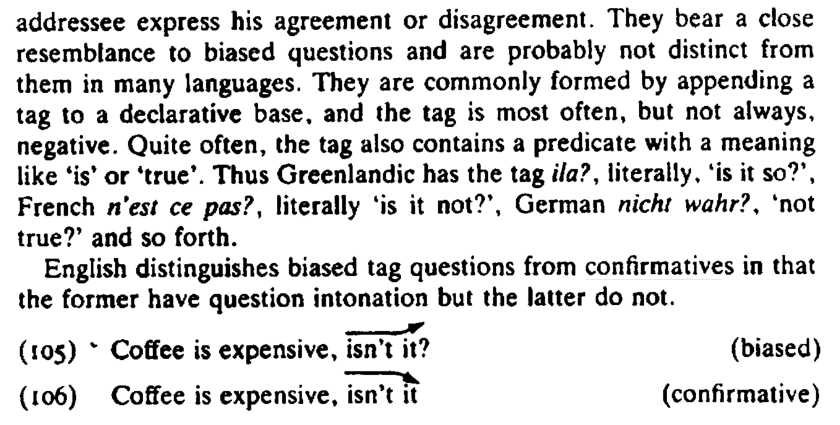
Recently we’ve been talking a lot about tag questions, and tag questions are one of the kinds of “sentence types” that Sadock and Zwicky talk about.  (I think that’s Sadock’s handwriting on the scan of the paper title that you see at the top of this post, by the way.)  They point out a quirk of English tag-questions that we haven’t talked about before: you can say them with different intonation patterns, and the different patterns do pretty different things.

Screen Shot 2017-12-24 at 15.32.25

Native speakers of English have a tendency to respond to a tag question according to the response that the question is intended to evoke.  Children are quite likely to do this, and lawyers use tag questions in the court room to try to get witnesses to answer as the lawyer would like them to.  See this post for more on that topic.

Sadock and Zwicky talk about typical tag questions in English as an example of what they call a biased question: a question that is meant to evoke a specific answer.  (That in itself is pretty different from what we think about questions as doing: obtaining some information that we don’t know.)  They differentiate confirmatives from biased questions; they describe confirmatives like this:

Rather than having as their goal the garnering of information, these really amount to statements that carry with them the demand that the addressee express his agreement or disagreement.

Back to their “coffee” examples:

Screen Shot 2017-12-24 at 15.40.11

See these posts for the following:

3rd person singular tag questions with the verb is

3rd person plural tag questions with the verb are

So, yeah: the tag question construction seems simple, but it’s actually pretty complex, in a lot of ways.  In fact, English tag questions can be quite difficult for non-native speakers to learn to use, and that’s why we’ve been drilling them recently.


We’ve been working on tag questions with the verb to be recently.  We worked on the third person singular (Trump is an asshole, isn’t he?) and the third person plural (Trump and his cronies ARE the swamp, aren’t they?).  We did that in the present tense–let’s try the past tense now, ’cause the verb in the tag has to agree with the verb in the base sentence with respect to tense.  (Still think that tag questions are simple?)

We’ll follow our usual structure for drills–half a dozen on the same model, half a dozen on a similar model, and then mix ’em up.  Remember: we’re not testing ourselves–we’re practicing.  This is fun!  (…and this is why I never get a second date.)

Model:

  • Trump was a draft dodger during the Vietnam war.
  • Trump was a draft dodger during the Vietnam war, wasn’t he?
  1. Trump was a draft dodger during the Vietnam war.
  2. Trump was remarkably silent about Roy Moore for quite a while.
  3. Obama was fucking wonderful for the economy.
  4. Trump was given a draft deferment for bone spurs in his feet.  Now he says he’s the healthiest president ever.  Fucking coward.
  5. Trump was more pissed about being criticized for his defense of the bigots in Charlottesville than he was about the poor girl that was murdered by a white supremacist.

…and now the opposite polarity:

  1. Trump wasn’t actually a very successful businessman.
  2. Trump wasn’t above refusing to pay small businessmen who had done work for him.
  3. Trump wasn’t embarrassed to declare bankruptcy.
  4. Trump wasn’t honest with the students in his real estate “school.”
  5. Trump wasn’t eager for war when he was still young enough to be drafted.

As President Obama said, over and over and over: Merry Christmas.

Check your gender at the door

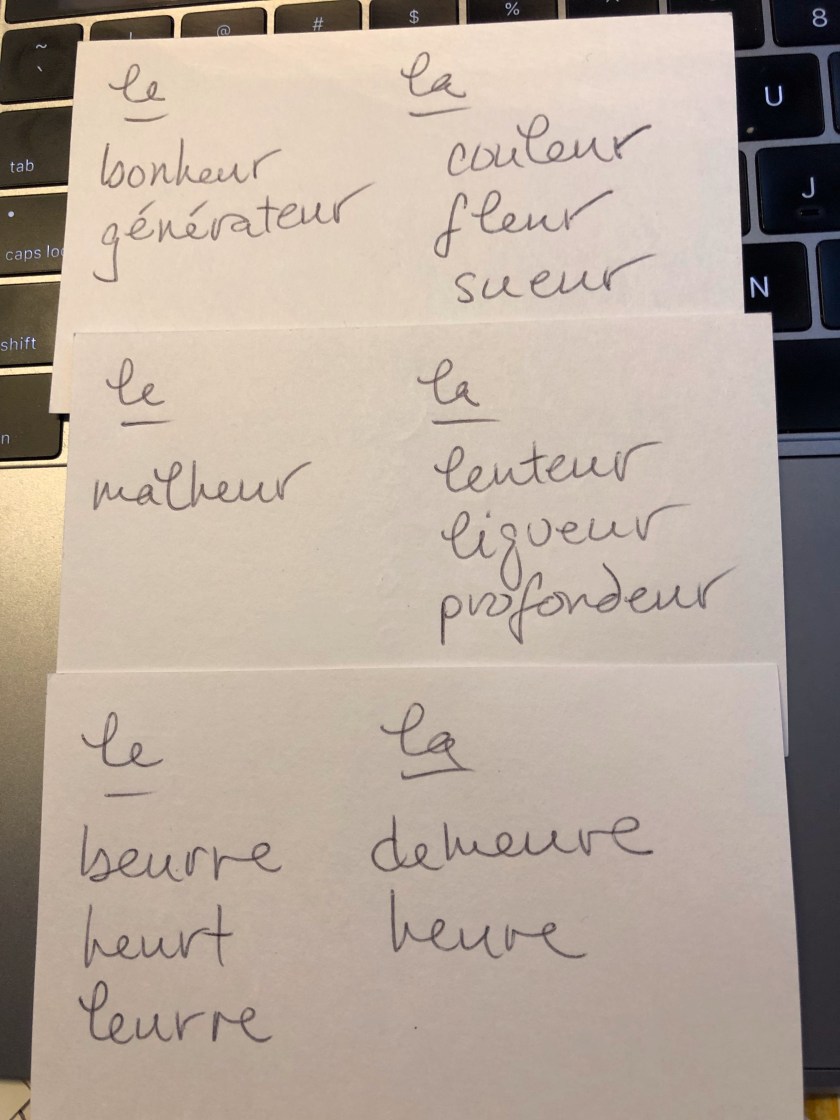
The phenomena are the same whether you’re talking about the two genders of French or the 20 genders of Shona: some things have to agree with nouns.  Does it really matter what we call them?  No, not really.

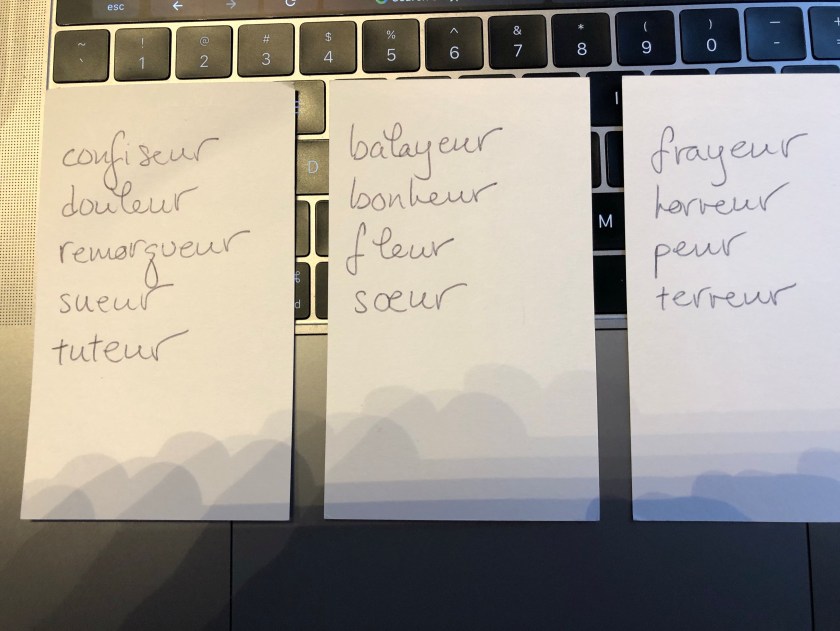
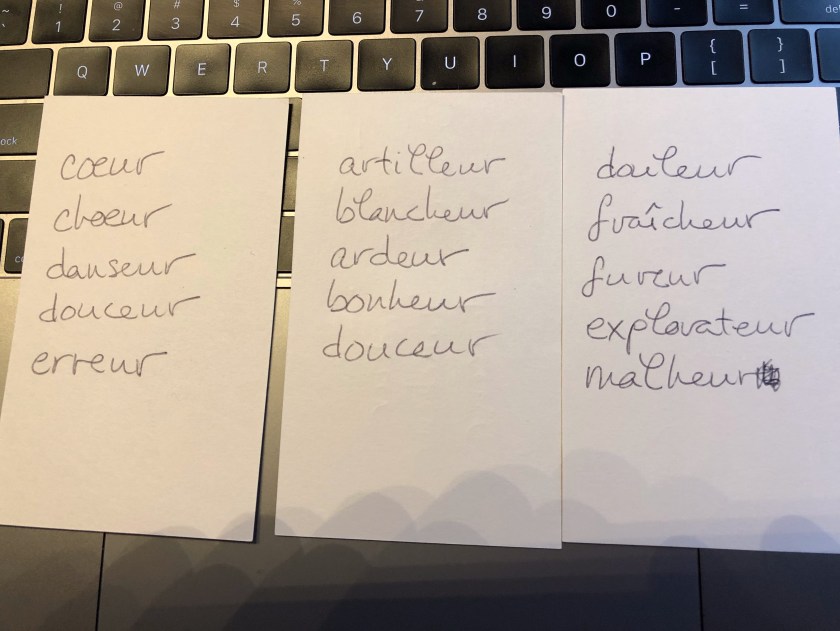
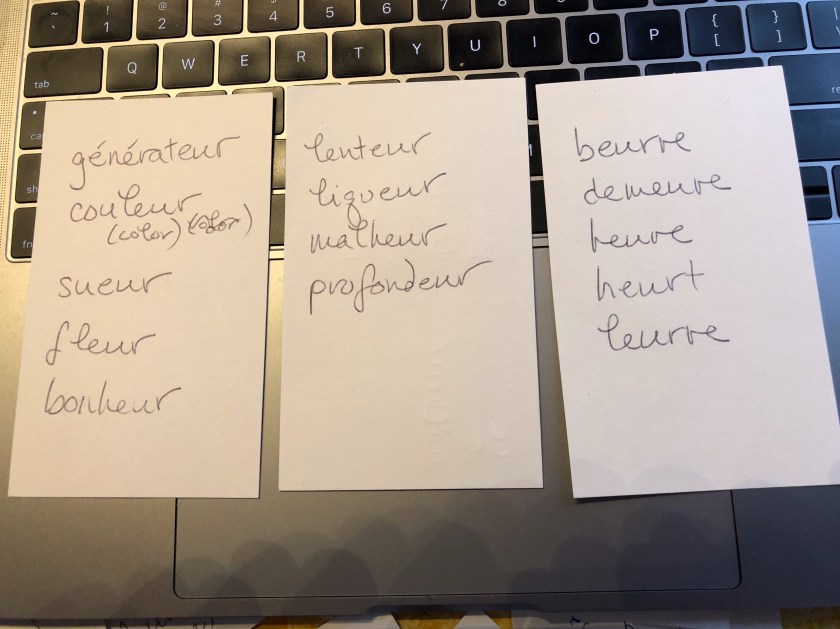
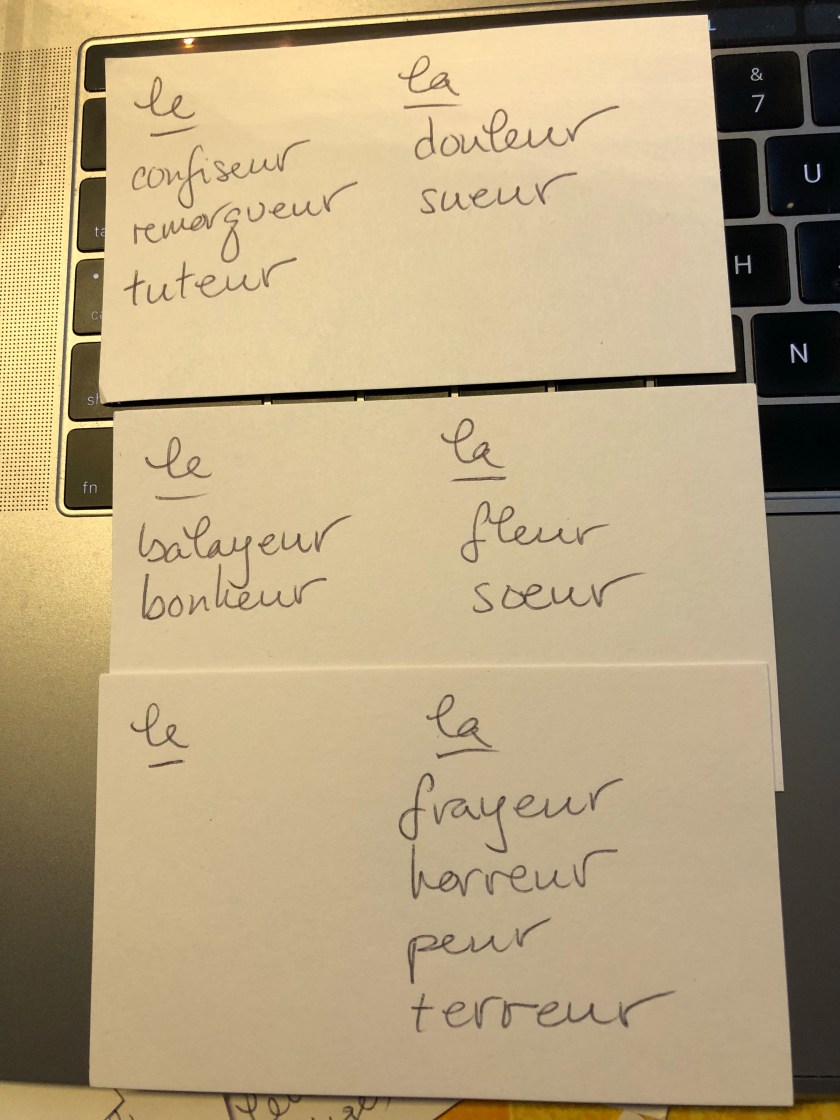
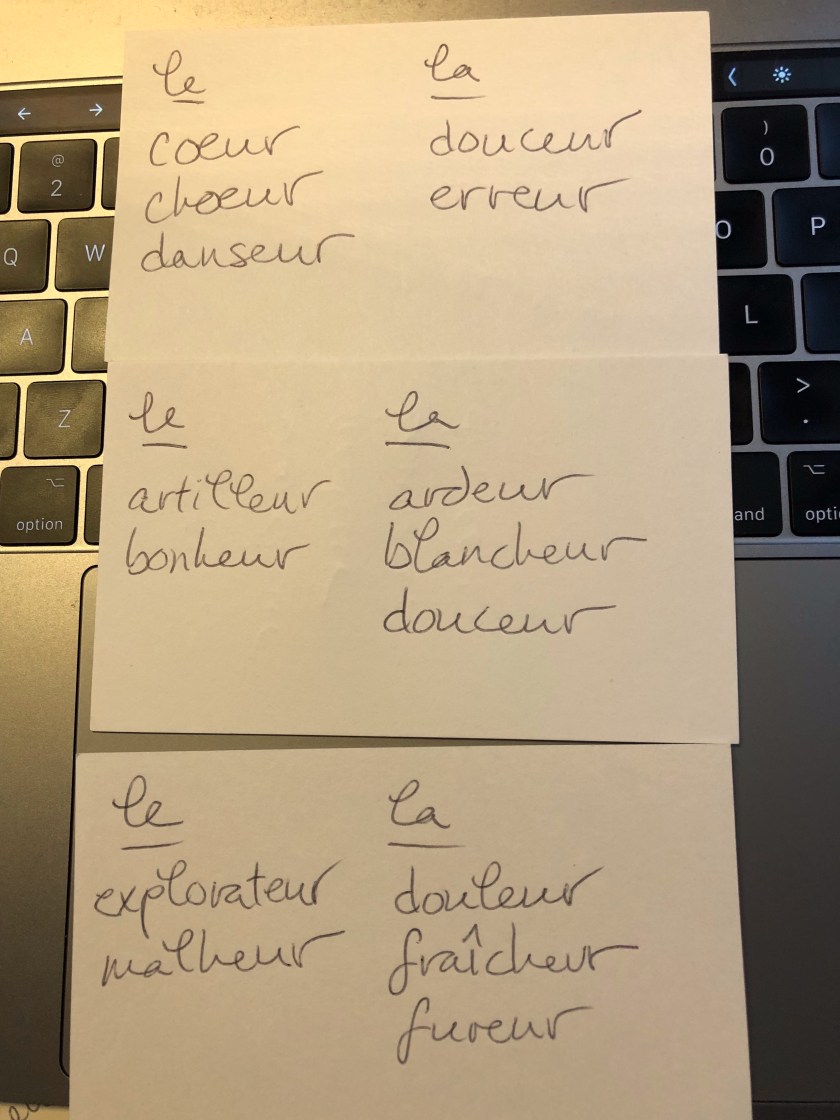
This is the kind of thing that linguists mean when they say that gender in languages with noun gender is arbitrary: malheur is masculine, peur is feminine; why?  No reason–it’s just one of those things that you have to memorize.  When a language has two genders, people will try endlessly to convince you that the specific noun genders in that language are as they should be (of course a tugboat (remorqueur) is masculine and booze (liqueur) is feminine, they might say); when a language has three genders (Bulgarian, German, Tamil) they don’t argue quite so loudly; get above 15 (Swahili: 18, Shona: 20), and you have trouble convincing those same people that they’re gender systems.  And yet: the phenomena are the same whether you’re talking about the two genders of French or the 20 genders of Shona: some things have to agree with nouns.  What classes do those nouns fall into?  Does it really matter what we call them?  No, not really.


The task of the day: memorize the gender of nouns ending with -eur.  Now, I know what the native speakers are going to tell me: It’s easy, Zipf.  If it’s a person, it’s masculine, and there’s a corresponding feminine form, which might end in -euse (chanteuse) or might not (doctoresse).  If it’s an abstract quality—peur, douleur, fureur-–then it’s feminine, except when it’s not, like bonheur and malheur.  Oh, and remorqueur is a tugboat, not a person, but it’s still masculine, plus fleur and sueur are not abstract qualities, but they’re feminine.  Yep: it’s arbitrary–you just have to memorize it.

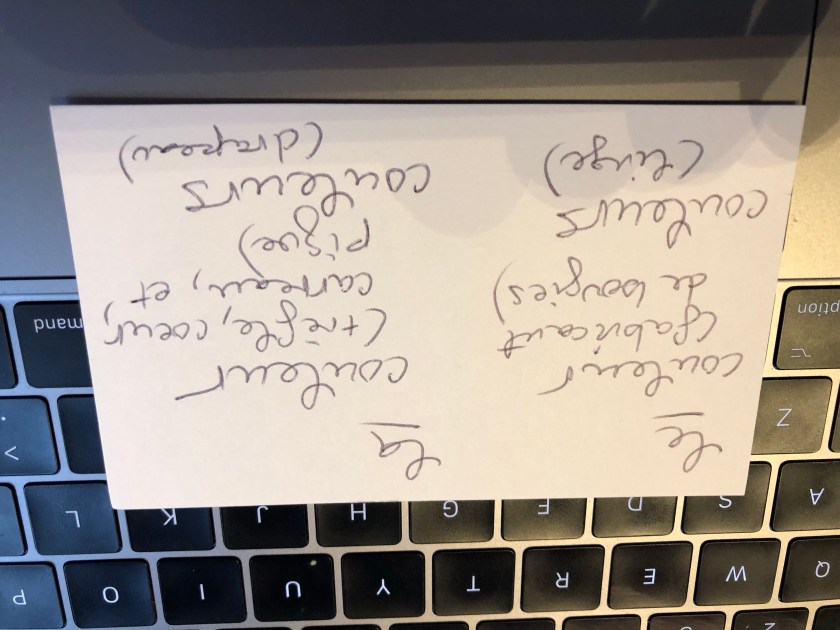
I think you can figure out how these drills work.  Oh–native speakers might disagree about some of these, especially the two plurals couleurs, one for the flag and one for the darks in your laundry.  Native speakers, please feel free to chime in in the Comments section…

img_4393img_4395img_4397img_4394img_4396img_4398img_4400


Trump is an asshole, isn’t he? Tag questions in English II

It’s frustrating when something LOOKS really easy, but you just can’t get it right, isn’t it?

It’s frustrating when something looks really easy, but you just can’t get it right, isn’t it?  I hate it when I screw up the simplest things in French–don’t you?

The preceding questions are examples of “tag questions.”  A tag question is made up of two parts:

  1. An assertion (think of it as a sentence)
  2. Something added to the end of it to turn it into a question (I think always expecting a yes or a no answer, but I can’t swear to it). Tag questions invite a specific response: either a yes, or a no.

For example:

Assertion Tag Invited response
Trump is an asshole isn’t he Yes
Trump est vraiment un gros connard hein Oui
Kawaii ne Ee

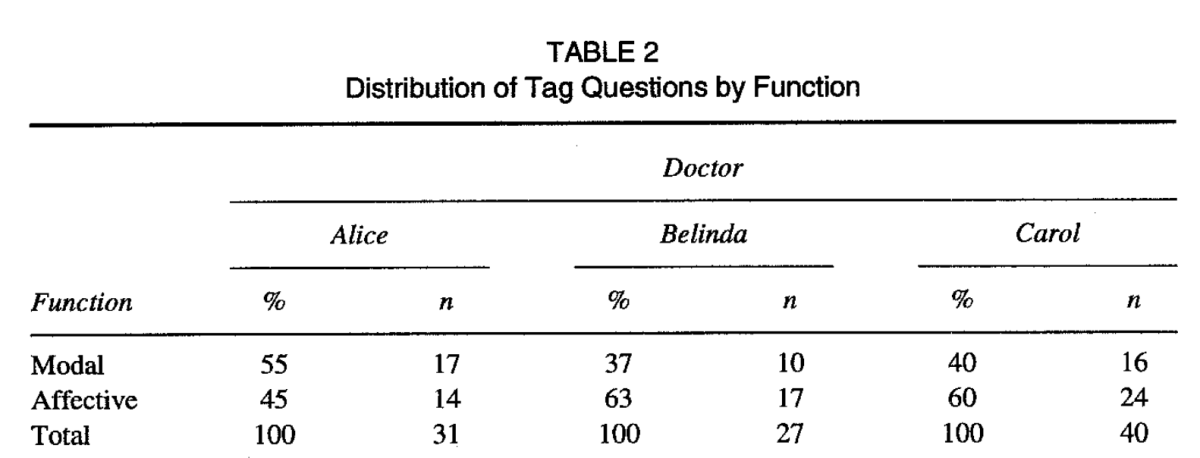
Tag questions have many functions in anglophone social contexts.  Female speakers of English are often said to use tag questions to avoid making overly confident statements and to reduce the force of what they have to say. From a blog post by Mark Liberman:

In her influential (1975) work Language and Women’s Place, Robin Lakoff depicted a typical female speech style, allegedly characterized by the use of features such as hesitations, qualifiers, tag questions, empty adjectives, and other properties, which she asserted to have a common function: to weaken or mitigate the force of an utterance. Thus tag questions “are associated with a desire for confirmation or approval which signals a lack of self-confidence in the speaker.”  —Language Log

However: tag questions can also be powerful tools.  As Roger Shuy puts it in his book Linguistics in the courtroom: A practical guide,

Be alert for questions ending with tags such as, “didn’t you” or “wasn’t it.”  Discourse analysts know that tag questions intend to influence the answer in the way it was stated before the tag.  Lawyers know that it’s very hard to disagree with the premise of a tag question.  Among other things, the listener first has to temporarily suspend belief in the cooperative principle of conversation (Grice 1977).  Linguistic experts should have no problem with this, right?  But it’s one thing to know this academically and quite another to have it happen to you in a deposition, where your mind is racing about many other things.  –-Roger Shuy


Tag questions are one of those things that look simple.  In fact, they can be pretty complicated, and that is the case in every language in which I know anything at all about tag questions.  That’s not a million, but it’s more than a couple.  For example, in Bulgarian, the particle li is used to form yes-no questions:

  • Obichash me (you love me)
  • Obichash li me (do you love me?)

There are two tags (that I know of): nali, which invites a response of da (yes), and dali, which invites a response of ne (no).

Let’s think through those two tags.  You already know that li means a yes-no question.  In Bulgarian, da means yes, while ne means no.  But, if you’re expecting a yes-no question to be answered yes, you put nali at the end of it, while if you’re expecting a yes-no question to be answered no, you put dali at the end of it.  Ne me obichash, dali?  (You don’t love me, do you?)  This confuses the hell out of non-native speakers.


For all that they appear simple, English-language tag questions often confuse non-native speakers.  In order to construct them, you have to get a lot of things right–the person and gender of the pronoun, the polarity of the tag, the verb in the tag, and the tense, at a minimum.  In a recent post, we did some drills on tag questions of this form:

Trump is an asshole, isn’t he?

Trump isn’t honest, is he?

To get those right, you had to:

  1. Get the pronoun right (he)
  2. Get the “polarity” right (isn’t he versus is he)
  3. Get the tense right (is/isn’t, not was/wasn’t)
  4. The verb in the tag (is, not do, etc.)

Today let’s start with that basic frame, but add in plural subjects.  We’ll keep the verb to be and the present tense, but with plural subjects, we’ll need the plural forms of the irregular verb to be:

  1. Trump is an asshole, isn’t he?
  2. Trump and Kushner are assholes, aren’t they?

As before, we’ll do half a dozen each of the positive and negative polarity forms (i.e. are + aren’t they and aren’t + are), and then mix them up a bit.  Scroll down past the picture for the answers.  Remember: we’re drilling, not testing ourselves, so no anxiety–just joy in the bizarreness of all languages.

  1. Trump and Kushner are assholes.
  2. Trump and Bannon are nihilists.
  3. Trump and Kim Jong Un are two of a kind.
  4. Trump and nuclear weapons are like booze and driving.
  5. Trump and his administration are a disaster for this country.
  6. Trump and his cronies are pulling off the biggest heist by any American president, ever.
1pp409
Picture source: https://imgflip.com/i/1pp409
  • Trump and Kushner are assholes, aren’t they?
  • Trump and Bannon are nihilists, aren’t they?
  • Trump and Kim Jong Un are two of a kind, aren’t they?
  • Trump and nuclear weapons are like booze and driving, aren’t they?
  • Trump and his administration are a disaster for this country, aren’t they?
  • Trump and his cronies are pulling off the biggest heist by any American president, ever–aren’t they?

Now let’s switch the “polarity”–that is, let’s change from are + aren’t to aren’t + are.

  1. Trump and honesty are not close friends.
  2. Trump and nuclear weapons aren’t a very smart combination.
  3. Trump and his kids are not going to be in the line of fire if we go to war.
  4. Trump and his cronies are not as good at making deals as they are at breaking them.
  5. Trump and Roy Moore are not doing much to hide the essential hypocrisy of the Republican Party.
  6. Trump and his Republican allies are not as interested in the people who elected them as they are in the people who shipped the factories in which those people used to work off to China.
spw7nqceuhoy
Picture source: https://www.reddit.com/r/MarchAgainstTrump/comments/62cetd/trump_the_draft_dodger/
  1. Trump and honesty are not close friends, are they?
  2. Trump and nuclear weapons aren’t a very smart combination, are they?
  3. Trump and his kids are not going to be in the line of fire if we go to war, are they?
  4. Trump and his cronies are not as good at making deals as they are at breaking them, are they?
  5. Trump and Roy Moore are not doing much to hide the essential hypocrisy of the Republican Party, are they?
  6. Trump and his Republican allies are not as interested in the people who elected them as they are in the people who shipped the factories in which those people used to work off to China, are they?

…and finally, we’ll mix them up a bit.  Remember–we’re drilling, not testing!  No anxiety–just joy!

  1. Trump and Kushner are assholes.
  2. Trump and Bannon are nihilists.
  3. Trump and honesty are not close friends.
  4. Trump and his administration are a disaster for this country.
  5. Trump and nuclear weapons aren’t a very smart combination.
  6. Trump and nuclear weapons are like booze and driving.
  7. Trump and his kids are not going to be in the line of fire if we go to war.
  8. Trump and his cronies are not as good at making deals as they are at breaking them.
  9. Trump and Roy Moore are not doing much to hide the essential hypocrisy of the Republican Party.
  10. Trump and Kim Jong Un are two of a kind.
  11. Trump and his Republican allies are not as interested in the people who elected them as they are in the people who shipped the factories in which those people used to work off to China.
  12. Trump and his cronies are pulling off the biggest heist by any American president, ever.
veterans-against-trump
Picture source: http://newyork.cbslocal.com/2016/05/23/trump-veterans-fundraiser-protest/
  1. Trump and Kushner are assholes, aren’t they?
  2. Trump and Bannon are nihilists, aren’t they?
  3. Trump and honesty are not close friends, are they?
  4. Trump and his administration are a disaster for this country, aren’t they?
  5. Trump and nuclear weapons aren’t a very smart combination, are they?
  6. Trump and nuclear weapons are like booze and driving, aren’t they?
  7. Trump and his kids are not going to be in the line of fire if we go to war, are they?
  8. Trump and his cronies are not as good at making deals as they are at breaking them, are they?
  9. Trump and Roy Moore are not doing much to hide the essential hypocrisy of the Republican Party, are they?
  10. Trump and Kim Jong Un are two of a kind, aren’t they?
  11. Trump and his Republican allies are not as interested in the people who elected them as they are in the people who shipped the factories in which those people used to work off to China, are they?
  12. Trump and his cronies are pulling off the biggest heist by any American president, ever, aren’t they?


Tag, you’re it: Tag questions in English I

American (soon-to-be-dumped) guy: This ice cream is good, isn’t it? His Japanese girlfriend: Stop talking like a girl, it’s weird!

It’s frustrating when something looks really easy, but you just can’t get it right, isn’t itI hate it when I screw up the simplest things in French–don’t you?  I mean, the conditional mood can’t be that hard, can it?  And I studied the shit out of it before I took the C1 test, didn’t II studied it over and over, did I not?  And all of those web pages that I read–they explained the conditional pretty well, didn’t they?  And my brother and I are super-into this kind of shit, aren’t weI didn’t neglect to study, did II’m going to sulk about this for weeks, aren’t I…  I won’t give up complaining about this until I take the C2 and have something new to grouse about, will I

Tag questions are one of those little things in English that look like they oughta be super-simple—but, in fact, they’re not.  Actually, tag questions have complications in all of the languages in which I know anything about tag questions.  (That’s not a ton of languages, but it’s more than a couple.)  Japanese is a good example of a language in which tag-questions can be a problem for non-native speakers.  There is a very easy way to ask a tag-question in Japanese: add ne to the end of a sentence.  But, in Japanese (more accurately, in Japanese culture–when you figure out how to draw a precise line between language and culture, please notify us linguists), tag-questions get asked more frequently this way by women than by men, so Americans tend to learn them the way that they tend to be asked by women.  But, if you’re a guy, you sound funny when you ask them, ’cause you’re speaking like a girl.  Stereotypical conversation between an American guy and his Japanese girlfriend who has grown weary of him:

  • American (soon-to-be-dumped) guy: This ice cream is good, ne (isn’t it)?
  • His Japanese (soon-to-be-ex-) girlfriend: Stop talking like a girl, it’s weird!

I should point out that one of the most useful things for any American to learn to say in Japanese is a tag question.  Kawaii, ne? means something like he/she/it is cute, isn’t he/she/it?  You can use it to compliment babies and dogs, and it’s a great smile-eliciting ice-breaker.

We’ll use the same approach that we used the other day to work on son versus leur: drill something half a dozen times or so, drill something else half a dozen times or so, then mix them up.  We’ll do tag questions that vary with respect to polarity: are we using a tag to ask something about something that is negated (Trump is not handling the stress well, is he?), or not negated (Trump is an asshole, isn’t he?) . Remember that we’re not testing ourselves here–we’re practicing.  So, no stress–rather, joy, like if you had a free evening to go to judo class, or to work on a blog post that’s been giving you fits.

For starters: a “positive polarity” sentence.  That means a sentence that makes a positive assertion, i.e. one that does not involve negation.  In order to have to vary as little as possible in the beginning, we’ll stick with he.  (Third person masculine singular, for those of you who like noun phrases.)  We’ll also stick with the verb to be.  Here’s the model that we’ll be following:

Prompt: Trump is an asshole.

Response: Trump is an asshole, isn’t he?

The answers follow the lovely illustration.

  1. Trump is an assclown.  (Assclown is a type of asshole.  You could think of an assclown as an asshole who soaks up attention without realizing the extent to which he’s getting a lot of attention precisely because he’s an asshole.)
  2. George Papadopoulous is dead meat.  (To be dead meat means to be in a lot of trouble.)
  3. Steve Bannon is a malignant fucker.
  4. Jared Kushner is an embarrassment.
  5. Melania Trump is a plagiarist. (trick question, sorry–Melania is not a he.)
  6. Paul Manafort is under indictment.

Screen Shot 2017-11-30 at 07.50.35

  • Trump is an assclown, isn’t he?
  • George Papadopoulous is dead meat, isn’t he?
  • Steve Bannon is a malignant fucker, isn’t he?
  • Jared Kushner is an embarrassment, isn’t he?
  • Melania Trump is a plagiarist, isn’t… whoops!
  • Paul Manafort is under indictment, isn’t he?

So far so good?  Let’s switch “polarity” now: we’ll start with a negated sentence.

  • Trump isn’t very happy.
  • Milos isn’t a contributor at Breitbart anymore.
  • Trump isn’t a very good example for the children of America.
  • Kellyanne Conway isn’t very honest. (shit–did it again!)
  • John Kelly is not helping things much.
  • Trump isn’t actually as rich as he says he is.

Again, the answers follow the lovely illustration.

Screen Shot 2017-11-30 at 07.59.43

  1. Trump isn’t very happy, is he?
  2. Milos isn’t a contributor at Breitbart anymore, is he?
  3. Trump isn’t a very good example for the children of America, is he?
  4. Kellyanne Conway isn’t very honest, is she?  (shit–did it again!)
  5. John Kelly is not helping things much, is he?
  6. Trump isn’t actually as rich as he says he is, is he?

Hanging in there?  Great–let’s mix it up a bit.  Remember: we’re not testing, we’re practicing.  We’re drilling.  Joy, not anxiety.

  1. Trump is screwing exactly the people who elected him.
  2. Trump isn’t very loyal.
  3. Trump is a fucking liar.
  4. Trump is a draft-dodger.
  5. Trump isn’t a military veteran.
  6. Trump isn’t honest.

Answers after the lovely illustration, as usual:

Screen Shot 2017-11-30 at 08.09.29
Probably a pretty good window into what the francophone world (at least that portion of it that is located in France) thinks about this disaster of a human being…

5774141tagquestions-grammar


How we’re sounding stupid today: “their”

The next morning I’ll show up at the lab and someone will say “good morning” to me in a way that I haven’t heard before, and I’ll stand there like a drooling idiot trying to figure out what the hell I just heard. 

It never fails.  One evening I’ll be sitting around with friends discussing how the American right wing versus the American left wing defines “the establishment,” or the contrasting French and American understandings of religious freedom, or the lack of correspondence between the French and American categories of liberal, conservative, leftist, rightist, or something equally complex.  I’ll think that I’m finally starting to be able to function in the French language.  Then the next morning I’ll show up at the lab and someone will say “good morning” to me in a way that I haven’t heard before, and I’ll just stand there like a drooling idiot trying to figure out what the hell I just heard.  (For lots of ways to say “hello” in English, see the English notes below.)

presentacion-basica-16-728
Picture source: https://fr.slideshare.net/surco2011/presentacion-basica

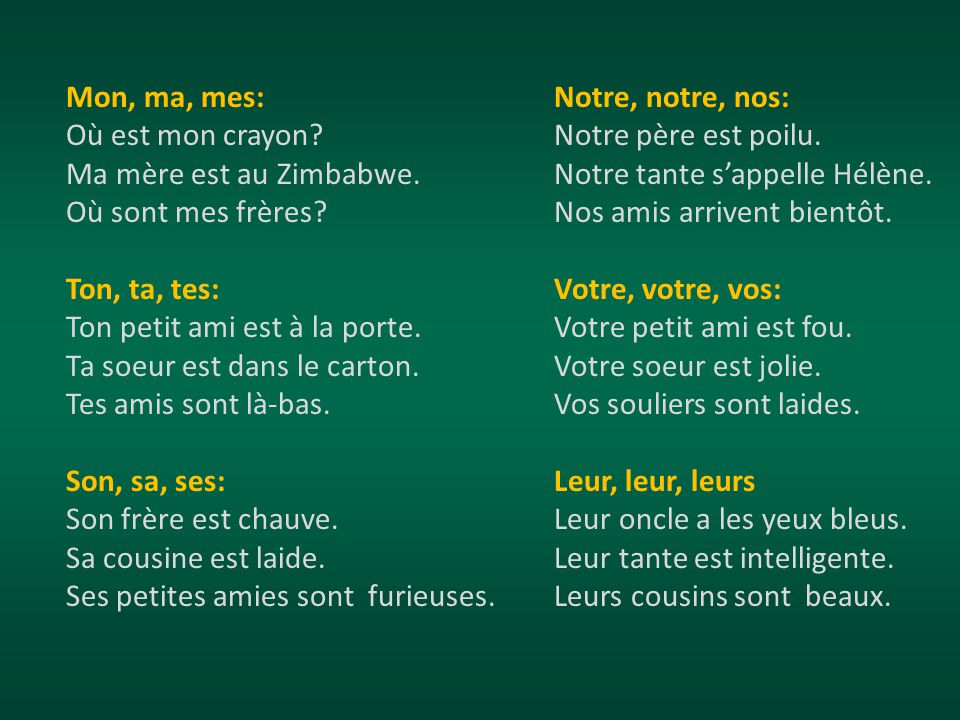
Case in point: it was recently pointed out to me that I essentially always get the word their wrong.  It has two forms, leur and leurs, neither of which I ever get right–instead, I say/write son/ses.  Those are the singular forms.  Crazy–any child could get this right…

OK: enough self-castigation.  Let’s practice.  We’ll use a technique that I learned from the book Português Contemporâneo, by Maria Abreu and Cléa Rameh.  Amazon describes it like this:

This is the first volume of a basic course organized around the concept that to learn another language is to internalize another set of linguistic rules.

How do you do that?  Abreu and Rameh do it with drills.  Not tests, really–drills.  When you have things that contrast with each other–say, the first-person singular form of a verb (I like you) and the first-person plural form of a verb (We like you)–you repeat each one several times in a very similar sort of sentence.  Only after that do you start mixing them together.  If memory serves, you do this in sets of half a dozen or so.  For example:

Ça c’est son livre.

  1. stylo : Ça c’est son __________ stylo.
  2. porte-monnaie : Ça c’est __________ porte-monnaie.
  3. sac à dos : Ça c’est __________ sac à dos.
  4. père : Ça c’est __________ père.
  5. chien : Ça c’est __________ chien.
  6. bateau : Ça c’est __________ bateau.

Now, remember: I belong very firmly to the “write about what you don’t know” school of…well, of writing.  So, I may wander into error very quickly here–I depend on you native speakers to keep me straight here.  This is about to get to be a problem, because…

There can be quite a bit of variation between languages in how nouns get inflected–or don’t–when you’re talking about a group of individuals, each of which has something.  For example, suppose you’re talking to a group of kids, and their faces are dirty, and you’re going to tell them.  Here is how that works in English, and in Spanish:

  • Wash your faces.
  • Lavense la cara.

Notice that in English, faces is plural, while in Spanish, la cara is singular.  It’s pointless to talk about logic or lack thereof here–this isn’t about logic.  It’s just a fact about the individual language.  How does it work in French?  I actually have no idea, but I bet I can screw it up pretty easily.  In order to try to avoid that, I’m going to hunt about for real-life examples.  But–I’ll bet that native speakers disagree about this kind of thing.  I’d love to hear your opinions on this in the Comments, if they differ.  In order to try to get the most Académie-ish usage, I’ve taken these examples from the EUROPARL corpus, a set of speeches in all of the languages of the European Union.  These texts come from either native-speaker politicians or professional EU translators, so they should, in theory, be close to the spoken standard.

OK–leur: 

  1. travail : Je le déplore car nous devons agir du fait que d’ autres n’ ont pas fait __________ travail.
  2. choix : Nous espérons que ceux qui envisagent de voter contre ces amendements pourront donner de bonnes raisons de __________ choix au Parlement et aux citoyens qui sont à la recherche d’ un emploi.
  3. but : Pourtant, __________ but originel est d’ indiquer la direction à suivre et de fixer des priorités.
  4. part : Les États membres ont aussi __________ part de responsabilité dans ce domaine et ils ne doivent pas l ‘ oublier.
  5. région : Les gens réagissent en ” votant avec leurs pieds “, en quittant __________ région dans l ‘ espoir de trouver de meilleurs revenus.
  6. taux :  Je pense que nous en avons tous le plus grand besoin si nous considérons les résultats des dernières élections européennes, si nous considérons __________ taux de participation.

Now: that probably looks super-simple, but it’s probably six times more than I’ve used leur in the entire past six months–apparently, I get this wrong all the time.  It’s about to get a lot harder for me to set up the drill, because I have to figure out a way to cue whether the possessors are singular or plural, while simultaneously keeping the structures as similar as possible–difficult (for me, at any rate) in a language in which the verb agrees with the number (i.e., singular or plural) of the subject.  Let’s see what we can do here…

Il culpabilise son prof.

Ils culpabilisent leur prof.  (Note that we have to make the assumption that “they” share the same (single) professor–this is different from the “wash your faces” case, where everyone has their own, individual face.)

  1. il, cousin : Il culpabilise __________ cousin.
  2. ils, père : Ils culpabilisent __________ père.
  3. ils, président : Ils culpabilisent __________ président. 
  4. il, président : Il culpabilise __________ président.
  5. il, chien : Il culpabilise __________ chien.
  6. ils, chef : Ils culpabilisent __________ chef. 

OK, that wasn’t so bad…  Let’s do another drill of six examples.  This time, though, I’m going to use feminine nouns, so the singular will be sa.

  1. Les deux frères, mère : Les deux frères aiment __________ mère.
  2. Les deux maîtresses d’école, directrice : Les deux maîtresses d’école aiment__________ directrice.
  3. il, mère : Il aime __________ mère.
  4. ils, tante : Ils aiment __________ tante.
  5. il, voiture : Il aime __________ voiture.
  6. Le jeune homme et sa meuf, voiture : Le jeune homme et sa meuf aiment __________ voiture.

(OK, quick question for my fellow anglophones: or these more straightforward or less straightforward when I can find actual nouns (les deux frères) instead of pronouns (ils)?)

Notice that we haven’t even touched the form leurs, which is used when multiple things are owned–that gets us straight into the question of what you do in cases where everyone has their own of something (remember the example wash your faces in English versus lavense la cara in Spanish that we talked about above).  We’re up to 1200 words already, so let’s leave that for another day–if I can get this straight with the singular leur, maybe I’ll at least be making 50% fewer errors today, at any rate…


English notes

Here are a bunch of ways to say hello.  Some of them you would only use in the morning–I’ve listed them separately.  Good afternoon and good evening sound pretty formal–in America, we tend to use separate greetings for the morning only.  For the rest of the day, we mostly just use some form of hello. 

  1. Hello
  2. Hi
  3. Hey
  4. Hey there
  5. What’s up?
  6. ‘Sup?  (for young people only–I’ve probably never said this in my life.  It’s a form of what’s up?)
  7. What’s goin’ on?
  8. Howdy (don’t even think about using this one unless you want to make people smile/laugh, in which case: go for it)
  9. Howdy, pardner (see note above–and, yes, you have to pronounce it pardner, with a d, to get the full effect)

For the morning only:

  1. Good morning
  2. ‘mornin’
  3. mmmphglrg (or words to that effect–I’m (mostly) joking here)

Mystery solved: the Paris edition

img_3139
Filled-in windows next to the gate of the Cordeliers campus of the École de médecine, Paris. Picture source: me.

Adam Gopnik’s Paris to the moon is the best writing that I know of on the experience of being an American ex-pat in Paris.  He maintains that the only really important difference between Paris and New York is the latitude: Paris is, in fact, so far to the north that in the wintertime, days are super-short here.  For me, it’s the one and only problem with this place—the winter darkness is crushing, a weight that I often think I can feel physically. 

Screen Shot 2017-11-22 at 05.17.57
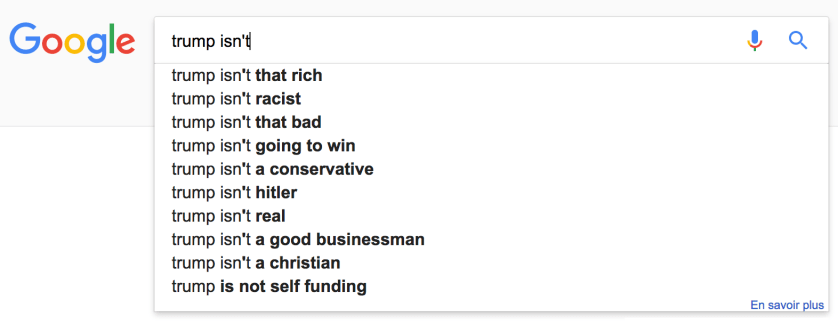
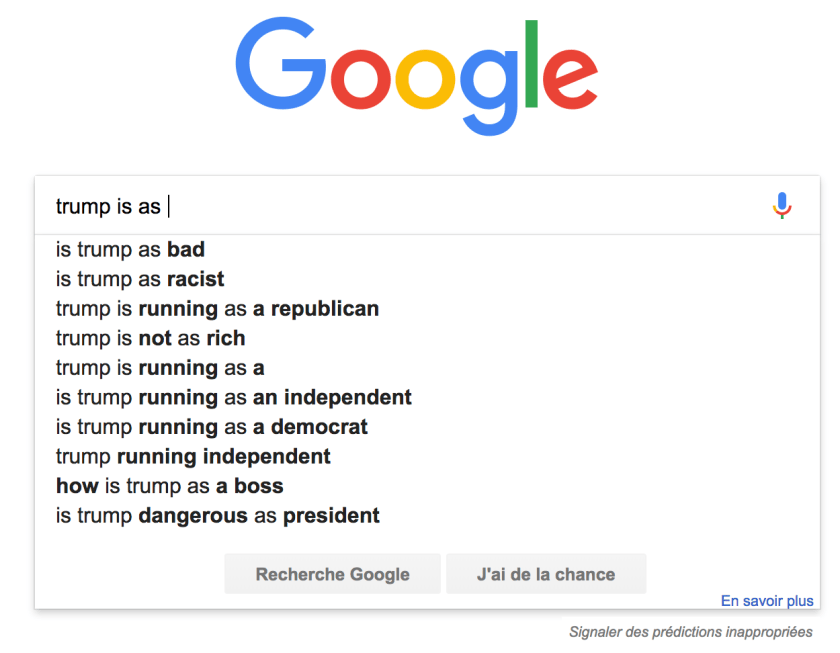
Google’s autocompletes when I looked for the origin of Paris’s nickname, “The City of Light.” Note: Paris is NOT dirty.

In this city often called the City of Light, light actually is often an issue.  If you live on one of the lower floors of the typical 7-story Hausmannian apartment buildings that make up about 60% of Paris, the sunlight only actually shines into your home for a short time every day, even in the summer—in the winter, it’s a sort of perpetual gloom, even if you have big windows, just because of the height of the surrounding buildings.   Your windows are everything here, as far as I’m concerned.

img_3494
Bricked-up windows, someplace or other in Paris. Picture source: me.

Consequently, it’s always been a surprise to me to see things like you see in the photo to the left.  You’ll notice that a number of the windows have been bricked up.  In a city where sunlight is at a premium, why the hell would you do that?

A wonderful tour guide told me the answer: once upon a time, buildings were taxed by the number of windows.  Brick up your windows, and you paid less in taxes.  At the time, Parisians mostly rented their apartments (today it’s common to own your apartment), and from the landlord’s perspective, it made sense—if you didn’t think that you could make up the tax difference by charging more rent, you might as well brick up your windows, pay less taxes, and your renters be damned.

img_3150
Bricked-up windows overlooking a little café on the rue des Écoles. I accidentally learned the word “braguette” here when I walked inside to pay–with mine open. Picture source.

Interesting, but I was never able to find any documentation of the old tax rule that the tour guide had told me about, and I don’t typically write about things on this blog if I can’t find a source to cite.  Fast-forward a few months, though, and I find myself reading Victor Hugo’s Les misérables.  I was expecting a nasty cop trying to throw a guy in prison for stealing two loaves of bread; instead I’ve read  chapters and chapters about a really nice priest.  Is this book ever going to go anywhere?  I have no clue.  But, then I came across this.  Remember: as I said, the priest is really nice.  At one point, he gives this sermon:

« Mes très chers frères, mes bons amis, il y a en France treize cent vingt mille maisons de paysans qui n’ont que trois ouvertures, dix-huit cent dix-sept mille qui ont deux ouvertures, la porte et une fenêtre, et enfin trois cent quarante mille cabanes qui n’ont qu’une ouverture, la porte. Et cela, à cause d’une chose qu’on appellee l’impôt des portes et fenêtres. Mettez-moi de pauvres familles, des vieilles femmes, des petits enfants, dans ces logis-là, et voyez les fièvres et les maladies ! Hélas ! Dieu donne l’air aux hommes, la loi le leur vend. Je n’accuse pas la loi, mais je bénis Dieu. Dans l’Isère, dans le Var, dans les deux Alpes, les hautes et les basses, les paysans n’ont pas même de brouettes, ils transportent les engrais à dos d’hommes ; ils n’ont pas de chandelles, et ils brûlent des bâtons résineux et des bouts de corde trempés dans la poix résine. C’est comme cela dans tout le pays haut du Dauphiné. Ils font le pain pour six mois, ils le font cuire avec de la bouse de vache séchée. L’hiver, ils cassent ce pain à coups de hache et ils le font tremper dans l’eau vingt-quatre heures pour pouvoir le manger. — Mes frères, ayez pitié ! voyez comme on souffre autour de vous. »  — Victor Hugo, Les misérables


Hugo, a champion of the poor, had it right: search for impôt des portes et fenêtres and you’ll find the Wikipedia page on the subject.  Turns out the tax was first instituted during the Revolution of 1789, but it comes from an older Roman tax scheme called the ostiarium.  In effect until 1926, the original goal was to have a progressive tax, i.e. one that falls proportionally more heavily on richer people.  As it turned out, it had a bad effect on the renters.  From Wikipedia:

Cet impôt fut accusé de pousser à la construction de logements insalubres, avec de très petites ouvertures, donc sombres et mal aérés, et il conduisit à la condamnation de nombreuses ouvertures, ainsi qu’à la destruction, par les propriétaires eux-mêmes, des meneaux qui partageaient certaines fenêtres en quatre, ce qui augmentait substantiellement l’impôt.  Wikipedia

Sombres et mal aérés–exactly as Hugo described them.

On the plus side, the lack of any prolonged sunshine on my windows means that my apartment never gets very hot in the summertime.  When the days get short, I pull a light box out from under my little water heater (which turns out to be related to another Parisian mystery, but more on that another time), and half an hour a day in front of that makes the crushing winter darkness feel less…crushing.  Spring will be here before we know it.


French notes

Dieu donne l’air aux hommes, la loi le leur vend.  “God gives men the air, the law sells it to them.”  What interests me about this is the double pronominal objects: le leur vend, “sells it to them.”  I have a terrible time with that kind of double-pronominal construction, and as it turns out, a lot of French people do, too–ask someone how to say I give myself to you and you give yourself to me, and I’ll bet that they have to think about it for a minute.  The most common answers that I get are along the lines of Je me donne à toi and Tu te donnes à moi, where the indirect object pronoun (in this case, the person to whom something is being given) is not placed in front of the verb, but rather after it, in a prepositional phrase–contrast those with le leur donne, where both of the pronouns are pre-verbal (before the verb).  Native speakers, got any help for us anglophones here?

Speak to us of drinking, not of marriage

The feeling was like what gay friends have described to me when they first learned that they weren’t the only guys in the world who wanted to have sex with other men.

A Basque joke about the alleged difficulty of the Basque language: The Devil wanted to tempt the Basques to sin, so he decided to learn to speak Basque.  He quit after seven years, only having learned the word “no.”  The Devil did better learning Basque than I’ve done learning French, because I still don’t know how to say “no” in French.  My stumbling block: the second clause in a contrast.  My father speaks Portuguese, but I don’t.  We have pinot noirs in Oregon, but not Brouillies.

Jean Girodet’s magisterial Pièges et difficultés de la langue française to the rescue.  According to Girodet, the issue comes up in what he calls ellipticals.  In this situation, he says that literary language tends to prefer non, while the spoken language tends to prefer pas: 

Dans les tours élliptiques, la langue littéraire préfère en général non, la langue familière pas.

He gives these examples:

Non Pas
Veut-on réformer la société ou non Qu’il travaille ou pas, je m’en moque !
Il néglige son travail, moi non. Elle aime le ski, moi pas.
Cette parole est d’un marchand et non d’un prince. J’irai en voiture, pas à pied.
Il habite une villa, non loin de Cimiez. Il tient un café, pas loin d’ici.
Il veut créer un art tout nouveau, pourquoi non ? Partir tout de suite ? Pourquoi pas, après tout.

OK, good so far: you can use either, with non sounding more literary, and pas sounding more casual.  But, why do you occasionally run into both of them together??  Here’s a clear elliptical in Girodet’s sense of the word: the refrain of the song Parlez-nous à boire, “Speak to us of drinking (not of marriage).”  There are many recordings of it available (sometimes with minor differences in the lyrics), but my favorite du moment is this one from the film Southern Comfort.  Lyrics follow, from CajunLyrics.com:

https://www.youtube.com/watch?v=iMzysRahEXs

Oh parlez-nous à boire, non pas du marriage
Toujours en regrettant, nos jolies temps passé

Si que tu te maries avec une jolie fille,
T’es dans les grands dangers, ça va te la voler.

Si que tu te maries aves une vilaine fille,
T’es dans les grands dangers, faudra tu fais ta vie avec.

Oh parlez-nous à boire, non pas du marriage
Toujours en regrettant, nos jolies temps passé

Si que tu te maries avec une fille bien pauvre,
T’es dans les grands dangers, faudra travailler tout la vie.

Si que tu te maries avec une fille qu’a de quoi,
T’es dans les grands dangers, tu vas attraper des grandes reproches.
Fameux, toi grand vaurien, qu’a tout gaspillé mon bien
Oh parlez-nous à boire, non pas du marriage.

Source: cajunlyrics.com

Native speakers, can you help this poor, lost anglophone?  (Note: I’m guessing that jolies temps passé should be jolis temps passés, but what do I know?)

My source for the Basque joke: I don’t remember, but it’s probably one of Mario Pei‘s many books.  Pei was a linguist who wrote tons of popular-press books about language between the 1930s and the 1970s or so.  Running across one of them in a used bookstore  was the first time I ever heard of “linguistics.”  After a lifetime of mostly keeping quiet about my unending obsessions with language, the feeling was like what gay friends have described to me when they first learned that they weren’t the only guys in the world who wanted to have sex with other men.

Ukrainian Humanitarian Resistance

Resisting the russist occupation while keeping our humanity

Languages. Motivation. Education. Travelling

"Je suis féru(e) de langues" is about language learning, study tips and travelling. Join my community!

Curative Power of Medical Data

JCDL 2020 Workshop on Biomedical Natural Language Processing

Crimescribe

Criminal Curiosities

BioNLP

Biomedical natural language processing

Mostly Mammoths

but other things that fascinate me, too

Zygoma

Adventures in natural history collections

Our French Oasis

FAMILY LIFE IN A FRENCH COUNTRY VILLAGE

ACL 2017

PC Chairs Blog

Abby Mullen

A site about history and life

EFL Notes

Random commentary on teaching English as a foreign language

Natural Language Processing

Université Paris-Centrale, Spring 2017

Speak Out in Spanish!

living and loving language

- MIKE STEEDEN -

THE DRIVELLINGS OF TWATTERSLEY FROMAGE