La grande guerre, “The Great War,” the First World War, World War I, The War To End All Wars, was primarily fought in France. I can’t imagine how to talk about all of the ramifications of the effects of the First World War through French history, art, politics, even cuisine; certainly European history, and indeed, the history of much of the planet. It would be pretty fair to say that the European refugee/migrant crisis today is related to the fact that Germany is incredibly welcoming to refugees; that Germany is so incredibly welcoming to refugees today because it murdered millions of civilians during the Second World War; and that the Second World War came about in part due to the effects of the First World War. (You’ve probably heard it said that “the first shot of the Second World War was the Treaty of Versailles“–the codification of the German terms of surrender at the end of the First World War. The treaty contributed enormously to the German sense of humiliation that helped to build support for the next war in 1939.)
Military language has a very rich vocabulary of its own. It includes both technical language, and slang. The French military is one of the most highly developed in the world, and the French language has a rich military vocabulary. Here are some words that you would need to know in order to read about the First World War in French. Bear in mind that I have no idea how many of these are still in current use, or not. Can native speakers help? A couple of these are cavalry terms. France still had active cavalry units in the First World War, and Céline’s Bardamu in Voyage au bout de la nuitserves in a mounted unit.
la tranchée: trench.
le fourgon: ammo truck. In general French: a truck.
le dragon: A cavalryman. From the 8th edition of the Dictionnaire de l’Académie française: Il se dit aussi d’un Soldat d’un des corps de cavalerie de ligne.Il est dans les dragons.Régiment de dragons. Colonel, capitaine de dragons. Le casque d’un dragon. “It is also said of a soldier of a line cavalry corps.” I found this one as early as the first edition of the Dictionnaire de l’Académie française, published in 1694: On appelle, Dragons, Des arquebuziers a cheval, qui combattent tantost à pied, tantost à cheval.Les dragons d’une armée. une compagnie de dragons. Capitaine de dragons. “We call Dragons, mounted arquebus carriers, who fight sometimes on foot, sometimes mounted.” (Don’t you love that tantost, where current French has tantôt? See here for more from various and sundry historical dictionaries.)
le brigadier: a brigadier general. It can also indicate a corporal; I think this might be somewhat specific to the cavalry. Here’s part of the entry from the 6th edition of the Dictionnaire de l’Académie française, published in 1835: Il se dit maintenant Du militaire qui a, dans la cavalerie, le grade correspondant à celui de caporal dans l’infanterie.Brigadier de chasseurs, de dragons, etc. “It’s now said of the soldier who, in the cavalry, has the rangk corresponding to that of a corporal in the infantry.” Later, in Emile Littré’s Dictionnaire de la langue française, published between 1872 and 1877, we see this: Titre donné au soldat revêtu du grade le moins élevé dans la cavalerie. “Title given to the soldier decorated with the least elevated rank in the cavalry.” (See here for more from various and sundry historical dictionaries.)
I write about (or at least allude to) the statistical behavior of language quite a bit in this blog. After all, it takes its name from Zipf’s Law, which was originally an observation about the behavior of language. We’ve also talked a fair bit about the Poisson distribution and how we can use it to understand why some days a second language learner is going to feel like they have made no progress whatsoever.
In these discussions, I’ve pretty much always ignored a basic fact about language. It’s not always a bad thing to ignore this fact, and we can actually get computers to do quite a bit of fun/useful things with language even when we ignore it. However, it is a fact nonetheless. Most statistical models (not just of language, but of anything) assume that samples are independent: that is, that having made any one particular observation has nothing to do with any other observation. However, when you’re talking about words, this is probably never true. (I tend to avoid the words never and always when talking about language, but in this case, “never” might actually be appropriate.) Rather, the probability of any one word is typically related to the presence of other words. Let’s take an example: bark and dog. Both of these are words that are relatively infrequent in English, as compared to, say, the, or and. From a statistical point of view, they’re actually pretty rare. Intuitively, however: if you’ve already run into the word dog, then it’s not quite as surprising if you run into the word bark, and vice versa. The same doesn’t hold for avocado–running into the word dog (or bark) wouldn’t make it seem much more likely to run into avocado than if you hadn’t just seen the word dog or the word bark.
We can quantify this statistical relationship without too much difficulty. I’m going to take some liberties here, so my apologies to my language peeps out there.
Let’s look at the frequencies of some words in a big sample of the English language: a collection of just over 96,000,000 words of English called the British National Corpus.
The frequency of the word bark in this collection of English as a whole is 11.8/million words. That is to say: for every 1 million words in the collection as a whole, 11.8 of them are bark.
Now let’s take just the sentences that contain dog. (There are about 12,000 of them.) If we look at just the sentences that contain the word dog, the frequency of bark changes quite a bit: it is now 1,073 per million words. The frequency of bark is not independent of dog: if we don’t know anything about the surrounding words, the frequency of bark is 11.8/million words. On the other hand, if we know that the word dog is nearby, then the frequency of bark is 91 times higher–1,073 per million words, versus just 11.8/million words. We say that bark and dog are not conditionally independent. Rather, the frequency of bark is conditionally dependent on the presence (and probably absence, but I haven’t demonstrated that) of dog.
The thing is this: there is pretty much never conditional independence when you’re talking abut words. Rather, the probability of seeing any particular word is related to the words that occur around it. This is true on the level of sentences, and it’s also true on the level of situations–it’s not an accident that when I run into new French words, I tend to run into other new French words that are related by, say, subject matter.
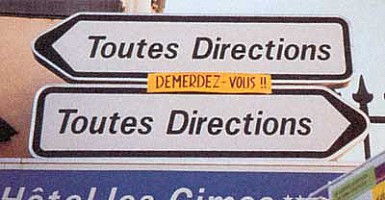
All of this came up today when I found myself repeatedly looking up words in order to be able to read the morning’s emails, and found that many of them contained the French word merde, or “shit.” Somebody did something that they shouldn’t have, it pissed somebody else off, and soon the emails were flying fast and furious. Here are the shit-related words from my day’s email, plus some related words that I came across while looking them up. All examples are taken from my correspondence:
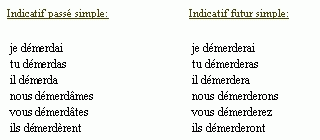
démerder: to figure out, to work out.
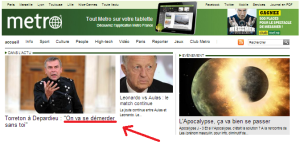
se démerder pour: to manage. Je le laisse se démerder. “I’ll leave him to figure it out.”
merdique: shitty; hopeless, useless. …leur responsabilité dans cette affaire merdique. “…their responsibility in this shitty business.”
There’s an implication here for how to study a language: the “structured vocabulary” approach that textbooks take, where you are introduced to a variety of words related to the same theme, works. When you get beyond the point where there are no textbooks for the level that you’ve achieved in a language, then other resources that bring together words on the same subject can be really useful to you. I like Mastering French Vocabulary: A Thematic Approach (Mastering Vocabulary Series), 2nd Edition, by Wolfgang Fischer and Anne-Marie Plouhinec. It separates the vocabulary of a domain into more central and more peripheral vocabulary, and also gives example sentences. However, there are many others. I am also a big fan of the Oxford-Duden pictorial dictionaries, and there’s a French-English bilingual one. They’re not quite as user-friendly as something like the Fischer and Plouhinec book–no verbs at all, and no examples of usage, and no indication of when words are ambiguous–but they are excellent for technical and obscure vocabulary.
I said above that words are probably never conditionally independent. I can think of one particular kind of language in which you might see something like conditional independence. This is the phenomenon of word salad.
Wikipedia defines word salad as a “confused or unintelligible mixture of seemingly random words and phrases.” Random is the key word for us here–if you are random, then there is no conditional dependence–that is, knowing that any particular word shows up tells you nothing about the probability of some other word showing up, just as picking up, say, a piece of lettuce when you’re eating a (tossed) salad doesn’t let you predict anything about what you’re going to pick up next. Here are some word salad examples from schizophrenics:
Yesterday, the neighbors arrived with a bushel of wheat. I can only hope that the children will receive their weekly bath. It seems to me that young Gracie has blue eyes. Snakes often have eyes. The grass is green as well. (http://pasadenavilla.com/2009/10/18/living-with-a-schizoprenic-patient-2/)
Back to the drama: the emails flew fast and furious for a while. Ultimately, the issue was decided by appeal to logic and the basic principle of égalité–equality. In this case, that meant that identical standards would be applied to everyone, which might sound obvious, but in a similar situation in the US, that would not necessarily be assumed to be the case, at all. (I say that after having seen similar situations in the US many, many, many times.) In France: you can get pretty far here by arguing for logic and consistency, as far as I can tell. Seems pretty sane to me…
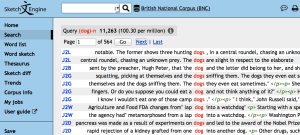
What you get when you search for the lemma “dog” as a noun in the British National Corpus. “Lemma” means that it includes both the singular “dog” and the plural “dogs.” Picture source: screen shot by me.
Technical note: I got the initial frequencies for dog and bark through Sketch Engine. I saved all sentences containing dog in a Sketch Engine search as a text file. Then I counted the total words. I counted the number of lines containing bark, making the simplifying assumption of one token of bark per line. I then normalized the frequency to words per million.
Standard tourist question in Paris: is that Notre Dame? The short answer is usually no. One possible longer answer would be which Notre Dame? There are 37 churches in Paris called Notre Dame (Our Lady) of something or other. According the Wikipedia page listing religious buildings in Paris, there are 197 churches in Paris at the moment. That’s just in the 20 arrondissements of Paris proper. Even without bearing in mind the observation that French society can be aggressively anti-clerical, that’s a lot of churches.
Robert Cole’s explanation: as the year 1000 approached, everyone knew that the world was going to end. Prayer for the sparing of life was widespread, and when the world did not, in fact, end, gratitude was widespread as well. A spate of church-building was the result.
Should we buy this account? Clearly the churches of Paris are not generally anywhere near that old. Parts of Saint-Germain-des-prés go back 1000 years, and Saint-Julien-le-pauvre began construction in the 1100s, but most Parisian churches are at least a hundred years younger than that. So, you could call Cole’s explanation into question because of that. However, it’s also certainly the case that many Parisian churches are built on the sites of earlier churches, or are mostly additions to earlier churches, or are replacements for churches that burnt down, or exploded, or set on fire by Vikings (I’m not kidding about any of this), or what-have-you. So, there’s often some rationale for dating a church as being earlier than the current state of whatever you happen to see on the spot today. For example, the current Saint-Germain-des-prés is dated to 1014, but it replaced another church that went up on the same spot in 542. Saint-Julien-le-pauvre replaced another church built on the same spot in the 500s. Google oldest church in paris and it will suggest both Saint-Germain-des-prés and Saint-Julien-le-pauvre. It’s a difficult question. But, it’s not inconsistent with Cole’s story.
A personal digression: my very boring little residential neighborhood alone contains a Gallic Rite church–the somewhat-Celtic, somewhat Eastern Orthodox–and possibly somewhat Dark Ages French–Gallic Rite was abolished at some point (can anyone tell me when?), but later revived by Russian emigres in Paris in the early 20th century–and a wonderful Art Deco church. I always assumed that Art Deco was totally American–it turns out that Art Deco is short for Arts Décoratifs, and the style had its origin in France. Who knew? Personally, I don’t think that this list of the ten most unusual churches in Paris has anything on my little neighborhood.
For more information on millenialism in medieval France, see:
The typical stereotype of Paris is as a beautiful, majestically historical city that just oozes romance, and indeed, Paris is all that. But, visitors are often surprised to find that it is also a city with a sometimes astounding number of beggars on the street. The reasons behind this are many, and varied, and, I think, interesting.
In the pre-modern period, the vast majority of the French (like the vast majority of everyone else in the world) were farmers. Most children didn’t live to adulthood, and you needed a lot of hands to work the farm, so people had big families.
In the 1500s, the French death rate took a relatively sudden drop. People were still having those big families, so there were a relatively large number of people making it to adulthood. The inheritance laws of the time included primogeniture, i.e. inheritance of everything by the oldest son, so lots of those people wouldn’t have a farm of their own to work. Options were limited, and if they couldn’t find other employment, a lot of people hit the road. (There’s an excellent description of the mechanics of this phenomenon in Robert Darnton’s The Great Cat Massacre and other episodes in French cultural history.)
If you hit the road in France, you’re eventually going to end up in Paris, if for no other reason than that it’s the hub of the road system (and today, the rail system). If you can’t find other employment, your options come down to begging or stealing, and most people aren’t thieves. So: begging.
Begging actually has a very long and somewhat respectable history in Europe. As Robert Cole puts it: “In the middle ages, ‘Christian charity’ perceived the poor as God’s special children and therefore deserving of alms.” Begging can be a profession, really. (Old Eastern European Jewish joke: beggar hits a guy up for money. Guy gives him some helpful hints on improving his approach. Beggar responds: YOU’RE telling ME how to beg? This would make total sense in a French context: a métier (profession) is a métier, whether you’re a doctor, an engineer, or an elevator operator.)
If you’re gonna be a beggar, though, it helps to have a schtick. Physical lack of ability to work was a good one, and Parisian beggars were known for faking such a disability, leading to their squatting areas being known as Cours des miracles(“Courts of miracles”) for their recovery at the end of the working day. (There was one just to the north of what is now the Place des Vosges, I believe.) By the 1500s, begging wasn’t viewed quite as kindly. Robert Cole again:
In sixteenth-century Paris the poor were viewed as merely layabouts who preferred to live off public welfare. Meanwhile bad harvests, plagues, inflation and religious war increased their number dramatically. Public begging was outlawed in 1536, and in 1551 laws were enacted which limited eligibility for public assistance and forbad women to have their children in tow when selling candles outside churches. To do so, went the rationale, evoked sympathy from prospective customer, which proved that such women were really only begging. A traveller’s history of Paris.
So: there have been a lot of beggars in Paris for centuries. In 2007, the European Union was enlarged to include a couple countries with large Roma populations. There have always been Roma in France, but now a lot more came (the Roma rights group FNASAT says 12,000 currently, and that’s after 10,000 being expelled in 2009 and another 8,000 in 2011; other estimates range from 20,000 to 400,000), and they are a prominent part of the Parisian begging ecosystem. (There is, indeed, a Parisian begging ecosystem, and there are actually a number of distinct genres of begging in Paris–a subject in and of itself.)
To be clear: if you don’t give charity, your life is pointless. Let me point out that this is a teaching of at least Christianity, Judaism, Islam, and Hinduism, and–for my fellow secularists in France–Rousseau, the revolutionary Constituent Assembly, National Convention, and Directory, and modern French philosophers from Sartre to Alain Finkielkraut. (All of those links are to citations on the subject, not to their biographies.) The Buddhist view of charity is especially appealing to me, as a (really bad) student of judo:
Buddhism views charity as an act to reduce personal greed which is an unwholesome mental state which hinders spiritual progress. What Buddhists believe, Venerable K. Sri Dhammananda Maha Thera.
Judo’s view of the best human relationships is mutual welfare–we’re taught that human interactions should be mutually beneficial. So, if it’s the case that charity benefits both the giver and the receiver, then it’s very judo. Seriously, give charity–if for no other reason than that you’ll feel better about humanity if you take part in it being more humane.
le mendiant: beggar.
le gueux/la gueuse: beggar (literary). A number of other, more pejorative meanings–highwayman for men, whore for women, etc. Probably obsolete, but keep it mind for when you read Tartuffe.
le clochard: beggar; also bum. (Slang.)
le/la clodo: beggar; also homeless person, tramp, hobo.
I saw a guy peeing on the street today. It was on one of those concrete things outside of the Centre Georges Pompidou, France’s national museum of modern art. It seemed odd, because there was a free public toilet not 5 meters away. I could smell the large–and rapidly growing–puddle of piss as I walked by.
Paris has always smelled, and by “smelled,” I mean stunk. Philip II (Philip Le Dieu-donné) tried to deal with the stench from the streets by paving them, sometime between 1180 and 1223. It didn’t work–the description of sources of the stench in one neighborhood in the 1680s or so (I think it was near what’s now Place d’Italie) included “a stream that served as public sewer and a waste dump for the Gobelins factory, a pig farm, a neighborhood tanner, a starch maker, and an abattoir which emptied blood into the street.” (Robert Cole’s excellent A traveller’s history of Paris, the source of this quote, proceeds by historical period; each chapter details the stench situation at that point in time.) Louis XIV moved his residence from the Louvre to Versailles in 1682 in part to get away from fractious Parisian mobs, but also to get away from the stench of Paris.
Poop can still be an issue. Edmund White used to walk his dog by the Centre Pompidou expressly to have it poop in the ventilation duct of the office of a guy who had refused to give him a writing job. However, in these days of modern sewer systems, the main issue is pee, and there’s not actually that much of an issue with that. Despite everything that you hear about Parisian men peeing all over the place, you are only really likely to smell it in the metro stations. It’s claimed that a couple liters of perfume are dumped into the Métro ventilation system every day in an attempt to cover the smell of pee. (See here for the closest I’ve been able to come to verifying this.)
Really, in a European context, France is not that bad in the urine-smelling department. In Belgium, I once had to pee in the kitchen of a decent restaurant–because that’s where the urinal was.
faire pipi: to urinate.
pisser: to urinate.
uriner: to urinate–I found this in my medical dictionary.
la miction: urination. Also from my medical dictionary, so it might just be a technical term. The English cognate is micturition.
pisser dans un violon: to waste your breath, to talk to a wall. Literally: “to piss in a violin.”
gey kakn afn yam: “go shit in the ocean.” This is Yiddish, not French, but it’s really the only Yiddish you need to know.
I was in the Navy with an Armenian woman. (No, you don’t have to be a citizen to serve in the American military, and that’s probably true in most countries. In France, you can get citizenship by serving in the military–you are français par le sang versé, “French by spilt blood.” This isn’t the case in the United States–you can apply for citizenship as a member of our military, but there actually isn’t any guarantee that you’ll get it.) We’ll call her Nairi (not her real name). Like many members of the Armenian diaspora, Nairi was massively multilingual–she spoke Armenian, Arabic, and Spanish natively, and French and English as very strong second languages. (I once saw her mother test her to make sure that she wasn’t forgetting any of them.) One day Nairi came back from leave (what we call vacation in the military) with a seven-language dictionary. I admired it, and she insisted that I take it. I refused, she insisted, I refused, she insisted, I refused, she insisted, and finally, I took it. What I didn’t realize was that in Armenian culture, if someone admires something of yours, you must insist that they take it. Armenians know that they most certainly should not take it–I didn’t. Now I do. Stupid me–every time I see that dictionary on my bookshelf, I feel like a total jerk.
In a recent post, we talked about monolingual dictionaries–that is, dictionaries that list words in some language and give definitions of them in that same language. Today, let’s talk about bilingual dictionaries–that is, words that list words in some language and give corresponding words in another language. Of course, anything that we might say about bilingual dictionaries applies equally to dictionaries with even more languages, like the one that I stupidly took from poor Nairi.
I carefully said “corresponding” words just above–I carefully didn’t say “equivalent” or “the same” words. This is because it’s often the case that there isn’t a single translation from one word in one language to one word in another language. Even when there is one, it doesn’t necessarily “mean” the same thing, in some sense of the word “meaning.” To give you an example from my college French 101 textbook: a fenêtre in French is a window in English–fine so far. But, say window in English, and the referent is most likely a casement window, specifically–one that slides up and down. Say fenêtre in French, and the reference is most likely a window that opens in the middle–horizontally. (We would call this a French window in English. See this post for a list of things that we call French something-or-other in English that aren’t called anything of the sort in French.) And, as I said, there often isn’t just one. A language that I worked on in grad school has the word invert. But: invert what? If you’re inverting a hollow object, that’s one verb–if you’re inverting a solid object, it’s another verb. French has maybe two words for snow–la neige, and la poudreuse (powder snow). Depending on how you count, English has 13 or 55 or 120 (scroll down past the Inuit words) or 182 words for snow. So: not a 1-to-1 correspondence.
Having at least mentioned some of the theoretical issues, let’s look at the practical points of buying and using a bilingual dictionary. In these days of Amazon, you can use reader reviews in a way that we never could before–it’s really a nice advantage over the old pre-Internet days. However, there are also some specific things to look for.
Example sentences: you want a dictionary with example sentences, at least in the language that’s foreign to you.
Verb + preposition combinations: a good dictionary should tell you which prepositions, if any, go with which verbs. You need to know, for instance, that in English you shoot at something, you lean toward (have a preference for) something, and you stop doing something, with no preposition. Likewise, in French you need to know that you tirer suror tirer contre (shoot “on” or shoot “against”) something, you pencher pour(lean “for”) something, and you arrêter de (stop “from”) doing something.
If you are working with language(s) that have gender, you want the gender to show up both in the Language1 -> Language2 section and in the Language2 -> Language1 section. If you look up kitchen towel and find that the translation to French is torchon, you don’t want to then have to go to the French -> English section to see whether it’s le torchon (it is) or la torchon (it isn’t).
This might seem obvious, but make sure that the pronunciation is given for the words in any language whose pronunciation isn’t obvious from the spelling–and, yes, that includes both English and French.
This takes a while, but: when you find the word that you’re looking for in the other language, you might want to look it up in the other direction. For example: suppose that you look up the English word towel in a crappy bilingual English/French dictionary. In a crappy dictionary, you might find the following: serviette, torchon. Both of those can, indeed, be used to translate towel from English to French–but, they’re not equivalent. Serviette is for a bath or beach towel, while torchon is for a kitchen towel. You want a dictionary that will distinguish between the various possible translations. It’s often useful to look the French words up in turn (or the English words, if you’re going from French to English). If you do that, you’ll find that a serviette can be a towel, but also a napkin, or a briefcase. A torchon, you’ll find, can also be a messy document, or a rag. It’s good to be on top of this kind of thing when you’re trying to choose between supposed synonyms.
Labelling of registers, or levels of appropriateness: you most definitely want a dictionary that includes slang, obscenities, informal words, etc., or you’re not going to get very far in real life. However, you also want a dictionary that labels words that are non-standard–offensive words, etc. This kind of thing can be really, really hard to catch when you’re learning a language from movies, your neighbors, etc.
The always-awesome Lawless French web site has a good page on the subject of how to use a bilingual dictionary, and it has much better examples than I do. You can find it here.
So, what are some good bilingual English/French dictionaries? Here are some options.
The best thing out there these days is almost certainly WordReference.com. It has lots of language pairs, example sentences, colloquial expressions, pronunciations, male and female forms of adjectives, plurals, a verb conjugator, and a reverse look-up feature that does exactly what I suggest you do in the last bulletted item above. The auto-c0mplete feature in the search box saves me enormous amounts of time (and guessing about spellings). There’s an excellent WordReference iPhone app. Be aware, though, that the iPhone app will not generally let you look up obscenities–you have to go to the web site for that.
For the Kindle or for the Kindle app on your phone, the Collins English-French and French-English dictionaries are quite good. They’re quite highly rated on Amazon.com. I have the Collins dictionaries on my phone, and use them whenever I don’t have Internet access and therefore can’t get to WordReference.com. The Collins dictionaries also have an advantage over WordReference: they don’t give as many super-subtle translations. The only bad thing about WordReference is that it can sometimes give an overwhelming number of other-language translations. That’s great when you want it, but when you don’t, you might prefer the Collins dictionary. As it happens, there is a Collins dictionary tab on the WordReference site, and it’s easy to click on that.
Linguee.fr is fantastic for seeing things in context. You will generally get lots of example sentences. There’s an iPhone app for that, too.
Reverso.net is another good one for seeing things in context. It sometimes has better coverage of colloquial, slang, and obscene language than Linguee does. Again, there’s an iPhone app.
I found Nairi on Facebook recently. I sent her a friend request–no response. Is it because she doesn’t remember who the hell I am? Is it because she hates me for taking her dictionary? I have no idea. Nairi, if you’re reading this: I’m sorry!
Refugees and migrants are dying in shocking numbers in the Mediterranean. Here is some vocabulary that you’ll need to know to talk about the tragedy in French.
One of the ways that the world is sucking right now is the migrant crisis in Europe. As I write this (in April 2016), there are tens of thousands of refugees and migrants stranded in Greece. Many of these people cross from Turkey to Greece by boat, and many go from North Africa to Italy by ship. Tragically high numbers of these sink; in April of last year, five vessels sank, with a death toll of about 1,200 people.
The other day I was listening to the news on the radio. It was yet another story about the refugee crisis. The word aufrage kept coming up, but I couldn’t find it in my dictionary. Un aufrage, I kept hearing. Looking up similar stories on line solved the mystery: it was not un aufrage, but unnaufrage–a capsizing or shipwreck. I had “segmented” (as linguists say) the n of naufrage as part of a separate word, coming up with un aufrage.
This isn’t an uncommon phenomenon. One of the surprises for students in introductory linguistics classes is that in speech, there are no breaks between words–if I showed you a spectrogram (a sort of recording of a sound wave) of a sentence, you would see a continuous sound. “Segmenting” that stream of speech into smaller units is something that humans do–it’s not something that’s there in the acoustics.
Occasionally speakers of a language will, over time and as a community, “reanalyze” words in a way that changes the segmentation, and eventually the pronunciation. The word uncle is a word that has undergone this process. A variant of the word in English is nuncle. Oxford describes it as archaic or dialectal, but it’s there. You can see it in Shakespeare:
Can you make no use of nothing, nuncle?
–King Lear, Act 1, Scene 4
The word is thought to have come from a segmentation of phrases like mine uncle as my nuncle, thine uncle as thy nuncle, etc.
The same thing can happen in other languages, too–any time people speak, there’s an opportunity for segmentation errors. Children who are learning their mother tongue often try out different segmentations. For example: in a past post, we looked at some bear-related vocabulary in French and English. Here are various and sundry relevant phrases:
un ours: a male bear.
une ourse: a female bear.
un ourson: a baby bear; a teddy bear.
un nounours: a teddy bear.
I once read a great blog post in which a French guy wrote about his toddler producing three different pronunciations of the word ours (male bear) in one day: ours, nours, and I believe lours (the last one would be a reanalysis of l’ours, “the bear”). (Sorry I’m guessing about that last one–I can’t find the guy’s post.)
Linguistics geekery, which you should feel free to skip: one of my homeworks in Phonetics 101 was to look at spectrograms and find indications of syllabic association, which can correspond to word segmentation, on occasion. It’s possible to do so–sometimes. For nasals in French, as far as I know, it would be restricted to some variability in when a vowel is nasalized before a nasal consonant, versus when it’s produced as a sequence of an unnasalized vowel before a nasal consonant. American English speakers, who have no contrast in nasalization versus lack of nasalization before a vowel, are unlikely to be able to perceive it, and I don’t know at what age a French kid would be likely to acquire it.
I have no clue how the current situation will or should be resolved. Obviously, if your town is being destroyed by the Syrian government, or ISIS, or whatever other assholes are causing death and misery in the Middle East these days, it makes sense that you would take your family and go elsewhere, and it’s simple human decency to shelter people in that situation. However, the situation is not clear in other ways–even the fact that the Wikipedia article on the subject is titled European migrant crisis and not European refugee crisis is a loaded choice, and one that has implications about how the people who are affected should be treated. The situation continues to evolve, with European and world sympathies tilting now one way and now the other–in favor of sheltering the affected people after a tragedy like the widely-publicized drowning of a Syrian toddler, and in opposition to it after the despicable assaults on women by crowds of migrant men last New Year’s Eve in Germany. Certainly the situation will have long-range effects on Europe. I began this post by talking about one of the ways in which the world sucks right now–the existence of this crisis. One of the ways in which the world doesn’t suck right now is that many people in many countries have been very active in welcoming refugees, providing real support services for them, and generally acting like decent human beings. This will get worked out.
It’s raining, it’s pouring, the old man is snoring,
He went to bed and he bumped his head and he didn’t get up ’til the morning.
–Children’s song
Adam Gopnik once described Paris as “a scowling gray universe, relieved by pastry.” The “gray” part comes from the observation that it’s very often cloudy here. Actually, one of the things that I love about Paris is that it rains here. In the US, I live in a very sunny, dry part of the country–300 days of sunshine a year. However, I grew up in a very, very wet part of the country, and I miss that. So, coming to Paris in March and seeing flowers bursting from wet earth on my walk to work through the forest is a real treat.
Being from a very wet place, I have a large vocabulary for talking about rain in English. Here are some examples of relevant verbs. These are all impersonal verbs, using what linguists call a pleonastic pronoun, i.e. it’s:
to rain: the default verb.
to pour: to rain hard–see the children’s song above.
to rain cats and dogs: to rain hard.
to rain/pour buckets: to rain hard.
to mist: to rain very lightly.
to drizzle: to rain, especially if it’s cold. (I’ve seen a couple definitions of this as “to rain lightly.”)
to sprinkle: to rain, especially for a short period of time.
to storm: to rain very hard, often with thunder and lightning.
One day a friend and his wife dropped by my office to share the good news that they’d just seen an ultrasound of their baby-to-be. They didn’t speak English, so we spoke Spanish. Is the baby a macho or a hembra?, I asked-–a boy, or a girl? My friend and his wife cracked up (American English for “started laughing hard,” although it can also mean “to go crazy”–be careful). It turns out that macho and hembra are used only in what you might think of as a biological sense–that is, to refer to male or female animals. A baby boy or baby girl human is a niño or niña. There’s a similar set of words in French for describing biological sex, as distinct from gender, and that set of words can come in handy. We’ll see more on this below, but first some big-picture issues.
Most dictionaries today are descriptive, rather than prescriptive, meaning that their goal is to describe how language is used, rather than to try to prescribe the way that the editors think that it should be used. With that goal in mind, what should the editorial stance be towards the ways that language reflects society, and in particular, shitty things in a society–say, sexism in America and the United Kingdom? Here’s an article on the subject from the New Yorker, and if you like it, be sure to follow the link in it to Deborah Cameron’s article–she is an amazing linguist. (Full disclosure: I took sociolinguistics from her as an undergrad. Favorite quote: “Well, that rather fucks the theory up, now, doesn’t it, Kevin?”)
Relevant French vocabulary, with a quote from the French Wikipedia page on sexism:
Le sexisme est une attitude discriminatoire adoptée en raison du sexe.
La critique du sexisme dénonce l’idée selon laquelle les caractéristiques différentes des deux genres masculin et féminin impliqueraient l’attribution de rôles, droits et devoirs distincts dans la société. Elle dénonce cette construction de la société qui attribue un caractère, un rôle, des prédispositions physiques et affectives selon le sexe. La notion de sexe n’est alors plus une notion de sexe biologique (mâle et femelle) mais une construction sociale du genre féminin et du genre masculin limitant par là même le développement de l’individu sur les plans personnel, affectif, professionnel et social.
dénoncer: to denounce or condemn; to back out of, to renege on.
le devoir: duty, obligation; homework, assignment.
affectif: emotional.
le mâle: male, in a biological sense. Slang: studmuffin.
la femelle: female, in a biological sense. Slang: bitch.
None of this stuff is simple or straightforward. As a sociolinguist once said to me: if a language reflects sexism, homophobia, or whatever other nastiness, that’s data. The claim of some of the people interviewed in the article is that when a lexicographer includes sexist language in a dictionary, they’re not just describing it, even if they think that that’s what they’re doing–they’re endorsing it. A good descriptive lexicographer would protest against that claim–see this recent post. How does the person on the street see it? Is the interviewee right in asserting that people perceive the dictionary as an authoritative stamp of approval on the language, rather than seeing it as descriptive of the language, like the lexicographer does? That’s an empirical question, and I don’t know the answer. If you go out and do a survey on this, please let the rest of us know the result…
In which an encounter with a crazy guy on the subway leads to a statistical analysis of French adverbs.
One evening I was riding the metro home when a guy got into the car with some used books to sell. A man sitting across the aisle from me asked to see them. He flipped through one of them, then took a pen out of his jacket pocket and began circling words–in this book that the other guy was trying to sell. Are you going to buy that?, the would-be bookseller asked the guy with the pen. They exchanged words–the bookseller was not happy about having his books marked up. The bookseller said something that Mr. Pen apparently thought was obvious or stupid. Il est fort, lui, he snorted–he’s a sharp one.
The central meaning of fort/forte is “strong,” but it can also be used adverbially. You hear it a lot that way, and I’ve been trying to figure out exactly when you can use it in that way–it’s often the case that there are word combinations that are possible in a language, but that don’t sound right. Rather, there are particular words that are conventionally used in very specific combinations. Violeta Seretan of the University of Geneva gives some examples of English words that are used to describe the magnitude of various nouns. The semantics of each of these is the same, but the words that are typically used are quite different. We talk about big problems, heavy rain… How about injury? (Answer below.) It would certainly be possible to say large problem, but it’s nowhere near as likely, and it sounds odd, as a native speaker. For example, you could say large problem, but it seems odd. I wanted to be able to demonstrate that this corresponds to some actual statistical tendency, not just my intuitions, so I searched the enTenTen corpus, a collection of almost 20 billion words of written English, looking for big problem and large problem. Here are the frequencies:
big problem: occurs 6 times per million words.
large problem: occurs 0.5 times per million words.
Big problem occurs twelve times more often than large problem–the latter is possible, but it’s not really what you would expect to hear from a native speaker. We call these things like big problem “collocations”–combinations of words that occur statistically more often than you would expect by chance.
You can find collocation dictionaries for English, and they’re quite useful for second-language learners. I don’t know of any for French, though, or at least not where to find them in the US, which is where I am at the moment. (I’ve seen similar things in Canada.) I additionally want to know how these adverbial uses of fort should be translated into English, so I need a way to figure this kind of thing out for myself.
First step: find a whole lot of French text in some easily searchable form. I started with the French section of EUROPARL–a collection of documents from the European Parliament, translated to/from a wide variety of languages. The French section of EUROPARL contains about 59 million words–so, a whole lot–and you can access it through the Sketch Engine web site–so, easily searchable. A quick search showed me that fort is quite common in that data set:
Fort shows up 17,130 times in French section of the EUROPARL corpus–257 times per million words. That’s pretty frequent.
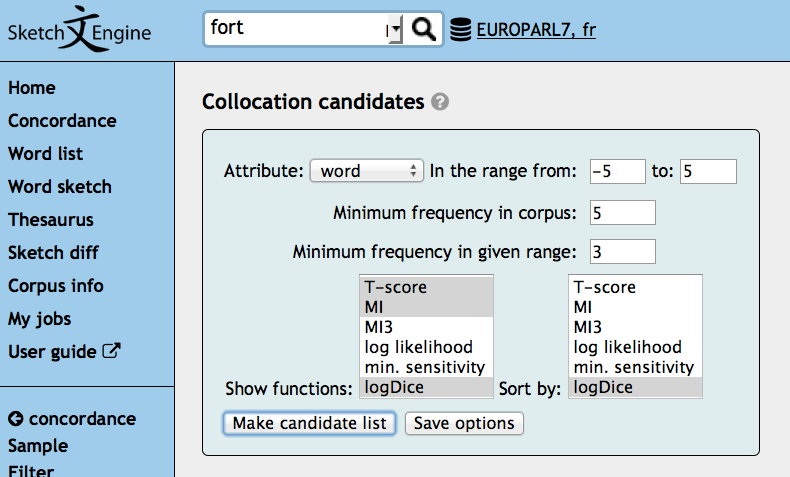
Once I know that, I know that there will be enough data to calculate the collocations–recall that this is a statistical thing, so you need plenty of data. The Sketch Engine interface gives me a number of options for how to do the calculations (scroll down to get past the screen shot):
…which I show you just so that you’ll see that there are a lot of approaches to doing this. I just went with the defaults.
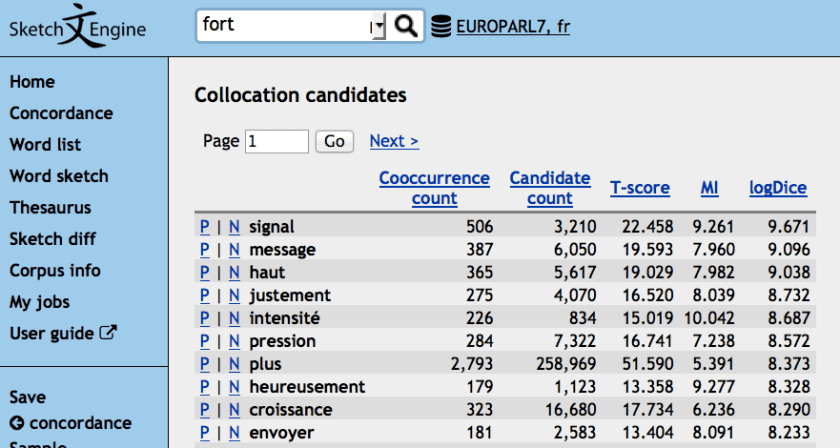
The calculations yielded quite a few possibilities. Here are some of them:
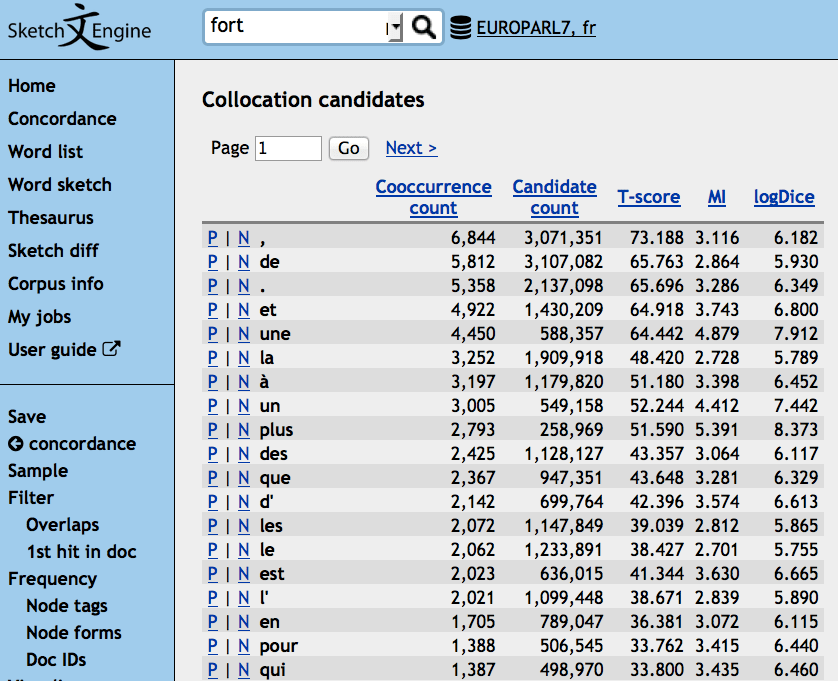
If you’re a stickler for data, you might have noticed that the collocations are ordered by the log of the Dice coefficient, which you could think of as a measure of the statistical effect, I guess. I am really looking for the most common collocations involving fort, though, so I’ll reorder by the cooccurrence count, i.e. the raw count of how often the collocations occurred:
Crap–that basically tells me nothing. Why not? Zipf’s Law. Remember that Zipf’s Law tells us not only that most words are pretty rare, but also that some words are really, really common, and in French, that certainly includes de (“of”), et (“and”), une (“a”), and the rest of what we’re seeing here. (Moral of the story: don’t expect the most frequent things in a language to necessarily be the most revealing things in a language.) If I scroll down a bit, though, I see bien on the list. 683 examples of this–a frequency of 10.25 per million words. Bien is often an adjective, which would presumably make fort adverbial in these cases, so we’re on to something now. Let’s check out some of those examples:
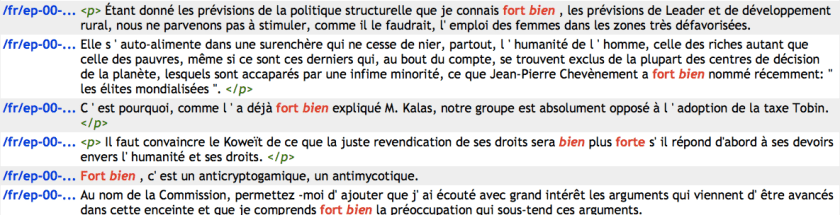
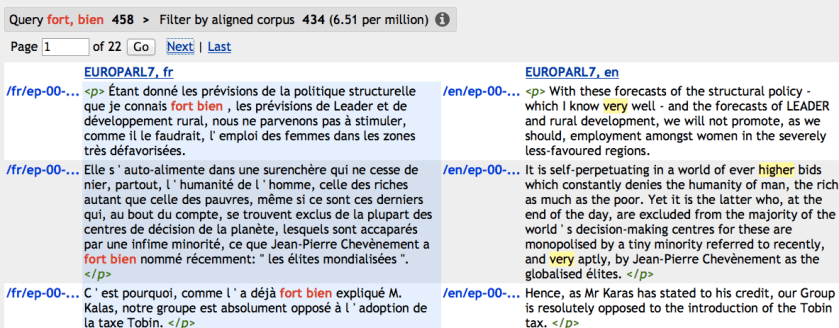
So, now I have some cases where it would make sense to use fort, but I want to know how they would correspond to English, too. This requires that I have access to the corresponding English text. No problem–recall that the EUROPARL corpus is multilingual. In particular, it is what is known as a parallel corpus, which means that it contains the same contents in multiple languages, not just similar contents (although that kind of corpus can be useful, too). I searched for the phrase fort bien. Here’s an example of the output:
So, now I have some French/English equivalents for fort bien:
Étant donné les prévisions de la politique structurelle que je connais fort bien… With these forecasts of the structural policy – which I know very well…
…ce que Jean-Pierre Chevènement a fort bien nommé récemment… …referred to recently, and very aptly, by Jean-Pierre Chevènement…
C’est pourquoi, comme l’a déjà fort bien expliqué M. Kalas…Hence, as Mr Karas has stated to his credit…
…je comprends fort bien la préoccupation… … I have a great deal of sympathy for the unease…
Vous savez fort bien que… You know very well that…
…non seulement parce que le président le connaît fort bien… …not only because the President is very familiar with it…
Il est fort bien d’ organiser des réunions, mais ce sont les résultats qui comptent.Meetings are all very well, but it is the result that counts.
…ils se tirent fort bien d’affaire. …they are managing really rather well.
…et je les comprends fort bien. …which I fully understand.
Ils les connaissent fort bien et un par un. They recognise each and every one of them very well.
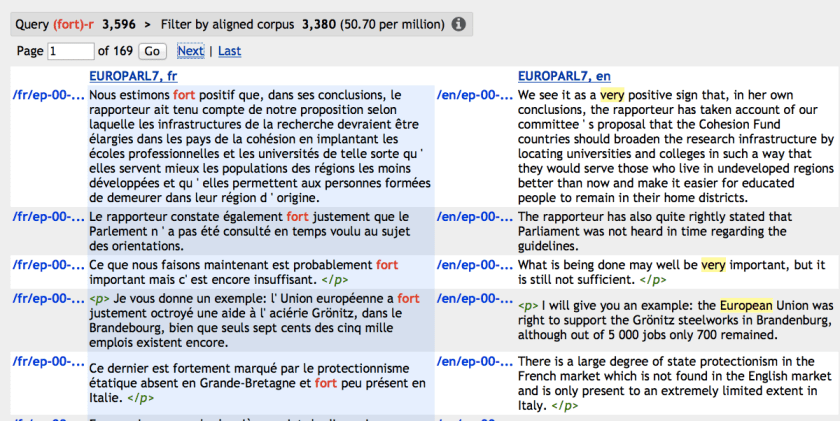
I’m feeling good about how to use fort bien now, but I want to know about other ways that fort could be used with an adjective. So, I’ll do another search of the parallel corpus (i.e. the matched French and English texts), but this time I’ll just search for fort, and I’ll specify that I want it to be an adverb. Here are some of the results:
Now I have some general examples of how to use fort:
Nous estimons fort positif que…We see it as a very positive sign that…
Le rapporteur constate également fort justement que…The rapporteur has also quite rightly stated that…
Ce que nous faisons maintenant est probablement fort important…What is being done may well be very important…
…l’ Union européenne a fort justement octroyé… …the European Union was right to support…
…nous entretenons des relations bilatérales fort satisfaisantes avec… …We have very satisfactory bilateral relations with…
I don’t know every adjective with which it would be OK to use fort, but I know one more than I did when I got out of bed this morning, and I’m cool with that–one less time when I’ll have to use très, which is all that they teach us in school.
A colleague had some observations on this:
On top of being used in collocations, it also marks a style / genre which is somewhat formal or elevated (“soutenu”). This might explain why it remains frequent mostly in collocations and is less frequent (or more marked) in freer combinations. This gives the expression a literary turn or a pretense to a higher register. Both in speech and in writing, it is “soutenu.”
Another native speaker had this to say about it:
“Fort” is used as a synonym of “très”, before adjectives or adverbs . You can use it in about any case, it’s just more elegant than “très”, but not really literary .
The Mr. Pen guy on the subway turned out to be pretty crazy, as far as I could tell. At one point he snapped at my adorable cousin, who happened to be visiting, and I told him to cut it out. This was followed by an initially amusing conversation between him and me that at some point degenerated into a loud tirade on his part. I kept telling him that my French wasn’t that good and I couldn’t understand him, but he just kept going and going. Eventually French people around us began telling him to stop being an asshole and words to that effect, so I assume that it wasn’t very nice, but honestly, I couldn’t tell you. At some point a large and very drunk French guy got on the subway car, and started seriously getting in Mr. Pen’s face–it was clear that this was going to turn violent. Mr. Pen was a very diminutive Haitian man, and I wasn’t going to watch him get the shit beaten out of himself no matter how bizarre he was being, so I got involved. The train stopped, Mr. Pen jumped out, and Mr. Drunk Guy launched into an animated discussion with me about American heavy metal, punctuated by snatches of Metallica songs. All in all, an unusual evening on the metro, but not an unpleasant one by any means–just part of life in The Big City, as we say in English.










 Zipf's Law


