
The Paris hustling ecosystem: the bad side

There are scammers all over the world, but there are some scams that are especially Parisian.

i-hustle-hard
The good meaning of hustle. Picture source: http://www.top-law-schools.com/forums/viewtopic.php?t=177021&start=50.

The verb to hustle can have a couple different meanings in English, one of which is good, and one of which is bad.

  • The good meaning of hustle: behaving with what the Merriam-Webster dictionary calls “energetic activity.”  Someone who’s hustling in this sense is working hard; moving around a lot; expending a lot of effort, in a good way.  If you want to get into a good college, you’re going to have to hustle this year.  She really hustled, and she finished the program early.  Commonly said to athletes: Come on, get out there and show some hustle! 
  • The bad meaning of hustle: “to sell something to or obtain something from by energetic and especially underhanded activity…to lure less skillful players into competing against oneself at (a gambling game)” (Merriam-Webster dictionary again).  (“Underhanded” means through trickery or dishonesty.)  This is basically the same meaning as to con someone–to trick them out of money—and a hustle (it can be a noun, too) can also be known as a con, or a con game, or a confidence game (which is where the shorter name comes from).

    pool hustler
    A pool hustler is more or less the archetype of the hustler. Pool hustlers are excellent pool players. They trick people into betting with them by pretending to not be very good, and then reveal their true skill after the bets are laid. Picture source: http://bankingwiththebeard.com/?p=1425.

    You will find people running hustles (or cons) pretty much everywhere you go in the world, including places where there are no tourists–people try to hustle the locals, too. But, there are some hustles that are especially common in Paris, and some that I haven’t seen anywhere else.  Read on for descriptions of how they work.


The common Parisian hustles

There are some pretty common hustles in Paris, and you will probably see at least one of these if you go to any of the famous tourist sites (and you totally should–I firmly believe that everyone should do as many of the stereotypical Paris tourist things as they can, at least once).  Here are the things that you’re likely to see:

  • The ring hustle
  • The friendship bracelet
  • 3-card Monte, or whatever
  • The fake petition
  • The fake deaf/mute

What I find especially interesting about all of this is that there is a system in operation here–an ecosystem, if you will.  We saw in a previous post that there are specific kinds of beggars that do their thing in specific areas–the guys who make speeches on subways, the Roma ladies on the Champs Elysées, etc.  There’s a similar kind of system in effect with regard to hustles–different groups more or less own specific hustles, and specific hustles are associated with specific areas of Paris.  In addition, there are some common types of robbery: picking pockets, and snatch-and-runs. You can find countless web pages on the subject of how to avoid getting your pocket picked in Paris, and I won’t belabor the point. Of course, the vast majority of people will have no trouble with thieves at all (although I do have a friend who had his pocket picked twice during the same visit to our fair city–just rotten luck). The only thing that I would add to the bazillion web pages on not getting your pocket picked in Paris is this: don’t lay your cell phone on the table while you’re talking, or even while you’re reading emails or something–you should have it in your hands at all times, and if you’re standing in the middle of the sidewalk looking at it, you should have it tightly in your hands. Now that cell phones can be worth hundreds of dollars, picking them up off of a table on the patio outside of a cafe, or even snatching them out of someone’s hands, and running off is unfortunately a thing.

The ring hustle
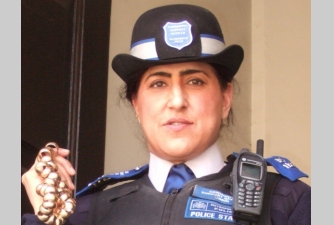
british police woman with fake rings
British police officer with confiscated fake rings used in the ring scam.  They use identical rings in France. Picture source: http://content.met.police.uk/cs/Satellite?blobcol=urldata&blobheadername1=Content-Type&blobheadervalue1=image%2Fjpeg&blobkey=id&blobtable=MungoBlobs&blobwhere=1283551938574&ssbinary=true.

The basic principle of this is that you and someone else find a gold ring at that same time, and they try to convince you that you should give them money in exchange for “their share” of the ring.  The ring is a piece of crap.  I once had the same guy try this one on me twice within twenty minutes on the same bridge.  He tried it as I was crossing the bridge in one direction, and then again as I crossed back the other way–I think he might not have been very focussed that day.  How exactly you both happen to discover this thing at the same time can vary, and how exactly the person tries to talk you out of your money can vary, but the basic principle is the same: ring, money.


This is pretty much a Roma thing, as far as I can tell.  In Paris, you should especially watch for this one on the bridges over the Seine–why, I have no clue.

The friendship bracelet
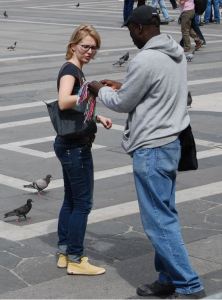
bracelet_scam
This lady made the mistake of being polite to the guy and not ignoring him and walking off–now she’s been snagged. Picture source: https://www.corporatetravelsafety.com/safety-tips/watch-out-for-the-infamous-paris-string-scam/.

The basic principle of this is that you are offered a free friendship bracelet by a friendly guy.  In fact, you don’t even have to accept it–he’ll just grab your hand and start putting it on you, if you don’t avoid him well.  Once it’s on you, it’s no longer free, and he demands a lot of money for it.  Part of what makes this work is that the guy uses the bracelet as a handle to keep you physically under control–in the best (for him)/worst (for you) case, by using your finger to make the thing for you (see below).  This is almost entirely a West African thing, and the hotbed is the steps of the Sacré Coeur basilica.  Why?  I have no idea.

The shell game

Make no mistake: the people who are doing the things that I’m describing on this page are scumbags.  They steal–they just mostly don’t use violence to do it.  In the case of the shell game (and its card-based relative, known as 3-card Monte in English) though, I have to admit that I find it somewhat difficult to feel as much empathy for the victims as I usually do.  This is despite the fact if you fall for this one, you are probably going to lose much, much more money to this con than you would to anything else on this page.  More on that in a minute.
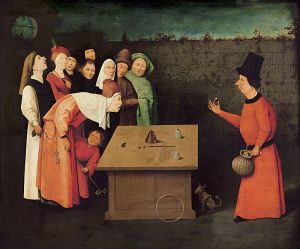
Hieronymus_Bosch_051 shell game
Hieronymus Bosch’s painting “The Conjurer,” painted between 1475 and 1480. Notice that the guy on the left in white with a black top is stealing the purse of the guy who’s watching closely. Picture source: https://commons.wikimedia.org/wiki/File:Hieronymus_Bosch_051.jpg.

The basic idea here is that the guy running the con has three cups.  He’ll put something under one of them, move the three cups around, and then give free money to anyone who can guess which cup it’s under.  It’s easy–you see the guy just giving money away.  He gets you to put up some of your own money.  You do, and all of a sudden you guess wrong.  I watched a guy doing this a couple weeks ago–he was trying to get people to put up 100 euros.

The reason that I find it harder to empathize with people who get caught by this one than with people who fall for the other cons that I describe on this page is this: people have been pulling this shit for over 2,000 years.  The shell game existed in Ancient Greece.  It was already all over Europe in the Middle Ages.  How can people not have heard of this??  I have no clue.

This is mostly a Roma thing, although I saw what appeared to be a South Asian guy doing it once.  I’ve often seen it in Paris in the near surroundings of the Eiffel Tower–mostly on the Iena Bridge, and I don’t remember seeing it anywhere else.  I have to say that this is the rarest of the Paris hustles–it requires a fair amount of set-up, and a number of confederates (when I was watching the other night, there were four adult males involved, one of whom was pretending to be a stranger playing the game, and the other two of which were hanging around discreetly nearby and watching–if you get pissed and try to take your money back from the guy, good luck duking it out with four adult males at the same time).  It’s also super, super illegal, so although the potential benefits to the crooks are large, the potential costs are, too.

The fake petition
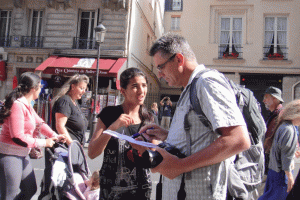
petition-3
A pretty young girl who looks like pretty much every pretty young girl I’ve ever seen doing this hustle in Paris. Picture source: https://www.corporatetravelsafety.com/safety-tips/deaf-mute-scams-in-europe/.

The basic idea: a pretty girl asks you to sign a petition.  For no reason that I understand, it’s typically about better treatment for the deaf, and indeed, she pretends to be deaf.  Once you’ve signed, you’re pressured to donate some money for the cause.  She’s not deaf, nor are the other pretty girls who are with her with their own identical petitions, nor are the other pretty girls who you’ll see in other parts of Paris with their identical petitions on the same day.  In a variant of the usual approach, while you’re signing the petition, someone is picking your pocket.  This is mostly a Roma thing, and it’s common in front of Notre Dame and the surrounding areas, as well as the Hôtel de Ville.

The fake deaf-mute

This one happens on the local trains.  A guy gets on board and walks up and down the train leaving little printed notes on the empty seats, explaining that he is deaf/mute/whatever, and do you have a little spare change?  These guys are actually the least objectionable of all of the folks who I describe on this page–they don’t pester you.  I saw a variant of this in Slovenia last week–the guy went through restaurants, leaving his little cards (trilingual–Slovenian, Italian, and German) on the tables, with a couple little trinkets that you were invited to buy.

The free flower/rosemary/herb of some variety or another

This is a variety of the here’s-something-free-that-suddenly-isn’t-free-anymore scam.  I haven’t actually seen it in France, but I include it for completeness.  In the Spanish version, it’s a little old lady on the steps of a church.  If you don’t give her money, you are threatened with a Roma curse.  (I actually find this somewhat charming–who gets cursed anymore?)  I ran into a wonderful version involving an attractive woman in an extremely short dress in Turkey.  Wonderful mostly not in that there was an attractive woman involved, but in that I was able to participate in the ensuing mess with only as much knowledge of Turkish as you get from the Pimsleur course:
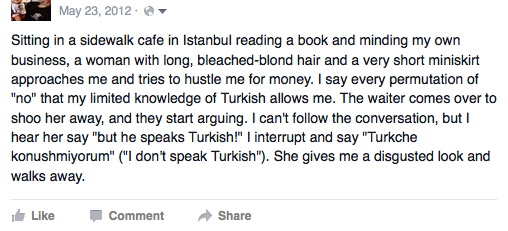
Click on the picture if you can't read it clearly.
My little adventure with a “free flower” lady in Istanbul.  Click on the picture if you can’t see it clearly–it’ll get bigger.


There are indeed lots of guys wandering through the restaurants in tourist areas trying to sell you roses in Paris, but there’s no deception involved (at least, not that I’ve experienced, and I did double-check this with a local), and they’re typically not pushy (pushiness being an identifying feature of hustling in its bad sense–see above)–it’s not really a hustle (in the bad way), per se.  I would call it the good kind of hustle–see a later post on the subject.

Videos of these folks in action

Here are some videos of these folks in action.  I didn’t shoot these–more on why you shouldn’t try to, either, below.  This is all stuff that I found on YouTube.

First, some pretty good footage of the friendship bracelet thing, shot in Italy.  I haven’t seen the shoulder thing in France, but the principle is similar–the guy does whatever he can to establish a situation such that you are physically in possession of the bracelet.  Other interesting points: notice the repeated use of a question that the guys know you’ve been answering automatically several times a day, and that it feels rude not to respond to: where are you from?  It’s also a question that lets the guy quickly establish some sort of rapport with you.  Another cute thing about this: notice the guy who keeps saying waka waka?  That’s not a Sesame Street thing–it’s Cameroonian English (Cameroon is a country in West Africa with two official languages: French, and English.)  It’s an exhortation–literally, it means something like “walk while working.”  You can hear it in Shakira’s theme song for the 2010 soccer (football, sorry) World Cup.

There’s a lot of dead footage in the beginning of this next video, but right about at the middle there’s some great footage of an attempt to snatch someone’s bags as they’re boarding the subway.  It’s a good view of how proximity to the door of a metro car is used to snatch stuff.  Atypically, these young ladies were unsuccessful, but you get the picture of how it works.

 Don’t try to film these guys in action

Don’t try to film any of this shit!  I think it’s great that people can get footage of this kind of shitty behavior and then post it on YouTube for the edification of the rest of us, but photographing or shooting video of a criminal in action is an excellent way to get punched a couple times and to have your expensive cell phone stolen.  Déconseillé, as we say in these parts.

Final words: don’t berate yourself, don’t be scared, don’t let it ruin your vacation, and don’t feel obliged to be polite to these folks

If you get snagged by the evil kind of hustler, it’s really easy to berate yourself afterwards for being a fool, a sucker.  Don’t.  Unless you go for the shell game, you’re not–these people are pros, they make their living this way. This kind of incident can really sour you on wherever you happen to be, too, and really cast a cloud over your trip.  Don’t let that happen!  These people are the tiniest, tiniest, tiniest, tiniest fraction of the people you’ll meet, and they’re pretty unlikely to be Parisians, or even French.  Plus, unless you fall for the shell game thing, these guys don’t actually take that much money off of you, and there are far, far more expensive hustles being worked in China and Turkey right now.  It’s also worth pointing out that there is very little violent crime in this country.  In America, you can get shot to death in a road rage incident pretty much any day of your life–it’s just a fact of life in our gun-cursed country.  In France, you might get robbed, but the chances of your being physically attacked if you’re not visibly Jewish are very, very low (and even if you are visibly Jewish, your chances of being physically attacked are still pretty low).  So, use some common sense, be aware that all you have to do is ignore these people, or in the case of a friendship bracelet guy handing you something, feel free to drop it on the ground and walk off without a word.  The truth is, these people are trying to rip you off, and you do not owe them one single tiny bit of the typical American friendly politeness to strangers.  You should also realize that there are plenty of people out there on the streets of Paris trying to make a living via the good meaning of “hustle”–just getting out there and working long hours in all kinds of weather, perhaps not totally within the law, but not hurting anyone, either.  We’ll talk about those in another post.

  • un tour de passe-passe: one French expression for the shell game–can native speakers help me with others?
  • l’arnaque (n.f.): rip-off, swindle, fraud, con.
  • arnaquer qqn: to rip off, swindle, or con someone.
  • c’est de l’arnaque: that’s highway robbery!
  • se faire arnaquer: to get ripped off, to be had.

Paris’s begging ecosystem

There are entire genres of begging in Paris, some unique to this city.

toblerone-hero
Picture source: https://mcfarlandcampbell.co.uk/tag/toblerone/

One evening I was on the RER (a regional train) on the way home from work when a woman of indeterminate age got on.  She was eating a Toblerone.  Excuse me, ladies and gentlemen, she said loudly.  (If it’s in italics, it happened in French.)  Could you give me some change, perhaps a euro?  She pulled out another Toblerone and examined it closely, turning it from side to side.  Sometimes I lure a man into a parking lot, and I bite him.  She put it slowly into her mouth.  Sometimes in Cameroon, I would eat a man.  Another Toblerone, which she chewed on meditatively.

By this point, I was seriously questioning my ability to understand spoken French.  I looked at my French coworker who happened to be sharing the train with me.  Did she just say…  Yep, he answered.  Parisians most definitely do not speak to strangers on trains, but this time a young woman sitting next to him joined in: “She says she eats men.”  (It’s pretty easy to tell that I’m not French, and she spoke English.)  The lady examined another Toblerone before putting it in her mouth.  I’m hungry.  If you have some money, some spare change… 

This was a very strange little speech to hear, and the whole box-of-Toblerone thing added a certain hallucinatory element to the experience.  But, in a Parisian context, it made a certain amount of sense.  Visitors to Paris usually notice pretty quickly that there are a lot of beggars here.  We talked in a previous post about why there are so many beggars here, and there are perfectly good reasons for it.  Although there are a lot of folks who are out there asking for money in this town, they actually fall into a finite number of classes, at least one of which is specific to Paris, and the cannibalistic Toblerone eater was an instance of one of them.  Here in France we love to classify things, so let’s run through the categories.  Beyond the intrinsic interest of the facts that there are categories at all and the nature of the categories themselves, it’s interesting to think about how the various and sundry categories manage to live together in an ecosystem of sorts–different kinds of beggars fill different niches in the city.

Métro: You will occasionally see someone–usually a man–get onto a métro car or a regional train and ask for money.  There’s a set ritual for this.  Basically, the guy makes a speech.  It tends to follow a specific pattern.

  1. Apology: Ladies and gentlemen, I’m sorry to disturb you during your trip.
  2. Statement of problems to be solved: I am homeless/jobless/I have four children and a sick wife and need a hotel room/money for food/diapers.
  3. Request: If you have some spare coins/restaurant tickets/a euro or two…

and then they walk through the car with a paper cup or with their hand out.  These guys don’t necessarily make much in a single car, but they typically do make something–more if they’re old, less if they’re young and look like they could be working for a living like the rest of us.  Then it’s off of that car and on to the next one.  In the light of the existence of this genre of begging, the Toblerone lady makes a certain amount of sense, and you have to give her credit for originality (or for insanity–I’m actually betting on the latter).

roma woman begging champs elysee
Roma woman begging on the Champs Elysée. Picture source: http://flickrhivemind.net/Tags/beggar,paris/Interesting.

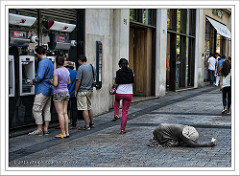
Eastern European Roma women on the Champs Elysées: There’s a genre of begging which until recently I’d only ever seen in Eastern European countries.  The way it works is that the beggar kneels on the bare sidewalk with his head on the concrete and his cupped hands held out to receive alms.  It looks really, really painful.  For the past couple years, I’ve seen Roma women doing this on the Champs Elysée.  Only Roma women so far, and only on the Champs Elysées so far.  Why them, and why there?  I have no idea.  Clearly, they’re Eastern European, but there are lots of Eastern Europeans in Paris, and I’ve yet to see any others begging like this.  Occasionally the police will come by and roust them.  They pick up their water bottles (this is, after all, 2016) and move on, then return later.

Disabled: One day this past winter I was on the metro on the way to work.  I was bundled up like everyone else in Paris, as it was cold–hat, leather jacket, neck warmer (I still haven’t been here long enough to wear a scarf), gloves.  Into the car climbed a guy in short-shorts.  His legs were these skinny, twisted things–maybe as big around as my forearm, and oddly bent.  He didn’t say a word to anyone–just struggled down the aisle with his hand out.  For a year or so, there was a guy sitting on the ground outside my metro station all day–no feet.  There’s a kid (I say “kid”–I would guess that he’s in his twenties) who has a spot outside the grocery store.  He sits there, silent, his head hanging, with a paper cup in front of him.  I’m pretty sure that he’s schizophrenic.

With kids: An Eastern European friend taught me that there’s a special place in hell for people who abuse their kids by using them for begging when they should be in school.  As far as I can tell, it’s mostly a Roma thing in Paris.  You park your family on the sidewalk under a blanket, children prominently displayed, and hold your hand out to passersby.  You occasionally also see Roma women with a baby panhandling–be especially careful, as some of them do a trick such that they only appear to be holding a baby, as it’s actually supported by a sling.  That’s the hand that picks your pocket.  (Let me point out that the vast majority of these ladies are just begging–but, the pocket-picking thing does happen, too.)

IMG_4126
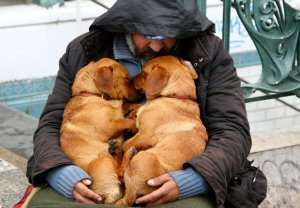
Parisian beggar with dogs. Picture source: http://www.newsner.com/en/2015/11/12-dogs-that-love-their-owners-no-matter-how-little-money-they-have/.

With animals to pet:  You’ll see a lot of people with an animal or two on their lap.  Drop some money in their cup and give doggie/kittie/bunny a scratch, if you feel like it.  Most weeks petting beggars’ dogs and cats is my only physical contact with another living being, so a lot of my change goes into these folks’ cups.  One of my favorite guys is usually in the Latin Quarter on weekend nights.  He has these two little spaniel mixes, and it’s clear that he adores them and they adore him.  The last time I saw him, I leaned over to drop a coin in his cup and pet the dogs.  It’s Orthodox Easter tomorrow, you know, he said.  (If it’s in italics, it happened in French.)  Really?, I asked.  Yeah, Easter–Orthodox Easter.  Cabbage, I said.  Have a good night.  (My French continues to suck.)  I still haven’t figured out why we had that particular conversation, other than the possibility that the next day might actually have been Orthodox Easter.  Lately I’ve been noticing shiftless young people with ill-kempt animals trying to do the pet-my-animal thing.  Their animals look like shit–not loved or cared for at all.  You can tell the difference, I think.  Note: be sure that the animal is there to be petted before you try to pet it!  This sounds obvious, and I guess that it would be to any non-stupid person.  However: I bent over to pet a kid’s pit-bull-looking dog one day without checking him out first, and he snapped at me.  I had no clue whatsoever that I was capable of jumping that far that fast–backwards, no less.  Obviously, if this dog had felt like ripping my arm off, he could have–he just gave me a little warning.  Learn from my stupidity.

Finally, there are plenty of run-of-the-mill beggars.  If they’re young, people mostly walk right by them, because there are plenty of frail old run-of-the-mill beggars that probably need your money even more.

Now, I’m not talking here about people who hustle–“hustle” in the good sense, or “hustle” in the bad sense.  With the exception of the people with animals, the people that I’m describing here are straight-up beggars.  Street musicians, mimes, comedians, dancers–that’s a whole nother genre.  Pick-pockets, 3-card monte, the ring scam, the bracelet scam–that’s yet another genre, and they each have their niches in the hustling ecosystem of Paris.


English notes

Short-shorts: very, very short pants.  Line from an advertisement for Nair, a leg-hair remover: Who wears short-shorts?  Nair wears short-shorts.  How it was used in the post: One day this past winter I was on the metro on the way to work.  I was bundled up like everyone else in Paris, as it was cold–hat, leather jacket, neck warmer (I still haven’t been here long enough to wear a scarf), gloves.  Into the car climbed a guy in short-shorts.  

bunny: an informal/children’s word for rabbit.  On my first visit to Belgium, I knew just barely enough French to order a meal in a restaurant.  Seeing a meat on the menu whose name I didn’t recognize, and being an adventurous eater, I ordered it.  It being pre-Internet, I had to ask a coworker the next day what I had had for dinner.  His response (in English): You ‘ave eaten, ‘ow you say… Bugs Bunny.  How it was used in the post: You’ll see a lot of people with an animal or two on their lap.  Drop some money in their cup and give doggie/kittie/bunny a scratch, if you feel like it.  


French notes

Cameroun: Cameroon.  Pronunciation: the is silent, so [kamrun].

Roma: there are many ways to say “gypsy” in French.  In part, I know this because my favorite neighborhood bum gave me a lecture on the topic one day, with statistics.  I have very little clue as to the current social acceptability of any of them; as far as I know, Roma or Rom is OK (just as it is in the US, where the word gypsy is definitely not OK in all circles), but I’m pretty sure that all of the others have varying levels of pejorativeness.  How it was used in the post: For the past couple years, I’ve seen Roma women doing this on the Champs Elysée.  Only Roma women so far, and only on the Champs Elysées so far.  

Losing face: what cows, dogs, and Neanderthals can tell you about why you have wisdom teeth

The story of wisdom teeth is as interesting as wisdom teeth are unpleasant.

One of the characteristics of the modern human skull is that the face is located primarily under the eyes.  What the hell does that mean?  For comparison, let’s look at some not-terribly-exotic animals. We’ll start with a nice side view of a cow.

cow-head-closeup-side-profile-9289987
Side view of a cow head. Picture source: http://www.dreamstime.com/stock-photo-profile-cow-head-image2728710.

Check out the cow’s muzzle.  Is there any sense in which you could say that the cow’s face is under its eyes?  No–the muzzle protrudes out frontally quite a bit.

In fact, by definition, a muzzle (or snout) protrudes.  From the Wikipedia post on the subject: “A snout is the protruding portion of an animal’s face, consisting of its nose, mouth, and jaw. In many animals the equivalent structure is called a muzzle, rostrum or proboscis.”

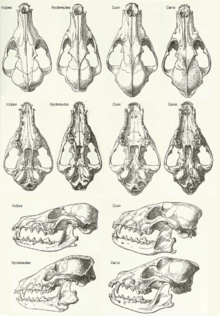
There’s quite a bit of variety in muzzle (snout) shapes in the animal kingdom.  Here are some possibilities in dogs.  Mouse-over the pictures for technical terms that describe these different skull shapes.

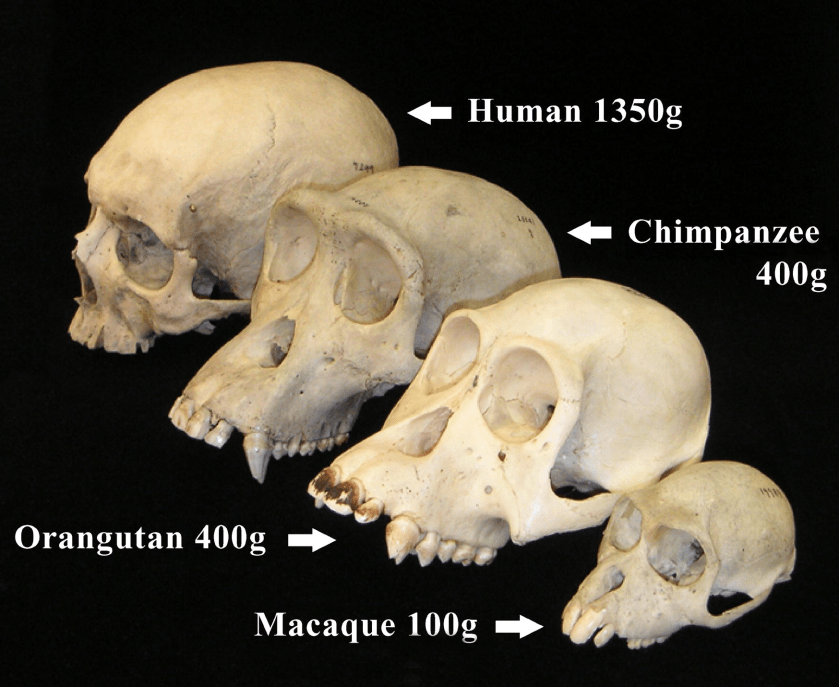
If we look at various and sundry apes, we see that they have protruding muzzles (or snouts), as well.  (Scroll down past the pictures.)  Compare the human, the chimp, the orangutan, and the macaque, and you’ll note that the three non-humans have protruding muzzles.  The human: no.  (BTW: I don’t think that the macaque is an ape.)

primate_skull_series_with_legend_cropped
Human, chimp, orangutan, and macaque skulls. I don’t think the macaque is an ape, unlike the other three. Picture source: https://upload.wikimedia.org/wikipedia/commons/d/db/Primate_skull_series_with_legend_cropped.png.
220px-msu_v2p1a_-_vulpes2c_nyctereutes2c_cuon_26_canis_skulls
Skulls of four canid species: a fox, a raccoon dog, a dhole, and a jackal. Picture source: https://upload.wikimedia.org/wikipedia/commons/thumb/1/18/MSU_V2P1a_-_Vulpes%2C_Nyctereutes%2C_Cuon_%26_Canis_skulls.png/220px-MSU_V2P1a_-_Vulpes%2C_Nyctereutes%2C_Cuon_%26_Canis_skulls.png.

We can see how this anatomy relates to the rest of the skull if we look at the skull from the underside.  Let’s go back to dogs–or dog-like things, at any rate.  Here are four different canid species.  Look at the second row from the top–that’s the underside of the skull.  The narrow thing sticking out towards the front of the skull is the palate, or roof of the mouth.  That’s the bone of the muzzle.

Where this becomes relevant to humans is that over the course of human evolution, we’ve gone from having protruding snouts to not having them. It’s hard to find a single picture that illustrates the progression, so I’ll run some individual ones by you.  Here’s an Australopithcus africanus.  Australopithecus was around from about 4 million years ago to about 2 million years ago.  They’re probably ancestral to us–if not, we share a common ancestor. Note the prominent protrusion.

australopithecus-africanus-sts5-together
Australopithecus africanus. Picture source: https://whatmissinglink.files.wordpress.com/2014/05/australopithecus-africanus-sts5-together.jpg.


homo erectus and modern human

Here’s a nice side-by-side of a Homo erectus skull and a modern human skull.

Homo erectus was around from about 1.9 million years ago until about 70,000 years ago.  It’s probably an ancestral species to modern humans.  The frontal protrusion is nothing like the australopithecine one, but it’s still there.  (Keep scrolling down–alignment problems…)


Sapiens_neanderthal_comparison
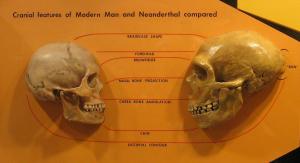
Side-by-side modern human skull and Neanderthal skull from the Cleveland Museum of Natural History. Picture source: https://commons.wikimedia.org/wiki/File:Sapiens_neanderthal_comparison.jpg.

Neanderthals were around from maybe 250,000 years ago until about 40,000 years ago.  I’m not clear on the arguments as to whether or not they’re ancestral to modern humans, but we probably inbred with them.  Not much protrusion left, at this point.

So, how does this relate to the question of why you have wisdom teeth?  The thought is that as the muzzle of early hominids shortened down to what we (don’t) have today, it resulted in a crowding of the teeth into a smaller anterior-posterior (front to back) area.

Do we get anything out of all of this change in oral anatomy?  Actually, modern humans do have a fairly unique oral cavity morphology (shape, in this sense of the word morphology).  One of the results of that morphology is a lot more space in which to make different kinds of sounds, and those possibilities do indeed get exploited in the languages of the world.  More on that another time.  Until then, here’s some relevant French vocabulary.

  • le museau: muzzle, snout
  • le groin: pig snout
  • le boutoir: wild boar snout
  • la dent de sagesse: wisdom tooth

By the way: if you’re interested in this kind of thing, it’s worth checking out both the English-language Wikipedia page on wisdom teeth and the French-language Wikipedia page on wisdom teeth.  Each one has interesting content that the other one doesn’t.

Who has a sagittal crest?

Before you hit your dog, remember that he can bite your hand hard enough to break it–but, he chooses not to.

Due to some WordPress layout issues, there are occasional gaps in this page.  Please scroll down to get past them.  Sorry!

what if i never find out whos a good boy
Picture source: https://twitter.com/m_pendar.

In America, we do love our dogs.  A culturally common way for us to show our dogs affection is this: we pet them, while saying Who’s a good boy?  (or Who’s a good girl?, depending on gender).  In my family, we do it a little differently: we pet the dog while saying Who’s got a sagittal crest?  Dogs don’t look at you with any more or less puzzlement regardless of which one you pick, so: feel free to go crazy with this one.


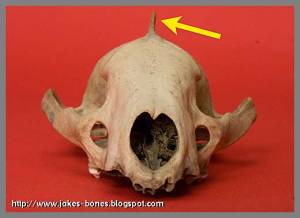
badger-4422
Badger skull. The arrow is pointing at the sagittal crest. Picture source: http://www.jakes-bones.com/2010/09/my-new-badger-skull.html.

What’s a sagittal crest?  The next time you run into a dog, run your hand along the center of the top of his skull.  That ridge that you feel is his sagittal crest.  Sagittal means along a plane that runs from the front to the back of the body.  A sagittal crest runs along that plane.  This sense of crest means something sticking out of the top of the head–think the plume on top of a knight’s helmet.  Many animals have a sagittal crest, but not us modern humans.  You see them in species that have really strong jaw muscles.  A sagittal crest serves as one of the points of the attachment of the temporalis muscle, which is one of the main muscles used for chewing.  If you have a sagittal crest, you can have a bigger temporalis muscle, which means that you can bite/chew harder.

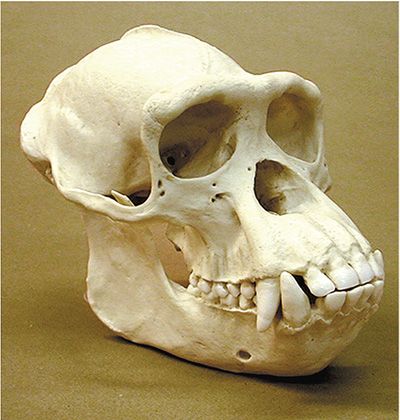
gorilla skull
Gorilla skull. Picture source: http://alfa-img.com/show/new-gorilla-skull.html.

If you look at relatively close relatives to humans, you see sagittal crests on some of them.  To the left, you see a gorilla.  You wouldn’t want to get bitten by this guy.  (Note that some gorilla species, especially their males, have really enormous sagittal crests–this is actually a pretty modest one, for a gorilla.)


pan troglodytes skull
Excellent replica of a Pan troglodytes (common chimpanzee) skull. Picture source: http://www.connecticutvalleybiological.com/product-full/product/chimpanzee-skull-pan-troglodytes.html.

Here’s (an excellent replica of) a Pan troglodytes (common chimpanzee) skull.  This guy (I think it was a guy) had more of a sagittal crest than you (you don’t have any), but he didn’t have much, compared to that gorilla.  Other chimps vary.  Monkey species vary pretty widely regarding the presence or absence of a sagittal crest.


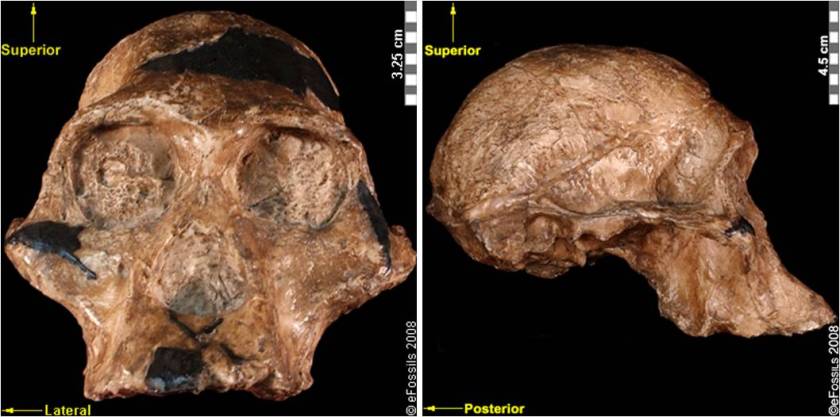
800px-Paranthropus_aethiopicus
An Australopithecus robustus species. This specimen is known as “The Black Skull.” Picture source: https://commons.wikimedia.org/wiki/File:Paranthropus_aethiopicus.JPG.

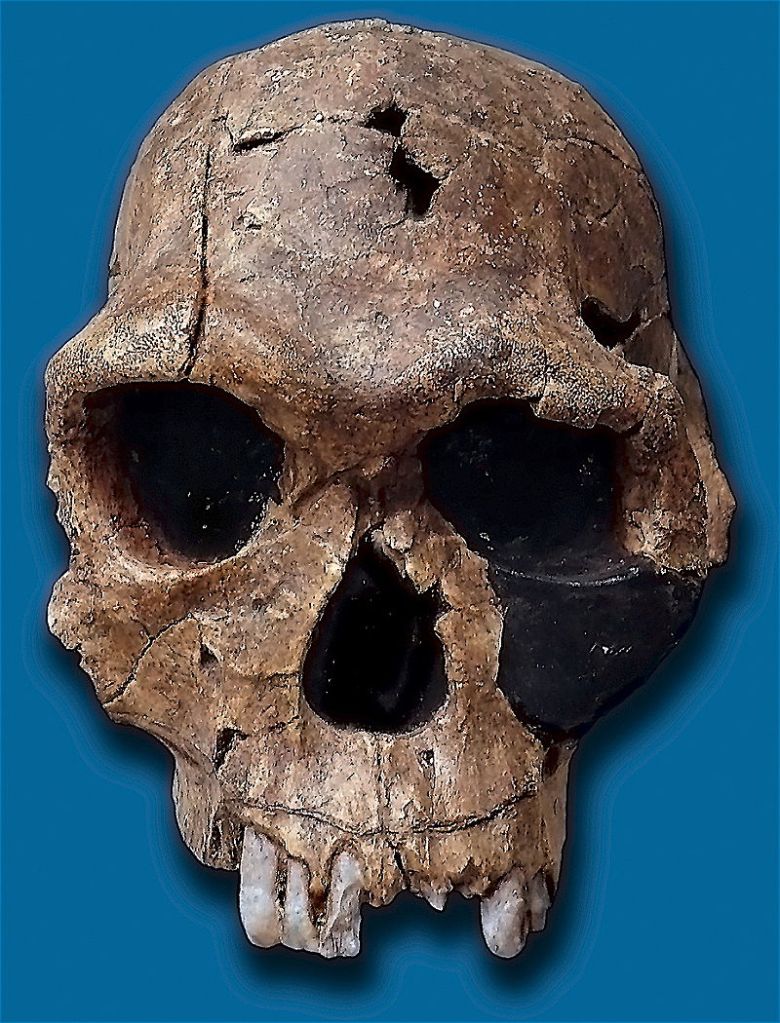
Some hominids that were ancestral to us had sagittal crests, but they disappeared pretty early in the course of our evolution.  Here is a picture of the “Black Skull,” about 2.5 million years old.  It’s from a type of Australopithecus robustus.  By the time Homo erectus comes along (starting about 1.9 million years ago and lasting until about 70,000 years ago), the sagittal crest is gone.  Picture below.

So: feel free to express your affection for your dog any way you want–you can’t possibly be any geeker than my son and me.  Scroll down past the picture for French vocabulary.

800px-Homo_habilis-KNM_ER_1813
Homo habilis skull, dated at 1.9 million years ago. Picture source: https://commons.wikimedia.org/wiki/File:Homo_habilis-KNM_ER_1813.jpg.


Relevant French vocabulary (see the Comments section for more):

  • la crête sagittale: sagittal crest
  • le muscle masticatoire: chewing muscle (note: the “c” in muscle is pronounced in French)
  • le muscle temporal: temporalis muscle
  • la morsure (action de mordre): bite (noun)
  • la morsure (marque de dents): teeth marks

How we’re sounding stupid today: staggering, test tubes, and French health care

There’s probably a finite number of ways to BE stupid, but there seem to be an infinite number of ways to SOUND stupid, at least in French.

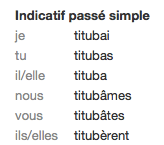
Screenshot 2016-05-20 03.08.27
The passé simple (my current favorite tense) of the verb tituber, to stagger/stumble/reel. Picture source: screen shot of http://en.bab.la/conjugation/french/tituber.

I sat in a lab yesterday waiting to have blood drawn for some routine tests.  If it’s in italics, it happened in French:

Lab tech: I’m going to take two you are staggering.

Me: (puzzled, miming staggering by walking my fingers randomly across the desktop) “To stagger” means to walk like this, right?

Lab tech looks at me for a minute, then laughs: I’m going to take two LITTLE TUBES.

Titubes is “you are staggering/stumbling/reeling.”  Petits tubes is “little tubes.”  Spoken casually, it comes out as p’ti tubes, and if you don’t hear the p, that sounds just like titubes. 

There’s a lot we could say about the linguistic phenomena behind this, but at the moment, I’m feeling more impressed by the experience of interacting with the French medical system.  The health care system here is one of the best in the world–there’s nothing you can get in America that you can’t get here.  One of my foster brothers is a surgeon with a fascinating sub-specialty.  He was sent here for a week during his training, because the surgeons in France were doing techniques that hadn’t made it to the US yet.  (I find it ironic that Pasteur (the most important microbiologist of the 19th century) was French, and now America forbids French cheeses made with unpasteurized milk if they’re less than 60 days old.  It’s going to go to 75 days soon, which will wreak havoc with the tiny bit of an artisanal cheese movement that we have in the US.)

Health care is universal here–it was declared a human right in 1948.  In addition to being great, the health care here is not expensive.  These routine blood tests done cost me $200 in the US every time that I have them done; here, along with a visit with a friendly young doctor who giggled adorably at my crappy French, they cost me exactly nothing.  You gotta laugh at those Trump-voting Americans who sneer at socialized medicine, and then want a socialized snow plow to clear their street before work in the morning…

  • le système de santé français: the French healthcare system
  • l’assurance maladie: health insurance
  • une analyse de sang: blood test
  • passer une radiographie: to have an x-ray
  • faire une radiographie: to take an x-ray
  • une radio: x-ray (slang).

It’s the little things that get you: how to say “yes” in French

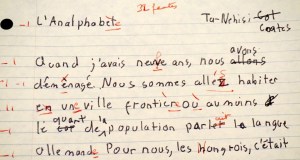
ta-nehisi coates french composition
Ta-Nehisi Coates tries to write in French. The red writing at the top of the page says “30+ errors.” What you have to realize is that in English, Ta-Nehisi Coates is one of the most articulate people you’ll ever read–or hear. Picture source: http://www.theatlantic.com/education/archive/2014/08/acting-french/375743/.

It’s the little things that get you.  It amazes and frustrates me that I can spend an evening sitting at home, happily reading a novel that uses the passé simple and the imparfait du subjonctif (two tenses that are used in literary French, but almost never in speaking–we aren’t even taught them in school).  But, then I’ll go to work the next day, and someone will say “good morning” to me in a way that I haven’t heard before, and I just stand there like a blithering idiot.

The Lawless French web site just posted an article that shows just how difficult the “easy” things can be.  It describes a wide variety of ways to say yes in French.  You certainly don’t have to use all of them yourself, but you most definitely do need to understand them.  And, as far as I can tell, it’s even more difficult than you would think from the wide range of yes-meaning expressions.  For example, I’m told that ben, oui (“well, yes”) can have different meanings, depending on the intonational pattern.  Say it one way, and it expresses uncertainty in your yes answer; say it another way, and it expresses confidence in your yes answer.

One of the ways of saying yes that the Lawless French web site talks about is, I suspect, one of the most common mistakes that us Americans make in France.  A thousand years ago when I was in college, I took a course on linguistic field methods–how to deal with a situation where you run into a language about which you have no information whatsoever.  We did Hungarian for ours.  We were all amazed when it turned out that Hungarian had two separate, non-interchangeable words, both of which meant yes, but which were used completely differently:

  • igen is what you might think of as the “usual” yes.
  • de is yes, but only when you’re contradicting something that someone has said.  You don’t want any ice cream, do you?  De.  (Yes, I do.)

Although we were all fascinated by this, it’s not that unusual of a phenomenon.  French also has a “usual” yes: oui.  And, it also has a different yes that you use when you’re contradicting a previous assertion: si.  Me, to my delightful office mate Brigitte (if it’s in italics, it happened in French): I can’t SSH into the server.  Brigitte: Si–if you can connect to the internal network, you can SSH into the server.  Si instead of oui because she’s contradicting what I said–I said I can’t, and her si means something like yes, you can. 

Back to the classic American mistake: in America, if we have any knowledge of a second language at all, it’s most likely to be Spanish.  Spanish has one word for yes, and it’s sí.  Remember the “foreign language buffer” that I swore I would not tell you about?  Put an American in a situation where they can’t communicate in English and the language that’s most likely to come out is Spanish, regardless of whether or not that’s the language that’s actually being spoken around them.  So: ask an American in France a simple question, and if the answer is yes, they’re quite likely to say si, even if on some level they know that the French word is oui.  I have made this mistake a thousand times, myself–I’m not any more immune to it than the next American.

So: check out the Lawless French web site for more ways to say “yes” in French than you ever could have imagined, and here’s hoping that you don’t sound as stupid as I do today.


From astrophysicist to data scientist

People often sidle up to me at conferences, lab retreats, or receptions at the boss’s house.  “I’m thinking about leaving academia and going into industry/Big Pharma/law school.  What will that be like?”  Here’s a response to that question, not from me, but from a colleague who went from an academic career in astrophysics to a job as a research associate in a biomedical informatics department.  Here’s what that experience was like, both for him and for his spouse.  Since he wrote this, he’s moved into a faculty position.  His wife has gone into the private sector.  French vocabulary at the bottom of the post, as usual.

As far as the transition from astrophysics, I’m terrible at giving advice, but I’ll tell you the experience of my wife and I. My wife was a liberal arts college professor and I was on my second postdoc.  Both of us were working on high-profile cosmology experiments.  Solving the 2-body problem and the stresses of starting a new family were coming into conflict with our careers, and so we realized we had to make a change.  We had been doing astrophysics so long we literally had to mourn the loss of our future careers in the field – like we literally went through stages of grief.  Part of it was thinking about all the time we had invested and all the connections we had made, part of it was that we couldn’t imagine doing anything else, and part of it was that we were doubtful we had the skill set to compete with statisticians, data analysts and computer scientists who had been doing what they were doing since they were freshmen in college.

Eventually, we realized that the time in physics and in academia wasn’t wasted, that we had learned a lot about how people and organizations function, and how to get things done.   We also found that the physics data analysis methods and ways of approaching data were actually refreshing to people outside the field.  We further realized that people with statistics degrees know a lot about logistic regression, sample size calculations, statistical tests, .. but they are more clerics – they approach problems from the point of view of “I’ve spent years learning tests, which test best fits the problem?”.  This is in contrast to the approach of physicists who are expected to think of things from first principles and build things from scratch – scouring the literature for ways to solve problems, downloading random bits of code in whatever language and modifying it, …  This is a huge advantage, because people think we are brilliant when really we are just not doing what the usual statistician would do.  As far as computer science, yeah, we realized we weren’t programmers (my wife knows more about programming than anyone I know, but she’d probably have a hard time getting a job as a programmer at Amazon).  Further, in talking to people, we found that software certifications, in some circles, are actually taken as a joke.  So depending on where you’re applying, they may be more valuable, or less.  Obviously, it was good to show we had some knowledge of programming.  My only bit of advice: learn R – it is used everywhere.  It will literally take you 20 minutes and you can put it on your resume.  Eric Feigelson has some nice tutorials (e.g., https://www.google.com/?gws_rd=ssl#q=eric+feigelson+r+tutorial ).  Also, Hadoop and Spark are pretty much industry standards, so you might think about learning something about them.

We also found  many jobs BUT NOT ALL require you take ‘tests’ – almost like entrance exams filled with brain teasers and data science questions.  I could never do them… but almost all of the interviews required us to give talks (an advantage, given our backgrounds in academia).

Anyway, I eventually obtained a job in bioinformatics analyzing language and speech production of patients with mental illness at a teaching hospital, and my wife eventually landed in a company doing consumer data analysis.  The challenges are so absorbing, the only time I think about astrophysics is when  my boss asks me about some new astronomical discovery.

We were also worried about things like time-flexibility, especially since we have kids– like having to work a standard set of hours and put in for time off, but (1) a huge number of work places now allow you to spend a lot of time working from home (it’s almost expected in some industries), (2) many work places have flexible times when you can come and go, and (3) putting in for vacation has enormous advantages.  In astrophysics, I always felt like I had to be ‘on’ even during time off.  Vacation is a way of telling everyone, “I’m gone don’t bother me” and they are forced to respect it.  Also, speaking of the workplace, a lot of tech companies are still doing this ‘open office’ concept with no walls or anything.  It’s annoying and counter-productive, but they often compensate by having spaces where you can hide, and often allow you to work from home much of the time.

We were also worried that we would be working in a place that looked like the movie “Office Space” – with people with ties speaking in cliché BS bureau-speak.  There’s some of that (and it can be hilarious), but chances are you’re going to be working with other smart people who see through that stuff.

On a more superficial note, we also found that the word ‘astrophysicist’ carries a lot of weight.  I have had Harvard-trained neurologists (the super-brilliant nerds of the clinical world!) who always introduce me as “an astrophysicist” as if I were a brain surgeon.

Anyway, the bottom line is, we realized we were way more valuable than we thought we were.  Also, we realized we were looking for employers who were willing to take a chance with a person on a non-traditional background – i.e., non-cookie cutter companies run by people who understood that there would be a learning curve and respected our backgrounds.  We discovered that they are few in number, but very much exist.

  • la science des données ou la science de données: data science.
  • les mégadonnées: “Big Data.”  Le big data, littéralement « grosses données », ou mégadonnées (recommandé3), parfois appelées données massives4, désignent des ensembles de données qui deviennent tellement volumineux qu’ils en deviennent difficiles à travailler avec des outils classiques de gestion de base de données ou de gestion de l’information.
    (Source: Wikipedia.)

Opposites in language and in the world

The opposite of talking isn’t listening. The opposite of talking is waiting.

–Fran Lebowitz

15c95ea
Picture source: https://media.licdn.com/mpr/mpr/p/6/005/09d/26a/15c95ea.jpg.
The Learn French Avec Moi blog just published a nice post about opposites in French–in particular, mostly words that you could think of as adverbial opposites relating expressions of temporality (the time of occurrence of an event):

  • déjà (already) versus pas encore (not yet)
  • encore (still) versus ne…plus (not anymore)

…and quantificational opposites relating expressions of quantity or expressions of part/whole relations:

  • et (and) versus ni…ni (neither…nor)
  • aussi (also) versus non plus (neither [in the sense of “also not”])

What does it mean to be an “opposite”?  Let’s look up opposite in a few dictionaries:

  • diametrically different (as in nature or character) <opposite meanings> (m-w.com, definition 2.b)
  • being the other of a pair that are corresponding or complementary in position, function, or nature <members of the opposite sex> (m-w.com, definition 4)
  • Being the other of two complementary or mutually exclusive things (thefreedictionary.com, definition 3)

What strikes me about this is that the definitions all refer to things in the world.  However, I don’t know of any way to define a binary relation of oppositeness in the world, as such.  Rather, oppositeness is a property of words.  It’s what we call in linguistics a lexical relation–a relationship between two words, per se.  So, in English, or at least in American English, it makes some sense to say that up is the opposite of down (the link goes to the antonym entry for up in WordNet), or that bad is the opposite of good (again, the link is to WordNet).  But, these are relationships between the word up and the word down, between the word good and the word bad–there isn’t any clear way to define a notion of opposite between things, as opposed to between words. 

We’ve talked a fair amount about ontologies in this blog–models of the things in the world and the relationships between them.  If you look at ontologies–you can find hundreds of them here, all specializing in the biomedical domain–you’ll see that these models of things and the relationships between them have no notion of oppositeness.  If you want to find the idea of oppositeness encoded, you have to look at models not of things, but of the words of a language, such as the WordNet entries that are linked to above.  It’s entirely relevant here that many ontologists insist vociferously that WordNet is not an ontology.  (Why you would wax vociferous over the question of what is and isn’t an ontology, I don’t actually know–there seems to be a certain religious element to the field…)

People act as if they think that other people have mental models that include some notion of being an opposite of something else.  You can see this in metalanguage–talking about language (all quotes from brainyquote.com):

The opposite of talking isn’t listening. The opposite of talking is waiting.  –Fran Lebowitz

 I have a very strong feeling that the opposite of love is not hate – it’s apathy. It’s not giving a damn.  –Leo Buscaglia
The opposite of bravery is not cowardice but conformity.  –Robert Anthony
It strikes me as significant that Lebowitz, Buscaglia, and Anthony all are aware of oppositeness–but, they see it as something that you could be wrong about.  This strikes me as an implicit awareness that oppositeness is not a property of the world–not something that you can measure, not something that you can quantify, not something that is obvious.  If it’s not about the world, then what is it?  Ultimately, being an opposite is a fact about the language that we use to talk about the world.  We can talk about whether language has a role in reinforcing how we think about the world–does the fact that English only has two words referring to genders have the effect of constructing a binary opposition where there are actually many genders?  Does language play into supporting dichotomies like colonizer/colonized, male/female, capitalism/Communism?  Maybe.  That doesn’t change the essence of the fact that oppositeness isn’t a property of the world.  A property of systems, quite possibly–indeed, it’s a fundamental notion of structuralism, not just in linguistics but in the many relatives and descendants of structuralism in anthropology, sociology, literary criticism, psychoanalysis–on and on.  Certainly we talk about those systems with language.  But, that doesn’t change the fact that the opposites exist in how we conceive of and talk about those things–not in the things themselves.
Translating the word opposite from English to French is a tough one.  There are different corresponding words for things, locations, directions–I stumble over them fairly frequently.  One option for saying that something is the opposite of something else is l’opposé de or à l’opposé de.  I don’t know when you would use one or the other.  Here are some examples of each from the linguee.fr web site:


In fact, I think that taking life is the opposite of reproductive health.
Je pense d’ailleurs que la suppression d’une vie est à l’opposé de la santé génésique. (europarl.europa.eu)
The result is an attitude which is the opposite of true supporters and allies.
Avec pour résultat une attitude à l’opposé des fidèles soutiens et alliés. (esisc.net)
Red is the opposite of green, blue is the opposite of yellow and white is the opposite of black. Le rouge est l’opposé du vert, le bleu est l’opposé du jaune et le blanc est l’opposé du noir. (thinkfirst.ca)
A “terroir” wine is the opposite of a technological wine.

Un vin de terroir est à l’opposé d’un vin technologique. (cave-cleebourg.com)

 This is the opposite of what many people are now used to in other environments. fdisk(8) does not warn before saving the changes…
C’est l’opposé de ce que beaucoup de gens peuvent voir sous d’autres environnements. fdisk(8) ne demandera aucune confirmation… (openbsd.gr)
In this situation, branches are the opposite of “land rich and cash poor”.

Dans cette situation, les filiales sont l’opposé de ”riches en terrain et pauvres en argent”. (legion.ca)

 The color example is a good one: Red is the opposite of green, blue is the opposite of yellow and white is the opposite of black.  Red clearly isn’t the opposite of green in any scientific sense.  Cultural sense?  Sure.  Blue and yellow?  Not that I know of.  Not even white and black?  No–black has the same relation to red, green, and blue as it does to any other color.
I memorized the Learn French Avec Moi post on opposites–it’s a very useful linguistic concept.  Check it out!

No one knows why people have chins

Two facts about chins: (1) Only humans have them. (2) No one knows why humans have them.

Two facts about chins: (1) Only humans have them.  (2) No one knows why we have them.

The chin isn’t just specific to humans: it’s specific to modern humans.  Earlier forms of us didn’t have them.  I think it shows up around the time of Cro-Magnon Man, the earliest form of modern humans, about 45,000 years ago.

homo erectus and modern human
Side-by-side Homo erectus and modern human skulls. Picture source: http://www.slideshare.net/PaulVMcDowell/fossil-hominins-from-australopithecus-to-homo.

Homo erectus was around from about 1.9 million years ago until about 70,000 years ago.  It’s probably an ancestral species to modern humans.  No chin, though.


Sapiens_neanderthal_comparison
Side-by-side modern human skull and Neanderthal skull from the Cleveland Museum of Natural History. Picture source: https://commons.wikimedia.org/wiki/File:Sapiens_neanderthal_comparison.jpg.

Neanderthals were around from maybe 250,000 years ago until about 40,000 years ago.  I’m not clear on the arguments as to whether or not they’re ancestral to modern humans, but we probably inbred with them.  No chin, in any case.  (Note: I’m not a big fan of arguments that are only backed up by a single data point.  For lots more pictures of Neanderthal skulls, go to Google Images.  You still won’t find any chins.)

Neoteny_in_humans
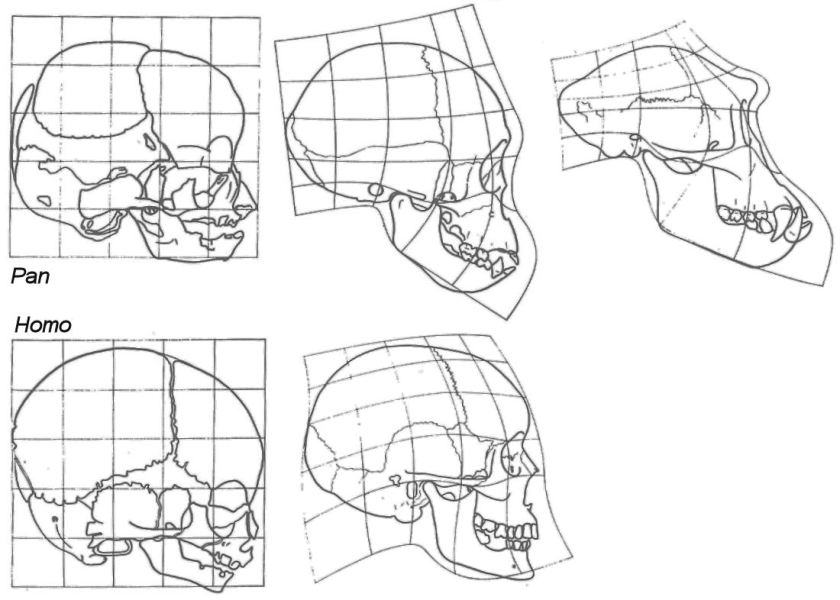
Chimpanzee skull development on the top, human skull development on the bottom. Picture source: https://www.mun.ca/biology/scarr/Neoteny_in_humans.htm.

I’ve read that human infants don’t have chins, but rather they develop over the course of growth.  From the skulls that I’ve looked at, this isn’t true–if you look at a human infant’s skull and the skull of any of a variety of apes, the human infant skull looks pretty distinct to me, in part because of the presence of a chin.  A tiny, not-very-protuberant chin, sure–but, a chin nonetheless.

Do we really not know why modern humans have chins?  We really don’t.  Which is to say: a number of proposals have been advanced, but none of them is very convincing.  Some of those proposals:

  • Chins protect the lower jaw from the mechanical stresses of mastication (chewing).
  • Chins protect the lower jaw from the mechanical stresses of speaking.
  • Chins are what is left behind after the rest of the face shortens over the course of human evolution.  (Look at how far the adult chimp’s face sticks out in the series of drawings of human and chimp skull development; then compare the adult human face, which doesn’t stick out.)
  • Chins are meant to deflect blows to the face.
  • Chins come from unspecified “changes” related to reduction in testosterone levels over the course of human evolution.

None of these is a great explanation; some of them are very bad explanations; all of them are difficult to test.  For some approaches to thinking about these various and sundry proposals, see any of these pages:

Some relevant French vocabulary for talking about the chin:

  • le menton: chin.
  • mentonnière: Although I can’t find this in the dictionary as an adjective, I think that it can be: Le mouvement volontaire de saillie mentonnière est assurée par l’extrémité de la sous-unité corporéale de l’os mandibulaire et par le muscle releveur du menton (aussi nommé houppe du menton ou incisif inférieur).  “The voluntary movement of chin-projecting…”  Can a native speaker verify this?
  • la mentonnière: chin-piece.

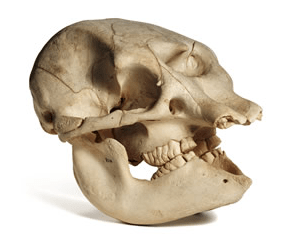
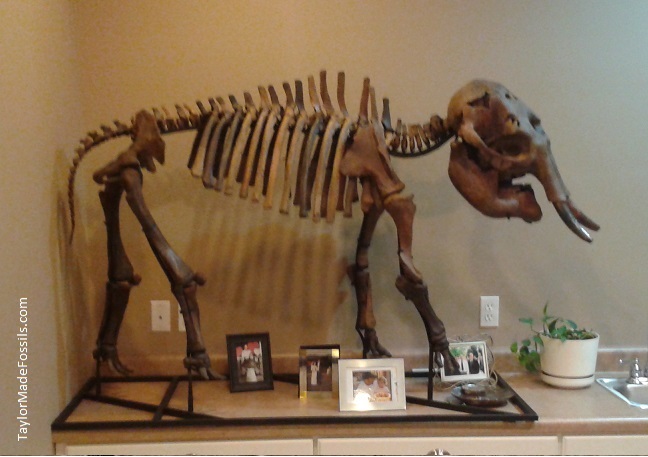
By the way: as MELewis has pointed out, if you want to have this discussion in any sort of detail, it’s important to have a definition of “chin.”  In fact, depending on how you define it, you might want to say that elephants have independently involved a chin.  Here are some pictures: an elephant skull, a mammoth skull, and a mastodon skull.  All three of them show chin-like structures.

elephant skull
Elephant skull from the California Academy of Science. Picture source: http://thinkelephants.blogspot.com/2013_11_01_archive.html.
baby_mammoth_skeleton_2011_b_text
Baby mammoth skeleton. Picture source: http://www.angelfire.com/mi/dinosaurs/mammoth_fossils.html.
Mastodon skull
Mastodon skull from the La Brea tar pits. Picture source; https://www.flickr.com/photos/63799013@N00/3275842356.

Data mining, text mining, natural language processing, and computational linguistics: some definitions

Parsing, data mining, and encryption are not going to get you. That pistol in your nightstand might, though.

Every once in a while an innocuous technical term suddenly enters public discourse with a bizarrely negative connotation.  I first noticed the phenomenon some years ago, when I saw a Republican politician accusing Hillary Clinton of “parsing.”  From the disgust with which he said it, he clearly seemed to feel that parsing was morally equivalent to puppy-drowning.  It seemed quite odd to me, since I’d only ever heard the word “parse” used to refer to the computer analysis of sentence structures.  The most recent word to suddenly find itself stigmatized by Republicans (yes, it does somehow always seem to be Republican politicians who are involved in this particular kind of linguistic bullshittery) is “encryption.”  Apparently encryption is now right up there with dirty bombs in terms of things that terrorists are about to use to kill us all.  (“All” might be an exaggeration.  I find it interesting that the United States had 33,169 firearm deaths in 2013–roughly 11 times as many deaths as on 9/11–and yet, Republicans seem to think that it’s important that we make firearms as widely available as possible.  I guess they just don’t like people very much.)  As a moderately technical person, this strikes me as odd, since I’ve always thought of encryption as that nifty mathematical technique (I was about to say “algorithm,” but I think the Republicans are down on that one now, too) that keeps you from intercepting my text messages, me from reading your Ashley Madison profile, and so on.

In between the Republican outrage over parsing and the current panic over encryption, we had the sudden appearance in the public consciousness of data mining.  As far as I knew up to that point, data mining was a bunch of statistical techniques for finding relationships between things.  Suddenly it was showing up in scary news stories–Google the phrase “data mining is evil” (you have to put the quotes around it to search for the phrase, as opposed to the individual words) and you will get 1,400 hits as of the time of writing (May 2016).

Besides being bemused by this intrusion of American know-nothingness into public discourse, I have a personal stake in the issue, because people often refer to what I do for a living as text data mining.  This is a misnomer–by its nature, data mining is not something that you can do with texts.  Bear with me and I’ll explain why, and then we’ll look at some French vocabulary for talking about all of this.

data-mining
Data mining is a set of mathematical and computational techniques. Somehow it became a threatening expression a couple years ago, leading to crap like this. Picture source: https://theamericangenius.com/tech-news/top-10-companies-mine-sell-data/.

Data mining is basically about databases.  In a database, the statistical techniques of data mining can help you do things like discover that Republicans with HBO subscriptions are more likely to consider voting for Romney in a primary than Republicans who don’t have HBO subscriptions.  (Real one, if I remember the facts correctly.)  You can do that because you have a table in the database that tells who’s a Republican, a table that tells who has HBO subscriptions, and a table that tells you which members of a random sample told the interviewer that they would/wouldn’t consider voting for Romney in a primary.  Data mining is the science/art of figuring out what things are related (HBO subscription/willingness to vote for Romney) and what things aren’t related (making one up here: having bought an Escalade and being willing/unwilling to vote for Romney in a primary)–this among probably thousands and thousands of variables.  Doing data mining research requires things like knowing particular kinds of math, understanding how to sample a population, getting computers to do complicated calculations in a way that is time-efficient—stuff like that.

text mining
Text mining is a set of techniques for using computers to cope with the enormous amount of written information in the world today. Picture source: http://www.authorstream.com/Presentation/dchiavetta-1383718-text-mining/.

With data mining, you have that database, and you know what everything is.  With “text mining,” or “text data mining,” as some people call it, you have texts, and you don’t know what anything is.  (By “you,” I mean a computer program.)  This is usually talked about as a difference between “structured” data (i.e., the database)–you know what everything “is”–what it “means”–in some sense, its semantics.  Whoops–that sentence got a little out of control.  “Unstructured” data: that’s typically how we would describe text.  With text, you know what nothing is–you don’t know what anything means–in a very literal sense, you don’t know its semantics.

“Text mining” could be thought of as turning unstructured data into structured data.  You’ve got a bunch of texts, and you want to use it to populate a database, perhaps.  Maybe you have 23 million journal articles in the National Library of Medicine, and you want to find every statement that those 23 million articles make about which genes are affected by which drugs.  Maybe you have a huge collection of French fairy tales, and you want (the computer) to find every time that a stepmother is mentioned and whether the portrayal of the stepmother is positive or negative.  You could think of both of those as turning unstructured data into structured data–you’re taking that unstructured data and using it to build a database about drugs and proteins, or a database about stepmothers.  You can see now why we tend to prefer the term “text mining” to “text data mining”–to the extent that “data mining” is about structured data, it doesn’t really make sense to talk about “data mining” with respect to language.  Where the data mining person basically just needs to know math, the text mining person needs to know something about how people write about whatever it is that you’re interested in.  I do a bit of text mining.  People will have really specific requests–tell me whether or not the genes from some experiment show up in the cancer literature, say; tell me if this is a suicide note or not; read this doctor’s note and tell me if this kid is a candidate for epilepsy surgery; stuff like that.  It’s not really linguistics, but it pays the bills, and it suits my need to do something that might actually make the world a better place.

A related field is natural language processing.  Natural language means human language, as opposed to computer languages.  Natural language processing is about building tools to handle specific linguistic tasks–parse a sentence, figure out parts of speech, stuff like that.  You might use a combination of different language processing programs to do a text mining task.  I find this more interesting, since the questions are less about some set of facts than they are about the language itself.  Where the data mining person needs to know math and the text mining person needs to know how people write about genes and drugs, or stepmothers, or whatever, the natural language processing person needs to know something about language itself–what kinds of structures sentences can have, how word frequencies are distributed, how to build linguistic resources for letting a computer process things that can’t be directly observed (e.g. semantics).  I do a lot of this kind of stuff.  Recently I’ve been working on coreference resolution–how to get a computer to recognize that Obama, President Obama, and Barak Obama are all referring to the same thing in the world, while Mrs. Obama and Michelle Obama are referring to something else in the world.  (Recognizing that those “things” in the world are people, as opposed to, say, locations, or the names of companies, is a whole different story.)

Yet another field is computational linguistics.  This is about using computational models to test theories about language.  This is my favorite, but it’s the hardest to pay the bills with.  I do some of this, too.  Nowadays a lot of my time goes into large-scale attempts to model the semantics of biomedical language.  I’m trying to investigate differences in the semantic primitives of biomedical language versus “general” English by building a large set of data-driven semantic representations of predicates found in journal articles; I’ll then compare that resource to a similar resource built for general English and look for things like whether or not the semantic primitives seem to come from the same set, whether or not given verbs have different representations in the two types of language, etc.  My hope is to get a sense of the range of types of semantic variability from this particular project.  You could imagine using computational linguistics work to build natural language processing tools, and then using those to carry out practical text mining tasks.  You could use the text “data” mining results to do actual data mining.

gender binary examples
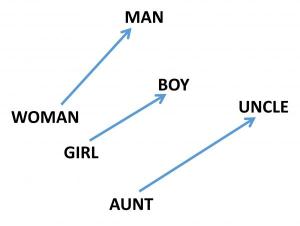
Mathematical representations of semantics can define how the gender binary gets manifested in English. This diagram transforms gendered word relationships into a map-like space. Pairs like girl/boy and aunt/uncle have the same “spatial” relationship. Picture source: http://www.offconvex.org/2015/12/12/word-embeddings-1/.

As you can tell from my examples, I’m very much in the world of biomedical language.  There’s also a lot that you can do in the humanities with this kind of stuff.  A hot topic in the future might be using mathematical representations of semantics to study things that are/are not thought of as binaries–gender, sexuality, race, political economy, whatever.  However, I would not claim to do ANY of that–I can just barely explain it.  For more on that kind of stuff, see this excellent post by Ben Schmidt.

In practice, even people in the field don’t always differentiate between these terms, or at least don’t draw sharp boundaries between them.  My business card says that I’m the director of a text mining group, but I identify most strongly as a computational linguist.  We figured that “text mining” makes more sense as a practical field of inquiry to have within a medical school (which is where I work), so that’s what we called the group when we formed it.  If you go to the annual conference of the Association for Computational Linguistics, you will see almost no computational linguistics, but rather a ton of natural language processing.  If you go to the annual Biomedical Natural Language Processing meeting, you’ll see a mix of text mining, natural language processing, and a bit of computational linguistics.  Sometimes the distinctions really matter, though.  This post started its life as a response to someone who asked me to be on a panel about data mining, to talk specifically about text data mining.  When I responded that I don’t do data mining, they asked what the difference is–this blog post started out as my response.

As far as I can tell, the relevant community in France doesn’t make these distinctions in any kind of rigid fashion, either, despite the much-vaunted French penchant for categorization (see Nadeau and Barlow’s excellent book for a discussion of where it comes from).  However, French does have technical vocabulary for all of these fields.  Here it is:

  • fouiller: to excavate; to rummage through, to search (see also here)
  • la fouille de données: data mining
  • la fouille de texte(s): text mining
  • le traitement automatique des langues naturelles: natural language processing
  • la linguistique informatique: computational linguistics
Ukrainian Humanitarian Resistance

Resisting the russist occupation while keeping our humanity

Languages. Motivation. Education. Travelling

"Je suis féru(e) de langues" is about language learning, study tips and travelling. Join my community!

Curative Power of Medical Data

JCDL 2020 Workshop on Biomedical Natural Language Processing

Crimescribe

Criminal Curiosities

BioNLP

Biomedical natural language processing

Mostly Mammoths

but other things that fascinate me, too

Zygoma

Adventures in natural history collections

Our French Oasis

FAMILY LIFE IN A FRENCH COUNTRY VILLAGE

ACL 2017

PC Chairs Blog

Abby Mullen

A site about history and life

EFL Notes

Random commentary on teaching English as a foreign language

Natural Language Processing

Université Paris-Centrale, Spring 2017

Speak Out in Spanish!

living and loving language

- MIKE STEEDEN -

THE DRIVELLINGS OF TWATTERSLEY FROMAGE