The Internet is full of web pages, blog posts, and out-and-out screeds on the subject of How you can tell that you’ve become French/Parisian/Provençal/name-your-region-of-choice. One of the common themes: you no longer struggle with numbers.
I find that French speakers often have trouble buying this, but it’s true (to buy in this weird sense explained in the English notes below): I can have a conversation in French about Marx’s critique of ontology versus Simone de Beauvoir’s critique of the same and why the latter is relevant to computational bioscience but the former isn’t–but, I can’t even begin to understand French numbers. (Marx: what you should be doing is trying to change reality, not trying to understand it, and besides, it’s completely determined by economics, so what’s the question? Not relevant to computational bioscience. Simone de Beauvoir: ontology is inherently essentialist, but being a woman is a matter of contingency, not essence; ontology gets misused to relegate women to a secondary status. Relevant to computational bioscience, which takes gender as essential (and binary, but we can get into that another time). My interpretation–your mileage may vary.)
This difficulty with French numbers has real consequences for my life. For example: at work, we use quantitative measures of system performance. Someone will be discussing their approach, and they’ll give a number for the results of their most recent experiment, and by the time I figure out whether it’s a big number or a little number, 15 seconds have gone by and I’ve lost the thread of the conversation.
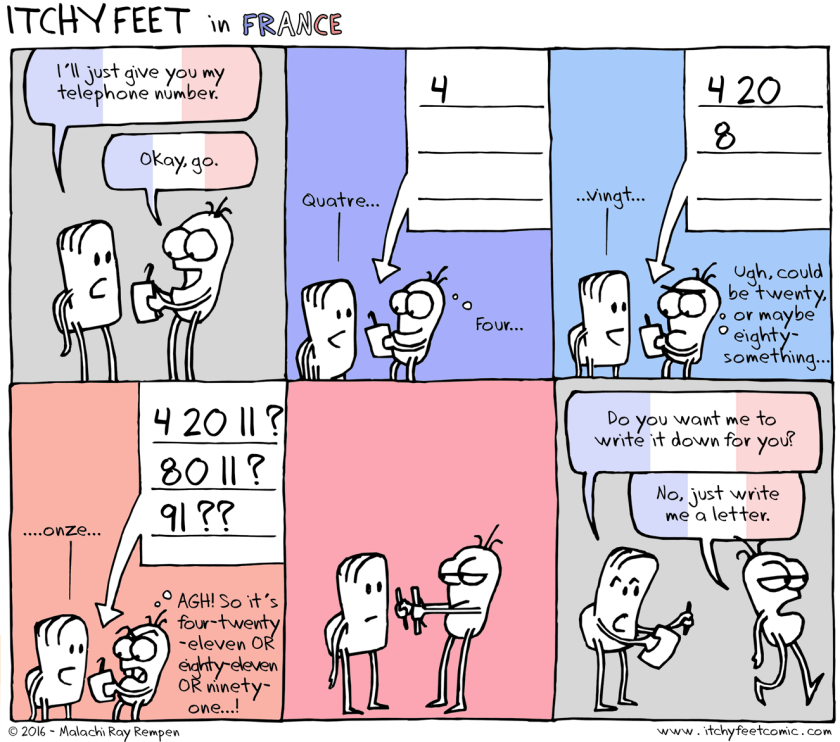
The comic that you see above captures the feelings of much of the anglophone population of France, as far as I can tell from reading countless memoirs of the expat experience in this amazing country. History? Forget it–by the time I figure out whether we’re talking about the 1800s or the 1900s, the last two numbers have long gone by. This evening I was listening to a podcast of La méthode scientifiqueon the question of the origins of life, and they were tossing around times on the scales of billions of years, and it was practically impossible. (As far as I could tell, milliard is used both for “thousands” and “billion.” They’re not: as Laura Lawless explained it to me, Nope. You’re mixing up “milliards” (billions) and “milliers” (thousands).) Honestly, I could go on and on (and on and on) about this, but I think you get the point.
What to do? I suggest the sound files on the Lawless French web site. Scroll down towards the bottom of this page and you’ll find links to a number of sets of random numbers, including some that are all years, all prices (if I had a nickle for every time I’ve confused deux euros and douze euros…), etc. In a kind world, YouTube would be filled with videos of smiling native speakers reading random numbers and then holding up signs with the answer, but until that happy day arrives, Laura Lawless is your savior in this matter.
Want to read more about Anglophone struggles with French numbers? Check out the next post.
English notes
to buy: besides the basic meaning, this can also mean to believe or to accept a claim. Some examples from Twitter:
I don’t buy the idea that people are walking around saying things they don’t mean. At some point, after repeated repetition, they mean them. (What the writer doesn’t believe: the claim that “people are walking around saying things (that) they don’t mean.”)
I really agree with this. I keep seeing her described as a weak candidate and I don’t buy it. (What the writer doesn’t believe: the claim that an unspecified female is a weak candidate.)
@anonymized that’s what I tried to tell him. He didn’t buy it. (What “he” didn’t believe: whatever @anonymized had claimed, which the writer of this tweet also claimed, in a conversation with “him.” OK: you’re on your own for the rest, but feel free to ask questions in the Comments section.)
One of the panelists said she doesn’t buy that the ad agency is dead or on its way there.
my mom’s just jealous cause her sister had blonde hair & not her. She doesn’t buy that God made a mistake w me 😦
My wife is so beautiful that when I saw her comin up 2 the N tower (Livingston) I had 2look away. She doesn’t buy that story.
Oh God just had a flashback to being in a seminar and a woman saying she doesn’t “buy” that there are other genders in other cultures o m g
didn’t give me permission to get into school because I was really late to school. I was sick for fck’s sake but he didn’t buy my excuse
I just tackled a guy in a football jersey but the police didn’t buy my excuse of “Look at how he was dressed, he was asking for it.”
How it was used in the post: I find that French speakers often have trouble buying this, but it’s true: I can have a conversation in French about Marx’s critique of ontology versus Simone de Beauvoir’s critique of the same and why the latter is relevant to computational bioscience but the former isn’t–but, I can’t even begin to understand numbers.
I first heard about the 9/11 attacks while sitting in my office. I’d just eaten my peanut butter sandwich–3 hours before lunch. Crap. My wife called: a plane had flown into one of the World Trade Center towers. Private plane? Airliner? Accidentally? On purpose? No one knew. Soon she called back: the other tower had been hit, too.
All of the news sites were crashing under the load, but one of my office mates had a radio–not a common thing in those days. People gathered around; we listened as the towers fell, as the Pentagon was hit, as Flight UA93 went down in Pennsylvania.
One of the grad students wasn’t quite there with the rest of us, though. After an hour or two, he said: this is huge, and the repercussions of this are going to be playing out for years, but I really need to get this assignment finished. …and he went back to hacking.
Personally, I was useless for the rest of the day. Around noon, it seemed pretty clear that nothing else was going to happen, and I went home to see if I could catch it on TV. We talked about how to break the news to my kid. We found out how to donate blood. I spent hours on the phone trying to make sure that my cousin who spent a lot of time at the Pentagon was OK. Work: not at all.
I felt pretty much the same today. 6 AM China time found me sitting in front of my computer watching the first returns come in. By mid-morning, I did what I do when I’m really, really unhappy: I crawled into bed and went to sleep. When I got up an hour later, the situation was even worse. The rest of the day was spent flipping between NBC and the Politico web site, where I watched the pool of red spread across the country. Normally when I’m anxious, I deal with it by working. A very adaptive response, I find–but, I was way beyond anxiety. As bizarre as this will sound: I found myself passing the time waiting for Trump to give his acceptance speech making French vocabulary flash-cards, because that’s at least easy and distracting, and it gave me a way to think about something other than the fact that a complete assclown had just been elected president of the most powerful country in the world (for the moment–until he fucks it up; assclown explained below in the English notes). When it was all over, I found myself doing something that I haven’t done in a long, long, long time: watching cartoons on TV. They were on the one French-language station that I’ve found in China. It was about ninja cats. They used the subjunctive, so I’m counting it as studying.
As it happens, I’ve been trying to find a good French equivalent for the American English expression “to screw (something) up” or “to mess (something) up.” I’ve been using merder, but I have a feeling that it’s too vulgar for a lot of contexts. Sometimes you come across things right when you need them, and as I watched a lot of American voters screw up very badly, I came across foirer and faire foirer. I found these definitions of them:
foirer: to screw (something) up, to mess (something) up (WordReference). To mess up, to go wrong, to fail (Reverso.net).
faire foirer: to mess (something) up (Collins)
OPUS2 is a collection of millions of words in the same text translated between about 40 different languages–what’s known as a parallel corpus. EUROPARL is another parallel corpus–a collection of the proceedings of the European Parliament translated between all of the languages of the European Union. I searched them through the Sketch Engine web site’s interface.
Seems relatively innocuous. However, looking at translations on line, I think it might be stronger than the dictionary suggests. I found translations along the lines of “screw/mess up,” but I also found plenty of “fuck up,” particularly in the OPUS2 corpus. And, foirer doesn’t show up even once in the EUROPARL corpus, which is consistent with the idea that it might not be as socially acceptable as the WordReference and Collins definitions suggest. (Neither does merder.) Here are some examples of both, from OPUS2 and from the Linguee.fr web site.
Foirer:
Tu foires tout!You’ve done nothing but screw up! (OPUS2)
J’ai tout foiré. I messed up bad. (OPUS2)
J’ai eu ma chance et j’ai foiré.I had my chance, and I muffed it. (OPUS2)
C’était comme un mariage foiré.It was like a really fucked up wedding. (OPUS2)
Et qu’arrivera-t-il si je foire tout encore une fois?What happens if I fuck up again? (OPUS2)
II y a huit jours, vous êtes arrivé défoncé à une simple néphrectomie, vous l’avez foirée, mis le patient en syncope en le tuant presque. Eight days ago you showed up half-stoned for a simple nephrectomy … botched it, put the patient in failure, and damn near killed him. (OPUS2)
Ça foire quand on arrive aux desserts.It always goes wrong when we come to the desserts. (OPUS2)
Depuis que je suis rentré, je foire tout ce que j’entreprends.It’ s just that since I got back, it seems like the only natural talent I got is for screwing up. (OPUS2)
J’ai foiré mon audition aujourd’hui. I did terribly at an audition today. (OPUS2)
Si ça a foiré, je veux savoir comment.If this is fucked up, I wanna know how. (OPUS2)
Nous avons tenté de faire une tournée à l’étranger et deux tournées étaient presque confirmées mais bien sûr elles ontfoiréà la fin. We tried to get some abroad tour and two tours were already nearly confirmed but of course in the end they fucked up. (Linguee.fr)
Ceci est susceptible de fairefoirervotre partenaire, puisqu’il a alors un temps mort, et qu’il ne relancera donc pas la… This trick is likely to make your partner fuck up the pattern as she gets a ‘hold’, and thus won’t be passing back the same… (Linguee.fr) (I put this under faire rather than faire foirer because it’s the partner who’s going to foirer–a different construction from faire foirer followed by a direct object, I think.)
…lieu 20 minutes avant que CATHEDRAL ne monte sur scène : j’ai littéralement foiré ma performance à cause du style vocal ! …literally 20 minutes before CATHEDRAL was due to play on stage, so I literally fucked my performance due to the vocal style! (Linguee.fr) (Can’t wait to see the reactions to avant que…ne monte!)
Faire foirer:
Vous faites foirer le plan. You’re screwing up the plan. (OPUS2)
Seulement si tu fais tout foirer. Only if you blow it, dear. (OPUS2)
Il me plaît vraiment, alors ne fais pas tout foirer. I really like him, so don’t screw this up. (OPUS2)
C’est comme si tu voulais tout faire foirer. It’s like you’re actually trying to screw this up. (OPUS2)
Mais j’ai juste tout fait foirer pour tout le monde. …but I’ve just messed up everything for everyone. (OPUS2)
Ensuite, le bureau central fait tout foirer.And the Central Office then proceeds to screw everything up. (OPUS2)
Nous sommes en parfaite osmose avec Waldemar et nous ne pouvions pas nous permettre de tout fairefoirer. We are in perfect osmosis with Waldemar and we could not allow ourselves to screw everything up. (Linguee.fr)
Native speakers: how about it? Can I say merder at work? Can I say (faire) foirer at work? In front of a friend’s children? In front of a friend’s mother? Input appreciated. Like the grad student said: the repercussions of yesterday’s American presidential election are going to be playing out for years, and I think that I’m going to be needing a way to talk about how badly the American voter has “screwed things up” for quite a while to come…
English notes
In Assholes: A theory of Donald Trump (originally published under the title Assholes: A theory) the philosopher Aaron James defines assholes in general like this:
A person counts as an asshole, when and only when, he systematically allows himself to enjoy special advantages in interpersonal relations out of an entrenched sense of entitlement that immunizes him against the complaints of other people.
Il naquit une fois au centre de la Chine une vachette. Elle aima sa maman, et sa maman l’aima. Elle passa son enfance en jouant avec ses amis, en vadrouillant dans la pâture, en découvrant le goût, si doux, du mélilot. Ce fut bon, le goût du mélilot.
Un jour elle eut mal aux mamelles. Le fermier constata ça. Il fut bienveillant, le fermier. Mal aux mamelles : non plus. Ce fut bon, être traite.
Un jour d’automne elle eut un genre de faim. Pour quoi, elle ne sut pas. Le fermier constata ça. Il fut bienveillant, le fermier. Le fermier la mena à la pâture. Il y eut l’odeur de pommes mûres dans l’air. Il y eut un taureau. Ce fut bon, être dans la pâture, un jour d’automne, l’odeur de pommes mûres dans l’air, avec un taureau.
Au fil des mois elle accoucha une vachette. Elle aima sa vachette. La vachette l’aima, sa maman. Ce fut bon, l’amour.
Un jour elle eut du mal à se mettre debout. Le fermier le constata. Il fut bienveillant, le fermier. Il lui apporta du mélilot. Elle mourut sans peur, sans peine, sans douleur. Ce fut bon, le goût du mélilot.
Une jeune fille à Shanghai qui était timide mangea sa langue, et le jour d’après elle parla. Un gars à Pékin, anémie, mangea son foie, et le prochain jour il courut avec ses amis. Moi, à Wuhan je mangeai son coeur sur un lit de nouilles frites, et je sentis à l’aise dans un pays où je ne pouvais ni parler, ni lire, ni courir. (Question de vieillesse, pas d’anémie.) Ce fut bon, être à l’aise dans un pays où je ne pouvais ni parler, ni lire, ni courir. Il y eut un léger goût du mélilot.
Le parfait latin était traxi, traxis, traxit… Le passé simple en ancien français alterne formes faibles et fortes, les formes faibles sont accentuées sur la désinence.
On voit l’inconvénient en comparant au présent de l’indicatif : trai, trais, trait, traions, traiez, traient. Les formes de presque toutes ces personnes sont des réfections analogiques sur les 2e et 3e personnes, ainsi que sur le radical de l’infinitif. Il y eut ensuite une homonymie surtout pour les personnes 1 et 3 des deux temps, après l’amuissement des finales. Une réfection aurait été possible à partir de la 2e personne sur le modèle sigmatique de cousis, mais la plupart des passés sigmatiques d’ancien français ont été refaits (ceinsis, joinsis, masis de mettre, morsis, plainsis, escressis, solsis de soudre) ou leurs verbes sont morts (arsis deardre, escosis de escoudre « secouer », semonsis de semondre). Le passé simple aurait eu alors un radical irrégulier et rare.
Voici quelques exemples médiévaux tirés de Littré, les phrases sont toutes au passé :
Lors s’armerent tuit par l’ost [tous dans l’armée] chevalier et serjant, et trait chascuns à sa bataille, Villehardouin.
Cil Alexis print l’empereour son frere ; si lui traist les iex [yeux] de la teste, idem.
Lors [je] trais une aiguille d’argent D’un aguiller mignot et gent, Si pris l’aguille à enfiler, Roman de la rose.
Le clerc tendi s’arbalestre, et trait, et en feri [frappe ] l’un parmi le cuer, Joinville.
The topic of conversation over lunch today: is there, or is there not, a feminine form of the word for “roommate?” Someone used the word colocatrice, someone objected that it’s invariant colocataire, and we were off to the races. (This and other American English expressions explained in the English notes.) It was a nice example of a stereotypical French behavior: engaging in heated discussions of the French language.
The first day of a Linguistics 101 class, you teach your students the difference between descriptive and prescriptive approaches to language. Prescriptive approaches to language, ethics, or whatever are approaches based on the goal of telling people what to do or how to do it. In English-language schools, all instruction concerning the English language is prescriptive: we’re taught that ending a sentence with a preposition is wrong, that you must say I don’t have rather than I don’t got, and that you’re supposed to say Mary and I, not Mary and me.
In contrast, descriptive approaches to language seek to describe language–what actually happens in it–and to understand the implications of what happens in a language for our understanding of language in general. (French has separate words for these–langue and langage, respectively–and the more that I (start to) understand them, the more that I wish that we had them in English.)
I’m a linguist by training, by profession, and by nature, and linguists are entirely descriptivists. (You could make an argument for an exception to this in the case of issues of language and gender, but for a linguist, prescriptive statements along the lines of encouraging gender neutrality in language are always preceded by data on the subject.) For me, as a linguist, the idea of something linguistic being right or wrong, correct or incorrect, has no more meaning than the notion of a particular variant in mosquito wing beat rates being right or wrong to an entomologist–for me, it’s all data, and I just want to know what the facts are, and then figure out what the facts mean for our understanding of language. It’s not that I don’t care whether or not you end sentences with a preposition–rather, I want to know how often you do or don’t end a sentence with a preposition, and how that frequency varies depending on who you’re speaking to when you do it, whether you’re speaking or just writing, what your power relationship is with the person to whom you’re speaking, whether or not you’re the same gender as that person, what gender you are to begin with, where you grew up, what your social aspirations are, how you identify yourself, how long the sentence is, how long the noun phrase that the preposition modifies is, whether or not the noun phrase was mentioned earlier in the conversation, etc., etc., etc. Ultimately, my expectation is that I’ll end up with a bunch of numbers, and then I’ll draw a graph, or build a regression model, or something. The notions of correct and incorrect don’t enter it. Just not relevant to anything that I care about as a linguist.
So, it should come as a surprise to you–and it certainly comes as a surprise to me–that right here and now, I am going to advocate that you use a particular verb. As you may be aware, some days ago the European ExoMars Schiaparelli lander went silent during its descent toward the Red Planet and was later photographed in pieces on the ground. This sad event followed a period of considerable excitement in the local geekosphere, but this being France, also occasioned some linguistic anxiety. The burning question: what verb do you use to refer to a landing on Mars?
French is quite well equipped with words that refer to the action of landing on or touching down on–on purpose or otherwise–something. In particular, you have the following:
atterrir: to land; to end up, to wind up; figuratively, to come back down to earth.
alunir: to land on the moon.
amerrir: to land on the sea; to splash down.
What might not be immediately evident is that all of these verbs incorporate the noun referring to the thing that is landed on. Here are the three nouns and the verbs that are derived from them:
What you’re landing on
Incorporated noun
Verb
Earth
la Terre (Earth)
atterrir
the moon
la lune (moon)
alunir
the ocean
la mer (sea)
amerrir
So, while in English you use the verb to land and then have the option of also specifying what exactly what landed on, in French you use a variety of different verbs. I’ve gotten examples by using the Sketch Engine web site, which lets me search for words in French and gives me the English translation of the French sentence:
En cas de problème moins de 30 mn après le décollage, faites demi-tour et amerrissez.If you should develop motor trouble within a half hour after leaving the Hornet, fly back to the ship and land in the water.
Si on amerrit maintenant, on aurait peut-être la chance d’être repêchés.If we land on the water now, we might have a rescue.
Hier, un engin spatial américain a amerri au large des côtes de Californie.Yesterday, a U. S. spacecraft splashed down off the Southern California coast.
Amerrissez là.Land here.
On amerrit.We’ re ditching.
Le 6 octobre de l’année dernière, c’est ici que j’ai amerri pour prendre Tim et Amie.On October 6 last year, this is the spot here at Kaflia Lake where I pulled in to pick up Tim and Amie.
For landing on the moon, there’s a different verb: alunir.
On n’a pas aluni.We didn’ t land on the moon.
Malheureusement, on n’alunit pas.Well, unfortunately, we’re not landing on the moon, are we?
Le LEM est conçu pour alunir, pas pour faire des corrections de trajectoire.We designed the LEM to land on the moon, not fire the engine out there for course corrections.
Apollo a-t-elle vraiment aluni?Did the Apollo really land on the moon?
Six équipes à deux hommes ont fait alunisage et ont rapporté divers prélèvements. Six two-man teamslandedon the moon and returned various samples.
There’s another sense of the English verb to land, in the sense of troops, an explorer, or something like that landing somewhere after an ocean voyage: débarquer. (We have an English cognate: to debark.)
Le site du bassin Brown est chargé d’histoire puisque c’est là que débarquèrent les soldats britanniques du général Wolfe en 1759. The Brown Basin site is laden with history, because this is where General Wolfe’s British soldiers landed in 1759.
…des poissons et produits de la pêche qu’ilsdéclarent les quantités débarquées, transbordées, mises en vente ou achetées. …fish and fishery products should be required to declare the quantities landed, transhipped, offered for sale or purchased.
À la fin du 15e siècle, quand les Européens débarquent officiellement en Amérique du Nord avec Christophe Colomb en tête… At the end of the 15th century, when Europeans first officially landed in North America, led by Christopher Columbus and then John
Comment mes troupes peuvent-elles debarquer sur Midway si les avions et les batteries de cote ennemis ne sont pas neutraIises?How am I expected to land my invasion forces on Midway, unless the enemy airfields and shore batteries have been neutralized?
Now, bombs and rockets can land, too, in English. French has a verb for this one: tomber. Remember that tomber uses être for the passé composé:
Une roquette taliban est tombée dans le fleuve lors de la première semaine de construction, mais autrement, le chantier… A Taliban rocket landed in the river nearby during the first week of construction, but the site has not been attacked.
Toutes les bombes sont tombées sur leurs cibles et toute la moitié ouest du village semblait s’élever dans les airs. All bombs landed where they were aimed for and the entire west half of the village seemed to rise into the air.
There’s something that I like about these three verbs, which is this: they are all regular IR-class verbs. Now, about 80% of French verbs fall into the regular ER-class, and it’s said that the ER-class is the only one that’s productive. What “productive” means: in this case, it means that it’s the only class that modern speakers are creating new verbs for. When a new verb is needed–tweeter, chunker, télécharger–it goes into the ER-class.
This takes us back to the European Mars lander. The question in French is: when all of your verbs for landing a vehicle lexicalize what you’re landing on–atterrir for the Earth, alunir for the moon, and amerrir for the sea–don’t you need a new verb for landing on Mars? Lots of people feel that you do, and that it would naturally follow the pattern for verbs that encode what you’re landing on. Those are IR-class verbs. So, if we get a new verb for landing on Mars, it will be amarsir, and then we’ll have something quite unusual: a new IR-class verb. And IR-class verbs are cool!
Why IR-class verbs are cool:
Unlike the more common ER-class verbs, they have a real subjunctive. J’atterris, but que j’atterrisse; on alunit, but qu’on alunisse.
The present participle requires -ss– : tout en atterrissant.
Same for the imperfect tense: nous amerrissions.
Now, “cool” is not a technical description. But, seriously: what’s not to love? Although to a linguist, inconsistency is boring, as a language learner, I find it charming. (This blog post, Linguists versus normal people, explains why irregularities in a language aren’t particularly interesting to linguists, in general. I love a good irregular verb–but as a civilian, so to speak, not as a linguist.)
So: although in my professional life–and in my thinking about language in general–I’m very much a descriptivist, I’m going to break with my norms and take a prescriptivist stance: we should all be saying amarsir to describe landing on Mars.
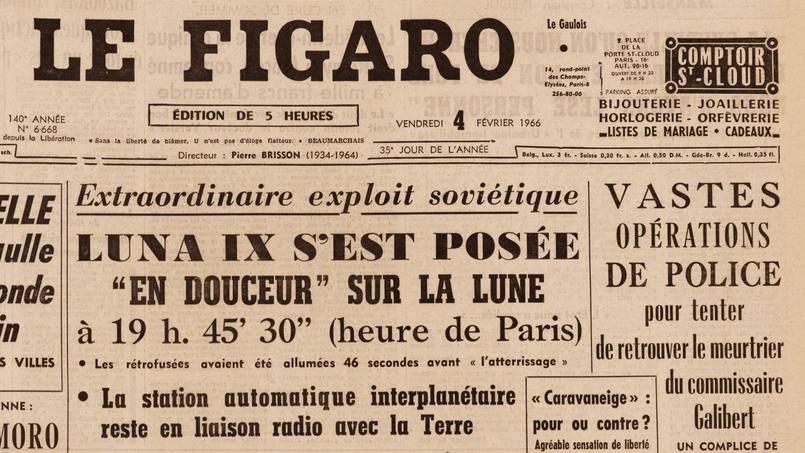
Now, that stalwart of prescriptivism, Le Figaro, disagrees with me here. It takes a typical prescriptivist approach to the question of how to refer to landing on Mars: in a recent essay on the subject, Alice Develey examines a number of dictionaries. Finding no dictionary that lists amarsir but an on-line one, and multiple traditional dictionaries that define atterrir as “to land” without any specification of what’s being landed on, she concludes that a Mars landing should be referred to with the verb atterrir, as well.
Si l’on se fie donc aux dictionnaires, les Terriens et les Martiens ont la même légitimité à atterrir sur le sol de la planète bleue que celui de la planète rouge!
“Thus, if one trusts in dictionaries, Earthlings and Martians have the same right to atterrir on the Blue Planet as on the Red Planet!” …and prescriptivists pretty much always “trust in dictionaries.” Certainly it’s true that if you look at naturally occurring data, you will see that atterrir is used for landing on all kinds of things, such as aircraft carriers. However, there’s been use of amarsir, as well–going back to 189t, according to Wiktionnarie. In this particular case, I can at least excuse my shameful prescriptiveness with a bit of empirical data. Sadly, the failed Mars landing keeps refusing to come up in conversation, and I haven’t been able to create facts on the ground by casually using it. I’m not dead yet, though…
to be off to the races: to have started something, to have reached a state of successfully performing an activity. The Free Dictionary gives this definition: an expressioncharacterizingtheactivity or excitementthat is justbeginning. Wiktionary gives this: In or into a process of energeticengagement in some activity; in or into a phase of conspicuouslyincreasingsatisfaction or success. Notice that in both of them, there’s a crucial element of change–of beginning something, or of having a notable increase in something. How it was used in the post: Someone used the word colocatrice, someone objected that it’s invariant colocataire, and we were off to the races. The meaning is that someone did something, someone else reacted, and that was the beginning of engagement in the activity of talking about language.
When I arrived in Paris for the first time, my cousin drove me by the Place de la Concorde. That’s where we chopped the Royalists’ fucking heads off, he said. It’s a good example of the European tendency to have a very long memory, as compared to the typical American preference to look only towards the future. It’s also a good example of my family’s general lefty-ness—on both sides of the Atlantic, actually. In light of that lefty-ness, I’ve always had mixed feelings about the French fondness for the great Renaissance-era châteux. So, it was without great enthusiasm that I let myself be talked out of my general impulse to never, ever leave Paris and be talked into a tour of Chenonceau, one of the finer ones. As I looked out of the windows at the beauty of the sun setting over the Cher River, I found myself wondering, over and over again: just how many peasants did one have to starve in order to build such an edifice?
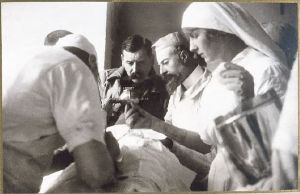
And yet: like so many things in France, it’s more complicated than it looked to me at first glance. Is Chenonceau a vestige of a brutal feudal system, built on the backs of starving farmers? Absolutely. It was also, under the ownership of Louise Dupin, essentially a country salon for many of the Lumières–the Enlightenment thinkers, philosophers, writers, and Encyclopédistes who laid the intellectual groundwork for the 1789 Revolution that would end the aristrocratic system (minus minor bumps in the road in the forms of the First and Second Empires and a Restoration that I don’t really understand) that had kept the French people in a state of servitude for so long. During World War I, the owner of the château, Gaston Menier, would turn it into a hospital at his own expense; over 2,000 soldiers would be nursed back to health there. During the Second World War, the line of demarcation between the Free Zone and the German-occupied zone was marked by the Cher River, and the bridge over that river that the château formed (see the picture above) became a method of transit for Resistance fighters and for Jews escaping from the slaughter that claimed the lives of 70,000.
French notes
le château fort: a “strong castle,” the original castles of the Middle Ages, built for defense from attacks. If I understand correctly, the invention of artillery made them considerably less useful–building a castle in a way that would withstand artillery made them uncomfortable to live in.
le château Renaissance: a “Renaissance castle,” serving essentially as a country residence for royalty and aristrocracy, rather than as a defensive structure as was the case with the old châteuax forts.
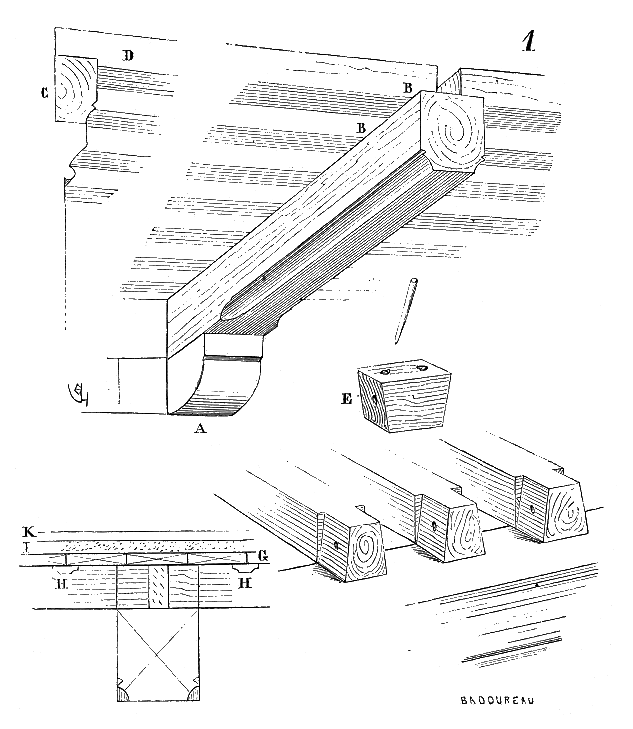
la solive: joist. French buildings of this era often had magnificent ceilings, and I was quite surprised at how many rooms in Chenonceau have solives apparentes–ceilings with exposed joists.
Macarons and revolutionaries: just another day in the Big City.
Days of cramming French grammar have left me with a terrible need for fresh air, sunshine, and at least a bit of exercise, so I shut my laptop this afternoon and went out for a walk. Mission: track down an antique book dealer that I came across one day, and find the best macarons in Paris.
Big cities often offer us a bit of urban weirdness, and Paris did not disappoint me today. To wit: just down the avenue de Breteuil from Les Invalides, I encountered the following scene.
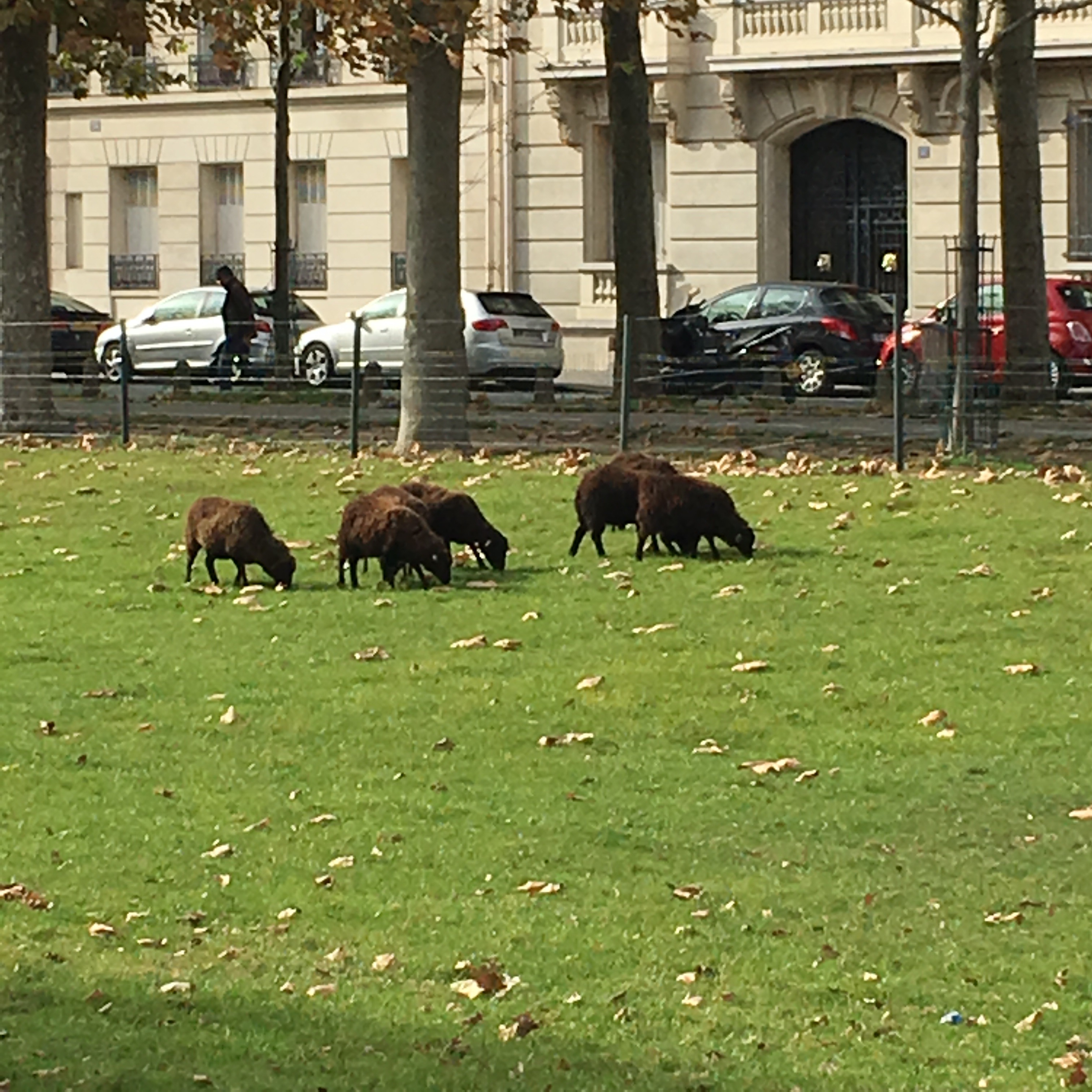
That little cluster of brown things that you see on the grass towards the right of the photo turns out to be this flock of sheep:
What are they doing there? I can only guess. Cutting the grass, perhaps.
A bit further down, on the left side of the street as you walk south from Les Invalides, is the best place in Paris to buy macarons. These cream-filled bits of meringue are a popular Parisian delicacy. The best ones in town turn out to come from a Japanese bakery called Mori Yoshida, 65 avenue de Breteuil. The owners fell in love with French baking and moved to Paris to realize their dream of exploring the possibilities of melding the French arts of the boulanger and the pâtissier with a Japanese sensibility. They have truly mastered the macaron, and this is where I would take you to get your fix.
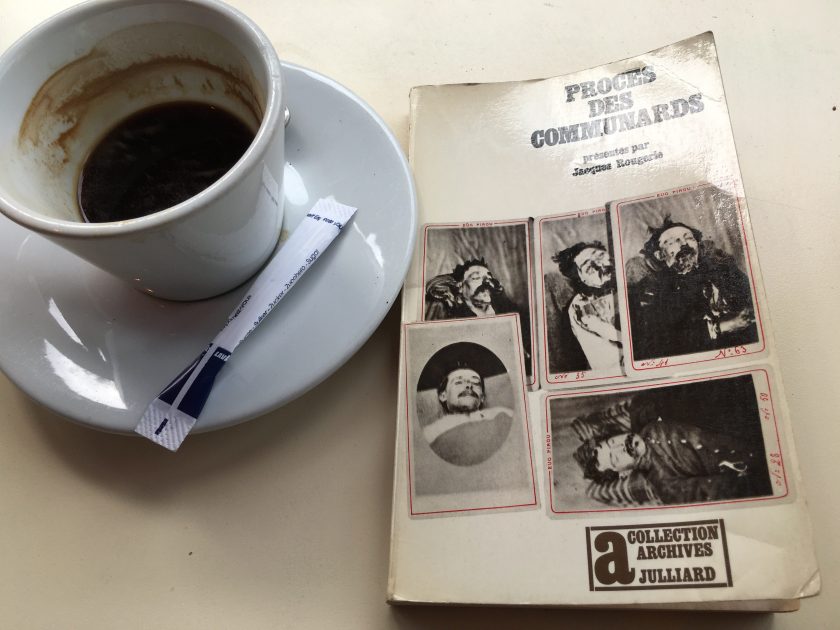
I never did find the dealer in old books, but I did stumble across this little beauty in a used bookstore in my neighborhood–an account of the trials of the leaders of the Paris Commune, my personal favorite of the various French Revolutions. (Ask a French person a question about the Revolution, and the response may be which one?)
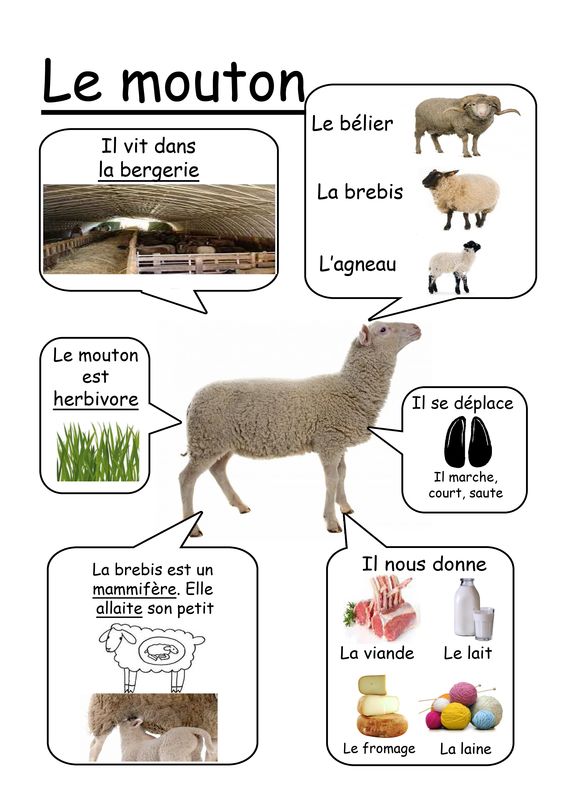
French notes: Sheep-related vocabulary! All links are to WordReference. Scroll down for a cute poster.
le mouton: sheep; mutton; sheepskin. Also: a credulous person.
Le Campanella, corner of avenue Bosquet and rue Saint-Dominique. Picture source: me.
For my money, Bulgaria is one of the best breakfast countries in the world. (For my money explained below in the English notes.) Yoghurt, figs, amazing doughnuts, coffee–on and on, at least if you have the good luck to be offered it in a farmhouse in Koprivshtitsa, which I did. Japan is another marvel in the breakfast department, at least if you’re being served it in a hotel–fish, rice, pickles, and some miso soup make for a great start to your day, actually.
France is a different story. If you’re travelling in Paris and therefore not eating out of your own kitchen, the cafes will basically offer you two options:
Something that they’ll call a “French” breakfast: coffee, juice, and a piece of baguette with butter and jam, or a croissant.
Something that they’ll call an “English” breakfast: coffee, juice, some sort of sausage, an egg or two, and baked beans.
You can make it for a while on the “French” breakfast, especially if you add a piece of fruit–I do, every day–but, personally, I can’t make it all the way to lunch on that, and in a country where people don’t really snack, that’s a problem. The “English” breakfast: baked beans and a nasty piece of sausage for breakfast? Not on an empty stomach.
This morning, though: this morning I happened across a good breakfast for 10 euros. The place: Le Campanella, 18 avenue Bosquet, right on the corner of avenue Bosquet and rue Saint-Dominique. Drink not included, so it was maybe 12.50 with coffee. Sounds like a lot, but I’ve seen more charged for those English breakfasts–a lot more. 10 euros got me four eggs sunny-side-up, my choice of meat, a salad, and of course some bread. The best part? I learned how to say “sunny side up” in French! The only wrinkle: there’s a 15 euro minimum on credit cards, and I was out of cash, which is why you see that little “to go” box on the front-most table in the picture–I had to buy a piece of apple buy to have a large enough bill to justify using a credit card. Poor me, I know…
Le Campanella, corner of avenue Bosquet and rue Saint-Dominique. Picture source: me.
The location is quite close to the Eiffel Tower, and it would make a lot of sense to start your day with breakfast at Le Campanella, and then head over to the Eiffel Tower, stopping on the way there at L’esprit du Sud-ouest for some very non-touristy sportswear, following up the Tower with lunch on the rue Cler. Just sayin’.
French notes
les oeufs au plat: eggs sunny-side-up.
English notes
for my money: in my opinion. How it was used in the post: For my money, Bulgaria is one of the best breakfast countries in the world.
in the X department: when you’re talking about X; concerning X; related to X. Tough to define! Here are some examples, and my attempts to explain them.
Again, it should be of no surprise that Fox News takes first place in the lies department. Meaning: you shouldn’t be surprised that with respect to lies, Fox News has the largest number. Source: here.
Since I failed epically in the marriage department, I think dating is out.Meaning: since where marriage is concerned, I failed very badly, I don’t think that dating is something that I should do. Source: here (scroll down to the comments).
If the Leafs pick up Neil as well, the team is going to put Burke’s Ducks squad to shame in the dirtbag department. Meaning: if the Leafs hire that guy, then they’re going to be even more richly endowed in dirtbags than the Ducks. Source: here.
How it was used in the post: Japan is another marvel in the breakfast department.
Statue of Michel de Montaigne on the rue des Ecoles. It makes me all warm and gooey inside to know that my grandfather probably visited this statue for the same reason that I did. Picture source: me.
I’m a big believer in tutelary gods. These are the local deities that rule over or protect a place. You could make a good case that part of the reason that Judiasm was able to survive its exile from its place of origin was that the original idea of its typically Fertile Crescent god–he lived on top of a particular hill, and in order to really worship him properly, you had to go there–changed to an idea of an immanent god who was everywhere, in all things. (Yes, he is transcendent in Judaism, too, as far as I know–it’s complicated.) And yet: the old tutelary gods live on. It’s worth paying attention to the kami when you’re in Japan, and Pele in Hawaii.
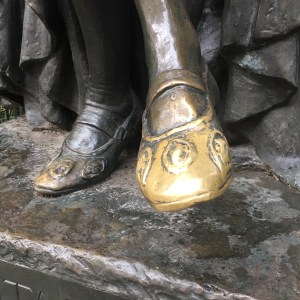
Montaigne’s right foot, polished by generations of students touching it for luck with their tests. Picture source: me.
As far as I can tell, the only relevant deity in the Paris region is Montaigne. Also known as Eyquem, Michel de Montaigne was a writer who is widely considered to be the father of the modern essay and the grandfather of all magazine writers. There’s a statue of him on the rue des Ecoles. I passed by it on my way home today expressly to engage in the rites of Montaigne-worship, which consist of rubbing the toe of his right foot for luck before a test. The reason: I had just finished the first of four days of language-testing that I’ll be doing this week and next week, and I was not feeling happy about the valuable insight that I’d gotten into my weak points.
A lot of what I struggled with on today’s exams didn’t bother me that much–a super-fast speaker, mostly. But, I was pretty down on myself when I still found myself struggling with the A2-level issue of tout/tous/toute/toutes. In theory, these four words all mean all of, but it gets a bit more complicated than that, and there is also a pronunciation issue: tous is pronounced as tou most of the time, but tousse on occasion. Throw in there the fact that I was never sure how to spell some of the stuff that I know how to say, like tout ce que je veux…, and you see how I might still be struggling with this–despite the fact that a class that I attended last winter spent an hour on it one day!
I’ll lay this out a bit differently than other explanations that I’ve seen: I’m going to put the idiomatic expressions first. These get used a lot, and if you can remember that they’re (almost) all the same form, tout, that might make it easier to digest the complexity that follows.
Here are some idiomatic expressions with tout. I took them from Eli Blume and Gail Stein’s French: Three years review text, just because that’s the one reference for English speakers that I happen to have lying around my apartment:
en tout cas: in any case, at any rate
pas du tout: not at all
tout à coup: all of a sudden, suddenly (see also tout d’un coup, below)
tout à fait: indeed
tout à l’heure: just now; in a little bit
tout demême: nevertheless
tout de suite: immediately
tout le monde: everybody, everyone
tout le temps: all the time
Some others that you’re likely to run into:
tout doucement: slowly
malgré tout: despite everything, in spite of everything
tout droit: straight ahead
tout d’un coup: all of a sudden, suddenly (see also tout à coup above)
…and now the only fixed expressions that I know of with a form other than tout:
toute la journée: all day
tous les jours: every day
toutes les nuits: every night
tous les quatre: all the time, often
tous les deux, toutes les deux: both
With that out of the way, let’s talk about what people usually talk about first: using tout to mean “all (of).” Something important to remember here that might be difficult to remember if you’re an English-speaker: you do not follow this tout with de. Don’t, don’t, don’t.
When used in this way, tout agrees in number and gender with the noun that it’s modifying, the forms being:
tout: masculine singular (tout le gateau all of the cake, the whole cake)
tous: masculine plural (tous ces amis all (of) his friends)
toute: feminine singular (toute la durée de vie all of the life cycle)
toutes: feminine plural (toutes les peintures all (of) the paintings
You probably noticed that all of those examples were followed by a definite article (i.e., some form of the word the). You can also use it before a noun without an article to mean every or any. In this case, it agrees with the gender of the noun, but the number is always singular:
Tout tatou est poète ! Every armadillo is a poet! (Tex’s French Grammar web site)
Je contredirai ceux et celles qui croient que toute femme prend la décision de mettre fin à sa grossesse le cœur léger… I would contradict those people who believe that any woman takes the decision to terminate a pregnancy lightly… (Linguee.fr web site)
You could think of the preceding examples as quantifiers–they specify how many or how much of something specified. All of his friends, all of the cake. Every armadillo, any woman. Tout can also function as a pronoun, not quantifying something, but replacing something. In this case, you’re either going to have tout to mean something like “everything,” or you’re going to have one of the two plural forms–tous, or toutes, depending on the gender of what’s being replaced. Here is the one case (that I know of) where you pronounce tous as tousse (I don’t know whether or not you have liaison to touze):
Tout s’est bien goupillé. Everything came together well (said by a friend of some slides that she put together for a PowerPoint presentation).
Ils partageront tout. They will share everything. (Blume and Stein)
Tout ce qu’il dit est la vérité. Everything he says is the truth. (Blume and Stein)
Mes amis sont venus et tous étaient contents. My friends came and they all were happy. (Kwiziq French web site) (Liaison? I don’t know. Native speakers?)
Les filles sont allées aux toilettes toutes ensemble. The girls all went to the bathroom together. (Transparent Language French blog)
Ils sont tous invités They’re all invited (my tutor)
Tous sont malades Everybody’s sick (my tutor)
Now: tout as an adverb. We’ll call it an adverb when it modifies an adjective. In this case, it means something like completely or entirely.
Il me parle tout bas He talks all Barry White to me (Edith Piaf, La vie en rose–technically it’s modifying another adverb here, but we’ll let that go)
Il est tout pâle He’s totally pale (my tutor)
Tout simplement simply put, simply, just (Linguee.fr–again we’re modifying another adverb)
Tout comme just like; il est grand, tout comme ses parents He’s big, just like his parents (WordReference.com)
C’est tout comme “same difference,” “it’s close enough” Il ne m’a pas insulté mais c’est tout comme ! He didn’t insult me, but he might as well have! (WordReference.com)
…and now it gets tough. You’ll notice that in all cases, we had tout in the same form. But, there’s an exception. If the adjective:
…is feminine, and…
…starts with a consonant or with h aspiré…
…then it becomes toute or toutes. For example:
Diane a mangé la pizza tout entière. Diane ate the whole pizza. (Transparent Language French web site) The adjective entière is feminine, since pizza is feminine–but, it starts with a vowel, so we have tout, not toute.
C’est une fille toute petite, mais elle peut tout faire! She’s a small girl, but she can do it all! (Transparent Language French web site) The adjective petite is feminine AND it starts with a consonant, so we have toute.
En outre, vu ses propriétés en matière de construction, elle est tout indiquée pour les hauts murs non porteurs… In addition, because of its constructional properties, it is particularly suitable for high, non-load-bearing walls… (Linguee.fr) The adjective indiqée is feminine, but it doesn’t start with a vowel or h aspiré, so we have tout.
Elles sont tout autant africaines qu’européennes. They are African just as much as they are European. (Linguee.fr) Africaines and européennes are feminine and plural, but they (or maybe the relevant thing here is autant) don’t start with a consonant or h aspiré, so we have tout.
(Sorry, I haven’t been able to find good examples of a consonant-initial feminine plural adjective to show you (and myself) the contrast. Native speakers??)
Tout ce que vous voulez: Everything you want. Picture source: me, on my way home this evening.
Feel like trying this out? You’re now ready for this quiz on the Français Facile web site. You can find a bunch more of them here. Want another take on all of this? See the Tex’s French Grammar site, which also has a nice little exercise at the end: https://www.laits.utexas.edu/tex/gr/det9.html. As the cartoons of my childhood would have put it: Th-th-th-th-that’s all, folks! Off to bed now, ’cause testing starts again first thing in the morning…
A chausson aux pommes–a sort of apple turnover. Picture source: me, waiting for the RER B at the Denfert-Rochereau train station.
One of the things that most amazes my American friends is that I don’t gain weight in France. The opposite–I lose it. This despite the fact that I feel free to eat delicious French stuff–being in France means that you don’t stuff yourself with it, and all of the walking that you do in Paris helps work it off. Case in point: I was up until 4 AM this morning studying the plus-que-parfait and the futur antérieur, so I’m running a bit late. That means that breakfast was a pastry grabbed at the kiosk in the train station. Happily, they had one of my favorites left–a sort of apple turnover.
Good morning–a chaussette aux pommes, please.
A chausson aux pommes? Sure.
Oh–it’s not an apple sock??
He laughed. I was happy to have made his day. By the end of the day, I had walked up innumerable steps in metro stations and hiked from the lab to the train. No problem with a little apple sock.
English notes
To make someone’s day: to have done something that will make them so happy that the whole day will feel good for them. When Clint Eastwood, pistol in hand, says go ahead–make my day, he means that shooting the bad guy would make him happy.
It’s two days until your French test and you just discovered that there’s an entire agreement phenomenon that you’ve never heard of before. Chrestomathies to the rescue! Trigger warning: grammar and colloquial English obscenities.
I’ve always wanted to write a chrestomathy. Chrestomathies are certainly useful, but mainly, I just want an excuse to use the word. Mind you, I wasn’t even sure that I knew how to pronounce it until I looked it up just now: stress on the second syllable.
A chrestomathy is a book of examples, typically used to assist with learning a language. I love the idea, but never expected that when the time came to write one, it’d be after midnight and I’d be panicking about an upcoming French proficiency exam. I just read that the French tense (actually, it’s an aspect, but I try to keep technical vocabulary out of here) called the plus-que-parfait (the past perfect) requires agreement of the past participle when it’s conjugated with the verb être. (If you’re thinking WTF?, see this post for an introduction to the plus-que-parfait, and then this post for an example of how to use it in all six persons/numbers. WTF? is explained below, in the English notes.) Some urgent searching found me a page on the Tex’s French Grammar web site with a review of the plus-que-parfait and some great exercises. That got me started, but I wanted lots, lots more practice. What to do? For starters, I wanted a chrestomathy, and I especially wanted examples of agreement of the past participle with the subject. (If you’re still thinking WTF: you really should either go read the posts that I pointed you to above, or stop torturing yourself. This post won’t be that interesting if you’re not into either lexicography, or French morphosyntax.)
Happily, today we can build our own chrestomathies. Web sites that offer multilingual example sentences can help us find them. The problem, of course, is that we need to know how to search for the sentences that we want. In this case, the process that I went through went something like this.
I started at the Linguee web site. This site allows you to search in one language, and then get results in that language, as well as an additional language of your choice. Where do they get them? I have no idea. The results do tell you what web site they came from, and I run across the proceedings of the European Parliament fairly often. But, the rest could come from pretty much anywhere, as far as I can tell. Are any of the translations manually checked for accuracy? I have no idea. Caveat emptor, but the site is generally pretty good.
I made use of two facts: (a) most search interfaces will let you surround multiple words with quotes to find those words in exactly that sequence, versus just happening to occur in the same document. (b) French verbs that use être in the plus-que-parfait belong to a pretty finite group, and some of them are quite common (“high-frequency,” in technical terms), so I should be able to find examples of the plus-que-parfait with être by searching for those specific verbs.
Now I started looking for specific verbs that I knew should show up with être. The plus-que-parfait usually corresponds to had somethinged (where something is an arbitrary verb) in English, so I did searches like “had arrived”, “had gone”, and such. Did this work perfectly? Certainly not–although the verbs for which I searched are often or usually translated into French with the equivalent verbs in that language–arriver “to arrive,” aller “to go,” etc.–that’s not always the case. For example, my search for “had gone” got me these results: The man had gone into a coma after drinking a bottle of vodka and he had been taken to hospital in an ambulance. L’homme a sombré dans un coma après la consommation d’une bouteille de vodka et a été transporté d’urgence en ambulance. But, more often than not, I did get a verb with être. I just had to read through a lot of examples to pick them out. Remember: the double quotes are essential to this search, as they’re what ensures that the words are next to each other.
After doing this for a while, I had plenty of examples of masculine singular and plural subjects and feminine singular subjects, but no examples with feminine plural subjects, and that’s important, since the agreement markers for feminine plural subjects are unique to them. So, I had to make my search a bit more specific. “the women had” only got me one verb with être, but one is ooooh so much more than zero…
You can practice the plus-que-parfait at this page on the Tex’s French grammar web site, where you’ll find twelve test sentences. Have at it! If you have examples to add or corrections to make, I’d love to hear about them. Scroll down past the examples if you just want the discussion of English points.
Masculine singular:
That was when I had left and now I saw that my vision had been the truth.
C’était lorsque j’étais parti et je voyais maintenant que ce que j’avais vu était vérité.
He said he had consulted many Canadians and had arrived at a balanced budget.
Il a dit qu’il avait consulté un grand nombre de Canadiens et qu’il en était arrivé à un budget équilibré.
He had gone to the clinic over and over again.
Il était allé au centre de soins maintes et maintes fois.
Masculine plural:
Many only realised just how bad things were once the fire brigade, the army
and the emergency services had left.
Beaucoup ne se sont effondrés que lorsque les pompiers, les soldats de l’armée fédérale et
les secours étaient déjà repartis.
The local chief said that since 1989 many people had left for Kadugli.
Le chef local a dit que depuis 1989, beaucoup étaient partis pour Kadubli.
Feminine singular:
I thought I had gone to school for nothing.
Je me disais alors que j’étais allée à l’école pour rien. (I tried to go to the original source’s web site to verify that the writer was female–broken link.)
She testified at arbitration that she had left on vacation because she felt
much better than she had a few weeks earlier.
Elle a témoigné à l’arbitrage qu’elle était partie en vacances parce qu’elle se sentait beaucoup mieux que quelques semaines auparavant.
Yes the myopic vision had gone and for once a unified horizon stretched out before them to the ends of the earth.
Oui, la vision myope était dépassée et, du coup, les chrétiens voyaient se déployer devant eux un horizon unifié, s’étendant jusqu’aux extrémités de la terre.
Only 8.9% of its population had arrived between 1996 and 2001.
Seulement 8,9 p. 100 de sa population était arrivée entre 1996 et 2001. NB: I don’t know why this one has feminine agreement. Pour cent is masculine, according to WordReference.com.
Feminine plural
At the first session, the women had grouped according to their cultures – the Indigenous women clustering on one side of the room.
Lors de la première séance, les femmes s’étaient groupées selon leur culture – les femmes autochtones s’étant regroupées d’un côté de la classe.
Want to try a little test of the plus-que-parfait? Check out this page on the Français Facile web site. English notes below.
WTF: an abbreviation for “what the fuck.” It’s usually used to express puzzlement or surprise. For far more hilarious/freaky/weird/creepy examples than I could ever possibly put in this post, go to Google Images and search for WTF. I’m going to leave you with just this one GIF, which illustrates nicely the evolution that this expression has gone through: in spoken English, it’s possible to just say the fuck?? …that is, you can leave out the word what. I don’t know why–sometimes in language, shit just happens. DO NOT use this expression in any sort of formal situation–not at school, not at work, not in writing, not when meeting your new in-laws for the first time, etc. How it appeared in the post: If you’re thinking WTF?, see this post for an introduction to the plus-que-parfait, and then this post for an example of how to use it in all six persons/numbers.

 You’re mixing up “milliards” (billions) and “milliers” (thousands).) Honestly, I could go on and on (and on and on) about this, but I think you get the point.
 I first heard about the 9/11 attacks while sitting in my office. I’d just eaten my peanut butter sandwich–3 hours before lunch. Crap. My wife called: a plane had flown into one of the World Trade Center towers. Private plane? Airliner? Accidentally? On purpose? No one knew. Soon she called back: the other tower had been hit, too.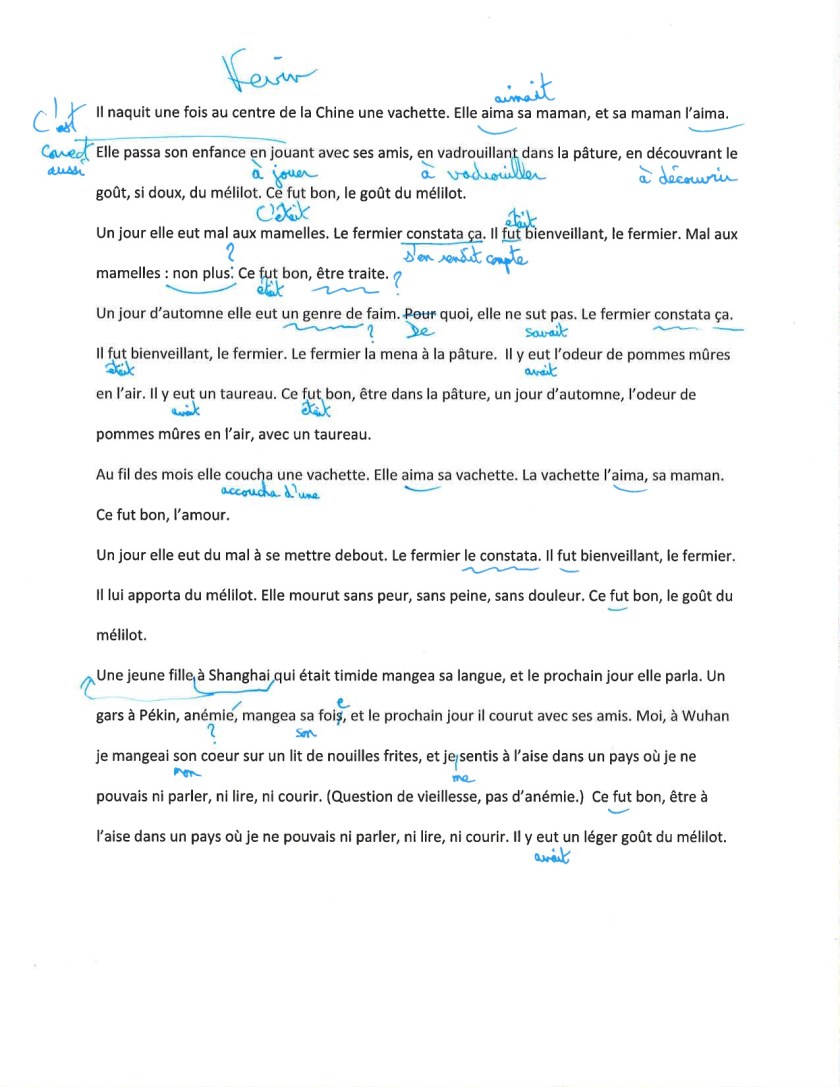

 la
la 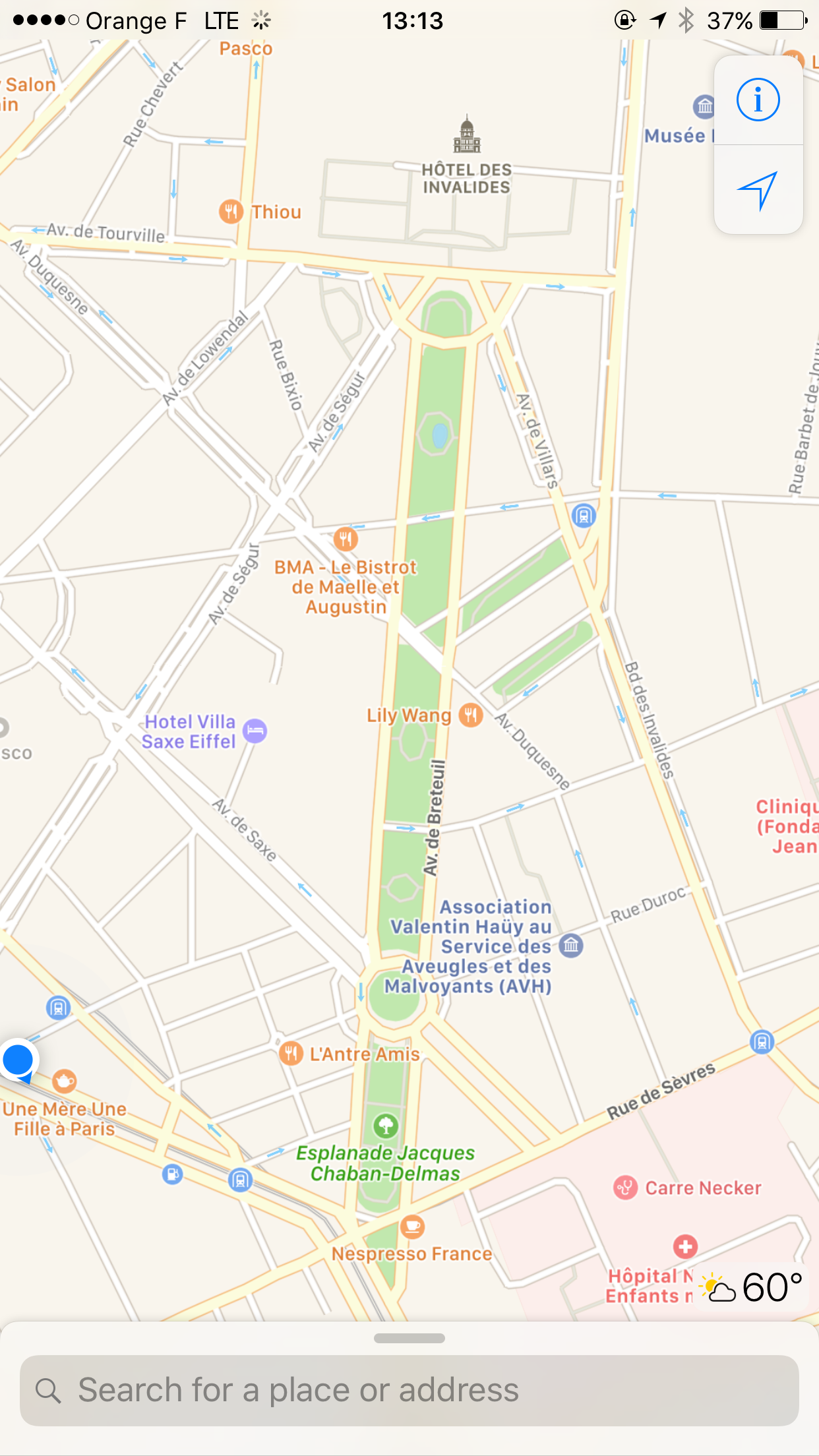










 Zipf's Law
.jpg)