Mehitabel and her Kittens, with a bit of vocabulary

Punished for having been a vers libre poet in his previous life…

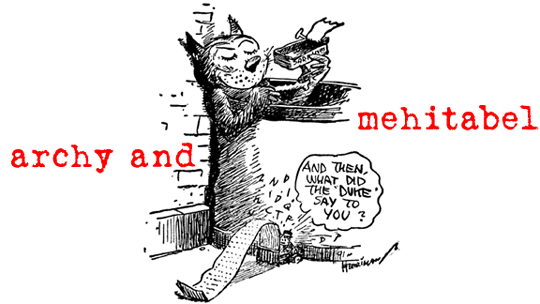
I’m pretty sure that Don Marquis’s archy and mehitabel was the only poetry that I ever read as a kid.  La trame: Archy is a cockroach–a cockroach who has been reincarnated as such as punishment for having been a vers libre poet in his previous life.  (As a child, that didn’t seem terribly bizarre to me–I wasn’t clear on what vers libre was, but I was in the process of receiving a pretty good Jewish religious education in a very traditional Ashkenazic community, and in such communities it’s not uncommon to believe in reincarnation.)  Archy now lives in a newspaper office, where at night he types out messages to Don Marquis (“boss”), a columnist for the New York Evening Sun at the time.  Being a cockroach and all, he has to type by jumping onto one key at a time; since capital letters require you to hold down the Shift key simultaneously, he is not physically capable of producing them.  Hence “boss,” rather than “Boss.”  The Mehitabel in this poem from 1927 is his closest friend, a more-than-a-little-disreputable cat.  Scroll down to the bottom of the page for an explanation of the words to hamper, to be shy on, and tom cat.

Mehitabel and her kittens

Don Marquis, 1927

well boss
mehitabel the cat
has reappeared in her old
haunts with a
flock of kittens
three of them this time

archy she says to me
yesterday
the life of a female
artist is continually
hampered what in hell
have i done to deserve
all these kittens
i look back on my life
and it seems to me to be
just one damned kitten
after another
i am a dancer archy
and my only prayer
is to be allowed
to give my best to my art
but just as i feel
that i am succeeding
in my life work
along comes another batch
of these damned kittens
it is not archy
that i am shy on mother love
god knows i care for
the sweet little things
curse them
but am i never to be allowed
to live my own life
i have purposely avoided
matrimony in the interests
of the higher life
but i might just
as well have been a domestic
slave for all the freedom
i have gained
i hope none of them
gets run over by
an automobile
my heart would bleed
if anything happened
to them and i found it out
but it isn t fair archy
it isn t fair
these damned tom cats have all
the fun and freedom
if i was like some of these
green eyed feline vamps i know
i would simply walk out on the
bunch of them and
let them shift for themselves
but i am not that kind
archy i am full of mother love
my kindness has always
been my curse
a tender heart is the cross i bear
self sacrifice always and forever
is my motto damn them
i will make a home
for the sweet innocent
little things
unless of course providence
in his wisdom should remove
them they are living
just now in an abandoned
garbage can just behind
a made over stable in greenwich
village and if it rained
into the can before i could
get back and rescue them
i am afraid the little
dears might drown
it makes me shudder just
to think of it
of course if i were a family cat
they would probably
be drowned anyhow
sometimes i think
the kinder thing would be
for me to carry the
sweet little things
over to the river
and drop them in myself
but a mother s love archy
is so unreasonable
something always prevents me
these terrible
conflicts are always
presenting themselves
to the artist
the eternal struggle
between art and life archy
is something fierce
my what a dramatic life i have lived
one moment up the next
moment down again
but always gay archy always gay
and always the lady too
in spite of hell
well boss it will
be interesting to note
just how mehitabel
works out her present problem
a dark mystery still broods
over the manner
in which the former
family of three kittens
disappeared
one day she was taking to me
of the kittens
and the next day when i asked
her about them
she said innocently
what kittens
interrogation point
and that was all
i could ever get out
of her on the subject
we had a heavy rain
right after she spoke to me
but probably that garbage can
leaks so the kittens
have not yet
been drowned

archy


English notes

to hamper: “to moderate or limit the effect or full exercise of” (Merriam-Webster).  As a noun, a hamper is a receptacle for dirty clothes.  Why?  Who the fuck knows…

How it was used in the poem:

archy she says to me
yesterday
the life of a female
artist is continually
hampered what in hell
have i done to deserve
all these kittens

to be shy on: to not have very much of, perhaps to not have enough of, something.  A common usage: to be shy on cash.  Example: I can’t go out for dinner with you–I’m a little shy on cash.  How it was used in the poem:

it is not archy
that i am shy on mother love
god knows i care for
the sweet little things
curse them

tom cat: a male cat.  Also, just tom.  A related expression: to tom-cat around, which is a verb for a guy that means to be having sex with a lot of women.  How it was used in the poem:

it isn t fair
these damned tom cats have all
the fun and freedom

A bonus for the reader who has made it this far: some examples of use of the verb to tomcat around.

  • There are many advice books for women on how to manipulate the male psyche. They suggest how to get him to propose, to be more faithful or simply to be better in bed. But a new book for men takes the opposite approach, counseling the male animal on how to tomcat around shamelessly, while avoiding commitments.  (Braden Kell, writing for the New York Post)
  • Venitucci claims Mechanic, a state-licensed social worker, was equally determined to get him and other men in a group session to tomcat around. “For 10 years, I was faithful. Then I just caved in and had an affair, and [Mechanic] said there was nothing wrong with that,” Venitucci said. (Kathianne Boniello and Brad Hamilton, writing for the New York Post–no link, sorry)
  • Ray, you know I’m right. I don’t really care who he fucks, as long as his tomcating around doesn’t harm our reputation. (M.J. Natali, Adara)



Mere anarchy

Ever since Obama got elected and the Republican Party went insane over the sight of a black man in the Oval Office, Yeats’s “The Second Coming” has become more and more meaningful to me.

I was never really all that struck by Yeats’ poem The Second Coming when I was an English major in college.  We mostly contented ourselves with showing off our knowledge of what a gyre is, and then moved on to Beowulf, or Salman Rushdie.  But, ever since Obama got elected and the Republican Party went insane over the sight of a black man in the Oval Office, The Second Coming has become more and more meaningful to me.  When Trump got elected, it went way past “meaningful” towards “frightening,” and nothing that has happened in the subsequent year+ that he’s been in office has done anything to make it less so.

As you can imagine, the imagery of this poem has generated enormous amounts of discussion, and I won’t pretend to even begin to get a handle on it.  Even the language is difficult to understand at points, and not just for reasons of obscure vocabulary.  Here are the two words that people have the most trouble with:

  • gyre: a spiral motion.  From what I understand, falcons hunt by flying in a widening spiral, or gyre.  I haven’t been able to find a video that shows it clearly, but if you have a strong stomach and want to see a falcon kill something: seek, and you shall find.
  • mere: the sense of the word here is an old one: pure, absolute.  See the Merriam-Webster entry here.  The typical meaning is something like “nothing more than”–He is a mere child.
  • to vexto trouble.

The Second Coming

W. B. Yeats, 1919

Turning and turning in the widening gyre
The falcon cannot hear the falconer;
Things fall apart; the centre cannot hold;
Mere anarchy is loosed upon the world,
The blood-dimmed tide is loosed, and everywhere
The ceremony of innocence is drowned;
The best lack all conviction, while the worst
Are full of passionate intensity.

Surely some revelation is at hand;
Surely the Second Coming is at hand.
The Second Coming! Hardly are those words out
When a vast image out of Spiritus Mundi
Troubles my sight: somewhere in sands of the desert
A shape with lion body and the head of a man,
A gaze blank and pitiless as the sun,
Is moving its slow thighs, while all about it
Reel shadows of the indignant desert birds.
The darkness drops again; but now I know
That twenty centuries of stony sleep
Were vexed to nightmare by a rocking cradle,
And what rough beast, its hour come round at last,
Slouches towards Bethlehem to be born?

À Grenelle

Suddenly Bruant’s poem made sense.

For the 3rd day of National Poetry Month, here’s a slice of life from Aristide Bruant.

IMG_3629
My little bookstore.

I live in the most boring arrondissement of Paris.  The 15th typically doesn’t even show up in tourist guide-books–it’s the biggest arrondissement in the city, but it’s just a residential neighborhood, plain and simple.  (Plain and simple is an adverb, not an adjective–see the English notes below.)  The pearl of my little corner of the 15th is a small used bookstore on the boulevard Grenelle.  The floor is almost completely covered with stacks of books, to the point that if the owner ever has a heart attack in there, they will have to empty the store to get the stretcher inside–it’s adorable, and if the owner sees something that he thinks I’ll like, he puts it aside for me.


bruant_aristide
Aristide Bruant. He’s usually pictured wearing a wide-brimmed hat, but you can find such depictions anywhere… Source: http://www.dutempsdescerisesauxfeuillesmortes.net, https://goo.gl/rcFw9e

And yet: this being Paris, there are centuries of history everywhere around me.  An afternoon’s walk often takes me through the side streets to the west of the École militaire, the military academy that was meant to increase the size of the French officer corps by making it possible for the sons of non-aristocrats to get into it.  (Napoleon learned his craft there.)  Amongst those streets was the red-light district of this very military neighborhood, and the poet Aristide Bruant immortalized it in À Grenelle.

Much of this poem puzzled the shit out of me (see the English notes below for what that means) until the day that I walked into my little bookstore and the owner showed me something that he was saving for me.  Called Les mots et la chose, the trame (premise?) of Jean-Claude Carrière’s epistolary novel is that a retired lexicographer gets a letter in the mail from a struggling actress who pays her bills by dubbing pornographic films into French.  She’s tired of the limited vocabulary that she’s asked to use, and she requests that the lexicographer suggest some alternatives.  (Note the subjunctive: that the lexicographer suggest, not suggests.)  The rest of the book is his responses, with separate chapters for penises, breasts, la chose itself, etc.

IMG_0495Suddenly Bruant’s poem made sense.  Faire sentinelle: to stand guard, but also to have an erection.  La chapelle: chapel, but also vagina.  Other plays on words are more obvious, at least to a veteran (which I am, but Trump isn’t, having been excused from Vietnam due to a sore foot, although apparently said foot did not deter him from being an enthusiastic athlete).  Montaient à l’assaut de mes mamelons: the word le mamelon is a nipple or a small hill, and lemme tell ya, assaulting a hill is a highly technical undertaking–higher ground gives the defender a major advantage, and assaulting hills is the kind of thing that you really have to practice.  I was also impressed by the technical accuracy of this verse: …des lanciers, // Des dragons et des cuirassiers // Qui me montraient à me tenir en selle… Specifically, the fact that these soldiers who are teaching her “to stay in the saddle” (do French men all share the universally-held American man’s wish to “die in the saddle”?) are all mounted (i.e. on horseback) troops of one sort or another: lanciers and cuirassiers were cavalry troops, and dragons were “mounted infantry,” meaning that they travelled on horseback, but dismounted to fight.

There’s cool stuff in the poem for grammarians, as well–most notably, this line: J’en ai-t-y connu des lanciers…  Us anglophones struggle with both and en, and finding both of the together and with an inversion…well, good luck finding anything that complicated ever again, and if you do, please tell us about it in the comments…

738_yvette_guilbert
Yvette Guilbert in 1885. I HATE the Toulouse-Lautrec paintings of her, but looking at this photo, you can see why he did what he did with her… Source: franceculture.fr, https://goo.gl/RknwY1

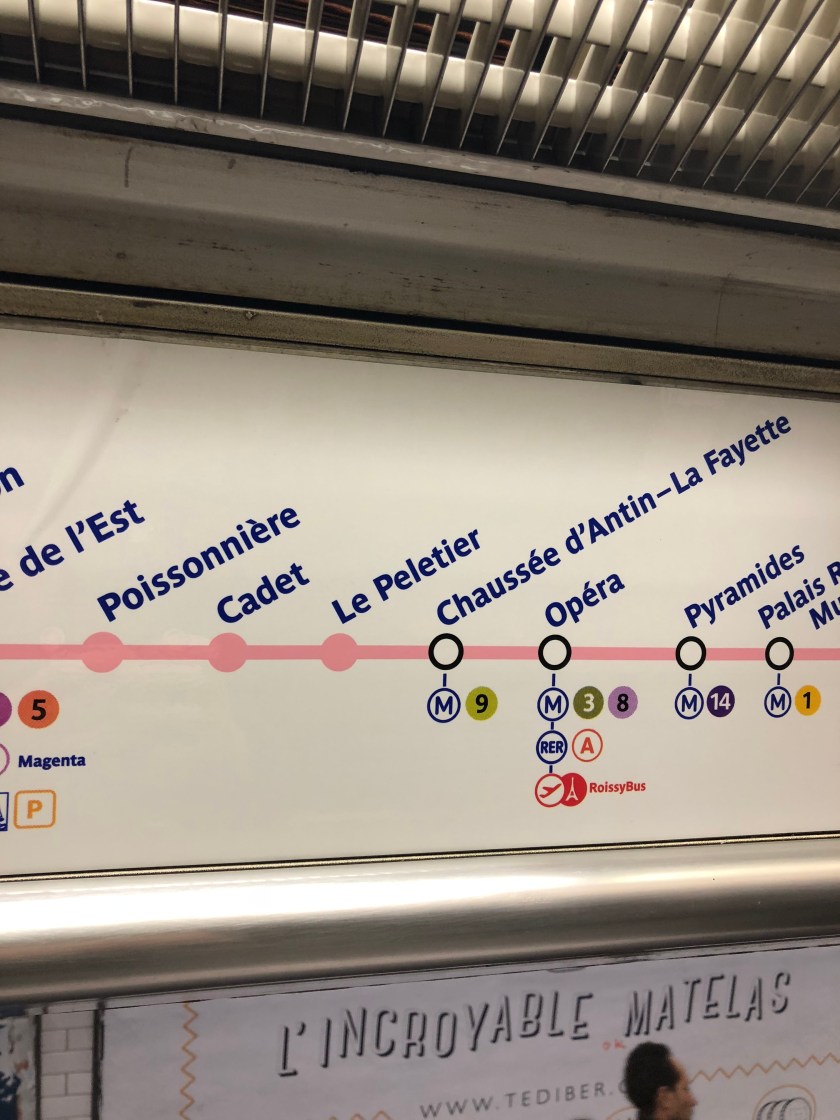
Bruant’s poem was eventually recorded by Yvette Guilbert, and more recently by Patachou.  I hum it in my head whenever my train passes by the Chaussée d’Antin metro station, for reasons that will become clear when you get to the last verse.


À Grenelle

Aristide Bruant

Quand je vois des filles de dix-sept ans,
Ça me fait penser qu’y a bien longtemps
Moi aussi, je l’ai été, pucelle,
A Grenelle!Mais c’est un quartier plein de soldats,
On en rencontre à tous les pas,
Jour et nuit, ‘font sentinelles,
A Grenelle!J’en ai-t-y connu des lanciers,
Des dragons et des cuirassiers
Qui me montraient à me tenir en selle
A Grenelle!Fantassins, officiers, colons,
Montaient à l’assaut de mes mamelons!
Ils me prenaient pour une citadelle!
A Grenelle!

Moi, je les prenais tous pour amants,
Je commandais tous les régiments,
On m’appelait “Mâme la Colonelle”,
A Grenelle!

Mais ça me rapportait que de l’honneur,
Car si l’amour, ça fait le bonheur,
On fait pas fortune avec elle,
A Grenelle!

Bientôt je m’aperçus que mes beaux yeux
Sonnaient l’extinction des feux,
On se mirait plus dans ma prunelle
A Grenelle!

Mes bras, mes jambes, mes appâts,
Tout ça foutait le camp à grands pas,
J’osais plus faire la petite chapelle
A Grenelle!

Aujourd’hui que j’ai plus de position,
Les régiments me font une pension:
On me laisse manger à la gamelle,
A Grenelle!

Ça prouve que quand on est putain,
Faut s’établir Chaussée d’Antin,
Au lieu de se faire une clientèle
A Grenelle!

Scroll down for the English notes.

IMG_5803
The Chaussée d’Antin stop on line 7. Picture source: me.

English notes

plain and simpleClearly; without any complexity (Wiktionary).  Plain and simple is what linguists call a sentential or sentence-level adverb.  It describes the speaker’s attitude towards the assertion being made by the rest of the sentence: in this case, that the assertion is indisputably true.  Plain and simple is unusual in that most sentential adverbs come at the beginning of the sentence (Luckily, we didn’t miss the train); in contrast, plain and simple usually comes at the end of the sentence.  Some examples from the enTenTen13 corpus at the Sketch Engine web site, purveyor of fine linguistic corpora and the tools for searching them:

  • It doesn’t work, plain and simple.
  • Those things are just evil, plain and simple.
  • A mood disorder is an illness, plain and simple.
  • Seriously addressing the long-term fiscal problem means restraining entitlement spending growth, plain and simple.
  • That is the reason for the obesity epidemic, plain and simple.

to verb the shit out ofa delightful English adverb (well, maybe American–I don’t actually know much about British English) that intensifies the action of the verb.

  • Found : At most gay bars, probably confusing the shit out of everyone.
  • When and if it does happen it won’t freak the shit out of you…
  • The group is preparing to shock the shit out of tourists.
  • If there is one thing ATLA is overflowing with, it’s ladies absolutely walloping the shit out of everyone.
  • There’s not a critic in the world who could say anything to me, because I kick the shit out of myself way worse than anybody ever could.
  • What happened here was the jury didn’t like the victim, and so the wrong-doer got a walk, and frankly that should scare the shit out of you.
  • If you want this to be a legitimate sport, start running it like one and stop embarassing the shit out of everyone who has supported your organization since the get go.

Note that the modified verb is usually one with a negative sense–to confuse, to beat, to shock, to wallop (to hit very hard), to scare, to embarrass.  (Yes, it’s spelled wrong in the example above.)  But, it doesn’t have to be a negative verb; using it with a positive one is odd, though, and that gives a certain flavor to such uses.

  • I plan to enjoy the shit out of it.
  • I’d buy the shit out of those tickets.
  • Then go find your Peter Brand and hire the shit out of him before someone else does.
  • Choir! – but you have, right? – they are everyday people who get together on Tuesdays or Wednesdays to sing the shit out of something, usually a popular song from the last 30 years or so.
  • I want to marry the shit out of you and then I want to put a baby inside you as soon as you’ll let me.

The Chad Gadya machine

Yehuda Amichai is a good illustration of the fact that nobody hates war more than the people who have to fight it.  Amichai fought in four wars–and wrote one of the great poems of peace of the past century.

YA6
Yehuda Amichai. Photo originally from Hana Amichai.

For the second day of National Poetry Month: Israeli poet Yehuda Amichai’s beautiful poem An Arab shepherd is searching for his goat on Mount Zion.  Amichai is yet another example of something that we’ve seen many times on this blog: being a poet doesn’t mean that you can’t kick ass.  From his Wikipedia entry:

He was a member of the Palmach, the strike force of the Haganah, the defense force of the Jewish community in Mandate Palestine. As a young man he volunteered and fought in World War II as a member of the British Army, and in the Negev on the southern front in the Israeli War of Independence.[4]

…In 1956, Amichai served in the Sinai War, and in 1973 he served in the Yom Kippur War.[6]

Amichai is also a good illustration of another thing that I hope you’ve gotten from this blog: nobody hates war more than the people who have to fight it.  Trump is, of course, a big fan of it–for other people, for other people’s children.  (He ditched out on Vietnam himself, and you’ll notice that none of his kids have served, either.)  Amichai fought in four wars–and wrote one of the great poems of peace of the past century.

An Arab Shepherd Is Searching For His Goat On Mount Zion

Yehuda Amichai

An Arab shepherd is searching for his goat on Mount Zion
and on the opposite hill I am searching for my little boy.
An Arab shepherd and a Jewish father
both in their temporary failure.
Our two voices met above
the Sultan’s Pool in the valley between us.
Neither of us wants the boy or the goat
to get caught in the wheels
of the “Chad Gadya” machine.

Afterward we found them among the bushes,
and our voices came back inside us
laughing and crying.

Searching for a goat or for a child has always been
the beginning of a new religion in these mountains.


…caught in the wheels of the “Chad Gadya” machine: this is a metaphor for a sort of process of tit-for-tat that snowballs out of control (whoops, another metaphor–sorry).  Chad Gadya is a song that’s sung at the end of the seder, the (loooooong) ritual meal eaten on the first two evenings of Pesach (Passover, or la Pâque des juifs, as it’s called in French–“Jewish Passover.”  This always makes me smile–and, yes, I’m Jewish.)  It’s a highly allusive/metaphorical story, like … well, like every Jewish story I’ve ever heard.  “Chad gadya” is Aramaic for “one kid”–in English, a baby goat is a kid.  The plot line of the song: Father buys a baby goat.  The cat eats the goat.  So, the dog bites the cat.  So, the stick hits the dog.  So, the fire burns the stick, the water puts the fire out, and on, and on, and on.  Hence:

Neither of us wants the boy or the goat
to get caught in the wheels
of the “Chad Gadya” machine.


In case you were wondering: Aramaic is similar to Hebrew–you can recognize Aramaic by the frequent presence of at the end of nouns where you wouldn’t expect them in Hebrew.  It’s the definite article (the), which in Hebrew is ha- at the beginning of the word. For example, here’s a chunk of the lyrics:

le-tora de-shatah le-mayathe ox that drank the water,

de-khavah le-nura de-saraf le-chutrathat put out the fire that burnt the stick,

de-hikkah le-khalba de-nashakh le-shunrathat hit the dog that bit the cat,

de-akhlah le-gadya dizabin abba bitrei zuzei.  that ate the kid that Dad bought for two zuzim.

“What about the at the end of abba,” you’re wondering?  No–that one’s just part of the word abba–Dad or Daddy.

…and with that, I’ll stop language-geeking and go watch an episode of Santa Clarita Diet.  The always-adorable Drew Barrymore as a zombie–brilliant, just brilliant.

A time and a place for everything

When to correct the other guy’s grammar–and when not to.

One evening I was riding the métro home, minding my own business, when a very, very drunk man got on.  He was carrying an open bottle of some sort of hard liquor, and occasionally took a swig.  (This and other obscure vocabulary items discussed in the English notes below.)  He was so plastered that he could barely stay on his seat as the train swerved.  He ranted incoherently–really incoherently.  (After he left, I asked the guy next to me: Pardon me sir, was he speaking French?  (If it’s in italics, it happened in French.) He gave me that look that people in Paris (and New York) give you when approached by a stranger before deciding that you’re OK, and then said: Of a sort.)

A young woman got on the train and took a seat.  She had her phone to her ear, and was talking.  The drunk, ranting guy leaned over, put his fingers to his lip, and said: Shhhhhh.

Bizarre, hein?  No–in a Parisian context, this actually wasn’t surprising at all.  The general French approach to politeness is: don’t do anything that would inconvenience the other person.  A very noticeable way that this works out is that in general, the French tend to communicate more quietly than Americans do.  Indeed, the first thing that I notice when I get off the plane in the US is how loud everyone is–I clear Customs, go sit in the United club, and find myself listening to the cell phone conversations of every random stranger within earshot. In Paris, if you see someone talking on the phone on the train, the chances are excellent that they’re not French–it’s just not done.  So, it wasn’t that bizarre for a shitfaced lunatic to interrupt his raving to say shhhhh to someone talking on the phone on the métro—he might have been hammered, but she was being rude.  In America, someone would have said some equivalent of “it’s a free country, she can talk on the phone if she wants to.”  People did hush him up when he got too carried away, but no one criticized him for saying shhhhh to the girl on the phone–that’s just logical, quoi...

For an extended discussion of the “don’t inconvenience the other guy” principle in French culture, see Raymonde Carroll’s Cultural misunderstandings: The French-American experienceor the original French version, Évidences invisibles: Américains et Français au quotidien.  Carroll’s book is the uber-citation on American/French cultural differences.


I thought about the drunk guy on the train and his shhhhh just now when I stepped out on my balcony (I have the good luck to have an apartment on the étage noble) for a cigarette–and overheard a delivery guy in the street below speaking on his phone.  Avant qu’elle apparaisse, he said–before she appears.  Even though I’m in France, where correcting other people’s grammar is just part of daily intercourse, I suppressed the urge to yell avant qu’elle N‘apparaisse–who doesn’t hate to see a good opportunity to use the ne expletif be wasted?–on the theory that this guy’s day was already going poorly enough without the shame of having some random foreigner fuck with his langue de Molière.  A time and a place for everything.

For the meaning of étage noble and the significance of what floor you live on, see this post on Parisian apartment buildings.  English notes below.


English notes

swigthe amount drunk at one time; a gulp.  (Merriam-Webster)  Some examples from the English Preposition Corpus, courtesy of Sketch Engine, purveyor of fine linguistic data sources and search engines therefor (note the lack of an E at the end–therefor is a different word from therefore):

  • I scowled into the night, took a swig of my beer and dumped the rest over the side of the deck .
  • I picked up the bottle beside me and took another long swig.
  •  If, after a stiff swig of nectar, we were to watch further developments, we’d find that in another 100,000 years or so, or even longer, exactly the same thing would happen again, and the compass would swing back suddenly to its original position.

How I used it in the post: He was carrying an open bottle of some sort of hard liquor, and occasionally took a swig

plasteredslang for drunk.  Some examples from the enTenTen corpus (just under 20 billion words of English scraped from the Web), again courtesy of Sketch Engine:

  • Once Dolly and I got really plastered together.
  • An hour or so later, the Englishman is really plastered. 
  • Jonathan is so ugly; I could only have sex with that double bagger if I was really plastered
  • And by “former glory,” of course, we mean “a time when college-aged people used beer pong as an excuse to get so plastered they sometimes made sexual overtures toward bar stools.
  • Only to realise the switch happens yet again and you’re there staring at the mouth of Gingy the Gingerbread Man (Midgett in a triplicate role with Sugar Plum) so plastered on that baking sheet like an angry drunk.

How I used it in the post: He was so plastered that he could barely stay on his seat as the train swerved. 

shitfacedalso slang for drunk.  Don’t use this one in front of my grandmother.

  • The night ended with Patty directing my drunk ass to grab the mattress and set up the bed while I was completely stumbling and shitfaced.
  • Let me get this straight — this stuff supposedly gives you more energy … so you can stay out later, drink more and get more thoroughly shitfaced?
  • The end of the week and I’m tired, over-worked and really just in need of deep sleep so I can get to work the next day with a fresh brain that can fire on all six creative cylinders but I opt to get shitfaced on free beer instead. 
  • In the Black Forest they celebrate by getting shitfaced, setting fire to 800-lb straw-packed oak wheels, rolling them down mountainsides into sleepy villages and making bets on the fates of the panicked peasantry as they flee in terror.

How I used it in the post: It wasn’t that bizarre for a shitfaced lunatic to interrupt his raving to say shhhhh to someone talking on the phone on the métro—he might have been hammered, but she was being rude. 

hammered….and, once again: slang for drunk.  

  • By the time we got to the dessert, I was, to put it delicately, hammered , as you can see from the picture above.
  • Made me want to check out more, especially as I was so hammered that I was in danger of keeling over, and consequently remember very little, other than that it was good.
  • I think the only way I’ll ever feel the urge to try that is if I’m already so hammered that it seems like a really good idea.

How I used it in the post: It wasn’t that bizarre for a shitfaced lunatic to interrupt his raving to say shhhhh to someone talking on the phone on the métro—he might have been hammered, but she was being rude. 


Conflict of interest statement: I don’t have one.  Sketch Engine doesn’t pay me to shill their stuff–I pay them to use it.


Cursing incoherently

I’m sitting at the breakfast table one beautiful spring morning when I start cursing in some incoherent mixture of French and English.

I’m sitting at the breakfast table one beautiful spring morning when I start cursing in some incoherent mixture of French and English: fuck!  Mais c’est pas possible !  Bordel de cul ! No!!!  What had happened: I was reading a comic book, and the ending touched me, deeply.  A comic book.  A COMIC BOOK.  I read Céline, and he mostly makes me laugh; I read Jean Genet, and he makes me laugh even more; reading Les liaisons dangereuses, I often shut the book just to let the beauty of a sentence that I had just read sink in.  But, what led me to break out in inarticulate multilingual shouts of rage and sadness was a comic book.  A fucking COMIC BOOK.


I’m hanging out in a bookstore not far from my little deux-piece (a two-room apartment, very common in Paris).  I’m browsing through a book, and all of a sudden I have to put it down and dash to a quiet, hidden corner of the store, where I burst into sobs.  (For context: I am an American male in his 50s, and American men of my generation do not, not, not cry.)  What caused this sudden storm of emotion: a comic book.  A comic book.  A fucking COMIC BOOK.  


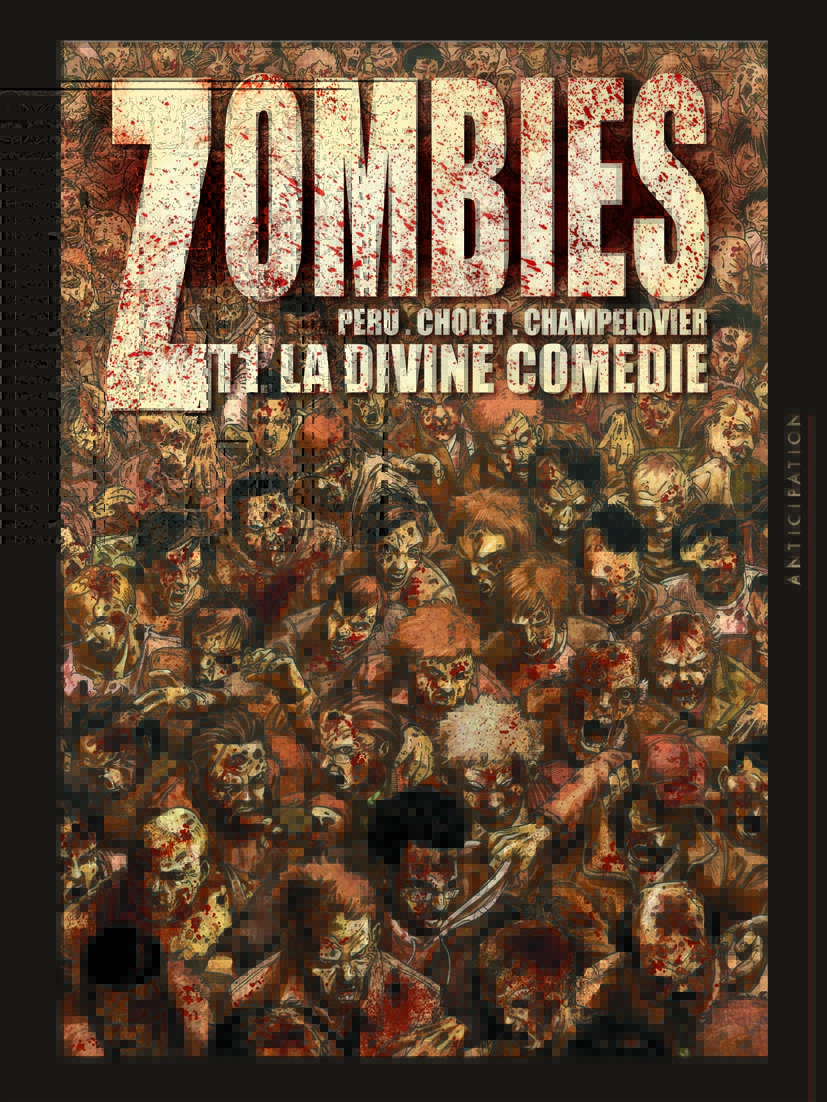
Comic books–les bandes dessinées–are considered literature in France, like any other high-brow written form.  It’s not unusual to see men and women in business suits or stereotypically academic clothes (which is to say, blue jeans and a backpack full of journal articles on math or literature) reading one on the train on the way to work in the morning, and comic books can get literary prizes just like anything else.  The series that had me screaming over my breakfast was this one by Peru and Cholet:

Zombies, Tome 1 : La divine comédie


My Uncle John immigrated to the US from the UK as a young man and promptly joined the Army, which sent him to Korea.  Before he died, some oral history project sent someone to interview him about the experience, and we learned things that he had never, ever talked about, like the time that he had to pile up a couple bodies of his dead pals so that he could shelter behind them while he shot at the North Koreans (or Chinese, or whoever it was that was actually behind the triggers on the other side).  When I was a little tike, he made me solemnly swear to never read a comic book.  I still feel a little guilty every time I pick one up–I feel exempt from fulfilling that particular oath, since I made it as a small child, but as an adult, I take promises super-seriously, and rarely make them.  Hopefully, the quality–and power–of this particular one takes it out of the realm of the kinds of comic books that Uncle John was talking about.  Yes: I was moved to rage and sadness by a comic book.  comic book.  A fucking COMIC BOOK.


To my surprise, I notice that this is the 500th post on the Zipf’s Law blog.  It’s super-amazing to me that this thing that started out as a way to publicize information about the judo clubs of Paris, and then evolved into a way to keep my family and friends up to date on Parisian adventures that were too long for Facebook posts, has  become something else entirely, with as of today, more than 45,000 page views and just under 28,000 visits.  I thank Ellen Epstein for suggesting the blog in the first place, and all of you who comment on the posts–you give me the positive feedback of knowing that someone out there listens to what I say, and the helpful guidance of pointing out my errors in French, explaining French history and culture to me, and the like.  Even beyond the relief of getting the shit that grouille dans ma tête out of it and “on the page,” you folks who leave comments make this an enriching experience for me.  Thank you again.

English notes:

tike/tyke: a small child.  “When I was a little tike” is a common way of introducing something that you’re going to say about your early childhood.

French notes:

la bande dessinée : comic book, graphic novel.

How to abandon ship

The most important thing is to look before you leap: you have to expect the water to be full of debris, as well as your shipmates, and you don’t want to land on either of them.

May 19th, 2018

United States

Dear Zipf,

Chlöé says that she and her uncle both passed the highest ARC water-safety tests, but that her uncle, who got his cert a generation earlier, had to learn to jump into the water from destroyer-height, wearing a Mae West, without having the vest break his neck on hitting the water.
She wondered whether you’d learned how to do this, and if so, how to do it.
Reynaud
March 20, 2018
Zurich
Dear Reynaud,

Yep, sure did. The most important thing is to look before you leap: you have to expect the water to be full of debris, as well as your shipmates, and you don’t want to land on either of them. The vest thing makes perfect sense, but I don’t remember what to do about it–the old kapok vests have a high collar, which is meant to keep your face out of the water if you lose consciousness, and indeed, if forced straight upwards hard enough, it could probably take out your cervical spine. What I do remember how to do is that when you jump, you hold your balls.  And, no: I’m not kidding about your balls.  The idea is to avoid them getting racked up when you hit the water.  Today there are women on board ship, but I don’t know what they’re told to do.  You’re also taught to use a hat, your shirt, or your pants as flotation devices.  That last one is effective, but fucking HARD to do–I got worn out the first time I tried, and had to do it again to pass the test.

The basic thing once you’re safely off of the vessel is to get as far from the ship as quickly as possible: you don’t want to get sucked down when it sinks, and depending on how deep it is when (if) the engines explode, you could get injured by the shock.
The thing that they didn’t have us practice is swimming with burning oil on the surface.  They told us that at night, the burning oil lights up the water underneath it, so you look for a shaft of darkness, swim up to the surface through it, take a breath, and then submerge again to find your way away from the oil.
Zipf
Here’s a video showing how to use your pants as a flotation device.  This is actually better than what they were teaching when I was a squid (slang for “sailor”), in that we were taught to tie each pants leg individually, which is a hell of a lot harder than what this guy does: tie them together.  Note that this guy is using a floating technique, so he’s not expending very much energy while he prepares his pants–we just treaded water, which is exhausting when you can’t use your arms to help ’cause they’re occupied trying to get your pant legs tied and the @#$% things inflated.
uss_biddle
My ship, the USS Biddle. It’s a cruiser, formerly called a destroyer escort–bigger than a destroyer, but smaller than a lot of other things. Picture source: https://www.helis.com/database/unit/1068_USS_Biddle/  Hey, guess who didn’t serve?  Donald Trump–multiple draft deferments for college, and then a claim of a bone spur in his foot.  Snowflake.

English notes


  • ww11-raf-pilot-in-full-flying-clothing-with-mae-west-lifejacket-DXB07W
    Royal Air Force pilot wearing an inflated “Mae West” flotation device. Note how it comes behind the pilot’s neck–that is meant to keep his head out of the water if he’s unconscious. Picture source: http://www.alamy.com/stock-photo/mae-west.html

    ARC: American Red Cross.

  • cert: certification.
  • destroyer: a small ship, mostly used to screen big ships from submarines and aircraft.
  • Mae West: a kind of life vest.  It’s named after Mae West, a film star of the epoque known for playing super-sexy roles.
MaeWest
Mae West showing how you get a life vest named after yourself. Picture source: http://www.selenie.fr/2014/04/mae-west-la-sandaleuse-de-hollywood.html
French notes
This vocabulary comes up in Jean Genet’s lyrical Le miracle de la rose, in the occasional flights of fancy about shipboard promiscuity.
la frégate: frigate.
le destroyer or le contre-torpilleur: destroyer.
le croiseur: cruiser.

Giving back: Pronouncing English words that end with -ive

Paradoxically, the better your skill in a second language, the more your mistakes stick out.

I work with a couple of French folks whose English is so good that they are effectively native speakers, as far as I can tell.  It’s super-impressive—if my French were ever anywhere near as good as their English…

It’s their very skills themselves that make it obvious when they make a pronunciation error–it’s as if I were making a pronunciation error.  It is not at all the case that I don’t make pronunciation errors in my native language, and people most definitely do notice them–but, I suspect that they’re all the more obvious precisely because (a) I’m a native speaker, and (b) I’m an “educated native speaker” (sounds hoity-toity, but it’s a technical term in linguistics).  I would guess that many of my “smaller” mistakes in French go unnoticed because they get lost in the thick fog of all of my other mistakes–in my native language, though, they all stand out.

hoity-toity: pretentious.

So, when my French-speaking-colleagues-who-are-essentially-native-speakers-of-English-too make pronunciation errors in English, it is, indeed, noticeable.  Happily, their English-language pronunciation errors often fall into a single category, and that’s what we’re going to go after today–my little attempt to repay more hours than I even want to think of that they’ve spent hammering on my pronunciation/lexicon/syntax/politeness/EVERYTHING in French.


You may have noticed that written vowels in English are pronounced differently than those vowels would be pronounced in essentially every other written language on the planet.  (That’s just a fraction of all languages, by the way–the vast majority of languages have no writing system.)

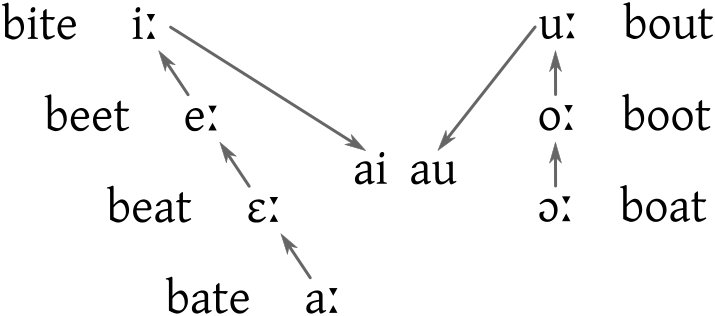
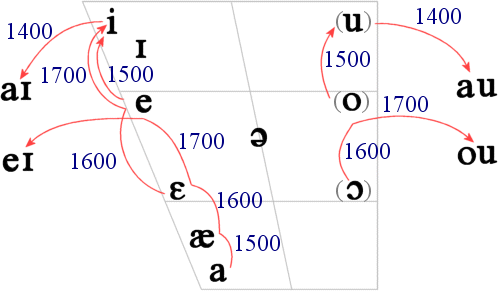
The reason behind all of this English-versus-the-world divergence in vowel sound pronunciation is something called the Great Vowel Shift.  It changed the pronunciation of many vowel sounds, and it happened after English spelling was mostly established.  The result was that English vowel sounds didn’t line up with their spelling as well as they used to.

greatVowelShift-time
The Great Vowel Shift, with approximate dates–and yes, with some training in phonetics, it does make perfect sense. Picture source: http://sites.millersville.edu/bduncan/221/history/4.html

One of the changes in pronunciation affected words that happen to be spelled with an at the end.  It’s a silent now, but it wasn’t always.  The preceding vowel sound changed–in a very systematic way that requires knowing a bit about what you do with your mouth to make sense of–and one of the consequences was that if that preceding vowel was i, it went from being pronounced like in most languages to being pronounced like the word eye is pronounced today.  

So, today, if you’re an Anglophone kid, you grow up being taught that when a word ends in -iCe, where means any consonant, the indicates the sound of the word eye.  There are plenty of examples of this:

  • five
  • drive
  • dive
  • thrive
  • alive
  • hive
  • archive
  • strive

But–and this is a big “but” (which is why I italicized and underlined it)–iCe (followed by a consonant followed by an at the end of the word) is not always pronounced that way.  There are plenty of times when it is not, and those tend to be longer words that educated people would use, and my French co-workers are super-educated, so they use these words.  For some of the native speakers of French that I know, mis-pronouncing these words is essentially the only mistake that I ever hear them make in English.  So: let’s work through some of these.

You’ll notice something about the words that are pronounced the way that Anglophone kids are told you always pronounce -iCe: they tend to be single-syllable.  Consider:

  • five
  • drive
  • dive
  • thrive
  • live (the adjective only, as in live bait)
  • alive
  • hive

But, not all single-syllable words of this type are pronounced that way.  Here’s the one counter-example that I can think of:

  • give

And, not all of the words in which -iCe is pronounce like “eye” are single-syllable words.  The counter-examples that I can think of:

  • archive
  • derive
  • arrive
  • survive
  • revive
  • deprive

I know what you’re thinking now: Zipf, this is simple–regardless of the number of syllables, the is pronounced as in five if it’s in a STRESSED syllable.  And, yes, that almost works–but, consider archive, which is stressed on the first syllable, but is still pronounced like five.

…and live is weird–when it’s a verb, it’s pronounced like give, but when it’s an adjective, it’s pronounced like five.  


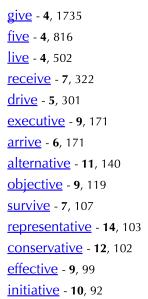
OK, we’re more or less good with the words that end in iCe and get pronounced like five.  What about the words that don’t get pronounced like five?  Let’s take a look at some.  Now, I’m not going to select these randomly.  I went to this web page on the Morewords.com web site.  What it gave me is a list of words that end in -ive, sorted by how frequent they are.  Here’s what the output looks like.  You’ll notice that every word is followed by two numbers.  The first one is the length of the word in letters, while the second one is how many times the word occurs in every million words of text.  (What collection of texts did they do their counts in?  They don’t say.)  So, give is 4 letters long and occurs 1735 times per million words, executive is 9 letters long and occurs 171 times per million words, and so on.

Screen Shot 2018-01-26 at 16.40.33
Source: MoreWords.com

With that list in my greedy little fingers, I’ll go through it and pull out some of the ones that are not pronounced like five.  That gives us this:

  • receive
  • executive
  • alternative
  • objective
  • representative
  • conservative
  • effective
  • initiative
  • positive
  • relative
  • olive

…and there’s a little attempt to help with the already-almost-perfect English spoken by so many of my French colleagues.  Got a funny story related to mispronunciation?  Tell us about it in the comments…

The last duel in France: traces in syntax

The last duel in France leads to a discussion of syntactic theory, ’cause that’s how I roll.

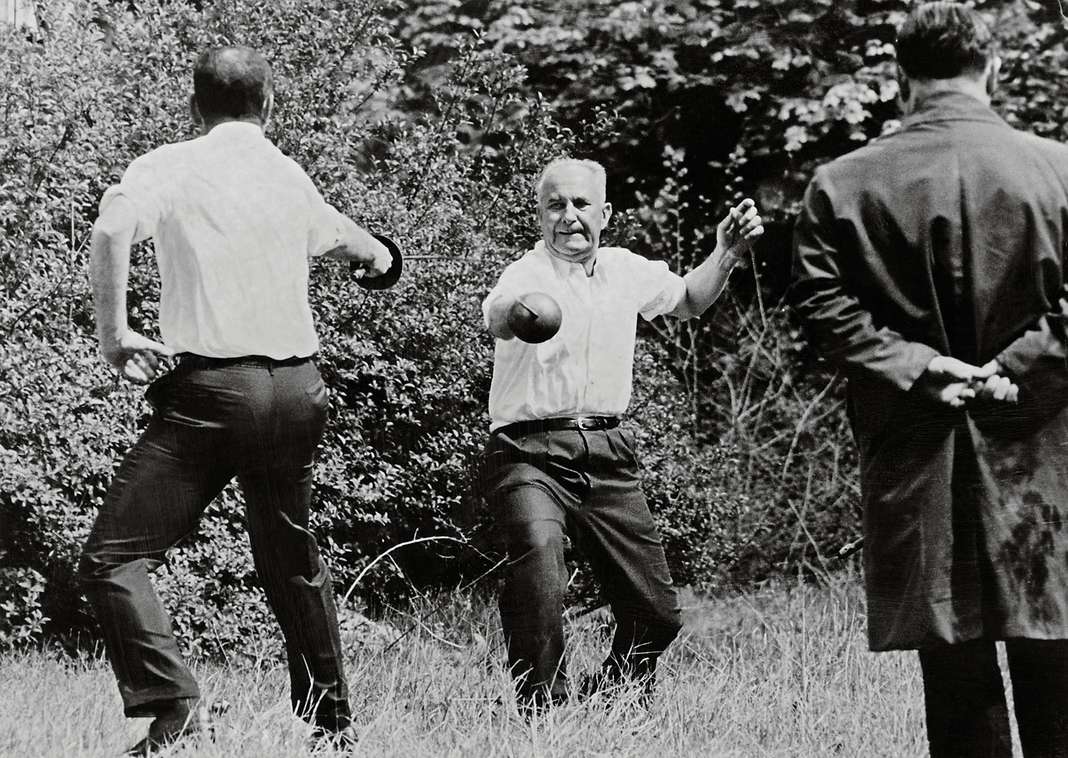
Wanna watch the last duel in France?  Here you go.  Scroll down past the video for an excerpt from an article on the topic from Le monde and the definitions of some of the French vocabulary therein.

The article in Le monde: click here.  Some relevant vocabulary:

retrousser [+ sleeves or pant legs] : to roll up.  Elle avait un de mes pyjamas dont elle avait retroussé les manches.  (Camus, L’étranger)

l’hôtel particulier : like a château, but it’s in a city, versus being in the country, and it could just as well be owned by a bourgeois as an aristocrat–I think it’s actually more likely to have been owned by a bourgeois, at least in Paris.  Don’t quote me on this.

Dans un jardin ombragé par des arbustes bienveillants, enveloppé d’une douceur printanière, chemise blanche, col ouvert, manches retroussées, deux hommes, épée à la main, se jugent, se jaugent, puis, sur un signe de l’arbitre, croisent le fer. Quatre minutes plus tard, le combat cesse un des deux duellistes ayant été touché par deux fois au bras. Cette scène n’est extraite d’aucun roman ou film de cape et d’épée. Elle eut lieu il y a exactement cinquante ans, le 21 avril 1967, dans le parc d’un hôtel particulier de Neuilly-sur-Seine.


English notes

wanna: the written form of the contraction of want + to.  One of the interesting things about this contraction is that it is only possible in specific syntactic contexts, and is absolutely impossible in others.  This lets you distinguish between the following.  Suppose that the following situations exist:

  1. There is going to be a contest.  Whoever wins the contest will be awarded a horse.  There are a number of horses available, and the winner of the contest will be able to choose the horse that they will receive.
  2. There is going to be a horse race.  One of the horses will win the race.

In situation number 1, if you want to ask someone which of the horses they would choose were they to win the contest, you could ask the question in either of two ways.  The second one is more casual, but they are both completely acceptable from a linguistic point of view:

Which horse do you want to win?

Which horse do you wanna win?

In situation number 2, if you think that someone has a preference regarding the winner of the race, and you want to ask them which of the participating horses they hope will emerge the winner of the race, you only have one option:

Which horse do you want to win?


Google the quoted phrase “which horse do you wanna win” and you will get 5 results, all of them in Japanese.  WTF, you’re wondering…


Screen Shot 2018-03-07 at 10.21.41

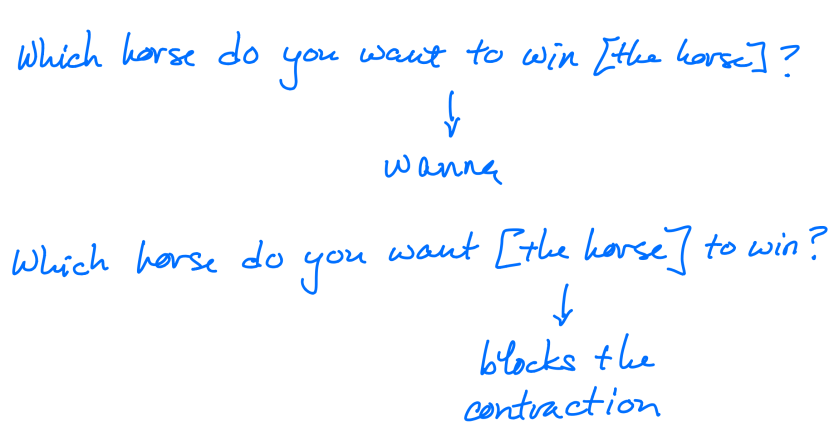
What you’re seeing in the Google results is sentences that illustrate interesting syntactic phenomena.  Most of the literature on syntax is written about English syntax (blame Chomsky), mostly by (notoriously monolingual) anglophones, and the classic examples in the field are hence mostly in English.  (Actually, the only classic non-English examples that I can think of are in Swiss German–more on that another time, perhaps.)  The which horse do you want to/wanna win sentences are used in classic transformational-generative grammar to argue for the existence of something called a trace.  This is held to be something that is present in the structure of the sentence, but that is not observable–the claim is that you can’t “see” it, but it’s there.  What is that “it”?  The idea is that underlying those two sentences are two “deeper” forms:

  1. For situation 1 (there’s a contest, and the winner gets a horse): Which horse do you want to win [the horse]?
  2. For situation 2 (there’s a horse race, and one of the horses will win): Which horse do you want [the horse] to win?

(Linguists in the audience: yes, I am simplifying this for didactic purposes–no hate mail, please.)  In both cases, the bracketed [the horse] goes away; in the second case, the “trace” that is left behind blocks the contraction of want + to to wanna.

Screen Shot 2018-03-07 at 10.46.55


Now, I know what you’re thinking: It’s obsessing about things like this that keeps Zipf from ever getting a second date.  …and you’re right, I imagine.


The last words of Biloxi

For poignancy, it’s hard to beat the International Journal of American Linguistics.

No one actually knows how many languages there are in the world.  Linguists generally estimate a number in the range of 5,000 to 10,000.  What people generally do agree about is this: by the end of this century, half of them will be gone.  Extinct.  No longer spoken.


When you teach linguistics, you often find yourself saying things like this:

All human languages have the property of ambiguity.

No language has a voiced stop without having the corresponding unvoiced stop.

Well: we actually know almost nothing, relatively speaking, about most languages.  Whether there are 5,000 languages today, or 10,000, most of them are what linguists call “undescribed:” that is, we know that they exist, but not much else about them.  “We” in the sense of linguists–that is, people who study language as a system.  (Obviously, the speakers know something about them.)

Consequently, I always find myself needing to give a disclaimer: of the 1,000 or so languages about which we know something, out of the 5,000-10,000 languages in the world, all of them have the property of ambiguity… Clunky, but more plausible than all or none.  As a scientist, I don’t really like “universal quantifiers,” anyway–always, never, all, none… They just aren’t true that often.  No language has a voiced stop without having the corresponding unvoiced stop: a well-known fact, which turns out not to be true: Kukú (a language of the Eastern Nilotic family, with 30,000 or so speakers, mostly in the town of Kajo-Kaji (several other possible spellings) in South Sudan) has a voiced palatal stop, but no voiceless one.  Ambiguity, though: yep, as far as I know, every human language is ambiguous.


Franz_Boas_-_posing_for_figure_in_USNM_exhibit_entitled_-_Hamats'a_coming_out_of_secret_room_-_1895_or_before
Franz Boas posing for a museum exhibit: “Hamats’a coming out of secret room.” 1895 or earlier. A quote from the Wikipedia article about him: “In his 1963 book, Race: The History of an Idea in America, Thomas Gossett wrote that “It is possible that Boas did more to combat race prejudice than any other person in history.” Picture source: By Anonymous [Public domain], via Wikimedia Commons
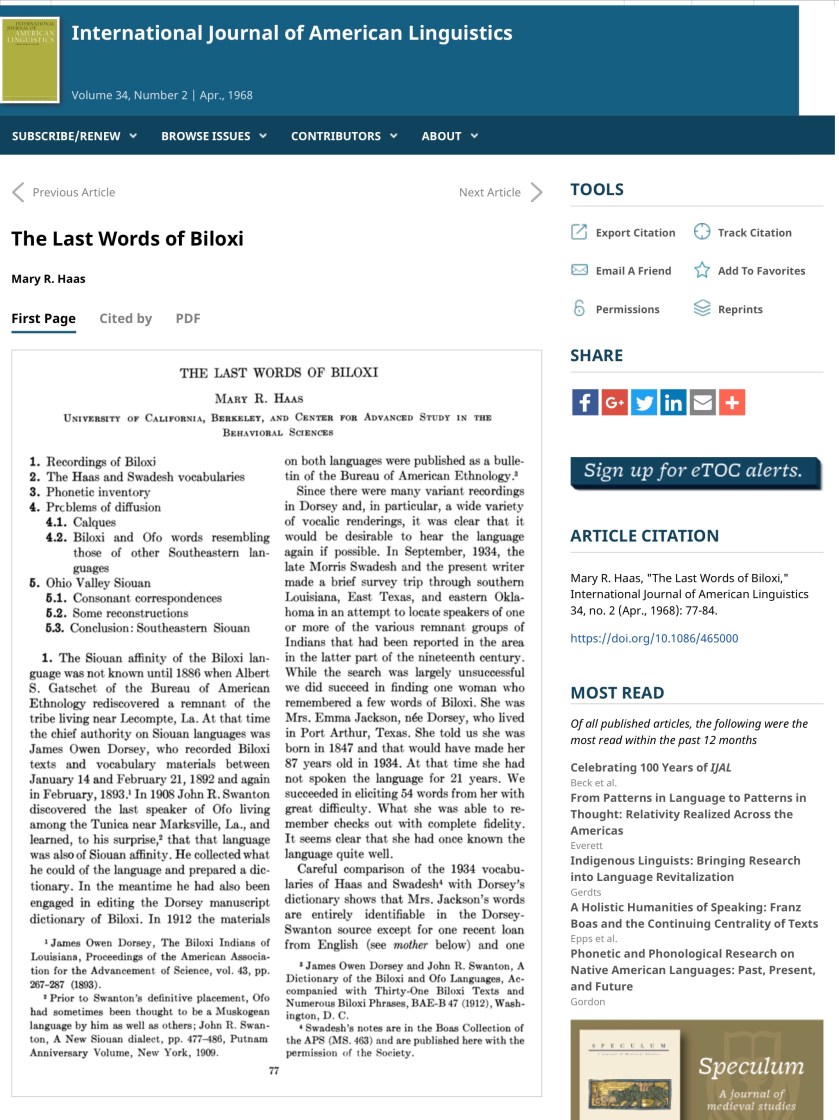
For poignancy, it’s hard to beat articles like this one from IJAL, the International Journal of American Linguistics.  No, “American linguistics” does not mean linguistics done by Americans, or done in America: it means the study of the indigenous languages of the Americas.  (The Americas explained in the English notes below.)  Wikipedia tells me that it was established in 1917 by the anthropologist Franz Boas (a fascinating figure–check him out).

The article was written by Mary Haas, one of the most prolific producers of linguistics PhDs ever (including Marc Okrand, who would go on to create the Klingon language for the Star Trek movies–one of my colleagues used to use it as a source for exam questions).  Haas spent a decade researching some of the indigenous languages of the southeast United States (and an island off the coast of British Columbia), and then was recruited by the War Department to develop a methodology for teaching Thai.  She did so; my anthropological linguistics professor told me that after the war, her approach was abandoned on the theory that she had been teaching her American students to speak a tone language and that for an American to learn to speak a tone language is impossible–clearly Haas was right, and it is not impossible for an American to speak a tone language.  My professor chalked this folly up to the sexism of the time, and she was probably right.  Haas worked with the last living speakers of a number of languages; this paper describes her work on one of them.  Read it and weep.


English notes

The Americas: North, Central, and South America.  Some examples from the Sketch Engine web site:

  • From the local ports it was shipped to Liverpool and thence into larger vessels overseas, including West Africa where it became a key component in the triangular trade involving slaves to the Americas.
  • Her work explores contemporary cultural production in the Americas to analyze how artists and activists use a variety of media, the Internet, Closed Circuit TV, the street, and theatre, to challenge traditional notions of politics in relation to location, simulation, and embodiment.
  • The members represent not only the various disciplines (such as history, anthropology, archaeology, sociology and law) but also the various regions of the world (Africa, the Americas, the Caribbean, Europe, the Indian Ocean, the Arab states and Asia).

How I used it in the post: No, “American linguistics” does not mean linguistics done by Americans, or done in America: it means the study of the indigenous languages of the Americas. 

poignancy: from the adjective poignant, meaning

(1) painfully affecting the feelings piercing 
(2) deeply affecting touching
  • The Schubert in particular was very affecting: in the second movement, the poignancy of an old man now 87 playing the searing music of a young man facing early death was almost too much to take.
  • The threshold between life and death imparts poignancy to the utterances of the dying.
  • If we don’t survive, we can imagine the same faint chance the Voyagers have of being detected and studied by some other intelligence, a thought that adds an almost unbearable poignancy to some of these images.
  • But a second viewing reveals that what he has witnessed is his own funeral, the final scene of the film, adding an unbearable poignancy to a very potent image of tragic inevitability.
  • It was meant to be a romantic comedy, and it definitely has those elements, but it ended up having a bittersweet poignancy as well, as Paisley deals with the death, bequests and scandals of her great-aunt.

How I used it in the post: “For poignancy, it’s hard to beat articles like this one from IJAL, the International Journal of American Linguistics.”  

to chalk (something) up to (something): “To link something that has happened to a particular reason or circumstance.”  (Source: The Free Dictionary You’ll find a number of related, but different, meanings there.)  Examples:


Ukrainian Humanitarian Resistance

Resisting the russist occupation while keeping our humanity

Languages. Motivation. Education. Travelling

"Je suis féru(e) de langues" is about language learning, study tips and travelling. Join my community!

Curative Power of Medical Data

JCDL 2020 Workshop on Biomedical Natural Language Processing

Crimescribe

Criminal Curiosities

BioNLP

Biomedical natural language processing

Mostly Mammoths

but other things that fascinate me, too

Zygoma

Adventures in natural history collections

Our French Oasis

FAMILY LIFE IN A FRENCH COUNTRY VILLAGE

ACL 2017

PC Chairs Blog

Abby Mullen

A site about history and life

EFL Notes

Random commentary on teaching English as a foreign language

Natural Language Processing

Université Paris-Centrale, Spring 2017

Speak Out in Spanish!

living and loving language

- MIKE STEEDEN -

THE DRIVELLINGS OF TWATTERSLEY FROMAGE