No clever title about the bombings in Brussels, but here’s some relevant vocabulary

ward-markey-sur-Twitter-echt-wtf-daar-in-zaventem-httpst.co2AGTBBA0xs-Google-Chrome-630x0
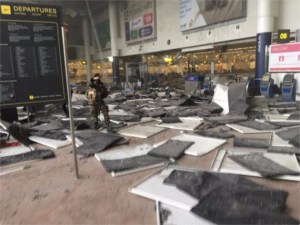
Scene from Zaventem airport in Brussels after the bombings of March 22, 2016. There is some concern that with the security in restricted areas of airports as high as it is now, terrorists will now start attacking the public areas, as they did today. Picture source: http://www.lejournaldelorne.fr/2016/03/22/attentats-explosions-a-l-aeroport-et-dans-le-metro-de-bruxelles-suivez-les-evenements-en-direct/.

The radio show that I listen to in the mornings (Les matins de France culture) starts with the various and sundry reporters going around and saying a few words about what they’ll be talking about.  Yesterday one of the reporters said this: I’ll be talking about the attacks in, um…in, um…well, there are so many of them.  [Nervous chuckle.]  This morning I woke up to the news of the latest attacks in Brussels: two bombings at the airport, then one at a metro station.  All major European capitals are on heightened security at the moment, especially at transit points, but other than that, planes are flying (except to and from Brussels), the trains are moving (except in Brussels, where all subways, busses, and trams are shut down, and people are being advised to stay at home), etc.

It’s depressing to note that I now know most of the words in any given story about a terrorist attack.  However, Zipf’s Law never really goes away, so here are some words from stories about this morning’s bombings.  For the full story from the source, click here.

  • survenir: to occur, to arise.

 Une explosion survenue dans le métro, à la station Maelbeek, aurait fait une dizaine de morts et de nombreux blessés.

“An explosion that took place in the metro, at the Maelbeek station, has caused a dozen deaths and numerous injured.”

  • réaffirmer: to reaffirm.

Nos pensées vont naturellement aux victimes, à leurs proches ainsi qu’à l’ensemble des autorités belges auxquelles nous réaffirmons notre solidarité.

“Naturally our thoughts are with the victims, with their dear ones, and we reaffirm our solidarity to all of the Belgian authorities.”

  • faire le point sur: to take stock of, to review.

Nous venons de faire le point sur notre dispositif en place aux frontières et dans les transports.

“We have just reviewed our security team in place at the frontiers and in the means of transport.”

  • rehausser: to raise, to boost.

Nous n’avions pas attendu cette attaque pour réhausser notre niveau de sécurité.

“We didn’t wait for this attack to boost our level of security.”  Note: the news story spells the word réhausser, but WordReference.com gives it as rehausser.


How we’re sounding stupid today: #JeSuisCirconflex

2016-03-21 08.41.55
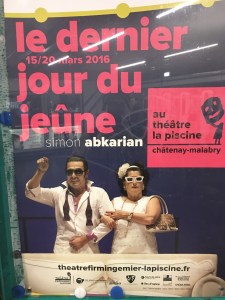
“The last day of the fast.” Picture source: picture by me of an advertising poster in the train station.

The military has this problem.  People transfer from one “duty station” to another fairly often, and you need to be able to get them integrated quickly–you can’t have someone taking up unproductive space on a ship or on a base for very long.  The US military has gotten this integration process down to a science.  Basically, when you show up at a new command, you’re given a check-sheet.  You take it around to various and sundry places–the medical clinic, the pay clerk, the base library, etc.  The people who work there do whatever has to be done to get you integrated into the unit.  They sign your check-sheet, and you go on to the next place.  It takes maybe two days to get totally set, and then you’re productive.

The place where I work when I’m in France has a similar system.  By now, je connais déjà cette musique–I know the drill–and I can usually get all of my administrative stuff done the first day back in the lab.  There’s only one problem: I have to successfully pick up the check-sheet.  The issue is that it’s called a feuille jaune–a “yellow piece of paper” (it is indeed a piece of paper, and it is indeed yellow), and I constantly mess up and ask the administrator for a feuille jeune.  Only a one-vowel difference, but it means “young piece of paper,” not “yellow piece of paper.”  This gets me confused looks, or by now a smile.  I was reminded of just how ambiguous this really is on the way to work this morning, when I saw the poster that you can see at the top of this post.  What’s interesting about it is the word jeûne, which is pronounced the same as the word jeune, but spelt differently–notice the circumflex accent in the former.  As I said, they’re pronounced the same, but jeune (no accent) is “young” or “youngster,” while jeûne (with accented û) is a fast (that is, when you don’t eat).  The pair of words has been much in the news lately.  The issue here is that the French government will be instituting a spelling reform at the beginning of the next school year.  Among other derangements of the current system, some words with circumflex accents will be losing them.  There is a major Twitterstorm about this.  One funny tweet that I read pointed out that the circumflex accent on jeûne (a fast) is the only difference between je vais me faire un petit jeûne (I’m going to take a little fast) and je vais me faire un petit jeune (I’m going to have myself a little youngster.)

Now, “fast” is a perfect Zipf’s Law sort of word: it certainly is not common, but it also is certainly not particularly weird in any way–any native speaker knows it.  I had never run into jeûne before the Twitterverse went crazy about the spelling reform, and in fact, that’s how I learnt it.  Now it’s a couple months later, and there it is: right there in my face as I went to work this morning.  Zipf’s Law!

  • jaune (adj.): yellow.
  • le jaune: scab, strikebreaker.
  • le/la jeune: young person.
  • le jeûne: fast, fasting.


Fun (and possibly useful) facts about the Paris metro

2014-07-08 10.34.50
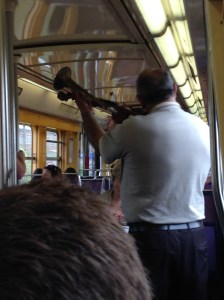
Musician playing an interesting variant of the violin on the RER B train to Roissy. Picture source: me.

In a previous post, we saw some basic principles of politeness on the Paris métro.  Here are some other fun facts about the subway experience in the City of Lights.

  • There’s a whole genre of panhandling that takes place on the métro and on Paris-area trains.  Someone will get into the car and declaim a speech.  “Declaim” might not be the best verb here, as it’s typically done in something of a monotone.  It typically begins something like this: Mesdames et messieurs, je suis désolé de vous déranger pendant votre trajet.  “Ladies and gentlemen, I am sorry to disturb you during your journey.”  It then proceeds along the following lines:
    1. I am homeless/I have 5 children/I have lost my job and am unemployed.
    2. I need a place to stay tonight/food for my children/money to pay my rent.
    3. I would appreciate money/lunch tickets/a few sous.
  • The mendicant then walks through the car holding out his hand (it’s primarily men that do this) or a paper coffee cup.  If it’s a young street person carrying a backpack and a leather jacket, he’s probably not going to get much.  If it’s an old person, a few people will give him money.  Then he gets off at the next stop and gets on another car.  Linguistic note:  it is taken me over a year and a half to be able to understand one of these guys.
  • Musicians on the subway and on local trains are a real thing, not just a cute cliche.  Sometimes they will be playing the accordion that we’ve all seen a thousand times in the movies, but they also may sing, or play any of a variety of musical instruments.  You’ll see this not just in touristy areas, but even on the train that I take out to the suburbs with tons of other people on their way to work or to the various and sundry universities south of Paris.  I would guess that they are organized in some way, as the majority of them show up with the same loudspeaker and canned background music.  (See above for one of the more bizarre things that I’ve seen in this respect.) I encourage you to give these folks some money–they’re out there working for a living, and they’re one of the things that gives Paris its usually-wonderful ambience.  In addition, it sometimes takes some courage for these folks to do what they do, e.g. the guy who plays the recorder in one of the stations, frequently including Hatikvah (the Israeli national anthem) in his repertoire.  This is risky in a city in which anti-Jewish violence has recently been pretty severe.  One of my favorites is a guy who often sits in the Cluny-La Sorbonne station, west-bound quai, on Saturdays.  He alternates between playing the er-hu, playing the flute, and singing truly impressive Chinese songs.
  • There’s usually an excellent map of the immediate neighborhood somewhere in a métro station.  However, its location is somewhat unpredictable.  Sometimes you’ll find it on the actual subway platform, and sometimes outside of the turnstiles.  Check before you leave the platform; if you don’t find it there, try again once you exit.
  • In his book Five nights in Paris: after dark in the City of Light, John  Baxter claims that massive amounts of perfume are pumped into the métro system on a daily basis.  I can’t say that I’ve ever smelt it, but I did find a couple of articles from 1998 that are consistent with the claim.  (Here’s one.  Here’s another.)
  • It’s said that within Paris, you’re usually not more than 10 minutes’ walking distance from a metro station.  This is probably true.  If you’re near a metro station with multiple lines, you’re probably about 30 minutes door-to-door from any place in Paris.  Add a bit if you’re near a metro station that only serves one line.

Paris metro etiquette

If you follow Parisian rules of etiquette on the metro, your visit will go more smoothly. Here’s how to do it.

enleve son sac a dos
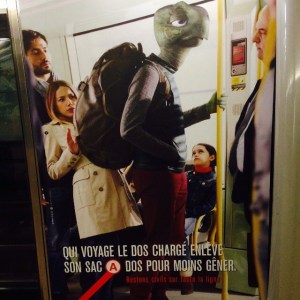
“He who travels with his back loaded removes his back pack in order to be less bothersome.” Picture source: photo that I took of a sign in a metro station.

If you look on question-answering web sites like Quora, or even just do a quick Google search, you’ll see many people asking this question: Why do Parisians hate tourists?  The answer: Parisians do not hate tourists.  On the contrary–Paris is very aware that tourists are part of the life-blood of the city, and they are happy to have foreign visitors in droves.

However: there are definitely things that tourists do that can interfere with the flow of your daily life here, and those things can be irritating.  A lot of those things happen on the métro, the Paris subway system.  Every morning, 2.5 million people get on that thing for their commute to work, and then they do it again in the evening.  In hopes of preventing you from being one of those tourists who irritate the locals, here are some notes on metro etiquette.  You’ll note here many instances of what I understand to be the basic principle of French behavior: don’t inconvenience the other guy.

  • Entering/exiting: When you’re waiting to enter a subway car or train, stand off to the side of the door so that you’re not blocking it.  People will exit through the center, and then you enter at the side, or through the center if it’s not obstructed.  (This is a really common rule for tourists to break, and it’s really irritating during rush hour when lots of people are trying to get off and into the cars.  Don’t be that tourist.)
  • Hold gates open: When you go through the gate, hold it open behind yourself for the next guy.  You don’t have to stand there and wait for him, but if there’s someone right behind you, this is the polite thing to do.
  • Luggage: Be considerate about trying to wrestle your big, bulky suitcase through the turnstile when there are lots of people trying to go through it–wait until traffic lets up, so that you’re not keeping everyone else from getting to their train.  Some stations also have a space next to the turnstile for luggage, so look for those.  Also note that you shouldn’t be taking your @#$% luggage on the metro anyway–see this post for reasons why that’s a bad idea.
  • Strapontins: Subway cars in Paris typically have a couple of folding seats right next to the doors, called strapontins, believe it or not (it’s the general word for a folding chair).  If the car is crowded, don’t sit in them–you will see French people who are using them stand up when a bunch of people enter the car.
  • Be quiet: If you hear someone talking or laughing loudly on the metro, they will probably be speaking English.  If you hear someone speaking on a cell phone, they will probably be a foreigner.  In general, Parisians tend to be quiet on public transportation.  See here for a funny story about what can happen if you’re not.
  • Backpacks off: If a car is crowded, take off your backback–even if it’s a little one.  If you don’t, it’s super-awkward, both for you and for everyone else.
  • Offer your seat to pregnant/elderly people: Even kids from bad neighborhoods will offer their seats to an old person or a pregnant woman on the métro.  You should do the same.
  • Say pardon: You will often have to squeeze by a few people to get on or off of a crowded car.  The polite thing to do is to say pardon when you do so.
  • Don’t block the quai, stairs, or escalators–move to the right.  If you’re walking along the subway platform or going up/down stairs and escalators, stay to the right.  People will pass you on the left.  Similarly, if you need to stop and figure out which way to go, don’t stop in the middle of heavy foot-traffic–get out of the way while you get your bearings.
  •  le strapontin: folding seat, jump seat.
  • le quai: platform, dock, quay.
  • le wagon: subway car, train car.


Don’t take the train from the airport to Paris

Any guidebook will tell you that you can take the train from the airport to Paris. What they don’t tell you is that you can–BUT, YOU SHOULDN’T.

Man descending stairs, Abbesses Metro Station, line 12, Paris, France
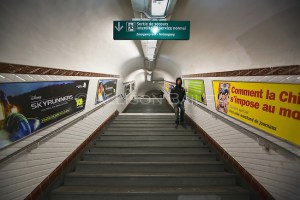
Stairs at the Abbesses metro station. Picture source: http://allisonbailey.photoshelter.com/image/I0000_biCI_fb7wM.

I happened to be on the metro on the way home from work during rush hour yesterday.  Onto the packed train climbed a young woman wearing an enormous backpack.  Her travelling companion was similarly encumbered, and was also carrying an enormous, ornately embroidered, blue velvet sombrero.

Their backpacks took up at least as much space as two additional people would have.  Furthermore, since they were wearing them on their backs, there was no way that they could move without smacking someone with 65 liters’ worth of stuff, and no way that they could maneuver out of anyone else’s way in those tight quarters.

You didn’t even have to be able to hear them to know what their nationality was–just by watching their mouths, it was pretty clear that they were Americans.  (Yes, the mouths of American English speakers move quite differently from the mouths of French speakers.)  They had probably read their Paris guide books closely–and they had been lead astray by them.

Any Paris guidebook will tell you that you can get from Charles de Gaulle Airport (or Roissy, as the locals call it) by taking the train into Paris, and then switching onto the subway.  This is certainly true.  What the guidebooks don’t tell you is that even though you can, you should not do this. 

There are two basic problems with the take-the-train-to-the-subway plan, and I see those two problems raise their ugly heads all the time.

  1. There are a heck of a lot of stairs in some of those stations.  I can’t tell you how often I have come across someone trying to struggle up–or down–a long flight of stairs in a Parisian metro station with a huge suitcase.  (Oh, there really ARE nice people in the world, said one old lady with an absolutely enormous suitcase who I found almost in tears at the top of a loooong flight of stairs in a metro station.  If I hadn’t recently been training to fight in Nationals, I don’t think that I could have carried that big honking thing down the stairs, either.)  Even if your plan is to take the train to someplace from where you can catch a taxi, versus transferring to a subway, you are not going to escape the stairs in the train station.
  2. Trains and metro cars can both be absolutely packed with people.  Want to get stared at with deep dislike?  Try to squeeze your suitcase with a week’s worth of vacation wear into a subway wagon filled with people jammed [trying to think of a non-vulgar way to put this] together like sardines already.  Enjoy the welcoming looks of all of the people on their way to/from work as they try to squeeze around your giant suitcase, which is now mostly blocking the door.  Roll your 49-pound suitcase over the toes of some nice Parisian woman’s $835 asymmetric-strap Manolo Blahniks.  Or, roll your 49-pound suitcase over the toes of some nice Parisian woman’s $10 Converse knock-offs after she’s just spent all day on her feet at her job as a cashier.  Or…well, the possibilities for pissing off people on a crowded train or metro car are endless, really.

Is that really how you want to start (or end) your vacation?  Probably not.  I recommend that instead, you spring for a taxi.  Due to a recently-passed law, the price of taxi rides from either Paris airport into Paris proper is fixed: 50 euros to the Right Bank, 55 euros to the Left Bank.  You get in the taxi, the total price shows up on the meter, and that’s it.  After a looong flight across the Atlantic, this is the only civilized way to start your Parisian adventure.

I ate my dinner last night while mulling over what the heck that kid could possibly have been doing with that giant sombrero.  Using it to cover his eyes while he slept on the plane?  Using it to cover his entire body while he slept on the plane?  Bringing it as a present for some unsuspecting Parisian who couldn’t possibly have enough room in their tiny Parisian apartment for a Sombrero of Unusual Size?  Hard to say…

  • fourvoyer: to mislead; to lead astray.  The American tourists with their giant backpacks (and their giant sombrero) were led astray by their guide books.
  • se fourvoyer: to be mistaken, to get something completely wrong; to get lost, to stray from one’s path.  I do this pretty much all the time.

Every cheese has its story: Munster

2016-03-12 14.11.06
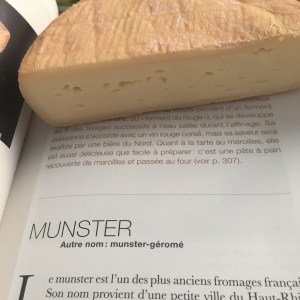
Half of a Munster. Photo source: me.

My Saturday morning shopping trip always starts with a visit to the neighborhood cheese shop.  Once I get there, I check the sign in the window to see what’s in season.  If it’s not something that I haven’t tried before, I go in and shop for something interesting.

This weekend a medium-sized, soft, raw cow milk cheese caught my eye.  However: I’ve been focussing on French cheeses, and this one was called Munster–a German place name.  He iz French, this cheese here?, I asked the always-helpful attendant.  Yes, she answered–it’s from Alsace.  That explained the German name–Alsace and Lorraine are regions that go back and forth between France and Germany, depending on who won the most recent war.  At home, people often speak German, but the official language of school, the government, etc. is French.  (Wikipedia says that 43% of adults speak the local dialect of German, but that its use is disappearing among the younger generation.)

Every French cheese has its story–and its particularities.  Munster is thought to be one of the oldest cheeses in the country.  I’ve seen estimates of its date of origin from the 700s to the 800s.  The story is that it had its origin in the village of Munster, currently located near the very easternmost part of France, quite close to Germany.  The village is thought to have taken its name from the Latin word monasterium, meaning a monastery or a monk’s cell in Medieval Latin.  People clustered around the monastery, and in order to ensure the availability of food to the surrounding populace, the monks made this cheese.  (I’m a little skeptical–like any other soft cheese, Munster doesn’t last very long.)  Another story is that the cheese was brought into the region by monks who came to Christianize the area during the time of Charlemagne.  In the 1500s, it became popular outside of the region, being sold not just in Paris, but in Luxembourg, Switzerland, and Germany as well.  Back in those days, the price of the cheese for the upcoming year was announced every June 23rd at a large fair in the town of Gérardmer–I’ve never heard anything similar about any other cheese.

Some cheeses are defined in part by what the cows have to be fed in order for a cheese to have the right to its name, and Munster is one of those.  The cows have to graze on the grass of the massif of the Vosges, in eastern France.  This is what gives the cheese its terroir, its regional character.  During its preparation, the surface of the cheese is salted, and you can taste that very clearly.  While it ages, it is occasionally washed with beer.  This kind of washing is characteristic of cheeses that originated in monasteries, and specific cheeses have to be washed with specific things.  If it’s not washed with beer, it’s not Munster.

Munster (pronounced, incidentally, [mœ̃stɛʁ]]) smells stronger than it tastes, so it’s actually not a bad cheese for an American who is just starting to explore the stinky cheeses (even the French call them les fromages qui pue, “cheeses that stink”).  Enjoy!

The confusion of thinking about the subjunctive

I got an email today with this question:

Screenshot from 2016-03-16 15:41:59
“Do you think that I should bring it to the English-speaking depositor’s attention that their article is a little short?” Picture source: screen shot of my email.

It’s a nice data point regarding something that’s difficult for us English speakers to remember: penser que (“to think that”) takes the indicative in the present affirmative (that is, when you’re making a statement).  However, it takes the subjunctive when it’s used in a question, and when it’s used in a negative.

The Lawless French web site has a succinct description of how it works at this web page.  Using the example of devoir that showed up in the email, we would have this (hopefully one of you native speakers out there will double-check me):

  • Je pense que tu dois…  I think that you should…  (present affirmative, takes indicative dois)
  • Je ne pense pas que tu doives…  I don’t think that you should… (present negative, takes subjunctive doives)…
  • Penses-tu que je doive…  (present interrogative, takes subjunctive doive)

I hate it when Anglophones complain about the subjunctive–I think it’s charming.  I bring this up only because it’s a corner of the grammar that puzzled the heck out of me today.  How does this work in the future tense?  I have no clue.  I’d love to be able to say “I don’t think that Trump will win the election”–present tense?  Subjunctive?  No clue.  Native speakers?

Vocabulary of the terrorist attack in the Ivory Coast

terrorst attack ivory coast
A man helps an injured child at the site of the March 2016 terrorist attack at a beach resort in Ivory Coast. Picture source: http://heavy.com/news/2016/03/ivory-coast-grand-bassam-hotel-terrorist-attack-photos-pictures-isis-suspect-victims-nationalities/2/.

I swear, it makes my heart ache every time I learn vocabulary from yet another terrorist attack.  On Sunday, March 13, six guys dressed in black showed up at a resort on the beaches of Grand-Bassam in Côte d’Ivoire (Ivory Coast) and started shooting people–men, women, and children.  By the end, 22 people were dead–14 civilians, 2 soldiers, and the six gunmen.  Al Qaeda in the Islamic Maghreb (AQIM) took credit.  Bastards…

Here is some vocabulary from the Matins de France culture news story.

  • balnéaire: seaside, bathing.
  • la station balnéaire: beach resort.
  • le fusil: [fyzi] rifle.  Also a gunman, a “(good) shot.”
  • le pistolet: pistol.
  • kalash: a pistol, as far as I can tell.  Presumably short for Kalashnikov.  However, from what I can tell from a French slang web site and from a list of synonyms that I turned up, it seems to be a pistol.  Native speakers?  Also, does someone know the gender of this noun?
  • la flingue: pistol (slang).

Plate-lickin’ good: Cafe culture in Paris takes an unexpected turn

cafe arts et the
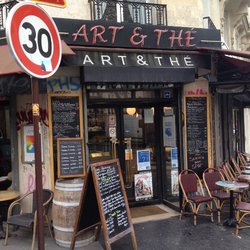
The Café art et thé on rue de la Roquette. Picture source: Yelp, http://www.yelp.fr/biz/art-et-th%C3%A9-paris-2.

I saw something today that I’ve never seen before: a French person taking food home from a restaurant.  Doggy bags really are not a thing in France at all–there isn’t even a word for them–and it was a moderate scandal last year when the government passed a law requiring restaurants over a certain size to provide them.  So, when the lady a couple tables over told the waiter that she wanted to take her left-over merguez (a kind of sausage) home, he brought her a piece of aluminum foil, and she wrapped them up.

What happened next surprised me even more.  To set the context, you have to realize that this was a perfectly nice little cafe, not some hipster hole in the wall.  Carefully-coiffed middle-aged ladies with pearls and subtle but impressive decolletage (or décolleté, as we say in these parts), silver-haired guys in sports coats and shirts with collars–that kind of thing.  So, imagine that–and then imagine this lady licking her plate.  Wow–I was pretty stunned.  Amazingly, no one else seemed to notice.

I will happily grant that I do not have a complete handle on French table manners.  However, if this is something normal, I definitely haven’t seen or heard of it before, and let me tell you, the French typically take their table manners seriously.  Native speakers, can you enlighten the rest of us?  Incidentally: the lunch was delicious.  Café art et thé, on rue de la Roquette.  A delicious lamb couscous and a glass of Côtes du Rhone set me back 15 euros.  Come at 11 on a Sunday and you may find a large group of people discussing philosophy, depending on where they’re meeting that week.

  • la brochette: a kebab.  Typically lamb, unless otherwise specified, but ask.
  • le couscous: couscous!  Some say that it is becoming one of France’s national dishes.  France has a large North African Arab population, and you can get excellent North African food here–Algerian, Moroccan, Tunisian, whatever.
  • lécher: to lick.  Yes, this is a relative of the English word lecher, in a not-too-roundabout way.  The Frankish word lekko:n (the o: is a long o) gave rise to the Old French word lichiere/lechier, meaning “to live in debauchery or gluttony,” and also to the verb lécher, “to lick.”  English lecher comes from lichiere/lechier.  Etymology is so much more fun than you might have thought!

Are you taking pictures of the entire world?  Street life in Paris


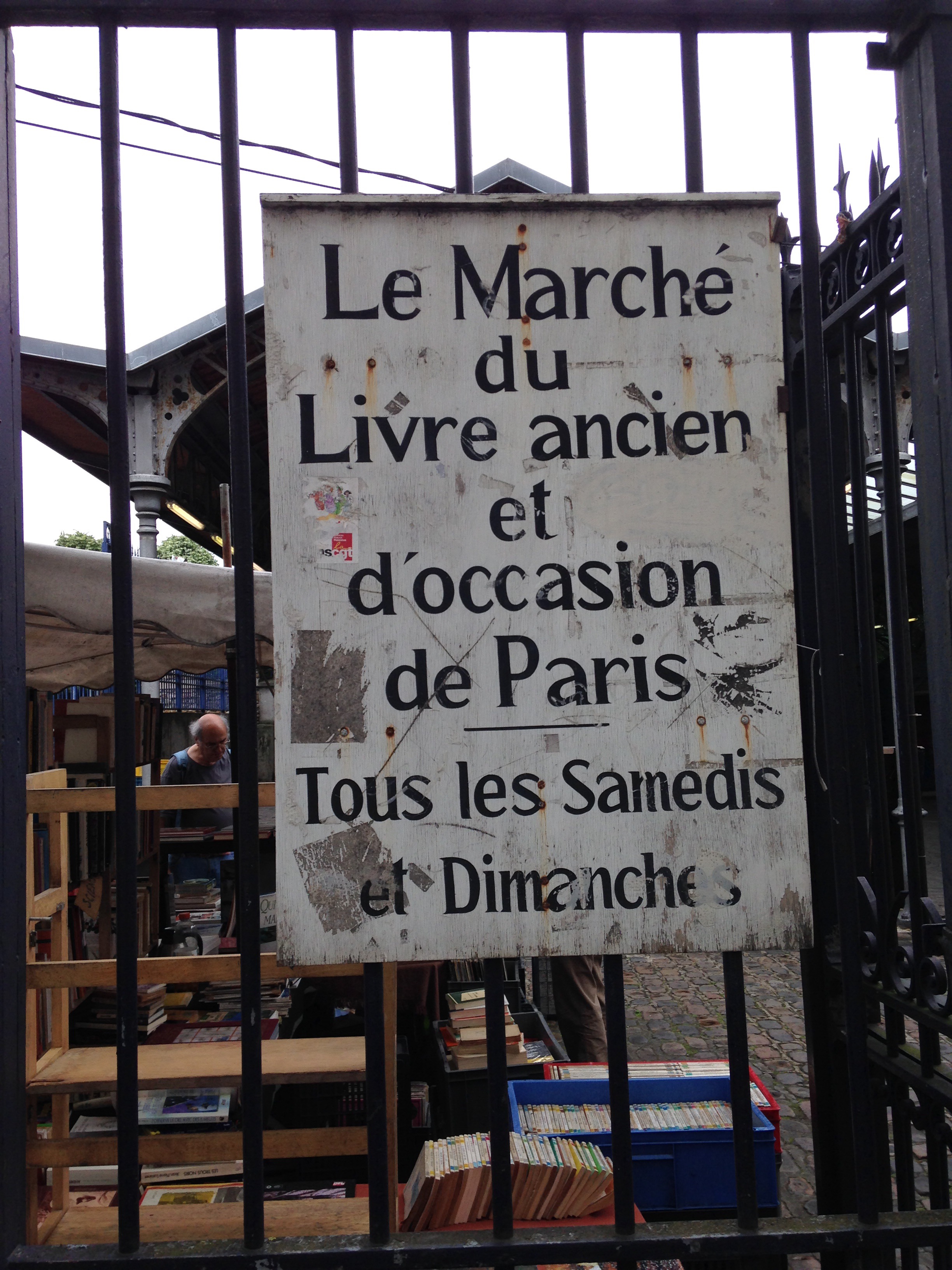
“Old and used book market of Paris. Every Saturday and Sunday.”  Picture source: me.

As soon as I think I’m getting Paris, something happens to disorient me completely. Just now I pulled out my phone on the street to look for a cafe on Yelp. The French are famously uncomfortable around strangers, and tend not to approach them. So, I was quite surprised when an old man, clearly totally français de souche (of French origin), approached me. Are you taking pictures of the entire world?, he asked me. I search a cafe, I answered.  Which cafe?, he wanted to know.  Some…any…um…, I stumbled.  Go down that way. There are several.   Sure enough, right down the street I found Le boin coin, a popular neighborhood place right across the street from the used book market that I had forgotten about. And so goes my understanding of Paris and the French–two steps forward, one step back.

Ukrainian Humanitarian Resistance

Resisting the russist occupation while keeping our humanity

Languages. Motivation. Education. Travelling

"Je suis féru(e) de langues" is about language learning, study tips and travelling. Join my community!

Curative Power of Medical Data

JCDL 2020 Workshop on Biomedical Natural Language Processing

Crimescribe

Criminal Curiosities

BioNLP

Biomedical natural language processing

Mostly Mammoths

but other things that fascinate me, too

Zygoma

Adventures in natural history collections

Our French Oasis

FAMILY LIFE IN A FRENCH COUNTRY VILLAGE

ACL 2017

PC Chairs Blog

Abby Mullen

A site about history and life

EFL Notes

Random commentary on teaching English as a foreign language

Natural Language Processing

Université Paris-Centrale, Spring 2017

Speak Out in Spanish!

living and loving language

- MIKE STEEDEN -

THE DRIVELLINGS OF TWATTERSLEY FROMAGE