Social media, linguistics, suicide, and you

All of that time you spend on Facebook isn’t wasted if you donate your social media data to suicide research.

Until the 1960s or so, there were basically two ways to do linguistic research.

  1. If you were into historical linguistics and/or dead languages, you looked at ancient texts.
  2. If you were into living languages, you went and camped out on a reservation, in a village, or whatever, and you sat with native speakers and your notebook and you collected data.  You transcribed things, and then went home and copied out your notes, and then you thought about them a lot.

In either case, the underlying philosophy was that there was some body of data in your hands, and your task as a linguist was to come up with a description/explanation of what was in that body of data.  Seems straightforward enough.

In the 1960s or so, the American linguist Noam Chomsky turned the world of linguistics upside down with the idea that what you should be doing is describing/explaining native speakers’ intuitions about their language.  Intuition is a technical term here–it refers not to “what Kevin happens to think is the case about his native language,” but to native speaker judgements about questions like Is the sentence “I saw the man on the hill with a telescope” ambiguous?  This changed the conception of what constitutes “data” enormously.  On this view of linguistics, there’s no need to go freeze on the Siberian tundra to get your data–you can do it in your living room.  Les données, c’est moi !  

Today linguists are less likely to talk about binary “yes it is/no it isn’t” questions than they are about gradient judgments–“Sentence X is more acceptable than sentence Y”. For a really good discussion about the issues from a perspective I think you’ll like, see the work of John Sprouse under the general heading of “experimental syntax.”

–Philip Resnik

From a philosophical perspective, this was a radical shift–from empiricism (sometimes a very extreme empiricism, as for example in the case of Leonard Bloomfield (leading American linguist of the first half of the 20th century, author of the first article published in the journal Language, and Yale professor who was refused membership in the Faculty Club because they didn’t let Jews join in those days), who was of the opinion that mental states are not observable, and therefore semantics is not a fit topic for science) to rationalism, and a rather extreme rationalism at that.  Not everyone was happy about this, and in fact most older linguists weren’t–from a methodological point of view, it’s hard to see how you could falsify a hypothesis when the evidence that’s being presented is some version of yes it IS ambiguous–but Chomsky took the grad students by storm, and linguistics underwent a radical change.  It swept the world of academia in a way that it never had before, too.  (Check out Randy Allen Harris’s The linguistics wars for details.)

Meanwhile, Henry Kučera and W. Nelson Francis were thinking about the potential for computerized analysis of language, and in 1967 they published Computational Analysis of Present-Day American English, based on the study of a bit over one million words of American English that they had had typed up by keypunch operators.  They were at Brown, and called their data set, which they made available to the public–now you could check someone else’s data–as the Brown Corpus.  As far as I’m aware, that data itself didn’t lead to any earthshaking discoveries, but it did make people’s ears perk up: it was clear that there were possibilities for doing defensible studies of language when you could search a large body of text with a few keystrokes that just weren’t there if your data were whatever you happened to need to intuit that morning.  Or whatever your grad student happened to need to intuit that morning.  Or, in a pinch, whatever you happened to need to intuit in the heat of your dissertation defense.

There were some issues with the Brown Corpus, or at any rate, with trying to make similar corpora (the plural of corpus) on your own. One was copyrights.  The Brown Corpus was what is called a stratified sample: it deliberately tried to structure its contents.  Those contents included fiction, non-fiction, personal correspondence, books, newspaper articles–all sorts of stuff, much of which required getting permission from someone or other.  Then there was the matter of those keypunch machines–all 1,014,312 words had to be entered by hand.  People continued to pursue the construction of corpora, and cool things came out of that work, both in terms of linguistic theory and in terms of designing computer programs that could do things with language.  But, it was slow going–people realized that bigger and bigger corpora would let them do cooler and cooler things, but typing is neither fast, nor inexpensive.

Then a miracle happened: the Internet.  All of a sudden random people around the world were vomiting forth massive quantities of linguistic data, and it was mostly copyright-free, and they were typing that shit themselves.  Nectar!  Now you can get access to billions of words of text in an amazing variety of language.  Is it necessarily clean, pretty, or legible?  No.  Is it real?  Yes, and that’s what matters, at least to linguists.  My colleague Graciela Gonzalez at Penn has done amazing things with social media data, ranging from monitoring medications for previously unknown adverse effects to monitoring prescription medication abuse.


Until recently, there was remarkably little data available on the language of suicidal people, or even on the language of people with psychiatric disorders in general.  This is surprising, because with so many mental illnesses, the symptoms are, for the most part, expressed via language.  As Philip Resnik, Rebecca Resnik, and Margaret Mitchell put it in the introduction to the proceedings of the first Association for Computational Linguistics workshop on computational linguistics and clinical psychology in 2014,

For clinical psychologists, language plays a central role in diagnosis. Indeed, many clinical instruments fundamentally rely on what is, in effect, manual annotation of patient language. Applying language technology in this domain, e.g. in language-based assessment, could potentially have an enormous impact, because many individuals are motivated to underreport psychiatric symptoms (consider active duty soldiers, for example) or lack the self-awareness to report accurately (consider individuals involved in substance abuse who do not recognize their own addiction), and because many people — e.g. those without adequate insurance or in rural areas — cannot even obtain access to a clinician who is qualified to perform a psychological evaluation.

Suppose you’re interested in the language of suicidal people.  Until recently, if you wanted to get your hands on actual data, you could get your hands on a set of suicide notes collected and annotated by my colleague John Pestian at Cincinnati Children’s Hospital Medical Center (and me and a bunch of other people). That data has been revealing, and we’ve learnt things about suicide from that data that we didn’t know.  But, that data was hard to come by.  Putting that data set together took years (if you can read French, you can find a paper here on some of the issues), and if you want to get your hands on it, you need to go through some hoops to demonstrate that you have a legitimate research interest, that you will not be posting people’s suicide notes on Facebook or Pinterest, and so on.

Social media has changed all of that.  In fact, the past couple years have seen an explosion of work on the linguistic characteristics of mental states associated with mental illness, including suicidality.  Much of it has appeared in the proceedings of CLPsych, the above-mentioned Association for Computational Linguistics workshop.   To give you some examples:

  • Glen Coppersmith and his colleagues at Johns Hopkins worked with tweets from people with post-traumatic stress disorder, seasonal affective disorder, depression, bipolar disorder, and psychiatricaly healthy controls.  They found that based on the contents of the tweets, they could do a pretty good job of classifying which of those categories the poster belonged to.  They tried various methods of representing the contents of the tweets, and found that they got the best results with what are called statistical language models.  In a later paper, they looked at six more conditions, and added exploratory analysis on the distributional characteristics of emotionally relevant language.
  • Margaret Mitchell of Microsoft and her colleagues worked with tweets from schizophrenics and healthy controls, and found some unexpected signals in the language of the schizophrenics.  For example, the schizophrenic social media users were statistically more likely to use what linguists call hedging expressions like think, I believe, or I guess. 
  • In one of my favorite papers of this ilk, Munmun De Choudhury and their colleagues looked at the language of people who moved from a Reddit for people with mental health related diagnoses to a suicide watch Reddit.  They found a number of differences in the language of those Reddit users who moved to the suicide watch group and those who didn’t, including differences in what is called accommodation: the ways that we (can) adjust our language to that of the people with whom we’re communicating.  (A post on the subject is in the works.)

Now, there’s an issue here: just because people post their lives on social media doesn’t mean that it’s OK for you to use that stuff for your own purposes.  Ethical questions abound, and that’s just as true for the tweets, posts, or whatever of the psychiatrically healthy controls as it is for those with mental illness, suicidal behavior, or whatever.  And that’s where you come in.

OurDataHelps.org is a group that collects social media data, particularly linguistic data, for use in doing research like the stuff that I’ve described here with the goal of suicide prevention.  They want your data if you have ever flirted with suicide, but they want your data if you haven’t, too–you always need something to compare to, and people like me need data from non-suicidal people to compare to the data from suicidal people.  That could be you!  Check it out: OurDataHelps.org.


Work in this space is definitely emotionally taxing. I find myself with a rule similar to John’s “no more than 10 a day” rule — enough to constantly remind me of the importance of this work, without becoming emotionally oppressive. The emotional response to spot-checking the data is qualitatively different and far more visceral than something like sentiment analysis of beer reviews.

–Glen Coppersmith

One day I needed to read through some suicide notes.  I set an afternoon aside to do it.  I made it through about 150–an hour, maybe–before I read one that was like being punched in the stomach.  I went out and bought a pack of cigarettes, and I didn’t even smoke (at the time!).  I spent a lot of time over the course of the next couple weeks trying to forget it.  I mentioned it to John.  All afternoon?  Man, you can’t do that–10 a day, max.  He was, of course, right.  In this kind of work, ethical issues come up with the researchers, too.  We now provide free therapy for the people who transcribe data for us on suicide-related projects, our researchers who work directly with the data are required to visit a therapist or a clergyman once a month, and we rotate research assistants off of the project every quarter.  Moral of the story: I don’t recommend that you go digging around in this data out of curiosity. But, you can be the data–suicidal or not, why not donate your social media data to OurDataHelps.org and maybe keep someone else from writing one of those notes?

Thanks to John Pestian, Philip Resnik, and Glen Coppersmith for their comments and contributions.  French notes follow.


French notes

le suicide: suicide

le/la suicidé(e): person who kills themself

suicider: to drive someone to suicide; to make someone’s death look like suicide

se suicider: to kill yourself

se donner la mort: to kill yourself

la tentative de suicide: suicide attempt

maquiller un meurtre en suicide: to make a murder look like a suicide

l’attentat-suicide: suicide attack

la mission suicide: suicide mission

la lettre d’adieu: suicide note
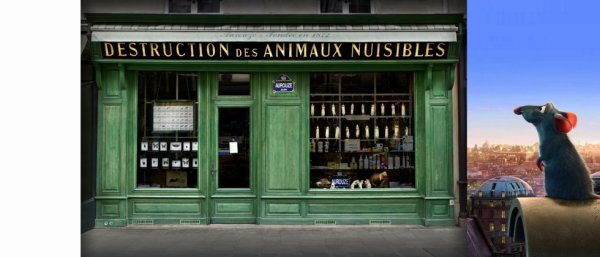
Derivational morphology, pragmatics, and the Great Parisian Rat Crisis

Here in France, our major worries are that we’ll do the same idiotic thing in our next election that America just did in hers. Meanwhile, all the anglophone press can find to talk about is our little rat problem, while ignoring everything linguistically interesting about it.

The French 2017 presidential race is quickly coming down to a match between the far-ish right and the extreme right, it’s not clear how much longer Europe as we know it will continue to exist, and Marine Le Pen was just voted the most admired politician in France,  but the main story about France in the anglophone press right now is… an explosion of the Parisian rat population.

3201193267_1_2_1xvwye8b
Picture source: https://goo.gl/Vi12De

That store window in Ratatouille: it’s for real.  (There’s a cool bar nearby, Le baiser salé (“The Salty Kiss”), that I stop into once in a while.  I’m sparing you a photograph of the real rat window because it really is quite disgusting, and I say that as someone who once posted a picture of a grilled guinea pig here.)  Friends tell me that the story has it that there is one rat for every person in Paris, but current estimates are quite a bit higher.

How would you know the size of the rat population, one way or the other?  There’s a specific sampling technique that’s used to estimate the size of a population that can’t be directly observed–think about fish in a pond, or arctic ground squirrels in their little burrows, or–rats.  Charming video involving goldfish crackers to be seen here.

Zipf’s Law being what it is, this brings up a linguistic oddity that I find interesting.  It has to do with what’s called derivational morphology: the things that we can add to words that change their meaning or their part of speech, like the un in unlock or the ic in anemic.


French has a prefix, dé, that you can add to verbs to make them mean something like a reversal of the normal action of the verb.  Alain Bentolila, in his La langue française pour les nuls (don’t mock it–it may be the best book on the linguistics of any single language that I’ve ever read) defines it and its close relatives, dés- and dis-, as contributing a meaning something like séparé de, qui a cessé de, différent.  Some examples:

visser to screw dévisser to unscrew
voiler to veil dévoiler  to unveil
vérouiller to bolt; to lock; to close (a brèche, in a military context) déverrouiller to unbolt; to unlock (a phone, a keyboard, the caps lock)
valoriser to add value to, to increase the value of dévaloriser to devalue
vêtir to dress (transitive) dévêtir to undress (transitive)

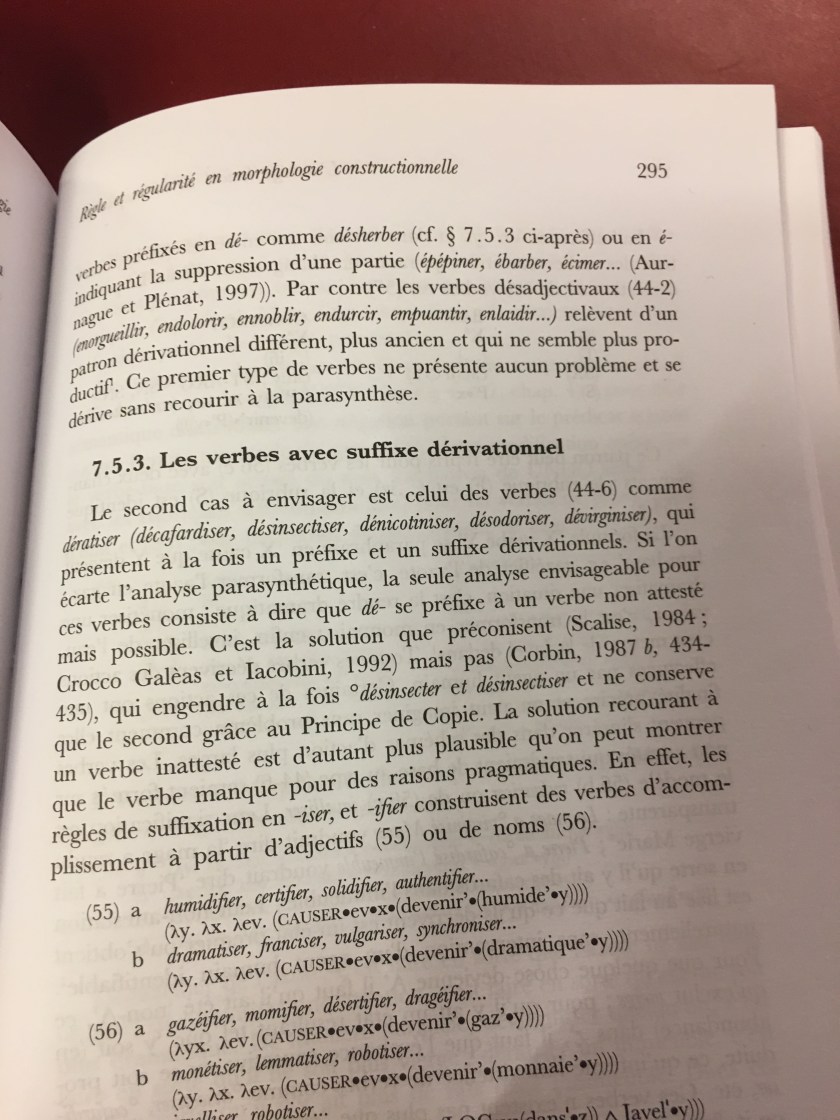
This is relevant to current events because there is a set of words that have to do with removing things–mostly pestilential things, except for the last one–that have an interesting pattern with respect to this derivational prefix.  To wit, I give you these examples from Bernard Fradin’s Nouvelles approches en morphologie (definitions in French when necessary, because these don’t typically show up in bilingual dictionaries)

dératiser  to exterminate the rats in [something] (WordReference)
désinsectiser  to spray [something] with insecticide (WordReference) (I will mention here that some of the definitions of désinsectiser that I’ve come across have specified that this means to get rid of insects by using gas.  I can’t find any at the moment, though.)
décafardiser  (not in WordReference) détruire les cafards dans un lieu, spécialement par fumigation. (Cordial)
dénicotiniser  to remove the nicotine from [something] (WordReference)
désodoriser to deodorize (WordReference)
dévirginiser  to deflower (WordReference)

What’s interesting about this–a lot, actually.  To wit:

  1. There are no corresponding forms without dé.  Unlike visser/dévisser vêtir/dévêtir, we have no form of dératiser/désinsectiser/décafardiser without dé.  
  2. These verbs seem to have both a prefix () and a suffix–where does the -is- come from?
  3. As we will see, this gets us to an interaction that is not supposed to happen in language: between pragmatics, and morphology.

Fradin explains the pattern like this (scroll down for the translation):

2016-11-29-16-52-20

The second case to consider is that of the verbs like dératiser (décafardiser, désinsectiser, dénicotiniser, désodoriser, dévirginiser) which display at the same time a derivational prefix and a derivational suffix….[T]he only analysis worth considering for these verbs is to say that here  is affixed to a verb that is not present in the language, but is possible.  The solution appealing to an unattested verb is especially plausible since we can show that the verb is missing due to reasons of pragmatics.

Fradin goes on to make the case that what we have here is a set of verbs that describe the reversal of a state that you do not create.  You don’t infest something with rats, or insects, or nicotine.  (Note that Molière’s Sganarelle would disagree with the notion that nicotine is something that one is infested with.)  His story is that we see this bizarre combination of patterns:

  1. No corresponding version of the verb without 
  2. There’s an -is- that doesn’t seem to have anything obvious to do with the meaning of 

…just in the case of these verbs, in which you didn’t create the initial state of infestation.

As one of my coworkers pointed out over lunch one day: that’s not to say that you couldn’t create the initial state of infestation.  He’s right: you certainly could put rats in something, or insects, or a cockroach.  (In fact, that’s a famous scam, right?)  It’s a nice point, because it doesn’t change the essentially pragmatic nature of the explanation for this bizarre little grouping of verbs–in fact, it highlights the involvement of pragmatics, because it argues against the possibility of an ontological explanation for this.  On an ontologically-based approach, you have to have a model of reality in which it simply isn’t possible to cause something to have rats, or cockroaches, or insects, and that clearly is not the case.  Rather, this is more about what’s plausible than about what’s possible.  It’s not about what “is” (i.e., ontology)–it’s about what people expect to be the case.  (This is a big deal (to me) because you run into people who think that the answer to every question in the world is an ontology.  That doesn’t seem to be the case here.  It’s also a big deal (again, to me) because the dominant school of thought in 20th-century linguistics was heavily into denying the effects of pragmatics on language.  However, pragmatics appears to have a role here, if we buy Fradin’s story.)

My coworker also raised a counterargument.  It’s a kind of counterargument that we really like in my line of work: positing that there is a simpler explanation for the phenomenon in question.  His suggestion was that the -is- thing comes from what we call denominalization, or turning nouns into something else–in this case, a verb.  (You can find a discussion of nominalization–turning a verb into a noun–here.)  I don’t buy the adequacy of this hypothesis, because we can find so many French verbs that are pretty clearly denominalized–that is, derived from a noun–but don’t have the -is-.  Some examples:

dérater Débarrasser une personne ou un animal de l’organe appelé Rate.  Il se disait des Chiens à qui l’on faisait cette opération pour les rendre, croyait-on, plus agiles à la course. (L’appli Larousse Dict-français-français) “To remove from a person or an animal the organ called Rate (spleen).  It was said of Dogs to whom this operation was done in order to make them, it was thought, faster at racing.”
dévisser to unscrew ..from visser, to screw, from la vis (screw, and you pronounce the s)
déclouer Détacher, défaire ce qui est fixé par des clous.  (L’appli Trouve-mot) ..from clouer, to nail, from le clou, nail

I especially like the contrast between dérater and dératiser.  The semantics of both of them involves changing the state of something (linguists are heavily into the changing of states), and they both involve changing a state that you didn’t create.  So, why no -is- in dérater?  If we asked Fradin, he would be likely to point out that the verbs that he mentions–that is, the ones with dé and -is–all make reference to changing a state that is in some sense noxious.  In contrast, having a spleen is not something that you would think of as noxious, and so dérater–the removal of the spleen–doesn’t get the -is- part.  (The technical term is morpheme.)

Now, I’ve been sorta defending Fradin here, but: I hate this kind of argument in linguistics, where you’re basically arguing on the basis of examples and counterexamples.  I’m aware of the venerable history of this form of rhetoric in theoretical linguistics, but I also am more and more aware–as is much of the field–that science in general, and linguistics in particular, is less often about always and never than it is about tendencies in populations.  If you look at tendencies in the population of French verbs about changing states, you can notice a group of verbs that shares a particular “behavior” (mucking about with both dé and -is-) and a particular meaning (changing a noxious state that you didn’t create).  But, there are other verbs that have the dé-is- pattern that involve a change of state, but don’t involve a noxious condition–Friden himself gave us the example of dévirginiser, which I passed on to you in the second table above–and as far as I know, there’s nothing noxious about virginity in the Francophone world.  Furthermore, there are:

  • …verbs that have to do with changing a noxious state that you didn’t create, but have a different morphological structure that doesn’t involve dé or -is-: to delouse, which is épouiller, and likewise for to de-flea: épucer or, again, épouiller.
  • …verbs with pretty much the same semantics that do take dé, but don’t take -is-.  In particular, dévirginiser has another form, dépuceller, which led to a very embarrassing moment for me over lunch one day, but that’s a story for another time…

…and beyond that: who says that there are no corresponding verbs without dé, which you will recall is crucial to his pragmatically-based analysis?  There are hundreds of millions of easily searchable words of naturally-occurring French-language data on the web, and I would like to see a solid effort to find those words before I bought the idea that they don’t occur in the language.

So, from my point of view, I’d want to see quantitative data.  Being a minor phenomenon in a language does not by any stretch of the imagination mean that you’re not an interesting phenomenon–but, from my point of view, part of understanding anything linguistic is understanding the distribution of the phenomenon.


The mayor’s office launched a deratization campaign last month, and the story seems to have fallen out of the news.  My strolls across the city haven’t run into any of the closed-off parks that you might have read about.  I still stick my bread in the microwave before I go to bed at night–but, I always have.  I hate rats. 

English notes

rats! is a very mild way of expressing unhappy surprise.  When I say “very mild,” I mean that you could say this in front of your grandmother.

  • Oh, rats!” I couldn’t find it. I had copies of other stories and poems that I’d written in the past, but couldn’t find this particular one. (Marcus Mebes, Rats! And other frustrations)

rat: an informer.  This is slang.

  • That Richard’s been badmouthing me to the boss behind my back; he’s a rat. Ce Richard dit du mal de moi au patron derrière mon dos ; c’est une ordure. (WordReference.com)
  • We’ve used the term “rat” to refer to an informer since approximately 1910.  (Mentalfloss.com)

to not give a rat’s ass: to not care (about some fact).

  • I don’t give rats ass, my niece and her boyfriend met in church but she a hoe.  (Twitter, in response to a tweet asking Guys!! Can you marry a girl you met at a Club? Not standard English, obviously (I don’t give rats ass, she a hoe).)
dont-give-a-rats-ass-about-the-clueless
Picture source: http://likesuccess.com/topics/1224/ass/8

Fill in the blanks

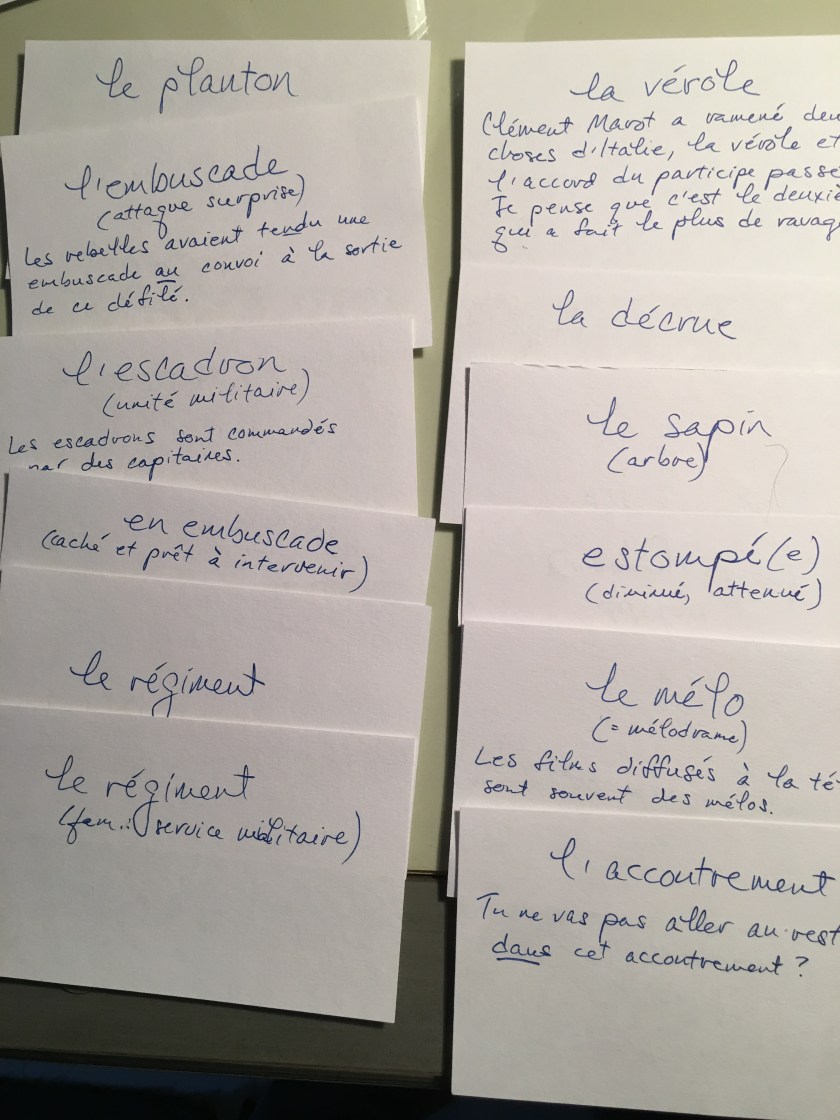
Zipf’s Law describes one aspect of the distribution of vocabulary items in a language. It often feels random; it is approximately as random as life.

2016-12-19-09-00-53

  1. Given the vocabulary items pictured above, last night I most likely fell asleep listening to the beginning of Céline’s _________________________.
  2. Given the posts that I have been writing lately, I have most recently probably read Queneau’s __________________________________.

French notes

  • le planton: orderly.  In the military sense of the word, not the hospital sense of the word–a hospital orderly is an aide-soignant(e). 
  • l’ambuscade (f.): ambush.
  • en embuscade: in waiting, in ambush.
  • le régiment: regiment.
  • le régiment: military service.  (Native speakers: is this specifically obligatory military service?)
  • l’escadron (m.): squadron.
  • la vérole: smallpox; (slang) syphilis.
  • la décrue: decrease in water level, subsiding of floodwaters.
  • le sapin: pine tree, fir (tree).
  • estompé: (of memory or color) faded, dimmed, dulled
  • le mélo: melodrama.  (Native speakers: is this pejorative?)
  • l’accoutrement: clothes that are amusing.  Get-up.

Answers

  1. Voyage au bout de la nuit.  It starts with Bardamu enlisting in the French army during World War I.
  2. Exercices de style, the same story told 99 times in 99 different ways, which I realized I was doing with this series of posts presented as different kinds of tests. 


Matching 

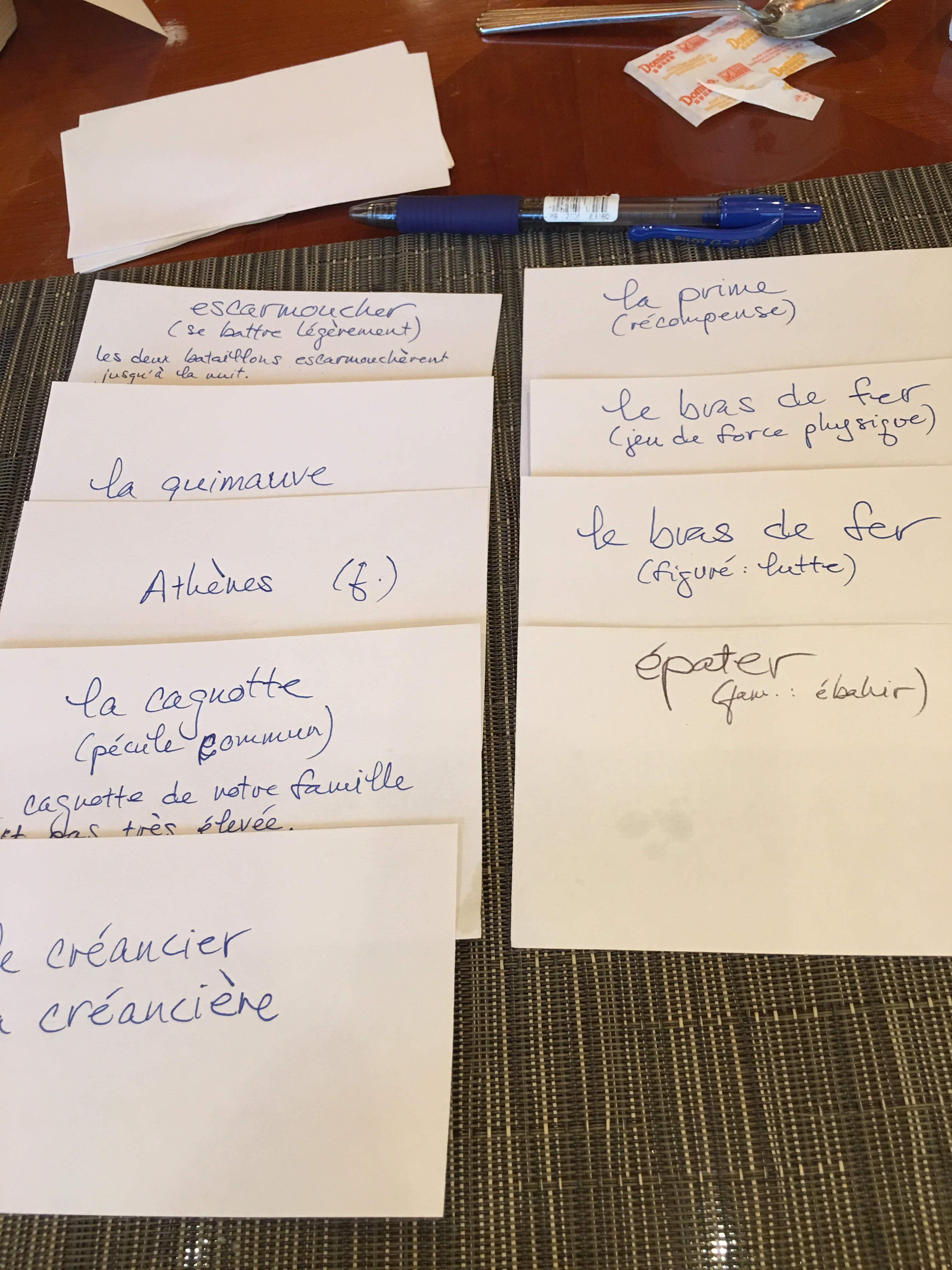
Instructions: match the vocabulary word with its description. 

  1. Tsipras is pissing off the EU again (don’t pick Athènes, it’s too obvious)
  2. Something you can eat
  3. From an email about my moves on the dance floor
  4. Reminds you of a Queen song

  1. Everything but escarmoucher, guimauve, and épater.
  2. La guimauve (marshmallow)
  3. Épater (haters gonna hate)
  4. Escarmoucher (to spar, physically or verbally)

True/False

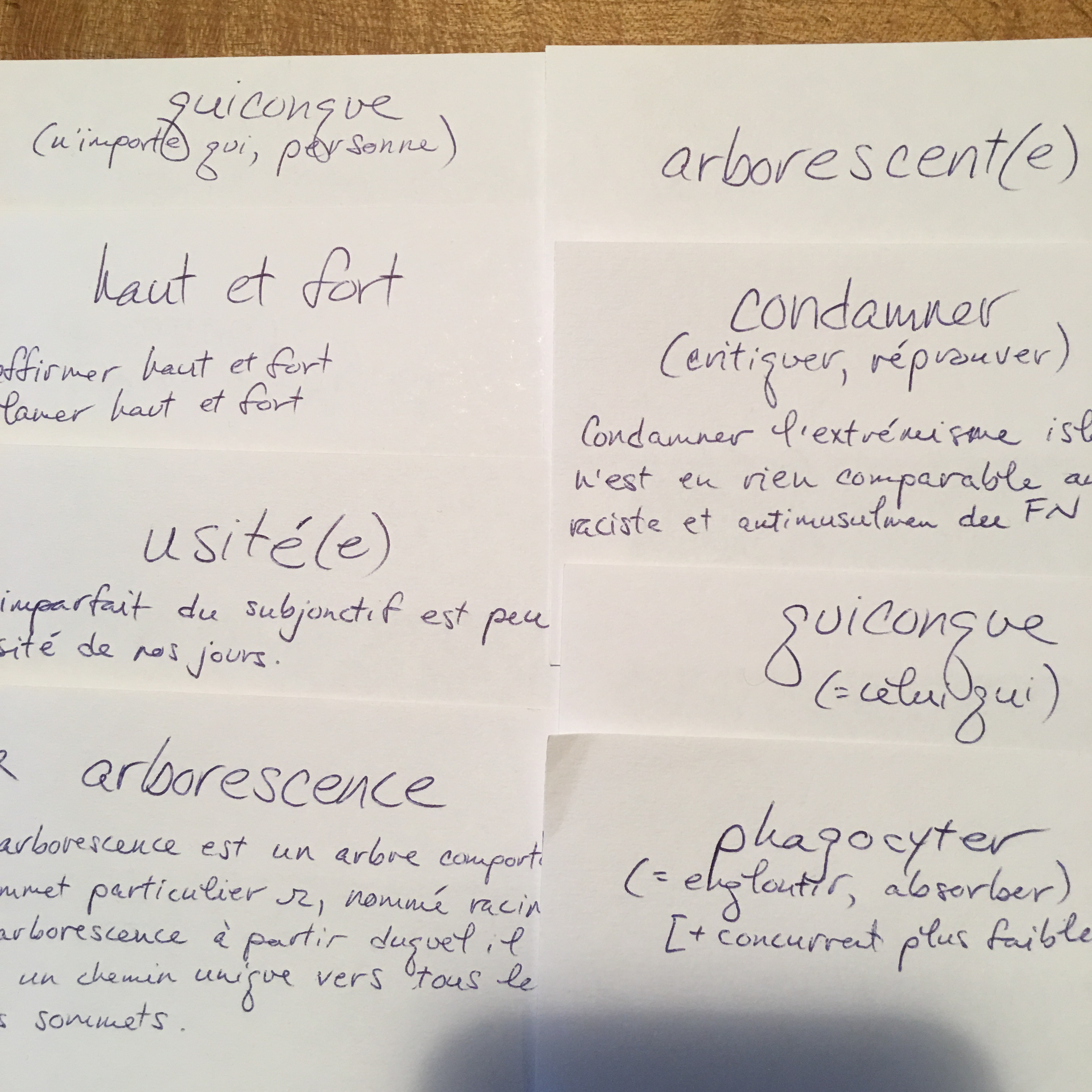
All questions are to be answered “true” or “false.”  No partial credit.

1. True/False: The guy who was being interviewed on the radio when I came across these words was an Immortal. 


2. True/False: I will have nightmares about these rabbits. 


3. True/False: I need to start leaving less geeky magazines on the coffee table, or no one is going to want to visit me. 


Answers:

1. True, although to be honest, phagocyter came from an email about what a nice guy I am–none of your goddamned business what the context was.

2. True–you probably didn’t even have to think about this one, right?

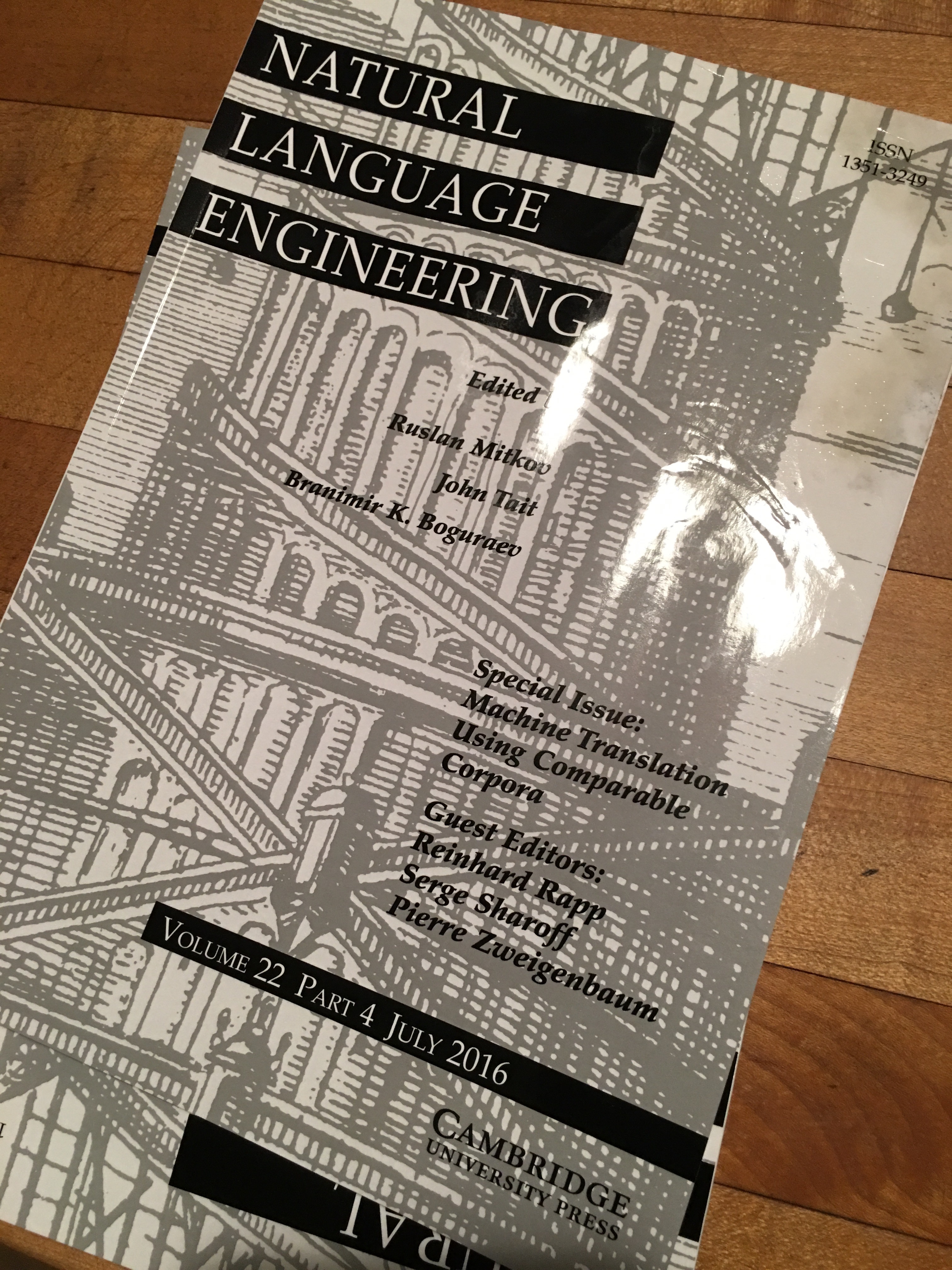
3. False–no one is ever going to want to visit me, so why not have cool journals like Natural Language Engineering lying around the house?

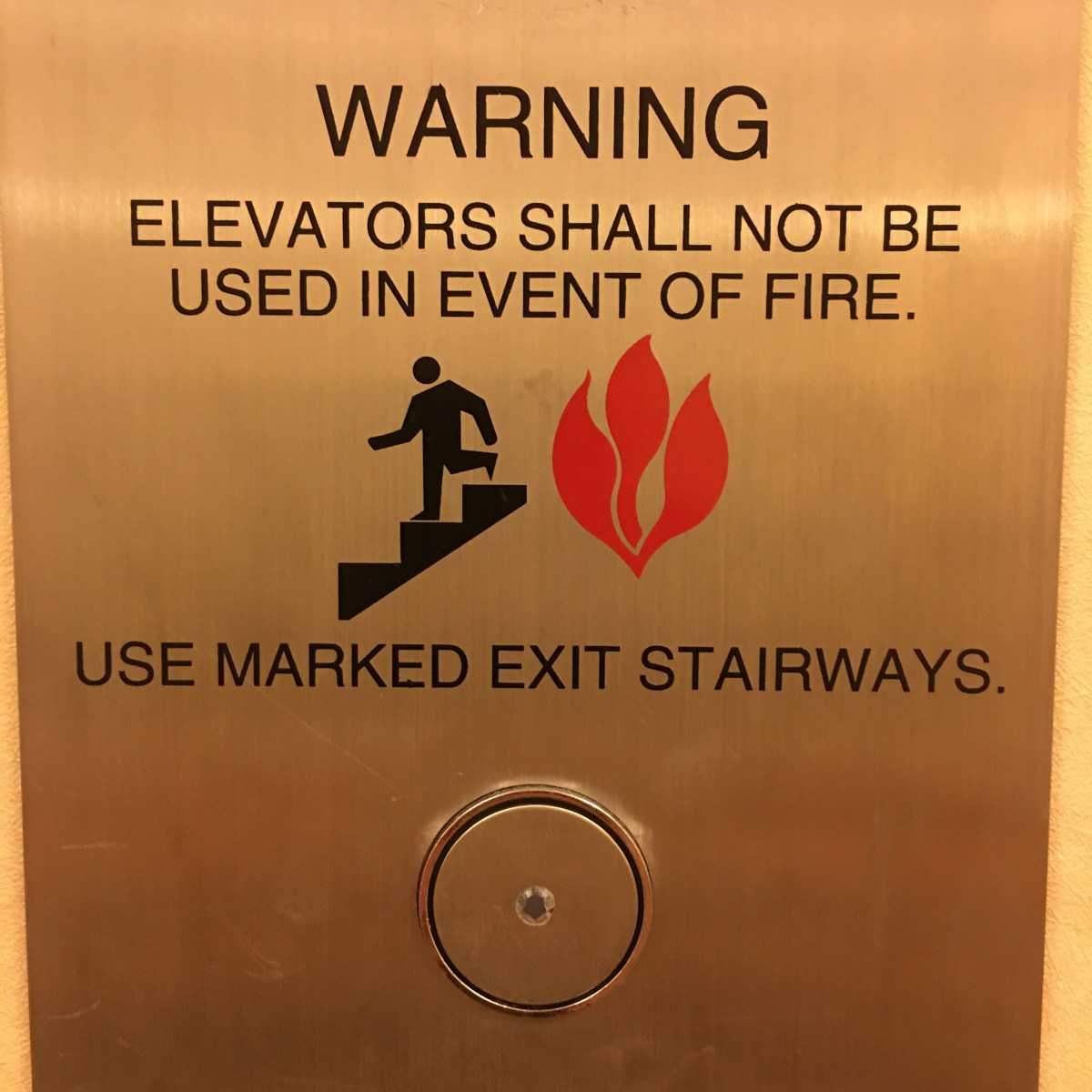
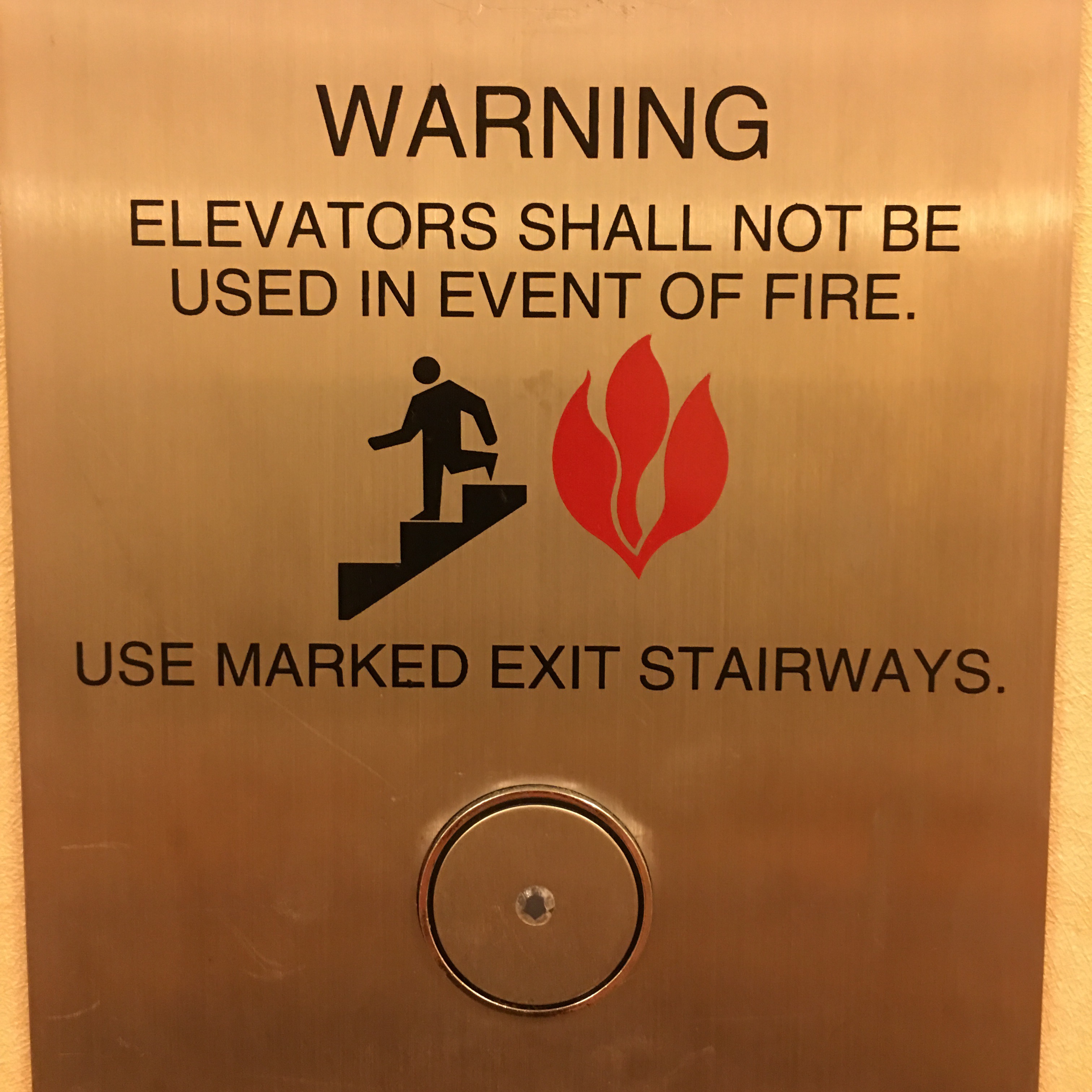
Elevators shall not be used in case of fire–seriously??

While I sit on a plane, somewhere past midnight, waiting for a gate to clear…

1. From a linguistic perspective, exactly how useless is this sign?  Give examples. 


2. Multiple choice: The fact that this was my dinner the other night, eaten in bed upon my post-midnight arrival at the hotel, is (a) a classic First-World Problem, (b) just to be expected, (c) better than trying to go to sleep hungry, (d) all of the above. 


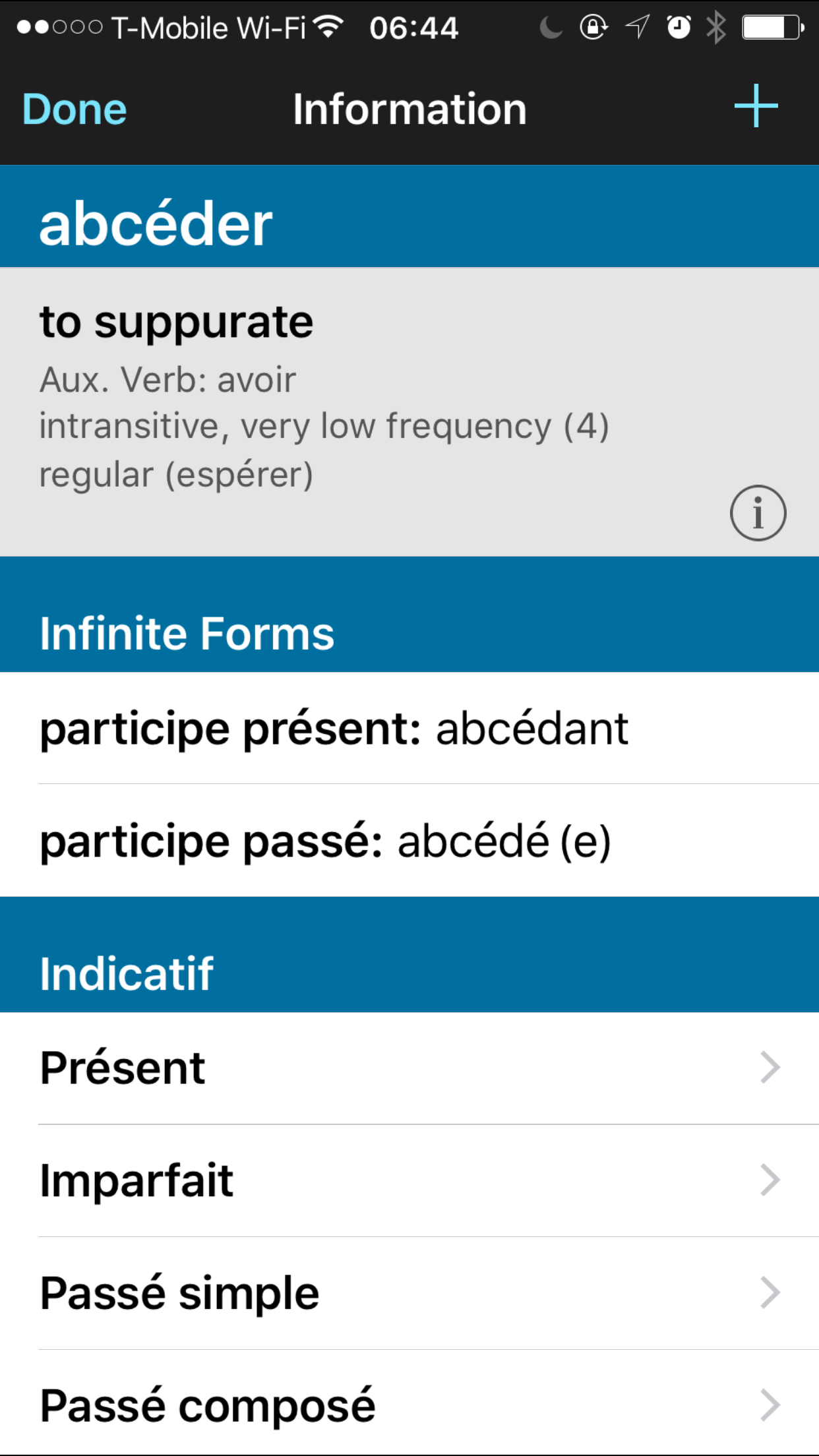
3. Knowing that the French verb “to suppurate” (I think it’s actually an inchoative–“to become suppurative,” or something like that) starts  with the sequence ABC makes me feel ______________.

Haussmannian apartment buildings and the zombie apocalypse

Paris will be a great place to survive the zombie apocalypse. Part of the reason why: those stereotypical Parisian apartment buildings.

A recent study evaluated the survivability of cities during the zombie apocalypse.  The approach was rational, modeling a number of factors that contribute to surviving the apocalypse–food supplies, containment, and the like.

Paris was nowhere on the list of best places to be when the mort-vivants come.  This illustrates a problem with the study, because Paris is going to be an excellent place to survive the zombie apocalypse.  In a recent post, we looked at how the history of Parisian street design will make it easier to defend your little home against the marauding flesh-eaters.  However, the next step is important, too–clearing the zombies from the city.  In this, Paris has some distinct advantages.  They come from the design of the stereotypical Parisian apartment buildings.

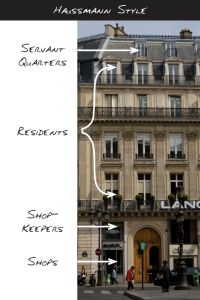
haussmann-with-floors-indicated-by-hand-81de56bf1bf1a125a06a1def21481833
Picture source: https://www.pinterest.com/pin/485685141039130992/

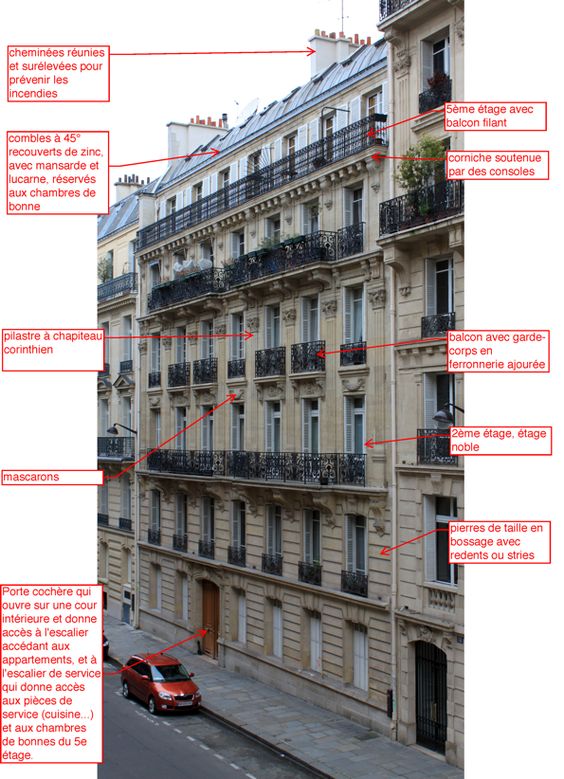
Part of everyone’s image of Paris is those stereotypical apartment buildings.  They make up about 60% of the city, especially in the older quarters.  You know them: seven stories tall (6 as we count them in France, where the ground floor is the rez de chaussée and the first floor is what we would call the second floor in the US).  The design goes back to the 3rd quarter of the 19th century–roughly 1850 to 1875.  They differ in their details, but the basic design is a 7-story building with horizontal lines of decoration and some kind of additional fancy detail–often a balcony–on the second floor (American 3rd floor, known as the étage noble) and the 6th floor.  The exterior embellishments reflect the original intent of the structure of the floors: shops on the ground level, the shopkeepers on the floor above that, richer people on the floors above that, and the servants under the roof (in the chambres de bonnes).  The picture to the left gives the idea, with more details to be found in the picture below, in French–scroll down past it for the rest of the post, and see the French notes below for a couple of the related vocabulary items.

haussmann-with-details-in-french-f5d8b7f457292025a07b4a0283731c5c
Picture source: https://www.pinterest.com/pin/484699978619249706/

Second-Empire Paris was a place where there was an enormous amount of money to be made, and an enormous amount of money was made–by people in the “right” social classes.  The Haussmannian apartment buildings played a big role in that money-making.  As Rupert Christiansen puts it in his magnificent Tales of the new Bablyon: Paris in the mid-19th century,

The money was made out of the apartment blocks, those distinctive…six-storey tapered edifices, which have remained the norm in stretches of central Paris until today.  Architectural historians now lovingly catalogue the variations in detail that their iron- and stonework embrace, but the basic construction followed a strict code of regulation: specified height and depth, with an entrance wide enough for carriages and a courtyard for parking, ventilation and fire prevention.

Those apartment blocks are, I think, beautiful–but, their construction (along with that of the wide boulevards that we talked about here) had the effect of displacing an enormous number of people who had previously lived in the old buildings that they replaced.  As Christiansen describes it, Haussmann‘s redesign of  Paris

…remains the nineteenth century’s most radical experiment in shaping and governing urban society… [The logic of the redesign was to] push industry and the sans-culottiste tendency out of the centre of Paris, replacing its warren of dangerous slums with public monuments and commercial development attractive to a new class of clean-living, high-spending, Empire-supporting bourgeois.  In other words, kill off a city built on the virus of poverty and give birth to a financially fecund city resting on clean foundations… [and] keep the construction trade busy and happy, thus preventing a resurgence of the discontents which had led its workers to fan the revolutionary flames in 1848…

You can find more details on what kind of housing the displaced poor ended up in on this web page:  Housing the poor of Paris, 1850-1902.

What’s missing from the study mentioned above will be the relative ease (or difficulty) of   clearing out the zombies afterwards.  The architecture of Paris is made for clearing zombies.  In particular, the typically small apartments limit the number of zombies that you could possibly have to deal with at one time in order to clear a building, as well as reducing the number of rooms from which a zombie could mount a surprise attack–the typical ad for an apartment in Paris (I read them obsessively) is for 30 square meters, versus a more typical 90 square meters in the US.  The vertical design will play a role in this, too–you can clear the zombies one floor at a time, isolating the apartments pretty easily.  A working-class Haussmannian building–if you can find one–is not an imposing edifice (see pictures of mine below, probably built around 1900, a quarter-century after the end of the big Haussmannian boom).  Clearing the zombies out of my building is going to be cake–I look forward to a relatively easy time when the zombie apocalypse comes.


French notes

la mansarde: attic room.  In a Haussmannian apartment building, these are the chambres de bonne–the rooms for the servants.  In theory it’s not legal to rent them out, but of course everyone does, and at the moment there’s a legislative move afoot to legalize those rentals while stiffening the requirements for the modifications that have to be made to them in order to make them moderately habitable.

la lucarne: skylight, dormer.  Look for them in the pictures above.

English notes

to be cake: être fastoche.  This is a shortened form of to be a piece of cake, which means to be fastoche, to be very easy.  How it was used in the post: Clearing the zombies out of my building is going to be cake.  This could also have been put as Clearing the zombies out of my building is going to be a piece of cake.  

mansard roof: An English-language technical term for the type of roof that you see on Second-Empire-style buildings in France and in the US.  As Wikipedia defines the term: A mansard or mansard roof (also called a French roof or curb roof) is a four-sided gambrel-style hip roof characterized by two slopes on each of its sides with the lower slope, punctured by dormer windows, at a steeper angle than the upper.[1][2][3]  I didn’t use it in the post–its presence here is inspired by the definition of the French term la mansarde just above.

dormer: those things with a little roof of their own and a window that you commonly see sticking through the roof of older American houses.  I love them because there is an entire vocabulary for describing them–you can find it, along with plenty of pictures, on this Wikipedia page.


Down the hill comes a bear rug: the non-autonomy of syntax

French people are not rude, and syntax is not autonomous.

I’m walking up the hill to the lab the other day.  It’s a long hill, and I’m old and fat, so I usually stop to catch my breath halfway up.  I’m standing in my usual spot when down the hill comes a man who (I hope) looks even older than I do.  (Down the hill comes an old man…explained in the English notes below.)  Snow-white hair, snow-white beard, and a serious snow-white bear rug rising up out of his coat to merge with his beard.  He and his well-behaved dog walk up to me.  Good morning.  Are you OK?  I take my earphones out.  Oh, yes, thank you–I’m just resting a bit.  You know, there’s a nice path through the forest–the road that you’re going up isn’t really very interesting.  He points out the entrance to the path, but I can’t quite make it out for the trees.  He and his dog walk a bit back down the hill with me and take me right to the beginning of the path.  Go straight for a while–then you can turn left and go down to the town, or turn right and go up to the campus.  My dog likes to walk here–it’s really pretty.  I thank him, I start down the path, and he and his dog head back up the hill.

I get up to “the plateau,” the top of the hill, where the campus is located.  I have only the vaguest idea where I am.  I wander down a little side street, thinking that it might lead to the lab, and pass a construction vehicle.  I hear a voice calling me, and turn back.  Good morning, mister, the construction worker says.  Your earphones are hanging out of your back pocket.  …and he’s right, they are!  I thank him, ask the way to my building, brush the dirt off, and go back to listening to whatever I was listening to.

Google rude french and you will find countless web pages, YouTube videos, etc., on the subject of French rudeness.  Um…seriously??  Not from where I’m standing.  Have I ever had a run-in with a rude lady at the phone company?  Sure–just like in the US.  Have I had enormous numbers of entirely pleasant interactions with  random French strangers?  Sure–just like in the US.  The countries are, in some ways, very, very different–but, the people aren’t any more or less nice in either.  You just have to know how to recognize the very different forms of American and French politeness when you see them–and how to be polite, in both the American and the French ways, yourself.

Here’s a really good explanation of some of the ways that things can go wrong for typical Americans interacting with typical French people in a typical French context–because we mistake French politeness for rudeness.  Note: no one is completely typical.  

English notes

…down the hill comes an old man…: There’s a lot going on here.  I’ll try to unpack it (I think that’s what the kids say these days)–let’s start with looking at the sentence and its context:

I’m walking up the hill to the lab the other day.  It’s a long hill, and I’m old and fat, so I usually stop to catch my breath halfway up.  I’m standing in my usual spot when down the hill comes a man who (I hope) looks even older than I do.

The first thing that you probably notice is the unusual word order–not an old man comes down the hill, but down the hill comes an old man.  This phenomenon goes by a couple of names–a good one is subject-locative inversion.  That is: you are inverting the positions of the subject of the sentence and of a phrase that conveys something that is more or less a location.  (Down the hill is a direction, not a location, but let’s stick with the “simple” name for the moment.)

You probably already understand the sentence, but if you’re not a native speaker, may not be at all clear on when one could use it.  I’m going to draw on this excellent discussion (which itself draws on the Cambridge Grammar of the English Language) and on Wikipedia in trying to explain it.

First of all: as far as I know, you would only use this construction in telling a story.  Much like the passé simple in 20th-century French, this isn’t something that you would use in every-day spoken language.  You can certainly say it out loud, and news reporters often use it to describe a scene when they’re reporting “on location.”  But, you’re not going to stick your head into your wife’s office and say On the table is dinner.  

The circumstances under which you can use this depend on aspects of what we call discourse structure, which you could think of as the way that things that are said form a coherent whole.  We talked the other day about discourse connectives–words and expressions like because, even though, and as a result that establish how the ideas behind two sentences (or whatever) are related to each other.  When talking about subject-locative inversion, there needs to be a particular relationship between the subject (the old man in my sentence) and the locative phrase (down the hill).  The Cambridge Grammar of the English Language specifies that relationship like this:

i. The preposed phrase must not represent information that is less familiar in the discourse than that represented by the postposed NP.

(Preposed means moved to an earlier position.  Postposed means moved to a later position.  An NP is a noun phrase, a group of words that is focussed on a noun.)

Does Cambridge’s claim hold?  Let’s look at the post again.

I’m walking up the hill to the lab the other day.  It’s a long hill, and I’m old and fat, so I usually stop to catch my breath halfway up.  I’m standing in my usual spot when down the hill comes a man who (I hope) looks even older than I do.

We’ve established that there’s a hill involved in whatever it is that I’m going to tell you about: I’m walking up the hill to the lab the other day.  So, in down the hill comes a man, it is indeed the case that the preposed phrase (down the hill) does not represent information that is less “familiar in the discourse” than the postposed noun phrase (a man).  The claim is not falsified by my data.

Back to the Cambridge Grammar of the English Language:

iii. The verb must not represent information that is new to the discourse.

…and back to the post again:

I’m walking up the hill to the lab the other day.  It’s a long hill, and I’m old and fat, so I usually stop to catch my breath halfway up.  I’m standing in my usual spot when down the hill comes a man who (I hope) looks even older than I do.

Is it, in fact, the case that the verb does not represent information that is new to “the discourse?”  Actually, I don’t know how you would evaluate that, one way or the other.  Certainly the whole “discourse” up to that point has been about my movement, so I guess you could say that the verb to come is not “new”–it’s in the same lexical field.  However, if you accept that analysis, then unless you insist that the verb be identical to some preceding one, I don’t know how you could demonstrate that the verb did represent information that’s “new to the discourse.”

(You might have noticed that my quotes from the Cambridge Grammar of the English Language went straight from (i) to (iii).  This is because I don’t know what the hell (ii) is talking about.  See this page if you want to see it for yourself.)

This kind of phenomenon turns out to be important in one of the deep theoretical issues in linguistics.  For various and sundry reasons, Chomsky and his ilk would like to posit what they call “the autonomy of syntax”–the idea that syntax is a part of human linguistic knowledge (the kind that we all have unconsciously, not the kind that people like me get in graduate school) is “autonomous”–that is, that it operates independently of the rest of language.  When you have a situation like we see with subject-locative inversion, where the syntax is dependent on something else–in this case, on the structure of the discourse, or more specifically, whether something is “old information” or “new information”–it makes it tough to argue that syntax is autonomous.

The best place to survive the zombie apocalypse, and why Parisian streets are wide

Why are Parisian streets wide? They mostly aren’t, and that has everything to do with surviving the zombie apocalypse.

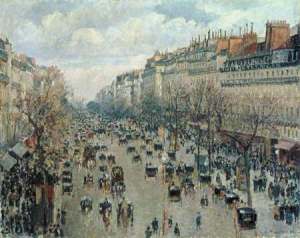
boulevard_montmartre_paris_pissarro_240211
Boulevard Montmartre by Camille Pissarro, 1897. Picture source: https://goo.gl/TzPSuS

I recently read a news story on the subject of the best and worst cities for surviving the zombie apocalypse.  The model took some reasonable things into account–ability to maintain a food supply, ease of containment, stuff like that.  Scores ranged from a low of 8.69 (New York, at 53rd place) to 48.33 (Boston, in first place).  (You have to know the range of a number to have the faintest clue how to interpret it.)  However, ultimately, the model is bullshit.

Here’s the thing: first of all, the study only looked at US cities.  Excuse me: most people in the world are not in the US, and if the US hopes to survive the zombie apocalypse, it’d better hope like hell that the rest of us do, too.  Second of all: most of the things in the model had to do with the ability of the city to deal with the virus, while none of them had to do with the ability of the city to deal with the zombies.  When you introduce the basic physical geography of the city itself into the model, Paris starts looking really good, for the following reason: our many tiny streets will be easy to keep the zombies out of, because they present relatively small openings at each end.  A Special Forces friend once told me this: the purpose of a wall is so that you can shoot people as they come around it.  The tiny openings on our tiny streets will make them easy to barricade, so it will be easy to nail the zombies as they try to get past the barricades.

Now, I know what you’re thinking: Paris is all wide, tree-lined boulevards, right?  Some of it is, sure.  Most of it isn’t, though, and this is quite related to why those of us in Paris are going to be in a good position when the zombie apocalypse comes.


Part of many people’s stereotype of Paris is the grands boulevards, the wide streets that characterize much of the older part of the city.  Indeed, they are for real: as Wikipedia puts it,

The boulevards…now define Paris, with uniform façades and overhanging balconies stretching along them. These are immediately recognisable, and are under the strict control of Paris’ urban planners.

It’s not clear that they’re just there to be pretty, though.  A major part of the enormous urban renewal project that took place in Second Empire Paris between about 1850 and 1875 or so was the tearing down of the buildings around the old twisting, crooked medieval streets, and replacing them with these broad boulevards.  A number of reasons have been proposed for this particular aspect of the project, most of them not what you would expect.

  • Theory: the streets were widened to make it harder to barricade them in times of political unrest.  From Wikipedia: The center of the city was also a cradle of discontent and revolution; between 1830 and 1848, seven armed uprisings and revolts had broken out in the centre of Paris… The residents of these neighborhoods had taken up paving stones and blocked the narrow streets with barricades, and had to be dislodged by the army.[6]
  • Theory: the streets were designed to be wide enough to permit a cavalry charge in times of political unrest.  As a web site for buying property in Paris puts it: Hoping to ease the movement of the cavalry if another conflict arose, as well as considering the dimensions of the steering locks for the horse drawn artillery, Napoleon III carefully calculated the width of the avenues based on these factors, as well as aesthetic ones.
  • Theory: Haussmann realized that the city would be able to function only if its populace and its supplies could be moved around quickly.  Wikipedia describes the pre-Haussmann situation like this: Traffic circulation was [a] major problem. The widest streets in [some neighborhoods] were only five meters wide; the narrowest were only one or two meters wide.[4] Wagons, carriages and carts could barely move through the streets.[5] 

Haussmann had to deal with this impediment if the redesigned city were to work.  As Rupert Christiansen puts it in his truly magnificent Tales of the New Bablyon: Paris in the mid-19th century, which tells the story of the Paris Commune, the siege of Paris during the Franco-Prussian war that preceded it, and the tail of the Second Empire, which preceded the siege:

Haussmann understood with genius one profound necessity of the age: the modern city’s dependence on its lines of communication, its capacity to move at speed.  [A] cliché is the notion that the chief reason for planning wide, straight boulevards was to allow for the strategic movement of troops in the event of rioting and to prevent the throwing up of barricades, but there is no evidence to suggest that this was anything more than a minor incidental consideration…The absolute priority was moving from A to B with the minimum amount of interference, in the minimum amount of time.

Recall that in Second Empire Paris, the economy was booming and there were these brand-new railroad termini.  If you wanted to be able to sell stuff, you had to be able to get it into town, and if you wanted to get that stuff into town, the other guy had to get his train emptied quickly so that you could get your train in there.

In fact, there was every reason to worry about barricading the streets of Paris.  Note that Christiansen doesn’t say that keeping rebellious Frenchmen from controlling the streets wasn’t an issue–he says that it was nothing more than “a minor consideration.”  Why worry?  In the revolution of 1830, the rebelling Parisians (it’s almost always Parisians that rebel, or at least that start it–the Fronde is the only exception that I can think of.  Native historians?)  immediately starting throwing up barricades.  A quote from the Wikipedia entry on the 1830 revolution:

In only a day and a night over 4,000 barricades had been thrown up throughout the city.

In the revolution of 1848, barricades were, again, a crucial part of the kick-off of the Parisians’ rebellion.  From the Wikipedia page on the revolution in question:

On 23 June 1848, the working class of Paris rose in protest over the closure of the National Workshops. On that day 170,000 citizens of Paris came out into the streets to erect barricades.[25]

They were effective, too, those barricades:

To meet this challenge, the government appointed General Louis Eugène Cavaignac to lead the military forces suppressing the uprising of the working classes…. Cavaignac’s forces started out on 23 June 1848 with an army composed of from 20,000 to 30,000 soldiers of the Paris garrison of the French Army.[25] Cavaignac began a systematic assault against the revolutionary Parisian citizenry, targeting the blockaded areas of the city.[26] However, he was not able to break the stiff opposition put up by the armed workers on the barricades on 23 June 1848….Cavaignac’s forces were reinforced with another 20,000–25,000 soldiers from the mobile guard, some additional 60,000 to 80,000 from the national guard.[27] Even with this force of 120,000 to 125,000 soldiers, Cavaignac still required two days to complete the suppression of the working-class uprising.

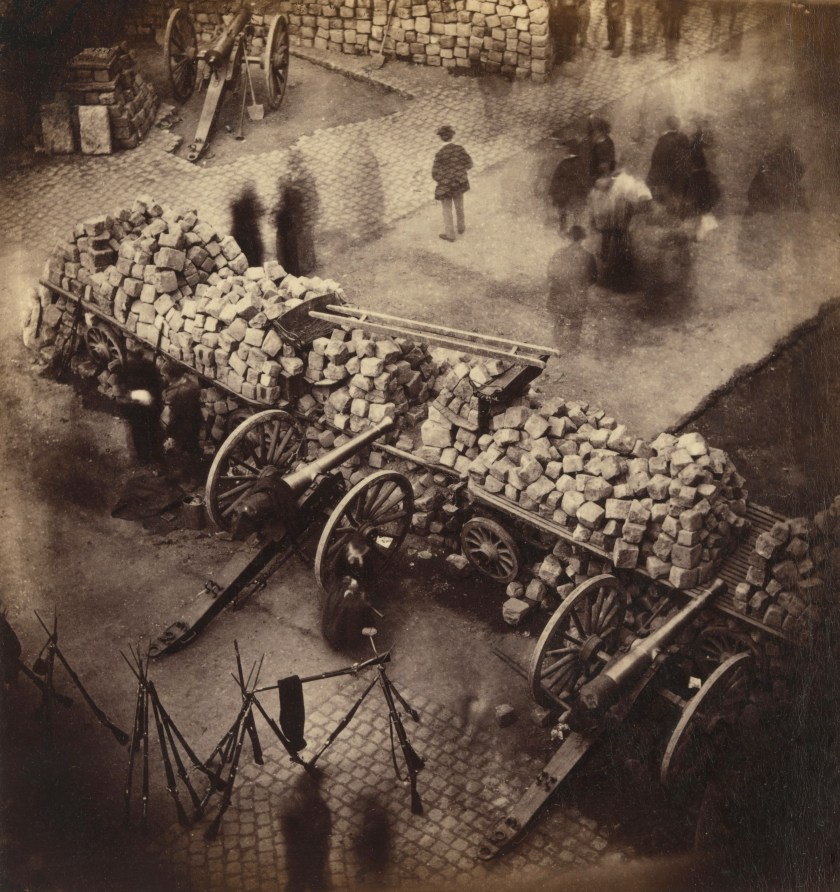
What do you make barricades of?  There are certainly a number of options.  Furniture.  Trees.  In 1848, omnibuses were used.  But, mostly, you build them out of paving stones.

barricade_paris_1871_by_pierre-ambrose_richebourg
Note several places in the photograph where you can see the edge between where the stones are still in place and where they’ve been pulled up to build the barricade.  Original caption: avril 1871. Coin de la place de l’Hôtel de Ville et de la rue de Rivoli. Picture source: https://goo.gl/1JsHPl

Here’s a quote from a recounting of the beginning of the 1968 riots in the Latin Quarter:

The police surrounded the march on the Boulevard Saint Michel, halting the demonstrators’ progress. The students decided to occupy and defend the Latin Quarter, they spread into neighbouring streets and quickly started constructing barricades out of anything they could find. Many sympathisers – young and old – flocked to the Latin Quarter to join in the student revolt after listening to their exploits on independent radio stations. A passing builder demonstrated the use of a pneumatic-drill to students who were trying to dig up the cobblestones (the soon-to-be infamous pavées) from the street to add to their arsenal.  http://modernhistorian.blogspot.com/2009/05/on-this-day-in-history-night-of.html (bolding by me)

Notice the bolded text: the students started on Boulevard St-Michel, and then when they wanted to barricade the place, they went off into the side streets.  A small detail, but a telling one.  There’s a reason that you would need to leave the Boulevard Saint Michel if you wanted to build barricades–the Boulevard Saint Michel is a classically wide Haussmannian boulevard, and you’d have a hell of a time trying to block it off.  In contrast, the side streets in the Latin Quarter are stereotypically narrow.

And barricades are not all that pavés, the traditional Parisian cobblestones, are good for: they are “traditionally” used for throwing at whomever you happen to be barricading the streets against.  This goes way back–here’s a quote about paving stones being used as weapons in the 1830 revolution: Paving stones, roof tiles, and flowerpots from the upper windows… began to rain down on the soldiers in the streets”.[10] 

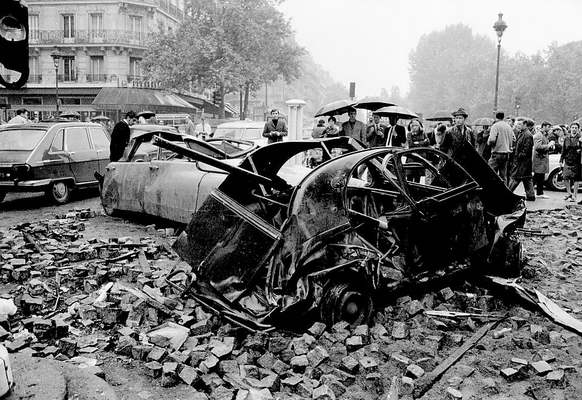
car-and-paves-dyn005_original_582_400_pjpeg_2579114_11c16ef2d2f65e2ca6b4febec3fed2ec
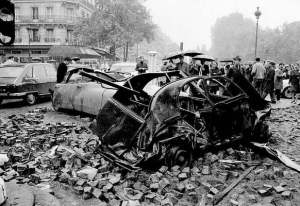
Post-riot rubble, Paris, May 1968. Picture source: https://goo.gl/c8a1AG

…and it was a serious activity during the 1968 student riots.

So, yeah, Paris has some grands boulevards, but most of it is small streets, and it’s going to be a good place to be if you’re interested in keeping your street clear of zombies during the apocalypse.  Un homme averti en vaut deux: a word to the wise is sufficient.


Want more information about streets in Paris?  Here are a couple miscellaneous links.  French and English notes below.

French notes

queue-de-paon-images
“Queue de paon” (peacock tail) paving stone pattern. Picture source: https://goo.gl/0tdn3H

la queue de paon: peacock tail.  This is the term for a particular pattern of paving stones that you’ll sometimes see in Paris.

English notes

cobblestone: A stone used for paving a street.  Merriam-Webster defines it more generally: a naturally rounded stone larger than a pebble and smaller than a boulder; especially :  such a stone used in paving a street or in construction.  The word goes back to the Middle English period (which was roughly 1100-1400).  In restless dreams I walked alone // Narrow streets of cobblestone (Paul Simon and Art Garfunkel)  Example from WikipediaCobblestones are typically either set in sand or similar material, or are bound together with mortar.  How it was used in the post:  And barricades are not all that pavés, the traditional Parisian cobblestones, are good for: they are “traditionally” used for throwing at whomever you happen to be barricading the streets against.

Tea, panda cookies, and the Bibliothèque Nationale

My family is weird, and I love it, and most of what you’ve heard about French bureaucrats is false.

When I show up at my father’s house for a visit, it’s a quick kiss, an exchange of pleasantries, and before I have a chance to poke my head into the fridge, he has his coat on and he’s ready to be chauffeured about town on our bookstore rounds. It’s one of the great things about being with my family–with anyone else, I’m hesitant to ask to, say, go on a tour of the local libraries, but with my family, it’s not a problem. C’est normal, as we say in French–a very short expression that means something like that’s the wOn a recent visit to my baby brother, I knew that (a) he wouldn’t think that it was weird that I wanted to spend my free day in Shanghai visiting bookstores, and (b) he would be happy to get lost in a series of bookstores and would enjoy practicing his Mandarin while asking for books for me–and that’s exactly what we did.

img_8286
The Bibliothèque Nationale, or National Library. Picture source: me.

I felt the need to get away from Internet access  today so that I could focus on setting up an experiment (yes, linguists do experiments), and I needed a specific book to look something up, so I headed to the Bibliothèque Nationale de France, never having been inside and feeling that that was something that was missing from my life. A pet project of the former Socialist president François Mitterrand, it’s a huge multi-building complex on the east side of town.  The picture to the left shows one of the towers–the windows are beautiful, but apparently no one thought in advance about the fact that sunlight would damage the priceless book collection, and they had to be retrofitted with something to block said light at some outrageous expense.  (See Adam Gopnik’s wonderful description of expat life in Paris, From Paris to the moon, for details.)

The nice ladies who I approached to ask how to navigate the aforementioned complex pointedly ignored me until they heard the word book come out of my mouth, at which point I got friendly smiles and careful directions to the right building and the correct entrance. (On the down side, I realized that I really must do something about my trousseau–it’s incidents like this that remind me that I look way too much like an SDF (sans domicile fixe, or homeless person). On the up side, apparently it’s the case that for very short conversations I can pass for a French SDF.  We second-language speakers have to take our little linguistic triumphs where we can find them.)

img_8301
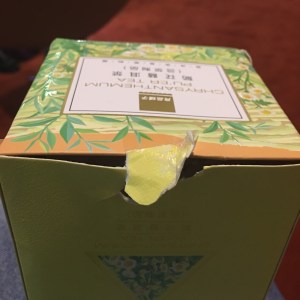
The box of tea that I brought back from China for a visit did not survive its visit to the BNF. Picture source: me.

Security is tight at the BNF–like, the security guard made me rip open a box of tea that I had in my bag to give to a friend this evening.  (He was otherwise very nice–he also made me open a metal box of cookies that I had brought back from China for said friend, and we had a fun conversation about the pandas that they’re shaped as.)

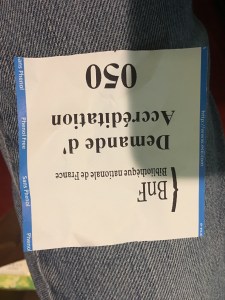
Having put away my poor, bedraggled box of tea and resisted the urge to eat one of the cookies, I cooled my heels for a bit while waiting for what turned out to be an appointment to get a library pass.  No problem–I got to find out what accréditation means (see pictures).

The nice guy who I finally got to talk to asked what book I wanted, kindly offered to speak English when I told him that it was Laurence Horn’s The natural history of negation, and then kindly continued speaking French when I told him that French would be great.  Then he gave me some options:

img_8299
My number for an appointment with the guy who finds books for you and sells you a pass to the research library.  Why it’s upside-down: I don’t know.  Picture source: me.
  1. Pay for a pass to use the library–getting into the “research library” costs a small fee, which you can pay for one day at a time, or a year at a time.
  2. Walk a few blocks to the Paris-Diderot library, where I could use it for free to my heart’s content.

(2) sounded as much fun as anything else that I could think of at the moment, and when I indicated as much, the guy printed out for me:

  1. The card catalogue information for the book
  2. A map to the Paris-Diderot library
  3. A set of walking directions to same

I was pretty blown away by this wonderful level of service.  When I expressed my thanks, he gave me a smile and said c’est mon travail–“it’s my job.”


img_8300English notes

Actually, I don’t see anything particularly obscure in this post, as far as the English is concerned.  If you have questions about anything, please feel free to put them in the Comments section.

Oh–the Paris-Diderot library turned out to have a fantastic selection of books in the area that I needed to read about, in both English and French.  It’s a real find.

Ukrainian Humanitarian Resistance

Resisting the russist occupation while keeping our humanity

Languages. Motivation. Education. Travelling

"Je suis féru(e) de langues" is about language learning, study tips and travelling. Join my community!

Curative Power of Medical Data

JCDL 2020 Workshop on Biomedical Natural Language Processing

Crimescribe

Criminal Curiosities

BioNLP

Biomedical natural language processing

Mostly Mammoths

but other things that fascinate me, too

Zygoma

Adventures in natural history collections

Our French Oasis

FAMILY LIFE IN A FRENCH COUNTRY VILLAGE

ACL 2017

PC Chairs Blog

Abby Mullen

A site about history and life

EFL Notes

Random commentary on teaching English as a foreign language

Natural Language Processing

Université Paris-Centrale, Spring 2017

Speak Out in Spanish!

living and loving language

- MIKE STEEDEN -

THE DRIVELLINGS OF TWATTERSLEY FROMAGE