Global warming: At least I’m messing up a better class of verbs

Pride comes before a fall, and sometimes the fall is worse than others.

Most mornings, I sit with my first cup of coffee and a stack of index cards and look up all of the words that I ran into the day before and didn’t know.  My 15 minutes or so of vocabulary every morning is a given–I typically learn about 10 new words a day, which means that despite having grammar that makes my French tutor shudder and an accent like fingernails on a blackboard, I know three ways to say “unremittingly.”

Everything else–conjugation, grammar, pronunciation–I rotate between.  Which is to say: I try to make sure that every week I spend a day on some new verb form, a new tense I don’t know, the order of double pronominal preverbal objects (my current bugaboo–il me le rend? Il le me rend?  FUCK), or something of that ilk.  Hence, I know lots of obscure things to say–but, I don’t necessarily know how to say them, if that makes any sense.

The other morning my plane landed in Paris after a long weekend in the US.  (A work thing, and then I surprised my father for his birthday.  We made fried matzah with schmaltz, which is to say: rendered chicken fat.)  On your first day in Europe, the challenge is to stay awake–fall asleep when you get off the plane and you’ll find yourself in a cycle of décalage horaire-induced sleep cycle disturbance that you won’t work your way out of for a week.  Sundays and Wednesdays it’s easy–there’s a market under the Metro tracks down the block, and getting out in the fresh air and sunshine is a good way to keep yourself moving and conscious.

On market days, I actually start not at the market, but at the fromagerie at the Dupleix metro station.  (Right outside the station was the spot where you were most likely to get taken to face the firing squad, at least as recently as 1871, the last date of which I’m sure.)  Although as an American, I had no clue about this ’til I got here, it turns out that cheeses have seasons; the first thing that I do when I get to Laurent Dubois is check the ardoise in the window to see what’s just come in.

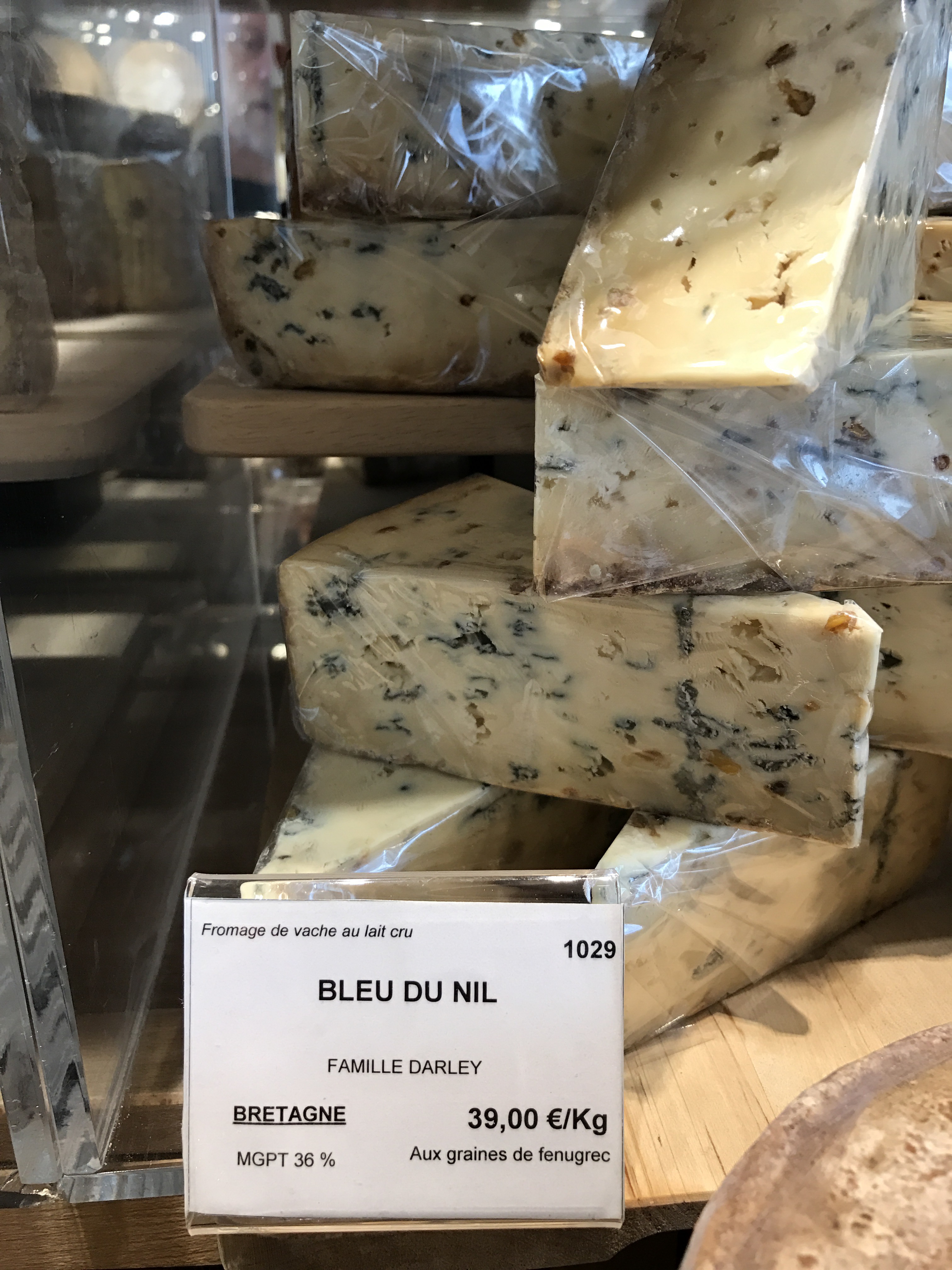
This week: 3 “rare” cheeses.  Bleu du Nil, an obscure tomme, and something even more obscure that had already sold out.  Now, you’ll hear numbers about how many cheeses France has, but in truth, no one really knows how many cheeses France has.  Like the apocryphal Eskimo words for snow (that’s bullshit, by the way), some say 200, some say 300, some say 350…  In truth, there’s no way to know, because it’s not clear how to define “a cheese.”  In the limiting case, since every farmwife who still makes her own cheese is making a cheese unlike any other, the cheeses of France are essentially uncountable. (That’s not to say that there’s an infinite number–uncountable and infinite are different things.  I remember well being baffled by the idea of being countably infinite versus uncountably infinite as a graduate student.  As my wife of the moment said to me: Kevin, if you can’t wrap your head around this, you just can’t take any more math classes.  I thought that that was adorable, since I haven’t taken a math course since the obligatory algebra and trig course in college, and in fact am completely innumerate.)

But, back to the fromagerie.  My copy of Marie-Anne Cantin’s Guide de l’amateur de fromages (“”Cheese-lover’s guide”) lists somewhere around 200 or so French cheeses, but it doesn’t list any of the cheeses that had come in this week, so I asked the adorable pixie-cut saleslady to tell me about them.  It developed that the name of one of them comes from the valley where the cows from whose milk it is made graze.  Except…she didn’t use the word graze, and I didn’t catch the word that she did use.  No problem–I recently learnt the verb to graze.  “Where they paissent?” …I asked, using the verb paître–a favorite of mine, because I love circumflex accents.  Seulement voilà, the only thing is: I’d never had the opportunity to use this delightful lexical item before, and I screwed it up.  I should have said paissent–but, my mind wandered off into the delights of that circumflex, and instead I said paîtent.  Which sounds like pètent…  Which means that I had just asked the nice lady if she were referring to where the cows fart.  Damn it.  Pride before a fall, and all that.  She had the good grace not to laugh.  At least, I think she didn’t–I was too embarrassed to look at anything but the floor.

In the English notes, we talk about the little-known English subjunctive.  The French notes are, of course, devoted to the verb paître.  The bleu du Nil comes from exactly one farm, in Brittany–see the picture above.  It’s delicious–as creamy as butter, with little bits of fenugreek.


English notes

Anglophones complain constantly about the French subjunctive.  Even French teachers get into it, commiserating with us about its chiant existence and teaching us ways to avoid it.  In reality, this most charming of the conjugations of the French language is not one that is completely foreign to us.  Although it’s not widespread, my dialect still has a subjunctive.  It’s easiest to say in the case of the verb to be.  Here’s how it showed up in this post:

I had just asked the nice lady if she were referring to where the cows fart.  

The subjunctive here is were.  You would expect was:

I had just asked the nice lady if she was referring to where the cows fart.

…and indeed, (a) you most certainly could say that, and (b) I would guess that most Americans would say that.  (I hate to guess, but I don’t have any statistics on this–sorry.)  You can find some exercises on the use of the subjunctive in English here, if you’d like to pursue this.  Be aware that there are some differences between American and British English in the use of the subjunctive–the Wikipedia page on the English subjunctive goes into them at some length.

French notes

Paître is the kind of delightfully irregular verb that I just adore.  Along with repaître, native speakers don’t seem to agree on whether either, both, or neither of them can be used for humans, or just for cows and the like; whether either, both, or neither of them can be transitive only, intransitive only, or both; or in which tenses the gets its little chapeau chinois.  (From what I can tell, the Academy’s decision on this has not always been gracefully accepted.)  My Bescherelle maintains that (a) it doesn’t have any of the compound tenses, and (b) le participe passé pu, invariable, n’est utilisé qu’en termes de fauconnerie…. and if you can find a verb that’s cooler than that, I will buy you a beer–and if you’re a woman, I’ll marry you.

Three ways to say unremittingly: 

  • sans trêve
  • sans répit
  • sans cesse

Dulce et decorum est

Engine room, Liberty Ship John W Brown 2012_284_4718-1024x677
Engine room of the Liberty Ship John W. Brown. Picture source: https://goo.gl/aT2YhF

I spent my last few years in the Navy working in cardiac catheterization labs, doing physiological monitoring–mostly hemodynamics and electrophysiology.  I started out on a ship, though–working in the engine room of a guided missile cruiser.  It was hot down there–the coolest that it got was under one of the giant air vents, where it was about 100 degrees Fahrenheit (37.8 Celsius).

The good side of being on a naval vessel is visiting cool ports of call, seeing the sun and the moon both in the sky at sunrise after a midnight watch, eating roasted squid in Spain–stuff like that.  The bad side is the Navy’s equivalent of combat training.  At the time, that involved a few weeks in the Caribbean, doing “casualty drills” over, and over, and over again, until you could get them right over, and over, and over again.

When a ship is on the receiving end of a nuclear, chemical, or biological attack, you put on gas masks, and you shut its openings down completely while some guys put on serious protective gear, go up on the decks, and scrub down every inch of the vessel.  This takes a long time–my ship, the USS Biddle, was 547 feet (167 meters) long.

So, there you are down in the engine room.  The alarm for an NBC attack (nuclear/chemical/biological) is sounded.  You put on your gas mask and you shut off all of the ventilation–in a space where it was already 100 degrees Fahrenheit in the cool places.  Then you watch the temperature start to rise.

When you learn how to put on a gas mask, they teach you what to do if you vomit with the gas mask on.  (If you can think of a way to not end that sentence with a preposition, I’d love to hear about it.)  This is super-necessary, because one of the old dirty tricks of gas warfare is to mix in an emetic with the gas.  An emetic is something that makes you vomit–the idea is to get you vomiting in the hopes that you’ll rip your gas mask off, in which case you’re toast.  (To be toast explained in the English notes below.)  So, you know what to do if you vomit–but, there’s nothing to be done about what happens when you’re in a super-hot space with a gas mask on, which is that the parts around your eyes fill up with sweat to the point that you can’t see anymore.  We’d sit there, our eye ports filling up with sweat, and watch the thermometer go up, and up, and up.

The temperature in an unventilated engine room goes up fast.  Around 120-130 degrees, the air is so hot that it’s painful to breathe, and when I say painful, I mean really painful.  It’s very quickly so hot that they call it a day for the engineering spaces and let you take off your gas mask and open the ventilation again.  Now, as I said, it takes a long time to scrub down a ship–but, it was clear to everyone that there was no way that we were going to be able to survive that long with the ventilation shut down.  So much for What To Do In Case Of NBC Attack.

Today’s bow to National Poetry Month is about a gas attack.  It’s by Wilfred Owen, an Englishman who fought in the Great War.  You tend to think of poets as wispy, ethereal types who you wouldn’t want backing you up in a tight spot; Wilfred Owen is a pretty good counter-example to this widely-held prejudice.  He was one of the great poets of the First World War–the poem that you’ll find below was the first one I ever memorized that didn’t involve words that I don’t really dare to put on this blog.  He was also a gay man who wrote what appears to be a poem about anonymous sex–and a decorated military hero who volunteered to go to the front repeatedly, even after being wounded twice in artillery shellings.  He was awarded the Military Cross–here’s the text of the commendation:

For conspicuous gallantry and devotion to duty in the attack on the Fonsomme Line on October 1st/2nd, 1918. On the company commander becoming a casualty, he assumed command and showed fine leadership and resisted a heavy counter-attack. He personally manipulated a captured enemy machine gun from an isolated position and inflicted considerable losses on the enemy. Throughout he behaved most gallantly.  (Copied from Wikipedia.)

Before the war, he spent several years teaching French and English in France.  He died there just days before the Armistice–in action.

DULCE ET DECORUM EST

by Wilfred Owen

blood-shod is an amazing neologism.  “To be shod” means something like “to have footgear (e.g. shoes, boots, and the like).”  Examples below in the English notes.

Bent double, like old beggars under sacks,
Knock-kneed, coughing like hags, we cursed through sludge,
Till on the haunting flares we turned our backs
And towards our distant rest began to trudge.
Men marched asleep. Many had lost their boots
But limped on, blood-shod. All went lame; all blind;
Drunk with fatigue; deaf even to the hoots
Of gas-shells dropping softly behind.

Gas! GAS! Quick, boys!—An ecstasy of fumbling
Fitting the clumsy helmets just in time,
But someone still was yelling out and stumbling
And flound’ring like a man in fire or lime.—
Dim, through the misty panes and thick green light,
As under a green sea, I saw him drowning.

In all my dreams before my helpless sight
He plunges at me, guttering, choking, drowning.

hqdefault1
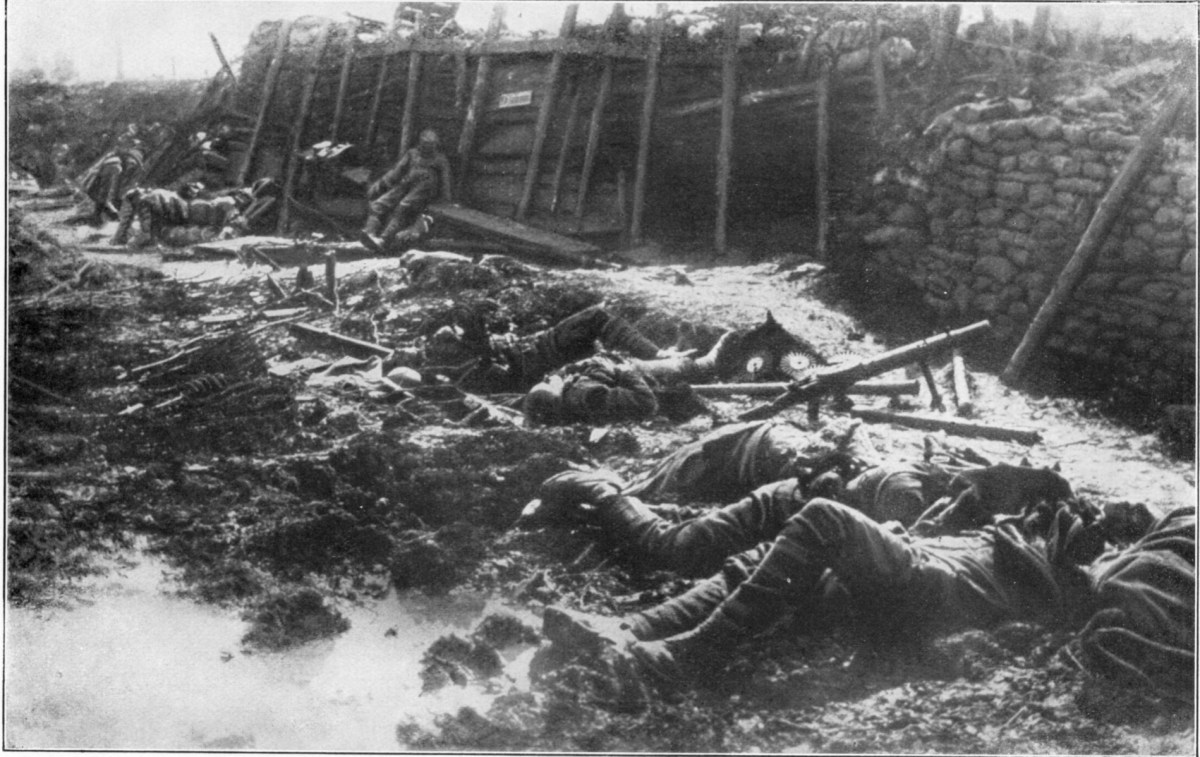
“…the white eyes writhing in his face…” Victim of gas attack by the Syrian government. Picture source: https://goo.gl/6nHTK6

If in some smothering dreams you too could pace
Behind the wagon that we flung him in,
And watch the white eyes writhing in his face,
His hanging face, like a devil’s sick of sin,
If you could hear, at every jolt, the blood
Come gargling from the froth-corrupted lungs,
Bitter as the cud
Of vile, incurable sores on innocent tongues,—
My friend, you would not tell with such high zest
To children ardent for some desperate glory,
The old Lie: Dulce et decorum est
Pro patria mori.

You can find readings of this very famous poem here.


English notes

Examples of shod:

  • All horses’ hooves are healthier without shoes, and barefoot horses are healthier than shod horses.  (Source)
  • The foot evolved to function unshod. (Source)
  • Paul says in verse 15 that we are to have our feet “shod with the preparation of the gospel of peace.” (Source)

to be toast: to be in a bad situation, to be in trouble.


Juventud, divino tesoro

…con el cabello gris, me acerco a los rosales del jardín…

rubc3a9n_darc3ado_maison_paris_1909_e28093_1912
Darío lived in Paris for 4 months–who knew? 4, rue Herschel, 75006. Picture source: DanielaBPSept.

For National Poetry Month, here’s some Rubén Darío.  I first came across this poem sitting in a night class at Old Dominion University, purveyor of fine educational experiences to a wide range of traditional and non-traditional students, including a hell of a lot of sailors.  The first stanza was carved into the top of the desk at which I was sitting (the desk I was sitting at, more commonly):

Juventud, divino tesoro,
¡ya te vas para no volver!
Cuando quiero llorar, no lloro…
y a veces lloro sin querer…

Youth, divine treasure, // you’re gone, never to return! // When I want to cry, I can’t… // and sometimes I cry without wanting to….

I thought it was the saddest thing I’d ever read, and in isolation, it most certainly, certainly is.

In isolation.  And, oddly: even more so at 25 or so than at 55.

Eventually, I tracked down the rest of the poem–much harder back in those pre-Google days–and made it to the end.

Mas a pesar del tiempo
terco, mi sed de amor no tiene fin;
con el cabello gris, me acerco a los
rosales del jardín…

But despite pig-headed // time, my thirst for love is endless; // gray-haired, I approach the rose-bushes in the garden…

(Don’t feel bad–I had to look up terco, too.)

As the grandson of a man who started a new family in the United States in his 60s (¡muy fuerte!, say my Mexican buddies when I tell them the story–I’ll spare you the accompanying gesture of admiration), I think I get the metaphor.  You go, pépère.  You go, Rubén.  Do I ever cry without wanting to?  Rarely–I am certainly an American male of my generation–but, yeah: it happens.  Nonetheless: I’m headed out to the back porch for a cigarette next to the lilacs, and the plum tree, and the flowering chestnut…

JUVENTUD DIVINO TESORO DE RUBEN DARIO

Juventud, divino tesoro,
¡ya te vas para no volver!
Cuando quiero llorar, no lloro…
y a veces lloro sin querer…

Plural ha sido la celeste
historia de mi corazón.
Era una dulce niña,
en este mundo de duelo y de aflicción.

Miraba como el alba pura;
sonreía como una flor.
Era su cabellera obscura

hecha de noche y de dolor.
Yo era tímido como un niño.

Ella, naturalmente, fue,
para mi amor hecho de armiño,

Herodías y Salomé…
Juventud, divino tesoro,
¡ya te vas para no volver!
Cuando quiero llorar, no lloro…
y a veces lloro sin querer…

Y más consoladora y más
halagadora y expresiva,
la otra fue más sensitiva
cual no pensé encontrar jamás.
Pues a su continua ternura
una pasión violenta unía.
En un peplo de gasa pura
una bacante se envolvía…

En sus brazos tomó mi ensueño
y lo arrulló como a un bebé…
Y te mató, triste y pequeño,
falto de luz, falto de fe…

Juventud, divino tesoro,
¡te fuiste para no volver!
Cuando quiero llorar, no lloro…
y a veces lloro sin querer…

Otra juzgó que era mi boca
el estuche de su pasión;
y que me roería, loca,

con sus dientes el corazón.

Poniendo en un amor de exceso

la mira de su voluntad,
mientras eran abrazo y beso
síntesis de la eternidad;

y de nuestra carne ligera
imaginar siempre un Edén,
sin pensar que la Primavera
y la carne acaban también…

Juventud, divino tesoro,
¡ya te vas para no volver!
Cuando quiero llorar, no lloro…
y a veces lloro sin querer.

¡Y las demás! En tantos
climas, en tantas tierras siempre son,
si no pretextos de mis rimas
fantasmas de mi corazón.

En vano busqué a la princesa

que estaba triste de esperar.
La vida es dura. Amarga y pesa.
¡Ya no hay princesa que cantar!

Mas a pesar del tiempo
terco, mi sed de amor no tiene fin;
con el cabello gris, me acerco a los
rosales del jardín…

Juventud, divino tesoro,
¡ya te vas para no volver!
Cuando quiero llorar, no lloro…
y a veces lloro sin querer…
¡Mas es mía el Alba de oro!

Keeping your…together: Reproducibility in computational research

A failure to archive some data leads to discussion of a colorful American English expression. Trigger warning: rampant obscenity referring to poop.

You’ve probably heard: there is a crisis in science.  You don’t have to be on top of the literature to be aware of this–it’s covered in the popular press, too.  This piece in Forbes is representative: How the reproducibility crisis in academia is affecting scientific research.  The term “crisis” might be a bit overblown, but certainly researchers in many fields have recently been paying a lot more attention to planning their analyses for reproducibility, which can sometimes mean planning the experiments that precede the analysis for replicability (also known as repeatability).  The contrast between these is that you can think of reproduction as arriving at the same values, the same findings, or the same conclusion as an earlier study; replication, on the other hand, refers to the ability to repeat the initial experiment.  Replicability is important for a number of reasons, one of them being that as an initial attempt to assess the reproducibility of a study, you might want to see if you can replicate the results when you repeat the original experiment.

Lately I’ve been talking and writing about this kind of thing a lot.  When I do that, I’ve found that what audiences and reviewers seem to enjoy the most is when I give details on my own failures to be able to repeat my own studies.  The irony is lost on exactly no one, including (obviously) me: in theory, I have some expertise on the relevant issues, and yet I struggle just to keep my own shit together in this regard.  (To keep one’s shit together explained in the English notes below.)

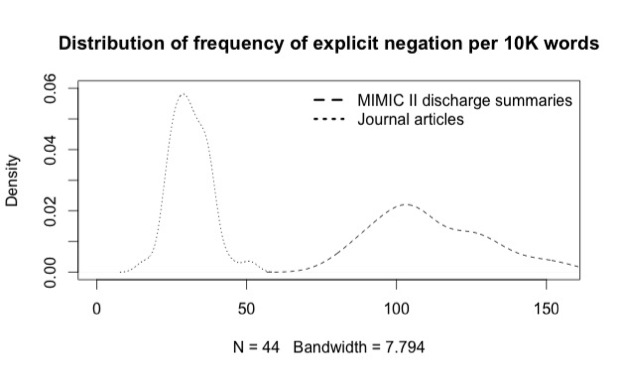
So: for your amusement, I present today’s reproducibility fail.  To wit: I just had a paper accepted that involved doing manual examination of hundreds and hundreds of words, all of which started with letters that could be one of the negating morphemes of English. (A morpheme is a part of a word.  For example, cat has one morpheme, while cats has two: cat, and the plural -s.)  When I say negating morpheme, I mean things like the prefix de in deoxygenate, or the prefix in in inefficient.  

Now, I said that we were examining words that start with letters that could be one of the negating morphemes of the English language.  Those strings are not always negative–think of examples like these:

  • ineffective (not effective) versus intuitive (nothing negative in there)
  • unclear (not clear) versus uncle (nothing negative in there)
  • deactivate (cause to not be active) versus deal (nothing negative in there, although the word’s current association with Donald Trump–the molesting, draft-dodging, tax-dodging, race-baiting, disabled-mocking, religiously bigoted, lying assclown that is now the president of my fatherland–makes it somewhat nauseating for me to type it)

…the moral of which is that you can’t find all of the words with negative prefixes in a text just by starting with a list of negative prefixes and looking for all words that start with them.  Doing this would lead you to count intuitive, uncle, and deal as words that start with negatives, which they are not.

affix: something that cannot be a word, but can be added to one.  English examples: un-, pre-, -‘s.

prefix: an affix that is added to the beginning of a word.  English examples: un-, pre-, pro-.

suffix: an affix that is added to the end of a word. English examples: -‘s, -ing, -ed.

So, when I wanted to find out how the incidence of affixal negation compares between different kinds of biomedical texts–I care about that kind of thing because my job involves researching computer programs that do things with biomedical texts, and I need to know things like how much does negation add to the burden of understanding medical texts by patients’ family members?–I knew that I could write a program to pull out all of the words that start with things like de-, un-, in-, and anti-, but I also knew that I would have to have actual human beings look at those lists and mark which ones actually started with negative prefixes, and which didn’t.

Now, when you do something like this–that is to say, when you have humans look at data (linguistic or otherwise) and make judgments about it, you typically want to have more than one person do it.  Then you calculate how often they agree with each other.  If they agree with each other, say, 90% percent of the time, then you probably have pretty good judgments in hand.  On the other hand, if they agree with each other only 60% of the time, then you’ve got a problem.  Maybe you’ve defined a task that’s just too difficult for humans to do consistently, in which case you want to redefine it in a way that makes more sense.  Maybe you wrote crappy instructions, in which case you want to improve them.  Maybe one of your humans is smoking what we call in France shit (marijuana–no, I do not indulge).  In any case, it’s that calculation of agreement between the humans that lets you decide whether or not you have a problem that needs to be dealt with.

Coincidentally, at the moment I’m teaching a course on what I do for a living, and I wanted to give my students the opportunity to get some hands-on practice with the process of making the human judgments that provide the data that we use to do our research.  This little project seemed like a good one to offer them, for a number of reasons:

  1. It’s relatively straightforward (we got good agreement on the original project)…
  2. …while still difficult enough to be challenging (we had to take a couple passes at developing the instructions, and even then, we didn’t have complete agreement on everything)…
  3. …plus, you don’t need a special program to record the judgments, while more complicated tasks frequently do require that the human learn a complicated program in order to record their analyses (did you notice that little subjunctive?  …that a human learn… versus …that a human learns…?)…
  4. …and I actually need the data for future research, which means that I’ll use it to write papers, which means that the students will have the opportunity to participate in writing the papers, and for students, published papers are the key to getting your doctorate and getting the hell outta Dodge.

Now, because I care about reproducibility of research, I use a publicly available web site to archive the code (computer programs) that I use to do my analyses.  (You can find the stuff for the project that I’m talking about here.)  So, getting my students started seemed like it would be straightforward: send them to the web site, and tell them to download the instructions, the list of words that needed judgments, and the actual judgments of the two analysts so that they could use those to figure out how to use the analysis program and to evaluate their own judgments.

It happens that I was one of those analysts, and that a colleague who happens to be a practicing emergency room physician was the other.  It also happens that we annotated a randomized mixture of text from two sources: from scientific journal articles, and from the clinical records (totally anonymized, and available free to researchers) of actual patients.  In the case of the clinical records, I found when doing the analysis of our agreements and disagreements that when we disagreed, I mostly thought that he was right and I was wrong.  (Not surprising, since he is currently practicing, and I haven’t touched a patient since 1991.)  In contrast, I tended to be right when we disagreed on the scientific journal articles–not surprising, either, since I spend all day, every day with my nose stuck deep in them.  So: it was super-important to me that my students have access to both of our data, both so that they could compare their own judgments to it, and so that they could see what kinds of things we had disagreed on.  (It’s usually the differences in the world that are the most interesting, right?)

Seulement voilà, the thing is: when I went to the web site where I had archived all of the code and the data on which the analysis was based, I saw that I had totally forgotten to put the other analyst’s data there.  Think about the context of this:

  1. In theory, I have some expertise on issues of reproducibility in computational science.
  2. I was very deliberately making an effort to make this experiment as repeatable as possible.

…and yet, I still screwed it up.  This is important in that when you read about reproducibility problems in science, sometimes you’ll see–often implicitly, and sometimes even explicitly–the view that reproducibility problems come from deliberately deceptive actions on the part of the researcher.  Now, I know that a certain amount of self-deception can take place pretty easily in research, typically taking the form of screwing around with statistical tests of significance. But, that’s a pretty different thing from deliberately publishing crap research.  When you consider that someone who is pretty deeply invested in doing, and in promoting, reproducible research–that is: me–can still fail to archive everything that would be needed to repeat one of his own experiments, it gives you an object example of how difficult it can be to ensure even the less-ambitious goal of repeatability of one’s work…and a fortiori, reproducibility of one’s results.

In French, there are some very interesting things associated with affixal negation, including the phenomenon of verbs like dératiser and décafardiser that we talked about in the post that you can find here.  Several of the English-language examples in this post come from this paper on affixal negation by Chantal van Son, Emiel van Miltenburg, and Roser Morante, all of the Vrije Universiteit Amsterdam.


English notes

One of the expressions in this post, along with its many relatives, strikes me as interesting because it contains the word shit, which is almost always an “inherently negative” word, and yet it describes a desirable state.  The expression in question: In theory, I have some expertise on the relevant issues, and yet I struggle just to keep my own shit together in this regard.   (I should point out that you can only use these expressions in contexts, and with people, such that it would be acceptable to use obscenity.  So, I would use this with my siblings and cousins, maybe or maybe not with my aunts, depending on which one, and most definitely not in front of my grandmother.)  Unless otherwise stated, the examples here come from the OPUS2 English corpus, a collection of 19.7 billion words of English texts.  I searched it through the Sketch Engine web site, purveyor of fine linguistic corpora and tools for searching them.

to have one’s shit together is the most basic of this surprisingly large family of expressions.  In its most central sense, it means something like to be functioning in an efficient way.  Here are some examples of how it’s used.

  • That’s because I have my shit together and I prioritize properly.
  • If you don’t have your shit together chances are it’s because you surround yourself with people who don’t have their shit together  (Twitter) (Note: “chances are” means “probably.”)
  • I know I probably sound like I have my shit together , but really I feel confused inside.
  • And pretending I have my shit together when it comes to deadlines and paperwork is one of my specialties, a skill to which I probably owe every job I’ve ever had.
  • I thought, perhaps naively, that by almost a year along I would have my shit together – or at least have some sort of clue and I do not.
  • Turns out she’s sharp as a tack and really has her shit together.  (Note: “to be sharp as a tack” means “to be quite intelligent.”)
  • And so perhaps this is why he doesn’t find himself attracted to his students, and instead finds himself attracted to Audrey’s silver hair and faintly lined face: these things signify a woman who has her shit together, who has moved on to the next level.

With that established: if to have one’s shit together means to be in a particular state–the state of having one’s shit together–to keep one’s shit together means to maintain that state.  Some examples:

  • I am now one of the countless unemployed because I could not keep my shit together.
  • I’m trying to navigate the holiday season as a crafter, keep my shit together at work, plan the holidaze both for Thanksgiving at my mom’s house and what will surely be a painful Christmas Eve . . .if we could decide who’s host/essing it.
  • “As long as you keep improving.” I raised my eyebrows. “Is that your way of telling me to keep my shit together?”  (Michelle Hodkin, The evolution of Mara Dyer)
  • Ruby Pelletier put her hands on her skinny hips, threw her head back, and bellowed laughter.  “You think you can keep your shit together when twelve CB cowboys pull in all at once and order scrambled eggs, bacon, sausage, french toast, and flapjacks?”  (Stephen King, The dead zone.  CB cowboy is a truck driver–very, very old slang, although not quite as old as I am.  1970s, I would say.  French toast is pain perdu.  Flapjacks are pancakes.)

There are several more of these odd expressions where shit means something positive–so many that if I tried to get them all into one post, I would be writing this for the next two weeks.  Watch this space for more, as the spirit moves me–and don’t say this stuff in front of my grandmother.


Bonnets, lice, and dialect differentiation

You’ll often hear people bemoan the loss of dialects due to television. No worries: it’s not happening. Also, a cute kid and some off-color language.

Just in case you’re worried that television is taking away all of the dialects: every study I’ve ever heard of concludes the opposite.  What’s different today from 100 years ago is that geographic proximity has become somewhat less important in dialect differentiation relative to other social factors.  For example, all of the action in American dialects at the moment is in increasing differentiation between urban and rural speech.  All other things being equal, the dialects spoken within an American city are more likely to change to become more like dialects in other cities than they are like the dialects in the immediately surrounding rural areas.  That’s not to say that they’re all becoming the same, either!  But, what drives dialect differentiation in early-21st-century America is increasingly about the urban/rural split.  (Note that I’m not claiming that urban/rural distinctions in America or anywhere else are new–this is about a shift in degrees of relative importance, not a wholesale appearance of a new phenomenon.)

In fact, regional dialects of English can still be sufficiently distinct that native speakers of one regional dialect of English can’t necessarily understand native speakers of other regional dialects of American English.  Hilarious stories of the ensuing misunderstandings abound, but few of them (or few of my stories of the ensuing misunderstandings, at any rate) are as adorable as this video of a little Scottish girl speaking with her (much bigger) Scottish father.  Take a look/listen–if you can’t follow it, there’s a version with subtitles floating around out there somewhere.  Scroll past the video for linguistic details (and considerably less cute examples of the local dialect), if you’re interested.


Linguistics trivia, for those who are geeky enough to care

It’s actually difficult to find evidence for television playing a role in language acquisition–that is, learning by children of their native language(s).  However, here’s a nice paper by Jane Stuart-Smith and her colleagues that shows a role for television in increasing dialect differentiation amongst adolescents.

Here is a master’s thesis written byMichaela Zikmundová, a graduate student in the Czech Republic at the time, on language in the novel Trainspotting.  It is a very Scots novel, and Americans have to watch the movie version with subtitles.  She concludes that Scots is itself composed of so many different dialects that it should be considered a language, not a dialect of English.  (This is not actually a valid argument, for my money–see this blog post on the surprising irrelevance of linguistics to the definitions of the terms language and dialect.)

Family trivia, for those of us who are related closely enough to me to care

My father is extremely fond of mixing languages with…wild abandon, I guess one might say.  A typical email from him might have six, I would suppose–English (obviously), Portuguese, Hebrew, French, Latin, and Yiddish being the standards, with occasional guest appearances by Hawaiian (my father remains convinced that the similarity between the Hawaiian word for priest (kahuna) and the Hebrew word for priest (kohen) are evidence for one of them being the original human language, and I’ll give you a hint: he’s not thinkin’ Hawaiian.  More on this another time), Polish, and a déclinaison of Scandinavian tongues.

Despite this linguistic profligacy, none of those languages is ever Scots.  In fact, my childhood exposure to Scots consists all and only of the following:

O wad some Pow’r the giftie gie us

To see oursels as ithers see us!

…which is from Robert Burns, and therefore, I hear, linguistically suspect as to authenticity (whatever exactly that means in this context).  However: it’s a damn good line or two to keep in mind, nonetheless.

More Scots listening practice

Here’s an interview with a Scottish airport worker, just after he attacked a terrorist who had just dumped gasoline over himself and gone after a police officer; from what I’ve read, he kicked him in the balls bollocks couilles beitzim cojones testicles so hard that he broke his foot.  Crucially (from our perspective), he did this after yelling something at the guy in Scots which I understand every Scottish male would mean let’s fight!, but that is so not like any dialect that I speak that I can’t remember it.  (Native speakers?  C’mon’en, or something like that?)  I can understand maybe a bit more than 90% of this, I would guess–for perspective, I’ve been a native speaker of English for my entire life, and I’m old.  (And, for more perspective: this guy’s a native speaker of English, too.  See this blog post for how that’s an example of using what’s called mutual intelligibility for labelling things as languages versus dialects.)


Red, but not off-color

sophia_schliemann_treasure
I can’t find a picture of Dimitar Pantaleev, so here’s a picture of Schliemann’s wife. I’ve loved it since childhood, though I couldn’t tell you why.  Here she’s dressed in jewelry that they dug up in Turkey. Picture source: Storia Illustrata n. 167. Public domain.

My father once told me that the archaeologist Heinrich Schliemann spoke 14 languages, all of which (other than his native German) he learnt by memorizing a book in the language.  Whether or not this is true, I don’t know–my father’s level of willingness to just make things up is non-zero (although never malicious).  But, memorizing things in your language of choice makes as much sense to me as any other way of learning a language, and it’s certainly more fun than memorizing long lists of vocabulary.  Unfortunately, my choices of what to memorize are mostly drawn from the stuff that I like to read, which means that (from what I’m told), way too much of what comes out of my mouth is either off-color (Céline, Queneau) or marivaudage (Laclos, Molière).  (See the English notes below for what off-color means.)

As National Poetry Month continues, here’s the first poem that I ever tried to memorize in Bulgarian.  I only got as far as the first stanza, which may explain why my Bulgarian sucks (see here for a good example of the trouble you can get into when you don’t speak Bulgarian quite as well as you think you do).  By Dimitar Pantaleev, in theory it’s a Communist poem, although I don’t understand why, since it’s entirely anti-authoritarian–the title means I cross against a red light.  Also, as far as I can tell, he was considered a formalist, and Communists (Reds, if you will) were pretty anti-formalism, to the best of my (very limited) knowledge.

Amazingly, the poem was recorded as a song by the officially government-sanctioned rock group Diana Express.  The production is as unfortunate as most music recorded in the 1980s that wasn’t either Joan Armatrading, Simon and Garfunkel, or Elton John, which isn’t to say that you shouldn’t spend $0.99 (literally) to buy it on Amazon, just for its inherent cool-value.  Amazingly, these guys are still around–here’s footage of them giving a concert two months ago in Atlanta, Georgia.

минавам на червена светлина

by Dimitar Pantaleev

Аз пазя свято земните закони,
но в дни, когато леден дъжд се рони
и трябвада спася една старица,
едно дете, една ранена птица
или една разплакана жена –
минавам на червена светлина.

Когато гинат младите тополи,
когато нечий глас за помощ моли
или когато в топлата ни есен
внезапно слъхва млада чиста песен
по чужда необмислена вина –
минавам на червена светлина.

А някой път, когато трябва смело
да се спаси едно човешко дело,
една любов или една страна,
провиквам се на кръстопътя ясно:
минете, въпреки, че е опасно,
минете на червена светлина.


English notes

Off-color means something like not quite obscene, but not quite OK, either, at least not for the context.  Here are some examples from the OPUS2 and enTenTen13 corpora, collections of 1.1 million and 19.7 billion words of English, respectively, that I searched through the Sketch Engine web site, purveyors of fine linguistic data in more languages than I care to count.  You’ll notice that it frequently modifies either joke or remark, and almost always a noun whose semantics have inherently to do with communication–

  • It’s an off-color remark, it was highly inappropriate.
  • Tom never tells off-color jokes.
  • You also need to be careful of the language you use – nothing off-color, or discriminatory.
  • For the most part, Smith said she overlooked the off-color jokes, sexist remarks and rituals that permeated the fighter pilot culture.
  • The event host was Leonard Maltin who remained professional during an event riddled with technical problems and a few off-color moments.
  • on many other websites normal people converse sans real names and do so without rancor, without hostility, without profanity, without racism, without sexism, without misogyny, without venom, without bile, without hatred, bigotry, obscenity and lame off-color jokes.
  • A disgruntled employee, or one with an off-color sense of humor, could post something reckless under the company’s name.
  • One of the most vivid characters in the show, whose off-color tantrums have become an audience favorite the way Kramer’s clumsy entrances once were.
  • This is the time to Get Yer Ya-Ya’s Out! in terms of cursing and off-color talk.
  • Crow is the most likely of the four movie-riffers to make off-color or lewd comments during the film, and receives frequent scoldings from Joel, Mike, and occasionally Tom because of this habit (see Crow Syndrome ).
  • And we hear what is believed to be Tiger telling an off-color joke.
  • Sure this is an extreme case but it’s a reminder that we all eventually have that moment when we get a complainer, an off-color remark, or misleading information posted by users on our social media sites.
  • The humor here is ribald and off-color and noone is safe from abuse including tuners, parents and vendors.
  • You’ll be teaching him the principles of keyword searching; at the same time, you’ll be able to steer him away from off-base or off-color content.

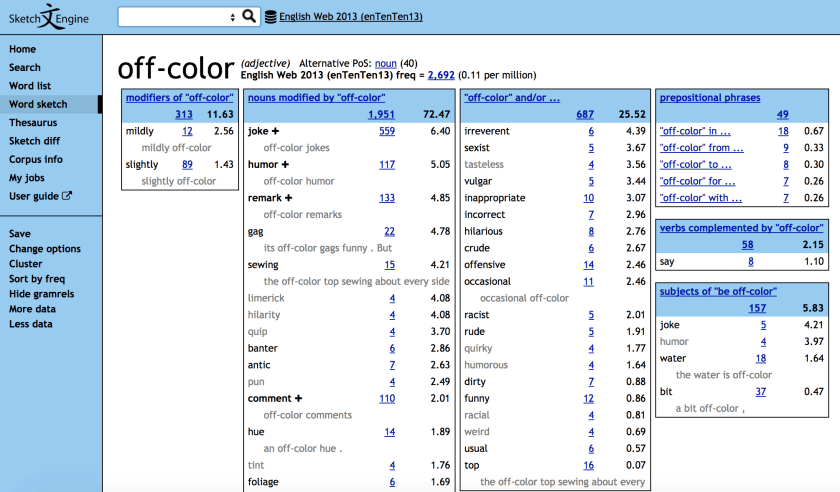
To get a really solid sense of how to use off-color, it’s useful to look at the other words that it occurs with.  (With which it occurs, if you prefer your sentences non-preposition-final.)  Here’s a screen shot of something called a “word sketch”–again, from the Sketch Engine web site.  Scroll down past the figure and I’ll talk you through it.

Screenshot 2017-04-14 06.01.28
Picture source: screen shot from the Sketch Engine web site.

At the top left, you see the adverbial modifiers that are most commonly associated with off-color.  Note that they are similar–mildly and slightly.  What you’re not seeing here are intensifiers–you wouldn’t typically say that something is very or horribly “off-color.”  Why?  I don’t know–that’s just the statistical tendency with this adjective.  You certainly could say that–but, a native speaker probably wouldn’t.

In the next column, you see the nouns that have the strongest statistical associations with off-color.  You won’t be surprised to see that the most common ones are joke, remark, and humor.  Most of the other words with strong statistical associations are other nouns that refer to humor–gag, limerick, hilarity, quip, banter, antic, and pun.

The next column over is a nice example of how you can get insight into a word by seeing what other words it’s joined with by and or or.  Most of the words that are joined with off-color in this way fall into one of two categories: they’re either related to humor, or they’re clearly negative.  The first category is related to the fact that off-color itself is so often used to modify joke and, as we saw in the preceding paragraph, other words that refer to humor.  In that category, we have:

  • hilarious
  • quirky
  • humorous
  • funny

In the second category, we have:

  • tasteless
  • vulgar
  • inappropriate
  • incorrect
  • crude
  • offensive
  • racist
  • rude
  • dirty
  • racial

If you had any questions about whether being off-color is good or bad, this should make it pretty clear to you that it’s not good.

In case you’re wondering: no, Sketch Engine does not pay me to shill for them.  In fact, I pay them quite a bit of money every year for access to their corpora and search engine.

Bon ménage

It’s amazing how many Republican politicians have gone down in flames over the years because they talked a lot of shit about immigration and then turned out to have an illegal housecleaner.  Some examples:

  • Meg Whitman, Republican candidate for governor of California, 2010
  • Andy Puzder, Trump pick for Labor Secretary, 2017
  • Tom Tancredo, long-time Republican congressman from Colorado and one of the worst of the hypocritical people in the area of pushing anti-immigrant policies and then hiring them.  He bragged about turning in a high school student when an article about him receiving an honors scholarship mentioned that he was in the US illegally–and then got busted hiring illegal immigrants to work on his mansion.

I’ll point out here that two of Bill Clinton’s nominees for Attorney General (the highest law-enforcement office in the United States) went down over illegal nannies–and I’ll also point out that unlike the Republicans, they were not hiring illegal immigrants while hypocritically talking trash about hiring illegal immigrants.  Of course, most past misdeeds seem less relevant under the Trump administration, which seems positively gleeful about being a bunch of crooks, bigots, and–I suspect we’ll soon know clearly–traitors.

On that note, here’s a nice post from the France Says blog on the subject of French vocabulary related to people who clean things.  Enjoy–and if you’re going to hire illegal aliens to work for you, have the grace not to build your career on talking about how bad they are!

Source: Bon ménage

Leavin’ on a jet plane: how to read a newspaper story about research

5:01 AM Wake up.  Check phone to see if Trump launched a missile strike last night because a teenager made a web site where you can watch a kitten scratch his face and his feelings were hurt.  (Remember how he used to say that Hillary isn’t “tough enough?”)  Lie in bed for half an hour listening to the news and trying to get back to sleep.

5:30 AM Get up.  To the balcony with coffee and a cigarette.  Wonder if the drunk guy staggering down the street is “your” drunk.  (Fascinating guy–gave me a long lecture the other day on the differences between Western European and Eastern European Roma, with statistics.)  Make sure you have passport & French visa.

5:39 AM Check email.  Find a web site that lets you tinker with minor changes to variables and watch the level of statistical significance go up and down.

6:00 AM Alarm goes off.  Be happy that you’re half an hour ahead of schedule.

6:20 AM Realize that you have a plane to catch and you’ve just spent 40 minutes tinkering with minor changes to variables and watching your level of statistical significance go up and down.  Into the shower.  (Sous the shower, in French–I still struggle with this.)

6:30 AM Start downloading TV shows onto your phone.

7:06 AM Realize that you have a plane to catch, and you’ve just spent 36 minutes downloading TV shows onto your phone.  Charge spare battery while you empty the refrigerator.

7:10 AM Take pre-flight aspirin and drink pre-flight glass of water–blood clots suck.  Pack daily medications.  Pack emergency medications.  Pack the extra emergency medications that you need when you fly, because you just can’t take 15 hours on airplanes like you used to.  Sucks getting old…

7:30 AM Update Gmail Offline.  Check to see if Trump has launched a missile strike to distract from yet another revelation about members of his campaign being unregistered agents of foreign government, and a hostile one, at that.  (Remember when he always called her “Crooked Hillary?”)

7:31 AM American keys: check.  American dollars: check.  American driver’s license: haven’t seen it in months.  Whatever.  Make sure you have passport and French visa.

7:35 AM Make sure you have your passport.  Pack paper to edit on the plane: semantic relations in compound nouns.  Download another TV show.

7:40 AM Pack gifts: poster of a skeleton playing a banjo that you bought from a bouquiniste for your father.  Camembert box and a snail tray for your mother.  Mustard for an ex.  Remember to pick up macarons and salted butter caramel at the airport.  Pack another paper to edit on the plane: inter-annotator agreement and linguistic data.

7:45 AM Stick the clothes that you pre-packed last night into your suitcase: only two days’ worth, ’cause this is a passage éclair, plus you have spare clothes pre-positioned in Denver–must pre-position stuff when you live out of your suitcase.

7:49 AM Wonder why you have 18 euros in 2-euro coins in your pants pocket.

7:53 AM Empty ashtrays.  Check news again to see if Trump has launched a missile strike because he’s pissed that he can’t violate the Constitution by discriminating against people because of their religion.   Empty trash.  Make sure you have your passport.  Second pre-flight glass of water–blood clots suck.

8:00 AM Out to the balcony for a cigarette.  Think a lot about how well the woman who’s walking down the street’s shoes match her dress.  Advantage of having a boyfriend who’s descended from a long line of women’s clothing retailers: I will notice what you’re wearing, and if you ask me what I think about it, I’ll give you my honest opinion.  Disadvantage of having a boyfriend who’s descended from a long line of women’s clothing retailers: I will notice what you’re wearing, and if you ask me what I think about it, I’ll give you my honest opinion.  Get into a discussion on the phone of how to say “awakeness” in French.

8:33 AM Realize that you’ve just spent 33 minutes having a discussion on the phone of how to say “awakeness” in French–and you have a flight to catch.  Hang up and shave–I look disreputable enough as it is, and getting on a plane unshaven just isn’t a good idea if something should happen to go wrong with my ticket/seat assignment/United club membership/whatever.

8:55 AM Pre-flight back stretches.  Sucks getting old…

9:20 AM Time to head to the airport.  Realize on your way out the door that you almost left your iPhone headphone adapter on the kitchen table, without which your 15-hour trip to the US would be hell since Apple’s stupid iPhone 7 redesign.  First World Problem, I know–but, still: flying without the ability to listen to podcasts is miserable.  Make sure you have your passport.  Carry your luggage down the stairs.  The big suitcase first, before your legs are exhausted.  Suitcase in your left hand even though that’s the side of your back that hurts, so that you can hold on to the railing on the tight, tight, tight circular staircase of your poor-man’s-Hausmannian apartment building.

9:24 AM Look for a taxi cab, because you see the taxi cab drivers’ point of view in the whole Uber issue.  As usual, there’s no taxi, so duck into a side street and call Uber.  While you’re waiting, look up at your apartment and hope that the zombie apocalypse doesn’t start while you’re gone, because Paris is definitely going to be a better place to survive the zombie apocalypse than where you’re going.


fAndaccuracy
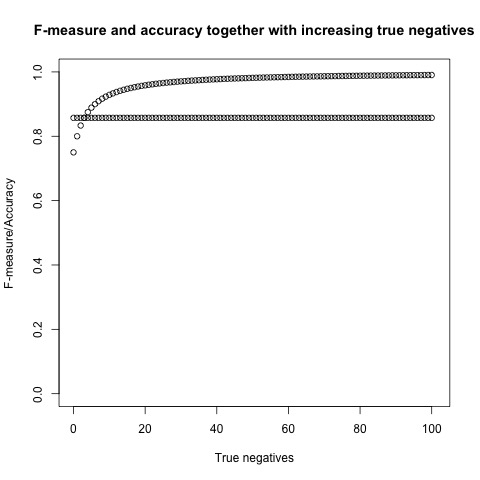
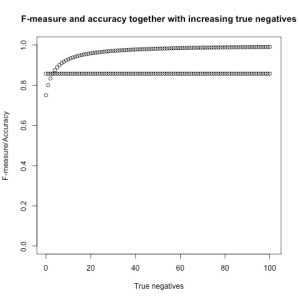
Whether a system looks good or bad can depend on a lot of things.  When I measure accuracy here AND I test it on 50 or more data points, the system looks almost perfect.  But if I measure something called the F-measure, or measure accuracy but only test it on a few data points, it doesn’t look terrible, but you wouldn’t bet your life on it, either.  Guess which of those is a better reflection of how good this system actually is?

Now, I know what you’re thinking: what kind of sick bastard spends 40 minutes on a web site that lets you tinker with minor changes to variables and watch the level of statistical significance go up and down?  Well: you should spend a little while watching statistical significance levels go up and down as you make minor tweaks in variables.  Ever hear someone claim about how they’ve given up trying to follow the news about health or science because it seems like what’s good for you one day is bad for you the next, and then good for you again the next, and eventually they just give up and stop listening to the science and health news?  Well, in fact it’s not the case that caffeine, or meditation, or oatmeal was good for you one day, and then it wasn’t the next.  Rather, some thing can be true in one set of conditions but not in another.  Even given the exact same data, the way that you frame the research question and do the analysis can have crucial effects on the statistics of the results.  It’s not like people are running around deliberately manipulating their data or their analysis–often, it just isn’t clear what the relevant conditions are for your experiment, or how exactly you should be framing the research question, or how exactly you should be doing the analysis.  Take 5 minutes to go play with this web site, where you’ll find data on the US economy going back to 1948, and a bunch of options for analyzing it.  Then we’ll talk about the difference between the paper that the economist writes about this data, and how an economics journalist will talk about those research findings in the newspaper.

The web site

You’re back?  Great.  Let’s talk about what you saw.

You were working with the same data the entire time–the facts never changed.  What you changed by making different selections was the way that you framed the question and did the analysis.  This is hidden to some extent by the way that the web site explicitly frames the question: Is the US economy affected by whether Republicans or Democrats are in office?

  • You’re going to have to frame that by looking at the economic numbers with either Republicans in office, or with Democrats in office.  When I picked Republicans to be the party on which I did my statistics, the Presidency as the definition of “being in office,” employment as my index of the performance of the economy, and I excluded recessions, then guess what?  When Republicans are in office, the economy is affected, and in a bad way.  But, guess what?  If I include recessions, then the answer to the question Is the US economy affected by whether Republicans or Democrats are in office? is “no.”
  • Oh–what was all of that stuff about what you use as your index of performance of the economy?  It turns out that how you measure “performance of the economy” has a big effect on the statistics.  If you define it as holding the Presidency, then if you use employment as your index of economic performance and exclude recessions, then Republicans hurt the economy, and the answer to the question Is the US economy affected by whether Republicans or Democrats are in office? is “yes.”  But, if you measure economic performance in terms of employment and inflation and Gross Domestic Product and stock prices, then there’s no effect on the economy at all, and so the answer to the question is “no.”
  • Is it possible to find some set of conditions in which we can say that the answer to the question is “yes, the US economy is affected by whether Democrats or Republicans are in office,” and it’s the case that the economy does better when Republicans are in office?  Yes!  If you define “being in office” as controlling the Presidency and the House of Representatives (but not the Senate or the state governorships), and you measure economic by GDP or GDP and stock prices (but not any other combination of variables, including just stock prices), and you weight the Presidency more heavily than the other offices, and you include recessions, then the economy does better under Republicans, and the answer to the question Is the US economy affected by whether Republicans or Democrats are in office? is “yes.”

Now: how is that going to be reported in the newspapers?  There are a number of possibilities–and, one important way that it won’t be reported.

  • Here’s how it won’t be reported: it won’t be reported as the US economy is not affected by whether Republicans or Democrats are in office.  The economist is not going to be able to publish that paper in the first place, and so the reporter is not going to come across it.
  • Here’s one way that it will get reported: the US economy is affected by whether Republicans or Democrats are in office.  Is that true?  Under a very specific way of framing the question (we picked Republicans to look at, rather than Democrats) and a very specific way of doing the analysis (we defined “in office” a particular way, selected a specific way of defining economic performance, and made a decision about whether or not to include recessions), it certainly is true.
  • Here’s another way that it will be reported: Republicans hurt/help the economy.  Is it true?  Yes, whichever way you state it–under a very specific definition of the question and set of decisions about how to do the analysis.  

What should you conclude from this?  Let me tell you some things that you should not conclude from it.

  • Don’t conclude that the economist who published the paper is a liar.  He/she/it didn’t make the claim that the reporter made.  The economist laid out exactly the conditions under which it is/isn’t the case that the US economy looks like it’s affected by which party is in office.  The reporter simplified it.
  • Don’t conclude that the reporter is a liar.  The reporter probably has no clue how to think about the contents of that paper critically.  The reporter got the message that under certain conditions, it is the case that the US economy seems to be affected by which party is in office, and left out the “under certain conditions” part, not realizing that they are crucial to interpreting the finding.
  • Don’t conclude that science is hopelessly screwed, or that statistics are not believable.  That study is going to be done by lots of people, with lots of different ways of framing the question and lots of different ways of doing the analysis.  Looking at those results in the aggregate, we’re going to end up with a decent understanding of under what conditions, and in what ways, the ruling political party does (or doesn’t) affect the US economy.  Can the economist report all of those studies in their paper?  No–they haven’t been done yet.

How does this relate back to reporting on science and health?  It relates back to reporting on science and health in that we have exactly the same issues about framing questions and doing the analysis that the economists do.  So do psychologists.  So do historians.  So do educators.

What to do?  This: understand that when you read about a scientific result–or any study that involves numbers, for that matter–in the paper, it’s always more complicated–and almost always less clear-cut–than it sounds.  Look at the overall picture.  Ask yourself questions like the ones that we’ve asked ourselves here: which population, exactly, did the researchers look at?  Out of all of the things that they could have measured, what did they measure?  How many subjects did they have?  You may not be able to design an experiment–really, we spend our entire careers trying to get really good at that–but, you can ask yourselves this kind of basic question about pretty much anything that you read.  Try it–it’s empowering!


I fell asleep as lunch was being served.  Two hours later, I woke up.  I edited the paper on semantic relations and compound nouns.  Then I edited the paper on inter-annotator agreement and linguistic data.  I never got around to watching the TV shows.  I didn’t get a blot clot!


Just because you’re a poet doesn’t mean you can’t kick ass

Operation Iraqi Freedom II
An LVTP7 amphibious assault vehicle. Picture source: USMC.

One day some decades ago, the amphibious assault vehicle in which I was riding around Camp Pendleton, California while we practiced assaulting hills and the like made an unplanned stop.  I reached into one of those voluminous pockets that military uniforms tend to be covered with and pulled out a book to read while the platoon leader tried to figure out where the fuck we were.  Whatcha reading, Doc?, some big, bulky Marine or another asked me.  (I was a medic in the Navy.  The US Marines don’t have their own medical personnel–they’re all provided by the Navy.  This came as a surprise to lots of young men who volunteered to join the Navy during Vietnam thinking that there was no better way to avoid finding yourself in a rice paddy with leeches on your scrotum and somebody shooting at you than working in a naval hospital–and then found themselves in a rice paddy with leeches on their scrota and somebody shooting at them.  Technically, the term for a Navy medic is hospital corpsman, but by long tradition, the Marines call us “Doc.”  But, back to Camp Pendleton…)

The social animal, I said.  Social psychology.  (You might think that I wouldn’t remember what I was reading in the early 1980s–but, the paperback fit perfectly in my left thigh pocket.  My right thigh pocket was for a bag of licorice.  You never know when you will/won’t get to eat, and licorice doesn’t leave your hands covered with melted chocolate.)  Social psychology…hm… I like to read about history, myself, said the big, bulky Marine.  The Wars of the Roses–that was some crazy shit…  The second lieutenant gave the staff sergeant an embarrassed smile and folded up his map; the big, bulky Marine and I climbed back into our hatches; and we all went back to assaulting whatever we were practicing assaulting–the Wars of the Roses would wait.  In the military, every branch has their stereotypical insults for the other branches, and everyone’s insult for the Marines is that they’re stupid, but I’ll tell you this: I know exactly two guys who dropped out of high school, joined the service, and then got a doctorate, and the one who isn’t me is a Marine.  (I don’t say “was” a Marine, because once a Marine, always a Marine, and they are, indeed, bad motherfuckers.  “Bad motherfucker” explained in the English notes below.)

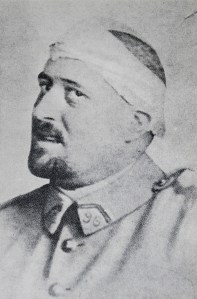
You tend to think of poets as ethereal, wispy types who are super-sensitive and probably wouldn’t be the person you would want to cover your back if you got into a fight in a metro station.  However, if you’ve been paying attention to the stuff that we’ve been reading for National Poetry Month, you’re already aware that there are plenty of counter-examples to that.  Case in point: Guillaume Apollinaire.  He may or may not have been sensitive, but he was definitely a serious scrapper.  He tried to join the army when the First World War came to France in August 1914, but was turned away due to not being a French citizen.  No problem–he left Paris and headed south-east to Nice and tried again, this time successfully.  He was initially assigned to an artillery unit, but this wasn’t hard-core enough for him, so he got himself transferred to a decimated infantry unit, picking up a promotion to second lieutenant in the process.  (That’s a very low rank for an officer, but for an enlisted man to get promoted to it is a pretty big deal.)

guillaume_apollinaire_calligramme
Calligramme. Public domain.

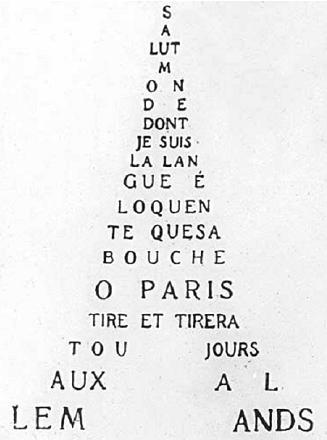
Apollinaire was one of the greats of French poetry; if you’ve only heard of one French poem, it was probably his Le pont Mirabeau.  One of his innovations was his role in the development of what’s known as “concrete poetry.”  It is “concrete” in the sense that not just its linguistic elements, but its typographic shape are essential to the poem.  The one to the left is my favorite of his works in this genre.  In the form of the Eiffel Tower, the words translate something like this:

Hello, world of which I am the eloquent tongue.  Oh Paris, may your tongue stick out, and stick out always, at the Germans.  

guillaume_apollinaire_foto
Guillaume Apollinaire. Public domain.

Now, being poetry, it is, of course, a bit more complicated than that.  What I’ve given here as “may your tongue stick out” comes from a volume of translations of Apollinaire  by Anne Greet and S.I. Lockerbie that I like.  “To stick one’s tongue out” is a plausible translation of tirer la bouche, but it’s not necessarily the most obvious one.  Certainly it fits with the facts that (a) Apollinaire refers to la langue éloquante, “the elegant tongue,” and the Eiffel Tower does have a tongue-like shape.  But, given that this was written by a guy who was putting his life on the line in the trenches at the time, I tend to think that he was playing on another meaning of the verb tirer: to fire a weapon.  For a poet in an infantry unit, the metaphor of the mouth as a weapon (que sa bouche…tire et tirera toujours aux Allemands) is certainly an apt one.

hybrid-suite-cardiac-16x9
A cardiac catheterization lab. Picture source: Children’s Hospital of Philadelphia.

The Navy eventually sent me to school, and I finished my time in the service in a cardiac catheterization lab, which over the course of some rather bizarre decades led to me being a faculty member at a medical school, where I specialize in biomedical language.  Apollinaire caught a shell fragment in the temple (when a bombardment started while he was reading a literary magazine, they say); although he survived trepanning, he never fully recovered, and in his weakened condition, died in the flu epidemic of 1918.  Whenever I visit the Panthéon, I take a moment to slip away from my friends and find his name on the (long) list of writers who gave their lives for France–and to pay my respects.


English notes

bad motherfucker: One of the cute things about American English is that bad–and similar words, depending on the region of the country that you’re in–can have positive connotations.  (Connotation is the cultural meaning of a word, as opposed to its denotation, which you could think of as its “dictionary meaning.”  Connotation and culture both start with a C; denotation and dictionary both start with a d.  That’s how remember them, at any rate.)

So: a bad motherfucker is someone who is really tough, with some implication that this toughness involves fighting.  You would want to be called a bad motherfucker.  When I was a kid, it was common to use bad to mean something like cool, impressive–our favorite bands were “bad,” a nice leather jacket was “bad,” etc.

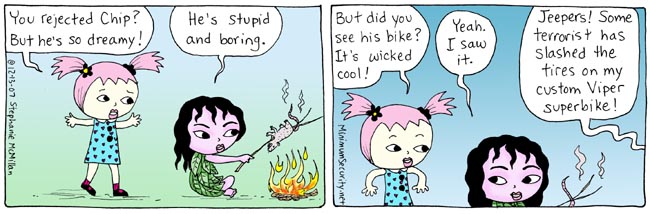
wicked-smart
The spelling of “smart” as “smaht” here is important, in that it’s meant to reflect the stereotypical regional pronunciation of the Northeast US, where this use of “wicked” comes from.

Less common, but incontestably much cooler, is the use of wicked to mean “very” in front of an adjective, especially one with a positive meaning.  I believe it’s a Northeast thing, although I’ve seen it as far west as Oregon.  Scroll down for lots of examples.

Screenshot 2017-04-09 02.09.11

6a00e54ef97d7c88330168ea8ec3c4970c-pi5326029-0490dfaa02f5b60aea13579ac26a82eb

73585648
The spelling of “smart” as “smaht” here is important, in that it’s meant to reflect the stereotypical regional pronunciation of the Northeast US, where this use of “wicked” comes from.

2007-12-13-imagine-wicked-cool-possessions

ws-teaser2

Danse macabre: the illustrated version

fleurs du mal larousse
The Larousse version of Baudelaire’s “Les fleurs du mal.” Picture source: me.

Being old, bald, and fat, I don’t get a lot of admiring glances when I ride the train to work in the mornings.  I do, however, get a lot of funny looks when I pull out a book to read.  The reason: I’m fond of reading French literature, but I tend to read it in the sorts of annotated versions of a work that you would read if you were a middle-school student in France (collégien in French, I think–roughly 7th and 8th grades in the American system).  For me, they’re perfect–they have definitions in simple French of the kinds of words that the editors think will be difficult for a French child, which as a non-native speaker, I have trouble with myself.  (Think back to the footnoted versions of Shakespeare that you read in high school and college.)  If this kind of thing interests you, you can find them used by the score (see this post for an explanation of what by the score means) in boxes in front of the Boulinier bookstore on boulevard Saint Michel in the Quartier Latin.  They’re so cheap–typically one euro–that there’s no reason not to by multiple versions of a play that you’re planning to see.  (17th-century French theater is actually probably more intelligible than Shakespeare is in English, although as is the case with Shakespeare, it’s a good idea to read a play before you go see it.)  I find it interesting to see the contrast between the sorts of things that one would (not) dare to teach middle-school students in the US and the sorts of things that one can teach middle-school children in France–definitely edgier in France.

In honor of National Poetry Month, here’s some Baudelaire, from Les fleurs du mal.  Baudelaire popularized poetry about cities, as opposed to nature, glorified ad nauseum by Romanticism.  In his delightful book The flâneur, Edmund White describes him as “the great apostle of dandyism,” which explains a lot about the picture of him that you see below.  Odd 6-degrees-of-separation stuff: he went to high school across the street from the university where my grandfather would later study.

Danse macabre

Charles Baudelaire

A Ernest Christophe

652b3299413ea4845776be34d1c66177
Picture source: https://goo.gl/BVRvlb

Fière, autant qu’un vivant, de sa noble stature,
Avec son gros bouquet, son mouchoir et ses gants,
Elle a la nonchalance et la désinvolture
D’une coquette maigre aux airs extravagants.

Note the inversion that moves un soulier pomponné, joli comme une fleur to the end of the sentence, indicated only by the relative maker que rather than qui.

s’écrouler: to fall, e.g. le mur s’est écroulé, s’écrouler sur le canapé.

Vit-on jamais au bal une taille plus mince ?
Sa robe exagérée, en sa royale ampleur,
S’écroule abondamment sur un pied sec que pince
Un soulier pomponné, joli comme une fleur.

la ruche: a strip of pleated cloth (see picture above)

lascif: sensual, lascivious

lazzi: jibes, ribbing

appas: “charms”

La ruche qui se joue au bord des clavicules,
Comme un ruisseau lascif qui se frotte au rocher,
Défend pudiquement des lazzi ridicules
Les funèbres appas qu’elle tient à cacher.

frêle: fragile, frail

attifé: dressed, not necessarily well

Ses yeux profonds sont faits de vide et de ténèbres,
Et son crâne, de fleurs artistement coiffé,
Oscille mollement sur ses frêles vertèbres.
Ô charme d’un néant follement attifé.

Note ivre here and enivré later.

armature: framework; also the underwiring of a bra, although I don’t know whether or not that sense was current in Baudelaire’s time

Aucuns t’appelleront une caricature,
Qui ne comprennent pas, amants ivres de chair,
L’élégance sans nom de l’humaine armature.
Tu réponds, grand squelette, à mon goût le plus cher !

éperonner: to spur, to spur on; also to ram

encor: an old literary spelling of “encore”

Viens-tu troubler, avec ta puissante grimace,
La fête de la Vie ? ou quelque vieux désir,
Éperonnant encor ta vivante carcasse,
Te pousse-t-il, crédule, au sabbat du Plaisir ?

Au chant des violons, aux flammes des bougies,
Espères-tu chasser ton cauchemar moqueur,
Et viens-tu demander au torrent des orgies
De rafraîchir l’enfer allumé dans ton coeur ?

aspic: asp

errer: to wander, roam, rove

Inépuisable puits de sottise et de fautes !
De l’antique douleur éternel alambic !
A travers le treillis recourbé de tes côtes
Je vois, errant encor, l’insatiable aspic.

Love the ne expletif after craindre!

Pour dire vrai, je crains que ta coquetterie
Ne trouve pas un prix digne de ses efforts ;
Qui, de ces coeurs mortels, entend la raillerie ?
Les charmes de l’horreur n’enivrent que les forts !

gouffre: gulf, chasm, abyss

Le gouffre de tes yeux, plein d’horribles pensées,
Exhale le vertige, et les danseurs prudents
Ne contempleront pas sans d’amères nausées
Le sourire éternel de tes trente-deux dents.

Pourtant, qui n’a serré dans ses bras un squelette,
Et qui ne s’est nourri des choses du tombeau ?
Qu’importe le parfum, l’habit ou la toilette ?
Qui fait le dégoûté montre qu’il se croit beau.

bayadère: sacred dancer from India

gouge: old word for a prostitute

offusqué: offended

musqé: musky

Bayadère sans nez, irrésistible gouge,
Dis donc à ces danseurs qui font les offusqués :
” Fiers mignons, malgré l’art des poudres et du rouge,
Vous sentez tous la mort ! Ô squelettes musqués,

Antinoüs: according to the footnotes in my middle-school-student version, jeune esclave d’une beauté parfaite, qui était le favori de l’empereur Hadrien

flétri: faded (beauty), withered, wilted (like the roses sitting on my table–I really need to toss them)

dandy: in Baudelaire, this is a compliment, as you might guess from the painting of him at left

glabre: clean-shaven, smooth-skinned (WordReference.com)

lovelace: séducteur pervers et cynique, according to the footnotes in my middle school version of the poem

chenu: white-haired from age

le branle: a kind of dance.  (If you are French: you can just imagine what happens when you try looking for videos of this on YouTube)

Antinoüs flétris, dandys, à face glabre,
Cadavres vernissés, lovelaces chenus,
Le branle universel de la danse macabre
Vous entraîne en des lieux qui ne sont pas connus !

se pâmer: to faint; to swoon, either literally or in a state of strong emotion, whether good (with synonyms délirer, exulter, se griser, s’émerveiller, s’enthousiasmer, s’exalter, s’extasier) or bad (elle s’est pâmée de douleur).

béant: gaping, wide open, cavernous

le tromblon: blunderbuss

Des quais froids de la Seine aux bords brûlants du Gange,
Le troupeau mortel saute et se pâme, sans voir
Dans un trou du plafond la trompette de l’Ange
Sinistrement béante ainsi qu’un tromblon noir.

la contorsion: contorsion, but also “a face” in the sense of “to make a face”

En tout climat, sous tout soleil, la Mort t’admire
En tes contorsions, risible Humanité,
Et souvent, comme toi, se parfumant de myrrhe,
Mêle son ironie à ton insanité ! “

Ukrainian Humanitarian Resistance

Resisting the russist occupation while keeping our humanity

Languages. Motivation. Education. Travelling

"Je suis féru(e) de langues" is about language learning, study tips and travelling. Join my community!

Curative Power of Medical Data

JCDL 2020 Workshop on Biomedical Natural Language Processing

Crimescribe

Criminal Curiosities

BioNLP

Biomedical natural language processing

Mostly Mammoths

but other things that fascinate me, too

Zygoma

Adventures in natural history collections

Our French Oasis

FAMILY LIFE IN A FRENCH COUNTRY VILLAGE

ACL 2017

PC Chairs Blog

EFL Notes

Random commentary on teaching English as a foreign language

Natural Language Processing

Université Paris-Centrale, Spring 2017

Speak Out in Spanish!

living and loving language

- MIKE STEEDEN -

THE DRIVELLINGS OF TWATTERSLEY FROMAGE