How to be interesting (the science version)

I spend a lot of my time thinking about how to be interesting.  Which is to say: my professional life mostly consists of writing things; or, more accurately, my professional life mostly consists of writing papers or grant proposals; or, more accurately, my professional life mostly consists of writing papers such that objective third parties will recommend that they be published, or grant proposals such that objective third parties will recommend that they be funded; or, more accurately, my professional life mostly consists of writing things in such a way that objective third parties won’t be pissed off about the fact that they’re being asked to read them, ’cause if they’re pissed while they’re reading, they’re unlikely to recommend either publishing (in the case of articles) or funding (in the case of grant proposals).  I know (from long experience reading other people’s papers and grant reviews) that a good way to piss someone off about the fact that they’ve been asked to read your stuff is to not be interesting; so: I spend a lot of my time thinking about how to be interesting.

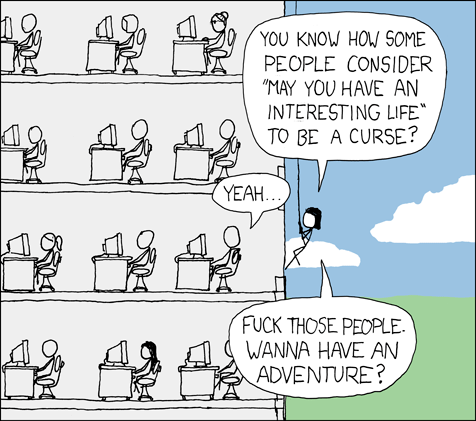
What’s interesting is, I imagine, dependent on context; my context (in my professional life, at any rate) is an academic one.  In an academic context, I can think of two ways to be interesting:

  • Show that something that looks really complicated is actually quite simple.
  • Show that something that looks really simple is actually quite complicated.

Some examples of being interesting by showing that something that looks really complicated is actually quite simple:

  • Darwin showing that the amazing, astounding, overwhelming diversity of life is explainable by one principle.
  • Chomsky claiming that the incredible diversity of human languages is all based on a small set of shared principles.  (I’m leaving out a bunch of details here.  Hell, I’m leaving out a bunch of details everywhere in this post–I’m just painfully aware of them in this case, ’cause I’m a linguist.)
  • The ideal gas law, which describes the relationship between the pressure and the volume and the temperature and the number of molecules in a sample of a gas with one beautiful little equation.  (We were very amused by the equation in the Navy.  Written PV = NRT, you could imagine pronouncing it “pervnert,” which sounds a lot like pervert, which we thought was super-funny.

Some examples of being interesting by showing that something that looks really simple is actually quite complicated:

  • Newton showing that the single most obvious fact about the world–if you haven’t watched a baby figuring out that it exists, you’ve really missed something (and you could fix that–go adopt someone, the need is enormous)–is, in fact, what holds the entire fucking physical universe together.
  • Gender–it’s supposed to be super-simple (only two, and you can tell which one you are by standing in the mirror).  Turns out it’s much more complicated than that, and if you think that it all boils down to chromosomes: it’s more complicated than that.  (The link takes you to a World Health Organization page that talks about some of the possibilities beyond XY sex chromosomes–there are complexities in each of the seven ways that gender gets taxonomized in the biomedical literature alone.)

I had a hell of a lot less trouble coming up with examples of being interesting by showing that something apparently complicated is actually quite simple than I did coming up with examples of being interesting by showing that something apparently simple is actually quite complicated.  Does that mean that one is better than the other?  Does that mean that I have a biased sample of interesting things?  Does that mean that I have a warped sense of what is interesting?  Does that mean that I need to get more sleep (I was singing Il est 5 heures, Paris s’éveille (which, now that I think about it, is relevant to the how-many-genders question) at 5 AM, ’cause I had been awake since midnight)?  I really don’t know.  Someone have examples to add?  I’ll just step out on the balcony for a cigarette while you do that…


English notes

to step out on: A nice ambiguity!  To step out on someone has a very specific meaning, and it’s not what I meant here–so, why not take this opportunity to go over an odd little corner of the English language?

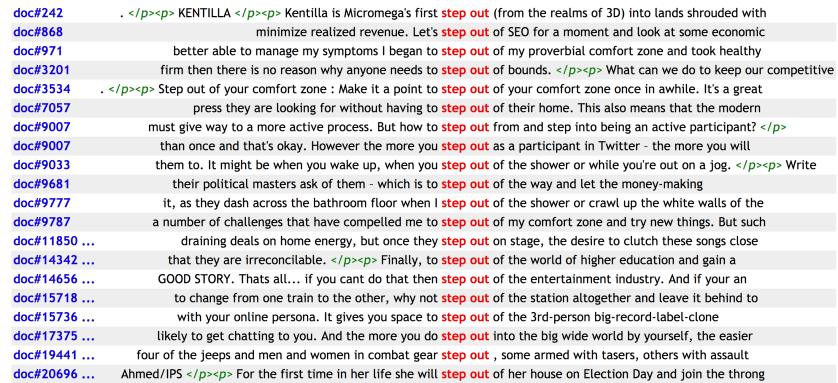
To step out typically means to–either literally or metaphorically–exit something by walking a very short distance.  It can be followed by lots of things, particularly prepositions:
Screen Shot 2018-01-19 at 05.57.06
I found these examples by using the Sketch Engine web site.  It provides access to hundreds of corpora (collections of texts with some data added, e.g. parts of speech of every word) in I-don’t-know-how-many languages, along with a single search facility that you can use for any and all of them.  I used it to search a corpus called enTenTen, which consists of 19.7 billion words of English-language text scraped from the Internet.  No, they don’t pay me for this–I pay them.  More accurately, my boss pays them–I use Sketch Engine for my day job, researching biomedical language.
  • You can step out on something, which you could paraphrase as to step out onto something, and it just means that you exited something by walking a very short distance, and then you were located on something:
  • Now Google is stepping out on that dance floor every day.
  • It’s like stepping out on the highwire in the big tent without the net.
  • Stepping out on the patio after getting into our robes, we felt the heat of the 80 degree sun – aah!
  • We have come to rescue you! yelled the young inventor, as he stepped out on the deck, with his electric rifle in his hand.
  • I was in complete shock after inching my drivers side door open with all of my might, and stepping out on to the pavement…
  • They paint an irresistible picture of Al in his bathrobe rolling over and over on the floor with his young son at his Miami villa or stepping out on the porch in his carpet slippers to smash bottles floating in the ocean with a machine-gun named Queenie.

However: to step out on (a person) means to cheat on them, to be unfaithful to them.  More vulgarly: to “fuck around on” them.  (Ooooh–two prepositions in a row!)  Some examples:

  • Poor Anna got caught stepping out on her old man – again.
  • Some of the boys heard rumours that she was stepping out on me.
  • Mom was never really all that happy, I think after he stepped out on her she had a fling, or tried.
  • Frank didn’t have the taste for that sort of work–chasing down bail jumpers or tracking husbands stepping out on their wives.
  • And it looks like Emma Frost will be stepping out on Cyclops with the King of Atlantis, which really doesn’t surprise me at all.
  • Yep, what if folks knew up front that he was stepping out on his wife; wouldn’t that pretty much kill the whole idea of being vulnerable to blackmail, etc.? 

Enjoy!

 

Sexual dimorphism in elephant rumbles

I was just getting ready for my day of calculating the ratio of unique words to total words in a bunch of journal articles about spinal cord injury and regeneration when it struck me that there really aren’t enough nice pictures of elephants in our lives. 

I was just getting ready for my day of calculating the ratio of unique words to total words in a bunch of journal articles about spinal cord injury and regeneration when it struck me that there really aren’t enough nice pictures of elephants in our lives.  Not mine, anyway.  Please enjoy the following picture of Chikwenya (left) and Mike (right), two African elephants from Mana Pools National Park in Zimbabwe.  The wavy lines in the middle of the bottom part of the photograph are a spectrogram of an elephant “rumble.”  See the things labelled F1 and F2 in the panels to the left and right?  Those are the first formant (F1) and second formant (F2) of Chikwenya and Mike’s rumbles.  In a human language, it’s the height and spacing of the first and second formants that identify the various and sundry vowels.  Want to know more about African elephant rumbles?  See Anton Baotic and Angela Stoeger’s recent paper on the topic:

Baotic, Anton, and Angela S. Stoeger. Sexual dimorphism in African elephant social rumblesPloS one 12.5 (2017): e0177411.

Want to know more about formants and vowels?  Encourage me in the Comments section.

Off I go for breakfast (see below) and a nice day of calculating the ratio of unique words to total words in a bunch of scientific journal articles about spinal cord injury and regeneration…

pone.0177411.g001

img_5302
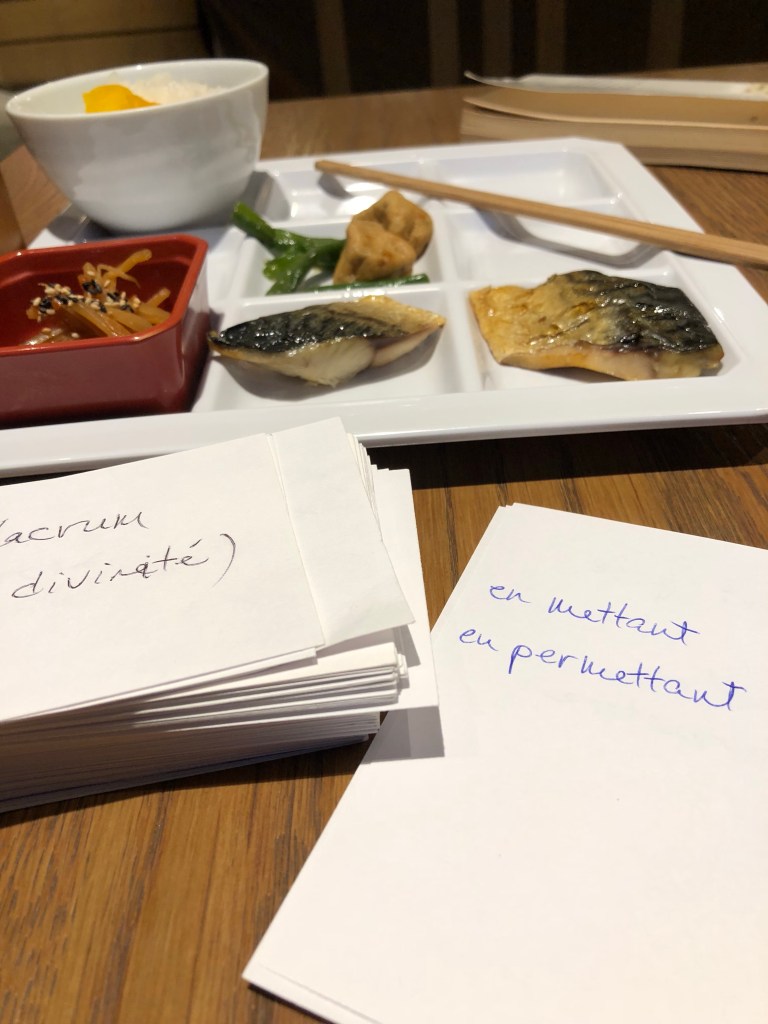
Breakfast in Kashiwa, Japan: grilled mackerel and a bit of French grammar.  Are the “macs” in Jean Genet’s “Miracle de la rose” “maquereaux” (“mackerel”, but also “pimps”)?  I honestly don’t know.

Ah, Josephine, if I dared…

Adventures in anaphora resolution: the Alain Bashung version.

A l’arrière des berlines
on devine
des monarques et leurs figurines
juste une paire de demi-dieux
livrés à eux
ils font des petits
ils font des envieux

What the hell is being delivered, and who the hell is it being delivered to? Livrés is masculine plural.  Berlines is feminine plural, so it can’t be the berlines; monarques is masculine plural, so it could be that; figurines is feminine plural, so it can’t be that; une paire de demi-dieux, I don’t know what to say about.  Demi-dieu is masculine (I think), but une paire is feminine and singular–WTF?  I’ve got livrés narrowed down to monarques or demi-dieux, in any case… Then we get to eux in livrés à eux.  My hypothesis: the figurines are being delivered to the monarchs.  Counter-arguments?

à l’arrière des dauphines
je suis le roi des scélérats
à qui sourit la vie

marcher sur l’eau
éviter les péages
jamais souffrir
juste faire hennir
les chevaux du plaisir

osez, osez Joséphine

plus rien ne s’oppose à la nuit
rien ne justifie

usez vos souliers
usez l’usurier
soyez ma muse
et que ne durent que les moments doux
durent que les moments doux
et que ne durent que les moments doux

osez, osez Joséphine
plus rien ne s’oppose à la nuit
rien ne justifie

Ethereal fluid

Just for fun: work the word “ichor” into a conversation.

Zipf’s Law: most words occur very rarely–but, they do occur. Case in point: ichor. I went 55 years of my life without ever running into it before that I can recall–and then last year, I came across it twice. (Yes, I remember shit like how many times I came across the word ichor last year–probably why I get divorced so often.)

Is it really possible to use the word ichor in a conversation? As the kids say: hells, yes! For example: I have a bit of a cold, so I spent the morning wiping ichor off of my nose. (Seriously–I feel like shit.) I’m in Hawaii at the moment, so I’m eating a lot of poke–a traditional Hawaiian dish made of raw tuna, which depending on how it’s been marinated, may or may not have a coating of ichor on it. Fastoche–working “ichor” into your quotidian conversations is easy-peasy.


Questions for discussion while you wonder whether or not I’m kidding about wiping ichor off my nose all morning:

  • What does it mean for a word to be in a language?  When I say that ichor is an English word: is it possible, in theory, to demonstrate whether or not that statement is true?
  • Is there some authority that determines what is or is not a word in the English language?  If so: who died and made them king?  (That’s something that kids say when someone who they don’t think has any right to tell them what to do tells them what to do: who died and made you king?)
  • Is being–or not–part of a language purely a question of use?  If so: does frequency matter?  How often does something have to be used to count as part of the language, versus, say, some word that I just made up off the top of my head, or some Yiddish word that I used because I happened to know that my interlocutor would understand it, even though we were speaking English at the time?
  • If it’s purely a question of use: does it matter who uses it?  Like, if a word is only used by adolescent pot-smokers, but it’s used by a lot of adolescent pot smokers–would that do it?  How about if a word is used by exactly the same number of people, but they’re all university professors with doctorates in something cool and tweed jackets?  And what if no one in the entire fucking world except university professors with doctorates in something cool and tweed jackets knows what the hell it means–does that change your judgement?  How about if it’s only one person, but he’s the president of the most powerful country in the world (for the moment, i.e. until he fucks it up)?  Covfefe, anyone?  What if the president uses it, but only one time, and he’s a fucking ignoramus, but then the whole country picks it up, even though it was just a typo, because the president of the most powerful country in the world (for the moment, i.e. until he fucks it up) is too sloppy to be bothered to check his tweets before he hits the Send button?

…or, we could all just step outside for a cigarette and a bit of fresh air.  We are, after all, in Hawaii, and the question of what it means for a language to have something–or not–is really hard to answer.  Tell us about your uses of “ichor” today in the Comments section!

Like, “the”

So true–and probably why I never get a second date…

Nunberg is a super-serious linguist, by the way–and an unusual one, in that he has been very successful in bringing real linguistics to the general public.  Check out his Wikipedia page here.

What’s so interesting about “the”?  Go ahead–tell me what it means.  Hell, forget what it means–just tell me how you know when to–and when not to–use it.


Coffee is expensive, isn’t it: Tag questions in English III

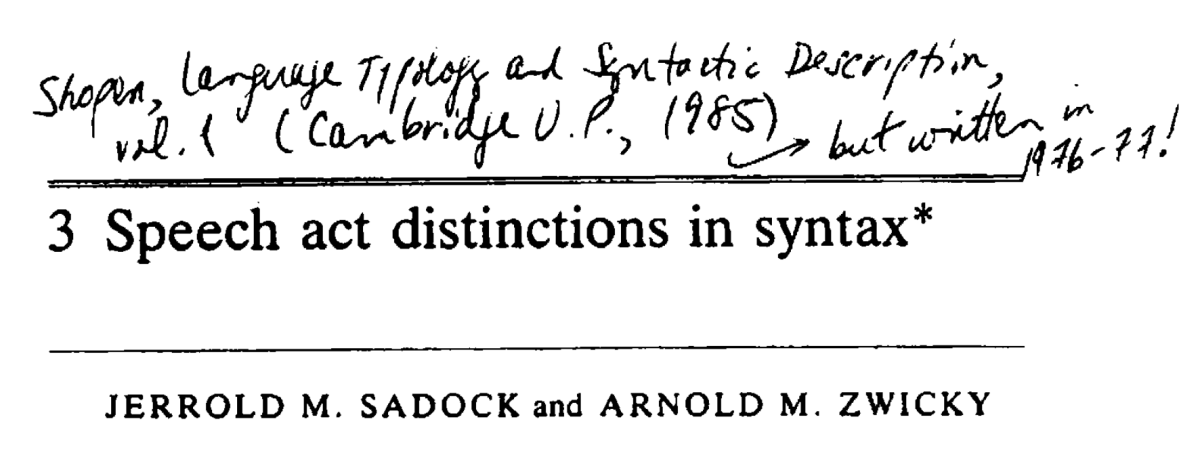
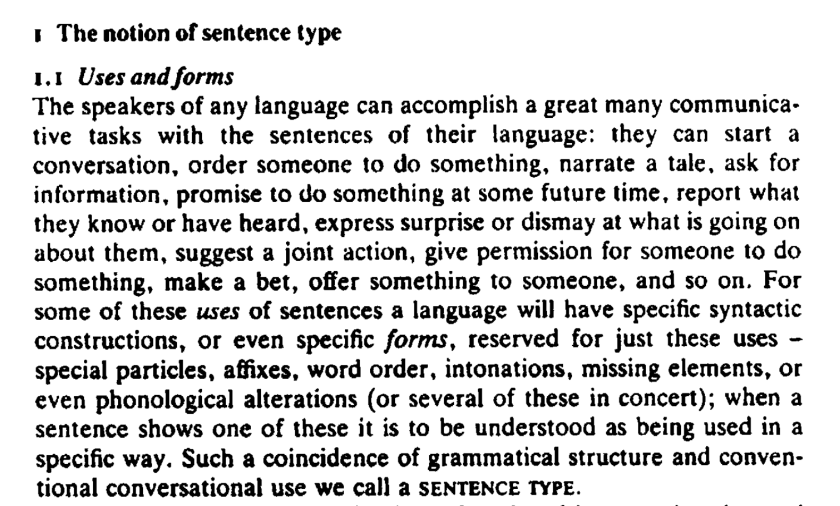
The purpose of language is to communicate, right?  Seems obvious.  In fact, it is not so obvious.  One way in which language is not clearly about communication per se is when we use language to do things.  Consider the following, from the introduction to the paper Speech act distinctions in syntaxby Jerry Sadock and Arnold Zwicky.  They refer to “communicative tasks,” which sounds like a counter to my claim here, but I think it’s a bit of a misnomer: they are mixing together things that are mainly communicative (e.g. “express surprise or dismay”) with things for which “task” would be a more appropriate label:

Screen Shot 2017-12-24 at 15.16.54

Consider, for example, the following:

I now pronounce you man and wife.

It is by saying those words of the (more or less) traditional American wedding ceremony that one performs the action of marrying someone.  Or this:

I promise to try to do better.

Again, it is precisely by saying that sentence that one performs the action of making a performance.  Certainly there’s some communication going on both in I now pronounce you man and wife and I promise to try to do better, but there’s a whole lot more going on than communication, too–in the first case, you are committing two people to sleeping with each other and no one else (presumably until death does them part), while in the second case, you are causing a commitment to exist on your part where no such commitment existed before.


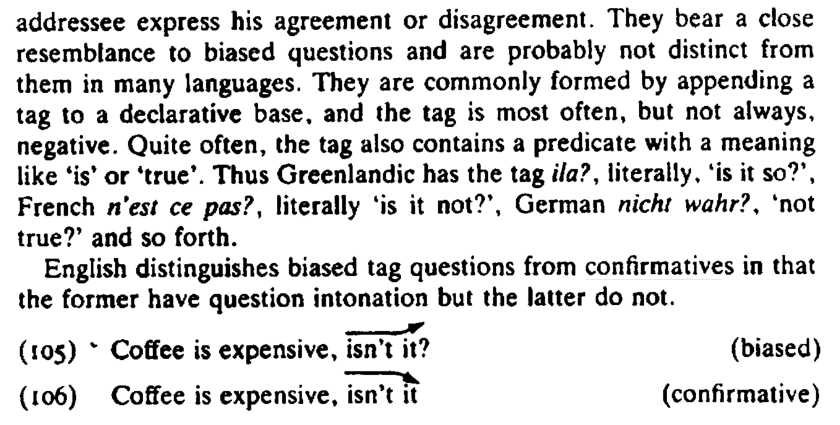
Recently we’ve been talking a lot about tag questions, and tag questions are one of the kinds of “sentence types” that Sadock and Zwicky talk about.  (I think that’s Sadock’s handwriting on the scan of the paper title that you see at the top of this post, by the way.)  They point out a quirk of English tag-questions that we haven’t talked about before: you can say them with different intonation patterns, and the different patterns do pretty different things.

Screen Shot 2017-12-24 at 15.32.25

Native speakers of English have a tendency to respond to a tag question according to the response that the question is intended to evoke.  Children are quite likely to do this, and lawyers use tag questions in the court room to try to get witnesses to answer as the lawyer would like them to.  See this post for more on that topic.

Sadock and Zwicky talk about typical tag questions in English as an example of what they call a biased question: a question that is meant to evoke a specific answer.  (That in itself is pretty different from what we think about questions as doing: obtaining some information that we don’t know.)  They differentiate confirmatives from biased questions; they describe confirmatives like this:

Rather than having as their goal the garnering of information, these really amount to statements that carry with them the demand that the addressee express his agreement or disagreement.

Back to their “coffee” examples:

Screen Shot 2017-12-24 at 15.40.11

See these posts for the following:

3rd person singular tag questions with the verb is

3rd person plural tag questions with the verb are

So, yeah: the tag question construction seems simple, but it’s actually pretty complex, in a lot of ways.  In fact, English tag questions can be quite difficult for non-native speakers to learn to use, and that’s why we’ve been drilling them recently.


We’ve been working on tag questions with the verb to be recently.  We worked on the third person singular (Trump is an asshole, isn’t he?) and the third person plural (Trump and his cronies ARE the swamp, aren’t they?).  We did that in the present tense–let’s try the past tense now, ’cause the verb in the tag has to agree with the verb in the base sentence with respect to tense.  (Still think that tag questions are simple?)

We’ll follow our usual structure for drills–half a dozen on the same model, half a dozen on a similar model, and then mix ’em up.  Remember: we’re not testing ourselves–we’re practicing.  This is fun!  (…and this is why I never get a second date.)

Model:

  • Trump was a draft dodger during the Vietnam war.
  • Trump was a draft dodger during the Vietnam war, wasn’t he?
  1. Trump was a draft dodger during the Vietnam war.
  2. Trump was remarkably silent about Roy Moore for quite a while.
  3. Obama was fucking wonderful for the economy.
  4. Trump was given a draft deferment for bone spurs in his feet.  Now he says he’s the healthiest president ever.  Fucking coward.
  5. Trump was more pissed about being criticized for his defense of the bigots in Charlottesville than he was about the poor girl that was murdered by a white supremacist.

…and now the opposite polarity:

  1. Trump wasn’t actually a very successful businessman.
  2. Trump wasn’t above refusing to pay small businessmen who had done work for him.
  3. Trump wasn’t embarrassed to declare bankruptcy.
  4. Trump wasn’t honest with the students in his real estate “school.”
  5. Trump wasn’t eager for war when he was still young enough to be drafted.

As President Obama said, over and over and over: Merry Christmas.

Just stick as many Ys in there as you can

“Just stick as many Ys in there as you can,” said my mentor–and if the question is how do you spell “homonymy,” then that’s the right answer.

A cherished mentor had this word of advice for me on how to spell words like homonymy and metonymy: 

Just stick as many Ys in there as you can.

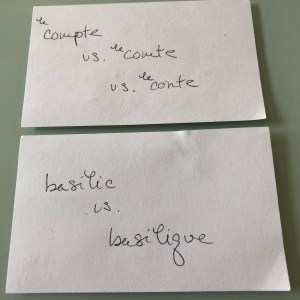
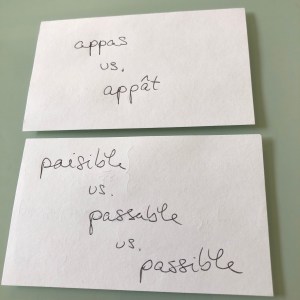
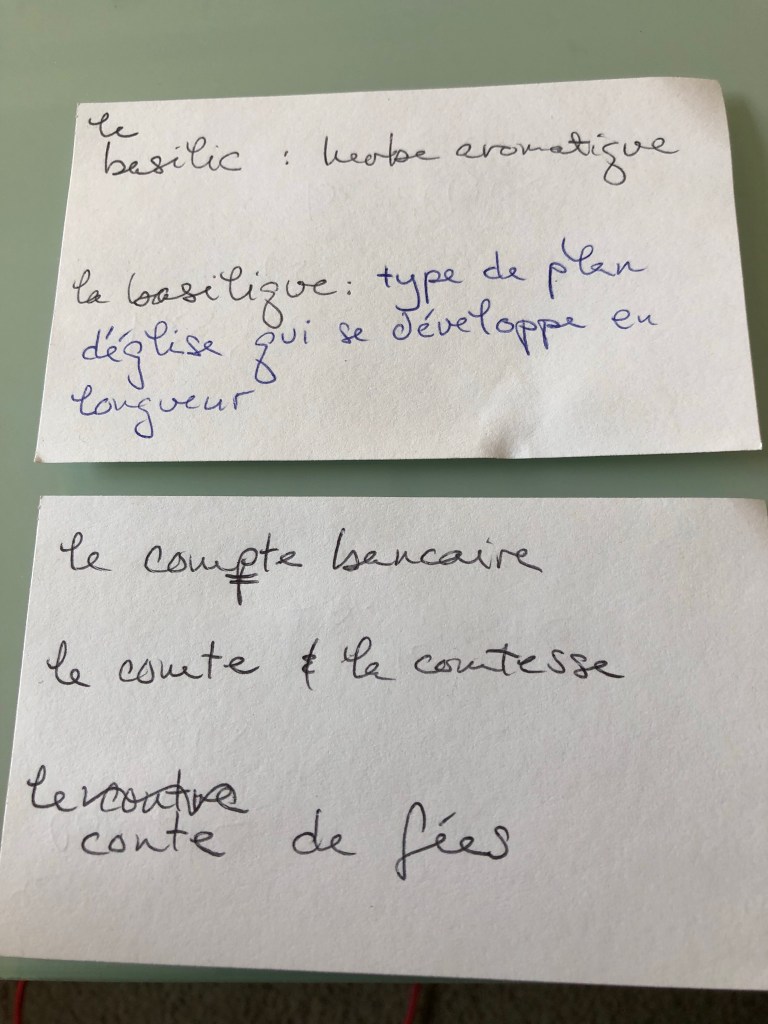
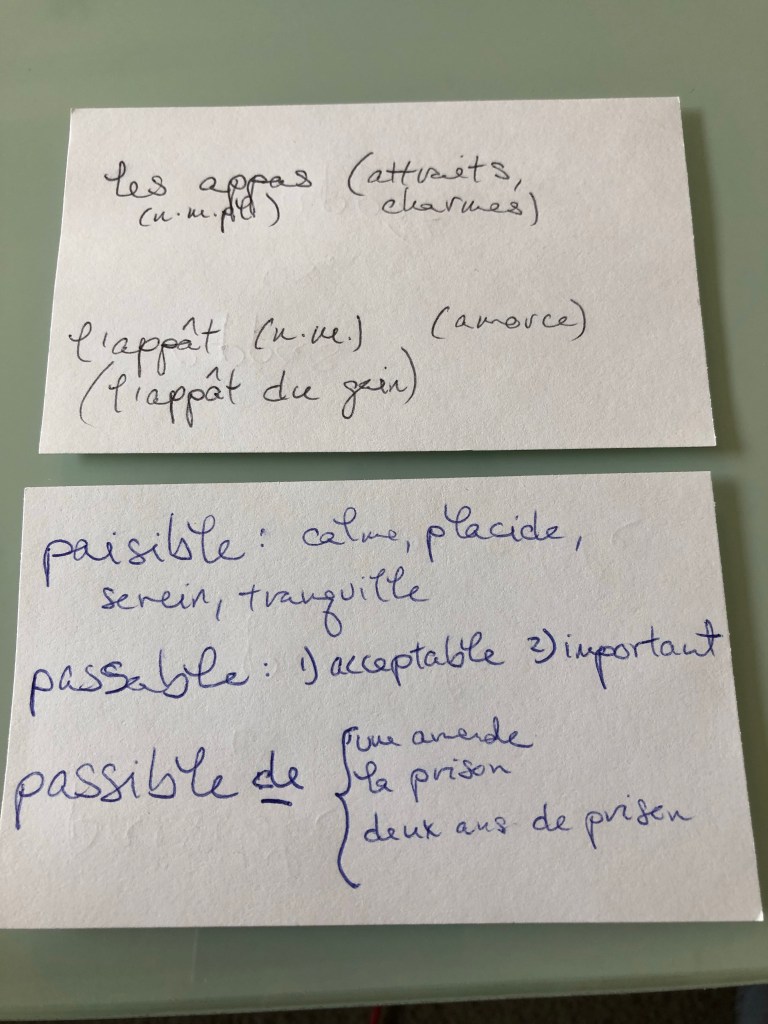
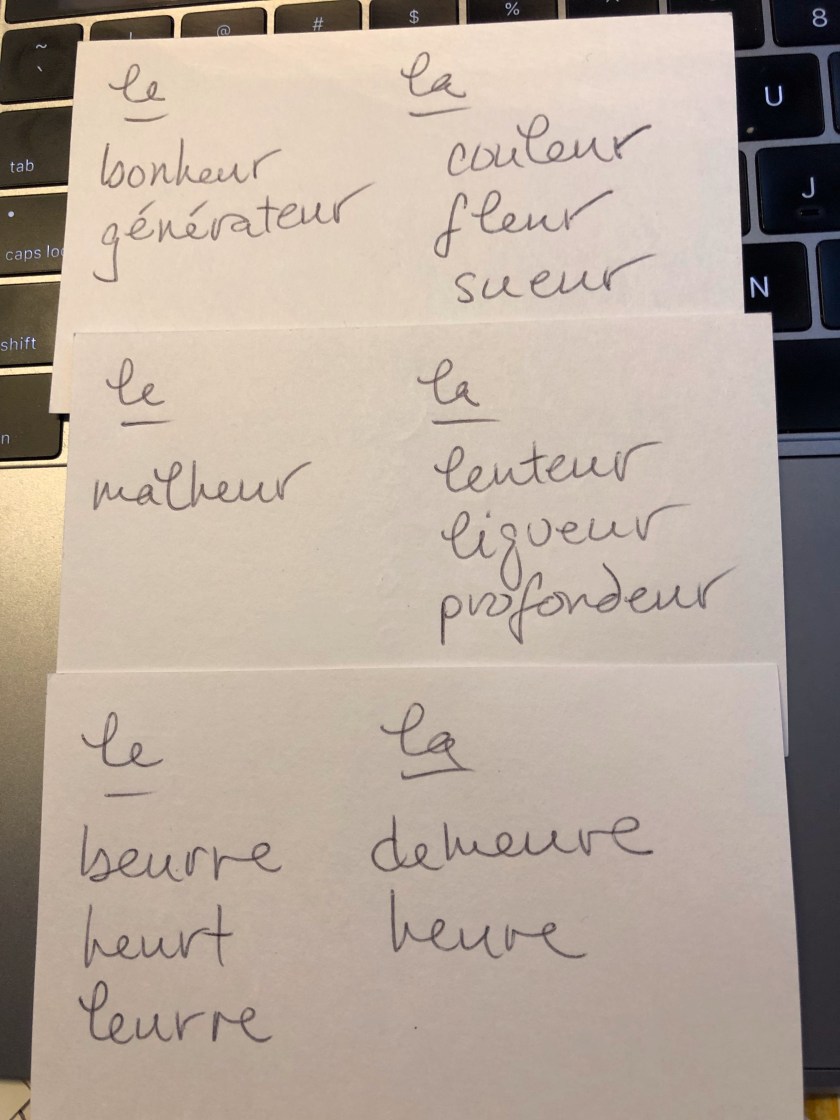
I thought about him today as I put together this post about words that I confuse (or that confuse me–I’m never clear on what the underlying semantics of confuse are).  As you can see from my flash cards, I’m working on words that sound the same, but that are written differently.  What do you call those? homo = the same, and graph = writing, so these are homographs.  

Now, two (or more) words can be written the same, but sound different: lead the metal (pronounced like laide in French) and lead the verb (pronounced like lied in English), for instance.  Homo = the same, phone = sound, so these are homophones.

Now, we’ve been making an assumption about homophones (words that sound the same) and homographs (words that are written the same): we’ve been making the assumption that they mean different things.  How about words that sound the same and are written the same–so, they are homophones and homographs–but, they mean different things?  These are homonyms.  Some examples of homonyms in English:

  • duck (a kind of bird) and duck (to move one’s body downward without sitting or lying down)
  • sentence (a group of phrases) and sentence (a punishment) and sentence (to assign a punishment to someone)
  • lead (to direct) and lead (the primary role in a movie, play, or television series)

Where do the Ys come in?  In spelling words like homonymy (the phenomenon of the existence of homonyms) and metonymy (referring to something by something that is associated with it, e.g. referring to the president’s administration as The White House).  Just stick as many Ys in there as you can, said my mentor–and if the question is how do you spell… then that’s the right answer.


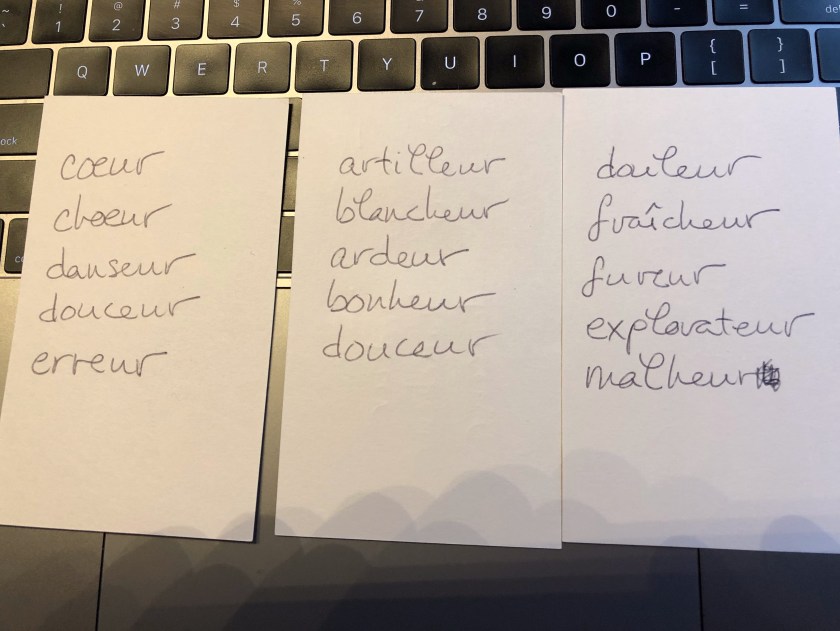
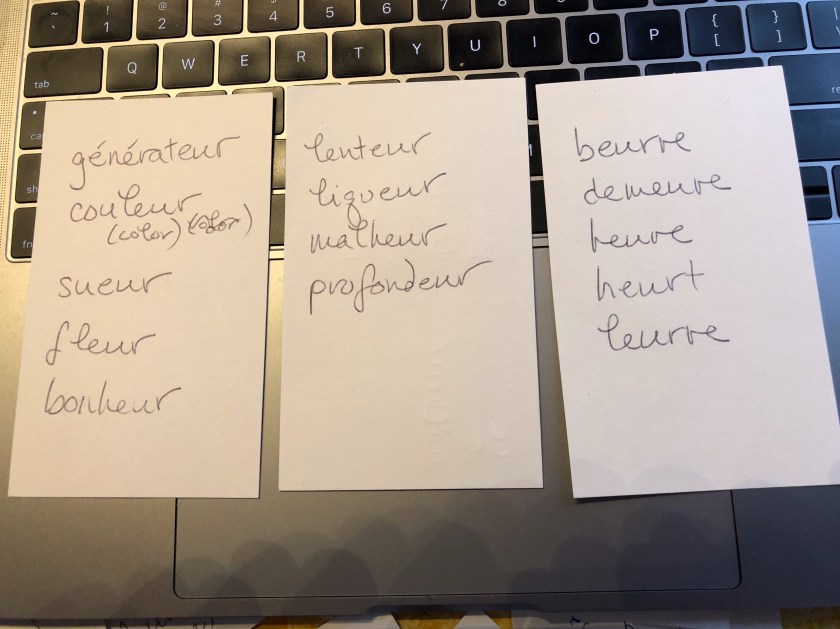
I learn about 10 new words a day, except during the month of December, when I review everything that I learned in the previous year.  My French review chore of the day is to get straightened out on a few similar words.  Zipf’s Law being a fact of life–most words almost never occur, and yet they do occur, I actually ran into all of these in 2017.  They’re mostly words that sound the same, but are written differently–so, homographs, homophones, or homonyms?  I threw in some that just sound and look similar–paisible, passable, and passible–but, all of the rest are homophones.  Enjoy!img_4835img_4834img_4836img_4837

Check your gender at the door

The phenomena are the same whether you’re talking about the two genders of French or the 20 genders of Shona: some things have to agree with nouns.  Does it really matter what we call them?  No, not really.

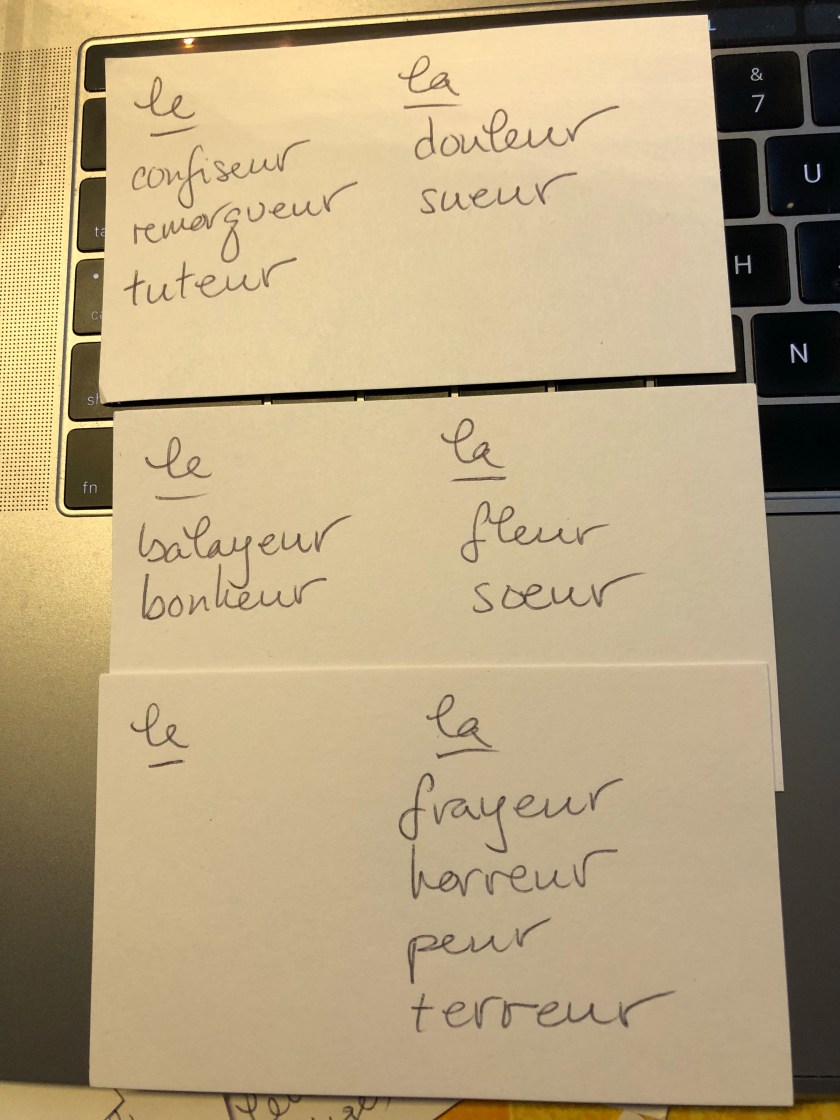
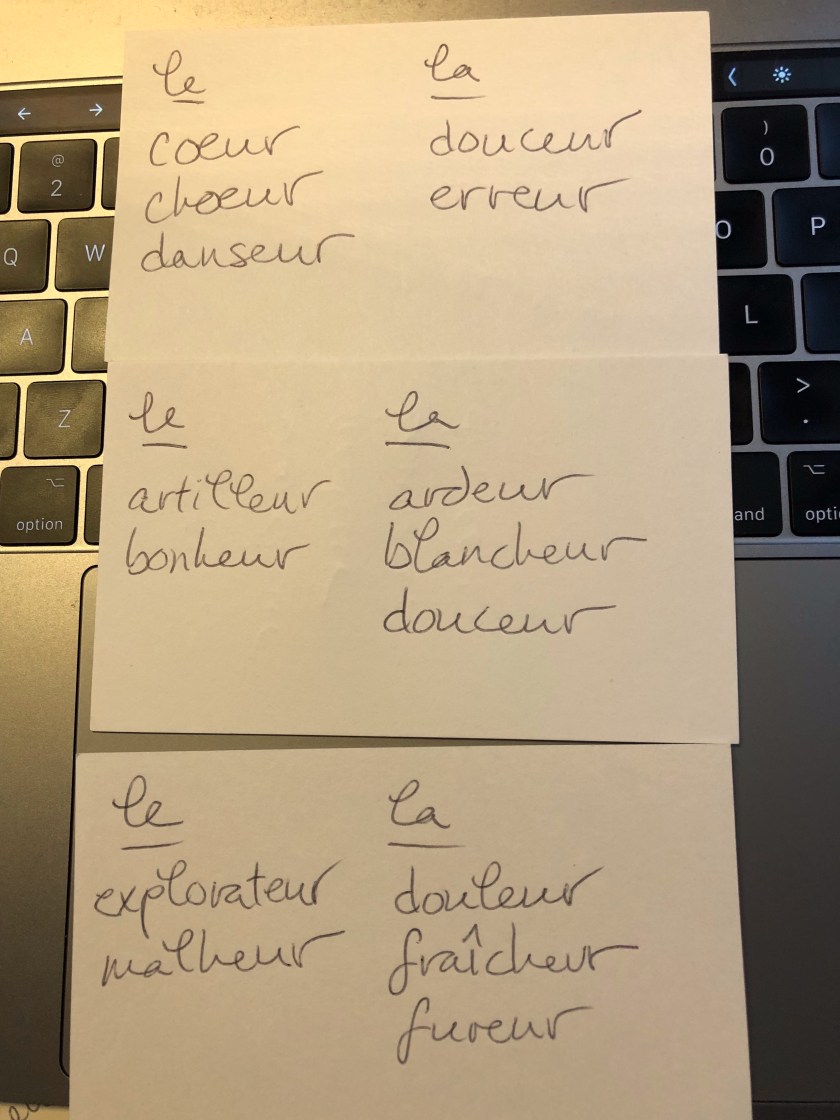
This is the kind of thing that linguists mean when they say that gender in languages with noun gender is arbitrary: malheur is masculine, peur is feminine; why?  No reason–it’s just one of those things that you have to memorize.  When a language has two genders, people will try endlessly to convince you that the specific noun genders in that language are as they should be (of course a tugboat (remorqueur) is masculine and booze (liqueur) is feminine, they might say); when a language has three genders (Bulgarian, German, Tamil) they don’t argue quite so loudly; get above 15 (Swahili: 18, Shona: 20), and you have trouble convincing those same people that they’re gender systems.  And yet: the phenomena are the same whether you’re talking about the two genders of French or the 20 genders of Shona: some things have to agree with nouns.  What classes do those nouns fall into?  Does it really matter what we call them?  No, not really.


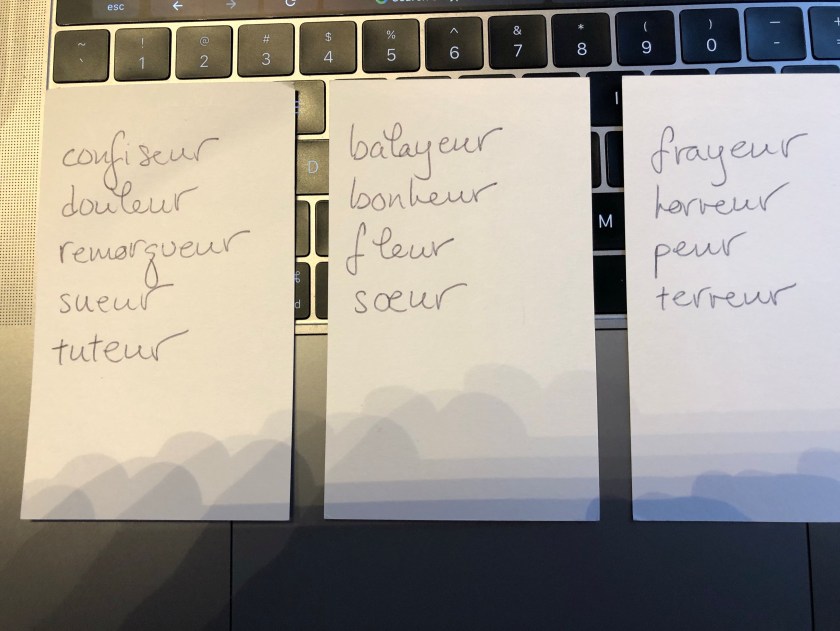
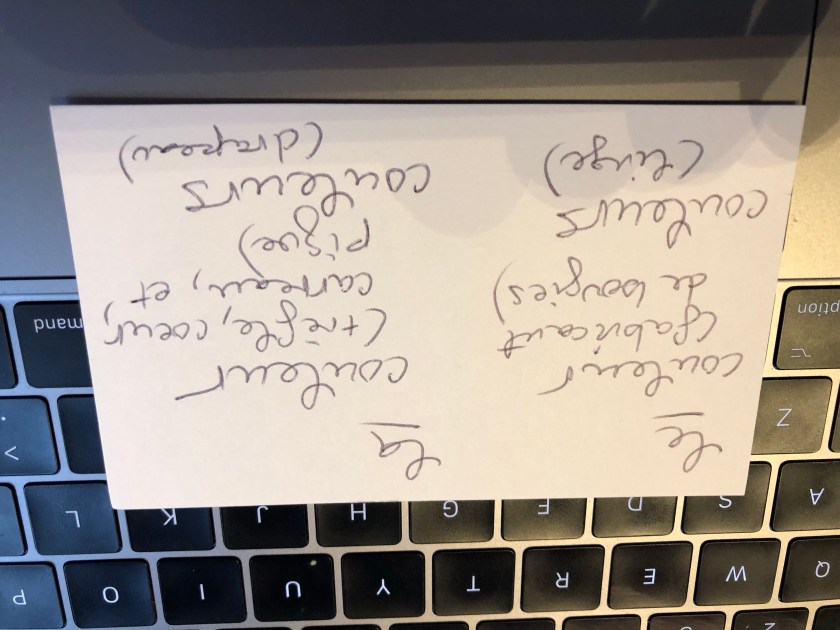
The task of the day: memorize the gender of nouns ending with -eur.  Now, I know what the native speakers are going to tell me: It’s easy, Zipf.  If it’s a person, it’s masculine, and there’s a corresponding feminine form, which might end in -euse (chanteuse) or might not (doctoresse).  If it’s an abstract quality—peur, douleur, fureur-–then it’s feminine, except when it’s not, like bonheur and malheur.  Oh, and remorqueur is a tugboat, not a person, but it’s still masculine, plus fleur and sueur are not abstract qualities, but they’re feminine.  Yep: it’s arbitrary–you just have to memorize it.

I think you can figure out how these drills work.  Oh–native speakers might disagree about some of these, especially the two plurals couleurs, one for the flag and one for the darks in your laundry.  Native speakers, please feel free to chime in in the Comments section…

img_4393img_4395img_4397img_4394img_4396img_4398img_4400


Ukrainian Humanitarian Resistance

Resisting the russist occupation while keeping our humanity

Languages. Motivation. Education. Travelling

"Je suis féru(e) de langues" is about language learning, study tips and travelling. Join my community!

Curative Power of Medical Data

JCDL 2020 Workshop on Biomedical Natural Language Processing

Crimescribe

Criminal Curiosities

BioNLP

Biomedical natural language processing

Mostly Mammoths

but other things that fascinate me, too

Zygoma

Adventures in natural history collections

Our French Oasis

FAMILY LIFE IN A FRENCH COUNTRY VILLAGE

ACL 2017

PC Chairs Blog

EFL Notes

Random commentary on teaching English as a foreign language

Natural Language Processing

Université Paris-Centrale, Spring 2017

Speak Out in Spanish!

living and loving language

- MIKE STEEDEN -

THE DRIVELLINGS OF TWATTERSLEY FROMAGE