Things to do in Paris on a Sunday

The French tend to value their time off more than Americans do.  In general, people are willing to trade the little bit of extra money that they would make by keeping their business open on Sunday for more time with family and friends.  Consequently, the majority of things are closed on Sunday in France.

That doesn’t mean that there’s nothing to do on a Sunday afternoon, though.  Here are some options for you.  They’re slanted towards the kinds of things that I like to do, of course–this is my list!  If you don’t like it, go to Paris and then write your own damn blog (insert smiley-face here).

Café philo: This is one of my favorite Sunday-morning activities.  It seems to be a lot of peoples’ favorite Sunday morning activity–the ones that meet on Sunday morning (I said “ones” because I can’t figure out how to pluralize café philo–native speakers, can you help??) always seem to be quite full, and maybe standing room only.  The original café philo at the Café des Phares on the place de la Bastille meets on Sunday mornings, actually.  Note that this kind of thing is a lot of fun if you have a pretty good handle on French, but probably isn’t any fun at all if you don’t.  (I should mention that I have even more trouble than usual following the discussion at the Café des Phares precisely because there are so many people there that they have to pass around a microphone, and that makes it harder for non-native speakers to understand.)

Church: I recommend this not out of any particular interest in your eternal salvation (I’m Jewish, personally), but because it can be a really nice experience.  The vast majority of those ancient churches that you see in Paris (see this post for how many there are, and why there are so many) are still functioning regularly, and if you think that they’re cool when they’re empty, imagine what they’re like with a choir singing the Mass.  There is no end of possibilities–I’ve heard the nuns at Sacré Coeur, a boy soprano in Notre Dame, and there’s a gospel group at the American Cathedral pretty much all the time, I think (possibly only in the evening).

Franglish language exchange: I highly recommend this, no matter how much or how little French you speak.  Here’s how it works: you sign up ahead of time through their web site.  This lets them balance native speakers of French and native speakers of English.  You show up up, pay 12 euros, and get a free drink.  They will have made a rotation schedule.  For the next couple hours, you spend 15 minutes each with a variety of people.  You speak one language for 7 minutes, then the other language for 7 minutes.  It is fun at worst and hysterical at best, and it really doesn’t matter what your level of skill in the other language is, or what theirs is–people adapt to each other, and you will love this.  People of all ages and backgrounds come–I’ve spoken with college students, electrical engineers, a high school teacher, a guy trying to get a start-up off the ground with his big brother.  The organizers are pretty much always looking for more native speakers of English, but do sign up beforehand.  The location varies, so check the web site, but it’s typically in a bar or cafe.

Boulinier on Saint-Michel: a little used CD and book store.  They have multiple locations.  I only know the one on Saint-Michel, so anything that I say only applies to that one.  It’s open until 9 PM on Sundays, which in a Parisian context would be amazingly late even on a weekday.  The general selection isn’t necessarily super, but they have some beautiful multi-volume sets for very good prices, and occasionally you’ll get lucky and run into something wonderful, like an old Grevisse at a price that a normal human being could actually afford.  Since it’s open so late, I tend to save this for my last stop on a Sunday.

Shakespeare and Company: This English-language bookstore is open until 11 PM on Sundays–a true rarity.  37 rue de la Bûcherie, almost right across from Notre Dame.

Markets: Some neighborhoods have their weekly or twice-weekly market day on Sundays.  You can find a great one on blvd. Grenelle under the métro tracks between La Motte Picquet-Grenelle and Dupleix (you pronounce the x at the end).  Search Google if you want to find one closer to wherever you happen to be.  Check out the aligot sellers–a highlight of my week.
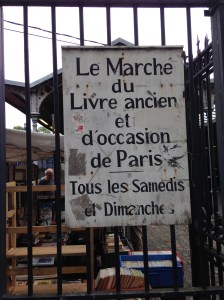
2014-06-07 11.25.12Marché du livre ancien et d’occasion: tons and tons of people selling antique and used books.  I’ve occasionally found really cool stuff there, and occasionally found more or less nothing.  You can also find paper ephemera–posters, theater bills, stuff like that.  There’s a highly-rated little cafe right across the street.

Marché aux timbres: A stamp collector’s market.  I’ve never been to this one, but if you’re geeky enough to be reading my blog, this might be right up your alley.

Other markets: there’s a list of various and sundry other markets here, but it’s dated 2015, so verify: http://www.marjorierwilliams.com/best-paris-markets-open-sunday/

Lots of theater matinées mid-afternoon: most Sunday plays and concerts are mid-afternoon.  There are various and sundry web sites that will sell you cheap tickets.  If your French is not up to sitting through an entire play in the language of Molière, go see How to become Parisian in one hour–it’s entirely in English, and very popular.

Movies: The cinema is very popular in France, and that includes movies in English.  If you want to see them in English, look for VO (“version originale”) on the schedule.  There are movie theaters all over the place; I especially like the ones in St. Germaine (6th arrondissement) because it’s so easy to find a place to have a dessert before or after.

Panthéon: this is the kind of place that French tourists will go to, but foreigners don’t typically visit.  It’s basically the National Mall in Washington, DC, but all under one roof.  I recommend it especially on a Sunday afternoon because you can walk from the Panthéon through the Luxembourg Gardens to St. Germaine for a movie (see above), and that’s pretty much an entire Sunday afternoon.

Walk like crazy: Weather permitting, this is one of my favorite Sunday-afternoon activities.  You can find entire books full of planned walks in Paris, and if you want to plan something in detail, I would look for one of those.  Personally, I tend to just pick a metro stop to ride to, and then walk for 3-4 hours (with a break to sit in a café with a dessert and a book, of course).   On Sunday, one area where I know that lots of little restaurants are open is the Canal St. Martin.

Eiffel Tower/Tour Montparnasse: Sunday is pretty good timing for an Eiffel Tower visit, just because it’s open then, when so many things aren’t.  I’m not saying that it’s a good time to go up the Eiffel Tower–it probably isn’t.  Then again, no time is good for going up the Eiffel Tower–come see it, then go up the Tour Montparnasse.

So, you could imagine a full Sunday like this:

  1. Go to the market and pick up your groceries.  Drop them off at home, then…
  2. Go to a café philo.  Have a bite to eat afterwards with some of the attendees, and then…
  3. Visit the Panthéon.  From there…
  4. Walk through the Luxembourg Gardens to Saint Germaine.  There you will…
  5. Catch a movie. Then…
  6. Walk to Boulinier and pick up a book to read.
  7. Head to a café to read your book over a beverage of some sort.

…and that, my friends, is why I am counting the days until I can get back to Paris!

Where to buy non-touristy souvenirs in Paris

Want to buy non-touristy souvenirs in Paris? Here are some places to check out. You can find stuff at a range of prices, a range of tastes, and a range of weights (important when you’re packing to head home).

Nalola, 51 rue Mouffetard, 75005

img_4832Nalola on the rue Mouffetard is one of my favorite places to pick up gifts for folks back in the US.  The rue Mouffetard is one of the most touristy places in Paris.  However, Nalola is not.  They sell a ton of stuff that wouldn’t be obviously touristy at all and that is aimed more at French customers than at tourists.  This includes stuff like:

  • Coffee cups saying things like Chieuse 24/7/365 (pain in the ass 24/7/365), Pousse pas mémé dans les orties (don’t piss off mama), Les hommes sont comme les grenouilles, ils ne veulent que sauter (men are like frogs–they just want to “jump” [sauter is slang for having sex with someone])
  • “3ème oeil” kitchen towels (famous picture of a cat’s butt)

Les Parisettes, 95 ave. Emile Zola, 75015

img_4823Les Parisettes mostly sells Eiffel-Tower-related stuff, but not the usual crappy little metal Eiffel Tower replicas and the like.  Lots of historical stuff–period photos, stuff like that; some unusual guide books, mostly in French, but some with English translations; all in all, this stuff is more clearly touristy than the stuff that you’ll find at Nalola (see above) in that it’s almost entirely explicitly related to things in Parisian (versus the Nalola stuff, which is culturally French but not in a souvenir-y way at all), but it’s a big cut above the usual crap that you find in souvenir stores.  There are a couple of locations, and I’ve only been to the one on Emile Zola, but I can vouch for it.  (If anyone goes to the other one, let me know what you think…)

Shakespeare and Company, 37 rue de la Bûcherie, 75005

Shakespeare and Company is the best-known English-language bookstore in Paris.  It has an interesting history and a great location–right across from the parvis of Notre Dame.  What you want to do here is to buy a good book (as you can imagine, there’s a great selection of books about France and French history, for example) and then get it stamped when you buy it.  This means that they put a “Shakespeare and Company” stamp on the title page.  Few people will see it, but those who do will know that this is a super-cool Parisian souvenir.  (They have other “personalization” options–one of them is spritzing your book with perfume.)  Note that this place is super-popular, and if you come on a weekend during tourist season, you can expect to wait in line to get in.

Breizh Café, 111 rue Vieille du Temple, 75003

Caramel au beurre salé (salted butter caramel) is an excellent food souvenir.  You can get them lots of places, at qualities ranging from average to really spectacular.  The Breizh Café is a restaurant with a little store attached, and that little store is where I go to pick up good-quality caramel au beurre salé.  Breizh means Brittany, and Brittany is where caramel au beurre salé originated.  The restaurant is quite good, by the way, but it showed up in a popular tourist guide a while ago, and now you generally have to wait in line to get in.  Another good option here would be a tin of crêpes dentelles, a sort of thin cookie that comes in a cool box (at Breizh Café, at any rate) with pictures of Breton girls in traditional dress on it.  I mentioned really spectacular caramel au beurre salé: see David Lebovitz‘s web site for his current recommendations.

Use an emoji, go to jail: semantics versus semiotics

If you send someone a pistol emoji, does that mean that you’re threatening them? It depends: what is “meaning,” and how can an emoji have it?

I was sitting in on a class on lexical semantics a couple years ago.  Lexical semantics is the study of the meanings of words.  What that means: think about the difference in meaning between The fairy godmother waved her baguette and The fairy godmother’s baguette waved her.  On some level, we can describe the difference in the meanings of those two sentences as coming from the facts that (a) an English sentence with a subject, a verb, and an object has the meaning that the subject did something to the object, and (b) the two sentences have different subjects and objects.  That’s not about lexical semantics, or the meanings of words–we could call that sentential semantics, perhaps.

In contrast with that, consider these sentences:

  1. Bobo swept the floor.
  2. Bobo swept.
  3. Bobo broke the glass.
  4. The glass broke.

In the case of sentence (2), Bobo did the sweeping.  In the case of sentence (4), though, the glass got broken.  To put it another way: in (2), the subject of the sentence carried out the action of the verb, while in (4), the subject of the sentence underwent the action of the verb.  This difference in meaning doesn’t have anything to do with the structures of the sentences, as was the case with the fairy godmother and her baguette–this is about the difference in meaning between sweep and break.  (For example: break involves a change in the state of something.  Sweep, in contrast, doesn’t.)  That’s lexical semantics–the study of the meaning of words.

So, back to that class: one of the folks in it started complaining about how deficient both of these approaches to thinking about semantics are.  Sure, we can formalize the meanings of words in a way that captures the differences in meaning between sweep and break.  We can formalize the meanings of sentences in a way that captures the differences in meaning between the two fairy godmother/baguette sentences.  But, what about the rest of the meaning?  How does the meaning of sweeping change, depending on whether Bobo is a property owner, or a member of the proletariat?   What does it mean that the fairy godmother is a godmother, and not a fairy godfather?  Indignation was widely shared.

Actually, this is a misunderstanding of what semantics is, versus semiotics.  Semantics is (in my version of the world) about how language means things.  Semiotics is about how meaning gets meant, in general.  If I say to you Bobo swept the floor, that’s got one kind of meaning.  If I give you a single red rose on our third date, that means something, too.  How does Bobo swept the floor mean what it means?  I can talk about that–we just did.  How does that single red rose on our third date mean what it means?  I don’t have a clue.  The meaning of the sentence: that’s semantics.  The meaning of the single red rose: that’s semiotics.  One way to think about why to study linguistics: suppose that you’re interested in the question of meaning.  You could think of language as the system of meanings that is the easiest to study.  So, if you’re into semiotics in general, then semantics might be a way to get a handle on what seems like a very large problem.  On that picture of the universe, semantics is a subset of semiotics.  (I don’t mean to imply that I think that we totally understand how meaning works in language, either–I don’t.  Indeed, we’ve had a number of posts on this blog about controversies and problems with representing the meanings of words.)

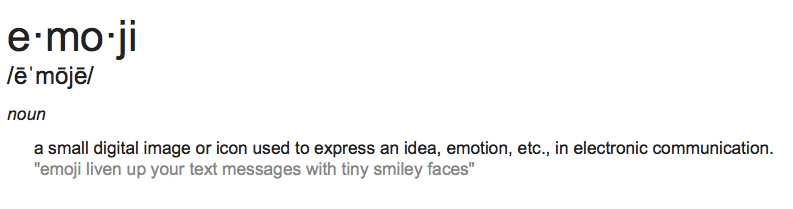
All of this came to mind recently when I came across a couple news stories on the use of emojis to convict people for various and sundry crimes.  (See below for a discussion of the differences/similarities between the English constructions a couple and a couple of.)  For those of you who have been in a digital wasteland for the past few years, here is a definition of emoji from Google:

Screenshot 2016-07-06 02.59.34
Picture source: screen shot of Google’s definition of “emoji.”

It is amazingly easy to find examples of the appearance of emoji in criminal cases.  I Googled this:

Screenshot 2016-07-06 03.04.55

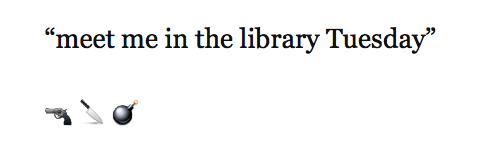
…and got tons of results.  A 12-year-old girl in Virginia is facing charges of threatening a classmate for sending her this message on Instagram:

Screenshot 2016-07-06 03.05.53
Picture source: https://www.washingtonpost.com/news/local/wp/2016/02/27/a-12-year-old-girl-is-facing-criminal-charges-for-using-emoji-shes-not-alone/

Last year, a 17-year-old male was arrested and charged with making terroristic threats for posting these emojis of a police officer and some guns on Facebook (a grand jury later declined to indict him):

aristypost

Picture source: http://www.cnet.com/uk/news/teen-arrested-after-alleged-facebook-emoji-threats/

David Fuentes and Matthew Cowan of South Carolina were arrested and charged with stalking after they sent these emoji to someone whom they’d beaten up the month before:

ambulance emoji-2-e1457457813222
Picture source: http://crimefeed.com/2016/03/3-times-emojis-landed-people-behind-bars/

Smiley-faces show up repeatedly in court cases, both criminal and civil.  Anthony Elonis’s case went all the way to the U.S. Supreme Court.  A quote from an article by Karen Henry and Jason Henry on the Law360 web site:

The defendant in Elonis v. United States had argued that his conviction for posting threatening communications on Facebook should be reversed in part because the presence of emoticons in some of the posts made them “subject to misunderstandings” and not as threatening as they would otherwise have been. For example, one of the defendant’s posts said that his son should dress up as “matricide” on Halloween, perhaps by wearing a costume of her “head on a stick.” He followed that post with an emoticon of a face with its tongue sticking out. He argued that the emoticon signaled that he was joking…

In a civil lawsuit, Universal Music Corp. tried to argue that the person who was suing them hadn’t really been injured by them, presenting as evidence the claim that an emoji that she had used in an email in which she corresponded with a friend about the case showed that she didn’t really feel that she’d actually been injured (same source):

…the evidentiary value of emoticon/emoji evidence was examined fairly recently in Lenz v. Universal Music Corp. (widely referred to as “the Dancing Baby” case). In that case, plaintiff Stephanie Lenz moved for summary judgment on six affirmative defenses asserted by Universal in response to Lenz’s copyright claim. Of particular relevance, Universal argued Lenz alleged in bad faith that she had been “substantially and irreparably injured” by its takedown notice. To support this argument, Universal proffered an email exchange between Lenz and her friend. In that exchange, the friend writes, “love how you have been injured ‘substantially and irreparably’ ;-).” Lenz, in turn, responds, “I have ;-).”

Universal contended that Lenz’s use of the “winky” emoticon signified that she was “just kidding.” Lenz countered that her use of the “winky” emoticon replied to the “winky” in her friend’s email, which basically was teasing Lenz about using lawyerese in her complaint — i.e., “substantially and irreparably injured.” The court sided with Lenz, finding Universal’s proffered evidence insufficient to prove Lenz acted in bad faith and granting summary judgment in Lenz’s favor on that affirmative defense.

There are multiple legal issues involved in these emoji cases, some of them just really basic procedural stuff.  If you’re reading an email out loud in a court case, do you have to read any accompanying emojis out loud?  If so: how?  Back to the Elonis case in the Supreme Court–I’m going to add in a clause that I omitted in the earlier quote (same source again):

… one of the defendant’s posts said that his son should dress up as “matricide” on Halloween, perhaps by wearing a costume of her “head on a stick.” He followed that post with an emoticon of a face with its tongue sticking out. He argued that the emoticon signaled that he was joking, but his wife interpreted the tongue sticking out in that context as an insult.

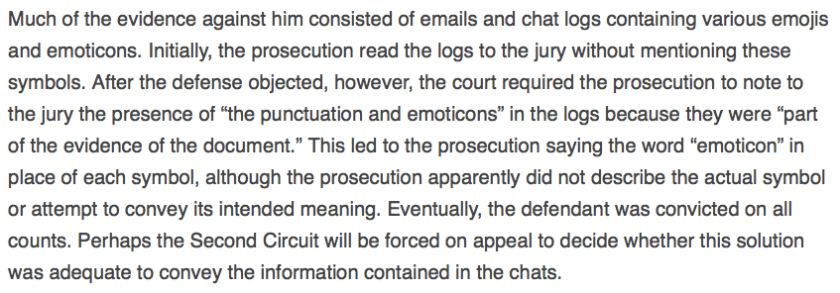
This issue–read them out loud, or not, and if so, how–came up in a case that you may have read about–the “Silk Road” case against Ross Ulbricht for running a huge “dark Web” site for selling illegal stuff:

Screenshot 2016-07-06 03.32.40
Picture source: screen shot of http://www.law360.com/articles/727700/exhibit-a-winky-face-emoticon-evidence-enters-courts

I write about this here and now in part because there have recently been a couple of similar cases in France (see here for Bilal Azougagh’s case), and I suspect that the French courts will do a much better job of hashing out the theoretical issues behind this than the US courts have so far.  In reading about this issue in the US, I’ve come across “useful” observations like the claim that unlike words, emoji don’t have clear and unambiguous meanings–total linguistic bullshittery, as words don’t have clear and unambiguous meanings in any human language that I’m aware of.  These are difficult and (to me) interesting questions/problems, and I look forward to seeing the French legal system do a much better job of getting at the underlying philosophical issues than the American courts have so far, that being something that the French have much more of a propensity for (and much better educational preparation for) than Americans do.


French notes (scroll waaaay down for the English notes)

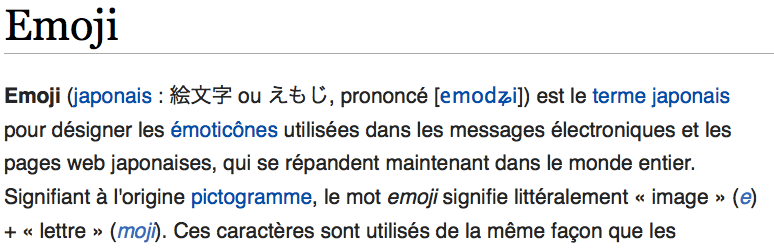
For some random Zipf’s-Law-induced vocabulary items, let’s look at the French Wikipedia page on emoji:

Screenshot 2016-07-06 03.46.33
Picture source: screen shot of https://fr.wikipedia.org/wiki/Emoji

Vocabulary item: I’ve been trying to get straight on the many uses of the verb répandre, and here it is!  (See above about words not having clear and unambiguous meanings.)  Two of the many potential meanings of se répandre that are possibly relevant here (from WordReference.com):

  • se répandre (s’etendre) (sur?): to spread.
  • se répandre (envahir, se disséminer) (dans?): to spread out, to invade.

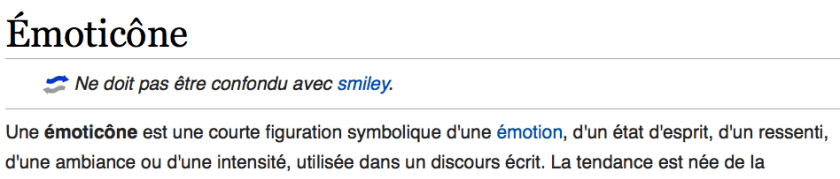
I’d also like to know the genders of emoji and émoticône.  Let’s see what evidence we can find:

Screenshot 2016-07-06 03.54.43
Picture source: screen shot of https://fr.wikipedia.org/wiki/Emoji

Certains rather than certaines suggests that emoji is a masculine noun.  Emoticône is easier to figure out:

Screenshot 2016-07-06 03.56.53
Picture source: screen shot of https://fr.wikipedia.org/wiki/%C3%89motic%C3%B4ne

Une, so: feminine noun.

Back to the lexical semantics lecture: I followed my classmate’s rant with my own, along the lines of the semantics/semiotics split that I talk about above.  The professor gave me an odd look when I suggested that it would mean something if I gave her a single red rose, but otherwise, there were no repercussions that I know of.  Watch this space for further developments.


English notes

I used the expression a couple a couple times in this blog post.  See these links for some discussions of the use of a couple versus a couple of:

It’s complicated–there are situations where either one is fine, and situations where only one of the two is fine.  Here is a little data.

A couple is mandatory:

  • I have a couple (fine)
  • I have a couple of (not OK at all)

A couple of is mandatory:

  • I have a couple them (not OK at all)
  • I have a couple of them (fine)

Either is fine (although I prefer a couple, personally):

  • I have a couple apples (fine)
  • I have a couple of apples (fine)

A couple of is mandatory:

  • I have a couple them (not OK at all)
  • I have a couple of them (fine)

How we’re sounding stupid today: I readed it in college

In which I try to talk about literature, and end up sounding even stupider than usual.

readed xqQV7
Picture source: http://english.stackexchange.com/questions/145638/why-do-we-say-and-write-read-instead-of-readed-for-the-past

Like I always say: it’s the little things that get you.  I was chatting with a friend the other day.  Stendahl’s The red and the black, one of the more famous French novels of the early 19th century, came up.  They know about “The red and the black” in the United States?, asked my friend?  (If it’s in italics, it happened in French.)  Oh, yes, I said–I readed it in college. 

I read it in college, my friend corrected me.  Readed–that’s cute!  But, it’s read. Fuck–it’s always those little things…  I got my only C on a literature paper–ever–for a paper on The red and the black, and consequently have never forgotten it.  So, I can talk about unfulfilled homosexuality in Stendahl’s masterpiece, but I can’t say the past tense of the verb to read in French without sounding like a 2-year-old.  ‘tain!

My problem here was the past participle.  This is a form of the French verb that is used in some past tenses, in passives, and occasionally as an adjective.  I need to take a French proficiency exam this fall and don’t want to make this kind of basic mistake, so let’s review.

You almost certainly know h0w to form the past participle of -er class verbs.  These make up about 80% of French verbs, so you hear that past participle a lot.  I’m not aware of any irregular -er verb past participles.  This includes -er verbs that have changes to the stem in some tenses.  For example:

donner donné
appeler appelé
récupérer récupéré
jeter jeté

Now: regular -ir class verbs.  Although the -er verbs are the most common in French, the Lawless French web site points out that there are several hundred regular -ir verbs.  The regular -ir verbs have an i at the end of their past participle.  Let’s look at a few, just to drill this into my head:

to act agir agi
to warn avertir averti
to build bâtir bâti
to choose choisir choisi
to obey obéir obéi

Now, lots of the fun of speaking French comes from its irregularities, and we do have some -ir verbs with irregular past participles.  The Lawless French web site has a helpful page on irregular -ir verbs.  We’ll work our way through it, starting with -ir verbs that have past participles that end with -ert:

to cover couvrir couvert
to open ouvrir ouvert
to offer offrir offert
to suffer souffrir souffert

Notice a pattern there?  It’s our old friends: verbs with a labiodental fricative followed by r. (Native speakers: anyone have an example of a verb with fr or vr in the root that belongs to the -ir class and doesn’t have a past participle with -ert?)

to hold tenir tenu
to come venir venu
to become devenir devenu
to support soutenir soutenu
to refrain, to abstain from s’abstenir abstenu (native speakers, is this right?)
to reach, to achieve parvenir parvenu
to suit, to be suitable convenir convenu

The generalization? All of those verbs end not just with -ir, but with -enir.  Here’s another fun little pattern with the past participles of -ir verbs:

to acquire acquérir acquis
to conquer conquérir conquis
to inquire about s’enquérir de enquis
to recapture, to recover reconquérir reconquis
to requérir requis

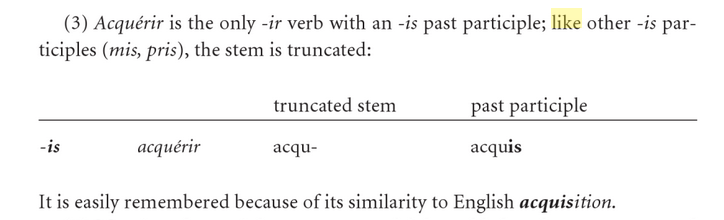
I came across this little gem of advice related to this class of irregular -ir past participles in David Brodsky’s book French verbs made simple(r):

Screenshot 2016-07-03 13.17.27
Picture source: screen shot of “French verbs made simple(r),” by David Brodsky.

Easily remembered, my ass…

Now, I know what you’re thinking: I’ve given you all of these irregular past participles, but still haven’t gotten anywhere near the past participle of the verb “to read.”  To which I respond: you’re right.  However, my head is at near-explosion-point with irregular past participles already, so for now let’s just accept that I sound even stupider when speaking French than when speaking English, and let it go until another day.  Oh–number of gun deaths in the United States in the past 72 hours: 104.  Here are the most recent:

  • David Urban, South Londonderry Township, Pennsylvania (click here for news story–his wife did it)
  • Killeen, Texas.  Murder-suicide at a Dollar Store–names not released yet.  (click here for news story)
  • Pittsburgh, Pennsylvania.  54-year-old male, name not released yet.  Drove himself to the ER with a bullet in his chest, hitting a few walls while trying to pull into the parking lot.  Died in the ER.  (click here for news story)
  • Monroe, Louisiana.  Two people shot in the Civic Center parking lot.  Names not released yet.  (click here for news story)
  • Harvey, Illinois.  49-year-old woman, name not released yet.  (click here for news story)
Ukrainian Humanitarian Resistance

Resisting the russist occupation while keeping our humanity

Languages. Motivation. Education. Travelling

"Je suis féru(e) de langues" is about language learning, study tips and travelling. Join my community!

Curative Power of Medical Data

JCDL 2020 Workshop on Biomedical Natural Language Processing

Crimescribe

Criminal Curiosities

BioNLP

Biomedical natural language processing

Mostly Mammoths

but other things that fascinate me, too

Zygoma

Adventures in natural history collections

Our French Oasis

FAMILY LIFE IN A FRENCH COUNTRY VILLAGE

ACL 2017

PC Chairs Blog

Abby Mullen

A site about history and life

EFL Notes

Random commentary on teaching English as a foreign language

Natural Language Processing

Université Paris-Centrale, Spring 2017

Speak Out in Spanish!

living and loving language

- MIKE STEEDEN -

THE DRIVELLINGS OF TWATTERSLEY FROMAGE