In which the messiness of my office leads to a discussion of cataphora and the pro-verb-phrase.
I know it’s not cool to do so, but I still read on paper. I like to take a few articles and sit on the couch outside my office with a cup of coffee and a highlighter. When I finish an article, I usually write up some notes about it, and then I stick the paper and my notes in a binder. I like paper in my hands even more when it comes to books. I appreciate the fact that my Kindle lets me get on the plane to France without having to carry a suitcase full of books, but my books are my connection to the entire experience of my life; I hate to part with them, and I love the way that they make my home feel like…a home.
My advisor in grad school told us that we had to make a decision early in our careers, and stick with it. Would we:
…file papers that we’d read by author’s last name, or…
…file papers that we’d read by topic?
Filing papers by topic didn’t work for me. The problem was that the same paper could be relevant to (a) acoustics, (b) Quantal Theory (the explanation of QT on Wikipedia sucks, but here it is if you want it), and (c) articulator velocity in stress contrasts. So, 15 years ago or so, I switched to by-author’s-last-name. The pictures below show the result: I have so many binders full of articles that it interferes with my ability to store my books.
Maybe it’s time to try by-topic again? A scary thought, but I can tell you this: the only reason that I haven’t thrown these boxes out despite the fact that I haven’t opened a single one of them in the five or so years since I moved into this office is that I know for a fact that one of them holds a stack of every paper I’ve ever read about metamorphic testing. I know that I would not want to have to remember who wrote every single paper I’ve ever read about metamorphic testing–it’s reassuring to know that when I need those papers again, I’ll find them, neatly stacked, in one of those boxes.
I hate ending blog posts with a question, but: how about you? What’s your strategy for hanging on to the stuff that you’ve read? Or, do you not even bother with paper anymore? Please tell me that it’s not the case that you no longer bother reading… English notes below–too many to leave room for French notes. Typical Anglo-Saxon…
English notes
Do so: you know what a pronoun is: it’s a word that takes the place of a noun. We use them in very particular circumstances–typically, when the noun has been mentioned before, and there is some assumption that both the speaker and the hearer know which thing is being talked about.
Do so and its relatives, which include do it, do that, and just plain do, can be thought of as pro-verb-phrases. That means that they’re taking the place of a verb and its related words (I’ll show you what I mean in a minute) that has typically been mentioned before, such that both the speaker and the hearer know which verb phrase is being talked about.
So:
He asked me to leave, and I did. (did replaces leave, sorta.)
He asked me to leave the money, and I did. (did replaces leave the money, sorta. Like how I switched intransitive leave (me to leave) and transitive leave (leave the money)?
He asked me to leave the money for the rent that we had forgotten to pay the month before because we were out of town on the table, and I did. (did replaces leave the money for the rent that we had forgotten to pay the month before because we were out of town on the table, sorta.)
Now, there’s another way that you could say all three of those sentences, and it would mean pretty close to the same thing, although the register is somewhat different, perhaps. In this form, the do becomes do so:
He asked me to leave, and I did so.
He asked me to leave the money, and I did so.
He asked me to leave the money for the rent that we had forgotten to pay the month before because we were out of town on the table, and I did so.
It’s worth pointing out that although I’ve given you examples only in the past tense, you can use either of these–that is, did or did so as a pro-verb-phrase–in any tense, as far as I know
Whenever I tell him not to be an asshole, he asks me to leave. I always do so, I always have done so, and I will always continue to do so.
If you want to read more about this construction as it is used after a verb phrase, there’s a nice page about that here, on the English Grammar web site. I’m going to talk about how it was used in this post: before the verb phrase. I know it’s not cool to do so, but I still read on paper.
We think about pronouns as I described them above: referring to something that has been referred to more specifically previously. But, we can use them before the thing that we’re going to refer to, as well. Here are some examples:
I know you don’t know him, but my brother will be here tomorrow, and he’d really like to meet you.
I hate them, those fucking bastards.
The phenomenon is called cataphora. From the point of view of how we usually think of discourse as working, it’s a bit bizarre, but you probably run across it most days of your life on which you do any reading, at least in English.
Pro-verb-phrases can be cataphoric, as well, and that’s how I used do so in this post:
I know it’s not cool to do so, but I still read on paper.
You can think of do so as a “preplacement,” versus a “replacement,” of read on paper. I hope that helps, and if you have thoughts to share with me on the subject of how to file papers that you’d like to give me, please do so.
I’m bald…et je suis gentil–I’m putting it nicely. The full version: I’m bald, fat, and old.
Nevertheless, every Tuesday morning I stop at Giorgio’s hair salon and take my seat in the chair. (I’m pretty sure that Giorgio is actually Georges, as his French is both Parisian and quite hip. A demen, he says to his employees as they head out the door at the end of the day–à demen.) The reason for my weekly visit: my hairdresser Nadine is helping me with my bise.
Kevin, she sneered, if you’re going to do la bise, you have to really do it. Apparently my air-kisses were too air and not enough kiss.
La bise is the French cheek-kiss that makes us Americans so incredibly uncomfortable. (Turnabout is fair play, and the American habit of hugging makes the French incredibly uncomfortable, so don’t feel like you’re at a cultural disadvantage here no matter which side of the Atlantic you’re from.) I ran into a French colleague at a conference a couple months ago. She was chatting with a bunch of French friends, so it made sense to faire la bise when we caught sight of each other. I did my best. Kevin, she sneered, if you’re going to do la bise, you have to really do it. Apparently my air-kisses were too air and not enough kiss. (This odd use of to sneer is explained in the English notes at the end of the post.)
Nadine has been happy to step in and help. After a few weeks, she was happy with my performance. “Ah, the French kiss,” she said after our exchange, clearly pleased with her didactic skills–in English. Now, Nadine doesn’t actually speak English, so I switched to French: Nadine, “French kiss” means something different in English. Oh, really? What? I explained. (See this post for how to say French kiss in French.) Oh–NO. Firm head-shake–there was no tongue in my future.
For me, the hardest part of la bise is remembering not to hug the person at the same time. That’s a big mistake–see this post for a story about just how awkward things can get if you forgot not to make that very American gesture. My current tactic: when I lean in for the kiss, I put my hands together behind my back. I imagine that it must look odd, but it’s better than the embarrassment of hugging when I oughtn’t. All in all, mind you, I find it a charming custom. Apparently not all foreigners do, though–here’s a clip from French Fried TV in which Paul Taylor complains in loud British English about all the bother. Subtitles in French. And, yes: the CombienDeBises.com web site is for real.
English notes below the video.
English notes
to sneer (something): to say while sneering. I believe that verbs like this, which are normally intransitive (that is, they don’t have an object) but can also be used for conveying what someone else said without a change in the tense of the original utterance, are called quotatives. (Compare “I screwed up that bise,” he said…where the person and tense of I screwed up doesn’t change, with He said that he screwed up that bise, where the person changes from I to he.English has an enormous number of verbs that don’t seem to have anything to do with speaking, but that can nonetheless be used in exactly this way. The wonderful children’s book The Phantom Tollbooth is packed with examples. How it was used in the post: Kevin,she sneered, if you’re going to do la bise, you have to really do it. Apparently my air-kisses were too air and not enough kiss.
‘My Boticelli nymph,’ he smiled, slipping it behind her ear.
Ahem!’ he coughed. I’ll take more careful aim.
‘It’s all so unbelievable,’ he choked.
The quotatives that everyone likes to complain about are to be like and to be all. I think they’re mostly American, but couldn’t swear to that. They’re characteristic of younger people. She was like, “I’m not kissing him!” He was all “well, I have baseball practice tonight.” You don’t have to use these, but you should recognize them when you hear them.
Talking about the ideal and the desired in French and in English: ways to say “should,” with some comics.
Why Paul Ryan should vote for Hillary Clinton. —headline, The Fiscal Times
Speaker Paul Ryan should disavow Donald Trump. —headline, Milwaukee Journal-Sentinel
Paul Ryan says Donald Trump should release tax returns —headline, Wall Street Journal
Should I have a cookie? Picture source: http://www.thatsnerdalicious.com/funny/the-eternal-question-should-you-have-a-cookie/It’s amazing (and more than a little depressing) to me that such enormous holes persist in my French, even after 2 3/4 years of studying really, really hard! I just realized that I don’t know how to express the difference between must and should. Obligation–must–that, I can express. It’s the verb devoir in the present tense. Ideal actions, desired actions–that’s a bit more complicated, both in French and in English. (See the English notes at the bottom for the English issues.)
See here for more information about parallel corpora like OPUS 2.
To express the idea of should, we still use devoir, but we need its conditional tenses. For the English present tense, e.g. I should, we use the French present conditional of devoir. You can read about how to do so here on the Lawless French web site; I’ll give you some examples from the Sketch Engine web site. I used Sketch Engine to search the OPUS2 corpus, a collection of billions of words of text in 40 different languages, drawn from sources as diverse as movie subtitles and the proceedings of the European Parliament, and lined up with each other wherever possible. We’re talking 1.1 billion words of English, 600,000 words of Afrikaans, 46 million words of Albanian, 300 million words of Arabic, etc. French? Almost 766 million.
Don’ t you think that before shooting a spy, we should makehim talk?
Vous ne pensez pas qu’avant d’abattre un espion, on devrait le faireparler?
Now that we have finished the script, we should save it to disk.
Maintenant que nous avons fini le script, nous devrions l’enregistrer sur le disque.
Well, then, I think we should go out on a Sunday night.
On devrait sortir le dimanche soir alors.
What we should do is have dinner sometime.
On devrait dîner ensemble un soir.
Should I have a cookie? Picture source: http://www.thatsnerdalicious.com/funny/the-eternal-question-should-you-have-a-cookie/To talk about something that you should have done in the past, you need the past conditional of devoir. Here‘s the Lawless French page with an example–there’s a more detailed lesson hidden somewhere on the Lawless French Kwiziq site, but I have no clue how to tell you how to find it. Again, I’ll give you some examples from the OPUS 2 corpus, retrieved via the Sketch Engine web site:
I knew we should have stayed on this case.
Je savais qu’on aurait dû rester sur cette affaire.
Maybe we should have bought some rice in town.
On aurait peut-être dû acheter du riz en ville.
According to all you told us, and to all calculations … we should have located the mine two days ago.
D’après ce que vous nous avez dit et nos calculs, nous aurions dû trouver la mine il y a deux jours.
Wonder if we should have told the exec about that package … … Mike used to keep under his sack.
Je me demande si on aurait dû parler du paquet … – que Mike gardait sous sa couchette.
As a result, we have not been able to make as much progress as we should have.
En conséquence, nous n’avons pas pu réaliser tous les progrès que nous aurions dû accomplir.
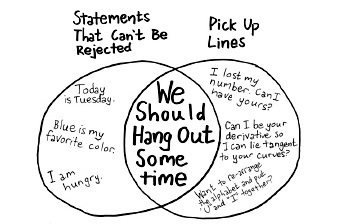
https://thebarcelonabookclub.wordpress.com/tag/we-should-hangout-sometime/It’s hard to believe that the 2020 Republican primaries won’t see Paul Ryan pitted against Tom Cruz. Cruz will still be as scary then as he is now, I imagine–personally, I find him even more frightening than Trump, and I find Trump pretty damn frightening. Paul Ryan will continue to bear the burden of his failure (so far) to denounce Trumpism, which probably won’t hurt him much in the Republican primaries, but I hope will keep him from winning the general election.
English notes
If you’re French: I probably don’t have to tell you that should in English is at least as bizarre as it is in French. There’s a good web page on it here, from the Cambridge Dictionary. Note that the page describes the British uses of the word, which are different from the American ones in some respects. For example, the conditional form should you, as in should you want some coffee…, is not used in America–we would say if you want some coffee… The UK also has a formal/neutral alternation between should and would that we don’t have in the US. For example, the Brits have neutral I would love to come and formal I should love to come, but in the US, only I would love to come will work. Finally, oughtn’t instead of shouldn’t is more formal in British English, but it’s dialectal and possibly stigmatized in the US.
Linguists are sometimes accused of spending their time navel-gazing over sentences that are not realistic. The truth is that you don’t have to look any further than your daily life for real linguistic puzzles.
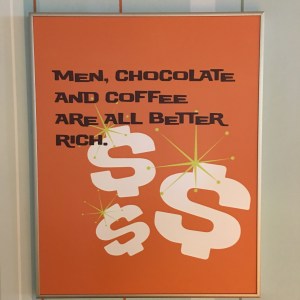
Sign on the wall of a Village Inn. Picture source: me.
Linguists and philosophers are sometimes accused of spending their time navel-gazing over sentences that are not realistic. However, the truth is that you don’t have to look any further than your daily life for real puzzles, and sometimes for real challenges to linguistic theory.
Right at this moment, I’m sitting in a Village Inn. If you’re French: that’s a restaurant chain that’s known for being somewhat déclassé (déclassé and other obscure English expressions explained below in the English and French notes), and for having great pancakes. I’m somewhat déclassé, and it’s Saturday morning, so I’m sitting here treating myself to pancakes. (Village Inn is not so redneck as to not have wifi.) On the wall opposite me is the poster that you see at the beginning of this post. It says:
Men, chocolate and coffee are all better rich.
Now: that is a joke. It plays on multiple meanings of the word rich. Something like this:
rich man: A man with a lot of money.
rich chocolate:Containing a largeamount of choiceingredients,such as butter,sugar, or eggs,andthereforeunusuallyheavy or sweet:a richdessert
(from thefreedictionary.com).
A reasonable native speaker could disagree with me over whether or not rich has different meanings in rich chocolate and rich coffee, but the essential fact about the example remains: rich has more than one sense in this sentence.
Who cares? It’s like this. One of the fundamental assumptions in the vast majority of approaches to understanding semantics (in the sense of the meaning of language) is something called compositionality. Compositionality is the process of meaning being produced by something that you could think of as similar to addition (technically, it’s a more general “function,” but “addition” will work for our positions–linguists, no hate mail, please): the idea is that the meaning of Khani stole the butter is the adding together of the meanings of Khani, steal, butter, and the meaning of being in the subject position versus the object position of an active, transitive sentence.
That’s compositionality. Another bit of background that we need: the mapping problem. The mapping problem is the question of how the semantics of a sentence–its meaning–is related to the syntax of the sentence–the structure of the phrases of which the sentence is made up. There are all sorts of problems here. To give you one example: take a situation where my dog stole some butter. The semantics are: there’s a dog, it’s my dog, there’s some butter, and the butter was taken, by the dog, without permission. (You can’t believe how horrible the poo that I had to pick up over the course of the next 24 hours was.) The syntax, though: there are multiple possibilities. My dog stole the butter. The butter was stolen by my dogs. The meaning is the same–how do you account for multiple syntactic structures being usable for communicating that meaning? I’m giving you a very simple example of a very complex and nuanced topic–again, no hate mail from linguists, please.
So: we have the mapping problem. Your answer to it is probably going to involve compositionality. Imagine this sentence:
Men are better rich, kind, and patient.
How do we map the semantics to the syntax via composition? Let’s see:
Take the significance of the subject position and the adjective relative to that verb in a declarative sentence…
…add the meaning of to be, and
…add the meaning of men…
…add the meaning of rich…
…add the meaning of kind…
…and add the meaning of patient.
No probs–sentence structure meaning + word meanings = the meaning of the assertion. Now let’s go back to the sign on the wall:
Men, chocolate and coffee are all better rich.
How do we map the semantics to the syntax via composition? Let’s see:
Take the meaning of to be and the significance of the subject position and the adjective relative to that verb in a declarative sentence…
…add the meanings of men, chocolate, and coffee…
…and add the meaning of rich.
Ooooh–what the hell?? We have the one word rich, but we have three meanings. We’ve been mapping one word to one meaning–how the hell can we get three meanings out of one word? This works as a joke, versus just a simple statement, precisely–and only–because you can have that single word rich contributing three different meanings to the “utterance,” as we linguists say (énoncé in French). Myself, though: I can’t for the life of me see how to reconcile it with linguistic theory. That’s not a problem–it’s a good thing. Personally, I am pretty happy with the notion that science gets pushed forward by finding problems with theories, not by showing how they work. Something fun to think about while I listen to the hum of Berber, Spanish, and some very stigmatized dialects of English around me as I eat my redneck, Saturday-morning pancakes…
Native speakers of French: I’d love a similar example in the language of Molière–do you have one for me?
Postscript: the sentence that is the topic of this post contains the word and. The word and is (believe it or not) actually one of the toughest problems in computational linguistics, and I have glossed over it in this discussion deliberately, despite the fact that it is crucial to the nature of the problem. Another time, perhaps. English and French notes below.
Englishnotes:
déclassé: having inferior social status. It can also have a similar meaning to the French meaning–“fallen or lowered in class, rank, or social position,” per Merriam-Webster–but, I don’t believe I’ve ever heard it used in that sense. How it appears in the post: That’s a restaurant chain that’s known for being somewhat déclassé, and for having great pancakes.
redneck: from Merriam-Webster: a white person who lives in a small town or in the country especially in the southern U.S., who typically has a working-class job, and who is seen by others as being uneducated and having opinions and attitudes that are offensive. It can also be an adjective, which is how I used it in the post. How it appears in the post: Village Inn is not so redneck as to not have wifi.Note: this can be a very offensive term if you are not yourself a redneck, and if you are not a native speaker, I recommend that you never use it.
French notes:
déclassé: downgraded, relegated, demoted.
le déclassé: dropout (societally, not from school)
gaulois: redneck, among other things. See above for the definition of redneck; I don’t actually know whether or not the French word is offensive.
Trigger warning: lots of grammar, occasional obscenities, and photo of deceased Cavia porcellus.
I should’ve expected trouble from the moment that the stewardess on the Lima-to-Houston flight recognized me. ¿No venimos de hacer este viaje anoche? “Didn’t we just do this trip last night?” I smiled a “yes” at her. She switched to English: Couldn’t wait to see me again, huh? I’m sure I blushed.
The English word before belongs to a couple of parts of speech. Rarely, it can be a preposition indicating location:
Sufficiently stoned but not unreasonably so, westand before the bathroom mirror, marvelling at the crisp clean surfaces of ourselves and one another.
How can youstand before her and offer her the nothing, the nothing, that you are?
When the last trump sounds and Istand before the Lord our God and am judged I will be found wanting and know not what to do.
(All examples from the British National Corpus, a collection of 100 million words of British English that is commonly used in linguistic research, courtesy of the Sketch Engine web site.)
More commonly, before is adverbial, indicating a point in a temporal (time) sequence:
It should be hard enough to secure the tesserae, but it must not harden before the local pattern has been completed.
Admittedly, there is a larger number of fourth century pavements (differential preservation may be an important factor here):before the 1960’s, but for those from Wheeler’s excavation at Verulamium, few pre-fourth century pavements were datable at all.
That means that the court has to consider the position immediatelybefore an emergency protection order, if there was one, or an interim care order, if that was the initiation of protection, or, as in this case, when the child went into voluntary care.
In constructions with the perfect tenses, it has a special meaning. The perfect tenses in English are the ones with have used in what’s called a modal sense, followed by a past participle:
I have never been able to understand why anyone would want to wake up at the dead of night (5 a.m.) to go and paddle a canoe, but I am assured that the challenge is worth it.
I don’t suppose you’ve ever heard it sung in Latin, I certainly haven’t.
She has written various articles on medieval theatre.
I saw everything had beentidied up.
He was president of the Carnegie Endowment for International Peace when Whittaker Chambers, a renegade and self-confessed Communist ‘spy’ then on the staff of Time magazine, accused him of havingpassed him documents from the State Department during the late 1930s.
When you combine before with a perfect tense, it has a very specific interpretation: it refers to something that has happened at an earlier point in time, and is happening again now, or is about to happen, or will certainly happen at some point in the future:
But, as I‘ve said before, you do have such interesting friends.
Here the speaker is both asserting right now that you have such interesting friends, and asserting that they have said that on some previous occasion.
You‘ve heard beforethat Leeds works within the rules of the framework set down by regional planning guidance…
The speaker is asserting right now that Leeds works within some framework or other, and also asserting that such has been asserted on some previous occasion.
I’ve neverbeen to Venice before, I can prove it, nor have I met your father.
The speaker is in Venice now, but is asserting that they have not been to Venice on a previous occasion.
What you should take away from these examples: in English, the perfect tense plus before refers to something that is happening now, or is about to happen. So, when a U.S. Customs and Border Protection officer said to me yesterday morning at 7 AM after a long night spent in an unusually uncomfortable aircraft: Have you ever been arrested before? …I thought: This morning is not going to go quite as I had planned.
A friend who was scheduled to give a keynote speech at a conference on Big Data in Cuzco, Peru had taken ill, and I was asked to fill in for her at the last minute. I had a commitment right before the conference and a commitment right after it, so giving the talk required that I land in Cuzco at 5 AM, give my talk at 2 PM, and then get on a flight back to the U.S. at 7 PM–a passage éclair, “lighting visit,” as we say in French.
The most salient fact about Peru is this: it’s wonderful. A beautiful place that has a lovely Southern Hemisphere ambience without the constant in-your-face grinding poverty of, say, Guatemala. The people that I met were delightful, and the grilled meats that I had for all three of my meals in-country were probably the best I’ve ever had in my life (and I say that as someone who knows a few good restaurants in Paris). It’s also one of the world’s biggest producers of cocaine.
Cocaine entered the European context when an Italian doctor ran across it in South America. As Wikipedia tells it:
In 1859, an Italian doctor, Paolo Mantegazza, returned from Peru, where he had witnessed first-hand the use of coca by the local indigenous peoples. He proceeded to experiment on himself and upon his return to Milan he wrote a paper in which he described the effects. In this paper he declared coca and cocaine (at the time they were assumed to be the same) as being useful medicinally, in the treatment of “a furred tongue in the morning, flatulence, and whitening of the teeth.”
As he put it in his work Sulle Virtù Igieniche e Medicinali della Coca e sugli Alimenti Nervosi in Generale (“On the hygienic and medicinal properties of coca and on nervous nourishment in general”, translation and quote from Wikipedia):
“… I sneered at the poor mortals condemned to live in this valley of tears while I, carried on the wings of two leaves of coca, went flying through the spaces of 77,438 words, each more splendid than the one before…An hour later, I was sufficiently calm to write these words in a steady hand: God is unjust because he made man incapable of sustaining the effect of coca all life long. I would rather have a life span of ten years with coca than one of 10 000 000 000 000 000 000 000 centuries without coca.”
I don’t actually know how many countries I’ve been to. Between 9 ½ years in the military and a subsequent career that involves a lot of international collaborations, it’s got to be somewhere north of twenty (north of and other obscure American English expressions explained below, as usual). I cross many national borders, and I have never had any problems, either in foreign countries, or when returning to the United States. (I was really worried the time that I passed through French customs with a little bottle of American-made kosher wine in my luggage—I was going to be in Germany for Passover—but, they didn’t catch my nervousness, and I made it into the country without being searched.) Normally, when I return to the United States, I stick my passport into a Global Entry machine, it spits out a piece of paper with my photograph and various bits of information on it, I show that piece of paper to an Immigration officer, he waves me on, and I go about my business. This time, the paper was different: it had a big, black X on it. I showed it to the immigration officer. He asked for my passport, stuck it in an electric reader, and pushed buttons on his computer. Then more buttons, more buttons, and more buttons. Finally: how long have you been out of the country? “Less than 24 hours,” I said.
He pointed me towards an area off to the side of the Customs area that I’d never been to before. (Note the perfect tense had (never) been to and before—that means that I’m going there now.)
I took my suitcase and stood waiting while several Customs agents let me stand there and think for a while. Finally, a couple of them waved me over. Put your suitcase, backpack, and jacket on this table. I did. Then one of them asked me two questions: Is there anything you’d like to tell me before I open this? No. Have you ever been arrested before?
Uh-oh. As it turns out: no, I have never been arrested. (This might come as a surprise to those of you who know just how many tattoos I have, but: no, I haven’t.) Then they started going through my stuff, and when I say “going through,” I mean: searching, and searching very thoroughly. Throughout this, two Customs agents asked me the same questions, over and over, in a variety of ways: Why did you go to Peru? How long were you in Peru? How much cash are you carrying?
The answers didn’t change: For work. Under 24 hours. Under $100. Occasionally they threw in something different: do you have any narcotics? I carry a couple pills containing butalbital for migraines. Your employer paid for your plane ticket? Yes. (Actually, the organizers of the conference at which I gave a keynote paid for it, but my employer actually purchased the ticket—it didn’t seem like a good idea to introduce that level of complication into the conversation, though.) Their question about why I have so many pills in my luggage was easily dealt with—I’m old, I have shit wrong with me, although I didn’t put it in quite those terms—just said that I have prescriptions for everything, which is true. What really raised their eyebrows surprised me—the copy of New French feminismsin my backpack (edited by Elaine Marks and Isabelle de Courivron—it’s quite good), and the laminated photocopy of my passport that I carry in my suitcase in case of emergency.
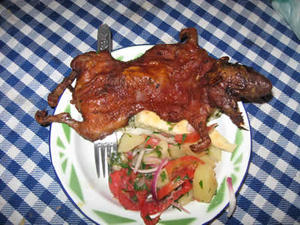
It’s a good thing that I had a decently long layover, because this went on for quite a while. They pulled back the lining on the bottom of my suitcase. The nature of the bags of salted dried corn (corn is a Peruvian specialty, raised in many species and prepared in many ways) that I had purchased as gifts for friends back home were questioned. Inquiries were made as to my profession, what exactly informatics is, and in which countries my relatives reside. (For me, the most nervous-making part of an American border crossing is when the Immigration officer asks me to explain what I do for living—that used to happen a lot before I got my Global Entry card, and it’s hard enough for me to explain my profession in one sentence even when I haven’t just spent six to twelve hours sleeping only very fitfully during an airborne traversal of a very large ocean.) Finally they harrumphed, told me to take my stuff, and I was off to my next flight. Many years ago, I read a novel about a customs inspector, and marveled at/was skeptical about how easy it was for him to spot the lady with a fortune in undeclared currency sewn into the lining of her overcoat, or the man with a king’s ransom of diamonds encased in a salami. I didn’t bother asking why they had flagged me for a thorough search, though—it’s easy enough to guess that some algorithm noted my frequent international travel and my under-24-hours visit to a cocaine-producing country. No big mystery there–that’s what happens when you spend less than 24 hours in Peru, I guess. So: if you ever have the opportunity to visit that beautiful country, plan to stay a while—I plan to visit again, and next time, I’m going to eat some guinea pig.
Thanks to Sketch Engine, purveyor of fine linguistic search tools and corpora, for the examples. Check out their web site to see what sorts of things you can learn by exploring huge collections of naturally occurring language. No, they didn’t pay me to mention them–the opposite. I pay them a few hundred dollars a year for access to their fine offerings.
North of/south of: these expressions mean more than and less than, respectively. See the picture for a good example. How it showed up in the post: Between 9 ½ years in the military and a subsequent career that involves a lot of international collaborations, it’s got to be somewhere north of twenty [countries].
To catch: lots of idiomatic meanings. I used it in the post in this sense, taken from The Free Dictionary: To become cognizant or aware of suddenly: caught her gazing out the window. How it showed up in the post: …they didn’t catch my nervousness, and I made it into the country without being searched.
I’ve always been more into depth than breadth. It’s more like me to explore every restaurant on a single street than to try to cover the top ten eateries of a city; to try everything on the menu of one restaurant, going back week after week, than to go from restaurant to restaurant; to spend years with one woman, rather than flitting from flower to flower, as the girls say in the Philippines. (This hasn’t stopped me from being married three times, or perhaps that’s why I’ve been married three times.)
Want to know more about denominal verbs? See this blog post, and Carolyn Gottfurcht’s fascinating doctoral dissertation on the subject of the kinds of relationships that can exist between the original noun and the derived verb.
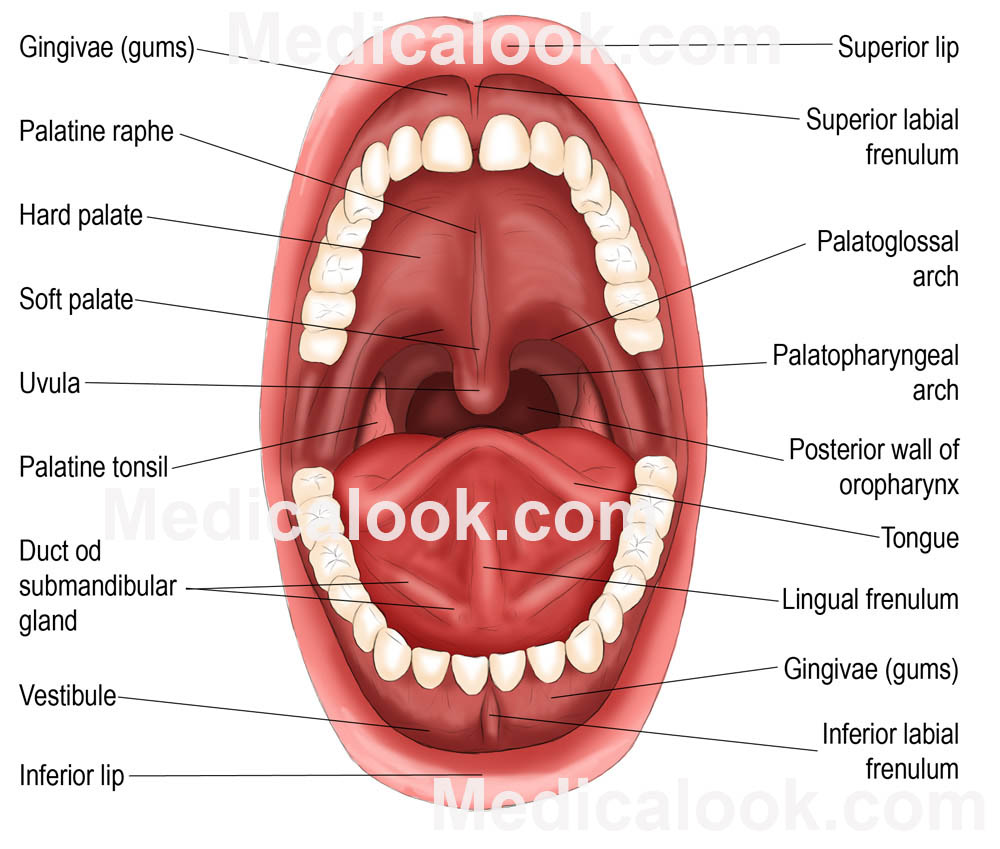
So, when learning vocabulary, I like to pick one subject, and dive deep. Lately I’ve been struck by my crappy command of words for common things–in particular, parts of the face. In the way that things always seem to spin out of control, or to become more complicated, or to just be connected to everything else, that soon branches out into questions of pronunciation, questions of how words are put together, and who knows where else I’ll end up–which is to say, what I’ll be distracted by–but, let’s be polite–by the time I finish writing this. For today, let’s talk about English verbs that come from parts of the face. We recently talked about the phenomenon of denominal verbs–that is, verbs that are made from what were originally nouns. English has a bunch of these verbs that are related to body parts. We’ll focus today on denominal verbs that come from parts of the mouth. They tend to be related to three ideas: producing language, chewing, and making contact with a physical object. As we go along, we’ll see others, too.
to lip: to speak in a disrespectful way to someone, perhaps especially if answering something said to you by an authority figure. You can’t lip just anyone–it has to be someone to whom you’re supposed to show respect.
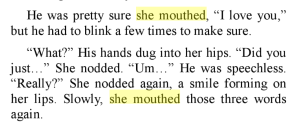
to mouth (first definition): From Google: say (something dull or unoriginal), especially in a pompous or affected way. From The Free Dictionary: To utterwithoutconviction or understanding; To declare in a pompousmanner;declaim.
Example of “to mouth” in the sense of saying something without making any sound. Picture source: screen shot of https://goo.gl/61Y0V5
to mouth (second definition): to say or sing without making a sound. From The Free Dictionary: To form soundlessly.
Example of “to mouth” in the sense of saying something that you don’t really mean. Picture source: screen shot of https://goo.gl/BIF7Kp
to mouth off to someone: to speak disrespectfully to someone. Again, this needs to be someone in a position of authority, someone to whom you owe respect.
Native speakers of French: are there French verbs that come from the nouns referring to parts of the mouth, whether they denote acts of speaking, or anything else? I’d love to hear about them.
When we talk about hand surgery being all about function: it’s about the function of the hand, sure. But: it’s also about the function of the person.
I’m in Guatemala at the moment. I come here once a year with a group called Surgicorps. We’re volunteer surgeons, anesthesiologists, nurses, technicians, therapists, and interpreters (that’s me) who provide surgical services to people who are so poor that for them, even the almost-free Guatemalan health care system is too expensive. There are a lot of groups like us, actually–you can find them all over the world. What makes Surgicorps special is the set of surgical specialties that we bring with us. One of those is hand surgery. Hand surgery is a very specialized occupation—in the course of learning his trade, our hand surgeon did fellowships in both plastic surgery and orthopedics. A fellowship is about five years, and that’s on top of four years of college, four years of medical school, and a three-year residency—so, these guys are hard to come by.
Every medical and surgical specialty has its central concept, its central concern. In hand surgery, that’s function. When our hand surgeon told me about this, he was talking about the function of the hand–the goal is to take something that isn’t working, and make it able to do things again. Hand surgery is about function in a larger sense, too, though. The thing is: in a country like Guatemala, most people work either in agriculture or in manufacturing, and opportunities for education are few. (In 2010, 31% of the female population was illiterate.) In that kind of economy, for most people it’s the case that either you work with your hands, or you don’t feed your children. Functioning here means doing manual labor, which for men is likely to be farming and for women is likely to include weaving and doing housework. You’ve got a hand that doesn’t function? Then you don’t function.
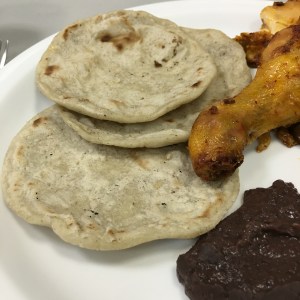
Guatemalan handmade tortillas from the hospital cafeteria. Picture source: me.
For women here, part of functioning is making tortillas. Guatemalans might not get much in the way of nutrition, but getting enough calories per se is usually not a problem: when there’s no drought, corn is plentiful and cheap. If a Guatemalan is poor enough, he might be living on tortillas and salt–but, he’s living, not dying. Not from hunger, at any rate. (The top five causes of death in Guatemala: respiratory/pulmonary diseases (influenza and pneumonia), violence, coronary artery disease, diabetes, and stroke.)
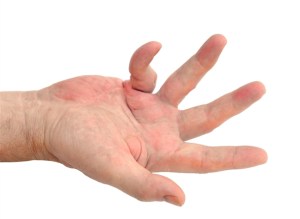
A contracture. I’m showing you one called a Dupuytren’s contracture because after a week of looking at poorly healed burns, skin grafts gone bad, and the like, I just can’t take any more. Call me a wimp, but it’s difficult. Picture source: https://www.thebmc.co.uk/dupuytrens-contracture-research-survey
You make tortillas with your hands. They’re actually made somewhat differently here in Guatemala, as compared to elsewhere: not so much with the palms, as patted out with the fingers. So, when women show up on screening day with a contracture in one of their hands from a burn, or a cut, or whatever horrid thing has happened to them and won’t let them open their hand all the way, and our hand surgeon asks them what the matter is, they say: No puedo tortillar–I can’t make tortillas–while making a characteristic slapping-your-fingers-together-while-turning-your-hands-over motion.
Here’s a short video that shows you how a Guatemalan woman makes tortillas. Like 70% of the country, she’s Mayan. There are a bunch of things to notice in the clip:
When the video starts, the language that you’re hearing is one of the 20-22 different Mayan languages spoken in Guatemala. (There are some more spoken in Mexico.)
The women are wearing the traditional clothing of their village. Mayan women most definitely do still wear the traditional clothing, every single day. Choosing not to wear it makes a huge statement about your personal identity and affiliation, and the waiting rooms of the hospital where we do our thing are jammed with people in this kind of clothing. I’ll point out that every village has its pattern of dress, apron, and huipil (the shirt that the ladies are wearing), and leave it at that.
The lady is cooking over an open fire. Super-common here, and I haven’t yet been here without a few people showing up on screening day to show us their burn-scar-contracted hands.
The American speaking crappy Spanish. One of the main industries of the town that we’re in is intensive Spanish lessons.
The lady’s hands are wide open, and fingers are flat–with a contraction like the one that you see above, she couldn’t do it.
At about 1:05, the verb tortillar.
Tortillar is an interesting little verb (at least if you’re the kind of person who gets excited about verbs). As far as I can tell, it doesn’t exist anywhere else. Here’s where I looked:
WordReference.com, which has an amazingly complete on-line dictionary. No luck.
The Bantam New College Spanish and English Dictionary, which is by no means huge, but has excellent coverage of Central American Spanish. (If you’re an American, and therefore don’t know where Guatemala is: it’s in Central America.) Also no luck.
Google, through which I found a number of blog posts written by people who ran across the word while travelling this part of the world, but no evidence that the word exists anywhere else.
What the verb tortillar means: to make tortillas. It’s a nice example of a verb that comes from a noun–what’s called in linguistics a denominal verb. We have lots of these in English–“bare” or “zero-derived” ones like to tango, to cash, to water; ones made with prefixes, like to defrost and to encage; and ones made with suffixes, like to victimize, to vaccinate, and to classify. (Language geeks: yes, I am leaving out back-formation. No hate mail, please.)
One of the interesting things about the process of making nouns of out verbs is that there is some systematicity to it–there are particular types of relationships that tend to exist between the original noun and the derived verb. You might remember a post in which we talked about the particular kinds of relationships that exist between the nouns in compound nouns, like kitchen knife (knife that is used in a kitchen), bread knife (knife that is used to cut butter), and pocket knife (knife that is carried in a pocket). In that post we talked about how the set of relationships between those nouns is limited, and about how trying to explain that set of relationships is a good example of the issue of falsifiability in scientific theories–if you can posit any old relationship on the basis of any particular compound noun that you happen to run across, then you have a theory that cannot, even in theory, ever be shown to be wrong (“falsified”). That’s a theory that can’t actually be tested, and a theory that can’t be tested is a crappy theory.
How about verbs? Carolyn Gottfurcht wrote a fascinating doctoral dissertation on the subject of denominal verbs and the kinds of relationships that can exist between the original noun and the derived verb. (All of the English verb examples in this post are from her dissertation.) She looked at 8,900 English verbs and found that in that language, one of the most common relationships is what is called the resultative.
The resultative relationship is especially relevant to us today, because that’s what the Guatemalan verb tortillar is based on. The resultative relationship holds between a noun and a verb that is derived from that noun when doing the verb brings the noun into being. For example:
to granulate: to cause something to exist as granules
to enslave: to cause someone to be a slave
to mummify: to cause someone to be a mummy
to summarize: to cause a summary to exist
to cripple: to cause someone to be a cripple
This is the kind of verb that tortillar is: to tortillar is to cause tortillas to exist.
Here’s the thing about causing tortillas to exist: if you’re a functioning Mayan woman, that’s one of the things that you do. That’s not the only thing that you do–but, if you can’t do it, you can’t take care of your family. So, when we talk about hand surgery being all about function: it’s about the function of the hand, sure. But: it’s also about the function of the person.
Like the rest of us Surgicorps volunteers, our hand surgeon donates his services, buys his own plane ticket, pays for his food and lodging, and contributes a week of hard-earned vacation. The costs of the surgeries themselves–instruments, medications, dressing materials, anesthetic agents, pain medications, etc.–are covered by Surgicorps. Surgicorps lives or dies on the basis of donations from nice folks like you. Want to make a donation? Click here. $250 will pay for all of the costs of surgery for one patient. $100 will pay for four surgical packs. $25 will pay for a nice lunch for you–or one surgical pack for us. $10 will pay for all of the Tylenol that we’ll send our patients home with all week–and, yes, we send our patients home with nothing stronger than Tylenol, in the vast majority of cases–or, it’ll buy you a latte and a scone. I have nothing against lattes and scones–I’m a big fan of both–but, when you think about it from that perspective, how can you not click on this link and make a donation?
No French stuff today–back to the language of Molière on Monday. Now, donate some money! I’ll stop hitting you up for donations next week.
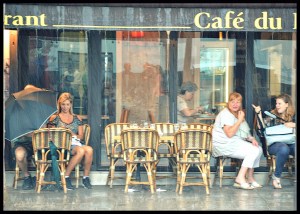
I was waiting in line at the boulangerie the other day. Outside, a nicely dressed woman sat and sipped a coffee while the rain poured down.
Suddenly the rain stopped. The lady popped in the door, put her empty coffee cup and some money on the counter, and said: I’m going to leave before it starts raining again. She dashed across the street, and I went home happy. Why?
In the United States, I can tell quite a bit about you as soon as you open your mouth. It’s not that I’m an expert in American speech–I’m not. But, I can give a pretty good guess about the following, and I would guess that most Americans can, too:
Your probable ethnic self-identity
What kind of music you’re likely to listen to
Possibly part of the country that you’re from
Whether or not you went to college
Whether you’re more likely to vote for Hillary, or for Trump
In contrast: in France, hearing you speak gives me no insight into you whatsoever. The director of the research institute where I hang out when I’m in France, the kid working the counter in the cafe outside the train station, a drunk panhandling by the ATM across the street from my apartment–their French all sounds the same to me. Marine Le Pen, my radical colleague–if there’s a difference in their French, I can’t hear it. In English, though…well, let me just say that if you have a high front tense rounded vowel in the word who’d, I’ll bet you’re voting for Trump (and that you would spell that sentence I’ll bet your voting for Trump).
Even I could tell that the woman who had her coffee spoke French quite elegantly, though. Here’s how she said “before it starts raining again:” avant qu’il ne repleuve. What’s so special about that: the tiny little ne.
The first thing that you have to know about that tiny little ne is that it’s not a negation marker. What it does: it makes your speech sound more elegant, more formal. That’s the explanation that I’ve gotten from every native speaker that’s brought it up with me, at any rate. It’s called the ne explétif, or (in English) expletive ne.
One of the cool things about the ne explétif is that as far as I can tell, it’s always used with the subjunctive. Now, one of the cool things about that is that although we are taught in school to think of the subjunctive as being triggered by verbs, in a number of cases we see the ne explétif + subjonctif being triggered by other parts of speech (none of which I can actually describe very well, PhD in linguistics or no PhD in linguistics!). One set of them connects clauses (more or less, sentences):
Les médias boudent le Front National … à moins que ce ne soit l’inverse? “The media give the cold shoulder to the National Front–unless it’s the other way around?” (see the news story here)
A moins que Maurice Szafran ne bascule dans un Antihollandisme aigu… “Unless Maurice Szafran swings toward an intense anti-Hollandeism…” (see the comment here)
When #JasonBourne aka Matt Damon asks you to take a selfie…Unless it’s the other way around -ok I admit it!
You can find more of these on the Lawless French web site.
Another cool thing about this ne is that although the subjunctive will always be there when you use it, you don’t use it every time that you use the subjunctive–rather, it’s used only in very specific constructions. You can’t make your speech more refined and elegant by just sprinkling it with ne‘s willy-nilly. If you use it when you’re not supposed to, that just shows that you’re trying to be one of the refined, elegant people—but, you’re not. And that’s where I get into trouble–I’m sure that I tend to use the expletive ne when I shouldn’t. There’s a name for the phenomenon of trying to speak more elegantly, but screwing it up exactly by trying to be more formal. It’s called hypercorrection. Here’s the definition from Wikipedia:
In linguistics or usage, hypercorrection is a non-standard usage that results from the over-application of a perceived rule of grammar or a usage prescription. A speaker or writer who produces a hypercorrection generally believes that the form is correct through misunderstanding of these rules, often combined with a desire to appear formal or educated.[1][2]
The example that we were always given in linguist school was the pronunciation of the t in often. If you’re not a native speaker, let me point out that that t is silent. But, you’ll sometimes hear native speakers who are making an extra effort to try to speak “correctly” pronounce it.
The “perceived rule” that they’re applying: typically, if there’s an ft sequence in the pronunciation of a word, then the word is spelt with an ft sequence.
after
laughter
crafty
lift
raft
Sometimes, though, you come across words that don’t have a t in their pronunciation, but they’re written with one, like in these consonant clusters:
listen
Christmas
mortgage
wrestle
For more words with silent ts, see this list. Often is a word in which the t is silent, and it’s rarely pronounced with the t. Take someone who’s insecure about how they sound, though, and put them in a formal situation, and that t in often might show up in their pronunciation. Someone who’s not insecure about how they sound in formal situations? Probably not. Someone who’s insecure about how they sound in formal situations, but is not actually in a formal situation at the moment? Also probably not–no t in often. It’s just the mix of insecurity and a specific context that brings it out. (This is laid out very nicely in the French Wikipedia page on hypercorrection.)
So, why do I not call out Wikipedia for calling this “non-standard” and using the word “incorrect” to refer to the pronunciation of often with a t, when as a linguist, “correct” and “incorrect” are not meaningful concepts to me?It’s the pattern of variation. The reasoning might be circular, but I will ‘fess up to that and explain it to you.
The speaker typically doesn’t use the t-pronunciation all the time: there is variability.
The speaker typically doesn’t use the t-pronunciation when speaking informally.
The speaker typically uses the t-pronunciation only when speaking formally.
Other speakers don’t use the t-pronunciation. Notice that I’m not saying that higher-class speakers don’t use it, or that lower-class speakers don’t use it, or that educated people don’t use it: I’m asserting that other speakers don’t typically use it at all, regardless of the formality of the situation.
Do native speakers of French make hypercorrective uses of the ne expletif? Of the subjunctive? I would predict that they do, but I haven’t been able to find any data on this. Native speakers, can you tell us anything about this?
Why that tiny little incident made me happy: I like it when I can see some of the huge complexity that is any language–French or otherwise–being reflected in the small things of life. That lady just wanted to take off in a hurry before it started raining again. She had probably already forgotten about that tiny little moment in her life before she ever got home–setting her coffee cup and some money on the counter, with a hurried explanation as she dashed out the door. For me, though, it was a little point of contact with some of the larger mysteries of French that are waiting for me; a sign of some progress (I hope) in that I was able to recognize sophisticated speech when I heard it; a source of questions about how to describe the structures that can trigger the use of the expletive ne, and you know how much I enjoy that kind of shit; hours of thought, really, and a bit of positive feedback on my language-learning adventure.
French details: See this page on the Lawless French web site for more fun things that can happen with ne in French–I had no clue!
English details: here are some moderately obscure words and expressions from this post.
to panhandle: this is a verb that means to beg, typically by sticking out your hand or a receptacle of some sort. If someone were sitting on the sidewalk with a cup, you would probably be more likely to call that begging. If someone were walking down the street asking strangers for money, you would probably call that panhandling.
willy-nilly: haphazardly; without any plan; randomly. According to the definitions that I found on the web, it has another meaning: under compulsion, without having a choice in the matter. I’ve never heard the word used in this sense, but I can attest that that is, indeed, the origin of the word, and I picked it specifically for this post because it has an old negative in it. The original form was willan-nillan. In Old/Middle English, willan was the verb to want, and nillan was the negative–to not want. So, willy-nilly was whether he wants to or not.
to lay out: this idiom can have many meanings.
to display, arrange, and/or explain very clearly and systematically. That’s the sense in which I used it in this post: This is laid out very nicely in the French Wikipedia page on hypercorrection.
to knock unconscious, or at least to hit so hard that the person is lying on the floor afterwards. I laid that motherfucker out. Asshole.
of a person: to lay out in the sun is to spend time sunbathing. She would lie out for hours every day.
of a thing in a location: to be left unattended and not taken care of. My toy rifle laid out in the playground overnight. When my father found out, he made me stand attention while he broke it across his knee.
See this page on the Merriam-Webster web site for some others.
There are no good maps of Paris. This leads us to some interesting observations about the nature of human language.
Spoiler alert: there is no great map of Paris. There never has been.
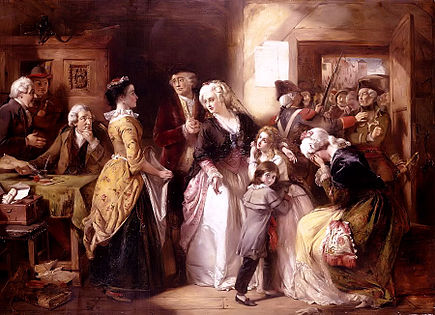
The arrest of Louis XVI and his family, dressed as members of the bourgeoisie, in Varennes. By Thomas Falcon Marshall (1818-1878). Picture source: This is a faithful photographic reproduction of a two-dimensional, public domain work of art (Wikipedia).
Graham Robb maintains that Louis XVI and Marie Antoinette lost their heads in part because of the lack of a good map of Paris. In his book Parisians: An adventure history of Paris, he tells the story of how the French royal family planned to sneak out of the Tuileries Palace under cover of darkness. Unfortunately for them, their departure was badly delayed when Marie got lost trying to find the place where the carriage was waiting for them; due to the delay, they were spotted in Varennes the next day, stopped, arrested, and eventually beheaded. (See this Wikipedia page for more details.)
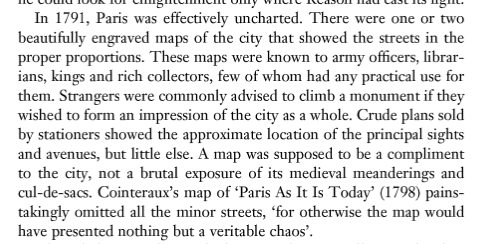
It really wasn’t that hard to get lost. Until the Hausmannian reconstruction in the mid-19th century, Paris was a typically medieval mess of tiny streets intersecting at bizarre angles, and in truth, it mostly still is. Robb explains the maplessness situation like this:
It still isn’t that hard to get lost in Paris. And, there still isn’t a great map. However, there are certainly more maps than there were in 1791, and they each have their strong points. The basic issues to think about when picking your map(s) of Paris are:
You need sufficient detail. Paris is still full of those tiny, crooked medieval streets, and you want a map that shows all of them.
You want to know which metro lines the metro stations on your map serve.
You want a size that will be convenient for you to carry and wrestle with.
The problem is that if there’s a map that does a good job with both of these, I haven’t found it yet. Here’s a quick review of what’s available.
Don’t rely on any map in a guidebook that you’ll be reading on a Kindle. I’ve found Kindle maps (at least of Paris) to be more or less worthless.
Paris Pratique is more or less the standard, as far as I can tell. If you see a Parisian pull out a map, it’s probably going to be this one. It’s sold in every news kiosk in Paris, so you can wait until you get there before buying one. There are different versions–with and without the suburbs, large and small format, and probably others. Advantages: the version that you see the most is small enough to carry in a back pocket, and it is super detailed. It gets updated every year–you’ll see the publication date on the cover. Disadvantages: it’s so detailed that if you’re as old as I am, it might be hard for you to read, and it doesn’t show which metro lines the stations serve.
Streetwise Paris: this is the easiest map to find in the US. It’s printed on heavy stock and laminated, so it will take a beating while you carry it around on your adventures, and it also won’t flop around in your hands as you attempt to figure out where you are while your kids whine about wanting to go to McDonald’s. Advantages: It shows the metro lines that serve the metro stations. It’s both detailed and big enough to read, and you can buy it before you leave the US. Disadvantages: it only shows the main parts of the city, which will be fine if you’re only planning on going to the usual areas that tourists go to, but if you plan on exploring more extensively, it may not cover every area that you plan to visit. The trade-off for the easy readability is that it’s too big to fit in a back pocket, so unless you’re carrying a purse, it’s an obvious marker of touristness. (More on this word below.) It’s also hard to tell when the most recent update was done.
The free maps that you get at metro stations: not surprisingly, these are the best maps for navigating the metro. They come in a larger size and a smaller size, and I would guess that most Parisian women have the smaller one in their purse. (Not that I know every Parisian woman, but I do know a few, and they all carry one of these.) Advantages: very good for the metro, and they don’t immediately mark you as a tourist–see above about Parisian women. Disadvantages: not enough detail to be useful in finding your way around once you’re out of the metro station; printed on regular paper, so they flap around in the breeze.
There are plenty of mapping apps for your smart phone, and there seem to be new ones all the time. I don’t have a favorite; features to think about when picking one:
Does it update to your current location automatically when you open the map? Some do, some don’t, and sometimes you want this feature, and sometimes you don’t (e.g. if you want to keep consulting the same map without it updating to your current location constantly).
Can you search it for categories of places–restaurants, cafes, etc.–or just by address?
What kind of support does it have for walking directions?
One app that I do recommend that you download is the RATP app. This will do a good job of finding the best metro routes for getting from point A to point B.
Earlier in this post, you saw the word touristness. Whether or not you’ve ever seen that word before, if you’re a native speaker, you probably had no trouble understanding it. How can that be, when common conceptions of meaning hold that they are attached to words? If that word isn’t in the language, how could I use it to say something, and how could you understand it? The answer: the productivity of derivational morphology.
Morphology is the (study of) the structure of words. What do I mean by the “structure” of words? Think about the English word unlockable. What does it mean? It’s actually ambiguous. It can mean capable of being unlocked, in which case you have un + lock, with unlock having able attached to it. It can also mean not capable of being locked, in which case you have lock + able, with un attached to lockable. These are two different structures of the parts that make up the word. Those “parts” are called morphemes–the basic units of meaning in a language. (We see here a problem with the common conception of meaning as being something that’s attached to words, per se, but we’ll come back to that another time.)
Morphemes–those minimal units of meaning, like un, lock, and able–can be grouped into a number of categories. Derivational morphemes change either the meaning or the part of speech of what they’re attached to. So, un changes the meaning of lock or of lockable to mean something like the opposite of whatever it means without un, and able changes the part of speech of lock or unlock from a verb to an adjective. So, now you understand what I meant by derivational morphology when mentioned the productivity of derivational morphology earlier.
One of the characteristics of human language is that it is productive. That means that we can use it to say and to understand things that haven’t been said before. Derivational morphology in English is something that’s quite productive–we can use it to form words that we haven’t used or heard before, and when we hear those words that we haven’t heard before, we can understand them. Hence: it’s the productivity of derivational morphology that let me say, and that let you understand, the word touristness, even if you haven’t run across it before.
So, this is nice: we know a couple facts about language that perhaps we didn’t know before. But: facts are generally interesting (at least from a scientific point of view) only to the extent that they have larger implications. Here are some larger implications of the productivity of derivational morphology:
It illustrates a basic difference between human language and animal communication systems. There are some fascinating animal communication systems. The thing about them is: even the really fascinating ones only communicate a pretty limited range of meanings. Vervet monkeys have this really cool system of calls that communicate the presence of three different kinds of threats: airborne predators, terrestrial predators, and snakes. It’s cool because it reflects interesting abilities to categorize, and because juvenile vervet monkeys display errors in using the system that are very much like a type of error that human children display when learning human languages. But: the only things that it can communicate are the presence of one of these three kinds of threats. A vervet monkey can’t say anything that hasn’t been said before. Contrast that with your ability to use derivational morphology productively, which lets you say–and understand–things that have never been said before.
It raises a problem for the idea that meaning is a property of words. A couple problems, actually. One problem: it suggests that there has to be a unit of meaning that is smaller than the word. Another problem: if words have their meanings by being shared within the community of speakers of a language, then how can you explain the ability of speakers of the language to understand a new word, which by definition cannot have been shared?
It raises a problem for any easy behaviorist explanation of human linguistic behavior. If you want to claim that know a word because you’ve learnt some association between a stimulus (presumably the word) and a response (harder to define, but let’s say that your response was some sort of reinforcement, even if indirect, for having understood it), how can you explain the production and the understanding of words that you haven’t been exposed to before?
So, you probably want to draw conclusions something like these:
Meaning is attached to morphemes, not to words. We can share the meanings of the morphemes within a community of speakers of a language–no problem. We probably don’t understand those morphemes by means of any simple behaviorist phenomenon of stimulus/reinforcement, though.
You can find 22 interesting maps of Paris at this link. They won’t help you find the street that you’re looking for, but they have lots of interesting information on things like rental prices, where to rent bikes and scooters, locations where movie scenes were filmed, refugee camps–all sorts of stuff.
Back to maps: when figuring out your way around town, keep in mind that streets have a bad habit of changing names abruptly. One minute you’re on blvd. Grenelle, and the next it’s turned into ave. Garibaldi. This is important if you’re planning on walking down street X until you come to street Y–you have to bear in mind that street Y might be called one thing to your left, but something entirely different to your right.
Back to Marie Antoinette: the failure of the attempt to escape from Paris had a number of consequences. Any claim that the king was in agreement with the Republican government was pretty much trashed by the fact that the king had attempted to escape from it. Other European monarchies then worried even more that the Republican revolution would spread to other countries, which trashed relations between the new government and the rest of Europe, or a lot of it. Louis XVI and his family were imprisoned thereafter; they were eventually tried for treason, and he and Marie Antoinette had their heads lopped off. Something to think about the next time you pull a map out of your pocket…
Want to know more about new words and how to spot them? Check out Orin Hargraves’s book New Words.
If you send someone a pistol emoji, does that mean that you’re threatening them? It depends: what is “meaning,” and how can an emoji have it?
I was sitting in on a class on lexical semantics a couple years ago. Lexical semantics is the study of the meanings of words. What that means: think about the difference in meaning between The fairy godmother waved her baguette and The fairy godmother’s baguette waved her. On some level, we can describe the difference in the meanings of those two sentences as coming from the facts that (a) an English sentence with a subject, a verb, and an object has the meaning that the subject did something to the object, and (b) the two sentences have different subjects and objects. That’s not about lexical semantics, or the meanings of words–we could call that sentential semantics, perhaps.
In contrast with that, consider these sentences:
Bobo swept the floor.
Bobo swept.
Bobo broke the glass.
The glass broke.
In the case of sentence (2), Bobo did the sweeping. In the case of sentence (4), though, the glass got broken. To put it another way: in (2), the subject of the sentence carried out the action of the verb, while in (4), the subject of the sentence underwent the action of the verb. This difference in meaning doesn’t have anything to do with the structures of the sentences, as was the case with the fairy godmother and her baguette–this is about the difference in meaning between sweep and break. (For example: break involves a change in the state of something. Sweep, in contrast, doesn’t.) That’s lexical semantics–the study of the meaning of words.
So, back to that class: one of the folks in it started complaining about how deficient both of these approaches to thinking about semantics are. Sure, we can formalize the meanings of words in a way that captures the differences in meaning between sweep and break. We can formalize the meanings of sentences in a way that captures the differences in meaning between the two fairy godmother/baguette sentences. But, what about the rest of the meaning? How does the meaning of sweeping change, depending on whether Bobo is a property owner, or a member of the proletariat? What does it mean that the fairy godmother is a godmother, and not a fairy godfather? Indignation was widely shared.
Actually, this is a misunderstanding of what semantics is, versus semiotics. Semantics is (in my version of the world) about how language means things. Semiotics is about how meaning gets meant, in general. If I say to you Bobo swept the floor, that’s got one kind of meaning. If I give you a single red rose on our third date, that means something, too. How does Bobo swept the floor mean what it means? I can talk about that–we just did. How does that single red rose on our third date mean what it means? I don’t have a clue. The meaning of the sentence: that’s semantics. The meaning of the single red rose: that’s semiotics. One way to think about why to study linguistics: suppose that you’re interested in the question of meaning. You could think of language as the system of meanings that is the easiest to study. So, if you’re into semiotics in general, then semantics might be a way to get a handle on what seems like a very large problem. On that picture of the universe, semantics is a subset of semiotics. (I don’t mean to imply that I think that we totally understand how meaning works in language, either–I don’t. Indeed, we’ve had a number of posts on this blog about controversies and problems with representing the meanings of words.)
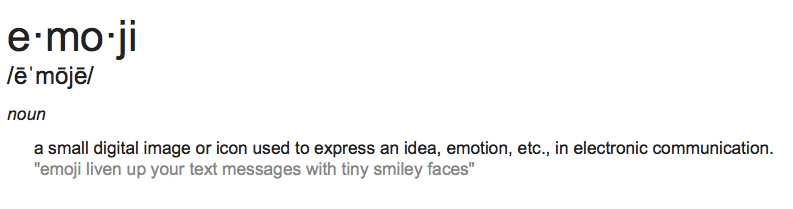
All of this came to mind recently when I came across a couple news stories on the use of emojis to convict people for various and sundry crimes. (See below for a discussion of the differences/similarities between the English constructions a couple and a couple of.) For those of you who have been in a digital wasteland for the past few years, here is a definition of emoji from Google:
Picture source: screen shot of Google’s definition of “emoji.”
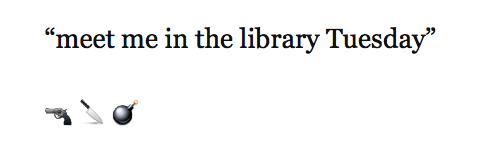
It is amazingly easy to find examples of the appearance of emoji in criminal cases. I Googled this:
…and got tons of results. A 12-year-old girl in Virginia is facing charges of threatening a classmate for sending her this message on Instagram:
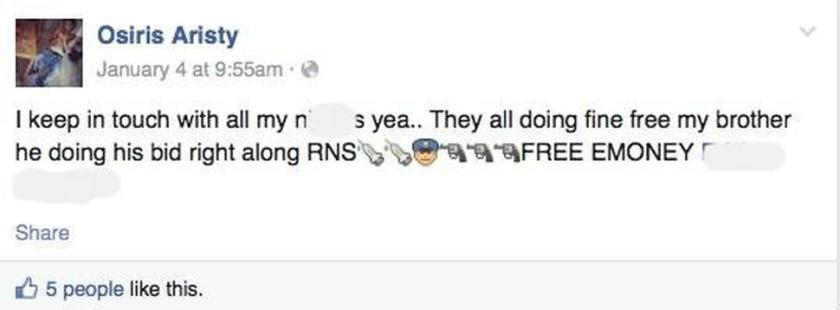
Last year, a 17-year-old male was arrested and charged with making terroristic threats for posting these emojis of a police officer and some guns on Facebook (a grand jury later declined to indict him):
David Fuentes and Matthew Cowan of South Carolina were arrested and charged with stalking after they sent these emoji to someone whom they’d beaten up the month before:
Smiley-faces show up repeatedly in court cases, both criminal and civil. Anthony Elonis’s case went all the way to the U.S. Supreme Court. A quote from an article by Karen Henry and Jason Henry on the Law360 web site:
The defendant in Elonis v. United States had argued that his conviction for posting threatening communications on Facebook should be reversed in part because the presence of emoticons in some of the posts made them “subject to misunderstandings” and not as threatening as they would otherwise have been. For example, one of the defendant’s posts said that his son should dress up as “matricide” on Halloween, perhaps by wearing a costume of her “head on a stick.” He followed that post with an emoticon of a face with its tongue sticking out. He argued that the emoticon signaled that he was joking…
In a civil lawsuit, Universal Music Corp. tried to argue that the person who was suing them hadn’t really been injured by them, presenting as evidence the claim that an emoji that she had used in an email in which she corresponded with a friend about the case showed that she didn’t really feel that she’d actually been injured (same source):
…the evidentiary value of emoticon/emoji evidence was examined fairly recently in Lenz v. Universal Music Corp. (widely referred to as “the Dancing Baby” case). In that case, plaintiff Stephanie Lenz moved for summary judgment on six affirmative defenses asserted by Universal in response to Lenz’s copyright claim. Of particular relevance, Universal argued Lenz alleged in bad faith that she had been “substantially and irreparably injured” by its takedown notice. To support this argument, Universal proffered an email exchange between Lenz and her friend. In that exchange, the friend writes, “love how you have been injured ‘substantially and irreparably’ ;-).” Lenz, in turn, responds, “I have ;-).”
Universal contended that Lenz’s use of the “winky” emoticon signified that she was “just kidding.” Lenz countered that her use of the “winky” emoticon replied to the “winky” in her friend’s email, which basically was teasing Lenz about using lawyerese in her complaint — i.e., “substantially and irreparably injured.” The court sided with Lenz, finding Universal’s proffered evidence insufficient to prove Lenz acted in bad faith and granting summary judgment in Lenz’s favor on that affirmative defense.
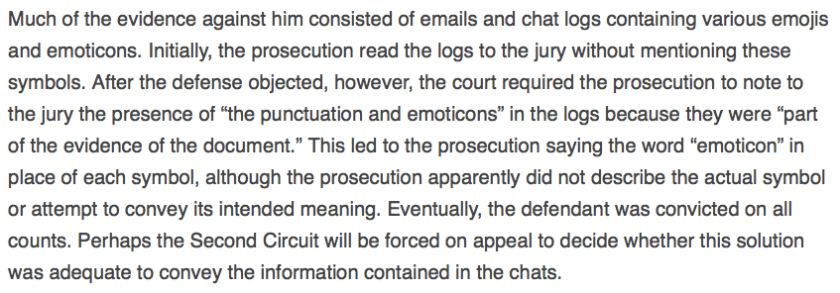
There are multiple legal issues involved in these emoji cases, some of them just really basic procedural stuff. If you’re reading an email out loud in a court case, do you have to read any accompanying emojis out loud? If so: how? Back to the Elonis case in the Supreme Court–I’m going to add in a clause that I omitted in the earlier quote (same source again):
… one of the defendant’s posts said that his son should dress up as “matricide” on Halloween, perhaps by wearing a costume of her “head on a stick.” He followed that post with an emoticon of a face with its tongue sticking out. He argued that the emoticon signaled that he was joking, but his wife interpreted the tongue sticking out in that context as an insult.
This issue–read them out loud, or not, and if so, how–came up in a case that you may have read about–the “Silk Road” case against Ross Ulbricht for running a huge “dark Web” site for selling illegal stuff:
I write about this here and now in part because there have recently been a couple of similar cases in France (see here for Bilal Azougagh’s case), and I suspect that the French courts will do a much better job of hashing out the theoretical issues behind this than the US courts have so far. In reading about this issue in the US, I’ve come across “useful” observations like the claim that unlike words, emoji don’t have clear and unambiguous meanings–total linguistic bullshittery, as words don’t have clear and unambiguous meanings in any human language that I’m aware of. These are difficult and (to me) interesting questions/problems, and I look forward to seeing the French legal system do a much better job of getting at the underlying philosophical issues than the American courts have so far, that being something that the French have much more of a propensity for (and much better educational preparation for) than Americans do.
French notes (scroll waaaay down for the English notes)
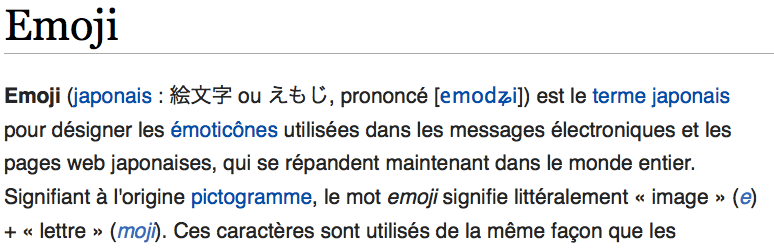
For some random Zipf’s-Law-induced vocabulary items, let’s look at the French Wikipedia page on emoji:
Vocabulary item: I’ve been trying to get straight on the many uses of the verb répandre, and here it is! (See above about words not having clear and unambiguous meanings.) Two of the many potential meanings of se répandre that are possibly relevant here (from WordReference.com):
se répandre (s’etendre) (sur?): to spread.
se répandre (envahir, se disséminer) (dans?): to spread out, to invade.
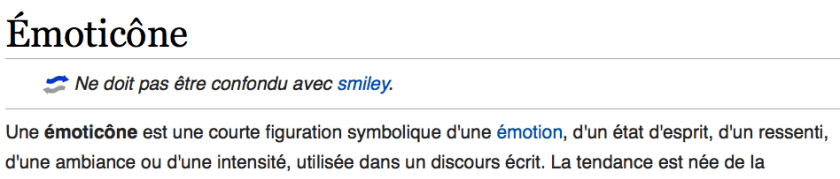
I’d also like to know the genders of emoji and émoticône. Let’s see what evidence we can find:
Back to the lexical semantics lecture: I followed my classmate’s rant with my own, along the lines of the semantics/semiotics split that I talk about above. The professor gave me an odd look when I suggested that it would mean something if I gave her a single red rose, but otherwise, there were no repercussions that I know of. Watch this space for further developments.
English notes
I used the expression a couple a couple times in this blog post. See these links for some discussions of the use of a couple versus a couple of:



 Maybe it’s time to try by-topic again? A scary thought, but I can tell you this: the only reason that I haven’t thrown these boxes out despite the fact that I haven’t opened a single one of them in the five or so years since I moved into this office is that I know for a fact that one of them holds a stack of every paper I’ve ever read about metamorphic testing. I know that I would not want to have to remember who wrote every single paper I’ve ever read about metamorphic testing–it’s reassuring to know that when I need those papers again, I’ll find them, neatly stacked, in one of those boxes.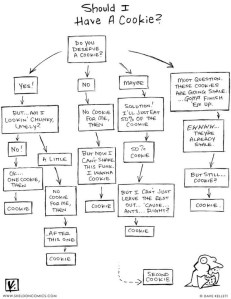









 Zipf's Law
.svg)