
Foreign language, second language, bilingual–there are actually no widely accepted definitions of any of these terms. To put it another way, there are lots of definitions of these terms, but none that everyone agrees on. Here are the ones that I learnt in college–just one set of possible classifications among many:
- Foreign language: you know something about the language, perhaps because you studied it in school, maybe even quite a bit. However, it’s not something that you’re comfortable using.
- Second language: you use a language routinely in at least some aspects of your daily life, and are reasonably comfortable with it, but it’s not a language that you speak natively.
- Bilingual (or more): you speak two (or more) languages natively. They’re both “mother tongues” that you learnt in childhood (up to, say, your teenaged years).
Linguists don’t see “speaking” a language as a binary, yes-you-do-or-no-you-don’t thing. Rather, they think in terms of what you might call contexts and capabilities. For example:
- Could you understand someone speaking the language to you with his mouth full? When he’s drunk? When you’re drunk?
- Can you speak the language naturally in very informal situations?
- Can you speak the language naturally in very formal situations?
- Can you understand someone speaking the language in a regional dialect?
- Could you teach computer programming/judo/knitting/whatever in the language?
- Are you comfortable with the language’s slang?
- Can you understand a toddler speaking the language?
- Can you understand an old person with no teeth speaking the language?
- Could you understand computer-synthesized speech in that language? An announcement over a crappy speaker in a train station? Someone trying to talk to you over the background noise in a bar?
The European Union has its own set of classifications, and you won’t find the terms “foreign” or “second” language anywhere amongst them. The Common European Framework of Reference, as it’s called, defines 6 levels of skill in a language that is not your own. Tests for these 6 levels involve multiple parts: spoken language production, spoken language comprehension, written language production, and written language comprehension. In contrast with the linguist’s way of seeing things, notice that the Common European Framework of Reference is 50% about the written language, while linguists generally don’t care about written language that much, one way or the other–it doesn’t show up anywhere on my list of examples of contexts and capabilities.
Given the Common European Framework of Reference’s four aspects of language skill, what do language skills look like to them? Here’s the CEFR’s “global” description of their 6 levels (from A1, the lowest, to C2, the highest), taken from this document:
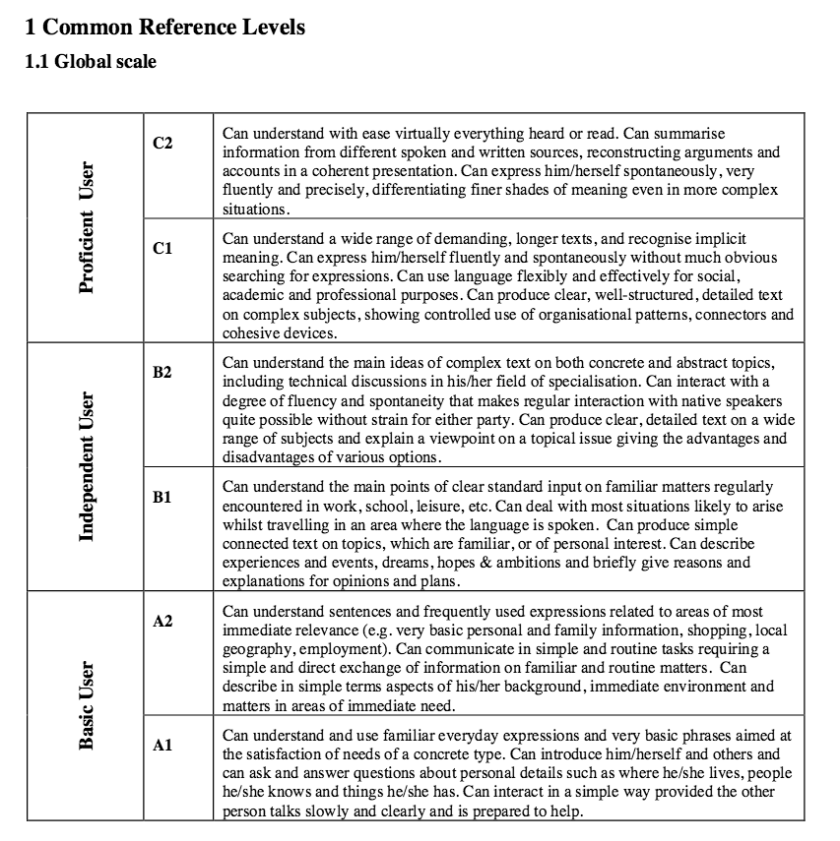
That’s just the global description of their six levels, though. Let’s look at the specifics of spoken language use corresponding to the six levels:
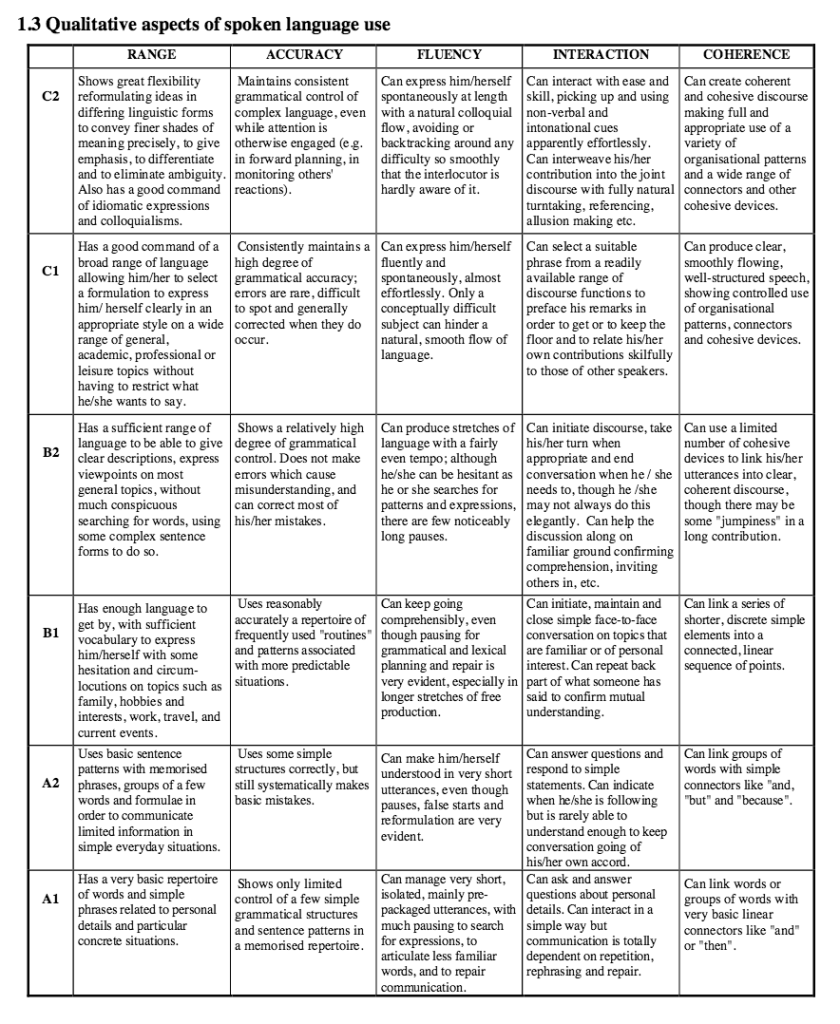
All of these various kinds of contexts get broken down further. Here are the global descriptions of reading comprehension at the six levels:
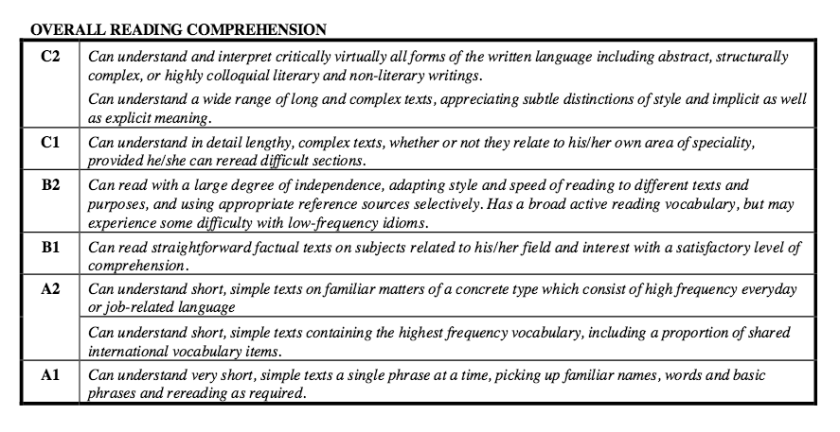
That gets broken down further into reading correspondence, reading instructions, reading to orient oneself, and reading to digest information and arguments. Here are the details on a couple of those:
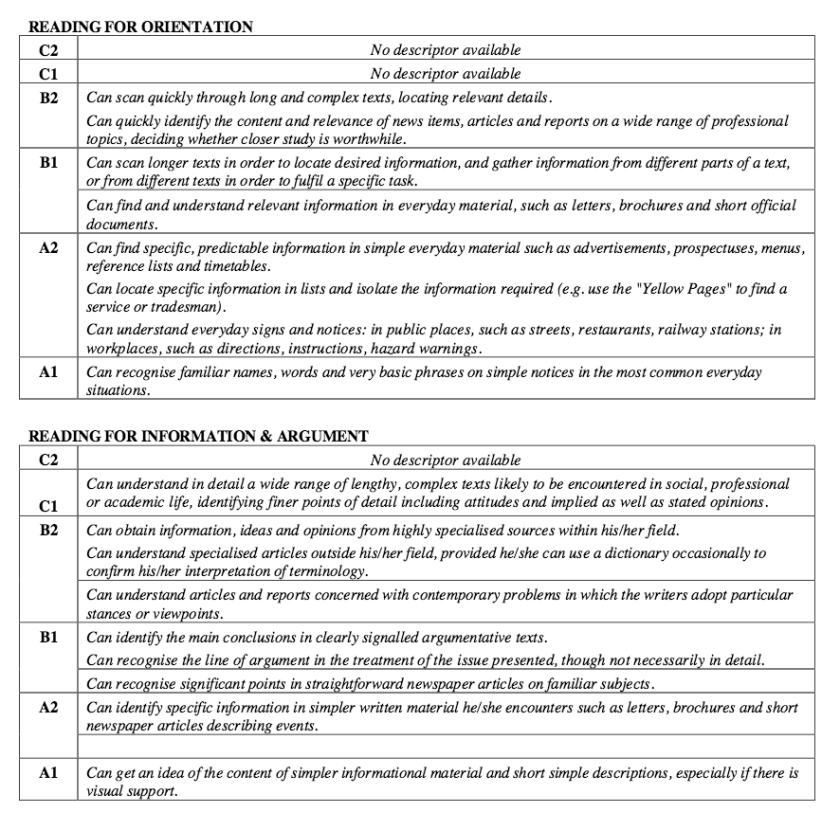
What should we take home out of this wealth of detail? This: the answer to the question “do you speak English/French/Spanish/Kukú/whatever” is not yes or no, at least from a linguist’s point of view. Rather, speaking a language is a matter of having a constellation of skills that you can exercise across a wide spectrum of contexts and conditions. So, if you decide to irritate me by asking me how many languages I “speak,” I’m going to say: one, my native language of English. Then I’m going to politely excuse myself and go freshen up my drink, ’cause I’m pretty sure that you don’t want a lecture on contexts and competencies.
Here is some vocabulary from the French Wikipedia page on the Common European Framework of Reference. Definitions from WordReference.com.
Le Cadre européen commun de référence pour les langues – Apprendre, Enseigner, Évaluer (CECRL) est un document publié par le Conseil de l’Europe en 2001, qui définit des niveaux de maîtrise d’une langue étrangère en fonction de savoir-faire dans différents domaines de compétence.
- le cadre: a great word, with lots of meanings. The most common ones that I’ve run into are “framework” (the sense in which it’s used here, as well as in cadre juridique, “legal framework,” which for no reason that I can explain I really like to say), and “frame,” as in a picture frame.
- la maîtrise: lots of meanings; in this case, “mastery, knowledge, command.”
- en fonction de: as a function of, or depending on, or geared to, or in accordance to, in accordance with. Any of those would work in this sentence.





 Zipf's Law
