Eat, choke, and leave: how to pronounce toponyms

nevada-pronunciation-1-5590
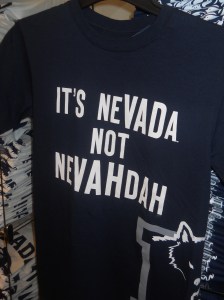
How to pronounce “Nevada.” Picture source: eventflags.com/Nevada-Decals-and-Magnets/

Part of running for president in the United States is that you have to travel around the country and visit places.  While you’re there, you’re expected to do two things:

  1. Eat whatever food is associated with the region or the immigrants who settled the region (with the exception of Native Americans, we’re all immigrants in this country) and appear to enjoy it.
  2. Pronounce the name of the place that you’re in correctly.

This being the bizarre election cycle that it is, Trump chose instead, on a recent visit to Nevada, to get it backwards.  Most Americans pronounce it Ne-VAH-da, but Nevadans pronounce it Ne-VA-da.  That is: most Americans pronounce the middle vowel of Nevada with the vowel of hot, but the locals pronounce the middle vowel with the vowel of hat.  Trump got it backwards—and made a big deal about it.  My guess is that he did this in an attempt to draw the news coverage away from the fact that he had no clue what people were talking about when they asked him about the Yucca Mountain nuclear waste site, the hottest issue in Nevada politics.  (Yes, Hillary knew what they meant.)

nevada-pronunciation-2-12536092l
How to pronounce “Nevada.” Picture source: nevadawolfshop.com

Place names are weird in America, and in France, too.  It’s definitely not always possible to know how they’re pronounced by anyone, let alone by the locals, just by seeing the spelling.  My home town’s Couch St.?  It’s pronounced kooch.  Mind you, we call a couch a couch, just like anyone else (unless it’s a sofa)–but, Couch St. is pronounced Kooch St.  Macadam St.?  No, it’s not Ma-CA-dam—it’s MA-cadam.  In France?  Forget it.  Rennes is  [ʁɛn], which you could guess from the spelling, but Reims is [ʀɛ̃s] (Prononciation du titre dans sa version originale Écouter) , which I don’t think you can.  Lille is [lil] Prononciation du titre dans sa version originale Écouter), which you could guess, but if you’re like me, you’ve wondered a thousand times if it’s supposed to be pronounced like fille.  Of course, any French person would laugh their ass off at the pronunciation of the name of the city of Beaufort in South Carolina, which is totally different from the pronunciation of the name of the town of Beaufort in North Carolina.  Do you pronounce the x at the end of deux, or aux, or peux?  No.  Do you pronounce the x at the end of Aix and Dupleix?  Why, yes–you do.

nevada-pronunciation-t-shirt-photo-2
How to pronounce “Nevada.” Picture source: oliviapiotter.wordpress.com/

Indeed, there has been plenty of press coverage about Trump insisting that Nevadans pronounce the name of their state his way, and it has drowned out the little bit of press coverage about what Nevadans actually seem to care about, which is Trump showing up in their state without having taken the time to find out what the issues of concern there.  But, this being the bizarre election that it’s been, it’s hard to believe that any of this will affect anything.  Are you an American?  Get out there and vote, or you can’t really complain if you end up with a reality TV star for a president…

English notes:

to laugh one’s ass off: to laugh very hard.  DO NOT use this in circumstances where you would not use bad language.  Hey Steve, you want to hear a joke so funny you’ll laugh your ass off?  Steve, tu veux entendre une blague super drôle tu seras péter de rire(Source: reverso.net) And you’re gonna laugh your ass off, ’cause it’s really freakin’ funny.  Et vous allez vous péter de rire, parce c’est vraiment trop drôle.  (Source: reverso.net)  How it was used in the post: Of course, any French person would laugh their ass off at the pronunciation of the name of the city of Beaufort in South Carolina, which is totally different from the pronunciation of the name of the town of Beaufort in North Carolina.  

French notes:

Apropos of nothing but my desire to make blogger Bea dM smile, here is a list of Italian place names, in French. 

Trump and a blood-stained sheet: talking about confrontation and bullies in French

Bullies want to fight victims, not adversaries.  –Bruce Tegner

When I was a kid, instructions for dealing with a bully were clear and unambiguous: fight him.  Bullies deal in the currency of fear and intimidation, and what they told us is true: if you come at them, they will typically back down.  My favorite Navy fight stories are not about fights–they’re about fights that didn’t happen, because I didn’t back down from a bully, and then he backed down from me.  (This probably makes me sound like a badass.  I’m not–I’m a total wimp.  But, at some point, the possibility of being beaten shitless is a lot less painful than continuing to be bullied by some asshole.)

At this point in our bizarre election cycle, all of the talk is about confrontation.  Last night was what the French press called the first passe d’armes between Clinton and Trump.  I would guess that most of us turned on the TV to watch the debate with a fair amount of trepidation.  What would Trump do?  Would he literally beat his chest like a fucking gorilla?  Would he lash out from the git-go?  (This expression explained below in the English notes.)  As it turned out, Clinton did what they told us to do when I was a kid: she got right in his face.  She took the fight to him.  Trump did what he’s done in the past when confronted with a woman who wouldn’t back down: he folded.  (I’m thinking here of Carly Fiorina and the Rev. Faith Timmons.)

When I was a kid, everyone advised fighting bullies–parents, teachers, the world.  In American schools today, kids who are involved in anything remotely resembling a fight are suspended from school, whether they initiated it, or they were attacked–see here, or here, or here for news stories about kids being thrown out of school for standing up to a bully.

How kids are supposed to deal with bullies under those conditions, I have no clue. I mean, I can read, so I know what the current advice is:

  • Reframe the problem of bullying.  By changing your attitude towards bullying you can help regain a sense of control.  Try to view bullying from a different perspective.  (That’s Tip #2 from this page.)
  • Feel good about you. Nobody’s perfect, but what can you do to look and feel your best? Maybe you’d like to be more fit. If so, maybe you’ll decide to get more exercise, watch less TV, and eat healthier snacks. Or maybe you feel you look best when you shower in the morning before school. If so, you could decide to get up a little earlier so you can be clean and refreshed for the school day.  (I think that’s what you call “blaming the victim.”  I found that gem of anti-bullying here.)
  • It is incredibly important that you go through the appropriate reporting channels by firstly telling a teacher/parent/guardian/learning mentor or another responsible adult.  (Anyone in the reading audience have success with this as a child?  Found that one at the Ditch The Label site–they describe themselves as “one of the largest anti-bullying charities in the world.”)

…so, yes, I know what kids are told to do.  But, what are kids supposed to do that might actually work?  ‘Cause I’m pretty sure that “reframing the problem of bullying” would not have done much for the girl I was in the Navy with who our bully decided to go after one day by hanging up the sheets that she’d been sleeping on for her 24-hour stretch of ambulance duty so that it would be clear to the world that she was on her period.

Anyone know how kids are taught to deal with bullies in France?  Surely it’s nothing this stupid…

French notes

  • un affrontement: confrontation, battle, clash. Premier affrontement musclé entre Hillary Clinton et Donald Trump (headline, RFI, https://goo.gl/2nLOUOAffrontement Clinton-Trump: un débat qui devrait fracasser des records (headline, Huffington Post Québec, https://goo.gl/HTZMTX) L’affrontement entre les deux prétendants à la Maison-Blanche a été rude, avec dans le rôle du chœur les internautes et les médias (Le Temps, https://goo.gl/jRveH4)
  • une passe d’armes: échange énergique; sparring.  Premières passe d’armes entre les deux candidats (TV5MONDE tweet)  Vive passe d’armes. “Je ferai revenir nos emplois, vous ne pouvez pas le faire” – Trump. “Donald, vous vivez dans un monde à part” – Clinton  (AFP USA, tweet)  Première passe d’armes entre Clinton et Trump sur l’économie (headline, Libération)
  • la brute, le tyran: bully.
  • la brimade: bullying, baiting, vexation, aggravation.  This is the title of the French Wikipedia page on bullying.

English notes

  • from the git-go: from the beginning.  Here‘s a post about the expression from the Grammarphobia blog.

The English word bully can have other meanings besides brute or tyran.  Here are some:

bulldog-bennetts_thumb
“Bully” is an affectionate term for any kind of bulldog, usually used by “dog people.” Picture source: http://www.englishbullydog.com/
bully-beef-images
Canned or pickled beef. Thefreedictionary.com says that this comes from the French “boeuf bouilli.” Picture source: http://www.amazon.in/Bully-Beef-Biscuits-Food-Great/dp/1473827450
bully-sticks-in-dog-mouth-580x385
Bully stick: dried animal penis, usually purchased for dogs to chew on. Picture source: http://bullystickshoppe.com/category/dogs/
750x400xthe-bully-pulpit-jpg-pagespeed-ic-p0-s37oj_
The bully pulpit: a position, usually in public life, that gives you the ability to broadcast your views widely. Picture source: http://www.historynet.com/book-review-the-bully-pulpit.htm


A boring of linguists

Just because you know a lot of languages doesn’t mean you have anything to say.

giuseppe-caspar-mezzofanti
Cardinal Mezzofanti, 1774-1849. Picture source: By Unknown – University of Bologna http://www.bub.unibo.it/biblioteca/popup/personaggi.htm, Public Domain, https://commons.wikimedia.org/w/index.php?curid=1118309

In his book Babel no more: The search for the world’s most extraordinary language learners, Michael Erard talks about Cardinal Giuseppe Mezzofanti.  Mezzofanti spoke a lot of languages.  It’s not clear exactly how many–certainly that depends on your definition of what it means to “speak” a language–but, nevertheless, it was a ridiculously large number of languages.  Something that Erard says about him really struck me: What [we] can’t explain is how he could switch from one language to another without confusing them.  Here’s an anecdote from the book:

On one occasion, Pope Gregory XVI (1765-1846), a friend of Mezzofanti, arranged for dozens of international students to surprise him.  When the signal was given, the students knelt before Mezzofanti and then rose quickly, talking to him “each in his own tongue, with such an abundance of words and such a volubility of tone, that, in the jargon of dialects, it was almost impossible to hear, much less to understand them.”  Mezzofanti didn’t flinch but “took them up singly, and replied to eachin his own language.” The pope declared the cardinal to be victorious.  Mezzofanti could not be bested.

walking-dead-espanol-maxresdefault
“Just run!” The Walking Dead in Spanish. Picture source: https://www.youtube.com/watch?v=b_VMSchKr2Y

Why this struck me: we’ve talked before about the difficulty that many people have with keeping foreign languages “separate.”  Before a recent trip to Guatemala, I prepared by basically purging French from my life completely for the month before I went there.  I didn’t study French vocabulary, I didn’t listen to the news in French, and I didn’t read in French.  Of course, I listened to Spanish podcasts, I read in Spanish (a book about semantics, and The Walking Dead–I’m not picky), and I watched Spanish-language movies.  But, pushing French out of my head was as important to the process as packing Spanish into it.

So, when I got to Guatemala, it was interesting to see where I had trouble keeping the two apart.  I don’t really know what to make of it.  Here are the facts.

For background: I would never claim to speak either French or Spanish.  I’m pretty comfortable in Spanish, which serves very nicely with my siblings if we want to have a private conversation in Shanghai, and when I’m in France, I don’t speak English very often–I live my life in French, both personal and professional.  I would guess that my vocabulary is a thousand times better in French than in Spanish, and that my grammar is a thousand times better in Spanish than in French.  Pronunciation: who knows.

So: as it turns out, I didn’t have trouble keeping the vocabulary apart.  What I had trouble with was the little stuff.  Here are some specific things that struck me:

Possessives

In French, there are three (simplifying by just talking about the second person informal, since that’s what I use the most in the hospital):

  • tes for plural nouns.  Sou: tes parents your parents, tes soeurs your sisters.
  • ton for masculine nouns and before any noun that begins with a vowel. So: ton chiot, your puppy, because chiot ‘puppy’ is masculine; ton orange, your orange, even though orange ‘orange’ is feminine, because it begins with a vowel.
  • ta for feminine nouns that don’t begin with a vowel.  So: ta chaussette your sock.

In contrast, Spanish only has two:

  • tus for plural nouns.  So: tus padres your parents, tus hermanas your sisters.
  • tu for singular nouns.  So: tu perrito your puppy, tu amigito your little friend.

It’s things like tu amigito that threw me.  I just could not wrap my tongue around the sequence tu + vowel.  It just…stopped.  Eventually I would push it out, while people turned and looked at me like what’s up with the old dude?

The word after

Even after a week incountry, if I did not pay attention, the Spanish word después ‘after’ would not come out of my mouth.  Instead, it was the equivalent French word: après.  Even if I did pay attention, I really had to struggle to dig up después.  I eventually started pausing every time I needed to say after, and thinking to myself: say después, not après.  

Excuse me

If I had a nickel for every time that I said pardon or désolé instead of con permiso or disculpe… 

The “excuse me” problem doesn’t puzzle me that much–that’s right-brain language.  The little function words, though–I’m not sure what to think about that particular phenomenon.  It’s a pretty small sample, so maybe I shouldn’t generalize.

The other funny thing about Cardinal Mezzofanti: apparently, he didn’t actually have much of interest to say.  As Erard puts it:

Despite this…Mezzofanti was…the target of sarcastic barbs.  Irish writer Charles Lever wrote that Mezzofanti “was a most inferior man….An old dictionary would have been to the full as companionable.”  Baron Bunsen, a German philologist, said that in all the countless languages which Mezzofanti spoke he “never said anything.”  He “has not five ideas,” said a Roman priest quoted in a memoir.”

Speaking as someone who was once married to a woman who coined the term of venery a boring of linguists, I fear that there may be a cautionary note for me here…

French notes

From the French Wikipedia article on Mezzofanti:

Giuseppe Caspar Mezzofanti, né le 17 septembre 1774 à Bologne en Émilie-Romagne et mort le 15 mars 1849, fut un religieux et un universitaire italien du XIXe siècle, qui devint cardinal de l’Église catholique, et était un linguiste et un polyglotte renommé.

  • le religieux: clergyman, priest.
  • renommé: renowned.

English notes

to throw (someone): 5. Informal To cause confusion or perplexity in; disconcert or nonplus.  (From The Free Dictionary.)  How it appeared in the post:

It’s things like tu amigito that threw me.  I just could not wrap my tongue around the sequence tu + vowel.  It just…stopped. 


Fish and semantic theory

Don’t you hate it when you just want to order dinner, and your host starts ranting about lexical semantics?

poissons-b475313b200d67ac8b7433d85e9b4004
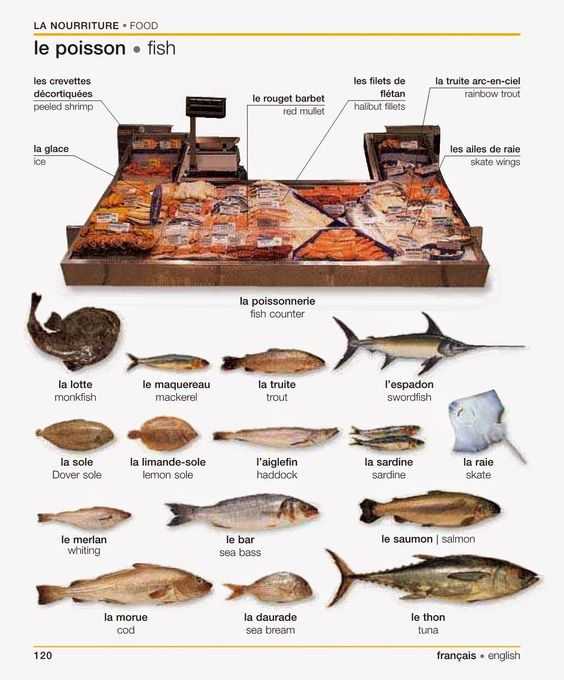
Picture source: https://s-media-cache-ak0.pinimg.com/564x/b4/75/31/b475313b200d67ac8b7433d85e9b4004.jpg

At this point in my French adventures, I’m reasonably capable of helping an American visitor navigate a French menu.  Quail, lamb, artichokes–I’ve got those under control.  The subtleties of the cheese plate–you’d be amazed.  Tajines versus couscous–I’m getting there.  Sausages–you want dry?  Spicy?  Halal?  Pork guts?

There’s still one part of the menu where I’m pretty hopeless, though.  It’s the fish section.  Here’s the thing: I don’t even know what the fish are in English.  Is flounder the flat one, or is that halibut?  Is haddock a dark fish, or a light fish?  I have no clue.  I know that tuna are really, really big and anchovies aren’t, but if you put me face to face with a monkfish and a sea bream, I’d be pretty lost.

This is curious.  Here’s the thing about lexical semantics–the meanings of words: theories of lexical semantics all assume that what we know about the meaning of a word is sufficient (a) to identify what it refers to, and (b) to distinguish what it refers to from what it doesn’t refer to.  Linguistics as we know it today begins with Saussure‘s observation that all meaning boils down to what you are not: I believe the quote is Dans la langue, il n’y a que des différences.  (“In language, there is nothing but differences.”)  We’re looked at a number of ways of representing word meanings in the past, including ontologies, prototypes, and necesssary and sufficient conditions.  The ability of a definition to distinguish between things is crucial to all of them.  The currently most popular approach to representing the meanings of words in the field of natural language processing, known as word embeddings, is based entirely on a spatial metaphor–similarities in meaning are closeness in meaning, differences in meaning are distances.  Nothing is defined in terms of any of its characteristics–it’s all about which other words a word is more, or less, different from.  All of these approaches to semantics require not just that you be able to define what a thing is, but also differentiate it from the things that it isn’t.

So, how do you fit fish into this?  They’re just one example of a phenomenon that is not uncommon.  It doesn’t have a name, that I know of, but I’ll bet that you can give your own examples of it.  Here are some from my own experience:

A B C
opaline birch ochre
amethyst alder taupe
garnet poplar cerise
tourmeline yew ecru

I know what everything in columns A, B, and C have in common.  Column A is precious stones.  Column B is trees.  Column C is colors.  But, which stones, trees, colors?  I haven’t a clue.  I know how they’re similar, very broadly–they’re all stones/trees/colors.  But, I couldn’t tell which was which if my life depended on it.

So: how do you explain this phenomenon where I know what kinds of things they are, but I don’t know specifically what they are?  I know a similarity–it’s the difference that I don’t know.  How you fit that into a theory of meaning that relies crucially on being able to differentiate between things, I have no clue.  And, it’s not like this is rare, either: I’ll bet that if pushed, you could come up with a list of things that you know are geographic features, without actually being able to define them (hill, hillock, dale, dell, valley, hollow, swale); same for furniture (settee, chaise lounge, tuffet, ottoman); fish, perhaps?  A request: if I’m the only freak in the world who knows categories of words that he can’t tell apart, feel free to leave me in peace.  But, if there are categories of words like that that you don’t know how to define the members of, either, could you let me know that I’m not alone in my weirdness by giving me examples?  And, if you’re a linguist, and you know the name of this phenomenon: please enlighten me…

  • le thon: tuna
  • la truite: trout
  • la daurade: sea bream

The ideal and the desired, French and American versions

Talking about the ideal and the desired in French and in English: ways to say “should,” with some comics.

Why Paul Ryan should vote for Hillary Clinton.  —headline, The Fiscal Times

Speaker Paul Ryan should disavow Donald Trump.  —headline, Milwaukee Journal-Sentinel

Paul Ryan says Donald Trump should release tax returns —headline, Wall Street Journal

should-i-have-a-cookie-21319-1292865209-9
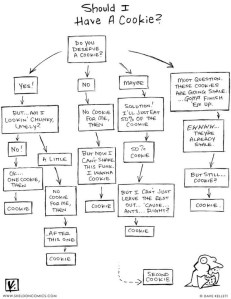
Should I have a cookie? Picture source: http://www.thatsnerdalicious.com/funny/the-eternal-question-should-you-have-a-cookie/
It’s amazing (and more than a little depressing) to me that such enormous holes persist in my French, even after 2 3/4 years of studying really, really hard!  I just realized that I don’t know how to express the difference between must and should.  Obligation–must–that, I can express.  It’s the verb devoir in the present tense.  Ideal actions, desired actions–that’s a bit more complicated, both in French and in English.  (See the English notes at the bottom for the English issues.)

See here for more information about parallel corpora like OPUS 2.

To express the idea of should, we still use devoir, but we need its conditional tensesFor the English present tense, e.g. I should, we use the French present conditional of devoir.  You can read about how to do so here on the Lawless French web site; I’ll give you some examples from the Sketch Engine web site.  I used Sketch Engine to search the OPUS2 corpus, a collection of billions of words of text in 40 different languages, drawn from sources as diverse as movie subtitles and the proceedings of the European Parliament, and lined up with each other wherever possible.  We’re talking 1.1 billion words of English, 600,000 words of Afrikaans, 46 million words of Albanian, 300 million words of Arabic, etc.  French?  Almost 766 million.

Don’ t you think that before shooting a spy, we should make him talk?

Vous ne pensez pas qu’avant d’abattre un espion, on devrait le faire parler?

Now that we have finished the script, we should save it to disk.

Maintenant que nous avons fini le script, nous devrions l’enregistrer sur le disque.

Well, then, I think we should go out on a Sunday night.

On devrait sortir le dimanche soir alors.

What we should do is have dinner sometime.

On devrait dîner ensemble un soir.

2009-06-03-coffee-should-be
Should I have a cookie? Picture source: http://www.thatsnerdalicious.com/funny/the-eternal-question-should-you-have-a-cookie/
To talk about something that you should have done in the past, you need the past conditional of devoir.  Here‘s the Lawless French page with an example–there’s a more detailed lesson hidden somewhere on the Lawless French Kwiziq site, but I have no clue how to tell you how to find it.  Again, I’ll give you some examples from the OPUS 2 corpus, retrieved via the Sketch Engine web site:

I knew we should have stayed on this case.

Je savais qu’on aurait dû rester sur cette affaire.

Maybe we should have bought some rice in town.

On aurait peut-être dû acheter du riz en ville.

According to all you told us, and to all calculations … we should have located the mine two days ago.

D’après ce que vous nous avez dit et nos calculs, nous aurions dû trouver la mine il y a deux jours.

Wonder if we should have told the exec about that package … … Mike used to keep under his sack.

Je me demande si on aurait dû parler du paquet … – que Mike gardait sous sa couchette.

As a result, we have not been able to make as much progress as we should have.

En conséquence, nous n’avons pas pu réaliser tous les progrès que nous aurions dû accomplir.

statements-that-cant-be-rejected-pickup-lines-12443604
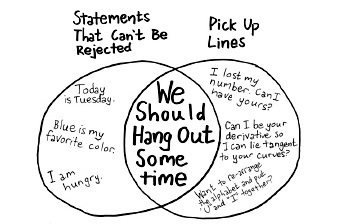
https://thebarcelonabookclub.wordpress.com/tag/we-should-hangout-sometime/
It’s hard to believe that the 2020 Republican primaries won’t see Paul Ryan pitted against Tom Cruz.  Cruz will still be as scary then as he is now, I imagine–personally, I find him even more frightening than Trump, and I find Trump pretty damn frightening.  Paul Ryan will continue to bear the burden of his failure (so far) to denounce Trumpism, which probably won’t hurt him much in the Republican primaries, but I hope will keep him from winning the general election.

English notes

If you’re French: I probably don’t have to tell you that should in English is at least as bizarre as it is in French.  There’s a good web page on it here, from the Cambridge Dictionary.  Note that the page describes the British uses of the word, which are different from the American ones in some respects.  For example, the conditional form should you, as in should you want some coffee…, is not used in America–we would say if you want some coffee…  The UK also has a formal/neutral alternation between should and would that we don’t have in the US.  For example, the Brits have neutral I would love to come and formal I should love to come, but in the US, only I would love to come will work.  Finally, oughtn’t instead of shouldn’t is more formal in British English, but it’s dialectal and possibly stigmatized in the US.

What soldiers carry in their pockets

Some questions are deceptively simple, masking quite a bit of complexity and some non-obvious answers.

echarpe-veste-militaire-armee-francaise-neuf
What could possibly be more French than wearing a scarf with your cammies? I don’t think that this is in any sense official, though–I found the picture on the web site of a French army surplus store. Certainly I’m not aware of any military that allows its members to lounge about with their hands in their uniform pockets. Picture source: http://www.lecasquebleu.fr/88-veste-militaire-armee-francaise-neuf.html

Some questions are deceptively simple, masking quite a bit of complexity and some non-obvious answers.  I ran across this one on Quora, a web site where you can post a question, and if you’re lucky, random strangers will answer it:

What do soldiers keep in all those pockets they have?

As you can tell from the responses: (a) there’s no one answer, and (b) people really do devote a lot of thought to this.  Reading through them, you’ll notice some basic themes: (1) the necessities of life, like eating and pooping; (2) the necessities of staying alive, like first aid kits; and (3) the necessities of keeping your mind/spirit alive at the same time as the rest of yourself.  Focussed around those basic themes, you’ll see a lot of variety and creativity–the Turkish soldier who carries sanitary pads to staunch bleeding and catch sweat, as well as women’s nylon stockings (I’m surprised more people didn’t mention those–they’re popular in areas where there are heavy mosquitoes); writing materials; be sure to read the one about the Marine and his stuffed frog…

My own answer reflects those themes pretty closely: What I kept in those pockets

cammie-parts-veste-militaire-f2-camouflage-03
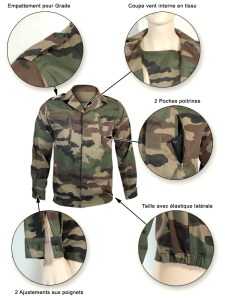
Parts of the cammie blouse in French. Picture source: http://www.projet13.com/surplus-militaire/veste-militaire-f2-camouflage-equipement-1-781.html

So, when you read my posts about the incredible number of needless gun deaths in the US and think about what a naive lefty liberal I must be: yes, I am a lefty liberal, and, yes, I can fire a weapon just fine, and, yes: I am a pretty good shot, actually.

  • le treillis: [treji] fatigues, battledress, “cammies.”

Flirty repartee, French-style: technical terms for the mandible

You don’t think you can have flirty conversations about the mandible? You haven’t been to France.

mandibule-467a2066e2f0fad993693e07107c439d
La partie inférieure de la mâchoire, ou la mandibule: the mandible. Picture source: https://s-media-cache-ak0.pinimg.com/564x/46/7a/20/467a2066e2f0fad993693e07107c439d.jpg

Even more than soccer, flirting is often said to be France’s national sport.  I like it–it’s fun, and (so far) a harmless way to practice my French.  So, I was chatting with a girl over a cup of coffee in a café by the Museum of Comparative Anatomy and Paleontology one day (no, I’m not making that museum up–along with the Pergamon in Berlin and the British National Museum in London, it’s one of my favorites in the entire world, and I can’t even imagine how many hours I’ve spent there) when she said something that made my ears perk up: she mentioned la partie inférieure de la mâchoire.  The “lower part of the jaw:” what you and I probably know as the mandible, and most French speakers as la mandibule.  

On the surface, the jaw doesn’t look that interesting.  One bone, with a pretty simple hinge on each side.  It’s got a lot of subtleties, though, and if you look at how jaws vary across species, a jaw can tell you a lot about an animal.

mandible-basic-20087tn
Picture source: http://img.medscapestatic.com/pi/meds/ckb/87/20087tn.jpg

Let’s look at the “gross anatomy” first–the basic parts.  In many species, the mandible has two main parts: the body, and the ramus.  The body is the part that’s parallel to the ground, and the ramus is the part that goes up vertically.  We’ll go through the French vocabulary now, rather than at the end of the post, because it’s essential to understanding my flirty ways.

  • la mâchoire: the jaw; jawbone.
  • la partie inférieure de la mâchoire: the lower part of the jaw. The official term for the mandible.
  • la partie supérieure de la mâchoire: the maxilla–again, the “official” term.
  • la mandibule: mandible.
  • le maxillaire: maxilla.
  • l’articulation temporomandibulaire: temporo-mandibular joint.
  • la branche de la mandibule: the ramus of the mandible.
  • le corps de la mandibule: the body of the mandible.

Why it made my ears perk up when she said la partie inférieur de la mâchoire: as far as I know, that’s the technical term for the mandible, versus la mandibule, which I believe to be more general language.  How often do you meet someone whose idea of witty repartee includes throwing around technical terms for bones?  Of course, then a bum walked by.  Blah blah blah blah, you gotta blah blah for me? 

What’s a blah-blah? …I asked my terminologically gifted new friend.  He wants a cigarette, she replied.  And what does blah blah blah blah mean? 

“Kevin Costner”–he called you Kevin Costner.

How the fuck does he know my name’s Kevin?

He doesn’t–you’re an American, and you’re bald, so…

Whatever.

English notes:

to make someone’s ears perk up: to make someone suddenly interested in what you’re saying.  How it was used in the post: She said something that made my ears perk up: she mentioned la partie inférieure de la mâchoire. 

repartee: (Yes, this is an English word.)  Witty conversation that goes back and forth.  From Merriam-Webster: conversation in which clever statements and replies are made quickly.  How it was used in the post: How often do you meet someone whose idea of witty repartee includes throwing around technical terms for bones?


Weapons Of Math Destruction: Cathy O’Neil on how people go wrong with Big Data

gartner_hype_cycle-svg
The Hype Cycle, beloved by technoskeptics such as myself. Big Data is somewhere around the “Peak of Inflated Expectations” point–maybe just starting down towards the trough. Picture source: https://commons.wikimedia.org/wiki/File:Gartner_Hype_Cycle.svg
It’s tough to read technology news these days without hearing about the wonders of Big Data and how it’s going to revolutionize our world.  Apparently it will soon predict epidemics, prevent terrorist attacks, and boost farm production.

In truth, though: it’s not so clear that it’s a great thing.  One of the problems with Big Data is a special case of a general problem in the ethics of technology: the kinds of things that can go wrong when the public perception of how well/poorly technology performs doesn’t match well with the truth. In particular: when the public thinks that technology performs way better than it does.

You will occasionally hear people talking about how algorithms are going to take our jobs, bring about the zombie apocalypse prematurely, etc. More commonly, technology gee-whizzers will tell you the opposite: that they will remove bias and introduce complete objectivity to sentencing guidelines, for instance.  In fact, an algorithm is nothing more (or less) than a defined set of procedures.  In the case of an algorithm for computing, it’s typically a set of calculations. An algorithm can’t be biased. It can’t be unbiased, either. The data, though: that can be biased. An example from the interview: train an algorithm to evaluate resumes from applicants for jobs at an engineering firm. You could imagine training it with the resume of everyone who has ever been hired in the past, and the following piece of information for each person: whether or not they were a successful employee. If the engineering firm is a typical one, those previous hires are mostly going to have been males. Now the program learns the characteristics of a successful hire, and among other things, the program will conclude that a successful hire is going to be a male, since that’s all that it’s ever seen. Is the algorithm biased?  No. Is the person who programmed it biased?  No. What’s biased?  The data. Not biased in the way that a person is biased–rather, biased in the statistical sense: not every member of the population had an equal likelihood of being included in the training set.

Where people get seduced by things with the Big Data label on them is by the bigness. Most people know that the bigger your data set is, the more reliable the statistical model that comes out of it will be. A lot of people look at Big Data and think: there’s a LOT of data, so it’s GOT to be good. That’s where the trouble comes from.

I like this interview because it’s neither a gee-whiz-this-technology-is-so-great story, nor an ignorant oh-my-God-the-data-miners-are-going-to-kill-us story. The interviewee, Cathy O’Neil, knows what she’s talking about, and she explains it well.  The unbiased sentencing program?  It didn’t work out so great–see a very detailed story about it here.

Link to the interview with Cathy O’Neil:

http://one.npr.org/i/493654950:493654951

French notes:

  • le big data: Big Data.
  • les mégadonnées: Big Data.
  • les données massives: Big Data.

English notes:

  • to sentence to (a punishment): to assign a punishment or penalty to someone.  Examples: A 46-year-old man threw feces in a Clark County, Ohio, courtroom Wednesday after learning he was being sentenced to 40 years in prison for armed robbery.  (Story here.)  Alan Turing, the pioneering computer scientist and cryptanalyst who cracked the Nazis’ Enigma code, was sentenced to chemical castration as a punishment for his homosexuality.
  • sentencing guidelines: instructions for how to determine the length of the jail or prison sentence of someone who has been convicted of a crime.  How it was used in the post: More commonly, technology gee-whizzers will tell you the opposite: that they will remove bias and introduce complete objectivity to sentencing guidelines, for instance. 

Men, chocolate, and coffee: compositionality and the mapping problem

Linguists are sometimes accused of spending their time navel-gazing over sentences that are not realistic. The truth is that you don’t have to look any further than your daily life for real linguistic puzzles.

men-chocolate-coffee-img_6556
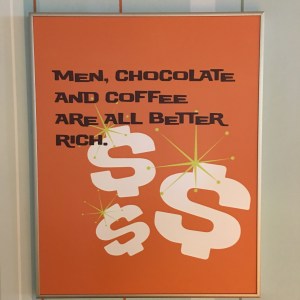
Sign on the wall of a Village Inn. Picture source: me.

Linguists and philosophers are sometimes accused of spending their time navel-gazing over sentences that are not realistic.  However, the truth is that you don’t have to look any further than your daily life for real puzzles, and sometimes for real challenges to linguistic theory.

Right at this moment, I’m sitting in a Village Inn.  If you’re French: that’s a restaurant chain that’s known for being somewhat déclassé (déclassé and other obscure English expressions explained below in the English and French notes), and for having great pancakes.  I’m somewhat déclassé, and it’s Saturday morning, so I’m sitting here treating myself to pancakes.  (Village Inn is not so redneck as to not have wifi.)  On the wall opposite me is the poster that you see at the beginning of this post.  It says:

Men, chocolate and coffee are all better rich.

Now: that is a joke.  It plays on multiple meanings of the word rich.  Something like this:

  • rich man: A man with a lot of money.
  • rich chocolate:  Containing a large amount of choice ingredients, such as butter, sugar, or eggs, and therefore unusually heavy or sweet: a rich dessert
    (from thefreedictionary.com).
  • rich coffee: Strong in aroma or flavor: a rich coffee (from thefreedictionary.com).

A reasonable native speaker could disagree with me over whether or not rich has different meanings in rich chocolate and rich coffee, but the essential fact about the example remains: rich has more than one sense in this sentence.

Who cares?  It’s like this.  One of the fundamental assumptions in the vast majority of approaches to understanding semantics (in the sense of the meaning of language) is something called compositionality.  Compositionality is the process of meaning being produced by something that you could think of as similar to addition (technically, it’s a more general “function,” but “addition” will work for our positions–linguists, no hate mail, please): the idea is that the meaning of Khani stole the butter is the adding together of the meanings of Khani, steal, butter, and the meaning of being in the subject position versus the object position of an active, transitive sentence.

That’s compositionality.  Another bit of background that we need: the mapping problem.  The mapping problem is the question of how the semantics of a sentence–its meaning–is related to the syntax of the sentence–the structure of the phrases of which the sentence is made up.  There are all sorts of problems here.  To give you one example: take a situation where my dog stole some butter.  The semantics are: there’s a dog, it’s my dog, there’s some butter, and the butter was taken, by the dog, without permission.  (You can’t believe how horrible the poo that I had to pick up over the course of the next 24 hours was.)  The syntax, though: there are multiple possibilities.  My dog stole the butter.  The butter was stolen by my dogs.  The meaning is the same–how do you account for multiple syntactic structures being usable for communicating that meaning?  I’m giving you a very simple example of a very complex and nuanced topic–again, no hate mail from linguists, please.

So: we have the mapping problem.  Your answer to it is probably going to involve compositionality.  Imagine this sentence:

Men are better rich, kind, and patient.

How do we map the semantics to the syntax via composition?  Let’s see:

  1. Take the significance of the subject position and the adjective relative to that verb in a declarative sentence…
  2. …add the meaning of to be, and
  3. …add the meaning of men…
  4. …add the meaning of rich…
  5. …add the meaning of kind…
  6. …and add the meaning of patient.

No probs–sentence structure meaning + word meanings = the meaning of the assertion.  Now let’s go back to the sign on the wall:

Men, chocolate and coffee are all better rich.

How do we map the semantics to the syntax via composition?  Let’s see:

  1. Take the meaning of to be and the significance of the subject position and the adjective relative to that verb in a declarative sentence…
  2. …add the meanings of men, chocolate, and coffee
  3. …and add the meaning of rich.

Ooooh–what the hell??  We have the one word rich, but we have three meanings.  We’ve been mapping one word to one meaning–how the hell can we get three meanings out of one word?  This works as a joke, versus just a simple statement, precisely–and only–because you can have that single word rich contributing three different meanings to the “utterance,” as we linguists say (énoncé in French).  Myself, though: I can’t for the life of me see how to reconcile it with linguistic theory.  That’s not a problem–it’s a good thing.  Personally, I am pretty happy with the notion that science gets pushed forward by finding problems with theories, not by showing how they work.  Something fun to think about while I listen to the hum of Berber, Spanish, and some very stigmatized dialects of English around me as I eat my redneck, Saturday-morning pancakes…

Native speakers of French: I’d love a similar example in the language of Molière–do you have one for me?

Postscript: the sentence that is the topic of this post contains the word and.  The word and is (believe it or not) actually one of the toughest problems in computational linguistics, and I have glossed over it in this discussion deliberately, despite the fact that it is crucial to the nature of the problem.  Another time, perhaps.  English and French notes below.

English notes:

  • déclassé: having inferior social status.  It can also have a similar meaning to the French meaning–fallen or lowered in class, rank, or social position,” per Merriam-Webster–but, I don’t believe I’ve ever heard it used in that sense.  How it appears in the post: That’s a restaurant chain that’s known for being somewhat déclassé, and for having great pancakes
  • redneck: from Merriam-Webster: a white person who lives in a small town or in the country especially in the southern U.S., who typically has a working-class job, and who is seen by others as being uneducated and having opinions and attitudes that are offensive.  It can also be an adjective, which is how I used it in the post.  How it appears in the post: Village Inn is not so redneck as to not have wifi.  Note: this can be a very offensive term if you are not yourself a redneck, and if you are not a native speaker, I recommend that you never use it.

French notes:

  • déclassé: downgraded, relegated, demoted.
  • le déclassé: dropout (societally, not from school)
  • gaulois: redneck, among other things.  See above for the definition of redneck; I don’t actually know whether or not the French word is offensive.

Tossing out lexical fields

9780521023221-template.indd
Leave it to a linguist to suck the joy out of pretty much anything. Picture source: http://www.cambridge.org/si/academic/subjects/languages-linguistics/semantics-and-pragmatics/lexical-field-taste-semantic-study-japanese-taste-terms

One of the many things to like about France: random people will occasionally toss out words and concepts that would be quite unusual in the United States.  (To toss out explained below in the English notes.)  Case in point: the expression “lexical field.”  A lexical field, also known as a semantic field, is a set of words that share some focus of meaning.  In American English, this is a highly technical term, and you wouldn’t expect to hear it come out of the mouth of anyone who isn’t an academic of some sort.  As Wikipedia puts it: The kinds of semantic fields vary from culture to culture and anthropologists use them to study belief systems and reasoning across cultural groups.[7]  ….The term is also used in other academic disciplines, such as … computational semiotics,[4] and technical exegesis.[5]

In France: not nearly so obscure.  It came up over a glass of wine with a friend one night, and I’m talking about a music person, not a linguist friend.   Yesterday evening I ran across it on a web site for kids who are preparing for the bac, the high school exit exam.  Here is how it showed up:

Montaigne parsème ainsi son texte du champ lexical du combat: “César,” “Alexandre,” “grand besogne,” “vigueur,” “courage,” “violentes occupations,” “grands maniements,” “batailles,” “provinces,” “grand et glorieux.”

In English:

Thus, Montaigne sprinkles his text with the lexical field of combat: “Caesar,” “Alexander,” “great work,” “vigor,” “courage,” “violent activities,” [not sure how to translate maniements–can a native speaker help?], “battles,” “provinces” [Montaigne refers to conquering them–bear in mind that at the time of writing in the 1500s, it wasn’t that long since Louis XIV had finished the unification of France], “great and glorious.”

Wrap your head around that one: a concept that most of us almost certainly didn’t run into until college, and probably not even then—the lexical field—is used in test-prep materials for high school students, without explanation.   And people ask me why I like to hang out there…

French and English notes follow…

English notes:

to toss out: in this sense, it means something like “to mention casually,” similar to Definition 2 on the Merriam-Webster web site.  Note that it has many other meanings, mostly negative ones having to do with discarding something.  An example of the sense in which I’m using it here, from this story by Alexandra Rosenmann:  “Tell me,” Trump continued. “I mean, I don’t know. You tell me.”  It’s a phrase Trump tosses out a lot: Discussions on everything from Obama’s birthplace, to why gays support Clinton, to why Ghazala Khan stayed silent at the DNC all end the same. Either Trump’s stumped, or he thinks we are.  How it appeared in the post: One of the many things to like about France: random people will occasionally toss out words that would be quite unusual in the United States.

French notes:

Translations from WordReference.com:

  • la besogne: hard work, task, labor.
  • besogner: to slave away.
  • besogner quelqu’un: to have sex with someone.  WordReference.com gives pénétrer as an explanation of the phrase, so presumably this can only have a man as the logical subject (a technical term–my dog is the logical subject of both My dog stole the butter and The butter was stolen by my dog, but it is the grammatical subject only of My dog stole the butter.  She did, too–horrible shit to clean up for the next 24 hours or so…).
  • C’est aller en peu vite en besogne: to be a bit hasty or premature, to get ahead of oneself a bit.
  • la basse besogne: dirty work.  From Twitter: Honte à ceux qui utilisent les enfants pour leur basse besogneAnother tweet: au fait ce ne sont pas des flics femmes qui auraient dû faire cette basse besogne?????????


Ukrainian Humanitarian Resistance

Resisting the russist occupation while keeping our humanity

Languages. Motivation. Education. Travelling

"Je suis féru(e) de langues" is about language learning, study tips and travelling. Join my community!

Curative Power of Medical Data

JCDL 2020 Workshop on Biomedical Natural Language Processing

Crimescribe

Criminal Curiosities

BioNLP

Biomedical natural language processing

Mostly Mammoths

but other things that fascinate me, too

Zygoma

Adventures in natural history collections

Our French Oasis

FAMILY LIFE IN A FRENCH COUNTRY VILLAGE

ACL 2017

PC Chairs Blog

Abby Mullen

A site about history and life

EFL Notes

Random commentary on teaching English as a foreign language

Natural Language Processing

Université Paris-Centrale, Spring 2017

Speak Out in Spanish!

living and loving language

- MIKE STEEDEN -

THE DRIVELLINGS OF TWATTERSLEY FROMAGE