A chausson aux pommes–a sort of apple turnover. Picture source: me, waiting for the RER B at the Denfert-Rochereau train station.
One of the things that most amazes my American friends is that I don’t gain weight in France. The opposite–I lose it. This despite the fact that I feel free to eat delicious French stuff–being in France means that you don’t stuff yourself with it, and all of the walking that you do in Paris helps work it off. Case in point: I was up until 4 AM this morning studying the plus-que-parfait and the futur antérieur, so I’m running a bit late. That means that breakfast was a pastry grabbed at the kiosk in the train station. Happily, they had one of my favorites left–a sort of apple turnover.
Good morning–a chaussette aux pommes, please.
A chausson aux pommes? Sure.
Oh–it’s not an apple sock??
He laughed. I was happy to have made his day. By the end of the day, I had walked up innumerable steps in metro stations and hiked from the lab to the train. No problem with a little apple sock.
English notes
To make someone’s day: to have done something that will make them so happy that the whole day will feel good for them. When Clint Eastwood, pistol in hand, says go ahead–make my day, he means that shooting the bad guy would make him happy.
It’s two days until your French test and you just discovered that there’s an entire agreement phenomenon that you’ve never heard of before. Chrestomathies to the rescue! Trigger warning: grammar and colloquial English obscenities.
I’ve always wanted to write a chrestomathy. Chrestomathies are certainly useful, but mainly, I just want an excuse to use the word. Mind you, I wasn’t even sure that I knew how to pronounce it until I looked it up just now: stress on the second syllable.
A chrestomathy is a book of examples, typically used to assist with learning a language. I love the idea, but never expected that when the time came to write one, it’d be after midnight and I’d be panicking about an upcoming French proficiency exam. I just read that the French tense (actually, it’s an aspect, but I try to keep technical vocabulary out of here) called the plus-que-parfait (the past perfect) requires agreement of the past participle when it’s conjugated with the verb être. (If you’re thinking WTF?, see this post for an introduction to the plus-que-parfait, and then this post for an example of how to use it in all six persons/numbers. WTF? is explained below, in the English notes.) Some urgent searching found me a page on the Tex’s French Grammar web site with a review of the plus-que-parfait and some great exercises. That got me started, but I wanted lots, lots more practice. What to do? For starters, I wanted a chrestomathy, and I especially wanted examples of agreement of the past participle with the subject. (If you’re still thinking WTF: you really should either go read the posts that I pointed you to above, or stop torturing yourself. This post won’t be that interesting if you’re not into either lexicography, or French morphosyntax.)
Happily, today we can build our own chrestomathies. Web sites that offer multilingual example sentences can help us find them. The problem, of course, is that we need to know how to search for the sentences that we want. In this case, the process that I went through went something like this.
I started at the Linguee web site. This site allows you to search in one language, and then get results in that language, as well as an additional language of your choice. Where do they get them? I have no idea. The results do tell you what web site they came from, and I run across the proceedings of the European Parliament fairly often. But, the rest could come from pretty much anywhere, as far as I can tell. Are any of the translations manually checked for accuracy? I have no idea. Caveat emptor, but the site is generally pretty good.
I made use of two facts: (a) most search interfaces will let you surround multiple words with quotes to find those words in exactly that sequence, versus just happening to occur in the same document. (b) French verbs that use être in the plus-que-parfait belong to a pretty finite group, and some of them are quite common (“high-frequency,” in technical terms), so I should be able to find examples of the plus-que-parfait with être by searching for those specific verbs.
Now I started looking for specific verbs that I knew should show up with être. The plus-que-parfait usually corresponds to had somethinged (where something is an arbitrary verb) in English, so I did searches like “had arrived”, “had gone”, and such. Did this work perfectly? Certainly not–although the verbs for which I searched are often or usually translated into French with the equivalent verbs in that language–arriver “to arrive,” aller “to go,” etc.–that’s not always the case. For example, my search for “had gone” got me these results: The man had gone into a coma after drinking a bottle of vodka and he had been taken to hospital in an ambulance. L’homme a sombré dans un coma après la consommation d’une bouteille de vodka et a été transporté d’urgence en ambulance. But, more often than not, I did get a verb with être. I just had to read through a lot of examples to pick them out. Remember: the double quotes are essential to this search, as they’re what ensures that the words are next to each other.
After doing this for a while, I had plenty of examples of masculine singular and plural subjects and feminine singular subjects, but no examples with feminine plural subjects, and that’s important, since the agreement markers for feminine plural subjects are unique to them. So, I had to make my search a bit more specific. “the women had” only got me one verb with être, but one is ooooh so much more than zero…
You can practice the plus-que-parfait at this page on the Tex’s French grammar web site, where you’ll find twelve test sentences. Have at it! If you have examples to add or corrections to make, I’d love to hear about them. Scroll down past the examples if you just want the discussion of English points.
Masculine singular:
That was when I had left and now I saw that my vision had been the truth.
C’était lorsque j’étais parti et je voyais maintenant que ce que j’avais vu était vérité.
He said he had consulted many Canadians and had arrived at a balanced budget.
Il a dit qu’il avait consulté un grand nombre de Canadiens et qu’il en était arrivé à un budget équilibré.
He had gone to the clinic over and over again.
Il était allé au centre de soins maintes et maintes fois.
Masculine plural:
Many only realised just how bad things were once the fire brigade, the army
and the emergency services had left.
Beaucoup ne se sont effondrés que lorsque les pompiers, les soldats de l’armée fédérale et
les secours étaient déjà repartis.
The local chief said that since 1989 many people had left for Kadugli.
Le chef local a dit que depuis 1989, beaucoup étaient partis pour Kadubli.
Feminine singular:
I thought I had gone to school for nothing.
Je me disais alors que j’étais allée à l’école pour rien. (I tried to go to the original source’s web site to verify that the writer was female–broken link.)
She testified at arbitration that she had left on vacation because she felt
much better than she had a few weeks earlier.
Elle a témoigné à l’arbitrage qu’elle était partie en vacances parce qu’elle se sentait beaucoup mieux que quelques semaines auparavant.
Yes the myopic vision had gone and for once a unified horizon stretched out before them to the ends of the earth.
Oui, la vision myope était dépassée et, du coup, les chrétiens voyaient se déployer devant eux un horizon unifié, s’étendant jusqu’aux extrémités de la terre.
Only 8.9% of its population had arrived between 1996 and 2001.
Seulement 8,9 p. 100 de sa population était arrivée entre 1996 et 2001. NB: I don’t know why this one has feminine agreement. Pour cent is masculine, according to WordReference.com.
Feminine plural
At the first session, the women had grouped according to their cultures – the Indigenous women clustering on one side of the room.
Lors de la première séance, les femmes s’étaient groupées selon leur culture – les femmes autochtones s’étant regroupées d’un côté de la classe.
Want to try a little test of the plus-que-parfait? Check out this page on the Français Facile web site. English notes below.
WTF: an abbreviation for “what the fuck.” It’s usually used to express puzzlement or surprise. For far more hilarious/freaky/weird/creepy examples than I could ever possibly put in this post, go to Google Images and search for WTF. I’m going to leave you with just this one GIF, which illustrates nicely the evolution that this expression has gone through: in spoken English, it’s possible to just say the fuck?? …that is, you can leave out the word what. I don’t know why–sometimes in language, shit just happens. DO NOT use this expression in any sort of formal situation–not at school, not at work, not in writing, not when meeting your new in-laws for the first time, etc. How it appeared in the post: If you’re thinking WTF?, see this post for an introduction to the plus-que-parfait, and then this post for an example of how to use it in all six persons/numbers.
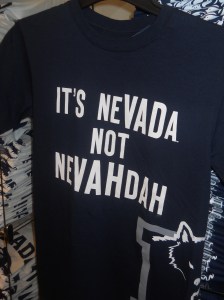
How to pronounce “Nevada.” Picture source: eventflags.com/Nevada-Decals-and-Magnets/
Part of running for president in the United States is that you have to travel around the country and visit places. While you’re there, you’re expected to do two things:
Eat whatever food is associated with the region or the immigrants who settled the region (with the exception of Native Americans, we’re all immigrants in this country) and appear to enjoy it.
Pronounce the name of the place that you’re in correctly.
This being the bizarre election cycle that it is, Trump chose instead, on a recent visit to Nevada, to get it backwards. Most Americans pronounce it Ne-VAH-da, but Nevadans pronounce it Ne-VA-da. That is: most Americans pronounce the middle vowel of Nevada with the vowel of hot, but the locals pronounce the middle vowel with the vowel of hat. Trump got it backwards—and made a big deal about it. My guess is that he did this in an attempt to draw the news coverage away from the fact that he had no clue what people were talking about when they asked him about the Yucca Mountain nuclear waste site, the hottest issue in Nevada politics. (Yes, Hillary knew what they meant.)
How to pronounce “Nevada.” Picture source: nevadawolfshop.com
Place names are weird in America, and in France, too. It’s definitely not always possible to know how they’re pronounced by anyone, let alone by the locals, just by seeing the spelling. My home town’s Couch St.? It’s pronounced kooch. Mind you, we call a couch a couch, just like anyone else (unless it’s a sofa)–but, Couch St. is pronounced Kooch St. Macadam St.? No, it’s not Ma-CA-dam—it’s MA-cadam. In France? Forget it. Rennes is [ʁɛn] (listen), which you could guess from the spelling, but Reims is [ʀɛ̃s] (Écouter) , which I don’t think you can. Lille is [lil]Écouter), which you could guess, but if you’re like me, you’ve wondered a thousand times if it’s supposed to be pronounced like fille. Of course, any French person would laugh their ass off at the pronunciation of the name of the city of Beaufort in South Carolina, which is totally different from the pronunciation of the name of the town of Beaufort in North Carolina. Do you pronounce the x at the end of deux, or aux, or peux? No. Do you pronounce the x at the end of Aix and Dupleix? Why, yes–you do.
How to pronounce “Nevada.” Picture source: oliviapiotter.wordpress.com/
Indeed, there has been plenty of press coverage about Trump insisting that Nevadans pronounce the name of their state his way, and it has drowned out the little bit of press coverage about what Nevadans actually seem to care about, which is Trump showing up in their state without having taken the time to find out what the issues of concern there. But, this being the bizarre election that it’s been, it’s hard to believe that any of this will affect anything. Are you an American? Get out there and vote, or you can’t really complain if you end up with a reality TV star for a president…
English notes:
to laugh one’s ass off: to laugh very hard. DO NOT use this in circumstances where you would not use bad language. Hey Steve, you want to hear a joke so funny you’ll laugh your ass off? Steve, tu veux entendre une blague super drôle tu seras péter de rire ? (Source: reverso.net) And you’re gonna laugh your ass off, ’cause it’s really freakin’ funny. Et vous allez vous péter de rire, parce c’est vraiment trop drôle. (Source: reverso.net) How it was used in the post: Of course, any French person would laugh their ass off at the pronunciation of the name of the city of Beaufort in South Carolina, which is totally different from the pronunciation of the name of the town of Beaufort in North Carolina.
French notes:
Apropos of nothing but my desire to make blogger Bea dM smile, here is a list of Italian place names, in French.
I’m bald…et je suis gentil–I’m putting it nicely. The full version: I’m bald, fat, and old.
Nevertheless, every Tuesday morning I stop at Giorgio’s hair salon and take my seat in the chair. (I’m pretty sure that Giorgio is actually Georges, as his French is both Parisian and quite hip. A demen, he says to his employees as they head out the door at the end of the day–à demen.) The reason for my weekly visit: my hairdresser Nadine is helping me with my bise.
Kevin, she sneered, if you’re going to do la bise, you have to really do it. Apparently my air-kisses were too air and not enough kiss.
La bise is the French cheek-kiss that makes us Americans so incredibly uncomfortable. (Turnabout is fair play, and the American habit of hugging makes the French incredibly uncomfortable, so don’t feel like you’re at a cultural disadvantage here no matter which side of the Atlantic you’re from.) I ran into a French colleague at a conference a couple months ago. She was chatting with a bunch of French friends, so it made sense to faire la bise when we caught sight of each other. I did my best. Kevin, she sneered, if you’re going to do la bise, you have to really do it. Apparently my air-kisses were too air and not enough kiss. (This odd use of to sneer is explained in the English notes at the end of the post.)
Nadine has been happy to step in and help. After a few weeks, she was happy with my performance. “Ah, the French kiss,” she said after our exchange, clearly pleased with her didactic skills–in English. Now, Nadine doesn’t actually speak English, so I switched to French: Nadine, “French kiss” means something different in English. Oh, really? What? I explained. (See this post for how to say French kiss in French.) Oh–NO. Firm head-shake–there was no tongue in my future.
For me, the hardest part of la bise is remembering not to hug the person at the same time. That’s a big mistake–see this post for a story about just how awkward things can get if you forgot not to make that very American gesture. My current tactic: when I lean in for the kiss, I put my hands together behind my back. I imagine that it must look odd, but it’s better than the embarrassment of hugging when I oughtn’t. All in all, mind you, I find it a charming custom. Apparently not all foreigners do, though–here’s a clip from French Fried TV in which Paul Taylor complains in loud British English about all the bother. Subtitles in French. And, yes: the CombienDeBises.com web site is for real.
English notes below the video.
English notes
to sneer (something): to say while sneering. I believe that verbs like this, which are normally intransitive (that is, they don’t have an object) but can also be used for conveying what someone else said without a change in the tense of the original utterance, are called quotatives. (Compare “I screwed up that bise,” he said…where the person and tense of I screwed up doesn’t change, with He said that he screwed up that bise, where the person changes from I to he.English has an enormous number of verbs that don’t seem to have anything to do with speaking, but that can nonetheless be used in exactly this way. The wonderful children’s book The Phantom Tollbooth is packed with examples. How it was used in the post: Kevin,she sneered, if you’re going to do la bise, you have to really do it. Apparently my air-kisses were too air and not enough kiss.
‘My Boticelli nymph,’ he smiled, slipping it behind her ear.
Ahem!’ he coughed. I’ll take more careful aim.
‘It’s all so unbelievable,’ he choked.
The quotatives that everyone likes to complain about are to be like and to be all. I think they’re mostly American, but couldn’t swear to that. They’re characteristic of younger people. She was like, “I’m not kissing him!” He was all “well, I have baseball practice tonight.” You don’t have to use these, but you should recognize them when you hear them.
Bullies want to fight victims, not adversaries. –Bruce Tegner
When I was a kid, instructions for dealing with a bully were clear and unambiguous: fight him. Bullies deal in the currency of fear and intimidation, and what they told us is true: if you come at them, they will typically back down. My favorite Navy fight stories are not about fights–they’re about fights that didn’t happen, because I didn’t back down from a bully, and then he backed down from me. (This probably makes me sound like a badass. I’m not–I’m a total wimp. But, at some point, the possibility of being beaten shitless is a lot less painful than continuing to be bullied by some asshole.)
At this point in our bizarre election cycle, all of the talk is about confrontation. Last night was what the French press called the first passe d’armes between Clinton and Trump. I would guess that most of us turned on the TV to watch the debate with a fair amount of trepidation. What would Trump do? Would he literally beat his chest like a fucking gorilla? Would he lash out from the git-go? (This expression explained below in the English notes.) As it turned out, Clinton did what they told us to do when I was a kid: she got right in his face. She took the fight to him. Trump did what he’s done in the past when confronted with a woman who wouldn’t back down: he folded. (I’m thinking here of Carly Fiorina and the Rev. Faith Timmons.)
When I was a kid, everyone advised fighting bullies–parents, teachers, the world. In American schools today, kids who are involved in anything remotely resembling a fight are suspended from school, whether they initiated it, or they were attacked–see here, or here, or here for news stories about kids being thrown out of school for standing up to a bully.
How kids are supposed to deal with bullies under those conditions, I have no clue. I mean, I can read, so I know what the current advice is:
Reframe the problem of bullying. By changing your attitude towards bullying you can help regain a sense of control. Try to view bullying from a different perspective. (That’s Tip #2 from this page.)
Feel good about you. Nobody’s perfect, but what can you do to look and feel your best? Maybe you’d like to be more fit. If so, maybe you’ll decide to get more exercise, watch less TV, and eat healthier snacks. Or maybe you feel you look best when you shower in the morning before school. If so, you could decide to get up a little earlier so you can be clean and refreshed for the school day. (I think that’s what you call “blaming the victim.” I found that gem of anti-bullying here.)
It is incredibly important that you go through the appropriate reporting channels by firstly telling a teacher/parent/guardian/learning mentor or another responsible adult. (Anyone in the reading audience have success with this as a child? Found that one at the Ditch The Label site–they describe themselves as “one of the largest anti-bullying charities in the world.”)
…so, yes, I know what kids are told to do. But, what are kids supposed to do that might actually work? ‘Cause I’m pretty sure that “reframing the problem of bullying” would not have done much for the girl I was in the Navy with who our bully decided to go after one day by hanging up the sheets that she’d been sleeping on for her 24-hour stretch of ambulance duty so that it would be clear to the world that she was on her period.
Anyone know how kids are taught to deal with bullies in France? Surely it’s nothing this stupid…
French notes
un affrontement: confrontation, battle, clash. Premier affrontement musclé entre Hillary Clinton et Donald Trump (headline, RFI, https://goo.gl/2nLOUO) Affrontement Clinton-Trump: un débat qui devrait fracasser des records (headline, Huffington Post Québec, https://goo.gl/HTZMTX) L’affrontement entre les deux prétendants à la Maison-Blanche a été rude, avec dans le rôle du chœur les internautes et les médias (Le Temps, https://goo.gl/jRveH4)
une passe d’armes: échange énergique; sparring. #Trump2016#Clinton Premières passed’armes entre les deux candidats (TV5MONDE tweet) Vive passed’armes. “Je ferai revenir nos emplois, vous ne pouvez pas le faire” – Trump. “Donald, vous vivez dans un monde à part” – Clinton (AFP USA, tweet) Première passe d’armes entre Clinton et Trump sur l’économie (headline, Libération)
la brute, le tyran: bully.
la brimade: bullying, baiting, vexation, aggravation. This is the title of the French Wikipedia page on bullying.
English notes
from the git-go: from the beginning. Here‘s a post about the expression from the Grammarphobia blog.
The English word bully can have other meanings besides brute or tyran. Here are some:
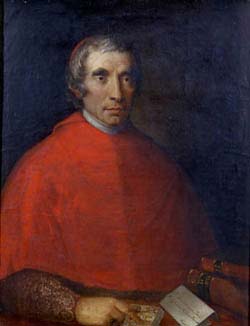
In his book Babel no more: The search for the world’s most extraordinary language learners, Michael Erard talks about Cardinal Giuseppe Mezzofanti. Mezzofanti spoke a lot of languages. It’s not clear exactly how many–certainly that depends on your definition of what it means to “speak” a language–but, nevertheless, it was a ridiculously large number of languages. Something that Erard says about him really struck me: What [we] can’t explain is how he could switch from one language to another without confusing them. Here’s an anecdote from the book:
On one occasion, Pope Gregory XVI (1765-1846), a friend of Mezzofanti, arranged for dozens of international students to surprise him. When the signal was given, the students knelt before Mezzofanti and then rose quickly, talking to him “each in his own tongue, with such an abundance of words and such a volubility of tone, that, in the jargon of dialects, it was almost impossible to hear, much less to understand them.” Mezzofanti didn’t flinch but “took them up singly, and replied to eachin his own language.” The pope declared the cardinal to be victorious. Mezzofanti could not be bested.
Why this struck me: we’ve talked before about the difficulty that many people have with keeping foreign languages “separate.” Before a recent trip to Guatemala, I prepared by basically purging French from my life completely for the month before I went there. I didn’t study French vocabulary, I didn’t listen to the news in French, and I didn’t read in French. Of course, I listened to Spanish podcasts, I read in Spanish (a book about semantics, and The Walking Dead–I’m not picky), and I watched Spanish-language movies. But, pushing French out of my head was as important to the process as packing Spanish into it.
So, when I got to Guatemala, it was interesting to see where I had trouble keeping the two apart. I don’t really know what to make of it. Here are the facts.
For background: I would never claim to speak either French or Spanish. I’m pretty comfortable in Spanish, which serves very nicely with my siblings if we want to have a private conversation in Shanghai, and when I’m in France, I don’t speak English very often–I live my life in French, both personal and professional. I would guess that my vocabulary is a thousand times better in French than in Spanish, and that my grammar is a thousand times better in Spanish than in French. Pronunciation: who knows.
So: as it turns out, I didn’t have trouble keeping the vocabulary apart. What I had trouble with was the little stuff. Here are some specific things that struck me:
Possessives
In French, there are three (simplifying by just talking about the second person informal, since that’s what I use the most in the hospital):
tes for plural nouns. Sou: tes parents your parents, tes soeurs your sisters.
ton for masculine nouns and before any noun that begins with a vowel. So: ton chiot, your puppy, because chiot ‘puppy’ is masculine; ton orange, your orange, even though orange ‘orange’ is feminine, because it begins with a vowel.
ta for feminine nouns that don’t begin with a vowel. So: ta chaussette your sock.
In contrast, Spanish only has two:
tus for plural nouns. So: tus padres your parents, tus hermanas your sisters.
tu for singular nouns. So: tu perrito your puppy, tu amigito your little friend.
It’s things like tu amigito that threw me. I just could not wrap my tongue around the sequence tu + vowel. It just…stopped. Eventually I would push it out, while people turned and looked at me like what’s up with the old dude?
The word after
Even after a week incountry, if I did not pay attention, the Spanish word después ‘after’ would not come out of my mouth. Instead, it was the equivalent French word: après. Even if I did pay attention, I really had to struggle to dig up después. I eventually started pausing every time I needed to say after, and thinking to myself: say después, notaprès.
Excuse me
If I had a nickel for every time that I said pardon or désolé instead of con permiso or disculpe…
The “excuse me” problem doesn’t puzzle me that much–that’s right-brain language. The little function words, though–I’m not sure what to think about that particular phenomenon. It’s a pretty small sample, so maybe I shouldn’t generalize.
The other funny thing about Cardinal Mezzofanti: apparently, he didn’t actually have much of interest to say. As Erard puts it:
Despite this…Mezzofanti was…the target of sarcastic barbs. Irish writer Charles Lever wrote that Mezzofanti “was a most inferior man….An old dictionary would have been to the full as companionable.” Baron Bunsen, a German philologist, said that in all the countless languages which Mezzofanti spoke he “never said anything.” He “has not five ideas,” said a Roman priest quoted in a memoir.”
Speaking as someone who was once married to a woman who coined the term of venerya boring of linguists, I fear that there may be a cautionary note for me here…
Talking about the ideal and the desired in French and in English: ways to say “should,” with some comics.
Why Paul Ryan should vote for Hillary Clinton. —headline, The Fiscal Times
Speaker Paul Ryan should disavow Donald Trump. —headline, Milwaukee Journal-Sentinel
Paul Ryan says Donald Trump should release tax returns —headline, Wall Street Journal
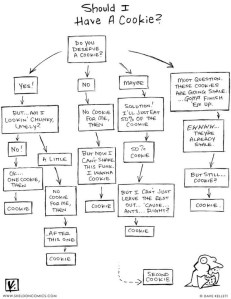
Should I have a cookie? Picture source: http://www.thatsnerdalicious.com/funny/the-eternal-question-should-you-have-a-cookie/It’s amazing (and more than a little depressing) to me that such enormous holes persist in my French, even after 2 3/4 years of studying really, really hard! I just realized that I don’t know how to express the difference between must and should. Obligation–must–that, I can express. It’s the verb devoir in the present tense. Ideal actions, desired actions–that’s a bit more complicated, both in French and in English. (See the English notes at the bottom for the English issues.)
See here for more information about parallel corpora like OPUS 2.
To express the idea of should, we still use devoir, but we need its conditional tenses. For the English present tense, e.g. I should, we use the French present conditional of devoir. You can read about how to do so here on the Lawless French web site; I’ll give you some examples from the Sketch Engine web site. I used Sketch Engine to search the OPUS2 corpus, a collection of billions of words of text in 40 different languages, drawn from sources as diverse as movie subtitles and the proceedings of the European Parliament, and lined up with each other wherever possible. We’re talking 1.1 billion words of English, 600,000 words of Afrikaans, 46 million words of Albanian, 300 million words of Arabic, etc. French? Almost 766 million.
Don’ t you think that before shooting a spy, we should makehim talk?
Vous ne pensez pas qu’avant d’abattre un espion, on devrait le faireparler?
Now that we have finished the script, we should save it to disk.
Maintenant que nous avons fini le script, nous devrions l’enregistrer sur le disque.
Well, then, I think we should go out on a Sunday night.
On devrait sortir le dimanche soir alors.
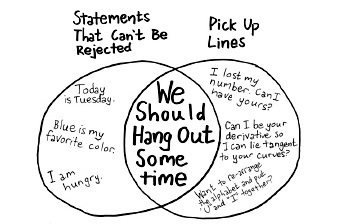
What we should do is have dinner sometime.
On devrait dîner ensemble un soir.
Should I have a cookie? Picture source: http://www.thatsnerdalicious.com/funny/the-eternal-question-should-you-have-a-cookie/To talk about something that you should have done in the past, you need the past conditional of devoir. Here‘s the Lawless French page with an example–there’s a more detailed lesson hidden somewhere on the Lawless French Kwiziq site, but I have no clue how to tell you how to find it. Again, I’ll give you some examples from the OPUS 2 corpus, retrieved via the Sketch Engine web site:
I knew we should have stayed on this case.
Je savais qu’on aurait dû rester sur cette affaire.
Maybe we should have bought some rice in town.
On aurait peut-être dû acheter du riz en ville.
According to all you told us, and to all calculations … we should have located the mine two days ago.
D’après ce que vous nous avez dit et nos calculs, nous aurions dû trouver la mine il y a deux jours.
Wonder if we should have told the exec about that package … … Mike used to keep under his sack.
Je me demande si on aurait dû parler du paquet … – que Mike gardait sous sa couchette.
As a result, we have not been able to make as much progress as we should have.
En conséquence, nous n’avons pas pu réaliser tous les progrès que nous aurions dû accomplir.
https://thebarcelonabookclub.wordpress.com/tag/we-should-hangout-sometime/It’s hard to believe that the 2020 Republican primaries won’t see Paul Ryan pitted against Tom Cruz. Cruz will still be as scary then as he is now, I imagine–personally, I find him even more frightening than Trump, and I find Trump pretty damn frightening. Paul Ryan will continue to bear the burden of his failure (so far) to denounce Trumpism, which probably won’t hurt him much in the Republican primaries, but I hope will keep him from winning the general election.
English notes
If you’re French: I probably don’t have to tell you that should in English is at least as bizarre as it is in French. There’s a good web page on it here, from the Cambridge Dictionary. Note that the page describes the British uses of the word, which are different from the American ones in some respects. For example, the conditional form should you, as in should you want some coffee…, is not used in America–we would say if you want some coffee… The UK also has a formal/neutral alternation between should and would that we don’t have in the US. For example, the Brits have neutral I would love to come and formal I should love to come, but in the US, only I would love to come will work. Finally, oughtn’t instead of shouldn’t is more formal in British English, but it’s dialectal and possibly stigmatized in the US.
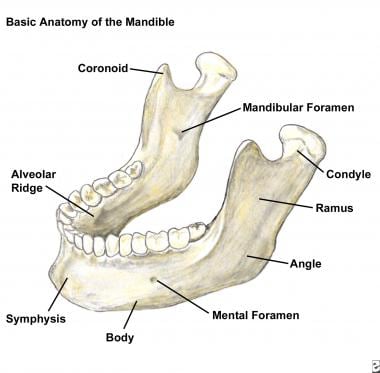
Even more than soccer, flirting is often said to be France’s national sport. I like it–it’s fun, and (so far) a harmless way to practice my French. So, I was chatting with a girl over a cup of coffee in a café by the Museum of Comparative Anatomy and Paleontology one day (no, I’m not making that museum up–along with the Pergamon in Berlin and the British National Museum in London, it’s one of my favorites in the entire world, and I can’t even imagine how many hours I’ve spent there) when she said something that made my ears perk up: she mentioned la partie inférieure de la mâchoire. The “lower part of the jaw:” what you and I probably know as the mandible, and most French speakers as la mandibule.
On the surface, the jaw doesn’t look that interesting. One bone, with a pretty simple hinge on each side. It’s got a lot of subtleties, though, and if you look at how jaws vary across species, a jaw can tell you a lot about an animal.
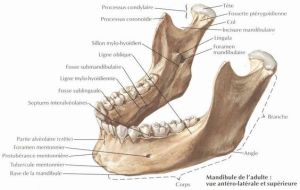
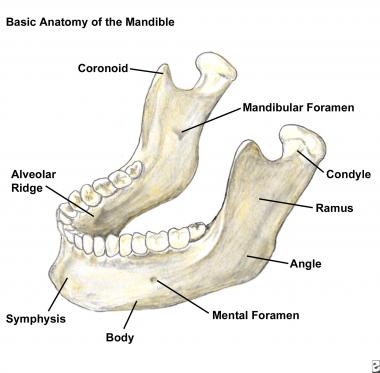
Let’s look at the “gross anatomy” first–the basic parts. In many species, the mandible has two main parts: the body, and the ramus. The body is the part that’s parallel to the ground, and the ramus is the part that goes up vertically. We’ll go through the French vocabulary now, rather than at the end of the post, because it’s essential to understanding my flirty ways.
la mâchoire: the jaw; jawbone.
la partie inférieure de la mâchoire: the lower part of the jaw. The official term for the mandible.
la partie supérieure de la mâchoire: the maxilla–again, the “official” term.
la branche de la mandibule: the ramus of the mandible.
le corps de la mandibule: the body of the mandible.
Why it made my ears perk up when she said la partie inférieur de la mâchoire: as far as I know, that’s the technical term for the mandible, versus la mandibule, which I believe to be more general language. How often do you meet someone whose idea of witty repartee includes throwing around technical terms for bones? Of course, then a bum walked by. Blah blah blah blah, you gotta blah blah for me?
What’s a blah-blah? …I asked my terminologically gifted new friend. He wants a cigarette, she replied. And what does blah blah blah blah mean?
“Kevin Costner”–he called you Kevin Costner.
How the fuck does he know my name’s Kevin?
He doesn’t–you’re an American, and you’re bald, so…
Whatever.
English notes:
to make someone’s ears perk up: to make someone suddenly interested in what you’re saying. How it was used in the post: She said something that made my ears perk up: she mentioned la partie inférieure de la mâchoire.
repartee: (Yes, this is an English word.) Witty conversation that goes back and forth. From Merriam-Webster: conversation in which clever statements and replies are made quickly. How it was used in the post: How often do you meet someone whose idea of witty repartee includes throwing around technical terms for bones?
In truth, though: it’s not so clear that it’s a great thing. One of the problems with Big Data is a special case of a general problem in the ethics of technology: the kinds of things that can go wrong when the public perception of how well/poorly technology performs doesn’t match well with the truth. In particular: when the public thinks that technology performs way better than it does.
You will occasionally hear people talking about how algorithms are going to take our jobs, bring about the zombie apocalypse prematurely, etc. More commonly, technology gee-whizzers will tell you the opposite: that they will remove bias and introduce complete objectivity to sentencing guidelines, for instance. In fact, an algorithm is nothing more (or less) than a defined set of procedures. In the case of an algorithm for computing, it’s typically a set of calculations. An algorithm can’t be biased. It can’t be unbiased, either. The data, though: that can be biased. An example from the interview: train an algorithm to evaluate resumes from applicants for jobs at an engineering firm. You could imagine training it with the resume of everyone who has ever been hired in the past, and the following piece of information for each person: whether or not they were a successful employee. If the engineering firm is a typical one, those previous hires are mostly going to have been males. Now the program learns the characteristics of a successful hire, and among other things, the program will conclude that a successful hire is going to be a male, since that’s all that it’s ever seen. Is the algorithm biased? No. Is the person who programmed it biased? No. What’s biased? The data. Not biased in the way that a person is biased–rather, biased in the statistical sense: not every member of the population had an equal likelihood of being included in the training set.
Where people get seduced by things with the Big Data label on them is by the bigness. Most people know that the bigger your data set is, the more reliable the statistical model that comes out of it will be. A lot of people look at Big Data and think: there’s a LOT of data, so it’s GOT to be good. That’s where the trouble comes from.
I like this interview because it’s neither a gee-whiz-this-technology-is-so-great story, nor an ignorant oh-my-God-the-data-miners-are-going-to-kill-us story. The interviewee, Cathy O’Neil, knows what she’s talking about, and she explains it well. The unbiased sentencing program? It didn’t work out so great–see a very detailed story about it here.
to sentence to (a punishment): to assign a punishment or penalty to someone. Examples: A 46-year-old man threw feces in a Clark County, Ohio, courtroom Wednesday after learning he was being sentenced to 40 years in prison for armed robbery. (Story here.) Alan Turing, the pioneering computer scientist and cryptanalyst who cracked the Nazis’ Enigma code, was sentenced to chemical castration as a punishment for his homosexuality.
sentencing guidelines: instructions for how to determine the length of the jail or prison sentence of someone who has been convicted of a crime. How it was used in the post: More commonly, technology gee-whizzers will tell you the opposite: that they will remove bias and introduce complete objectivity to sentencing guidelines, for instance.
Help! I need advice on memorizing conjugations. I don’t remember how the hell I did it in school, and I’ve got 30 days left to prepare for the DELF/DALF exams. I have no clue about how to handle the fact that I don’t know which conjugations I don’t know. I’m pretty sure that there are some tenses that I’m weaker on than others, some verb classes that I’m weaker on than others, and some irregulars that I’ve never even heard about… I’ve got the things that I know that I’m weaker on on my todo list for the month leading up to the exams, but I don’t know how to figure out what I don’t know. How do you do it? (I am not a big fan of ending blogs that way, but: how DO you do it??)
English notes:
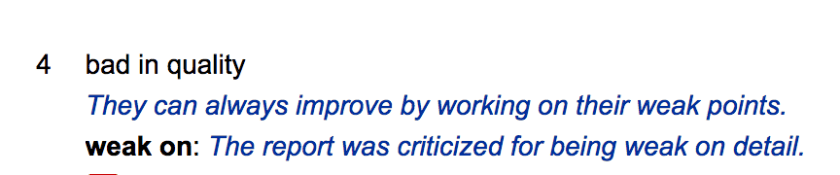
to be weak on [a subject]: to not have sufficient knowledge of some subject. See the definition below from Macmillan. (There’s also a use that means something like not taking a strong or effective stance against something, and you see that in the news all the time right now–candidates accuse each other of being weak on crime, weak on ISIS, weak on Russia, etc. That’s a different sense, though.) How it appeared in the post: I’m pretty sure that there are some tenses that I’m weaker on than others, some verb classes that I’m weaker on than others, and some irregulars that I’ve never even heard about…















 Zipf's Law