Movement of bodies: the illustrated version

Fields, lexical and otherwise: Henry Reed’s sweetly funny WWII poem “Movement of bodies.”

For the third day of National Poetry Month, here is more of the gentle humor of Henry Reed.  This version of Movement of bodies, published in 1950, comes from the Sole Arabian Tree web site, where you can find a recording of Henry Reed reading the poem.

LESSONS OF THE WAR

III. MOVEMENT OF BODIES
Those of you that have got through the rest, I am going to rapidly
Devote a little time to showing you, those that can master it,
A few ideas about tactics, which must not be confused
With what we call strategy. Tactics is merely
The mechanical movement of bodies, and that is what we mean by it.
Or perhaps I should say: by them.

Strategy, to be quite frank, you will have no hand in.
It is done by those up above, and it merely refers to,
The larger movements over which we have no control.
But tactics are also important, together or single.
You must never forget that, suddenly, in an engagement,
You may find yourself alone.

This brown clay model is a characteristic terrain
Of a simple and typical kind. Its general character
Should be taken in at a glance, and its general character
You can, see at a glance it is somewhat hilly by nature,
With a fair amount of typical vegetation
Disposed at certain parts.

Here at the top of the tray, which we might call the northwards,
Is a wooded headland, with a crown of bushy-topped trees on;
And proceeding downwards or south we take in at a glance
A variety of gorges and knolls and plateaus and basins and saddles,
Somewhat symmetrically put, for easy identification.
And here is our point of attack.

But remember of course it will not be a tray you will fight on,
Nor always by daylight. After a hot day, think of the night
Cooling the desert down, and you still moving over it:
Past a ruined tank or a gun, perhaps, or a dead friend,
In the midst of war, at peace. It might quite well be that.
It isn’t always a tray.

And even this tray is different to what I had thought.
These models are somehow never always the same: for a reason
I do not know how to explain quite. Just as I do not know
Why there is always someone at this particular lesson
Who always starts crying. Now will you kindly
Empty those blinking eyes?

I thank you. I have no wish to seem impatient.
I know it is all very hard, but you would not like,
To take a simple example, to take for example,
This place we have thought of here, you would not like
To find yourself face to face with it, and you not knowing
What there might be inside?

Very well then: suppose this is what you must capture.
It will not be easy, not being very exposed,
Secluded away like it is, and somewhat protected
By a typical formation of what appear to be bushes,
So that you cannot see, as to what is concealed inside,
As to whether it is friend or foe.

And so, a strong feint will be necessary in this, connection.
It will not be a tray, remember. It may be a desert stretch
With nothing in sight, to speak of. I have no wish to be inconsiderate,
But I see there are two of you now, commencing to snivel.
I do not know where such emotional privates can come from.
Try to behave like men.

I thank you. I was saying: a thoughtful deception
Is always somewhat essential in such a case. You can see
That if only the attacker can capture such an emplacement
The rest of the terrain is his: a key-position, and calling
For the most resourceful manoeuvres. But that is what tactics is.
Or I should say rather: are.

Let us begin then and appreciate the situation.
I am thinking especially of the point we have been considering,
Though in a sense everything in the whole of the terrain,
Must be appreciated. I do not know what I have said
To upset so many of you. I know it is a difficult lesson.
Yesterday a man was sick,

But I have never known as many as five in a single intake,
Unable to cope with this lesson. I think you had better
Fall out, all five, and sit at the back of the room,
Being careful not to talk. The rest will close up.
Perhaps it was me saying ‘a dead friend’, earlier on?
Well, some of us live.

And I never know why, whenever we get to tactics,
Men either laugh or cry, though neither is strictly called for.
But perhaps I have started too early with a difficult task?
We will start again, further north, with a simpler problem.
Are you ready? Is everyone paying attention?
Very well then. Here are two hills.


English notes

This poem is full of delightful plays on multiple meanings of words, most of which I’ll skip to focus on the lexical field of geographic terms.  Reed uses a bunch of terms that refer to elements of topography (Merriam-Webster: the art or practice of graphic delineation in detail usually on maps or charts of natural and man-made features of a place or region especially in a way to show their relative positions and elevations) as metaphors for a woman’s body.  Many of these are terms that a typical native speaker (including myself) wouldn’t necessarily be able to define specifically, although I would guess that most people would at least know that they refer to elements of a terrain, and might even be able to group them into two classes: ones that refer to elevations (high points), and ones that refer to depressions (Merriam-Webster: a place or part that is lower than the surrounding area :  a depressed place or part :  hollow ).  I’ll split them out in that way, then follow them with a few miscellaneous terms.  (All links to Merriam-Webster are to the definition for that word.)  For a reminder, here’s a paragraph from near the beginning of the poem:

Here at the top of the tray, which we might call the northwards,
Is a wooded headland, with a crown of bushy-topped trees on;
And proceeding downwards or south we take in at a glance
A variety of gorges and knolls and plateaus and basins and saddles,
Somewhat symmetrically put, for easy identification.
And here is our point of attack.

Elevations
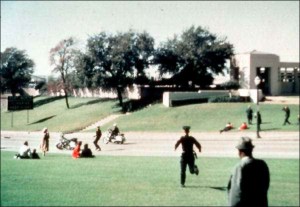
bond1
The famous “grassy knoll.” I got this off of a JFK assassination conspiracy theory website, but have no idea to whom it should actually be credited.

knoll: Merriam-Webstera small round hill :  mound.  The term grassy knolla small hill covered with grass, is closely associated with the assassination of President John F. Kennedy, particularly with conspiracy theories about it.

headland: Merriam-Webstera point of usually high land jutting out into a body of water :  promontory

plateau: Merriam-Webster: a usually extensive land area having a relatively level surface raised sharply above adjacent land on at least one side :  tableland

Depressions
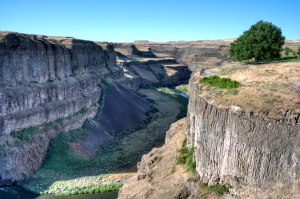
palouse-river-gorge
The Palouse River Gorge. Picture source: https://goo.gl/zkU7CN

gorge: Merriam-Webstera narrow passage through land; especially :  a narrow steep-walled canyon or part of a canyon

basin: Merriam-Webstera large or small depression in the surface of the land or in the ocean floor.  As I speak a bit of French, it’s difficult not to make the association here with le bassin, the pelvis.
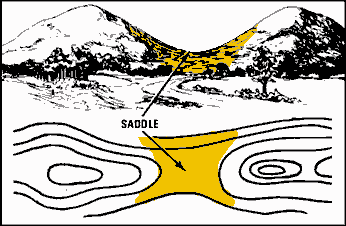
b5_1211
Picture source: armystudyguide.com, https://goo.gl/SNBe4g

saddle: Merriam-Webstera ridge connecting two higher elevations; a pass in a mountain range.  In English, this has the same connections with sex as it does in French: J’en ai-t-y connu des lanciers, // Des dragons et des cuirassiers // Qui me montraient à me tenir en selle // A Grenelle!

Others

wooded: Merriam-Webstercovered with growing trees

engagement: In the context of the poem, the most obvious meaning is the military one of a hostile contact between enemy forces (Merriam-Webster).  Presumably Reed is also playing here on the more commonly-used meaning of a commitment to marriage (my best guess on all of the crying trainees).

tactics versus strategy: tactics are short-term–a tactical nuclear weapon is one that you would use on the battlefield.  (Not very fun to think about, is it?  When I tell people that some aspects of the peacetime military seem kinda silly and they ask me for examples, I always tell them about our “what to do in case of nearby nuclear weapon explosion” drills.)  In contrast, strategic nuclear weapons are meant for the bigger picture–the stuff that you would use to hammer the other guy’s country in such a way that he becomes unable to continue fighting at all.  My tactics in my professional life mostly consist of making schedules to ensure that I don’t miss deadlines, while my strategy is the set of papers that I plan to publish in the next few years.  From the poem:

Strategy, to be quite frank, you will have no hand in.
It is done by those up above, and it merely refers to,
The larger movements over which we have no control.
But tactics are also important, together or single.
You must never forget that, suddenly, in an engagement,
You may find yourself alone.


Judging distances: the illustrated version

More wistful beauty from Henry Reed’s WWII poetry

For the second day of National Poetry Month, here is more of Henry Reed’s wistful beauty.  I got this version from the Sole Arabian Tree web site; at the bottom of their page for this poem, you can find a link to a recording of it.  After the poem, you’ll find a couple of notes on the vocabulary.

LESSONS OF THE WAR, by Henry Reed 

Published 1943

II. JUDGING DISTANCES

Not only how far away, but the way that you say it
Is very important. Perhaps you may never get
The knack of judging a distance, but at least you know
How to report on a landscape: the central sector,
The right of the arc and that, which we had last Tuesday,
And at least you know

That maps are of time, not place, so far as the army
Happens to be concerned—the reason being,
Is one which need not delay us. Again, you know
There are three kinds of tree, three only, the fir and the poplar,
And those which have bushy tops to; and lastly
That things only seem to be things.

A barn is not called a barn, to put it more plainly,
Or a field in the distance, where sheep may be safely grazing.
You must never be over-sure. You must say, when reporting:
At five o’clock in the central sector is a dozen
Of what appear to be animals; whatever you do,
Don’t call the bleeders sheep.

I am sure that’s quite clear; and suppose, for the sake of example,
The one at the end, asleep, endeavors to tell us
What he sees over there to the west, and how far away,
After first having come to attention. There to the west,
On the fields of summer the sun and the shadows bestow
Vestments of purple and gold.

The still white dwellings are like a mirage in the heat,
And under the swaying elms a man and a woman
Lie gently together. Which is, perhaps, only to say
That there is a row of houses to the left of the arc,
And that under some poplars a pair of what appear to be humans
Appear to be loving.

Well that, for an answer, is what we rightly call
Moderately satisfactory only, the reason being,
Is that two things have been omitted, and those are very important.
The human beings, now: in what direction are they,
And how far away, would you say? And do not forget
There may be dead ground in between.

There may be dead ground in between; and I may not have got
The knack of judging a distance; I will only venture
A guess that perhaps between me and the apparent lovers,
(Who, incidentally, appear by now to have finished,)
At seven o’clock from the houses, is roughly a distance
Of about one year and a half.


English notes

gkvp0cz
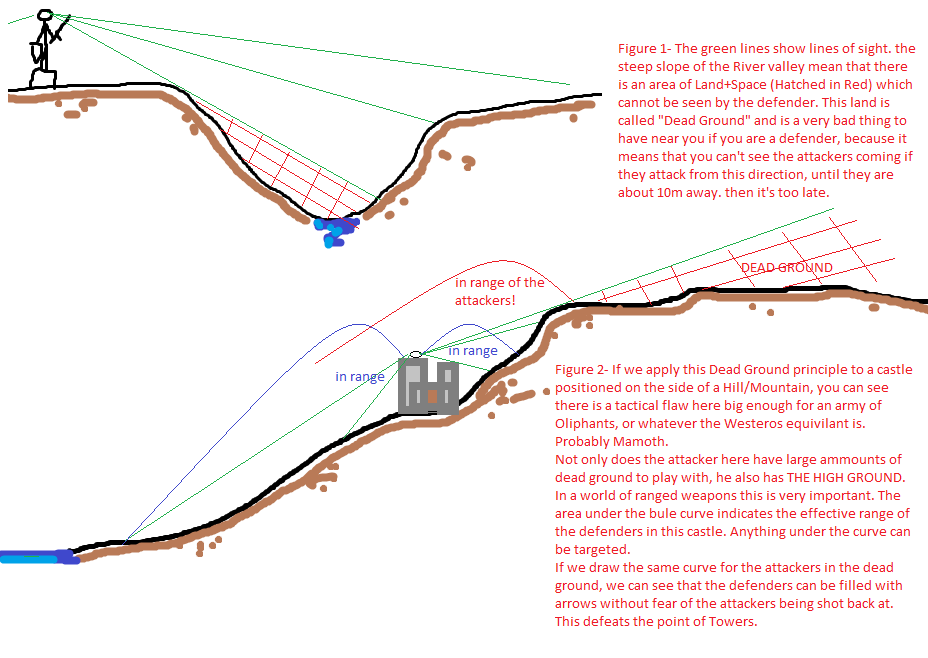
This illustration seems to come from a forum about a computer game or something. Nonetheless: it’s a pretty good illustration of dead ground! Picture source: https://goo.gl/5rWBHB

dead ground: technically, this is space that cannot be observed.  Tracing back through references, it seems to have come from a term for describing parts of the base of a castle’s fortifying walls that were sheltered from fire by the defenders, and therefore were weak points vulnerable to attack.  Here’s one Quora writer’s definition of it:

Dead Ground is when the observer is unable to resolve keeping eyes on over an intermediate part of the stretch of ground being observed. The observer may be interchanged with detection equipment and includes areas of surveillance which are obscured from a clear alarm signature (environmental distortion from clear auditory reception) or trigger reception (automatic pixel motion detection) by the way the observer is angled. Dead ground exists in hidden embankments and undulating paths, roads or desert open areas with heat waves rising and obscuring or creating distorted imagery.

Naming of parts: the illustrated version

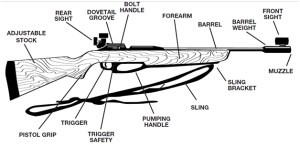
basic_rifle_parts
Picture source: https://goo.gl/b9U0dY

It’s April 1st, and that means National Poetry Month.  Here’s one that I find both achingly beautiful and super-funny.  Getting the humor might require having spent some time in the military, which I did; getting the vocabulary certainly does, as it’s full of technical terms for rifle-parts.  I found the version that I give here, with its nice links to some of the difficult vocabularyon the Sole Arabia Tree web site.  Go to it for a recording of Henry Reed reading the poem.

LESSONS OF THE WAR

To Alan Michell

Vixi duellis nuper idoneus
Et militavi non sine gloria

I. NAMING OF PARTS

To-day we have naming of parts. Yesterday,
We had daily cleaning. And to-morrow morning,
We shall have what to do after firing. But to-day,
To-day we have naming of parts. Japonica
Glistens like coral in all of the neighboring gardens,
And to-day we have naming of parts.

This is the lower sling swivel. And this
Is the upper sling swivel, whose use you will see,
When you are given your slings. And this is the piling swivel,
Which in your case you have not got. The branches
Hold in the gardens their silent, eloquent gestures,
Which in our case we have not got.

This is the safety-catch, which is always released
With an easy flick of the thumb. And please do not let me
See anyone using his finger. You can do it quite easy
If you have any strength in your thumb. The blossoms
Are fragile and motionless, never letting anyone see
Any of them using their finger.

And this you can see is the bolt. The purpose of this
Is to open the breech, as you see. We can slide it
Rapidly backwards and forwards: we call this
Easing the spring. And rapidly backwards and forwards
The early bees are assaulting and fumbling the flowers:
They call it easing the Spring.

They call it easing the Spring: it is perfectly easy
If you have any strength in your thumb: like the bolt,
And the breech, and the cocking-piece, and the point of balance,
Which in our case we have not got; and the almond-blossom
Silent in all of the gardens and the bees going backwards and forwards,
For to-day we have naming of parts.

What it means to be an iguana: the Jaccard index

In the end, what does it really mean to be an iguana, and how could you tell?

The big thing in language these days is distance-based representations of semantics.  The idea is that the meaning of a word can be discussed in terms of its closeness to, or distance from, other words.

How the hell would you measure that?  Current approaches to distance-based semantics are based on something called the distributional hypothesisthe idea that a word’s meaning is, in essence, the set of words that it occurs with.  (With which it occurs, if you prefer.)  When you have sets, you can calculate the distance between (or closeness between–it doesn’t matter what you call it) those sets.  I’ll give you an example of this in which we’ll use a distance metric (metric, in this case, means a number that measures something) called the Jaccard index.  It’s based on counting the number of things that two sets have in common and then adjusting it with respect to the total number of things in the sets.

Let’s walk through the intuitions behind the Jaccard index.  The first intuition: the more things that you share with another set, the more similar to that set you are.  Let’s think about two sets of words:

Set 1 fur eat pet play ball
Set 2 fur eat pet sleep mouse

What do those two sets share?

  1. fur
  2. eat
  3. pet

That’s three things.  Now let’s look at Set 1 again, versus a third set:

Set 1 fur eat pet play ball
Set 3 scales eat sun sleep climb

How many things do they share?

  1. eat

Based just on the counts of things that these three sets have in common, you might say that Set 1 and Set 2 are the most similar to each other, since they have the most things in common.

Now, it’s a bit more complicated than this.  Think about these two pairs of sets, and tell me which you think is closer: Set 3/Set 4, or Set 1/Set 2?  Here’s Set 1/Set 2 again:

Set 1 fur eat pet play ball
Set 2 fur eat pet sleep mouse

…and here’s Set 3/Set 4:

Set 3 scales eat sun sleep climb
Set 4 scales eat sun sleep climb strike hiss bird molt brumate

To brumate: similar to hibernating, but the state of dormancy is not as deep.

Set 1/Set 2 share 3 things.  Set 3/Set 4 share even more–5 things.  But, how much more similar does that make them?  I’m going to suggest that it’s not as much as you might think.  The reason that I’m saying this is that the fact that Set 3 and Set 4 share as much as they do has to take into account the fact that Set 4 has more things in it than any of the other sets have.

learn more about brumation 6c505dfd5f0942f62981d4f820f09207
Picture source: https://goo.gl/zjuxaC

How can we take this difference in the set sizes into account?  We’ll do something called “normalizing” the count of the things that they share: we’ll make it relative to the sizes of the sets that we’re comparing.  How we’ll calculate the sizes of the sets: we’ll count up the total number of words that you would get if you added both sets of words together, and only counted each unique word one time.  We’ll go back to Sets 1 and 2:

Set 1 fur eat pet play ball
Set 2 fur eat pet sleep mouse

What are the unique words in the combination of both sets?

  1. fur
  2. eat
  3. pet
  4. play
  5. sleep 
  6. ball
  7. mouse

There are 10 total words in the two sets, but if you only count each word once–each unique word, that is to say–you have 7.  Now let’s look at 3 and 4, this time counting the unique words that are found in the combination of the two sets:

Set 3 scales eat sun sleep climb
Set 4 scales eat sun sleep climb strike hiss bird molt brumate
  1. scales
  2. eat
  3. sun
  4. sleep
  5. climb
  6. strike
  7. hiss
  8. bird
  9. molt
  10. brumate

To normalize the number of things that two sets of things have in common by the total number of types of things in the set, we divide the number of things that they have in common by the total number of things.  So, for Set 1 and Set 2:

3 things in common / 7 types of things = 0.43

For Set 3 and Set 4:

5 things in common / 10 types of things = 0.50

…and those are the Jaccard indexes for Set 1 and Set 2, and for Set 3 and Set 4.

Let me give you one more pair: Set 1 and Set 1.  If you calculate the similarity between a set and itself, you get a value of 1.0.  What you should take from that is that the range of values for the Jaccard index is from 0.0 to 1.0.  Knowing that, you have a point of reference: if the Jaccard index is close to 1.0, then the two things are very similar (because identical things give you a Jaccard index of 1.0).  On the other hand, if two things are very different, then you’ll have a Jaccard index that’s close to zero.  This might seem obvious, but imagine if there were no upper limit on how big the Jaccard index could get.  What would 20 mean?  What would 4,808 mean?  Who the hell knows?  Metrics in the range of 0.0 to 1.0 are the ginchiest.

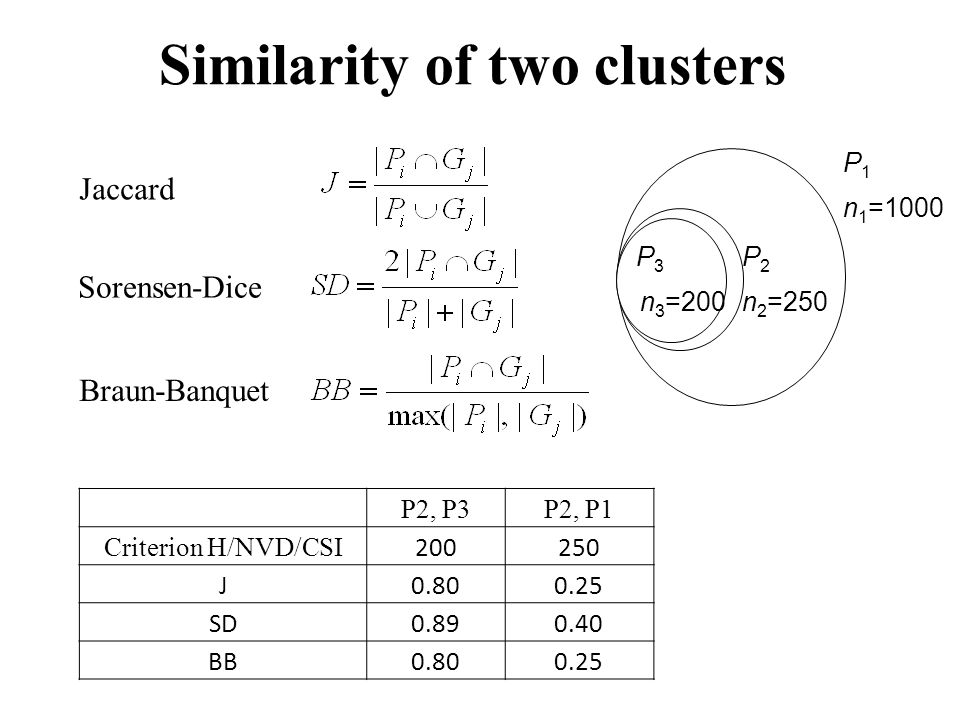
So, now that we have a way to quantify the similarity (or difference) between two sets based on the quantity of things that they share, normalized by the total quantity of things: suppose that those things are the other words that some word occurs with.  If you replace the names of the sets like this:

  1. Set 1: dog
  2. Set 2: cat
  3. Set 3: iguana
  4. Set 4: snake
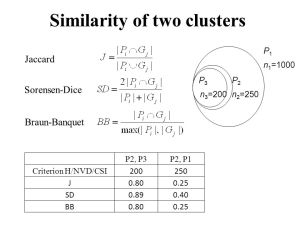
slide_54
We’ve looked at one measure of similarity/difference–the Jaccard index–but, there are others. Here’s a small sample. Picture source: http://images.slideplayer.com/24/6982424/slides/slide_54.jpg

…then you could imagine the words in those sets being the words that dog, cat, lizard, and snake occur with.  When we calculate our numbers, we end up with dog being more like cat than it is like iguana or snake.  In contrast, our numbers are consistent with the idea that iguanas are more like snakes than they are like dogs or cats…and that’s one way that you can think about quantifying the similarities between the meanings of words.

john_rupert_firth
John Rupert Firth. Picture source: Public domain, photographer unknown.

These particular kinds of distributional representations of word meanings go back to the 1950s and the work of John Firth, who famously (OK: famously among linguists) said that “you shall know a word by the company it keeps.”  Distributional representations suddenly become popular in the language processing world (surprising, to some extent, because the language processing world is populated much more by computer scientists than by linguists) a few years back, for two reasons:

  1. Thanks to the Internet, we now have access to quantities of textual data that are big enough to be able to calculate reliable quantities–you need a lot of data to actually make this kind of approach work.
  2. People have recently had some success with figuring out ways to do calculations of these numbers in ways that are efficient enough to be able to handle those enormous quantities of data without bringing every supercomputer in the world to its knees.  If you tried to do something like this naively, you would be calculating the similarity between every word and every other word; no one actually knows how many words there are in (to take one example) English, but you’re probably talking about a table with 10,000,000,000 cells in it.  A few years ago people came up with a couple ways of reducing that number drastically, and that makes it practical to do the calculations and to store their results.  (If you could do one calculation a second, it works out to a bit over 19,000 years.)  Now my laptop can crunch the numbers for a few million words or so worth of text overnight.

We’ve talked about calculating the Jaccard index today (shared things divided by total things), and calculating it on the basis of words.  That’s a very straightforward way of doing this–the Jaccard index is the simplest distance metric that I know of, and words are the easiest things to count.  However: words are actually much more difficult to count in real life–or even to define–than they seem to be in the examples that we looked at, and there are lots of other things that one could count that might work out better.  There are also different ways to define what counts as “occurring together.”  To give you some examples of the kinds of questions that you need to think about in doing this kind of thing:

  1. Words: What is a unique word?  Do you want to count Dog and dog as the same word, even though one starts with an upper-case letter, and the other starts with a lower-case letter?  Do you want to count reproduisisse, reproduisît, reproduisissions, reproduisissiez, and reproduisissent (the forms of the imparfait du subjonctif of the French verb reproduire, “to reproduce”) as the same word?  How about pet peeve and bête noire–do those count as one word, or two?  Do you want to count bete noire as the same word as bete noir, bête noire, and bête noir?  (More generally: do you count an incorrectly spelt word with its correctly-spelled equivalent?  If so: how the hell do you spell-correct the Internet?)
  2. Things to count: Do you want to count $1, $2.25, 50%, and 75% as 4 different things?  Maybe you want to consider them all as numbers, in which case there is just 1 “thing?”  Maybe you want to count $1 and $2.25 as prices, and 50% and 75% as percentages, in which case there are 2 things?
  3. What “occurring together” means: Is it occurring in the same sentence?  The same newspaper article?  The same book?  Maybe it means occurring within two words to the right or within two words to the left–i.e., occurring within the four surrounding words?

…and that’s the kind of thing that will keep graduate students busy for the next 5 years or so, unless something else becomes au courant in the meantime (au courant discussed below in the French and English notes), in which case all of the grad students who were betting their careers on the latest cool thing will be spending some time engaging in some serious nombrilisme and then either starting all over again or quitting grad school and going into building better search engines for Twitter or something.  Welcome to my world.

For more information on distance-based semantics and its alternatives, see Elisabetta Jezek’s The lexicon: an introduction.

I got into this 2400-word little essay in the course of trying to come up with a way to respond to a series of comments on my last post in which we got into a discussion of whether or not the English word bete noire means the same as the English word pet peeve (see how I snuck an assumption in there about how many “words” are in bete noire and pet peeve?)  Obviously I went down a bit of a rabbit-hole here.  More on the bete noire/pet peeve thing some other time, if Trump doesn’t nuke some country because the president said something mean about him (remember how he was saying that Hillary wasn’t “tough enough?”) and bring the world as we know it to an end, along with all of the electricity.  A quick discussion of some relevant French and English words follows.


French and English notes

au courant: This expression exists in both English and French, but with different uses in the two languages.  In French, it means something like “up to date,” and is used to describe people.  In English, it can be used in the same way, but is also (and I think more commonly, although I don’t have the data to demonstrate this, one way or the other) used to describe things, in which case it means something like “in fashion.”  Additionally, in English, this is a very high-register word–you wouldn’t use it with just anybody.  Here are some French examples from the frTenTen12 corpus, a collection of 9.9 billion words of French scraped off of the Internet that I searched via the Sketch Engine web site:

  • Nous tiendrons nos lecteurs au courant de cette tentative…
  • …que Dieu t’entende pas petite Marie Bon courage et tiens nous au courant
  • Vous êtes au courant de ces dangers, vous devez donc protéger votre PC contre toutes intrusions.
  • …mea culpa, je n’étais pas au courant
  • …ni les Etats-Unis ni l’URSS n’ont été au courant de cet événement…
  • Peut-être que le jeune mutant était au courant , aussi elle décida de l’attendre devant la porte.

I like the second-to-last one, because it describes two countries there, rather than the two people that you would expect.

To find examples of au courant in English, I went to the enTenTen13 corpus, a collection of 19.7 billion words of English-language text, which, again, I accessed through Sketch Engine.  Here is some of what I found:

  • …a library of au courant phraseology and jabber…
  • Where once the adage “Things go better with bacon” was au courant ,”Things go better with cheese” is timeless.
  • That isn’t to say that paisley prints are reserved solely for custom-fitted, au courant French fashion houses; just the opposite.
  • Pappardelle is the au courant cut of pasta right now…
  • It’s all very au courant , yet it’s not at all.
  • Being au courant can be its own sort of stultifying endgame.

Comparing the experience of putting these two lists together, I can tell you that I had to hunt to find examples of au courant in French where it wasn’t modifying a human, and I had to hunt to find examples of au courant in English where it was modifying a human (my last example here is the closest that I came).  Here’s how it was used in the post: That’s the kind of thing that will keep graduate students busy for the next 5 years or so, unless something else becomes au courant in the meantime, in which case all of the grad students who were betting their careers on the latest cool thing will be spending some time engaging in some serious nombrilisme and then either starting all over again or quitting grad school and going into building better search engines for Twitter or something.  

The zombie apocalypse and education in the computational sciences

How to respect both logical positivism and the zombie apocalypse while educating computer scientists.

Screenshot 2017-03-10 04.25.01
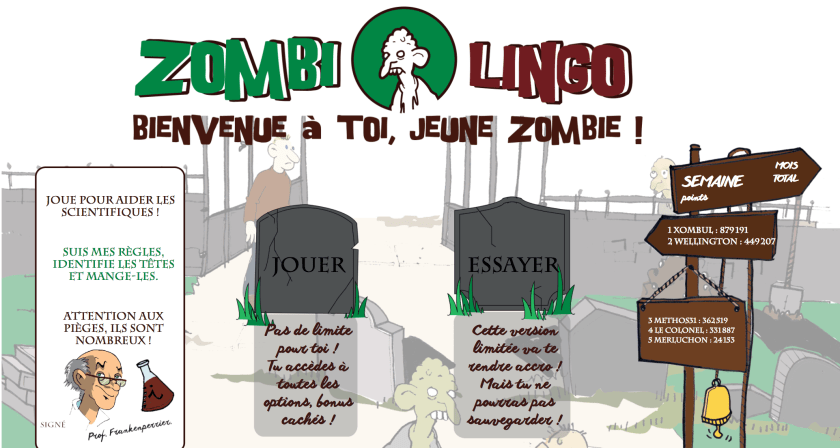
zombilingo.org, a web site that supports research on what linguists call the “heads” of groupes nominaux (“noun phrases,” in English).

In my professional life, one of my pet peeves is scientific discussions that involve the verb to believe.  For example:

  • …we believe that [joint circumscription] will be important in some AI applications.  (John McCarthy, Circumscription–A form of non-monotonic reasoning, publication date unclear) 
  • We believe ontologies are key requirements for building context-aware systems… (H. Chen, T. Finin, and A. Joshi, An ontology for context-aware pervasive computing environments, 2003)
  • We believe enzyme-loaded erythrocytes may have therapeutic possibilities for several diseases.  (Ihler et al. 1973, Enzyme loading of erythrocytes, which I should note has been cited over 300 times nonetheless)

I have actually been–on multiple occasions–cautioned against using formulations like Je pense que… (“I think that…”) in some professional situations in France, as it’s considered a sign of having a position that you’re not actually confident that you can defend.  (Native speakers, can you comment on this?)

I’m not shy about bringing up my problems with the verb to believe in any discussion in which I find myself that claims to be scientific, be those lab meetings or reviews of papers/grants/whatever.  I would not label myself as a logical positivist, but I try to always keep in mind the potential logical positivist position–it’s not a bad foundation for a philosophy of science.  (See, I didn’t say I think that it’s not a bad foundation for a philosophy of science–I flat-out asserted it.  In academic writing, I would follow that assertion with a few credible citations.)

Follow these links for more information on the zombie apocalypse and…

In light of that tendency of mine towards the empirical and the epistemological, students are often surprised to learn of my concerns regarding the upcoming zombie apocalypse.  Clearly, zombies are something about which I have no empirical data, and one would have to classify the upcoming zombie apocalypse as something about which I have beliefs, but not knowledge, and therefore outside of the realm of something that I would talk about in my professional life.  So, yes: students are surprised when I bring it up.  (As far as I can tell, my French colleagues just think I’m crazy, or chalk it up to some quirk of the Anglo-Saxon psyche, or something.  I actually have no clue what my American colleagues think.)

Here’s the thing: the zombie apocalypse is an engaging point of entry into the problem of making robust systems.  In the context of computer programming, you could think of “robustness” as the ability of a program do deal with the unexpected–making speech recognition systems that will work in a crowded restaurant (impossible 20 years ago, not unusual today), or building sentence analyzers that won’t reformat your hard drive if someone passes them a sentence in Uzbek. In particular, the upcoming zombie apocalypse is an engaging entry point to the problem of how to think about the problem of making robust systems.  The issue is that a major contributor to robustness is planning for unanticipated inputs (I had English in mind when designing my sentence analyzer, and then someone gave it a sentence in Uzbek) or operating conditions (I never thought about someone trying to use my speech recognition system with a lot of noise in the background).  Seulement voilà–the thing isit’s the nature of unanticipatedness that we have trouble coming up with the unanticipated.  Even more fundamentally a problem: we often have trouble getting into the mindset of taking seriously the very idea that unanticipated inputs or operating conditions are even plausible.  In fact, they are; but, how to get students to think about something that is, a priori, difficult to conceptualize?  Posing the question as how will your approach work when the zombie apocalypse comes? typically leads to a laugh–and seems to give one a way to think seriously about what kinds of things might happen that you haven’t actually thought about yet.  To think seriously about things that it’s difficult to think about by means of thinking non-seriously about things that don’t exist, you might say.  You might say that–if you haven’t really thought about the upcoming zombie apocalypse.


English notes

pet peeve: something that annoys a specific person a lot.  To call something a pet peeve, it should be rather specific to that person, especially with respect to the extent that it bothers them or with respect to the extent that they are sensitive to it.  For example, traffic jams wouldn’t really be anybody’s pet peeve–everybody is annoyed by traffic jams.  However, traffic jams caused by trash trucks doing their collections during rush hour could be someone’s pet peeve-say, if they happen to actually notice them more than most people would, in a situation where most people don’t particularly care whether or not a traffic jam was caused by a trash truck doing its collections during rush hour–they are equally annoyed by all traffic jams.  How it was used in the post: In my professional life, one of my pet peeves is scientific discussions that involve the verb “to believe.”  

French notes

la robustesse: robustness.  You can use this in a lot more ways in French than in English.  For example:

  • Hardiness would probably be the English-language equivalent here, where we’re talking about plants and their illnesses: Différentes maladies peuvent entraîner un flétrissement des tubercules qui se traduit, à son tour, par une perte de robustesse des plants.  (Source: Sketch Engine web site)
  • Toughness would probably be the equivalent here, where what’s being discussed is fabric: Ce tissu se distingue par sa robustesse, sa longévité et son confort.  (Source: click here)

How defending Trump is like defending domestic abuse

From a linguistic perspective, defenses of Trump have a lot in common with domestic abuse. Here’s how that works.

screenshot-2017-02-26-02-10-47
Source: https://goo.gl/kQeAju

Data point: back in the United States, our new President has been gleefully violating our Constitution, or at least trying to, to the very best of his ability.  The heart of American political philosophy is expressed in the First Amendment to the Constitution:

Congress shall make no law respecting an establishment of religion, or prohibiting the free exercise thereof; or abridging the freedom of speech, or of the press; or the right of the people peaceably to assemble, and to petition the Government for a redress of grievances.

What our new President’s been up to:

  • Banning people from entering the United States based on their religion.  Quote from December 7th, 2015: Donald J. Trump is calling for a total and complete shutdown of Muslims entering the United States.  (Yes, he is enough of an asshole to refer to himself in the third person.)
  • Attacking the press.  Tweet from February 17th, 1:48 PMThe FAKE NEWS media (failing , , , , ) is not my enemy, it is the enemy of the American People!
screenshot-2017-02-26-02-14-35
Source: https://goo.gl/YswwKk

It interests me that many of his supporters defend his un-American actions based on the argument that he’s “just” doing what he said he would do.  There seems to be some implicit claim that if you say that you’re going to do it, then it’s OK to do it.  Some examples:

  • “He was simply doing what he said he was going to do in the campaign,” Paul Hess told the Times.  (source)
  • President Trump is, after all, just doing what he said he would do. And, in a representative democracy, that’s something to be respected.  John E. Stafford, letter to the New York Times
  • Amid all the wailing and gnashing of teeth, President Trump reminded us that he was just doing what he said he would do.  “We have really done a great job. We’re actually taking people that are criminals, very, very hardened criminals in some cases, with a tremendous track record of abuse and problems, and we’re getting them out,” Trump said. “And that’s what I said I would do. I’m just doing what I said I would do.”  Sean Hannity (source) (includes video of Trump saying exactly that)

As far as I know, this is not the case–either from a legal perspective, or from an ethical perspective.  If I say to you If you drink my Coke again, I will punch you in the face, I’m going to arrested if I do, in fact, punch you in the face–having said in advance that I was going to do it does not make it legal.  It does not make it ethical, either.

“I warned her I would kill her if she went with other boys,” he added. He said that Sunday afternoon she went to a show with another boy and that “she broke her promise at other times.” “I kept my promises and she broke hers. I loved her very much,” he added.  –Source: https://goo.gl/X05M2x

The whole phenomenon reminds me of the stereotype of domestic abusers: This is your fault–I told you I would hit you if you talked to him again.  I told you I would whip you if you didn’t come straight from school.  I told you I would kill the kids if you tried to leave me. Do domestic abusers actually do that kind of thing?  Read the quotes.

Now, there’s an interesting little linguistic thing going on in the quotes from the Trump defenders.  Let’s look at the quotes again:

  • “He was simply doing what he said he was going to do in the campaign,” Paul Hess told the Times.  (source)
  • President Trump is, after all, just doing what he said he would do. And, in a representative democracy, that’s something to be respected.  John E. Stafford, letter to the New York Times
  • Amid all the wailing and gnashing of teeth, President Trump reminded us that he was just doing what he said he would do.  “We have really done a great job. We’re actually taking people that are criminals, very, very hardened criminals in some cases, with a tremendous track record of abuse and problems, and we’re getting them out,” Trump said. “And that’s what I said I would do. I’m just doing what I said I would do.”  Sean Hannity (source) (includes video of Trump saying exactly that)

Note the words simply and just.  They have a very specific function here.  You can think of it as justification through minimization: their goal is to communicate the idea that what follows is not a bad thing, specifically by minimizing it relative to things that would admittedly be bad.  It’s quite complex, because it starts with a concession–with an implicit agreement that if you had done what the other person states that you did, then it would have been bad.  But, that concession is then followed with an argument that what you did was not, in fact, that, and since it wasn’t that, then you are meant to accept that it was not bad. 

The English words just and simply have a lot of meanings.  This particular meaning gets used in a couple very particular ways.  I’ll give you the more complicated one first, because it’s actually easier to see how they function in the more complicated case:

  • Yes, I did sorta take some of your sandwich, but I really just tasted it.
  • Mom, I didn’t hit him–I just touched him hard.
  • Don’t get mad at what I said–it was just a joke.
  • I’m not being mean–I’m simply stating a fact.  You are fat, old, and bald.

The structure of all of them works something like this: there’s this thing that you think that I did, and if I had done it, sure, maybe that would have been bad.  But, I didn’t–I did some lesser thing, and since it’s not the bad thing that you mentioned, it’s not bad.  So:

  • Yes, I did sorta take some of your sandwich, but I really just tasted it.  The structure: if I had really taken some of your sandwich, then that would have been bad–but, I didn’t.  I did a lesser thing: I tasted it.  Since that’s not the bad thing, then it’s not bad.
  • Mom, I didn’t hit him–I just touched him hard.  The structure: if I had hit him, then sure–that would have been bad.  But, I didn’t hit him–I did something less than that, and since it’s not that bad thing, then it’s not bad.

This is a fallacious argument.  Suppose that there is some bad thing–let’s call it X.  The fact that something is not X does not mean that it is not bad.  The fact that something is “less” than X does not mean that it’s not bad, either.  But, that’s exactly the implication behind the whole “he’s just doing what he said he would do” attempt at a justification.  In fact, “just” is being used here without the concession–it’s pure minimization.  It’s adding to the assertion he’s doing what he said he would do an adverb that is meant to convey that the doing is something less than something else–specifically, less than bad.  

At some point, the current insanity is going to end–America always rights herself, eventually.  How?  Who knows?  Maybe Trump will throw one of his little hissy fits and resign.  Maybe he’ll nuke somebody, and somebody will nuke him, and the world as we know it will end.  These days, it’s tough to be surprised.  One thing that I am, however, sure of: history is not going to look kindly on this period, and it’s not going to look kindly on the people who supported Trump.  Are they all going to go to jail?  Of course not.  Are their grandchildren going to be ashamed of them?  Probably.  You have a choice to make here: collaborate, talk back, or just keep your head low.  There’s only one of those that you won’t be ashamed to tell your grandkids about.

How to not get a second date with a non-linguist

I always love being in France–but, sometimes, I REALLY love being in France.

The first thing you learn in American linguistics graduate schools is that you can make sure that there will never be a second date by commenting on some aspect of your companion’s speech.  Although America has no official language and nothing remotely like the notion of an Académie-Française-sanctioned standard form of the language, we are nonetheless super-sensitive about having the way that we speak brought up in a conversation.  Comment on the way that your date speaks, and it’s all over.  In France, the situation is very different–anyone will talk about how anybody else speaks, anywhere, any time.  I love that.


Sunday is market day in my little neighborhood in Paris.  Vendors set up their booths under the metro tracks down the block (I live by one of the few “aérienne” (elevated) lines).  Most things are pretty local–in France, meat and produce is usually sold with its area of origin marked, and the majority of foodstuffs for sale at the market come from no further away than Spain.  (For my geography-challenged American concitoyens: that’s right next door.)

I have my little routine.  The first place where I stop is the aligot booth, because if they were to sell out of that potato-butter-and-cheese equivalent of crack cocaine before I got there, my week would be ruined.  On the last leg of my trek, I stop by the choucroute stand.

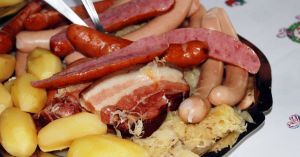
Choucroute is an Alsatian specialty consisting of sauerkraut, an occasional carrot or potato, and any of a wide variety of smoked and/or cured meats.  Which raises a question: which meat do you want?  My habitual choice: all of them.

la-choucroute-en-pratique-5015-1200-630
Picture source: http://www.jds.fr https://goo.gl/2aCI2i

When I got to the front of the line for the choucroute, the elderly gentleman next to me was having a detailed discussion with one of the ladies working the booth about the ham on offer, and exactly how close to the bone it had been sliced.  The lady had set the pig leg on the counter, and was indicating various and sundry parts of the unfortunate animal’s anatomy with her knife.  (How close to the bone you’ve been sliced turns out to have implications for how deeply the meat has been cooked, and therefore both the smell (apparently worse the closer you get to the bone) and the taste (apparently better the closer you get to the bone).)  I looked at the variety of meats resting atop the bed of fermented cabbage and decided, as I usually do, that I wanted a bit of everything.  (If it’s in italics, it happened in French.)  May I have a mix of meats, please?  A huge smile from the vendor: oh, what a beautiful French word!  Did you hear what he just said?  …she asked the gentleman examining the ham.  He grunted and went back to discussing bone-closeness.  Shit, I thought to myself–what did I just say??  

Where are you from?  America, really?  Seriously, did you hear?  He said “déclinaison de viandes.”  This time the elderly gentleman didn’t even bother to grunt–nothing was going to distract him from his deepening relationship with that ham.  What should I have said? …I asked.  A “mélange,” I think…or an “assortiment.”  But, don’t change–that’s delightful.  


Lest you think that I’m bragging: this wasn’t the last time that I amused the nice choucroute lady yesterday morning.  In particular, when she asked me if I wanted some alaille, I was baffled.  She was happy to explain to me that this was saucisson à l’ailgarlic sausage.  D’oh!  On the down side, I still sound like a complete idiot when I try to speak French.  On the plus side, I gave the nice choucroute lady a few good laughs, and that has to count as A Good Thing.  I always love being in France–but, sometimes, I LOVE BEING IN FRANCE.  Seriously.


English notes

atop: a preposition meaning on top of.  This is a word that you might use in writing, but would rarely, if ever, use in the spoken language.  How it was used in the post: I looked at the variety of meats resting atop the bed of fermented cabbage and decided, as I usually do, that I wanted a bit of everything.

trek: a long journey, usually done specifically by walking, and usually difficult.  How it was used in the post: On the last leg of my trek, I stop by the choucroute stand.  In this case it conveys the idea that my journey through the market is long, and that I’m walking, but in this context, it’s not meant to suggest difficulty.

French notes

la déclinaison: according to WordReference, a range or variation; I saw it used in this way on the ardoise (“slate”–the little blackboard, often an actual piece of slate, on which the specials of the day are posted in restaurants) of the cafe downstairs from my apartment, advertising a déclinaison de tomates–an assortment of tomatoes.  Also according to WordReference, a declension, in the sense of a set of related words (sausage/sausages/sausage’s).  I have loved this word from the moment that I learnt it–apparently the choucroute lady thinks it’s pretty cool, too.

Questions with only one right answer

You’re in country X.  Let’s say that the local language is called Xish.  Here are the only correct answers to the following questions:

Q: So, what do you think about Xish?  A: It’s beautiful.
Q: Xish is really easy to speak, isn’t it? A: No.
Q: Do you think that Xish is hard?  A: Yes.
 Q: What’s more difficult–English, or Xish?  A: Xish.
 Comment: You speak Xish wonderfully!  Response: Oh, no, I speak Xish terribly.

In some technical sense, your answer to all of these will have been been false, except for the one about speaking Xish poorly.  “Difficulty” is not a meaningful word when applied to languages.  Neither is “beauty” in a technical sense, although I won’t belabor that one.

It occurred to me as I wrote this that the picture that I’ve painted here could be interpreted as suggesting that people who speak any language other than the one that you speak are easily fooled. In fact, that’s not the case at all.  This is about shared human culture–as far as I know, most people in most places love to talk about their language with foreigners, and how hard that language is will pretty much always be a good conversational tack to take.  (Obviously, I haven’t been everywhere or talked to everyone, but I’ve probably done this little exercise in somewhere in the neighborhood of 20 countries by now.)  In fact, in a lot of places, the Your Xish is great! thing is a sophisticated opportunity to let you show your grasp of the culture (or not)–in many cultures, accepting a compliment is quite gauche, and the only proper response is self-deprecation.  Respond with “oh, thank you–I’ve really been working on it!”…and you’ve just shown yourself to still be clueless.  Respond appropriately and you’ve just shown your grasp of, and respect for, the culture.

Ironically, I can’t quite figure out whether or not that’s the case in France–in general, this is not a country where self-deprecation is valued.  It’s a real problem for Americans, since self-deprecation is more or less our default attitude any time that we meet someone new, and often for much, much longer than that.  You could think of this whole isn’t-my-language-hard thing as an instance of not “exoticizing the Other,” as we academics like to say, but rather, of exoticizing oneself–of supporting a sort of exceptionalism for one’s own language, in the sense that we talk about “American exceptionalism” (the idea that America is just plain better than the rest of the world and has something to offer it–I certainly agree with the second part of that) and “French exceptionalism” (the idea that France is just plain better than the rest of the world and has something to offer it–I certainly agree with the second part of that, too).


English notes

gauche-james-dean-quote-i-m-a-serious-minded-and-intense-little-devil-terribly-gauche-and-so-tense-that-i-don-james-dean-63-50-46
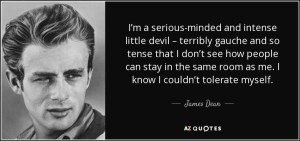
Picture source: http://www.azquotes.com/quote/635046

gauche: lacking social experience or grace; also :  not tactful :  crude  (taken directly from Merriam-Webster).  I think that the best French equivalent might be maladroit, but couldn’t swear to it.  How it was used in the post: In many cultures, accepting a compliment is quite gauche, and the only proper response is self-deprecation.  Some examples from the Open American National Corpus, a collection of 15 million words of American English, collected and annotated by my colleague Nancy Ide, that you can download to do with as you please.  I used the Sketch Engine web site to search it.

  • You are correct that you cannot come right out and say, “It is gauche to come over and serenade me with your potato chips , so please go away.”
  • Gauche, gauche, gauche, and tacky.  (I love this one even more than the previous one.) 
  • Your take on his behavior was correct: It was gauche. Prudie does have one slight bit of curiosity about the faux pas.

to take a tack: to go in a particular direction, metaphorically speaking.  It comes from nautical language, where the verb to tack means to change the direction of a ship by turning the bow into the wind.  Confusingly, it can mean something like tactic, but it is not related to that word at all.  How it was used in the post: Most people in most places love to talk about their language with foreigners, and how hard that language is will pretty much always be a good conversational tack to take.  Some examples from the Open American National Corpus (see above):

  • Britain’s Independent took a similar tack, observing, “The situation is far from precisely parallel, but it is still a chastening thought that the Kosovo Liberation Army is, under conditions of vastly greater duress, handing in its guns at a rather faster rate than the Provisional IRA seems able to arrange  “
  • But rather than pursue that obscure tack any further (place names such as Washington are surely both proper nouns and eponyms) , let us see if the proper categories of words really end there as grammar books tend to suggest .  (Different verb–pursue, rather than take–but, same meaning)
  • Having apparently grown tired of obsessing over just how skeletal the Ally McBeal Über-waif has become, the tabs take a different tack: They bare their fangs and become positively McCarthyesque in their zeal to rat out celebs who’ve become the least bit unsvelte.
  • I think it’s one of the tacks Gerald Posner took in his book JFK book, Case Closed.

French notes

gauche: according to WordReference.com, this adjective can mean awkward, clumsy, or gauche, but with this sense (meaning) it is soutenu.  

le langage soutenu or le registre soutenu: according to the French-language Wikipedia, this is especially a written form of the language, used in official letters and literary texts.

How socks changed me: lexical category and syntactic ambiguity

Usually you change your socks, but one day socks changed me.

I got my start on an education by going to college classes at night after work.  I was in the Navy at the time, and the evening classes in the Norfolk, Virginia-area universities were full of people looking to advance their careers, squids like me (squid is military slang for a sailor), and of course typical college students.  Waiting for class to start one evening, I listened to two of them discuss their distaste for dating sailors.  One of them shared her hint for avoiding doing so inadvertently: she identified them by their black socks.  Indeed, we were issued a kind of heavy, padded black sock that was great for supporting your feet inside the low boots that were part of the uniform at the time.  Your tiny little locker on a ship doesn’t allow you the room to have much in the way of clothes other than your uniform, so we wore them all the time, whether in uniform or in civvies.  I’m sure that I was wearing a pair at that very moment.


sock-knitting-poem-rc07899
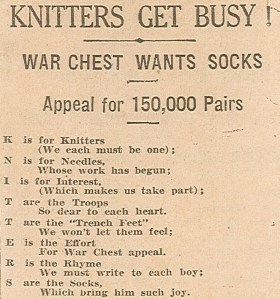
Poem about knitting socks for soldiers. From a 1918 newspaper, original source unknown. My source: https://goo.gl/dUYUG7

In fact, socks are a crucial part of the military uniform.  In the First World War, they were crucial to the avoidance of trench foot, which could (and frequently did) lead to the loss of a foot, or a leg, or two of them.  They remained important in World War II–socks are crucial to your ability to march.  Today, nothing has changed but the sales platform–whether you’re standing on your feet for hours guarding jets on an air base in Alaska (my cousin did that–he’s in Hawaii now, which makes a hell of a lot of sense to me) or standing on your feet for hours in a military hospital shooting radiopaque dye into people’s coronary arteries (that was me), nothing about the technologization of the American military changes the fact that what’s on your feet is part of your equipment, just like anything else, and you need the best you can get.


The formidable Queen Mary led the movement to keep our troops warm during winter in the trenches, when Lord Kitchener asked her to undertake the huge task of providing 30,000 pairs of socks for our brave lads. Unfortunately with all the nice middle class ladies knitting away, many working class women lost out on a valuable revenue stream. After a meeting with the Queen it was suggested that ladies from the upper echelons might buy the wool and pay the lower classes to knit the socks, keeping everyone happy. —Juliet Bernard, HuffPost United Kingdom, https://goo.gl/ew4Z27

I spent my last few years in the Navy working in a large hospital.  Every fourth day, the people in my group spent 24 hours in the hospital–“on duty,” or “having the dutes,” as we called it.  You know how in the movies when someone’s heart stops, someone comes running down the hall with a big red cart and a defibrillator and shocks them until their heart (hopefully) restarts?  That was us.

That doesn’t actually happen very often, so we spent a lot of time sitting around reading.  This was before the Internet, smart phones, etc., so we brought piles of books, magazines, whatever.  I used to write long letters to my father.  On a typewriter–can you imagine?

One night I was sitting in the lab flipping through a National Geographic.  This was in the late 1980s–less than 10 years after the taking of the hostages at the American embassy in Iran, with the subsequent end of relations between the two countries (except, of course, for the illegal Iran-Contra affair, brought to you by the Reagan administration).  National Geographic is basically a collection of photographs from around the world, with a bit of accompanying text and occasionally a gorgeous map thrown in.  I found one of the photographs particularly interesting.  It was a close-up of an Iranian soldier’s socks, one of which was embroidered with the following words: Through Iraq to the Mediterranean–this was in the midst of the Iran-Iraq war.  The other was embroidered with the words Fill the sea with the blood of the Jews.  

Now, I’m Jewish, like my grandmother, and my sister, and my aunts, and my uncles, and my cousins, and…you get the idea.  So, when you talk about filling the sea with the blood of the Jews, I presume that you’re not going to leave my grandmother out of that particular adventure, or my sister, or my aunts, or…you get the picture.

As it happens, I am also a sharpshooter with the .45 caliber pistol (the handgun of the American military of those times).  I’m not a gun nut–in fact, I hate firearms.  But, when you’re in the military, one of the many things that you learn how to do is shoot people.  It’s fairly standard.

So I figured: fine, fuck you.  You know how to use your weapon, I know how to use mine–maybe one day we’ll meet in a “shooting war,” and then whoever’s the best shot gets to walk away.  I’ll take my chances with that.  And I turned the page…

…to find a picture of a farmer holding his adult son in his arms in the waiting room of a hospital in Tehran.  The kid was a soldier, and had been blinded in the war against Iraq.  The farmer was utterly uneducated, and had brought his son to the Big City to see if the doctors could take his eyes out of his head and transplant them into his son’s.

It was one of the biggest “light bulb moments” of my life.  I was a new father myself at the time, and I would have done anything for my baby, and the connection that I felt with that Iranian father was absolute, total, and complete.  It’s difficult for me to describe what that was like–a sudden awareness of a connection between my soul (and I say that as an atheist) and that of someone on the other side of the world who was quite possibly offended by my very existence (and that of my grandmother, and my sister, and my aunts, and…you get the picture.)  I knew something, immediately, in that moment: I was never going to be OK with killing anybody.  If you’re trying to kill my grandmother, or my sister, or–you know the list–sure, I will put a bullet in you, and thanks to your tax dollars and my fine Navy training, I know how to do it.  But, fine, fuck you?  Not after that moment.

I’m very sorry that I haven’t been able to find the picture of the soldier’s socks, nor the picture of the farmer with his blind son.  I spent a couple hours looking for them on line, with no luck.  If by some chance a reader of this post happens to be able to track them down…  English notes below.  

screenshot-2017-01-20-14-20-50
I found this jewel of a review of a pair of socks on the THORLO web site. “Basic” is “basic training,” more commonly known as “boot camp”–your first training in the transition from civilian to soldier/sailor/whatever. Picture source: screen shot of https://goo.gl/Uk1IYN

English notes

shooting war: in opposition to the Cold War, which did not actually involve violence (overtly), a “shooting war” is the usual kind.  How it was used in the post: So I figured: fine, fuck you.  You know how to use your weapon, I know how to use mine–maybe one day we’ll meet in a “shooting war,” and then whoever’s the best shot gets to walk away.

light bulb moment: when you suddenly realize something.  The image is that the realization comes to you as suddenly as a light bulb turning on.  How it was used in the post: It was one of the biggest “light bulb moments” of my life.

dating sailors: this is an example of ambiguity on multiple levels.  Let me give you a parallel example with less uncommon lexical items–it probably comes from an old edition of Language Files, the Ohio State University linguistics department textbook:

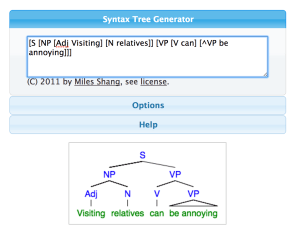
  • Visiting relatives can be annoying.  (You have some relatives, and some of them visit you, and those relatives that visit you can be annoying to you.)
  • Visiting relatives can be annoying.  (You have some relatives, and when you visit them, doing it can be annoying to you.)

On one level, this is ambiguity related to the fact that visiting can belong to multiple lexical categories (what normal people, i.e. non-linguists, call parts of speech).

  • Visiting relatives can be annoying.  (You have some relatives, and some of them visit you, and those relatives that visit you can be annoying to you.)  In this case, visiting is an adjective, and it modifies relatives: it takes the universe of all possible relatives and restricts it to just those that visit.
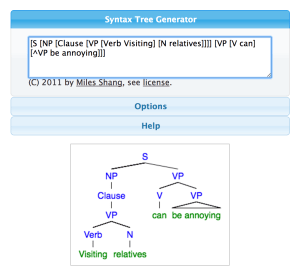
  • Visiting relatives can be annoying.  (You have some relatives, and when you visit them, doing it can be annoying to you.)  In this case, visiting is a verb, and in particular, a non-finite one–that is, one that doesn’t have a tense, per se.

Going along with that ambiguity with respect to lexical category (part of speech) is a difference in syntactic structure, as well.  In the case where visiting is an adjective, the group of words visiting relatives is what’s called a noun phrase (le groupe nominal, I think), formed by an adjective and a noun.  From a syntactic point of view, this is a relatively simple structure.  (I said relatively–no hate mail from afficionadoes of deeply-embedded X-bar structures and the like, please.)  Scroll down a bit and you’ll find a picture of what this looks like.  In the case where visiting is a non-finite verb, I think that you need to posit something pretty complicated, along the line of a verb phrase within a dependent clause within a noun phrase.  

screenshot-2017-01-20-16-07-06
S is “sentence,” NP is “noun phrase,” and VP is “verb phrase.”  Picture source: screen shot from http://mshang.ca/syntree/. Try it out, it’s super-fun! I mean, for a syntactic tree generator… and if you like bracketing phrases… Certainly more fun than sitting here in my hotel room in the middle of the night thinking about the bullshit-filled speech that I just watched Trump give at his inauguration…

screenshot-2017-01-20-16-10-31
VP is “verb phrase.” The verb phrase forms a clause, and the clause has to be inside a “noun phrase” (NP), or else you have to posit that you don’t need to have nouns to have a subject, which you can do, but then you trade off the less-complex structure for a more-complex set of syntactic categories. You choose. Picture source: screen shot from http://mshang.ca/syntree/.

Want to try your hand at this?  Here are some examples.  (I think I found them on the Sketch Engine web site, but I started writing this post back on the day of Trump’s inauguration, and my memory is a bit hazy, mostly being masked by my horror at the event.)  Label each one as adjectival or verbal, and I’ll tell you what I think the answers are at the bottom of the page.

  1. In the morning our team of highly experienced instructors will kit you out with your riding gear and a Yamaha off road bike, and introduce you to the principles of off road riding.
  2. We all know training is the key to utilizing technology to its fullest extent and saves BIG money in the long run . 
  3. These color tiers provide a quick, visual means of comparing players at different positions with similar fantasy value.
  4. Walking distance to the centre, car parking spaces are a god-send, lovely comfortable beds and clean bathrooms and kitchen.
  5. There are various eating establishments in the village of Gairloch which is about 10 miles away.
  6. The upstairs rooms offer fantastic panoramic views over surrounding croftland to the Torridon Mountains to the east, and over the Minch to the Isle of Skye and Outer Hebrides to the west.
  7. Surveying developments in the medical sciences allows for the identification of those areas, which have particular relevance to cardiovascular disease.
  8. Making our research accessible to a wide range of audiences, and involving people from different sectors and backgrounds in the development of our work has always been one of our key aims.
  9. Her torturers constantly accused her of recruiting and training youths for banditry, and of working with the opposition Movement For Democratic Change (MDC) in an alleged plot to topple Mugabe.
  10. My sources within the Central Intelligence Organisation (CIO) tell me that days before my piece appeared, the agency had submitted a report to Mugabe’s office specifically accusing both Zambia and Botswana of offering their lands as “ launching pads ” for a military attack.
  11. The increasing realization that their access to ancestral lands was diminishing encouraged many of the Indians to strike at the encroaching whites.
  12. The plan called for the converging columns to maintain a continuous offensive until a decisive defeat had been inflicted on the Indians.
  13. U.S. Army soldiers and Indian warriors engaged in running battles through rugged terrain such as this near Palo Duro Canyon during the Red River War.

This sequence of -ing + noun is very common in English.  It shows up at least three times in this post, once in a verbal construction, the other adjectival:

  • Waiting for class to start one evening, I listened to two of them discuss their distaste for dating sailors.  (Verb)
  • National Geographic is basically a collection of photographs from around the world, with a bit of accompanying text and occasionally a gorgeous map thrown in.  (Adjective)
  • You know how to use your weapon, I know how to use mine–maybe one day we’ll meet in a “shooting war,” and then whoever’s the best shot gets to walk away.  (Adjective)

You may have noted an attempt at humor in the title of this post: How socks changed me.  Usually we talk about changing one’s socks, which means to put on clean socks.  For socks to change a person is quite bizarre not just semantically, but in terms of the odd combination of the verb change and the noun socks that native speakers are quite accustomed to.

socks-australian-children-h11581

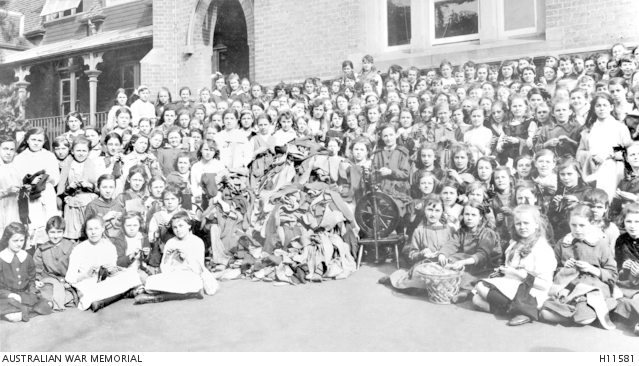
Australian schoolchildren during WWI with a pile of socks they’ve knitted. 1918. Picture source: Australian War Memorial, public domain. https://goo.gl/dUYUG7

My best shot at the answers

  1. Adjective In the morning our team of highly experienced instructors will kit you out with your riding gear and a Yamaha off road bike, and introduce you to the principles of off road riding.
  2. Verb We all know training is the key to utilizing technology to its fullest extent and saves BIG money in the long run . 
  3. Verb These color tiers provide a quick, visual means of comparing players at different positions with similar fantasy value.
  4. Adjective Walking distance to the centre, car parking spaces are a god-send, lovely comfortable beds and clean bathrooms and kitchen.
  5. Adjective There are various eating establishments in the village of Gairloch which is about 10 miles away.
  6. Adjective The upstairs rooms offer fantastic panoramic views over surrounding croftland to the Torridon Mountains to the east, and over the Minch to the Isle of Skye and Outer Hebrides to the west.
  7. Verb Surveying developments in the medical sciences allows for the identification of those areas, which have particular relevance to cardiovascular disease.
  8. Verb Making our research accessible to a wide range of audiences, and involving people from different sectors and backgrounds in the development of our work has always been one of our key aims.
  9. V Her torturers constantly accused her of recruiting and training youths for banditry, and of working with the opposition Movement For Democratic Change (MDC) in an alleged plot to topple Mugabe.
  10. Adjective My sources within the Central Intelligence Organisation (CIO) tell me that days before my piece appeared, the agency had submitted a report to Mugabe’s office specifically accusing both Zambia and Botswana of offering their lands as “ launching pads ” for a military attack.
  11. Adjective The increasing realization that their access to ancestral lands was diminishing encouraged many of the Indians to strike at the encroaching whites.
  12. Adjective The plan called for the converging columns to maintain a continuous offensive until a decisive defeat had been inflicted on the Indians.
  13. Adjective U.S. Army soldiers and Indian warriors engaged in running battles through rugged terrain such as this near Palo Duro Canyon during the Red River War.

The question your grand-kids are going to ask you

We’re going to get past this–America always does. And someday, your grand-kids are going to ask you: what did you do during the Trump administration?

croix-de-lorraine-2656_400
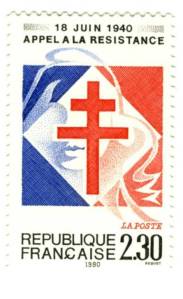
The Croix de Lorraine, symbol of the French Resistance during World War II. Picture source: https://goo.gl/lChOU1
I went to a “language exchange” the other night.  7 minutes in one language, 7 minutes in the other, and then you change to someone new.  It works out well–you speak with a pretty random cross-section of people, you get to try your hand at understanding lots of dialects, ages, and speech rates, and usually you learn something.  Hopefully they do, too.

With one of my conversation partners, we started in English.  “Since we’re speaking English, I’m going to ask you all of the questions that an American would ask you, but a French person wouldn’t–where you’re from, what your job is…”

“Actually, French people ask each other those kinds of questions when they meet, too,” he replied.  ” What we don’t ask each other about is families–you don’t talk about family with someone you don’t know well.”


Indeed, the French are, in general, far slower to talk about family than Americans are.  And there’s one question that, I think more than any other, you don’t ask a French person: what did your family do during the war?  If they want you to know, they’ll tell you.  Uncle Jean-Paul was a fighter in the Resistance?  It’ll get worked into the conversation. Mom got arrested by the Gestapo while she was pregnant with your big sister?  It’ll come up without you asking.  (I’ll tell you mine: one of my uncles was in the Resistance.  According to another uncle’s autobiography, he was executed by the Germans, along with a bunch of his buddies.  The uncle who survived to write an autobiography was in the Army, apparently mostly spending his time driving trucks and teaching boxing to the son of an Army officer who thought his kid was a bit effeminate and wanted him toughened up a bit.)  Otherwise: don’t ask.  Plenty of French resisted the Nazis, and plenty of those, like my uncle, paid with their lives.  Others collaborated–the reason that the French government is not allowed to collect most demographic information today is that when the Germans told the Parisian police to go round up the Jews, they had no trouble finding them, because everyone’s religion was recorded in the local records.  (Altogether, French people sent around 70,000 French Jewish fellow citizens to the death camps.  (Wikipedia says 78,853.)  Under 1,000 came back.)  Most people just ate Jerusalem artichokes and rutabaga (cattle fodder otherwise) and tried to stay alive.


1314227-obeir_cest_trahir_desobeir_cest_servir
French Resistance message: “To obey is to betray. To disobey is to serve.” Picture source: https://goo.gl/a5Ep9Y
The reason I bring this up: America is in a world of shit right now.  But, we’re not going to be in this particular world of shit forever.  The hallucinatory world that Trump has brought us will end–eventually, America always rights itself.  As a nation, we’ve overcome slavery, overcome institutionalized racism, overcome extermination of Native Americans and then of their languages, overcome prejudice against Jews, prejudice against Catholics, and prejudice against Mormons.  Some day we’re going to get past the band of sociopaths who are currently running our government, we’re going to get past their reprehensible and un-American anti-Muslim and anti-Mexican prejudices, and we’re going to become a moral and exceptional country again.

So, if you’re an American: someday your kids and your grand-kids are going to have questions.  We’re not French, and we do ask about family.  Your grand-kids are going to want to know what Grandma and Grandpa did during the Trump administration.  Did you speak up?  Did you collaborate?  Did you just try to get along and let the refugees, the religious and racial minorities, and the people losing their health insurance worry about themselves?  We’re not French–we do ask.  Your grand-kids will.  They’ll ask you.  


English notes

to be in a world of shit: to be in a very bad situation.  There are a number of shit-related expressions for describing the state of being in a bad situation–to be in deep shit, to be up shit creek without a paddle, and I imagine others that slip my mind at the moment.  How it was used in the post: America is in a world of shit right now.  

French notes

la Résistance intérieure: the Resistance within France.  What we would call in English “the Resistance.”

la Résistance extérieure: the Free French forces operating out of London.

clandestin: clandestine, underground, secret.

la presse clandestine: the underground press.  Putting out newspapers was a big move during the Nazi occupation–Germany took the press so seriously that in Germany the Nazi government killed intellectuals and writers who published underground anti-government writings.  It was a difficult one, too–it was illegal to sell paper, ink, or stencils.

Ukrainian Humanitarian Resistance

Resisting the russist occupation while keeping our humanity

Languages. Motivation. Education. Travelling

"Je suis féru(e) de langues" is about language learning, study tips and travelling. Join my community!

Curative Power of Medical Data

JCDL 2020 Workshop on Biomedical Natural Language Processing

Crimescribe

Criminal Curiosities

BioNLP

Biomedical natural language processing

Mostly Mammoths

but other things that fascinate me, too

Zygoma

Adventures in natural history collections

Our French Oasis

FAMILY LIFE IN A FRENCH COUNTRY VILLAGE

ACL 2017

PC Chairs Blog

Abby Mullen

A site about history and life

EFL Notes

Random commentary on teaching English as a foreign language

Natural Language Processing

Université Paris-Centrale, Spring 2017

Speak Out in Spanish!

living and loving language

- MIKE STEEDEN -

THE DRIVELLINGS OF TWATTERSLEY FROMAGE