Acquisition of edible invertebrates

As far as I know, no videos of Morning Dance Party exist.

thelenota_ananas
Thelenota ananas, a species of sea cucumber. Credit: By Leonard Low from Australia – Flickr, CC BY 2.0, https://commons.wikimedia.org/w/index.php?curid=1552175
I mostly relate to places through two things: food, and language.  (Presumably it would be better to be relating to people, rather than to places, but in the absence of a shared language, relating to people is difficult.)  Both of those–food, and language–get you pretty quickly into odd and difficult-to-resolve questions of what one might call “authenticity:” people never want to teach you slang, but it’s the thing that interests the typical linguist-on-the-road the most; we’re all always looking for that “real” svíčková na smetaně in Prague, but looking for “real” anything these days gets you into either fun conversations about cultural appropriation or fun conversations about post-modernity, both of which are fairly instant buzz-killers for anyone other than, say, me and the two other people in the universe who enjoy talking about cultural appropriation from the perspective of post-modernism without having slept very much the night before.  (Obviously, I’m not a very fun date–this may be related to my shitty divorce record.)

I think I cracked the “authenticity” nut on a recent evening in Hangzhou, though, where I had the funnest experience I’ve ever had in China that didn’t involve me, my niece and nephew, and Morning Dance Party.  (As far as I know, no videos of Morning Dance Party exist, and we should all be thankful for that.)  A colleague took me out for dinner to a buffet at a place that he described as typical and reasonably priced–the kind of place that any family could afford to go to.  Indeed, it was packed with families–imagine a very loud room filled with long tables, those long tables filled with big families talking, laughing, and passing an ever-growing assortment of plates back and forth while various and sundry foods hiss over a grill built into the table.

The way that the restaurant works: you wander around and pick things from an enormous selection, then take them back to your table, where you grill them.  When I say “enormous,” bear in mind that I’m talking about China here–“enormous” in China is really big.  Then think about this: I only recognized perhaps 10% of the available foods.  Some fruits; some vegetables; duck gizzards, certainly, and I guessed the avian liver correctly, too.  But, for the most part, I hadn’t the faintest clue what I was looking at.


Zipf’s Law describes an important characteristic of language: about 50% of the words in any large sample of words almost never occur–but, they do occur.  The word that came up in the Chinese restaurant: trepang.  As a verb, Wikipedia defines it like this:

Trepanging is the act of collection or harvesting of sea cucumbers…

“Not to be confused with trepanning,” it adds.  Indeed, indeed.

Zipf’s Law takes you into some pretty out-of-the-way corners of the lexicon.  As Wikipedia points out, to trepang is a member of a larger group of English verbs.  A trepang is a sea cucumber–a marine invertebrate animal related to starfish and crinoids.  To trepang is to harvest sea cucumbers, and in having that relation between the noun and the verb meaning to harvest things that are labelled by that noun, it resembles a number of more-familiar verbs.  From Wikipedia again:

Trepanging is comparable to clammingcrabbinglobsteringmusselingshrimping and other forms of “fishing” whose goal is acquisition of edible invertebrates rather than finfish.

Other than the pure joy of having a verb that means “to collect or harvest sea cucumbers,” what’s interesting about this?  In science, “interesting” usually means “different from what you would expect based on what you already know.”  The interesting thing here, then, is that there are other verbs that come from a noun that refers to an animal–but, they don’t mean “acquisition of.”  Consider, for example, the verb to flea.  Don’t look for it in Merriam-Webster—it’s not there.  What it means is to remove fleas from.  It’s a transitive verb–here’s an example from a forum on pets:

https://www.petforums.co.uk/threads/can-i-flea-my-cat-a-week-after-shes-had-kittens.431344/
Source: http://www.petforums.co.uk
The poster has a cat, the cat has fleas, and the poster would like to cause the cat to no longer have fleas, but is concerned about the fact that the cat has recently had kittens.  Thus: Can I flea my cat a week after she’s had kittens?

To foal is another verb that comes from a noun that refers to an animal.  A foal is a young horse, and to foal is to give birth to a foal.  It can be transitive or intransitive:

  • I would say she will foal in less than a week. (Intransitive.  Source: enTenTen corpus, from Sketch Engine.)
  • Animal science students have been involved with the entire process of preparing the horses to foal and bringing them to campus.  (Intransitive.  Source: enTenTen corpus, from Sketch Engine.)
  • Ada had just been up four hours helping to foal a horse and wasn’t prepared for the intrusion of the outside world.  (Transitive.  Source: enTenTen corpus, from Sketch Engine.)

To lamb is a similar verb–Merriam-Webster gives the example The ewes will lamb soon.

Getting into conversations like this over dinner is probably why I get divorced a lot, so I’ll point you to this YouTube video, One way to flea a cat, and get on with my day–I need to run a bunch of experiments on how to split up words in sentences in biomedical journal articles…

On being stared at

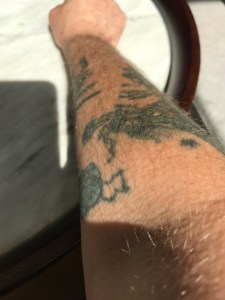
At some point in their life, everyone should spend some time in a place where they’ll be stared at

img_2534
Picture source: me.

It’s 1981, and my ship has pulled into Istanbul for a week.  Being a stupid young sailor, I’m wandering around alone.  I pass some old men sitting on a stoop drinking tea (a common pastime for old men in Turkey).  One of the old men gets up, walks over to me, spits on a finger, and tries to rub one of my many tattoos off.  When he can’t, he shakes his head in disgust and sits down again.


It’s 1981, and my ship has pulled into Istanbul for a week.  Being a stupid young sailor, I’m wandering around alone.  Going down a busy street, I suddenly find myself surrounded by a crowd of young men.  One of the guys emerges from the crowd, and in broken English starts translating for the rest of the crowd, telling me everything that they have to say about how much they love my tattoos.


It’s 2016.  I’m waiting in line at an art show in China.  A guy walks up to me: excuse me, I can take picture of you with my children?  Sure, why not?  Smiles all around as pictures are snapped, and we all go back to waiting in line.


My job and my pastimes take me far and wide, and in some of the places that they take me, I look unlike anyone else.  Japan, Guatemala, China, Mexico, Turkey–in all of them, I am a “white guy,” a light-skinned, blue-eyed guy in a country where everyone else is brown-skinned, with black hair and brown eyes.  In some of those countries, I go places where I may be the only “white guy” that I see all day, and in those countries, I get stared at–a lot.  It’s not just me–it’s the experience of any Westerner in those places.

What I’ve learnt in those countries: how good it can feel to be smiled at.  This morning I took a walk along the riverfront in Hangzhou, China.  Men (and a couple women) did tai chi alone.  Women (and a couple men) did synchronized dancing to music.  Grandmothers pushed strollers, and grandfathers jogged–often in business casual–occasionally omitting a loud yell or two.  (I have no clue what the purpose of the yells is–native speakers, do you have any insight into this?)  For 45 minutes, I was the only “white guy” that I saw.

It was unusual for people not to stare at me.  Sometimes out of the corner of their eyes, and sometimes quite openly, but almost everyone stared.  Some of them, though–some of them smiled at me, too.  你好, they might say.  你好, I would answer.  I waved at little kids, and their grandmothers smiled–and made them wave back at me if they were too shy to do it on their own.  Not big-deal interactions–but, it always felt so good.  What it cost them: nothing.  What it gave me: a lot, actually.


I maintain that at some point in their life, everyone should spend some time in a place where they’ll be stared at.  It’ll teach you the value of a smile for someone who doesn’t seem to fit.  Lots of people get stared at in today’s America–Muslim women in hijab.  Black men in nice hotels/white neighborhoods/academic conferences.  Any woman at all in a computer science department.  A smile at someone else costs nothing–and can give a lot.


English notes

on being stared at: I include this one in the English notes because of the commonly-taught, commonly-believed old bullshit that there’s something wrong with ending a sentence with a preposition.  Is on being stared at English?  Absolutely.  Is there any other way to say it?  Not that I know of.

their life: This is a good example of the use of a third-person plural pronoun to refer to a singular person.  Since there is no reason to assume any particular gender here, some dialects of English use their gender-neutral pronoun, which looks like the plural pronoun, but in this context is not.  You can read more about this phenomenon here.

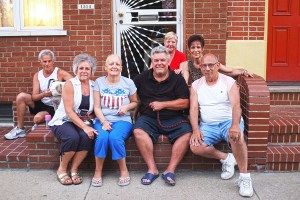
stoop-project-philly-1200x800-2
Picture source: http://media.philly.com

stoop: Besides being a verb with a number of different meanings, stoop can also be a noun.  Merriam-Webster defines it as  a porch, platform, entrance stairway, or small veranda at a house door.  How I used it in the post: I pass some old men sitting on a stoop drinking tea (a common pastime for old men in Turkey). 

Rackling against the breast bone

When I was a kid, I liked to do drugs as much as the next trailer trash, but I never, never understood how someone could stick a needle in their arm–until I had my wisdom teeth out. (Trailer trash explained in the English notes below.) The oral surgeon pushed the plunger on the syringe, I watched the medication travel down the IV line, and before I slipped off into unconsciousness, I heard the sound of the wind blowing in my ears and thought Ohhhhhhhh–THIS is why they do it.


I was lucky–before anesthesia was invented in the mid-19th century, that would’ve been a horrible procedure. Here’s a woman’s description of her mastectomy in 1811. Her name is Fanny Burney, and her record of the operation has survived until today because she was both a popular novelist and a part of the court of George III. This extract from a letter to her big sister Esther is quite unusual, in that it is a rare record of pre-anesthesia surgery from the patient’s point of view, rather than from the surgeon’s point of view, which is much better documented. Just in case you don’t feel up to reading the whole dreadful thing, I’ve shortened it, and then I’ve bolded the most horrific sentence—the sentence that people cite the most.  You’ll find the whole thing at the bottom of the post, after the English notes.

…when the dreadful steel was plunged into the breast—cutting through veins—arteries—flesh—nerves… I began a scream that lasted unintermittingly during the whole time of the incision—and I almost marvel that it rings not in my Ears still! so excruciating was the agony. When the wound was made, and the instrument was withdrawn, the pain seemed undiminished, for the air that suddenly rushed into those delicate parts felt like a mass of minute but sharp and forked poniards, that were tearing the edges of the wound—but when again I felt the instrument—describing a curve—cutting against the grain, if I may so say, while the flesh resisted in a manner so forcible as to oppose and tire the hand of the operator, who was forced to change from the right to the left—then, indeed, I thought I must have expired… The instrument this second time withdrawn, I concluded the operation over—Oh no! —Dr Larry rested but his own hand, and—Oh Heaven!—I then felt the Knife rackling against the breast bone—scraping it!—This performed, while I yet remained in utterly speechless torture…

Once a year I spend a week in Guatemala with a group of physicians, nurses, operating room techs, and therapists who do free surgeries for people for whom the almost-free national health care system is still too expensive.  When people think about groups like ours, they mostly think about the surgeons, and the stories that people want to hear are mostly about the surgeries that those surgeons do—the children who will be able to get married some day because a plastic surgeon repaired their cleft lip; the child who will be able to learn to write because the hand surgeon gave him functioning fingers; the woman who will be able to go to the market and sell corn again—thereby getting cash to pay for her kids’ school supplies—because the gynecological surgeons repaired her prolapsed uterus and urinary incontinence. There’s someone who usually gets left out of these stories, though–the anesthesiologists and nurse anesthetists who made it possible for those surgeries to happen.


Reasonable people could debate about what the most important inventions in the history of humankind have been. The wheel makes most lists; penicillin gets on a lot of them; stupid ones have “The Internet.” Here’s my hypothesis, in no particular order:

  1. The toothbrush
  2. Vaccines
  3. Corrective lenses
  4. Anesthesia

After that, the importance levels drop off pretty quickly–vaccines have killed some diseases forever (and may kill more if bad hombres with political motivations don’t prevent it–Boko Haram, Trump administration Cabinet member Ben Carson, and occasional presidential candidate Jill Stein come to mind here). Penicillin, on the other hand, is a once-great idea whose time will soon be past, leaving us with no good answers for XDR (extensively drug-resistant) tuberculosis or for people like my former Navy shipmate whose penchant for returning from port visits with gonococcal pharyngitis was legendary throughout the 6th Fleet. Few things will ever be as near and dear to our hearts as our toothbrushes, but the Internet will die as soon as the zombie apocalypse starts, leaving us poorer in idiotic Twitter feeds (see death of Internet) but immeasurably richer in our appreciation for the value of our ties to our fellow humans (see zombie apocalypse).

Anesthesia, though: let’s think about some things that would not have ever happened without anesthesia. Bear in mind that before anesthesia as we know it today was invented in the 1840s or so, surgery was something to be avoided at all costs and, in the case of non-emergencies like cancer, until the last possible minute; if unavoidable, it was to be done as quickly as possible. (The main criterion for the quality of an amputation, other than the patient surviving it, was how quickly it was done; as far as I know, amputation was the main surgical intervention of the American Civil War.) With anesthesia, though–with anesthesia, surgeons could be careful. They could do things that took time; they could do things that were complicated. As Dr. David Metro, our chief anesthesiologist, put it to me: “anesthesia is what has made every surgical advance since the mid-19th century possible. Organ transplantation–it saved over 33,000 lives last year–cochlear implants, cataract surgery, hip replacements, coronary artery bypass surgery–all of that is only possible because we can put patients to sleep, keep them there painlessly for as long as necessary, and then wake them up again afterwards.”


That’s what anesthesia has done for us–but, on some level, anesthesia is just a bunch of chemicals. You could give them to yourself, like folks once used ether for fun. (See John Irving’s novel The cider house rules for where playing with ether can lead–it’s nowhere good.)  But, anesthesiologists–they’re another thing altogether. I’m not talking here about their technical skills–about the nurse anesthetist who worked the night shift in a hospital where I worked in the late 1980s, and who saved the life of pretty much every single patient whose life got saved in our emergency room, or about the anesthesiology resident who picked up on a case of tuberculosis a couple years ago here in Guatemala. I’m talking about a display of honesty and intellectual rigor that has had effects not just in the surgical world, but in the engineering world in general and in flight safety in particular.

In the 1970s, four anesthesiologists at Massachusetts General Hospital undertook a study of errors by members of their profession. 47 of their colleagues discussed with them–on tape–the errors that they had made in their careers. They talked about 359 incidents in total, of which 82% were caused by human error. As one commentator on that paper put it, Anesthesiology is the one domain in which patient safety was identified as a problem long before the Institute of Medicine’s 1999 wake up call to the healthcare community. Not only was the problem identified in the late 1970s, but anesthesiologists faced the issues, taking actions to effect changes that would reduce errors, adverse outcomes, and injuries. While it is often difficult to trace the historical path of change, there is reason to believe that the anesthesia critical incident studies planted seeds of ideas for others, either directly or subliminally.

Along with later work on equipment problems in anesthesia that proceeded on the same methodology, this body of research set the standard for a broad field of research in engineering on how to understand problems with systems, and how to use your understanding of those problems to make those systems safer. Table 3 in that paper gives nice insight into how that works. It shows the distribution of frequent types of equipment-related errors; one thing that you notice there is how many of the frequent categories of problems are related to misconnections or disconnections of the various and sundry tubing systems involved. One of the responses to this finding was to make it mandatory to have connectors on medical gas systems that cannot be plugged into the wrong gas supply–today, it is mechanically impossible to plug your oxygen line into a “room air” supply, or your room air supply into a vacuum. Today’s anesthesia machines are one of the best-designed kinds of systems for supporting a human life on this planet, and the anesthesiologist’s approach to thinking about what he or she does is ubiquitous in fields as diverse as flight safety—and surgery. As Atul Gawande put it in his book The checklist manifesto, describing the ways that checklists are used to help a pilot and co-pilot work together to recover from a potentially fatal emergency: as integral to a successful flight as anesthesiologists are to a successful operation.  Step back for a second and think about where these advances came from: anesthesiologists admitting to other people what they did wrong, on the record.  I wish that I had that kind of courage.

Connectors for the hoses for four different kinds of gases.  It’s not physically possible to plug these hoses into the wrong source–a product of those studies by anesthesiologists.

I woke up when my surgery ended, poorer by four molars but with an increased appreciation for what anesthesia and anesthesiologists bring to the world.  When our patients wake up here in Guatemala, it’s usually with their lives changed–Monday’s reconstruction of a hand for a teenager who I’ve seen every one of the five years that I’ve been coming here, as it’s a complicated surgery that has to be done in stages; yesterday’s removal of a mass on the right wrist of a woman whose job involves writing with a pen all day, and who therefore was losing the ability to support herself in a country in which there is no such thing as unemployment insurance, or disability support for people who can’t work; Tuesday’s repair of a cleft lip for a kid who otherwise would have been unlikely to find a spouse, in a country in which your only social support net is your family…

Enjoying these posts from Guatemala?  Why not make a small donation to Surgicorps International, the group with which I come here?  You wouldn’t believe how much aspirin we can hand out for the cost of a large meal at McDonalds–click here to donate.  Us volunteers pay our own way–all of your donations go to covering the cost of surgical supplies, housing for patients’ families while their loved one is in the hospital, medications, and the like.


English notes

Trailer trash: Here’s Wikipedia’s definition of this very American term: Trailer trash (or trailer park trash) is a derogatory North American English term for poor people living in a trailer or a mobile home.[1][2] It is particularly used to denigrate white people living in such circumstances[3] and can be considered to fall within the category of racial slurs.[4] The term has increasingly replaced “white trash” in public and television usage.

How I used it in the post: When I was a kid, I liked to do drugs as much as the next trailer trash, but I never, never understood how someone could stick a needle in their arm–until I had my wisdom teeth out.


The full description of Fanny Burney’s surgery

Here are the two paragraphs of Fanny Burney’s letter to her sister describing her surgery.  There’s more to the letter, which also describes the whole process of the development and diagnosis of her breast cancer–there’s a link to it at the end of the post.

My dearest Esther,—and all my dears to whom she communicates this doleful ditty, will rejoice to hear that this resolution once taken, was firmly adhered to, in defiance of a terror that surpasses all description, and the most torturing pain. Yet—when the dreadful steel was plunged into the breast—cutting through veins—arteries—flesh—nerves—I needed no injunctions not to restrain my cries. I began a scream that lasted unintermittingly during the whole time of the incision—and I almost marvel that it rings not in my Ears still! so excruciating was the agony. When the wound was made, and the instrument was withdrawn, the pain seemed undiminished, for the air that suddenly rushed into those delicate parts felt like a mass of minute but sharp and forked poniards, that were tearing the edges of the wound—but when again I felt the instrument—describing a curve—cutting against the grain, if I may so say, while the flesh resisted in a manner so forcible as to oppose and tire the hand of the operator, who was forced to change from the right to the left—then, indeed, I thought I must have expired.

I attempted no more to open my Eyes,—they felt as if hermetically shut, and so firmly closed, that the Eyelids seemed indented into the Cheeks. The instrument this second time withdrawn, I concluded the operation over—Oh no! presently the terrible cutting was renewed—and worse than ever, to separate the bottom, the foundation of this dreadful gland from the parts to which it adhered—Again all description would be baffled—yet again all was not over,—Dr Larry rested but his own hand, and—Oh Heaven!—I then felt the Knife rackling against the breast bone—scraping it!—This performed, while I yet remained in utterly speechless torture, I heard the Voice of Mr Larry,—(all others guarded a dead silence) in a tone nearly tragic, desire everyone present to pronounce if anything more remained to be done; The general voice was Yes,—but the finger of Mr Dubois—which I literally felt elevated over the wound, though I saw nothing, and though he touched nothing, so indescribably sensitive was the spot—pointed to some further requisition—and again began the scraping!—and, after this, Dr Moreau thought he discerned a peccant attom (fragments of diseased [peccant] breast tissue)—and still, and still, M. Dubois demanded attom after attom.

Web site with Fanny Burney’s letter http://newjacksonianblog.blogspot.com/2010/12/breast-cancer-in-1811-fanny-burneys.html

Blog about pre-anesthesia surgery https://thechirurgeonsapprentice.com/2014/07/16/the-horrors-of-pre-anaesthetic-surgery/

https://en.wikipedia.org/wiki/Frances_Burney

Cough!

Once a year I spend a week in Antigua, Guatemala, where I interpret for a group that does free surgeries for people for whom even the almost-free national health care system is too expensive.  I spend a lot of time in the recovery room. It’s a challenge–you’re interpreting for people who are half-asleep, and often wearing an oxygen mask–and I do like a challenge. (This use of do explained in the English notes below.)  Sometimes the challenges are unexpected ones, though.

One day last year a recovery room nurse asked me to tell a little boy to cough. That’s not unusual in a recovery room–sometimes post-operative secretions in your lungs cause a minor drop in the amount of oxygen that you’re getting, and a cough or two will clear them right up.

Tosa, I said. The kid looked at me uncomprehendingly.  Hmmm, I thought to myself–does the kid not speak Spanish?  That’s not uncommon in Guatemala, where 70% of the population is indigenous and over 20 Mayan languages are spoken.

The father looked at me and smiled. Tosá, he said. The kid coughed. So: no cough when I said tosa, but tosé elicited the desired response.

The father was using a verbal form that’s used in Guatemala and a few other places in Central and South America. Indeed, it’s probably the most distinctive thing about Guatemalan Spanish. However, although I know a few local regional nouns and usually get a happy laugh when I use them, I had never learnt this particular verbal form–Americans would rarely have an occasion to use or to hear it, as it’s used only in the context of particular social relationships, and it wouldn’t be at all typical for a foreigner to have one of those.

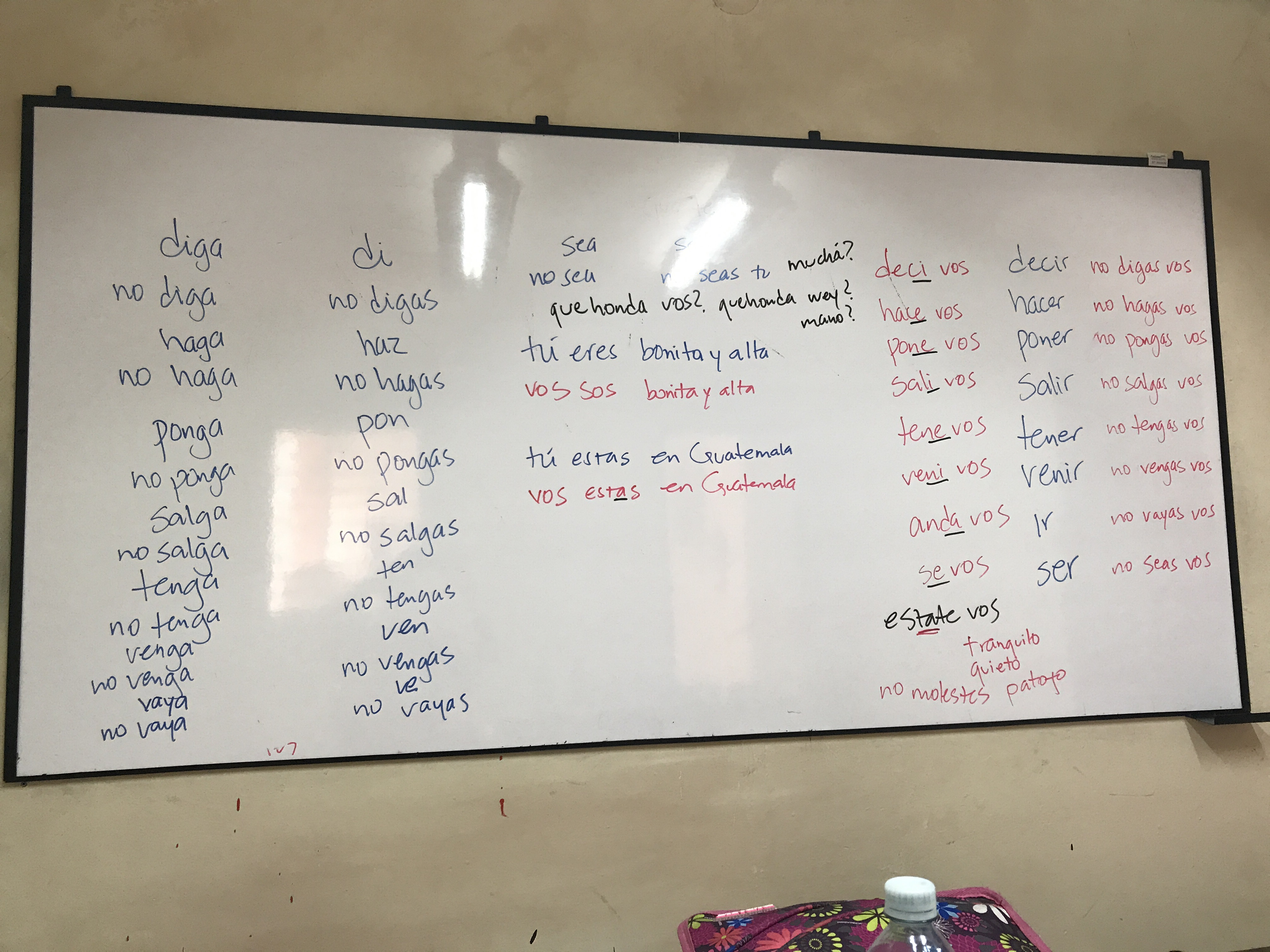
My “voseo” lesson at Maximo Nivel, a Spanish language school in Antigua, Guatemala. Picture source: me.

The verbal form in question is called voseo. It’s used in very close relationships–between friends of long duration is the typical one.  In Guatemala, the tu form of verbs is used in many situations in which the usted form would be used anywhere else in the Spanish-speaking world–for example, waiters in restaurants and the ubiquitous vendedores ambulantes (people who stroll constantly through the tourist areas selling stuff, primarily Mayan women of a variety of ethnicities from the surrounding pueblos) will typically address you with the formal terms señor or señora (sir or ma’am)–and then use the tu form of verbs with you, which even on my fifth time in-country sounds weird.

So, you’re wondering: how does one form this mysterious conjugation?  For starters, let’s go over the present indicative.  It’s almost entirely regular, and very easy to relate to the three classes of Spanish verbs.

Spanish verbs end with either -ar, -er, or -ir, with the -ar verbs mostly being homologous with the French -er verbs.  (Sorry–I havent even thought about the others!)  To form the voseo present indicative of almost all verbs, you keep the vowel of the infinitive, add the -s that you would expect in the tu form of the verb, and put the stress on the final syllable.  So:

  • escribir – escribís
  • decir – decís
  • venir – venís
  • tener – tenés
  • comer – comés
  • volver – volvés
  • tomar – tomás
  • buscar – buscás
  • caminar – caminás

Of course, just because Ive learnt the voseo forms doesnt mean that I have anyone with whom to use them–as I said, there are only some relationships in which its OK.  I did use them with the dog at my host familys apartment.  I listened carefully, and they use the formal usted form with him,  but he didnt seem to mind my voseo–although I was sneaking him treats, so who knows…

Enjoying these posts from Guatemala?  Why not make a small donation to Surgicorps International, the group with which I come here?  You wouldn t believe how much aspirin we can hand out for the cost of a large meal at McDonalds–click here to donate.  Us volunteers pay our own way–all of your donations go to covering the cost of surgical supplies, housing for patients’ families while their loved one is in the hospital, medications, and the like.  Scroll down for the English notes, per usual.


English notes

I do like…  This use of do emphasizes something.  As far as I can tell, the primary use, although not the only one, is to emphasize something that is contrary to expectations.  For example, in this Dashiell Hammett quote

I do like a man that tells you right out he’s looking out for himself. Don’t we all? I don’t trust a man that says he’s not. And the man that’s telling the truth when he says he’s not I distrust most of all, because he’s an ass and ass that’s going contrary to the laws of nature.

…you wouldnt expect anyone to like a person who is looking out for himself (a very Trumpian behavior, particularly if youre only looking out for yourself)–hence the do.  How I used it in the post:

It’s a challenge–you’re interpreting for people who are half-asleep, and often wearing an oxygen mask–and I do like a challenge.   Liking a challenge is presumably at least somewhat contrary to expectations–hence, the do.  

In-country: being or taking place in a country that is the focus of activity (such as military operations or scientific research) by the government or citizens of another country (Merriam-Webster)


Um, about that time you almost died…

This is a second attempt at something that I accidentally posted the other day before it was done–sorry!  My laptop died on arrival to Guatemala, and I’m limping along on my cell phone.

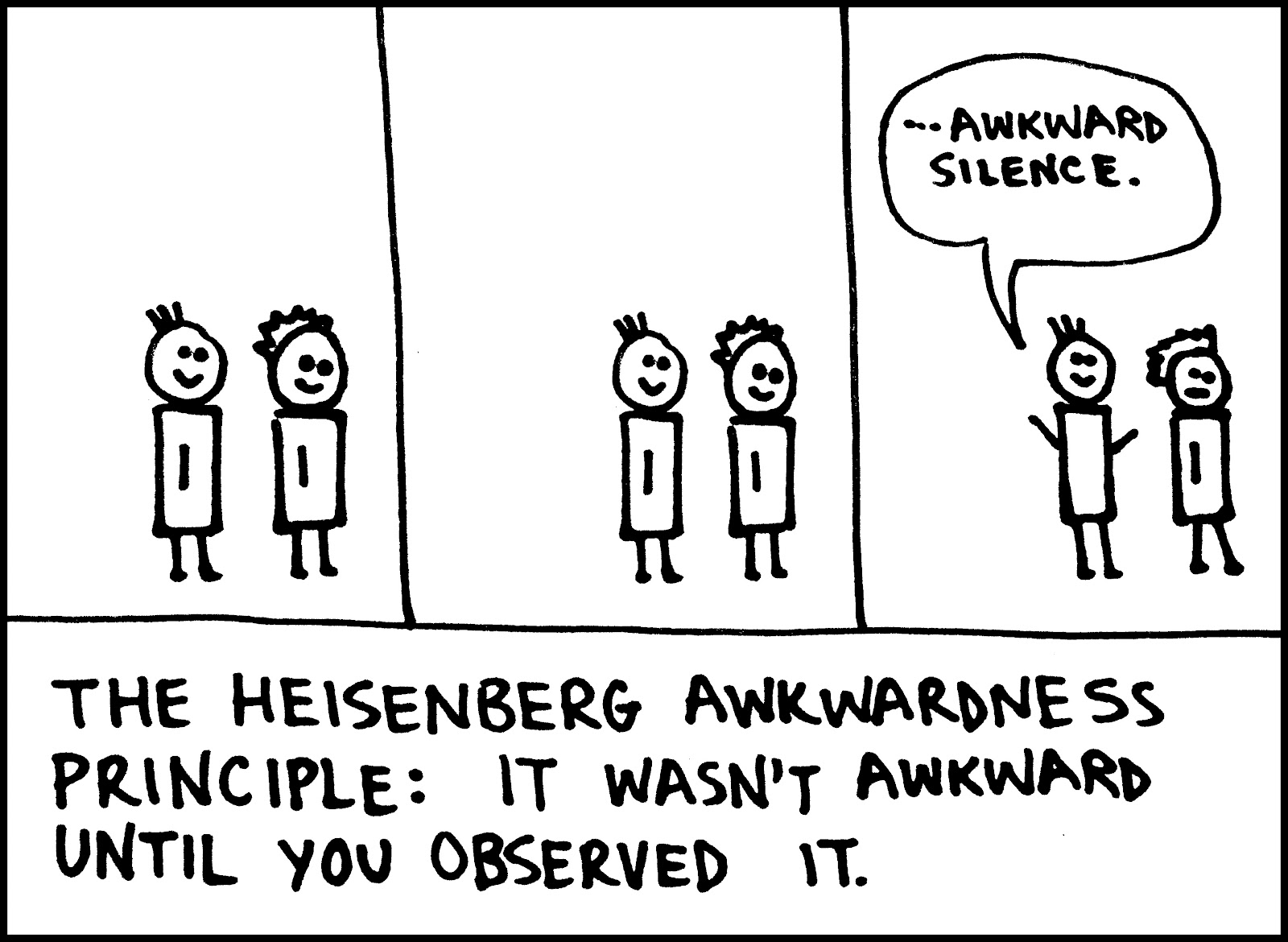
Picture source: http://statpsych.blogspot.com/

In science, you often worry about something called the observer effect. This refers to situations in which by observing a behavior, you change it.  It’s a real problem for linguists: tell people that you’re a linguist and you’re there to study how they speak, and you can bet that they’re going to speak differently than they would have otherwise.

One way for a linguist to deal with the observer effect is to get people speaking about something that’s so emotionally engaging that they’ll stop thinking about how they’re speaking. One linguist who worked with teenagers in gangs would ask them to tell him about a really great fight they were in. With people who are not teenaged gang members, you might ask them to tell you about a time that they almost got killed, or the last car wreck that they had seen. You get the picture.

I thought about how linguists handle the observer effect today when my Spanish tutor asked me if I’ve ever seen anyone die.  Once a year I spend a week in Guatemala, where I interpret for a group of surgeons, anesthesiologists, therapists, and nurses who do surgery gratis for people for whom the almost-free national health system is too expensive.  A couple months ago I had a glass of wine with a Mexican friend in Paris. She’s been there for 25 years, and normally we bounce back and forth between French and Spanish as the holes in our vocabularies dictate, et tout s’arrange. This time, though… I tried to switch to Spanish, and it was as if my tongue were frozen–nothing would come out of my mouth. I tried again–bobkes.   (Bobkes explained in the English notes at the end of the post.) I listen to the news in Spanish every day and don’t have any trouble understanding it, but I had to face it: I couldn’t speak Spanish anymore.

No problem, I figured: the town that we go to in Guatemala is jam-packed with schools offering intensive Spanish courses, so I’ll sign up for one. A couple days should loosen up my Spanish-speaking muscles, and all will be well.

Indeed, after a couple of days of 6-hour-a-day private lessons, Spanish is back.  What that means: yesterday my teacher made me explain Zipf’s Law in Spanish, then the principle of compositionality and what the implications of light verbs are for said principle. Today I had to relate–off the top of my head–the history of the migrations of the population of the United States and how they relate to the distribution of anti-Hispanic prejudice, followed by a discussion of regional, generational, social class, and social-contextual variability in language, with examples. (Damn good thing I went to William and Mary.)

So: my professor’s avoid-the-observer-effect technique worked well.  Need a good Spanish school?  Try Maximo Nivel in Antigua, Guatemala.  Want to do something nice for someone who is more than a little necesitado  (needy, in need)?  $20 bucks will pay for more than the entire amount of Motrin (the only painkiller that we can send people home with) that we’ll hand out all week.  Click here to donate, and for today only you’ll also get to see a photo of my adorable fellow interpreter Amelia and a super-cute baby.

Conflict of interest statement: I don’t have one.  Maximo Nivel doesn’t pay me–I payed them for a week of their time, and it was totally worth it.


English notes

bobkes: this word is mostly used on the East Coast, where it means something like nothing, but is stronger than that–perhaps a big fat nothing.  This latter is a very emphatic way of saying nothing.  There are lots of ways to spell it–bopkes, bubkes, bupkes…

Apropos of nothing, here are some babies

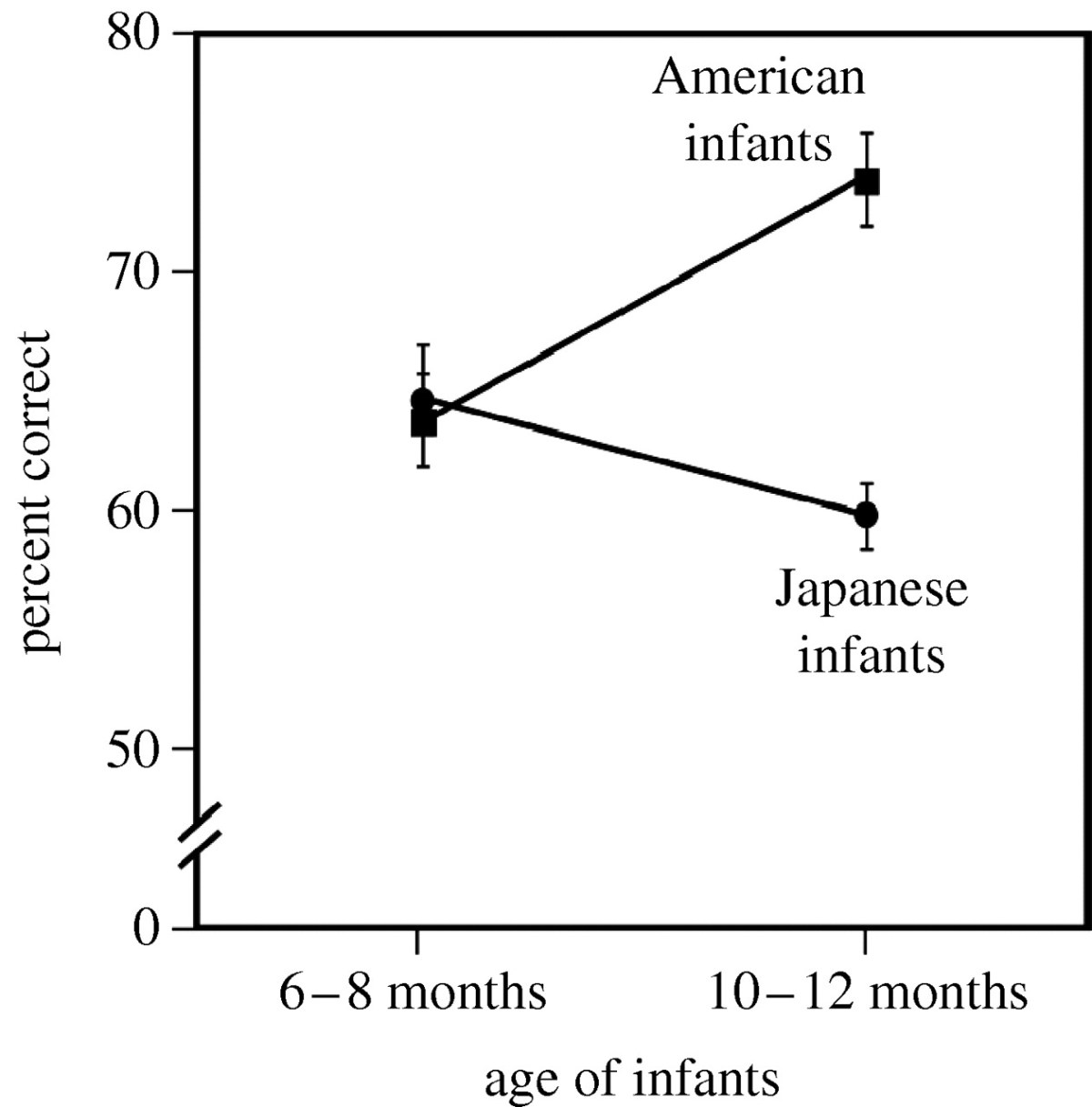
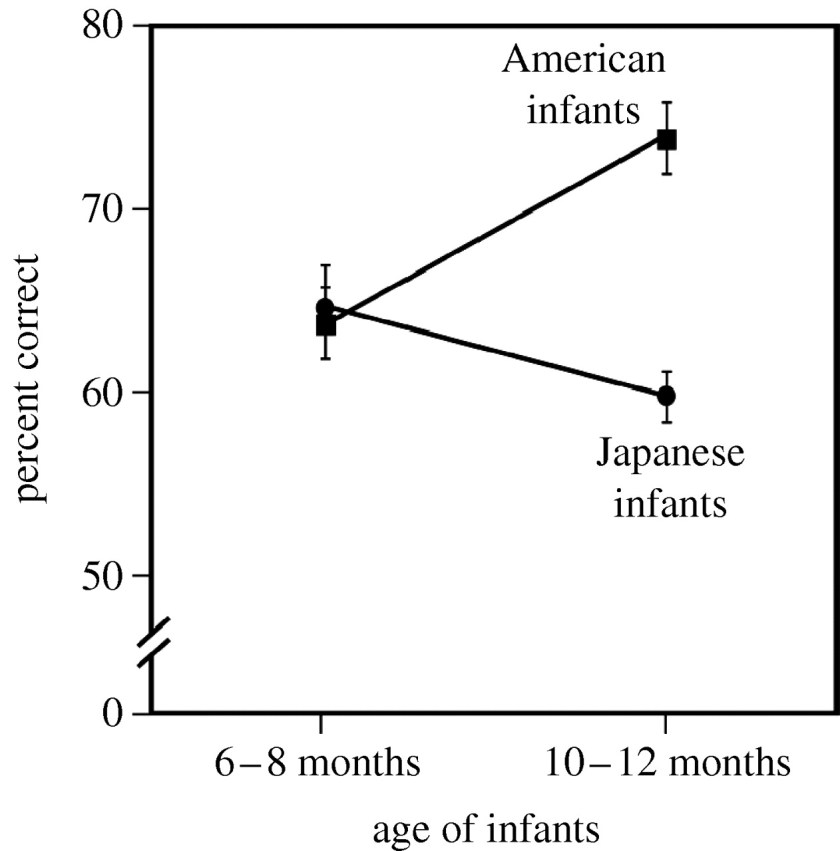
How could one possibly know what sounds an infant can hear, and how could one possibly know that they’ve lost the ability to hear the differences between some of them, but not others?  

f2-large
Differentiating between R and L sounds: American infants and Japanese infants at 6-8 months and at 10-12 months. American English differentiates between the R and L sounds, but Japanese doesn’t. At 6-8 months, the American and Japanese infants do equally well/poorly at telling the difference between R and L sounds. At 10-12 months, the American infants have improved, while the Japanese infants have gotten worse. Picture source: Kuhl et al. (2008), Phonetic learning as a pathway to language: new data and native language magnet theory expanded (NLM-e).
Apropos of nothing but my frustration with my inability to understand the French phrase à propos, here’s a couple of videos on how you do experiments to study how children learn language.  (Linguists use the verb to acquire to describe what you do when you learn your native language(s), which we call language acquisition–hence the title of the second video.)  You’ve probably heard things like this: humans are born capable of hearing the differences between the sounds of all of the languages of the world, but they lose that ability when they start learning their native language.  How could one possibly know what sounds an infant can hear, and how could one possibly know that they’ve lost the ability to hear (the differences between) some of them, but not others?  These videos show you.

I picked these specific videos in part because they’re subtitled, and if you’re not a native speaker of English, they’re great for listening practice.  They have some differences, namely:

  1. The first one, a TED talk by the pioneering child language acquisition researcher Patricia Kuhl, is a presentation by one of the giants of the field.  It has nice graphics, but her language is sometimes much more idiomatic than one might expect, and it might be more difficult for a non-native speaker—or a non-scientist—to understand than the second video.
  2. The second one, from the YouTube channel The Ling Space, features very clear explanations of how the experimental paradigms work, but lacks the great graphics of the Patricia Kuhl TED talk.

Enjoy, and see the English and French notes at the bottom of the post for my best shot at apropos in English and à propos in French.  No guarantees on the French stuff…

Shorter explanation of the experimental paradigms, without the nice graphs of the Patricia Kuhl video, but with very clear explanations.


English notes

Apropos: the dictionary actually doesn’t help much with this.  There are three uses of this that we need to talk about.  One use of apropos in English is as an adjective, in which case it means something like relevant.  Another use of it is in the phrase apropos of, in which case it’s a discourse connector, or a preposition, or something–I’m not entirely sure.  Finally, there’s a special use, apropos of nothing, in which case it’s definitely a discourse connector.  Here are some examples of its use as an adjective meaning relevant or pertinent–all examples but the ones from Twitter are from the enTenTen corpus, via the Sketch Engine web site:

  • The one most apropos in this instance seems to be: to pacify or attempt to pacify an enemy by granting concessions, often at the expense of principle. 
  • Only the cheesiest and best pop song ever! And I found the lyrics to be quite apropos at the time.  
  • It’s tradition to give wood for a fifth wedding anniversary, which is quite apropos for me since I’m married to a blockhead.  (A blockhead is a stupid person, and a block is a particular sort of piece of wood)
  • It is like the modern day holy grail in the face of disruptive tech trends that usurp business models, not to mention Moore’s law being ever more apropos.
  • It might’ve been cool and apropos if blood started coming of the showerhead, but no go. 

Apropos of means something like with respect to, in relation to, as far as … is concerned.  Some examples:

  • I have been thinking about this apropos of the numbers of children claimed to be known to children’s social care.  
  • In 1807 Napoleon wrote Louis, apropos of his domestic relations, a letter which is a good example of scores of others he sent to one and another of his kings and princes about their private affairs.
  • In a letter to Mian Bashir Ahmed, Iqbal has emphasised the point that a comparative study of Ghalib and Bedil apropos of their poetry is necessary.

Now, there’s a particularly common form of this: apropos of nothing.  It is used to indicate that something is not relevant to anything that preceded it, or to introduce something that is not relevant to anything that has preceded it.  The first example explains it about as well as I could:

  • So when you say “ apropos of nothing, person X said this” it means “out of nowhere (relating to nothing) person X said…
  • “Definitely probably,” Wurtzel said, and then asked, apropos of nothing, where I went to school.

…and there’s an especially common use of apropos of nothing, which is straightforwardly a discourse connector used right at the beginning of something that you’re saying.  You use it to introduce a topic that you’re just now introducing and which you’re pointing out is not relevant to anything that’s come before it in the conversation.


…and that’s how I used it in the post.  Why did I use it at all?  I don’t know… I guess because not only is the post not connected to any previous post (other than that it contains a reference–see the first tweet just above–to Trump’s crappy behavior), but there isn’t even any connection between the linguistic thing under discussion (apropos and à propos–this is very meta) and the videos in the post (which are about child language acquisition).  So:

  • Apropos of nothing but my frustration with my inability to understand the French phrase à propos, here’s a couple of videos on how you do experiments to study how children learn language.  

It’s worth noting that this is not what you might call “everyday language”–you would expect any of these uses of apropos in English to come out of the mouth of someone who went to college, is relatively articulate and well-spoken, etc.  This example is a good illustration of that fact:

  • And it’s a weird choice, considering the language Jenna uses (she alternates between swearing and using phrases like “ apropos of nothing”… seriously, what 14-year-old says “apropos of nothing”?), the fact that the boys in her middle school are potheads, and her best friend dresses like a hooker.

Criminy–I’m almost at 1200 words already, and I haven’t gotten to the French à propos at all yet–and WordReference tells me that it’s complicated!  Another time, perhaps–native speakers, please feel free to jump in here…

Your hands and how you feed your children

On an atypical day, the biggest hardship that one has to overcome is explosive diarrhea and projectile vomiting due to forgetfulness about not rinsing your toothbrush in the tap water.

c17-ff3-8
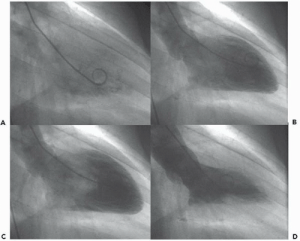
That curly thing (it’s called a “pigtail”) is a catheter sitting in the left ventricle of the heart. Frame D is what it looks like when a healthy heart contracts–if you’ve had damage from a heart attack, you’ll see it here as a section of the chamber that doesn’t contract. Picture source: https://goo.gl/MaS89j

One week a year I get on a plane with a bunch of surgeons, nurses, anesthesiologists, and therapists and head to Guatemala, where everyone else spends the week providing free surgery for people for whom the almost-free health care provided by the government medical system is still too expensive, and I spend the week interpreting.  Don’t get totally lost in Doctors Without Borders fantasies–we stay in a lovely hotel, the surgeries happen in a four-OR operating suite, and on a typical day the biggest hardship that one has to overcome is finding someone to relieve you so that you can get to the cafeteria before the hand-made Guatemalan tortillas (yes, they’re different from the ones that you’re used to) are gone.  (On an atypical day, the biggest hardship that one has to overcome is explosive diarrhea and projectile vomiting due to forgetfulness about not rinsing your toothbrush in the tap water–but, as I said, that’s atypical.)

320behind20scenes_cover_fig2010
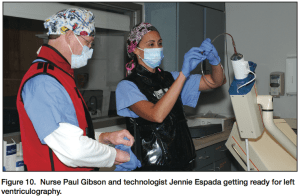
The left ventricle needs to get filled with dye far more quickly than your hand could inject it, so you need a special pump to slam it in quickly. Picture source: https://goo.gl/1S41Am

When new interpreters join us for the first time, the thing that they’re most worried about is the medical vocabulary.  However, that’s actually the least of your problems–medical vocabulary is more or less finite, and you can buy a book about it, memorize it, and modulo local dialect differences (every cardiac catheterization lab that I ever worked in had a different name for the special pump that you use to shoot a bolus of radiopaque dye into the left ventricle), you’ll be just fine.  (Modulo is explained in the English notes at the end of the post.)

The real problem is everything but the medical vocabulary.  Think about this: a patient presents themself to the surgeon.  They’re missing two fingers, and one is just hanging there, useless.  The surgeon’s first question: what happened?  The answer could be anything.  

  • I was getting out of my car and three guys attacked me with a machete.
  • I fell into the cooking fire.
  • I was sitting in a truck and the carburetor exploded.

I didn’t make any of these up, and the cooking fire thing happens tragically often–mostly with children.

I mostly work with a hand surgeon.  The basic principle of hand surgery is this: make the person be able to function again at whatever they do.  You often have to make choices about trade-offs–a surgery that would let you open your hand again after it’s been scarred into a fist by burns might leave you with a weak grip, and that’s going to be a problem for a farmhand; a surgery that would give you back your full grip strength might make it tough for you to do things that require fine motor control, which is not OK if you’re a seamstress.  Consequently, one of the questions that the hand surgeon always asks is: what do you do for a living?  …and that could be pretty much anything.  

So, yeah: it’s not the technical vocabulary that keeps you on your toes in medical interpreting–it’s the entire remainder of the language, and if you’re a regular reader of this blog, you know that the statistical properties of human languages are such that if you’re not a native speaker, you will come across vocabulary items that you don’t know Every. Single. Day. Of. Your. Life.


evrmuseo33
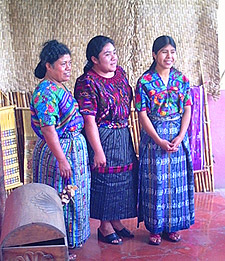
The shirts are called huipiles. In the Guatemalan highlands, you will see women wearing them every single day. Weaving one takes about a year. Picture source: https://goo.gl/SpjLW3

For today’s vocabulary, here are some words for professions that require quite a bit of use of your hands.  Note that almost any profession requires some use of your hands–I’m picking just a few here, focussing on ones that you wouldn’t be surprised to come across in low-income people in Central America.  If you have almost no education, and you’re doing any of these for a living, and you lose the use of a hand, your options for feeding your children become quite limited.  Hand surgery is about removing those limitations.  Want to support this kind of work?  Twenty bucks from you would literally pay for more than all of the pain medication that we’ll hand out in one week’s time.  You can donate here.

English Spanish French
farmhand granjero  ouvrier agricole
farmer  agricultor  fermier, agriculteur
gardener jardinero jardinier
seamstress modista  couturière
tailor  sastre  tailleur
waiter/waitress  mesero, camarero  serveur
weaver tejedor/a tisseur, tisserand
 carpenter carpintero  charpentier
 construction worker el albañil  ouvrier du bâtiment

English notes

modulo This is originally a term from mathematics.  In casual use, it means something like with the exception of, or besides.  I should point out that this word is characteristic of the speech of geeks, and only geeks–but, amongst my people (geeks), it’s quite common.

This example should be incomprehensible to any normal human, but I find it adorable due to exactly that incomprehensibility–“init” refers to a common part of a program, and the writer is saying that she’s left the “init” part out of what she’s showing you:

How it was used in the post: Medical vocabulary is more or less finite, and you can buy a book about it, memorize it, and modulo local dialect differences, you’ll be just fine. 

themselfHere we get into the controversial topic of pronouns in the Pacific Northwest, the part of the United States where I grew up.  Many native speakers of American English would balk at this pronoun, as well as theirself, which we also use in the Pacific Northwest.  Another vagary of our local use of pronouns is that when you have a subject that consists of two conjoined pronouns, they have to be in the dative: Me and him are going to the store, do you want some Redman?  Here’s a nice article on the themself form from the Merriam-Webster web site, which points out that themselves (which every other native speaker thinks us Pacific Northwest natives should be using) didn’t show up in English until the 1400s, with themself being the only possibility up to that point.

How it got used in the post: Think about this: a patient presents themself to the surgeon.  They’re missing two fingers, and one is just hanging there, useless.  


French notes

There are two French words that could translate the English word “carpenter:” charpentier, and menuisier.  Looking them both up on Google Images, it seems to be the case that a charpentier is a carpenter in the sense of someone who builds buildings, while a menuisier is a carpenter in the sense of a woodworker.  Native speakers, do you have thoughts about this?

Hits for charpentier from Google Images:

Hits for menuisier from Google Images:

…and, yes, this is how linguists try to figure things out.  We’re actually less excited about dictionaries than you might think…

Communications Over Various Feeds Electronically for Engagement

covfefe-trump_wide-b5fd498736b7baadff7cf38932c364133fb1847a
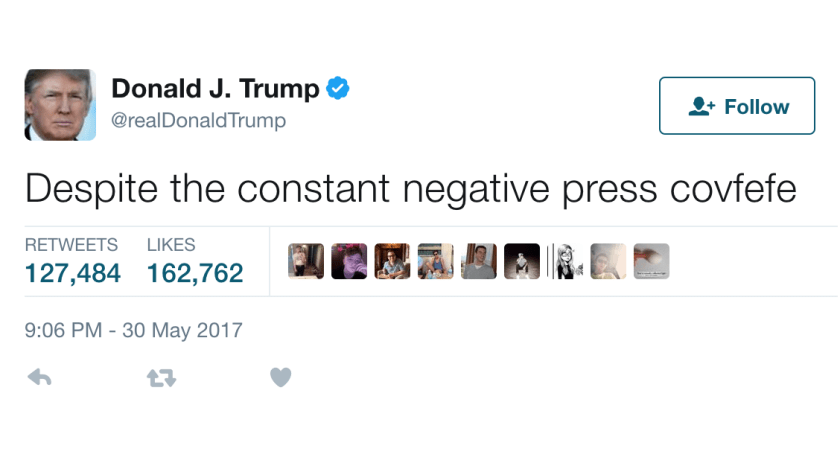
The “covfefe” tweet. Picture source: https://goo.gl/ucYXdr

Donald Trump–also known as The Molester-In-Chief, Draft-Dodger-In-ChiefLiar-In-Chief, Traitor-In-Chief, and undoubtedly many similarly uncomplimentary epithets by the time our current national nightmare ends–has been nicely trolled by Representative Mike Quigley, D-Ill.  His COVFEFE Act–Communications Over Various Feeds Electronically For Engagement–aims to amend the Presidential Records Act to include the social media that Trump so loves to use to troll the rest of us.  The name of the act ridicules a stupid Trump tweet–see the picture above.  The Presidential Records Act defines the requirement that US presidential records be preserved.  Trump loves to communicate via social media, and also loves to flat-out deny ever having said things that he manifestly did, in fact, say–often on social media.  Quigley’s COVFEFE Act would define social media posts as presidential records, which would prevent Trump from deleting the evidence of his lies–at least the lies that he told on social media.  The Republican-controlled House of Representatives (roughly the American equivalent of the French Assemblée Nationale) will almost certainly block it, but in the meantime: the Troller-In-Chief has been nicely trolled.  You can read about the COVFEFE Act here–relevant French and English vocabulary explained below.


English notes

draft dodger: the draft is the mechanism for summoning people to obligatory military service.  A draft-dodger, then, is a person who illegally avoids joining the armed forces (Merriam-Webster).  Trump famously avoided military service during Vietnam by claiming to have flat feet, and then announced that he would be the most physically fit president ever.


French notes

le traiteur: this is one of the more puzzling words for newly-arrived Americans in France.  It appears all over Paris, most visibly on the signs of Chinese restaurants.  To us, it looks like the English word traitor.  However, it means something like “someone who sells prepared foods.”  WordReference.com defines it as caterer, but as far as I can tell, it’s a lot more general than that.

le traître: traitor.


PITA ferret: the informal imperative

What’s a Jewish mother’s favorite metro station? Read to the end of the post and you’ll get the answer, plus a video of a ferret.

042411_2018_limpratif1
Picture source: the Le Coin du français blog. https://goo.gl/jN0fh8

I never stop being amazed at how basic some of the mistakes that I still make are, even after three and a half years of intensive study of la langue de Molière.  Case in point: the spelling of the tu form of the imperative.  The thing that you have to remember is that it doesn’t have an at the end–except when it does.

The wonderful Lawless French web site gives this explanation of the general rule (keep going for some exceptions):

The imperative tu conjugation for –er, –frir, and –vrir verbs is the present tense minus the final s.

Here are some examples from the Nouvel Obs’s (the form of this genitive explained below in the English notes) description of the informal imperative:

  • Rentre immédiatement !
  • Ne discute pas !
  • Va voir tes grands parents !

OK, an exception: when the verb is followed immediately by or en, you have an at the end.  Here’s the explanation from the Français Facile web site:

Cependant, devant « en » et « y » qui  suivent immédiatement le verbe, on ajoute un « s » au verbe en « er » à l’impératifsingulier, et on le joint par un trait d’union comme tous les pronoms qui suivent un impératif.

Ex. Amènes-y ta soeur.

Cette règle s’applique aussi au verbe « aller »

Ex. Vas-y.

Fiez-vous à votre oreille. Si vous prononcez le verbe et que le son vous paraît étrange, il peut y avoir un problème.

Mange-en, sans « s » sonnerait d’une façon étrange à l’oreille.

EX :

À Londres, vas-y si tu veux, mais amènes-y ta soeur et rapporte-moi un cadeau.


OK: that’s the “first group” verbs (-er)–we’ll return to the –frir and -vrir verbs that Laura mentions in a bit.  For -ir and -re verbs, the is always present.

Now: some exceptions.  First, as we’ve seen before, verbs that end in -frir or –vrir sometimes have odd behaviors.  (See this post if you want some insights into what they have in common, and how they differ phonologically from other –ir verbs.)  These verbs do not have an in the informal imperative…

  • Couvre ta bouche quand tu tousses, dégueu !

…except when they do, which is the same as when the first-group (-er) verbs do, i.e. when followed by en or y.

  • Couvres-en un peu avant d’attraper une pneumonie.  (Reverso)

(Native speakers: do you have dissenting opinions about this?  I had to ask around a bit…)

Almost at the end!  Just four verbs that are totally irregular in this respect:

  • Aller: Va te faire voir, but vas-y !
  • Être: always s-final: Sois beau et tais-toi.
  • Avoir: N’en aie pas marre, c’est bon pour les pépitos ! …but Aies-en de meilleures (notes), tes profs te féliciteront
  • Savoir: Sache qu’elle a vomi ce matin, alors que le thon était frais,  but saches-en plus pour réussir ton examen.

So, the Jewish mother: here’s the first joke I ever understood in French.  I’m minding my own business in the basement of a bar near the St-Sebastien Froissart metro station (none of your business why I was in the basement of a bar near the St-Sebastien Froissart metro station, or why I’m ever in the basement of any bar anywhere, for that matter) when I heard the following from the table behind me: La station de métro d’une mère juive, c’est laquelle ?  Monge, parce qu’elle dit “mange, mange, mon fils.”  In English: what’s a Jewish mother’s favorite metro station?  Monge, because she says “eat, eat (in French, mange, mange), my son.”  Now, this is interesting on a number of levels; the one that I’d like to point out is that it might only make sense to someone who does not speak hexagonal French, and that might be the only reason that I got it.  As a monolingual native speaker of English, I can’t hear the difference between the vowels of mange and Monge–we don’t have contrasting nasalized vowels in English, and those two in particular are particularly impossible for me to hear, and pretty tough to pronounce, too, leading me to say things like marde, je t’ai trempée (“shit, I got you wet”–marde is a Canadianism that I can’t seem to get past) and getting responses like “but we’re not going out together!”…which suggests that I pronounce it as je t’ai trompée, “I cheated on you.”   I’ll throw in to the mix the fact that I’m told that pieds-noirs (the pieds-noirs, “black feet,” are the French who returned to France after France lost Algeria as a colony in 1962–maybe 800,000 people) don’t differentiate between the nasalized vowels an and on, either.  Not surprising–differences in the nasalized vowel inventory are a common feature of francophone dialect differentiation, including in France.  What does this joke have to do with the subject of this post?  It only works with the informal imperative, i.e. mange, mange (“eat, eat”)–with the formal or plural imperative (mongez, mongez), “eat” doesn’t sound anything at all like the name of the metro station (Monge), and you have no joke.


Here’s a video that has approximately a bazillion examples of the informal imperative.  There’s a bit of vocabulary that might help you out here, if you’re not a native speaker of French:

  • le furet : ferret.
  • relou : here’s the best I can do for a definition of this word, which I haven’t found in a French-English dictionary as of yet: Relou” est un mot verlan (langage des rues semblable à un ver lent grignotant doucement… ) signifiant “lourd”. Dans un contexte particulier, désigne une action/personne qui a fait/dit une chose qui a déplu à l’émetteur de ce mot.  Source: lachal.neamar.fr.  The source gives these synonyms: casse-couille (familier), chiant (familier), casse-pied, and lourd.  So: maybe irritating, or “pain in the ass?”

English notes

PITA: a less-shocking way of saying “pain in the ass.”  This is something somewhat more than annoying.  Assembling the appropriate forms in order to be able to fill out the forms that you need in order to get permission to ask for (more) permission from the Dean’s office before doing any international travel is a PITA.  (I’m talking about America here–everything you’ve ever heard about French bureaucracy being worse than American bureaucracy is bullshit, period.)  My old neighbor was a PITA–always complaining if anyone parked in front of her house, although she didn’t have a car.  The constant flood of papers that you have to review when you’re on Christmas vacation is a PITA.  The ferret in the video is being a PITA to the cats–hence relou.

An excellent example, both using and defining the abbreviation:

Of course, if we can have an example with a cat, all the better, seeing as how we’re on the Interwebs and all…

A geeky example, but a very good one–you could hear this around my lab in the US any day of the week:

 and now you have to know what this means:

Any day of the week: (at) any time.

An idiot:

Gratuitous picture of a guy with no shirt on:

Obama at Hiroshima: American English listening practice

My judo friends cry at Hiroshima, and they are a hell of a lot tougher than I am.

I know some really, really tough young people.  Guys and girls, they all are, or recently have been, nationally-ranked judo players.  These are kids who have, for most of their lives (typically they started at 5 years of age), spent two hours straight, three times a week, getting pounded into a thin tatami.  They spend their weekends going to tournaments where they walk onto a mat with a stranger who will try to slam them into that mat again–hard.  These are the bravest, toughest, strongest people I know–and also probably the kindest.  At some point in their studies, we try to send them to Japan to study for the summer.  While they’re there, they go to visit Hiroshima.  When they visit Hiroshima, they do the same thing that I did in Nagasaki–they cry.


general20cargo20ship
The “hold” of a ship is a big empty space belowdecks where you can transport things in bulk–see the compartment labelled 10 in this illustration. Picture source: https://forshipbuilding.com/ship-types/cargo-ship/

When I was a child, I didn’t have books of my own–so, I read my father’s books.  He has always been into first-person accounts of survival in conditions of crisis, and we had piles of relevant books around the house, so that’s what I grew up reading about.  Consequently, long before puberty I knew about the two philosophies of how to manage the limited resources of your once-a-month Red Cross package in a German prisoner of war camp; the mechanics of soup distribution in Soviet gulags; and what it feels like to watch a buddy die of dehydration in the hold of a Japanese prisoner transport ship.  My point: I know what happened in that war, and I know who did what to whom.  I also understand that dropping the bombs on Hiroshima and Nagasaki prevented the almost inconceivable bloodbath that an amphibious invasion of Japan–and the nationwide bombing that would have preceded it–would have brought to the world.  And still: I cried at Nagasaki.  My judo friends cry at Hiroshima, and they are a hell of a lot tougher than I am.  Life is complicated, people are complicated, the world is complicated.  Be as zen as you like: anything of interest is still going to be complicated.  Simplistic bullshit is just that: simplistic bullshit.


Of the four language skills–speaking, listening, reading, and writing–none is harder than listening.  Want to practice your American English listening skills?  You could do worse than this beautiful, complex, and subtitled speech by former President Barack Obama.  The vocabulary is quite advanced; in recompense, his pronunciation is clear and beautiful.  I checked the subtitles up to 8:20, and they’re quite good.  It’s pathetically depressing to contrast the infantile rants of Trump with the nuanced thought and articulate self-expression of President Obama; it’s even more depressing to think that your own country could have experienced an Obama, and then turned around and elected a Trump, a king of simplistic bullshit…  French notes after the video.


French notes

La cale d’un navire est l’espace où sont entreposées les marchandises, le produit de la pêche ou autres entités transportées (lest). Elle se situe sous le pont et est recouverte par un panneau de cale s’appuyant sur des hiloires.  (Wikipédia)

entreposer: to store, to stock; to put in a customs-bonded warehouse (I don’t know what that means, but Word Reference says it’s so)

le lest: ballast.  The is pronounced, so don’t confuse this with leste…

Ukrainian Humanitarian Resistance

Resisting the russist occupation while keeping our humanity

Languages. Motivation. Education. Travelling

"Je suis féru(e) de langues" is about language learning, study tips and travelling. Join my community!

Curative Power of Medical Data

JCDL 2020 Workshop on Biomedical Natural Language Processing

Crimescribe

Criminal Curiosities

BioNLP

Biomedical natural language processing

Mostly Mammoths

but other things that fascinate me, too

Zygoma

Adventures in natural history collections

Our French Oasis

FAMILY LIFE IN A FRENCH COUNTRY VILLAGE

ACL 2017

PC Chairs Blog

Abby Mullen

A site about history and life

EFL Notes

Random commentary on teaching English as a foreign language

Natural Language Processing

Université Paris-Centrale, Spring 2017

Speak Out in Spanish!

living and loving language

- MIKE STEEDEN -

THE DRIVELLINGS OF TWATTERSLEY FROMAGE