Anatomically modern humans have a facial structure that is different from our evolutionary predecessors and close relatives. Here’s how to recognize it.
I’ve occasionally read that Neanderthals were so similar to modern humans that you wouldn’t notice one if you walked by them on the street. This is probably not true. Leaving aside the question of whether people who write things like that know anything about what I, personally, am and am not likely to notice, anatomically modern humans have quite different facial structures from anything else out there today, and also from any of our hominid relatives. That includes Neanderthals.
In recent posts, we’ve talked about three unique features of the anatomically modern human face:
If you’re not sure about what any of those mean and you want to know, follow the links, which will take you to illustrated posts on each of those individual features.
The tendency to notice faces, and the ability to read facial expressions, seem to be very important in humans, based on things like the sophistication of the musculature that we have for controlling facial expressions, the amount of the motor nervous system that is developed to controlling those muscles, and the skill that most humans have in recognizing facial expressions of emotion. For an accessible discussion of the psychology and biology of all of this, see this Wikipedia page. Chimpanzees are lousy at recognizing human facial expressions–dogs can be pretty good at it, though. (There’s a lot of variation here, so don’t get pissed at your dog if he doesn’t seem to be up to the task. He undoubtedly has other charms. Another cool thing that dogs can learn to do, but chimpanzees can’t: understand that when you point in a direction, they should look that way.)
If you’ve read the preceding posts, and you can remember these three features–forehead, chin, and being located under the eyes–then I’m guessing that you can impress your kids the next time you go to the zoo/museum/catacombs by explaining what to notice about the faces of the skulls of the various and sundry critters that they’ll see. Want to test yourself? Here are some skulls to check out. See if you can tell which are anatomically modern humans and which aren’t. Answers at the bottom of the post, along with some French vocabulary for talking about faces.
Modern human infant. (Trick question.) This is a reproduction of the skull of a deceased 4-month-old child. Human infant skulls are similar to chimpanzee infant skulls in that they both have foreheads (which the chimp will lose as it ages), but note that the human infant’s face is located beneath the eyes. Picture source: https://boneclones.com/category/child-skulls/human-anatomy#view=grid&category=76&page=1&pageSize=30
Australopithecus. No lower jaw, so you can’t look for a chin, but notice the lack of a forehead and the forward-protruding muzzle (i.e., the face is not located under the eyes). Picture source: http://www.wikiwand.com/en/Australopithecus
le visage: face. I think this might be a higher register of language than la figure–perhaps more literary? Not sure. Here’s a link to the Noir Désir song Des visages des figures, just for fun: https://www.youtube.com/watch?v=wW533pwLMv0.
le sourcil: eyebrow. The l at the end is silent, unlike most word-final l‘s.
le cil: eyelash. This l is pronounced.
la joue: cheek.
un œil: eye. Pronunction: [œj]. That is: the L is silent. Follow the link to the Lawless French web site if you want to hear a recording of the proper pronunciation. (I threw this one in despite the fact that we all probably know it because I was recently in a French theater class, and I noticed that NONE of the students (including me) was sure how to pronounce it when it would come up in a play, despite the fact that we all had good enough handles on French to talk about Molière in it. Like I always say–it’s the little things that get you…)
les pattes: sideburns.
la barbe: beard.
barbe-à-papa: cotton candy.
la gueule: mouth. Ta gueule! Shut up!
être très physionomiste: to have a good memory for faces
The errors of a child learning their native language can be tremendously interesting.
When my kid was about four years old, he went through a period where he switched the orders of certain kinds of words. It wasn’t random–this happened only with a particular kind of word formed by putting two nouns together. For example, he would say:
light kitchen instead of “kitchen light”
friendgirl instead of “girlfriend”
On the other hand, if there were a noun preceded by an adjective, he got the order right:
big kitchen
mean girl
The phenomenon has some implications for theories of how children learn language. In particular, it’s difficult to give a simple behaviorist explanation for this phenomenon, where the kid gets exposed to stimuli, repeats them, and gets reinforced for producing them correctly: to my knowledge, the kid was never exposed to things like friendgirl. There are also interesting things about his pronunciation of these things on a smaller scale, though, and in particular, how we make compounds–read on, if you want to know more.
One of the most difficult problems in getting a computer to understand language is understanding compound nouns. These are nouns that are made up of two or more words in a sequence. The toughest ones can be compounds where the words that make up the compound are both nouns. For example, in English:
school bus
kitchen cupboard
fire engine
I’ve given you examples where the two nouns are written with a space between them, but they might also be spelt with a hyphen, or without a space. For example:
gunboat (no space)
timesheet (no space)
rainbow (no space)
gun-carriage (hyphen)
train-spotting (hyphen, and yes, you are allowed to argue about whether or not spotting is a noun)
From a theoretical perspective, there isn’t a distinction between these–they’re all compound nouns. From the point of view of writing a computer program that deals with language, we would tend to treat the ones that are written with a hyphen or with no space as single words that don’t necessarily get analyzed further, but the ones written with a space usually need special treatment. (In fact, amongst people who do natural language processing, there’s a whole field of research concerning what are called multi-word expressions.
From both a theoretical and a practical perspective, the big question about compound nouns is: how can you describe, understand, and get a computer to deal with the different kinds of relationships that can exist between the nouns? It’s not a random thing–languages tend to exploit particular kinds of relationships in compounds. Even describing these things from the perspective of theoretical linguistics is tough, though, separately from the practical problem of getting a computer program to process them. A classic English example (due, I believe, to the recently departed linguist Chuck Fillmore) is the names for different kinds of knives in English.
bread knife: a knife for cutting bread
butter knife: a knife for spreading butter
pocket knife: a knife that is carried in a pocket
butcher knife: a knife that is used by a butcher
palette knife: a knife that is shaped like a palette
utility knife: a knife that is used in food preparation
paring knife: a knife that is used for paring
steak knife: a knife that is used for cutting steak
boning knife: a knife that is used to trim meat from a bone
boot knife: a knife that’s meant to be carried on or in a boot
Just with this partial list, we can see some patterns of semantic relationships between the nouns in the compound:
intended material
bread knife, butter knife, steak knife
used by
butcher knife
used for
paring knife, boning knife
carried in
pocket knife, boot knife
shaped as
palette knife
Dog bones at a Hungarian butcher shop in Cleveland, Ohio. Picture source: me.
How should we classify utility knife? Or dog bone? I don’t know. As I said, this is difficult–it’s not like this is something that they teach you in linguistics grad school. And, do you get to just make these kinds of relationships up on an ad hoc basis? If so, you’ve got descriptions that couldn’t possibly be shown to be wrong, and from a scientific point of view, that’s bad–your theories need to be testable, and falsifiable. (Generally we assume that we can’t prove anything, but we do try to construct theories in such a way that if they’re wrong, in principle we should be able to demonstrate that.) Some people have proposed limited sets of relationships that they hope can capture all such compound nouns–for example, the Generative Lexicon theory of James Pustejovsky. It’s not clear that all of the issues that are involved in this are resolved, though.
Rather than this kind of noun-noun compound, French generally has nouns modified by prepositional phrases. That is, you have the noun, then a preposition, and then another noun. For example, compare these English and French nouns:
railroad (rail + road)
chemin de fer
windmill
moulin à vent
wine glass
verre à vin
goods transport
transport de marchandises
shaped as
palette knife
For more examples, see the picture in this post, which shows the vocabulary for a variety of kinds of knives in French.
It’s not the case that all French nouns of this sort follow the prepositional phrase pattern–for example, we have homme grenouille, “frogman.” But, the pattern with the prepositional phrase is much more common. Having said that: one of the biggest mysteries of French for me is how you know when the preposition will be de versus à. Is there some principle that would let me know that it’s a boîte à gants (glovebox) and a cuillere à café (coffee spoon), but a animal de compagnie (pet) and a crème de cacao? A boîte à bijoux (jewelry box), but a boîte d’allumettes (matchbox)? A boîte à chaussures (shoebox), but a boîte de nuit (nightclub)? I have no clue.
Some details of compound nouns in English: the pronunciation of these things is different from phrases with adjectives. In general, in a compound noun, you’ll have the stress on the first noun, e.g.:
chef’s knife is pronounced CHEF’S knife, while David’s knife would usually be pronounced equal stress on both words.
coffee spoon is pronounced COFFEE spoon, while yellow spoon would be pronounced with stress on both words.
beat box is pronounced BEAT box, while big box would be pronounced with stress on both words.
Some details of compound nouns in French: I have no clue how to pluralize these things, and I’m not sure that all French people do, either. Here’s what the Wikipedia page on French compound nouns has to say on the topic. It breaks the compounds down to what they’re made up of: a noun plus a noun, a verb plus a noun, a noun plus a verb, etc.:
noun + noun: pluralize both. Example: oiseau-mouche, oiseaux-mouches (hummingbird). Exception: I don’t understand the Wikipedia explanation for this, but sometimes you only pluralize the first noun: des chefs-d’œuvre (masterpiece), des arcs-en-ciel (rainbox).
verb + noun: plural only at the end. Example: cure-dent, cure-dents. Exception: I don’t understand the Wikipedia explanation for this, either, but sometimes you don’t mark the plural at all: des chasse-neige (snowplow) (= chasser la neige, devenu variable dans l’orthographe de 1990), des trompe-l’œil… (direct quote from Wikipedia)
adjective + noun: pluralize both. Example: la basse-cour, des basses-cours (farmyard; chickens and rabbits; outer courtyard).
verb + verb: don’t mark the plural at all. Example: des garde-manger (pantry).
If you’d like to know more about the Generative Lexicon theory and how it accounts for these kinds of relationships between nouns, but don’t feel like you want to tackle the primary sources (I have a PhD in linguistics and I’ve never been able to finish working my way through the last chapter), there’s a book called Generative Lexicon theory: A guide, by James Pustejovsky and Elisabetta Jezek, coming out. For a detailed discussion of relationships in this kind of noun in French and Italian, see this paper by Pierrette Bouillon, Elisabetta Jezek, Chiara Melloni, and Aurélie Picton. (I got some of the examples in this post from there.)
So, back to my poor kid: why friendgirl and light kitchen, but mean girl and big kitchen? He seems to have come up with some conception of there being a difference between the compound nouns and a sequence of an adjective and a noun. Remember that he was maybe 4 years old, so no one taught him this. As is characteristic of kids learning their native language(s), he came up with a hypothesis about how to produce the difference between these things, and what he came up with was an ordering difference for the compound nouns. So: don’t freak out if your kid comes up with some weird things in the language department, and be aware that it’s mostly not trying to correct them–it’s not like they’re consciously aware of these “rules,” and nothing that you can say to them is going to change them. However: they’ll figure it out. Keep Calm And Keep Talking.
Sorry, no French stuff in this one–this is an interview with Graeme Hirst, a well-known researcher on language and computers and the editor of a popular series of books on that subject. Come back in a day or two for a return to the subject of the implications of the statistical properties of language for second-language learners and how that plays out in one person’s life (mine).
Graeme Hirst is a professor of computer science at the University of Toronto. From a theoretical perspective, his research is focussed on lexical semantics, especially problems in the representation of linguistic and semantic knowledge; text classification, the study of how to categorize bits of language into things that can tell us something (do the contents of this note tell us that the writer is experiencing cognitive decline?); and the linguistic nature of argument. He is an internationally respected expert on quantifying the extent to which words are semantically similar to each other (his paper on this has been cited over 1400 times), how we use “chains” of related words to make discussions of a topic cohesive, and how we can build computational models of language that can help us understand how people make sense of ambiguities by using what they know about words. He has also put this theoretical work to very practical use in his work on methods for detecting Alzheimer’s disease, or cognitive decline, by looking at long-term changes over time in people’s writing. (Some of this description is lightly edited from his web page.)
Prior to this, Graeme was for more than 25 years, book review editor of the journal Computational Linguistics. So Graeme has been in a unique position to observe the dynamics of publishing books in a world where people don’t necessarily start their investigations of a topic with a trip to the library, as we did when I was a younger man, but by doing a Google search and looking for a free tutorial to read. Graeme was kind enough to let me interview him by email; here is what he had to say on subjects ranging from what the editor-author relationship is like in a technical environment, an editor’s perspective on writing, and business models for book publishing in a world where it’s not clear that technical people read books any more.
Me: How do you see the role of the editor of a non-fiction book?
Graeme: There’s no single answer to that, even assuming that we are talking specifically about academic books. Also, do you mean the editor of a single multi-author volume or (given your earlier allusion to book series) the editor of a series?
In this kind of editing, there is a spectrum between gatekeeping and (what I’ll call for lack of a better term) programming. The former is typical of academic journals: the editor’s job is merely to enforce quality control and all relevant papers that are scientifically acceptable (by some threshold that depends in part on how much space is available in the journal) are published, without regard to the specific topic of each paper. There is no attempt to “balance” the papers by topic within an issue or across issues or to ensure that any particular topic is covered. That’s in contrast to a popular magazine, say, where variety is important, and so is entertainment or interest value. In such a magazine, the editor will decide what topics to cover partly from his/her own knowledge of what’s going on and from listening to article pitches from writers. Writers will then be commissioned to write articles, with a view to creating (or “programming”) a magazine that pleases its readers with an interesting variety and which covers topics that “need” to be covered. Not all commissioned articles will necessarily be published.
An academic book series can be much like the academic journal, where scientific quality is the main consideration rather than variety or covering specific topics — although the assurance of a market for the book is usually taken into account too. It costs a lot more to publish a book than a journal article, and even non-profit publishers, such as university presses, need some assurance that costs will probably be covered by proceeds from sales. (That consideration obviously doesn’t apply to predatory publishers and vanity presses that for a fee will just toss any author’s camera-ready copy out into the world, or will charge the author for all production costs, without any editorial judgement at all.)
But my personal approach has been in the middle of the spectrum — not exactly a popular magazine but with some of the same aspects of “programming”. Since the series I edit is intended to be largely tutorial in nature, rather than research monographs, I actively identify important topics, especially emerging topics, for which an introductory book would be helpful to the research community and then try to find (sometimes successfully, sometimes not) appropriate authors to write it. And I also gratefully receive suggestions and proposals from potential authors. So I aim for both variety and coverage. I would not want to have two books on the same topic in the series, as that kind of redundancy and competition would not be fair to the authors who put a lot of time and work into their book.
Quality is also an issue. For my series, I am conscious of the series as a “brand”, and I want readers to have confidence that if a book is allowed into the series then it will be a good one and worth their while. Not all books can be equally totally wonderful, but bad books will tarnish the series and have a bad effect on the other authors. For scientific quality control, like any editor, I have to rely on the reviewers, as I can’t be sufficiently expert on most of the topics. I also care about quality in writing, especially as these are introductory books aimed at a relatively wide audience within the research field — graduate students reading for an advanced course, or a researcher who wants to come up to speed rapidly on a new topic — and I do my best to help authors improve their writing where I can. Production quality matters, too; typos and sloppy formatting reduce credibility. The series is professionally copy-edited and typeset, but it helps if authors deliver a Latex source file that is as error-free as possible.
Me: How do you see the future of book-writing and publishing in a world where it’s not clear that technical people read books any more? I’m not sure that my students ever read books on topics in our field unless I make them do it–their natural impulse seems to be to go to Google and look for a web page that will explain it to them quickly, and without the hassle of a trip to the library or the cost of buying a book.
Graeme: It’s a cliché that no one has the time or attention span any more to cope with anything long, and books are no exception to that. And as books become ever more expensive, we want a really good reason to lay out our money, and we’re loath to do that if we need only some parts of the book. It’s no different to the rebellion against buying CDs or record albums; why pay a lot when there’s only one or two tracks I want, and I can download those cheaply (or free). Meeting this demand was one of the appeals of the Synthesis series for me — books on very focused topics in (mostly) just 100–150 pages, that set the topic out for the reader far better than he or she could do just by putting together the results of a Google search. The result, I hope, is books that work both for the reader who is motivated by fascination with the topic and for the reader who just has a pragmatic need to know the material without a deep level of interest. But the future of book writing seems secure. There is no shortage of people who have lots to say about topics that they are passionate about and who want to tell the world.
Me: Do you have thoughts about the distinction(s) between editing a non-fiction book and editing a work of fiction? I’m guessing that you don’t have the kind of relationships with your authors that I read about fiction writers having with their editors–you paying their rent, advising them on their love life, etc. On the other hand, I’m guessing that you do have some aspects of the novelist/editor relationship–say, advising people on how to get over “writer’s block,” procrastination, dealing with reviewer comments, and the like.
Graeme: I don’t have any experience in editing fiction. And I’m usually too remote from my authors’ lives to offer the kind of advice that more typically characterizes the relationship between an advisor and a graduate student. Also, it is explicitly my publisher’s job, not mine, to cajole, nudge, hector, and badger tardy authors.
As with most things we do, writers tend to underestimate how long the work will take. But there are some who seemingly just keep putting it off, or can’t organize themselves to put in the time when there is always a more-urgent deadline for a conference paper or similar that needs to be attended to first. What always astonishes me is the people who will put a lot of work into writing 50% or 80% or more of a book, and then simply can’t bring themselves to complete it, thereby throwing away an enormous amount of time and effort.
Me: You mentioned that you try to help authors improve the quality of their writing. How does that work? What are you looking for, where quality is concerned? Do you see more/less in the way of problems from academic writers? Computer scientists versus linguists? What’s your level of tolerance/support for the somewhat impenetrable writing that we academics often get rewarded for?
Graeme: Despite what I said, there’s actually not all that much that I can do as an editor to influence writing except to point out general principles, often rather superficial ones, such as “refer to people, not papers”. One occasional problem in multiple-authored books is that the authors use different terminology or different mathematical conventions and symbols in their respective parts, and I now instruct groups early on about how to maintain consistency and avoiding redundancy where each author re-introduces certain material at the start of their part.
I’m astonished how much I need to do at the formatting level. Many authors need to be told to proofread both their BiBTeX entries and the resulting bibliography. Or how to use math mode properly. Or design a table logically.
Me: Indeed, as a reader, I find the whole multiple-authors-using-different-terminology-and/or-symbols thing really frustrating, and occasionally a non-trivial barrier to comprehension.
So, lessons learnt, then: what general (or specific) advice might you offer to authors up front?
Graeme: It’s faster in the long run to do it properly the first time than to go back later to correct all the little inconsistencies and errors.
Me: What would you most want authors (and readers, I guess–or other editors) to get out of this conversation?
Graeme: Don’t say yes unless you mean it. Finish what you start. Aspire to publish a book in the Synthesis HLT series.
Me: What do you wish I’d asked you that I didn’t?
Graeme: “Welcome to Paris. Will you join me for dinner at my favorite Michelin-starred restaurant?”
I would never claim to “speak” any language that I don’t speak natively, and that pretty much means English–more specifically, American English. However, I’m pretty comfortable in Spanish, and I’m getting there in French (which doesn’t mean that I don’t still sound like an idiot, but I do pretty much live my life in French when I’m in France, both personal and professional). People often say something like this to me–almost always Americans: I’m no good at languages. Or: why are you so good at languages? My answer: I’m not “good at languages,” and you’re not bad at them. Why I am comfortable in one or two of them, and can survive in a few others: you would not believe how much time I spend studying.
As far as I know, the only reliable predictor of success in learning a foreign language is motivation. That was the case when I started grad school in 1991, and it’s still the case now. Motivation is important in a couple forms, where language-learning is concerned:
You cannot quit. If you don’t quit, it’s not like success is guaranteed–I don’t know what level of mastery you’re looking to achieve, after all–but, if you do quit, that does guarantee failure.
While you’re busy not quitting, you have to bear in mind that you will learn quickly to the extent that you spend a lot of time working on it–or not. I’ve been able to go from not speaking French to living my life in French in 2.5 years only because I am relentless about taking notes on the words that I don’t know in the course of my day and then looking them up, memorizing vocabulary, learning new grammatical points, driving around town (when I’m in America) practicing the French r in my car, listening to French radio, following a really good French-learning podcast (Coffee Break French), using French every single time that I can, and reading in French. It’s pretty uncommon for a day to go by without me spending some time studying the language.
Here’s what the Wikipedia page on second-language acquisition has to say about the role of motivation in learning a second language. (The links to references are working, so I’ll leave them as-is.)
The motivation of the individual learner is of vital importance to the success of language learning. Motivation is influenced by goal salience, valence, and self-efficacy.[92] In this context, goal salience is the importance of the L2 learner’s goal, as well as how often the goal is pursued; valence is the value the L2 learner places on SLA, determined by desire to learn and attitudes about learning the L2; and self-efficacy is the learner’s own belief that he or she is capable of achieving the linguistic goal.[92] Studies have consistently shown that intrinsic motivation, or a genuine interest in the language itself, is more effective over the long term than extrinsic motivation, as in learning a language for a reward such as high grades or praise. However, motivation is dynamic and, as a L2 learner’s fluency develops, their extrinsic motivation may evolve to become more intrinsic.[92] Learner motivation can develop through contact with the L2 community and culture, as learners often desire to communicate and identify with individuals in the L2 community. Further, a supportive learning environment facilitates motivation through the increase in self-confidence and autonomy.[92] Learners in a supportive environment are more often willing to take on challenging tasks, thus encouraging L2 development.
So, if you want to learn another language: work hard, and don’t quit. As far as I know, that’s really the only secret.
There are plenty of people whose life in Paris consists of working their butts off selling the little trinkets that you’ll bring home as souvenirs or use to make your vacation more pleasant. Here’s the kind of stuff they do.
Just as Paris has a begging ecosystem and an ecosystem of hustling (in the bad sense of that word), it also has an ecosystem of hustling in the good sense of that word. (See here for an explanation of the two senses of hustle in English.) The people who make their living in this system are almost entirely foreigners, as far as I can tell, and they are pretty much just out there working their asses off, in good weather and bad–earning a mostly honest living within the law, if just on the edges of it.
I say “just on the edges” because the only thing that anyone could complain about concerning these people is that they aren’t licensed. I find it hard to see how anyone could complain about what they do, really–personally, I admire their hustle (in the good sense of that word), how hard they work. And, since these people have their little niches in the ecosystem, it’s not like they’re taking away money that could have been earned by French citizens, either–these people are doing things that no one else does.
Of course you’ll see people doing this kind of hustling anywhere, and supporting the people who do work of this kind can be a good way to help support the local economy. In fact, in some places, the beggars are so totally controlled by criminal gangs that take a large chunk out of their earnings that if you want to support the local poor people, it’s much better to buy stuff from the little old ladies who show up in the town squares with a few pieces of fruit that they picked in their back yard or buns that they baked at home that morning than to give money to people begging on the street. The begging situation isn’t under that kind of criminal control in France (with the possible exception of the Roma women that you’ll see–Roma women are very often exploited as beggars in this way in Eastern Europe).
Having said that, some of these things are quite Parisian. As we’ve so often seen to be the case, different ethnic groups have different niches, and different kinds of selling take place in different parts of the city. Here’s a sketch of the sorts of (the good kind of) hustling folks that you’re almost certain to see in Paris.
These guys are the most common sight in the Parisian hustling ecosystem (in the good sense of “hustling”). What they do: they sell little replicas of the Eiffel Tower.
They mostly work the area of the Eiffel Tower–a little bit on the steps of Sacré Coeur, too, but it’s primarily an Eiffel Tower thing–not surprising, given that that’s mostly what they sell. (A year or two ago, they started peddling selfie sticks, too.) There are two kinds of these guys:
Guys that walk around with big metal hoops full of Eiffel Towers.
Guys with a square piece of cloth with a bunch of Eiffel Towers on it–they try to sell stuff to passers-by.
The Eiffel Towers come in a range of sizes. The smallest ones are on little key rings, at 5 for 1 euro. They get as big as maybe 8 inches–no clue what those cost.
The square pieces of cloth that the guys who aren’t walking with a ringful use have a standard construction. They’re roughly a yard or a meter square. They have a strip of cloth running down opposite sides of the cloth. When the police come around, they pick the cloth up by those strips, the square of cloth becomes a sort of pouch, and they take off running.
Selling the little Eiffel Tower things is a West African monopoly, and again, you almost entirely see it around the Eiffel Tower and on the steps of Sacré Coeur. Why West African? This post on Quora by Jacob Hood might shed some light on the question.
Wine and beer sellers
Another thing that’s quite specific to the Eiffel Tower area is the South Asian guys selling bottles of wine and beer. More precisely, these guys wander the Champ de Mars (the big grassy area to the south of the Tower). They spend their entire day carrying a heavy bucket full of ice, beer, and bottles of wine and champagne. I’ve heard that they will try to charge outrageous prices for their wares, and that makes them the only people on this page with whom I have any problems whatsoever. I’ve also heard that they will give you a reasonable price if you haggle with them, though (although perhaps they won’t give it to you very graciously–remember, these guys are hauling those heavy buckets around all day long). There’s a perfectly good wine store a couple blocks away on the Rue Cler, and I don’t know why anyone would buy their booze from a guy with a bunch of bottles in a bucket–but, hey, these guys gotta make a living, too. (You can read an American expat’s story of haggling with one of the wine sellers here.)
This is a South Asian monopoly–Indian and Pakistani guys. I’ve only ever seen it on the Champ de Mars.
I spent way too much time trying to find a picture of these guys on line, with no luck. Yesterday I left work early enough to walk up to the Champ de Mars and take a picture of one myself (questionable legality, with Europe’s privacy laws), only to discover that the Champ de Mars is completely fenced in until mid-July due to the Euros 2016, and the majority of these guys have been displaced for a month or so. If you happen to have a picture of a Champ de Mars wine seller that I could post here, it would be great.
Water sellers
Water sellers sell…bottles of water, of course! You’ll see them around a lot of the touristy areas. As Phildange has pointed out:
The water sellers are a modern echo of the “porteurs d’eau” from the Ancient Regime. They did exactly the same job, selling water to the thirsty, but in a time when there were no taps anywhere, and fountains could be far away. Amazing how globalized economy makes society regress to XIXth ot XVIIIth centuries, and in many points.
In the kings’ times there was also a glamour function that has not been replicated yet: some guys carried portable latrines, with a big blanket for privacy and water for cleanliness . Fantastic job, isn’t it ?
Water is generally 1 euro a bottle if it’s not oppressively hot, and 2 euros a bottle if it is oppressively hot. (Don’t hate them for this–you can go cool off in the shade any time you want, but those guys are going to be out in the sun all day.) Personally, I think these folks are doing a public service. Could be anybody doing this, but it’s mostly a South Asian thing–Indian and Pakistani guys.
Rose sellers
You’ll have seen these guys in most of the tourist cities of Europe. They show up on the patios of restaurants, and very occasionally inside. They carry a bouquet of roses, and primarily approach tables with couples at them. This is mostly a South Asian thing, again.
In case I haven’t made it clear: I admire these guys. (They’re almost always men.) They’re not begging, and they’re not ripping people off–they’re out there every day, working their asses off for what can’t be very much money. Good for them, I say.
mars (n.m.): March. Note: the s is pronounced.
Mars (n.m.): Mars, the god. Reminder: the s is still pronounced.
Mars (n.f.): Mars, the planet. Yes, the s is pronounced. Yes, WordReference.com says that the planet is a masculine noun. Yes, I checked with multiple native speakers, and it does appear to be feminine.
The verb to hustle can have a couple different meanings in English, one of which is good, and one of which is bad.
The good meaning of hustle: behaving with what the Merriam-Webster dictionary calls “energetic activity.” Someone who’s hustling in this sense is working hard; moving around a lot; expending a lot of effort, in a good way. If you want to get into a good college, you’re going to have to hustle this year. She really hustled, and she finished the program early. Commonly said to athletes: Come on, get out there and show some hustle!
The bad meaning of hustle: “to sell something to or obtain something from by energetic and especially underhanded activity…to lure less skillful players into competing against oneself at (a gambling game)” (Merriam-Webster dictionary again). (“Underhanded” means through trickery or dishonesty.) This is basically the same meaning as to con someone–to trick them out of money—and a hustle (it can be a noun, too) can also be known as a con, or a con game, or a confidence game (which is where the shorter name comes from).
A pool hustler is more or less the archetype of the hustler. Pool hustlers are excellent pool players. They trick people into betting with them by pretending to not be very good, and then reveal their true skill after the bets are laid. Picture source: http://bankingwiththebeard.com/?p=1425.
You will find people running hustles (or cons) pretty much everywhere you go in the world, including places where there are no tourists–people try to hustle the locals, too. But, there are some hustles that are especially common in Paris, and some that I haven’t seen anywhere else. Read on for descriptions of how they work.
The common Parisian hustles
There are some pretty common hustles in Paris, and you will probably see at least one of these if you go to any of the famous tourist sites (and you totally should–I firmly believe that everyone should do as many of the stereotypical Paris tourist things as they can, at least once). Here are the things that you’re likely to see:
The ring hustle
The friendship bracelet
3-card Monte, or whatever
The fake petition
The fake deaf/mute
What I find especially interesting about all of this is that there is a system in operation here–an ecosystem, if you will. We saw in a previous post that there are specific kinds of beggars that do their thing in specific areas–the guys who make speeches on subways, the Roma ladies on the Champs Elysées, etc. There’s a similar kind of system in effect with regard to hustles–different groups more or less own specific hustles, and specific hustles are associated with specific areas of Paris. In addition, there are some common types of robbery: picking pockets, and snatch-and-runs. You can find countless web pages on the subject of how to avoid getting your pocket picked in Paris, and I won’t belabor the point. Of course, the vast majority of people will have no trouble with thieves at all (although I do have a friend who had his pocket picked twice during the same visit to our fair city–just rotten luck). The only thing that I would add to the bazillion web pages on not getting your pocket picked in Paris is this: don’t lay your cell phone on the table while you’re talking, or even while you’re reading emails or something–you should have it in your hands at all times, and if you’re standing in the middle of the sidewalk looking at it, you should have it tightly in your hands. Now that cell phones can be worth hundreds of dollars, picking them up off of a table on the patio outside of a cafe, or even snatching them out of someone’s hands, and running off is unfortunately a thing.
The basic principle of this is that you and someone else find a gold ring at that same time, and they try to convince you that you should give them money in exchange for “their share” of the ring. The ring is a piece of crap. I once had the same guy try this one on me twice within twenty minutes on the same bridge. He tried it as I was crossing the bridge in one direction, and then again as I crossed back the other way–I think he might not have been very focussed that day. How exactly you both happen to discover this thing at the same time can vary, and how exactly the person tries to talk you out of your money can vary, but the basic principle is the same: ring, money.
This is pretty much a Roma thing, as far as I can tell. In Paris, you should especially watch for this one on the bridges over the Seine–why, I have no clue.
The basic principle of this is that you are offered a free friendship bracelet by a friendly guy. In fact, you don’t even have to accept it–he’ll just grab your hand and start putting it on you, if you don’t avoid him well. Once it’s on you, it’s no longer free, and he demands a lot of money for it. Part of what makes this work is that the guy uses the bracelet as a handle to keep you physically under control–in the best (for him)/worst (for you) case, by using your finger to make the thing for you (see below). This is almost entirely a West African thing, and the hotbed is the steps of the Sacré Coeur basilica. Why? I have no idea.
The shell game
Make no mistake: the people who are doing the things that I’m describing on this page are scumbags. They steal–they just mostly don’t use violence to do it. In the case of the shell game (and its card-based relative, known as 3-card Monte in English) though, I have to admit that I find it somewhat difficult to feel as much empathy for the victims as I usually do. This is despite the fact if you fall for this one, you are probably going to lose much, much more money to this con than you would to anything else on this page. More on that in a minute.
Hieronymus Bosch’s painting “The Conjurer,” painted between 1475 and 1480. Notice that the guy on the left in white with a black top is stealing the purse of the guy who’s watching closely. Picture source: https://commons.wikimedia.org/wiki/File:Hieronymus_Bosch_051.jpg.
The basic idea here is that the guy running the con has three cups. He’ll put something under one of them, move the three cups around, and then give free money to anyone who can guess which cup it’s under. It’s easy–you see the guy just giving money away. He gets you to put up some of your own money. You do, and all of a sudden you guess wrong. I watched a guy doing this a couple weeks ago–he was trying to get people to put up 100 euros.
The reason that I find it harder to empathize with people who get caught by this one than with people who fall for the other cons that I describe on this page is this: people have been pulling this shit for over 2,000 years. The shell game existed in Ancient Greece. It was already all over Europe in the Middle Ages. How can people not have heard of this?? I have no clue.
This is mostly a Roma thing, although I saw what appeared to be a South Asian guy doing it once. I’ve often seen it in Paris in the near surroundings of the Eiffel Tower–mostly on the Iena Bridge, and I don’t remember seeing it anywhere else. I have to say that this is the rarest of the Paris hustles–it requires a fair amount of set-up, and a number of confederates (when I was watching the other night, there were four adult males involved, one of whom was pretending to be a stranger playing the game, and the other two of which were hanging around discreetly nearby and watching–if you get pissed and try to take your money back from the guy, good luck duking it out with four adult males at the same time). It’s also super, super illegal, so although the potential benefits to the crooks are large, the potential costs are, too.
The basic idea: a pretty girl asks you to sign a petition. For no reason that I understand, it’s typically about better treatment for the deaf, and indeed, she pretends to be deaf. Once you’ve signed, you’re pressured to donate some money for the cause. She’s not deaf, nor are the other pretty girls who are with her with their own identical petitions, nor are the other pretty girls who you’ll see in other parts of Paris with their identical petitions on the same day. In a variant of the usual approach, while you’re signing the petition, someone is picking your pocket. This is mostly a Roma thing, and it’s common in front of Notre Dame and the surrounding areas, as well as the Hôtel de Ville.
The fake deaf-mute
This one happens on the local trains. A guy gets on board and walks up and down the train leaving little printed notes on the empty seats, explaining that he is deaf/mute/whatever, and do you have a little spare change? These guys are actually the least objectionable of all of the folks who I describe on this page–they don’t pester you. I saw a variant of this in Slovenia last week–the guy went through restaurants, leaving his little cards (trilingual–Slovenian, Italian, and German) on the tables, with a couple little trinkets that you were invited to buy.
The free flower/rosemary/herb of some variety or another
This is a variety of the here’s-something-free-that-suddenly-isn’t-free-anymore scam. I haven’t actually seen it in France, but I include it for completeness. In the Spanish version, it’s a little old lady on the steps of a church. If you don’t give her money, you are threatened with a Roma curse. (I actually find this somewhat charming–who gets cursed anymore?) I ran into a wonderful version involving an attractive woman in an extremely short dress in Turkey. Wonderful mostly not in that there was an attractive woman involved, but in that I was able to participate in the ensuing mess with only as much knowledge of Turkish as you get from the Pimsleur course:
My little adventure with a “free flower” lady in Istanbul. Click on the picture if you can’t see it clearly–it’ll get bigger.
There are indeed lots of guys wandering through the restaurants in tourist areas trying to sell you roses in Paris, but there’s no deception involved (at least, not that I’ve experienced, and I did double-check this with a local), and they’re typically not pushy (pushiness being an identifying feature of hustling in its bad sense–see above)–it’s not really a hustle (in the bad way), per se. I would call it the good kind of hustle–see a later post on the subject.
Videos of these folks in action
Here are some videos of these folks in action. I didn’t shoot these–more on why you shouldn’t try to, either, below. This is all stuff that I found on YouTube.
First, some pretty good footage of the friendship bracelet thing, shot in Italy. I haven’t seen the shoulder thing in France, but the principle is similar–the guy does whatever he can to establish a situation such that you are physically in possession of the bracelet. Other interesting points: notice the repeated use of a question that the guys know you’ve been answering automatically several times a day, and that it feels rude not to respond to: where are you from? It’s also a question that lets the guy quickly establish some sort of rapport with you. Another cute thing about this: notice the guy who keeps saying waka waka? That’s not a Sesame Street thing–it’s Cameroonian English (Cameroon is a country in West Africa with two official languages: French, and English.) It’s an exhortation–literally, it means something like “walk while working.” You can hear it in Shakira’s theme song for the 2010 soccer (football, sorry) World Cup.
There’s a lot of dead footage in the beginning of this next video, but right about at the middle there’s some great footage of an attempt to snatch someone’s bags as they’re boarding the subway. It’s a good view of how proximity to the door of a metro car is used to snatch stuff. Atypically, these young ladies were unsuccessful, but you get the picture of how it works.
Don’t try to film these guys in action
Don’t try to film any of this shit! I think it’s great that people can get footage of this kind of shitty behavior and then post it on YouTube for the edification of the rest of us, but photographing or shooting video of a criminal in action is an excellent way to get punched a couple times and to have your expensive cell phone stolen. Déconseillé, as we say in these parts.
Final words: don’t berate yourself, don’t be scared, don’t let it ruin your vacation, and don’t feel obliged to be polite to these folks
If you get snagged by the evil kind of hustler, it’s really easy to berate yourself afterwards for being a fool, a sucker. Don’t. Unless you go for the shell game, you’re not–these people are pros, they make their living this way. This kind of incident can really sour you on wherever you happen to be, too, and really cast a cloud over your trip. Don’t let that happen! These people are the tiniest, tiniest, tiniest, tiniest fraction of the people you’ll meet, and they’re pretty unlikely to be Parisians, or even French. Plus, unless you fall for the shell game thing, these guys don’t actually take that much money off of you, and there are far, far more expensive hustles being worked in China and Turkey right now. It’s also worth pointing out that there is very little violent crime in this country. In America, you can get shot to death in a road rage incident pretty much any day of your life–it’s just a fact of life in our gun-cursed country. In France, you might get robbed, but the chances of your being physically attacked if you’re not visibly Jewish are very, very low (and even if you are visibly Jewish, your chances of being physically attacked are still pretty low). So, use some common sense, be aware that all you have to do is ignore these people, or in the case of a friendship bracelet guy handing you something, feel free to drop it on the ground and walk off without a word. The truth is, these people are trying to rip you off, and you do not owe them one single tiny bit of the typical American friendly politeness to strangers. You should also realize that there are plenty of people out there on the streets of Paris trying to make a living via the good meaning of “hustle”–just getting out there and working long hours in all kinds of weather, perhaps not totally within the law, but not hurting anyone, either. We’ll talk about those in another post.
un tour de passe-passe: one French expression for the shell game–can native speakers help me with others?
l’arnaque (n.f.): rip-off, swindle, fraud, con.
arnaquer qqn: to rip off, swindle, or con someone.
Trigger warning: this post contains graphic descriptions of Talpidae-phobic violence. Sorry, no French language stuff here–come back tomorrow (or so) for our usual exploration of the implications of the statistical properties of language for second-language learners.
Here’s some advice on how to flunk your rotation in informatics. I’ve written this with details that are specific to my particular field–natural language processing–but the broader ideas apply to informatics in general, to dissertation-writing in most academic fields that I can think of, and outside of academia, to software development jobs, to grant-writing, or to almost anything with a deadline at which you will be evaluated at some point. Following this advice won’t guarantee that you’ll flunk your rotation, but not following it is an excellent way to improve your chances of passing.
Be afraid to ask questions
This is the biggie. Afraid that people will think you’re stupid if you ask questions? Don’t be–they’ll definitely think that you’re stupid if you don’t, and then don’t figure stuff out some other way. The absolute best students I’ve known were two people who had weekly appointments with me while they were doing their studies, specifically to ask questions. One of them is a rapidly rising star at a government research institute now, and the other is running a bioinformatics program. If you can’t get over your fear of asking questions, your chances of professional success are low. (I don’t mean to imply that I’m any good at answering questions–but, something about the nature of that interchange seems to have made some sort of contribution to their educations.)
Don’t make a schedule
As soon as you figure out what you’re doing for your project, don’t do what we do in the military—if you want to flunk your rotation. What we do in the military: write down a list of every step that has to be accomplished to get from where you are now to where you need to be at the end of the rotation. Are you going to think of everything? No–but, you’re going to think of most things. Don’t obsess about that.
Now put the due date by the last thing in your list of things that have to be done. Work backwards, estimating the time by which you will hit each of the preceding steps.
Now ask a question: is the date by which you would need to have started in order to get done on time already past? If so: go back to your advisor, because you need to modify your project–now. If not: great! So far, you’re on track!
A good way to flunk your rotation is to not have any way to estimate whether or not you’re on schedule to finish on time. If you don’t want to flunk your rotation: make a realistic schedule that lists everything that you have to do, and by when each step needs to be finished. (See the sidebar for one way to do this.) Go back to your timeline frequently, and make sure that you’re on track to finish by the due date. If you’re not on track: figure out what you need to do differently to get back on schedule. If you are on track: great! Part of the beauty of working out your timeline early is that you find out quickly if you’re falling behind, but to my mind, the real beauty of working out your timeline is that if you see that you’re on schedule, you have a license not to be anxious. No point in sweating if you’re on track to finish on time at the moment. Schedules can be anxiety-inducing if you fall behind, but that’s OK–if you’re falling behind, you want to figure that out now, not a month from now. The thing is, schedules can also be reassuring–if you know that you’re not behind, then there is no reason at all to lie awake at night worrying.
Don’t establish immediately that there’s data available on which to test your system
This is the number-one informatics-specific rookie mistake. (The being-afraid-to-ask-questions thing is an indiscriminate killer of everyone.) Suppose that your rotation project is to build a system that whacks moles. (English note: the verb to whack means “to strike with a smart or resounding blow.” (Source: Merriam-Webster.) It can also mean “to kill,” especially when talking about organized crime.) You’re going to want to demonstrate that it does, in fact, whack moles: if you can’t actually get your hands on any moles, you’re going to be asking the faculty to just take your word for it that this would be a really, really great mole-whacker, and that’s not likely to happen. If you find out two weeks before your rotation ends/your conference submission deadline/your grant submission deadline that there’s no data available with which to test your interesting hypothesis, it’s probably game over–come back next semester/next year/next shift in national scientific priorities and try again. On the other hand, if you realize very quickly that there’s this interesting hypothesis but no existing data with which to test it, and then you propose a way to create the data and an associated evaluation methodology, that’s an excellent approach to doing a rotation/writing a paper/getting a grant. You can use the data to test your hypothesis in the next rotation/paper/grant proposal, and you’ll be the first one to do so (important in academia), ’cause there was never any data around that would have let anyone do the experiment before.
Neil Sarkar, the Founding Director of Brown University’s Brown Center for Biomedical Informatics, makes a related point that is crucial for people doing rotations in biomedical informatics: “One thing to also consider is importance of knowing when an Institutional Review Board protocol must be filed… And not trying to evade the process of getting Institutional Review Board approval…” It’s important to think about this up front, and if you need this kind of institutional approval, you want to ask for it early, because these things can take an amazing amount of time just to prepare the request, and then you have to wait through the approval process, too.
An aside: I’m guessing that all of you non-informatics people out there are thinking that I’m just making things up with this whole issue of mole availability or lack thereof–click here for the search page of Jackson Labs, which exists in large part to connect researchers with mice that have very specific genetic characteristics needed for an incredible variety of experimental investigations. You say that you need some Chinese hamster ovary cells? I ask: what kind? Click here for the CHO-K1 line. 575 euros. They’re super-important in research on therapeutic recombinant proteins. You say you’re a surgeon who does kidney transplants, and you want to do a better job of getting kidneys to survive between when you take them out of the recently-departed and put them into the recipient? You need to understand metabolism at low temperatures. You say you want to understand metabolism at low temperatures? You need to understand hibernation. You say you want to understand hibernation? You need a lab full of arctic ground squirrels. How does a surgeon who does kidney transplants get their hands on a bunch of arctic ground squirrels? Go to the Arctic Circle (during the summer, obviously, ’cause they hibernate in the winter) with a bunch of carrots–see here for an article about how fun this is (warning: graphic picture of an arctic ground squirrel on an anesthesia machine), here for how to figure out where to put your traps, and here for details on things like the trade-offs associated with large traps versus small traps, the relative effectiveness of selective site trapping versus grid trapping, how to use a girth hitch sling to allow a single person to handle an arctic ground squirrel alone, and some stuff about toe amputation that we don’t need to go into. This undoubtedly sounds like a lot of work, and it is. It could be worse, though–if what your research requires is woodchucks (useful for the study of a particular kind of liver cancer called hepadnavirus-associated hepatocellular carcinoma), you may have to raise them in the lab yourself. This is a huge big deal if you’ve got a deadline, because they only breed in March and April, and then they’re pregnant for a month, and then they don’t actually have very large litters after all of that. Now, if you’re reading this, you probably are studying some forms of informatics, and thinking: this guy’s full of shit–I don’t need no stinking woodchucks. But, keep in mind that long time-lags are common in informatics research. For example, the CRAFT corpus took over three years to build, and PropBank has been growing for well over a decade. Data is precious, and sometimes it’s expensive, and it’s not always there when you need it–unlike Chinese hamster ovary cells, it’s often not possible to just go to a web site and buy what you need. So, if you don’t want to find yourself doing the informatics equivalent of scooping the woodchuck litter boxes while the rest of your classmates are giving triumphant rotation talks, the question of availability of data for testing your system has to be the very first thing that you resolve after you walk out of your new rotation supervisor’s office to go sit in your carrel with a warm feeling in your heart and visions of an endowed professorship at Stanford. Let me repeat the word available–the fact that your medical school has 10 petabytes of electronic health records with all of the data that you need in them does you no good whatsoever if you can’t get access to them.
Don’t establish scoring criteria up front
You want to have a conversation with your rotation supervisor very early in the process about what will constitute success. Suppose that your project is to build a system that whacks moles. What does it mean to have built a system that whacks moles? Does it have to be a successful system, or can it just exist? If it has to be successful: what does “successful” mean? Does it have to kill the moles, or is it OK to just tap them on the head? Maybe it’s actually preferable to just tap them on the head? If you don’t ask, you won’t know. Does it have to whack every mole, or is it OK if it focusses on whacking the moles that smell bad? If it whacks one mole one time, does that satisfy the requirements of the mole-whacking-system-building project, or does it need to continue whacking moles unto eternity, and if so, what are the requirements regarding the ability of the system to continue whacking moles when the zombie apocalypse comes and there is no more electricity? If it misses 1 mole out of 10, would that still constitute mole-whacking? What about if it misses 5 moles out of 10? Suppose that what’s really wanted is a system that whacks every mole, every time, exactly on the top of the head, with uniformly fatal results, all the way through the zombie apocalypse until the spirit of cooperation, mutual assistance, and recognition that we are all connected in a web of interdependence restores humanity to its rightful zombie-free position on the planet–but, although your system is only catching 50% of the moles and sometimes it punches them in the stomach instead of whacking them on the head, and you don’t really have a good plan for the whole what-happens-when-there’s-no-more-electricity thing, but in the process of building the system, you’ve come across a really novel approach to thinking about mole-whacking that is likely to yield real insight into the nature of moles, the nature of whacking, and how to think about speciesist violence in terms of a general framework with applicability to subterranean mammals as a whole, and possibly also some of the smaller lizards–but, not until a couple months after your project is over and grades are submitted. This might seem persnickety, but I have most definitely seen the situation where the student (or software engineer, or grant writer, or whatever) thought that they were supposed to be whacking moles in the sense of small fossorial mammals, but what their rotation supervisor was looking for was a system that whacks moles in the sense of a spy who has integrated themself into an organization, and those situations most definitely did not end in a way that led to the student feeling happy. (See above for how you can use fear of asking questions about things like this to increase the chances of flunking your rotation.)
A pithier version of the preceding, very long paragraph: the great suicidologist Ed Shneidman used to say that “the most dangerous four-letter word in the English language is only.” (If you’re not a native speaker of English: a “four-letter word” is an idiom meaning a curse word–fuck, shit, piss, etc.) The biggest warning sign of an impending rotation-failure (or comprehensive exam, or missed grant deadline, or whatever) is the word something in your topic. If your description of your topic is I’m going to do something with mole-whacking/semantic role labelling/protein structure prediction, then you still have major gaps in your conception of the project, and you have no idea what will constitute success–or a failing grade, either. Seriously: sounds simplistic, but the presence of the word something is a strong diagnostic.
Spend a lot of time obsessing about minor details early in the process
Have you been tasked with building a mole-whacker? Put a lot of time into thinking about moles with bad breath, moles with nice breath, and moles that would be really cute if only they did something about their taste in Restoration essayists. Are you going to build a system that does deep analysis of subtle differences between different kinds of change-of-state verbs? Spend a lot of time thinking about how you’re going to detect the ends of sentences. (If you’re not a language processing person: getting a computer program to recognize the ends of sentences is a lot harder than you might be thinking. But, it’s not super-crucial to the bigger problem of deep analysis of subtle differences between different kinds of change-of-state verbs.) If there’s one thing that I’ve learnt from spending a lot of time around French people, it’s that minor details are important. But, you need to have the big picture in your mind all the time, and if you have a 10-week rotation and you spend two weeks of that time thinking about how to do a perfect job of finding the ends of sentences, then you have reduced your chances of successfully completing your project quite a bit, unless it’s about improving the ability of computer programs to find the ends of sentences. (If you’re not a language processing person and you think that I’m just making this shit up: click here for a paper on the role of finding the ends of sentences in the task of finding bacteria habitats, or here for a paper on event response potentials as they relate to prospective and retrospective processes at sentence boundaries, or here for a paper on why you need a support vector machine with a linear kernel (or so the authors claim) to tell the difference between a period at the end of an abbreviation and a period at the end of a sentence in clinical documents (health records).)
Don’t differentiate between aspects of the approach that do and don’t test your hypothesis
By now you might accept that it’s important not to spend a lot of time obsessing about minor details early in the process. But: how do you know what makes something a “minor detail”? Minor details are things that have very little to do with actually testing your hypothesis. Now, you’re thinking: I’ve discussed what counts as success with my rotation supervisor, and we reached the consensus that analyzing subtle details of different kinds of change-of-state verbs means reaching an F-measure of 0.80 on the Semantics Evaluation Conference Official Subtly Different Change-Of-State Verb Test Set. What if I pick the wrong find-the-ends-of-sentences system, and that reduces my performance to 0.79, when it could have been 0.81 if only I’d picked the right find-the-ends-of-sentences system? In that case, I would suggest that you renegotiate what you’re doing with your rotation supervisor. The question with which you would start the conversation: what’s interesting about getting an F-measure of 0.80 versus 0.79? How would that change our knowledge of the world, or software for analyzing subtle differences in the various and sundry kinds of change-of-state verbs, or moles, or whatever? Can we frame the project in terms of a question of some sort that might have broader implications for how one might approach this kind of task in the future, such that my career doesn’t succeed or fail on the basis of whether or not I’m good at finding the ends of sentences?
Don’t have a hypothesis
If you would like to flunk your rotation, it’s helpful to not have a hypothesis. If you don’t have a hypothesis, then you’re less likely to know whether or not you’ve tested anything, which means that neither you nor the faculty who will be grading your rotation project will know whether or not you finished your rotation project. That’s not a guaranteed way to flunk your rotation–you’ll leave the faculty in the position of guessing whether or not you finished it, and maybe they’ll guess that you did–but, it’s a pretty good one.
Don’t know why you’re doing your project
On some level, you always know why you’re doing your project–you’re doing it because your advisor thinks that it would be a good idea. But, why? Let’s step back a bit. Suppose that you have a hypothesis in hand. From a practical perspective, you care about knowing why you’re investigating that particular hypothesis out of a universe of possible hypotheses because if you know why you’re investigating that particular hypothesis, you’re more likely to do a good job of investigating it, or so I assert. Some reasons that I assert that: we discussed above the importance of being able to differentiate between things that take up a lot of time but don’t actually test the hypothesis and things that do contribute to testing the hypothesis. In fact, if you know why you’re testing the hypothesis, then you might realize (hopefully early in the process) that your specific hypothesis isn’t actually going to contribute very much to achieving whatever it is that was your rotation advisor’s motivation for suggesting the project in the first place. That’s the practical reason. There’s a more general reason, too: you’re a graduate student. You want to get a graduate degree. In most fields, we give people graduate degrees when they have contributed some significant piece of knowledge to the stock of what we know. You can certainly contribute pieces of knowledge to the stock of what we know without having any kind of broader conceptual framework (say, a theory) for understanding why those pieces of knowledge would be relevant to someone somewhere, but it’s harder to contribute a significant piece of knowledge to what we know without some kind of broader conceptual framework. It’s that broader conceptual framework that establishes the context that defines your piece of knowledge as significant or not; your piece of knowledge consists, in some sense, of whether or not your results are consistent with your hypothesis; your hypothesis is more likely to be a useful hypothesis if you know why you’re evaluating it. There has been far more written about what makes a hypothesis a useful hypothesis (or not) than I will ever understand before I retire, but it’s worth your while to check out at least some of it. You can find relevant stuff in epistemology, or in philosophy of science, or in statistics–there’s something for every taste.
The epistemology of flunking rotations: Where I got all of this stuff
Some of this stuff comes from my own experience of flunking things–I left graduate school feeling like I knew a lot more about how to not get a PhD than I did about how to get one. I asked a number of people who teach in graduate programs of computer science, medical informatics, bioinformatics, and linguistics to look at the post, and incorporated their comments. The rest comes from years of watching people flunk rotations, as well as flunk master’s thesis defenses, comprehensive exams, prelims… Also watching people miss deadlines for conference submissions, grant submissions, software releases–and I’ve missed more than one of those myself. Learn from my mistakes–it’s a hell of a lot less painful than learning from your own!
One evening I was on the RER (a regional train) on the way home from work when a woman of indeterminate age got on. She was eating a Toblerone. Excuse me, ladies and gentlemen, she said loudly. (If it’s in italics, it happened in French.) Could you give me some change, perhaps a euro? She pulled out another Toblerone and examined it closely, turning it from side to side. Sometimes I lure a man into a parking lot, and I bite him. She put it slowly into her mouth. Sometimes in Cameroon, I would eat a man. Another Toblerone, which she chewed on meditatively.
By this point, I was seriously questioning my ability to understand spoken French. I looked at my French coworker who happened to be sharing the train with me. Did she just say… Yep, he answered. Parisians most definitely do not speak to strangers on trains, but this time a young woman sitting next to him joined in: “She says she eats men.” (It’s pretty easy to tell that I’m not French, and she spoke English.) The lady examined another Toblerone before putting it in her mouth. I’m hungry. If you have some money, some spare change…
This was a very strange little speech to hear, and the whole box-of-Toblerone thing added a certain hallucinatory element to the experience. But, in a Parisian context, it made a certain amount of sense. Visitors to Paris usually notice pretty quickly that there are a lot of beggars here. We talked in a previous post about why there are so many beggars here, and there are perfectly good reasons for it. Although there are a lot of folks who are out there asking for money in this town, they actually fall into a finite number of classes, at least one of which is specific to Paris, and the cannibalistic Toblerone eater was an instance of one of them. Here in France we love to classify things, so let’s run through the categories. Beyond the intrinsic interest of the facts that there are categories at all and the nature of the categories themselves, it’s interesting to think about how the various and sundry categories manage to live together in an ecosystem of sorts–different kinds of beggars fill different niches in the city.
Métro: You will occasionally see someone–usually a man–get onto a métro car or a regional train and ask for money. There’s a set ritual for this. Basically, the guy makes a speech. It tends to follow a specific pattern.
Apology: Ladies and gentlemen, I’m sorry to disturb you during your trip.
Statement of problems to be solved: I am homeless/jobless/I have four children and a sick wife and need a hotel room/money for food/diapers.
Request: If you have some spare coins/restaurant tickets/a euro or two…
…and then they walk through the car with a paper cup or with their hand out. These guys don’t necessarily make much in a single car, but they typically do make something–more if they’re old, less if they’re young and look like they could be working for a living like the rest of us. Then it’s off of that car and on to the next one. In the light of the existence of this genre of begging, the Toblerone lady makes a certain amount of sense, and you have to give her credit for originality (or for insanity–I’m actually betting on the latter).
Eastern European Roma women on the Champs Elysées: There’s a genre of begging which until recently I’d only ever seen in Eastern European countries. The way it works is that the beggar kneels on the bare sidewalk with his head on the concrete and his cupped hands held out to receive alms. It looks really, really painful. For the past couple years, I’ve seen Roma women doing this on the Champs Elysée. Only Roma women so far, and only on the Champs Elysées so far. Why them, and why there? I have no idea. Clearly, they’re Eastern European, but there are lots of Eastern Europeans in Paris, and I’ve yet to see any others begging like this. Occasionally the police will come by and roust them. They pick up their water bottles (this is, after all, 2016) and move on, then return later.
Disabled: One day this past winter I was on the metro on the way to work. I was bundled up like everyone else in Paris, as it was cold–hat, leather jacket, neck warmer (I still haven’t been here long enough to wear a scarf), gloves. Into the car climbed a guy in short-shorts. His legs were these skinny, twisted things–maybe as big around as my forearm, and oddly bent. He didn’t say a word to anyone–just struggled down the aisle with his hand out. For a year or so, there was a guy sitting on the ground outside my metro station all day–no feet. There’s a kid (I say “kid”–I would guess that he’s in his twenties) who has a spot outside the grocery store. He sits there, silent, his head hanging, with a paper cup in front of him. I’m pretty sure that he’s schizophrenic.
With kids: An Eastern European friend taught me that there’s a special place in hell for people who abuse their kids by using them for begging when they should be in school. As far as I can tell, it’s mostly a Roma thing in Paris. You park your family on the sidewalk under a blanket, children prominently displayed, and hold your hand out to passersby. You occasionally also see Roma women with a baby panhandling–be especially careful, as some of them do a trick such that they only appear to be holding a baby, as it’s actually supported by a sling. That’s the hand that picks your pocket. (Let me point out that the vast majority of these ladies are just begging–but, the pocket-picking thing does happen, too.)
With animals to pet: You’ll see a lot of people with an animal or two on their lap. Drop some money in their cup and give doggie/kittie/bunny a scratch, if you feel like it. Most weeks petting beggars’ dogs and cats is my only physical contact with another living being, so a lot of my change goes into these folks’ cups. One of my favorite guys is usually in the Latin Quarter on weekend nights. He has these two little spaniel mixes, and it’s clear that he adores them and they adore him. The last time I saw him, I leaned over to drop a coin in his cup and pet the dogs. It’s Orthodox Easter tomorrow, you know, he said. (If it’s in italics, it happened in French.) Really?, I asked. Yeah, Easter–Orthodox Easter. Cabbage, I said. Have a good night. (My French continues to suck.) I still haven’t figured out why we had that particular conversation, other than the possibility that the next day might actually have been Orthodox Easter. Lately I’ve been noticing shiftless young people with ill-kempt animals trying to do the pet-my-animal thing. Their animals look like shit–not loved or cared for at all. You can tell the difference, I think. Note: be sure that the animal is there to be petted before you try to pet it! This sounds obvious, and I guess that it would be to any non-stupid person. However: I bent over to pet a kid’s pit-bull-looking dog one day without checking him out first, and he snapped at me. I had no clue whatsoever that I was capable of jumping that far that fast–backwards, no less. Obviously, if this dog had felt like ripping my arm off, he could have–he just gave me a little warning. Learn from my stupidity.
Finally, there are plenty of run-of-the-mill beggars. If they’re young, people mostly walk right by them, because there are plenty of frail old run-of-the-mill beggars that probably need your money even more.
Now, I’m not talking here about people who hustle–“hustle” in the good sense, or “hustle” in the bad sense. With the exception of the people with animals, the people that I’m describing here are straight-up beggars. Street musicians, mimes, comedians, dancers–that’s a whole nother genre. Pick-pockets, 3-card monte, the ring scam, the bracelet scam–that’s yet another genre, and they each have their niches in the hustling ecosystem of Paris.
English notes
Short-shorts: very, very short pants. Line from an advertisement for Nair, a leg-hair remover: Who wears short-shorts? Nair wears short-shorts. How it was used in the post: One day this past winter I was on the metro on the way to work. I was bundled up like everyone else in Paris, as it was cold–hat, leather jacket, neck warmer (I still haven’t been here long enough to wear a scarf), gloves. Into the car climbed a guy in short-shorts.
bunny: an informal/children’s word for rabbit. On my first visit to Belgium, I knew just barely enough French to order a meal in a restaurant. Seeing a meat on the menu whose name I didn’t recognize, and being an adventurous eater, I ordered it. It being pre-Internet, I had to ask a coworker the next day what I had had for dinner. His response (in English): You ‘ave eaten, ‘ow you say… Bugs Bunny. How it was used in the post: You’ll see a lot of people with an animal or two on their lap. Drop some money in their cup and give doggie/kittie/bunny a scratch, if you feel like it.
French notes
Cameroun: Cameroon. Pronunciation: the e is silent, so [kamrun].
Roma: there are many ways to say “gypsy” in French. In part, I know this because my favorite neighborhood bum gave me a lecture on the topic one day, with statistics. I have very little clue as to the current social acceptability of any of them; as far as I know, Roma or Rom is OK (just as it is in the US, where the word gypsy is definitely not OK in all circles), but I’m pretty sure that all of the others have varying levels of pejorativeness. How it was used in the post: For the past couple years, I’ve seen Roma women doing this on the Champs Elysée. Only Roma women so far, and only on the Champs Elysées so far.
The only things naked in this post are my foot, and a cat.
A surprise for you: linguists hate dictionaries. There are attitudinal reasons for this: one gets tired of undergraduates going on about how they must surely be The Official Source For What Words Really Mean. There are technical reasons for this: there’s an enormous amount of relevant information about words that dictionaries very rarely include–collocations (words that occur together more often than would be expected by chance–strong wind but heavy rain and stuff like that), argument structure (what kinds of things must occur with a word, e.g. to drink is transitive, except when it’s intransitive, in which case it means to drink alcohol specifically), crucial stuff like that.
Despite the fact that we’re not crazy about dictionaries, I would guess that most linguists probably deal with their distaste for them the same way that I do: I have a lot of them. How many, I couldn’t really tell you. In fact, I can’t even tell you how many English dictionaries I have. Do I count the dictionary of lumberjack language? How about my medical dictionaries (I have two)? My biology dictionary? My woefully-out-of-date dictionary of linguistics?
Which dictionary do I use? Probably not a shocker to anyone who knows me: I have many monolingual English dictionaries lying around my place, and there are some electronic ones that I use, as well. Here are some of them, and when/why I use them:
This is my Macmillan Visual Dictionary. As you might guess, it’s been in my life for a while; I find it humorous that despite being a visual dictionary, it has no picture on the cover anymore, since it has no cover…Visual dictionaries are super-useful for some things. I used this one to do fieldwork. Since visual dictionaries group things thematically, they’re great for taking a structured approach to learning vocabulary in a foreign language. One of the more obscure recent additions to my dictionary collection is a bilingual French/Chinese visual dictionary–why not…This is my beloved Webster’s 3rd–picture of my foot included for scale. When I was a young man, my father told me that if I ever saw one used, I must buy it. As it turned out, this was my college graduation present to myself. Based on the writing inside the front cover, I have reason to believe that it began its life as the property of the United States Navy: scrawled in heavy black marker are the words “Oil shack.” On a naval vessel, the oil shack is the control center for routing fuel to the boiler rooms and for monitoring its purity, or at least that was the case back when US naval vessels still had boiler rooms. This is my beloved American Heritage College Dictionary. (“College” dictionaries are usually what are called “desk dictionaries”–as far as I know, it’s mainly a description of size. Picture of a cat included for scale. Some things that I like about the American Heritage College, which I was introduced to by my second linguistics professor: for usage questions, they have a panel, and they give the statistics on the panel’s votes; in the back, there’s a dictionary of Indo-European roots; there are just enough pictures to be helpful without interrupting the flow of the whole thing. (Yes, dictionaries can flow–or not.)Webster’s Seventh New Collegiate Dictionary. This one has a special purpose. It was published in the early 1960s, and it’s my go-to dictionary for American literature from the first half of the 20th century. You can find a review of it here. (Of course people review dictionaries!)My beloved compact Oxford English Dictionary. Books have been written about this one. Books have been written about its first editor. You might like Simon Winchester’s The professor and the madman: A tale of murder, madness, and the making of the Oxford English Dictionary. Somebody clearly used mine as a resting place for paint cans.Zsa Zsa Gabor in 1959. Picture source: Rogers and Cowan talent agency. Downloaded from Wikimedia.
This being the 21st century, there are also some very good online monolingual English dictionaries, as well as a couple dictionary apps that I like a lot. For the moment, I’ll just leave you with this Zsa Zsa Gabor quote:
The only way to learn a language properly, in fact, is to marry a man of that nationality. You get what they call in Europe a ‘sleeping dictionary.’ Of course, I have only been married five times, and I speak seven languages. I’m still trying to remember where I picked up the other two. Source: https://www.brainyquote.com/quotes/keywords/dictionary.html
The story of wisdom teeth is as interesting as wisdom teeth are unpleasant.
One of the characteristics of the modern human skull is that the face is located primarily under the eyes. What the hell does that mean? For comparison, let’s look at some not-terribly-exotic animals. We’ll start with a nice side view of a cow.
Check out the cow’s muzzle. Is there any sense in which you could say that the cow’s face is under its eyes? No–the muzzle protrudes out frontally quite a bit.
In fact, by definition, a muzzle (or snout) protrudes. From the Wikipedia post on the subject: “A snout is the protruding portion of an animal’s face, consisting of its nose, mouth, and jaw. In many animals the equivalent structure is called a muzzle, rostrum or proboscis.”
There’s quite a bit of variety in muzzle (snout) shapes in the animal kingdom. Here are some possibilities in dogs. Mouse-over the pictures for technical terms that describe these different skull shapes.
If we look at various and sundry apes, we see that they have protruding muzzles (or snouts), as well. (Scroll down past the pictures.) Compare the human, the chimp, the orangutan, and the macaque, and you’ll note that the three non-humans have protruding muzzles. The human: no. (BTW: I don’t think that the macaque is an ape.)
We can see how this anatomy relates to the rest of the skull if we look at the skull from the underside. Let’s go back to dogs–or dog-like things, at any rate. Here are four different canid species. Look at the second row from the top–that’s the underside of the skull. The narrow thing sticking out towards the front of the skull is the palate, or roof of the mouth. That’s the bone of the muzzle.
Where this becomes relevant to humans is that over the course of human evolution, we’ve gone from having protruding snouts to not having them. It’s hard to find a single picture that illustrates the progression, so I’ll run some individual ones by you. Here’s an Australopithcus africanus. Australopithecus was around from about 4 million years ago to about 2 million years ago. They’re probably ancestral to us–if not, we share a common ancestor. Note the prominent protrusion.
Here’s a nice side-by-side of a Homo erectus skull and a modern human skull.
Homo erectus was around from about 1.9 million years ago until about 70,000 years ago. It’s probably an ancestral species to modern humans. The frontal protrusion is nothing like the australopithecine one, but it’s still there. (Keep scrolling down–alignment problems…)
Neanderthals were around from maybe 250,000 years ago until about 40,000 years ago. I’m not clear on the arguments as to whether or not they’re ancestral to modern humans, but we probably inbred with them. Not much protrusion left, at this point.
So, how does this relate to the question of why you have wisdom teeth? The thought is that as the muzzle of early hominids shortened down to what we (don’t) have today, it resulted in a crowding of the teeth into a smaller anterior-posterior (front to back) area.
Do we get anything out of all of this change in oral anatomy? Actually, modern humans do have a fairly unique oral cavity morphology (shape, in this sense of the word morphology). One of the results of that morphology is a lot more space in which to make different kinds of sounds, and those possibilities do indeed get exploited in the languages of the world. More on that another time. Until then, here’s some relevant French vocabulary.
le museau: muzzle, snout
le groin: pig snout
le boutoir: wild boar snout
la dent de sagesse: wisdom tooth
By the way: if you’re interested in this kind of thing, it’s worth checking out both the English-language Wikipedia page on wisdom teeth and the French-language Wikipedia page on wisdom teeth. Each one has interesting content that the other one doesn’t.
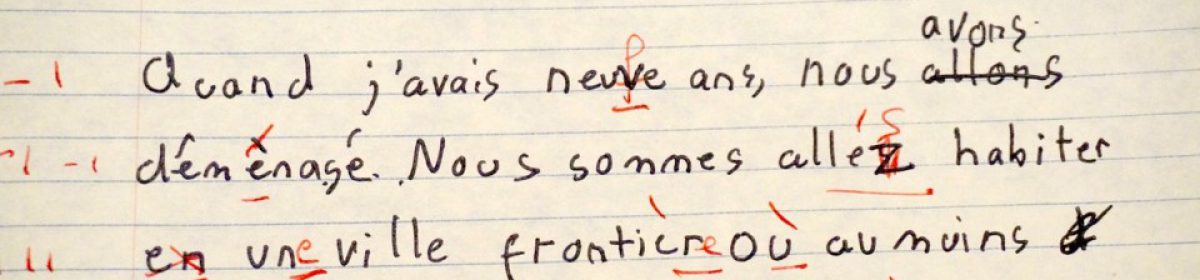







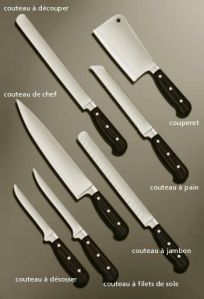 When my kid was about four years old, he went through a period where he switched the orders of certain kinds of words. It wasn’t random–this happened only with a particular kind of word formed by putting two nouns together. For example, he would say:
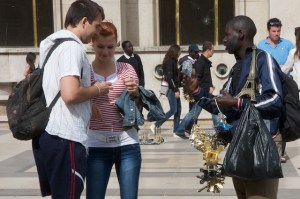



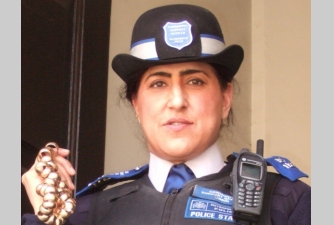
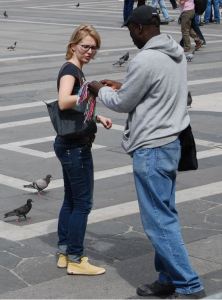
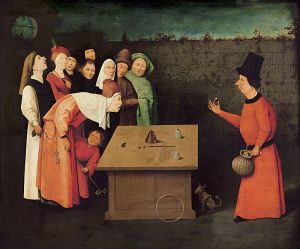
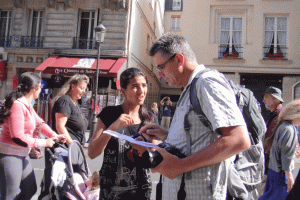
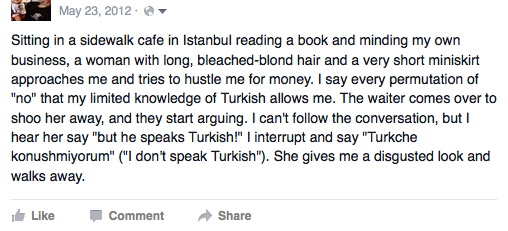



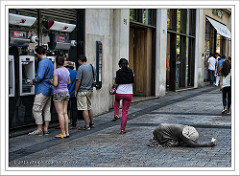










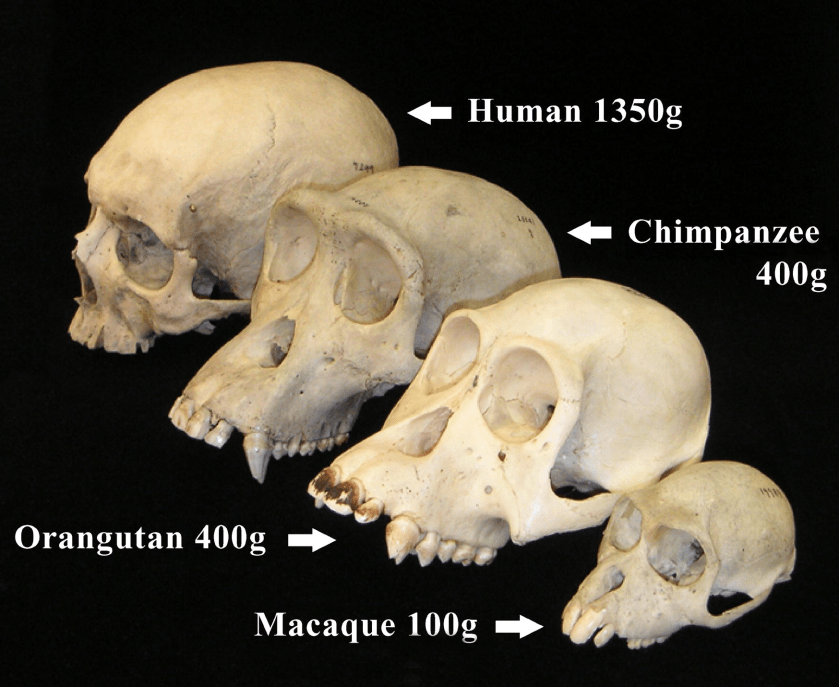
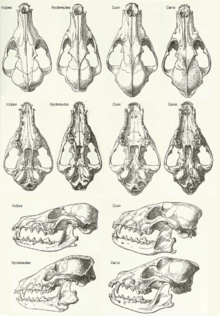



 Zipf's Law