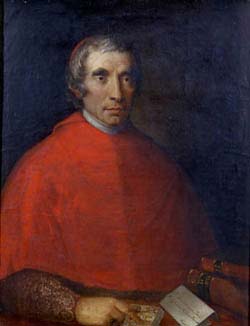
In his book Babel no more: The search for the world’s most extraordinary language learners, Michael Erard talks about Cardinal Giuseppe Mezzofanti. Mezzofanti spoke a lot of languages. It’s not clear exactly how many–certainly that depends on your definition of what it means to “speak” a language–but, nevertheless, it was a ridiculously large number of languages. Something that Erard says about him really struck me: What [we] can’t explain is how he could switch from one language to another without confusing them. Here’s an anecdote from the book:
On one occasion, Pope Gregory XVI (1765-1846), a friend of Mezzofanti, arranged for dozens of international students to surprise him. When the signal was given, the students knelt before Mezzofanti and then rose quickly, talking to him “each in his own tongue, with such an abundance of words and such a volubility of tone, that, in the jargon of dialects, it was almost impossible to hear, much less to understand them.” Mezzofanti didn’t flinch but “took them up singly, and replied to eachin his own language.” The pope declared the cardinal to be victorious. Mezzofanti could not be bested.

Why this struck me: we’ve talked before about the difficulty that many people have with keeping foreign languages “separate.” Before a recent trip to Guatemala, I prepared by basically purging French from my life completely for the month before I went there. I didn’t study French vocabulary, I didn’t listen to the news in French, and I didn’t read in French. Of course, I listened to Spanish podcasts, I read in Spanish (a book about semantics, and The Walking Dead–I’m not picky), and I watched Spanish-language movies. But, pushing French out of my head was as important to the process as packing Spanish into it.
So, when I got to Guatemala, it was interesting to see where I had trouble keeping the two apart. I don’t really know what to make of it. Here are the facts.
For background: I would never claim to speak either French or Spanish. I’m pretty comfortable in Spanish, which serves very nicely with my siblings if we want to have a private conversation in Shanghai, and when I’m in France, I don’t speak English very often–I live my life in French, both personal and professional. I would guess that my vocabulary is a thousand times better in French than in Spanish, and that my grammar is a thousand times better in Spanish than in French. Pronunciation: who knows.
So: as it turns out, I didn’t have trouble keeping the vocabulary apart. What I had trouble with was the little stuff. Here are some specific things that struck me:
Possessives
In French, there are three (simplifying by just talking about the second person informal, since that’s what I use the most in the hospital):
- tes for plural nouns. Sou: tes parents your parents, tes soeurs your sisters.
- ton for masculine nouns and before any noun that begins with a vowel. So: ton chiot, your puppy, because chiot ‘puppy’ is masculine; ton orange, your orange, even though orange ‘orange’ is feminine, because it begins with a vowel.
- ta for feminine nouns that don’t begin with a vowel. So: ta chaussette your sock.
In contrast, Spanish only has two:
- tus for plural nouns. So: tus padres your parents, tus hermanas your sisters.
- tu for singular nouns. So: tu perrito your puppy, tu amigito your little friend.
It’s things like tu amigito that threw me. I just could not wrap my tongue around the sequence tu + vowel. It just…stopped. Eventually I would push it out, while people turned and looked at me like what’s up with the old dude?
The word after
Even after a week incountry, if I did not pay attention, the Spanish word después ‘after’ would not come out of my mouth. Instead, it was the equivalent French word: après. Even if I did pay attention, I really had to struggle to dig up después. I eventually started pausing every time I needed to say after, and thinking to myself: say después, not après.
Excuse me
If I had a nickel for every time that I said pardon or désolé instead of con permiso or disculpe…
The “excuse me” problem doesn’t puzzle me that much–that’s right-brain language. The little function words, though–I’m not sure what to think about that particular phenomenon. It’s a pretty small sample, so maybe I shouldn’t generalize.
The other funny thing about Cardinal Mezzofanti: apparently, he didn’t actually have much of interest to say. As Erard puts it:
Despite this…Mezzofanti was…the target of sarcastic barbs. Irish writer Charles Lever wrote that Mezzofanti “was a most inferior man….An old dictionary would have been to the full as companionable.” Baron Bunsen, a German philologist, said that in all the countless languages which Mezzofanti spoke he “never said anything.” He “has not five ideas,” said a Roman priest quoted in a memoir.”
Speaking as someone who was once married to a woman who coined the term of venery a boring of linguists, I fear that there may be a cautionary note for me here…
French notes
From the French Wikipedia article on Mezzofanti:
Giuseppe Caspar Mezzofanti, né le 17 septembre 1774 à Bologne en Émilie-Romagne et mort le 15 mars 1849, fut un religieux et un universitaire italien du XIXe siècle, qui devint cardinal de l’Église catholique, et était un linguiste et un polyglotte renommé.
- le religieux: clergyman, priest.
- renommé: renowned.
English notes
to throw (someone): 5. Informal To cause confusion or perplexity in; disconcert or nonplus. (From The Free Dictionary.) How it appeared in the post:
It’s things like tu amigito that threw me. I just could not wrap my tongue around the sequence tu + vowel. It just…stopped.













 Zipf's Law