
Every once in a while an innocuous technical term suddenly enters public discourse with a bizarrely negative connotation. I first noticed the phenomenon some years ago, when I saw a Republican politician accusing Hillary Clinton of “parsing.” From the disgust with which he said it, he clearly seemed to feel that parsing was morally equivalent to puppy-drowning. It seemed quite odd to me, since I’d only ever heard the word “parse” used to refer to the computer analysis of sentence structures. The most recent word to suddenly find itself stigmatized by Republicans (yes, it does somehow always seem to be Republican politicians who are involved in this particular kind of linguistic bullshittery) is “encryption.” Apparently encryption is now right up there with dirty bombs in terms of things that terrorists are about to use to kill us all. (“All” might be an exaggeration. I find it interesting that the United States had 33,169 firearm deaths in 2013–roughly 11 times as many deaths as on 9/11–and yet, Republicans seem to think that it’s important that we make firearms as widely available as possible. I guess they just don’t like people very much.) As a moderately technical person, this strikes me as odd, since I’ve always thought of encryption as that nifty mathematical technique (I was about to say “algorithm,” but I think the Republicans are down on that one now, too) that keeps you from intercepting my text messages, me from reading your Ashley Madison profile, and so on.
In between the Republican outrage over parsing and the current panic over encryption, we had the sudden appearance in the public consciousness of data mining. As far as I knew up to that point, data mining was a bunch of statistical techniques for finding relationships between things. Suddenly it was showing up in scary news stories–Google the phrase “data mining is evil” (you have to put the quotes around it to search for the phrase, as opposed to the individual words) and you will get 1,400 hits as of the time of writing (May 2016).
Besides being bemused by this intrusion of American know-nothingness into public discourse, I have a personal stake in the issue, because people often refer to what I do for a living as text data mining. This is a misnomer–by its nature, data mining is not something that you can do with texts. Bear with me and I’ll explain why, and then we’ll look at some French vocabulary for talking about all of this.
Data mining is basically about databases. In a database, the statistical techniques of data mining can help you do things like discover that Republicans with HBO subscriptions are more likely to consider voting for Romney in a primary than Republicans who don’t have HBO subscriptions. (Real one, if I remember the facts correctly.) You can do that because you have a table in the database that tells who’s a Republican, a table that tells who has HBO subscriptions, and a table that tells you which members of a random sample told the interviewer that they would/wouldn’t consider voting for Romney in a primary. Data mining is the science/art of figuring out what things are related (HBO subscription/willingness to vote for Romney) and what things aren’t related (making one up here: having bought an Escalade and being willing/unwilling to vote for Romney in a primary)–this among probably thousands and thousands of variables. Doing data mining research requires things like knowing particular kinds of math, understanding how to sample a population, getting computers to do complicated calculations in a way that is time-efficient—stuff like that.
With data mining, you have that database, and you know what everything is. With “text mining,” or “text data mining,” as some people call it, you have texts, and you don’t know what anything is. (By “you,” I mean a computer program.) This is usually talked about as a difference between “structured” data (i.e., the database)–you know what everything “is”–what it “means”–in some sense, its semantics. Whoops–that sentence got a little out of control. “Unstructured” data: that’s typically how we would describe text. With text, you know what nothing is–you don’t know what anything means–in a very literal sense, you don’t know its semantics.
“Text mining” could be thought of as turning unstructured data into structured data. You’ve got a bunch of texts, and you want to use it to populate a database, perhaps. Maybe you have 23 million journal articles in the National Library of Medicine, and you want to find every statement that those 23 million articles make about which genes are affected by which drugs. Maybe you have a huge collection of French fairy tales, and you want (the computer) to find every time that a stepmother is mentioned and whether the portrayal of the stepmother is positive or negative. You could think of both of those as turning unstructured data into structured data–you’re taking that unstructured data and using it to build a database about drugs and proteins, or a database about stepmothers. You can see now why we tend to prefer the term “text mining” to “text data mining”–to the extent that “data mining” is about structured data, it doesn’t really make sense to talk about “data mining” with respect to language. Where the data mining person basically just needs to know math, the text mining person needs to know something about how people write about whatever it is that you’re interested in. I do a bit of text mining. People will have really specific requests–tell me whether or not the genes from some experiment show up in the cancer literature, say; tell me if this is a suicide note or not; read this doctor’s note and tell me if this kid is a candidate for epilepsy surgery; stuff like that. It’s not really linguistics, but it pays the bills, and it suits my need to do something that might actually make the world a better place.
A related field is natural language processing. Natural language means human language, as opposed to computer languages. Natural language processing is about building tools to handle specific linguistic tasks–parse a sentence, figure out parts of speech, stuff like that. You might use a combination of different language processing programs to do a text mining task. I find this more interesting, since the questions are less about some set of facts than they are about the language itself. Where the data mining person needs to know math and the text mining person needs to know how people write about genes and drugs, or stepmothers, or whatever, the natural language processing person needs to know something about language itself–what kinds of structures sentences can have, how word frequencies are distributed, how to build linguistic resources for letting a computer process things that can’t be directly observed (e.g. semantics). I do a lot of this kind of stuff. Recently I’ve been working on coreference resolution–how to get a computer to recognize that Obama, President Obama, and Barak Obama are all referring to the same thing in the world, while Mrs. Obama and Michelle Obama are referring to something else in the world. (Recognizing that those “things” in the world are people, as opposed to, say, locations, or the names of companies, is a whole different story.)
Yet another field is computational linguistics. This is about using computational models to test theories about language. This is my favorite, but it’s the hardest to pay the bills with. I do some of this, too. Nowadays a lot of my time goes into large-scale attempts to model the semantics of biomedical language. I’m trying to investigate differences in the semantic primitives of biomedical language versus “general” English by building a large set of data-driven semantic representations of predicates found in journal articles; I’ll then compare that resource to a similar resource built for general English and look for things like whether or not the semantic primitives seem to come from the same set, whether or not given verbs have different representations in the two types of language, etc. My hope is to get a sense of the range of types of semantic variability from this particular project. You could imagine using computational linguistics work to build natural language processing tools, and then using those to carry out practical text mining tasks. You could use the text “data” mining results to do actual data mining.
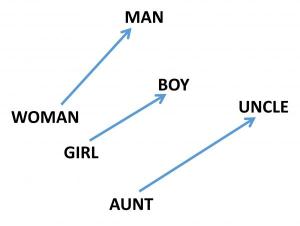
As you can tell from my examples, I’m very much in the world of biomedical language. There’s also a lot that you can do in the humanities with this kind of stuff. A hot topic in the future might be using mathematical representations of semantics to study things that are/are not thought of as binaries–gender, sexuality, race, political economy, whatever. However, I would not claim to do ANY of that–I can just barely explain it. For more on that kind of stuff, see this excellent post by Ben Schmidt.
In practice, even people in the field don’t always differentiate between these terms, or at least don’t draw sharp boundaries between them. My business card says that I’m the director of a text mining group, but I identify most strongly as a computational linguist. We figured that “text mining” makes more sense as a practical field of inquiry to have within a medical school (which is where I work), so that’s what we called the group when we formed it. If you go to the annual conference of the Association for Computational Linguistics, you will see almost no computational linguistics, but rather a ton of natural language processing. If you go to the annual Biomedical Natural Language Processing meeting, you’ll see a mix of text mining, natural language processing, and a bit of computational linguistics. Sometimes the distinctions really matter, though. This post started its life as a response to someone who asked me to be on a panel about data mining, to talk specifically about text data mining. When I responded that I don’t do data mining, they asked what the difference is–this blog post started out as my response.
As far as I can tell, the relevant community in France doesn’t make these distinctions in any kind of rigid fashion, either, despite the much-vaunted French penchant for categorization (see Nadeau and Barlow’s excellent book for a discussion of where it comes from). However, French does have technical vocabulary for all of these fields. Here it is:
- fouiller: to excavate; to rummage through, to search (see also here)
- la fouille de données: data mining
- la fouille de texte(s): text mining
- le traitement automatique des langues naturelles: natural language processing
- la linguistique informatique: computational linguistics






 Zipf's Law


