For the 3rd day of National Poetry Month, here’s a slice of life from Aristide Bruant.

I live in the most boring arrondissement of Paris. The 15th typically doesn’t even show up in tourist guide-books–it’s the biggest arrondissement in the city, but it’s just a residential neighborhood, plain and simple. (Plain and simple is an adverb, not an adjective–see the English notes below.) The pearl of my little corner of the 15th is a small used bookstore on the boulevard Grenelle. The floor is almost completely covered with stacks of books, to the point that if the owner ever has a heart attack in there, they will have to empty the store to get the stretcher inside–it’s adorable, and if the owner sees something that he thinks I’ll like, he puts it aside for me.
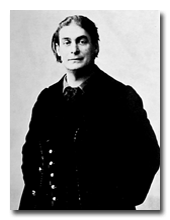
And yet: this being Paris, there are centuries of history everywhere around me. An afternoon’s walk often takes me through the side streets to the west of the École militaire, the military academy that was meant to increase the size of the French officer corps by making it possible for the sons of non-aristocrats to get into it. (Napoleon learned his craft there.) Amongst those streets was the red-light district of this very military neighborhood, and the poet Aristide Bruant immortalized it in À Grenelle.
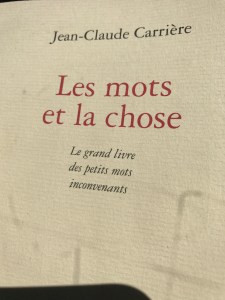
Much of this poem puzzled the shit out of me (see the English notes below for what that means) until the day that I walked into my little bookstore and the owner showed me something that he was saving for me. Called Les mots et la chose, the trame (premise?) of Jean-Claude Carrière’s epistolary novel is that a retired lexicographer gets a letter in the mail from a struggling actress who pays her bills by dubbing pornographic films into French. She’s tired of the limited vocabulary that she’s asked to use, and she requests that the lexicographer suggest some alternatives. (Note the subjunctive: that the lexicographer suggest, not suggests.) The rest of the book is his responses, with separate chapters for penises, breasts, la chose itself, etc.
 Suddenly Bruant’s poem made sense. Faire sentinelle: to stand guard, but also to have an erection. La chapelle: chapel, but also vagina. Other plays on words are more obvious, at least to a veteran (which I am, but Trump isn’t, having been excused from Vietnam due to a sore foot, although apparently said foot did not deter him from being an enthusiastic athlete). Montaient à l’assaut de mes mamelons: the word le mamelon is a nipple or a small hill, and lemme tell ya, assaulting a hill is a highly technical undertaking–higher ground gives the defender a major advantage, and assaulting hills is the kind of thing that you really have to practice. I was also impressed by the technical accuracy of this verse: …des lanciers, // Des dragons et des cuirassiers // Qui me montraient à me tenir en selle… Specifically, the fact that these soldiers who are teaching her “to stay in the saddle” (do French men all share the universally-held American man’s wish to “die in the saddle”?) are all mounted (i.e. on horseback) troops of one sort or another: lanciers and cuirassiers were cavalry troops, and dragons were “mounted infantry,” meaning that they travelled on horseback, but dismounted to fight.
There’s cool stuff in the poem for grammarians, as well–most notably, this line: J’en ai-t-y connu des lanciers… Us anglophones struggle with both y and en, and finding both of the together and with an inversion…well, good luck finding anything that complicated ever again, and if you do, please tell us about it in the comments…

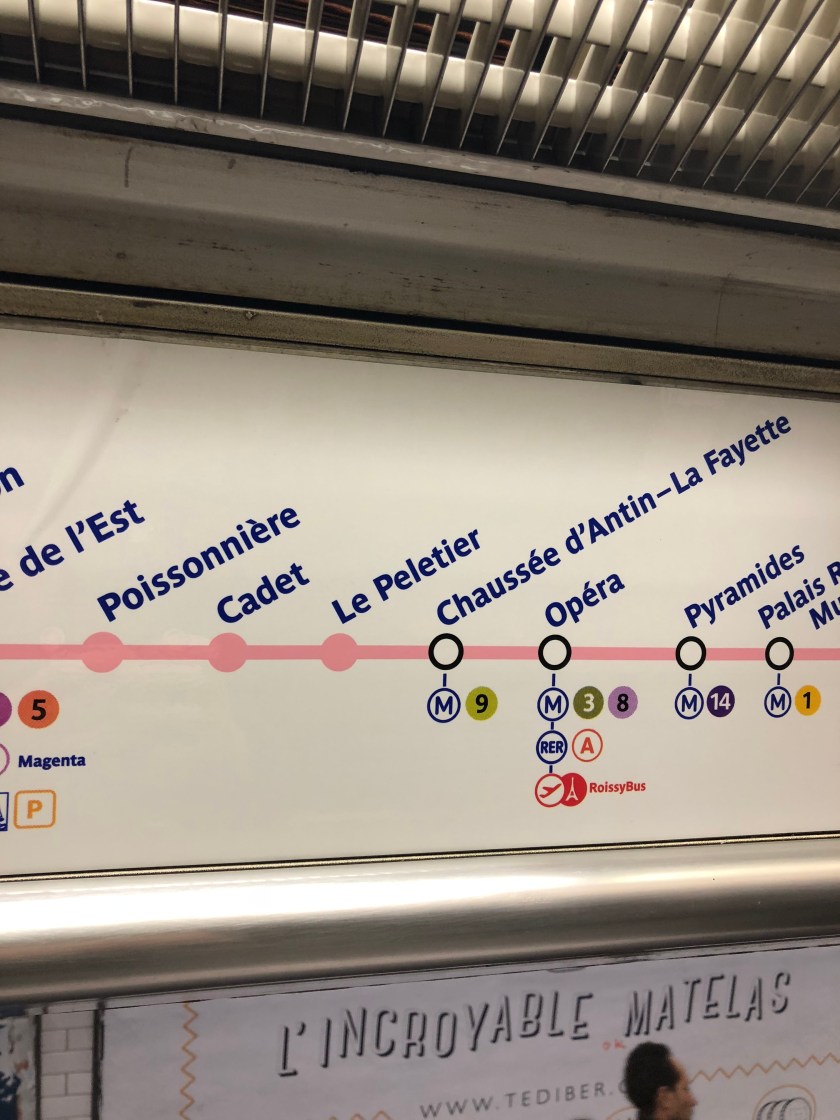
Bruant’s poem was eventually recorded by Yvette Guilbert, and more recently by Patachou. I hum it in my head whenever my train passes by the Chaussée d’Antin metro station, for reasons that will become clear when you get to the last verse.
À Grenelle
Aristide Bruant
Ça me fait penser qu’y a bien longtemps
Moi aussi, je l’ai été, pucelle,
A Grenelle!Mais c’est un quartier plein de soldats,
On en rencontre à tous les pas,
Jour et nuit, ‘font sentinelles,
A Grenelle!J’en ai-t-y connu des lanciers,
Des dragons et des cuirassiers
Qui me montraient à me tenir en selle
A Grenelle!Fantassins, officiers, colons,
Montaient à l’assaut de mes mamelons!
Ils me prenaient pour une citadelle!
A Grenelle!
Moi, je les prenais tous pour amants,
Je commandais tous les régiments,
On m’appelait “Mâme la Colonelle”,
A Grenelle!
Mais ça me rapportait que de l’honneur,
Car si l’amour, ça fait le bonheur,
On fait pas fortune avec elle,
A Grenelle!
Bientôt je m’aperçus que mes beaux yeux
Sonnaient l’extinction des feux,
On se mirait plus dans ma prunelle
A Grenelle!
Mes bras, mes jambes, mes appâts,
Tout ça foutait le camp à grands pas,
J’osais plus faire la petite chapelle
A Grenelle!
Aujourd’hui que j’ai plus de position,
Les régiments me font une pension:
On me laisse manger à la gamelle,
A Grenelle!
Ça prouve que quand on est putain,
Faut s’établir Chaussée d’Antin,
Au lieu de se faire une clientèle
A Grenelle!
Scroll down for the English notes.
English notes
plain and simple: Clearly; without any complexity (Wiktionary). Plain and simple is what linguists call a sentential or sentence-level adverb. It describes the speaker’s attitude towards the assertion being made by the rest of the sentence: in this case, that the assertion is indisputably true. Plain and simple is unusual in that most sentential adverbs come at the beginning of the sentence (Luckily, we didn’t miss the train); in contrast, plain and simple usually comes at the end of the sentence. Some examples from the enTenTen13 corpus at the Sketch Engine web site, purveyor of fine linguistic corpora and the tools for searching them:
- It doesn’t work, plain and simple.
- Those things are just evil, plain and simple.
- A mood disorder is an illness, plain and simple.
- Seriously addressing the long-term fiscal problem means restraining entitlement spending growth, plain and simple.
- That is the reason for the obesity epidemic, plain and simple.
to verb the shit out of: a delightful English adverb (well, maybe American–I don’t actually know much about British English) that intensifies the action of the verb.
- Found : At most gay bars, probably confusing the shit out of everyone.
- When and if it does happen it won’t freak the shit out of you…
- The group is preparing to shock the shit out of tourists.
- If there is one thing ATLA is overflowing with, it’s ladies absolutely walloping the shit out of everyone.
- There’s not a critic in the world who could say anything to me, because I kick the shit out of myself way worse than anybody ever could.
- What happened here was the jury didn’t like the victim, and so the wrong-doer got a walk, and frankly that should scare the shit out of you.
- If you want this to be a legitimate sport, start running it like one and stop embarassing the shit out of everyone who has supported your organization since the get go.
Note that the modified verb is usually one with a negative sense–to confuse, to beat, to shock, to wallop (to hit very hard), to scare, to embarrass. (Yes, it’s spelled wrong in the example above.) But, it doesn’t have to be a negative verb; using it with a positive one is odd, though, and that gives a certain flavor to such uses.
- I plan to enjoy the shit out of it.
- I’d buy the shit out of those tickets.
- Then go find your Peter Brand and hire the shit out of him before someone else does.
- Choir! – but you have, right? – they are everyday people who get together on Tuesdays or Wednesdays to sing the shit out of something, usually a popular song from the last 30 years or so.
- I want to marry the shit out of you and then I want to put a baby inside you as soon as you’ll let me.

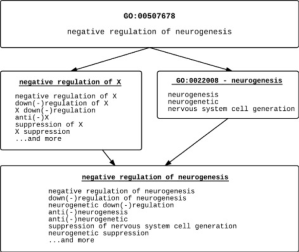 Paraphrase is the phenomenon of different (and typically syntactically different) expressions in language of the same meaning (Ganitkevitch et al. 2013)
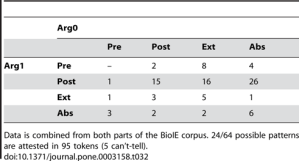 But, do those tremendous numbers of variants really occur? It appears that they do. Cohen et al. (2008) looked at the incidence of alternative syntactic constructions involving common nominalizations (nouns derived from verbs, such as treatment from to treat) in scientific journal articles—for example, drug treatment of cancer and cancer treatment with drugs. Figure 1 shows a typical finding: for some nominalizations, as many as 15 out of 16 possible variants could be found even in a relatively small corpus
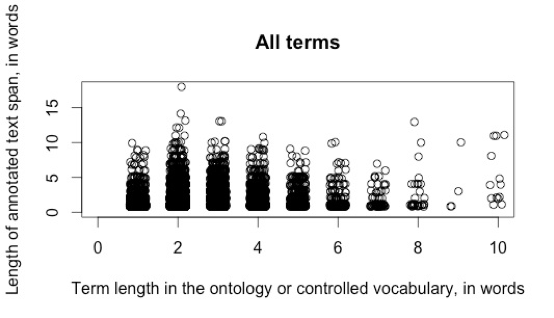
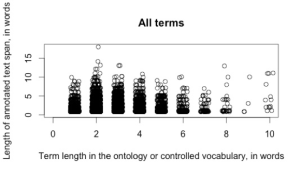 How different can these paraphrases be from each other? Technical terms in biomedical research can be quite long, which means that there can be multiple candidates for paraphrasing and for replacement of synonyms (see above). This means that the number of possible paraphrases of a long term can be explosive. Those paraphrases, even for a short term, can be quite different—for example, Cohen et al. (2017) examined the relationship between the length of terms in the Gene Ontology and the length of appearances of those terms in the CRAFT corpus of biomedical journal articles, and found that 2-word terms could show up with paraphrases as long as 15 words